
It Takes a Village: Routes to Local-Level Extractives Transparency
In many countries, there is a stark contrast between the wealth emerging from an extractive project and the resources held by the people living closest to the site. When the new industry fails to alleviate poverty and disrupts pre-existing livelihoods, the potential for discontent and conflict is high. Extractive companies are also affected as such tensions can delay projects and there is significant risk for profit loss due to conflict. This happens in the midst of power asymmetries where local actors may be excluded from national-level decisions that impact their daily lives. Local stakeholders’ responses to potential benefits and impacts are often hampered by low capacities and different incentives for reporting parties to share information. Different local policies and systems can make it difficult for affected communities to replicate interventions in other areas. Easy access to relevant information can be a key first step for communities striving towards creating better opportunities for local social and economic development.
The question remains as to which types of information to make public—and in which format—in order for the communities closest to extractive sites to use them. This paper is written for national and subnational policy makers and civil society organizations trying to improve transparency and governance of the extractive sector at the local level.
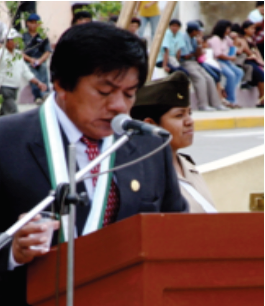 The mayor of Sechura, Peru reads the budget to citizens.
It compiles experiences from many resource-rich countries making efforts towards subnational transparency and provides practical suggestions on what information should be disclosed. Section I explains how subnational needs and challenges are different from those at the national level. Section II explores different mechanisms that are used to improve local transparency. Section III details the different types of information needed at the local level along with examples from different countries on their availability and use.
From Conflict to Collaboration: Lessons Learned From RWI Work at the Subnational Level
RWI pilot projects catalyzed revenue tracking and sound economic management. Projects also developed and institutionalized multi-stakeholder forums for consensus building, citizen participation and government accountability. Key lessons from these projects were the need for thorough assessments and careful planning at the initial stages. It is important to build a shared agenda with local partners and government counterparts, which can require considerable time and resources. Improvements of subnational governance also call for the active engagement of national governments and companies.
National governments can alter the regulatory framework and remove bottlenecks to subnational government action, while company cooperation is essential when seeking technical information needed for planning and revenue estimation. By building national partner capacity and institutionalizing multi-stakeholder forums, selected projects successfully sustained capacity gains and reforms despite government changes and turnover of officials.
Managing Iraq's Petroleum
Managing Iraq's Petroleum In April 2006, Iraq Revenue Watch hosted a workshop on Managing Iraq's Oil Industry which brought together leading petroleum experts, activists, economists and policy makers from across Iraq's regions and political spectrum. Convened during the World Bank's Fifth Middle East and North Africa Development Forum (MDF5) in Beirut, Lebanon, the workshop sought to identify and refine mechanisms for managing Iraq's oil wealth within a federal framework, in the hope of reducing future conflict and opening the way for compromise in other contentious areas.
With competition for Iraq's vast oil wealth continuing to provoke political and sectarian tensions, participants identified transparency and accountability as bulwarks against such abuse and key instruments for avoiding the "resource curse." Topics covered included the need for clarifications and potential changes to the constitution, national strategies for exploration and development, designs for a sound investment regime, and the establishment of unassailable legislation and more efficient institutions.
Extractive Industries Revenues Distribution at the Subnational Level
A new study, Extractive Industries Revenues Distribution at the Sub-National Level, presents a comparative analysis of international legislation regulating distribution of revenues from extractive industries across all levels of government. Prepared by development economics consultant Matteo Morgandi at the request of a working group of the Peruvian National Congress, it encompasses legislative practices in Bolivia, Brazil, Ghana, Indonesia, Mexico, Nigeria and Papua New Guinea.
The assessment stresses the potential and specific challenges associated with the transfer of revenues to lower levels of government through fiscal decentralization. Among these challenges are 'Dutch Disease'—the deindustrialization of an economy due to increased natural resource revenues and a resulting decline in the manufacturing sector; revenue volatility; constraints on local planning and expenditure capacity; the lack of local functional responsibilities proportional to new revenues received; the absence of external controls; and institutional deterioration. Although compensation of resource producing regions with a share of the total revenues is legitimate, empirical evidence from the selected countries shows that the mere transfer of revenue wealth to local governments is not a sufficient remedy to the negative effects of extractive activities on local communities. An explicit strategy to spur economic development and safeguard both institutions and the environment is critical to escaping the resource curse.
|
Download:
|
 Extractive Industries Revenues Distribution at the Subnational Level
The research also finds that countries with high level of resource dependency (e.g., Nigeria, Bolivia, Indonesia and Mexico) are more likely to redistribute extractive revenues to all regions rather than to producers only. Developing a revenue sharing formula that encompasses demographic and economic development parameters is necessary to mitigate inequalities between producing and non-producing regions.
Other mechanisms in the fiscal architecture can also enhance the equity and efficiency of revenue distribution. For instance, the General Grant (DAU) formula in Indonesia automatically allocates more funds to non-producing regions from the general pool of collected taxes.
Nevertheless, even where means of redistribution are in place, the country studies show limited effectiveness in redistributing resources to the poorest regions (such as in Indonesia, Bolivia, and Nigeria), due in some cases to an inadequate formula and in others to the limited amount of funds redistributed. Transparency and consensus building between producers and non-producers are crucial to establishing the legitimacy of any revenue distribution arrangement.
This study was prepared at the request of a congressional working group in Peru in order to review and integrate into a single proposal the numerous partial modifications of the Canon Law presented over the last few years. The Canon Law regulates the way income tax from companies in the extractive sectors (including mining, gas, oil, fisheries, forestry and hydroenergy) is distributed between the central government and the sub-national governments in regions where extractive activity takes place.
The study was presented to both the advisors of the working group and the congressional representatives, as well as to several independent experts.
The working group incorporated the study into its own report to the Congress, along with 12 general recommendations. The report was then approved by Congress, opening the way for debate on concrete proposals for modifying the existing regulations.
READ MORE
Ghana's Golden Opportunity
In 2006, Asutifi, a tiny district in central Ghana, changed forever. The relatively unknown farming community had caught the attention of one of the world’s largest gold producers, Newmont Mining Corporation. The company had discovered the mineral in the tiny district and began exploitation through its subsidiary, Newmont Gold Ghana Ltd (NGGL). Though the revenue Asutifi was to receive from Newmont was little compared to other districts, it made up a significant percentage of Asutifi’s income. Income from gold, however, is volatile and requires financial forecasting, realistic budgeting and participatory management, all of which were major challenges for Asutifi.
Three years later, Revenue Watch Institute (RWI) partnered with two Ghanaian organizations to create the Asutifi subnational project. Executed from 2009 to 2011, the project’s aim was to improve the governance of mining revenues. To achieve this goal, the project would improve local government’s policies and practices for collecting and using finite mining revenues effectively. It also would build civil society’s capacity to participate in, monitor and evaluate the sector’s governance processes. The project’s ultimate goal was to avert the curse of mismanagement often associated with extractive resources in developing countries.
The Asutifi project succeeded in building awareness, enhancing trust among stakeholders, and ensuring meaningful participation from citizens and community-based organizations in preparing the district’s development plan, a process that had been dominated by a few officials. The project also improved collaboration between Newmont’s voluntary corporate social responsibility activities and the priorities of the district assembly and administration.
Despite the project’s developments, its gains were limited, and no institutionalized systems and practices were put in place for effective governance and public accountability. Local politics, which should have been a democratizing factor, constrained public accountability. Traditional chiefs, who receive a substantial share of mining royalties, did not change much and continued to resist public accountability. The community’s demand for transparency remained weak.
The project’s successes and failures reflect the institutional strengths and weaknesses of its partners and indicate a degree of disparity between project intentions and capacities.
Subnational Oil, Gas and Mineral Revenue Management
This paper discusses challenges and approaches in managing resource revenues at the subnational level. Subnational resource-rich governments face distinct challenges in managing revenues from volatile, exhaustible resources. These include: unpredictable and discretionary resource revenue transfers between national and subnational governments, which can undermine development planning; resource revenue volatility which can lead to wasteful spending, poor quality investments; over the longer term, the finite nature of oil, gas and mineral revenues can lead to a long period of economic growth followed by a depression; and difficulty in scaling up public investment efficiently when experiencing a revenue windfall.
To address revenue volatility, subnational governments can “smooth” expenditures by delinking revenues from expenditures. When revenues are unexpectedly high, governments can run a surplus, to be saved or used to pay down public debt. When revenues are unexpectedly low, they can draw on those savings or borrow. To prevent long-term booms and busts, governments can also save a portion of resource revenues for future generations, as well as invest in the local economy to generate future growth. Fiscal rules can underpin these policies, constraining government spending decisions and compelling government bodies to adopt a long-term perspective on public finances.
Development planning can help prepare resource-rich regions for life after their oil, gas or minerals have been depleted. Planning helps prevent shortsighted reactions to temporary ebbs and flows in oil or mineral revenues, helps define the role of the resource sector in development, and lays the groundwork for a thriving post-extractive economy.
Assessing Mineral Licensing in a Decentralized Context: The Case of Indonesia
Selected aspects of natural resource management have been transferred (or decentralized) to subnational governments in at least 60 countries. Decentralized authority can include power to decide local land uses or to collect and manage fees and taxes from the extraction of oil, gas, and minerals. While in most countries licensing is still vested with national authorities, a small number of countries have transferred mineral licensing powers to subnational governments. These governments can assign, manage, and terminate the right to search for and extract minerals from the ground. Some of the developed countries with a decentralized mineral licensing system are Australia, Canada, and the United States. Developing countries with decentralized mineral licensing include Argentina, China, India, Indonesia, and the Philippines.
The decentralization of mineral licensing is driven by the wish to improve development outcomes by letting the people directly affected by extractive projects make decisions about the exploration and development of mineral deposits. However, the decentralization process can raise unforeseen political, fiscal, and administrative challenges.
This paper reviews primarily the case of Indonesia, where the proliferation of district-licensed mining permits has catalyzed a host of natural resource governance problems: a weak investment climate, pollution, increased rates of corruption and illegal mining, and inadequate revenue collection systems. While many countries with central government licensing face similar problems, a decentralized licensing system can exacerbate them. If not well conceived or designed, a decentralized system can suffer from poor information sharing and coordination among different levels of government. Also, implementation and enforcement of licensing rules may be severely undermined by weak capacities of subnational governments or a lack of mechanisms that keep governments accountable to citizens.
This paper reviews the attributes of a mineral licensing system, as well as the pros and cons of decentralizing licensing as found in the case of Indonesia. Mineral licensing was decentralized in Indonesia in 2001. NRGI initiated field research in 2012 in two districts (Bangka and Kukar). Field research is ongoing; this paper discusses preliminary findings and proposes some reforms.
Considerations for Indonesia's New Government
As a new government assumes power, Indonesia faces a historic opportunity to enhance the country’s management of its oil and mining industries; these enhancements could include more sustainable economic outcomes to benefit all Indonesians, reduction of risks of corruption, and an increase public trust. This series of briefings offers key considerations for the government as it forms its agenda for management of natural resources and begins to tackle the country’s pressing challenges.
Summaries of the briefings:
Transparency and Accountability in the Oil and Mining Industries
This briefing focuses on steps that the government can take to bolster existing efforts to promote transparency and greater government-citizen dialogue around natural resources. It includes a discussion of:
- Mechanisms to increase the transparency of licensing processes, especially in the mining sector
- The benefits that Indonesians could gain from public disclosure of petroleum and mining contracts
- The elements of the new, stricter EITI Standard that Indonesia will have to implement beginning in 2015, and the benefits that rigorous implementation can confer on Indonesia
- The importance of closer communication and coordination between national and subnational governments around extractive-sector management.
Structuring Petroleum-Sector Institutions
Indonesia is revising its oil and gas legislation, which necessitates a thoughtful approach to restructuring petroleum-sector institutions, particularly in the wake of a 2012 Constitutional Court decision which invalidated the role played by regulatory agency BP Migas. A new system that ensures rigorous and consistent enforcement of the rules and includes strong performance incentives for Pertamina and other public agencies will be essential. To this end, our second brief builds on Gadjah Mada University’s expertise on oil-sector institutions in Indonesia and NRGI’s global research on oil-sector administrative structure and national oil company management, to share:
- Pros and cons of various institutional models under consideration by Indonesian officials
- An assessment of the implications of different possible rules for enabling Pertamina to participate in (and lead) the operating groups that manage oil projects
- Lessons learned from international experience around various accountability mechanisms—including audits, advisory committees and rigorous reporting requirements—and the performance of national oil companies and regulatory bodies
A Dozen Perspectives on Resource Governance: Voices From the NRGI-Blavatnik School Executive Course

The course brought together public and private sector leaders from 21 countries to delve into a range of complex issues in resource governance. Some of the participants sat down with NRGI communications team members to share unique perspectives on the challenges and opportunities in resource governance in their respective countries:
Marcelo Alvarez on Challenges Facing the Mining Industry in Latin America
Alaka Lugonzo on Regulatory and Policy Gaps in Kenya's Extractives Sector
Alaka Lugonzo on Fostering Dialogue Between Investors, Communities and Government in Kenya
Andrew Mercer on Planning for the Energy Transition in Ghana
Timothy Musa Kabba on Legal Reforms in Sierra Leone's Mining Sector
Timothy Musa Kabba on Building Infrastructure & Including Communities in Post-Conflict Sierra Leone
Carole Nakhle on the Role of Oil and Gas in the Energy Transition
Hamida Nuhu on Challenges Facing the Oil, Gas and Mining Sectors in Ghana
Jemima Nunoo on the Future of Ghana's Oil Amid the Energy Transition
Mohamed Hassadi on Three Key Concepts in Resource Governance
Batnairamdal Otgonshar on License Allocation in Mongolia's Mining Sector
Batnairamdal Otgonshar on Designing Sovereign Wealth Funds for Mongolia's Mining Sector
Khadija Sulaiman Bello on Nigeria's Gas-to-Power Projects
Zouheir Touiti on Building Trust Between Investors, the State and Communities in Tunisia
Interested in the NRGI and Blavatnik School of Government executive resource governance course?
Uganda’s Local Governments Need Clarity on Oil Revenue Sharing

Driving from Hoima to the breathtaking banks of Lake Albert, where Uganda’s long-awaited 1.4 billion barrel oil project is located, it is clear that the government has been preparing for production for years. New roads and bridges criss-cross the region. However, one area in which the government is unprepared is the sharing of oil royalties with the region’s districts.
Section 75 of the Public Financial Management Act 2015 (PFMA) provides for the sharing of royalty revenues with local governments, and cultural or traditional institutions named in the government gazette. But the law is vague about the precise sharing mechanism. The challenges that this is causing for districts in the oil-rich region were apparent in a workshop that NRGI held with civil society organizations there earlier this month: scarcity of details has frustrated local officials’ planning and their management of public expectations. With production likely to start in just three years, the national government is running out of time to address these challenges.
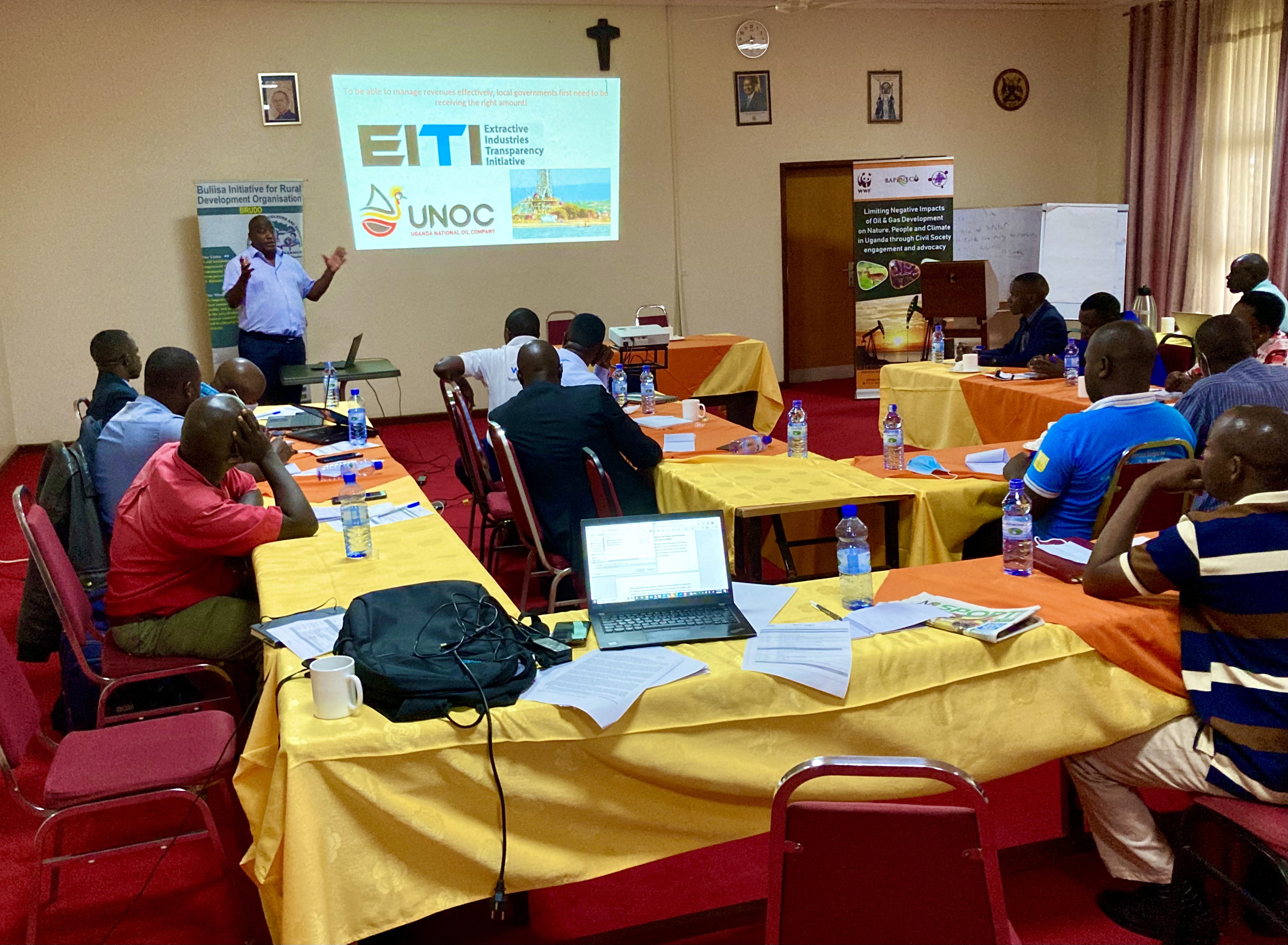
Providing clarity to subnational authorities is all the more important given the uncertainty that the energy transition has created around estimates of the total royalties that the Ugandan government will receive. Local governments and cultural and traditional institutions don’t have a sense of how much funding they can anticipate. The speed of the world’s shift away from oil will impact the price that the Lake Albert oil commands, as well as the potential for subsequent oil projects in the country.
To bring some of that much needed clarity, we developed a simple model which helps subnational entities assess how much revenue they might receive. The chart below shows the possible local government share from the Lake Albert project in three global demand scenarios, based on our modeling. The Announced Pledges Scenario (APS) from the International Energy Agency (IEA) assumes that countries implement the climate commitments that they have made to date. The reference scenario of the Organization of the Petroleum Exporting Countries (OPEC) envisages a slower transition, while the IEA’s Net Zero (NZE) scenario assumes that the world manages to achieve net zero emissions by 2050 and therefore sets out a much faster transition. (All of these scenarios have been updated by Rystad Energy to reflect developments since they were generated and converted to implied prices.)
Local government share of royalty across possible price scenarios
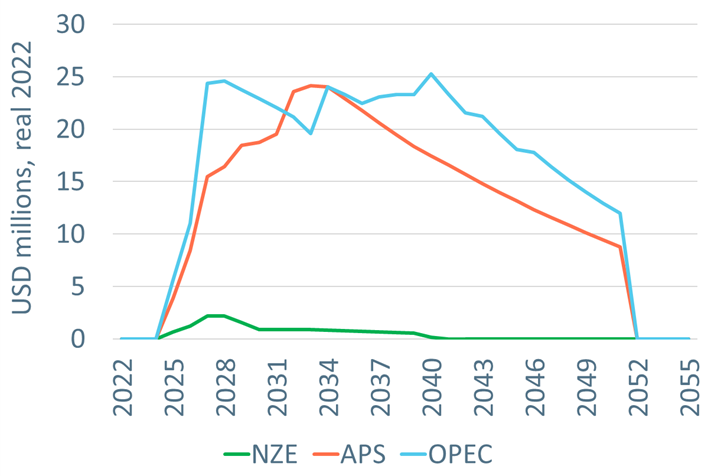
Local government revenues differ significantly between these three scenarios. In the OPEC scenario, Uganda’s local governments could receive around $20 million a year on average. As our model shows, this amount is more than double the revenues that districts in the region were expected to raise through normal, non-oil means in 2021/22 (using the initial list of districts that would receive a share). In the NZE scenario, the local government share of oil revenues would be much less, possibly around $0.6 million. Though even this smaller amount could be significant for some individual districts if managed carefully.
How revenues will be shared between individual subnational entities is currently unclear, however. As our model highlights, the gaps in detail about the sharing mechanism make this assessment impossible.
Uganda’s Ministry of Energy and Mineral Development and Ministry of Finance, Planning and Economic Development can clarify the situation by answering four key questions:
Which districts and cultural or traditional institutions will receive a royalty share?
The law states that six percent of total royalty revenues will be shared among the local governments “located within the petroleum exploration and production areas.” How these areas will be defined is unclear. An early version of the public financial management bill specifying districts that will receive a share (including some districts which are not home to any granted petroleum licenses) has confused this issue further. This list was retracted in 2015, but another list is yet to be published by the Ministry of Energy and Mineral Development. One percentage point of the royalty due to the central government will also be shared with “gazetted cultural or traditional institutions.” However, which institutions will be gazetted is similarly unclear.
What criteria will be used to create the sharing formula, and how are they defined and weighted?
Fifty percent of the local government share will be divided among local governments involved in production based on their production level or “impact,” according to section 75 of the PFMA. The other 50 percent will be shared among all local governments based on “population size, geographical area and terrain.” However, the formulas in the law’s schedule 6 only include production level and population size. Clarity is therefore needed from the government on whether the criteria in section 75 or the criteria in schedule 6 will be used, how each criterion is defined and, if the formulas are to contain more than one criterion, how the different criteria will be weighted. For example, the first fifty percent will likely be divided between five districts if production level is the only criterion, but it could be divided between a lot more districts if impact is also included depending on how it is defined. For example, if all the districts through which the East Africa Crude Oil Pipeline runs are seen as impacted.
What share will cultural or traditional institutions receive?
The amount that “one percentage point of the royalty due to the central government” entails isn’t clearly defined. For example, if the total royalty revenue is USD 100 million in a given year, the central government will initially receive $94 million (with the remaining $6 million being shared among local governments). Whether cultural or traditional institutions will receive $1 million (representing 1 percent of total royalty revenue) or $0.94 million (representing 1 percent of the royalty revenue received by central government) is not clear.
What are the rules governing how subnational entities manage revenues?
The PFMA earmarks local governments’ royalty revenues for “development purposes.” However, there is a risk that local governments could apply a broad definition to development purposes and, as a result, won’t spend petroleum revenues as intended. There is no instruction in the PFMA for how cultural and traditional institutions should spend their share of royalty revenues nor for what happens to royalty revenues that are unspent by recipient entities. Section 17 prevents local governments from retaining a budget allocation after the end of a given financial year. However, providing access to leftover oil funds in subsequent years will be important so that local governments don’t spend money ineffectively to avoid losing it. This will also prevent them from smoothing spending as royalty revenues fluctuate with production and prices.
The challenge of establishing an extractives revenue sharing mechanism that benefits communities is not unique to Uganda. NRGI’s work in countries such as Indonesia highlights the difficulty in ensuring revenues are shared based on a clear and predictable formula that is broadly seen as fair. Such complexities have led to delayed implementation in several countries, such as Guinea, reinforcing the need for the Ugandan government to start focusing on this issue now.
And establishing the mechanism is only the first step. As the past experience of Peru highlights, even if Uganda strengthens its rules for managing subnational revenues, increasing the capacity of local governments to address the unique challenges of resource revenues will be critical. Similarly, Colombia provides lessons on the importance of developing transparent processes for both the distribution and use of funds.
Uganda therefore has significant work to do to ensure that revenue-sharing will benefit communities in the oil-producing region. But until the central government addresses the four gaps outlined above and provides clarity on the revenue sharing mechanism, local governments and communities will be making plans based on guesswork.