Subnational Governance of Extractives: Fostering National Prosperity by Addressing Local Challenges
Since 2008, NRGI has conducted research and implemented interventions to better understand and respond to local impacts of the exploitation of oil, gas and minerals. These efforts have been aimed at distilling practical governance solutions to maximize the benefits from the use of non-renewable natural resources while mitigating the negative impacts for the people living closest to extraction sites. NRGI’s interventions engaged local actors—such as local governments and councils, civil society organizations and media—and national policy makers. Learning from these projects, as well as subsequent projects and research undertaken by others, NRGI produced seven policy papers that touch on a range subnational extractive governance issues, from whether there is a subnational “resource curse” to optimizing natural resource revenue sharing regimes. (See below for a list and links to all the papers.)
This paper summarizes what NRGI has learned from eight years of work and should serve as a high-level summary for national and local policy makers seeking to make the most of natural resources. Foundationally, the paper argues that a national perspective on natural resource management is necessary, but not sufficient to ensure long-term sustainable development for all in a resource-rich country. Using the framework of the Natural Resource Charter, the paper then offers a subnational perspective on the natural resource decision chain. For each element of the decision chain, the paper articulates whether and how governance challenges differ on the subnational level from the national level. It then provides policy recommendations for national and subnational governments to address the specific challenges that emerge at the subnational level of governance. Finally, it offers observations on areas where additional research is necessary to advance the impact of engagement at the subnational level.
This synthesis paper was informed by the following series:
- Is There Evidence for a Subnational Resource Curse?
- It Takes a Village: Routes to Local-Level Extractives Transparency
- Assessing Mineral Licensing in a Decentralized Context: The Case of Indonesia
- Local Content Initiatives: Enhancing the Subnational Benefits of the Oil, Gas and Mining Sectors
- Natural Resource Revenue Sharing
- Subnational Oil, Gas and Mineral Revenue Management
- Direct Social Expenditures: A Monitoring Guide for Civil Society Organizations
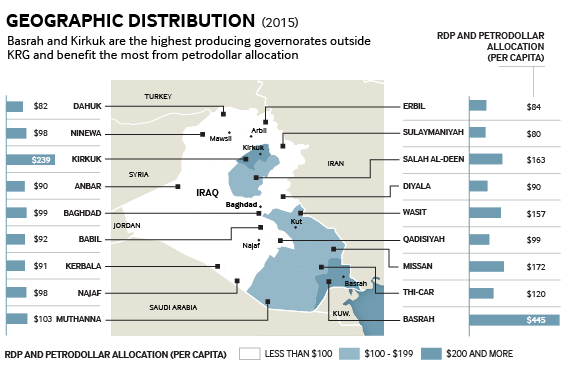
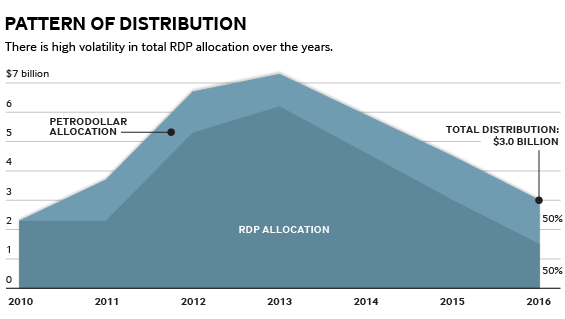
Revenue Sharing Case Study: Oil and Gas Revenue Sharing in Iraq
This study provides an overview of Iraq’s oil and gas revenue sharing, that is, the revenue that the Iraq national government earns from extraction and then redistributes to subnational—provincial and regional—governments.
The case study outlines the country’s attempts at fiscal decentralization and provides an overview of how resource revenues are collected and then shared with subnational governments. The study also provides information on any statutory earmarks on the revenue, and the level of transparency surrounding the revenue sharing system.
The case study and the related infographic are primarily intended to inform policy debates on revenue sharing in Iraq and other countries, as well as to assist researchers interested in further exploring key issues related to this topic. It forms part of a broader set of country case studies on revenue sharing.
Is There Evidence for a Subnational Resource Curse?
This paper examines the evidence of a subnational resource curse. Natural resource extraction can have positive effects, generating profits, tax revenue for government, and economic linkages to other sectors. In contrast, extraction can also have negative economic, environmental and social consequences, including changes in local relative prices that might crowd out other productive activities; deforestation; pollution and degradation; and the potential for social dislocation and displacement.
This paper evaluates the evidence for how these effects accrue to the subnational economy and whether government policy can lead to positive development impacts while balancing the challenge of costs borne locally.
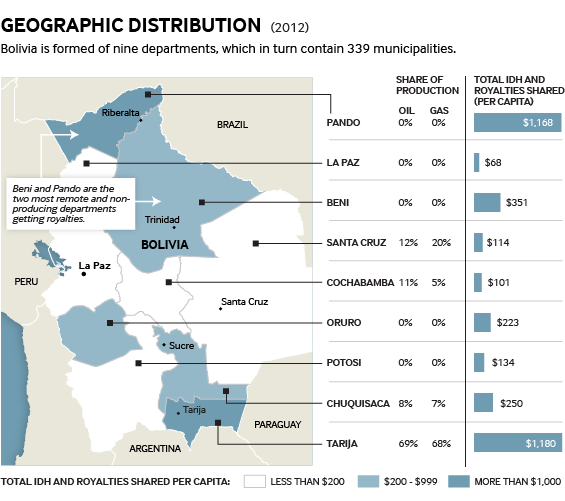
Revenue Sharing Case Study: Oil and Gas Revenue Sharing in Bolivia
This study provides an overview of natural resource-related intergovernmental transfers in Bolivia—that is, the revenue that the Bolivian national government earns from extraction and then redistributes to subnational authorities.
While the primary focus is on transfers of revenue from oil and gas, the study also provides some information on transfers from mining and forestry, as well as the revenue from the general tax regime, which is known in Bolivia as “fiscal co-participation.” This study outlines fiscal decentralization and the evolution of revenue sharing, and provides an overview of how resource revenues are collected and then shared with subnational authorities within the country’s wider intergovernmental transfer system.
The case study and related infographic provide information on any statutory earmarks of revenue, the level of transparency surrounding the revenue sharing system and the effectiveness of the system when this can be determined. This paper is primarily intended to inform policy debates on revenue sharing in Bolivia and other countries as well as researchers interested in further exploring key issues related to this topic. It forms part of a broader set of case studies on revenue sharing.
Revenue Sharing Case Study: Mineral Revenue Sharing in Peru
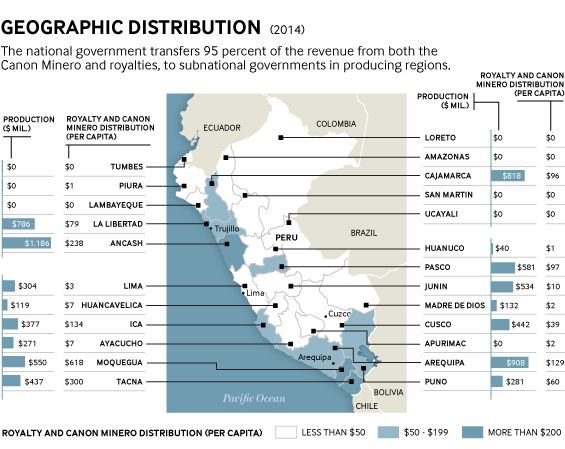
In 2013, Peru was the world’s second-largest producer of copper and silver, and the sixth-largest producer of gold. The country also holds significant reserves of coal, iron ore, tin, sulphur and zinc. In 2014, the contribution of the mining sector to Peru’s GDP was 12 percent and minerals made up 52 percent of total exports.
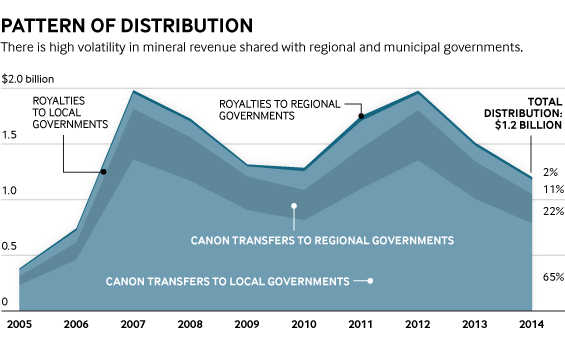
This case study and related infographic provide an overview of natural resource-related intergovernmental transfers in Peru—that is, the revenue that the Peruvian national government earns from extraction and then redistributes to subnational governments.
The case study outlines fiscal decentralization and the evolution of revenue sharing, and provides an overview of how resource revenues are collected and then shared with subnational governments, within the wider intergovernmental transfer system in Peru. Where there is sufficient information, the study highlights the statutory earmarks of revenue and the level of transparency and effectiveness of the revenue sharing system. It is primarily intended to inform policy debates on revenue sharing in Peru and other countries. It may also be of interest to researchers further exploring key issues related to this topic. It forms part of a broader set of case studies on revenue sharing.
Local Content Initiatives: Enhancing the Subnational Benefits of the Oil, Gas and Mining Sectors
Resource-rich regions usually expect and strive for local economies to benefit from oil, gas and mineral projects. Unfortunately, that is not always the case. These regions do not always know how to take advantage of extractive activities to create sustainable economic development, be it creating jobs and developing local businesses or building skills and improving technologies. Local content is the processes of building such economic capital at the national and subnational level, and meeting set public policy objectives.
This paper offers guidance on designing and implementing local content initiatives in the oil, gas and mining sectors to ensure economic sustainability within producing regions. It aims to answer the question of how national and subnational governments, industry and civil society can maximize local benefits through partnerships among governments, companies and civil society organizations (CSOs). Governments should set clear targets based on which companies should make commitments and publish transparent reports on results. CSOs can then analyze the results and monitor progress of local content initiatives.
Thinking Locally: Community Consultation in the Philippines
This is one in a series of case studies that illustrates the principles of the Natural Resource Charter.
Local governments in the Philippines can influence the decision on whether mining operations proceed in their jurisdictions. Several local governments have denied their consent to mining operators or imposed moratoriums. Environmental gains have been made as a result, but there have also been significant investment losses for the national government. This case study considers the trade-offs associated with granting local authority on mining and explains the challenges that ultimately led to reduced benefits at the local level.
Primer: Subnational Revenue Management
Resource management requires maximizing the costs for affected communities, while enhancing the benefits.
KEY MESSAGES
- Subnational governments share many of the same challenges of managing natural resource wealth as national governments, with the added challenges of decentralization constraints, high potential for conflict, migration, and environmental and social impacts.
- Subnational governments can address volatility by using fiscal rules to limit distributions to the annual budget and instead distribute revenues to funds or managing debt.
- Medium-term development planning is a key tool for subnational governments to take advantage of the limited nature of natural resource revenues and the direct expenditures from companies.
- In order for subnational governments to manage their natural resource revenues optimally, they must have access to information from the national government and companies about revenue payments, sharing formulas and production projections.
Primer: Subnational Revenue Distribution
The central government should link revenue distribution to the expenditure responsibilities of local governments, and be proactive in building the capacity of local governments to manage these responsibilities.
KEY MESSAGES
- National governments often share the responsibilities of governing with local governments through a process of decentralization, including on natural resource governance.
- In many resource-rich decentralized countries, local governments receive resource revenues through either direct payments from companies or resource revenue transfers from national government.
- Deciding whether subnational governments should receive resource revenues is often a complicated policy debate involving competing objectives, including promoting national cohesion, interregional equity, effective national fiscal management, and optimizing resource exploitation over time and space.
- Timely, accessible revenue sharing is necessary for subnational governments to fulfill their functions.
Improving Impacts of Extractive Resource Wealth Through Subnational Multi-Stakeholder Groups in the Philippines
Equipping local governments and communities with governance tools to manage subnational resource wealth is an increasingly important response in efforts to transform natural resources into long term development. This is a study of the successful use of one such tool, multi-stakeholder groups (MSGs), in the contentious Filipino mining sector.