
Rethinking Resource Nationalism: Cash Grab or Fair Share? (Mining Indaba)
Westin Stage 1, Cape Town International Conference Centre
Is the increase of exports bans of unprocessed minerals a sign of a wider trend across Africa? How have mining companies reacted to this continental shift? Does the uncertainty of access affect investment? What effect has the move towards greater beneficiation requirements had on existing and future mining projects? How can increased nationalism around mineral assets affect producers, specifically when considering beneficiation, ownership ambitions and greater employment?
This session will feature:
- Claude Baissac, CEO, Eunomix
- Warren Beech, CEO, Beech Veltman Incorporated
- Benedito Paulo Manuel, Director General, Sociede Mineira de Catoca LDA
- Silas Olan'g, Africa Energy Transition Advisor, NRGI (moderator)
- Jeff Quartermaine, CEO, Perseus Mining
- Hulme Scholes, Director, Malan Scholes
Featuring NRGI's
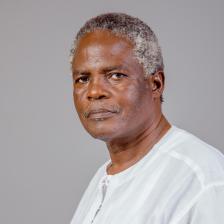
Silas Olan'g
Africa Energy Transition Advisor
The DRC-Zambia Battery Plant: Key Considerations for Governments in 2024

- The partnership between the Democratic Republic of the Congo and Zambia to develop battery precursors is central to Africa’s ambitions to add more value to its minerals. However, public information about the project is limited.
- Based on available information, the location of the precursor plant remains a source of disagreement. Regional bodies have a key role in developing mechanisms to ensure an equitable share of benefits irrespective of which country hosts the plant.
- The Congolese and Zambian governments should consider the challenges in attempting to source the required minerals from the two countries alone, and explore wider regional coordination to meet the need for nickel and manganese.
- The role of other global actors, such as the U.S., EU and China, remains unclear, but how the DRC and Zambia navigate the geopolitical complexities will be critical for the project’s success.
- Greater transparency and stakeholder consultation will help the governments make the difficult decisions necessary for the project to go ahead and increase the likelihood of it benefiting the Congolese and Zambian peoples.
African countries are gearing up to play a pivotal role in the production of clean energy technologies for the global energy transition, and not just as suppliers of raw minerals. They seek to maximize their role in regional and global value chains by adding value to the resources extracted from their soil.
One key initiative is the partnership between the Democratic Republic of the Congo (DRC) and Zambia to produce nickel, manganese and cobalt (NMC) battery precursors. A precursor is an intermediate input to a complete battery, which the two countries aim to ultimately also produce. However, without a large regional market for the electric vehicles that use these batteries, production of complete batteries will be challenging. For now, the focus is on producing and exporting precursors that foreign battery manufacturers will use.
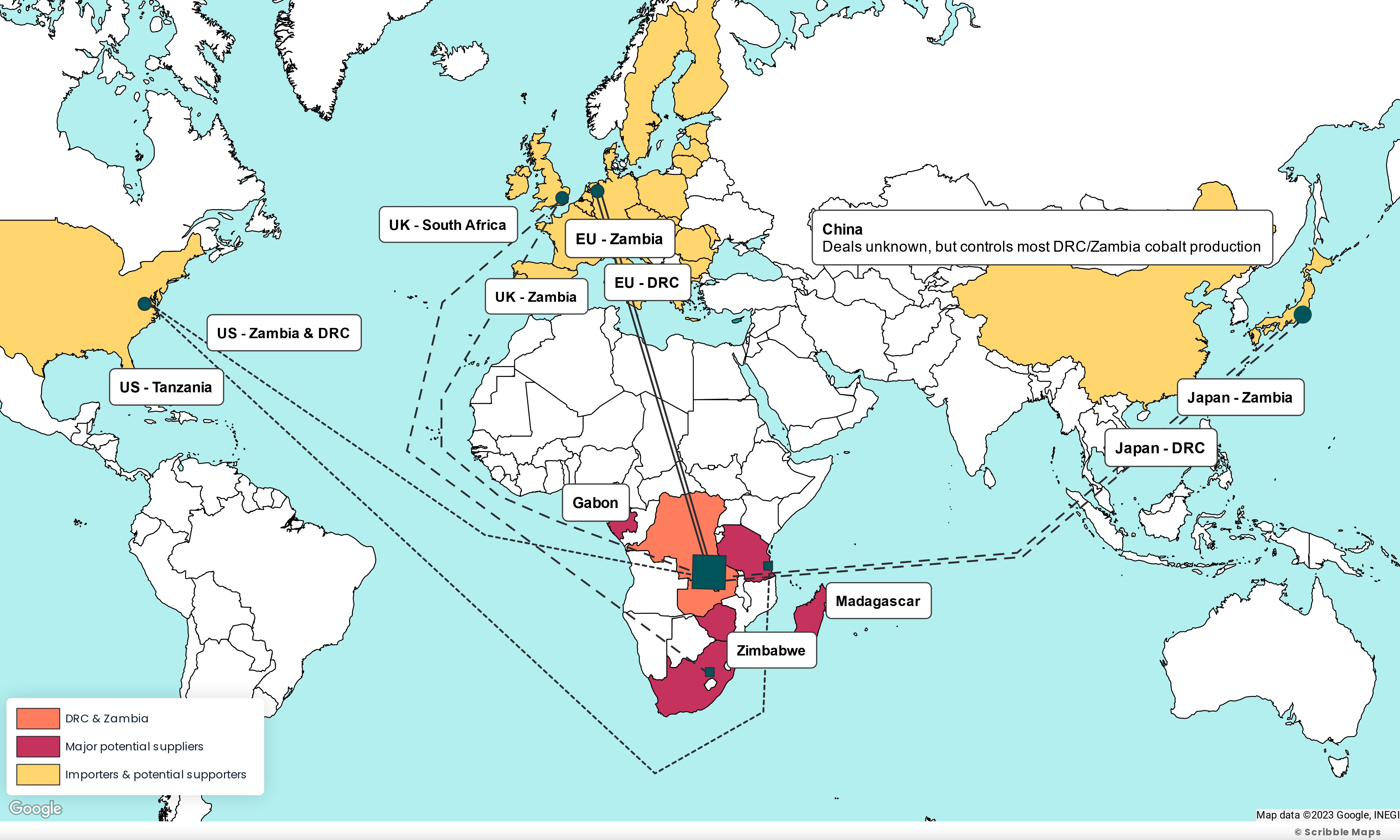
Planning for the precursor plant got properly underway in 2023, though details have been scarce. The status of a long-awaited pre-feasibility study is uncertain. There are conflicting statements about whether it has been completed and if it will be made public. The two countries have not disclosed their cooperation agreement or subsequent framework agreement. Various memoranda of understanding (MOUs) between these two countries and the United States and European Union are in the public domain, but further details remain behind closed doors, at least until roadmaps (action plans referenced in the EU MOUs) are developed next year. Little is known about other agreements that could impact the mineral sector and therefore the project—such as those between the DRC and Japan; Zambia and Japan; and Zambia and the United Kingdom. China’s dominance of cobalt production in the DRC and Zambia, including through state-owned companies, means it could have a significant influence on the precursor plant, but its role is uncertain.
Congolese and Zambian civil society actors are concerned about the lack of information and limited stakeholder consultation. In November 2023 they established the Pamoja Critical Minerals Forum to monitor and engage the governments on these plans and ensure that the plans reflect community voices.
Based on available information, we see four issues around the precursor initiative that the two governments should consider in 2024:
- Precursor plant location
- Mineral sourcing
- Role of international deals
- Transparency and multistakeholder engagement
Precursor plant location
Stakeholders suggest that this remains a point of disagreement between the DRC and Zambia. The governments initially agreed to construct the precursor plant in a cross-border special economic zone, but it seems that this shared site may be ultimately deemed unviable. The plant will therefore likely sit in one country or the other, and both countries aim to be the host. They have provisionally respectively earmarked the special economic zones of Kinsevere in DRC and Sub-Sahara Gemstone Exchange Industrial Park in Zambia.
Starting the project will be challenging regardless of its location. The independent prefeasibility study will likely recommend a location for the plant to maximize its economic viability and minimize environmental and social harms. To bolster the project’s prospects, the governments should accept the study’s recommendation in the absence of any major concerns. While it will not be easy for either country to agree to having the plant in the other, they can explore mechanisms to ensure an equitable share of benefits with the help of the regional bodies already active in the project such as the African Union’s African Minerals Development Centre, the African Development Bank, the UN Economic Commission for Africa and Afreximbank. For example, the country that does not host the plant could get a share of government revenues that the plant generates and have certain opportunities reserved for its workers, goods and services. This is a critical test for regional coordination: the proof of concept that the African Green Minerals Strategy calls for to catalyze other and wider coordination efforts.
Mineral sourcing
Stakeholders suggest that the governments aim to source all the required nickel, manganese and cobalt only from the two countries. The capacity of the plant and specific precursor design (including the ratio of nickel, manganese and cobalt) that the governments target will partly determine the feasibility of this approach. These parameters will be clearer after completion of the prefeasibility study. The plant that was initially envisaged would be large by global standards, producing around 100,000 tonnes (t) of NMC (622) precursors (one of the most common types currently demanded) a year. This would require around 48,000 t of nickel, 15,000 t of manganese and 16,000 t of cobalt that has been refined into sulfate.
The DRC and Zambia will find it challenging to source a sufficient amount of ores of the three metals and refine them into sulfates without involving other countries in the region. Neither the DRC nor Zambia currently refines any cobalt production into sulfate, but prospects are promising. Plans for a cobalt sulfate plant are advancing in Zambia, and World Bank analysis suggests a plant could also be viable in the DRC.
Production of nickel and manganese sulfate is less certain, however. Zambia produced around 4,000 t of nickel in 2022. First Quantum’s large nickel mine, Enterprise, started production in Zambia this year, which will add a massive 30,000 t a year on average. Nevertheless, this volume may still be insufficient for Zambia to meet the precursor plant’s needs on its own even if refining facilities were constructed and all production was supplied to the plant. Nickel exploration in the DRC is underway. Given only 19 percent of the country has been properly explored, this exploration may yield discoveries. However, with nickel mines taking an average 17.5 years from discovery to production, supplying the precursor plant is a far-off prospect.
Time is also a factor for manganese. Manganese is mined in the DRC and Zambia, currently by artisanal and small-scale operators. Formalizing these operations, including to reassure potential buyers of the precursors that the supply chain meets high ESG standards, and going on to build refining capabilities will be challenging.
The two countries could potentially meet these challenges over time, but there is no time to waste. The rapid evolution of battery technologies and global scramble for minerals mean that the longer this project takes to come to fruition, the harder it will be to attract investors and secure minerals for the precursor plant from the DRC, Zambia or elsewhere that haven’t already been tied up in long-term offtake agreements. The two governments should therefore utilize the African Continental Free Trade Agreement and start engaging other African countries on potential supply. Gabon and Madagascar have been cited as potential suppliers of battery grade manganese and nickel, respectively. Other countries, such as Tanzania, Zimbabwe and South Africa, are also possibilities. However some of these countries, such as South Africa, may actually harbor their own battery ambitions: further highlighting the importance of regional coordination to determine an approach from which all countries benefit.
Role of international deals
There is little information in the public domain on the specific support that the U.S. and EU intend to provide to the DRC and Zambia’s precursor ambitions. G7 support for the Lobito Corridor railway appears to have the most momentum currently. This project could increase investment prospects for value addition in DRC and Zambia by improving the route to market, but the railway could also be used to export unprocessed minerals. The implications for the precursor plant are therefore currently unclear.
It remains to be seen whether U.S. and EU will “put their money where their mouth is” in terms of specific support to the plant, and what the DRC and Zambia commit to in exchange. While the precursor plant could become a focal project of the U.S.-led Mineral Security Partnership or an EU strategic project under the bloc’s Critical Raw Materials Act, none of the parties have given such an indication.
Private investment and financing for the project will also depend on whether the U.S. enables buyers of mineral products processed in the DRC or Zambia to benefit from incentives offered by U.S. legislation. Only minerals processed in the U.S. or a country with which it has a free trade agreement qualify for the Inflation Reduction Act’s electric vehicle tax credits, for example. As the Carnegie Endowment’s Zainab Usman has highlighted, adjustments to the African Growth and Opportunity Act or other legislative instruments are needed for the DRC and Zambia (and other African countries) to qualify. Eligibility for U.S. incentives would increase the likely demand for DRC-Zambian precursors, and as a result, the attractiveness of the project to investors.
In the meantime, Chinese authorities and companies are not standing still amid all the talk and action from G7 countries. How the DRC and Zambia leverage this geopolitical competition while navigating the resulting complexities will be critical. It remains to be seen how these various actors will manage Chinese dominance of cobalt production when establishing supply for the precursor plant. Morocco’s experience may generate lessons as it seeks to utilize Chinese investment in battery manufacturing and its U.S. free trade agreement to export batteries to the U.S. and Europe.
Agreements between the likes of the U.S. and EU and other African mining countries could also impact the prospects of the precursor plant. For example, the U.S. is supporting the construction of nickel refining facilities in Tanzania but the deal stipulates that the battery-grade nickel will be exported to the U.S. Gabon, currently an exporter of manganese ore, could need similar support to start refining. While Gabon would benefit from the commencement of refined nickel exports irrespective of their destination, a deal that prevents exports to other parts of Africa could inadvertently stymie regional integration and the more transformative impacts that it would bring. Significant coordination is therefore required between both African governments and other governments.
International deals that could affect the DRC-Zambia precursor plans
Transparency and multistakeholder engagement
The Pamoja joint statement calls for greater transparency around plans and deals related to the precursor project and transition minerals more generally. Initially, this applies to disclosure of the prefeasibility study once completed and any inter-state deals not yet in the public domain. Going forward, the Congolese and Zambian governments should disclose subsequent agreements such as the EU roadmaps as well as any between the governments and investors in mining and value addition projects. The governments should also increase consultation with other stakeholders, including civil society actors.
The stakes are high for the DRC and Zambia with these projects. More transparency will help catch mistakes and ensure that the projects generate the intended benefits for the Congolese and Zambian peoples. Greater public awareness of the various opportunities and trade-offs should provide the governments with space to make difficult decisions—for example, the location of the precursor plant and sourcing of minerals. Building more public consensus and trust will also support the credibility of long-term planning and stability of the regulatory framework, and therefore increase the ability of the DRC and Zambia to attract investment.
People in the DRC and Zambia could benefit greatly from precursor production in their countries, particularly if the associated energy and transport infrastructure is leveraged for wider use. However, government efforts in other policy areas will be at least as important. For example, as Zambia aims to significantly increase copper production, the government should ensure it manages the upstream effectively. Other value addition opportunities, such as scaling up copper manufacturing in DRC, also hold at least as much, if not more, promise. Given that the complexities of the precursor project risk absorbing large amounts of the governments’ time, money and political capital, officials must weigh the opportunity costs carefully.
Africa’s Energy Future: Navigating the Path to Sustainability at the Africa Climate Summit

With Africa already grappling with the devastating impacts of global warming on its people, ecosystems and economies, the 2023 Africa Climate Summit could set the stage for a brighter and greener future for Africa. Now is the moment for the region’s leaders to address the critical intersection of environmental preservation and economic growth, and the need for a just energy transition in Africa.
Summit host President William Ruto of Kenya has called the meeting an opportunity to “define and refine [Africa’s] fresh and distinctive position” on climate action, for which renewed multilateral governance is needed. He has also called for equitable funding to address the climate emergency, and is marshalling support for a Nairobi Declaration on Green Growth and Climate Finance.
Africa boasts a significant share of the world’s natural resource reserves, with 30 percent of mineral reserves, eight percent of gas reserves and 12 percent of oil reserves. It holds substantial reserves of gold, chromium, platinum, diamonds, and also transition minerals like cobalt and copper. The continent’s heavy dependence on the production of fossil fuels makes it vulnerable to economic shocks when demand for these fuels drastically decline. Nigeria’s government budget, for instance, relied on oil exports for 31 percent of its revenue generation in 2022, underlining the need for a diversified economic strategy and energy mix. Similarly, oil and gas contributed 12.5 percent of Ghana’s total revenue for the 2022 fiscal year.
Nonetheless, African nations are making earnest strides toward a fossil fuel phase-out, as Nigeria’s energy transition plan and Ghana’s energy transition framework demonstrate. Nigeria’s energy transition demands an estimated investment of USD 1.9 trillion, while Ghana’s framework is projected to require around USD 561.8 billion for full realization. The announcement of a EUR 2.5 billion just energy transition partnership (JETP) for Senegal signals a commitment by Senegal’s government and its international partners to advance toward resilient, universal energy access and low-carbon systems.
In terms of mining, Africa’s mineral wealth is crucial for the global shift toward renewable energy systems. The continent holds significant reserves of minerals critical to the energy transition, including 19 percent of the minerals needed for battery-powered electric vehicles.
The amount of financing needed for Africa’s energy transition and climate adaptation—including sustainably developing transition minerals, building reliable energy systems and developing viable alternatives to fiscal systems dependent on fossil fuel exports—is staggering, and current resources are vastly insufficient. The continent will require huge financial and technological investments to exploit transition mineral deposits meaningfully and profitably.
The financial support promised by wealthier nations to aid in this transition has fallen short. These countries have not fulfilled their 2009 promise to provide $100 billion annually to aid developing countries in climate response, and their emissions reduction efforts remain inadequate to prevent warming beyond critical thresholds. Meanwhile the COP27 climate conference yielded new commitments, including a fund for loss and damage, a commitment to the 1.5-degree target and increased financial support for developing countries.
In June, French President Emmanuel Macron launched the New Global Financing Pact, recognizing the urgency to overhaul multilateral institutions, and emphasized the need for enhanced financial support for developing countries to confront challenges like climate change and future pandemics.
Also in June, at the Bonn Climate Change Conference, Emirati minister state oil chief and COP28 president-designate Sultan Al Jaber underscored the role of renewable energy and support to developing countries in phasing out fossil fuels and noted that the transition should not only meet the 1.5°C target but also be just and inclusive, accommodating all nations and regions. This phase-out of fossil fuels is inevitable, its pace determined by the swiftness of the transition to zero-carbon alternatives that prioritize energy security, accessibility and affordability.
Africa’s abundant resources hold the key to global decarbonization, making the upcoming summit a pivotal moment for leaders to drive actionable change before COP28.
At NRGI, we work with African government officials, civil society actors and communities, and they increasingly express an urgent need for policies and strategies that reduce fossil fuel dependence, mitigate economic shocks and foster prosperity.
In advance of the Africa Climate Summit, we offer five potentially transformative policy recommendations developed from our work across the continent:
1. Improve mining governance
Africa will not attract transition mineral investments at scale or ensure shared benefits without a concerted focus on good governance. As they plan future mineral developments, government officials should work to minimize harms to communities and the environment. The international community should enhance international standards on company responsibility and provide financial support to bolster government oversight capacity.
2. Foster regional collaboration
Economic cooperation and coordination across countries have been a longstanding goal of many African governments, which have taken important steps forward in recent years. Enhanced regional collaboration can help to unlock potential for African countries to move up transition mineral value and supply chains: generating additional revenues and jobs, enhancing energy security and access, and in some cases, supporting the restructuring of economies that are highly dependent on exports of fossil fuels. African governments should redouble investments in cross-border planning, both bilateral and multilateral, and implement existing strategies and policies such as the Africa Mining Vision and ECOWAS Model Mining and Minerals Development Act. The African Union with the Green Minerals Partners should also fast-track the development of the Africa green mineral strategy.
3. Promote equitable, people-centered dialogue on energy transitions
In both petroleum- and mineral-rich communities, energy transition has the potential to help unlock new pathways to sustainable development to benefit citizens. But this is far from guaranteed, and many people fear that the transition will exacerbate inequality and deprive the vulnerable of opportunities. African governments must establish mechanisms that ensure that civil society organizations and local communities have a say in how decisions are made and implemented, and how their interests should be protected. This can include establishing mechanisms for participation, consultation and consent. Bilateral donors and partners, international development banks, and international NGOs should support non-governmental efforts to ensure that the most vulnerable are not left behind.
4. Combat corruption
To attract responsible mining investment and foster sustainable growth, governments in producing countries should strengthen anticorruption laws and institutions and implement best practice transparency standards. All governments must do more to enforce anticorruption measures, prosecute corrupt officials and companies, and compensate potential victims of corruption. Recent setbacks in the fight for accountability are especially concerning as the boom in demand for transition minerals heightens corruption risks. Multistakeholder initiatives can play an important role in shaping the actions of countries and companies across the supply chain but require stronger anticorruption provisions and robust implementation.
5. Enable access to finance and innovative funding mechanisms
All of these recommendations require financing to become a reality. The Bretton Woods institutions and the wealthiest (and highest-emitting) countries, through international climate finance and innovative funding mechanisms, can support the deployment of clean energy projects at scale, propelling the transition. African leaders should work collaboratively to attract investments, align financial incentives, and de-risk projects to accelerate the transition.
The summit marks an opportunity to forge a new path for Africa, where leaders develop, agree and commit to concrete agendas and actions for Africa’s sustainable energy journey and shape a future that is cleaner, safer and more prosperous. Achieving this requires bold action, unwavering commitment, and collaborative efforts from all stakeholders.
How to score a triple win
Africa's endowments of minerals needed for the energy transition are critical to humanity's future and the continent's prosperity.
One Year of War in Ukraine: The View from Resource-Rich Developing Countries

Listen to this post · One Year of War in Ukraine The View from Resource-Rich Developing Countries
Russia’s invasion of Ukraine has uniquely affected developing countries rich in oil, gas and minerals. Translating resource wealth into economic and energy pathways that benefit all citizens has been a longstanding challenge in such countries. A year of mixed messages, market turbulence and persistent vested interests have added further complexity. Policymakers in resource-rich countries—and their international partners—have three opportunities to advance economic and environmental sustainability.
Invest in renewables and equitable energy access
Coming on the heels of the pandemic recovery, the war in Ukraine threw the global energy transition into doubt. Prioritization of energy security pointed to a resurgence of demand for fossil fuels. Oil, gas, and coal prices rose as Europe scrambled to secure alternatives to Russian supply. Expectations across African gas-producing countries soared, and Colombian coal exporters were likewise buoyant as coal’s share of EU power generation reached its highest point since 2018.
Yet, a year later, policy responses to the war have actually turbocharged the global energy transition. Global capital expenditure on wind and solar assets surpassed investment in new and existing oil and gas wells for the first time. In 2021, wind and solar already made up 75 percent of all global power production capacity added, as fossil fuels additions hit a record low (14 percent). In pursuit of greater energy security, countries that have historically imported large amounts of oil, gas and coal have doubled down on domestic deployment of renewables. Europe launched its REPowerEU package less than three months after the invasion, promising an aggressive expansion of wind and solar power and new energy efficiency measures. Even if delivering on that ambition by 2030 remains a challenge, Europe made steady progress in 2022: wind and solar power generation reached record levels and exceeded gas generation for the first time. The U.S. Inflation Reduction Act represented the most significant expansion of public spending on the clean energy economy ever and has pressured the EU to keep up the pace of its own financial outlays.

As a result, policymakers need to plan for economic and energy pathways beyond fossil fuels. For the first time, the IEA’s World Energy Outlook (WEO) 2022 contains a prevailing policy scenario (called STEPS) that projects a global peak or plateau for all fossil fuels, with total fossil fuel demand falling steadily from “the mid-2020s.” Policymakers in low- and middle-income exporting countries need to factor the resilience of the global energy transition—and its implications for their countries’ revenues—into economic and energy transition planning. These countries should redouble efforts—and international partners should support them—to boost their own energy security through faster deployment of renewables.
Low- and middle-income fossil fuel-producing countries are particularly vulnerable to energy shocks. They were fully exposed to the turmoil, unlike wealthy countries that spent upwards of $500 billion to shield consumers from price shocks. Paradoxically even Africa’s largest oil producer, Nigeria, saw businesses struggle as diesel prices increased by more than 200 percent shortly after the invasion. And rising gas prices made utility-scale power generation much more expensive in markets like Côte d’Ivoire, Ghana and Nigeria. The IEA reported that the number of people without access to modern energy services rose for the first time in a decade. Around 75 million people (more than four times the population of Senegal) who recently gained access to electricity now risk losing the ability to pay for it, and 100 million people may be forced to revert to traditional biomass for cooking.
Investment in renewables, advocacy for international financial and technical support and equitable energy access are priorities. Annual clean energy investment in emerging and developing economies (excluding China) has remained flat since the 2015 Paris Agreement. And yet the IEA STEPS scenario makes clear that these countries require the greatest growth in renewables investment in the 2020s. To meet necessary energy demand growth, governments in developing oil- and gas-producing countries need to develop their pipeline of “shovel-ready” wind and solar projects. They can also work with international partners to prioritize public investment around hard-to-finance areas that will unlock large-scale private investment in renewables. Policymakers also need to develop governance frameworks that equitably share renewable energy’s developmental benefits, expand energy access and economic opportunities for the most vulnerable populations, and prevent harmful community impacts and corruption.
Improve minerals governance to seize energy transition opportunities
The conflict has heightened global concern about a stable supply of transition minerals. The accelerating energy transition and the impact of the conflict on the gas supply chain has spooked officials in major consumer countries, who see control of transition minerals as a matter of energy security. The world’s top three producing nations for each of lithium, cobalt and rare earths control more than three-quarters of the global output of each mineral. Processing of transition minerals is even more concentrated. This significantly increases the risk of supply chain disruptions due to trade restrictions, conflict, climate impacts or other shocks affecting major producing countries.
Officials in G7 countries are particularly concerned by China’s important role in the transition minerals supply chain, due to its significant domestic resources (e.g., 60 percent of global rare earths production in 2019), overseas investments, and key processing role in many commodities. Fears that Beijing could restrict access to minerals in case of a severe geopolitical crisis (around Taiwan, for example) have motivated initiatives such as the U.S.-led Mineral Security Partnership.
Competition for transition minerals opens economic opportunities for producing countries. The imperative of securing supply was on full display at this year’s African Mining Indaba, where Mineral Security Partnership envoys met with African officials to discuss financing and other support to transition mineral mining, processing and recycling. African countries such as the Democratic Republic of the Congo are already essential suppliers of metals for electric vehicles and of other transition minerals. And Africa’s geology is also relatively underexplored; many African countries have the potential and ambition to play a more important role in mineral supply. At the 2022 Summit of the Americas, Argentina and Chile launched a bilateral lithium working group, and Bolivia and Mexico have worked to foster regional cooperation around value generation, royalties and industry standards.
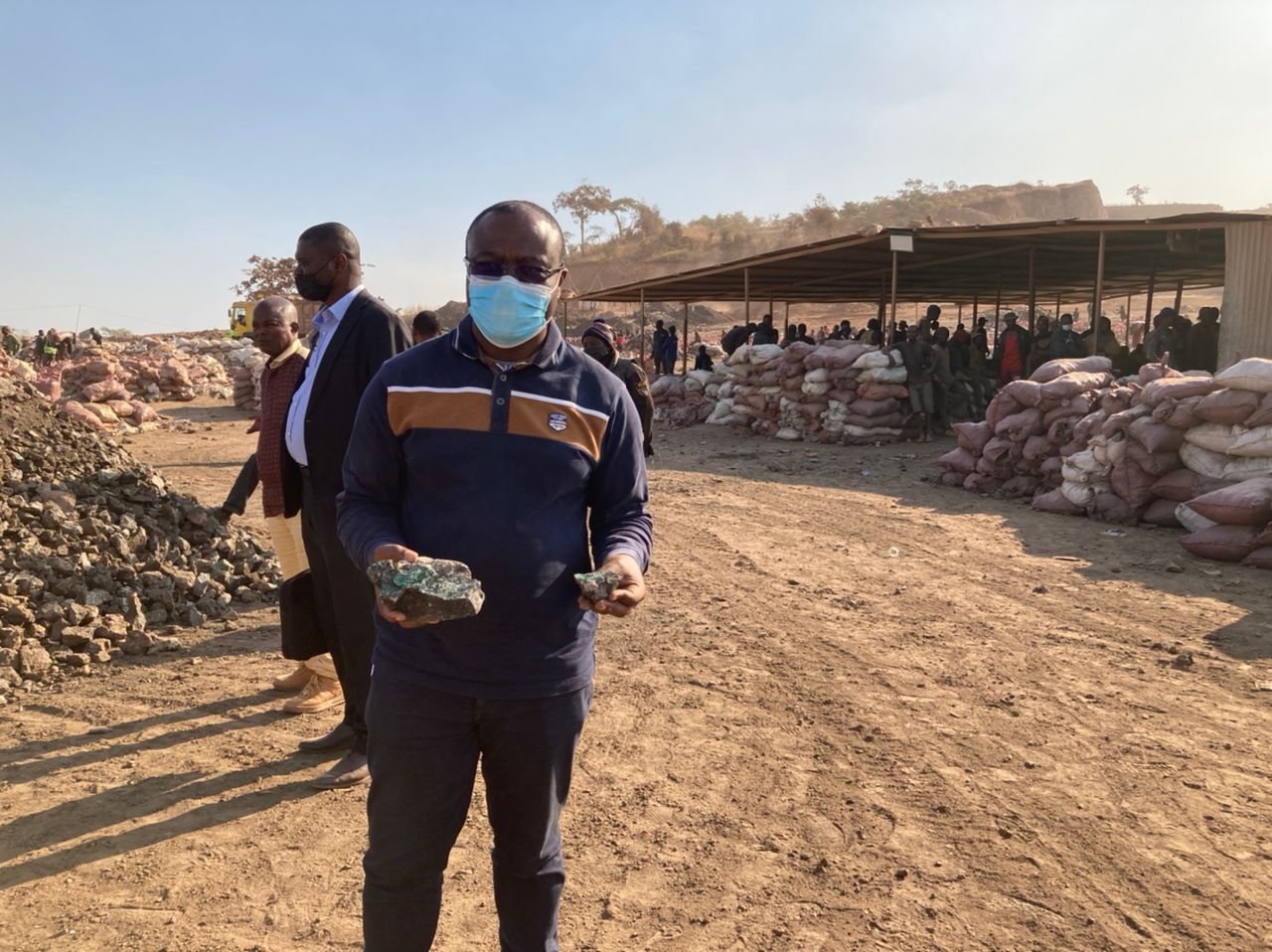
Good governance—increased transparency, open public dialogue and policy reforms that advance the public interest—is essential to seize opportunities. By prioritizing good governance, transition mineral-producing countries in Africa and Latin America can leverage the opportunities presented by competition for minerals in an accelerated energy transition. To deliver a “triple win” for their citizens, the environment, and the energy transition, many of these countries need to undertake urgent policy reforms, putting mining governance (including anticorruption measures) at the center of their policy plans.
Support the increasing range of anticorruption efforts
Kleptocrats have been put on notice. The 2022 energy crisis initially prompted an “anywhere but Russia" approach. However, there is a growing call for action against kleptocrats like Vladimir Putin who use fossil fuel wealth to perpetrate instability and aggression. A year on, in Europe and North America, policymakers have ramped up measures to crack down on dirty money flowing into their jurisdictions. From Nigeria to Angola, Azerbaijan to Belarus, those who steal wealth generated from their countries’ resources to invest in property and other luxuries are already being exposed, at home and abroad.
Leadership on anticorruption will help to secure economic opportunities. Growing demand for transition minerals brings its own corruption risks. Producing countries should ensure transparency over contracts, payments, commodity trading, and beneficial ownership; implement robust measures to prevent elites from capturing opportunities; and enforce accountability mechanisms to hold wrongdoers to account. And initiatives like the Mineral Security Partnership and EU Critical Raw Materials Act must be equally tough on corruption. By focusing on this good governance, policymakers can prevent public funds leaking out into private hands, and better respect local communities, protect the environment, and prevent disruptions and delays to supply. NRGI colleagues found that of three factors identified as shortening mineral production lead times, better governance is the only one within policymakers’ control.
Prioritizing the development of new economic and energy pathways, seizing opportunities presented by transition minerals and promoting good governance will help ensure policymakers in Africa and Latin America navigate the geopolitical and market forces unleashed by the war in Ukraine for the benefit of their citizens.
One Year on From the Russian Invasion: Impacts for the Middle East and North Africa

Transcript:
The Middle East and North Africa region has been impacted by the Russian invasion of Ukraine—especially the region’s energy sector. Here I will highlight three important elements.One is the renewed interest of many European countries in the oil and gas sector of the region, mainly Italy. Italy has been very open about its renewed interest in North Africa—Algeria and Libya. And we’ve seen ENI sign deals with Sonatrach in Algeria and the Libyan National Oil Corporation, and to develop new gas fields and existing fields as part of Italy’s energy diversification plan. We also saw high-level EU leadership going into Cairo in June 2022 to sign a memorandum of understanding with Israel and Egypt to allow these two countries to export gas to the European Union. Also, we have seen easing between Germany and Qatar about contracts—new contracts of for export of LNG to the European continent; before the invasion that was not an easy discussion between the countries, and even between the EU and LNG providers like Qatar.
The second trend has been an acceleration when it comes to clean energy and renewables. We’ve seen, again, the European Union signing deals with countries of the region, mainly a partnership with Morocco, to support clean energy in Morocco that will also serve some of the EU’s needs for clean energy. At the same time, we’ve seen pledges from the Gulf countries like Saudi Arabia and UAE to push for more investment in clean energy. Again, that could serve European needs as well as other parts of the world. There was also a big announcement about the need to further accelerate the energy transition. The region is taking action; Saudi Arabia has created a critical mineral fund to invest inside and outside the region in new minerals that are critical for the energy transition.
The third point is energy security. This was an opportunity for some countries in the region, mainly Saudi Arabia and the UAE and other producing countries, to remind us that it’s a fragile world that still needs oil and gas to move into what is being called now “orderly transition.” And we have seen Saudi Arabia and the UAE be very open about the issue of not breaking the oil sector by pushing to stop investing in oil and gas. That was very loud in the region as well. And the UAE is carrying that message into COP28 which it will host in November 2023. And lastly on energy security: the Ukraine crisis did help to seal a deal between two enemy countries, Lebanon and Israel, on their maritime border. There were many different reasons that that deal happened, but one element was that the world needed more gas, and if that deal would help with providing more gas, they thought, “Let's do it.”
These are the main messages we have seen, and these are the main highlights from the region after almost one year of the war between Russia and Ukraine.
The Resource Remix: Europe's Gas Crunch, African Supply, and the Energy Transition

The Resource Remix is a podcast from the Natural Resource Governance Institute exploring new futures for commodity-exporting countries in the energy transition.
In this third episode of NRGI's podcast, available on Apple Podcasts, Google Podcasts and Spotify, NRGI’s Silas Olan’g converses with Crystol Energy CEO Carole Nakhle and Theophilus Acheampong, economist and political risk analyst, and senior lecturer at the University of Dundee.
NRGI · The Resource Remix - Episode 3 - Europe's Gas Crunch, African Supply, and The Energy Transition
During their conversation, Nakhle, Acheampong and Olan’g explore the implications of Russia’s war in Ukraine on global energy markets, how it has prompted many countries to reevaluate their dependency on Russian oil and gas, and what Europe’s subsequent demand for gas means for African countries. They discuss whether the current geopolitical climate and market dynamic presents African oil- and gas-producing states with opportunities or risks.
With COP27 on the horizon, the three experts deliberate on whether recent developments will influence African producer countries’ energy transition plans, and to what extent. Acheampong points out how the crisis has exposed how energy security seems to come above all else, including achieving climate goals. With prevailing energy poverty across the African continent, Acheampong argues that African countries shouldn’t have to choose. Concurring, Nakhle affirms that, while domestic energy supply should be the priority for African countries, ensuring the energy transition and safeguarding energy security are not mutually exclusive. But, she adds, this hasn’t happened in practice so far, noting that governance should underpin any efforts to achieve both.
On to the topic of financing the energy transition, Olan’g highlights that the European Union, and other wealthy importers, haven’t yet met their existing climate finance commitments. Acheampong but adds that investment opportunities also exist elsewhere and must be considered.
***
Transcript:
Silsa Olan’g, NRGI: The 27th Conference of the Parties will take place in Egypt this November. The so-called African COP will be the first major climate conference in the wake of Russia's invasion of Ukraine. The war has had implications on global energy markets. Much attention has focused on how African countries from the Cape up to the Mediterranean have reacted to the shockwave. For many years now we have heard that fossil fuels must go. But suddenly European countries are hunting high and low for natural gas, including in Africa. This dash for gas has exposed double standards in energy access and achieving climate goals. What opportunities might resource-rich African states have in these tumultuous times? And how will this affect African governments and citizens’ agenda at COP27?
Welcome to The Resource Remix, a podcast from the Natural Resource Governance Institute. We bring listeners dynamic perspectives on the cutting-edge issues affecting countries rich in commodities in the context of the energy transition. I am Silas Olan’g. I have been with NRGI for more than a decade. And now serve as the organization's Africa energy transition advisor based in Dar es Salaam, Tanzania. Two guests join me today to dive into the prospects for African countries in this new energy market landscape. Our first guest speaking to us from London is Carole Nakhle. Carole is an energy economist, founder and chief executive officer of Crystol Energy, an advisory and research firm, and a member of NRGI’s Governing Board. Carole, welcome to NRGI’s podcast.
Carole Nakhle, Crystol Energy: Hello Silas. I am very happy to join you today.
SO: Thank you. We also welcome Theo Acheampong. Theo is an economist and political risk analyst and a lecturer at the University of Dundee in Scotland where he is speaking to us from today. Theo, you are most welcome to the podcast.
Theo Acheampong, University of Dundee: Thank you very much, a pleasure to be here.
SO: Thank you both so much for joining me in this episode.
Russian invasion has prompted moves by many countries to reassess their reliance on Russian oil and gas and reduce their dependence on its imports. Many articles have sprung up with commentators, discussing how world leaders desperate for energy are turning to Africa for its reserves of oil and gas, considering them as potential beneficiaries of Europe’s supply gap. In May, the EU published its energy strategy, but the strategy leaves many unanswered questions. Carole, now that it has been some months since the initial market shock, what is the clear-eyed view of the coming two to three years? Are some of the countries likely to profit from the current context of increased European demand? If so, which countries and in which way?
CN: Thank you, Silas. Well, first of all, before I answer the question, it is very important to clarify to the listeners and viewers that the crisis we are seeing today in Europe and elsewhere – because the record high gas prices that we are seeing currently are not only in Europe but also in Asia, even North America – it is not caused by Russia's invasion of Ukraine. It is, of course, that factor that the geopolitical development plays a very important role, but it would be naive to blame it all on the war, because some dynamics have been happening in gas markets over decades, including the development of LNG trade, which I think, last year or 2020, but probably last year, if I am not mistaken, for the first time overtakes pipeline trade. So, there is this globalization of gas markets. Of course, we are very far from what we have in oil markets, but the fact that you have more LNG trade happening than originally, markets that were independent of each other – so European would not really care about what was happening to the Asians, the Asians would not care what was happening in North America – this is not the case anymore today. Today if Asia catches a cold, Europe sneezes because of LNG trade, that's very important. I am saying that right up front, because it has implications for existing and potential producers, especially exporters of LNG, whether by pipeline, for example, from North Africa to Europe, or LNG exporters, including in West Africa, but even more so in East Africa, with the likes of Mozambique. They will be facing a completely different market than, for example, what they faced a few years ago.
Now to go back to your question about the outlook for the gas situation in Europe — what that means for African producers, current and future. And I insist on “the future” because we shouldn't underestimate the role that East Africa will play in the next few years. But, first, in the short term, if I focus on this winter, because gas demand increases in winter in Europe, I am more pessimistic because you've got to see usually gas demand increase around this time. If winter is going to be as cold as it was a year ago, then we should expect the most important consequence, which is higher prices. And we're already seeing record prices across Europe, and then in the longer term, after that, things should start to ease up. But I am an economist, so I have to say that high prices may be the solution to high prices, and I say it may be, because it depends also on what governments are doing, and see, as you highlighted, that in your opening remarks about the kind of contradictions and new terms that we are seeing. Because for years, if not decades, the rich countries, the OECD countries, blamed or recommended the developing countries for giving subsidies to their people, energy subsidies for self-use subsidies. Guess what? They are doing exactly the same today and giving subsidies to the rich and poor alike. So that is one aspect. I had to get it off my chest because it really bothers me as an economist.
But if we think about the high price signal, that is pushing consumers to adjust their demand. They are looking for an alternative, they are even thinking about which room to congregate into the winter and avoid using other rooms in the house if they have more than one room, let's say, in a house. We are seeing on the biggest scale the switching from gas to a targeted source of energy. Nuclear is one option, and renewables is another option. But ironically, we are seeing a shift to coal. We are seeing a shift to oil products, such as diesel. So that is another reversal and climate change and energy policies we are seeing in Europe. And they are scrambling to find alternatives for supplies coming from Russia because Russia for decades has been the largest, or was maybe, today's not anymore, the largest supplier of gas to the continent. But that means, maybe on the face of it, you would say, Okay, that's great. That will be an opportunity for African gas producers. But there are two things I want to highlight here.
First, they are not the only ones eyeing the European markets. You have American LNG increased by more than 70 percent compared to last year for the first quarter of this year. They love to send their gas to Europe, and don't forget the American-sanctioned Nord Stream 2, the pipeline coming from Russia to Europe from last year. So, it is not after the war. It was long before the war started. So, for the Americans, the European market is very attractive. So African producers will have to face the reality that there will be greater competition from the Middle East, Qatar, for example, from elsewhere. Everybody wants to send their gas to Europe. But the second thing, and that's a big question. Does Africa have the capacity to increase its exports beyond what they have today?
Let me focus on North Africa, and I leave it there, and then I let Theo elaborate more on sub-Saharan Africa. But look at Algeria, look at Egypt, especially Algeria, its export potential has been declining because its production has not been rising as fast as its consumption. So local consumption has been growing very fast because of different unattractive, irrational policies, economically speaking, and as a result, if they don't keep up with investment, if they don't keep up with increasing production, and they don't slow down the growth in demand, I think we should be realistic about how much more Africa can send to Europe. I'll leave it there, and we can elaborate on the rest later on.
SO: Thank you very much, Carol. From what you're saying, several established producers, Algeria, Angola and Nigeria seem already well positioned to benefit from this demand. As they are already reaping higher revenues from the spike in oil and gas prices. Countries with projects due to start within the next year or so, such as Mauritius and Senegal, I think they will likely also benefit from the higher prices. Others, on the other hand, where investment decisions on key LNG projects are still pending, could end up suffering larger financial risks than benefits. I am thinking of Mozambique, for example, given security challenges, and, of course, my own country, Tanzania, due to ongoing negotiations and outstanding project design processes. Is there a risk of heightened expectations not being made for certain producer countries, especially in sub-Saharan Africa? And what are the risks associated for some countries in attempting to meet European demand? Theo, I would really like to hear your views on this.
TA: Thank you very much, Silas. And again, it is a pleasure to be here. Let me also start with a much broader-level remark, and then we can look at the specifics.
I think what is interesting is that we live in quite extraordinary times. In my relatively short life, I have seen at least three crises, if not maybe four. From the financial crisis of 2008-2009, and then the commodities price lump of 2014-2017, then we had COVID, and, just as the recovery was gaining momentum, now we're dealing with the aftershocks of the Russia-Ukraine war or conflict, and, of course, that has had some major repercussions in terms of the global energy geopolitics or the dynamics. For me, what is kind of interesting, as you already allude to in your opening remarks, is the fact that there seems to be a change in tone.
Only from a year ago, when a lot of the European and Western nations were saying, we're going on net-zero, and the environment is the key consideration, but rather we've seen energy security and issues of access and affordability becoming the dominant theme in the global energy debate going forward. And of course, some have even said that it is quite hypocritical in a sense that some of the developing countries, including those in Africa, haven't been given as much of an opportunity to also develop their own domestic energy resources, which are mostly fossil fuels, by the way. But I think the tone has changed and because Europe especially is looking to fill its energy supplies with alternative sources, Africa, then, of course, comes strongly into the question. As you rightly pointed out, in terms of the gap, or the size that needs to be filled, a couple of numbers may be able to help you put things in a better context.
Then we look at specifically which of sub-Saharan African countries are likely to benefit. If so, when and how? So? We know that Russia has about 17 percent of the world’s production of natural gas. I checked some numbers. It is about 25 Tcf and about 40 percent of the European or EU import historically has come from Russia. If we look at the African context, Africa has just about 7 percent of the world’s production of natural gas, and you're expecting to ramp this up to about 350 billion kilometers or 12.4 Tcf. The earlier production is about 9 Tcf. And if you look at how much the size of the gap is, I don't think that African countries would be able to fill that in the short term.
So there are several issues, but it really comes down, in my view, to about four, some of which Carole talks about. The first one is the availability of spare capacity or how much countries would really be able to ramp up their production even the one year to be able to augment the sort of supply deficit that the Europeans are looking for. And related to that are also issues of logistics and infrastructure. If I take Nigeria, for example, which has the highest gas reserves in Africa at about 207 Tcf. Last year they were only able to produce 2 Tcf. And exported 1 Tcf out of that. Predominantly it comes down to financing issues. It comes down even to issues of theft of petroleum products, including the landscape or the regulatory landscape not being fully harmonized. So, I think it is not really a problem of reserves per se. But how fast African countries can ramp up that production. And this is where given the logistical issues, given that the gas markets are not fully formed, I don't really see any potential beneficiaries in at least the one-year outlook, I think. Of course, we've seen Italy trying to negotiate for more gas from the likes of Algeria and Egypt, and some of the production may go up, but in terms of sub-Saharan Africa, when I look at Nigeria, or Equatorial Guinea, or Mauritania, Senegal, or Mozambique, and Tanzania, or even Republic of Congo, I think, in the one year highly unlikely. Beyond that, in maybe two to three, you can even say four years, there is a possibility of that happening. But again, it takes a lot to develop these gas projects and policy will play a role, regulation will play a role, and ultimately even the direction of the war will play a role in terms of these alternative supplies from the likes of the US and the other Middle Eastern countries who are able to much more quickly ramp up capacity and take market share.
SO: Thank you very much. So yes, capacity is a real issue, and because we’re are looking into one year, two years is okay. But there is a big question as to how long Europe will continue demanding gas, given that they are also developing their own energy transition. So indeed, Europe is looking for gas now and not necessarily in the long term, which may lead to a disconnect somehow, because we're looking at, on the one hand, the capacity gap requires significant investment in Africa, for example, producing countries. On the other hand, Europe is also going for the countries, as you mentioned, the US and others. So I think Europe is looking really for renewables as well, and this is where the disconnect is.
This is a warning to gas-producing countries in Africa when setting their priorities, as you talk about setting up the policies, but if they are setting the policies looking into the European market, while the European market, again, is trying to focus on renewables, what does this mean in terms of a long-term engagement with Europe from African producer countries?
CN: What you're touching on is a very important question that I asked myself recently when I wrote an article on policy confusion that you are seeing across the Western countries, in particular the EU and North America, and the UK as well. In the sense that we see these governments are asking, oil companies are asking oil and gas producers across the world, including Africa, to produce more oil and gas, and send it across to Europe to help them temporarily with the crisis. But, as we all know, oil and gas projects are by their own nature long-term. So by the time you take the investment decision to commit the capital, it will take a couple of years before you start producing, and then you're not going to produce for a year or two. You are hoping to produce for the next 20-30 years, and if the outlook for those 20-30 years is hugely uncertain, then why would you bother and commit today? So this is really the fair position and questioning that existing producers are telling those consumers. Those consumers are telling them we want your gas, but only to help us through the crisis, to help us through this winter, and maybe next, until we beef up our capacity of nuclear and renewable energy.
But let me tell you an example of a country that doesn't often come to my mind. And this is a European country, Norway. So, just to understand the position of African countries. Let's look at a country in Norway, that is the closest to the EU in everything culturally, values, principles, legislations, regulations, you name it.
Norway made it very clear in May. The Minister of Energy said it openly. If Europe commits to buying more gas for the long term, we can help it replace Russian gas. And that's why, a month or two later, if I am not mistaken, there was EU-Norway energy cooperation where the EU openly said that it supports Norway's continuous exploration and production of oil and gas for 2030 and beyond. So that was a clear reassurance that the EU gave to Norway to say, we'll continue buying your oil and gas, continue investing. Why would it be a different position for African countries? So African countries should also get the same commitment from European customers who are desperate for gas that they want to maintain their gas demand for many years to come. if they don't want it., there is China on its own. If you look at the expected increase and the demand for China for the next few years on its own, it can capture all the additional capacity in expansion in liquified natural gas and LNG. So this goes back to the point I said earlier about the globalization of gas markets. It is not any more Europe on its own telling producers, “send me your gas.” If Europe is not going to be more linear and understand the position of oil and gas producers in Africa, Europe will lose it to Asian consumers who are very hungry for natural gas.
SO: Thank you very much. As we approach COP27, it is important to consider the impact of recent developments on the energy transition that we have been speaking about and the implications for African producer countries and their energy transition plans. Theo, you have shared elsewhere how wealthy countries have not delivered on their climate finance promise to sub-Saharan African countries. Some people have suggested that African countries shouldn’t pursue plans to extract gas in a world of crisis and gas supply crisis, balancing the climate crisis and gas supply crisis somewhat competing. And can be tricky. Should issues, such as who gets to extract fossil fuels and which projects are financed, be revisited in the pursuit of a more equitable energy transition? Is Europe’s sudden interest in African gas hypocritical, especially as Europe pressures African country to meet green goals or potential revenues from gas is worth it? Theo, you have spoken a lot about that.
TA: Yeah, very interesting question. And let me piggyback to what Carole said earlier. If Norway can still produce oil and gas in 2030 and beyond, if the UK in their new energy strategy clearly outlined the role of oil and gas, even in the US, again, oil and gas being a mainstay even in 2030 and beyond, then I ask myself, why must it be different for Africa in that sense? Because at the end of the day what this crisis has shown above all else is that energy security comes first. And Africa for that matter must also prioritize meeting its own domestic energy security needs. And then the rest, of course, for export to wherever the market may be. And as Carole actually told us, the market is not necessarily in Europe, and if you do a 30-40-year demand projection, the market is elsewhere outside of Europe, and the technology is also available now to even produce some of these fossil fuel resources and reduce the carbon intensity of that production process.
In my sort of limited world where I sit, I don't really see a disconnect between the climate objectives and energy security in terms of access and affordability, what we typically in literature will call “the energy trilemma,” and more so, for Africa, because, again, what this conflict has shown, and even COVID has also shown is that we have very fragile energy systems, you have deepening or prevailing energy poverty on the continent, and we need all the resources to be able to address those concerns around energy security, and in that regard the fewer choice to plug that gap, I don't think African countries should be forced into the binary whole of having to choose between renewables and/or oil and gas in that matter. When you even talk specifically about the overall emissions, if you take Africa as a whole, it is actually less than 4 percent of the total CO2 emissions cumulatively to date. If you look even specifically within the energy systems of many African countries, I argue, that it is largely already decarbonized except for South Africa, where coal is the most dominant. So I think the issue of the just and equitable transition is very much paramount at the heart of the continent.
But it shouldn't be made to look as though you have to choose one particular technology option and/or the other. When it comes to the financing issues again, this is where you see quite a bit of geopolitics also at play. So we know from some estimates, including a very recent study done by the climate policy initiative that Africa as a whole, needs about 250 billion every year between 2020 and 2030. We are already two years into that. If you look at last year's numbers and the flux, the continent got just a little around 30 billion coming in terms of these financing flows. And, interestingly, most of them actually went into mitigation, less into adaptation, where the research also shows African countries are heavily exposed, and even on the financing flows, many of these are coming in as loans interest-bearing commercial laws, and less as grants. So, in a sense, you see a lot of African countries caught in this quagmire. But I don't think that the solution should be one to force a technology choice on African countries, one even in Europe, the main producers as to exploring their oil and gas deposits and number two, the issue of the financing, I think, is going to be absolutely critical, especially at COP where many of the financing flows would need to be increased, and when it comes to things of the mitigation financing, and of course, the other one, which I forgot to mention, is the issue of loss and damage for historical emissions.
SO: I cannot agree with you more. Indeed, in a recent media appearance, my colleague, Thomas Scurfield also noted that European Union and wealthy countries, in general, must meet their existing climate and finance commitment before new European Union investment commitment and funding pledges can be taken seriously, particularly in Africa, where they have not made those bridges.
Building on sustainable and reliable domestic energy systems is another crucial aspect that's just mentioned. I think in the end, in the EU energy strategy this has not been clearly addressed, and many of the commentators in the Western media also noted that. But today, 600 million people in Africa still lack access to electricity and Europe wants to find as much gas as possible in Africa and other regions. It doesn’t sufficiently support energy access for market references on the need to diversify its own energy sources. I think, Carole, you mentioned this before. What are and should be the priorities for export business domestic consumption in Africa? I would like to hear from both of you.
CN: For long we all believed that in the case of gas, and in particular in the case of Africa especially, I think, the priority should be given to the local market, to the domestic market. Because if you want to really have economic development, you need to give access to energy.
You need to allow that access by developing the local market, by putting the regulations in place, the right pricing systems in place, to build the infrastructure. So if you have gas, and that's why gas by large remains a regional business, and a big chunk of the gas produced is consumed locally, why would it be any different in Africa? I think the main problem in Africa is domestically because of the institutional side, because of the investment climate, and these are things that African countries need to really work on improving the governance of the sector. If they are to seize your portion of the golden opportunity that no other country maybe has in this way, or onahe same scale, not only in terms of oil and gas resources and reserves.
We forget that Africa is very rich in the critical minerals needed for the energy transition. And that's why I will go back to the point that you made. We don't need to choose between oil and gas and green energy, because Africa is blessed with resources that allow the production of both to meet the energy transition while safeguarding energy security. But the experiences show that it is not if you have the resources in the ground you're going to benefit. Look at Venezuela — they have the largest proven reserves in the world, and yet they are not among the largest oil producers in the world because of what was well-known as the resource curse. So let me keep my answer brief to your question, and say, the domestic market should take precedence, but that will not be developed automatically, you need to put in place the right institutional framework to allow that to happen so that everybody benefits from the resources that you have, and the export market can be developed in parallel but should not be given priority over the domestic market.
TA: Just to add a bit to Carole's point, an interesting point, we've been doing some bit of exercise just to see if you doubled Africa's current electricity output to bridge the access deficit, how much more emissions would that contribute if you even had a major chunk of that coming by way of natural gas. And what is quite remarkable is that even if we double the output of power on the continent using the same energy mix as currently pertains, it Is still going to contribute less than 5 percent of the total cumulative greenhouse emissions in that regard. The point here is that seeking to export gas from Africa for me is not necessarily a bad idea, but as Carole said, the important thing is also to develop the regional gas markets.
I have been involved in a few studies, and you can find that there are significant constraints in terms of developing these markets. However, we have an opportunity now with the Africa Continental free trade area to work on some of these issues, such as having harmonized gas pricing, regime, the issues about the investment requirements, and I think some of the sovereign wealth funds on the continent need to think about pulling some of their resources together, because, after all, if the money is not going to be coming from Europe and other places, if they decide to pull out the investment, we still need to develop these gas markets and there are other groups of money even domestically on the continent, with the sovereign world funds, but also some of the pension funds, et cetera, to put into some of these investment. And of course, you need to address all the regulatory and political risk issues and ensure that you are pricing the gas appropriately and doing that based on what must go to industry, and which ones must go for domestic consumption. Because if we don't develop those regional gas markets, and it is all about export, export, export, then, unfortunately, it is still going to be, in my view, the same old colonial extractivist model, which has dominated the geopolitical order for the last 400 years, with very little trickle-down effects for livelihoods on the continent.
SO: Thank you. To what extent do you think COP27 will be a moment for settling some of these questions? Are there many questions still out there?
TA: I think going into COP27, there are three key things: the issue of energy access, the issue of climate financing, and all around the issue of just transition. But I think really what is important here is that historically, Africa has not had a unified strategy on most of these issues. I think, going into COP, we, as a continent, must present a unified strategy, and the strategy should detail, in my view, our unique circumstances, but also highlight the role that oil and gas would play as an important fuel choice for any decarbonization pathway for the continent. I am not talking about other continents. I am only talking specifically about oil in Africa. In that regard, both oil and gas and renewables would for sure play a big part of that agenda.
I am just worried that the attempt to force this different pathway like it is this and not that, is going to push a lot of the already existing assets for reserves and make them potentially even become stranded in the first instance, and that would already have a cascading impact on the worst energy poverty that we were talking about with about half of the continent not having access to electricity, so the strategy is important, highlighting unique circumstances, and also advocating for more of the financing flows on the continent. And lastly, things around the critical minerals for transition where many of the countries on the continent have one form or the other. But to really make an opportunity out of it, it must be developed on a regional basis.
SO: Thank you, Carole and Theo, for joining me today for this episode of the NRGI podcast. This has been a very interesting conversation, leaving us with a lot of food for thought on what really constitutes a just transition.
For our listeners: please check out the first two episodes on your preferred platforms. We are on SoundCloud, YouTube, Spotify, Apple Podcasts and Google Podcasts. Do join us in the next episode. Thank you.
Disclaimer: Views and opinions expressed in this podcast belong to the individuals featured and do not necessarily represent those of the Natural Resource Governance Institute. The recording and transcript have been edited and condensed for clarity.
NRGI's podcast The Resource Remix explores new futures for commodity-exporting countries in the energy transition.
VIDEO: Europe's Hypocrisy Over Africa's Gas?

Examining which countries in Africa can increase gas production in the next few years, Scurfield highlights Nigeria's and Angola's liquefied natural gas (LNG) plants' spare capacity to extract more gas and supply gas to Europe if appropriate investment are made.
Projects that can’t come online until 2030 probably won’t have much of a market in Europe to supply at that point.
He adds: “But there are other countries where production is a lot further off. A country like Tanzania, that has had an LNG project plan for over a decade, hasn’t yet reach an investment decision and is unlikely to do so before 2025, meaning production won’t start until 2030. It seems like those sort of projects won’t be able to meet Europe’s needs and make the most of this opportunity from this supply crunch, given that Europe is looking to find other sources of gas right now, but actually in the longer term its main response to the Russian invasion of Ukraine is to accelerate its energy transition. And it is looking to reduce its gas consumption by 40 percent by 2030. So projects that can’t come online until then probably won’t have much of a market in Europe to supply at that point."
Scurfield also stresses that the European Union and wealthy countries in general must meet their existing climate finance commitments before new European Union investment commitments and funding pledges can be taken seriously: "It [the European Union] still isn’t providing the 100 billion USD dollars of climate finance a year that it promised back in 2009 that it would provide by 2020. It didn’t in 2020. It didn’t in 2021. And it doesn’t look like it will do in 2022. So this package of support does holds some promise, but it’s hard to take it seriously until these exciting climate finance commitments are met."
On the question of whether Africa should invest in costly pipelines that require years of planning and construction, given Europe's demand outlook, Scurfield is sceptical that by the time the pipelines are built and can deliver gas, the market in Europe will be large enough to make investing in these projects truly profitable.
He says, "There’s a worry that governments from the countries involved in those, because of the likely private investor reluctance to get involved or at least cover all the costs, would stump up a significant amount of the money required and then those pipelines wouldn’t actually generate the expected returns. There is a real risk of those pipelines being talked up now because of this hype around European demand, but them actually becoming stranded assets and a real dead weight on the public finances of the countries involved.”
Europe’s demand for Africa’s gas
Read key insights from NRGI experts
Senegal and the G7: Five Questions about the Just Energy Transition Partnership

A French-language version of this post appeared as a commentary piece in La Tribune Afrique on 24 June 2022.
Unlike South Africa and several of the countries targeted by the G7 for a possible JETP, such as Indonesia and India, Senegal is neither a major coal producer or consumer, nor a major polluter. Instead, Senegal is primarily a future gas producer, whose production will be important for both domestic and export markets. While the opportunity for climate finance for Senegal presented by the JETP is to be welcomed, the motivations and potential content of such an agreement should be examined, insofar as these discussions are taking place in the geopolitical context of an overhaul of European energy policy as a result of Russia's invasion of Ukraine.
Public debate should address five questions in the coming weeks:
1. How will the JETP ensure better access to energy for Senegalese citizens?
Senegalese citizens will expect that a potential JETP will help meet the country’s energy needs and support its economic development. Senegal relies on its gas reserves to achieve its goal of universal access to electricity by 2025. In this sense, the partnership could support the financing of gas-to-power projects in the country that would not otherwise be financed, but also (and especially) the development of renewable energy projects.
2. What is the role of Senegalese gas exports to Europe under the JETP and which gas projects will be targeted for this purpose?
This question leaves much room for speculation, including that the nascent JETP has been established solely as an alibi for exporting Senegalese liquefied natural gas to the EU. Although the first phase of the GTA project, which is expected to start production in 2023, has already been promised to Asian buyers, the second phase, for which a final investment decision (FID) is expected within the next year, remains an option for supplying the European market. However, the Mauritanian government’s weak participation in ongoing talks with Senegal, despite the two countries sharing the gas field, suggests that the Europeans may be eyeing another, exclusively Senegalese gas field: Yakaar-Teranga. This project, which is close to a final investment decision, would be an excellent candidate for supplying the European market, except for the fact that its first phase is planned to supply the local market. The Sangomar oil project, which comes on stream in 2023, will also generate gas in later phases (which have not yet achieved FID). This would be associated gas, requiring significant processing before marketing, which would entail additional investment.
3. If Europe is going to secure its gas supplies through the JETP, how will it finance these projects?
The financing of gas projects is a stated priority of the Senegalese government in the JETP discussions, but it is a goal made difficult by Europe’s aversion to long-term gas purchase agreements in light of climate commitments. It is therefore important to pay particular attention to how any financing of gas projects under the JETP will be structured to avoid excessive risk being allocated to Senegal in order to attract the necessary investment.
4. Will the JETP involve agreements not to exploit some of Senegal’s gas, like South Africa’s JETP, which targets a phase-out of coal?
A JETP should balance the objectives of decarbonization, energy access and maximizing Senegalese revenues. Important elements for Senegal to consider in this regard are the approach to later phases of gas projects and new exploration, and support for renewables and energy access, including financing and technical assistance for grid extension, improving the stability of electricity supply or integrating clean technologies into polluting sectors. In the case of agreements involving the non-exploitation of gas, the JETP should promote compensation (direct or indirect) to replace the sources of revenue that Senegal will lose.
5. What support is there for any alternatives to gas exports under consideration?
The JETP may promote collaboration on green hydrogen, which is also a focus for Senegal. Given the uncertainties around the economic and technical feasibility of green hydrogen exports, the Senegalese government should be careful not to rely too heavily on this prospect that is rather distant for the time being.
The answers to these questions are of interest to the Senegalese, but not only the Senegalese. This potential JETP is an interesting proposition because it offers a potentially transformative just transition model for emerging gas-producing countries. Conversely, failure could slow down the momentum of these countries toward energy transition.
Europe’s Demand for Africa’s Gas: Toward More Responsible Engagement in a Just Energy Transition

Through the publication on 18 May of its external energy strategy, the EU somewhat clarified its approach to diversifying gas supplies. The strategy is of course written from a European perspective; its implications for African producer countries require a bit of dissection. These implications are important given live debates around the role of gas in Africa’s future and more broadly, including at the G7 level.
The EU strategy (and the broader “REPowerEU” package in which it sits) indicates that Europe is seeking a short-term injection of additional gas—but also that it is accelerating its transition to cleaner energy sources. The EU is therefore unlikely to seek longer-term (post-2030) sources of gas. Current and prospective African gas producers ought to take note and adapt accordingly. If European interest in African gas is indeed primarily short-term, responsible EU-Africa engagement would require European officials to clarify their intentions and needs, and relevant African policymakers to ensure that related expectations in their countries are realistic given likely future scenarios.
With such clarity, the handful of African countries ready now (or soon) to start or increase gas production can seize a short-term opportunity to increase public revenues. But given major uncertainties around the future of gas, officials in these and other countries should focus primarily on building more sustainable economies and domestic energy systems, not investing billions of dollars of public capital in long-term gas projects that face tough obstacles and risk carbon lock-in.
There is a bigger opportunity in Europe’s energy rethink for African countries: they can use it to push the EU to follow through on its promises of financing and technology for renewable energy growth in Africa. Europe could couple the realization of these commitments with near-term gas procurement from certain African countries, contributing to long-term partnerships in service of a just energy transition.
Implications for African gas: Timing is everything
Some of the main reactions to the EU strategy have focused on important areas of climate-related concern. The strategy also brings mixed messages for policymakers in countries evaluating opportunities to export gas.
Europe’s main tool for reducing Russian gas imports will be reducing gas consumption.
The REPowerEU plan details how Europe will expedite its energy transition in the wake of the Russian invasion of Ukraine. Europe’s main tool for reducing Russian gas imports will be reducing gas consumption. The plan doubles down on a previous objective to lower consumption by 30 percent by 2030 (around 100 billion cubic meters (bcm)); it details European aims to reduce consumption by a further 11 percent (35 bcm) by 2030 through a combination of energy efficiency and clean energy substitution.
Alongside the reduction in consumption, the EU envisions an increase in gas imports from non-Russian sources: mostly of liquefied natural gas (LNG) (an additional 50 bcm), but also pipeline gas (an additional 10 bcm or more).
So, for whom is this an opportunity, and for how long? On this, the strategy is less clear.
One point of ambiguity concerns the timeframe for increased non-Russian gas imports. The strategy references the need “over the coming years” but omits further detail. Nevertheless, this will likely sync with the strengthened plans around reduced gas consumption by 2030, meaning that if the EU sticks to its decarbonization objectives it is unlikely to need much additional longer-term supply (i.e., for 2030-2050) given its 2050 net-zero target.
A second point of ambiguity relates to the prospective sources of additional supply. The EU has already advanced some deals for short-term supply, including a political agreement with the U.S. for additional LNG imports of at least 15 bcm in 2022 and approximately 50 bcm annually until at least 2030. The 50 bcm would cover all of the EU’s planned increase in LNG supply, meaning there may not be any opportunities for other producers. And yet the strategy also references separate efforts to source gas (e.g., LNG from Egypt and Israel, and piped gas from Algeria and Azerbaijan) and specifically mentions the “untapped LNG potential” of countries in sub-Saharan Africa.
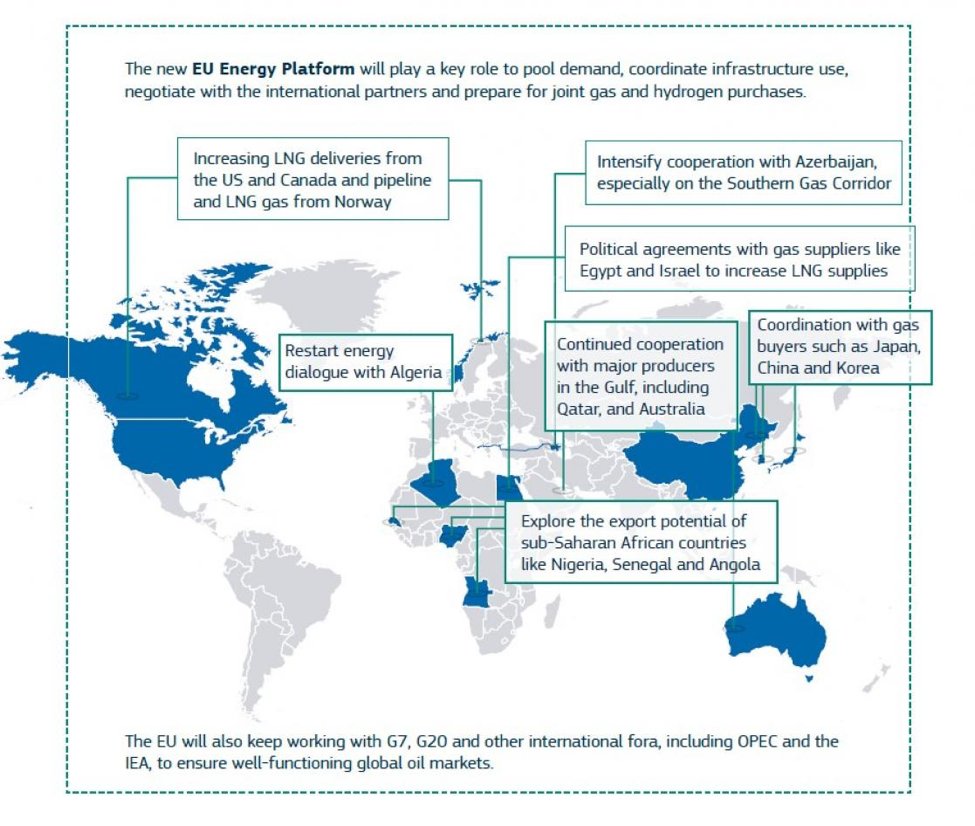
And so it seems that within Africa the opportunity is for existing producers, or those with projects on the cusp of production, that can supply gas before 2030. These could include Angola, Egypt and Nigeria insofar as they can quickly ramp up production. Senegal has already sold the LNG from its initial GTA project, due to start producing in 2023, to Asian buyers, but a final investment decision on a second phase is possible within the next year and production on that phase could start within the next few years.
More generally, expansion of projects with existing infrastructure would be particularly attractive to Europe for a few reasons. It could potentially avoid signing long-term commitments that trigger investments. European officials could also argue that expansions do not constitute development of “new oil and gas fields,” which the IEA has deemed incompatible with achieving net zero by 2050. European demand is unlikely to be much of an opportunity for other countries (or other projects in the above countries) that can only export in the longer-term (2030-2050); these would clearly constitute “new production.”
Europe’s identification of other potential sources of LNG may just be insurance against the possibility that EU-U.S. negotiations fail to result in the full supply of 50 bcm—or a tactic to increase European leverage in those negotiations. Like any insurance policy, this one may not be used, and ultimately significant European demand for additional African supply may not materialize even in the near term. And it may be that Europe wants the “insurance” but isn’t willing to pay the “premium”—or at least not a very high one—in the form of long-term gas purchase agreements necessary to secure financing for projects or funding new infrastructure. If the EU does not plan to make big, long-term investments in African LNG in that way, the responsible course would be to say so explicitly now, rather than leave prospective African suppliers to interpret ambiguities in the strategy.
Officials in producing countries should note these nuances and recognize that Europe and other importers generally prefer to have a diversity of producers, though Europe’s climate considerations may temper the EU’s preference. Many producing countries may never reach the “front of the queue.” Responsible engagement by officials in producing countries would mean avoiding significant risk when jostling for position—by entering a “race to the bottom” negotiation, investing significant public capital to de-risk projects for investors, or getting locked into oversized domestic gas infrastructure that may crowd out cheaper renewable energy alternatives.
EU energy strategy: Missed opportunity on just transition?
In its strategy the EU states that a “just and socially fair” transition is integral to its external energy policy. In practice, its plans around supplier diversification seem shortsightedly agnostic as to where supplies originate—essentially anywhere but Russia.
In a truly just transition, the EU would reduce rather than increase gas imports from countries such as the U.S. and Qatar, as these wealthier countries should be among the first to cut production in a just fossil fuel phaseout. As researchers and advocates for an equitable transition are increasingly recognizing, countries with more urgent development needs should have priority within the remaining carbon budget given their lower capacity to finance their own even more challenging energy transitions. In the absence of an agreed international framework for managed phaseout of fossil fuels, such priority access for developing producers is unlikely. But the EU should support the development of such a framework—or at least apply just principles where it can, as in its international energy strategy.
If consumer countries fail to adopt good governance criteria when selecting future energy suppliers, they risk repeating the mistakes of the past, when Western companies and governments served as key enablers of Putin’s catastrophic kleptocracy. The EU has laid important groundwork on this front, with democratic values and good governance/transparency as key principles for partnerships under its Global Gateway initiative. However, plans to intensify cooperation with authoritarian regimes as part of the EU’s gas diversification strategy raise concerns about its commitment to avoid enabling corrupt regimes.
As part of a responsible engagement the EU and its prospective African gas suppliers should account for the risk that citizens in these African countries may view gas export to the EU as coming at the expense of domestic energy plans.
Developing countries’ domestic energy needs, particularly in Africa where about 600 million people (around half of the population) lack access to electricity, are essential to a just transition. The EU should prioritize delivering on its stated support for increasing renewables in such countries. The strategy’s recognition that renewable energy exports to Europe (e.g., as green hydrogen) should not adversely impact a country’s domestic energy access is significant; the EU should develop this further. But the EU strategy is noticeably silent on the potential impact of increased gas exports to Europe on domestic energy needs in gas-producing countries. This is particularly relevant for discussions around sub-Saharan African gas producers, given the significance (rightly or wrongly) assigned to gas in strategies for addressing domestic energy needs. As part of a responsible engagement the EU and its prospective African gas suppliers should account for the risk that citizens in these African countries may view gas export to the EU as coming at the expense of domestic energy plans. This could accelerate resentment as Europe uses African gas while objecting to gas-supported electrification within Africa for climate reasons.
A way forward
More broadly, the EU should redouble its engagement around ensuring a just transition for developing countries that produce, or aim to produce, fossil fuels. The strategy’s reference to these countries’ interest in exporting green energy shows that the EU appreciates the importance of replacing revenue sources that lower-income countries will lose as part of the energy transition. The EU should support such long-term “revenue smoothing.” This could be part of an Africa-EU green energy initiative inclusive of partnerships of the type launched with South Africa at COP26.
The EU and producer countries should not over-rely on the idea included in the strategy that combining gas cooperation with long-term energy cooperation on hydrogen can “avoid stranded assets and ensure the green transition.” Avoiding stranded assets should be a priority, but not based on an overly broad assumption that fossil fuel infrastructure can be repurposed for other uses.
The EU should instead avoid stranded asset risk in the first place by being as clear as possible on likely future gas demand. With that clarity, African gas-producing countries can determine whether and how they can benefit in the short-term, while avoiding the temptation to sink billions of dollars in public capital in projects predicated on long-term European demand.
Can African Oil and Gas Benefit From Europe’s Energy Crisis?

This commentary originally appeared in African Arguments on 29 March 2022 under the title "Will Africa Really Be ‘Europe’s Next Gas Station'’’?
These shifts, combined with Western oil and gas companies dumping their Russian interests, present an opportunity to other petroleum producing countries, albeit one tempered by actions to address the climate crisis. This has led governments and commentators to discuss African producers as potential beneficiaries of Europe’s supply gap, with talk of a “seismic shift” to Africa and of the continent as “Europe’s next gas station”.
Such headlines gloss over the complex reality. It is true that several established producers – such as Algeria, Angola, and Nigeria – are already reaping higher revenues from soaring oil and gas prices. Countries with projects due to start within the next year or so, such as Mauritania and Senegal, will likely also benefit from higher prices. However, most current producers have limited spare capacity to quickly ramp up supply and need to attract more investment before they can.
Investment decisions on key liquefied natural gas (LNG) projects in prospective producers, such as in Mozambique and Tanzania, are not likely until at least 2024 given security challenges in the former, and ongoing negotiations and outstanding project design processes in the latter. This means significant production is unlikely before 2030. Most of Mauritania and Senegal’s oil and gas reserves won’t be developed until later project phases. And any supply from prospects currently under exploration is likely even further off. It has historically taken sub-Saharan countries around 12 years to move from discovery to production – often longer than initially predicted by governments and companies.
While some African projects may come online more quickly, investors will make decisions based on an uncertain long-term outlook. The current spike in prices is a potent reminder of the fundamental unpredictability of oil and gas markets. Seven years on from the price spike in 1979, rates had fallen more than two-thirds from the peak of the crisis.
Three factors make the current outlook particularly uncertain. First is Russia’s role in the oil and gas market. Its supply to Europe will be affected by how its negotiations with Ukraine unfold, as highlighted by how prices have fluctuated in line with perceptions of how the talks are progressing. Russian supply earmarked for Europe could be diverted to Asian markets in the long term. This would reduce Asian demand for gas from elsewhere and offset the benefit of increased European demand for oil and gas from these producers.
The second factor is how much market share other non-African producers capture. Europe is not only looking to Africa to fill the gap. US LNG exports to Europe are surging, multiple additional large US LNG projects are ready for development, and European leaders are striking long-term deals in the Middle East. Many of these producers have more spare capacity and projects that can be greenlit more quickly than African producers.
Third, prospective suppliers must consider potential “demand destruction” and the pace of the energy transition. A lesson from the 1970s is that high prices and market turmoil often lead to a permanent reduction in demand through improvements in energy efficiency and development of alternative technologies. The current crisis could lead to even greater demand destruction given it appears to have reinforced Europe’s conviction to accelerate its energy transition away from fossil fuels. Beyond its goal to secure non-Russian supplies in the short-to-medium term, the EU also aims to leave fossil fuels behind for good.
What African and European officials can do?
Leaders in both Europe and Africa can take steps to make this moment more of an opportunity for Africa.
The EU could begin by clarifying its energy transition strategy for the benefit of African producer countries and potential private investors. Thus far, its pathway has been a minefield of mixed messages. For example, its plans announced in February 2022 to label some kinds of gas-fired power as “green” was seen by some producer countries as a signal to move ahead with gas projects. However, some European leaders seem to increasingly view renewables as not only necessary to tackle the climate crisis but also to improve energy security.
As Europe seeks to expand its use of clean energy, it should ensure that African producers of the critical mineral inputs to green tech receive good and fair deals.
To ensure a globally equitable transition, Europe should consider meeting any longer-term demand first with petroleum from African countries, given their pressing development needs. Europe could also champion the inclusion of incentives for good governance in the sequencing of the global phase out of fossil fuel production. In so doing, it should balance addressing European energy security with reducing African energy poverty as part of a broader strategy that also supports African countries’ own transitions to clean energy. Finally, as Europe seeks to expand its use of clean energy, it should ensure that African producers of the critical mineral inputs to green tech receive good and fair deals.
Irrespective of how Europe proceeds, officials in existing and prospective oil and gas producing Africa countries should soberly evaluate the longer-term uncertainties. While prices are soaring now, this unpredictability includes the possibility of fewer supply opportunities and lower prices over time.
Governments should ensure that strong revenue management frameworks are in place, including by directing any windfall revenue toward sustainable development and economic diversification. Diversifying economies remains crucial. Governments should also rigorously analyse their prospects across different scenarios, factoring in project timelines and potential market evolutions. They must remain cautious and avoid using public capital to make risky bets on oil and gas.
While some African producers may benefit from Europe’s scramble for non-Russian oil and gas, the reality is unlikely to match the hype.