
How to Stop Oil Companies From Propping Up Kleptocrats

Divestments by these Western oil companies contribute to the crisis now facing Russia’s oil and gas sector, one of the largest in the world. Even in the absence of sanctions on energy exports, oil companies as well as commodity traders, insurance providers, banks, and other industry players are backing away from the country. This leaves Russia without buyers for its crude oil and has sent the stock value of Russian oil companies plummeting. In the longer term, divestments could delay key projects, such as the ExxonMobil-operated Sakhalin oil and gas fields, and deprive the industry of the financing and technology it needs to sustain its growth...
Read the full commentary.
Gillies subsequently spoke on a related topic to National Public Radio (U.S.):
Gillies also addressed a related topic in this short documentary by VICE News:
The Russia-Ukraine war has led to a range of new challenges and opportunities for developing countries rich in oil, gas and minerals.
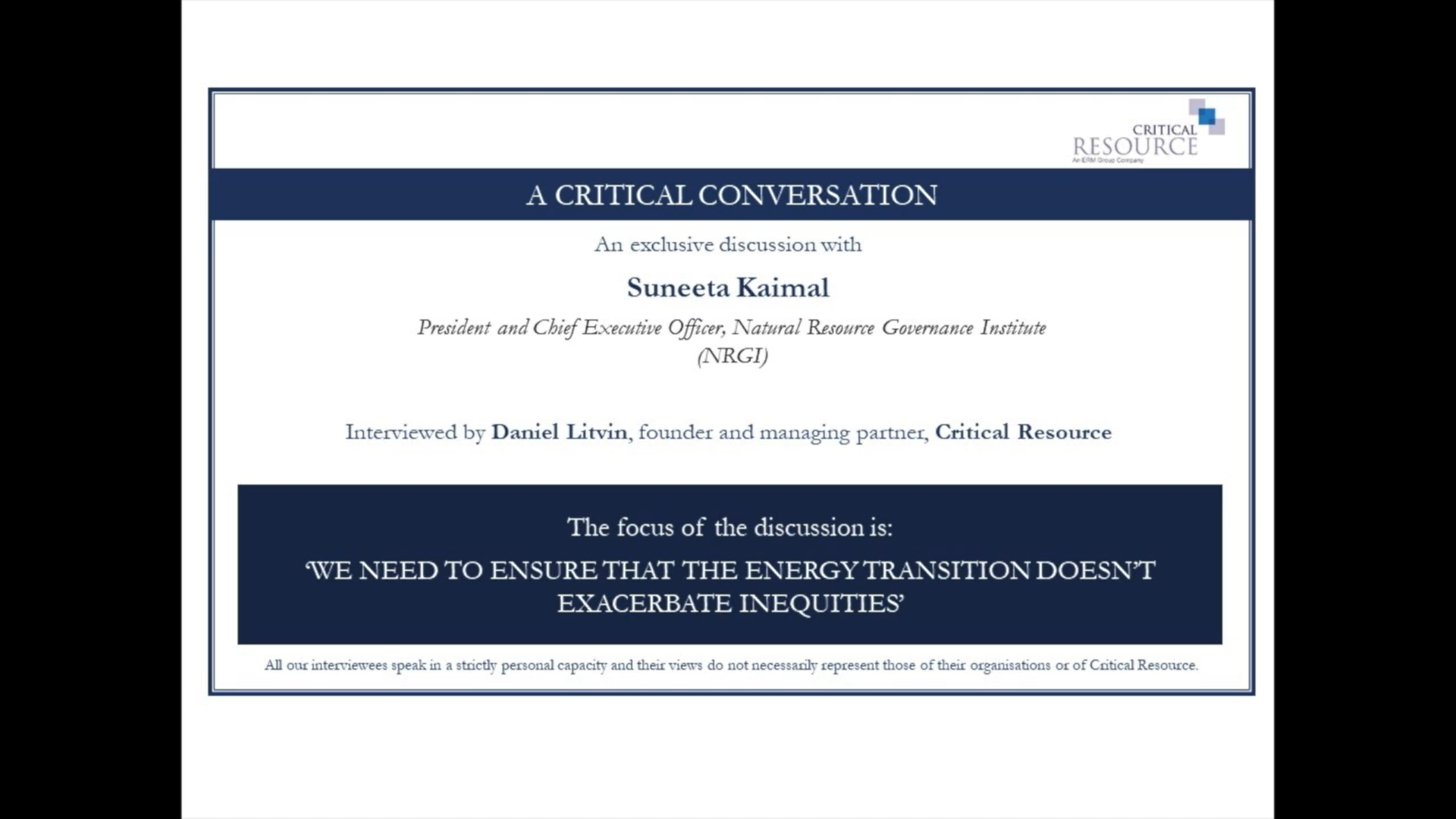
Improving Governance for a Just and Equitable Energy Transition: A 'Critical Conversation' with NRGI's Suneeta Kaimal

Critical Resource's latest "Critical Conversation" podcast features an exclusive discussion with President and CEO of the Natural Resource Governance Institute (NRGI), Suneeta Kaimal, on the opportunity and need for improved governance to manage a just and equitable transition to a decarbonized world.
Suneeta Kaimal was appointed President and CEO of NRGI in February 2021. Previously, she served as NRGI’s Chief Operating Officer and became interim president in 2020, she is also on the board of the International Centre for Not-For-Profit Law, and previously chaired the Open Government Partnership and Publish What You Pay.
This 30-minute conversation was recorded on 22 October 2021, and was moderated by Daniel Litvin, Founder and Managing Partner of Critical Resource.
Among the key points raised by Suneeta:
- The pandemic has been a litmus test for resource governance. Resource rich developing nations have been pushed back into poverty – by 2030 half of the world’s poor will be in resource rich countries.
- Increased tensions between China, the US and the EU are pulling resource rich developing nations in radically different directions, making it harder for them to understand the rules of the game. We need to stand up for the laws and policies we’ve worked together to create and address governance challenges to ensure a greener, more prosperous planet.
- Tax systems have failed to deliver – Sub-Saharan Africa loses $600m annually in lost taxes. For many years, companies have exploited asymmetries of capacity, power and knowledge, with government revenues eroded by lopsided agreements and unnecessary incentives. We need to thread the needle to design taxes that mobilise revenue and attract investment, while being flexible, simple and resilient to changing circumstances.
- Wealthier countries should wind down fossil fuel production first and fastest the hypocrisy of major economies is shocking. G20 countries have poured billions into fossil fuels since the start of the pandemic, and yet are asking low-income producers with small carbon footprints to transition faster than wealthier, high emitting producers. It’s economically and morally unjustifiable.
- We need to ensure that the energy transition doesn’t exacerbate or introduce new inequities. We have to stop repeating the errors of the past and see the energy transition as an opportunity to do things differently.
- The expected boom from mining ‘energy transition metals’ could help countries rich in these resources fund much-needed social spending. It could also engender reforms to the mining sector, making it a greener, more rights respecting industry that contributes to sustainable economic and social systems. However, corruption and mismanagement risks disrupting the supply of critical minerals and leave citizens worse off.
- It is naïve to assume that renewables won’t be prone to similar governance challenges that we’ve already seen in the extractive sector. Applying the lessons we have learnt from oil, gas and mining would enable us to create a greener future grounded in good governance.
This article was originally published on Critical Resource's website.
Democratizing the Benefits of Natural Resources: Anticorruption and Public Accountability in the Extractive Sector and Energy Transition

Ahead of the Summit for Democracy, NRGI and several of its partner organizations came together to propose five commitments that governments could make to address the challenge of corruption in the extractive sector and energy transition.
Proposed country commitments for the 2021-2022 Summit for Democracy
Corruption in the oil, gas and mineral sector undermines the efforts of resource-rich countries to democratize, prosper and address the climate crisis. More foreign bribery cases originate in the extractive sector than any other industry; from Brazil to Iraq to Angola, the sector has spawned some of the world’s largest and most damaging corruption schemes; oil-producers in particular struggle to democratize. Huge portions of the illicit financial flows that spread around the world originate from this sector. The Pandora Papers leak, like others before it, further reveals how political insiders capture wealth from the oil, gas and mining sector and hide it overseas.
To fight this scourge, we propose five commitments that governments of resource-producing countries could make as part of their participation in the Summit for Democracy:
- Adopt and implement basic elements of extractive sector transparency.
- Prevent corruption in critical mineral supply chains.
- Tackle oil sector state capture and kleptocracy, as part of climate action.
- Address major nodes of corruption risk: state-owned enterprise procurement, commodity trading and the participation of political elites in the extractive industries.
- Support civil society, protect civic space and promote gender equality.
Most of the proposed commitments address the summit theme of “addressing and fighting corruption,” and item 3.5 relates to “defending against authoritarianism.” Many are commitments that countries could make in connection to their domestic oil, gas and mining industries, while others offer opportunities for leading economies to catalyze global progress. Advancing this agenda would help strengthen democracies all over the world by empowering citizens and preventing corrupt interests from capturing resource wealth. The commitments would also help diffuse potential threats to climate action and the energy transition. Below we provide further detail about the five commitments.
1. Adopt and implement basic elements of extractive sector transparency
These commitments represent basic standards all resource-producing countries should adopt, and many reflect the recommendations of the Open Government Partnership and the Extractive Industries Transparency Initiative (EITI). Diverse countries have already adopted these measures, proving they are feasible and helpful. However, major transparency gaps remain.
For resource-producing countries:
- 1.1. Join the EITI and ensure that civil society actors can fully, actively and effectively engage in the process.
- 1.2. Disclose all payments received from extractive sector companies and commodity traders on a projectby-project basis.
- 1.3. Publicly disclose unredacted versions of all extractive sector contracts and licenses, including annexes and amendments.
- 1.4. Require the public disclosure of beneficial ownership information for all companies that apply for or hold exploration or production licenses.
- 1.5. Enshrine in national mining and energy laws the standard of free, prior and informed consent (FPIC) for Indigenous peoples. Consent should be free from coercion, acquired prior to each project development phase, and informed through access to all relevant project information.
- 1.6. Publish annual reports on the assessment and collection activities of resource revenue collecting authorities, including taxpayer and contractor audit and compliance activities, in line with the IMF Fiscal Transparency Code.
For countries home to large extractive companies (e.g., U.S., Australia, Japan, South Africa, China, Brazil):
- 1.7. Enact robust extractive sector payment reporting requirements along the lines of those contained in the EU’s Accounting and Transparency Directives.
The above disclosures should meet international open data formats, be free to access and follow leading practices on gender-disaggregated data disclosure.
2. Prevent corruption in critical mineral supply chains
Meeting Paris climate goals will require a quadrupling by 2040 of the minerals currently used by clean energy technologies. For the countries that produce cobalt, lithium, copper and other critical minerals, especially those with weak institutions, this spike in demand could trigger surges in corruption and authoritarianism, like those associated with past oil booms. Yet currently, corruption receives scant attention from various critical mineral and green technology supply chain initiatives.
For governments of large consumer nations (e.g., G7 members):
- 2.1. Convene supply chain participants (governments, companies, civil society organizations) to identify and commit to the anticorruption standards that should be fully implemented across global supply chains. This would help advance recent announcements made by the U.S. and Canada and the EU.
- 2.2. Deliver technical assistance to governments of developing producer countries that prioritizes transparency, accountability and anticorruption; and support civil society and other oversight actors to work in this area.
For governments of countries that produce critical minerals (e.g., Argentina, Australia, Brazil, Canada, Chile, DRC, Peru, Philippines, U.S., Zambia):
- 2.3. Implement the transparency agenda noted in part 1.
- 2.4. Strengthen accountability and public oversight in the mining sector, including by supporting civil society and protecting civic space. (See part 5.)
- 2.5. Enact anticorruption reforms, such as those highlighted in part 4.
3. Tackle oil sector state capture and kleptocracy, as part of climate action
Efforts to combat corruption and climate change must intersect, especially given the oil and gas industry’s tendencies toward state capture and kleptocracy. In many oil-producing democracies, secrecy and the undue influence enjoyed by the fossil fuel industry can undermine public accountability, leading officials to greenlight new fossil fuel projects, lavish the industry with subsidies, allow national oil companies to spend on potential stranded assets, and neglect greener energy sources. But oil is not only found in democracies: half the world’s oil is produced by 13 authoritarian countries, including several kleptocracies. In these nations, foreign enablers working in the oil sector help kleptocrats to thrive.
For governments of fossil fuel-producing countries:
- 3.1. To facilitate public debate, disclose basic information about fossil fuel activities and adaptation plans to facilitate public debate, including project-level data on reserves, production, breakeven price assumptions, greenhouse gas emissions (scope 1, 2 and 3), government subsidies and national oil company spending.
- 3.2. Introduce these disclosures as part of the Net-Zero Producers Forum (initial members: U.S., Norway, Canada, Saudi Arabia, Qatar).
- 3.3. Strengthen integrity and scrutiny where government and the fossil fuel industry interact, including lobbying, campaign finance, asset development contracts, subsidy payments and national oil company affairs. Commitments should include government actions, such as OGP’s recommendations on political integrity, requirements for fossil fuel companies to disclose political contributions, plus resources for civil society.
For governments committing to counter kleptocracy:
- 3.4. Identify how anti-kleptocracy policies and sanctions can account for climate issues unique to the oil sector, including the risks kleptocracies could pose to supply-side climate action.
- 3.5. Advance more stringent standards for companies working in kleptocratic contexts, such as restrictions on partnering with political elites and integrity measures when engaging with state-owned enterprises.
4. Address major nodes of corruption risk: state-owned enterprise procurement, commodity trading and the participation of political elites in extractive industries
As recent asset seizure and foreign bribery cases, the Panama and Pandora Papers and other revelations make clear, much of the dirty money flowing around the world originated in the extractive sector. Three practices frequently feature in corruption schemes across countries. If the anticorruption efforts ignore such proven areas of risk, they leave doors wide open for more illicit funds to escape.
For governments of resource-producing countries:
- 4.1. Implement state-owned enterprise (SOE) procurement reform including: robust due diligence systems (such as the reforms Petrobras adopted following the “Car Wash” scandal); beneficial ownership transparency requirements for suppliers; and open contracting systems.
- 4.2. Require SOEs to: publish detailed commodity trading data including the beneficial owners of the trading companies they work with; reform their buyer selection processes including by using open tenders; and prohibit the use of agents in trading deals.
- 4.3. Adopt and actively enforce restrictions on public officials holding interests in the extractives sector; implement asset disclosure requirements; require beneficial ownership transparency and screening throughout the extractive supply chain.
- 4.4. Require proactive political lobbying disclosures for extractive companies or for corporate actors more broadly.
For governments of trading hubs such as Singapore, Switzerland, the U.K. and U.S.:
- 4.5. Strengthen currently scant regulation of commodity trading firms, including by requiring payment disclosures.
For leading economies and multilateral organizations:
- 4.6. Fund anticorruption activities initiatives targeting SOEs, commodity trading and extractive sector political capture, including by enforcement agencies and civil society.
5. Support civil society, protect civic space and promote gender equality
A free and active civil society and media are essential to the prevention of extractive sector corruption. In particular, women and gender non-binary people in civil society and at a community level play an important role in demanding accountability from decisionmakers and companies, but often face barriers due to gender inequality.
Governments should:
- 5.1. Invest in support to civil society actors and journalists to undertake anticorruption work, including investigations, oversight and policy advocacy, in the areas noted above, and use their diplomatic leverage to deter threats against them.
- 5.2. Develop, strengthen and implement legal frameworks to protect the rights of activists, journalists and independent media, and dismantle laws and policies that hinder free civil society and media.
- 5.3. Promote the participation of women and gender non-binary people in governance initiatives such as the EITI and in community consultation and consent processes; invest in understanding the gender-differentiated impacts of extractive corruption in affected communities, including sexual extortion; and ensure grievance mechanisms are accessible to women and gender non-binary people and sensitive to gendered forms of corruption.
The Natural Resource Governance Institute (NRGI), the ONE Campaign, Oxfam-America, Publish What You Pay (PWYP), PWYP-U.S. and the Transparency International Accountable Mining Programme welcome dialogue and discussion about these proposed summit commitments.
The G7 Missed a Crucial Ingredient for a Green and Equitable Future. Here’s a Way Forward.

Last weekend leaders of the G7 group of wealthy countries recommitted to the value of democratic, open societies and declared lofty ambitions around the pandemic response, economic recovery, climate change and global infrastructure. But they left out a crucial element. Improved governance in resource-rich countries is essential for the billion people who live in poverty in countries abundant in oil, gas and minerals. Without it, they will be excluded from the “clean, green growth” needed for an effective global energy transition. Fortunately the major gatherings in the months ahead—notably the G7 interior ministers meeting in September and the COP26 climate summit in November—offer an opportunity for G7 governments to address the gap in their plans.
Here are five ways they can correct their course:
Wind down fossil fuel production and support low-income producer countries on governance fundamentals needed for the transition to clean energy
The G7 “advanced economies” have yet to fulfil their pledge to mobilize $100 billion in public or private funding to support energy transition in developing countries. Low-income resource-rich countries need support to transition to a future in which fossil fuel extraction delivers dramatically less income. At the same time, enabling them to decarbonize and diversify into renewables will require a major shift in incentives. G7 governments should:
- Promote a core set of government and company disclosure requirements on fossil fuel projects in all countries; this will enable the public to assess every project’s viability under different climate scenarios.
- Support accountability and economic planning capacity in low-income countries, to help align political incentives and capabilities around a sustainable path forward. G7 countries must fund the identification of options for lower-income countries that are more attractive than fossil fuel extraction.
- Lead by example and take more decisive action to wind down their own countries’ production of oil, gas and coal. It is unrealistic, and unfair, for wealthy countries to expect low-income countries to abandon the sector when G7 countries continue to license new petroleum fields.
Enact and support global standards on critical minerals governance
The G7 meeting and communiqué rightly touched upon the importance of resilience in the global supply chain of critical minerals from the perspective of economic recovery and jobs in their own countries, and called for sharing of best practice to address threats to supply. However, addressing governance and corruption risks in producing countries were missing from the G7 conclusions. Failing to address these risks will impact reliability of supplies and thereby threaten the clean energy transition which relies on increased use of minerals such as cobalt and lithium; it will also diminish the potential for citizens of producer countries to benefit from the extraction of these minerals. G7 governments should:
- Promote robust governance standards in mineral supply chain initiatives.
- Prioritize transparency, accountability, anticorruption and support to civil society in their assistance to low-income critical mineral producer countries.
Deploy the new infrastructure initiative with an emphasis on financial support, accountability and debt transparency
Last weekend the G7 announced a new approach to financing the significant infrastructure needs of low- and middle-income countries. The aim is to enable these countries to build back better post-pandemic, with a focus on quality infrastructure supporting “clean and green growth” based on the principles of transparency, sustainability and collaboration. (In recent decades, many resource-rich countries have financed infrastructure upgrades with opaque resource-backed loans, often from China.)
The initiative has been cast in the media, and will likely be viewed from low-income countries, as an attempt to compete with China, given the important role that the country has played in financing infrastructure in much of the world. Developing countries will likely view this increased interest and competition around infrastructure as positive. However, no announcements of specific financial support accompanied the G7’s plan.
In order for their new infrastructure initiative to succeed, the G7 governments should:
- Raise the bar on sovereign debt transparency, so that citizens can assess the impact of different financing options, including on resource-backed loans. Publication of key loan terms and loan agreements is essential. Greater transparency in direct G7 country lending will be important, as will a broader G7 push for transparency from private creditors. (In resource-producing countries, loans from commodity trading firms are often even more opaque than those from Chinese lenders and have destabilized whole economies.)
- Support borrower countries in adopting transparent debt approval and management processes.
- Follow through on the commitment to consult openly and collaborate with developing country governments, including as part of the new proposal development taskforce.
- Commit significant funding in the near term to get the initiative off the ground.
Include the concerns of resource-rich developing countries in global tax reforms
Tax avoidance and evasion are longstanding challenges for resource-producing countries. The G7 acknowledged the need to end the “40-year race to the bottom” on international tax—a welcome step. However, the G7 commitment doesn’t serve resource-rich developing countries. The proposed global minimum corporate tax rate of 15 percent is likely too low to prevent profit shifting in the extractive sector as producer country tax rates for the sector are often significantly higher. Developing countries are also unlikely to acquire much additional revenue from applying the 15 percent rate to profits booked in low-tax jurisdictions as the G7 is silent on who collects those, suggesting that most will go to multinational companies’ headquarters jurisdictions, as per an OECD proposal. The emphasis on allocating taxation rights to “market countries” (i.e., where goods or services are consumed) rather than producer countries also means that resource-rich countries may even end up with less revenue than they collect now unless the sector is exempted (as was previously agreed in the OECD context).
G7 governments should integrate the concerns of resource-rich developing countries into the OECD/G20 Inclusive Framework when these tax reforms are refined later this year.
Tackle fossil fuel sector corruption, state capture and kleptocracy—with a climate lens
Corruption is an overlooked threat to a successful energy transition. In fossil fuel-producing countries, corruption and narrow political agendas can mean that leaders invest more in oil, gas and coal projects; lavish these industries with subsidies; and block progress on greener energy—even when doing so runs counter to climate goals and citizens’ economic and environmental interests. Elites behind fossil fuel company lobbying and campaign donations can (often legally) influence or even direct energy and climate policy.
Half of the world’s oil is produced by 13 authoritarian countries, including several run by kleptocratic regimes with few incentives to move away from fossil fuel production. Meanwhile, as we have discussed above, the boom in demand for minerals required for clean energy could also trigger surges in corruption like those associated with past oil booms. G7 governments, including the G7 interior ministers meeting in September with their focus on strengthening international action against corruption and kleptocracies, should:
- Explicitly acknowledge the extractive sector as high-risk and recognize that strong action on anticorruption in fossil fuels and critical minerals is also good climate policy.
- Build on the commitment to greater beneficial ownership disclosure by requiring greater transparency in areas where the fossil fuel industry and governments interact, such as lobbying and government contracting, commodity trading, subsidy payments and national oil company finance.
- Seek fresh responses and modes of cooperation, including punishment for Western enablers who help kleptocrats to profit and thrive.
Leaders of G7 countries must turn their rhetoric into reality in the months ahead; they can do so by urgently prioritizing the governance of fossil fuels and critical minerals in producer countries, and making concrete commitments as described here. The “green revolution” cannot otherwise succeed.
This post was written by a group of NRGI experts.
G7 Countries Cannot Secure Critical Minerals Without Tackling Governance and Corruption

For the U.S., EU and U.K., achieving this will involve honing strategies around supply of “critical minerals” such as cobalt and lithium needed for cleaner technologies like electric vehicles. Just today, the White House released a report on supply chain resilience with a focus on expanding critical minerals production, particularly domestically. Critical minerals will likely be high on the section of the G7 agenda around economic resilience of the global economy, especially given the interplay with geopolitical tensions with China and concerns that the U.K., this year’s G7 host, is lagging in the race for these crucial commodities.
Earlier this year, much was made of the U.S. re-blacklisting controversial mining magnate Dan Gertler over alleged corruption in the Democratic Republic of Congo (DRC), where Gertler’s companies control royalty streams from three of the world’s biggest cobalt projects. Gertler’s is not the only case of suspected corruption in the mining sector, yet governance and corruption are barely on the agenda when it comes to the white-hot topic of clean technology supply chains. If the G7 countries ignore mineral governance and corruption risks, they will be unable to secure reliable supplies; they also diminish the potential for citizens of producer countries to benefit from the extraction of these minerals.
As demand rises, consumer countries cannot just rely on mining “closer to home”
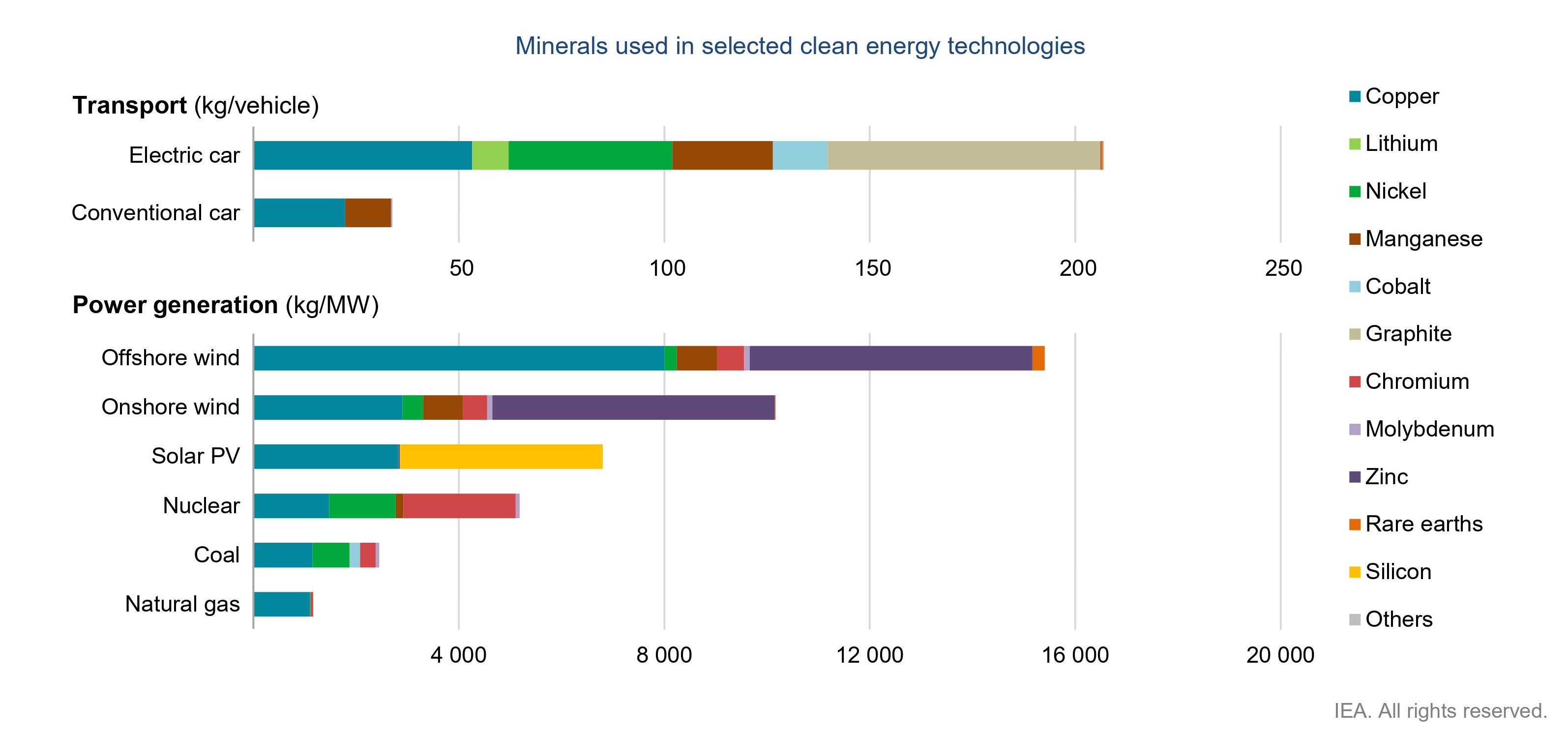
The need for greater quantities of clean technology minerals is ever more apparent. A recent IEA report underscored that cleaner transportation and power generation technologies use significantly more critical minerals than existing technologies. How this trend will shape the market remains difficult to predict. Supply sources can change as price increases entice new entrants, and demand can evolve as companies use alternative technologies and fewer (or recycled) minerals.
Click to enlarge
As G7 countries unveil climate commitments that rely on battery and other clean technologies, securing critical mineral supplies has shot up the policy agenda, with major consumers such as the U.S. and the EU focusing on securing supplies closer to home. As the Biden administration recognizes, these efforts are unlikely to suffice, given the geographical concentration of resources and the magnitude of mineral requirements in the clean energy transition.

Click to enlarge
Developing countries and emerging markets will likely remain important suppliers for the foreseeable future given the predicted increase in critical mineral demand and likely opposition to more mining in places like Europe. The IEA finds that high reliance on the DRC for cobalt (the DRC is currently responsible for around 70 percent of global production) is set to persist. For copper, expanding supply will likely require growing production in places such as DRC, Indonesia, Mongolia and Peru.
Major consumer countries should invest in improved mining governance in critical mineral producer countries
In many countries with large critical mineral deposits, mining sector governance remains weak, vulnerable to corruption and tied to concerns around political instability. These challenges are neither new nor easily overcome. But they are an essential part of the critical mineral supply puzzle, and therefore essential to achieving the G7’s economic resilience and energy transition objectives. Without effective policies and well-governed institutions in major producer countries, effective scale-up and stable supply will be elusive.
The DRC, the world’s largest cobalt producer and a major supplier of copper, must improve the fundamentals of mining governance. This includes granting mining projects to efficient and qualified companies (rather than well-connected cronies) and addressing the challenges of artisanal and small-scale mining that represents 15 to 30 percent of Congolese cobalt production. For countries such as Bolivia, with its huge undeveloped lithium deposits, a strong government understanding of where economic opportunities lie is essential. Otherwise, governments risk chasing rainbows, such as insisting on sometimes infeasible in-country processing of raw commodities, thereby delaying and disrupting projects without increasing benefits for citizens.
As demand for critical minerals increases, two possible scenarios emerge for mineral-rich developing countries. The first is an acceleration of corruption, political instability and resource dependency of the kind associated with previous commodity booms—especially in oil—and a governance “race to the bottom,” where host countries compromise on standards and fiscal terms as consumer countries clamour to capture market share. This path is a minefield for Western companies as well as producer countries. In the second scenario producer countries mature their mining sectors to meet the demand, with the proceeds contributing to (rather than undermining) their stability and economic wellbeing.
To make this second scenario more likely, leading consumer economies including G7 members should provide increased support and technical assistance to producer country governments seeking to improve sector laws, institutions and practices, and prioritize transparency, accountability and anticorruption within these programs. G7 governments could establish a trust fund for concerted investment in capacity development and accountability, including support for industry regulators, anticorruption actors and civil society players. The U.S.-led Energy Resource Governance Initiative (ERGI), which engages developing country producers, as well as the UN could be other key influencers.
G7 countries should also prioritize governance in their mineral supply chain initiatives. Unfortunately multilateral discussions of the issue have barely touched on better resource governance in producer countries. Efforts such as the OECD’s Due Diligence Guidance and public-private partnerships such as the Global Battery Alliance are laudable, but they tend to focus on tracking and certifying where mineral flows originate, stemming from very valid concerns around connections to child labor and conflict. They lack focus on governance problems (though a recent OECD report on corruption risks is a promising start). Discussions on transparency in critical minerals, including in the IEA report, have focused on market transparency (e.g., greater information on reserves, demand, processing capacity and pricing) and technological solutions such as blockchain. These are important, but miss some of the more glaring governance threats to stable supply.
The governments and companies leading supply chain initiatives must advance forward-looking anticorruption and governance standards. Such measures should prominently feature in standards such as the OECD guidance, legislation in the European Union and other consumer jurisdictions, new systems in producer countries, and the policies of mining and battery companies and sector investors. Such measures include:
- Disclosure of the identities of beneficial owners of companies participating in the critical mineral supply chain, to reduce the risks posed by politically exposed persons and other inappropriate players.
- Disclosure of mineral contracts/licenses and payments, to support public oversight.
- Stronger company anticorruption policies, with robust measures for assessing corruption risks, avoiding high-risk third parties and responding to wrongdoing.
- Producing country commitments such as audits of state-owned mining companies, competitive tenders for major procurement, and transparent licensing and commodity-trading regimes.
By prioritizing this agenda, G7 countries and others can shore up critical mineral supply chains in ways that advance their energy transition and economic resilience objectives while also reinforcing their broader commitments to good governance, anti-corruption and financing development.
Transforming Natural Resource Governance: Break Silos, Sharpen Politics

The political dimensions of natural resource governance are more prominent than ever. Rising threats to democracy, including surging populism, repression of civil society, and shifts in global power form an intimidating backdrop. This context will affect the levers of change that those seeking to promote effective natural resource governance must use. At the same time, there are opportunities to seize, including a growing global consensus of the imperative to address the climate emergency and state capture, and decolonize development by ending the systemic injustices and racism that plague the extractive sector.
To address these political challenges and capitalize on these opportunities, the natural resource governance community must evolve. We need to deepen and broaden coalitions at the local, national, regional, and international levels. We need to be politically savvier. We need to examine different ways of collaborating; consider merging efforts and institutions; and recognize when it is best to lead, follow the leadership of others, or move beyond the traditional single-leader model.
Confronting geopolitics and state capture
Meeting the twin objectives of defending gains and advancing resilient and sustainable governance of natural resources requires navigating geopolitical realities and political economy considerations. In an environment of intensified competition for natural resources, where gains made on transparency, civic space, and governance standards are under threat, the natural resource governance field must more proactively and effectively engage key geopolitical players. China serves as a case in point. China’s significant demand for natural resources, increasing presence in resource-rich countries, and dominance in the global rare earth minerals market show its prominence and centrality in the global natural resource governance space. Participants at the dialogue identified China as a priority actor for engagement.
Several participants noted that while China has often dominated the conversation (in large part due to its outsized role in global supply chains), those conversations have been about China rather than with China-based stakeholders. Dialogue participants called for adding another, newer dimension to engagement with Chinese standards and with Chinese stakeholders: in particular, more engagement with the Chinese government and company representatives in countries where they are extracting. Participants suggested that adding to the existing mix a new approach encouraging transparency and accountability on reputational or business grounds could be more effective for improving natural resource governance than a normative, moralistic one. Another key shift in perspective is to see the geopolitics from an Asian vantage, not just a US-EU-UK centric lens.
More generally, to appropriately analyze the interaction between corruption risks, political economy, and governance issues, a number of participants emphasized the need to understand and diagnose state capture—a pervasive form of high-level political corruption whose dynamics vary across settings. This may help transparency and accountability activists and reform agents to clearly identify obstacles to economic diversification, energy transition, and effective and equitable public health measures. Moving forward, implementing radical transparency in both industry (including state-owned enterprises) and government regarding natural resources and climate and environmental risks; eliminating tax loopholes, subsidies and bailout handouts for the fossil fuel industry; and advancing political finance reforms and reviewing the role and responsibilities of the U.S. oil majors in international initiatives such as the EITI must be priorities.
Combating repression of civil society
The pandemic has provided ample opportunity for states to abuse COVID-19 related restrictions to ramp up internet surveillance and restrict freedoms of assembly, association, and expression. As a result, many transparency and accountability advocates face increasing safety concerns. Yet, some international NGOs are struggling to maintain access to and political cover for these local actors.
New action within the natural resource governance field is needed to reinforce at-risk actors. While civil society actors often bear the brunt of risks for engaging with government, investors, IFIs, the G7, and G20, there must be a shared responsibility for protecting these activists by calling out bad actors and leveraging the power of investors, states, institutions, and corporations as appropriate. Political support should come from a wide range of groups at both the local and international levels, and from those with the power to influence government behavior.
Growing the coalition and strengthening alliances
COVID-19 has broadened the gap between groups operating on the local level and those functioning on a national or international level. Even before the pandemic, divides between local civil society organizations and national or international NGOs perpetuated the idea that policy discussions are high-level, technical exchanges between public officers and professionalized institutions.
Many participants expressed concern that the natural resource governance community has not done enough to collaborate across strategic vertical alliances within the natural resource governance field and horizontal alliances with other fields and movements. On the former, actors in the field believe that IFIs, local civil society organizations, national and international NGOs, and governments must unite on common objectives and improve information-sharing channels. On the latter, international and national groups must also find ways to engage more effectively with on-the-ground social movements such as those on human rights, gender, taxes, and climate in order to create a lasting change that is informed by and helps meet the needs of locally led, broad-based coalitions. Rather than co-opting those movements, natural resource governance actors should complement broader movements that will have spillover benefits for good governance of natural resources.
Advancing the agenda ahead
Throughout this three-part series, we have highlighted some of the trends, challenges, and opportunities that researchers, activists, and policymakers may examine to reimagine the sector. The call is to be clear and bold. Timid efforts and insufficient focus risk decreasing the effectiveness and credibility of the natural resource governance field.
Read the first two entries in this series here and here. Share your thoughts on these and other issues related to the future of natural resource governance on Twitter using #FutureOfNRG and participate in our survey on natural resource governance priorities.