
Ten Red Flags for Corruption Risk in Transition Minerals Licensing and Contracting

Key messages
- Corruption in the licensing and contracting of transition minerals projects is undermining a just energy transition.
- Some government officials and mining company executives are already using corruption around licenses and contracts to deny citizens and communities a fair share of the benefits of mining transition minerals. Through corruption that starts in the licensing and contracting phase, companies are neglecting and harming vulnerable populations and ecosystems with impunity. And corruption is delaying mineral production, sometimes for years.
- Corruption in transition mineral supply chains is a global problem, with our study identifying 53 cases of corruption in 30 countries across five continents, involving a diverse range of minerals. Corruption cases have been documented in 8 out of the 10 countries with the highest levels of transition mineral reserves. The companies involved in these cases are often based in the world’s wealthiest or most powerful countries, including Australia, Canada, China, Russia, Switzerland, the U.K. and the U.S.
- Most of the corruption cases identified followed a familiar pattern, with red flags surrounding the types of company granted licenses or contracts, the ways in which companies have sought to unduly influence decisions and decision-makers—often with implications for democratic processes, and how officials have circumvented proper processes.
- Efforts to skip or shorten essential safeguards around licensing and contracting processes can lead to greater problems in the future, as production is slowed or stopped entirely by legal proceedings, shutdowns, protests and strikes.
As the world moves away from fossil fuels, there is a growing demand for renewable energy technologies—and the minerals and metals needed to build them. To reach net zero globally by 2050, the International Energy Agency estimates that the world will require six times more mineral inputs in 2040 than in 2021. For some minerals, the demand could even reach 30 times current levels. Demand remained strong in 2023, despite more volatility in prices. While the development of new technologies or policies to reduce consumption and increase circularity could have a crucial mitigating impact on this demand, the coming decades will no doubt see many new mines come online.
As demand for these essential materials booms, there is risk of a corresponding increase in corruption, with harmful impacts on communities and nature, the state budgets of mining countries, and humanity’s collective ability to realise a just energy transition. In past commodity booms, fast-paced dealmaking and the promise of windfall profits encouraged graft and self-dealing. At the same time, the scale and pace of activity hampered the ability of oversight actors to keep pace with developments in the sector, making it harder to spot corrupt behavior. These problems could easily repeat themselves in transition mineral projects, not least given the added pressure of tackling the climate crisis.
Other characteristics of the current mineral boom could further increase corruption risks. First, NRGI’s research finds that many players in today’s transition mineral supply chains are assuming new roles in different stages of the supply chain and negotiating unprecedented deals, such as in cobalt supply chains.
As offtakers and consumer product companies manage unfamiliar risks and dominate multiple stages of the supply chain, their anticorruption processes may be poorly equipped, perhaps even intentionally, to address the challenges posed in the extraction and processing of transition minerals.
Second, reserves of key transition minerals are concentrated in countries that have struggled to control corruption. Transparency International Australia identified that as much as 94 percent of rare earth reserves and 70 percent of cobalt reserves are found in countries that score poorly on Transparency International’s Corruption Perceptions Index. Some minerals, such as rare earth elements, are found in countries with contested governments or ongoing violent conflict.
Corruption in mineral supply chains threatens a just energy transition both by increasing the risk of harms associated with mining, and delaying and disrupting the supply of minerals needed to deliver the necessary scale-up in renewable technologies required to fight climate change. Taking steps now to identify, prevent and redress corruption can help avoid the mistakes and harmful outcomes of the past, as well as new harms, lost opportunities and the reproduction of inequities.
Pemex and the Energy Transition: Timely Responses to Growing Threats

The energy transition requires timely and effective responses to ensure a sustainable future for everyone.
Key messages
- An energy transition that progressively phases out fossil fuels is needed to avoid climate catastrophe. Nonetheless, such a transition will harm oil-producing countries and their state-owned businesses, such as Mexico and Pemex. In the International Energy Agency’s Announced Pledges Scenario, an estimated USD 10 billion of Pemex investments would not break even. This would harm Mexican society: government revenue would fall, and Mexican businesses in the oil industry, such as those in the states of Campeche and Tabasco, would suffer.
- The energy transition is increasingly likely to result in a progressive and lasting decrease in global demand for oil. Although Mexico’s domestic oil market is significant, were Pemex to produce only to meet domestic demand, this would not sufficiently protect it or Mexico from the fall in global export demand.
- The energy transition may exacerbate what is already a difficult financial situation for Pemex. It is the world’s most indebted state oil company, with high costs in its refinery system, its labor and pension commitments, and several upstream projects. These challenges weaken the company’s position vis-à-vis the impacts of the energy transition.
- Oil extraction in Mexico has decreased over time. Despite substantial government financial support, Pemex has been unable to reverse the significant downward trend, and this is unlikely to radically change.
- Without sufficient profits, Pemex’s debt will grow. Its creditors have thus far been willing to loan it money, expecting continued government support. However, as more creditors worry about energy transition risk and decarbonize their investments, such willingness to lend is reducing. Interest rates are already rising for Pemex and likely also to increase for the Mexican government. This trend will make debt costs prohibitive for the company, trigger a spiraling of financial problems and increase the costs of government support.
The global energy transition is necessary to avoid the worst impacts of the climate crisis. However, it also brings risks for fossil fuel producer countries and national oil companies (NOCs), such as Mexico and Petróleos Mexicanos (Pemex). The International Energy Agency (IEA) estimates that if governments around the world meet the climate commitments they have set, global demand for crude oil will drop by half by 2050. This won’t be sufficient to meet the targets in the Paris Agreement, but it is concerning for oil companies and oil-producing governments.
The energy transition comes at a time when Pemex already faces challenges. Its oil production has fallen by nearly half since 2010. As a result, Mexico is today a net importer of oil products. To boost its “energy sovereignty” as defined by the Andrés Manuel López Obrador administration, and to ensure a diversified and secure oil supply, Pemex has invested significant resources in its national refinery system. The company also carries important financial labor liabilities linked to funds committed to its workers’ pensions. Considered the most deeply indebted oil company in the world, Pemex stays afloat because of substantial government support. Pemex’s debt exceeds USD 100 billion, equivalent to 5.6 percent of Mexico’s gross domestic product (GDP) for 2023.
On top of this, a significant portion of the government’s revenue comes from oil revenue. In 2023, oil revenue accounted for 15 percent of its total budgeted income. Of this total, 10 percentage points (MXN 736.56 billion) came from Pemex revenue. If we include the contribution Pemex makes to the Mexican Oil Fund, Pemex’scontribution to the country’s 2023 budget revenue is 22 percent. Nonetheless, as this report will explain, Pemex itself has reabsorbed a large portion of this contribution through financial support from the government.
These factors put Pemex in a difficult bind in facing the global energy transition. The response from Pemex and the government will be crucial for the sustainability of this state-owned enterprise. The response will equally be critical for Mexico’s public finances,6 its energy security, and the 520,000 people Pemex and its associated industries employ—especially in states like Campeche and Tabasco, where Pemex extracts most of its oil (50 percent and 41 percent of total company production respectively).
The decisions Mexico’s new government makes around Pemex will be pivotal, as will be proposals for how the company can face the enormous challenges ahead, including the energy transition risks the new administration faces. Mexico’s change of government in October 2024 represents an opportunity for citizens to demand a commitment from their political leaders to focus on the challenges Pemex faces in the context of the transition and on progress toward the country’s energy and decarbonization goals.
This report contributes to an understanding of the current situation and recommends three main focuses of discussion and action for Pemex, the Mexican government and policy-makers
Dispatches from COP29

Europe’s Dash for Gas in Africa Puts Private Profits Before African Countries’ Interests (Press Briefing)
Baku, Azerbaijan

Europe’s demand for gas is contributing to a wave of liquefied natural gas (LNG) projects in Mozambique, Nigeria, and Senegal. This favors the interests of European oil and gas companies over those of African countries, research shows. Experts will set out the risks of banking on LNG for development and call on European leaders to support a more sustainable model.
Speakers:
- Denis Gyeyir, NRGI
- Richard Folland, Carbon Tracker
- Vance Culbert, IISD
- Dean Bhebhe, Power Shift Africa
Featuring NRGI's
Critical Minerals for a Just Energy Transition
Baku, Azerbaijan

This panel discussion will convene global leaders from government, industry, and civil society to explore the significant role of critical minerals in operationalizing a just energy transition. Key discussion points:
- Insights from the recent UN Panel report on Critical Energy Transition Minerals.
- Critical factors for scaling solutions and ensuring equitable access to these resources.
- The intersection of investment, finance, and sustainability in the context of critical minerals.
Featuring NRGI's

Antonio Hill
Advisor
How to Win the Race to Access Critical Minerals for the Energy Transition in a Sustainable and Equitable Manner?
Baku, Azerbaijan

Access to critical minerals is increasingly understood as a condition without which not to achieve the green transition and energy security. Ensuring the supply meets future demand requires that we work simultaneously on sustainability, equity and financing. In this session, we will hear from initiatives that are trying to strike that balance, what challenges and opportunities they face in the process, and what is required from policymakers and various stakeholders to address these.
Speakers:
- Antonio Hill, NRGI
- Tom Haslett, U.S. International Development Finance Corporation (DFC)
- John Lindberg, International Council on Mining and Metals (ICMM)
- Lisa Sachs, Columbia Center on Sustainable Investment (CCSI)
- Nour Amrani, FLS
Featuring NRGI's
Antonio Hill
Advisor
Shaping Inclusive Narratives About Just Transition in Colombia

Narratives—the overarching frameworks that shape our understanding of issues—encompass a collection of stories, perspectives, and values that influence public perceptions and policy decisions. NRGI’s Alexandra Malmqvist spoke with Juliana Peña Niño about the crucial role of these narratives in Colombia's energy transition and why NRGI’s work in this area is more timely than ever before.
Why are narratives about the energy transition in Colombia so important?
Colombia has long relied on oil and mining, which account for more than half of the country's exports. Despite some progress on the energy transition away from fossil fuel, including Colombia's current president recently assuming leadership roles in international forums, there is still a lack of clarity at the national level on what this transition should look like and how economic, social, environmental and institutional change might happen.
This uncertainty has led to polarization and narratives opposing the energy transition—primarily led by powerful economic and political actors with vested interests in continued fossil fuel exploitation. These actors have shaped much of public opinion against the energy transition by framing it as unnecessary, arguing that the country is not a significant carbon dioxide emitter and that the transition is detrimental to economic stability and national development. This polarization has turned the discussion into a political debate about who supports or opposes the current government’s agenda.
Civil society organizations, citizens, local communities and Indigenous Peoples are not sufficiently represented in this debate. And among them perspectives are fragmented and scattered. There isn’t a unified alternative viewpoint in the public discourse that considers the energy transition as a desirable, possible, and all-embracing process. Without an alternative narrative that proposes a different vision, the energy transition itself may perpetuate the same historic inequality and inequity and imbalance of power that we see today.
So how has NRGI engaged on narratives in the country? What actions were taken, and what were the main findings or insights gained? Any surprising findings?
NRGI convened a diverse group of 30 individuals representing local communities, grassroots and Indigenous and women’s organizations, academics, and national and international civil society organizations (CSOs) to create a meta-narrative for a just transition as envisioned by various populations and civil society actors in Colombia.
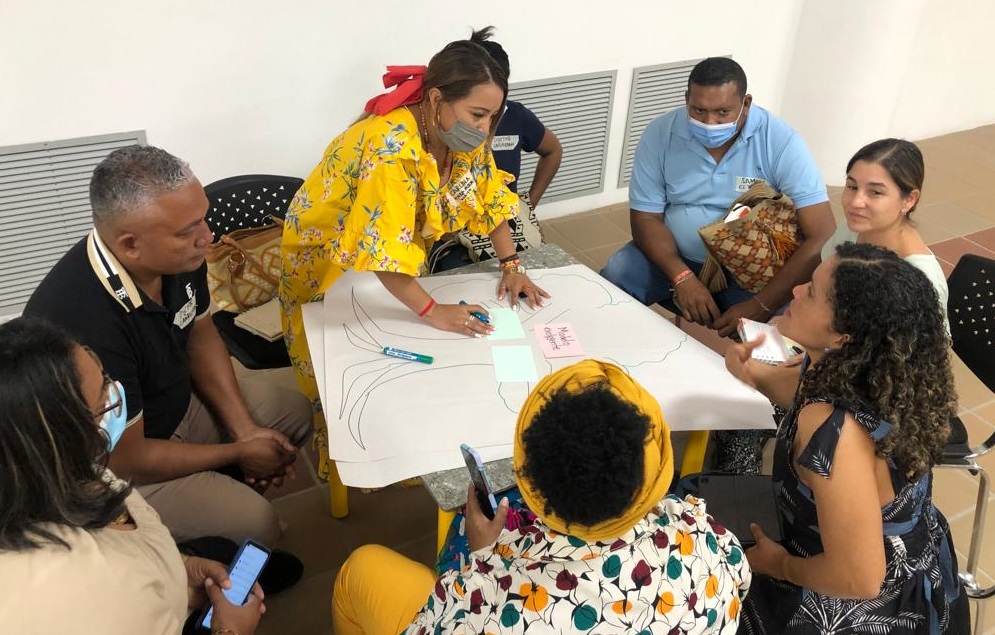
This initiative empowered communities and civil society to contribute more effectively to a public discourse that supports the energy transition. Participants learned about the concepts of stories, narratives and meta-narratives, and their role in strategic communications. For example, a story describes a single fact, while a series of stories form a narrative. A meta-narrative, on the other hand, encompasses several specific narratives, including core values and worldview that underpin them, and explains how we understand our relationships with ourselves, others and the world.
A key objective was to connect emotionally with the participants, fostering empathy for how others are experiencing the energy transition, particularly in Colombia’s north, where coal mines were closed and wind projects established. This work was also inspired by philosopher Martha Nussbaum’s ideas on the role of emotions in shaping public culture and a renewed ideal of justice.
With an academic partner we also used artificial intelligence to analyze outputs in Colombian news media to identify dominant narratives, providing a baseline of how the energy transition was framed by the media. We used this to develop our meta-narrative and ensure it was grounded in evidence.
One of the biggest challenges was balancing different views and the inability to reach consensus on some topics. However, in other areas, we found alternative ways to approach our differences. For example, an Afro-Colombian woman supported the energy transition but opposed new projects in her community due to their negative impacts. As a result, we included the principle that justice entails avoiding overburdening energy-rich regions with large-scale energy transition projects.
Two key aspects of this initiative stand out: first, the diverse contexts and realities of populations across different regions were central to crafting the meta-narrative, which is unprecedented in the sector. Bringing such particularities into the national discussion is essential for fostering a more inclusive decision-making process. Second, the project strengthened social capital by uniting a diverse group of individuals who are now more aligned and eager to continue working collaboratively to influence a just energy transition agenda in Colombia.
How do you ensure that the narratives you promote are inclusive and represent diverse community voices?
The meta-narrative drew on the diverse perspectives, values and ambitions discussed by the participants of a country beyond fossil fuels, with renewable energy sources and a diversified economy. To ensure inclusivity, we actively engaged participants with differing views and experiences. For instance, one Indigenous woman expressed that her community did not want the energy transition, fearing it would increase copper mining, threatening their customary lands and an important water source for their community and the wider region. In response, we included a principle in the meta-narrative that Indigenous communities have the right to manage their own lands. This aligns with Colombia’s constitution, which grants Indigenous peoples’ jurisdiction over their territories, and with the International Labour Organization Convention No. 169, which supports free, prior and informed consent.
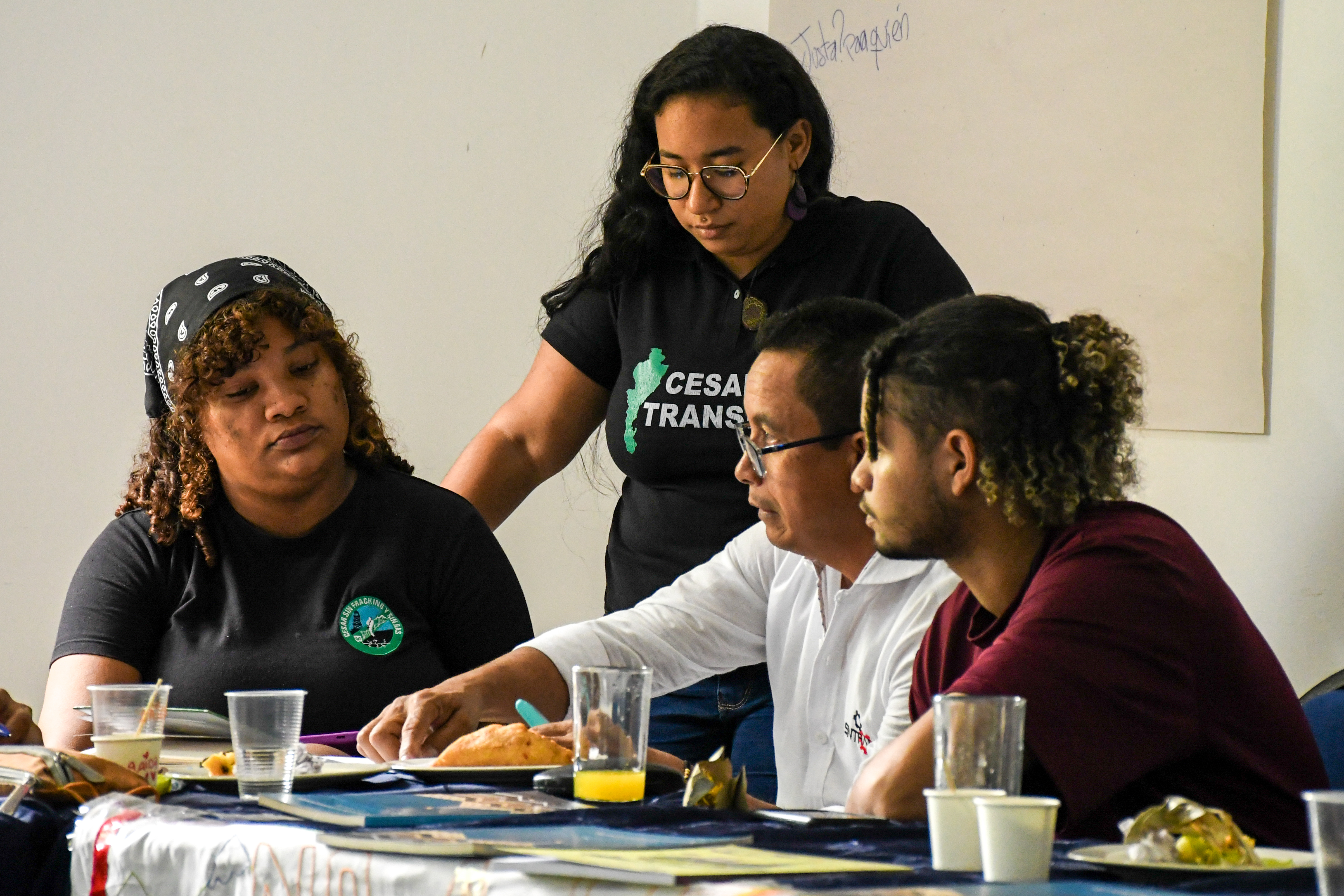
Building trust within the group was crucial from the start. We created a neutral, safe and inclusive environment where everyone felt comfortable, respected and valued. This approach was key to building consensus, so we made efforts to prevent and manage situations that could lead to feelings of competition, mistrust or power imbalances, particularly between national and local organizations. The exchange of different types of knowledge—including technical expertise, ancestral wisdom and lived experience—was highly valued and complementary.
As a result, the meta-narrative effectively captured the common goals identified by all members for a just energy transition, therefore supporting the collective efforts to position it in the public discourse.
Watch NRGI's video series from the narratives workshop featuring Colombian civil society's views on the energy transition and the framework for a just transition beyond fossil fuels.
Recently, we held an event aimed at "giving life to the meta-narrative," which provided capacity building on strategic communications and identified key political moments for its dissemination, such as COP16, COP29, and COP30. This event brought together 45 participants, including many from last year, fostering a growing network of individuals from various producing regions of the country who are now exchanging knowledge and strategies for advocacy to influence public discourse effectively.
NRGI is supporting civil society organizations and leaders to implement the meta-narrative in their communications and aiming to position this vision about just energy transition into the public discourse.
Enabling a People-Centered Energy Transition with Renewables and the Mining Industry
Baku, Azerbaijan

This event will explore the need for collaboration between the renewables and mining sectors to achieve the 1.5-degree climate target responsibly, focusing on sustainable supply chains that prioritize people. Following recent global commitments to triple renewables by 2030, the session will explore how these industries can jointly support a just and equitable energy transition, spotlight successful partnerships, and identify policy needs for sustainable growth in key markets.
Featuring NRGI's
Antonio Hill
Advisor
Multi-stakeholder analysis of the report of the United Nations Secretary General's Panel on Critical
Cali, Colombia

The United Nations Secretary-General's Panel on Critical Energy Transition Minerals was established on 26 April 2024, with the purpose of establishing ambitious principles and actionable recommendations for all actors involved in the critical minerals supply chain. As a result of more than four months of work by 40 experts, including country officials, civil society and industry, among others. Seven principles and five actionable recommendations were established.
Among the principles established by the panel of experts is the safeguarding of the integrity of the planet, its environment and biodiversity. Amid the urgent need for critical minerals for the energy transition, the governments of producing countries will be challenged to have very strong measures to face the climate crisis and meet the 2030 goals of the Kunming-Montreal Global Framework to stop and reverse the loss of biodiversity. In particular, Goal 3: ensuring “30 percent of terrestrial and marine areas conserved” and Goal 7: “[r]educing pollution from all sources” are very relevant to the challenges involved in critical mineral supply.
Objective
The purpose of this event is to show the progress made by the panel in the area of “no-go areas”, or the recognition of areas which, despite having critical minerals, should not be exploited for their ecosystem value, as well as the challenges for positioning this prohibition in international scenarios and the challenges for ensuring compliance with these good practices.
Panelists
- Johana Rocha, Ministry of Mines and Energy
- Mauricio Cabrera, Ministry of Environment and Sustainable Development
- Pedro Manuel Moreno, Deputy Secretary-General of UNCTAD
- John Lindberg, Head of Policy & Public Affairs of the International Council on Mining and Metals – ICMM.
- Nafi Chinery, Africa Director, NRGI
*Translation available
Featuring NRGI's

Nafi Quarshie
Africa Director
Financing the Energy Transition in Africa
Addis Ababa, Ethiopia

There is a general agreement among global policymakers that Africa’s development is inextricably tied to the growth of the energy sector within the region. It is estimated that Africa requires between $35 billion and $50 billion per year in energy finance to reach the United Nations’ Sustainable Development Goal Seven. Currently, Africa attracts only three percent of global energy investment.
Energy transition financing is not a new topic. However, in discussions to date, Africa is often considered a single entity. Countries rich in transition minerals and fossil fuels have specific profiles and face unique challenges and opportunities. On one hand, nations like Senegal, Nigeria, Ghana, and Uganda might see their fossil fuel projects jeopardized or slowed by the transition. This dependence on revenues from fossil fuels can influence policy decisions and financial flows, diverting potential investments away from renewable energy projects.
On the other hand, countries such as the DRC, Zambia, and Guinea could benefit from increased revenues due to their mineral wealth. These minerals needed for the energy transition provide one pathway for these countries to finance their transition.
This closed-door policy dialogue aims to bring a diverse stakeholder to reflect on the challenges, opportunities and mechanisms for financing the transition in Africa in oil, gas and mineral-producing countries. It will serve as a critical platform for stakeholders to discuss innovative financing solutions that can support sustainable (economically, financially, socially and environmentally) energy projects to reduce energy poverty across the continent.
Remarks by NRGI Africa director Nafi Chinery
Ladies and gentlemen, it is a pleasure to welcome you to this critical dialogue on “Financing Energy Transition in Africa.” This is the first of a policy dialogue series that NRGI is organizing to shape narratives and policies for financing the energy transition on the continent.
We are at a critical juncture where Africa’s energy demands continue to grow alongside the global imperative for sustainable and equitable development. Africa holds vast energy potential—abundant natural gas, mineral wealth, and some of the world’s richest solar and wind resources. Yet, with only 3 percent of global energy investment, we are far from realizing this potential to meet our needs.
We must face crucial structural challenges head-on, such as inequitable risk assessments, high capital costs, insufficient regulatory support, and the hurdles of underdeveloped financial markets.
We know that without an inclusive approach, our countries, whether oil and gas producers or rich in transition minerals, will face even greater obstacles in harnessing their resources for both economic resilience and environmental stewardship.
Driving sustainable energy solutions for our continent is a task that requires innovative financing, fair partnerships, and a commitment to Africa’s unique context and ambitions. As the energy transition accelerates globally, Africa’s pathway must be shaped not by external prescriptions but by our own priorities: powering growth, reducing poverty, and building resilience.
Together, we can interrogate and redefine how financing mechanisms support African countries—whether fossil fuel producers seeking transition paths or mineral-rich nations poised to fuel a greener future. We must continue to explore regional solutions, share lessons, and forge alliances that ensure the energy transition is both equitable and effective.
This is the beginning of exploring how to transform financing structures to reflect Africa’s realities and amplify African voices in global forums. It’s about ensuring that as we transition, we prioritize energy access, economic empowerment, and the environmental future of Africa’s people.
Featuring NRGI's
Nafi Quarshie
Africa Director
Silas Olan'g
Africa Energy Transition Advisor


Papa Daouda Diene
Senior Economic Analyst, Francophone Africa
Aaron Sayne
Lead, Sustainable Energy Supply

Paul Bagabo
Uganda Country Manager