
2018 Natural Resource Governance Institute Training Courses
The Natural Resource Governance Institute (NRGI) and its partners are pleased to announce course offerings for 2018.
NRGI offers global and regional courses (both in-person and online) that are tailored to civil society advocates, government officials, journalists, parliamentarians and other actors who are working to improve the management of oil, gas and minerals. Using participants’ own experiences as a launching pad for learning, our approach centers around in-depth discussions and policy labs that allow participants to apply new knowledge to their current professional roles. Courses encourage participants to examine and debate the pros and cons of policy decisions from various angles.
Thanks to generous donor support, NRGI offers a number of scholarships that are available to eligible participants from select countries.
This page will be regularly updated as new information about courses becomes available. Announcements on courses will also be made via NRGI’s Facebook and Twitter feeds.
ONLINE COURSES
Natural Resources for Sustainable Development: The Fundamentals of Oil, Gas and Mining Governance (facilitated MOOC)
Course cycle starts in February 2018
Delivered in English and Arabic starting in 2018
Subtitling available in Spanish, French and Russian
NRGI, the Columbia Center on Sustainable Investment (CCSI), the World Bank, and the Sustainable Development Goals (SDG) Academy (the educational arm of the United Nations Sustainable Development Solutions Network) will offer “Natural Resources for Sustainable Development: The Fundamentals of Oil, Gas and Mining Governance.” This massive open online course (MOOC) is designed for the participation of large numbers of geographically dispersed students. The course stretches over 12 weeks and covers a range of topics, including the challenges and opportunities that come with extractive industries, key political economy considerations, legal frameworks, tax policy, environmental issues, community rights, artisanal mining, economic linkages to the wider economy, and the management and investment of revenues for sustainable development. Each week, students will have access to around one hour of recorded video lectures that will be led by a diverse faculty of world-class experts and practitioners, including Professor Sir Paul Collier and Professor Jeffrey Sachs. In addition to completing key background readings, engaging in online forums and taking quizzes, students will have the opportunity to ask experts questions in weekly Q&A sessions. The course is particularly suitable for those who seek to build a solid understanding of the natural resource management field. The first facilitated edition of the MOOC was launched in February 2016, and the revised course with new additions and updates will run on 5 February 2018. Access to the course requires a reliable Internet connection.
To register for the 2018 facilitated MOOC, please click here.
Online Interactive Course (self-paced)
Course cycle starts in early 2018
Delivered in English
Starting in 2018, web users will be able to explore natural resource governance in Petronia through NRGI's new interactive web platform. Petronia is a simulated learning experience that explores the policy challenges of a fictional developing country that makes an oil discovery that could change the course of its development. Online learners join a team of experts who are deployed to advise Petronia's policymakers in a series of complex resource governance scenarios that are based on models and case studies developed by NRGI experts. Learners interact with their team and Petronian clients, choose their own interests, set their own learning pace, and along the way build their knowledge of the issues, stakeholders, and complex tradeoffs that are involved in managing resource wealth for development. This course combines the best of NRGI's learning tools—including animations, graphics, case study approaches, problem solving and data analysis—while also providing greater accessibility to a general audience. The full learning experience takes from 90 to 120 minutes and is suitable for users who may not be ready to make the more significant time investments required by the MOOC or in-person courses.
The platform will be available on NRGI’s website starting in 2018. To be notified of the platform launch, please register here.

GLOBAL COURSES
Reversing the Resource Curse: Theory and Practice
15-26 April 2018
Budapest, Hungary
Delivered in English
The application deadline has passed
This advanced course (offered in partnership with the School of Public Policy at the Central European University) is open to exceptional individuals from governments, civil society, parliaments, media, international development agencies, industry associations and academia who already have a solid understanding of natural resource governance and seek to enhance their knowledge and skills.
A limited number of scholarships (covering travel, accommodation and tuition) are available on a competitive basis for leaders from governments, civil society, parliaments, and media from the following countries: Colombia, the Democratic Republic of Congo, Ghana, Guinea, Indonesia, Mexico, Mongolia, Myanmar, Nigeria, Tanzania, Tunisia and Uganda. Individuals from other countries and sectors are welcome to apply for the course but will not be considered for scholarships. Donor and partner organizations may wish to provide additional scholarships. The cost of tuition is EUR 2,800 (this does not include travel, accommodation and dinners).
Watch a short video on Reversing the Resource Curse: Theory and Practice.
Visit NRGI’s course page to find contact details for inquiries and additional information on course content, faculty and requirements.
Executive Course in Oil, Gas and Mining Governance
9-14 September 2018
Oxford, U.K.
Delivered in English
Applications accepted starting in April 2018
NRGI and the University of Oxford’s Blavatnik School of Government (BSG) offer an annual high-level executive course on natural resource management for the most senior policymakers in government (e.g., ministers, deputy ministers, heads of agencies, departments and state-owned enterprises, as well as high-ranking members of parliament) and leaders in the private sector and in the donor community. This intensive five-day course provides the training and insight policy leaders need to work toward better management and governance of oil, gas or mineral resources. The course builds a better understanding of both public and private sector interests and facilitates dialogue and the mutual appreciation of the positions held by different groups.
More information on tuition and available funding will be available in April 2018. Visit NRGI’s course page or BSG’s course page to find contact details and more information about the course.
REGIONAL COURSES
Anglophone Africa Knowledge Hub Course
September 2018 Accra, Ghana Delivered in English Application deadline TBA
NRGI runs a comprehensive, intermediate-level summer school for participants from Anglophone Africa. The two-week residential course covers fundamental governance issues in the natural resource management decision chain. It also seeks to deepen participants’ knowledge and analytical skills in areas of fiscal and revenue management policies, Extractive Industries Transparency Initiative (EITI) reports, contracts and key legislation. The course is open to government officials, civil society actors, journalists, parliamentarians and private sector actors. Attendance costs USD 2,500 (inclusive of accommodation, food and tuition).
Watch a short video on the Anglophone Africa knowledge hub course.
For more information, please contact Nafi Chinery at nchinery@resourcegovernance.org.
| Francophone Africa Knowledge Hub Course | Université d’été du Centre d'Excellence pour la Gouvernance des Industries Extractives en Afrique Francophone |
|---|---|
|
30 July-10 August 2018 In partnership with the Centre d’Excellence pour la Gouvernance des Industries Extractives en Afrique Francophone (CEGIAF) at the Catholic University of Central Africa, NRGI delivers a two-week intermediate-level summer school on extractive resources governance in Yaoundé, Cameroon. The course is open to civil society actors, journalists, parliamentarians, mayors and senators with at least two years’ experience promoting good governance in extractive industries. The course covers the decision chain, including the decision to extract, legislation, contracts, taxation, collection and management of revenues, social and environmental impacts, and the impact of extractives on development. Three months of online preparatory activities will precede the two-week residential course. Preparatory work will commence on 1 March 2018. Attendance costs approximately USD 2,700 (inclusive of flights, accommodation, meals at venue and tuition). For more information, consult NRGI’s course page or contact CEGIAF at cegieaf.candidatures@gmail.com. Watch a short video on the Francophone Africa hub. |
30 juillet au 10 août 2018 En partenariat avec le « Centre d'Excellence Pour La Gouvernance des Industries Extractives en Afrique Francophone » (CEGIAF), de l’Université Catholique d’Afrique Centrale, Yaoundé, Cameroun NRGI offre un cours d'été (‘l’université d’été’) de niveau intermédiaire sur la gouvernance des ressources extractives, d’une durée de deux semaines à Yaoundé au Cameroun. L’université d’été est ouverte aux acteurs de la société civile, aux journalistes, aux parlementaires, aux maires et aux sénateurs engagés dans la promotion des industries extractives (IE) dans leur pays depuis au moins deux ans. Elle couvre la chaîne de décision des industries extractives: la décision d’extraire, la législation, les contrats, la fiscalité, la collecte et gestion des revenus, les impacts sociaux et environnementaux, et l’impact des ressources extractives sur le développement. Elle comprend des activités préparatoires de trois mois, qui se font en ligne et le cours d’été de deux semaines en résidentiel. Les travaux préparatoires débuteront le 1 mars 2018. Les frais de cours, y compris le transport par vol, l'hébergement, les repas et les frais de cours, sont d'environ US$2,700. Pour plus d'information, consultez la page dédiée à ce cours sur le site de NRGI ou contactez le CEGIAF cegieaf.candidatures@gmail.com. |
Asia-Pacific Knowledge Hub Course
January 2018
Bangka Belitung, Indonesia
Delivered in English
In partnership with the School of Politics and Government at the Faculty of Social and Political Sciences, Universitas Gadjah Mada, NRGI runs a two-week intermediate-level course, “Advancing Accountable Resource Governance in Asia Pacific.” The course is open to civil society organizations, legislators, national and subnational government officials, staff of state-owned enterprises, professionals involved in oil, gas and mining companies, people in academe, and media practitioners in the Asia-Pacific region. Attendance costs approximately USD 2,300 (inclusive of accommodation, food and tuition). For more information, consult the course page or contact Muhammad Djindan, Asia-Pacific hub manager at aspachub.polgov@ugm.ac.id.
| Eurasia Knowledge Hub Courses | Курсы Евразийского Центра Знаний |
|---|---|
|
Delivered in Russian In partnership with Khazar University, NRGI offers a comprehensive course on the extractive industries decision chain and thematic courses in issues relevant to the Eurasia region. These include EITI, revenue management and economic diversification in periods of low commodity prices. Courses are open to civil society actors, government officials, journalists and researchers. Watch a short video on the Eurasia hub. Planned courses for 2018 are:
For more information about Eurasia Hub courses, visit NRGI’s course page or contact Nazaket Azimli, Communications and Development Manager at nazaket_a@eurasia-hub.com. |
Курсы проводятся на русском языке В сотрудничестве с Университетом Хазар, NRGI предлагает всеобъемлющий курс по цепочке решений в добывающих отраслях и тематические курсы по важным вопросам для Евразии, такие как Ининциатива Прозрачности в Добывающих Отраслях (ИПДО), управление доходами и экономическая диверсификация в период понижения цен на нефть и газ. Курсы открыты для членов гражданского общества, госчиновников, журналистов и исследователей. На 2018-й год планируются следующие курсы:
Стоимость курсов отличается, однако стоимость основного курса по цепочке решений Хартии Природных Ресурсов составляет $2,625, включая оплату за обучение, расходы на проживание и питание. Даты курсов предворительны и будут утверждаться. Для дополнительной информации о курсах Евразийского Центра, посетите страницу NRGI по курсам или свяжитесь с Назакет Азимли, Менеджером по Коммуникации и Развитию Евразийского Центра по адресу nazaket_a@eurasia-hub.com. |
| Middle East and North Africa Knowledge Hub Course | دورة الشرق الأوسط وشمال أفريقيا |
|---|---|
|
Fall 2018 NRGI and the Lebanese Center for Policy Studies deliver an annual beginner-level comprehensive course on the governance of the oil and gas sectors. For more information, visit the course page or address your questions to resourcehub@lcps-lebanon.com. |
يقدم معهد حوكمة الموارد الطبيعية والمركز اللبناني للدراسات دورة تدريبية سنوية للمبتدئين حول حوكمة الصناعات الاستخراجية .دورة 2017 ستقام في شهرسبتمبر/ايلول. للمزيد من المعلومات، الرجاء التوجه الى صفحة الدورة او ارسال الاسئلة على العنوان التالي resourcehub@lcps-lebanon.com سيتم تنفيذ التدريب باللغة العربية و سوف يتم اقرار التاريخ المحدد في الأشهر القادمة |
[2]NRGI’s priority countries in Eurasia are Afghanistan, Albania, Azerbaijan, Kazakhstan, Kyrgyzstan, Mongolia, Tajikistan and Ukraine.
Grupo Propuesta Ciudadana Report Highlights Peru Mining Sector Challenges
In 2016, tax collection from Peru’s mining sector was negative. In other words, the government returned more money to miners than these companies paid in taxes paid. The result was that the collection was approximately negative USD 250 million. How did this happen?
This Spanish-language report from Peruvian civil society organization Grupo Propuesta Ciudadana explains the main challenges of Peru’s mining sector. It provides an assessment of what happened to that sector in 2016, presenting illuminating statistics on production, investment, value of extraction, taxes and royalties, among others. It also discusses critical issues such as economic diversification and the environmental impacts of extractive industries.
Claudia Viale is a Latin America officer with the Natural Resource Governance Institute (NRGI).
Countries Struggling with Governance Manage $1.2 Trillion in Resource Wealth
Revenue from natural resources can serve as a crucial tool for low- and middle-income countries to improve their development outcomes. However, these revenues are susceptible to mismanagement. A country’s newfound wealth is often squandered.
A key challenge for those seeking to ensure that resource revenues benefit citizens has been tracking resource flows. In the 2017 Resource Governance Index, NRGI assessed the management of resource sectors around the world. We set out to collect total oil, gas and mining revenue data for the countries included in the index to find out how many dollars flow to governments that botch the handling of their natural resources wealth.
This was challenging. Information on resource revenue in the public domain is incomplete and non-standardized. In many cases, this data was inconsistently measured across countries. Nevertheless, we were able to gather sufficient data to find that over USD 1.2 trillion in revenue is raised in countries with unsatisfactory (i.e., weak, poor or failing) scores in the index.
Methodology
In order to calculate total resource revenue data for 78 countries included in the RGI (we excluded three countries with devolved governance of extractive industries), we collected figures from the following sources:
EITI data. The Extractive Industries Transparency Initiative’s (EITI) 50 member countries publish documents about resource revenues. These documents reconcile the amount of revenues that governments report receiving and the amount of payments that companies report making. This data is compiled and available on ResourceData.org.
IMF dataset. The World Commodity Exporters Database published by the International Monetary Fund (IMF) includes key macro-fiscal indicators from IMF primary sources. The dataset covers 51 countries whose exports of oil, gas and metals contribute 20 percent or more of total exports.
ICTD database. The International Centre for Tax and Development (ICTD) publishes a global tax dataset combining multiple sources on a range of policy relevant indicators and, where possible, figures inclusive and exclusive of natural resource revenues. The most recently available version of the government revenue dataset was released in partnership with UNU-WIDER.
National data. Where data were unavailable from global datasets, we used data published by the governments themselves.
Looking at 2014 revenue numbers (we chose 2014 as the sample due to the highest availability of data across sources), these centralized datasets have data for 78 countries, 62 of which were included in the 2017 RGI (data collection was completed in 2016). We obtained resource revenue data for a further four countries from government-published data, bringing the total coverage of the RGI sample to 66 countries, or 85 percent.
Challenges
That left 12 RGI countries for which 2014 data is not available. We can group these remaining countries into the following categories:
Delayed reporting. For example, the latest EITI report for Myanmar covers 2013.
Lack of a total figure. Government reporting is disaggregated into resource and non-resource revenues at some level (e.g., only export custom duties are disaggregated for petroleum in India), but no total figure is published or can be calculated.
No data. For a number of countries—such as Argentina, Cuba, Morocco, Turkmenistan and Uzbekistan—we found no data. In the latter two of these countries, resource exports make up over 50 percent of total exports. Knowing what revenues they generate would be of high relevance. A number of extractive companies disclose granular information on the payments made in many of these countries due to payment disclosure legislation in Europe and Canada, However, this does not provide a figure for what the government received across the whole sector.
A lack of coverage was just one challenge. There was also discrepancy among data sources, which was caused by inconsistent and non-standardized data definitions and collection methodologies. Of the 38 countries included in more than one dataset, the difference between the highest and lowest data point is over 20 percent in 23.
For example, estimates of resource revenues for Zambia in 2014 reported by EITI are USD 1 billion, which is more than twice as high as the figure reported by the IMF and ICTD. Digging deeper, we found that most of this discrepancy can be attributed to the EITI’s inclusion of personal income tax, import taxes and VAT in resource revenues—all of which were omitted from IMF data.
In Nigeria, EITI estimates of 2014 oil revenue are 30 percent higher than the IMF’s. The IMF excludes national oil company proceeds from the sale of its equity stakes in oil projects. Instead, it captures only the dividends the national oil company elected to remit to the treasury. ICTD data is the lowest for Nigeria, at USD 37 billion, which lags the EITI total by a whopping USD 17 billion. (The ICTD dataset presents both central government and general government revenue data for Nigeria; NRGI used the higher general government figure.)
A detailed look at the data and discussions with some of the experts who compiled and had them revealed further differences in definitions and classifications.
Because EITI allows member countries to determine certain aspects of their reporting approach (such as the materiality threshold for the revenues it includes), EITI reports can vary in coverage from country to country, both in terms of revenue types and commodities covered. Also, the final EITI figure is based on a reconciliation process between government-reported extractive industry revenue and a company’s reported payment figures.
The IMF dataset focuses on on-budget payments, which may exclude revenues received by state-owned resource companies (in some countries these can be the largest revenue source for the country), resource funds and subnational governments. Other discrepancies may relate to cash and accrual accounting; differences in calendar and fiscal years; exchange rate conversions; and valuation of in-kind payments.
Despite these gaps, our data collection reveals that the level of coverage is steadily improving. Each initiative has been at least somewhat successful in assembling resource revenue information. But, between governments and sources of government statistics, more could be done to collect data in a comparable and standardized manner. The EITI International Secretariat now encourages countries to use Government Finance Statistics classification, but it doesn’t provide totals based on the standardized categories. The publication of revenue data by IMF is laudable, but it is unclear whether this is a one-off effort or will be continued.
Providing reliable, timely data on natural resource revenues is a first step in bringing more accountability to the sector. Our analysis found that in a handful of countries—including some of the most poorly governed—this basic information is still not available. It is crucial that the national governments of all countries with resource wealth disclose this information and participate in international data collection and standardization efforts.
Outcomes
Despite imperfections in the availability and comparability of resource revenue data, we were able to determine a sum total for 66 RGI countries: we estimate that resource revenue across the sample totaled USD 1.4 trillion in 2014. When we found multiple sources of revenue data for a single country, we used the average of the figures. Picking the lowest or highest of the multiple figures results in estimates of USD 1.3 and USD 1.5 trillion, respectively. This USD 233 billion range in total estimates exposes the challenges in attempting to combine resource revenue data.
The table below shows the results from resource revenue data collection based on the RGI banding system, which ranges from the highest rating of “good” to the lowest rating of “failing.”
|
RGI band (score /100) |
Total resource revenue (bn USD) | Average contribution of resource revenue (% total revenue) | Countries in this group with data available | Total countries in this group | Country coverage | Average deviation across sources* |
|---|---|---|---|---|---|---|
| Good (≥75) | 76 | 9.8% | 3 | 3 | 100% | 36% |
| Satisfactory (60-74) | 89 | 22.2% | 8 | 10 | 80% | 41% |
| Weak (45-59) | 469 | 25.6% | 26 | 28 | 93% | 25% |
| Poor (30-44) | 689 | 42.9% | 24 | 27 | 89% | 37% |
| Failing (<30) | 75 | 53.6% | 5 | 10 | 50% | 30% |
| Total | 1398 | 32.9% | 66 | 78 | 85% | 33% |
*Percentage distance between highest and lowest data point.
We find that:
- The availability of public government resource revenue data is, on average, worse in countries that performed poorly in the RGI. We could only locate data for 50 percent of the countries that have “failing” resource governance ratings.
- Over USD 1.2 trillion in revenue is managed by governments of countries that that have an unsatisfactory (i.e., weak, poor or failing) score in the RGI.
- The most resource revenue-dependent countries (restricted to the sample of countries we have data on) scored lowest on the 2017 RGI. Across countries where over 50 percent of revenues come from extractives, almost all scored either weak (45-60 out of 100) or poor (30-45 out of 100) in the RGI.
The strong negative correlation between resource governance and resource dependence provides suggestive evidence of the resource curse and the failure of these countries to diversify their revenues. Our analysis also underscores that resource revenue data that is reliable, timely and has good coverage is much too scant.
This must change. The accountability of trillions of dollars of government revenues is at stake.
The resource revenue data collected for this blog is available at Resourcedata.org
Anna Fleming was a research assistant with the Natural Resource Governance Institute (NRGI). David Mihalyi is an economic analyst with NRGI.
The Challenge of Adding Value in Tanzania’s Mining Sector
On 3 March the government of Tanzania announced an immediate ban on the export of concentrates and ores of all metallic minerals. The ban is intended to ensure that “value addition activities,” such as smelting and refining, are undertaken within Tanzania, with the stated objectives of increasing revenue generation, employment creation and technology transfer. By announcing such a policy, Tanzania joins several other resource-rich countries, including Indonesia and Mongolia, which are considering or implementing policies that encourage domestic mineral “beneficiation”– the processing of mined output into a product of higher value – as an alternative to heavy reliance on the export of unprocessed minerals.
The Tanzanian government can potentially achieve increased economic benefits through a beneficiation policy. Smelting and refining facilities would provide some employment opportunities, and there could be spillover benefits for related industries through knowledge and technological transfer. In-country processing could also generate additional government revenue in the long term via the sale of a higher-value product and lower transport costs. (Refined products weigh less and take up less space than raw commodities.) It could also lower the risk of tax avoidance. Unlike refined products, the mineral content of ores and concentrates can vary considerably, increasing the risk that companies might underreport the value of their exports. Recent government comments suggest suspected tax avoidance is one of the primary reasons for the ban—though the risk of misreporting is likely to be lower now that the Tanzania Minerals Audit Agency (TMAA) can effectively assay samples.
The most obvious impact of the ban to date is on copper concentrate, which London-listed Acacia Mining Plc recovers during the processing of gold at two of the country’s gold mines. The gold bars produced can still be exported given their refined form. However, with no in-country capacity for smelting and refining copper concentrate, the company has been required to suspend its export until further notice. Acacia, the country’s largest gold producer, has indicated that copper concentrate represented 30 percent of its revenues in 2016. Extractive Industries Transparency Initiative (EITI) data suggests that Acacia contributed 37 percent of Tanzania’s mineral revenues in 2013/14. Other projects would also be significantly affected going forwards, including three prospective large-scale nickel projects which are scheduled to commence operations in the next few years.
Critical factors for consideration
While there are potential benefits to increased value addition in Tanzania’s minerals sector, the current policy may or may not achieve the intended impact. There are a number of factors that government officials should consider as they plan implementation of this policy.
Immediate opportunity cost. The government will suffer an immediate fall in mineral revenues as a result of the export ban. Development of smelting and refining facilities will likely take at least three years, so revenues will be lower for some time, reducing the government’s ability to address the country’s urgent development needs . The opportunity cost will be even greater if the affected companies decide to halt exploration or move production operations completely.
Different costs and benefits across minerals. As discussed briefly below, the costs and benefits associated with smelting and refining copper concentrate are different from those for other minerals. Applying this policy to all metallic minerals rather than targeting those that are more likely to generate benefits is likely to reduce chances for success.
The commercial viability of smelting and refining facilities. While economies of scale are less important for smelting and refining nickel, large-scale economies are required for copper plants to operate profitably. In a 2011 study of the viability of a copper smelter, TMAA suggested that the volumes currently being produced in Tanzania would not generate the necessary scale economies for a smelter to be profitable. Cost levels also depend on the quality of the feedstock. TMAA indicated that Acacia’s output tends to be blended with that of other producers before being smelted, given its lower quality. The discovery of further copper reserves and/or the import of copper concentrate from elsewhere in the region may therefore be necessary for smelting and refining facilities to operate profitably in Tanzania without government support.
Potential for additional revenues. Smelting and refining increases the export value of some metallic minerals by only a small margin. A 2013 Indonesia study by Nathan Associates indicated that refining can add significant value to nickel but generally adds little to the value of copper concentrate. The increase in the value of the gold and silver contained in concentrate is minimal, while the price differential between the concentrate and refined copper is only around 4 to 6 percent. Concurrently, the cost of constructing and operating smelting and financing facilities is significant, especially when scale economies are limited. Therefore any increase in export value may be negated by higher costs, resulting in lower, not higher, government revenues.
Impact on other sectors and diversification. Smelting and refining facilities require considerable financing. Government support may be necessary, such as through a public-private partnership. However, this could reduce the government’s capacity to provide similar support to other productive sectors. These facilities also require significant power, but a reliable power supply will likely mean diverting energy from elsewhere. In both cases, the government’s efforts to diversify Tanzania’s economy would be hampered while exposure to the inherent volatility of the minerals sector would increase.
Investment environment. While it seems the government and industry have been discussing this issue for some time, the imposition of the ban with immediate effect—including on existing projects—is indicative of an increasingly unpredictable policy environment. The impact that this has on the decision-making of both current and potential foreign investors could be significant. This has specific implications for the success of this policy. Given the scale economies required to overcome prohibitively high smelting and refining costs, any reduction in investment in the upstream–either due to already-present mining companies slowing operations or would-be new investors shying away from Tanzania–will affect the viability of investing in the downstream. It also has implications for the wider economy at a time when investment in Tanzania’s large offshore gas deposits is still uncertain. Engagement with industry and the development of a consensus on this process is now all the more important to reduce uncertainty and ensure that Tanzania continues to attract investment.
While there are potential benefits to increased value addition in Tanzania’s minerals sector, there are also a number of potential costs. These costs and benefits will vary for different minerals. A comprehensive cost-benefit analysis, specific to each mineral and undertaken in consultation with industry, is therefore a crucial next step in the implementation of this policy.
Thomas Scurfield is an economic analyst with the Natural Resource Governance Institute (NRGI) in Tanzania.
Mining Indaba 2017: Steps Toward a Sustainable Future?
This year’s Mining Indaba, the world’s largest mining investment conference, took place last month and was the usual whir of networking among government and industry power players against the stunning beauty of the Western Cape.
Last year’s edition was overshadowed by pessimism in the wake of tumbling commodity prices and organizers tried to boost morale by encouraging participants to look “beyond the cycle.”
But this year the buzz word for multilaterals was sustainability—from the launch of World Bank’s African Mining Legislation Atlas Guiding Template for drafting mining laws; to the African Legal Support Facility’s contract negotiation workshop; to a session on leveraging the African Mining Vision Compact for consensus building on shared benefits from mining between government and private sector; to a series of roundtables on local content, legal reforms, resource-based industrialization and more by the Intergovernmental Forum on Mining, Minerals, Metals and Sustainable Development. Even private sector actors got involved with the International Council on Mining & Metals, the International Finance Corporation and Anglo American co-sponsoring side events on employment creation and the contentious issue of water management.

This sustainability preoccupation may be a direct result of policy soul-searching at the end of the heady days of the commodity price boom. The sad realization that countries had failed to benefit from soaring prices and were ill-prepared to manage the fallout from the price crash has sector players asking “what went wrong?” Leaving pessimism aside, countries and donor organizations alike are focusing on improving legal frameworks, negotiating better contracts, and ensuring communities benefit from mining.
So, what are the prospects for getting sustainable mining right? A strong legal framework is obviously a good starting point and the World Bank’s new guiding template provides a detailed and comprehensive tool to support legal reform. But the template is not a panacea. Instead, it provides the foundation for vigorous, well-informed debate within a country on optimal policy choices in light of the trade-offs. The Democratic Republic of Congo recently learned the consequences of (perhaps) overly ambitious reforms. Aggressive proposed fiscal terms meant to right the wrongs of the 2002 Mining Code ended up stymying the entire reform process, and important environmental and social reforms were thrown out in the process.
These social and environmental elements are not trivial. The demonstration of the World Bank’s MinGov tool at the Indaba indicates that political stability, control of corruption, clear legal rules and predictable tax policy may not be enough to ensure sustainability. While Botswana, long considered an example of good natural resource governance, scores high on these dimensions, it lags in other important areas, such as environmental and social impact mitigation, human health, local supplier development and leveraging infrastructure.
So are countries moving in the right direction? NRGI’s upcoming 2017 Resource Governance Index will assess governance in some 80 countries, looking not just at the quality of laws but also implementation of these laws. For countries assessed in both the 2013 edition and the new index, we will have the chance to see whether governance is improving in the countries that need it most.
Since the close of the indaba, there are signs that the tide may be turning, at least for industry—heavyweights BHP Billiton and Anglo American have reported sharp increases in profits, at least in part on the back of a recent rebound in commodity prices.
But getting the full benefits of rising prices goes well beyond attracting investors. It’s a good sign that participants in a mining investment conference are recognizing that they must talk about more than just investment. Hopefully, this is one small indication that this time around a sustainable future in mining is within reach.
Nicola Woodroffe is a legal analyst with the Natural Resource Governance Institute (NRGI).
Oil Companies Face Stranded Assets, But Producer Countries Have It Worse
On Wednesday, BP chief economist Spencer Dale warned of a long-term and permanent slump in oil demand as the world shifts away from fossil fuel use. The Financial Times quotes Dale as saying: “I think it is increasingly likely that there will be technically recoverable oil reserves which will never be extracted and if I was the owner of one of those companies which owned that oil I would have every incentive to make sure it wasn’t mine [left in the ground].”
The NGO Carbon Tracker, as part of its “stranded assets” campaign, has issued similar warnings for some time. But Dale explained that while oil companies such as BP have the ability to “shift capital in pursuit of the most attractive resources … producer countries and their national oil companies have less flexibility.” Campaigners highlight the long-term risks investors face in investing in the oil industry, but it is countries dependent on extraction who may well be left with the greatest exposure.
In the working paper “Stranded Nations? The Climate Policy Implications for Fossil Fuel-Rich Developing Countries,” Jim Cust, Giorgia Cecchinato and I explain why many of these developing nations are between a rock and a hard place. If the world does not switch to low carbon consumption, these countries face extreme weather-related problems caused by global warming. If the world embraces clean energy, they face a dramatic depreciation in the value of their fossil fuel wealth.
Our research confirms BP’s warning. Many developing countries have abundant fossil fuel reserves but extract fossil fuels at relatively slow rates. Therefore much of their hydrocarbon wealth will remain stranded underground under a scenario in which demand peaks and then declines in the 2040s, as BP predicts.
Left stranded
Most fossil fuel-rich countries will take at least 45 years to liquidate their fossil fuel wealth unless they can increase production rates. (weighted reserves-to-production, years)

Source: David Manley, James Cust and Giorgia Cecchinato. “Stranded Nations? The Climate Policy Implications for Fossil Fuel-Rich Developing Countries”. Oxford Centre for the Analysis of Resource-Rich Economies Policy Paper 34 (2016).
What can fossil fuel-dependent countries do? First, officials must recognize the dilemma they face and plan accordingly. Many of the good governance principles espoused in the Natural Resource Charter remain relevant. It is the urgency that has changed.
The ultimate solution for these countries is to diversify. Governments of countries with nascent fossil fuel industries—such as offshore gas developer Tanzania—must ask hard questions about how many human and public resources to invest in an industry that might yield minimal returns. Given the uncertain future, those committed to helping these countries govern their resources must also re-calibrate. Our working paper and efforts by others (here, here and here) are only the beginning.
David Manley is a senior economic analyst at the Natural Resource Governance Institute.
At International Anti-Corruption Conference, Calls for Sustained—and Heightened—Vigilance
Earlier this month, I attended the International Anti-Corruption Conference, joining leading activists and advocates from around the world. Taking place in Panama City, the home of Mossack Fonseca, the event provided an opportunity to reflect on the Panama Papers nine months after their publication.
The government of Panama had agreed to host the IACC eight months prior to the leak. This threw the country into the spotlight. Primarily implicating Mossack Fonseca, the law firm and corporate service provider at the center of the scandal, the papers also raised questions for the Panamanian government.
Panama President Juan Carlos Varela assured the conference that his government had a zero tolerance approach to corruption, but his statements rang hollow. Nobel Laureate Joseph Stiglitz and anti-corruption expert Mark Pieth had resigned from the commission established to review Panama’s financial sector transparency in August. The government, they said, had refused to guarantee the commission’s results would be made public.
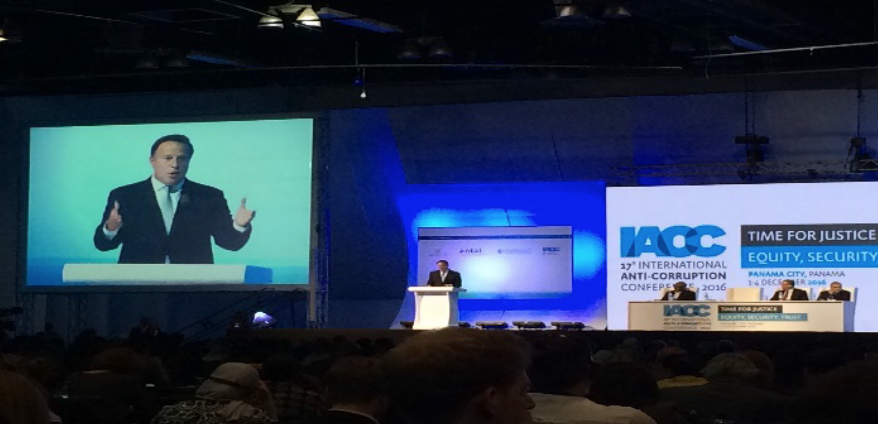 Panama President Juan Carlos Varela opens the IACC.
Importantly, the leaks focused mainstream media attention on secret offshore companies. Large demonstrations and a public sense of injustice forced officials across the globe to resign and face investigations. The repercussions were also felt in the private sector: recent research shows that the 397 publicly listed firms linked to the papers lost a total of USD 135 billion in market capitalization, demonstrating potential costs to the use of secret corporate vehicles.
The leaks brought a new sense of urgency to the international push for companies to publicly disclose beneficial owners. (This focus was also seen at the U.K. Anti-Corruption Summit in May.) How to build on this momentum was a frequent topic of conversation at IACC.
One positive step came from OpenCorporates, which launched an initiative to create a Global Beneficial Ownership Register. The register tackles the cross-border and highly networked nature of corruption and aims to link beneficial ownership data from corporate registries across the world and establish a common reporting standard.The few private sector IACC participants attending argued that it was time to end anonymous companies. Deloitte partner James “Chip” Cottrell said making the ultimate owner or owners of companies public is vital for business and helps create a level playing field. BHP Billiton Chief External Affairs Officer Geoff Healy said that when a corporate entity is established, it should disclose its beneficial ownership as a prerequisite to exist. Also from the private sector, The B Team worked closely with the Bank of Montreal, Deloitte and Thomson Reuters to develop an online tool that provides businesses with detailed information on beneficial ownership and concrete steps toward ending anonymous companies.
Beneficial ownership transparency just one piece of the puzzle to uncover corruption. It will need to be combined with additional transparency mechanisms like asset declarations by public officials (such as those introduced in Ukraine) and strong domestic legislation to guard against conflicts of interest. Though these issues got less attention at the IACC, they require further analysis.
The United States’ changing political landscape and its potential implications for the fight against corruption loomed large. Carnegie Endowment for International Peace senior fellow Sarah Chayes and Harvard professor Lawrence Lessig argued that President-elect Donald Trump effectively tapped into a U.S. fear of corrupt government officials, pledging to “drain the swamp” in Washington, D.C. Mainstream activists and politicians failed to recognize growing discontent, they said, and the anti-corruption movement now needs to wake up and more effectively address these concerns.
Other IACC speakers voiced fears that significant gains made by the United States in the global fight against corruption will be weakened. For instance, Section 1504 of the Dodd-Frank Act, which requires U.S.-listed oil, gas and mining companies to disclose payments made to governments for natural resource development, introduces greater transparency in resource-rich countries around the world. The American Petroleum Institute, an oil sector lobby group, has fought against this provision for years and blocked its implementation through a lawsuit launched in 2012. As of 2016, the law is back on track. Some are concerned, however, that special interest groups might enjoy even greater leverage in the coming years.
The fate of the Foreign Corrupt Practices Act was a recurring theme of discussion. Trump has said that the FCPA is “horrible law and it should be changed,” raising concerns that this legislation could be weakened or pursued less vigorously by the Department of Justice and the Securities and Exchange Commission. Since the early 2000s, the FCPA has become a key piece of legislation used by those agencies to pursue U.S. and U.S.-listed companies bribing foreign government officials. A change to the FCPA or its implementation would particularly affect companies in the extractive sector, given that a major focus of FCPA investigations have involved oil, gas and mining companies.
It is too soon to tell how the new administration will address transparency and corruption in the extractives sector. The IACC drove home that the global anti-corruption movement needs to brace itself for change, hold on to hard-fought victories and look for new opportunities where they arise.
Max George-Wagner is a governance associate with the Natural Resource Governance Institute (NRGI).
Report: Healthcare, Education, Gender Equality All Suffer During Azerbaijan Oil Boom
Resource-rich governments tend to overspend extractives revenues on large infrastructure projects and underinvest in education, healthcare and social welfare. This is a key component of the so-called resource curse paradigm, and one clearly exhibited in the case of quintessentially oil-dependent Azerbaijan, according to a December report.
Proceeds from oil exports, if managed well, can improve the quality of a country’s schools and universities or build an inclusive medical insurance system. Heathy, well-educated and high-capacity labor is necessary to ensure sustained economic development, and would clearly help countries like Azerbaijan in the longer term.
In a widely-cited paper, economist Thorvaldur Gylfason finds that states with abundant natural resources often inadvertently or deliberately neglect education spending. He argues that “nations that believe that natural [resource] capital is their most important asset may develop a false sense of security and become negligent about the accumulation of human capital.”
Governments might also be de-incentivized from investing in education and building domestic labor capacity: most high-tech technology can typically be supplied by foreign oil corporations, as can a high-skilled workforce. Oil sector jobs also tend to be male-dominated, affecting female labor force participation.
Importantly, foreign oil companies are expected to contribute to countries where they work through corporate social responsibility (CSR) projects and local content policies.
The December 2016 issue of the Caucasus Analytical Digest tested these concepts, looking at the record of human capital accumulation, gender equality and CSR in Azerbaijan during the recent oil boom. Its findings can be summarized as follows:
- The government clearly under-invested in education and healthcare.
- The quality of public education deteriorated precipitously, falling behind even the regional standard.
- The oil curse hurt women more than men, and women have missed out on the dividends of the latest oil boom.
- The contribution by oil companies, notably BP, has been limited to project-affected regions or in and around the Baku area, and most of the education investments have targeted professionals in the energy sector.
Farid Guliyev is a research associate with Eurasia Extractive Industries Knowledge Hub at Khazar University, Baku.
NRGI’s Top 10 Blog Posts in 2016
NRGI’s blog—which showcases the breadth of expertise of a global team and delves into the most pressing issues in resource governance—received thousands of unique visits this year.
Readers favored detailed long-reads posing provocative and original questions, analytical pieces on highly complex topics and output tied to breaking news and global events in the transparency space. These included posts testing a model for monitoring Ghanaian oil revenue, parsing Zambia’s new mining tax regime, and linking the Extractive Industries Transparency Initiative to the massive Panama Papers leak. Three of the most-read posts concerned the Anti-Corruption Summit held in London in May.
As 2016 draws to a close, read—or reread—this collection of NRGI’s most popular editorial output, starting with the most-visited post.
1. An Analysis of Ghana's 2015 Oil Revenue Performance: Testing the Model
2. Zambia's New Mining Tax Regime May Fail the Test of Time
6. Oil, Order and Diversification in Libya
7. Summit Supercharges Anticorruption Work, But We Must Aim Higher
8. Paradox of Plenty, Redux: Azerbaijan Grapples with Low Oil Prices
10. Who Committed to What in Extractives at the U.K. Anti-Corruption Summit?
And three of NRGI’s most-read blogs in 2016 showed a curiously long shelf life: they were published in 2015. They are:
- Did the U.K. Miss Out on £400 Billion Worth of Oil Revenue?
- Six Reasons Why Sovereign Wealth Funds Should Not Invest or Spend at Home
- Ghana's Petroleum Exploration and Production Bill: Steps Forward, But Room for Improvement
Click here to view NRGI’s most-read blogs in 2015.
Tanzania, Ghana, Uganda Journalists Share Extractive Industry Lessons
For years, Tanzania learned lessons in effective petroleum resource revenue management from Ghana and Uganda. During the latest regional media training course from NRGI, Tanzania’s recent stewardship of the sector presented lessons for Ugandan and Ghanaian journalists to take home.
In mid-October, journalists from the three countries spent two weeks together in Dar es Salaam and the southern coastal town of Mtwara focusing on current trends and developments in the extractive industry globally and within their respective countries. They homed in on policies, regulations, laws, and actions governments can take to ensure that the oil, gas and mineral wealth of their countries benefits the citizens.
Tanzania has at least 50 trillion cubic feet of natural gas reserves. Sixty percent of electricity supplied to the national grid is generated from this resource. A 2015 local content policy enabled Tanzanian nationals and businesses to increase their participation in the natural gas industry through employment, supply of goods and services, technology transfer and technical skills acquisition. The country is rapidly and vigorously installing and expanding its gas production, transmission and distribution infrastructure.
With developments in Tanzania as the backdrop, 24 reporters from 21 news outlets participated in the seventh edition of NRGI’s Africa regional course on covering the extractive industries. One of these reporters, Daily Monitor’s Jonathan Adengo, drew on what he learned about the Tanzanian experience to explore lessons for Uganda.
NRGI implements this media training program in partnership with the Journalists’ Environmental Association of Tanzania, Penplusbytes in Ghana and the African Centre for Media Excellence in Uganda.
Below are the profiles of the journalists in the class of 2016:
TANZANIA
 Bernard Lugongo
Bernard is a senior writer with the state-owned Daily News newspaper and has a media career spanning seven years. He has covered a range of issues, particularly the environment. Since Tanzania is striving toward becoming a gas-powered economy, Bernard believes the training will prepare him to report on the contribution and benefits of the oil and gas sector to Tanzania and its citizens.
 Rose Athumani
Rose is a senior journalist with Daily News. She has practiced journalism for 12 years, covering the environment, politics, parliament and health, among other beats. She wants to deepen her knowledge of the extractives industry to enable her accurately cover stories on oil, gas and minerals, and to ultimately bring positive change in society.
 Felix Mwakyembe
Felix is a senior environmental journalist for Raia Mwema, a Kiswahili weekly publication, and has 20 years of experience in media. His coverage focuses on the extractive industry. In 2011, he won the environmental category of the Excellence in Journalism Awards Tanzania. He looks forward to broadening his knowledge and skills in covering the extractive sector.
 Sophia Kessy
Sophia is a radio and TV news anchor for Clouds Media Group. She previously worked as programs manager for Orkonerey Radio and a news anchor at Triple A FM in Arusha. She has practiced journalism for eight years.
 Goodluck Hongo
Goodluck is a senior reporter for Business Times Limited (Majira) and has practiced journalism for seven years. His beat has largely been politics, but he is interested in covering the gas and mineral sectors. He believes that the training will equip him with a better understanding of the extractives sector in Tanzania and beyond, and to explore how governments can utilize extractive resources to build strong economies.
 Sidi Mgumia
Sidi has been working as a senior environmental reporter for Mtanzania newspaper since 2009. Her goal in attending this training is to gain knowledge and acquire techniques on management of the revenue generated from extractives, how it is spent and how it affects economic growth. She is also interested in covering related issues, such as the environment, contracts, employment and security.
 Muhamed Khamis Juma
Juma is a news writer/photojournalist with Mtanzania newspaper, a position he has held for five years. He is particularly interested in gaining knowledge on how to collect data to support his reporting on oil, gas and mining.
 Philemon Lusekelo
Philemon is the assistant news editor for The Guardian, a daily newspaper. In May 2016, he won the HIV/AIDS print category of the Excellence in Journalism Awards Tanzania. Driven by a strong urge to make a difference in his community, Philemon writes frequently and extensively about the extractives industry, the environment, HIV/AIDS, youth development and education.
GHANA
 Ebenezer Agyekum-Boateng
Ebenezer is a senior broadcast journalist and producer with TV3 in Accra. He has 15 years of experience in radio and television broadcasting. As a business journalist, he has covered issues in oil, gas and mining, the commodities market, fiscal and monetary policies, insurance, banking and finance. This training, he says, will deepen his understanding of governance issues in the extractive industry and enable him to highlight the right policies and regulations for Ghana through his stories.
 Juliet Aguiar
Juliet is the Western Region correspondent for the Business and Financial Times, a position she has held since April 2011. Her wide range of interests includes oil, gas and mining as well as maritime issues, commodities, the hospitality industry, small and medium enterprises, banking and finance. She previously worked with Ghana News Agency and Ghana Broadcasting Corporation.
 Abednego Akwasi Asante Asiedu
Abednego is the assistant producer of Burning Issues, a political talk show on Adom FM. He has practiced journalism since 2010 in both print and electronic media. In 2015, he was honored by the Pan African Clergy Council and Bible Seminary for his contribution to journalism in Ghana.
 Theophilus Kwesi Agyei Annim
Theophilus is a regional correspondent for Viasat1 News, having started as a video journalist for the same media house. He has close to a decade of experience in television and radio news reporting. He previously worked for Ghana News Agency, Ghana Broadcasting Corporation and Television Africa. His long years of reporting from the mineral-rich Western Region have equipped him with an appreciation of the extractive industry as well as the environmental and developmental concerns of rural Ghana.
 Mercy Acheampomaa Darko
Mercy is a business and financial broadcast journalist with Ghana Broadcasting Corporation. Trained on the job, her passion for journalism and economic issues has grown over the years. She is now a senior editor on the business and economics desk. By participating in this training, Mercy hopes to expand her professional horizon.
 Dennis Kwadwo Peprah
Dennis works for Ghana News Agency as a senior reporter and has been with the agency for 13 years. He is also the news editor for Sky FM. He is interested in covering the extractive sector, health, sports, agriculture and the environment.
 Maxwell Suuk
Maxwell works with Deutsche Welle, Germany’s international public broadcaster, as its northern Ghana correspondent. He is also an editor at a local radio station. He is interested in human rights and the environment, as well as health and poverty issues. Maxwell coaches young people interested in becoming broadcast journalists on how to produce radio reports and has received national recognition for this work.
 Frederick Duodu Takyi
Frederick writes for the Daily Guide. He is also the Volta Region correspondent as well as manager of News Ghana, an online news portal. For the five years he has practiced journalism, he has covered general news with special interest in the extractive industry, business, technology, the environment and investigative reporting.
UGANDA
 Jonathan Adengo
Jonathan is a business and financial journalist with Daily Monitor newspaper. His main areas of focus are finance, banking, insurance, telecoms, aviation and, lately, the extractive sector. Following the discovery of oil, the recent issuance of licenses and anticipated production, Jonathan is keen on following the developments in the sector as they unfold. He is also keen on following the money trail, as well as how local companies stand to benefit from oil production and how the revenues will be used to develop the economy.
 Betty Amamukirori
Betty is a staff reporter for New Vision newspaper. She took interest in the training so as to report from an informed point of view, influence policies and generate debate on court cases emanating from the extractive sector. She is particularly interested in the major players in the extractive industry, the policy and legal framework governing the sector, how the process of compensation for property acquired to pave way for extractive activities is conducted, and how the discovery of oil can be properly managed to benefit the population.
 Tyaba Ssettumba Abubakar
Tyaba is a news producer for NBS Television. His journalism career started in 2006 with a focus on political and parliamentary reporting. He has since shifted his focus to reporting on the extractive industry, health, the environment and agriculture. In 2015, he won the agriculture category of the Uganda National Journalism Awards. His long-term focus is covering oil and gas, land rights, climate change and health.
 Silvia Nyambura
Silvia is a business reporter for The CEO Magazine, a position she has held for close to five years. She has reported on the banking, insurance and telecoms sectors. As a journalist, Silvia believes in staying relevant and being up-to-date, which is the reason for her interest in training on the extractive industry.
 Robert Atuhairwe
Robert has been a New Vision reporter based in the oil-rich Hoima district in western Uganda since August 2010. Robert’s reporting has focused mainly on oil. He is interested in the human angle to the story of oil and why the management of revenues from the sector remains a huge challenge across Africa. By participating in the training, Robert hopes to report more accurately and objectively on the extractive sector generally.
 Joshua Mutale
Joshua works with Radio Simba in Kampala, broadcasting across central, eastern and western Uganda. Although he started by doing stories on politics and crime, he has since 2013 focused on environmental reporting and is interested in pursuing stories on oil, gas and mining from the same angle.
 Daniel Amule
Daniel works for Radio Pacis as a reporter. While he has covered a wide range of issues in education, justice, law and order, and business over the last five years, he has since developed an interest in the new and complex field of oil, gas and mining. His motivation for the training is to enhance his knowledge of the extractive sector. Coming from West Nile region where communities are inadequately informed about extractives, but have high expectations, Daniel looks to the training for the knowledge he needs to cover the issues effectively.
 Sam Jumbwike
Sam is the oil and gas reporter for Earthfinds Uganda, a position he has held since 2016. He previously worked as a feature/society writer for New Vision and was the online content editor (audio and video) for Integrity Media.
George Lugalambi is a media capacity development officer with the Natural Resource Governance Institute (NRGI). Toyin Akinniyi is a media capacity development associate with NRGI.