
The Proof is in the Politics: Fossil Fuel Interests and Domestic Energy Transitions

This post is part of the "Resource Governance and the Energy Transition" series.
Governments of oil, gas- and coal-producing countries often send mixed signals about using cleaner energy at home. Months after Mexico passed fresh laws and targets for renewables, its new nationalist government scrapped a successful clean energy auction and said it would spend billions on oil refineries. Officials in prospective oil and gas producer Lebanon targeted 30 percent renewables use by 2030, then laid plans for three new natural gas import facilities when one might have sufficed. Even in India, where the government has shown real commitment to burning less of its coal, subsidies for renewables recently fell by a third while those for fossil fuels rose by twice as much.
What does all this say about prospects for renewables in these countries?
Fossil fuels will inevitably be part of resource-rich countries’ domestic energy plans. But use of them for electricity is tapering off most quickly in industrialized, resource-poor nations while many oil, gas, and coal producers are burning more. The energy choices of an India or Mexico may matter more for global climate goals than Lebanon’s. Still, backing solar and wind power could help producers of all sizes cut energy costs and free up their valuable gas for export. Energy poverty and air pollution may also fall in places, though some studies suggest this isn’t inevitable.
At NRGI, we see signs that extractives sector policies and governance choices are holding back solar and wind projects in many of the countries where we work. Part of the trouble lies in the shortsighted habits of political decision-making that oil, gas or coal exploitation can foster. Debates about domestic energy use, after all, are highly political. They happen at unique political moments and can fall prey to narrow agendas.
Consider, for instance, the choice by governments to keep subsidizing oil, gas or coal. Such subsidies are not merely—or even mainly—exercises in economic policy. They buy popular support, defer tough reforms and benefit well-heeled elites. Likewise, officials can invest government funds in new fossil fuel electricity projects to dole out patronage and fulfil campaign promises.
Most of the political challenges that extractives pose to solar and wind in producer countries turn on control of money and influence. Developing oil, gas and coal reserves can bring governments higher rents than investing in renewables, not least because the state usually owns the resource. This comparison is somewhat one of “apples to oranges”: extraction is supposed to generate rents; renewables generate electricity. All the same, skewed incentives around fossil fuel extraction and use can crowd renewables out of a country’s domestic power market.
My colleagues and I see this playing out in several different ways. In a political system built around elites sharing natural resource money—as in Nigeria, for instance—officials may simply not see the value of making policy changes that support solar and wind projects. Other governments back coal or gas-fired electricity over renewables partly because some leaders think the money involved is key to their survival, as one analysis suggested in Tanzania. Elsewhere, politicians who face overlapping economic and energy crises conflate returns from exporting oil and gas with the possible upsides of converting more gas into electricity. This, in turn, leads them to overvalue the latter—especially when prices are much higher than they are right now. They may also oversell gas’s “transformative” potential to the public, as arguably has happened in Ghana and Lebanon.
Energy transition’s enemies in the fossil fuel industry can also “capture” important policy processes. In Nigeria and Lebanon, we found, powerful interests in the diesel generator market appear to be lobbying hard against the creation of new policies and institutions that could help nurture solar and wind power.
State-owned enterprises (SOEs) can block progress as well. When regulators directed it to buy more renewable electricity for the national grid, Indonesia’s state-owned utility, PLN, refused, even though the country had already started replacing its old coal plants with renewables. Conflicts of interest may explain this: PLN sells fuel for generators and owns half the country’s coal-based electricity supply. The SOE also has a settled business model and a large staff with little experience in solar or wind.
Globally, resource-rich countries still spend hundreds of billions of dollars a year propping up the private firms and SOEs that run fossil fuel extraction and power projects. Tax and duty breaks are the most visible subsidies to industry, but dozens of others exist. These can benefit fuels that compete with solar or wind in the local power market—for example, price caps on coal sales to Indonesian power plants, or the payment guarantees in Ghana’s purchase agreements with gas producers.
Consumer subsidies can also undercut solar and wind. In many resource-rich countries, officials court popularity by holding electricity tariffs below generation costs. This shields citizens from volatile fossil fuel prices, making the search for cleaner, efficient alternatives less urgent. It also drives the SOEs that produce power into debt, creating huge deficits that the state must absorb. In some poorly governed, resource-dependent economies—Nigeria or Myanmar, for instance—cheap electricity is among the few public benefits that poor citizens receive, even sporadically. When citizens come to see this as an entitlement, tariff hikes—including those that would make solar or wind projects viable—can feel like political suicide. This, in turn, reflects the broader politics of extraction, which tends to favor quick handouts over strategic investments in people, sectors and public goods.
Any predictions about solar or wind power’s chances in a fossil fuel-rich country must account for these dynamics. Politicians naturally speak different languages to different audiences. Yet deeper disconnects can exist between what they support on paper or at international events and the thorny energy politics they face at home. Some officials in developing countries may see solar and wind power as part of the fight against climate change, which could sit low among their priorities. Still others may tout clean energy in public while privately decrying it as a Western, donor-driven ploy to undercut their influence, market shares and sovereignty. In each producer country, then, a critical question for those who champion renewables will be: Which actors have the influence, interest and incentives to swim against the strong undertow of fossil fuel production and consumption?
Coronavirus, the Oil Crash and Economies: How Can Governments of Oil-Dependent Countries Respond?

Français »
The battle against the coronavirus is above all a public health crisis. Needless to say, the response to the crisis is having enormous economic repercussions. Some countries have imposed sweeping shutdown and isolation measures to contain the spread. As a result, businesses are closing and unemployment is soaring.
Countries that are net exporters of oil and gas will perhaps experience the biggest shock. As of early April, Brent crude was trading at USD 25 per barrel and forecast to decline, a result of plummeting demand, a growth in supply and a lack of storage capacity. This represents the biggest single negative oil price shock in modern history.
Central banks have been the first public authorities to respond to the crisis in many oil-dependent countries. For example:
- The Emirati and Saudi Arabian central banks announced support for small and medium-sized enterprises (SMEs) totaling USD 40 billion.
- The Bank of Canada announced about USD 30 billion in lines of credit.
- Oman’s government announced USD 20 billion in support for its banks.
- The Central Bank of Nigeria created a USD 136 million targeted credit facility.
- The Central Bank of Iran ordered commercial banks to extend low interest loans to ten types of businesses most affected by the coronavirus outbreak, including restaurants, textile companies and dried nut shops.
But central banks can only provide liquidity; they cannot prevent insolvencies. In response, several oil-dependent governments have promised to enact fiscal stimulus packages. In addition to a discount on electricity bills and free internet, Malaysia has focused on cash transfers, including a one-off USD 144 for tourist guides, a monthly USD 150 for medical personnel, and money for specific groups such as low-income households, civil servants and students. Iran is providing cash payments to the poorest households, while Kazakhstan is providing free groceries to the disabled and unemployed. Canada’s oil-rich province of Alberta is allowing people to defer electricity and gas payments. Russia reduced social insurance contributions for SMEs, increased unemployment benefits and sick leave, and increased monthly child support payments by USD 63 per child under 3 years of age. Qatar announced a USD 20.6 billion package, including food and medical goods customs exemptions and utilities bill exemptions for SMEs. Governments are set to announce more support measures soon.
What will these measures achieve? Will stimulus boost economic production, keeping people in jobs, especially where social safety nets are weak? And how will the impact differ in oil-dependent states versus more diversified economies?
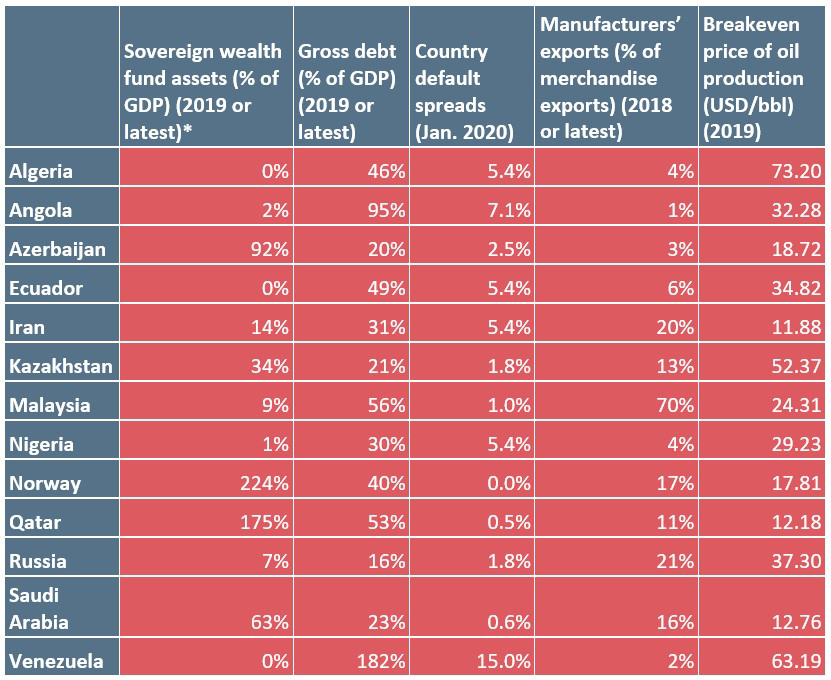
First, national experiences will depend on whether governments have prepared for a crisis. Kazakhstan, Kuwait, Malaysia, Norway, UAE, Russia, Saudi Arabia and Trinidad and Tobago have enough fiscal space to maintain public spending well into 2021 despite a collapse in government revenue, as suggested by CDS spreads on their sovereign debt, an indicator of default probability, as well as net debt figures. Each has significant savings in sovereign wealth funds or relatively low public debt levels. Moreover, with the exception of Malaysia and Trinidad and Tobago, each produces oil relatively cheaply, meaning their oil sectors are likely to generate significant revenue for their governments once the worst of the crisis is over.
Other governments of oil-producing countries had weaker public sector balance sheets heading into the crisis. Ecuador may default on its debt within the month. Nigeria’s sovereign debt rating was downgraded. Venezuela ran out of fiscal space to provide stimulus years ago. And Iraq does not have the administrative capacity to address either the economic crisis or health emergency. None of these countries is likely to be able to effectively mitigate the impact of the crash through more borrowing or drawing down on savings; the same is true for many other low-income oil producers.
Second, for many oil-dependent countries, the sharp drop in oil prices may lead to a disproportionately large fall in oil revenue. If prices remain low, some companies operating in countries where it’s relatively expensive to produce oil (such as Angola, Brazil, Canada, Malaysia, Trinidad and Tobago, the United States and Venezuela), could go bankrupt, leading to sustained lower output. In some places, oil production may never again reach pre-crisis levels due to technological “shut-ins.” Officials in many high-cost producer countries should expect a long-term decline in GDP rather than a temporary shock and therefore should not expect to “spend their way” out of the slump.
Third, governments of oil-dependent countries aiming to stimulate their economies through fiscal transfers to businesses face limited choices of where to allocate money. Many countries have only small and nascent productive sectors outside the oil industry. Economies in places like Algeria, Angola, Azerbaijan, Libya, Saudi Arabia, Timor-Leste and Trinidad and Tobago are not diversified, meaning there are fewer businesses that, with financial support, could quickly generate jobs and keep the economy churning. Even where there are businesses to support, governments cannot support many of them, since increased economic activity in some industries and much of the service sector risks spreading the virus. Officials in oil-dependent countries may therefore need to direct stimulus packages toward vulnerable groups, such as the poor or jobless, rather than businesses.
*Sovereign wealth fund asset values and GDP have declined since the crisis began
Sources: SWF annual reports or equivalent, IMF WEO, Damodaran (2020), WB WDI and Rystad Ucube.
Each country faces its own challenges, as illustrated in the table; no single policy would be applicable in every context. That said, officials in net hydrocarbon exporting countries could consider several general principles as they formulate their policy responses to the crisis:
1. Consider the role of sovereign wealth funds and borrowing
As mentioned, some governments entered the crisis with significant fiscal space, thanks to large sovereign wealth fund savings or low debt levels. Fiscal responsibility during boom years is designed to provide the space to draw down on savings or borrow during periods of crisis, such as now. Short- to medium-term borrowing may make sense now, with historically low interest rates available for those countries with access to credit. Governments may be wise to rely on models to determine how much fiscal space to use.
On the other hand, several oil-dependent countries have entered the crisis following a borrowing binge. Angola, Cameroon, Chad, Colombia, Republic of Congo, Ecuador, Equatorial Guinea, Gabon and Mexico were among those who had approached the International Monetary Fund before the crisis for program financing or a line of credit, meaning they already had difficulties financing themselves at higher oil prices. In recent weeks, Ecuador, Iran and Nigeria were among the 85 countries that approached the IMF for emergency assistance. Countries without fiscal space will at the minimum need to negotiate a moratorium on servicing external public debt, including repayments of oil-backed loans to oil traders and Chinese policy banks, and seek emergency support from multilateral and bilateral donors.
2. Resist the temptation to provide stimulus to the oil industry, whether through subsidies or tax cuts
There is a great deal of uncertainty around medium-term oil prices; some analysts suggest that they will not rebound for some time, while others say that the industry will contract quickly, leading to supply challenges and a swift price rebound next year. At the same time, public and private oil companies in several countries have been requesting large bailouts or tax relief. Government officials must consider the risks of “throwing good money after bad,” especially given the enduring climate challenge and the need to shift to renewable energies. Governments ought to resist hasty demands and properly evaluate (and model) the viability of projects at lower prices. If an oil company is facing insolvency, alternatives to a bailout can include seeking new investors or returning licenses to the state.
3. Devalue currencies slowly (in some countries)
Lower oil prices means far less foreign currency entering government coffers. This is already putting pressure on currencies. The implication is that countries like Ecuador, Iraq, Saudi Arabia and Timor-Leste and the CEMAC monetary union (including Chad, Gabon and Republic of Congo), which have dollarized or pegged their currencies to the U.S. dollar or the euro, will need to draw down on their foreign reserves or sovereign wealth fund savings or borrow foreign currency to maintain their pegs. Some countries, especially in the Persian Gulf, have the foreign savings to withstand years of low oil prices. But officials in others may need to choose whether to maintain their pegs, essentially subsidizing imports using their national savings, or devalue their currencies, leading to higher prices for imported goods, especially basic goods such as food, processed fuel and medication. As some countries run low on foreign currency, they may have to either seek assistance from bilateral or multilateral donors or devalue. In general, it is better to slowly depreciate rather than suddenly devalue under duress, generating another detrimental shock for consumers and many businesses.
4. Reinvigorate economic development and diversification plans
Authorities in oil-rich countries may want to use this “pause” to plan for the future, especially those that are historically poor at long-term investments in infrastructure and education. Governments could use this opportunity to improve their medium-term development plans, focusing on energy transitions and supporting economic diversification. One small example is Trinidad and Tobago’s plan for a USD 7.5 million grant facility for Tobago hoteliers to upgrade their hotel rooms. If unemployment stays high into 2021, as is likely in many countries, governments could use the excess labor to (re)build critical infrastructure, such as high-speed internet, water and sanitation and public transport, to improve competitiveness and quality of life over the long run.
New Countries Report in Latest Natural Resource Revenue Dataset
Are you researching a resource-rich country and in need of data to quantify the government’s dependence on revenues from natural resources? Looking for a dataset to analyze global trends in revenues accumulated from oil, gas and minerals?
If so, NRGI’s Natural Resource Revenue Dataset is for you. Better yet, the December 2019 update is now available at www.resourcedata.org/dataset/natural-resource-revenue-dataset .
The data includes total oil, gas and mining revenues received by governments on a USD, proportion of total government revenue and proportion of GDP basis. The dataset is a collation of resource revenue data available from 3 sources: Extractive Industries Transparency Initiative (EITI), ICTD/UNU-WIDER and International Monetary Fund (IMF).
Has anything changed in this update?
We have seen some progress in total resource revenue data availability in the last two years since we started collating this dataset. Country coverage is rising, in that data points are now available for some countries that there was previously no data for. Since we began two years ago, there are two RGI countries where coverage is now present where it was not before. Myanmar supplied data by completing relatively timely EITI reporting and general government resource revenue data became available for Morocco in the ICTD/UNU-WIDER dataset. But, crucially, there remains no data for very resource-dependent economies such as Uzbekistan and Zimbabwe. Data is also absent for countries with large populations such as Bangladesh, Brazil and India.
The positive development of slightly increased country coverage is somewhat held back by lagged data. There are not any countries that have data available for 2018 and in 2017 data available for just 16 countries. Indeed, the peak year for volum of data remains at 2014– exactly as it was when we blogged about this subject two years ago. In large part, this is a result of 2014 being the last year in which the IMF published its World Commodity Exporter’s Database (WCED), which includes the indicator “general government commodity revenues, percent of GDP.” For the most part, the ICTD/UNU-WIDER dataset uses IMF country reports, but their coverage is not as large as the IMF WCED reporting. In addition, there remains a timing disconnect between the EITI report publication and the open data publication.
This chart shows country coverage in the dataset over time for all countries available in the three sources:
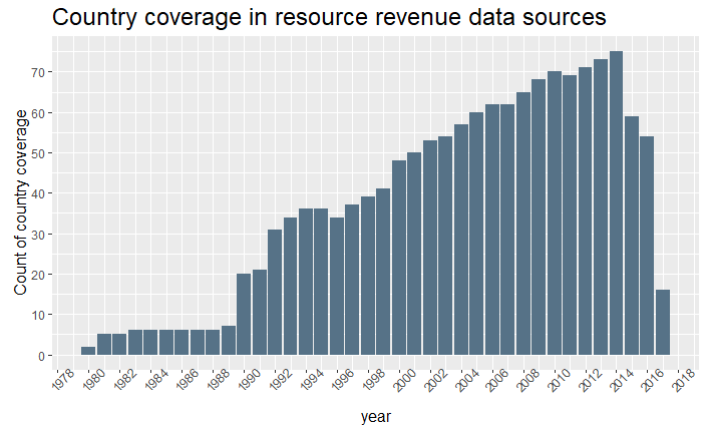
Since 2000, the aggregated global government revenue from natural resources that we collate in our dataset amounts to USD 15 trillion. (This figure takes the mean across sources when more than one source is available for a country.) While it is not possible to provide trend over time analysis, it is interesting to note the rate of accumulation of data. At the May 2019 publication of the dataset, the global aggregated total was $14.7 trillion. That’s $300 billion more traceable government revenues from extractives in just over six months.
Country data analysis example: declines in resource revenue sharpen in Nigeria
At the country-level, the refreshed dataset with additional years of data allows us to analyze trends in government revenues from the natural resources sectors. In Nigeria, it has been well documented in, for example, the BudgIT report An Analysis of Nigeria’s Economy and Vulnerability to Oil, that oil revenues are shrinking and becoming a smaller proportion of total government revenues. With recently published 2017 data, we see that this trend has continued sharply with resource revenues as a share of total federal and state government revenues dropping. In 2016, they dropped to just around 38 percent and in 2017, to 42 percent. This stands in stark contrast to resource revenues accounting for over 80 percent of government revenue in previous years. Resource revenues’ share of total GDP has also decreased. It tumbled from almost 20 percent to just 3 percent in 2016.
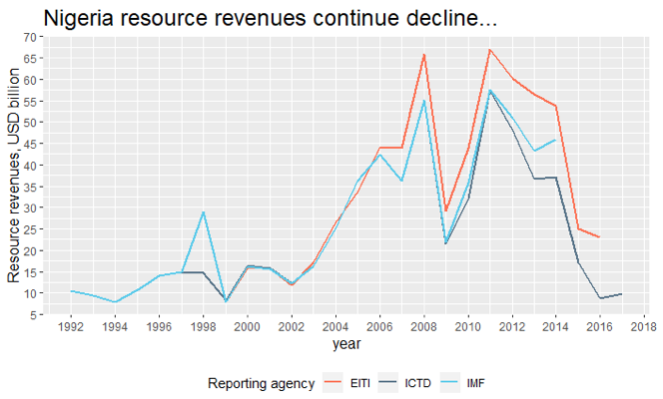
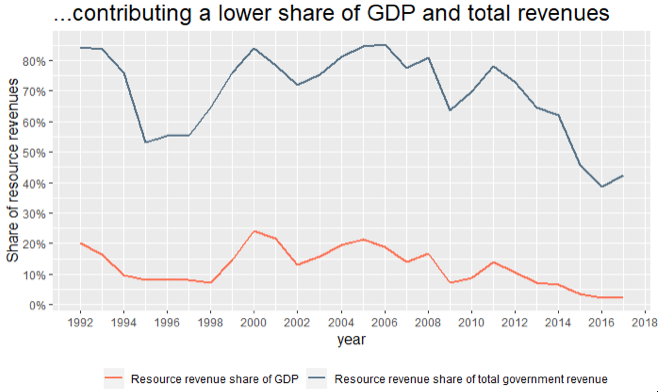
This short analysis on the Nigeria resource revenue data is one of many examples of interesting data that can be pulled from the NRGI resource revenue dataset.
Background of the resource revenues dataset
Just over two years ago, we published this blog post on our experience gathering data on the revenues governments receive from their natural resources sectors. We assembled enough data to conclude that in 2014, governments with unsatisfactory governance measured in the 2017 Resource Governance Index (RGI) (i.e., weak, poor or failing scores) raised over USD 1.2 trillion in revenue from natural resources.
Since 2018, we have been updating the resource revenue dataset and publishing it as open data, along with our methodology, on the NRGI repository Resourcedata.org. The resource revenue dataset doesn’t solve the need for definitive data on total oil, gas and mining revenues that go to governments, but we hope it can be a useful tool for researchers in the field.
We will continue to update the dataset every quarter and to track the availability of resource revenue data for our own work. We welcome requests for off-calendar updates. If you are engaging with the data and have questions or queries, please don’t hesitate to get in touch with us via the contact details available here.
Anna Fleming is a research and data officer at the Natural Resource Governance Institute (NRGI).
Energy Transition Brings New Challenges for New Petroleum Producers
At last week’s annual meeting of the New Petroleum Producers Discussion Group in Uganda, participants buzzed with the kind of enthusiasm that has come to typify the project. The event – co-organized by Chatham House, NRGI and the Commonwealth Secretariat and hosted this year by the
Ugandan government – gathered officials from 23 countries to share approaches to developing regulatory capacity, managing relationships with oil companies, communicating with citizens, and many other challenges they face in their emerging oil sectors.
This year’s discussions, however, brought a heightened focus on an emerging issue facing new producers: the impact of the global energy transition on their pursuit of long-term economic benefits from oil and gas production. The uncertainties surrounding transition permeated the week-long series of events, including a dedicated training session on navigating emerging risks in the sector, a plenary discussion examining various market scenarios and a discussion of the intersection between Uganda’s oil ambitions and climate commitments as part of a “national seminar” organized by the host government.
 Photo by Matt Grace for NRGI
The energy transition introduces a new dynamic. Expert opinion varies widely on how quickly the world will transition away from fossil fuels to the kinds of cleaner energy sources necessary to meet global climate goals. The prospect of a sustained long-term decline in fossil fuel demand carries with it the possibility that some oil and gas projects that would have otherwise been viable may become “stranded.” For prospective producer countries, this possibility puts further strain on what were in some cases already over-burdened expectations for the sector’s impact.
Of course, the transition may not happen rapidly, or systematically, and most of the representatives at the meeting exhibited confidence that the projects already on their horizons would proceed. Still, the sheer uncertainty around the trajectory of transition prompted various reflections over the course of the week about how their policies may evolve to manage risk:
- Managing the cost curve. Several speakers pointed to the likelihood that the projects most likely to be stranded as energy transition proceeds are the most expensive ones. New producer countries face a natural disadvantage in this regard, in that oil and gas deposits in frontier areas are more costly to develop than projects in countries with a long history of production. The ability of governments to influence where they sit on the cost curve is therefore limited by geology. Nonetheless, these governments can take steps to reduce the costs of production – including by increasing regulatory efficiency and reducing the tax burden on production. New producer governments are seeking to develop attractive fiscal and licensing approaches that would attract investors in a more constrained investment environment. Assessing where these steps are justified by opportunity – versus where they represent a harmful “race to the bottom” that risks depriving citizens of meaningful benefits – is one of the looming challenges for governments.
- Investment decisions for national oil companies. Many new producer governments have in the past expressed broad ambitions for their national oil companies (NOCs) to grow into major players with a wide range of commercial interests, including in exploration and production. As the uncertainties around energy transition grow, participants discussed whether a shorter time horizon for generating returns in oil and gas should impact decisions about NOCs’ exploration spending or aspirations to dramatically expand operational capabilities. In line with the diverse nature of countries represented in the group, there was no consensus among participants on this issue. Some contended that their governments should still prioritize growing NOC control of the sector, while others suggested that NOCs’ analyses of investment risks should perhaps evolve to account for changing market dynamics.
- An evolving approach to local content. Previous new producers discussion group meetings have focused heavily on “local content” – the development of jobs, technology transfer and opportunities for local companies associated with the sector. And local content remained a very salient topic at this year’s meetings, but the energy transition is beginning to impact the way that some participants are thinking about their local content priorities. Conversations emphasized the need to adapt a local content strategy to the evolving energy sector, both domestically and globally, to avoid the risk of a country building capacity in jobs or business models that quickly become outmoded. This is easier said than done, of course, and future discussions will turn with more specifics on how to tailor strategies to markets that are evolving so unpredictably.
The challenges facing new producers have always been complex, and the uncertain future of the global oil and gas market further complicates things. No participants at the meeting proposed scrapping their plans or dramatically altering their approach to the oil and gas sector. But the discussion provided an opportunity for a nuanced and detailed sharing of perspectives as governments seek to manage risk.
Patrick Heller is an advisor at the Natural Resource Governance Institute.
Talking Indonesia: Energy, a Podcast Featuring NRGI’s Emanuel Bria
NRGI’s Indonesia country manager Emanuel Bria recently spoke with Jemma Purdey for the University of Melbourne’s Talking Indonesia podcast. Their discussion focused on the tension between coal and renewable energy developments in Indonesia. Bria said that the country’s high dependence on and support for fossil-based energy sources has raised concerns among renewable energy investors.
Listen to the full podcast:

Three key points that Bria made:
- Subsidies remain a significant obstacle to changing the energy mix. The Indonesian government is still subsidizing the coal sector both in terms of supporting policies as well as preferential pricing. If this continues, the country’s shift towards renewables will be further delayed as not only will it take time for the people to change their behavior and mindset, it will also send a sign to investors that the government is not yet ready to support their business.
- Incentives to invest in the renewable energy sector are still lacking. While the coal sector is highly incentivized by the government, Indonesia has not made significant moves in attracting more investment into the renewable energy sector. Meanwhile, investors would need assurance that putting money into the development of renewables would bring them profits.
- Indonesia’s state companies must quickly adjust to the changing energy trend. While discussions around renewable energy use in Indonesia continue, state electricity and oil companies PLN and Pertamina still rely heavily fossil fuels.
Fikri Muhammadi is an Asia-Pacific associate with the Natural Resource Governance Institute.
EITI Data Can Support Guinea’s Efforts to Promote Local Mining Subcontractors
Mining subcontractors are important taxpayers and drivers of economic development. But they have not received the same level of attention as mining companies do in terms of transparency, accountability or tax contributions. Guinea, however, has been a pioneer in including information about subcontractors in its Extractive Industries Transparency Initiative (EITI) reports. (Mali also does it.) This is a trend that we at NRGI expect to grow as governments, companies and citizens become more interested in understanding the role subcontractors play.
Guinea’s 2017 EITI report is more detailed than ever before, a marked step forward in reporting about subcontractors.
The number of subcontractors included in EITI reports has grown from 11 in 2014 to 19 in 2016, and is up to 36 with the latest report. By including subcontractor names, EITI reports increase the accountability of companies that are often unknown to the public. This can also help Guinean entrepreneurs identify business opportunities: subcontractors are also obliged to meet local content targets of the country’s mining code and will often “sub-subcontract” smaller works, easier for small and medium-sized enterprises to take on. They also complement government efforts like the Guinea subcontractor exchange, a multi-stakeholder platform aiming to connect local suppliers to mining companies, launched in December 2018. Elsewhere, companies such as Rio Tinto, with its Oyu Tolgoi mine in Mongolia, have also taken steps to disclose who their suppliers are.
Revenues recorded from subcontractors operating in Guinea grew more than four-fold between 2016 and 2017, from GNF 234 billion (USD 25.3 million) to GNF 1,016 billion (USD 112.8 million). (See figure below.) The contribution of subcontractors to total extractive revenues covered in EITI reports grew from 8 percent in 2016 to 24 percent in 2017, reflecting the recent boom in the country’s mining sector. Indeed, typically, anywhere between 30 and 90 percent of mining project spending goes to subcontractors and suppliers.
Guinea government revenue contribution by company segment, 2016 and 2017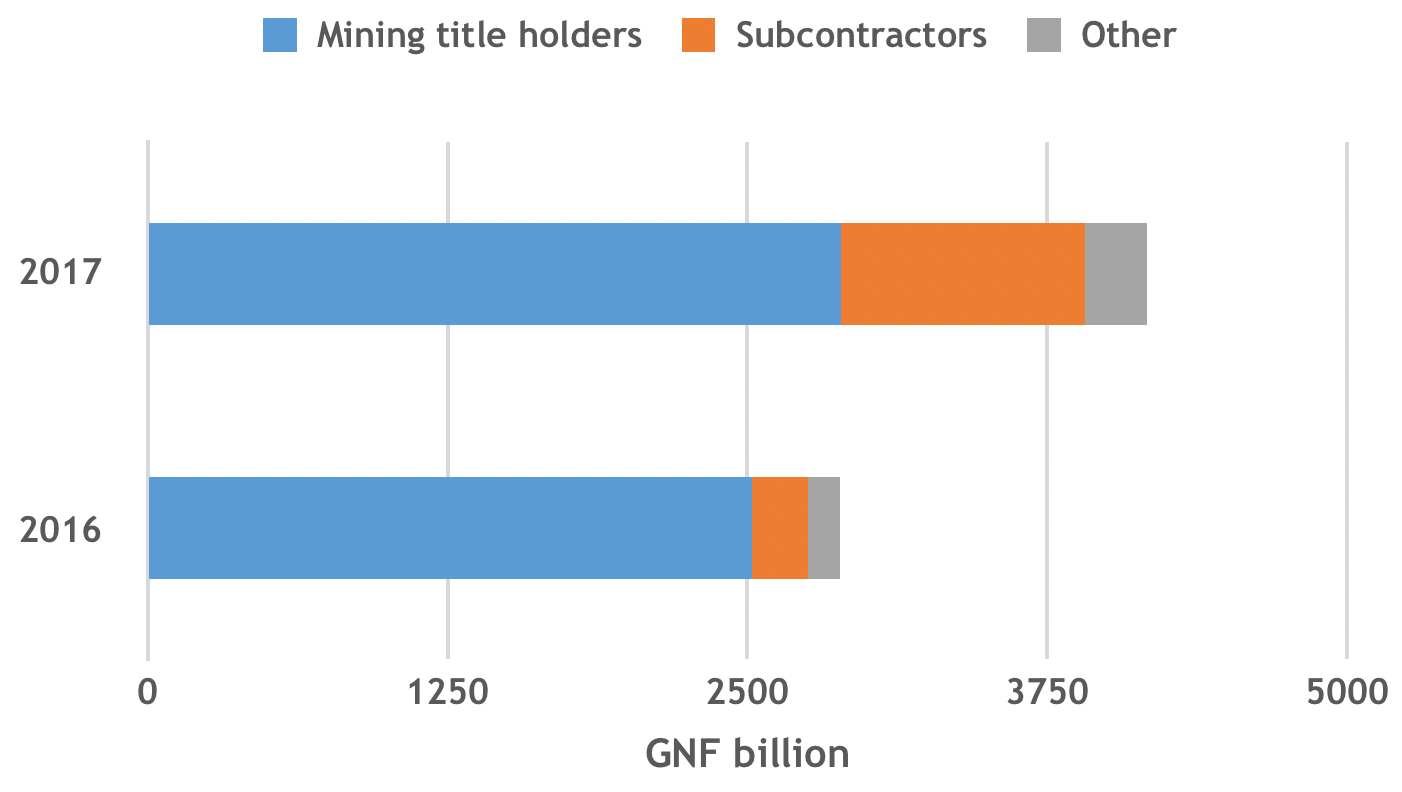
The 2017 report disaggregates subcontractor payments, adding new detail.
- Payments by company. The subcontractors covered in the 2016 EITI report contributed over 99 percent of total subcontractor revenues also in 2017, so the increase in overall subcontractor payments cannot be attributed to increased reporting coverage. In fact, in 2017, 82 percent of subcontractor revenues were paid by only two companies: Winning Alliance Ports (59 percent) and United Mining Supply (23 percent). They are also members of SMB Winning consortium—the leading bauxite producer in Guinea, whose production grew by 150 percent between 2016 and 2017. Other notable tax payers are large international drilling and engineering companies like AMCO Drilling and Fluor.
- Payments by receiving government entity. Fifty-eight percent of subcontractor payments were made to customs (Direction Générale des Douanes) and 42 percent to the tax authority (Direction Nationale des Impôts). Import duties and customs payments are more important in the subcontractor segment than for extractive revenues in total (37 percent of all payments covered in the EITI report went to customs). In this context, EITI reports since 2011 have been flagging discrepancies in customs reporting by subcontractors, who use customs forms reserved for mining title holders to benefit from import duty exemptions even though subcontractors can also be eligible for exemptions under certain conditions. Authorities and citizens can use public domain data to monitor exemptions granted to different types of companies and inform discussions on how incentives support different policy objectives. While exemptions can be a good for investment, they may contradict local procurement targets. In the Responsible Mineral Development Initiative (RMDI) workshops organized by the Ministry of Mines and Geology in May, Guinean entrepreneurs highlighted these inconsistencies as contributing factors to their poor competitiveness versus international subcontractors.
To date, this type of information is sparse in most mining countries, showing the value of Guinea’s effort. But EITI reporting can go further. Many countries already track progress on local content in EITI reports. Although subcontractors are not directly covered by the EITI Standard, requirement 6.1 mandates extractive industry companies to disclose material and in-kind social payments, including commitments to local employment and procurement. If ratified as expected in the next EITI board meeting later this month, the new standard will encourage countries to describe the rules and practices related to state-owned enterprises’ operating and capital expenditures, procurement, subcontracting and corporate governance. As countries are making progress toward the 2020 EITI timeline for beneficial ownership disclosure, some national EITI secretariats are starting to consider including subcontractors. Many subcontracting governance risks relate to complex ownership structures, such as cost inflation in subcontracting between related parties or conflicts of interest.
In summary, in Guinea and elsewhere, complementary reporting by government and country-level EITI multi-stakeholder groups can generate the following types of information for regulators, which prospective entrepreneurs and citizens can use to monitor progress and ensure accountability in the process of allocating subcontracts:
- Market size (opportunities for Guinean entrepreneurs, subcontractor tax base and actual payments)
- Actors (local and international subcontractors, and who actually owns them)
- Rules (rules applying to tender procedures, prequalification and selection of subcontractors)
- Processes (when are opportunities coming out)
- Outcomes (which entity awards contracts to whom, and are mines on track to meeting local content targets)
Kaisa Toroskainen is an Africa program officer with the Natural Resource Governance Institute (NRGI). Hervé Lado is NRGI’s Guinea country manager.
Governments, Companies Find a Bit of Common Ground on Resource Nationalism at Indaba
Over the past decade at least, “resource nationalism” has been a hotly debated concept for those in the oil, gas and mining industries, government decision-makers and media who cover the space.
It was also a main theme at this year’s Mining Indaba. Some interpreted debates at Indaba as precursors for more fighting between government and companies. But we are encouraged by what we saw as good dialogue. Diverse parties voiced interest in finding a sustainable, long-term balance between corporate and government interests.
Industry recognized that companies had aggravated mistrust by doing a poor job at recognizing the drivers and concerns behind policy reforms labeled as resource nationalistic.
“Companies have pushed it too far with discounts and incentives. They haven’t understood that in the end the resource belongs to the people and they need to see benefits,” Peter Breese, CEO of Asanko Gold, said.
According to one definition, policies of resource nationalism—in contrast to outright nationalization—encompass higher royalties and taxes, increased government free carry participation, requirements for in-country beneficiation and retention of profits, and participation of local employees and businesses in the value chains of oil, gas and mining.
Governments across the globe have undertaken such measures. Indonesia required foreign investors to divest parts of mining equity to nationals and banned raw mineral exports. It has been reported that Mexico is suspending new oil auctions to private companies, contrary to the energy reform under the previous government.
Since the booming mineral prices of the past decade, many countries have made ambitious, quick changes. The Democratic Republic of Congo’s 2018 mining code amendments set a super profit tax and increased royalties, up to 10 percent for strategic minerals. Zambia has changed its fiscal regime following each copper price swing since 2000, making budget stability harder to achieve. Local content requirements have been increased in South Africa’s new Mining Charter and in Tanzania.
Companies oppose recent policy changes by Africa’s major mineral producers because these changes risk lowering rates of return on investment. Reactions can be strong. In the DRC, companies lobbied aggressively against revising the country’s mining code, escalating into threats of arbitration, but ultimately lost the battle. Meanwhile, some governments in Africa are questioning the legitimacy of existing agreements and fiscal stabilization clauses.
A policy touted as resource nationalistic in one case might not be labelled similarly in another. Botswana’s domestic processing of diamonds—often cited as a success story of resource-based development—is a case in point.
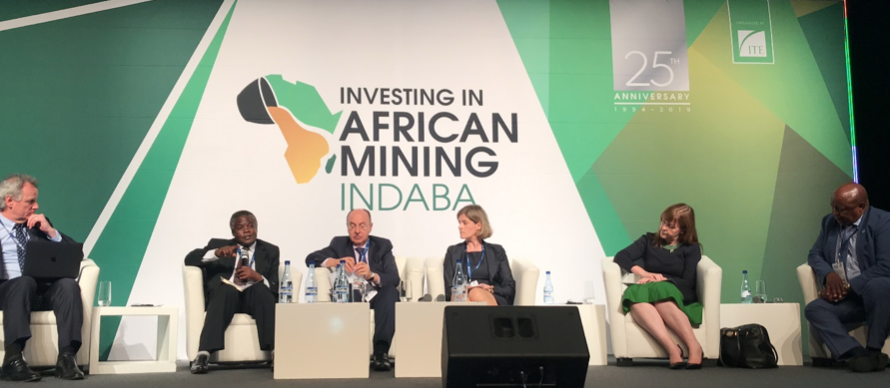 NRGI’s Africa Co-Director Silas Olan’g (second from left) speaks during a panel on taxation, revenue management and resource nationalism at Mining Indaba. Photo by Kaisa Toroskainen.
Throughout the Indaba, we saw government representatives demanding companies make greater contributions to host countries. Instead of only insisting on a greater government take, many emphasized “win-win” situations and committed to consultation and transparency in policy reform. Guinea’s minister for mines and geology underlined the importance of being upfront about government expectations, in line with a recent interview with NRGI. Transparent government intentions is a tenet of success, Botswana’s minister for mineral resources acknowledged. Ghana’s president urged the continent to leave the era of incentives behind, but also committed to disclosing Ghana’s mineral development agreements.
Anglo American and Goldfields, among other companies, called for more collaborative, inclusive and beneficial relationships with communities. Newmont’s vice president of sustainability and external relations framed the solutions with language of shared value and rebuilding trust.
NRGI, too, has highlighted that any reform process needs to be transparent and consultative to build trust and legitimacy. Findings from NRGI’s work across the continent show that by using analytical methods such as economic modeling and disclosing assumptions of the models, governments can design balanced policies that endure booms and busts. Modeling helps governments prioritize in case of trade-offs between objectives such as taxes, employment or domestic beneficiation, helping manage expectations.
But it is easier to debate congenially and even to write good laws than to implement them. Action is needed. Companies should take concrete steps to report on taxes and payments they make to governments at all levels. They should disclose information needed to analyze profitability of their operations and opportunities for local development. Governments should act on their promises for transparency and accountability by engaging in meaningful consultations, publishing contracts, fiscal models and information on environmental and social impacts. All should commit to long-term stability over short-term wins.
Kaisa Toroskainen is an Africa program officer with the Natural Resource Governance Institute (NRGI). Silas Olan’g is Africa co-director with NRGI.
Revisit the Most-Read NRGI Blog Posts of 2018
Through a sharp, unconventional Marvel superhero movie, global audiences were exposed to fundamental resource governance themes this year. Fictional African country Wakanda’s management and control of vibranium, a miraculous metal with seemingly infinite applications, was a plot point of the global smash film Black Panther as well as the subject of two of the Natural Resource Governance Institute’s most-read blog posts this year.

Other most-read posts ranged widely, focusing on different NRGI priority countries and topics.
Readers enjoyed an introduction to NRGI’s interactive, online resource governance simulation, Petronia; celebrated a contract transparency milestone from one of the largest oil and gas companies in the world; and reacted strongly to timely analysis of the Philippines mining sector and a new petroleum register in Ghana. They were interested in NRGI expert analysis of what makes an accountable state-owned enterprise, which will be a major area of focus for the organization in 2019.
As the year draws to a close, revisit the most-read NRGI blog posts of 2018:
- The Political Economy of Black Panther: Who Benefits from Wakanda’s Mineral Resources?
- Can Petronia Avoid the Resource Curse? It’s All Up to You in a New Interactive Online Course
- Beyond Wakanda’s Way: 'Africanizing' Mining Sector Benefits
- Total Becomes First Major Oil Company to Support Contract Transparency
- What Makes an Accountable State-Owned Enterprise?
- Ghana’s New Petroleum Register Features Full-Text Contracts
- A Withhold up in Mongolia? Thoughts on the Renewed Tax Debate Around Oyu Tolgoi
- Philippines: Will TRAIN Run Over the Mining Sector?
- Ensuring a Fair Deal for Nigerians with Oil-Backed Loans
- New NRGI Board Member Carole Nakhle: Longevity of Extractives Industry Depends on Gender Inclusivity
How Can a Mining-Dependent Indonesian Island Develop its Tourism Sector? A Natural Resource Governance Specialist Provides Insight
Lengga Pradipta is part of the Human Ecology team in the Research Centre for Population at the Indonesian Institute of Sciences (LIPI). Lengga was a participant in Advancing Accountable Resource Governance in Asia Pacific in Belitung, Indonesia, in January 2018. As the course progressed, Lengga spoke with NRGI about researching Belitung’s aim to develop its tourism industry and move away from a mining-based economy.
Advancing Accountable Resource Governance in Asia Pacific 2018 Course Videos
Each year, the Natural Resource Governance Institute and Gadjah Mada University’s Department for Politics and Government host a residential training course on extractives governance in Indonesia.
In January, participants from Indonesia, Myanmar, Philippines, Thailand, Vietnam, the United Kingdom and the United States gathered on the island of Belitung, north of Jakarta. Below are highlights from the course.
As Advancing Accountable Resource Governance in Asia Pacific took place, NRGI spoke with five participants from the region to get their sense of the most pressing resource governance issues in their countries. Links to those conversations follow.
How Can Mineral Policy Be Clarified in the Philippines? A Policy-maker Provides Perspective
How Can Thailand Balance the Demands of Extractives Stakeholders? A Mining Engineer Gives Her Take
What Are the Challenges Myanmar’s State-Owned Enterprises Face? A Researcher Describes Them