
Pemex and the Energy Transition: Timely Responses to Growing Threats

The energy transition requires timely and effective responses to ensure a sustainable future for everyone.
Key messages
- An energy transition that progressively phases out fossil fuels is needed to avoid climate catastrophe. Nonetheless, such a transition will harm oil-producing countries and their state-owned businesses, such as Mexico and Pemex. In the International Energy Agency’s Announced Pledges Scenario, an estimated USD 10 billion of Pemex investments would not break even. This would harm Mexican society: government revenue would fall, and Mexican businesses in the oil industry, such as those in the states of Campeche and Tabasco, would suffer.
- The energy transition is increasingly likely to result in a progressive and lasting decrease in global demand for oil. Although Mexico’s domestic oil market is significant, were Pemex to produce only to meet domestic demand, this would not sufficiently protect it or Mexico from the fall in global export demand.
- The energy transition may exacerbate what is already a difficult financial situation for Pemex. It is the world’s most indebted state oil company, with high costs in its refinery system, its labor and pension commitments, and several upstream projects. These challenges weaken the company’s position vis-à-vis the impacts of the energy transition.
- Oil extraction in Mexico has decreased over time. Despite substantial government financial support, Pemex has been unable to reverse the significant downward trend, and this is unlikely to radically change.
- Without sufficient profits, Pemex’s debt will grow. Its creditors have thus far been willing to loan it money, expecting continued government support. However, as more creditors worry about energy transition risk and decarbonize their investments, such willingness to lend is reducing. Interest rates are already rising for Pemex and likely also to increase for the Mexican government. This trend will make debt costs prohibitive for the company, trigger a spiraling of financial problems and increase the costs of government support.
The global energy transition is necessary to avoid the worst impacts of the climate crisis. However, it also brings risks for fossil fuel producer countries and national oil companies (NOCs), such as Mexico and Petróleos Mexicanos (Pemex). The International Energy Agency (IEA) estimates that if governments around the world meet the climate commitments they have set, global demand for crude oil will drop by half by 2050. This won’t be sufficient to meet the targets in the Paris Agreement, but it is concerning for oil companies and oil-producing governments.
The energy transition comes at a time when Pemex already faces challenges. Its oil production has fallen by nearly half since 2010. As a result, Mexico is today a net importer of oil products. To boost its “energy sovereignty” as defined by the Andrés Manuel López Obrador administration, and to ensure a diversified and secure oil supply, Pemex has invested significant resources in its national refinery system. The company also carries important financial labor liabilities linked to funds committed to its workers’ pensions. Considered the most deeply indebted oil company in the world, Pemex stays afloat because of substantial government support. Pemex’s debt exceeds USD 100 billion, equivalent to 5.6 percent of Mexico’s gross domestic product (GDP) for 2023.
On top of this, a significant portion of the government’s revenue comes from oil revenue. In 2023, oil revenue accounted for 15 percent of its total budgeted income. Of this total, 10 percentage points (MXN 736.56 billion) came from Pemex revenue. If we include the contribution Pemex makes to the Mexican Oil Fund, Pemex’scontribution to the country’s 2023 budget revenue is 22 percent. Nonetheless, as this report will explain, Pemex itself has reabsorbed a large portion of this contribution through financial support from the government.
These factors put Pemex in a difficult bind in facing the global energy transition. The response from Pemex and the government will be crucial for the sustainability of this state-owned enterprise. The response will equally be critical for Mexico’s public finances,6 its energy security, and the 520,000 people Pemex and its associated industries employ—especially in states like Campeche and Tabasco, where Pemex extracts most of its oil (50 percent and 41 percent of total company production respectively).
The decisions Mexico’s new government makes around Pemex will be pivotal, as will be proposals for how the company can face the enormous challenges ahead, including the energy transition risks the new administration faces. Mexico’s change of government in October 2024 represents an opportunity for citizens to demand a commitment from their political leaders to focus on the challenges Pemex faces in the context of the transition and on progress toward the country’s energy and decarbonization goals.
This report contributes to an understanding of the current situation and recommends three main focuses of discussion and action for Pemex, the Mexican government and policy-makers
Mexico’s President Sheinbaum Must Reform National Oil Company Pemex

Last week, Claudia Sheinbaum started her six-year term as Mexico’s president. Among great expectations for change, many are puzzling over how she might honour her background as a climate scientist while also upholding the legacy of her predecessor and ally Andrés Manuel López Obrador.
His administration doubled down on fossil fuel production and unconditionally picked up the tab for Pemex – Mexico’s national oil company – despite its debts exceeding $100 billion dollars, about 6 percent of Mexico’s gross domestic product.
In her inauguration speech to Congress last Tuesday, Sheinbaum said: “National consumption will continue to be the fundamental objective of Pemex’s oil production, limited to production of 1.8 million barrels per day. We will promote energy efficiency and the transition to renewable energy sources to meet the growth in energy demand.” Can she and Mexico have their cake and eat it too?...
Mexico’s new president must reform national oil company Pemex
CSO Alliance Sets 15 Critical Policy Reforms To Measure Political Parties
As Mexico Votes, State Oil Company Pemex Needs a New Direction

In less than two weeks Mexicans will vote for their next president. The outgoing leader, Andrés Manuel López Obrador, has made energy sovereignty and self-sufficiency one of the sustained themes of his presidency. AMLO, as he is universally known, has focused his energy aspirations on Pemex, the world’s most indebted national oil company. What Mexico’s next president does with Pemex will determine the country’s energy and fiscal future amid a rapidly changing outlook for fossil fuels.
Pemex faces unprecedented risk brought about by the quickening global energy transition away from hydrocarbons. At NRGI, we have described that risk in a new Spanish-language report, and summarize it below. We also offer some recommendations for the victor in June’s elections and the Pemex executives, including its director, whom the new president will appoint.
A risky business
National oil companies (NOCs) account for 55 percent of the world's oil production and yet they are moving more slowly than their private sector counterparts in terms of decarbonization planning.
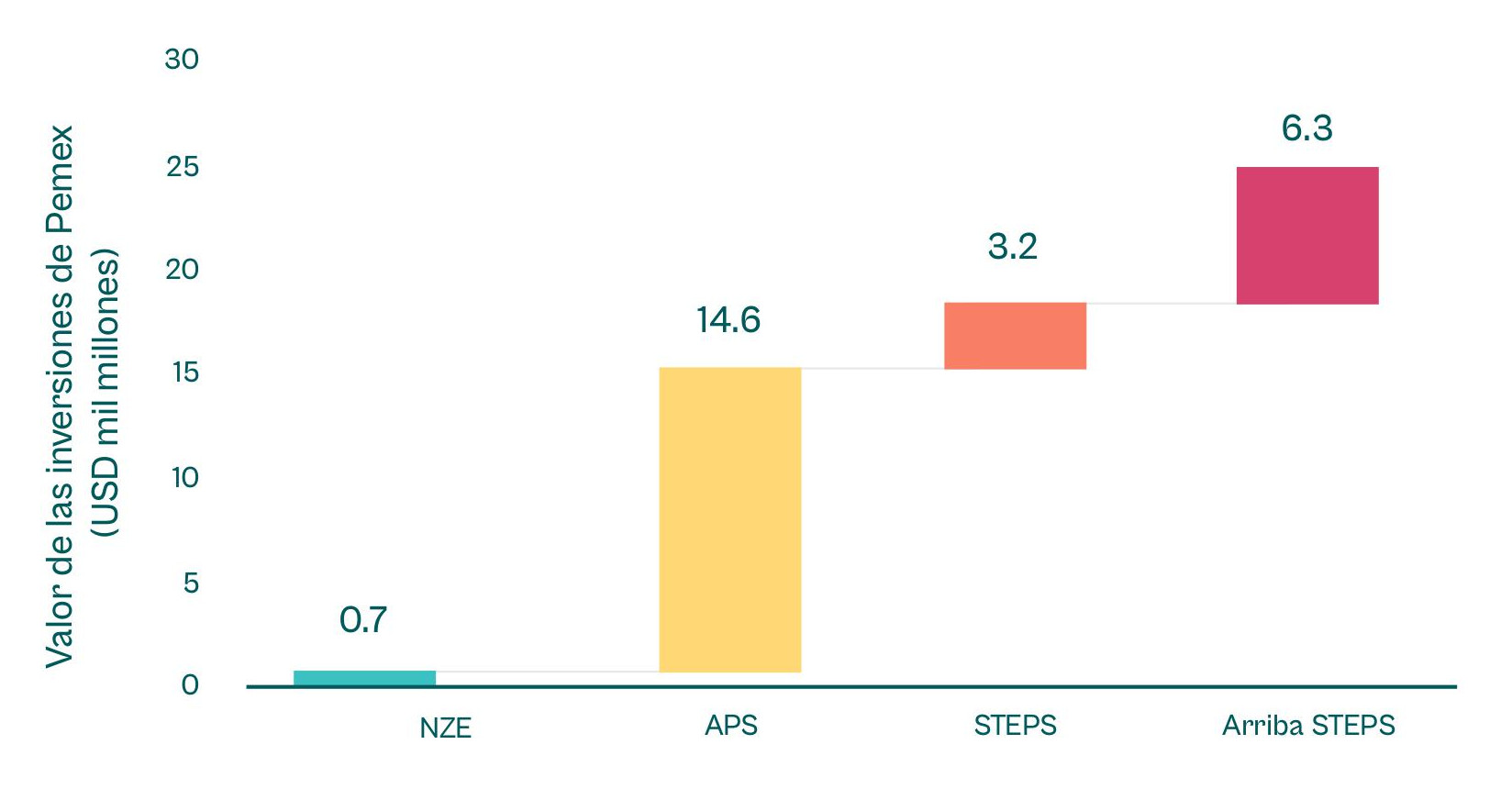
Among the 58 NOCs we studied last year, Pemex ranked 11th in terms of its exposure to transition risk. The biggest of these risks is the changing economics of the oil sector, with demand likely to markedly diminish in coming decades as countries seek to meet their emissions reduction goals. Mexico’s remaining oil reserves will be increasingly costly to extract, meaning that as global oil prices fall, Pemex may be caught out, its assets “stranded.” We found that approximately $10 billion in Pemex's expected investment over the coming decade would not break even under the International Energy Agency’s Announced Pledges Scenario for future oil demand. Given Pemex’s already problematic debt obligations, this presents the government with the specter of more bailouts to alleviate the company’s financial situation, generating an even deeper crisis.
Value of Pemex's upstream oil and gas investments breaking even in each of the IEA's scenarios.
In late 2022, Pemex presented a new business plan which, for the first time, explicitly referenced the energy transition. The plan recognized as risks the international hydrocarbon market contraction due to the increase in electric vehicles, and the downward trend in the demand for oil-derived plastics. While this recognition was an important first step, we still know little about what government officials and Pemex executives plan to do with respect to the transition.
In March 2024 Pemex released a sustainability plan that included more detail on some aspects of its intentions to reduce production emissions. But the plan did not address the transition risk in terms of falling global demand and prices.
Early dissemination of our findings in a workshop with climate and energy experts in Mexico yielded more insight:
- Pemex’s diversification plans remain somewhat vague, and their technical feasibility is uncertain.
- Pemex must be more transparent and accountable about its financial situation.
- Many sector insiders believe that the transition will be slow, and that Pemex will remain competitive.
We are confident that experts from Mexico’s oil and gas sector and its climate community can work with Pemex to improve understanding and communication of its plans.
How to improve Pemex’s future
Our research and consultations have led us to propose three categories of recommendation:
1. Pemex should further recognize and analyze transition risks.
This means more thorough scenario planning around market conditions, shared publicly. And Pemex officials should include more acknowledgement of transition risk in their financial reporting—not just in planning.
2. Pemex should adopt and adapt transition risk mitigation approaches from other oil companies.
Executives should look very carefully at large fields with high production costs. Factoring in lead times (7.5 years on average) and changing market conditions, these may not represent the bonanza that some imagine. One such find is the Kante field in Tabasco state; our analysis suggests that increased investment could be a financial misstep. Ambitions around producing more “no matter what” should give way to innovative thinking about Pemex’s potential role in a domestic energy transition.
Regarding diversification and downstream activities, executives have several opportunities. First, Pemex should better coordinate with CFE, Mexico’s state-owned electricity company. Both can play a fundamental role in advancing the energy transition. Leadership should build a coordinated and integrated vision and action plan that defines the role of each company.
Decision-makers must also carefully consider the viability of diversification options. For example, the two leading presidential candidates have been enthusiastic about expansion in petrochemical production. But petrochemicals only account for 12 percent of current oil demand and the global market may soon be oversupplied as many oil companies seek to expand. This presents a risk of overinvestment and therefore warrants caution.
3. Mexico’s next president should oversee key changes in the government’s approach to the oil and energy sectors.
Mexico’s energy ministry (SENER) should assume a transition planning role in which officials consider the transition risk and build synergies among the country’s state-owned energy companies.
Meanwhile, the finance ministry (SHCP) should review the conditions for financial support to Pemex in the interest of fiscal responsibility and transparency in the management of public resources.
Moreover, the state, as Pemex’s owner, has a crucial role in holding the company accountable. SENER, SHCP, the Congress of the Union and the Federal Superior Audit Office determine and supervise the company's ownership policy. These actors should therefore play a role in improving transition-related decision making within Pemex.
Whoever triumphs on 2 June must stop Pemex from making risky bets and have a clear vision for the company—and Mexico—in a world in transition.
Mexico’s risky bets
Learn more about the transition risks Pemex faces with new NRGI research.
Senegal: What we know about the oil contracts that Bassirou Diomaye Faye wants to renegotiate
Senegal: Bassirou Diomaye Faye aims to renegotiate contracts with oil giants BP, Kosmos, Woodside
Senegal’s New Leader Plans to Revisit Oil Deals with BP, Kosmos
Au Sénégal, le projet gazier GTA s’invite dans la campagne