
The Energy Dilemma: Energy Transition and Regional Collaboration in the Middle East and North Africa

Key messages:
- The Middle East and North Africa (MENA) region has abundant hydrocarbon reserves as well as vast renewable energy potential, giving it a unique and profitable position in the global energy transition.
- Governments in the MENA region are strategically leveraging hydrocarbons and renewables to reduce emissions and enhance energy security.
- Cooperation between MENA countries is crucial to building an integrated energy infrastructure, boosting competitiveness, and facilitating access to global markets.
- Engaging the private sector will be vital for advancing MENA’s energy transition. Governments must incentivize participation through partnerships, supportive policies and favorable investment conditions.
- Strategic policies–such as developing integrated energy infrastructure, fostering regional cooperation, investing in cutting-edge research and development, and developing human capacity–are critical for positioning the region as a leader in green energies.
Introduction
In recent years, resource-rich countries in the Middle East and North Africa (MENA) have played a pivotal role in global energy markets, mainly due to their abundance of oil and natural gas reserves. This has driven the economic growth of resource-rich MENA countries and established them, particularly the Gulf states, as key producers in the global energy supply chain, shaping international energy dependencies and market dynamics. With increasing pressure to put an end to the catastrophic effects of climate change, countries across the globe have been drafting strategies and plans to transition away from fossil fuel production and consumption towards green alternatives. The momentum of the energy transition has raised legitimate questions in the MENA region—especially for the countries which are the main producers of fossil fuels, whose economies depend on this energy. These concerns center around how post-oil economies will affect the future of MENA’s societies and whether governments in the region will still have a role to play in a future less dependent on fossil fuels.
This briefing examines the potential of resource-rich countries in the MENA to capitalize on their natural resources and strategic placement to lead in renewable and green energies. It explores the possible benefits for MENA countries, highlights the importance of regional cooperation, and provides recommendations for achieving sustainable energy leadership in the coming decades.
MENA at the crossroads of the energy transition
The MENA region’s impact on global energy markets is underscored by its substantial contribution to global oil and gas production. As shown in Table 1, five MENA countries—Iran, Iraq, Kuwait, Saudi Arabia and the United Arab Emirates (UAE) —rank among the top ten oil producers worldwide, collectively supplying approximately 26 percent of the world’s oil.
Table 1: Top ten oil-producing countries in 2023
| Country | Oil production (in million barrels per day) | Share of world total |
| United States | 21.91 | 22% |
| Saudi Arabia | 11.13 | 11% |
| Russia | 10.75 | 11% |
| Canada | 5.76 | 6% |
| China | 5.26 | 5% |
| Iraq | 4.42 | 4% |
| Brazil | 4.28 | 4% |
| UAE | 4.16 | 4% |
| Iran | 3.99 | 4% |
| Kuwait | 2.91 | 3% |
| Total Top 10 | 74.59 | 73% |
| World Total | 101.81 |
Source: U.S. Energy Information Administration, https://www.eia.gov/tools/faqs/faq.php?id=709&t=6.
Similarly, as shown in Table 2, four MENA countries—Algeria, Iran, Qatar and Saudi Arabia—rank among the top ten natural gas producers, collectively producing around 16 percent of the global natural gas supply.
Table 2: Top ten natural-gas producing countries in 2023
| Country | Natural gas production (in billion cubic meters) |
| United States | 1,035.3 |
| Russia | 586.4 |
| Iran | 251.7 |
| China | 234.3 |
| Canada | 190.3 |
| Qatar | 181 |
| Australia | 151.7 |
| Norway | 116.6 |
| Saudi Arabia | 114.1 |
| Algeria | 101.5 |
| Malaysia | 81.1 |
| World Total | 4,059.2 |
Source: Energy Institute, https://www.energyinst.org/statistical-review.
The global energy transition from hydrocarbons to renewable energy sources aims to combat climate change and reduce emissions, and it is redefining traditional economic and energy paradigms. Amid this shift, the MENA region stands at a crossroads. Resource-rich MENA nations face a choice: they can either lose the economic power they have held for many years, or seize the golden opportunity to emerge as global leaders in the era of clean energy. Nevertheless, this transition also brings about institutional, organizational, and financial challenges that governments in the region need to address. MENA countries must explore pathways to diversify their energy sectors in order to maintain economic growth and remain competitive in an evolving global energy market. However, governments of resource-rich countries do not have to view the energy transition as a complete shift away from hydrocarbons. Many are adopting policies where both hydrocarbons and renewables contribute to reducing emissions and enhancing energy security.
A win-win scenario for the MENA region
According to the governments of the region, MENA countries can uniquely benefit from a win-win scenario in the energy transition. By leveraging its dual strengths in both hydrocarbons and renewables potentials, the MENA region can drive economic resilience and growth. Its competitive advantage derives from three key factors:
- Dual resource advantage: The MENA region is endowed with a dual foundation in hydrocarbons and renewable energy potential, particularly solar and wind, thus giving it a natural advantage in adapting to the global energy transition. According to the World Bank, 22–26 percent of solar energy is concentrated in the MENA region, allowing it to produce at least half of global electricity needs. Moreover, each unit invested in solar energy is expected to reduce emissions by twice as much as a similar investment in Europe or North America. The region also has abundant unused land that is well suited for large-scale solar farms as well as having untapped potential for wind energy. Large-scale wind projects can be carried out in key locations, such as Morocco’s Atlantic coast, the Gulf of Suez in Egypt, as well as north-western deserts in Saudi Arabia and southern Oman. There are generally fewer challenges in implementing these projects than in Europe or North America, where obtaining permits can be more time-consuming and projects tend to face stronger resistance from local communities. Capitalizing on wind and solar energy could enable the MENA region to also become a hub for green hydrogen production, something that is a high energy transition priority for many governments.
- Balanced economic transition: For resource-rich producing countries, the global energy transition does not imply an immediate shift from hydrocarbons to renewables. Rather, it involves a balanced approach, allowing MENA countries to maintain economic stability through hydrocarbon exports while developing their renewable energy sectors.
- Competitive production in energy-intensive sectors and strategic export advantage: The MENA region could take advantage of its access to low-cost and renewable-based energy to support energy-intensive industries, such as metals and chemicals, thus producing goods with low emissions. It could then export these goods to nearby regions, such as Europe, to transform them into final products. As such, the MENA region would be an attractive production hub for global markets as well as a reliable supplier in the green energy economy.
Regional cooperation: The backbone of MENA’s energy transition
Regional cooperation could be a driving force for the energy transition in the MENA region. Some have the land, while others have the financial capacities, workforce, infrastructure, or political leverage. Gulf Cooperation Council (GCC) countries, particularly Saudi Arabia and the UAE, have been using the hydrocarbons sector and their financial capacities to advance their clean energy transition plans. Other countries, such as Morocco, have been able to attract investment for their projects through gaining knowledge and expertise to negotiate with financial institutions with complex standards. Others, such as Egypt, are attracting investment by catering to the needs of the global north, especially the European Union.
Several energy collaborations and infrastructure projects already exist in the MENA region, showcasing the potential for broader cooperation. These are projects related to hydrogen, renewable energy, electricity and grid interconnectors.
Hydrogen projects
- Saudi Arabia’s green hydrogen initiative: Saudi Arabia is leading the development of the largest utility-scale green hydrogen project globally, set to begin operations in 2026 in Neom. The facility is projected to generate 600 tons of clean hydrogen per day and 1.2 million tons of green ammonia annually. The majority of this is intended for export, with transportation routes to include shipment via the Red Sea, pipelines through Egypt, and overland pathways to neighboring countries. This project is expected to reduce carbon emissions by 5 million metric tons annually, showcasing Saudi Arabia’s commitment to sustainable energy.
- Egypt’s hydrogen agreements: At COP27, Egypt advanced its ambition to become a regional hydrogen hub by signing eight memorandums of understanding. These agreements include plans for an $8 billion hydrogen plant in the Suez Canal Economic Zone.
- Morocco’s hydrogen roadmap: Morocco aims to establish a thriving hydrogen market, targeting a local demand of 4 TWh and exports of 10 TWh by 2030. This plan requires the development of 6 GW of new renewable energy capacity to support its ambitious goals.
- Hydrogen pipelines and infrastructure: Proposals are being explored to establish a network of hydrogen pipelines connecting Israel, Jordan, Oman and the UAE. These pipelines could facilitate collaboration among these countries, leveraging existing natural gas infrastructure to transport hydrogen to regional and global markets.
Renewable energy projects
- Saudi Arabia’s renewable energy in Neom: Saudi Arabia aims to produce 4 GW of renewable energy, with 3 GW allocated specifically to power its green hydrogen plant in Neom, demonstrating its commitment to integrating renewable energy into its projects.
- Project prosperity: At COP27, Israel, Jordan and the UAE agreed on a water-energy swap initiative. This project includes the construction of a 600 MW solar PV plant in Jordan, which will supply electricity to Israel in return for desalinated water. Developed by Masdar, a UAE state-owned company, this collaboration underscores the advantages of regional cooperation in addressing energy and water challenges.
- Egypt’s renewable energy advancements: Egypt is rapidly increasing its renewable energy capacity through large-scale solar PV projects. A notable example is the Benban Solar Park in Aswan, which has a capacity of 1,650 MW and reflects Egypt’s dedication to clean energy development.
- Renewable energy potential in conflict-affected areas: The Sinai Peninsula in Egypt and the West Bank possess considerable potential for renewable energy projects. However, significant political and security barriers must be resolved to unlock these opportunities.
Electricity grids
- GCC grid: The GCC operates a reliable electricity grid for emergency and peak-load scenarios.
- Mashreq grid: The Mashreq grid connects countries such as Egypt, Iraq, Jordan, Lebanon, Libya, the Palestinian territories, Syria, and Turkey, though it has been less effective than other regional grids.
- Maghreb grid: North African countries such as Algeria, Libya, Mauritania, Morocco, and Tunisia use this grid for electricity trade.
- Egypt-Saudi Arabia interconnector: The Egypt-Saudi interconnector project aims to enhance electricity trade between the two countries, with plans for significant capacity expansions.
- Regional grid interconnection: Projects such as Israel-Jordan connections (as part of Project Prosperity) and Egypt-Cyprus-Greece interconnectors are under way, aiming to link MENA grids with Europe for better energy integration.
By cooperating, MENA countries can create a connected energy infrastructure that enhances regional competitiveness and facilitates access to global markets. Regional cooperation also enables the strategic placement of renewable energy stations across diverse areas, allowing for more efficient resource use. A well-connected or unified market would attract foreign investment more effectively, transforming natural resources into economic opportunities and solidifying the region’s position in the global green economy.
MENA countries are richly endowed with renewable resources and are deploying energy projects at varying paces under diverse policy frameworks. While many of these projects depend on imported technologies, such as solar PV panels, countries like Morocco and Tunisia have begun integrating elements of renewable technology value chains locally. Expanding this integration at a regional level presents a significant opportunity for collaboration across the MENA region. By adopting a coordinated approach, countries can leverage regional expertise in industries such as metals, mechanics, and electronics to develop complementary links in renewable technology value chains.
A strategy based on regional integration would not only create a larger market for renewable technologies, but also encourage manufacturers to scale operations and foster the creation of new businesses. Healthy competition among manufacturers in different countries could further drive productivity, innovation, and resilience against global competition. Additionally, a regionally integrated approach could optimize supply chains by reducing transportation distances, lowering carbon emissions, and improving overall efficiency. Such efforts would not only strengthen the renewable energy sector but also position the MENA region as a leader in the global energy transition.
The private sector: A catalyst in MENA’s energy future
In the MENA region, the energy sector—that is mainly electricity companies and those in oil and gas production—has generally been dominated by government-led investments. However, the need for private sector involvement in the energy transition is becoming increasingly apparent. Governments alone cannot shoulder the financial burden of meeting the region’s growing energy demands, especially as populations expand and economies industrialize. Most governments plan to replace the local energy needs from fossil-based fuels to clean energy, and this requires not only public investments in renewable projects but also a more active role for private companies that will need financing from different public and private sources.
Despite its potential, the private sector in the MENA region faces several challenges in contributing to the renewable energy transition. One of the primary obstacles is the capital-intensive nature of renewable energy projects, which requires developers to secure financing from banks or other financial institutions at the best prices and terms. Additionally, suppliers and contractors face significant pressure to deliver projects at the lowest possible cost while meeting stringent specifications, further complicating the process.
The overwhelming demand for renewable energy infrastructure has also created intense competition for supply chains, natural resources, and construction contractors, as the volume of demand exceeds the available supply on all levels. Companies like the Saudi and the Emirati Masdar have demonstrated global competitiveness by securing projects in Eastern Europe, Central Asia and South Africa. However, even these industry leaders face significant challenges—including navigating strained supply chains and securing favorable financing—as nations worldwide accelerate their renewable energy agendas. The broader market continues to struggle with establishing institutional frameworks and implementing effective risk-mitigation mechanisms to support project financing and attract global capital. Addressing these issues requires governments to prioritize investments in regional infrastructure and create environments that encourage private-sector participation. No single country’s resources are sufficient to meet the ambitious targets alone.
A key strategy to incentivize private-sector participation in the energy transition is for governments to encourage partnerships between small businesses and established companies. These collaborations enable smaller firms to gain expertise, thus equipping them to operate independently in the renewable sector. Governments can also play a critical role by committing to long-term purchase agreements for the produced energy, providing investment security and reducing risks for investors. For example, companies like ACWA Power and Masdar have benefited from such frameworks, enabling them to secure competitive financing and deliver large-scale renewable energy projects within and beyond the MENA region. This highlights the importance of creating regulatory environments that encourage private sector participation.
Establishing frameworks that attract global capital is equally important, as it ensures the scalability of projects beyond the capacity of domestic resources. Government resources can serve as seed funding to attract larger private investments, both domestically and internationally. Moreover, creating a regulatory and legal environment that protects and encourages investment—whether from local or foreign entities—is essential. MENA governments should also prioritize cross-border collaborations and public-private partnerships to establish an institutional framework that fosters private-sector growth and regional integration. Cross-border initiatives involving companies like ACWA Power and Masdar show how regional cooperation can amplify the impact of renewable-energy investments. These companies have initiated projects that not only strengthen local energy infrastructure, but also connect MENA markets to global energy systems. Combined with focused investments in regional infrastructure, these strategies can significantly enhance the region’s capacity to meet its ambitious renewable energy targets.
Recommendations for strengthening collaboration on MENA’s energy transition framework
To be established as a pioneer and leader in renewable energy—and to be able to produce enough green energy to suffice local demands and export the excess—governments in the MENA region should undertake several strategic actions to move toward complementarity, integration, collaboration, and exchange:
- Develop energy infrastructure and regional connectivity: MENA governments should prioritize policies that enhance green infrastructure and establish connections with neighboring countries. Establishing a reliable and integrated electricity network would support the efficient distribution of renewable energy across the region, providing ease of access and strengthening energy security.
- Maintain low-cost and high-reliability hydrocarbon electricity: Amid the transition to renewable energy, MENA governments should capitalize on their existing hydrocarbon resources to reliably produce electricity at a low cost. In this way, they can retain economic stability and allocate hydrocarbon revenues to fund projects based on renewable energy.
- Encourage energy-intensive industries: MENA governments should attract industries that rely heavily on energy to transform their industries by focusing on clean electricity and green hydrogen. Providing low-emission products could transform the region into a competitive renewable production hub.
- Invest in research and development: Investment in research and development is crucial to exploring innovative uses for clean energy. Governments can advance the application of renewable energy in sectors like green agriculture, for example, by investing in cutting-edge research and development.
- Enhance human capacity: MENA governments should develop the local expertise in both traditional and renewable energy sectors by equipping the workforce with the necessary skills. For example, governments could invest in training programs that upgrade the skills of those working in the oil and gas sector to meet the demands of a renewable-focused economy.
- Create a favorable investment environment: MENA countries should establish a favorable organizational and legal framework, which will help attract local and foreign investment. Government policies that protect investments and reduce risks will stimulate private-sector participation in renewable energy projects. Government funding should serve solely as seed capital in order to stimulate larger investments.
- Develop a regional roadmap for the energy transition: MENA countries should collaborate on a comprehensive regional roadmap, similar in structure to the European Green Deal, to guide them through the energy transition. The MENA Green Dealshould outline infrastructure needs, such as integrated electricity connections, and establish organizational and legal frameworks to support renewable energy development. Moreover, it should define the role of the private sector and provide incentives for investment in renewables, critical minerals, and research and development.
References
Coleman, L. (2024, April 25). World Economic Forum. “This is how the MENA region can accelerate its renewable energy production”. Retrieved from https://www.weforum.org/stories/2024/04/renewable-energy-capacity-mena/.
Energy Institute. (2024). Statistical Review of World Energy. Retrieved from https://www.energyinst.org/statistical-review.
Ezrahi, A. (2024). An Energy and Sustainability Road Map for the Middle East. Atlantic Council. Retrieved from https://www.atlanticcouncil.org/in-depth-research-reports/report/an-energy-and-sustainability-road-map-for-the-middle-east/#specific-initiatives.
International Energy Agency. (2024). Natural gas information: Database documentation (2024 edition). Retrieved from http://wds.iea.org/wds/pdf/gas_documentation.pdf.
Natural Resource Governance Institute. (2024). ندوة عبر الانترنات : الثروة المعدنية وتعزيز التعاون الإقليمي في الشرق الأوسط وشمال أفريقيا. YouTube video. Retrieved from https://www.youtube.com/watch?v=gGzXRGdI2rQ.
U.S. Energy Information Administration. (2024, April 11). “Frequently Asked Questions (FAQs) – What countries are the top producers and consumers of oil?”. Retrieved from https://www.eia.gov/tools/faqs/faq.php?id=709&t=6.
World Economic Forum. (2023). Closing the Climate Action Gap: Accelerating Decarbonization and the Energy Transition in MENA. Retrieved from https://www3.weforum.org/docs/WEF_Closing_the_Climate_Action_Gap_2023.pdf.
Acknowledgements
This briefing is part of the Natural Resource Governance Institute’s (NRGI) contribution to the just energy transition debate in the Middle East and North Africa. The content has been developed through discussions between the author, Laury Haytayan (MENA director at NRGI), and Dr. Shihab Elborai, partner at Strategy& Middle East and co-author of Arabian Gambit: The path to leadership in a shifting global energy landscape.
Insights and Lessons from Global JETP Experiences

As Senegal embarks on its journey toward a sustainable energy future through the historic Just Energy Transition Partnership (JETP), civil society has a critical role to play in shaping this transformation. With €2.5 billion committed by global partners, this initiative is set to significantly expand the role of renewable energy in Senegal, reducing dependence on fossil fuels and ensuring a just transition for all.
But how can civil society organizations (CSOs) effectively engage in this process and influence the decision-making?
What was covered
- CSO experiences from Vietnam, South Africa, and Indonesia: Lessons learned, challenges faced, and opportunities seized in their JETP journeys.
- Government perspectives from these countries on engaging with civil society in the design and implementation of energy transition plans.
- Actionable insights for Senegalese CSOs on how to ensure transparency, citizen rights, and accountability in the JETP process, and how to align it with Senegal's renewable energy goals.
Key speakers
- Birgit Strube: Head of the Climate Partnership Division, BMZ (German Federal Ministry for Economic Cooperation and Development)
- Awa Ndione Sène: Coordination and Monitoring Unit for the JETP (UCS-JETP) - Ministry of Energy, Petroleum, and Mines
- Blessing Manale: Executive head, consensus building and outreach at the Presidential Climate Commission (PCC) - South Africa
- Abraham Octama Halim: Power System Analyst at Institute for Essential Services Reform (IESR) - Indonesia
- Fatima Diallo: Executive director at CRADESC and Lead of the Civil Society Actors Platform for a Just Energy Transition in Senegal (PACTEJ) - Senegal
Moderator: Nafi Chinery - NRGI Africa Director
Organizing and Facilitating: Aida Diop - Senegal Senior program officer; Ousmane Touré - Communications officer
Power to the People: Perspectives on Nigeria’s Energy Transition Plan

Nigeria’s economy is the largest in Sub-Saharan Africa, with vast natural resources including oil and the continent’s largest gas reserves. However, according to the International Energy Agency, over 140 million Nigerians—70 percent of the country’s population—lack access to energy. In response, the government of Nigeria aims to achieve universal energy access by 2030 and is implementing several policies and initiatives to increase access to clean and affordable energy for its citizens. But how can the government achieve this ambitious goal?
“Empowering communities with reliable and affordable energy is not just a necessity; it is a catalyst for socio-economic progress. It fuels education, healthcare, and economic activities, paving the way for sustainable development” says Enebi Opaluwa, a senior research and policy analyst at BudgIT Nigeria, and a participant in the 2023 edition of the advanced course “Natural Resource Governance and Energy Transition: Policies and Practice”, co-organized by NRGI and the NADEL Center for Development and Cooperation at ETH Zurich. (The 2024 edition starts next week.)
After the course took place, we spoke with Nigerian participants, most of whom chose to focus on maximizing community benefits and managing diversification during the course. By enrolling in this path, participants learned about policies to enhance citizen engagement and mitigate socioeconomic impacts and conflicts related to extraction. They also studied tools for managing revenue distribution at the national and subnational levels, and the implementation of local content policies and national and local development plans.
A financing gap and changing regulations
“In Nigeria, many of the current policies and efforts to increase energy access are directed toward ensuring increased access to electricity for clean cooking, clean sources of energy, and energy transport, but there are gaps and barriers that prevent these policies from achieving their goal, including affordability, cultural factors and financing,” says Opaluwa.
“Financing is a key issue,” agreed Agwu Ojowu, a senior consultant for Africa Practice. He points out that the Nigerian government faces financial constraints in investing in the necessary energy and infrastructure system for delivering energy from new sources to citizens. The challenge is exacerbated in highly regulated markets, where existing providers discourage private investment needed for cleaner energy sources. Excessive regulation and market capture dynamics make it difficult for new players to enter these markets, posing obstacles to the introduction of more sustainable energy solutions
In response to this challenge, the Nigerian government passed a constitutional reform bill that allows individual states within the country to supply electricity, breaking the monopoly of the federal government over power provision. State governments can now independently explore the electricity generation business and transmit and distribute electricity in areas covered by the national grid and in remote areas. “This dually regulated system is less convoluted and allows the government to,” says Ojowu. This new process and innovation must be managed appropriately, with strong frameworks to build the capacity of states to manage this new development, the participants agreed.
In alignment with the participant’s perspective on the recent bill empowering individual states to supply electricity, the potential for state governments to distribute electricity across the national grid and in remote areas is a notable opportunity. However, Chichi Nwosu, a principal consultant at CRowland, a Nigerian development consultancy, underscores a significant challenge. She points out that the lack of employment opportunities stands as a major barrier, hindering local communities from reaping the benefits of this opportunity. This obstacle is rooted in socioeconomic implications and the unaffordability of social security for these communities. Addressing this employment gap becomes crucial for ensuring that the positive outcomes of the new bill are more inclusive and impactful for local populations.
“Emphasizing community engagement from the outset is paramount for fostering investments and ensuring that policies resonate with and benefit the local population.” - Agwu Ojowu
“Having well-crafted policies and legislation is crucial, and effective implementation is essential. However, without active involvement from local communities during the development stage, the successful implementation and dissemination of these policies become challenging,” explains Ojowu. “Emphasizing community engagement from the outset is paramount for fostering investments and ensuring that policies resonate with and benefit the local population.” Many communities exhibit “cash upfront rent-seeking behavior” whereby they agree to receiving cash handouts at the start of projects taking place locally. He argues that this has prevented local communities from benefiting from extractive projects and playing an active role in the sustainable development of their local economy because it precludes more significant investments in infrastructure, health services that would likely be more beneficial to communities in the long run.
Communities need education on the energy transition
“There is a need to raise awareness and sensitize local communities on the energy transition,” says Kolawole Kolade, a program officer on climate change adaptation and energy accountability at the Paradigm Leadership Support Initiative. Kolade explains that it is essential for government officials and civil society organizations to involve local communities in the decision-making and policy-making processes, so that citizens can actively understand the impact the transition has on the socio-economic development of their communities.
Community and stakeholder awareness is particularly important in the context of Nigeria’s new Energy Transition Plan, explains Nwosu. The plan was developed with the ambitious goal to achieve net-zero emissions in terms of Nigeria’s energy consumption. “This is a bold plan,” says Ojowu. “There is a need to build a climate change awareness culture in Nigeria.” He believes that authorities should include climate change awareness in curricula across all levels of education. He says that citizens across the entire country should be aware of what the climate change adaptation and mitigation measures the government can take—and that they, the citizens, must ensure that these goals are met. Enebi adds that the government should propose and implement education courses and other initiatives (including public hearings and media campaigns) to educate the population on the energy transition and its impacts, both at the national and local level.
Giving communities a role and a voice
“Currently, there is a gap between central and national governments, particularly when it comes to the energy transition agenda,” adds Enebi. He says that the energy transition plan focuses on attracting investments, but it lacks specificity about the federal government’s responsibilities going forward, as well as ways in which local communities can participate in to ensure the plan moves in the right direction.
“Even at the subnational level, relevant actors do not thoroughly understand what their role is in the context of the energy transition and climate change.” - Kolawole Kolade
Enebi suggests that civil society organizations advocate for clearer milestones and ways to measure the plan’s progress. One way government authorities could achieve this could be by incorporating citizen participation in budgetary processes, whereby the government provides citizens with easily digested information around budgeting during the approval and audit stages, so that they can participate and play an active role at the approval stage during public hearings. “This process should be applied to the energy transition plan,” says Enebi.
“Even at the subnational level, relevant actors do not thoroughly understand what their role is in the context of the energy transition and climate change,” says Kolawole. “There is a need at the federal level to create a framework for subnational governments to look into their responsibilities and have a tool to track their progress.” Civil society organizations should drive engagement and bridge the gap between the government and local communities on knowledge gaps around the energy transition plan, he adds.
Environmental concerns
“Environmental injustice should also be an important pillar of the energy transition plan,” says Enebi. “The energy transition will happen, but at the cost of the environment.” The plan should focus on ensuring that this conversation is at the forefront of discussions among Nigeria’s key decision-makers, politicians and local communities. This is particularly important as international oil companies increasingly divest assets to national oil companies leaving extant environmental pollution unremediated, Enebi adds.
Ojowu suggests that while engaging with local communities, the government should prioritize environmental regulation that is inclusive and consultative, fostering economic activities and alternative livelihoods beyond the oil sector. This is key in ensuring that local communities rely to a greater extent on other sectors, such as fishing and other sources of livelihood, so that there is a sustainable future that does not depend on oil or encourage oil pollution.
A unique learning opportunity
Regarding the advanced course itself as a platform to reflect on Nigeria’s challenges and opportunities in the context of the energy transition, participants particularly valued engagement with other participants from all over the world. “The peer-to-peer learning has allowed me to understand the similar challenges that other countries are currently facing,” said Enebi. “This has been very helpful in identifying potential opportunities and solutions.”
Ojuwu particularly enjoyed learning more about the tax and budget aspects of natural resource governance. The technical knowledge provided during the path on local communities allowed Kolade to further explore Nigeria’s gaps when it comes to community engagement tools, and this is something he is excited to continue working on. And Nwosu highlighted the importance of meeting participants who are active in same space, and how this enables them to share knowledge and collectively drive change with the aim of pushing for a just and inclusive energy transition.
The advanced course empowers participants to improve natural resource governance, especially around the energy transition.
Facing the Future: What National Oil Companies Say About the Energy Transition

-
National oil companies (NOCs) should publicly acknowledge the risk of the energy transition, assess this risk, and act by implementing mitigation plans.
-
Only 9 out of 21 NOCs analyzed acknowledge the risk of the energy transition, 4 have mentioned the use of transition risk assessments, and 5 have explicitly mentioned strategies to mitigate the risk.
-
None of the NOCs have published “just transition plans” detailing how they will help workers and communities.
-
NOCs do not plan to decrease investments in risky oil and gas assets. Petrobras (Brazil), Petronas (Malaysia) and Sonangol (Angola) are divesting from less valuable assets, but not necessarily to mitigate transition risk or downsize operations.
-
Some NOCs, such as NNPC (Nigeria) and GNPC (Ghana), want to expedite drilling before oil and gas demand falls and acquire assets divested by other companies.
-
At least six NOCs intend to increase oil and gas investment to secure energy supplies.
-
Most NOCs intend to diversify, especially into gas, oil refineries, petrochemicals and renewable energy. However, it is unclear how much NOCs are spending on diversification or whether these are effective mitigation strategies.
-
NOCs can learn from each other. Two NOCs—Ecopetrol (Colombia) and Petrobras—are clear leaders in terms of recognition of energy transition risk. However, NOCs disclosing more transition risk information are not necessarily also those reducing higher-risk investments.
NOCs’ readiness to manage energy transition risk (based on public statements)
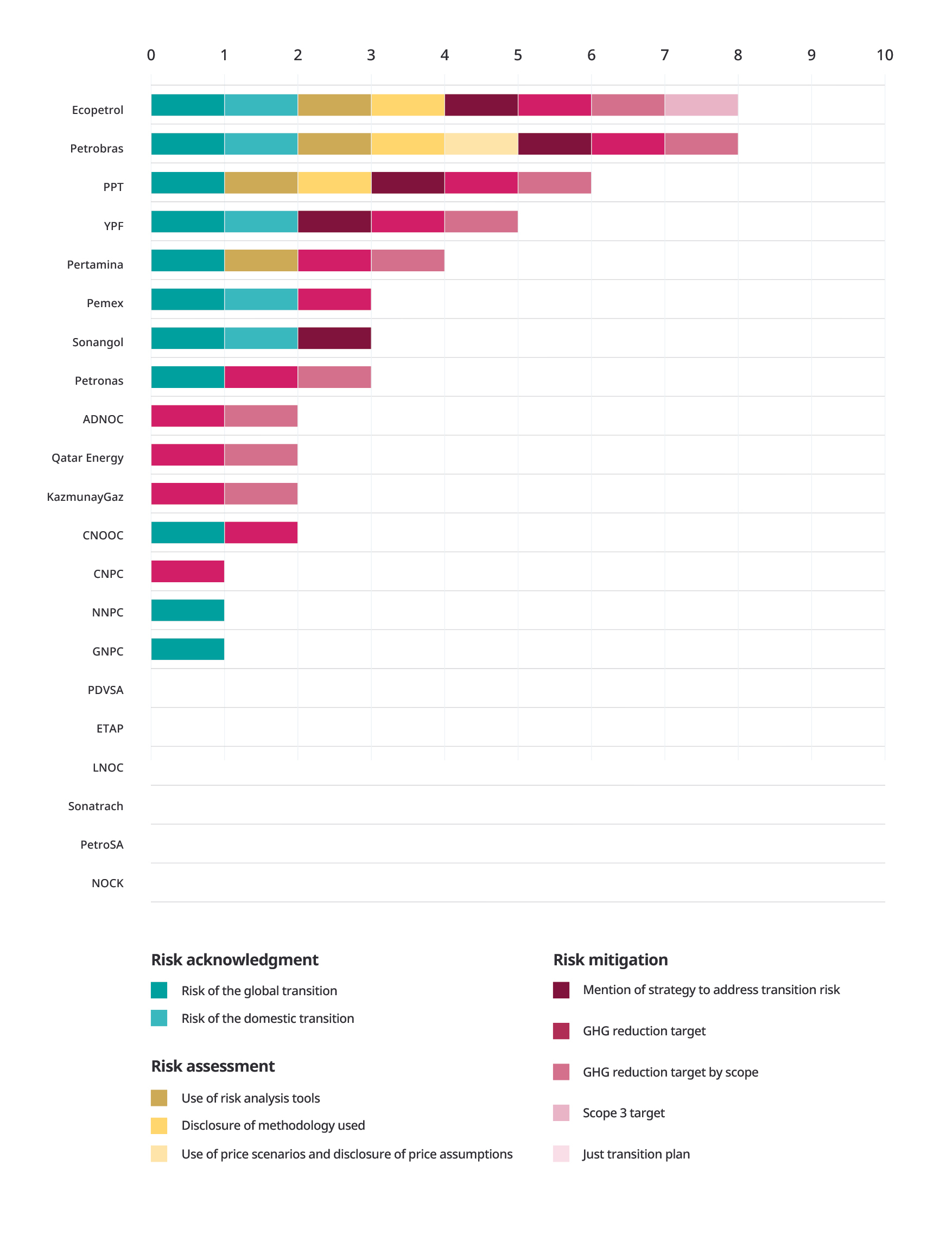
National oil companies (NOCs) produce half of the world’s oil, yet only recently have climate organizations considered NOCs a worthwhile area for advocacy.


How the Nigerian Government Can Right Size Its Gas Ambitions for Economic Development

Meeting Nigeria’s domestic energy needs remains one of the most significant barriers to sustainable development and economic growth in the country. Only half of Nigeria’s 200 million citizens currently have access to energy, and with the population set to double by 2050, universal access is a huge challenge.
The government proposes to ramp up gas production, utilization and export, with the aims of supporting industrialization, boosting domestic energy supply (for power, cooking and transport), and increasing government revenues. By doing so, the government expects to enhance economic activity, thus improving the lives of the half of the population living in extreme poverty.
The status of gas amid energy transition
Whether ramping up gas utilization is feasible, or indeed the appropriate approach to achieving Nigeria’s energy supply and economic ambitions, is uncertain. What is certain is that global pressure to transition away to cleaner energies and defund fossil fuel projects complicates the process of realizing that goal and could lead to wasted investments that jeopardize the economic and energy security of Nigerians in the future.
As the top oil producer with the largest gas reserves in Africa, set at around 200 tcf of proven reserves, Nigeria should be able to easily meet its domestic energy needs. But weak legal and regulatory frameworks, big infrastructure gaps, a non-cost-reflective pricing regime and host community conflicts have made the domestic gas sector uncompetitive and unattractive to investors. This, in turn, has left gas reserves underexploited, especially more expensive non-associated gas which represents half of Nigeria’s reserves.
Implementation of reforms by successive governments through the 2008 Gas Master Plan (GMP), the 2017 National Gas Policy (NGP) and other instruments have proven slow. With the passage of the Petroleum Industry Act (PIA) 2021, the legal, fiscal and regulatory framework of the gas sector has been strengthened with the creation of dedicated regulators, a dedicated minister, provision of third party access to infrastructure, and other improvements. But many gaps remain.
Thus the Decade of Gas Policy, launched in 2021 to address the limitations to achieving domestic gas-based industrialization and economic prosperity, and reduce energy poverty, faces greater challenges. The ambitious plan, not yet in the public domain, is intended to implement all previous ambitions in the GMP and NGP, including construction of the Nigeria-Morocco gas export pipeline, expansion of the Nigerian Liquified Natural Gas (NLNG) facility, and revival of the Nigerian Gas Flare Commercialisation Programme (NGFCP).
The government also intended the policy to settle debts to gas producers and initiate discussions on 10 key gas projects, aimed at unlocking greater volumes of gas both for domestic use and export. Nigeria seeks to unlock 3.1 bcf/d of gas to attract $14 billion in foreign direct investment, create over 2 million jobs and add $12 billion to the federal government’s revenue. However, three years on, authorities have publicized neither the policy itself nor progress updates, despite calls for clarification from several civil society actors, including the African Initiative for Transparency Accountability and Leadership, Civil Society Legislative Advocacy Centre, Centre for Journalism Innovation and Development, Stakeholder Democracy Network, Paradigm Leadership Support Initiative, Extractive360 and Nextier.
A challenging calculus
Despite the passage of the PIA, the push for gas expansion may have come decades too late. Fossil fuel projects are being defunded. The European Union will slap gas cargoes it deems to be of high methane and carbon intensity with punitive levies aimed at making them less competitive with cleaner fuels.
Consequently, African ambitions to bridge the still pervasive infrastructure deficit and expand investments to ramp up supply are more challenged than ever before. Countries on the continent only received 5 percent of global funding for gas power projects in 2022 compared to 12 percent in 2015. International public money for gas production in lower-income countries is less than $4 billion a year on average, with most going to Mozambique. With a gas infrastructure investment deficit of $20 billion per year, the Federal Ministry of Petroleum Resources and Power may need to prioritize alternative energy sources, in the midst of the government balancing its ambitions to transition its energy raising $10 billion annually.
Further, Nigeria’s government has not aligned its gas ambitions with broader energy transition plans, even as it bases its transition on leveraging gas as a “transition fuel.” New investments in gas fields as envisioned in section 9 of the PIA runs counter to the evolving global shift away from fossil fuels. New investments require long lead times before projects come online (and returns are realized), at which point there will likely be an oversupply of products and no demand. If countries’ commitments to combat climate change hold, Nigeria may be unable to export gas at the level it has come to rely on. That could potentially lead to stranded assets, including the pipeline investments to Europe, and infrastructure lock-in if renewable demand increases. Similarly, as gas production and use expand, the release of methane from flaring and venting gas, and from fugitive emissions, will likely increase. Those increased emissions will limit Nigeria’s ability to fulfil global methane emission reduction commitments, and also impact the health and environmental safety of nearby communities.
How the Nigerian government can move forward
To manage the decade of gas to enable Nigeria to meet its domestic energy needs and foster economic growth while accounting for global energy transition, the Nigerian government should:
- Manage its gas ambitions. Regurgitating all previous gas plans’ ambitions within the context of global commitments to defund fossil fuel investments is unrealistic. The government should instead acknowledge the reality of the energy transition; review its previous gas plans; access the available funds for projects; and adjust and articulate a shared agenda for financing a holistic domestic energy system with gas and renewables accounted for.
- Publicly disclose comprehensive details of gas plans. Unlike the GMP and NGP, the Decade of Gas Policy was neither approved by the Federal Executive Council nor published. The Federal Ministry of Petroleum Resources (Gas) and the Decade of Gas Secretariat must disclose details on the planned projects, realistic financial projections, and periodic progress updates so that Nigerians and investors can track progress and implementation and hold the government accountable.
- Align with national, subnational and energy transition plans. The Federal Ministry of Petroleum Resources (Gas) should work with the National Council on Climate Change and the Energy Transition Office to align gas plans with the energy transition plans to ensure sustainability. The Federal and State Ministries of Budget and National Planning should ensure that the gas plans do not contradict national and subnational development plans, and align to help achieve goals such as reducing household wood fuel use and increasing electrification.
- Manage the risks associated with expanding gas use. The Federal Ministry of Petroleum Resources (Gas) and the Federal Ministry of Environment should properly assess the risks involved with gas expansion, and create a strategy to minimize the impacts, maximize the benefits, phase out oil and gas assets, and plan for a post-oil and gas future.
- Demonstrate sustainability. The Nigerian Upstream Petroleum Regulatory Commission (NUPRC) and the Nigerian Midstream Downstream Petroleum Regulatory Authority (NMDPRA) should clarify how they intend to fund gas expansion, resolve legacy power sector debt, utilize flared gas through the NGFCP, and attract international oil company investments for more gas generation and infrastructure development. Most importantly, authorities should clarify how these investments will comply with Nigeria’s global commitments to reduce methane emissions.
- Require all gas projects to include community development agreements (CDAs). Gas projects should include community development initiatives such as health care services, educational programs which can directly benefit marginalized groups such as women and youth, and enhance quality of life in affected communities. The involvement of communities in project decisions would determine CDAs’ level of impact.
- Close the inequality gap. The Federal Ministry of Petroleum Resources; Gas and the Decade of Gas Secretariat should manage the Decade of Gas initiatives in a way that supports the economic independence of women and youth, especially, and specifically improve women’s decision-making power in use and distribution of gas, thereby contributing to gender equality and social inclusion.
- Include civil society. Authorities should deliberately engage civil society and the media to ensure they translate the government’s decisions to the Nigerian people. Media can guide the government to stay on course through consistent investigations, reviewing and agenda setting.
If Nigerian authorities can develop gas expansion plans sensitive to the increasing constraints (financial, infrastructural, human resource-related) imposed by the energy transition, they could better balance the need to meet domestic energy demand and achieve a sustainable energy future.
The authors wish to thank members of the civil society coalition on gas—Louis Ogbeifun (AfriTAL), Alexander Sewell (Stakeholder Democracy Network), Charles Majomi (NEXTIER) and Juliet Alohan Ukanwosu (Extractive360)—for their contributions to this post.
One Year on From the Russian Invasion: Impacts for the Middle East and North Africa

Transcript:
The Middle East and North Africa region has been impacted by the Russian invasion of Ukraine—especially the region’s energy sector. Here I will highlight three important elements.One is the renewed interest of many European countries in the oil and gas sector of the region, mainly Italy. Italy has been very open about its renewed interest in North Africa—Algeria and Libya. And we’ve seen ENI sign deals with Sonatrach in Algeria and the Libyan National Oil Corporation, and to develop new gas fields and existing fields as part of Italy’s energy diversification plan. We also saw high-level EU leadership going into Cairo in June 2022 to sign a memorandum of understanding with Israel and Egypt to allow these two countries to export gas to the European Union. Also, we have seen easing between Germany and Qatar about contracts—new contracts of for export of LNG to the European continent; before the invasion that was not an easy discussion between the countries, and even between the EU and LNG providers like Qatar.
The second trend has been an acceleration when it comes to clean energy and renewables. We’ve seen, again, the European Union signing deals with countries of the region, mainly a partnership with Morocco, to support clean energy in Morocco that will also serve some of the EU’s needs for clean energy. At the same time, we’ve seen pledges from the Gulf countries like Saudi Arabia and UAE to push for more investment in clean energy. Again, that could serve European needs as well as other parts of the world. There was also a big announcement about the need to further accelerate the energy transition. The region is taking action; Saudi Arabia has created a critical mineral fund to invest inside and outside the region in new minerals that are critical for the energy transition.
The third point is energy security. This was an opportunity for some countries in the region, mainly Saudi Arabia and the UAE and other producing countries, to remind us that it’s a fragile world that still needs oil and gas to move into what is being called now “orderly transition.” And we have seen Saudi Arabia and the UAE be very open about the issue of not breaking the oil sector by pushing to stop investing in oil and gas. That was very loud in the region as well. And the UAE is carrying that message into COP28 which it will host in November 2023. And lastly on energy security: the Ukraine crisis did help to seal a deal between two enemy countries, Lebanon and Israel, on their maritime border. There were many different reasons that that deal happened, but one element was that the world needed more gas, and if that deal would help with providing more gas, they thought, “Let's do it.”
These are the main messages we have seen, and these are the main highlights from the region after almost one year of the war between Russia and Ukraine.