
National Oil Company Database Update: How Did NOCs Respond to the 2020 Price Decline?

On 18 May, NRGI published the latest update of the National Oil Company Database, a free website that provides standardized and contextualized data on 71 national oil companies (NOCs), covering production, revenues and spending. NRGI updates the database semiannually—in May and December—using information published in official company or government reports.
With data now extending through 2020 for most companies and through 2021 data for nine others, NRGI has examined how NOCs responded to the sharp decline in oil prices in 2020 in this infographic. Since the lows in 2020, prices have climbed throughout 2021, reaching record highs this year. However, the way NOCs responded in 2020 may indicate how companies will—or won’t—change course in the face of the longer-term market decline anticipated as the energy transition unfolds.
As expected, financial transfers from NOCs to governments declined in 2020, reaching a new low for the decade covered by the database (2011-2021). However, this is not to say that contributions were not significant: transfers from NOCs accounted for well over 50 percent of the $600 billion governments collected from upstream oil and gas extraction in 2020. In terms of spending, NOCs appear to be increasingly reactive to market conditions, as our analysis shows a clear reduction in NOC capital expenditures in 2020. During the previous price decline in 2015, NOC investment growth stalled but didn’t drop (on average).
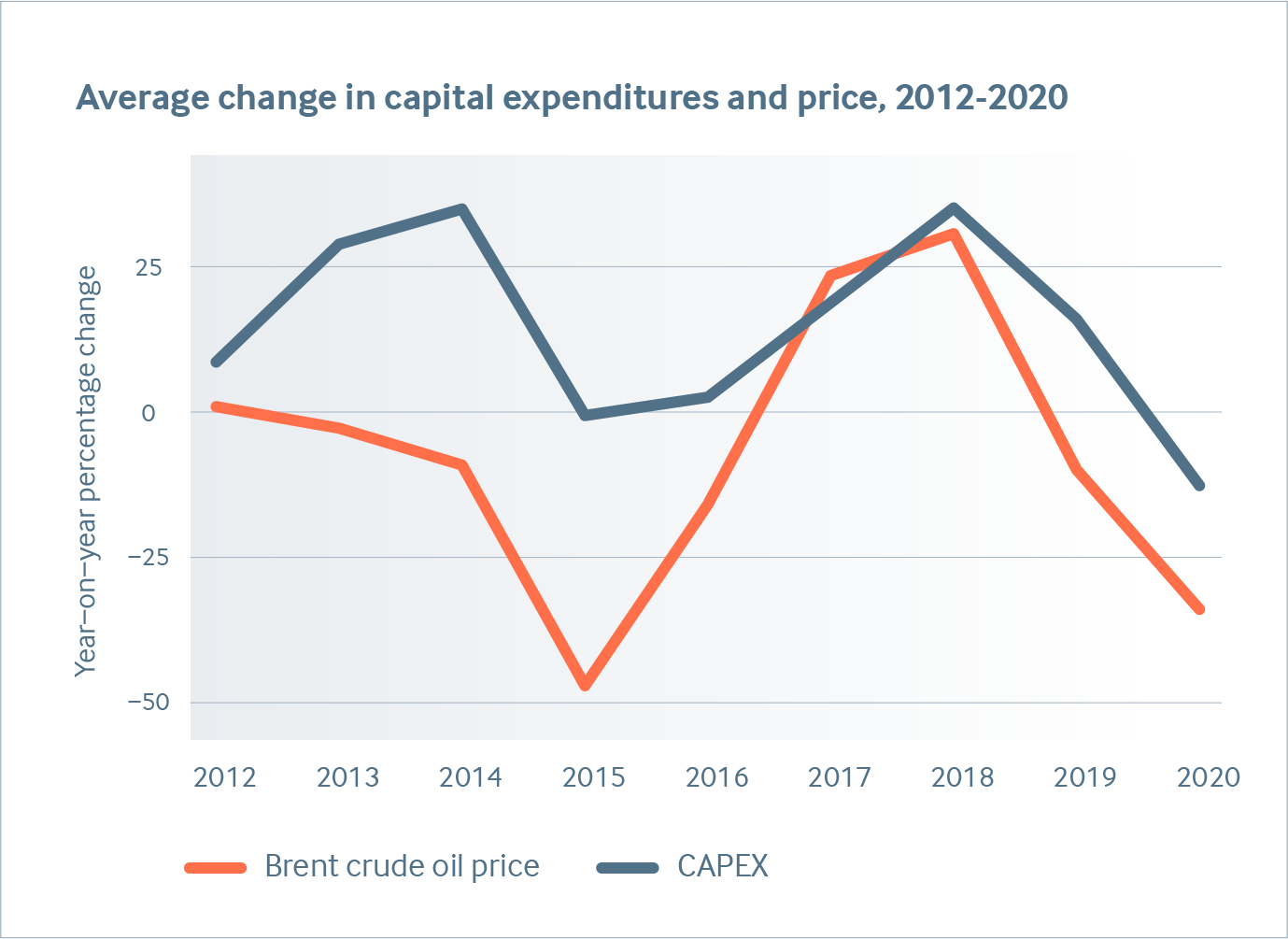
The energy transition could result in hundreds of billions of dollars of NOC investments in new projects becoming stranded, so it is particularly concerning that many companies remain opaque. For 2020, total revenue information is absent for around half of NOCs, as some do not report at all and others report with significant delays. Also notable absences in this update are Russia’s state-owned enterprises, Rosneft and Gazprom. Their annual reporting would typically be out by this point in the year, and while some news outlets have reported profit data, we have not been able to access any official reports for 2021.
In this round of data collection, we found a few large NOCs (Petrobras, Ecopetrol and Equinor) disclosing capital guidance on planned investments for decarbonization initiatives. This information is crucial to analyzing the energy transition pathways of national oil companies and we will continue researching decarbonization spending to include historical data as an indicator in future editions.
NRGI is using the National Oil Company Database extensively in its research and work on national oil companies and the energy transition. The purpose of the database is to advance public knowledge, and my NRGI colleagues and I find it encouraging to see the database being utilized as a resource in the production of vital research on the future of fossil fuel production such as the Production Gap Report, the EBRD’s Transition Report, and the Environmental Defense Fund’s Transferred Emissions report.
We designed the database with the researcher and data analyst in mind. The website provides several options for downloading data, a repository of original sources, and R code for analysis. Anyone utilizing the National Oil Company Database should contact us at nocdata@resourcegovernance.org with any questions or suggestions.
The next update of the National Oil Company Database is scheduled for December 2022.
Reflections on an Equitable Energy Transition from COP26

Reactions to emissions agreements reached at COP26 earlier this month were decidedly mixed. But one theme that emerged clearly from the dialogue surrounding the negotiations was the need for a just and equitable energy transition.
Developing countries that rely upon, or have been hoping to exploit, endowments of fossil fuels are in a unique predicament. They face the prospect of stranded assets and are caught between the global need to reduce fossil fuel consumption and their ambitions to economically develop, especially amid the turmoil wrought by the coronavirus pandemic. “In this challenging context, developing new producer countries are trying to figure out how to finance both their development and energy transition ambitions,” said NRGI’s Amir Shafaie as he moderated an event convened by NRGI, the Commonwealth Secretariat and the New Producers Group.
And in her intervention at Carbon Tracker’s “Energy Transition and the Far-Reaching Implications,” NRGI’s Nafi Chinery observed that “countries like Ghana need climate finance for their transition, but also a plan for how to spend transparently and based on stakeholder consultation and consensus.”
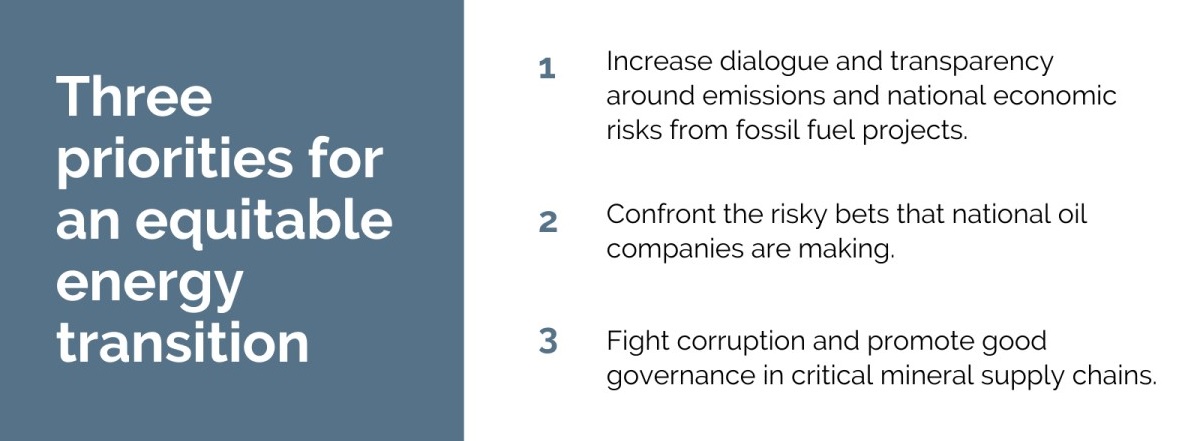
(This was one of three steps to a just and equitable energy transition outlined during COP by NRGI’s Suneeta Kaimal and Aaron Sayne, who also called for a focus on anticorruption in critical mineral supply chains.)
Chinery suggested that “the Ghanaian government needs a comprehensive outlook on energy transition that accounts for all risks and opportunities. Earlier this year the government proposed borrowing up to $1.6 billion to buy back offshore oil blocks, but this was based on a poor valuation and was extremely risky.”
Some saw previous COPs’ focus on the consumption of fossil fuels as lopsided. “We should have put fossil fuel supply on the table back in Rio, instead of focusing solely on emissions,” said Niclas Hallstrom of the What Next Forum. At the same event, Carbon Tracker’s Mike Coffin warned that “more than 400 million people live in countries with more than 20 percent of government revenue at risk due to oil investment. Oil-dependent countries must diversify their economies immediately. And other countries should not become petrostates; they must not double down.”
Engaging with oil-dependent states on their needs and with state-owned oil companies on their ambitions is critical at this juncture, as NRGI experts had highlighted in their contributions on state oil companies to October’s Production Gap Report. To further enable targeted advocacy, during COP NRGI and IISD released a joint briefing, “National Oil Companies and Climate Change: Insights for Advocates,” authored by several experts on state oil producers. Key points include:
- National oil companies are national. Engaging with them means engaging with the ambitions of their countries’ governments and citizens.
- Interests cloud perception of risks. National oil companies and their governments don't fully appreciate the economic risks associated with their investments.
- Economic development matters. National oil companies won’t change without public pressure and international support to diversify their countries’ economies.
- National oil companies differ. Climate and development advocates should tailor their strategies to distinct types of national oil companies, which present varying opportunities and challenges for reform.
- Renewable energy can be an opportunity or an obstacle. National oil company investment in renewables can boost the energy transition and give NOCs a stake in it, but can be counter-productive in some cases.
NOCs face especially high expectations and responsibilities in countries that have been planning to move into petroleum production and where “governments are wrestling with what the global imperative to shift away from fossil fuels means for them,” as Shafaie said at the new producers event.
The unique situation faced by these countries was illustrated by Agnes Moensi-Sokowikromo, COP delegate and chief financial officer of Suriname’s NOC Staatsolie. She observed: “Suriname’s recent oil discoveries are opportunities to stabilize the economy. We need these revenues now for social programs and the development of sustainable sectors to diversify the economy. On the other hand, Suriname is one of the few carbon-negative countries.”
Reducing fossil fuel consumption and production remains an essential area for climate action. In tackling this global problem, policymakers and activists must also keep in mind the challenges resource-rich developing countries face in the energy transition. NRGI and its partners Chatham House and the Commonwealth Secretariat continue to develop these themes through the New Producers Group, meeting on the key takeaways from COP and their implications for the policy and implementation challenges facing low-income, low-emissions new petroleum producers. This will remain a key priority for NRGI in 2022.
Hear more from Suneeta Kaimal on the energy transition in her podcast with Critical Resource.
Three Steps Toward an Equitable Energy Transition

When the curtain falls on COP26, a raft of action plans, pledges, compacts, coalitions and statements will have been announced. As “action-forcing moments,” these initiatives matter. But the choices made in countries around the world the other 50 weeks of the year, by actors ranging from national oil company officials and finance ministers to investors and activists, will equally determine the future for people and the planet.
Much of the spotlight in Glasgow is on promised cuts to fossil fuel consumption. Yet supply must also fall if we are to avoid catastrophe—the world needs to produce less oil, gas and coal starting now. Nearly two-thirds of already-discovered oil and gas would have to stay in the ground to keep within 1.5°C, and at current production levels, we’ll spend the global carbon budget by around 2030.
Each and every fossil fuel-producing country should support action on climate change for a simple reason: they are all vulnerable to it, and none more so than developing countries in the tropics. Yet an abrupt end to production would upend economic and political life in many of these countries, especially where leaders and citizens have staked their aspirations on getting more out of the ground.
At NRGI we believe that, at a minimum, wealthier, higher-emitting producers that have benefitted the most from extraction should wind down first and fastest. They should also make the deepest production cuts. Most lower-income producers have small carbon footprints, as well as pressing development and energy challenges. Pressuring them to wind down faster is economically unfair and morally unjustifiable.
The world cannot wait for wealthy nations to “lead” on fossil fuel production cuts. Many haven’t even acknowledged the limits of their moral authority on the topic, especially when toxic politics are stalling their own energy sector clean-ups. While the U.S., U.K., Canada and others just pledged to end financing for fossil fuel projects in low-income countries, G20 countries have poured $300 billion in new public money into fossil fuels since the pandemic started. Some countries—like the U.S., Canada and Australia—take the stage at events like COP to preach hard choices they won’t make for themselves. This sows mistrust and division, and complicates progress toward consensus.
In this tough political climate, we need solutions that don’t require a grand bargain. G20 countries must first honor their climate finance promises; supporting lower-income, fossil-dependent producing countries to transition to a post-oil, -gas or -coal economy is a critical complement. This includes investing in natural resource governance, which offers a road map to support quicker, fairer energy transitions for fossil fuel and mineral producers.
Here are three priorities that policy makers, activists and the international community must advance:
Increase dialogue and transparency around emissions and national economic risks from fossil fuel projects.
With a billion people already living in poverty in resource-rich developing countries, the stakes for adaptation and transition are high; yet fossil fuels represent one of the few avenues for much needed revenues for recovery and sustainable development. As a result, as demand wanes, some leaders will support costly, questionable handouts to extractives companies. Others with less altruistic aims will push through polluting, corrupt, possibly loss-making projects to keep their pockets lined.
Whatever their agendas, few politicians, in countries wealthy or poor, are likely to engineer fast, fair transitions by themselves. They will have to engage with—and be pushed by—activists, climate defenders, frontline communities, media, civic and trade organizations and research institutions, among others. If those actors are to play their critical roles, governments must first protect civic space and disclose more information on their energy transition plans. They should detail their future production goals, including what they’ll spend on subsidies and infrastructure. They should publish realistic scenarios for how transition could affect the health of their economies and the economics of particular fossil fuel projects. And they should be honest about the carbon-intensity of their production and reserves. This will help citizens hold leaders accountable, engage in more meaningful dialogue and shape new pathways for development.
International actors should also establish and implement strong and consistent standards. Extractives companies, for their part, must disclose more than the high-level information found now in most of their current climate risk disclosures, ESG metrics and sustainability reports. The data they publish should not just be for investors. Data should help stakeholders where the companies operate to understand how the companies’ transition plans—including divestment from specific projects—will impact national economic and development prospects. More broadly, fossil fuel companies can exacerbate governance and resource dependence risks in producing countries; climate disclosure standards must better and in a more nuanced fashion shed light on such risks. For this reason, norm-setting bodies must pay more attention to developing sector-specific standards, like the approach taken in the new Global Reporting Initiative Oil and Gas Standard.
Confront the risky bets that national oil companies are making.
The debate about how to cut supply cannot ignore national oil companies (NOCs), which produce over half of all oil and gas. Plans made by this “hidden half” of the industry matter at least as much as those of international oil companies, especially now that developing any new oil or gas fields conflicts with Paris goals. Leaders in resource-rich countries face a stark choice regarding new fossil fuel projects: investing public money in these projects will either undermine climate goals, or potentially cost their countries billions if climate goals are met.
Going forward, finance ministers and other economic decision-makers in countries with NOCs must reconsider whether letting NOCs grow is worth the risk. NOCs making risky bets in the oil and gas sector often do so by incurring largely hidden debt ultimately backed by government, meaning countries could be left responsible. Private oil and gas companies, for their part, should not try to pawn their risky assets onto state companies from poor countries; nor should they ask for tax breaks or other handouts.
Strategies to push NOCs to produce less must recognize that NOCs vary greatly in their openness to change, their vulnerability to the energy transition, and what they add to their economies and world emissions. Campaigners need context-specific, pragmatic strategies that don’t require NOC bosses to care about climate change—for example, pushing an NOC (or its financial backers) to recognize when its ambitions don’t make economic sense. Success along those lines would be a boon for the climate fight since countries with more risk-averse views on new extraction would produce less. It would also give fossil fuel-producing countries a better shot at building diversified, resilient economies as demand for what they currently produce wanes.
Fight corruption and promote good governance in critical mineral supply chains.
Thus far, COP has largely overlooked the flip side of fossil fuels’ decline: the projected quadrupling of the demand for clean technology minerals such as cobalt, lithium and copper that are needed for transition. As demand spikes, expectations in the countries producing them have surged, as prospects for a new mineral boom raise hopes for revenues to boost development. But mineral booms have often disappointed in the past, and these countries could also face rampant corruption—which, in turn, could disrupt supply.
Production surges could also feed an ugly, unjust “race to the bottom” that benefits rich consumer nations and producer-country elites while leaving citizens in host countries to pay the costs with their ecosystems, living standards and lives. Many countries with sizeable reserves of critical minerals have already suffered instability and destruction from poorly governed mining—these include the Democratic Republic of the Congo (home to half of known cobalt reserves), Myanmar (large deposits of rare earth minerals) and Bolivia (some of the world’s largest undeveloped lithium deposits). The energy transition should offer citizens in places like these something other than fresh disappointment.
Schemes to track and certify mineral supplies, while important, won’t alone promote a mineral boom that’s both fast and fair. The governments, companies and investors leading supply chain initiatives must also support forward-looking anticorruption and governance standards—for instance, by publishing all payments and mining contracts, avoiding corruption-prone agents and intermediaries, and disclosing companies’ true owners. They should also help producer countries strengthen their laws and institutions and encourage them to take important steps like auditing their state-owned mining companies or opening license awards to outside scrutiny.
These three actions can help governments and citizens in producing countries make more informed choices about their energy futures that protect the planet, strengthen their economies, and create fairer societies. The global energy transition should offer such chances to all, not just to those who have already excessively benefitted at the expense of others.
Suneeta Kaimal is president and chief executive officer of the Natural Resource Governance Institute (NRGI). Aaron Sayne is a senior governance officer at NRGI.
Improving Governance for a Just and Equitable Energy Transition: A 'Critical Conversation' with NRGI's Suneeta Kaimal

Critical Resource's latest "Critical Conversation" podcast features an exclusive discussion with President and CEO of the Natural Resource Governance Institute (NRGI), Suneeta Kaimal, on the opportunity and need for improved governance to manage a just and equitable transition to a decarbonized world.
Suneeta Kaimal was appointed President and CEO of NRGI in February 2021. Previously, she served as NRGI’s Chief Operating Officer and became interim president in 2020, she is also on the board of the International Centre for Not-For-Profit Law, and previously chaired the Open Government Partnership and Publish What You Pay.
This 30-minute conversation was recorded on 22 October 2021, and was moderated by Daniel Litvin, Founder and Managing Partner of Critical Resource.
Among the key points raised by Suneeta:
- The pandemic has been a litmus test for resource governance. Resource rich developing nations have been pushed back into poverty – by 2030 half of the world’s poor will be in resource rich countries.
- Increased tensions between China, the US and the EU are pulling resource rich developing nations in radically different directions, making it harder for them to understand the rules of the game. We need to stand up for the laws and policies we’ve worked together to create and address governance challenges to ensure a greener, more prosperous planet.
- Tax systems have failed to deliver – Sub-Saharan Africa loses $600m annually in lost taxes. For many years, companies have exploited asymmetries of capacity, power and knowledge, with government revenues eroded by lopsided agreements and unnecessary incentives. We need to thread the needle to design taxes that mobilise revenue and attract investment, while being flexible, simple and resilient to changing circumstances.
- Wealthier countries should wind down fossil fuel production first and fastest the hypocrisy of major economies is shocking. G20 countries have poured billions into fossil fuels since the start of the pandemic, and yet are asking low-income producers with small carbon footprints to transition faster than wealthier, high emitting producers. It’s economically and morally unjustifiable.
- We need to ensure that the energy transition doesn’t exacerbate or introduce new inequities. We have to stop repeating the errors of the past and see the energy transition as an opportunity to do things differently.
- The expected boom from mining ‘energy transition metals’ could help countries rich in these resources fund much-needed social spending. It could also engender reforms to the mining sector, making it a greener, more rights respecting industry that contributes to sustainable economic and social systems. However, corruption and mismanagement risks disrupting the supply of critical minerals and leave citizens worse off.
- It is naïve to assume that renewables won’t be prone to similar governance challenges that we’ve already seen in the extractive sector. Applying the lessons we have learnt from oil, gas and mining would enable us to create a greener future grounded in good governance.
This article was originally published on Critical Resource's website.
Climate Advocacy and the Politics of National Oil Companies

National oil companies (NOCs) are set to spend about USD 2 trillion on new oil and gas projects over the next decade. With such sizable investments expected, it is urgent to develop robust advocacy strategies to avoid dangerously pushing the world past 1.5°C.
It is also important to tailor such strategies to suit different contexts given that some countries are more exposed to international markets, some NOCs are more indebted than others, and not all NOCs are equally positioned to pivot into renewable energy. Yet, unlike international oil companies (IOCs), which experience pressure from shareholders and consumers, NOCs are more often subject to domestic political pressures.
Given these challenges, what factors drive NOC decision-making and what are their implications for climate action? In particular, what levers may lead to more ambitious climate action from NOCs? On 13 July, the final webinar in the “National Oil Companies and Climate Change” series, hosted by the International Institute for Sustainable Development (IISD) and the Natural Resource Governance Institute (NRGI), explored these questions in depth.
Alexandra Gillies of NRGI opened the discussion by framing the fundamental challenge: the climate emergency requires more concerted action by NOCs (and their governments), but stakeholders, campaigners and environmental advocates have not yet translated the incentives and tactics most commonly applied to international oil companies (IOCs). She noted that while incremental emission reduction steps may seem more feasible in the short run, these pale in comparison to the scale and urgency of the climate crisis.
Laurie van der Burg of Oil Change International shared lessons from her work campaigning for change within IOCs and the May 2021 Shell climate case win, which forced the company to reduce its CO2 emissions 45 percent from 2019 levels by 2030.
Chido Muzondo from IISD discussed how insights she gained from engaging with state-owned companies, such as highly coal-dependent power producer Eskom in South Africa, could apply to the NOC context. In particular, Chido explored which engagement strategies could lead to positive outcomes on the ground for workers, the utility company, and the climate.
Paasha Mahdavi from the University of California Santa Barbara analyzed the political economy of reform and key drivers for change in different NOC contexts. He mentioned that, in the complex relationship between governments and NOCs, influence tends to flow both ways, with both actors holding conflicting priorities at times.
In turn, Lourdes Melgar from the Baker Institute Center for Energy discussed how political leadership and government priorities, particularly in Mexico, play an important role in shaping NOC decisions.
Within and across countries, four main lessons emerged:
Interdisciplinary collaboration and tailored messaging are essential. Chido Muzondo highlighted how in South Africa, it has been crucial to engage in constructive dialogue with Eskom and build on the utility company’s initial progress on electricity sector reform and renewable energy investment. Acting as a subsidy watchdog and throwing a spotlight on public bailouts of the company has also been an effective way to gain public traction and pressure Eskom to improve financial performance. Laurie van der Burg agreed that climate advocates should collaborate across disciplines, using tactics including investigative journalism, climate protests and litigation to increase public pressure on oil majors. Not only does employing such a range of approaches increase the chances that some will succeed, they can also mutually reinforce each other—for example, shifting public opinion in the Netherlands helped create the conditions for a court to rule against Shell.
Four main levers can influence NOC behavior: political leadership, internal pressure, domestic public pressure and international pressure. As Paasha Mahdavi and Lourdes Melgar pointed out, political leadership by far exerts the most power upon most NOCs, which receive their mandate from their governments and must respond to national economic and environmental priorities. The other levers tend to be weaker influences on NOCs than IOCs, but they can still make a difference, even when government priorities are not fully aligned with climate goals. NOCs can both drive change internally and influence their governments, especially where they have a strategic interest in doing so. The Kuwait National Petroleum company, for example, invested in solar energy not primarily for climate reasons but to reduce the risk of energy imports and improve the recovery of oil from mature wells. Non-petroleum industry pressure can also influence NOC ambitions, as in Iran where domestic industries’ energy needs caused them to push back on the NOC’s plan to increase liquefied natural gas (LNG) exports; in South Africa, trade unions have vocally engaged Eskom around its strategic future. In terms of international pressure, NOCs that require international finance to satisfy long-term demand may be the easiest to influence.
Political motives and government signals can delay or accelerate the energy transition. In certain cases, officials or departments within the government might disagree on how to push the NOC to make more ambitious climate plans. Chido Muzondo mentioned that in South Africa, the president’s willingness to shift away from fossil fuels often conflicts with the views of the Department of Mineral Resources and Energy. In other contexts, a new political ideology may cast the NOC as crucial to the economy’s future. This has happened in Mexico, where the government has heavily invested in Pemex and future oil refining projects. In any case, neither governments nor NOC management teams are monolithic, and advocates should look for opportunities to play to their internal differences.
While incremental change may be necessary, it is important to focus NOC and government attention on rapid transition. A managed and equitable phase-out of oil and gas production is critical for the planet. But panelists emphasized that reaching this goal may require smaller steps along the way, such as first ending unconventional or deepwater production, and that the timing of reforms will vary in different contexts. That said, in oil-dependent countries with large NOCs—where phase-outs are the most contentious—decision-makers may be tempted to limit reform or to ignore the implications of a fast-transition scenario. Many of these governments believe an energy transition will happen, but unrealistically think their NOC will be the last one standing. Almost all will be wrong. And as Laurie van der Burg pointed out, change can come very fast as we’ve seen this past year, making previously implausible scenarios possible or likely. As such, analysts and advocates should focus government and NOC attention on the implications of (and the need for) rapid transition.
There are ample opportunities to influence NOCs on climate change—but those trying to use them will be most successful if they understand the dynamics at play and how to leverage them.
In order to further distill the lessons learned from the “National Oil Companies and Climate Change” webinar series, NRGI and IISD will publish a policy brief in the second half of 2021 which will synthesize key conclusions and make recommendations for governments in oil producing countries, NOC leaders, climate advocates, and the parties to international climate agreements.
Joachim Roth is a policy analyst with the International Institute for Sustainable Development's (IISD) energy team. Patrick Heller is an advisor at NRGI and a senior visiting fellow at the Center for Law, Energy & the Environment, University of California, Berkeley. Greg Muttitt is senior policy advisor for energy supply at IISD.
IEA’s Ambitious Climate Scenario Underscores Need for More Transparency on Fossil Fuel Projects

The IEA experts have articulated several dramatic milestones that would be necessary to reach this critical goal, including:
- no approvals of new oil and gas field development and no new coal mines or mine extensions by this year
- electric vehicles reaching 60 percent of global car sales by 2030
- nearly 70 percent of global electricity generation produced from solar and wind by 2050.
Given that government and industry leaders rely on IEA scenarios in their planning, many hope that these urgent targets will spur much-needed climate action.
Beyond these headline prescriptions, the IEA makes another critical point: changes brought by the clean energy transformation will be challenging to implement, so decisions must be transparent and just. As the gap grows between government and company plans for future production and the levels consistent with a Paris-compliant world, there is increasing attention on how supply-side commitments from oil-producing countries might shape net-zero ambitions. These countries face significant economic shocks as the world decarbonizes: the IEA estimates that per capita income from oil and gas in producer countries would fall by 75 percent under its new net-zero scenario. Even if the world falls somewhat short of the Paris goals, governments in these countries face the prospect of dramatically lower revenues and public assets wasted by excessive concentration in a declining sector. Against this backdrop, citizens in low- and middle-income producer countries will inevitably face major uncertainties in the race to net zero. Access to basic information about how their social and economic prospects are shifting should not be one of them.
Governments and companies must disclose more information of relevance to the billion people that live in poverty in oil- and mineral-rich developing countries, and engage impacted citizens in producer countries as core stakeholders in energy transition policy dialogues. Despite the urgency of the economic challenge they face, many fossil fuel producers have not done enough to develop strong plans for economic diversification or inclusive development in a lower-carbon future.
The allure of oil and gas has thus far been powerfully addictive. Open dialogue between governments, companies, and citizens on the role of fossil fuel production in national economies will facilitate meaningful climate action and improve the prospects of countries that remain hooked on oil and gas. Globally inclusive dialogue is also needed around which countries should reduce production first; developing and emerging market producers are already calling on wealthy countries to lead the decline.
Today, too much information that is necessary for just and effective transition discussions remains hidden from view. Increasingly, debates will center on whether specific fossil fuel projects are viable or not—from both economic and climate perspectives. In many producer countries, the decision to halt or continue one or two key projects can affect the whole economy. Project-focused transparency efforts could support a just transition by helping citizens in producer countries assess the impacts and effectiveness of divestment and economic diversification plans. Greater transparency at this level would also help citizens hold government officials, multinational decision-makers and industry executives accountable for an equitable and well-managed process.
Governments and companies should disclose the following information about fossil fuel projects:
- Exposure to climate-related financial risk. To hold governments and companies to account and determine whether continued extraction or particular project configurations are in the national interest, citizens need: information about the viability of projects and national budgets under various transition scenarios (including the IEA net zero scenario); break-even prices, reserves and potential emissions of current and pending fossil fuel projects; and price and revenue forecasts used by financial authorities. The Extractive Industries Transparency Initiative (EITI) encourages the governments of its 55 implementing countries to disclose information that will further public understanding and debate around issues of revenue sustainability and resource dependence, including official production, commodity price and revenue projections. In practice, however, few countries publish this information, which must change. The EITI Standard should require, rather than merely encourage, these disclosures. The Standard should also require EITI supporting and member companies to disclose their own scenarios, assumptions and projections. United States and European regulators, who are also considering this issue, should also require this project-level information of fossil fuel companies globally.
- Plans for energy transition and production. Governments in producer countries should disclose information about their project divestment (and investment) and energy transition plans, and invite public debate on these topics. Oil companies—both private and state-owned—should also disclose production, energy transition, and responsible exit plans for their projects. They should also engage with stakeholders on the social and economic impacts that project continuation, wind down, or transfer would have on host governments and communities (e.g., impacts on payments to government and local employment, timelines and decommissioning plans). Governments and companies must also disclose the contracts that govern projects so that oversight actors can assess exploration and production rights, project amendment conditions, and adherence to decommissioning and asset sale obligations. At a minimum, both government and company actors should account for how much proposed projects will cost, their carbon footprints, and whether they align with climate goals.
- Financing and subsidization of carbon-intensive projects. Countries should disclose current and proposed spending on fossil fuel projects by national oil companies, public investment in fossil-fuel linked infrastructure, and the value of tax incentives and other subsidies they provide to support fossil fuel projects. They should also disclose the impact various transition scenarios would have on the return on public investment.
- Carbon intensity of production and reserves. Officials and executives should disclose the levels of greenhouse gas emissions (scope 1 and 2 emissions) associated with a project, as well as information necessary to assess the emissions associated with the eventual burning of those fuels, including emissions made abroad after export. This information is critical for informed public debate about the climate impact of a country’s extractive activities. In addition to disclosures around current production, citizens and investors need reliable information about undeveloped fossil fuel reserves, their embedded carbon content and the costs necessary to extract them to make equitable decisions about which countries need to phase out production fastest.
- Influence of fossil fuel interests on policymaking. In some producing countries, political leaders use fossil-fuel revenues to maintain their positions and power, giving them strong incentives to continue production. In others, fossil fuel companies enjoy considerable influence over policymakers. Governments and companies should disclose information that enables accountability actors to monitor channels of influence by vested interests. This information includes the identity of politically exposed beneficial owners with stakes in extractives projects, details about industry lobbying activities and political donations, and corporate reporting on compliance with “revolving door” policies and other integrity measures.
The IEA report makes the case for decisive and immediate climate action. The many necessary steps will require complex negotiation and coordination. But extractive sector companies and governments of producing countries can rapidly implement a core set of project-level, supply-side disclosures that would enable impacted stakeholders to assess project viability and contribute to energy transition plans. Increasing production-related commitments in nationally determined contributions is a clear opportunity. Reporting entities should leverage the readymade platforms and multi-stakeholder networks offered by transparency-oriented forums like the EITI and the Open Government Partnership, and draw on the considerable thinking that already exists on many of the key technical components and data standards that would be central to such disclosures.
What remains unclear, however, is whether an actor or group will take up the mantle of making this critical transparency a global priority and realizing it. We are working with partner organizations to explore how we can jointly push global leaders to step up. With more than 50 global and regional climate-focused gatherings taking place in the next six months, culminating in COP26 in November, the time is ripe.