
Getting the Most Out of the EITI's New Provision on Greenhouse Gas Data

When the 2023 EITI Standard introduced Requirement 3.4 on greenhouse gas emissions in response to civil society demands, it marked the first time the global extractive industries transparency standard addressed this important climate data. But the provision is only "encouraged," at the lowest tier of the EITI's hierarchy of obligations—with no consequences for non-compliance.
Yet the response has been strong. As of June 2026, 25 implementing countries are already reporting on GHG emissions, and civil society in at least five more is actively pushing for disclosure. That is more than half of all implementing countries engaging with a provision they have no obligation to follow.
EITI implementing countries doing some form of GHG emissions reporting | EITI countries that are not reporting on GHG emissions but where civil society is working to advance emissions disclosures |
25 Angola, Argentina, Burkina Faso, Cameroon, Central African Republic, Chad, Côte d'Ivoire, Democratic Republic of the Congo, Ecuador, Ghana, Guyana, Kazakhstan, Mauritania, Madagascar, Mongolia, Nigeria, Norway, Peru, Republic of Congo, Senegal, Timor-Leste, Trinidad and Tobago, Uganda, Ukraine and United Kingdom | 5 Colombia, Guinea, Indonesia, Philippines, and Zambia |
Source: NRGI review of latest EITI reports, June 2026
The question now is not whether countries will engage with the provision, but whether they will use it to get the data they actually need to inform public debate about emissions from their extractive industries.
The data producing countries actually need
Requirement 3.4 has two parts. The first encourages companies to disclose GHG emissions in alignment with leading disclosure standards—something many large extractive companies already do, to varying degrees, through the CDP, corporate sustainability reports, or upcoming mandatory frameworks like the EU's Corporate Sustainability Reporting Directive and the ISSB's IFRS S2.
The second part encourages multi-stakeholder groups (MSGs) to request disaggregated disclosures. This is where the real opportunity lies—not because the EITI is going beyond what other frameworks require, but because it gives producing countries access to emissions data at a level of detail that actually serves their needs.
Most existing emissions disclosures are aggregated at the company level—global totals that may help investors compare companies' overall climate footprints and assess portfolio risk. But a company-wide emissions figure tells a government official in Senegal or a community leader in Mozambique nothing about the emissions profile of the company’s specific operations in their country. It tells them nothing about which projects are the highest emitters and therefore most exposed to carbon pricing, import restrictions like the EU's Methane Regulation and Carbon Border Adjustment Mechanism (CBAM), or shifting investor expectations. For workers, suppliers and communities whose livelihoods depend on these projects, this matters: high-emitting projects carry greater climate-related financial risk and are linked to greater environmental impacts. The people who depend on them deserve to understand that risk. Aggregated data hides it.
Even national-level data fall short for stakeholders in producing countries. What they need is project-level data. Only this level of detail lets them understand the emissions footprint of individual operations, assess economic risks, hold companies to account for reduction commitments, and inform national climate plans.
Project-level disclosure is already becoming the norm
Asking for project-level emissions data is not a radical proposition. In mining, the Global Reporting Initiative's GRI 14 Mining Sector Standard already recommends it. The most recent drafts of the revised Initiative for Responsible Mining Assurance (IRMA) standard and the Consolidated Mining Standard Initiative both require site-level disclosure. South32, Anglo American, BHP and Newmont disclose project-level emissions data through their sustainability reporting, and they are far from alone. Project-level disclosure is becoming standard practice across the mining sector.
Oil and gas has historically been more resistant to granular disclosure, but that is changing. The widely used Oil and Gas Methane Partnership 2.0 (OGMP 2.0) framework requires companies to produce site-level data to achieve its top-level reporting tier, and over 65 companies have now met that standard, including majors like Eni, Equinor, Repsol, Shell, and TotalEnergies. Given that these companies are already producing site-level, measurement-based emissions data, sharing it through the EITI MSG should be straightforward.
What countries and civil society are doing
Ambition varies across EITI implementing countries. In Côte d'Ivoire, Burkina Faso and Ghana, at least some mining companies are already providing project-level emissions data through EITI reporting. Norway publishes project-level oil and gas emissions data on the Norwegian Petroleum website, run by the Ministry of Energy and the Norwegian Offshore Directorate.
Much of this progress is being driven by civil society. In Nigeria, NRGI worked with the Nigeria EITI (NEITI) to develop a standardized GHG reporting template that is now integrated into the national EITI audit process, bringing company emissions data into a consolidated public dataset for the first time. NRGI has supported the development of tools to make this data more accessible and used it to help journalists, civil society organizations, and parliamentarians scrutinize corporate emissions performance. In Senegal—a new hydrocarbon producer—NRGI also produced some of the first independent estimates of methane emissions from the country’s oil and gas operations and is now working with EITI and government stakeholders to build a methane emissions governance framework, including a dedicated monitoring, reporting, and verification system for the sector.
Elsewhere, with support from the World Bank's Extractives Global Programmatic Support (EGPS) trust fund, Transparency International and NRGI ran a program supporting local civil society groups to use the 2023 EITI Standard to strengthen accountability. Two of the ten projects selected focused specifically on Requirement 3.4. In Indonesia, Publish What You Pay Indonesia produced a scoping study on GHG reporting gaps in the coal sector that led the Ministry of Energy to commit to using the findings for policy development. In Kazakhstan, Public Association Echo developed a standardized GHG reporting form and policy brief that resulted in the Terms of Reference for the National EITI Report being expanded to include disclosure of GHG reduction measures and emission quotas. Both projects independently identified project-level disaggregation as the critical missing piece for meaningful local oversight.
Why EITI? Turning data into dialogue
Data published through EITI is truly public. Many existing disclosure platforms for GHG emissions, including the CDP, the OGMP and UNEP’s Methane Alert and Response System (MARS), are oriented more toward investors, governments or company decision-makers than to the general public. Some put data behind paywalls. By contrast, data published through EITI is open to everyone.
But the distinctive value of bringing emissions data into EITI processes is not just the data itself—it is the multi-stakeholder structure that surrounds it. Emissions data disclosed through EITI enters a process where representatives of government, industry, and civil society are already convened to discuss extractive sector governance. Environmental groups can scrutinize methane emissions. Workers and suppliers can ask whether governments and companies are doing enough to ensure that projects they depend on remain competitive in light of international GHG regulations. Citizens can ask whether state-owned companies—which a recent IEA-led assessment found tend to fall short on reporting against their emissions pledges—are putting public finances at risk. Governments can assess whether extractive sector oversight aligns with national climate commitments. This process—different stakeholders examining the same data from different angles—is what turns transparency into accountability and supports more informed decision-making.
What MSGs should do now
The EITI International Secretariat published a guidance note on Requirement 3.4 in October 2025, setting out a six-step process for implementation. It is a practical resource. Importantly, the guidance shows why project-level data is important, and why MSGs should request it. This data serves citizens and governments. Many companies already report it. The momentum behind Requirement 3.4 shows that EITI stakeholders understand the value of emissions transparency. The task now is to ensure that the data countries collect is detailed enough to make a difference.
Notes
-
1
Authors’ analysis based on “Greenhouse Gas Emissions from Energy Data Explorer”, International Energy Agency, 2 August 2023, www.iea.org/data-and-statistics/data-tools/greenhouse-gas-emissions-from-energy-data-explorer. And Hannah Ritchie, Max Roser, and Pablo Rosado, “CO₂ and Greenhouse Gas Emissions,” Our World in Data, 2020, ourworldindata.org/co2-and-greenhouse-gas-emissions.
-
2
Authors’ calculations based on Hannah Ritchie, Pablo Rosado, and Max Roser, “Greenhouse Gas Emissions,” Our World in Data, 2020. And “Oil and Natural Gas Supply,” IEA, 2022, www.iea.org/reports/oil-and-natural-gas-supply. Quoted in African Natural Resources Management and Investment Centre, Minimising Greenhouse Gas Emissions in the Petroleum Sector: The Opportunity for Emerging Producers (Abidjan, Côte d’Ivoire: African Development Bank, 2022), 14, www.newproducersgroup.online/wp-content/uploads/2022/11/Minimising-Greenhouse-Gas-Emissions-in-the-Petroleum-Sector.pdf.
-
3
In order to ensure greater international equity in the energy transition, authorities in countries implementing schemes such as the EU’s CBAM should include, in or alongside such schemes, measures to mitigate their negative effects on low and middle-income countries, e.g., through financial and/or technical assistance to help such countries green their economies.
-
4
Methane is a common by-product of oil extraction and a particularly potent greenhouse gas. In the process of getting oil and gas out of the ground, it is commonly emitted either through leaks or planned release into the atmosphere – either unburned (“venting”) or burned (“flaring”). Processing (e.g., refining) and transporting oil and gas also generate significant emissions. See “Methane from Oil and Gas Production Explained,” The World Bank - Global Gas Flaring Reduction Partnership, accessed 24 October 2023, www.worldbank.org/en/programs/gasflaringreduction/methane-explained.
-
5
The Global Registry of Fossil Fuels is an “[O]pen-source database of oil, gas and coal production and reserves globally, expressed in CO2-equivalent… It contains data from 139 fossil fuel producing countries, which amounts to 99% of fossil fuel production aggregated to the national level.” The database also provides estimates of the emissions from producing oil and gas in 91 oil producing countries and 71 gas producers. See “Global Registry of Fossil Fuel Emissions and Reserves”, Global Registry of Fossil Fuels, accessed 4 September 2023, fossilfuelregistry.org.
-
6
Figures 1 and 2 show a selection of countries, including some of the world’s larger oil producers, some of the world’s lower emitting producers as well as a selection of countries where NRGI operates. This is intended to provide reference points to explore whether individual countries will be more or less “carbon-competitive” than other producers based on current intensities and identifying potential examples of good practice among lower emitting producers. We also include a selection of higher-emitting producers, which may provide examples of practices to avoid.
-
7
Source: “Carbon Intensity in the Fossil Fuel Supply Chain”, Global Registry of Fossil Fuels, 2023, fossilfuelregistry.org/carbon-intensity. Global Warming Potential (GWP) 20 is applied to methane emissions; see “Methane and Climate Change,” IEA, accessed 4 September 2023, www.iea.org/reports/methane-tracker-2021/methane-and-climate-change. The impact would be smaller if we used Global Warming Potential 100. The impact over the next 20 years is important and sufficient to justify action on cutting upstream emissions (and using GWP 100 would fail to show this); this is why we have chosen to display GWP 20 in this figure and figure 2. For further discussion, see Janos Maté and David Kanter, “The Benefits of Basing Policies on the 20 Year GWP of HFCs” (Greenpeace, 2011), ozone.unep.org/system/files/documents/Benefits%20of%20Basing%20Policies%20on%2020%20GWP%20of%20HFCs.pdf.
-
8
The world’s largest oil producers are the United States (accounting for 21 percent of global production), Saudi Arabia (13 percent) and Russia (10 percent). See “Frequently Asked Questions (FAQs) - What Countries Are the Top Producers and Consumers of Oil?”, U.S. Energy Information Administration (EIA), 22 September 2023, www.eia.gov/tools/faqs/faq.php?id=709&t=6.
-
9
Source: “Carbon Intensity in the Fossil Fuel Supply Chain.”
-
10
The world’s largest (fossil) gas producers are the United States (accounting for 25 percent of production), Russia (17 percent) and Iran (6 percent). See “Natural Gas Production”, Enerdata World Energy & Climate Statistics - Yearbook 2023, accessed 4 September 2023, www.doi.org/yearbook.enerdata.net/natural-gas/world-natural-gas-production-statistics.html. And Statista Research Department, “Natural Gas Production Worldwide from 1998 to 2022”, Statista, 29 August 2023, www.statista.com/statistics/265344/total-global-natural-gas-production-since-1998.
-
11
RMI provides data on supply chain emissions by oil and gas project. See RMI, “Assessing Global Oil and Gas Emissions”, Oil Climate Index plus Gas, 2023, ociplus.rmi.org.
-
12
Some initiatives to capture methane emissions can have a positive net present value for companies. See Chantal Beck et al., “The Future of Oil and Gas Is Now: How Companies Can Decarbonize,” McKinsey & Company, 7 January 2020, www.mckinsey.com/industries/oil-and-gas/our-insights/the-future-is-now-how-oil-and-gas-companies-can-decarbonize.
-
13
Authors’ calculations based on Tomas de Oliveira Bredariol and Christophe McGlade, “Fossil Fuels,” IEA, 11 July 2023, www.iea.org/energy-system/fossil-fuels. And Tomas de Oliveira Bredariol and Christophe McGlade, “Gas Flaring,” IEA, accessed 15 September 2023, www.iea.org/energy-system/fossil-fuels/gas-flaring.
-
14
This is a 30 percent cut relative to 2020 levels.
-
15
Authors’ analysis based on Rebecca Schulz, Christophe McGlade, and Peter Zeniewski, “Putting Gas Flaring in the Spotlight,” IEA, 9 December 2020, www.iea.org/commentaries/putting-gas-flaring-in-the-spotlight. And “Nigeria,” The World Bank, June 2022, flaringventingregulations.worldbank.org/nigeria.
-
16
In 2022 Nigeria’s government “[I[ssued guidelines to support the elimination of routine gas flaring by 2030 and a 60 percent reduction in fugitive methane emissions by 2031.” “Methane Abatement,” IEA, accessed 2 October 2023, www.iea.org/energy-system/fossil-fuels/methane-abatement.
Extracting Emissions: Why Resource-Rich Countries Should Cut Emissions from Extractive Operations

-
Global efforts to mitigate climate change are likely to greatly reduce demand for fossil fuels over time. Countries that depend on revenues from these resources should diversify their economies.
-
Investors and customers are pressuring the oil, gas and mining industries to cut greenhouse gas emissions from their production processes. This trend is likely to intensify, including with new policies from key trading partners seeking to reduce greenhouse gas emissions from the extractive commodities that they import. Examples of such measures include the European Union’s Carbon Border Adjustment Mechanism and its regulations on methane emissions from oil, gas and coal operations.
-
To stay competitive, governments of resource-rich countries will need to cut emissions from oil, gas and mining operations in their territories. Some are already doing this. But progress has been slow, and much work remains. To improve results, a wider set of stakeholders than just governments and including civil society actors should engage on the issue and seek increased transparency and accountability on emissions from the extractive industries.
Introduction
On 1 October 2023, the European Union launched the transitional phase of its “Carbon Border Adjustment Mechanism” (CBAM) through which the EU will tax products of the most polluting industries coming into the EU in proportion to greenhouse gas emissions involved in their manufacture. While the CBAM doesn’t yet apply to raw extractive commodities, it does apply to processed metals and mineral products such as aluminum, cement, fertilizer, iron and steel. And the EU is considering extending the CBAM to cover metals more broadly and refined oil by 2030.
The CBAM’s introduction, as well as the EU’s recent announcement that it will regulate methane emissions from oil, gas and coal operations (including in non-EU countries that export to the bloc), is part of a growing trend whereby investors, downstream industries and governments of resource-importing countries pressure the oil, gas and mining sectors to cut emissions from their operations. Here we analyze this trend and how resource-rich countries can respond to it.
We find that countries producing the extractive commodities that pollute the most (whether from extraction, supply chains or final consumption) will find it increasingly difficult to be competitive as the world prioritizes lower-emission varieties. Governments in such countries should therefore analyze emissions from their countries’ extractive operations. Moreover, officials should a) take this into account when deciding whether to invest further public financial resources in these industries given likelihood of decreased demand for high-emission commodities, and b) cut emissions from the production process as this will be an important factor in the economics of extraction going forward.
Climate change mitigation and resource-rich countries’ economic models
The extractive industries and the commodities that they produce are the main contributors to climate change. The use of mined products, especially the burning of coal, including by the extractive industries themselves, accounts for 28 percent of global greenhouse gas emissions; and burning oil and gas accounts for around 33 percent of total emissions.1
Cutting the use of fossil fuels is therefore essential to fighting climate change and efforts to do so will likely have major impacts on fossil fuel producing countries in the medium to long term. If countries follow through on pledges to cut greenhouse gas emissions, this will mean that oil, gas and coal demand will fall, posing problems for resource-rich countries where economic models depend on the production of fossil fuels. Indeed, many analysts think that global oil demand has already peaked. These dynamics make it imperative for fossil fuel producing countries to diversify their economies.
But demand for and production of fossil fuels is not disappearing overnight, and their climate impact is not limited to their end use. Producing, processing and transporting oil and gas (i.e., the sector’s scope 1 and 2 emissions) accounts for 10-13 percent of worldwide greenhouse gas emissions2 (compared to 2-3 percent from mining). Fossil fuel producers are therefore also under pressure to cut emissions from the production and supply of fossil fuels.
What are scope 1, 2 and 3 emissions?
The three different “scopes” relate to the different ways that extractive companies (or a specific project or the sector more broadly) can cause greenhouse gas emissions.
- “Scope 1” emissions are those that the company causes directly, e.g., through burning fossil fuels or failing to stop leaks of greenhouse gases from its infrastructure.
- “Scope 2” emissions are those that the company causes indirectly through purchases of electricity, steam, heat or cooling (e.g., they could come from fossil fuels that were burned to produce electricity that the company purchases).
- “Scope 3” are the emissions caused by the use of the products and services that the company sells to others. For an oil company, this would include the emissions caused by eventual burning of the fuel produced by the oil company, e.g., in a car or airplane.
Impacts of increasing carbon prices on producing countries
Across the world, governments, customers and investors are all increasing pressure on the extractive industries to reduce emissions from their operations and from their products. These efforts include the rise of carbon pricing, through which governments apply financial penalties to companies/individuals for their greenhouse gas emissions , and discourage the use of fossil fuels. For example, from 2018 to 2021, countries accounting for 80 percent of global energy use increased their average carbon price by around 17 percent. And World Bank data suggest that carbon prices increased further in 2021 and 2022.
This continues a long-term trend. From 2012 to 2018, carbon prices and the share of emissions that they covered had also increased. And an increasing number of countries (e.g., Canada, Norway, EU members) plan to bring in new carbon prices, or increase existing ones. As noted above, the EU’s CBAM even extends the EU’s carbon prices to cover emissions that occurred outside the EU during the production of the bloc’s imports of certain products. This could leave mineral-rich countries exporting to the EU worse off. As one of us has argued elsewhere, such countries should consider implementing their own carbon prices, both for the wider benefits they carry and to eliminate or reduce payments to the EU under the CBAM and potentially under the similar schemes being considered by Canada, the U.K. and the U.S. (though not necessarily with the same sectoral coverage).3
Increased carbon prices could further reduce demand for fossil fuels, leading to a lower market price which in turn could make many oil and gas projects unprofitable. Higher carbon prices will put most pressure on producers of the dirtiest fuels—coal, but also heavier, more carbon-rich oils, the burning of which generates the most emissions, requiring the highest payments of carbon prices, when compared with other fuels. Extra-heavy oils are estimated to emit at least 24 percent more CO2 when burned than light oils. Projects that are both high-cost (meaning that the commodity costs more per unit to extract) and highly carbon-intensive may struggle to be competitive in the future. Governments should therefore be wary of investing public money into development of such projects.
Importance of reducing emissions from extractive operations for future investment and revenues
While measures in extractives-importing countries such as the EU’s CBAM do not currently target emissions from the process of getting the imported oil, gas and minerals out of the ground in the first place. this could soon change. For example, the International Energy Agency and the OECD have called for fossil fuel importing countries to adopt standards on leaks of methane from extraction of the oil and gas that they import.4
The European Union has decided to leverage its position as the largest importer of oil and gas to reduce supply chain emissions of methane from the fossil fuels that the bloc imports. To do so, it will oblige countries from which it imports oil, gas and coal to apply the same monitoring, reporting and verification requirements that fossil fuel producers inside the bloc will have to meet. The European Union will also set a maximum methane emission intensity to the oil, gas and coal that it uses starting in 2030. EU member states will have the power to fine importers who do not respect these limits and monitoring, reporting and verificaiton measures. The bloc is also looking to coordinate this approach to methane emissions with other fossil fuel importers. Such approaches could make it harder for producers with the highest levels of methane leaks to achieve a high market price for their fossil fuel exports (unless they are able to reduce these leaks). Governments in producing countries should act to cut emissions from their extractive industries now, instead of leaving it too late and seeing exports suffer once importing countries implement such measures and producers scramble to make changes.
Similarly, investors and customers are pressuring the extractive industries to clean up or lose business or investment. Analysts consider low-carbon oil, gas and mining projects more likely to receive funding than higher-emission projects. And over the longer term, institutional investors expect high-emission oil and gas projects to no longer be viable. Even though for most countries, the bulk of the emissions from their oil and gas comes from burning the fuels upon end use, differences between countries’ supply chain emissions from producing oil and gas vary significantly, as shown in figures 1 and 2 below.5 ,6 These variations in supply chain emissions can add significantly to total emissions (supply chain plus end use) as well. Based on estimates from the Global Registry of Fossil Fuels, total emissions per barrel of oil from countries with the highest supply-chain emissions (top 25 percent) are over 60 percent higher than oil from countries with the lowest supply-chain emissions (bottom 25 percent). The equivalent figure for gas is over 90 percent.
Figure 1. Estimated emissions from oil supply chains7 ,8

Figure 2. Estimated emissions from gas supply chains9 ,10

NB: Yellow bars indicate countries where NRGI has programs and/or are highlighted for other reasons (see footnote 7 for an explanation).
Emissions can also vary significantly between projects in the same country, so some projects within a country may be “competitive” in terms of emissions, while others are not.11
In some cases, policymakers may be able to close this gap. For example, according to McKinsey, the oil and gas sector can reduce its operational emissions by over half at an average cost of less than $50 per ton of carbon dioxide equivalent in greenhouse gas emissions, which may be commercially viable for many projects. Methane accounts for 46 percent of emissions from oil and gas operations. It can be particularly strategic to focus on cutting methane emissions because of the gas’s potency–over a 20-year time horizon, it warms the climate 80 times as much as CO2. This is especially the case because existing technologies can already cut methane emissions from oil and gas production by 70 percent; and around 40 percent of methane emissions from oil and gas could be cut at no net cost by capturing and selling gas that would otherwise be wasted.12 It is also the main source of greenhouse gas emissions from mining; techniques exist to cut methane emissions from that sector too.
To date, a key issue holding back efforts to cut methane emissions has been that companies have lacked incentives to bring them down; even if the cost of cutting methane emissions can be recouped through savings, the “return on investment” may be insufficient to encourage companies to do so. For projects that are not very profitable and cannot afford to bring operational emissions down from a high level, ceasing production, and international incentives to do so, should also be considered.
Those resource-rich countries that move first and fastest to decarbonize their extractive sectors may acquire an edge. This may be particularly true for those with newer facilities that can be designed for low emissions intensities from the start, rather than having to retrofit old infrastructure. For fossil fuel producers, this may help them to be among the “last producers standing” as the world cuts the use of fossil fuels, with importers buying from those sources with the lowest emissions.
Resource-rich countries’ efforts to decarbonize extractive operations
In response to the dynamics identified above some resource-rich countries are starting to cut emissions from their extractive industries.
For example, one of the main sources of emissions from upstream extractives is gas flaring (see above for an explanation) which accounts for around 10 percent of the total emissions from oil and gas production, processing and transport.13
Colombian national oil company Ecopetrol reduced flaring steadily from 2012 to 2021, achieving an estimated 60 percent reduction in flared gas per barrel produced. Colombia has also adopted a specific regulation to cut methane emissions from the sector in 2022. Governments in 10 of the 12 countries where NRGI operates programming have committed to contribute to cutting global methane emissions by 30 percent by 2030.14 In addition, Mexico committed to spend USD 2 billion to reduce methane emissions from oil and gas exploration by 98 percent. Chile, Colombia and Mexico have also introduced carbon pricing, which should encourage extractive industries to cut the use of fossil fuels in their operations. Companies have also tried to limit the emissions from the planned East Africa Crude Oil Pipeline in Uganda and Tanzania by powering it with solar energy (though substantial environmental issues remain).
Roles for civil society and other stakeholders
Much work remains for those seeking to reduce emissions from extractive industry operations. Notwithstanding various stated commitments of companies and governments, and international pledges of financial and technical support, progress has been slow or otherwise disappointing. For example, in Nigeria, although gas flaring substantially decreased between 2000 and 2012, the level of flaring per barrel of oil produced barely changed after that, despite a commitment from the government in 2016 to eliminate routine flaring by 2030.15 ,16 And as international oil companies sell off their most-polluting assets, these have sometimes been bought by companies with lower environmental standards, leading to higher emissions.
Increased transparency and accountability will be important in ensuring greater engagement with the issue and to push governments, companies and investors to take the necessary action. At the international level, the Extractive Industries Transparency Initiative (EITI) has taken an important step, with the revised EITI Standard encouraging extractive-sector companies to publish project-level greenhouse gas emissions from oil, gas and mining projects. This will help governments and citizens assess which projects are most at risk of becoming uncompetitive due to high emissions and how to respond.
At the national level, more effective engagement by a broader set of actors can “move the needle” on emissions from extractive operations. This engagement will be more likely if stakeholders understand that reducing emissions from extractive sector operations is not just about countering climate change, but also related to other national priorities such as protecting government revenues and reducing harms to the health and environment of local communities. With that orientation, civil society, local community groups and concerned citizens can push governments (and businesses) to sufficiently prioritize emissions minimization, including by strengthening the regulatory framework and its enforcement. Looking beyond climate change at this broader set of reasons to cut extractive sector emissions can also increase civil society interest and capacity to campaign effectively on the issue of extractive sector operations emissions. This broader engagement will be important for resource-rich countries to effectively respond to the increasing challenge to cut emissions from extractive operations.
Acknowledgements
The authors would like to thank Paul Bagabo, Lee Bailey, Fernanda Ballesteros, Tengi George-Ikoli, Antonio Hill, Alexandra Malmqvist, David Manley, Valérie Marcel, Juliana Peña Niño, Rob Pitman, Thomas Scurfield, Ricardo Troncoso, Daniel Wilde and Nicola Woodroffe for very helpful comments.
Notes
-
1
Authors’ analysis based on “Greenhouse Gas Emissions from Energy Data Explorer”, International Energy Agency, 2 August 2023, www.iea.org/data-and-statistics/data-tools/greenhouse-gas-emissions-from-energy-data-explorer. And Hannah Ritchie, Max Roser, and Pablo Rosado, “CO₂ and Greenhouse Gas Emissions,” Our World in Data, 2020, ourworldindata.org/co2-and-greenhouse-gas-emissions.
-
2
Authors’ calculations based on Hannah Ritchie, Pablo Rosado, and Max Roser, “Greenhouse Gas Emissions,” Our World in Data, 2020. And “Oil and Natural Gas Supply,” IEA, 2022, www.iea.org/reports/oil-and-natural-gas-supply. Quoted in African Natural Resources Management and Investment Centre, Minimising Greenhouse Gas Emissions in the Petroleum Sector: The Opportunity for Emerging Producers (Abidjan, Côte d’Ivoire: African Development Bank, 2022), 14, www.newproducersgroup.online/wp-content/uploads/2022/11/Minimising-Greenhouse-Gas-Emissions-in-the-Petroleum-Sector.pdf.
-
3
In order to ensure greater international equity in the energy transition, authorities in countries implementing schemes such as the EU’s CBAM should include, in or alongside such schemes, measures to mitigate their negative effects on low and middle-income countries, e.g., through financial and/or technical assistance to help such countries green their economies.
-
4
Methane is a common by-product of oil extraction and a particularly potent greenhouse gas. In the process of getting oil and gas out of the ground, it is commonly emitted either through leaks or planned release into the atmosphere – either unburned (“venting”) or burned (“flaring”). Processing (e.g., refining) and transporting oil and gas also generate significant emissions. See “Methane from Oil and Gas Production Explained,” The World Bank - Global Gas Flaring Reduction Partnership, accessed 24 October 2023, www.worldbank.org/en/programs/gasflaringreduction/methane-explained.
-
5
The Global Registry of Fossil Fuels is an “[O]pen-source database of oil, gas and coal production and reserves globally, expressed in CO2-equivalent… It contains data from 139 fossil fuel producing countries, which amounts to 99% of fossil fuel production aggregated to the national level.” The database also provides estimates of the emissions from producing oil and gas in 91 oil producing countries and 71 gas producers. See “Global Registry of Fossil Fuel Emissions and Reserves”, Global Registry of Fossil Fuels, accessed 4 September 2023, fossilfuelregistry.org.
-
6
Figures 1 and 2 show a selection of countries, including some of the world’s larger oil producers, some of the world’s lower emitting producers as well as a selection of countries where NRGI operates. This is intended to provide reference points to explore whether individual countries will be more or less “carbon-competitive” than other producers based on current intensities and identifying potential examples of good practice among lower emitting producers. We also include a selection of higher-emitting producers, which may provide examples of practices to avoid.
-
7
Source: “Carbon Intensity in the Fossil Fuel Supply Chain”, Global Registry of Fossil Fuels, 2023, fossilfuelregistry.org/carbon-intensity. Global Warming Potential (GWP) 20 is applied to methane emissions; see “Methane and Climate Change,” IEA, accessed 4 September 2023, www.iea.org/reports/methane-tracker-2021/methane-and-climate-change. The impact would be smaller if we used Global Warming Potential 100. The impact over the next 20 years is important and sufficient to justify action on cutting upstream emissions (and using GWP 100 would fail to show this); this is why we have chosen to display GWP 20 in this figure and figure 2. For further discussion, see Janos Maté and David Kanter, “The Benefits of Basing Policies on the 20 Year GWP of HFCs” (Greenpeace, 2011), ozone.unep.org/system/files/documents/Benefits%20of%20Basing%20Policies%20on%2020%20GWP%20of%20HFCs.pdf.
-
8
The world’s largest oil producers are the United States (accounting for 21 percent of global production), Saudi Arabia (13 percent) and Russia (10 percent). See “Frequently Asked Questions (FAQs) - What Countries Are the Top Producers and Consumers of Oil?”, U.S. Energy Information Administration (EIA), 22 September 2023, www.eia.gov/tools/faqs/faq.php?id=709&t=6.
-
9
Source: “Carbon Intensity in the Fossil Fuel Supply Chain.”
-
10
The world’s largest (fossil) gas producers are the United States (accounting for 25 percent of production), Russia (17 percent) and Iran (6 percent). See “Natural Gas Production”, Enerdata World Energy & Climate Statistics - Yearbook 2023, accessed 4 September 2023, www.doi.org/yearbook.enerdata.net/natural-gas/world-natural-gas-production-statistics.html. And Statista Research Department, “Natural Gas Production Worldwide from 1998 to 2022”, Statista, 29 August 2023, www.statista.com/statistics/265344/total-global-natural-gas-production-since-1998.
-
11
RMI provides data on supply chain emissions by oil and gas project. See RMI, “Assessing Global Oil and Gas Emissions”, Oil Climate Index plus Gas, 2023, ociplus.rmi.org.
-
12
Some initiatives to capture methane emissions can have a positive net present value for companies. See Chantal Beck et al., “The Future of Oil and Gas Is Now: How Companies Can Decarbonize,” McKinsey & Company, 7 January 2020, www.mckinsey.com/industries/oil-and-gas/our-insights/the-future-is-now-how-oil-and-gas-companies-can-decarbonize.
-
13
Authors’ calculations based on Tomas de Oliveira Bredariol and Christophe McGlade, “Fossil Fuels,” IEA, 11 July 2023, www.iea.org/energy-system/fossil-fuels. And Tomas de Oliveira Bredariol and Christophe McGlade, “Gas Flaring,” IEA, accessed 15 September 2023, www.iea.org/energy-system/fossil-fuels/gas-flaring.
-
14
This is a 30 percent cut relative to 2020 levels.
-
15
Authors’ analysis based on Rebecca Schulz, Christophe McGlade, and Peter Zeniewski, “Putting Gas Flaring in the Spotlight,” IEA, 9 December 2020, www.iea.org/commentaries/putting-gas-flaring-in-the-spotlight. And “Nigeria,” The World Bank, June 2022, flaringventingregulations.worldbank.org/nigeria.
-
16
In 2022 Nigeria’s government “[I[ssued guidelines to support the elimination of routine gas flaring by 2030 and a 60 percent reduction in fugitive methane emissions by 2031.” “Methane Abatement,” IEA, accessed 2 October 2023, www.iea.org/energy-system/fossil-fuels/methane-abatement.
From the Amazon Summit to Climate Negotiations: The Importance of a Shared Vision

At the Amazon Summit in Belém do Pará and in various international climate meetings, including Climate Week in New York, the agenda on the future of the Amazon has regained prominence. This is largely thanks to the leadership of Brazil’s president, Luiz Inácio Lula da Silva, and Colombia’s president Gustavo Petro, despite their different approaches to oil and gas exploitation in the Amazon basin.
The widespread growth of illicit activities in all Amazon countries is limiting their ability to implement joint measures for conservation and sustainable development. Including the Amazon as an essential part of climate negotiations could help reach these objectives. To that end, a common vision is required through a systematic approach that combines political, economic, and social considerations.
Facing a point of no return
The Amazon basin is home to the planet’s most extensive tropical forests, serving as a crucial carbon sink to mitigate the effects of climate change. But alarming estimates by scientists from 2021 warn that the Amazon would turn the carbon sink into a carbon emissions source, with estimates that deforestation is nearing 20 percent, a point at which the region would lose its regenerative capacity.
This would lead to a point of no return with permanent change to the water cycle in the Amazon basin, resulting in extensive forest loss, drought, flooding, and a conversion to savanna ecosystems. This scenario would accelerate climate change at local and global levels, creating a catastrophic loss of biological diversity with devastating planetary impacts, especially for local populations.
Since Lula da Silva took office as President of Brazil, his progressive climate positions, as a global leader on the issue, have led to a reduction of deforestation levels in the Brazilian Amazon to the lowest level in six years, with a 33 percent drop in the first six months of his administration. This is a notable decrease despite the policies put in place by his predecessor, Jair Bolsonaro. Similarly, Colombia reported a positive decline in deforestation, which experts estimate has fallen by 26 percent in the Amazon in 2022 and by 29 percent for the country overall.
However, not all countries have demonstrated strong signs of a clear public policy commitment to fight deforestation and to conserve these vital ecosystems, let alone an energy transition policy. For instance, Peru, despite having ratified treaties and international agreements to fight deforestation, has not managed to reduce its deforestation rates, nor curb the encroachment of illicit economies. In 2022 alone, the Amazonas department experienced deforestation of over 6,000 hectares, which is a new upturn after the historic spike of 2020. These figures reflect weakened environmental institutions in the country, undermined by legislative proposals that run counter to the goals of environmental prevention and protection of Indigenous Peoples. Peru kept a low profile at the Amazon Summit, with no concrete proposals put forward.
The Belém Declaration: a step forward
During the Amazon summit, members of the Amazon Cooperation Treaty Organization (ACTO) signed the Belém Declaration, which includes 113 objectives and cross-cutting principles for implementation across 18 thematic areas. These objectives include strengthening cooperation against illicit activities, the creation of the Intergovernmental Scientific and Technical Panel for the Amazon to reduce deforestation, and establishing a working group to evaluate a financial mechanism for Amazon cooperation within the ACTO framework. This mechanism aims to facilitate cooperation and the allocation of non-reimbursable financial resources. The declaration sends a message to developed countries, urging them to finance tropical forest conservation and deliver the funds already pledged under the Paris Agreement commitments.
The Belém Declaration lacks specific targets to curb deforestation and growing illicit economies. In addition, the request by Indigenous Peoples representatives and civil society organizations to protect 80 percent of the Amazon by 2025 was not approved. There was also no consensus on the reduction of dependence on fossil fuels, nor on specific targets for the eight countries of the Amazon biome to begin a progressive change in their energy systems.
The Amazon basin countries have different approaches in this regard. Gustavo Petro was explicit in his position to prohibit fossil fuel exploration and exploitation throughout the Amazon, while Brazil continues to promote the development of hydrocarbon activities. Ecuador is a different case, as the country held a national referendum to keep the crude oil in the ground indefinitely in Block 43, which overlaps with the Yasuni National Park. Nonetheless, the Guillermo Lasso administration has repeatedly highlighted the economic losses that this decision will entail for the State and for local communities. The Peruvian government has also diverged from the objective of eliminating fossil fuel development, continuing instead to promote hydrocarbon exploitation and the development of new oil fields.
Seizing the opportunity of climate negotiations
“The global warming era has ended, and the era of global boiling has begun.” These alarming remarks by United Nations Secretary General António Gutérres amplified the call for renewed climate action and underscored the need to accelerate a just and equitable transition from fossil fuels to renewable energies, stopping the expansion of oil and gas and gradually eliminating carbon by 2040.
Gutérres’ declaration was a preamble for Climate Week, held in New York, leading up to the annual negotiations to be held at the next Conference of the Parties (COP), in less than two months in the United Arab Emirates, a country that has come under fire for being one of the largest fossil fuel producers in the world.
During Climate Week, President Petro shared his country’s approach, with Brazil and other ACTO member countries, to “revitalize the amazon rainforest,” emphasizing the need to allocate sufficient financial resources to “replace the productive and predatory activities that have taken place there.” Petro has also proposed swapping foreign debt for investment in Amazon conservation, a consideration included in the Belém Declaration.
Similarly, President Lula urged developed countries to meet their climate finance commitments, arguing that a USD100 billion funding plan was already insufficient to address the alarming rate of Amazon deforestation.
The remarks made by Colombia’s and Brazil’s leaders were geared toward attracting financial resources in the context of the upcoming COPs, especially COP30 in Belém do Pará in 2025. This may partly explain the reactivation of and efforts to shore up the institutional structures of the ACTO, and the need to develop a shared vision for governance in this biome, as well as joint initiatives with other tropical countries such as the Democratic Republic of Congo, and Indonesia.
The upcoming climate negotiations offer a unique opportunity for the Amazon basin countries to prevent the region from reaching the dreaded “point of no return” while securing the international financing needed. The Belém Declaration provides a good starting point. But its successful implementation hinges on the ability of ACTO countries to align objectives and set concrete joint minimum targets to curb deforestation and illicit activities, and to formulate security and energy transition policies. Coordinating these efforts presents a key challenge for the region, given the varying priorities and specific political, economic, and social contexts in each country.
From Declaration to implementation
While the Belém Declaration addresses crucial aspects of Amazon basin governance, successful implementation will require more than rhetoric and urgency alone. ACTO countries need to agree on a shared action plan that is applicable in each territory. There are still no region-wide strategies of this nature, meaning that the risk of reaching a point of no return is still afoot. Critical issues remain, such as rising deforestation in several countries, the encroachment of illicit economies in the Amazon basin, or rising violence in the triple border between Brazil, Colombia, and Peru, an area currently under dispute among various armed groups. In addition, governance problems erode states’ ability to implement effective strategies.
In part, ACTO’s historic passiveness and the limitations of the Belém Declaration in failing to enshrine concrete and ambitions commitments to reduce deforestation or gradually eliminate fossil fuels can be explained by each member country’s differing visions and capacity.
To build a common vision for the Amazon, the approach cannot be solely environmental; a system-wide view is needed, encompassing political, economic, and social factors. The level of consensus and engagement that the countries in the Amazon biome can reach and translate into an action plan for the Belém Declaration will be key for successful outcomes from the next COP, and to position the Amazon at the center of the global climate debate. To secure meaningful climate funds for the Amazon, the governments of the region must demonstrate firm and strategic commitments. They need to undertake coordinated strategies to guarantee the conservation and sustainable development of this essential biome for the global climate.
This post has been translated from Spanish.
Notes
-
1
Authors’ analysis based on “Greenhouse Gas Emissions from Energy Data Explorer”, International Energy Agency, 2 August 2023, www.iea.org/data-and-statistics/data-tools/greenhouse-gas-emissions-from-energy-data-explorer. And Hannah Ritchie, Max Roser, and Pablo Rosado, “CO₂ and Greenhouse Gas Emissions,” Our World in Data, 2020, ourworldindata.org/co2-and-greenhouse-gas-emissions.
-
2
Authors’ calculations based on Hannah Ritchie, Pablo Rosado, and Max Roser, “Greenhouse Gas Emissions,” Our World in Data, 2020. And “Oil and Natural Gas Supply,” IEA, 2022, www.iea.org/reports/oil-and-natural-gas-supply. Quoted in African Natural Resources Management and Investment Centre, Minimising Greenhouse Gas Emissions in the Petroleum Sector: The Opportunity for Emerging Producers (Abidjan, Côte d’Ivoire: African Development Bank, 2022), 14, www.newproducersgroup.online/wp-content/uploads/2022/11/Minimising-Greenhouse-Gas-Emissions-in-the-Petroleum-Sector.pdf.
-
3
In order to ensure greater international equity in the energy transition, authorities in countries implementing schemes such as the EU’s CBAM should include, in or alongside such schemes, measures to mitigate their negative effects on low and middle-income countries, e.g., through financial and/or technical assistance to help such countries green their economies.
-
4
Methane is a common by-product of oil extraction and a particularly potent greenhouse gas. In the process of getting oil and gas out of the ground, it is commonly emitted either through leaks or planned release into the atmosphere – either unburned (“venting”) or burned (“flaring”). Processing (e.g., refining) and transporting oil and gas also generate significant emissions. See “Methane from Oil and Gas Production Explained,” The World Bank - Global Gas Flaring Reduction Partnership, accessed 24 October 2023, www.worldbank.org/en/programs/gasflaringreduction/methane-explained.
-
5
The Global Registry of Fossil Fuels is an “[O]pen-source database of oil, gas and coal production and reserves globally, expressed in CO2-equivalent… It contains data from 139 fossil fuel producing countries, which amounts to 99% of fossil fuel production aggregated to the national level.” The database also provides estimates of the emissions from producing oil and gas in 91 oil producing countries and 71 gas producers. See “Global Registry of Fossil Fuel Emissions and Reserves”, Global Registry of Fossil Fuels, accessed 4 September 2023, fossilfuelregistry.org.
-
6
Figures 1 and 2 show a selection of countries, including some of the world’s larger oil producers, some of the world’s lower emitting producers as well as a selection of countries where NRGI operates. This is intended to provide reference points to explore whether individual countries will be more or less “carbon-competitive” than other producers based on current intensities and identifying potential examples of good practice among lower emitting producers. We also include a selection of higher-emitting producers, which may provide examples of practices to avoid.
-
7
Source: “Carbon Intensity in the Fossil Fuel Supply Chain”, Global Registry of Fossil Fuels, 2023, fossilfuelregistry.org/carbon-intensity. Global Warming Potential (GWP) 20 is applied to methane emissions; see “Methane and Climate Change,” IEA, accessed 4 September 2023, www.iea.org/reports/methane-tracker-2021/methane-and-climate-change. The impact would be smaller if we used Global Warming Potential 100. The impact over the next 20 years is important and sufficient to justify action on cutting upstream emissions (and using GWP 100 would fail to show this); this is why we have chosen to display GWP 20 in this figure and figure 2. For further discussion, see Janos Maté and David Kanter, “The Benefits of Basing Policies on the 20 Year GWP of HFCs” (Greenpeace, 2011), ozone.unep.org/system/files/documents/Benefits%20of%20Basing%20Policies%20on%2020%20GWP%20of%20HFCs.pdf.
-
8
The world’s largest oil producers are the United States (accounting for 21 percent of global production), Saudi Arabia (13 percent) and Russia (10 percent). See “Frequently Asked Questions (FAQs) - What Countries Are the Top Producers and Consumers of Oil?”, U.S. Energy Information Administration (EIA), 22 September 2023, www.eia.gov/tools/faqs/faq.php?id=709&t=6.
-
9
Source: “Carbon Intensity in the Fossil Fuel Supply Chain.”
-
10
The world’s largest (fossil) gas producers are the United States (accounting for 25 percent of production), Russia (17 percent) and Iran (6 percent). See “Natural Gas Production”, Enerdata World Energy & Climate Statistics - Yearbook 2023, accessed 4 September 2023, www.doi.org/yearbook.enerdata.net/natural-gas/world-natural-gas-production-statistics.html. And Statista Research Department, “Natural Gas Production Worldwide from 1998 to 2022”, Statista, 29 August 2023, www.statista.com/statistics/265344/total-global-natural-gas-production-since-1998.
-
11
RMI provides data on supply chain emissions by oil and gas project. See RMI, “Assessing Global Oil and Gas Emissions”, Oil Climate Index plus Gas, 2023, ociplus.rmi.org.
-
12
Some initiatives to capture methane emissions can have a positive net present value for companies. See Chantal Beck et al., “The Future of Oil and Gas Is Now: How Companies Can Decarbonize,” McKinsey & Company, 7 January 2020, www.mckinsey.com/industries/oil-and-gas/our-insights/the-future-is-now-how-oil-and-gas-companies-can-decarbonize.
-
13
Authors’ calculations based on Tomas de Oliveira Bredariol and Christophe McGlade, “Fossil Fuels,” IEA, 11 July 2023, www.iea.org/energy-system/fossil-fuels. And Tomas de Oliveira Bredariol and Christophe McGlade, “Gas Flaring,” IEA, accessed 15 September 2023, www.iea.org/energy-system/fossil-fuels/gas-flaring.
-
14
This is a 30 percent cut relative to 2020 levels.
-
15
Authors’ analysis based on Rebecca Schulz, Christophe McGlade, and Peter Zeniewski, “Putting Gas Flaring in the Spotlight,” IEA, 9 December 2020, www.iea.org/commentaries/putting-gas-flaring-in-the-spotlight. And “Nigeria,” The World Bank, June 2022, flaringventingregulations.worldbank.org/nigeria.
-
16
In 2022 Nigeria’s government “[I[ssued guidelines to support the elimination of routine gas flaring by 2030 and a 60 percent reduction in fugitive methane emissions by 2031.” “Methane Abatement,” IEA, accessed 2 October 2023, www.iea.org/energy-system/fossil-fuels/methane-abatement.
A Just Energy Transition Must Involve and Empower Women

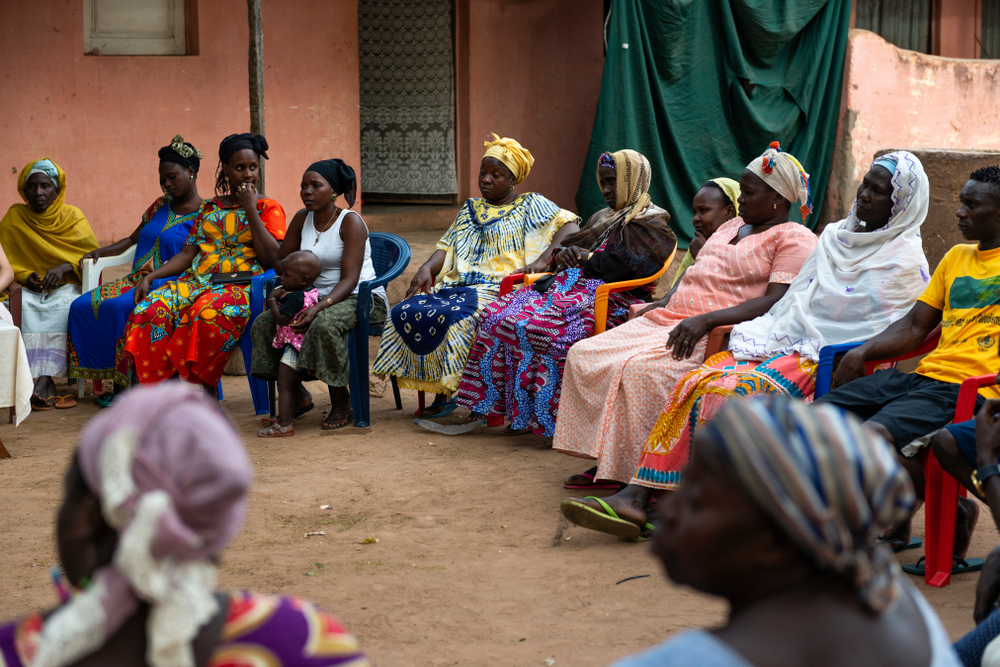
This encounter was a stark reminder that in the quest to fight climate change and promote clean energies, we risk undermining women’s rights, unwittingly introducing new or reinforcing existing inequities. But these risks can be mitigated.
A just transition that empowers women and respects their rights is possible. To attain this crucial outcome, members of the international community, donors, private and public sector actors, and civil society organizations like ours must decisively commit to enabling, supporting and learning from women-led organizations and many others already building this inclusive pathway.
Women are essential allies and key agents in fostering an inclusive energy transition; one study concluded that when women are politically empowered, CO2 emissions were reduced by about 12 percent across 72 countries.

At NRGI we seek to learn from and contribute to the efforts led by numerous organizations and individuals around the world, and define a feminist agenda for our energy transition work. We want to ensure that the lived experience of women informs extractive sector decisions concerning future opportunities and harm elimination, and that women have voice and influence in these debates. We are prioritizing developing approaches to increase gender awareness in our programming in countries that need to transition out of fossil fuels, or that aim to scale up renewable energy technologies and the minerals needed as inputs to them. Ultimately, we want to ensure that women are part of every stage of these processes.
We want to ensure that the lived experience of women informs extractive sector decisions concerning future opportunities and harm elimination, and that women have voice and influence in these debates.
In fossil fuel-producing countries, a just energy transition requires that workers are compensated by those governments and companies who benefited from and are now phasing down coal and oil extraction. But, because men account for more than 83 percent of the formal workforce in mining, women—who depend heavily on indirect and informal jobs around the mine—risk not being included in those compensation arrangements. As company executives and government officials think about mine closure, compensation and job reconversion, they must ensure women are key stakeholders in these plans, as APEC has proposed. Environmental liabilities that these projects leave behind and that might disproportionaly affect women need to be considered. In addition, women need to inform decisions about the diversification of local and national economies. Development models that replace the extraction of fossil fuels must align with women’s needs, consumption patterns, and their visions for their land; models must also fully recognize and properly compensate women for their contributions.
As company executives and government officials think about mine closure, compensation and job reconversion, they must ensure women are key stakeholders in these plans.
On the other side of the energy transition, women hold 32 percent of jobs in the renewables sector; however they are not the main owners of small-scale clean energy projects. Given that globally women's labour force share (48 percent) is higher than the average employment rate in the oil and gas sectors (22 percent), government officials and companies have an opportunity to increase employment options in this area. By recognizing property rights and ensuring that benefit sharing mechanisms reflect women’s needs, governmental agencies and international and local development agencies can support women to take up roles such as clean energy entrepreneurs or contribute to consultations about large scale projects.
Government authorities and mining companies can enhance gender justice by changing the way transition minerals are extracted. Today, many women in the Democratic Republic of the Congo are part of the informal workforce extracting the cobalt that goes into the profitable business of electric vehicle batteries. Yet, they often hold the least profitable and most toxic jobs—crushing, sorting and sifting the mineral and processing the waste. Many suffer sexual violence in mining sites. Gender impact assessments are a key step to avoid such harms, provided mining companies act upon them and that women are part of decision-making processes. Defining appropriate policies and implementing them at international, national and local levels is another key step. In 2019, for instance, Mongolia’s government introduced a law aimed at raising women’s participation in the mining sector. As NRGI highlighted in a 2022 video project, Mongolian women played a crucial role in informing this policy and spreading awareness within mining-affected communities.
At NRGI we recognize, and applaud, the efforts made by feminist activists around the world to promote gender justice. We seek to learn from and build on this work, starting with pilot interventions in Colombia, Ghana, Nigeria and Uganda, which will include multistakeholder dialogues, building networks and supporting the work of national women-led organizations to empower women’s voices. Promoting equity has always been the core of our mission and, together with partners, we have contributed to key projects around gender and extractives. In 2023, we are taking this commitment to our newest areas of work. We are excited and committed to identifying our contribution to the important work of advancing equity in the energy transition. We will develop guidance for our teams to mainstream gender across our energy transition programs, and deepen old and new partnerships that allow us to be impactful.
The authors wish to thank the members of NRGI's gender working group for their contributions.
Gender justice and the energy transition
NRGI colleagues share why the energy transition must include women as key agents of change.
Notes
-
1
Authors’ analysis based on “Greenhouse Gas Emissions from Energy Data Explorer”, International Energy Agency, 2 August 2023, www.iea.org/data-and-statistics/data-tools/greenhouse-gas-emissions-from-energy-data-explorer. And Hannah Ritchie, Max Roser, and Pablo Rosado, “CO₂ and Greenhouse Gas Emissions,” Our World in Data, 2020, ourworldindata.org/co2-and-greenhouse-gas-emissions.
-
2
Authors’ calculations based on Hannah Ritchie, Pablo Rosado, and Max Roser, “Greenhouse Gas Emissions,” Our World in Data, 2020. And “Oil and Natural Gas Supply,” IEA, 2022, www.iea.org/reports/oil-and-natural-gas-supply. Quoted in African Natural Resources Management and Investment Centre, Minimising Greenhouse Gas Emissions in the Petroleum Sector: The Opportunity for Emerging Producers (Abidjan, Côte d’Ivoire: African Development Bank, 2022), 14, www.newproducersgroup.online/wp-content/uploads/2022/11/Minimising-Greenhouse-Gas-Emissions-in-the-Petroleum-Sector.pdf.
-
3
In order to ensure greater international equity in the energy transition, authorities in countries implementing schemes such as the EU’s CBAM should include, in or alongside such schemes, measures to mitigate their negative effects on low and middle-income countries, e.g., through financial and/or technical assistance to help such countries green their economies.
-
4
Methane is a common by-product of oil extraction and a particularly potent greenhouse gas. In the process of getting oil and gas out of the ground, it is commonly emitted either through leaks or planned release into the atmosphere – either unburned (“venting”) or burned (“flaring”). Processing (e.g., refining) and transporting oil and gas also generate significant emissions. See “Methane from Oil and Gas Production Explained,” The World Bank - Global Gas Flaring Reduction Partnership, accessed 24 October 2023, www.worldbank.org/en/programs/gasflaringreduction/methane-explained.
-
5
The Global Registry of Fossil Fuels is an “[O]pen-source database of oil, gas and coal production and reserves globally, expressed in CO2-equivalent… It contains data from 139 fossil fuel producing countries, which amounts to 99% of fossil fuel production aggregated to the national level.” The database also provides estimates of the emissions from producing oil and gas in 91 oil producing countries and 71 gas producers. See “Global Registry of Fossil Fuel Emissions and Reserves”, Global Registry of Fossil Fuels, accessed 4 September 2023, fossilfuelregistry.org.
-
6
Figures 1 and 2 show a selection of countries, including some of the world’s larger oil producers, some of the world’s lower emitting producers as well as a selection of countries where NRGI operates. This is intended to provide reference points to explore whether individual countries will be more or less “carbon-competitive” than other producers based on current intensities and identifying potential examples of good practice among lower emitting producers. We also include a selection of higher-emitting producers, which may provide examples of practices to avoid.
-
7
Source: “Carbon Intensity in the Fossil Fuel Supply Chain”, Global Registry of Fossil Fuels, 2023, fossilfuelregistry.org/carbon-intensity. Global Warming Potential (GWP) 20 is applied to methane emissions; see “Methane and Climate Change,” IEA, accessed 4 September 2023, www.iea.org/reports/methane-tracker-2021/methane-and-climate-change. The impact would be smaller if we used Global Warming Potential 100. The impact over the next 20 years is important and sufficient to justify action on cutting upstream emissions (and using GWP 100 would fail to show this); this is why we have chosen to display GWP 20 in this figure and figure 2. For further discussion, see Janos Maté and David Kanter, “The Benefits of Basing Policies on the 20 Year GWP of HFCs” (Greenpeace, 2011), ozone.unep.org/system/files/documents/Benefits%20of%20Basing%20Policies%20on%2020%20GWP%20of%20HFCs.pdf.
-
8
The world’s largest oil producers are the United States (accounting for 21 percent of global production), Saudi Arabia (13 percent) and Russia (10 percent). See “Frequently Asked Questions (FAQs) - What Countries Are the Top Producers and Consumers of Oil?”, U.S. Energy Information Administration (EIA), 22 September 2023, www.eia.gov/tools/faqs/faq.php?id=709&t=6.
-
9
Source: “Carbon Intensity in the Fossil Fuel Supply Chain.”
-
10
The world’s largest (fossil) gas producers are the United States (accounting for 25 percent of production), Russia (17 percent) and Iran (6 percent). See “Natural Gas Production”, Enerdata World Energy & Climate Statistics - Yearbook 2023, accessed 4 September 2023, www.doi.org/yearbook.enerdata.net/natural-gas/world-natural-gas-production-statistics.html. And Statista Research Department, “Natural Gas Production Worldwide from 1998 to 2022”, Statista, 29 August 2023, www.statista.com/statistics/265344/total-global-natural-gas-production-since-1998.
-
11
RMI provides data on supply chain emissions by oil and gas project. See RMI, “Assessing Global Oil and Gas Emissions”, Oil Climate Index plus Gas, 2023, ociplus.rmi.org.
-
12
Some initiatives to capture methane emissions can have a positive net present value for companies. See Chantal Beck et al., “The Future of Oil and Gas Is Now: How Companies Can Decarbonize,” McKinsey & Company, 7 January 2020, www.mckinsey.com/industries/oil-and-gas/our-insights/the-future-is-now-how-oil-and-gas-companies-can-decarbonize.
-
13
Authors’ calculations based on Tomas de Oliveira Bredariol and Christophe McGlade, “Fossil Fuels,” IEA, 11 July 2023, www.iea.org/energy-system/fossil-fuels. And Tomas de Oliveira Bredariol and Christophe McGlade, “Gas Flaring,” IEA, accessed 15 September 2023, www.iea.org/energy-system/fossil-fuels/gas-flaring.
-
14
This is a 30 percent cut relative to 2020 levels.
-
15
Authors’ analysis based on Rebecca Schulz, Christophe McGlade, and Peter Zeniewski, “Putting Gas Flaring in the Spotlight,” IEA, 9 December 2020, www.iea.org/commentaries/putting-gas-flaring-in-the-spotlight. And “Nigeria,” The World Bank, June 2022, flaringventingregulations.worldbank.org/nigeria.
-
16
In 2022 Nigeria’s government “[I[ssued guidelines to support the elimination of routine gas flaring by 2030 and a 60 percent reduction in fugitive methane emissions by 2031.” “Methane Abatement,” IEA, accessed 2 October 2023, www.iea.org/energy-system/fossil-fuels/methane-abatement.
Extractive Company Disclosure of Project-Level Greenhouse Gas Emissions is Critical

Climate change and the transition to a low-carbon economy present the citizens of oil-, gas- and mineral-producing countries with both risks and opportunities. The reality is that extractive projects that emit high quantities of greenhouse gasses (GHGs) as part of their operation will become less competitive, risking that some investments will become “stranded”—i.e., economically unviable. But the Extractive Industries Transparency Initiative (EITI), a global standard for the good governance of natural resources, can play a crucial role in preventing this outcome.
Civil society organizations as well as some EITI member governments are therefore asking oil and mining companies to disclose granular, project-specific greenhouse gas (GHG) emissions data. With this information, governments can plan for the risks that the energy transition will bring to projects in which they have invested a significant amount of public finance, and citizens groups can exercise oversight of government decisions.
While the energy transition is imperative, in the near term it will have significant implications for government revenues, jobs, and business opportunities, and these must be better understood. And for that, GHG data are essential. Among all climate risk disclosures, GHG emissions are a top priority (even though there are other key disclosures as well, such as information about reserves).
Many oil and gas companies have so far resisted demands from the public and investors for more meaningfully detailed GHG disclosures, claiming that they already disclose GHG emissions data through multiple evolving disclosure initiatives. Granted, many large publicly listed extractives companies publish GHG emissions data in their own sustainability reports or through the CDP, a disclosure system for climate change information.
Most of these disclosures meet voluntary market-led standards including the recommendations of the Task Force on Climate-Related Financial Disclosures (TCFD), or the Sustainability Reporting Guidance for the Oil and Gas Industry. Moreover, governments and regulators, including the EU and the U.S. Securities and Exchange Commission, are taking steps to mandate these disclosures, while the newly formed International Sustainability Standards Board (ISSB) is developing a new set of standards to serve as a “global baseline,” with high-level backing from the G7, the G20, and finance ministers and central bank governors from over 40 jurisdictions.
But these emerging initiatives do not meet the data needs of key stakeholders; nor is the dissemination, public use, and impact of such disclosures by any means assured. The emerging disclosure architecture for GHG emissions is largely investor-focused. And while company-wide figures can help investors, these data are practically useless for government officials and citizens who seek to understand how company risks and opportunities impact specific jurisdictions and communities. For this they need project-level data.
Such granular detail would also aid investors, allowing them to see precise risks within asset portfolios. For example, project-level emissions data in Repsol’s 2021 CDP disclosures showed that one asset, the PM3 oil field in Malaysia, produced as much as 31 percent of the company’s annual scope 1 emissions in 2020. Project-level data also allows investors to understand how companies work to address their emissions. Repsol sold PM3 in 2021, a potential example of how companies may be using asset transfers to make questionable progress toward their emissions reduction targets. Acknowledging this trend, non-profit organizations Ceres and the Environmental Defense Fund recently recommended asset-level emissions disclosure as part of a set of climate principles for mergers and acquisitions in the oil and gas sector. They developed the guidance in consultation with a range of asset managers, private equity firms, banks, and oil and gas companies.
Civil society and government advocacy for project-level reporting of GHG emissions for oil, gas and mining companies has recently focused on EITI. Including such a provision in the EITI standard makes eminent sense for three reasons.
First, EITI is an extractives-specific governance standard, and this is an extractives-specific governance issue. Second, EITI focuses on government and company disclosures that policy makers and citizens can use—precisely the stakeholders that the evolving investor-focused initiatives have left out. And these EITI disclosures tend to be granular, often when relevant at the project level. Third, and perhaps most importantly, EITI has an advanced participatory implementation structure that supports national-level discussion and engagement between companies, governments and civil society—which the existing disclosure initiatives for GHG emissions reporting do not provide.
Company executives have suggested that bringing GHG emissions reporting into EITI could be duplicative. But it need not be. Among other sources of data, the EITI generally accepts routine disclosures through official websites, journals or publications. This means that most companies could comply with an EITI GHG disclosure guidance by simply adding a project-level breakdown to the GHG reporting they already make through the CDP or their own sustainability reports.
In fact, of the 10 exploration and production companies represented on the global EITI board, three—Anglo American, BHP and Newmont—do this already; while a further three—Equinor, Kosmos Energy and Royal Dutch Shell—provide country-level data that in some instances is close to project-level in detail. For these companies an EITI recommendation for project-level reporting would simply level the playing field, bringing the practices of less-forthcoming companies up to their high standards. Importantly, this would include national oil companies and privately held companies, which fly under the radar of most international reporting standards, but not EITI.
Members of the EITI board—including representatives of rich countries supporting the initiative, emerging countries, industry and civil society—are deciding on a new EITI standard which will govern the initiative for at least the next three years. They owe it to citizens and policymakers in producing countries, to investors, and to the future of the planet to ensure meaningful transparency about GHG emissions. It is time for disaggregated data disclosures of GHG emissions in EITI.
Photo by bhumann34 for Pixabay
The EITI Standard now promotes GHG emissions disclosure by companies for the first time.
Notes
-
1
Authors’ analysis based on “Greenhouse Gas Emissions from Energy Data Explorer”, International Energy Agency, 2 August 2023, www.iea.org/data-and-statistics/data-tools/greenhouse-gas-emissions-from-energy-data-explorer. And Hannah Ritchie, Max Roser, and Pablo Rosado, “CO₂ and Greenhouse Gas Emissions,” Our World in Data, 2020, ourworldindata.org/co2-and-greenhouse-gas-emissions.
-
2
Authors’ calculations based on Hannah Ritchie, Pablo Rosado, and Max Roser, “Greenhouse Gas Emissions,” Our World in Data, 2020. And “Oil and Natural Gas Supply,” IEA, 2022, www.iea.org/reports/oil-and-natural-gas-supply. Quoted in African Natural Resources Management and Investment Centre, Minimising Greenhouse Gas Emissions in the Petroleum Sector: The Opportunity for Emerging Producers (Abidjan, Côte d’Ivoire: African Development Bank, 2022), 14, www.newproducersgroup.online/wp-content/uploads/2022/11/Minimising-Greenhouse-Gas-Emissions-in-the-Petroleum-Sector.pdf.
-
3
In order to ensure greater international equity in the energy transition, authorities in countries implementing schemes such as the EU’s CBAM should include, in or alongside such schemes, measures to mitigate their negative effects on low and middle-income countries, e.g., through financial and/or technical assistance to help such countries green their economies.
-
4
Methane is a common by-product of oil extraction and a particularly potent greenhouse gas. In the process of getting oil and gas out of the ground, it is commonly emitted either through leaks or planned release into the atmosphere – either unburned (“venting”) or burned (“flaring”). Processing (e.g., refining) and transporting oil and gas also generate significant emissions. See “Methane from Oil and Gas Production Explained,” The World Bank - Global Gas Flaring Reduction Partnership, accessed 24 October 2023, www.worldbank.org/en/programs/gasflaringreduction/methane-explained.
-
5
The Global Registry of Fossil Fuels is an “[O]pen-source database of oil, gas and coal production and reserves globally, expressed in CO2-equivalent… It contains data from 139 fossil fuel producing countries, which amounts to 99% of fossil fuel production aggregated to the national level.” The database also provides estimates of the emissions from producing oil and gas in 91 oil producing countries and 71 gas producers. See “Global Registry of Fossil Fuel Emissions and Reserves”, Global Registry of Fossil Fuels, accessed 4 September 2023, fossilfuelregistry.org.
-
6
Figures 1 and 2 show a selection of countries, including some of the world’s larger oil producers, some of the world’s lower emitting producers as well as a selection of countries where NRGI operates. This is intended to provide reference points to explore whether individual countries will be more or less “carbon-competitive” than other producers based on current intensities and identifying potential examples of good practice among lower emitting producers. We also include a selection of higher-emitting producers, which may provide examples of practices to avoid.
-
7
Source: “Carbon Intensity in the Fossil Fuel Supply Chain”, Global Registry of Fossil Fuels, 2023, fossilfuelregistry.org/carbon-intensity. Global Warming Potential (GWP) 20 is applied to methane emissions; see “Methane and Climate Change,” IEA, accessed 4 September 2023, www.iea.org/reports/methane-tracker-2021/methane-and-climate-change. The impact would be smaller if we used Global Warming Potential 100. The impact over the next 20 years is important and sufficient to justify action on cutting upstream emissions (and using GWP 100 would fail to show this); this is why we have chosen to display GWP 20 in this figure and figure 2. For further discussion, see Janos Maté and David Kanter, “The Benefits of Basing Policies on the 20 Year GWP of HFCs” (Greenpeace, 2011), ozone.unep.org/system/files/documents/Benefits%20of%20Basing%20Policies%20on%2020%20GWP%20of%20HFCs.pdf.
-
8
The world’s largest oil producers are the United States (accounting for 21 percent of global production), Saudi Arabia (13 percent) and Russia (10 percent). See “Frequently Asked Questions (FAQs) - What Countries Are the Top Producers and Consumers of Oil?”, U.S. Energy Information Administration (EIA), 22 September 2023, www.eia.gov/tools/faqs/faq.php?id=709&t=6.
-
9
Source: “Carbon Intensity in the Fossil Fuel Supply Chain.”
-
10
The world’s largest (fossil) gas producers are the United States (accounting for 25 percent of production), Russia (17 percent) and Iran (6 percent). See “Natural Gas Production”, Enerdata World Energy & Climate Statistics - Yearbook 2023, accessed 4 September 2023, www.doi.org/yearbook.enerdata.net/natural-gas/world-natural-gas-production-statistics.html. And Statista Research Department, “Natural Gas Production Worldwide from 1998 to 2022”, Statista, 29 August 2023, www.statista.com/statistics/265344/total-global-natural-gas-production-since-1998.
-
11
RMI provides data on supply chain emissions by oil and gas project. See RMI, “Assessing Global Oil and Gas Emissions”, Oil Climate Index plus Gas, 2023, ociplus.rmi.org.
-
12
Some initiatives to capture methane emissions can have a positive net present value for companies. See Chantal Beck et al., “The Future of Oil and Gas Is Now: How Companies Can Decarbonize,” McKinsey & Company, 7 January 2020, www.mckinsey.com/industries/oil-and-gas/our-insights/the-future-is-now-how-oil-and-gas-companies-can-decarbonize.
-
13
Authors’ calculations based on Tomas de Oliveira Bredariol and Christophe McGlade, “Fossil Fuels,” IEA, 11 July 2023, www.iea.org/energy-system/fossil-fuels. And Tomas de Oliveira Bredariol and Christophe McGlade, “Gas Flaring,” IEA, accessed 15 September 2023, www.iea.org/energy-system/fossil-fuels/gas-flaring.
-
14
This is a 30 percent cut relative to 2020 levels.
-
15
Authors’ analysis based on Rebecca Schulz, Christophe McGlade, and Peter Zeniewski, “Putting Gas Flaring in the Spotlight,” IEA, 9 December 2020, www.iea.org/commentaries/putting-gas-flaring-in-the-spotlight. And “Nigeria,” The World Bank, June 2022, flaringventingregulations.worldbank.org/nigeria.
-
16
In 2022 Nigeria’s government “[I[ssued guidelines to support the elimination of routine gas flaring by 2030 and a 60 percent reduction in fugitive methane emissions by 2031.” “Methane Abatement,” IEA, accessed 2 October 2023, www.iea.org/energy-system/fossil-fuels/methane-abatement.
Governments and Companies Must Address Climate and Governance Risks When Petroleum Assets Change Hands

Whether driven by climate targets, reputational risk, financial considerations, or a combination of factors, some multinational enterprises are selling petroleum assets, sometimes as part of their decarbonization strategies. However, simply selling petroleum projects may not reduce, and may actually increase, climate impacts if assets are transferred from companies with stronger environmental and reporting commitments to those with weaker commitments. Moreover, unless handled responsibly, disengagement by reputable firms may increase certain other risks for host developing countries and their citizens, such as exacerbating weak governance, corporate capture and corruption, conflict, and human rights abuses. Governments, companies, investors and civil society actors should ensure that, when petroleum projects change hands, sustainability and governance standards do not slip. This may require revisiting approaches to petroleum laws and contracts and updating our understanding of company and investor social responsibility.
Seller companies should recognize that they too have important responsibilities. Sellers may soon see limits on a “clean” exit when transferring petroleum assets to less responsible parties. Increasing attention to the environmental consequences of such asset sales may mean growing reputational risks associated with irresponsible exits, along with pushback on whether such divestments should count as part of a company’s net-zero strategy. On the mining side, some legal experts have recommended that sellers conduct due diligence on buyers to assess their mission and reputation, ESG standards and adherence to international best practices, and that agreements include buyer commitments to maintain operating standards, stakeholder commitments and rehabilitation requirements. Such measures are critical for petroleum asset sales too, and sellers may build on existing approaches, such as buyer due diligence, to address anti-corruption risks. The appropriate mechanisms will depend in part on relevant laws of the applicable jurisdictions, but sellers will want to avoid the appearance of washing their hands of dirty projects to take a step forward on achieving their own net zero and ESG targets, while the host country and the planet take a step back.
Further, investors, regulators and standard-setting bodies that shape sector norms have a critical role to play in influencing company incentives and behavior. Climate disclosure and emissions reduction rules and standards must address reporting on transfers and transferred emissions. Emerging industry norms should also address broader risks associated with fossil fuel asset sales. These actors should develop standards that require sellers to conduct, and report on, due diligence on key policies and practices of buying companies, such as their environmental commitments, stakeholder engagement and measures to combat corruption internally and in engagements with high-risk partners.

Nicola Woodroffe and Erica Westenberg, ‘Governments and companies must address climate and governance risks when petroleum assets change hands,’ Columbia FDI Perspectives, No. 352, March 6, 2023. Reproduced with permission from the Columbia Center on Sustainable Investment.
Top photo by Spencer Thomas; bottom image by Shutterstock
Notes
-
1
Authors’ analysis based on “Greenhouse Gas Emissions from Energy Data Explorer”, International Energy Agency, 2 August 2023, www.iea.org/data-and-statistics/data-tools/greenhouse-gas-emissions-from-energy-data-explorer. And Hannah Ritchie, Max Roser, and Pablo Rosado, “CO₂ and Greenhouse Gas Emissions,” Our World in Data, 2020, ourworldindata.org/co2-and-greenhouse-gas-emissions.
-
2
Authors’ calculations based on Hannah Ritchie, Pablo Rosado, and Max Roser, “Greenhouse Gas Emissions,” Our World in Data, 2020. And “Oil and Natural Gas Supply,” IEA, 2022, www.iea.org/reports/oil-and-natural-gas-supply. Quoted in African Natural Resources Management and Investment Centre, Minimising Greenhouse Gas Emissions in the Petroleum Sector: The Opportunity for Emerging Producers (Abidjan, Côte d’Ivoire: African Development Bank, 2022), 14, www.newproducersgroup.online/wp-content/uploads/2022/11/Minimising-Greenhouse-Gas-Emissions-in-the-Petroleum-Sector.pdf.
-
3
In order to ensure greater international equity in the energy transition, authorities in countries implementing schemes such as the EU’s CBAM should include, in or alongside such schemes, measures to mitigate their negative effects on low and middle-income countries, e.g., through financial and/or technical assistance to help such countries green their economies.
-
4
Methane is a common by-product of oil extraction and a particularly potent greenhouse gas. In the process of getting oil and gas out of the ground, it is commonly emitted either through leaks or planned release into the atmosphere – either unburned (“venting”) or burned (“flaring”). Processing (e.g., refining) and transporting oil and gas also generate significant emissions. See “Methane from Oil and Gas Production Explained,” The World Bank - Global Gas Flaring Reduction Partnership, accessed 24 October 2023, www.worldbank.org/en/programs/gasflaringreduction/methane-explained.
-
5
The Global Registry of Fossil Fuels is an “[O]pen-source database of oil, gas and coal production and reserves globally, expressed in CO2-equivalent… It contains data from 139 fossil fuel producing countries, which amounts to 99% of fossil fuel production aggregated to the national level.” The database also provides estimates of the emissions from producing oil and gas in 91 oil producing countries and 71 gas producers. See “Global Registry of Fossil Fuel Emissions and Reserves”, Global Registry of Fossil Fuels, accessed 4 September 2023, fossilfuelregistry.org.
-
6
Figures 1 and 2 show a selection of countries, including some of the world’s larger oil producers, some of the world’s lower emitting producers as well as a selection of countries where NRGI operates. This is intended to provide reference points to explore whether individual countries will be more or less “carbon-competitive” than other producers based on current intensities and identifying potential examples of good practice among lower emitting producers. We also include a selection of higher-emitting producers, which may provide examples of practices to avoid.
-
7
Source: “Carbon Intensity in the Fossil Fuel Supply Chain”, Global Registry of Fossil Fuels, 2023, fossilfuelregistry.org/carbon-intensity. Global Warming Potential (GWP) 20 is applied to methane emissions; see “Methane and Climate Change,” IEA, accessed 4 September 2023, www.iea.org/reports/methane-tracker-2021/methane-and-climate-change. The impact would be smaller if we used Global Warming Potential 100. The impact over the next 20 years is important and sufficient to justify action on cutting upstream emissions (and using GWP 100 would fail to show this); this is why we have chosen to display GWP 20 in this figure and figure 2. For further discussion, see Janos Maté and David Kanter, “The Benefits of Basing Policies on the 20 Year GWP of HFCs” (Greenpeace, 2011), ozone.unep.org/system/files/documents/Benefits%20of%20Basing%20Policies%20on%2020%20GWP%20of%20HFCs.pdf.
-
8
The world’s largest oil producers are the United States (accounting for 21 percent of global production), Saudi Arabia (13 percent) and Russia (10 percent). See “Frequently Asked Questions (FAQs) - What Countries Are the Top Producers and Consumers of Oil?”, U.S. Energy Information Administration (EIA), 22 September 2023, www.eia.gov/tools/faqs/faq.php?id=709&t=6.
-
9
Source: “Carbon Intensity in the Fossil Fuel Supply Chain.”
-
10
The world’s largest (fossil) gas producers are the United States (accounting for 25 percent of production), Russia (17 percent) and Iran (6 percent). See “Natural Gas Production”, Enerdata World Energy & Climate Statistics - Yearbook 2023, accessed 4 September 2023, www.doi.org/yearbook.enerdata.net/natural-gas/world-natural-gas-production-statistics.html. And Statista Research Department, “Natural Gas Production Worldwide from 1998 to 2022”, Statista, 29 August 2023, www.statista.com/statistics/265344/total-global-natural-gas-production-since-1998.
-
11
RMI provides data on supply chain emissions by oil and gas project. See RMI, “Assessing Global Oil and Gas Emissions”, Oil Climate Index plus Gas, 2023, ociplus.rmi.org.
-
12
Some initiatives to capture methane emissions can have a positive net present value for companies. See Chantal Beck et al., “The Future of Oil and Gas Is Now: How Companies Can Decarbonize,” McKinsey & Company, 7 January 2020, www.mckinsey.com/industries/oil-and-gas/our-insights/the-future-is-now-how-oil-and-gas-companies-can-decarbonize.
-
13
Authors’ calculations based on Tomas de Oliveira Bredariol and Christophe McGlade, “Fossil Fuels,” IEA, 11 July 2023, www.iea.org/energy-system/fossil-fuels. And Tomas de Oliveira Bredariol and Christophe McGlade, “Gas Flaring,” IEA, accessed 15 September 2023, www.iea.org/energy-system/fossil-fuels/gas-flaring.
-
14
This is a 30 percent cut relative to 2020 levels.
-
15
Authors’ analysis based on Rebecca Schulz, Christophe McGlade, and Peter Zeniewski, “Putting Gas Flaring in the Spotlight,” IEA, 9 December 2020, www.iea.org/commentaries/putting-gas-flaring-in-the-spotlight. And “Nigeria,” The World Bank, June 2022, flaringventingregulations.worldbank.org/nigeria.
-
16
In 2022 Nigeria’s government “[I[ssued guidelines to support the elimination of routine gas flaring by 2030 and a 60 percent reduction in fugitive methane emissions by 2031.” “Methane Abatement,” IEA, accessed 2 October 2023, www.iea.org/energy-system/fossil-fuels/methane-abatement.
'Energy Futures that Protect the Planet': NRGI's Suneeta Kaimal on the Global Registry of Fossil Fuels

NRGI president and CEO moderated the 26 September 2022 launch of the Global Registry of Fossil Fuels, hosted by Carbon Tracker. These are her opening remarks.
NRGI aims to help fossil-fuel producing countries make informed choices about their energy futures that protect the planet, strengthen their economies and create fairer societies. This work is grounded in the reality that the world must produce much less oil, natural gas and coal starting now if we are to avoid climate catastrophe.
As we are gathering here in New York for Climate Week, the imperative of managing fossil fuel production is top of mind for all of us. As the most recent UNEP production gap report shows, greenhouse gas emissions continue to grow, fossil fuels still make up about 80 percent of the energy mix worldwide, and governments and companies around the world are still planning to produce more than double the supply of fossil fuels by 2030 that is compatible with the Paris Agreement.
Efforts to cut fossil fuel consumption are at the absolute core of global climate efforts. But these alone are unlikely to keep warming under 1.5C.
Getting back on track is absolutely crucial at this juncture. Efforts to cut fossil fuel consumption are at the absolute core of global climate efforts. But these alone are unlikely to keep warming under 1.5C. Managed supply cuts are also needed. And this is where the Global Registry of Fossil Fuels can help.
By providing us with information on reserves and how much coal, oil and gas is being produced, how much it is likely to cost, and what it means in terms of the remaining carbon budget, the registry gives international researchers and investors information we need to have a sensible conversation on fossil fuel supply and the pace of decline. It also provides leaders and activists within fossil fuel producing countries with a valuable tool to debate the risks – economic and environmental – associated with their production plans.
NRGI is pleased to support Carbon Tracker on this crucial project because we believe that making this information available can help in three distinct ways:
First and foremost, national policy makers can understand the scope of the problem, and they can engage in more inclusive and participatory decision-making.
Today, many producer countries continue to follow the same fossil-fuel-dependent pathways they have for decades, and are struggling to wrestle with the implication of what a managed decline means for them — whether that is on tax revenues, local business opportunities and employment, and on national climate commitments. Engaging with affected parties can help lead to outcomes that are better for all stakeholders involved.
More informed national debate might also help policy makers avoid risky bets, such as pouring public money into national oil company projects that will only break even if humanity exceeds its emissions targets.
In Nigeria, NRGI is working with local NGO BudgIT and the Nigeria Extractive Industries Transparency Initiative (NEITI) to support national dialogues on a future beyond oil that will examine questions like these. The registry will no doubt provide useful insights to inform conversations like this that need to happen all around the world.
Second, accountability actors can use production data to hold governments, companies, and others accountable to the commitments that they have made. And when producers fall short, civil society can facilitate market pressure, public shaming or litigation in response.
Finally, access to reliable data on production puts international stakeholders in a better place to cooperate to reach our shared goals. Globally inclusive dialogue is needed on important questions such as which countries should reduce production first. Many developing and emerging market producers with small carbon footprints are already calling on wealthy higher-emitting producers to lead the decline and to help provide support for national transition plans. Comparable data on production and emissions can lead to better understanding on what constitutes a managed, just and equitable transition away from fossil fuels.
Notes
-
1
Authors’ analysis based on “Greenhouse Gas Emissions from Energy Data Explorer”, International Energy Agency, 2 August 2023, www.iea.org/data-and-statistics/data-tools/greenhouse-gas-emissions-from-energy-data-explorer. And Hannah Ritchie, Max Roser, and Pablo Rosado, “CO₂ and Greenhouse Gas Emissions,” Our World in Data, 2020, ourworldindata.org/co2-and-greenhouse-gas-emissions.
-
2
Authors’ calculations based on Hannah Ritchie, Pablo Rosado, and Max Roser, “Greenhouse Gas Emissions,” Our World in Data, 2020. And “Oil and Natural Gas Supply,” IEA, 2022, www.iea.org/reports/oil-and-natural-gas-supply. Quoted in African Natural Resources Management and Investment Centre, Minimising Greenhouse Gas Emissions in the Petroleum Sector: The Opportunity for Emerging Producers (Abidjan, Côte d’Ivoire: African Development Bank, 2022), 14, www.newproducersgroup.online/wp-content/uploads/2022/11/Minimising-Greenhouse-Gas-Emissions-in-the-Petroleum-Sector.pdf.
-
3
In order to ensure greater international equity in the energy transition, authorities in countries implementing schemes such as the EU’s CBAM should include, in or alongside such schemes, measures to mitigate their negative effects on low and middle-income countries, e.g., through financial and/or technical assistance to help such countries green their economies.
-
4
Methane is a common by-product of oil extraction and a particularly potent greenhouse gas. In the process of getting oil and gas out of the ground, it is commonly emitted either through leaks or planned release into the atmosphere – either unburned (“venting”) or burned (“flaring”). Processing (e.g., refining) and transporting oil and gas also generate significant emissions. See “Methane from Oil and Gas Production Explained,” The World Bank - Global Gas Flaring Reduction Partnership, accessed 24 October 2023, www.worldbank.org/en/programs/gasflaringreduction/methane-explained.
-
5
The Global Registry of Fossil Fuels is an “[O]pen-source database of oil, gas and coal production and reserves globally, expressed in CO2-equivalent… It contains data from 139 fossil fuel producing countries, which amounts to 99% of fossil fuel production aggregated to the national level.” The database also provides estimates of the emissions from producing oil and gas in 91 oil producing countries and 71 gas producers. See “Global Registry of Fossil Fuel Emissions and Reserves”, Global Registry of Fossil Fuels, accessed 4 September 2023, fossilfuelregistry.org.
-
6
Figures 1 and 2 show a selection of countries, including some of the world’s larger oil producers, some of the world’s lower emitting producers as well as a selection of countries where NRGI operates. This is intended to provide reference points to explore whether individual countries will be more or less “carbon-competitive” than other producers based on current intensities and identifying potential examples of good practice among lower emitting producers. We also include a selection of higher-emitting producers, which may provide examples of practices to avoid.
-
7
Source: “Carbon Intensity in the Fossil Fuel Supply Chain”, Global Registry of Fossil Fuels, 2023, fossilfuelregistry.org/carbon-intensity. Global Warming Potential (GWP) 20 is applied to methane emissions; see “Methane and Climate Change,” IEA, accessed 4 September 2023, www.iea.org/reports/methane-tracker-2021/methane-and-climate-change. The impact would be smaller if we used Global Warming Potential 100. The impact over the next 20 years is important and sufficient to justify action on cutting upstream emissions (and using GWP 100 would fail to show this); this is why we have chosen to display GWP 20 in this figure and figure 2. For further discussion, see Janos Maté and David Kanter, “The Benefits of Basing Policies on the 20 Year GWP of HFCs” (Greenpeace, 2011), ozone.unep.org/system/files/documents/Benefits%20of%20Basing%20Policies%20on%2020%20GWP%20of%20HFCs.pdf.
-
8
The world’s largest oil producers are the United States (accounting for 21 percent of global production), Saudi Arabia (13 percent) and Russia (10 percent). See “Frequently Asked Questions (FAQs) - What Countries Are the Top Producers and Consumers of Oil?”, U.S. Energy Information Administration (EIA), 22 September 2023, www.eia.gov/tools/faqs/faq.php?id=709&t=6.
-
9
Source: “Carbon Intensity in the Fossil Fuel Supply Chain.”
-
10
The world’s largest (fossil) gas producers are the United States (accounting for 25 percent of production), Russia (17 percent) and Iran (6 percent). See “Natural Gas Production”, Enerdata World Energy & Climate Statistics - Yearbook 2023, accessed 4 September 2023, www.doi.org/yearbook.enerdata.net/natural-gas/world-natural-gas-production-statistics.html. And Statista Research Department, “Natural Gas Production Worldwide from 1998 to 2022”, Statista, 29 August 2023, www.statista.com/statistics/265344/total-global-natural-gas-production-since-1998.
-
11
RMI provides data on supply chain emissions by oil and gas project. See RMI, “Assessing Global Oil and Gas Emissions”, Oil Climate Index plus Gas, 2023, ociplus.rmi.org.
-
12
Some initiatives to capture methane emissions can have a positive net present value for companies. See Chantal Beck et al., “The Future of Oil and Gas Is Now: How Companies Can Decarbonize,” McKinsey & Company, 7 January 2020, www.mckinsey.com/industries/oil-and-gas/our-insights/the-future-is-now-how-oil-and-gas-companies-can-decarbonize.
-
13
Authors’ calculations based on Tomas de Oliveira Bredariol and Christophe McGlade, “Fossil Fuels,” IEA, 11 July 2023, www.iea.org/energy-system/fossil-fuels. And Tomas de Oliveira Bredariol and Christophe McGlade, “Gas Flaring,” IEA, accessed 15 September 2023, www.iea.org/energy-system/fossil-fuels/gas-flaring.
-
14
This is a 30 percent cut relative to 2020 levels.
-
15
Authors’ analysis based on Rebecca Schulz, Christophe McGlade, and Peter Zeniewski, “Putting Gas Flaring in the Spotlight,” IEA, 9 December 2020, www.iea.org/commentaries/putting-gas-flaring-in-the-spotlight. And “Nigeria,” The World Bank, June 2022, flaringventingregulations.worldbank.org/nigeria.
-
16
In 2022 Nigeria’s government “[I[ssued guidelines to support the elimination of routine gas flaring by 2030 and a 60 percent reduction in fugitive methane emissions by 2031.” “Methane Abatement,” IEA, accessed 2 October 2023, www.iea.org/energy-system/fossil-fuels/methane-abatement.
Peru Seeks Mining Sustainability Amid the Energy Transition

Español »
“Peru is a mineral-rich country with an important geological potential to become a key player in providing the critical minerals necessary for a green energy transition,” says Veronica Morelli, an attorney from Peru specializing in social and environmental law and policy.
Morelli was a participant in the 2022 edition of the advanced course “Natural Resource Governance and Energy Transition: Policies and Practice,” co-organized by the NRGI and the NADEL Center for Development and Cooperation at ETH Zurich. This year, the course brought together 31 participants (14 women, 17 men) from 17 countries to discuss and learn about the most pressing issues in natural resource governance, with a focus on the energy transition and its impact on the sector.
In the weeks after the course, I spoke with Morelli about how demand for transition minerals will impact Peru. She explains that demand for critical minerals is projected to increase in the coming decades, and that Peru must take advantage of its position in this context. According to the Ministry of Energy and Mines, Peru currently has a portfolio of 63 mining exploration projects worth USD 586 million, spread across 16 regions. In addition, 43 projects worth USD 53.2 million are under construction in 17 regions. “On the one hand, the Peruvian government has to provide clear and adequate conditions for the development of this portfolio,” explains Morelli. “On the other, companies must compete in the global market, and so they must pay attention to the current critical factors in the mining sector, including improving community relations, social and environmental sustainability efforts, and investing in innovation and technology to use cleaner energy in their operations.”

Veronica Morelli, participant in the advanced course “Natural Resource Governance and Energy Transition: Policies and Practice"
Morelli began her career in the private sector, where she was an attorney involved in the launch of PERU LNG, the first natural gas liquefaction plant in South America. With a total investment of USD 3.8 billion, PERU LNG represented the largest investment in a single project made in Peru at the time. This was a valuable learning experience for her as she was involved in the environmental and social impact assessments for the construction and operation and monitored regulatory challenges and provided legal assistance.
Afterward Morelli moved to the public sector, working in the hydrocarbon activities supervisory entity of the OEFA, the Peruvian Environmental Evaluation and Enforcement Agency, where she supervised more than 40 different companies in the oil and gas sector in Peru and was responsible for overseeing environmental control and ensuring the right balance between private investment and environmental protection. Since joining OEFA, she has advised national and international clients and projects, including the Sustainable Development Strategies Group (SDSG).
Using the advanced course as a platform to discuss Peru’s current challenges, Morelli noted that “in recent years, the formal mining sector in Peru has taken the issue of sustainability very seriously, not only as a requirement to remain competitive and meet current standards but also as an important tool to address climate change,” explaining that a growing number of companies are now working on mining-related economic, environmental, social and governance issues related to the United Nations Sustainable Development Goals (SDGs). Peru has made ambitious commitments to reduce its greenhouse gas emissions and decarbonize by 2050. A key factor in achieving this goal is to boost the use of renewable energy. Currently, however, only 5 percent of total energy demand is renewable.
“With the goal of increasing this to 20 percent by 2030, the government must act in a manner consistent with its commitments and build a plan with specific actions and regulatory changes to achieve this goal. While the mining industry has the potential to grow in line with this trend, it is important for the industry to focus its efforts on two areas: reducing water consumption and using cleaner energy sources.”
Connecting with participants from different countries and backgrounds during the advanced course provided Morelli with an opportunity to learn how much resource revenue management depends on the context and circumstances of each country. In the case of Peru, the country has managed to develop its natural resources despite constant political crises. Morelli explains, “This is mainly because mining is a key pillar of the Peruvian economy due to its contribution to public finances. However, recent social conflicts have led the mining sector to temporary cessations of mining operations, posing several challenges to the industry. In this context, the state has been unable to guarantee the integrity of the private property and the safety of communities and miners, creating instability and risks to the continuity of the mining activities.”
Reflecting on how the advanced course connects to the realities facing Peru, Morelli had an opportunity to discuss the challenges facing the country as a result of the current political crisis and the need for the Peruvian government to provide adequate policy changes so that the mining industry can continue its development for the benefit of Peru’s citizenry.
Finally, Morelli stressed that Peru must make progress on the energy transition that is equitable and just. As the next round of climate negotiations nears, she notes that the minerals needed to shift away from fossil fuels need to be sourced without impacting the environment and local communities. “COP27 is an opportunity for countries in the "LithiumTriangle"—Argentina, Bolivia and Chile—which hold 65 percent of the world’s lithium reserves, to play a big part in this critical discussion.”
Top photo by Jose Luis Stephens for Shutterstock. Bottom photo by abriendomundo for Shutterstock.
The advanced resource governance course from NRGI and ETH-Nadel is a yearly course.
Notes
-
1
Authors’ analysis based on “Greenhouse Gas Emissions from Energy Data Explorer”, International Energy Agency, 2 August 2023, www.iea.org/data-and-statistics/data-tools/greenhouse-gas-emissions-from-energy-data-explorer. And Hannah Ritchie, Max Roser, and Pablo Rosado, “CO₂ and Greenhouse Gas Emissions,” Our World in Data, 2020, ourworldindata.org/co2-and-greenhouse-gas-emissions.
-
2
Authors’ calculations based on Hannah Ritchie, Pablo Rosado, and Max Roser, “Greenhouse Gas Emissions,” Our World in Data, 2020. And “Oil and Natural Gas Supply,” IEA, 2022, www.iea.org/reports/oil-and-natural-gas-supply. Quoted in African Natural Resources Management and Investment Centre, Minimising Greenhouse Gas Emissions in the Petroleum Sector: The Opportunity for Emerging Producers (Abidjan, Côte d’Ivoire: African Development Bank, 2022), 14, www.newproducersgroup.online/wp-content/uploads/2022/11/Minimising-Greenhouse-Gas-Emissions-in-the-Petroleum-Sector.pdf.
-
3
In order to ensure greater international equity in the energy transition, authorities in countries implementing schemes such as the EU’s CBAM should include, in or alongside such schemes, measures to mitigate their negative effects on low and middle-income countries, e.g., through financial and/or technical assistance to help such countries green their economies.
-
4
Methane is a common by-product of oil extraction and a particularly potent greenhouse gas. In the process of getting oil and gas out of the ground, it is commonly emitted either through leaks or planned release into the atmosphere – either unburned (“venting”) or burned (“flaring”). Processing (e.g., refining) and transporting oil and gas also generate significant emissions. See “Methane from Oil and Gas Production Explained,” The World Bank - Global Gas Flaring Reduction Partnership, accessed 24 October 2023, www.worldbank.org/en/programs/gasflaringreduction/methane-explained.
-
5
The Global Registry of Fossil Fuels is an “[O]pen-source database of oil, gas and coal production and reserves globally, expressed in CO2-equivalent… It contains data from 139 fossil fuel producing countries, which amounts to 99% of fossil fuel production aggregated to the national level.” The database also provides estimates of the emissions from producing oil and gas in 91 oil producing countries and 71 gas producers. See “Global Registry of Fossil Fuel Emissions and Reserves”, Global Registry of Fossil Fuels, accessed 4 September 2023, fossilfuelregistry.org.
-
6
Figures 1 and 2 show a selection of countries, including some of the world’s larger oil producers, some of the world’s lower emitting producers as well as a selection of countries where NRGI operates. This is intended to provide reference points to explore whether individual countries will be more or less “carbon-competitive” than other producers based on current intensities and identifying potential examples of good practice among lower emitting producers. We also include a selection of higher-emitting producers, which may provide examples of practices to avoid.
-
7
Source: “Carbon Intensity in the Fossil Fuel Supply Chain”, Global Registry of Fossil Fuels, 2023, fossilfuelregistry.org/carbon-intensity. Global Warming Potential (GWP) 20 is applied to methane emissions; see “Methane and Climate Change,” IEA, accessed 4 September 2023, www.iea.org/reports/methane-tracker-2021/methane-and-climate-change. The impact would be smaller if we used Global Warming Potential 100. The impact over the next 20 years is important and sufficient to justify action on cutting upstream emissions (and using GWP 100 would fail to show this); this is why we have chosen to display GWP 20 in this figure and figure 2. For further discussion, see Janos Maté and David Kanter, “The Benefits of Basing Policies on the 20 Year GWP of HFCs” (Greenpeace, 2011), ozone.unep.org/system/files/documents/Benefits%20of%20Basing%20Policies%20on%2020%20GWP%20of%20HFCs.pdf.
-
8
The world’s largest oil producers are the United States (accounting for 21 percent of global production), Saudi Arabia (13 percent) and Russia (10 percent). See “Frequently Asked Questions (FAQs) - What Countries Are the Top Producers and Consumers of Oil?”, U.S. Energy Information Administration (EIA), 22 September 2023, www.eia.gov/tools/faqs/faq.php?id=709&t=6.
-
9
Source: “Carbon Intensity in the Fossil Fuel Supply Chain.”
-
10
The world’s largest (fossil) gas producers are the United States (accounting for 25 percent of production), Russia (17 percent) and Iran (6 percent). See “Natural Gas Production”, Enerdata World Energy & Climate Statistics - Yearbook 2023, accessed 4 September 2023, www.doi.org/yearbook.enerdata.net/natural-gas/world-natural-gas-production-statistics.html. And Statista Research Department, “Natural Gas Production Worldwide from 1998 to 2022”, Statista, 29 August 2023, www.statista.com/statistics/265344/total-global-natural-gas-production-since-1998.
-
11
RMI provides data on supply chain emissions by oil and gas project. See RMI, “Assessing Global Oil and Gas Emissions”, Oil Climate Index plus Gas, 2023, ociplus.rmi.org.
-
12
Some initiatives to capture methane emissions can have a positive net present value for companies. See Chantal Beck et al., “The Future of Oil and Gas Is Now: How Companies Can Decarbonize,” McKinsey & Company, 7 January 2020, www.mckinsey.com/industries/oil-and-gas/our-insights/the-future-is-now-how-oil-and-gas-companies-can-decarbonize.
-
13
Authors’ calculations based on Tomas de Oliveira Bredariol and Christophe McGlade, “Fossil Fuels,” IEA, 11 July 2023, www.iea.org/energy-system/fossil-fuels. And Tomas de Oliveira Bredariol and Christophe McGlade, “Gas Flaring,” IEA, accessed 15 September 2023, www.iea.org/energy-system/fossil-fuels/gas-flaring.
-
14
This is a 30 percent cut relative to 2020 levels.
-
15
Authors’ analysis based on Rebecca Schulz, Christophe McGlade, and Peter Zeniewski, “Putting Gas Flaring in the Spotlight,” IEA, 9 December 2020, www.iea.org/commentaries/putting-gas-flaring-in-the-spotlight. And “Nigeria,” The World Bank, June 2022, flaringventingregulations.worldbank.org/nigeria.
-
16
In 2022 Nigeria’s government “[I[ssued guidelines to support the elimination of routine gas flaring by 2030 and a 60 percent reduction in fugitive methane emissions by 2031.” “Methane Abatement,” IEA, accessed 2 October 2023, www.iea.org/energy-system/fossil-fuels/methane-abatement.
The Resource Remix: Europe's Gas Crunch, African Supply, and the Energy Transition

The Resource Remix is a podcast from the Natural Resource Governance Institute exploring new futures for commodity-exporting countries in the energy transition.
In this third episode of NRGI's podcast, available on Apple Podcasts, Google Podcasts and Spotify, NRGI’s Silas Olan’g converses with Crystol Energy CEO Carole Nakhle and Theophilus Acheampong, economist and political risk analyst, and senior lecturer at the University of Dundee.
NRGI · The Resource Remix - Episode 3 - Europe's Gas Crunch, African Supply, and The Energy Transition
During their conversation, Nakhle, Acheampong and Olan’g explore the implications of Russia’s war in Ukraine on global energy markets, how it has prompted many countries to reevaluate their dependency on Russian oil and gas, and what Europe’s subsequent demand for gas means for African countries. They discuss whether the current geopolitical climate and market dynamic presents African oil- and gas-producing states with opportunities or risks.
With COP27 on the horizon, the three experts deliberate on whether recent developments will influence African producer countries’ energy transition plans, and to what extent. Acheampong points out how the crisis has exposed how energy security seems to come above all else, including achieving climate goals. With prevailing energy poverty across the African continent, Acheampong argues that African countries shouldn’t have to choose. Concurring, Nakhle affirms that, while domestic energy supply should be the priority for African countries, ensuring the energy transition and safeguarding energy security are not mutually exclusive. But, she adds, this hasn’t happened in practice so far, noting that governance should underpin any efforts to achieve both.
On to the topic of financing the energy transition, Olan’g highlights that the European Union, and other wealthy importers, haven’t yet met their existing climate finance commitments. Acheampong but adds that investment opportunities also exist elsewhere and must be considered.
***
Transcript:
Silsa Olan’g, NRGI: The 27th Conference of the Parties will take place in Egypt this November. The so-called African COP will be the first major climate conference in the wake of Russia's invasion of Ukraine. The war has had implications on global energy markets. Much attention has focused on how African countries from the Cape up to the Mediterranean have reacted to the shockwave. For many years now we have heard that fossil fuels must go. But suddenly European countries are hunting high and low for natural gas, including in Africa. This dash for gas has exposed double standards in energy access and achieving climate goals. What opportunities might resource-rich African states have in these tumultuous times? And how will this affect African governments and citizens’ agenda at COP27?
Welcome to The Resource Remix, a podcast from the Natural Resource Governance Institute. We bring listeners dynamic perspectives on the cutting-edge issues affecting countries rich in commodities in the context of the energy transition. I am Silas Olan’g. I have been with NRGI for more than a decade. And now serve as the organization's Africa energy transition advisor based in Dar es Salaam, Tanzania. Two guests join me today to dive into the prospects for African countries in this new energy market landscape. Our first guest speaking to us from London is Carole Nakhle. Carole is an energy economist, founder and chief executive officer of Crystol Energy, an advisory and research firm, and a member of NRGI’s Governing Board. Carole, welcome to NRGI’s podcast.
Carole Nakhle, Crystol Energy: Hello Silas. I am very happy to join you today.
SO: Thank you. We also welcome Theo Acheampong. Theo is an economist and political risk analyst and a lecturer at the University of Dundee in Scotland where he is speaking to us from today. Theo, you are most welcome to the podcast.
Theo Acheampong, University of Dundee: Thank you very much, a pleasure to be here.
SO: Thank you both so much for joining me in this episode.
Russian invasion has prompted moves by many countries to reassess their reliance on Russian oil and gas and reduce their dependence on its imports. Many articles have sprung up with commentators, discussing how world leaders desperate for energy are turning to Africa for its reserves of oil and gas, considering them as potential beneficiaries of Europe’s supply gap. In May, the EU published its energy strategy, but the strategy leaves many unanswered questions. Carole, now that it has been some months since the initial market shock, what is the clear-eyed view of the coming two to three years? Are some of the countries likely to profit from the current context of increased European demand? If so, which countries and in which way?
CN: Thank you, Silas. Well, first of all, before I answer the question, it is very important to clarify to the listeners and viewers that the crisis we are seeing today in Europe and elsewhere – because the record high gas prices that we are seeing currently are not only in Europe but also in Asia, even North America – it is not caused by Russia's invasion of Ukraine. It is, of course, that factor that the geopolitical development plays a very important role, but it would be naive to blame it all on the war, because some dynamics have been happening in gas markets over decades, including the development of LNG trade, which I think, last year or 2020, but probably last year, if I am not mistaken, for the first time overtakes pipeline trade. So, there is this globalization of gas markets. Of course, we are very far from what we have in oil markets, but the fact that you have more LNG trade happening than originally, markets that were independent of each other – so European would not really care about what was happening to the Asians, the Asians would not care what was happening in North America – this is not the case anymore today. Today if Asia catches a cold, Europe sneezes because of LNG trade, that's very important. I am saying that right up front, because it has implications for existing and potential producers, especially exporters of LNG, whether by pipeline, for example, from North Africa to Europe, or LNG exporters, including in West Africa, but even more so in East Africa, with the likes of Mozambique. They will be facing a completely different market than, for example, what they faced a few years ago.
Now to go back to your question about the outlook for the gas situation in Europe — what that means for African producers, current and future. And I insist on “the future” because we shouldn't underestimate the role that East Africa will play in the next few years. But, first, in the short term, if I focus on this winter, because gas demand increases in winter in Europe, I am more pessimistic because you've got to see usually gas demand increase around this time. If winter is going to be as cold as it was a year ago, then we should expect the most important consequence, which is higher prices. And we're already seeing record prices across Europe, and then in the longer term, after that, things should start to ease up. But I am an economist, so I have to say that high prices may be the solution to high prices, and I say it may be, because it depends also on what governments are doing, and see, as you highlighted, that in your opening remarks about the kind of contradictions and new terms that we are seeing. Because for years, if not decades, the rich countries, the OECD countries, blamed or recommended the developing countries for giving subsidies to their people, energy subsidies for self-use subsidies. Guess what? They are doing exactly the same today and giving subsidies to the rich and poor alike. So that is one aspect. I had to get it off my chest because it really bothers me as an economist.
But if we think about the high price signal, that is pushing consumers to adjust their demand. They are looking for an alternative, they are even thinking about which room to congregate into the winter and avoid using other rooms in the house if they have more than one room, let's say, in a house. We are seeing on the biggest scale the switching from gas to a targeted source of energy. Nuclear is one option, and renewables is another option. But ironically, we are seeing a shift to coal. We are seeing a shift to oil products, such as diesel. So that is another reversal and climate change and energy policies we are seeing in Europe. And they are scrambling to find alternatives for supplies coming from Russia because Russia for decades has been the largest, or was maybe, today's not anymore, the largest supplier of gas to the continent. But that means, maybe on the face of it, you would say, Okay, that's great. That will be an opportunity for African gas producers. But there are two things I want to highlight here.
First, they are not the only ones eyeing the European markets. You have American LNG increased by more than 70 percent compared to last year for the first quarter of this year. They love to send their gas to Europe, and don't forget the American-sanctioned Nord Stream 2, the pipeline coming from Russia to Europe from last year. So, it is not after the war. It was long before the war started. So, for the Americans, the European market is very attractive. So African producers will have to face the reality that there will be greater competition from the Middle East, Qatar, for example, from elsewhere. Everybody wants to send their gas to Europe. But the second thing, and that's a big question. Does Africa have the capacity to increase its exports beyond what they have today?
Let me focus on North Africa, and I leave it there, and then I let Theo elaborate more on sub-Saharan Africa. But look at Algeria, look at Egypt, especially Algeria, its export potential has been declining because its production has not been rising as fast as its consumption. So local consumption has been growing very fast because of different unattractive, irrational policies, economically speaking, and as a result, if they don't keep up with investment, if they don't keep up with increasing production, and they don't slow down the growth in demand, I think we should be realistic about how much more Africa can send to Europe. I'll leave it there, and we can elaborate on the rest later on.
SO: Thank you very much, Carol. From what you're saying, several established producers, Algeria, Angola and Nigeria seem already well positioned to benefit from this demand. As they are already reaping higher revenues from the spike in oil and gas prices. Countries with projects due to start within the next year or so, such as Mauritius and Senegal, I think they will likely also benefit from the higher prices. Others, on the other hand, where investment decisions on key LNG projects are still pending, could end up suffering larger financial risks than benefits. I am thinking of Mozambique, for example, given security challenges, and, of course, my own country, Tanzania, due to ongoing negotiations and outstanding project design processes. Is there a risk of heightened expectations not being made for certain producer countries, especially in sub-Saharan Africa? And what are the risks associated for some countries in attempting to meet European demand? Theo, I would really like to hear your views on this.
TA: Thank you very much, Silas. And again, it is a pleasure to be here. Let me also start with a much broader-level remark, and then we can look at the specifics.
I think what is interesting is that we live in quite extraordinary times. In my relatively short life, I have seen at least three crises, if not maybe four. From the financial crisis of 2008-2009, and then the commodities price lump of 2014-2017, then we had COVID, and, just as the recovery was gaining momentum, now we're dealing with the aftershocks of the Russia-Ukraine war or conflict, and, of course, that has had some major repercussions in terms of the global energy geopolitics or the dynamics. For me, what is kind of interesting, as you already allude to in your opening remarks, is the fact that there seems to be a change in tone.
Only from a year ago, when a lot of the European and Western nations were saying, we're going on net-zero, and the environment is the key consideration, but rather we've seen energy security and issues of access and affordability becoming the dominant theme in the global energy debate going forward. And of course, some have even said that it is quite hypocritical in a sense that some of the developing countries, including those in Africa, haven't been given as much of an opportunity to also develop their own domestic energy resources, which are mostly fossil fuels, by the way. But I think the tone has changed and because Europe especially is looking to fill its energy supplies with alternative sources, Africa, then, of course, comes strongly into the question. As you rightly pointed out, in terms of the gap, or the size that needs to be filled, a couple of numbers may be able to help you put things in a better context.
Then we look at specifically which of sub-Saharan African countries are likely to benefit. If so, when and how? So? We know that Russia has about 17 percent of the world’s production of natural gas. I checked some numbers. It is about 25 Tcf and about 40 percent of the European or EU import historically has come from Russia. If we look at the African context, Africa has just about 7 percent of the world’s production of natural gas, and you're expecting to ramp this up to about 350 billion kilometers or 12.4 Tcf. The earlier production is about 9 Tcf. And if you look at how much the size of the gap is, I don't think that African countries would be able to fill that in the short term.
So there are several issues, but it really comes down, in my view, to about four, some of which Carole talks about. The first one is the availability of spare capacity or how much countries would really be able to ramp up their production even the one year to be able to augment the sort of supply deficit that the Europeans are looking for. And related to that are also issues of logistics and infrastructure. If I take Nigeria, for example, which has the highest gas reserves in Africa at about 207 Tcf. Last year they were only able to produce 2 Tcf. And exported 1 Tcf out of that. Predominantly it comes down to financing issues. It comes down even to issues of theft of petroleum products, including the landscape or the regulatory landscape not being fully harmonized. So, I think it is not really a problem of reserves per se. But how fast African countries can ramp up that production. And this is where given the logistical issues, given that the gas markets are not fully formed, I don't really see any potential beneficiaries in at least the one-year outlook, I think. Of course, we've seen Italy trying to negotiate for more gas from the likes of Algeria and Egypt, and some of the production may go up, but in terms of sub-Saharan Africa, when I look at Nigeria, or Equatorial Guinea, or Mauritania, Senegal, or Mozambique, and Tanzania, or even Republic of Congo, I think, in the one year highly unlikely. Beyond that, in maybe two to three, you can even say four years, there is a possibility of that happening. But again, it takes a lot to develop these gas projects and policy will play a role, regulation will play a role, and ultimately even the direction of the war will play a role in terms of these alternative supplies from the likes of the US and the other Middle Eastern countries who are able to much more quickly ramp up capacity and take market share.
SO: Thank you very much. So yes, capacity is a real issue, and because we’re are looking into one year, two years is okay. But there is a big question as to how long Europe will continue demanding gas, given that they are also developing their own energy transition. So indeed, Europe is looking for gas now and not necessarily in the long term, which may lead to a disconnect somehow, because we're looking at, on the one hand, the capacity gap requires significant investment in Africa, for example, producing countries. On the other hand, Europe is also going for the countries, as you mentioned, the US and others. So I think Europe is looking really for renewables as well, and this is where the disconnect is.
This is a warning to gas-producing countries in Africa when setting their priorities, as you talk about setting up the policies, but if they are setting the policies looking into the European market, while the European market, again, is trying to focus on renewables, what does this mean in terms of a long-term engagement with Europe from African producer countries?
CN: What you're touching on is a very important question that I asked myself recently when I wrote an article on policy confusion that you are seeing across the Western countries, in particular the EU and North America, and the UK as well. In the sense that we see these governments are asking, oil companies are asking oil and gas producers across the world, including Africa, to produce more oil and gas, and send it across to Europe to help them temporarily with the crisis. But, as we all know, oil and gas projects are by their own nature long-term. So by the time you take the investment decision to commit the capital, it will take a couple of years before you start producing, and then you're not going to produce for a year or two. You are hoping to produce for the next 20-30 years, and if the outlook for those 20-30 years is hugely uncertain, then why would you bother and commit today? So this is really the fair position and questioning that existing producers are telling those consumers. Those consumers are telling them we want your gas, but only to help us through the crisis, to help us through this winter, and maybe next, until we beef up our capacity of nuclear and renewable energy.
But let me tell you an example of a country that doesn't often come to my mind. And this is a European country, Norway. So, just to understand the position of African countries. Let's look at a country in Norway, that is the closest to the EU in everything culturally, values, principles, legislations, regulations, you name it.
Norway made it very clear in May. The Minister of Energy said it openly. If Europe commits to buying more gas for the long term, we can help it replace Russian gas. And that's why, a month or two later, if I am not mistaken, there was EU-Norway energy cooperation where the EU openly said that it supports Norway's continuous exploration and production of oil and gas for 2030 and beyond. So that was a clear reassurance that the EU gave to Norway to say, we'll continue buying your oil and gas, continue investing. Why would it be a different position for African countries? So African countries should also get the same commitment from European customers who are desperate for gas that they want to maintain their gas demand for many years to come. if they don't want it., there is China on its own. If you look at the expected increase and the demand for China for the next few years on its own, it can capture all the additional capacity in expansion in liquified natural gas and LNG. So this goes back to the point I said earlier about the globalization of gas markets. It is not any more Europe on its own telling producers, “send me your gas.” If Europe is not going to be more linear and understand the position of oil and gas producers in Africa, Europe will lose it to Asian consumers who are very hungry for natural gas.
SO: Thank you very much. As we approach COP27, it is important to consider the impact of recent developments on the energy transition that we have been speaking about and the implications for African producer countries and their energy transition plans. Theo, you have shared elsewhere how wealthy countries have not delivered on their climate finance promise to sub-Saharan African countries. Some people have suggested that African countries shouldn’t pursue plans to extract gas in a world of crisis and gas supply crisis, balancing the climate crisis and gas supply crisis somewhat competing. And can be tricky. Should issues, such as who gets to extract fossil fuels and which projects are financed, be revisited in the pursuit of a more equitable energy transition? Is Europe’s sudden interest in African gas hypocritical, especially as Europe pressures African country to meet green goals or potential revenues from gas is worth it? Theo, you have spoken a lot about that.
TA: Yeah, very interesting question. And let me piggyback to what Carole said earlier. If Norway can still produce oil and gas in 2030 and beyond, if the UK in their new energy strategy clearly outlined the role of oil and gas, even in the US, again, oil and gas being a mainstay even in 2030 and beyond, then I ask myself, why must it be different for Africa in that sense? Because at the end of the day what this crisis has shown above all else is that energy security comes first. And Africa for that matter must also prioritize meeting its own domestic energy security needs. And then the rest, of course, for export to wherever the market may be. And as Carole actually told us, the market is not necessarily in Europe, and if you do a 30-40-year demand projection, the market is elsewhere outside of Europe, and the technology is also available now to even produce some of these fossil fuel resources and reduce the carbon intensity of that production process.
In my sort of limited world where I sit, I don't really see a disconnect between the climate objectives and energy security in terms of access and affordability, what we typically in literature will call “the energy trilemma,” and more so, for Africa, because, again, what this conflict has shown, and even COVID has also shown is that we have very fragile energy systems, you have deepening or prevailing energy poverty on the continent, and we need all the resources to be able to address those concerns around energy security, and in that regard the fewer choice to plug that gap, I don't think African countries should be forced into the binary whole of having to choose between renewables and/or oil and gas in that matter. When you even talk specifically about the overall emissions, if you take Africa as a whole, it is actually less than 4 percent of the total CO2 emissions cumulatively to date. If you look even specifically within the energy systems of many African countries, I argue, that it is largely already decarbonized except for South Africa, where coal is the most dominant. So I think the issue of the just and equitable transition is very much paramount at the heart of the continent.
But it shouldn't be made to look as though you have to choose one particular technology option and/or the other. When it comes to the financing issues again, this is where you see quite a bit of geopolitics also at play. So we know from some estimates, including a very recent study done by the climate policy initiative that Africa as a whole, needs about 250 billion every year between 2020 and 2030. We are already two years into that. If you look at last year's numbers and the flux, the continent got just a little around 30 billion coming in terms of these financing flows. And, interestingly, most of them actually went into mitigation, less into adaptation, where the research also shows African countries are heavily exposed, and even on the financing flows, many of these are coming in as loans interest-bearing commercial laws, and less as grants. So, in a sense, you see a lot of African countries caught in this quagmire. But I don't think that the solution should be one to force a technology choice on African countries, one even in Europe, the main producers as to exploring their oil and gas deposits and number two, the issue of the financing, I think, is going to be absolutely critical, especially at COP where many of the financing flows would need to be increased, and when it comes to things of the mitigation financing, and of course, the other one, which I forgot to mention, is the issue of loss and damage for historical emissions.
SO: I cannot agree with you more. Indeed, in a recent media appearance, my colleague, Thomas Scurfield also noted that European Union and wealthy countries, in general, must meet their existing climate and finance commitment before new European Union investment commitment and funding pledges can be taken seriously, particularly in Africa, where they have not made those bridges.
Building on sustainable and reliable domestic energy systems is another crucial aspect that's just mentioned. I think in the end, in the EU energy strategy this has not been clearly addressed, and many of the commentators in the Western media also noted that. But today, 600 million people in Africa still lack access to electricity and Europe wants to find as much gas as possible in Africa and other regions. It doesn’t sufficiently support energy access for market references on the need to diversify its own energy sources. I think, Carole, you mentioned this before. What are and should be the priorities for export business domestic consumption in Africa? I would like to hear from both of you.
CN: For long we all believed that in the case of gas, and in particular in the case of Africa especially, I think, the priority should be given to the local market, to the domestic market. Because if you want to really have economic development, you need to give access to energy.
You need to allow that access by developing the local market, by putting the regulations in place, the right pricing systems in place, to build the infrastructure. So if you have gas, and that's why gas by large remains a regional business, and a big chunk of the gas produced is consumed locally, why would it be any different in Africa? I think the main problem in Africa is domestically because of the institutional side, because of the investment climate, and these are things that African countries need to really work on improving the governance of the sector. If they are to seize your portion of the golden opportunity that no other country maybe has in this way, or onahe same scale, not only in terms of oil and gas resources and reserves.
We forget that Africa is very rich in the critical minerals needed for the energy transition. And that's why I will go back to the point that you made. We don't need to choose between oil and gas and green energy, because Africa is blessed with resources that allow the production of both to meet the energy transition while safeguarding energy security. But the experiences show that it is not if you have the resources in the ground you're going to benefit. Look at Venezuela — they have the largest proven reserves in the world, and yet they are not among the largest oil producers in the world because of what was well-known as the resource curse. So let me keep my answer brief to your question, and say, the domestic market should take precedence, but that will not be developed automatically, you need to put in place the right institutional framework to allow that to happen so that everybody benefits from the resources that you have, and the export market can be developed in parallel but should not be given priority over the domestic market.
TA: Just to add a bit to Carole's point, an interesting point, we've been doing some bit of exercise just to see if you doubled Africa's current electricity output to bridge the access deficit, how much more emissions would that contribute if you even had a major chunk of that coming by way of natural gas. And what is quite remarkable is that even if we double the output of power on the continent using the same energy mix as currently pertains, it Is still going to contribute less than 5 percent of the total cumulative greenhouse emissions in that regard. The point here is that seeking to export gas from Africa for me is not necessarily a bad idea, but as Carole said, the important thing is also to develop the regional gas markets.
I have been involved in a few studies, and you can find that there are significant constraints in terms of developing these markets. However, we have an opportunity now with the Africa Continental free trade area to work on some of these issues, such as having harmonized gas pricing, regime, the issues about the investment requirements, and I think some of the sovereign wealth funds on the continent need to think about pulling some of their resources together, because, after all, if the money is not going to be coming from Europe and other places, if they decide to pull out the investment, we still need to develop these gas markets and there are other groups of money even domestically on the continent, with the sovereign world funds, but also some of the pension funds, et cetera, to put into some of these investment. And of course, you need to address all the regulatory and political risk issues and ensure that you are pricing the gas appropriately and doing that based on what must go to industry, and which ones must go for domestic consumption. Because if we don't develop those regional gas markets, and it is all about export, export, export, then, unfortunately, it is still going to be, in my view, the same old colonial extractivist model, which has dominated the geopolitical order for the last 400 years, with very little trickle-down effects for livelihoods on the continent.
SO: Thank you. To what extent do you think COP27 will be a moment for settling some of these questions? Are there many questions still out there?
TA: I think going into COP27, there are three key things: the issue of energy access, the issue of climate financing, and all around the issue of just transition. But I think really what is important here is that historically, Africa has not had a unified strategy on most of these issues. I think, going into COP, we, as a continent, must present a unified strategy, and the strategy should detail, in my view, our unique circumstances, but also highlight the role that oil and gas would play as an important fuel choice for any decarbonization pathway for the continent. I am not talking about other continents. I am only talking specifically about oil in Africa. In that regard, both oil and gas and renewables would for sure play a big part of that agenda.
I am just worried that the attempt to force this different pathway like it is this and not that, is going to push a lot of the already existing assets for reserves and make them potentially even become stranded in the first instance, and that would already have a cascading impact on the worst energy poverty that we were talking about with about half of the continent not having access to electricity, so the strategy is important, highlighting unique circumstances, and also advocating for more of the financing flows on the continent. And lastly, things around the critical minerals for transition where many of the countries on the continent have one form or the other. But to really make an opportunity out of it, it must be developed on a regional basis.
SO: Thank you, Carole and Theo, for joining me today for this episode of the NRGI podcast. This has been a very interesting conversation, leaving us with a lot of food for thought on what really constitutes a just transition.
For our listeners: please check out the first two episodes on your preferred platforms. We are on SoundCloud, YouTube, Spotify, Apple Podcasts and Google Podcasts. Do join us in the next episode. Thank you.
Disclaimer: Views and opinions expressed in this podcast belong to the individuals featured and do not necessarily represent those of the Natural Resource Governance Institute. The recording and transcript have been edited and condensed for clarity.
NRGI's podcast The Resource Remix explores new futures for commodity-exporting countries in the energy transition.
Notes
-
1
Authors’ analysis based on “Greenhouse Gas Emissions from Energy Data Explorer”, International Energy Agency, 2 August 2023, www.iea.org/data-and-statistics/data-tools/greenhouse-gas-emissions-from-energy-data-explorer. And Hannah Ritchie, Max Roser, and Pablo Rosado, “CO₂ and Greenhouse Gas Emissions,” Our World in Data, 2020, ourworldindata.org/co2-and-greenhouse-gas-emissions.
-
2
Authors’ calculations based on Hannah Ritchie, Pablo Rosado, and Max Roser, “Greenhouse Gas Emissions,” Our World in Data, 2020. And “Oil and Natural Gas Supply,” IEA, 2022, www.iea.org/reports/oil-and-natural-gas-supply. Quoted in African Natural Resources Management and Investment Centre, Minimising Greenhouse Gas Emissions in the Petroleum Sector: The Opportunity for Emerging Producers (Abidjan, Côte d’Ivoire: African Development Bank, 2022), 14, www.newproducersgroup.online/wp-content/uploads/2022/11/Minimising-Greenhouse-Gas-Emissions-in-the-Petroleum-Sector.pdf.
-
3
In order to ensure greater international equity in the energy transition, authorities in countries implementing schemes such as the EU’s CBAM should include, in or alongside such schemes, measures to mitigate their negative effects on low and middle-income countries, e.g., through financial and/or technical assistance to help such countries green their economies.
-
4
Methane is a common by-product of oil extraction and a particularly potent greenhouse gas. In the process of getting oil and gas out of the ground, it is commonly emitted either through leaks or planned release into the atmosphere – either unburned (“venting”) or burned (“flaring”). Processing (e.g., refining) and transporting oil and gas also generate significant emissions. See “Methane from Oil and Gas Production Explained,” The World Bank - Global Gas Flaring Reduction Partnership, accessed 24 October 2023, www.worldbank.org/en/programs/gasflaringreduction/methane-explained.
-
5
The Global Registry of Fossil Fuels is an “[O]pen-source database of oil, gas and coal production and reserves globally, expressed in CO2-equivalent… It contains data from 139 fossil fuel producing countries, which amounts to 99% of fossil fuel production aggregated to the national level.” The database also provides estimates of the emissions from producing oil and gas in 91 oil producing countries and 71 gas producers. See “Global Registry of Fossil Fuel Emissions and Reserves”, Global Registry of Fossil Fuels, accessed 4 September 2023, fossilfuelregistry.org.
-
6
Figures 1 and 2 show a selection of countries, including some of the world’s larger oil producers, some of the world’s lower emitting producers as well as a selection of countries where NRGI operates. This is intended to provide reference points to explore whether individual countries will be more or less “carbon-competitive” than other producers based on current intensities and identifying potential examples of good practice among lower emitting producers. We also include a selection of higher-emitting producers, which may provide examples of practices to avoid.
-
7
Source: “Carbon Intensity in the Fossil Fuel Supply Chain”, Global Registry of Fossil Fuels, 2023, fossilfuelregistry.org/carbon-intensity. Global Warming Potential (GWP) 20 is applied to methane emissions; see “Methane and Climate Change,” IEA, accessed 4 September 2023, www.iea.org/reports/methane-tracker-2021/methane-and-climate-change. The impact would be smaller if we used Global Warming Potential 100. The impact over the next 20 years is important and sufficient to justify action on cutting upstream emissions (and using GWP 100 would fail to show this); this is why we have chosen to display GWP 20 in this figure and figure 2. For further discussion, see Janos Maté and David Kanter, “The Benefits of Basing Policies on the 20 Year GWP of HFCs” (Greenpeace, 2011), ozone.unep.org/system/files/documents/Benefits%20of%20Basing%20Policies%20on%2020%20GWP%20of%20HFCs.pdf.
-
8
The world’s largest oil producers are the United States (accounting for 21 percent of global production), Saudi Arabia (13 percent) and Russia (10 percent). See “Frequently Asked Questions (FAQs) - What Countries Are the Top Producers and Consumers of Oil?”, U.S. Energy Information Administration (EIA), 22 September 2023, www.eia.gov/tools/faqs/faq.php?id=709&t=6.
-
9
Source: “Carbon Intensity in the Fossil Fuel Supply Chain.”
-
10
The world’s largest (fossil) gas producers are the United States (accounting for 25 percent of production), Russia (17 percent) and Iran (6 percent). See “Natural Gas Production”, Enerdata World Energy & Climate Statistics - Yearbook 2023, accessed 4 September 2023, www.doi.org/yearbook.enerdata.net/natural-gas/world-natural-gas-production-statistics.html. And Statista Research Department, “Natural Gas Production Worldwide from 1998 to 2022”, Statista, 29 August 2023, www.statista.com/statistics/265344/total-global-natural-gas-production-since-1998.
-
11
RMI provides data on supply chain emissions by oil and gas project. See RMI, “Assessing Global Oil and Gas Emissions”, Oil Climate Index plus Gas, 2023, ociplus.rmi.org.
-
12
Some initiatives to capture methane emissions can have a positive net present value for companies. See Chantal Beck et al., “The Future of Oil and Gas Is Now: How Companies Can Decarbonize,” McKinsey & Company, 7 January 2020, www.mckinsey.com/industries/oil-and-gas/our-insights/the-future-is-now-how-oil-and-gas-companies-can-decarbonize.
-
13
Authors’ calculations based on Tomas de Oliveira Bredariol and Christophe McGlade, “Fossil Fuels,” IEA, 11 July 2023, www.iea.org/energy-system/fossil-fuels. And Tomas de Oliveira Bredariol and Christophe McGlade, “Gas Flaring,” IEA, accessed 15 September 2023, www.iea.org/energy-system/fossil-fuels/gas-flaring.
-
14
This is a 30 percent cut relative to 2020 levels.
-
15
Authors’ analysis based on Rebecca Schulz, Christophe McGlade, and Peter Zeniewski, “Putting Gas Flaring in the Spotlight,” IEA, 9 December 2020, www.iea.org/commentaries/putting-gas-flaring-in-the-spotlight. And “Nigeria,” The World Bank, June 2022, flaringventingregulations.worldbank.org/nigeria.
-
16
In 2022 Nigeria’s government “[I[ssued guidelines to support the elimination of routine gas flaring by 2030 and a 60 percent reduction in fugitive methane emissions by 2031.” “Methane Abatement,” IEA, accessed 2 October 2023, www.iea.org/energy-system/fossil-fuels/methane-abatement.
Europe’s Demand for Africa’s Gas: Toward More Responsible Engagement in a Just Energy Transition

Through the publication on 18 May of its external energy strategy, the EU somewhat clarified its approach to diversifying gas supplies. The strategy is of course written from a European perspective; its implications for African producer countries require a bit of dissection. These implications are important given live debates around the role of gas in Africa’s future and more broadly, including at the G7 level.
The EU strategy (and the broader “REPowerEU” package in which it sits) indicates that Europe is seeking a short-term injection of additional gas—but also that it is accelerating its transition to cleaner energy sources. The EU is therefore unlikely to seek longer-term (post-2030) sources of gas. Current and prospective African gas producers ought to take note and adapt accordingly. If European interest in African gas is indeed primarily short-term, responsible EU-Africa engagement would require European officials to clarify their intentions and needs, and relevant African policymakers to ensure that related expectations in their countries are realistic given likely future scenarios.
With such clarity, the handful of African countries ready now (or soon) to start or increase gas production can seize a short-term opportunity to increase public revenues. But given major uncertainties around the future of gas, officials in these and other countries should focus primarily on building more sustainable economies and domestic energy systems, not investing billions of dollars of public capital in long-term gas projects that face tough obstacles and risk carbon lock-in.
There is a bigger opportunity in Europe’s energy rethink for African countries: they can use it to push the EU to follow through on its promises of financing and technology for renewable energy growth in Africa. Europe could couple the realization of these commitments with near-term gas procurement from certain African countries, contributing to long-term partnerships in service of a just energy transition.
Implications for African gas: Timing is everything
Some of the main reactions to the EU strategy have focused on important areas of climate-related concern. The strategy also brings mixed messages for policymakers in countries evaluating opportunities to export gas.
Europe’s main tool for reducing Russian gas imports will be reducing gas consumption.
The REPowerEU plan details how Europe will expedite its energy transition in the wake of the Russian invasion of Ukraine. Europe’s main tool for reducing Russian gas imports will be reducing gas consumption. The plan doubles down on a previous objective to lower consumption by 30 percent by 2030 (around 100 billion cubic meters (bcm)); it details European aims to reduce consumption by a further 11 percent (35 bcm) by 2030 through a combination of energy efficiency and clean energy substitution.
Alongside the reduction in consumption, the EU envisions an increase in gas imports from non-Russian sources: mostly of liquefied natural gas (LNG) (an additional 50 bcm), but also pipeline gas (an additional 10 bcm or more).
So, for whom is this an opportunity, and for how long? On this, the strategy is less clear.
One point of ambiguity concerns the timeframe for increased non-Russian gas imports. The strategy references the need “over the coming years” but omits further detail. Nevertheless, this will likely sync with the strengthened plans around reduced gas consumption by 2030, meaning that if the EU sticks to its decarbonization objectives it is unlikely to need much additional longer-term supply (i.e., for 2030-2050) given its 2050 net-zero target.
A second point of ambiguity relates to the prospective sources of additional supply. The EU has already advanced some deals for short-term supply, including a political agreement with the U.S. for additional LNG imports of at least 15 bcm in 2022 and approximately 50 bcm annually until at least 2030. The 50 bcm would cover all of the EU’s planned increase in LNG supply, meaning there may not be any opportunities for other producers. And yet the strategy also references separate efforts to source gas (e.g., LNG from Egypt and Israel, and piped gas from Algeria and Azerbaijan) and specifically mentions the “untapped LNG potential” of countries in sub-Saharan Africa.
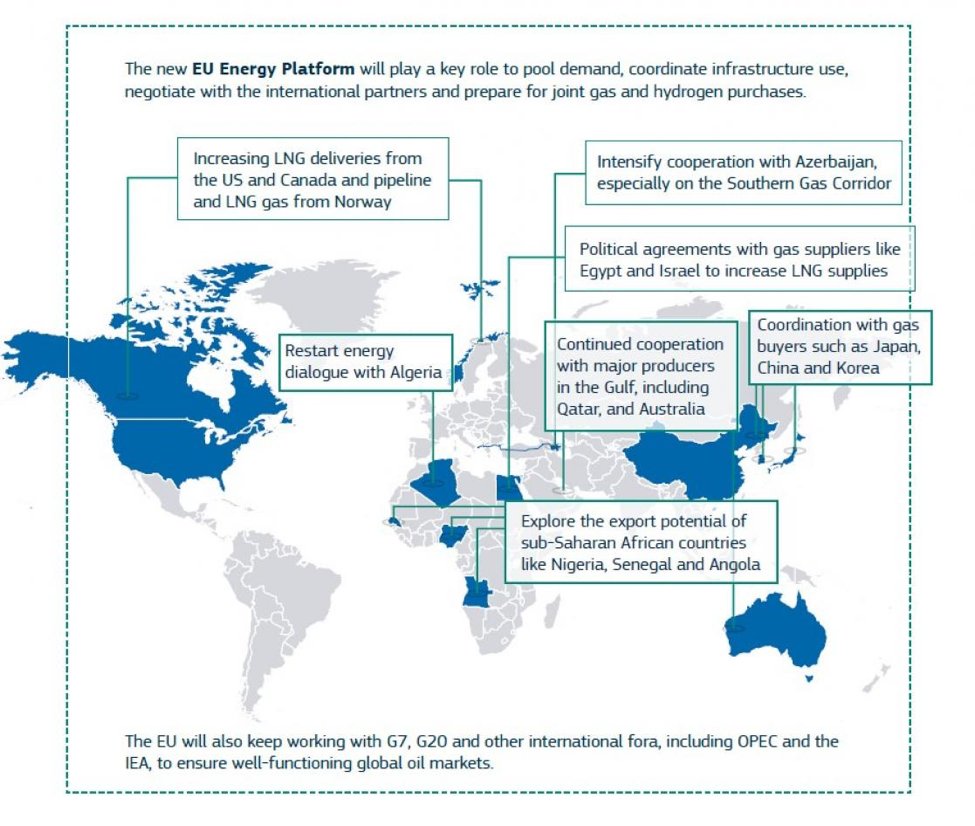
And so it seems that within Africa the opportunity is for existing producers, or those with projects on the cusp of production, that can supply gas before 2030. These could include Angola, Egypt and Nigeria insofar as they can quickly ramp up production. Senegal has already sold the LNG from its initial GTA project, due to start producing in 2023, to Asian buyers, but a final investment decision on a second phase is possible within the next year and production on that phase could start within the next few years.
More generally, expansion of projects with existing infrastructure would be particularly attractive to Europe for a few reasons. It could potentially avoid signing long-term commitments that trigger investments. European officials could also argue that expansions do not constitute development of “new oil and gas fields,” which the IEA has deemed incompatible with achieving net zero by 2050. European demand is unlikely to be much of an opportunity for other countries (or other projects in the above countries) that can only export in the longer-term (2030-2050); these would clearly constitute “new production.”
Europe’s identification of other potential sources of LNG may just be insurance against the possibility that EU-U.S. negotiations fail to result in the full supply of 50 bcm—or a tactic to increase European leverage in those negotiations. Like any insurance policy, this one may not be used, and ultimately significant European demand for additional African supply may not materialize even in the near term. And it may be that Europe wants the “insurance” but isn’t willing to pay the “premium”—or at least not a very high one—in the form of long-term gas purchase agreements necessary to secure financing for projects or funding new infrastructure. If the EU does not plan to make big, long-term investments in African LNG in that way, the responsible course would be to say so explicitly now, rather than leave prospective African suppliers to interpret ambiguities in the strategy.
Officials in producing countries should note these nuances and recognize that Europe and other importers generally prefer to have a diversity of producers, though Europe’s climate considerations may temper the EU’s preference. Many producing countries may never reach the “front of the queue.” Responsible engagement by officials in producing countries would mean avoiding significant risk when jostling for position—by entering a “race to the bottom” negotiation, investing significant public capital to de-risk projects for investors, or getting locked into oversized domestic gas infrastructure that may crowd out cheaper renewable energy alternatives.
EU energy strategy: Missed opportunity on just transition?
In its strategy the EU states that a “just and socially fair” transition is integral to its external energy policy. In practice, its plans around supplier diversification seem shortsightedly agnostic as to where supplies originate—essentially anywhere but Russia.
In a truly just transition, the EU would reduce rather than increase gas imports from countries such as the U.S. and Qatar, as these wealthier countries should be among the first to cut production in a just fossil fuel phaseout. As researchers and advocates for an equitable transition are increasingly recognizing, countries with more urgent development needs should have priority within the remaining carbon budget given their lower capacity to finance their own even more challenging energy transitions. In the absence of an agreed international framework for managed phaseout of fossil fuels, such priority access for developing producers is unlikely. But the EU should support the development of such a framework—or at least apply just principles where it can, as in its international energy strategy.
If consumer countries fail to adopt good governance criteria when selecting future energy suppliers, they risk repeating the mistakes of the past, when Western companies and governments served as key enablers of Putin’s catastrophic kleptocracy. The EU has laid important groundwork on this front, with democratic values and good governance/transparency as key principles for partnerships under its Global Gateway initiative. However, plans to intensify cooperation with authoritarian regimes as part of the EU’s gas diversification strategy raise concerns about its commitment to avoid enabling corrupt regimes.
As part of a responsible engagement the EU and its prospective African gas suppliers should account for the risk that citizens in these African countries may view gas export to the EU as coming at the expense of domestic energy plans.
Developing countries’ domestic energy needs, particularly in Africa where about 600 million people (around half of the population) lack access to electricity, are essential to a just transition. The EU should prioritize delivering on its stated support for increasing renewables in such countries. The strategy’s recognition that renewable energy exports to Europe (e.g., as green hydrogen) should not adversely impact a country’s domestic energy access is significant; the EU should develop this further. But the EU strategy is noticeably silent on the potential impact of increased gas exports to Europe on domestic energy needs in gas-producing countries. This is particularly relevant for discussions around sub-Saharan African gas producers, given the significance (rightly or wrongly) assigned to gas in strategies for addressing domestic energy needs. As part of a responsible engagement the EU and its prospective African gas suppliers should account for the risk that citizens in these African countries may view gas export to the EU as coming at the expense of domestic energy plans. This could accelerate resentment as Europe uses African gas while objecting to gas-supported electrification within Africa for climate reasons.
A way forward
More broadly, the EU should redouble its engagement around ensuring a just transition for developing countries that produce, or aim to produce, fossil fuels. The strategy’s reference to these countries’ interest in exporting green energy shows that the EU appreciates the importance of replacing revenue sources that lower-income countries will lose as part of the energy transition. The EU should support such long-term “revenue smoothing.” This could be part of an Africa-EU green energy initiative inclusive of partnerships of the type launched with South Africa at COP26.
The EU and producer countries should not over-rely on the idea included in the strategy that combining gas cooperation with long-term energy cooperation on hydrogen can “avoid stranded assets and ensure the green transition.” Avoiding stranded assets should be a priority, but not based on an overly broad assumption that fossil fuel infrastructure can be repurposed for other uses.
The EU should instead avoid stranded asset risk in the first place by being as clear as possible on likely future gas demand. With that clarity, African gas-producing countries can determine whether and how they can benefit in the short-term, while avoiding the temptation to sink billions of dollars in public capital in projects predicated on long-term European demand.
Notes
-
1
Authors’ analysis based on “Greenhouse Gas Emissions from Energy Data Explorer”, International Energy Agency, 2 August 2023, www.iea.org/data-and-statistics/data-tools/greenhouse-gas-emissions-from-energy-data-explorer. And Hannah Ritchie, Max Roser, and Pablo Rosado, “CO₂ and Greenhouse Gas Emissions,” Our World in Data, 2020, ourworldindata.org/co2-and-greenhouse-gas-emissions.
-
2
Authors’ calculations based on Hannah Ritchie, Pablo Rosado, and Max Roser, “Greenhouse Gas Emissions,” Our World in Data, 2020. And “Oil and Natural Gas Supply,” IEA, 2022, www.iea.org/reports/oil-and-natural-gas-supply. Quoted in African Natural Resources Management and Investment Centre, Minimising Greenhouse Gas Emissions in the Petroleum Sector: The Opportunity for Emerging Producers (Abidjan, Côte d’Ivoire: African Development Bank, 2022), 14, www.newproducersgroup.online/wp-content/uploads/2022/11/Minimising-Greenhouse-Gas-Emissions-in-the-Petroleum-Sector.pdf.
-
3
In order to ensure greater international equity in the energy transition, authorities in countries implementing schemes such as the EU’s CBAM should include, in or alongside such schemes, measures to mitigate their negative effects on low and middle-income countries, e.g., through financial and/or technical assistance to help such countries green their economies.
-
4
Methane is a common by-product of oil extraction and a particularly potent greenhouse gas. In the process of getting oil and gas out of the ground, it is commonly emitted either through leaks or planned release into the atmosphere – either unburned (“venting”) or burned (“flaring”). Processing (e.g., refining) and transporting oil and gas also generate significant emissions. See “Methane from Oil and Gas Production Explained,” The World Bank - Global Gas Flaring Reduction Partnership, accessed 24 October 2023, www.worldbank.org/en/programs/gasflaringreduction/methane-explained.
-
5
The Global Registry of Fossil Fuels is an “[O]pen-source database of oil, gas and coal production and reserves globally, expressed in CO2-equivalent… It contains data from 139 fossil fuel producing countries, which amounts to 99% of fossil fuel production aggregated to the national level.” The database also provides estimates of the emissions from producing oil and gas in 91 oil producing countries and 71 gas producers. See “Global Registry of Fossil Fuel Emissions and Reserves”, Global Registry of Fossil Fuels, accessed 4 September 2023, fossilfuelregistry.org.
-
6
Figures 1 and 2 show a selection of countries, including some of the world’s larger oil producers, some of the world’s lower emitting producers as well as a selection of countries where NRGI operates. This is intended to provide reference points to explore whether individual countries will be more or less “carbon-competitive” than other producers based on current intensities and identifying potential examples of good practice among lower emitting producers. We also include a selection of higher-emitting producers, which may provide examples of practices to avoid.
-
7
Source: “Carbon Intensity in the Fossil Fuel Supply Chain”, Global Registry of Fossil Fuels, 2023, fossilfuelregistry.org/carbon-intensity. Global Warming Potential (GWP) 20 is applied to methane emissions; see “Methane and Climate Change,” IEA, accessed 4 September 2023, www.iea.org/reports/methane-tracker-2021/methane-and-climate-change. The impact would be smaller if we used Global Warming Potential 100. The impact over the next 20 years is important and sufficient to justify action on cutting upstream emissions (and using GWP 100 would fail to show this); this is why we have chosen to display GWP 20 in this figure and figure 2. For further discussion, see Janos Maté and David Kanter, “The Benefits of Basing Policies on the 20 Year GWP of HFCs” (Greenpeace, 2011), ozone.unep.org/system/files/documents/Benefits%20of%20Basing%20Policies%20on%2020%20GWP%20of%20HFCs.pdf.
-
8
The world’s largest oil producers are the United States (accounting for 21 percent of global production), Saudi Arabia (13 percent) and Russia (10 percent). See “Frequently Asked Questions (FAQs) - What Countries Are the Top Producers and Consumers of Oil?”, U.S. Energy Information Administration (EIA), 22 September 2023, www.eia.gov/tools/faqs/faq.php?id=709&t=6.
-
9
Source: “Carbon Intensity in the Fossil Fuel Supply Chain.”
-
10
The world’s largest (fossil) gas producers are the United States (accounting for 25 percent of production), Russia (17 percent) and Iran (6 percent). See “Natural Gas Production”, Enerdata World Energy & Climate Statistics - Yearbook 2023, accessed 4 September 2023, www.doi.org/yearbook.enerdata.net/natural-gas/world-natural-gas-production-statistics.html. And Statista Research Department, “Natural Gas Production Worldwide from 1998 to 2022”, Statista, 29 August 2023, www.statista.com/statistics/265344/total-global-natural-gas-production-since-1998.
-
11
RMI provides data on supply chain emissions by oil and gas project. See RMI, “Assessing Global Oil and Gas Emissions”, Oil Climate Index plus Gas, 2023, ociplus.rmi.org.
-
12
Some initiatives to capture methane emissions can have a positive net present value for companies. See Chantal Beck et al., “The Future of Oil and Gas Is Now: How Companies Can Decarbonize,” McKinsey & Company, 7 January 2020, www.mckinsey.com/industries/oil-and-gas/our-insights/the-future-is-now-how-oil-and-gas-companies-can-decarbonize.
-
13
Authors’ calculations based on Tomas de Oliveira Bredariol and Christophe McGlade, “Fossil Fuels,” IEA, 11 July 2023, www.iea.org/energy-system/fossil-fuels. And Tomas de Oliveira Bredariol and Christophe McGlade, “Gas Flaring,” IEA, accessed 15 September 2023, www.iea.org/energy-system/fossil-fuels/gas-flaring.
-
14
This is a 30 percent cut relative to 2020 levels.
-
15
Authors’ analysis based on Rebecca Schulz, Christophe McGlade, and Peter Zeniewski, “Putting Gas Flaring in the Spotlight,” IEA, 9 December 2020, www.iea.org/commentaries/putting-gas-flaring-in-the-spotlight. And “Nigeria,” The World Bank, June 2022, flaringventingregulations.worldbank.org/nigeria.
-
16
In 2022 Nigeria’s government “[I[ssued guidelines to support the elimination of routine gas flaring by 2030 and a 60 percent reduction in fugitive methane emissions by 2031.” “Methane Abatement,” IEA, accessed 2 October 2023, www.iea.org/energy-system/fossil-fuels/methane-abatement.