
Mining Revenues Flow to Provinces and Communities in the DRC
In 2002, the Democratic Republic of Congo (DRC) adopted a mining code offering generous terms to investors to attract them to the country’s post-conflict environment. Investment indeed soared, but government revenues and local benefits did not—there was an urgent need to reform the code to decrease this disparity.
In 2011, NRGI provided a grant to the civil society organization POM to reform the code. POM then led advocacy to add a mechanism mandating that a fixed percentage of mining companies’ revenues go directly to subnational governments and local communities. POM also successfully pushed for a community development fund.
Parliament passed revisions in March 2018. The regulation was published in June 2019, and companies have begun payments to communities. The provincial governments of Haut-Katanga and Lualaba are projected to receive between USD 75 million and 225 million in annual revenue, while local communities will receive between 45 million and 157 million. Every province has received some money already. The sector head in Luilu said “With the first collections of our part of the mining royalty, we have already built some community facilities: a pediatric and a maternity ward at the Luilu Health Center, but also a well-equipped mortuary.”
Many communities still lack capacity to receive transfers, while others don’t have the infrastructure to ensure the money benefits citizens. NRGI is measuring the impact of transfers on communities and facilitating a manual to help communities budget, develop capacity and develop revenue management standards.
Civil Society Actors Play Key Role in Colombia EITI Entrance
The challenge
For years, the Colombian government expressed little interest in engaging in international transparency mechanisms for its extractives sectors. It failed to understand how revenue transparency might help strengthen these sectors’ productivity and equity, and instead relied on its own national systems to ensure transparency around extractives revenue. Colombian civil society, likewise, did not appreciate how their work could be bolstered via international mechanisms focused mainly on economic issues and not other areas of governance. Civil society’s interest changed when the Extractive Industries Transparency Initiative (EITI) expanded its purview to include information throughout the decision chain. Nevertheless, these organizations needed guidance on how to proactively engage with EITI and how to procure grants to support their participation in the initiative.
NRGI's role
Colombian civil society began its EITI engagement through regional meetings and training sessions organized by the Natural Resource Governance Institute (NRGI) and the World Bank. Through comprehensive, multi-stakeholder discussions and trainings, Colombian civil society developed an understanding of EITI’s core resource governance concerns and how these concerns overlap with their own extractives work. NRGI connected Colombian civil society actors with global partners that also participated in EITI, fostering exchanges that helped all sides expand their knowledge base.
NRGI’s counsel on the EITI process was extensive. Its experts had frequent and detailed conversations about technical issues, process and strategy with the Fundacion Foro Nacional por Colombia (FFNC), Transparencia Internacional Colombia, Universidad Externado and other actors. NRGI’s efforts in Colombia were further strengthened by the support of the Grupo Propuesta Ciudadana, an organization that leads Peru’s EITI process, and others, such as Bantay Kita of the Philippines.
FFNC used an NRGI grant to launch an information-gathering exercise that homed in on an essential question: What are the biggest priorities for communities living closest to extraction sites? After extensive interviews with organizations that work in and around mining and oil-producing areas, FFNC and others created the Mesa de la Sociedad Civil para la Transparencia en las Industrias Extractivas, a platform that aims to promote broad transparency in the extractive sector and civil society participation in the EITI multi-stakeholder group. The platform ensures that civil society is more comprehensively represented in the EITI process, and it is also used as a training tool for other issues related to extractive industries.
One of Mesa’s focuses is the disclosure of social and environmental payments. One way that the platform increased transparency was by issuing a study that showed how environmental payments were rendered opaque by convoluted government processes. The study found that the regulation (and consequently the payments made by companies) linked to social and environmental issues was complex and the information diffused among the different areas; therefore, the low transparency of social and environmental payments was not a problem attributable only to companies. Although the disclosure of social and environmental payments has not yet been resolved in Colombia’s EITI reports, the research has helped clarify the problem that needs to be addressed.
Impact
The NRGI-backed discussions and trainings bore fruit: when the Colombian government signaled its willingness to meaningfully engage in the EITI process in 2013, civil society was able to quickly organize and actively shape an approach to the initiative that suited their advocacy goals. Colombian civil society targeted the inclusion of environmental issues in the country’s EITI report and wide dissemination of the report to regional and national stakeholders.
NRGI has helped to foster civil society and government interest in Colombia’s extractive challenges. It has laid the groundwork for civil society’s entrance into and constructive engagement with multilateral initiatives. NRGI’s guidance has also helped civil society actors to recognize and come to terms with the challenges it faces as part of EITI—these actors are learning how to manage expectations, as well as how to balance their demands with those of other EITI participants.
DRC Communities Engage with Multinational Mining Companies

The Challenge
As the Democratic Republic of Congo mining sector liberalized over the past decade, private capital flooded in.
L’Action pour la Défense des Droits Humains (ADDH), or Action for the Defense of Human Rights, was part of a local response to the foreign investment in influx. Kolwezi, ADDH’s home in Lualaba Province, is a mining town. Nearly 30 companies operate there, extracting copper and cobalt.
Understanding the complex sector and the roles diverse stakeholders would play in it became a pressing need for members of civil society. As they began to explore the economically, legally and technologically complicated extractives sector, ADDH and Kolwezi’s citizens faced a significant knowledge gap: there are no academic or school programs on mineral resources governance in the DRC.
For ADDH to become an effective actor of meaningful change, expert training was urgently needed.
NRGI's role
In 2015, ADDH coordinator Daudet Kitwa Kalume took part in NRGI’s Francophone Africa training course in Yaoundé, Cameroon, where he learned about investment analysis, the political economy of extractive industries and the extractive industries value chain. During the training, Kalume focused on the legal and contractual obligations of companies and their often intense interactions with communities affected by their activities.
NRGI financially and technically supported ADDH efforts to monitor the corporate social responsibility obligations of majority foreign-owned Kamoto Copper Company (KCC) and Sino Congolaise des Mines (Sicomines), both of which operate in Kolwezi. The companies had a history of focusing more on international non-governmental organizations and largely ignoring inputs from activists and advocates in affected communities.
ADDH told NRGI it was difficult to conduct a study focused on the impacts of mining and community consultation and compensation robust enough to draw the attention of certain stakeholders, particularly mining companies. Local civil society was essentially unable to make their concerns known to companies operating in their own back yard.
Impact
With NRGI help, Kalume and his colleagues released a report evaluating the extractives-related benefits the community saw.
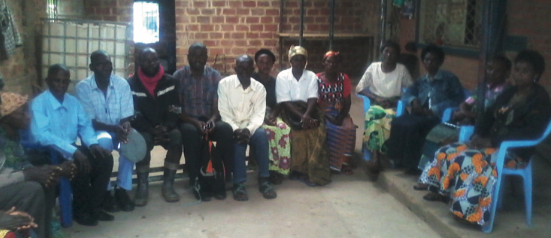 A focus meeting with members of communities surrounding the Sicomines project and impacted by it.
KCC’s board chairman, legal advisor and community development department manager welcomed ADDH to discuss the report. This was significant: the company had previously brushed off meetings with the civil society organization.
KCC and Sicomines directors sent ADDH responses to the report’s recommendations, surprising the group’s members. For the first time, ADDH was seen as a peer group worth hearing out—a legitimate interlocutor for the community impacted by mining.
Two days after ADDH visited KCC, a Luilu community delegation impacted by KCC’s project visited the miner’s offices. During that meeting, in an abrupt shift from previous experience, KCC expressed interest in the needs of the communities impacted by its project. The move was apparently prompted by the earlier KCC and ADDH meeting.
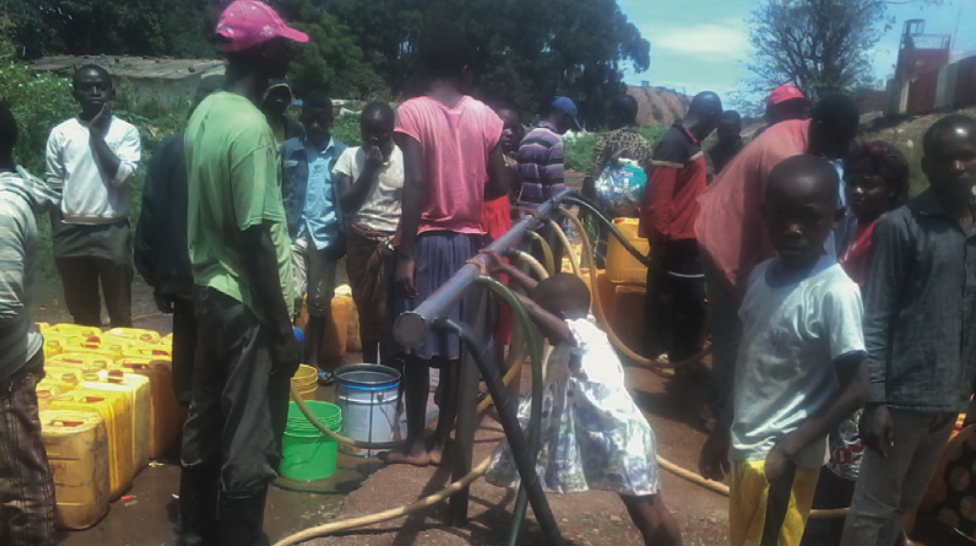 This well supplies the communities surrounding the Sicomines project.
A community consultation also resulted in KCC promising to finalize an uncompleted well project supporting the Luilu and Tshamundenda communities, with populations of 24,300 and 16,700, respectively. Lobbying also resulted in Sicomines building a multi-purpose road in a community impacted by its project.
Sicomines and KCC now have a different perception of local NGOs’ competencies. ADDH presented its report to key decision-makers in Kinshasa and presented report recommendations to national authorities, advocating for better monitoring of companies’ local commitments. The organization passed along what it learned in a data validation workshop with local authorities, NGOs, community leaders and journalists.
NRGI is helping the citizens most impacted by mining make their voices heard to elected representatives and companies operating with their consent. And through its training and outreach, NRGI is promoting the important work of organizations like ADDH.
Why Extractive Industry Gender Advocates Should Ask For Contract Transparency

How does the legal framework contribute to gender equity in the extractive sector? This was a driving question for joint research by NRGI and the World Resources Institute (WRI), leading to the publication of Gender and Extractive Governance: Lessons from Existing Legal and Policy Frameworks.
That research revealed that governments are influencing women’s involvement in the extractive industries and the benefits they receive—in both positive and negative ways—through provisions in their national laws, regulations, policies and guidelines. In this blog, I build on that important work by showing that governments and companies are also writing gender provisions into the contracts they agree with each other.
This is yet another reason why extractive industry contracts must be made public. With U.S. President Biden’s Summit for Democracy and the 2021 OGP Summit not far off, government reformers and their civil society counterparts should know that a commitment to resource contracts transparency can support gender goals in addition to improved governance of the extractive industries.
In most countries, when governments decide to develop publicly held natural resources, they usually make agreements with extractive industry companies with the expertise (and access to finance) needed to take resources out of the ground. These agreements are critical parts of the legal framework. They detail the specific rights granted to companies to exploit or explore for natural resources, and state how the financial gains from these activities are shared between the private sector on the one hand, and the government and citizens on the other. In addition, resource contracts often include health and safety requirements, environmental commitments and social obligations. As shown here, some contracts also include gender provisions.
Gender provisions in extractive contracts
To explore the ways that governments and companies are using resource contracts to make rules on gender related issues, I searched for the words “gender”, “women” and “sex” on ResourceContracts.org—the world’s largest repository of publicly available oil, gas, and mining contracts.
The search returned over 200 documents with at least one of the search terms (roughly 10 percent of all the documents in the repository). While more research would be required to determine exactly how many of these actually point to gender equity provisions rather than mere incidental uses of the search terms, I was able to find at least four different types of clauses that sought to address gender issues. These covered: inclusion in consultation activities; protection from workplace discrimination; fairness in local content policies; and gender in site security. Examples of typical clauses for each of these general areas are provided in the table below.
| Gender provisions written to address gender equity | |
| Inclusion in consultation activities |
1.1 … Any consultation shall strive to include, in socially and culturally acceptable forms, all social elements in the area affected by the subject matter under consideration, including both men and women. |
| Non-discrimination in the workplace |
13.3. The Contractor shall not discriminate on the basis of gender and shall respect the right of women workers to participate in policy and decision making processes affecting their rights and benefits. |
| Fairness in local content policies | 29.3 (g)(ii)… the development plan shall include… the contractor’s proposals for stimulating local content, including… identifying specific skills’ training programs and technical courses that shall… ensure fairness in gender practices Model PSA, Kenya 2015 |
| Gender in site security | 21.5 … a search [for suspected stolen diamonds] … shall be carried out by a police officer of the same sex as the person to be searched. Diamond (Argyle Diamond Mines Joint Venture) Agreement Act, Western Australia, 1981 |
Considerations around using contracts for gender provisions
There is some debate on whether using contracts to lay out obligations on issues like gender is a good idea. On the one hand, contract negotiation processes provide governments and companies an important opportunity to fill in gaps where legislation is insufficiently detailed; or to make rules for unusual oil, gas and mining projects that might not have been foreseen by existing laws (often the case after a big find). Given the pace of most legislative processes, and the wide-ranging interests of many legislators, contract negotiation processes can be faster and more reliable ways to lay down rules for specific issues.
On the other hand, excessive rulemaking by contract can undermine the role that the legislature and other democratic institutions play in the development and oversight of the law. In many instances, this accountability deficit is compounded because, unlike other parts of the legal framework, it is relatively common for resource contracts to be kept secret. As a consequence, citizens affected by contractual provisions—in this case women—may not be aware of rights or protections they are entitled to. Moreover, in instances where contractual terms are ineffective or negatively impact women, secrecy makes it hard to detect shortcomings, let alone work to address them.
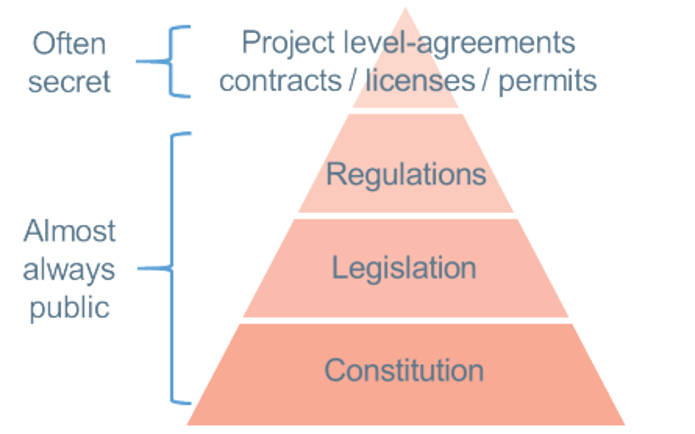 Secrecy in the legal framework
Gender advocates should be asking for contracts
The movement for contract transparency in the extractive industries, most recently anchored by the global Publish What You Pay movement’s #DiscloseTheDeal campaign, has made significant gains. In 2019, EITI made it a requirement for the 50+ countries implementing the EITI Standard to disclose all contracts or licenses granted, entered into or amended from 1 January 2021. There are now 49 countries that have officially disclosed at least one extractive industry contract and 31 with policies in place making publication mandatory.
But, despite these advances, there is still a long way to go. In many jurisdictions, including Egypt, Indonesia and Nigeria, the publication of resource contracts happens only rarely, if at all. In many more, disclosures are partial or incomplete. In these countries, it is impossible to know whether gender provisions are hidden in contracts, let alone determine whether they need to be changed or better enforced. This is why gender reformers should team up with their colleagues working on extractives transparency to advocate for contract disclosures.
This work was presented as part of a workshop session on Gender in extractive sector legal and policy frameworks that was conducted as part of the EITI global peer-learning event EITI & Gender: Towards a more equitable future in May 2021.