
Shell Published its Payments to Governments. Nigeria Has Taken Notice
On Monday, Shell released its payments to governments report for 2017, the company’s third year of reporting under the U.K.’s Reports on Payments to Governments Regulations. Nigeria national media closely covered the disclosure.
In the 24 hours since Shell published its report, six national media outlets in Nigeria—Punch, Vanguard, This Day, The Cable, World Stage and Leadership—have analyzed the news.
This level of immediate national press coverage reaffirms the importance of payments to government data to citizens in resource-rich countries, and how it is increasingly informing national debates on countries’ natural resources management.
.@Shell has reported on $22.4 billion in payments made to governments in 29 countries. Find out how much your government received from one of the world's largest #oil companies: https://t.co/qj3NKJJgyi pic.twitter.com/S9eEV5nUgS
— NRGI (@NRGInstitute) April 9, 2018
Similar laws to the U.K.’s in Europe and Canada have come into force over the last few years to shed light on billions paid to governments around the world by oil, gas and mining companies. Greater disclosure of these financial flows can deter corruption and mismanagement in the natural resource sector.
Shell reported payments made to governments in 29 countries amounting to USD 22.4 billion in 2017. Nigeria is the largest payment recipient at USD 4.3 billion (NGN 1.5 trillion), a USD 700 million increase on the amount Shell paid to Nigerian government entities in 2016. As analysis by Vanguard noted, this NGN 1.5 trillion figure represents 15 percent of Nigeria’s NGN 10.6 trillion total government revenue for 2017. (This total includes both oil and non-oil sources.)
Shell is the third international oil company to disclose payments to Nigerian government entities for 2017, with Statoil (USD 469 million) and Total (USD 1.15 billion) having already reported in March. Chevron, CNOOC, Eni and Seplat are all expected to disclose payments for 2017 by the end of May.
The stories written include analysis breaking Shell’s Nigeria payments up by recipient government entity (USD 3.2 billion to the Nigerian National Petroleum Corporation; USD 80 million to the Niger Delta Development Commission; USD 280 million to the Department of Petroleum Resources; and USD 765.5 million to the Federal Inland Revenue Service) and by payment type (USD 3.2 billion to production entitlement; USD 765.5 million in taxes; USD 245.7 million in royalties; and USD 114 million in fees).
NRGI has been working to promote the use of this data in Nigeria. In December, NRGI published Nigeria’s Oil and Gas Revenues: Insights from New Company Disclosures. The briefing explores how payments to governments data from Shell and six other international oil companies operating in Nigeria could be used to hold the government accountable for revenues generated from the sector.
NRGI is co-hosting a meeting with nongovernmental organization Connected Development in Abuja on Wednesday with around 20 Nigerian civil society organizations to launch the briefing. We aim to explore new ways in which civil society within the country can use this data as an accountability tool. NRGI has already been working to support Nigeria civil society organizations to use this data, including working with BudgIT, which produced infographics analyzing Shell’s 2016 payments to governments report.
NRGI also works with Nigeria-based journalists through the Media for Oil Reform Fellowship to promote the use of extractives industries data. Program fellow and Punch senior correspondent ‘Femi Asu was among the journalists who reported on the Shell disclosure.
As a new data source—most companies have reported for only the second or third time this year—it is exciting to see stakeholders in Nigeria engaging with payments to governments data as an informative and accountability tool.
Alexander Malden is a governance associate with the Natural Resource Governance Institute (NRGI). Toyin Akinniyi is a media capacity development associate with NRGI. Zira John Quaghe is a Nigeria officer with NRGI.
Tin is King in Belitung. Can this Indonesian Island Become a Tourist Destination?
For centuries, the Indonesian island of Belitung was known by outsiders for little more than its tin industry.
Things started to change with the release of Laskar Pelangi (The Rainbow Troops), a 2008 film about childhood and an inspiring rural school based upon an autobiographical novel from Belitung’s own Andrea Hirata. The book was a bestseller and the film a major Indonesian box office success, showcasing the island’s natural beauty and highlighting Belitung’s potential as a tourism destination.
Ten years on, the island has clear appeal. Azure waters, golden sandy beaches and smooth, stacked boulders mark its coastline. Many of Belitung’s inhabitants want to capitalize on this beauty. But further inland, the mining sector’s continued hold and the challenges of economic diversification are apparent.
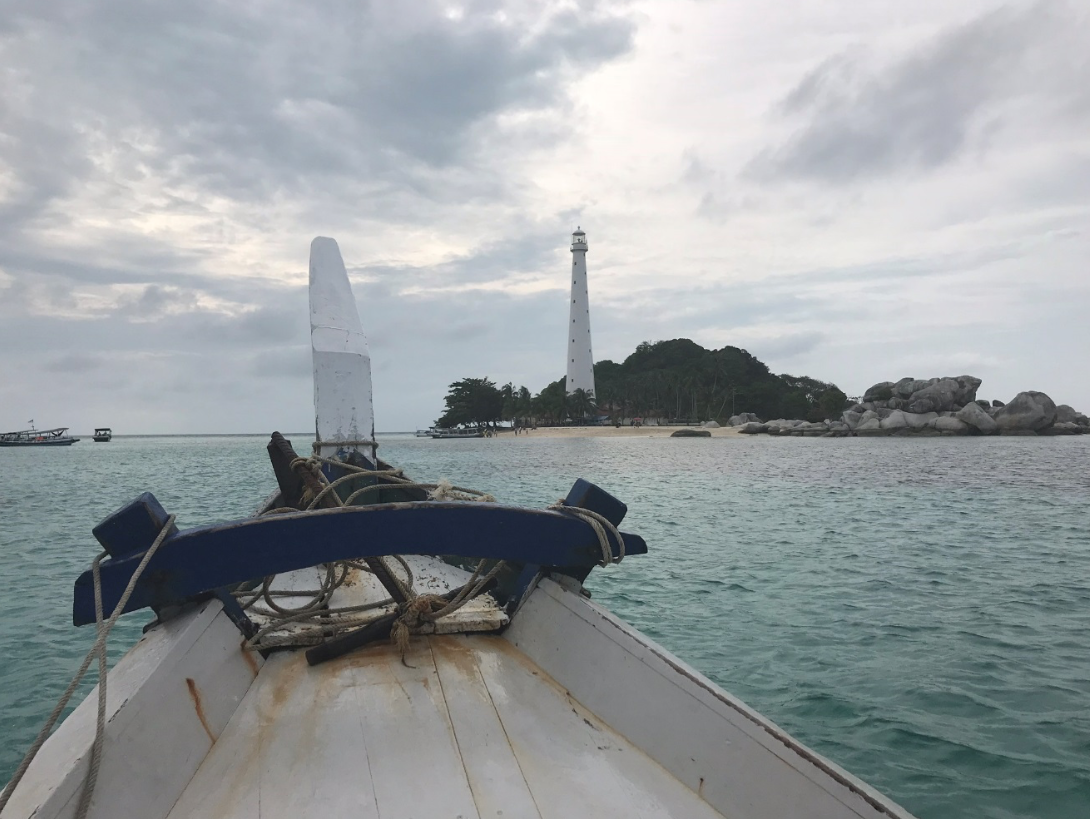 Approaching Lengkuas Island off the northwestern coast of Belitung. Photo courtesy of Sebastian Sahla for NRGI.
In January 2018, the Natural Resource Governance Institute and Gadjah Mada University’s Department for Politics and Government (PolGov) organized a two-week intensive resource governance course in Belitung. In its fifth year, this was the first time the course was held outside PolGov’s Yogyakarta campus. For 28 participants drawn from seven countries, it was a unique opportunity to come face-to-face with the challenges of a community hoping to move beyond dependence on extractives. (Read interviews with facilitator-participant Tim Grice, founder of Leapfrog International, and participant Starjoan Villanueva, director of the Philippine civil society organization Alternative Forum for Research in Mindanao.)
Since the early 18th century, mining has been Belitung’s driver. The industry was initially overseen by the Palembang Sultanate. In 1860, following Dutch colonization at the start of the century, NV Billiton Maatschappij, which would eventually evolve into global mining giant BHP Billiton, acquired mineral rights on the island.
The company dominated the local economy until the 1950s, when the industry was nationalized. In the 1990s, depletion of tin resources and a crash in global prices led Indonesia state-owned enterprise PT Timah to divest from its Belitung assets. Mass layoffs and the closure of company run schools and hospitals ensued, depriving residents of crucial social services. Companies left behind a landscape scarred with brownfield mine sites.
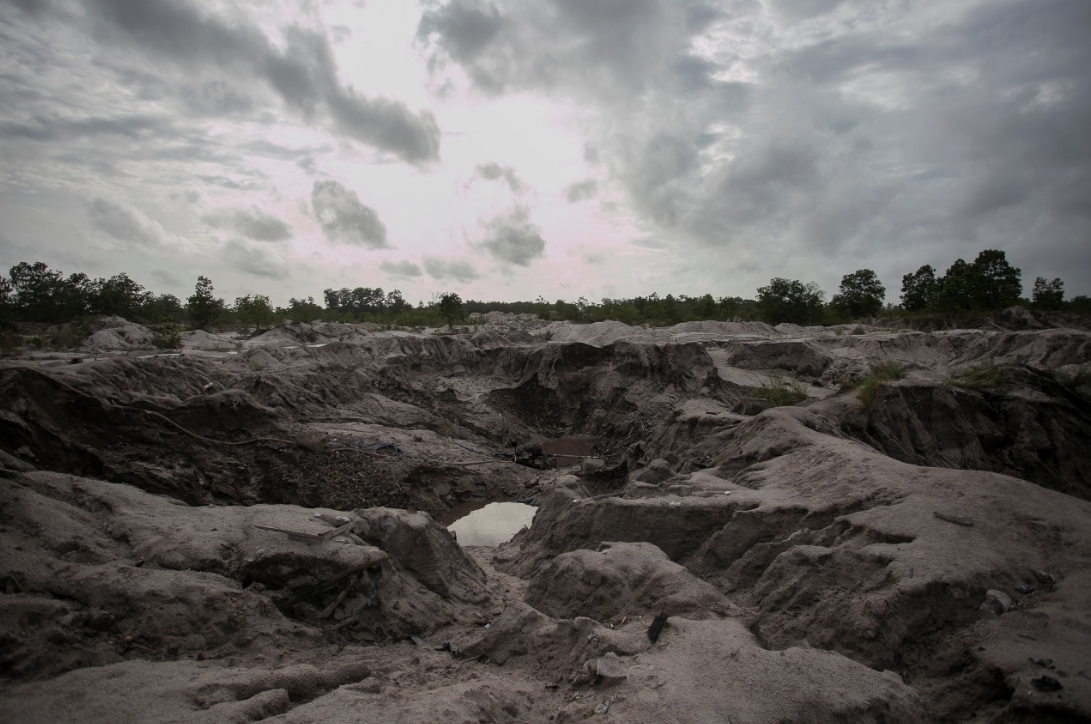 An abandoned tin mine in Belitung. Photo courtesy of Andrew Bauer for NRGI.
Since then, Belitung’s economy has been in transition. While large-scale mining continues on a neighboring island to the west, Bangka, Belitung’s extractive sector features only artisanal and small-scale activity. Mining still makes up a significant proportion of Belitung’s local economy and, together with Bangka, accounts for 90 percent of Indonesia’s tin output.
However, with the growth of tourism and prospects for expanding agriculture and safeguarding fisheries, diversifying away from mining has gained conceptual momentum among local officials and residents.
But we observed many challenges to diversification.
One is coordination within the government. We did not find evidence of a concrete plan within the district government to move from ambitions of diversification toward benchmarks.
More coordination between district and provincial authorities is needed. The district's ambitions for tourism and fisheries could be undermined by provincial mining licensing decisions. The province has issued licenses for offshore tin production around Bangka and there is talk of expanding this to Belitung. This could have major impacts on the marine environment.
Managing artisanal mining remains a major source of income for many, and artisanal mining is difficult to regulate. Unlicensed operations are highly visible and generally not penalized. In the absence of an official mandate to stop illegal mining, district officials resort to mediation based on interpersonal relationships and social sanctions to resolve conflicts. Barriers to entry are low, with only simple tools and technology required. Malaysia and Singapore serve as ready markets.
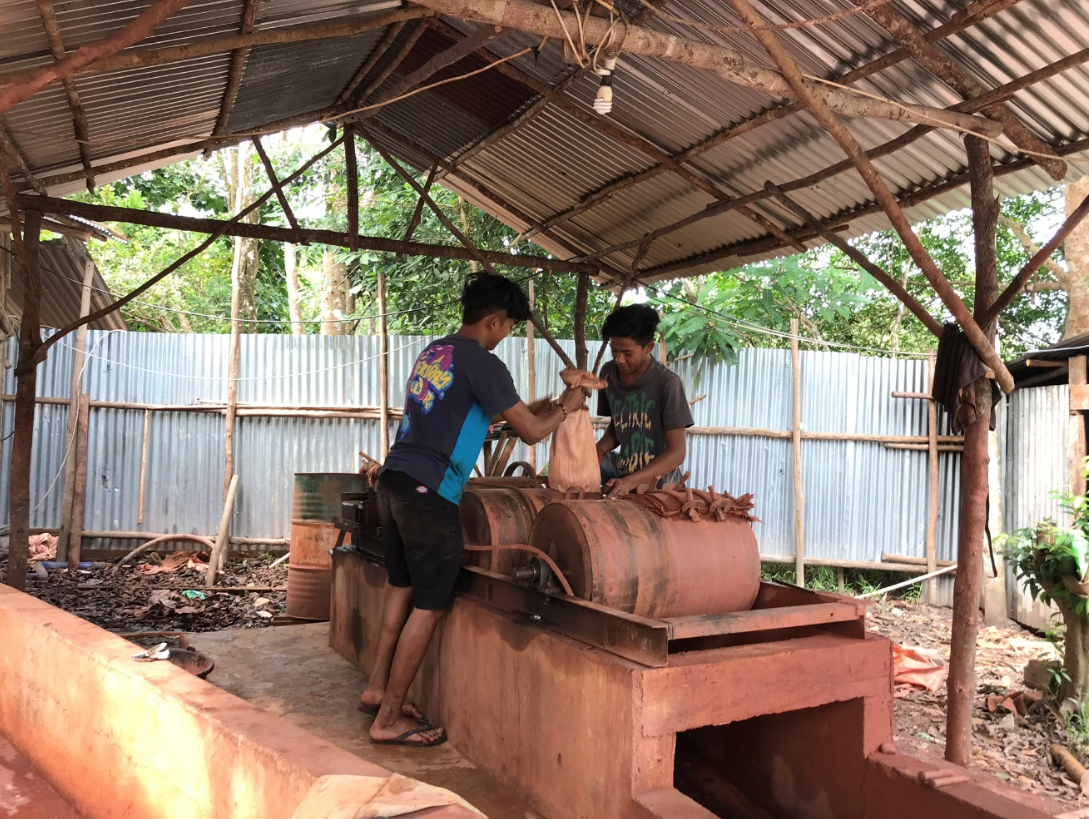 Artisanal miners process tin in eastern Belitung. Photo by Sebastian Sahla for NRGI.
While Belitung's journey shows that the path to diversification is not easy, three considerations might serve as a point to move things forward in Belitung and communities facing similar challenges elsewhere:
- Improve coordination between different levels of government. District and provincial officials should chart a shared vision for local economic development. This might include an agreement that offshore licensing will not be permitted in Belitung.
- Support the formalization of artisanal mining. Artisanal mining is a reality on Belitung that the district and provincial government need to deal with constructively. Authorities could provide support to artisanal miners to improve environmental and social standards.
- Develop a concrete and realistic plan for the tourism sector. The national government has identified Belitung as a priority area for tourism development and has established a special economic zone in the northwest of the island, which has attracted investment from the likes of Sofitel and Sheraton. In collaboration with provincial and district authorities, a clear strategy could help to identify what facilities or infrastructure is needed to further increase the appeal of other parts of Belitung. A tourism strategy could home in on the island’s mining heritage. There are already plans to convert a brownfield open pit mine into a tourist site. In other countries, similar schemes have been highly successful. In the U.K., the Eden Project has turned an old clay pit into “the largest indoor rainforest in the world” and attracted over 1 million visitors in 2016. While a project of this scale may not be feasible in Belitung, it could give food for thought on how tourism can build on the island’s mining legacy.
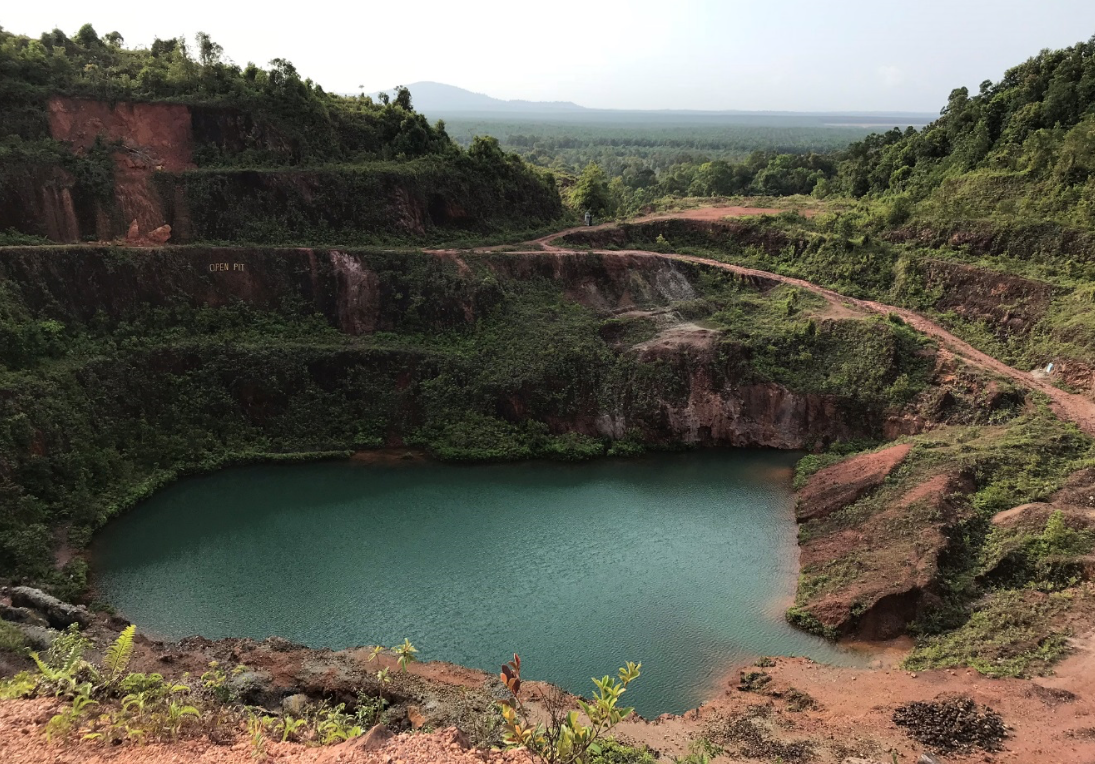 View of the Nam Salu open pit. There are plans to turn the site into a public park. Photo by Sebastian Sahla for NRGI.
It Takes A Village: Local Level Agreements in Mongolia’s Mining Sector
Local level agreements (LLAs) are formal agreements between resource companies and local stakeholders affected by their extractive projects. They are intended to create mutually beneficial relationships by increasing positive impacts for local livelihoods and development. In Mongolia, resource companies are encouraged to use LLAs, and though the quality and uptake of these agreements is not consistent—ranging from rudimentary, transactional contracts to sophisticated, multi-stakeholder agreements—Mongolia’s experience with LLAs provides important lessons for any resource-rich country that seeks to improve agreement-making in communities.
In Mongolia, the Natural Resource Governance Institute (NRGI) has implemented a series of interlinked projects that focus on transferring international good practice, encouraging learning from local experience, facilitating policy dialogue, and improving local government capacity. Takeaways from NRGI’s involvement in Mongolia include:
Independent monitoring is important
In Mongolia, local governments are the counterparties to companies in LLAs, and so it is important that local civil society organizations (CSOs) have the capacity to both engage in the LLA process and monitor the agreements’ implementation. Thus, NRGI provided training, grants and technical support to four local CSOs to build their capacity to independently monitor LLAs (these projects were carried out in coordination with five monitoring projects funded by the Open Society Forum, OSF). Using their newly developed skills and knowledge, staff of these CSOs identified serious gaps in the LLA process: local governments were found to be reluctant to disclose their LLAs; project-affected communities and the public were not sufficiently consulted (when they were consulted at all); vague language was used in the agreements, inhibiting adequate implementation; local governments didn’t have the capacity to prepare and conduct negotiations with mining companies; and little attention was paid to setting up mechanisms or processes that could ensure effective implementation.
Not all the news was bad, though: some monitoring projects highlighted emerging good practice, such as disclosure of agreements, multi-stakeholder consultation and the use of measurable agreement terms.
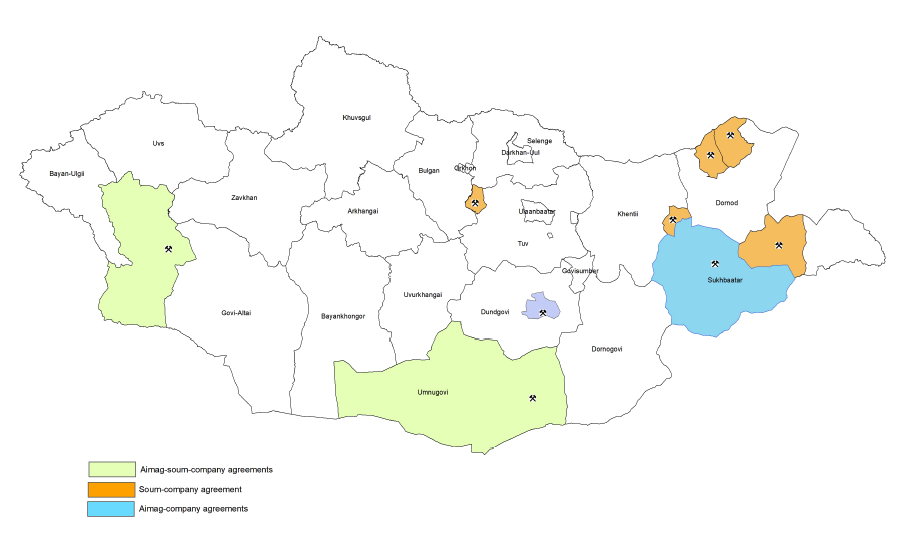 Aimags and soums i.e., provinces and districts) where LLA monitoring projects were implemented (Click on the map to enlarge)
In order to consolidate the findings of the monitoring projects, multi-stakeholder meetings and additional research on LLAs in Mongolia, NRGI (in collaboration with Tohoku University’s Byambajav Dalaibuyan) published Local Level Agreements in Mongolia’s Resource Sector: Lessons Learned and the Way Forward. The paper concluded that the government officials ought to be realistic about the plausibility of the universal uptake of LLAs under Article 42.1 of the Minerals Law and what can be achieved from the model agreement, given that the capacity and interest of local governments, companies and communities varies widely. One of the five policy responses recommended in the paper was using thresholds to prioritize the resource projects that are required to establish LLAs (e.g., projects at the mining and processing phase). This recommendation became a subject of heated debate at the multi-stakeholder meeting organized by NRGI in November 2017. Further discussion is needed to develop better regulations and policy incentives to improve the positive effects of LLAs.
Another key finding of the monitoring reports and policy paper was the need to build the capacity of local governments to use LLAs as an opportunity to sit at the negotiating table with mining companies and get them to engage them with local development issues in a transparent and effective manner. NRGI has sought to support the development of such local government capacity through a training program based on nurturing hands-on experience and knowledge-sharing. The aim has been to develop an effective country-specific training using a combination of international know-how (e.g., relying on cases from countries like Australia and Canada, which have extensive experience in local agreement-making) and local best practice and lessons learned (e.g., based on the Mongolian monitoring reports and the aforementioned research paper).
Tailored capacity building matters
The findings of the monitoring projects and the policy paper became good sources of information and real-world examples that NRGI used in developing a training module on the process, content and implementation of LLAs in Mongolia (the module was developed jointly with Byambajav Dalaibuyan and OSF's Erdenechimeg Dashdorj). Two regional training seminars held in November 2017 involved local government representatives from 20 districts in 10 provinces.

The highlight of the workshop was a fictional scenario and role-playing session used to give the participants hands-on experience and motivate them to distill key points of consideration. In each phase, learners were grouped into three groups with three separate roles: working groups acting out the roles of the provincial government, the district government and the company. After each role-playing session, the facilitators introduced insights from international and local examples and provided updates on relevant legislative frameworks. Mr. D. Ganzorig, an environmental officer in Galuut, in Bayankhongor aimag, said, “We taught [that an LLA] achieved its purpose if mining companies fulfill their monetary obligations. Through the role play, we learned about practical ways to expand benefits local communities could receive.”
This learning-by-doing approach proved to be very effective for local government representatives. Participants used the text of actual Mongolian LLAs, reviewed agreements available on www.resourcecontracts.mn and provided recommendations for potential improvements from different parties’ perspectives.
An insightful panel discussion involving representatives of aimags and soums that had experience with LLAs concluded the module and allowed discussants to share their practical approaches, strategies and challenges in dealing with resource companies and establishing and enforcing LLAs. Most of the participants recommended including mining companies and local CSOs in future training seminars.
Nomuuntugs Tuvaan is NRGI’s Mongolia officer.
‘Empowerment Without Good Governance is Precarious’: a Conversation with Leapfrog International’s Tim Grice
Tim Grice is a social researcher, development generalist and the founding director of Leapfrog International, a Brisbane-based consultancy that focuses on resource governance and inclusive growth. He is also an honorary senior fellow at the University of Queensland’s Sustainable Minerals Institute.
In January, Grice participated as an instructor in Advancing Accountable Resource Governance in Asia Pacific, an annual course that brings together experts from across the region to discuss pressing issues in oil, gas and mining.
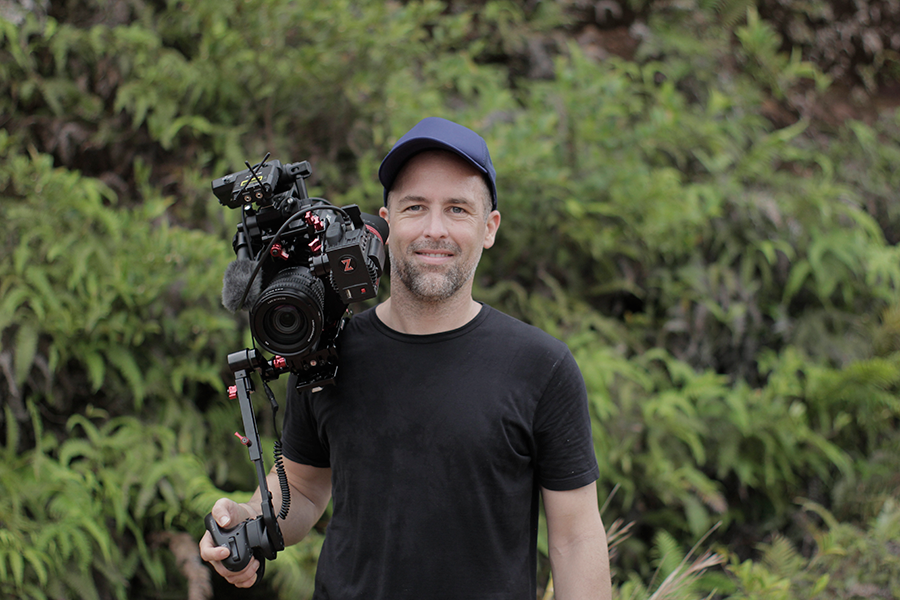
In Belitung, Indonesia, where this year’s hub course took place, I spoke with Grice about a formative early work experience in Papua New Guinea as a sustainable development group manager with Newcrest Mining, his more recent work with Leapfrog International and quantifying the unquantifiable.
Max Brett: What drew you to work for Newcrest? Was it the project they were working on?
Tim Grice: What drew me to Newcrest was the island, actually. I lived on Lihir Island with my family for six years. Lihir has an incredibly interesting development story. In the mid-1900s, there was a movement called the Tutukuvul Isakul Association, which prophesized that Lihir would become a city. People engaged in rituals with the expectation that material goods would arrive on the island.
It was basically a “cargo cult,” a millenarian movement to explain how Europeans, or more technologically advanced societies, got their “cargo.” Fast-forward half a century and Lihir is home to the world’s third-largest gold mine.
What were you able to achieve at Lihir and in Papua New Guinea?
I took a trip to a hospital in Namatanai in New Ireland. The hospital had no power and no running water, and to drive to the next hospital was a three- or four-hour trip. The day before we arrived, a woman died after walking down to the local river to wash after childbirth. The mining company worked with stakeholders on hundreds of corporate social responsibility projects during my time on the island, but the predicament at Namatanai hospital was particularly desperate.
Through the government of Papua New Guinea’s tax credit scheme, we worked with the New Ireland Provincial Government to install new power and water infrastructure at the hospital. The management of the power and water supply is now under the provincial authorities. We also set up a collaborative governance structure where health and education infrastructure projects were aligned to local development plans.
From your experience on Lihir, what are your takeaways on a mining company’s responsibilities to the community where it works?
It’s critical that local institutions have the opportunity to set the direction for their development plans, whether that’s local or regional level governments, landowner groups or civil society organizations—usually a combination of all stakeholders. That’s critical.
But there’s also a balance to be found ensuring that stakeholders have governance structures that can handle an influx of mine-derived funds. Empowerment without good governance is precarious.
Why did you transition out of the private sector?
Because the pay is better working for civil society and governments.
I’m kidding! I wanted to work with governments, civil society organizations and groups like NRGI to have more of an impact on extractives governance at the national and global levels.
Tell me about Leapfrog International.
I started Leapfrog International about 18 months ago. We focus on extractives governance and tend to work with aid donors and multilaterals, as well as the private sector and civil society.
One recent project was on the mining sector in Africa and countering violent extremism. We went to Burkina Faso, Ghana and Kenya to think through the role that the mining sector in Africa could and should be playing to prevent and counter violent extremism. Another project was with the World Bank in Solomon Islands, looking at establishing an independent center to advise landowners and local communities on the extractives process. We’ve also been involved with Transparency International’s Mining for Sustainable Development Program.
One focus area for Leapfrog is the use of digital storytelling in the research process. Through our work with clients like the Extractive Industries Transparency Initiative on subnational payments and the International Finance Corporation on mobile banking, we’re finding that people have different insights when they are telling stories to a camera, and documenting their circumstances and particular entanglements. Short documentary reports also become an effective way to share the outcomes of a project.
You’re also working with NRGI. Tell me about the non-fiscal costs and benefits project.We tend to do a fairly good job measuring and forecasting fiscal revenues from extractive projects. What we don’t measure and value particularly well are the “non-fiscal” costs and benefits of extraction, including the depletion of ecological assets like air, water and land, and the often profound social impacts of extractive projects, such as job creation, resettlement and social conflict. Together with NRGI, we’ve been surveying the methods and tools that can measure and value these non-fiscal impacts.
How would different stakeholders use this?
Unlike their fiscal counterparts, the non-fiscal impacts of the extractive sector tend to be underestimated, under-measured and under-reported by industry, governments and markets. When we look at a mining project in Chile, or an oil and gas project in Indonesia, we don’t really know what the total net impact of that project is. Many extractive projects might no longer be profitable with full accounting for financial and non-financial externalities and liabilities.
So, if we do a better job measuring and valuing all of the costs and benefits of extractive projects, governments and communities will be more informed when making the decision whether to extract. Better measurement and valuation of social and environmental impacts can also inform social and environmental management programs.
What are your thoughts about the course that brought us here?
I really like that the course is on Belitung, where BHP Billiton took its name. Belitung has a rich history of tin mining going back to the discovery of tin in the early 1700s, and the exploitation of tin by NV Billiton Maatschappij in the Dutch colonial period, and more recently the state-owned mining company PT Timah, as well as artisanal and small-scale miners. We have a live case study to think though, and lots to learn from local people.
This interview has been edited for clarity and length.
Max Brett is a communications officer with the Natural Resource Governance Institute (NRGI).
Barnard College Professor Anja Tolonen Analyzes Gender-Specific Effects of Extractives
Anja Tolonen is an assistant professor of economics at Columbia University’s Barnard College. Tolonen’s research focuses on how natural resources affect labor markets, criminal behavior, health and social welfare, and, in particular, gender inequality. Tolonen also focuses on the economics of gender in the household and child health in developing countries.

Tolonen also served as a consultant for NRGI in 2017. She compiled a literature review focused on collecting empirical data on the gendered impact of extractive industries, and identified areas for further research. Anja also did a statistical analysis of the Resource Governance Index compared with global gender indexes to assess any correlations.
Just before International Women’s Day, I spoke with Tolonen about common misconceptions in gender and extractives, the dearth of research on policies that can help women, and takeaways from extensive fieldwork.
Katarina Kuai: Tell us about the research you’ve completed with NRGI and your work in general.
Anja Tolonen: Natural resource extraction is an important economic activity in many countries, but for a long time we did not consider the gender-specific effects the industry has. My research focuses on this question, and in particular how mining activities interact with gender. I was very excited to hear about NRGI’s interest in this question.
What are some of the most common conventions or misperceptions about gender and extractives?
It’s often heard that extractive resources don’t affect women, because the sector employs mostly men. It is exactly because it mostly employs men that it is such an interesting industry to research from a gender perspective. What happens with women’s welfare as men’s wages go up? Do they work less, work more, lose bargaining power in the household? Or do they gain more of it? My own empirical research and the review I wrote with NRGI indicates that women do gain job opportunities when an economy specializes in extractives. Most of those opportunities are found within the service sector.
What can organizations like NRGI do better to support their struggle?
Surprisingly little research focuses on evaluating policies that can help women. We should evaluate more about how gender-sensitive community engagement, creating direct employment opportunities for women, or reducing pollution can improve women’s lives. It is important for organizations active within the sector, such as NRGI, to collect gender disaggregate statistics and to engage in dialogues around gender.
In your fieldwork, you interact with many different women. What do you find interesting or inspiring about their stories?
My favorite positive story was a woman living in a mining community in Tanzania. The mining company had trained and hired women as truck drivers, and at a competitive wage rate. She had saved the extra money she earned and used it to open a store and a restaurant and was now one of the most successful entrepreneurs. I think it is important we be open-minded and see that women are potential entrepreneurs who can take opportunities that extractives bring.
In another mining community in Tanzania, I spoke to a woman who had suffered a late miscarriage coinciding with a tailings dam breakage that resulted in polluted waterways. The water was contaminated with arsenic, which can lead to miscarriages. These stories are so different, but they came from two women not living too far away from each other. We need to see all sides of the picture.
What are you working on next?
I am working on a project about the gold rush in the United States in the 19th century. I am very excited to be able to compare historic evidence to that of developing countries today.
What are knowledge gaps in this field and why has the field of economics been slow to address or fund this research?
Development economics is generally quite strong in researching gender. However, some fields within economics—that are most often considered “manly,” such as macroeconomics, or natural resource economics—have been much slower in bringing gender into the analysis. More quantitative and rigorous research is definitely needed if we want to understand the full picture. In particular, how to engage women in the political sphere around extractives, and what policies work to improve the welfare of women in or near extractive industries.
Recent research points to patriarchic and discriminatory practice and bias in your field. Is this field moving with the times or resistant? Has the growth in numbers of women economists changed what economists study or their policy recommendations?
Sexism and discrimination against women is rampant in society, and the academic field of economics is definitely not an exception. It is important to have diverse group represented within an academic field, as it may influence what questions are asked and what subpopulations are studied. This is true in economics, but has also shown to be true for example in medicine. I think economics is gaining a better understanding of this, and wants to improve. But hard work remains.
Have you seen anything recently that’s made you feel hopeful about change in this field?
At the most recent annual meeting for economists in January 2018, we organized a successful session with eight female professors. It was a strong #allfemalepanel, and I hope it is just the beginning of what we will see within economics!
Katarina Kuai is a senior capacity development officer with the Natural Resource Governance Institute (NRGI).
Around the World, NRGI Works to Strengthen Women’s Participation in Resource Governance
On this International Women’s Day, we at NRGI are drawing inspiration from women’s movements and paying attention to ways we can work toward equal participation in extractives management.
Players in the resource governance movement has been working incrementally on the subject, from Publish What You Pay’s Extracting Equality – A Guide to Oxfam America’s position paper on gender justice and extractive industries to gender commitments recently integrated into the 2018 Extractive Industries Transparency Initiative (EITI) workplan. Although NRGI has had a gender policy in place since 2015, it is the organization’s country staff who are taking the organization’s first real steps on integrating women’s consultations into project design and research and measuring extractives’ impact on women and empowering their participation.
In NRGI’s Latin America office, program associate Lorena De la Puente Burlando is leading innovative research to understand the differentiated impacts of mining and hydrocarbons on women and men, using statistical data from six countries. The project is about to enter its field study phase, in which researchers will gather qualitative data from women in the highlands of Peru.
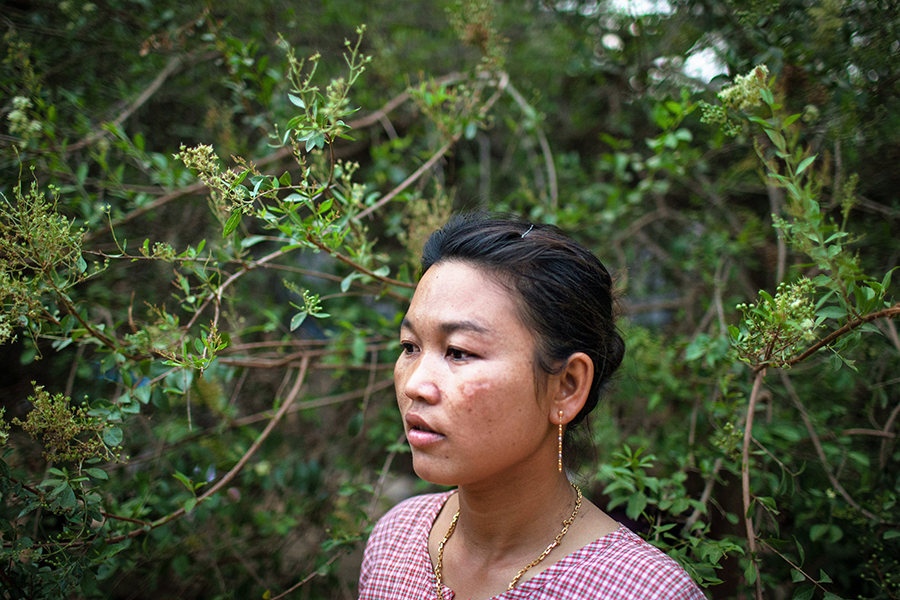 Lauren DeCicca for NRGI
In a recent visit to a town near Cusco, Peru, she found that “women’s organizations’ agendas revolve around the increase of gender violence and the negative impacts of mining on their access to water and land.”
NRGI is increasing female participation in its trainings. Ghana country program manager Nafi Chinery, a long-time activist in this space, has worked to create equal opportunities for women to benefit from NRGI training, including surpassing gender parity in the Anglophone Africa regional extractive industries knowledge hub course. In Myanmar, program associate Sebastian Sahla said the majority of participants from Myanmar in this year’s Asia-Pacific regional extractive industries knowledge hub course were women.
In the Democratic Republic of Congo, NRGI is planning research on the gendered impact of mining in Katanga and how these impacts can be better addressed in the legal reform of the mining regulation act.
Compared to other countries in the region, Tunisia has stayed relatively stable through its democratic transition and is reducing gender gaps in many areas. Nonetheless, some of the largest development gaps are found in resource-rich areas. This is the subject of a new NRGI project on local impact in the phosphate-rich Gafsa region, which has brought a gender lens into both project design and impact assessment.
“Although Tunisian women’s impact in the sector is still limited, women journalists are now covering issues related to governance,” Tunisia program officer Wiem Melki said. “Women parliamentarians are calling for transparency during hearings, women in civil society are part of EITI and women in government are working in diverse initiatives such as the Open Government Partnership, anticorruption and also the Ministry of Energy.”
Data is also a big part of NRGI’s work and a field where the lack of diversity and persistent gender gaps are well known: women and girls are less likely to get into data science or software development.
“The persistent difference in skill has implications for who accesses the data and analysis,” NRGI data scientist Hari Subhash said. “This is generally something with which the data space struggles and has considerable implications in terms of the questions we decide to ask using data and the way we present our analysis.”
NRGI’s Nigeria country program is working to counter this dynamic by increasing female participation in its Media for Oil Reform fellowship and seeking other ways to integrate gender into its media work.
At the global level, a NRGI gender thematic group supports the work of our colleagues and captures lessons learned to be shared. Members of the group are working to disseminate new research on a wide range of impacts of the extractive industries, based on literature and case studies from around the world, to help the movement to understand the mechanisms through which the industry impacts women’s welfare, opportunities and choices.
On this International Women’s Day, we are inspired by our global colleagues, who through diverse, context-specific projects are working to improve the participation of women in resource governance.
Claudia Viale is a Latin America officer with the Natural Resource Governance Institute (NRGI). Katarina Kuai is a senior program officer with NRGI's capacity development team.
Natural Resources Can Fuel Conflicts, But Also Bring Peace: A Conversation with AFRIM’s Starjoan Villanueva
Starjoan Villanueva is the director of the Philippine civil society organization Alternative Forum for Research in Mindanao. AFRIM focuses on natural resource management, sustainable rural development and peacebuilding.
In addition to the leadership role with AFRIM, Starjoan is the Mindanao civil society representative on the board of the Philippine Extractive Industries Transparency Initiative. The Mindanao region is a major metals producer in the Philippines, with copper, gold, nickel and cobalt deposits.
Mindanao has witnessed violent conflicts and is experiencing a very fragile peace process because of the historical injustice various groups, especially the Bangsamoro, suffered for generations, Starjoan said in an interview on the sidelines of Advancing Accountable Resource Governance in Asia Pacific, an annual course that brings together experts from across the region to discuss pressing oil, gas and mining issues.
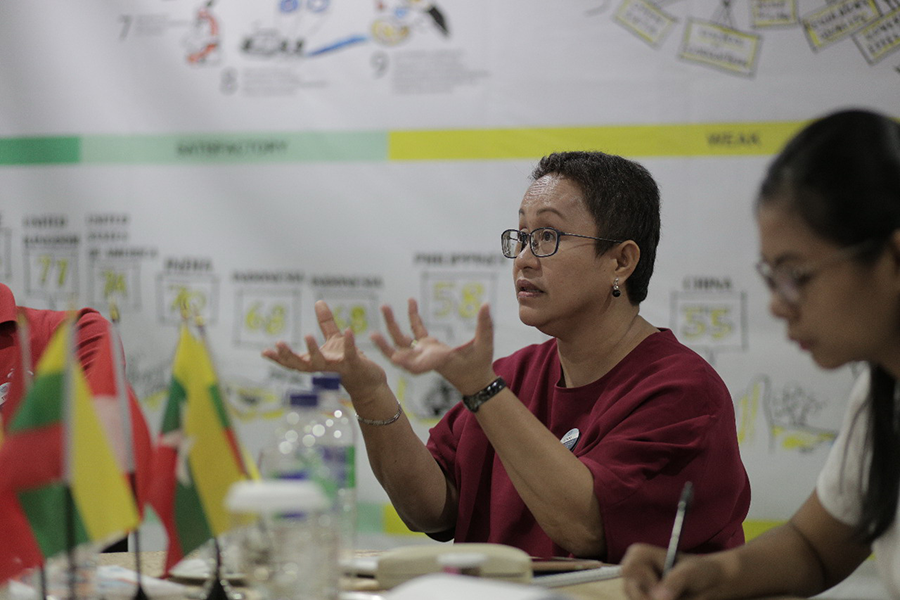 Starjoan Villanueva speaks at the regional hub in Belitung, Indonesia. Photo courtesy of RegINA
The conflicts have been shaped by the armed engagement between the Philippine government and separatist Bangsamoro movements led by the Moro National Liberation Front (MNLF), whose force has long splintered, and also the Moro Islamic Liberation Front (MILF) perspective, which has a strong presence and recently entered into a framework agreement for the creation of a Bangsamoro autonomous region. (The law has yet to be ratified.)
Central to such conflict is unresolved governance issues with Mindanao’s natural resources, Starjoan said. But she also argued they might serve as a source of peace.
Max Brett: How did you get involved in resource governance issues?
Starjoan Villanueva: I used to manage the coastal resource management program at Legal Rights Center, a nongovernmental organization in the Philippines providing legal services to indigenous peoples, human rights issues and land rights.
We were trying to build the capacity of local fishermen along with their local governments to manage mangrove rehabilitation and education. In the process, we also tried to come up with alternative livelihoods for them.
What are the biggest obstacles you see for resource governance in Mindanao?
Mindanao has major issues in natural resource governance—specifically mining. Most of the investments are significantly affecting ancestral domain areas. And [Mindanao has] the most of indigenous people’s groups in the Philippines.
Describe some of the nuances of the natural resources debate in Mindanao.
AFRIM is being more sensitive as a nongovernmental organization that helps communities vulnerable to mining operations. At some point, we realized that amid numerous environmental and social concerns, there are community members who are not against mining.
One can strongly argue that the government is falling short in its obligation to provide access to basic social services. Mindanao’s share from the government revenue is not enough to address all the needs of the people. This is especially the case in resource-rich areas where AFRIM works, where the poverty incidence is very high. That highlights the need that for this industry to be relevant, it must contribute to local economic development and poverty alleviation.
What’s your take on the Philippine Extractive Industries Transparency Initiative?
It’s the first platform in our country where I get to see, face to face, the powerful actors behind the industry. A lot of demonizing, pointing fingers at these companies happens when you don’t see them—especially at the local level. Local communities [typically] are airing their grievances not to the companies but to civil society organizations and local governments.
What are the major struggles and successes of EITI in the Philippines?
Well, we saw it survive from one administration to the next. [The Philippines joined in 2013 and its membership was validated in 2017.] But we feel that we need more teeth. So we are pushing for an EITI bill, so it no longer exists simply by executive order. So that it cannot be hijacked by any biases from one government to the next. So that it will not be voluntary. So that all mining companies will be forced to participate. Because right now it’s only voluntary.
All companies operating in the Philippines should be transparent, should make disclosures at subnational levels—not only at the national level—and should be accountable. Contract disclosure is part of that. I spent almost two decades on advocacy work and had not seen contracts between companies and communities. But this is the first time, through the EITI process, that this information has been disclosed.
More stringent laws and stricter regulations that would demand more transparency and accountability on the part of the companies is the way to go. It’s really full of challenges. As civil society organizations, our challenge is convincing environmentally inclined groups to support EITI. What we’re trying to say is, “Look at the data being disclosed and use it in your advocacy.”
This interview has been edited for content, clarity and length.
Max Brett is a communications officer with the Natural Resource Governance Institute (NRGI).
Five Lessons from a Free, Online Resource Governance Course
As a “data person” jumping into a project on opening up and communicating extractives industry data, I initially felt like a fish out of water. I was suddenly overwhelmed by a lot of jargon and complicated concepts that I had either never heard of, or only had a cursory knowledge of.
Luckily, there was a handy way for me to get a great overview of all the interrelated and complex concepts related to the extractives sector: a free massive online open course (MOOC) called Natural Resources for Sustainable Development: The Fundamentals of Oil, Gas, and Mining Governance. It’s being offered again this year, beginning 5 February, at no charge.
I anticipated the course would be very technical and challenging. It turned out to be quite understandable, even for someone like me, with very little background knowledge of extractives. Rock stars in the development field like Jeffrey Sachs and Paul Collier led online lectures on a wide range of interrelated topics. Below are five of my takeaways from the MOOC.
1. The resource curse
The main reason why extractives sector management is so important is because of the “resource curse.” While it is not universally true, resource-rich countries do tend to be poor. Usually, this is not just a coincidence—ironically, the lack of economic development is directly caused by the fact that they have a lot of natural resource wealth.
Why does this happen? Governments don’t have to be accountable to citizens if they can get funded by extracting natural resources. By contrast, in a country with no resources, you need your citizens to pay taxes, and in turn citizens want accountability. In resource-rich countries, there is also little incentive for the government to develop and invest in the non-extractives sectors of the economy, or in human capital. Extractive industries also tend to concentrate wealth into the hands of owners and producers of the resources; these often tend to be powerful elites, who form cozy relationships with the government, which encourages corruption and weak legal systems. Concentrated resources also invite conflict for control over them, both in the form of civil wars and international disputes.
2. Lifecycle of an extractives project
Before the MOOC, I had the naïve view that a mine or an oil and gas field is an automatic way to make money: once the project starts, money just starts flowing into your coffers. This is definitely not how extractives projects work.
Only 1 in 1,000 mineral projects that start out at the exploration stage actually come to fruition. For both mining and oil and gas, there is a long lifecycle involved in developing a project.
3. Fiscal Regimes
Extractives companies usually have a whole set of different rules for taxation than normal companies. The specific way in which extractive industries are taxed is called the fiscal regime.
Extractive industries produce what economists call “rents,” which are profits that do not relate directly to how competitive or productive the industry is. Ideally, these rents should be used to benefit the country as whole. This is why different types of taxation are required to capture these rents.
The best fiscal regimes try to find a balance between capturing rents from the companies without being so onerous as to discourage them from operating. They also have to try their best to prevent companies from finding loopholes and exploiting government corruption.
4. Environmental challenges
Extractive industries can be hugely damaging to the environment.
I learned that while large environmental disasters still occur in both sectors, the oil and gas industry in particular has become relatively more responsive to environmental concerns. For example, in the wake of oil spills from tankers in the 1980s, civil society put pressure on companies and governments stepped up regulation, leading to a redesign of the way hulls are built so that spills are a lot less likely to occur. Similar coordinated efforts from civil society, governments and industry will also be necessary to see this kind of change impact the mining industry.
5. Social challenges and artisanal mining
The first time I heard of the term “artisanal miners,” I pictured bearded hipsters sipping lattes while working in vintage mines that you’ve probably never heard of. But that’s not artisanal mining. Artisanal mining means mining that is not done with industrial equipment, but with basic tools like picks and shovels, and usually using human labor.
Ninety percent of the world’s mining workforce are artisanal miners, but they produce only 10 percent of the outputs of the global mining sector. Industrial mining produces the lion’s share with a small fraction of the workforce. This said, there’s variation across different mined materials. Artisanal miners produce about 80 percent of the world's color gemstones, up to a quarter of all gold in the world, about a quarter of all cobalt and tin, and about 15 percent of all diamonds.
Artisanal mining is hard work, and is usually done by individuals or families who are not organized into companies or collectives. They get into the profession for various reasons, often due to low barriers to entry and lack of other opportunities. Artisanal miners also tend to be very mobile, and thousands might migrate to a mining site within a few weeks. This leads to many social and environmental problems, including an impact on local communities.
Communities located near mining sites can suffer adverse consequences when either industrial mining operations or migrant artisanal miners move in. Local communities who have ties to their ancestral land and depend on it for their livelihoods can face a great deal of disruption. Human rights abuses and public health problems also adversely affect communities; women can suffer disproportionately.
So, if you are new to the extractives sector and want an accessible and enjoyable way to to dig into the weeds to explore the complex interplay of economic, political, social and environmental issues related to the sector, I highly recommend signing up for the MOOC.
Yan Naung Oak is a 2017 School of Data fellow for NRGI Myanmar working on data literacy and data availability in the jade mining sector. This post reflects his experiences and opinions, and does not represent the views or work of the Natural Resource Governance Institute.
A 2017 Year-End Message from NRGI President and CEO Daniel Kaufmann
Dear friends and colleagues,
It has been a turbulent year for extractives governance, bringing both setbacks and achievements.
We have seen the White House and U.S. Congress abandon their leadership on extractives transparency under undue influence from several major oil companies that continue to cling to opacity. Just yesterday, the U.S. House Financial Services Committee voted to proceed with a bill to repeal the Dodd-Frank Act’s Section 1504, a 2010 anticorruption provision that requires oil, gas and mining companies to disclose the payments they make to governments for the right to extract natural resources.
Members of Congress should not consider this bill any further. Instead, the U.S. Securities and Exchange Commission (charged with adopting new rules to implement Section 1504) should take inspiration from regulations in Europe and Canada. These laws have already prompted the disclosure of billions in payments from companies to governments, helping to deter corruption and improve resource governance.
Outside the U.S., a few resource-rich, developing countries also chose to step away from global transparency initiatives. In these and other countries, civic space is increasingly under threat, and numerous corruption scandals have erupted.
That said, there also is much cause for optimism. Today, we have access to more information than ever about the payments companies make to governments for subsoil resources. NRGI and its partners are navigating this “data deluge” and learning much in the process.
NRGI’s flagship 2017 Resource Governance Index (RGI) report revealed some key imperatives for our field. It showed that many countries are adopting appropriate regulations and laws to better govern resource extraction. However, a wide “implementation gap” remains, and becomes even more pronounced where corruption is rife. (We have been ramping up NRGI’s analytical and operational work on corruption, as exemplified by our guidance on corruption red flags.) More broadly, the RGI underscores how critical protecting civic space is for improving governance in extractives (as suggested by the chart below), and also shows that state-owned enterprises and sovereign wealth funds require urgent reform. These are key priorities for us now and for 2018.

Our work in resource-rich countries is at the core of what we do, and a number of countries made bold moves toward resource accountability this year. Mexico signed on to the Extractive Industries Transparency Initiative (EITI), and the country’s National Hydrocarbons Commission has become a champion of institutional transparency in extractives. The parliament of the Democratic Republic of Congo is now considering a much-improved mining code, on which we provided technical assistance.
Countries where we work are also making progress on meeting contract and beneficial ownership disclosure commitments; we see this in the Kyrgyz Republic, Mongolia, Nigeria and Ukraine. NRGI continues to support the establishment of national extractive industry contract portals in Guinea and the DRC—as we had in the past in the Philippines, Sierra Leone and Tunisia—and we have supported the media’s role in improving resource governance in a number of African countries. In Tunisia, an NRGI report detailed steps for disclosure of oil, gas and mining contracts, and the government has since made over 150 contractual documents public.
We have also addressed the changing role of civil society in responding to the extractives space in Latin America; Tanzania’s natural resources legislation and its offshore gas sector; and the mining divestment rule in Indonesia, among many other timely topics.
We have ambitious plans for next year, and will take the power of data to the next level. We are poised to launch a national oil company database and accompanying analysis. We will use the RGI and NRGI-led platforms like ResourceContracts.org and ResourceProjects.org to forge new research, data and analysis. Our aim is to go well beyond accessibility, to make available data understandable, useable and actionable, thereby empowering agents of change.
We will continue to innovate, growing our work on gender and sustainability, and incorporating the environmental and social impacts of extraction into our rigorous financial models, further contributing to evidence-based decision making in extractives. We will continue to speak truth to power, raising our voice to protect civic space, protect the gains made in transparency and accountability, and fight corruption. We will work toward further advancing the implementation of EITI, utilizing the initiative’s civil society safeguards when called for.
Challenges to progress on governance—whether with respect to global norms or within countries—are part of the present-day reality that afflicts billions of people living in poverty around the world. These challenges deepen our passionate belief in our mission and push us to create innovative opportunities in our work with our partners.
We thank you for your collaboration in 2017 and look forward to forging ahead in the coming months. We wish you a restful year-end and a brilliant start to 2018.
Very best regards,
Daniel Kaufmann
President and CEO
Natural Resource Governance Institute
Uncovering the Impacts of Phosphate Mining on Tunisian Women

Phosphate mining has long served as an important component of Tunisia’s economy—phosphate rock is used domestically to produce fertilizer and is also a valuable export. But some regions that are richest in phosphate reserves are also some of the most marginalized. Citizens in these regions’ say the government doesn’t provide them with the political voice and economic opportunities they seek, and that the state-owned Gafsa Phosphate Company (CPG) uses opaque recruitment processes that does not offer locals a clear path to working for the industry’s biggest employer.
In 2008, citizens in the phosphate-producing region of Gafsa organized protests against this marginalization and suffered a government crackdown. Called the “Mining Basin uprising,” the unrest seriously disrupted phosphate production, and nearly a decade later unrest continues to sporadically erupt over many of the issues that caused the initial protests—low employment, weak regional development, inadequate mitigation of the negative environmental impact of phosphate production, and the inequitable distribution of phosphate revenues. The cost of the unrest is considerable, with phosphate production falling from 8 million tons in 2010 to 3.1 million tons in 2017. Government officials blame protestors for the decrease in CPG’s activity. However, the root problems that caused the discontent remain unaddressed in a systematic manner. Gafsa still lacks basic public services and infrastructure, and the unemployment rate remains the second highest in the country, at 28.2 percent against a national rate of 15.6 percent in 2016.
While natural resource-related discontent in Gafsa remains largely unaddressed by policy-makers and underreported by the media—leading to a lack of awareness amongst the Tunisian public and international donors—even more underreported are the disproportionate negative effects that phosphate production has on women. To begin understanding these gendered effects, the Natural Resource Governance Institute (NRGI) held a consultative meeting with female activists in Gafsa on 28 December. The key findings from the consultation revolve around three themes: employment, health, and pollution and infrastructure.
Employment
While the lack of employment opportunities is a major issue for all populations in Gafsa, it disproportionately affects women. The region’s unemployment rate amongst female university graduates is 54 percent while it is 27 percent amongst male graduates. This disparity holds when it comes to the ratio of women to men employed at CPG and affiliated institutions. Additionally, most of the women employed by the company are cleaners—this despite the region’s high percentage of female university graduates. (Forty-seven percent of all Gafsa women hold a university degree.)
Health
Phosphate production has negative health effects on Gafsa’s population as a whole, according to activists, who say that women disproportionately suffer: They experience a high rate of miscarriages, as well as neonatal problems that go untreated due to a lack of services in the area. Activist Nawwara Bedhief, president of Sanad, states that “seven percent of children in the Mining Basin region of Mdhilla are born with birth defects due to women’s exposure to uranium present in phosphate deposits.” Consultation participants also cited negative psychological effects from phosphate production. For example, water and air pollution caused by the production causes damage to women’s skin, teeth and hair (leading to decreased self-esteem and confidence).
Pollution and infrastructure
Phosphate production leads to a high level of dust and air pollution. Dusting and cleaning is the responsibility of women in Gafsa’s households, and the chore is made especially arduous by the added phosphate dust and grime; women are forced to spend time, effort and money cleaning that could be used on leisure, education and other pursuits. Cleaning is made even more difficult by water shortages, which is a direct result of phosphate production. Activist and human rights advocate Mannena Zitouni said that water is “scarce, undrinkable, and of very poor quality.”
Promoting evidence-based, local responses to gender impacts
The main takeaways from NRGI’s meeting with female stakeholders revolved around two themes for further action.
Empowering local civil society to play a more concerted and coordinated role in demanding inclusion in decision-making
Local civil society actors must consolidate their efforts so that they can present a unified set of demands for inclusion in decision-making processes related to phosphate’s negative impacts. Local civil society organizations stand to benefit from their inclusion in the NRGI-supported Tunisian Coalition for Transparency in Energy and Mines (CTTEM), or from opening a direct line of communication with its regional coordinator (either of which could help elevate their demands and recommendations to the national level).
Supporting evidence-based advocacy through the commissioning of studies on phosphate’s environmental and societal impacts in the region
Civil society actors’ effectiveness in influencing decision-making is only possible if they can rely on informed, evidence-based accounts of impacts. Though anecdotal evidence abounds, there is a serious dearth of rigorous studies that definitively link phosphate mining to the various problems that are affecting citizens in Gafsa. NRGI is helping to address this by supporting its local partner and CTTEM regional coordinator—Association Bassin Minier pour l’Investissement et le Développement (ABMID)—to undertake a study on the environmental impacts of phosphate production. The study will gather and present data on the various environmental and health effects of phosphate extraction and has the potential to spark an informed debate on the government’s and other actors’ roles in mitigating phosphate-related damage and providing compensation. Many more studies of this kind need to be commissioned.