
Mining and Energy Reforms: Strategic Priorities for Ghana Under President Mahama's Government

As President John Mahama begins his second term as Ghana’s leader under the Fourth Republic, the context of his leadership is markedly different from his first tenure between 2013 and 2017. During that period, discussions around the energy transition and renewable energy were still emerging. Today, the urgency of transitioning to cleaner energy sources has become a global priority, with profound implications for resource-rich countries like Ghana. President Mahama returns to office at a critical time for the extractive sector, which is rapidly evolving.
The past few years have been turbulent for Ghana’s upstream petroleum activities. The Minister of Energy terminated four petroleum contracts in 2021 for failing to meet minimum work obligations. Additionally, several oil blocks have been relinquished since 2019 and Ghana’s oil production has declined since 2020. In contrast, the mining sector has shown promising growth. Gold production reached 4 million ounces in 2023, an impressive 8.3 percent increase from the previous year. Bauxite and diamond production have also surged, increasing by 24.1 percent and 146.5 percent respectively, between 2022 and 2023, reflecting the sector's potential to contribute meaningfully to Ghana’s economy.
Addressing the mining sector’s changing dynamics will require strategic planning and active engagement from all stakeholders. In his new term, President Mahama must implement the following recommendations to revitalize the extractive sector for the benefit of all Ghanaians.
Prioritize transition minerals governance
The global energy transition is creating a burgeoning demand for transition minerals. Ghana is richly endowed with transition minerals such as lithium, bauxite and graphite. However, outdated legislative and regulatory frameworks are hindering the country’s ability to capitalize on this opportunity.
The Minerals Commission must expedite the ongoing review of the 2014 Mining Policy and the Minerals and Mining Act. These revisions will pave the way for the resubmission of the lithium and bauxite contracts—previously under consideration in the recently dissolved Parliament—for parliamentary ratification. The revisions are also critical to establishing a more progressive fiscal regime that emphasizes community consultations and adherence to rigorous environmental and social standards for the transition minerals.
Consolidate energy transition targets and leverage domestic financing
Ghana’s Energy Transition Framework, launched at COP27 and subsequently an Energy Transition Investment Plan during the UN General Assembly, aims to meet its net zero commitments by 2060 instead of the initial 2070 target. Realizing this vision requires approximately USD550 billion in investment, primarily from the capital market. Given Ghana’s high debt situation, the government must adopt a strategic approach to position the country as an attractive investment destination for foreign investment.
President Mahama must repurpose extractive revenues from petroleum through the annual budget prioritization, and mineral revenues through the Mineral Income Investment Fund, to stimulate domestic investment in the transition. These efforts should include downstream transition minerals beneficiation with adequate accountability provisions while consolidating the Transition Framework and the Investment Plan to create a cohesive and effective policy direction.
Enhance good governance and transparency
Corruption continues to undermine the realization of benefits from the extractive sector through opaque contracting, ineffective cost monitoring and tax evasion, and revenue leakages. Tackling corruption in the extractives sector requires decisive action. The government must strengthen anti-corruption institutions, appoint non-politically exposed persons to sensitive State-Owned Enterprises in the extractive sector, and enforce accountability measures. Revisiting competitive licensing and procurement in the petroleum sector is essential. Additionally, taking steps to introduce competition and transparent contracting practices in the mining sector will foster greater public trust and maximize the sector's potential.
Reevaluate gas ambitions with a focus on long-term sustainability
Ghana’s reliance on natural gas as the main fuel for power has grown substantially since 2020. The government expects to spend USD1.22 billion on natural gas in 2025, a sharp rise from USD455.8 million in 2019. The Energy Transition Framework also identifies natural gas as a transition fuel. However, several challenges have limited the country's ability to maximize value from the sector, including huge energy sector indebtedness, inadequate gas processing capacity and high financing costs, particularly for infrastructure.
Barely 48 hours after the President took office, a gas supply crisis looms. Imminent maintenance on the West Africa Gas Pipeline and Jubilee facilities will create supply deficits of up to 50 million standard cubic feet per day by March 2025. Planned shutdowns of the ENI gas facilities in September and November 2025 will further deepen the crisis, with gas shortages potentially reaching 102 MMscfd.
Public discourse has centered on addressing the short-term power crisis, often overlooking the sector’s long-term sustainability. There is a need for comprehensive reforms to address systemic inefficiencies to ensure sustainability. The President Mahama-led government should review the gas masterplan to align gas ambitions with realistic goals and improve transparency of gas contracts. They must consider the risks of locking Ghana into a gas-for-electricity system with associated challenges, especially as renewable energy costs are decreasing. The government must guard against unbridled LNG contracts, which could worsen cashflow issues and increase electricity prices.
Improve institutional coordination in the energy sector
There is an urgent need for institutional strengthening and realignment within the petroleum and power sector to improve efficiency and coordination, reduce bureaucracy and conflict, and preserve the public purse. The objectives of these reforms should be clearly defined in consultation with various stakeholders, including worker unions, civil society and citizens.
As the new government takes charge, the extractive sector must be central to Ghana’s development strategy. With decisive leadership and strategic foresight, Ghana can maximize its resource wealth, ensuring it catalyzes economic prosperity and resilience for generations to come.
Notes
-
1
With a gold price of USD 1,600 per ounce.
-
2
With a low-profit mine and a gold price of $1,600 per ounce.
-
3
Cecilia Jamasmie, “Petra Diamonds’ stake in Williamson to shrink as part of deal with Tanzania,” Mining.com, 13 December 2021, www.mining.com/petra-diamonds-stake-in-williamson-to-shrink-as-part-of-deal-with-tanzania.
-
4
Lifezone Metals, “Kabanga Nickel Signs Framework Agreement,” 19 January 2021, www.lifezonemetals.com/kabanga-nickel-signs-framework-agreement.
-
5
Thomas Scurfield and Silas Olan’g, “Magufuli Seeks the Right Balance for Tanzania’s Mining Fiscal Regime,” NRGI, 31 January 2019, www.resourcegovernance.org/blog/magufuli-seeks-right-balance-tanzania-mining-fiscal; Thomas Scurfield, “Tanzania Strikes a Better Balance with its Mining Fiscal Regime,” NRGI, 24 June 2020, www.resourcegovernance.org/blog/tanzania-strikes-better-balance-mining-fiscal-regime.
-
6
This framework agreement was published in a document setting out Barrick’s offer to buy the shares it did not already own in Acacia Mining, the previous owner of the Bulyanhulu, Buzwagi and North Mara mines in Tanzania. See Acacia Mining and Barrick Gold, Recommended Final Offer for Acacia Mining Plc by Barrick Gold Corporation, 2019, 66–79, s25.q4cdn.com/322814910/files/doc_downloads/acacia/Acacia-2.7-announcement.pdf.
-
7
The main revenue streams are import duty, skills development levy, royalty, corporate income tax, a share of dividends and shareholder loan repayments through state equity, and dividend withholding tax.
-
8
The earlier in time a shilling (Tanzania’s official currency unit) is received, the more it is worth. This is, first, because it can be used earlier; and second, because the future is uncertain, and no one can be sure they will receive that shilling in the future. To account for this time value of money, a “discount rate” is applied. In the sharing arrangement, this would mean that if the government received a shilling in year 1, the company would need to receive more than a shilling in year 2 for the benefits to be comparable. However, given cumulation here is based on actual cash flow, the company would need to receive only a shilling in year 2 for the benefits to be shared equally.
-
9
This provision for the company to earn its minimum return before sharing is triggered means Ecuador’s mechanism is similar to an R-based cash flow tax, commonly referred to as a Brown Tax. See, e.g., Robin Broadway and Michael Keen, “Theoretical perspectives on resource tax design,” in The Taxation of Petroleum and Minerals: Principles, Problems and Practice, edited by Philip Daniel, Michael Keen and Charles McPherson (Oxford: Routledge, 2010), 13–74.
-
10
Prices are taken from World Bank, “Commodities Price Data (The Pink Sheet),” www.worldbank.org/en/research/commodity-markets.
-
11
With a gold price of $1,600 per ounce.
-
12
With a gold price of $1,600 per ounce.
-
13
With a gold price of $1,600 per ounce.
-
14
The Fraser Institute survey estimates that, unless there are extremely harmful policies, around 60 percent of an investment decision tends to be based on a country’s geology. The other 40 percent comprises of several other factors, including political stability and policy predictability (given they affect the risk that investors will not be able to secure future returns generated by their investments), a conducive business environment and the tax level. See Julio Mejia and Elmira Aliakbari, Fraser Institute Annual Survey of Mining Companies 2022, (Fraser Institute, 2023), 8, www.fraserinstitute.org/studies/annual-survey-of-mining-companies-2022.
-
15
However, information gaps make it difficult for taxes to be structured to capture all excess profit. See Jean-Franҫois Wen, Progressive Taxation of Extractive Resources as Second-Best Optimal Policy (International Monetary Fund, 2018), www.imf.org/en/Publications/WP/Issues/2018/06/13/Progressive-Taxation-of-Extractive-Resources-as-Second-Best-Optimal-Policy-45923.
-
16
Recent research provides a sense of the potential revenue loss to governments from tax avoidance. The International Monetary Fund recently estimated that sub-Saharan African mining countries could be losing between $450 and $730 million in corporate income tax a year. See Sebastian Beer and Dan Devlin, Is There Money on the Table? Evidence on the Magnitude of Profit Shifting in the Extractive Industries (International Monetary Fund, 2021), www.imf.org/en/Publications/WP/Issues/2021/01/15/Is-There-Money-on-the-Table-Evidence-on-the-Magnitude-of-Profit-Shifting-in-the-Extractive-49983.
-
17
It is perhaps surprising that Tanzania’s 50-50 sharing arrangement generates an AETR greater than 50 percent (with a discount rate of 10 percent). This is despite AETR measuring government take as the share of pre-tax profits, which is larger than “economic benefits” (given economic benefits exclude interest payments). This outcome results from the 50-50 split being based on actual cash flow. The government receives revenue before the mining company through input and production taxes that do not depend on the mine making a profit. Because of these earlier revenues, the government receives a larger share on a discounted basis.
-
18
As reported in the S&P Global database. Legal risks are “expropriation, state contract alteration and contract enforcement risks.” Tax risks are “tax increase and tax inconsistency risks.” Control Risks scores these risks as still “very high” and “high” respectively (following Tanzania’s overhaul of extractives sector laws and other actions against existing mines in 2017) but reducing.
-
19
With a discount rate of 10 percent. While Ecuador’s sharing mechanism does not account for the labor profit share because none of it will go to the government from 2024 onwards, I have included it in the AETR because it is a tax on the project. The Democratic Republic of Congo regime has an excess profits tax that is triggered for a mine when the realized price is at least 25 percent higher than the price in its feasibility study. I assumed that the feasibility study has a price of $1,300 per ounce, so the excess profits tax is not triggered.
-
20
Total benefits in this case are a project’s revenues minus operating costs and replacement capital (but not minus exploration and development capital). This cash flow represents the money available to pay back the initial investment and provide a return. The government share of it is a common measure of progressivity.
-
21
Wen, Progressive Taxation of Extractive Resources as Second-Best Optimal Policy.
-
22
With a discount rate of 10 percent. The results for only some countries are shown to clearly depict each data point. The results for all the evaluated countries can be found in my model.
-
23
Scurfield, “Tanzania Strikes a Better Balance with its Mining Fiscal Regime.”
-
24
This feature is not fully reflected in Figure 5 given that “total benefits” use a slightly different definition of profits and are based on discounted cash flows.
-
25
With a gold price of $1,600 per ounce.
-
26
For example, an average 62 percent of respondents to the Fraser Institute surveys between 2017 and 2019 said the current implementation of Tanzania’s legal system would strongly discourage investment, and 73 percent said regulatory uncertainty would. See, e.g., Ashley Stedman, Jairo Yunis and Elmira Aliakbari, Fraser Institute Annual Survey of Mining Companies 2019 (Fraser Institute, 2020), www.fraserinstitute.org/studies/annual-survey-of-mining-companies-2019.
-
27
With a low-profit mine and a gold price of $1,600 per ounce.
-
28
Tax avoidance could extend the Philippines’ recovery period, and therefore delay the payment of some taxes including import duty and interest withholding tax, given the end of the recovery period depends on the reported profitability of a mine rather than an ex-ante assessment. However, the rule that the recovery period must end five years from the start of production regardless of whether pre-production expenses have been recouped limits the extent to which it can be extended.
-
29
The merits of these measures require further scrutiny. E.g., taking a share of loan repayments could result in lenders charging a higher interest rate to ensure they still recoup their loan and a minimum return. This would not only reduce taxable income but also make it harder for the government to assess whether an interest rate is reasonable, because it would not be comparable with industry benchmarks. It can also be difficult for a government to always determine whether a loan is from a related party or not. However, these considerations are outside the scope of this analysis.
-
30
Natural Resource Governance Institute (NRGI), Natural Resource Charter, 2nd edition, 2014, resourcegovernance.org/analysis-tools/publications/natural-resource-charter-2nd-ed.
-
31
Although its exclusion of several significant taxes from the government’s share of benefits means low-profit mines may still be impacted.
-
32
With a gold price of $1,600 per ounce.
-
33
Anna Fleming, Thomas Lassourd and David Manley, “Variable Royalties: an Answer to Volatile Mineral Prices?” in Handbook on the Future of Resource Taxation, African Tax Administration Forum and Intergovernmental Forum on Mining, Minerals, Metals and Sustainable Development (forthcoming), www.iisd.org/publications/brief/future-resource-taxation-roadmap.
-
34
Ensuring that interest rates used as a comparison apply to comparable assets with a similar risk profile is challenging, but rules of this nature have been successful in reducing profit shifting in other countries. See Beer and Devlin, Is There Money on the Table?.
-
35
The main taxes listed are VAT, royalty and corporate income tax. The regime also includes a share of pre-tax profits that is currently divided between the company’s workers and the government, with the portion received by the government included in its accumulated benefits. However, a recent court ruling means that all this labor profit share will go to workers from the start of 2024 and therefore none of it will be included in government benefits.
-
36
The discount rate used is specific to each mine and based on its weighted average cost of capital (WACC). I have assumed that WACC is around 7 percent in real terms. This is based on the typical discount rate for equity shareholders used by industry and government analysts of 8 percent in real terms, and the current average cost of debt for the mining sector as reported by Aswath Damodaran, Damodaran Online, www.pages.stern.nyu.edu/~adamodar.
-
37
Republic of the Philippines, Financial or Technical Assistance Agreement, mgb.gov.ph/attachments/article/79/PFC_FTAA.pdf.
-
38
For example, some terms in the original FTAA for an OceanaGold mine differed in some areas: Republic of the Philippines, Financial or Technical Assistance Agreement with Arimco Mining Corporation, 1994, www.resourcecontracts.org/contract/ocds-591adf-2792396017. I understand that the recently signed extension to this agreement has slightly different terms again.
-
39
A template of the FARI model and a user guide that explains all the concepts and workings of the model are available at International Monetary Fund, “Fiscal Analysis of Resource Industries,”www.imf.org/external/np/fad/fari.
Open Letter to His Excellency John Dramani Mahama, President-Elect of the Republic of Ghana

Joint Appeal to Advance Transparency, Combat Corruption and Strengthen Resource Management
Your Excellency,
The Coalition of Civil Society Organizations (CSOs) working on Extractives, Anti-Corruption, and Good Governance extends our heartfelt congratulations on your decisive re-election as President of the Republic of Ghana. Your victory reflects the trust the Ghanaian people have placed in your leadership and vision to reset the nation.
As you prepare to assume office, we are keenly aware of the constrained fiscal space and significant economic challenges facing our nation. Prudent economic management and fiscal discipline, combined with targeted investment in economic and social priority areas, is imperative. The coming year demands bold and decisive action to eliminate revenue leakages and ensure the judicious use of our national resources to drive sustainable and inclusive development for all Ghanaians.
Your Excellency, the Coalition stands ready to support your administration in implementing reforms that enhance transparency, accountability, and efficiency. To this end, we respectfully present the following recommendations as critical priorities for your new administration:
1. Terminate the Strategic Mobilization Limited (SML) contract
The ongoing SML contract has diverted millions of Ghana Cedis into private hands without delivering commensurate value to the nation. Terminating this agreement will seal a significant revenue leakage and restore public confidence in financial management practices.
2. Abolish the Agyapa royalties deal and review the Mineral Income Investment Fund (MIIF) Act
We urge your administration to permanently terminate the controversial Agyapa Royalties Deal, which threatens Ghana’s mineral wealth and has faced widespread public rejection. While President Akufo-Addo paused its implementation, the underlying MIIF Act requires amendments to introduce stringent transparency and accountability measures in mineral revenue investment.
3. Reform the energy sector
- Limit political interference in State-Owned Enterprises (SOEs) within the energy sector, especially GNPC and Ghana Gas, to promote leadership stability and operational efficiency.
- Address persistent challenges in the energy distribution value chain, which have eroded sector performance and profitability.
4. Combat illegal mining and strengthen environmental governance
- Repeal the Environmental Protection (Mining in Forest Reserves) Regulation 2022 (L.I. 2462).
- Enforce existing mining laws, investigate the allocation of mineral licenses in forest reserves and prosecute politically exposed persons and traditional leaders complicit in illegal mining.
- Develop a comprehensive strategy to promote sound environmental governance, protecting our forests, rivers, and ecosystems for future generations.
5. Enhance anticorruption measures across all sectors
- Improve transparency in procurement processes to prevent inflated contracts and insider dealings.
- Strengthen oversight institutions like the Office of the Special Prosecutor and the Commission on Human Rights and Administrative Justice (CHRAJ) to independently investigate and prosecute corruption cases.
- Ensure public officials declare their assets transparently and comply with Ghana’s asset declaration laws.
6. Deliver on your commitment to run a lean government.
Fulfill your commitment to running a lean, efficient government that reduces waste and directs public resources toward productive sectors.
7. Prioritize inclusive governance
- Engage civil society and citizen groups as key stakeholders in decision-making processes.
- Ensure equitable distribution of resources, addressing disparities across regions to promote inclusive development.
- Repeal the Earmarked Funds Capping and Realignment Act, 2017 (ACT 947) to free funds earmarked for specific development purposes.
8. Identify and ringfence resources of key economic and social priorities
Identify key priorities in economic and social investment early in the life of your government, and ringfence the needed resources.
Your Excellency, we believe these actions align with your First 120 Days Social Contract and will honor the trust Ghanaians have placed in you, providing a solid foundation for restoring fiscal stability, fostering inclusive governance, and achieving sustainable development.
We assure you of our unwavering commitment to collaborating with your administration to build a better Ghana for all.
We wish you success as you prepare to assume office, and we look forward to a fruitful partnership.
Signed by:
- Africa Centre for Energy Policy (ACEP)
- Natural Resource Governance Institute (NRGI)
- Ghana Anti-Corruption Coalition (GACC)
- iWatch Africa
- Revenue Mobilization Africa (RMA)
- Third World Network-Africa (TWN-Africa)
- IMANI Centre for Policy and Education
- Centre for Extractives and Development (CEDA)
- Institute of Energy Security (IES)
- Human Environment and Livelihoods Platform Foundation (HELP Foundation Africa)
Notes
-
1
With a gold price of USD 1,600 per ounce.
-
2
With a low-profit mine and a gold price of $1,600 per ounce.
-
3
Cecilia Jamasmie, “Petra Diamonds’ stake in Williamson to shrink as part of deal with Tanzania,” Mining.com, 13 December 2021, www.mining.com/petra-diamonds-stake-in-williamson-to-shrink-as-part-of-deal-with-tanzania.
-
4
Lifezone Metals, “Kabanga Nickel Signs Framework Agreement,” 19 January 2021, www.lifezonemetals.com/kabanga-nickel-signs-framework-agreement.
-
5
Thomas Scurfield and Silas Olan’g, “Magufuli Seeks the Right Balance for Tanzania’s Mining Fiscal Regime,” NRGI, 31 January 2019, www.resourcegovernance.org/blog/magufuli-seeks-right-balance-tanzania-mining-fiscal; Thomas Scurfield, “Tanzania Strikes a Better Balance with its Mining Fiscal Regime,” NRGI, 24 June 2020, www.resourcegovernance.org/blog/tanzania-strikes-better-balance-mining-fiscal-regime.
-
6
This framework agreement was published in a document setting out Barrick’s offer to buy the shares it did not already own in Acacia Mining, the previous owner of the Bulyanhulu, Buzwagi and North Mara mines in Tanzania. See Acacia Mining and Barrick Gold, Recommended Final Offer for Acacia Mining Plc by Barrick Gold Corporation, 2019, 66–79, s25.q4cdn.com/322814910/files/doc_downloads/acacia/Acacia-2.7-announcement.pdf.
-
7
The main revenue streams are import duty, skills development levy, royalty, corporate income tax, a share of dividends and shareholder loan repayments through state equity, and dividend withholding tax.
-
8
The earlier in time a shilling (Tanzania’s official currency unit) is received, the more it is worth. This is, first, because it can be used earlier; and second, because the future is uncertain, and no one can be sure they will receive that shilling in the future. To account for this time value of money, a “discount rate” is applied. In the sharing arrangement, this would mean that if the government received a shilling in year 1, the company would need to receive more than a shilling in year 2 for the benefits to be comparable. However, given cumulation here is based on actual cash flow, the company would need to receive only a shilling in year 2 for the benefits to be shared equally.
-
9
This provision for the company to earn its minimum return before sharing is triggered means Ecuador’s mechanism is similar to an R-based cash flow tax, commonly referred to as a Brown Tax. See, e.g., Robin Broadway and Michael Keen, “Theoretical perspectives on resource tax design,” in The Taxation of Petroleum and Minerals: Principles, Problems and Practice, edited by Philip Daniel, Michael Keen and Charles McPherson (Oxford: Routledge, 2010), 13–74.
-
10
Prices are taken from World Bank, “Commodities Price Data (The Pink Sheet),” www.worldbank.org/en/research/commodity-markets.
-
11
With a gold price of $1,600 per ounce.
-
12
With a gold price of $1,600 per ounce.
-
13
With a gold price of $1,600 per ounce.
-
14
The Fraser Institute survey estimates that, unless there are extremely harmful policies, around 60 percent of an investment decision tends to be based on a country’s geology. The other 40 percent comprises of several other factors, including political stability and policy predictability (given they affect the risk that investors will not be able to secure future returns generated by their investments), a conducive business environment and the tax level. See Julio Mejia and Elmira Aliakbari, Fraser Institute Annual Survey of Mining Companies 2022, (Fraser Institute, 2023), 8, www.fraserinstitute.org/studies/annual-survey-of-mining-companies-2022.
-
15
However, information gaps make it difficult for taxes to be structured to capture all excess profit. See Jean-Franҫois Wen, Progressive Taxation of Extractive Resources as Second-Best Optimal Policy (International Monetary Fund, 2018), www.imf.org/en/Publications/WP/Issues/2018/06/13/Progressive-Taxation-of-Extractive-Resources-as-Second-Best-Optimal-Policy-45923.
-
16
Recent research provides a sense of the potential revenue loss to governments from tax avoidance. The International Monetary Fund recently estimated that sub-Saharan African mining countries could be losing between $450 and $730 million in corporate income tax a year. See Sebastian Beer and Dan Devlin, Is There Money on the Table? Evidence on the Magnitude of Profit Shifting in the Extractive Industries (International Monetary Fund, 2021), www.imf.org/en/Publications/WP/Issues/2021/01/15/Is-There-Money-on-the-Table-Evidence-on-the-Magnitude-of-Profit-Shifting-in-the-Extractive-49983.
-
17
It is perhaps surprising that Tanzania’s 50-50 sharing arrangement generates an AETR greater than 50 percent (with a discount rate of 10 percent). This is despite AETR measuring government take as the share of pre-tax profits, which is larger than “economic benefits” (given economic benefits exclude interest payments). This outcome results from the 50-50 split being based on actual cash flow. The government receives revenue before the mining company through input and production taxes that do not depend on the mine making a profit. Because of these earlier revenues, the government receives a larger share on a discounted basis.
-
18
As reported in the S&P Global database. Legal risks are “expropriation, state contract alteration and contract enforcement risks.” Tax risks are “tax increase and tax inconsistency risks.” Control Risks scores these risks as still “very high” and “high” respectively (following Tanzania’s overhaul of extractives sector laws and other actions against existing mines in 2017) but reducing.
-
19
With a discount rate of 10 percent. While Ecuador’s sharing mechanism does not account for the labor profit share because none of it will go to the government from 2024 onwards, I have included it in the AETR because it is a tax on the project. The Democratic Republic of Congo regime has an excess profits tax that is triggered for a mine when the realized price is at least 25 percent higher than the price in its feasibility study. I assumed that the feasibility study has a price of $1,300 per ounce, so the excess profits tax is not triggered.
-
20
Total benefits in this case are a project’s revenues minus operating costs and replacement capital (but not minus exploration and development capital). This cash flow represents the money available to pay back the initial investment and provide a return. The government share of it is a common measure of progressivity.
-
21
Wen, Progressive Taxation of Extractive Resources as Second-Best Optimal Policy.
-
22
With a discount rate of 10 percent. The results for only some countries are shown to clearly depict each data point. The results for all the evaluated countries can be found in my model.
-
23
Scurfield, “Tanzania Strikes a Better Balance with its Mining Fiscal Regime.”
-
24
This feature is not fully reflected in Figure 5 given that “total benefits” use a slightly different definition of profits and are based on discounted cash flows.
-
25
With a gold price of $1,600 per ounce.
-
26
For example, an average 62 percent of respondents to the Fraser Institute surveys between 2017 and 2019 said the current implementation of Tanzania’s legal system would strongly discourage investment, and 73 percent said regulatory uncertainty would. See, e.g., Ashley Stedman, Jairo Yunis and Elmira Aliakbari, Fraser Institute Annual Survey of Mining Companies 2019 (Fraser Institute, 2020), www.fraserinstitute.org/studies/annual-survey-of-mining-companies-2019.
-
27
With a low-profit mine and a gold price of $1,600 per ounce.
-
28
Tax avoidance could extend the Philippines’ recovery period, and therefore delay the payment of some taxes including import duty and interest withholding tax, given the end of the recovery period depends on the reported profitability of a mine rather than an ex-ante assessment. However, the rule that the recovery period must end five years from the start of production regardless of whether pre-production expenses have been recouped limits the extent to which it can be extended.
-
29
The merits of these measures require further scrutiny. E.g., taking a share of loan repayments could result in lenders charging a higher interest rate to ensure they still recoup their loan and a minimum return. This would not only reduce taxable income but also make it harder for the government to assess whether an interest rate is reasonable, because it would not be comparable with industry benchmarks. It can also be difficult for a government to always determine whether a loan is from a related party or not. However, these considerations are outside the scope of this analysis.
-
30
Natural Resource Governance Institute (NRGI), Natural Resource Charter, 2nd edition, 2014, resourcegovernance.org/analysis-tools/publications/natural-resource-charter-2nd-ed.
-
31
Although its exclusion of several significant taxes from the government’s share of benefits means low-profit mines may still be impacted.
-
32
With a gold price of $1,600 per ounce.
-
33
Anna Fleming, Thomas Lassourd and David Manley, “Variable Royalties: an Answer to Volatile Mineral Prices?” in Handbook on the Future of Resource Taxation, African Tax Administration Forum and Intergovernmental Forum on Mining, Minerals, Metals and Sustainable Development (forthcoming), www.iisd.org/publications/brief/future-resource-taxation-roadmap.
-
34
Ensuring that interest rates used as a comparison apply to comparable assets with a similar risk profile is challenging, but rules of this nature have been successful in reducing profit shifting in other countries. See Beer and Devlin, Is There Money on the Table?.
-
35
The main taxes listed are VAT, royalty and corporate income tax. The regime also includes a share of pre-tax profits that is currently divided between the company’s workers and the government, with the portion received by the government included in its accumulated benefits. However, a recent court ruling means that all this labor profit share will go to workers from the start of 2024 and therefore none of it will be included in government benefits.
-
36
The discount rate used is specific to each mine and based on its weighted average cost of capital (WACC). I have assumed that WACC is around 7 percent in real terms. This is based on the typical discount rate for equity shareholders used by industry and government analysts of 8 percent in real terms, and the current average cost of debt for the mining sector as reported by Aswath Damodaran, Damodaran Online, www.pages.stern.nyu.edu/~adamodar.
-
37
Republic of the Philippines, Financial or Technical Assistance Agreement, mgb.gov.ph/attachments/article/79/PFC_FTAA.pdf.
-
38
For example, some terms in the original FTAA for an OceanaGold mine differed in some areas: Republic of the Philippines, Financial or Technical Assistance Agreement with Arimco Mining Corporation, 1994, www.resourcecontracts.org/contract/ocds-591adf-2792396017. I understand that the recently signed extension to this agreement has slightly different terms again.
-
39
A template of the FARI model and a user guide that explains all the concepts and workings of the model are available at International Monetary Fund, “Fiscal Analysis of Resource Industries,”www.imf.org/external/np/fad/fari.
Behind the Schemes: Anticorruption Gaps in Mining Sector Certifications

Key messages
- Decisionmakers are increasingly looking to certification schemes to provide information on the sustainability of mining operations, yet these schemes have significant room for improvement regarding how they address corruption in their standards.
- The report assesses the content of the performance standards used by the Aluminium Stewardship Initiative (ASI), the International Council on Mining and Metals (ICMM), the Initiative for Responsible Mining Assurance (IRMA), The Copper Mark, and Towards Sustainable Mining (TSM).
- Schemes address some topics, such as revenue and payments and anticorruption procedures, relatively well; this may reflect the extent to which legislation and regulations address these topics. Schemes’ standards less frequently covered other issues, such as beneficial ownership and allegations of corruption. Many schemes, and the mining companies that use them, are missing an opportunity to assess the implementation of corporate-level anticorruption policies in mine-site assessments.
- The quality of certification schemes’ governance and assurance processes is essential to their effectiveness, yet many fall short of best practice. This undermines their credibility. Key governance challenges include the unbalanced representation of different interests within schemes and the risk of conflicts of interest in the auditing process.
- Decisionmakers risk becoming overreliant on certification schemes as indicators of responsible business conduct, which may be facilitated in part by industry influence over policymaking processes. Certification schemes are not a replacement for ongoing, robust due diligence into the environmental, social, and governance impacts of mining operations, including corruption, and the design and enforcement of robust regulatory frameworks.
- In a shifting standards landscape where there are efforts to both consolidate and review existing certification schemes, and a moment where the risk of corruption is heightened by growing demand for transition minerals, governments, mining companies, and certification schemes themselves must do more to address the topic of corruption. To do so effectively, they should focus their attention on solutions that will have the most impact in addressing this issue.
Governments worldwide are paying more attention to the role of minerals in the renewable technologies needed to transition away from fossil fuels. To meet growing demand for these minerals, policy-makers are largely relying upon the mining industry, which has a notorious track record for harm. Mining companies have abused communities and workers, polluted water sources, and perpetrated or been complicit in widespread corruption. While the energy transition may present an economic opportunity for some mineral-rich countries, past mining booms have often failed to deliver on their development promise, and many citizens are justifiably questioning whether the costs of mining outweigh the benefits.
Faced with these concerns, some policy-makers and investors are setting out conditions regarding the environmental, social and governance sustainability of mining projects they are willing to support. Mining companies use voluntary standards and certification schemes, also known as third-party assurance and accreditation schemes, to demonstrate that they meet a certain level of performance regarding environmental and social protections and overall governance. Operators of certification schemes do this by assessing the performance of companies against sustainability criteria set out in a voluntary standard. These standards, often developed, led, and governed by industry actors, vary significantly and can be subject to concerns regarding the transparency, governance and rigor of their processes.
In this report we seek to address the gap surrounding anticorruption approaches to mining sector certification schemes by answering the following questions:
- How well do certification schemes in the mining sector require companies to demonstrate anticorruption good practice?
- What governance challenges are posed by the use or structure of certification schemes.
To do so, we have developed assessment criteria outlining anticorruption best practice, conducted desk-based research and engaged with representatives from certification schemes, multilateral bodies, civil society and academia. Each question will be addressed in the following sections of this report. This research builds on the existing work of the Natural Resource Governance Institute (NRGI) to strengthen both regulatory and voluntary approaches to transparency and accountability in the mining sector, including our work to ensure that information gathered through certification processes is more accessible and useful to local communities and civil society in Latin America.
Notes
-
1
With a gold price of USD 1,600 per ounce.
-
2
With a low-profit mine and a gold price of $1,600 per ounce.
-
3
Cecilia Jamasmie, “Petra Diamonds’ stake in Williamson to shrink as part of deal with Tanzania,” Mining.com, 13 December 2021, www.mining.com/petra-diamonds-stake-in-williamson-to-shrink-as-part-of-deal-with-tanzania.
-
4
Lifezone Metals, “Kabanga Nickel Signs Framework Agreement,” 19 January 2021, www.lifezonemetals.com/kabanga-nickel-signs-framework-agreement.
-
5
Thomas Scurfield and Silas Olan’g, “Magufuli Seeks the Right Balance for Tanzania’s Mining Fiscal Regime,” NRGI, 31 January 2019, www.resourcegovernance.org/blog/magufuli-seeks-right-balance-tanzania-mining-fiscal; Thomas Scurfield, “Tanzania Strikes a Better Balance with its Mining Fiscal Regime,” NRGI, 24 June 2020, www.resourcegovernance.org/blog/tanzania-strikes-better-balance-mining-fiscal-regime.
-
6
This framework agreement was published in a document setting out Barrick’s offer to buy the shares it did not already own in Acacia Mining, the previous owner of the Bulyanhulu, Buzwagi and North Mara mines in Tanzania. See Acacia Mining and Barrick Gold, Recommended Final Offer for Acacia Mining Plc by Barrick Gold Corporation, 2019, 66–79, s25.q4cdn.com/322814910/files/doc_downloads/acacia/Acacia-2.7-announcement.pdf.
-
7
The main revenue streams are import duty, skills development levy, royalty, corporate income tax, a share of dividends and shareholder loan repayments through state equity, and dividend withholding tax.
-
8
The earlier in time a shilling (Tanzania’s official currency unit) is received, the more it is worth. This is, first, because it can be used earlier; and second, because the future is uncertain, and no one can be sure they will receive that shilling in the future. To account for this time value of money, a “discount rate” is applied. In the sharing arrangement, this would mean that if the government received a shilling in year 1, the company would need to receive more than a shilling in year 2 for the benefits to be comparable. However, given cumulation here is based on actual cash flow, the company would need to receive only a shilling in year 2 for the benefits to be shared equally.
-
9
This provision for the company to earn its minimum return before sharing is triggered means Ecuador’s mechanism is similar to an R-based cash flow tax, commonly referred to as a Brown Tax. See, e.g., Robin Broadway and Michael Keen, “Theoretical perspectives on resource tax design,” in The Taxation of Petroleum and Minerals: Principles, Problems and Practice, edited by Philip Daniel, Michael Keen and Charles McPherson (Oxford: Routledge, 2010), 13–74.
-
10
Prices are taken from World Bank, “Commodities Price Data (The Pink Sheet),” www.worldbank.org/en/research/commodity-markets.
-
11
With a gold price of $1,600 per ounce.
-
12
With a gold price of $1,600 per ounce.
-
13
With a gold price of $1,600 per ounce.
-
14
The Fraser Institute survey estimates that, unless there are extremely harmful policies, around 60 percent of an investment decision tends to be based on a country’s geology. The other 40 percent comprises of several other factors, including political stability and policy predictability (given they affect the risk that investors will not be able to secure future returns generated by their investments), a conducive business environment and the tax level. See Julio Mejia and Elmira Aliakbari, Fraser Institute Annual Survey of Mining Companies 2022, (Fraser Institute, 2023), 8, www.fraserinstitute.org/studies/annual-survey-of-mining-companies-2022.
-
15
However, information gaps make it difficult for taxes to be structured to capture all excess profit. See Jean-Franҫois Wen, Progressive Taxation of Extractive Resources as Second-Best Optimal Policy (International Monetary Fund, 2018), www.imf.org/en/Publications/WP/Issues/2018/06/13/Progressive-Taxation-of-Extractive-Resources-as-Second-Best-Optimal-Policy-45923.
-
16
Recent research provides a sense of the potential revenue loss to governments from tax avoidance. The International Monetary Fund recently estimated that sub-Saharan African mining countries could be losing between $450 and $730 million in corporate income tax a year. See Sebastian Beer and Dan Devlin, Is There Money on the Table? Evidence on the Magnitude of Profit Shifting in the Extractive Industries (International Monetary Fund, 2021), www.imf.org/en/Publications/WP/Issues/2021/01/15/Is-There-Money-on-the-Table-Evidence-on-the-Magnitude-of-Profit-Shifting-in-the-Extractive-49983.
-
17
It is perhaps surprising that Tanzania’s 50-50 sharing arrangement generates an AETR greater than 50 percent (with a discount rate of 10 percent). This is despite AETR measuring government take as the share of pre-tax profits, which is larger than “economic benefits” (given economic benefits exclude interest payments). This outcome results from the 50-50 split being based on actual cash flow. The government receives revenue before the mining company through input and production taxes that do not depend on the mine making a profit. Because of these earlier revenues, the government receives a larger share on a discounted basis.
-
18
As reported in the S&P Global database. Legal risks are “expropriation, state contract alteration and contract enforcement risks.” Tax risks are “tax increase and tax inconsistency risks.” Control Risks scores these risks as still “very high” and “high” respectively (following Tanzania’s overhaul of extractives sector laws and other actions against existing mines in 2017) but reducing.
-
19
With a discount rate of 10 percent. While Ecuador’s sharing mechanism does not account for the labor profit share because none of it will go to the government from 2024 onwards, I have included it in the AETR because it is a tax on the project. The Democratic Republic of Congo regime has an excess profits tax that is triggered for a mine when the realized price is at least 25 percent higher than the price in its feasibility study. I assumed that the feasibility study has a price of $1,300 per ounce, so the excess profits tax is not triggered.
-
20
Total benefits in this case are a project’s revenues minus operating costs and replacement capital (but not minus exploration and development capital). This cash flow represents the money available to pay back the initial investment and provide a return. The government share of it is a common measure of progressivity.
-
21
Wen, Progressive Taxation of Extractive Resources as Second-Best Optimal Policy.
-
22
With a discount rate of 10 percent. The results for only some countries are shown to clearly depict each data point. The results for all the evaluated countries can be found in my model.
-
23
Scurfield, “Tanzania Strikes a Better Balance with its Mining Fiscal Regime.”
-
24
This feature is not fully reflected in Figure 5 given that “total benefits” use a slightly different definition of profits and are based on discounted cash flows.
-
25
With a gold price of $1,600 per ounce.
-
26
For example, an average 62 percent of respondents to the Fraser Institute surveys between 2017 and 2019 said the current implementation of Tanzania’s legal system would strongly discourage investment, and 73 percent said regulatory uncertainty would. See, e.g., Ashley Stedman, Jairo Yunis and Elmira Aliakbari, Fraser Institute Annual Survey of Mining Companies 2019 (Fraser Institute, 2020), www.fraserinstitute.org/studies/annual-survey-of-mining-companies-2019.
-
27
With a low-profit mine and a gold price of $1,600 per ounce.
-
28
Tax avoidance could extend the Philippines’ recovery period, and therefore delay the payment of some taxes including import duty and interest withholding tax, given the end of the recovery period depends on the reported profitability of a mine rather than an ex-ante assessment. However, the rule that the recovery period must end five years from the start of production regardless of whether pre-production expenses have been recouped limits the extent to which it can be extended.
-
29
The merits of these measures require further scrutiny. E.g., taking a share of loan repayments could result in lenders charging a higher interest rate to ensure they still recoup their loan and a minimum return. This would not only reduce taxable income but also make it harder for the government to assess whether an interest rate is reasonable, because it would not be comparable with industry benchmarks. It can also be difficult for a government to always determine whether a loan is from a related party or not. However, these considerations are outside the scope of this analysis.
-
30
Natural Resource Governance Institute (NRGI), Natural Resource Charter, 2nd edition, 2014, resourcegovernance.org/analysis-tools/publications/natural-resource-charter-2nd-ed.
-
31
Although its exclusion of several significant taxes from the government’s share of benefits means low-profit mines may still be impacted.
-
32
With a gold price of $1,600 per ounce.
-
33
Anna Fleming, Thomas Lassourd and David Manley, “Variable Royalties: an Answer to Volatile Mineral Prices?” in Handbook on the Future of Resource Taxation, African Tax Administration Forum and Intergovernmental Forum on Mining, Minerals, Metals and Sustainable Development (forthcoming), www.iisd.org/publications/brief/future-resource-taxation-roadmap.
-
34
Ensuring that interest rates used as a comparison apply to comparable assets with a similar risk profile is challenging, but rules of this nature have been successful in reducing profit shifting in other countries. See Beer and Devlin, Is There Money on the Table?.
-
35
The main taxes listed are VAT, royalty and corporate income tax. The regime also includes a share of pre-tax profits that is currently divided between the company’s workers and the government, with the portion received by the government included in its accumulated benefits. However, a recent court ruling means that all this labor profit share will go to workers from the start of 2024 and therefore none of it will be included in government benefits.
-
36
The discount rate used is specific to each mine and based on its weighted average cost of capital (WACC). I have assumed that WACC is around 7 percent in real terms. This is based on the typical discount rate for equity shareholders used by industry and government analysts of 8 percent in real terms, and the current average cost of debt for the mining sector as reported by Aswath Damodaran, Damodaran Online, www.pages.stern.nyu.edu/~adamodar.
-
37
Republic of the Philippines, Financial or Technical Assistance Agreement, mgb.gov.ph/attachments/article/79/PFC_FTAA.pdf.
-
38
For example, some terms in the original FTAA for an OceanaGold mine differed in some areas: Republic of the Philippines, Financial or Technical Assistance Agreement with Arimco Mining Corporation, 1994, www.resourcecontracts.org/contract/ocds-591adf-2792396017. I understand that the recently signed extension to this agreement has slightly different terms again.
-
39
A template of the FARI model and a user guide that explains all the concepts and workings of the model are available at International Monetary Fund, “Fiscal Analysis of Resource Industries,”www.imf.org/external/np/fad/fari.
Global Commitment to an International Agreement on Mineral Supply Chain Traceability
Cali, Colombia

The purpose of this space is to present the foundations, scope, stakeholders and proposed timeline for developing an international agreement on the traceability of mineral supply chains within the framework of the COP16 processes, with an eye toward COP30.
The need to develop global actions and commitments will be raised in order to establish traceability and transparency systems to address some of the causes of biodiversity loss and pollution related to the extraction and commercialization of these minerals.
These actions are necessary at a global level to ensure that strategic minerals for the energy transition come from responsible sources; that is, that mining activities are not carried out in critical areas of high biodiversity or sensitive ecosystems, that they do not generate pollution, and that commercialization occurs within legal frameworks, avoiding the involvement of criminal groups that threaten democracies in mineral-extracting countries.
Panelists
- Suneeta Kaimal, President and CEO, NRGI
- María Susana Muhamad González, Minister of Environment and Sustainable Development, Colombia
- Marina Silva, Minister of the Environment and Climate Change, Brazil
- Mauricio Cabrera Leal, Vice-minister of Environmental Policies and Standardization – Ministry of Environment and Sustainable Development, Colombia
- OECD (TBC)
*Translation available
Featuring NRGI's

Suneeta Kaimal
President and Chief Executive Officer, NRGI Governing Board ex officio
Notes
-
1
With a gold price of USD 1,600 per ounce.
-
2
With a low-profit mine and a gold price of $1,600 per ounce.
-
3
Cecilia Jamasmie, “Petra Diamonds’ stake in Williamson to shrink as part of deal with Tanzania,” Mining.com, 13 December 2021, www.mining.com/petra-diamonds-stake-in-williamson-to-shrink-as-part-of-deal-with-tanzania.
-
4
Lifezone Metals, “Kabanga Nickel Signs Framework Agreement,” 19 January 2021, www.lifezonemetals.com/kabanga-nickel-signs-framework-agreement.
-
5
Thomas Scurfield and Silas Olan’g, “Magufuli Seeks the Right Balance for Tanzania’s Mining Fiscal Regime,” NRGI, 31 January 2019, www.resourcegovernance.org/blog/magufuli-seeks-right-balance-tanzania-mining-fiscal; Thomas Scurfield, “Tanzania Strikes a Better Balance with its Mining Fiscal Regime,” NRGI, 24 June 2020, www.resourcegovernance.org/blog/tanzania-strikes-better-balance-mining-fiscal-regime.
-
6
This framework agreement was published in a document setting out Barrick’s offer to buy the shares it did not already own in Acacia Mining, the previous owner of the Bulyanhulu, Buzwagi and North Mara mines in Tanzania. See Acacia Mining and Barrick Gold, Recommended Final Offer for Acacia Mining Plc by Barrick Gold Corporation, 2019, 66–79, s25.q4cdn.com/322814910/files/doc_downloads/acacia/Acacia-2.7-announcement.pdf.
-
7
The main revenue streams are import duty, skills development levy, royalty, corporate income tax, a share of dividends and shareholder loan repayments through state equity, and dividend withholding tax.
-
8
The earlier in time a shilling (Tanzania’s official currency unit) is received, the more it is worth. This is, first, because it can be used earlier; and second, because the future is uncertain, and no one can be sure they will receive that shilling in the future. To account for this time value of money, a “discount rate” is applied. In the sharing arrangement, this would mean that if the government received a shilling in year 1, the company would need to receive more than a shilling in year 2 for the benefits to be comparable. However, given cumulation here is based on actual cash flow, the company would need to receive only a shilling in year 2 for the benefits to be shared equally.
-
9
This provision for the company to earn its minimum return before sharing is triggered means Ecuador’s mechanism is similar to an R-based cash flow tax, commonly referred to as a Brown Tax. See, e.g., Robin Broadway and Michael Keen, “Theoretical perspectives on resource tax design,” in The Taxation of Petroleum and Minerals: Principles, Problems and Practice, edited by Philip Daniel, Michael Keen and Charles McPherson (Oxford: Routledge, 2010), 13–74.
-
10
Prices are taken from World Bank, “Commodities Price Data (The Pink Sheet),” www.worldbank.org/en/research/commodity-markets.
-
11
With a gold price of $1,600 per ounce.
-
12
With a gold price of $1,600 per ounce.
-
13
With a gold price of $1,600 per ounce.
-
14
The Fraser Institute survey estimates that, unless there are extremely harmful policies, around 60 percent of an investment decision tends to be based on a country’s geology. The other 40 percent comprises of several other factors, including political stability and policy predictability (given they affect the risk that investors will not be able to secure future returns generated by their investments), a conducive business environment and the tax level. See Julio Mejia and Elmira Aliakbari, Fraser Institute Annual Survey of Mining Companies 2022, (Fraser Institute, 2023), 8, www.fraserinstitute.org/studies/annual-survey-of-mining-companies-2022.
-
15
However, information gaps make it difficult for taxes to be structured to capture all excess profit. See Jean-Franҫois Wen, Progressive Taxation of Extractive Resources as Second-Best Optimal Policy (International Monetary Fund, 2018), www.imf.org/en/Publications/WP/Issues/2018/06/13/Progressive-Taxation-of-Extractive-Resources-as-Second-Best-Optimal-Policy-45923.
-
16
Recent research provides a sense of the potential revenue loss to governments from tax avoidance. The International Monetary Fund recently estimated that sub-Saharan African mining countries could be losing between $450 and $730 million in corporate income tax a year. See Sebastian Beer and Dan Devlin, Is There Money on the Table? Evidence on the Magnitude of Profit Shifting in the Extractive Industries (International Monetary Fund, 2021), www.imf.org/en/Publications/WP/Issues/2021/01/15/Is-There-Money-on-the-Table-Evidence-on-the-Magnitude-of-Profit-Shifting-in-the-Extractive-49983.
-
17
It is perhaps surprising that Tanzania’s 50-50 sharing arrangement generates an AETR greater than 50 percent (with a discount rate of 10 percent). This is despite AETR measuring government take as the share of pre-tax profits, which is larger than “economic benefits” (given economic benefits exclude interest payments). This outcome results from the 50-50 split being based on actual cash flow. The government receives revenue before the mining company through input and production taxes that do not depend on the mine making a profit. Because of these earlier revenues, the government receives a larger share on a discounted basis.
-
18
As reported in the S&P Global database. Legal risks are “expropriation, state contract alteration and contract enforcement risks.” Tax risks are “tax increase and tax inconsistency risks.” Control Risks scores these risks as still “very high” and “high” respectively (following Tanzania’s overhaul of extractives sector laws and other actions against existing mines in 2017) but reducing.
-
19
With a discount rate of 10 percent. While Ecuador’s sharing mechanism does not account for the labor profit share because none of it will go to the government from 2024 onwards, I have included it in the AETR because it is a tax on the project. The Democratic Republic of Congo regime has an excess profits tax that is triggered for a mine when the realized price is at least 25 percent higher than the price in its feasibility study. I assumed that the feasibility study has a price of $1,300 per ounce, so the excess profits tax is not triggered.
-
20
Total benefits in this case are a project’s revenues minus operating costs and replacement capital (but not minus exploration and development capital). This cash flow represents the money available to pay back the initial investment and provide a return. The government share of it is a common measure of progressivity.
-
21
Wen, Progressive Taxation of Extractive Resources as Second-Best Optimal Policy.
-
22
With a discount rate of 10 percent. The results for only some countries are shown to clearly depict each data point. The results for all the evaluated countries can be found in my model.
-
23
Scurfield, “Tanzania Strikes a Better Balance with its Mining Fiscal Regime.”
-
24
This feature is not fully reflected in Figure 5 given that “total benefits” use a slightly different definition of profits and are based on discounted cash flows.
-
25
With a gold price of $1,600 per ounce.
-
26
For example, an average 62 percent of respondents to the Fraser Institute surveys between 2017 and 2019 said the current implementation of Tanzania’s legal system would strongly discourage investment, and 73 percent said regulatory uncertainty would. See, e.g., Ashley Stedman, Jairo Yunis and Elmira Aliakbari, Fraser Institute Annual Survey of Mining Companies 2019 (Fraser Institute, 2020), www.fraserinstitute.org/studies/annual-survey-of-mining-companies-2019.
-
27
With a low-profit mine and a gold price of $1,600 per ounce.
-
28
Tax avoidance could extend the Philippines’ recovery period, and therefore delay the payment of some taxes including import duty and interest withholding tax, given the end of the recovery period depends on the reported profitability of a mine rather than an ex-ante assessment. However, the rule that the recovery period must end five years from the start of production regardless of whether pre-production expenses have been recouped limits the extent to which it can be extended.
-
29
The merits of these measures require further scrutiny. E.g., taking a share of loan repayments could result in lenders charging a higher interest rate to ensure they still recoup their loan and a minimum return. This would not only reduce taxable income but also make it harder for the government to assess whether an interest rate is reasonable, because it would not be comparable with industry benchmarks. It can also be difficult for a government to always determine whether a loan is from a related party or not. However, these considerations are outside the scope of this analysis.
-
30
Natural Resource Governance Institute (NRGI), Natural Resource Charter, 2nd edition, 2014, resourcegovernance.org/analysis-tools/publications/natural-resource-charter-2nd-ed.
-
31
Although its exclusion of several significant taxes from the government’s share of benefits means low-profit mines may still be impacted.
-
32
With a gold price of $1,600 per ounce.
-
33
Anna Fleming, Thomas Lassourd and David Manley, “Variable Royalties: an Answer to Volatile Mineral Prices?” in Handbook on the Future of Resource Taxation, African Tax Administration Forum and Intergovernmental Forum on Mining, Minerals, Metals and Sustainable Development (forthcoming), www.iisd.org/publications/brief/future-resource-taxation-roadmap.
-
34
Ensuring that interest rates used as a comparison apply to comparable assets with a similar risk profile is challenging, but rules of this nature have been successful in reducing profit shifting in other countries. See Beer and Devlin, Is There Money on the Table?.
-
35
The main taxes listed are VAT, royalty and corporate income tax. The regime also includes a share of pre-tax profits that is currently divided between the company’s workers and the government, with the portion received by the government included in its accumulated benefits. However, a recent court ruling means that all this labor profit share will go to workers from the start of 2024 and therefore none of it will be included in government benefits.
-
36
The discount rate used is specific to each mine and based on its weighted average cost of capital (WACC). I have assumed that WACC is around 7 percent in real terms. This is based on the typical discount rate for equity shareholders used by industry and government analysts of 8 percent in real terms, and the current average cost of debt for the mining sector as reported by Aswath Damodaran, Damodaran Online, www.pages.stern.nyu.edu/~adamodar.
-
37
Republic of the Philippines, Financial or Technical Assistance Agreement, mgb.gov.ph/attachments/article/79/PFC_FTAA.pdf.
-
38
For example, some terms in the original FTAA for an OceanaGold mine differed in some areas: Republic of the Philippines, Financial or Technical Assistance Agreement with Arimco Mining Corporation, 1994, www.resourcecontracts.org/contract/ocds-591adf-2792396017. I understand that the recently signed extension to this agreement has slightly different terms again.
-
39
A template of the FARI model and a user guide that explains all the concepts and workings of the model are available at International Monetary Fund, “Fiscal Analysis of Resource Industries,”www.imf.org/external/np/fad/fari.
Revealed: The Billions Big Oil Didn't Want You to See

For the first time, U.S.-listed mining, oil and gas companies are required to publicly disclose the payments they make to governments in the countries where they operate. After over a decade of legal and regulatory battles following the passage of Section 1504 of the Dodd-Frank Act, these payments will now be publicly available. These disclosures mark a turning point in the global push for corporate accountability and transparency.
Oxfam America, The One Campaign, EarthRights International, the Natural Resource Governance Institute and the FACT Coalition convened an online event to explore the far-reaching implications of this historic victory.
Panelists discussed how these disclosures provide a crucial tool for civil society to hold governments accountable, fighting the so-called "resource curse" that affects nations rich in natural resources.
Key topics
- Unveiling the numbers: Learn how U.S. oil, gas and mining giants—and their smaller U.S.-listed peers—are making payments to governments, what kind of data is being disclosed and how these figures will empower civil society in mineral-rich countries.
- The fight for transparency: Understand the legal battle between Oxfam America, the American Petroleum Institute, and the U.S. Securities and Exchange Commission (SEC), and the multi-decade advocacy by Publish What You Pay activists and allies to bring these disclosures to light.
- Global case studies: Discover how similar extractive industries' payments-to-government transparency laws in other countries and voluntary disclosures have been used to challenge corruption and demand accountability.
- What’s next: Gain insights on how this information could reshape governance in resource-rich countries and the fight for economic justice.
Participants gained access to first-hand insights from advocacy experts and case studies from across the globe.
Featuring
- Sen. Ben Cardin, Senior Senator, Maryland, U.S.
- Tawanda Mutasah, Vice-President, Global Partnerships and Impact, Oxfam America
- Alex Gillies, Director, Global Anti-Corruption Consortium
- Tutu Allicante, Magnitsky Award winner and founder of EG Justice
- Simon Taylor, Co-Founder, Global Witness
- Zorka Milin, Policy Director, FACT Coalition
The disclosure of payments by U.S. oil and mining companies provides new transparency into their operations in resource-rich countries.
Notes
-
1
With a gold price of USD 1,600 per ounce.
-
2
With a low-profit mine and a gold price of $1,600 per ounce.
-
3
Cecilia Jamasmie, “Petra Diamonds’ stake in Williamson to shrink as part of deal with Tanzania,” Mining.com, 13 December 2021, www.mining.com/petra-diamonds-stake-in-williamson-to-shrink-as-part-of-deal-with-tanzania.
-
4
Lifezone Metals, “Kabanga Nickel Signs Framework Agreement,” 19 January 2021, www.lifezonemetals.com/kabanga-nickel-signs-framework-agreement.
-
5
Thomas Scurfield and Silas Olan’g, “Magufuli Seeks the Right Balance for Tanzania’s Mining Fiscal Regime,” NRGI, 31 January 2019, www.resourcegovernance.org/blog/magufuli-seeks-right-balance-tanzania-mining-fiscal; Thomas Scurfield, “Tanzania Strikes a Better Balance with its Mining Fiscal Regime,” NRGI, 24 June 2020, www.resourcegovernance.org/blog/tanzania-strikes-better-balance-mining-fiscal-regime.
-
6
This framework agreement was published in a document setting out Barrick’s offer to buy the shares it did not already own in Acacia Mining, the previous owner of the Bulyanhulu, Buzwagi and North Mara mines in Tanzania. See Acacia Mining and Barrick Gold, Recommended Final Offer for Acacia Mining Plc by Barrick Gold Corporation, 2019, 66–79, s25.q4cdn.com/322814910/files/doc_downloads/acacia/Acacia-2.7-announcement.pdf.
-
7
The main revenue streams are import duty, skills development levy, royalty, corporate income tax, a share of dividends and shareholder loan repayments through state equity, and dividend withholding tax.
-
8
The earlier in time a shilling (Tanzania’s official currency unit) is received, the more it is worth. This is, first, because it can be used earlier; and second, because the future is uncertain, and no one can be sure they will receive that shilling in the future. To account for this time value of money, a “discount rate” is applied. In the sharing arrangement, this would mean that if the government received a shilling in year 1, the company would need to receive more than a shilling in year 2 for the benefits to be comparable. However, given cumulation here is based on actual cash flow, the company would need to receive only a shilling in year 2 for the benefits to be shared equally.
-
9
This provision for the company to earn its minimum return before sharing is triggered means Ecuador’s mechanism is similar to an R-based cash flow tax, commonly referred to as a Brown Tax. See, e.g., Robin Broadway and Michael Keen, “Theoretical perspectives on resource tax design,” in The Taxation of Petroleum and Minerals: Principles, Problems and Practice, edited by Philip Daniel, Michael Keen and Charles McPherson (Oxford: Routledge, 2010), 13–74.
-
10
Prices are taken from World Bank, “Commodities Price Data (The Pink Sheet),” www.worldbank.org/en/research/commodity-markets.
-
11
With a gold price of $1,600 per ounce.
-
12
With a gold price of $1,600 per ounce.
-
13
With a gold price of $1,600 per ounce.
-
14
The Fraser Institute survey estimates that, unless there are extremely harmful policies, around 60 percent of an investment decision tends to be based on a country’s geology. The other 40 percent comprises of several other factors, including political stability and policy predictability (given they affect the risk that investors will not be able to secure future returns generated by their investments), a conducive business environment and the tax level. See Julio Mejia and Elmira Aliakbari, Fraser Institute Annual Survey of Mining Companies 2022, (Fraser Institute, 2023), 8, www.fraserinstitute.org/studies/annual-survey-of-mining-companies-2022.
-
15
However, information gaps make it difficult for taxes to be structured to capture all excess profit. See Jean-Franҫois Wen, Progressive Taxation of Extractive Resources as Second-Best Optimal Policy (International Monetary Fund, 2018), www.imf.org/en/Publications/WP/Issues/2018/06/13/Progressive-Taxation-of-Extractive-Resources-as-Second-Best-Optimal-Policy-45923.
-
16
Recent research provides a sense of the potential revenue loss to governments from tax avoidance. The International Monetary Fund recently estimated that sub-Saharan African mining countries could be losing between $450 and $730 million in corporate income tax a year. See Sebastian Beer and Dan Devlin, Is There Money on the Table? Evidence on the Magnitude of Profit Shifting in the Extractive Industries (International Monetary Fund, 2021), www.imf.org/en/Publications/WP/Issues/2021/01/15/Is-There-Money-on-the-Table-Evidence-on-the-Magnitude-of-Profit-Shifting-in-the-Extractive-49983.
-
17
It is perhaps surprising that Tanzania’s 50-50 sharing arrangement generates an AETR greater than 50 percent (with a discount rate of 10 percent). This is despite AETR measuring government take as the share of pre-tax profits, which is larger than “economic benefits” (given economic benefits exclude interest payments). This outcome results from the 50-50 split being based on actual cash flow. The government receives revenue before the mining company through input and production taxes that do not depend on the mine making a profit. Because of these earlier revenues, the government receives a larger share on a discounted basis.
-
18
As reported in the S&P Global database. Legal risks are “expropriation, state contract alteration and contract enforcement risks.” Tax risks are “tax increase and tax inconsistency risks.” Control Risks scores these risks as still “very high” and “high” respectively (following Tanzania’s overhaul of extractives sector laws and other actions against existing mines in 2017) but reducing.
-
19
With a discount rate of 10 percent. While Ecuador’s sharing mechanism does not account for the labor profit share because none of it will go to the government from 2024 onwards, I have included it in the AETR because it is a tax on the project. The Democratic Republic of Congo regime has an excess profits tax that is triggered for a mine when the realized price is at least 25 percent higher than the price in its feasibility study. I assumed that the feasibility study has a price of $1,300 per ounce, so the excess profits tax is not triggered.
-
20
Total benefits in this case are a project’s revenues minus operating costs and replacement capital (but not minus exploration and development capital). This cash flow represents the money available to pay back the initial investment and provide a return. The government share of it is a common measure of progressivity.
-
21
Wen, Progressive Taxation of Extractive Resources as Second-Best Optimal Policy.
-
22
With a discount rate of 10 percent. The results for only some countries are shown to clearly depict each data point. The results for all the evaluated countries can be found in my model.
-
23
Scurfield, “Tanzania Strikes a Better Balance with its Mining Fiscal Regime.”
-
24
This feature is not fully reflected in Figure 5 given that “total benefits” use a slightly different definition of profits and are based on discounted cash flows.
-
25
With a gold price of $1,600 per ounce.
-
26
For example, an average 62 percent of respondents to the Fraser Institute surveys between 2017 and 2019 said the current implementation of Tanzania’s legal system would strongly discourage investment, and 73 percent said regulatory uncertainty would. See, e.g., Ashley Stedman, Jairo Yunis and Elmira Aliakbari, Fraser Institute Annual Survey of Mining Companies 2019 (Fraser Institute, 2020), www.fraserinstitute.org/studies/annual-survey-of-mining-companies-2019.
-
27
With a low-profit mine and a gold price of $1,600 per ounce.
-
28
Tax avoidance could extend the Philippines’ recovery period, and therefore delay the payment of some taxes including import duty and interest withholding tax, given the end of the recovery period depends on the reported profitability of a mine rather than an ex-ante assessment. However, the rule that the recovery period must end five years from the start of production regardless of whether pre-production expenses have been recouped limits the extent to which it can be extended.
-
29
The merits of these measures require further scrutiny. E.g., taking a share of loan repayments could result in lenders charging a higher interest rate to ensure they still recoup their loan and a minimum return. This would not only reduce taxable income but also make it harder for the government to assess whether an interest rate is reasonable, because it would not be comparable with industry benchmarks. It can also be difficult for a government to always determine whether a loan is from a related party or not. However, these considerations are outside the scope of this analysis.
-
30
Natural Resource Governance Institute (NRGI), Natural Resource Charter, 2nd edition, 2014, resourcegovernance.org/analysis-tools/publications/natural-resource-charter-2nd-ed.
-
31
Although its exclusion of several significant taxes from the government’s share of benefits means low-profit mines may still be impacted.
-
32
With a gold price of $1,600 per ounce.
-
33
Anna Fleming, Thomas Lassourd and David Manley, “Variable Royalties: an Answer to Volatile Mineral Prices?” in Handbook on the Future of Resource Taxation, African Tax Administration Forum and Intergovernmental Forum on Mining, Minerals, Metals and Sustainable Development (forthcoming), www.iisd.org/publications/brief/future-resource-taxation-roadmap.
-
34
Ensuring that interest rates used as a comparison apply to comparable assets with a similar risk profile is challenging, but rules of this nature have been successful in reducing profit shifting in other countries. See Beer and Devlin, Is There Money on the Table?.
-
35
The main taxes listed are VAT, royalty and corporate income tax. The regime also includes a share of pre-tax profits that is currently divided between the company’s workers and the government, with the portion received by the government included in its accumulated benefits. However, a recent court ruling means that all this labor profit share will go to workers from the start of 2024 and therefore none of it will be included in government benefits.
-
36
The discount rate used is specific to each mine and based on its weighted average cost of capital (WACC). I have assumed that WACC is around 7 percent in real terms. This is based on the typical discount rate for equity shareholders used by industry and government analysts of 8 percent in real terms, and the current average cost of debt for the mining sector as reported by Aswath Damodaran, Damodaran Online, www.pages.stern.nyu.edu/~adamodar.
-
37
Republic of the Philippines, Financial or Technical Assistance Agreement, mgb.gov.ph/attachments/article/79/PFC_FTAA.pdf.
-
38
For example, some terms in the original FTAA for an OceanaGold mine differed in some areas: Republic of the Philippines, Financial or Technical Assistance Agreement with Arimco Mining Corporation, 1994, www.resourcecontracts.org/contract/ocds-591adf-2792396017. I understand that the recently signed extension to this agreement has slightly different terms again.
-
39
A template of the FARI model and a user guide that explains all the concepts and workings of the model are available at International Monetary Fund, “Fiscal Analysis of Resource Industries,”www.imf.org/external/np/fad/fari.
The DRC-Zambia Battery Plant: Key Considerations for Governments in 2024

- The partnership between the Democratic Republic of the Congo and Zambia to develop battery precursors is central to Africa’s ambitions to add more value to its minerals. However, public information about the project is limited.
- Based on available information, the location of the precursor plant remains a source of disagreement. Regional bodies have a key role in developing mechanisms to ensure an equitable share of benefits irrespective of which country hosts the plant.
- The Congolese and Zambian governments should consider the challenges in attempting to source the required minerals from the two countries alone, and explore wider regional coordination to meet the need for nickel and manganese.
- The role of other global actors, such as the U.S., EU and China, remains unclear, but how the DRC and Zambia navigate the geopolitical complexities will be critical for the project’s success.
- Greater transparency and stakeholder consultation will help the governments make the difficult decisions necessary for the project to go ahead and increase the likelihood of it benefiting the Congolese and Zambian peoples.
African countries are gearing up to play a pivotal role in the production of clean energy technologies for the global energy transition, and not just as suppliers of raw minerals. They seek to maximize their role in regional and global value chains by adding value to the resources extracted from their soil.
One key initiative is the partnership between the Democratic Republic of the Congo (DRC) and Zambia to produce nickel, manganese and cobalt (NMC) battery precursors. A precursor is an intermediate input to a complete battery, which the two countries aim to ultimately also produce. However, without a large regional market for the electric vehicles that use these batteries, production of complete batteries will be challenging. For now, the focus is on producing and exporting precursors that foreign battery manufacturers will use.
Planning for the precursor plant got properly underway in 2023, though details have been scarce. The status of a long-awaited pre-feasibility study is uncertain. There are conflicting statements about whether it has been completed and if it will be made public. The two countries have not disclosed their cooperation agreement or subsequent framework agreement. Various memoranda of understanding (MOUs) between these two countries and the United States and European Union are in the public domain, but further details remain behind closed doors, at least until roadmaps (action plans referenced in the EU MOUs) are developed next year. Little is known about other agreements that could impact the mineral sector and therefore the project—such as those between the DRC and Japan; Zambia and Japan; and Zambia and the United Kingdom. China’s dominance of cobalt production in the DRC and Zambia, including through state-owned companies, means it could have a significant influence on the precursor plant, but its role is uncertain.
Congolese and Zambian civil society actors are concerned about the lack of information and limited stakeholder consultation. In November 2023 they established the Pamoja Critical Minerals Forum to monitor and engage the governments on these plans and ensure that the plans reflect community voices.
Based on available information, we see four issues around the precursor initiative that the two governments should consider in 2024:
- Precursor plant location
- Mineral sourcing
- Role of international deals
- Transparency and multistakeholder engagement
Precursor plant location
Stakeholders suggest that this remains a point of disagreement between the DRC and Zambia. The governments initially agreed to construct the precursor plant in a cross-border special economic zone, but it seems that this shared site may be ultimately deemed unviable. The plant will therefore likely sit in one country or the other, and both countries aim to be the host. They have provisionally respectively earmarked the special economic zones of Kinsevere in DRC and Sub-Sahara Gemstone Exchange Industrial Park in Zambia.
Starting the project will be challenging regardless of its location. The independent prefeasibility study will likely recommend a location for the plant to maximize its economic viability and minimize environmental and social harms. To bolster the project’s prospects, the governments should accept the study’s recommendation in the absence of any major concerns. While it will not be easy for either country to agree to having the plant in the other, they can explore mechanisms to ensure an equitable share of benefits with the help of the regional bodies already active in the project such as the African Union’s African Minerals Development Centre, the African Development Bank, the UN Economic Commission for Africa and Afreximbank. For example, the country that does not host the plant could get a share of government revenues that the plant generates and have certain opportunities reserved for its workers, goods and services. This is a critical test for regional coordination: the proof of concept that the African Green Minerals Strategy calls for to catalyze other and wider coordination efforts.
Mineral sourcing
Stakeholders suggest that the governments aim to source all the required nickel, manganese and cobalt only from the two countries. The capacity of the plant and specific precursor design (including the ratio of nickel, manganese and cobalt) that the governments target will partly determine the feasibility of this approach. These parameters will be clearer after completion of the prefeasibility study. The plant that was initially envisaged would be large by global standards, producing around 100,000 tonnes (t) of NMC (622) precursors (one of the most common types currently demanded) a year. This would require around 48,000 t of nickel, 15,000 t of manganese and 16,000 t of cobalt that has been refined into sulfate.
The DRC and Zambia will find it challenging to source a sufficient amount of ores of the three metals and refine them into sulfates without involving other countries in the region. Neither the DRC nor Zambia currently refines any cobalt production into sulfate, but prospects are promising. Plans for a cobalt sulfate plant are advancing in Zambia, and World Bank analysis suggests a plant could also be viable in the DRC.
Production of nickel and manganese sulfate is less certain, however. Zambia produced around 4,000 t of nickel in 2022. First Quantum’s large nickel mine, Enterprise, started production in Zambia this year, which will add a massive 30,000 t a year on average. Nevertheless, this volume may still be insufficient for Zambia to meet the precursor plant’s needs on its own even if refining facilities were constructed and all production was supplied to the plant. Nickel exploration in the DRC is underway. Given only 19 percent of the country has been properly explored, this exploration may yield discoveries. However, with nickel mines taking an average 17.5 years from discovery to production, supplying the precursor plant is a far-off prospect.
Time is also a factor for manganese. Manganese is mined in the DRC and Zambia, currently by artisanal and small-scale operators. Formalizing these operations, including to reassure potential buyers of the precursors that the supply chain meets high ESG standards, and going on to build refining capabilities will be challenging.
The two countries could potentially meet these challenges over time, but there is no time to waste. The rapid evolution of battery technologies and global scramble for minerals mean that the longer this project takes to come to fruition, the harder it will be to attract investors and secure minerals for the precursor plant from the DRC, Zambia or elsewhere that haven’t already been tied up in long-term offtake agreements. The two governments should therefore utilize the African Continental Free Trade Agreement and start engaging other African countries on potential supply. Gabon and Madagascar have been cited as potential suppliers of battery grade manganese and nickel, respectively. Other countries, such as Tanzania, Zimbabwe and South Africa, are also possibilities. However some of these countries, such as South Africa, may actually harbor their own battery ambitions: further highlighting the importance of regional coordination to determine an approach from which all countries benefit.
Role of international deals
There is little information in the public domain on the specific support that the U.S. and EU intend to provide to the DRC and Zambia’s precursor ambitions. G7 support for the Lobito Corridor railway appears to have the most momentum currently. This project could increase investment prospects for value addition in DRC and Zambia by improving the route to market, but the railway could also be used to export unprocessed minerals. The implications for the precursor plant are therefore currently unclear.
It remains to be seen whether U.S. and EU will “put their money where their mouth is” in terms of specific support to the plant, and what the DRC and Zambia commit to in exchange. While the precursor plant could become a focal project of the U.S.-led Mineral Security Partnership or an EU strategic project under the bloc’s Critical Raw Materials Act, none of the parties have given such an indication.
Private investment and financing for the project will also depend on whether the U.S. enables buyers of mineral products processed in the DRC or Zambia to benefit from incentives offered by U.S. legislation. Only minerals processed in the U.S. or a country with which it has a free trade agreement qualify for the Inflation Reduction Act’s electric vehicle tax credits, for example. As the Carnegie Endowment’s Zainab Usman has highlighted, adjustments to the African Growth and Opportunity Act or other legislative instruments are needed for the DRC and Zambia (and other African countries) to qualify. Eligibility for U.S. incentives would increase the likely demand for DRC-Zambian precursors, and as a result, the attractiveness of the project to investors.
In the meantime, Chinese authorities and companies are not standing still amid all the talk and action from G7 countries. How the DRC and Zambia leverage this geopolitical competition while navigating the resulting complexities will be critical. It remains to be seen how these various actors will manage Chinese dominance of cobalt production when establishing supply for the precursor plant. Morocco’s experience may generate lessons as it seeks to utilize Chinese investment in battery manufacturing and its U.S. free trade agreement to export batteries to the U.S. and Europe.
Agreements between the likes of the U.S. and EU and other African mining countries could also impact the prospects of the precursor plant. For example, the U.S. is supporting the construction of nickel refining facilities in Tanzania but the deal stipulates that the battery-grade nickel will be exported to the U.S. Gabon, currently an exporter of manganese ore, could need similar support to start refining. While Gabon would benefit from the commencement of refined nickel exports irrespective of their destination, a deal that prevents exports to other parts of Africa could inadvertently stymie regional integration and the more transformative impacts that it would bring. Significant coordination is therefore required between both African governments and other governments.
International deals that could affect the DRC-Zambia precursor plans
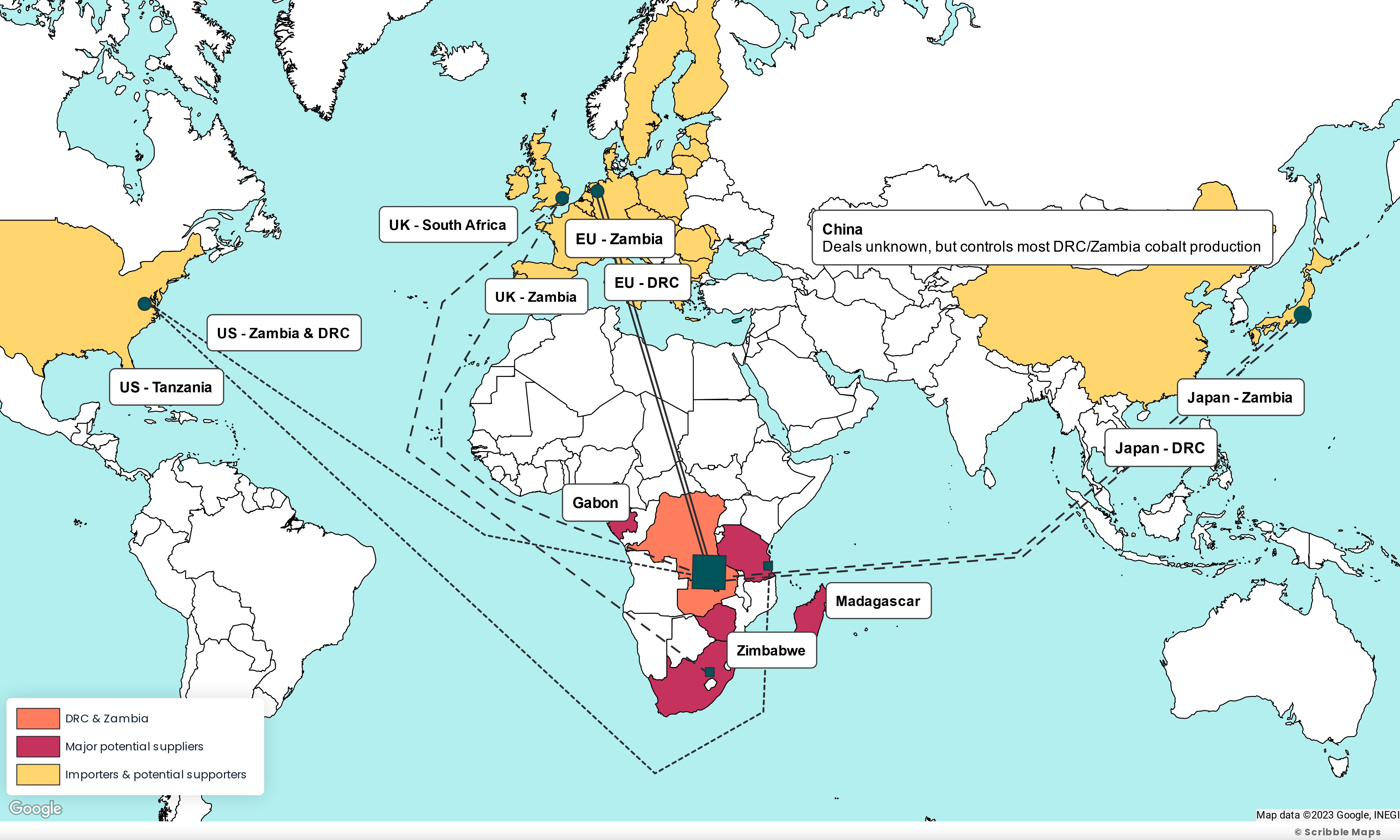
Transparency and multistakeholder engagement
The Pamoja joint statement calls for greater transparency around plans and deals related to the precursor project and transition minerals more generally. Initially, this applies to disclosure of the prefeasibility study once completed and any inter-state deals not yet in the public domain. Going forward, the Congolese and Zambian governments should disclose subsequent agreements such as the EU roadmaps as well as any between the governments and investors in mining and value addition projects. The governments should also increase consultation with other stakeholders, including civil society actors.
The stakes are high for the DRC and Zambia with these projects. More transparency will help catch mistakes and ensure that the projects generate the intended benefits for the Congolese and Zambian peoples. Greater public awareness of the various opportunities and trade-offs should provide the governments with space to make difficult decisions—for example, the location of the precursor plant and sourcing of minerals. Building more public consensus and trust will also support the credibility of long-term planning and stability of the regulatory framework, and therefore increase the ability of the DRC and Zambia to attract investment.
People in the DRC and Zambia could benefit greatly from precursor production in their countries, particularly if the associated energy and transport infrastructure is leveraged for wider use. However, government efforts in other policy areas will be at least as important. For example, as Zambia aims to significantly increase copper production, the government should ensure it manages the upstream effectively. Other value addition opportunities, such as scaling up copper manufacturing in DRC, also hold at least as much, if not more, promise. Given that the complexities of the precursor project risk absorbing large amounts of the governments’ time, money and political capital, officials must weigh the opportunity costs carefully.
Notes
-
1
With a gold price of USD 1,600 per ounce.
-
2
With a low-profit mine and a gold price of $1,600 per ounce.
-
3
Cecilia Jamasmie, “Petra Diamonds’ stake in Williamson to shrink as part of deal with Tanzania,” Mining.com, 13 December 2021, www.mining.com/petra-diamonds-stake-in-williamson-to-shrink-as-part-of-deal-with-tanzania.
-
4
Lifezone Metals, “Kabanga Nickel Signs Framework Agreement,” 19 January 2021, www.lifezonemetals.com/kabanga-nickel-signs-framework-agreement.
-
5
Thomas Scurfield and Silas Olan’g, “Magufuli Seeks the Right Balance for Tanzania’s Mining Fiscal Regime,” NRGI, 31 January 2019, www.resourcegovernance.org/blog/magufuli-seeks-right-balance-tanzania-mining-fiscal; Thomas Scurfield, “Tanzania Strikes a Better Balance with its Mining Fiscal Regime,” NRGI, 24 June 2020, www.resourcegovernance.org/blog/tanzania-strikes-better-balance-mining-fiscal-regime.
-
6
This framework agreement was published in a document setting out Barrick’s offer to buy the shares it did not already own in Acacia Mining, the previous owner of the Bulyanhulu, Buzwagi and North Mara mines in Tanzania. See Acacia Mining and Barrick Gold, Recommended Final Offer for Acacia Mining Plc by Barrick Gold Corporation, 2019, 66–79, s25.q4cdn.com/322814910/files/doc_downloads/acacia/Acacia-2.7-announcement.pdf.
-
7
The main revenue streams are import duty, skills development levy, royalty, corporate income tax, a share of dividends and shareholder loan repayments through state equity, and dividend withholding tax.
-
8
The earlier in time a shilling (Tanzania’s official currency unit) is received, the more it is worth. This is, first, because it can be used earlier; and second, because the future is uncertain, and no one can be sure they will receive that shilling in the future. To account for this time value of money, a “discount rate” is applied. In the sharing arrangement, this would mean that if the government received a shilling in year 1, the company would need to receive more than a shilling in year 2 for the benefits to be comparable. However, given cumulation here is based on actual cash flow, the company would need to receive only a shilling in year 2 for the benefits to be shared equally.
-
9
This provision for the company to earn its minimum return before sharing is triggered means Ecuador’s mechanism is similar to an R-based cash flow tax, commonly referred to as a Brown Tax. See, e.g., Robin Broadway and Michael Keen, “Theoretical perspectives on resource tax design,” in The Taxation of Petroleum and Minerals: Principles, Problems and Practice, edited by Philip Daniel, Michael Keen and Charles McPherson (Oxford: Routledge, 2010), 13–74.
-
10
Prices are taken from World Bank, “Commodities Price Data (The Pink Sheet),” www.worldbank.org/en/research/commodity-markets.
-
11
With a gold price of $1,600 per ounce.
-
12
With a gold price of $1,600 per ounce.
-
13
With a gold price of $1,600 per ounce.
-
14
The Fraser Institute survey estimates that, unless there are extremely harmful policies, around 60 percent of an investment decision tends to be based on a country’s geology. The other 40 percent comprises of several other factors, including political stability and policy predictability (given they affect the risk that investors will not be able to secure future returns generated by their investments), a conducive business environment and the tax level. See Julio Mejia and Elmira Aliakbari, Fraser Institute Annual Survey of Mining Companies 2022, (Fraser Institute, 2023), 8, www.fraserinstitute.org/studies/annual-survey-of-mining-companies-2022.
-
15
However, information gaps make it difficult for taxes to be structured to capture all excess profit. See Jean-Franҫois Wen, Progressive Taxation of Extractive Resources as Second-Best Optimal Policy (International Monetary Fund, 2018), www.imf.org/en/Publications/WP/Issues/2018/06/13/Progressive-Taxation-of-Extractive-Resources-as-Second-Best-Optimal-Policy-45923.
-
16
Recent research provides a sense of the potential revenue loss to governments from tax avoidance. The International Monetary Fund recently estimated that sub-Saharan African mining countries could be losing between $450 and $730 million in corporate income tax a year. See Sebastian Beer and Dan Devlin, Is There Money on the Table? Evidence on the Magnitude of Profit Shifting in the Extractive Industries (International Monetary Fund, 2021), www.imf.org/en/Publications/WP/Issues/2021/01/15/Is-There-Money-on-the-Table-Evidence-on-the-Magnitude-of-Profit-Shifting-in-the-Extractive-49983.
-
17
It is perhaps surprising that Tanzania’s 50-50 sharing arrangement generates an AETR greater than 50 percent (with a discount rate of 10 percent). This is despite AETR measuring government take as the share of pre-tax profits, which is larger than “economic benefits” (given economic benefits exclude interest payments). This outcome results from the 50-50 split being based on actual cash flow. The government receives revenue before the mining company through input and production taxes that do not depend on the mine making a profit. Because of these earlier revenues, the government receives a larger share on a discounted basis.
-
18
As reported in the S&P Global database. Legal risks are “expropriation, state contract alteration and contract enforcement risks.” Tax risks are “tax increase and tax inconsistency risks.” Control Risks scores these risks as still “very high” and “high” respectively (following Tanzania’s overhaul of extractives sector laws and other actions against existing mines in 2017) but reducing.
-
19
With a discount rate of 10 percent. While Ecuador’s sharing mechanism does not account for the labor profit share because none of it will go to the government from 2024 onwards, I have included it in the AETR because it is a tax on the project. The Democratic Republic of Congo regime has an excess profits tax that is triggered for a mine when the realized price is at least 25 percent higher than the price in its feasibility study. I assumed that the feasibility study has a price of $1,300 per ounce, so the excess profits tax is not triggered.
-
20
Total benefits in this case are a project’s revenues minus operating costs and replacement capital (but not minus exploration and development capital). This cash flow represents the money available to pay back the initial investment and provide a return. The government share of it is a common measure of progressivity.
-
21
Wen, Progressive Taxation of Extractive Resources as Second-Best Optimal Policy.
-
22
With a discount rate of 10 percent. The results for only some countries are shown to clearly depict each data point. The results for all the evaluated countries can be found in my model.
-
23
Scurfield, “Tanzania Strikes a Better Balance with its Mining Fiscal Regime.”
-
24
This feature is not fully reflected in Figure 5 given that “total benefits” use a slightly different definition of profits and are based on discounted cash flows.
-
25
With a gold price of $1,600 per ounce.
-
26
For example, an average 62 percent of respondents to the Fraser Institute surveys between 2017 and 2019 said the current implementation of Tanzania’s legal system would strongly discourage investment, and 73 percent said regulatory uncertainty would. See, e.g., Ashley Stedman, Jairo Yunis and Elmira Aliakbari, Fraser Institute Annual Survey of Mining Companies 2019 (Fraser Institute, 2020), www.fraserinstitute.org/studies/annual-survey-of-mining-companies-2019.
-
27
With a low-profit mine and a gold price of $1,600 per ounce.
-
28
Tax avoidance could extend the Philippines’ recovery period, and therefore delay the payment of some taxes including import duty and interest withholding tax, given the end of the recovery period depends on the reported profitability of a mine rather than an ex-ante assessment. However, the rule that the recovery period must end five years from the start of production regardless of whether pre-production expenses have been recouped limits the extent to which it can be extended.
-
29
The merits of these measures require further scrutiny. E.g., taking a share of loan repayments could result in lenders charging a higher interest rate to ensure they still recoup their loan and a minimum return. This would not only reduce taxable income but also make it harder for the government to assess whether an interest rate is reasonable, because it would not be comparable with industry benchmarks. It can also be difficult for a government to always determine whether a loan is from a related party or not. However, these considerations are outside the scope of this analysis.
-
30
Natural Resource Governance Institute (NRGI), Natural Resource Charter, 2nd edition, 2014, resourcegovernance.org/analysis-tools/publications/natural-resource-charter-2nd-ed.
-
31
Although its exclusion of several significant taxes from the government’s share of benefits means low-profit mines may still be impacted.
-
32
With a gold price of $1,600 per ounce.
-
33
Anna Fleming, Thomas Lassourd and David Manley, “Variable Royalties: an Answer to Volatile Mineral Prices?” in Handbook on the Future of Resource Taxation, African Tax Administration Forum and Intergovernmental Forum on Mining, Minerals, Metals and Sustainable Development (forthcoming), www.iisd.org/publications/brief/future-resource-taxation-roadmap.
-
34
Ensuring that interest rates used as a comparison apply to comparable assets with a similar risk profile is challenging, but rules of this nature have been successful in reducing profit shifting in other countries. See Beer and Devlin, Is There Money on the Table?.
-
35
The main taxes listed are VAT, royalty and corporate income tax. The regime also includes a share of pre-tax profits that is currently divided between the company’s workers and the government, with the portion received by the government included in its accumulated benefits. However, a recent court ruling means that all this labor profit share will go to workers from the start of 2024 and therefore none of it will be included in government benefits.
-
36
The discount rate used is specific to each mine and based on its weighted average cost of capital (WACC). I have assumed that WACC is around 7 percent in real terms. This is based on the typical discount rate for equity shareholders used by industry and government analysts of 8 percent in real terms, and the current average cost of debt for the mining sector as reported by Aswath Damodaran, Damodaran Online, www.pages.stern.nyu.edu/~adamodar.
-
37
Republic of the Philippines, Financial or Technical Assistance Agreement, mgb.gov.ph/attachments/article/79/PFC_FTAA.pdf.
-
38
For example, some terms in the original FTAA for an OceanaGold mine differed in some areas: Republic of the Philippines, Financial or Technical Assistance Agreement with Arimco Mining Corporation, 1994, www.resourcecontracts.org/contract/ocds-591adf-2792396017. I understand that the recently signed extension to this agreement has slightly different terms again.
-
39
A template of the FARI model and a user guide that explains all the concepts and workings of the model are available at International Monetary Fund, “Fiscal Analysis of Resource Industries,”www.imf.org/external/np/fad/fari.
Critical Minerals and Corruption (CoSP10 Special Event)

The green energy boom is increasing the demand for critical minerals. Large investments and limited availability exacerbate the financial crime risks. How do we safeguard a just energy transition and what can we learn from tackling illegal gold mining?
This discussion explored tools to address corruption as part of the special event Action Now: Combating Corruption to Protect the Environment. The event was held both in-person and online, part of the Conference of the States Parties (CoSP).
NRGI's Susannah Fitzgerald and Mohamed Cisse joined to share NRGI's work.

Susannah Fitzgerald
Critical Minerals Governance Senior Officer

Mohamed Cisse
Guinea Program Officer
Want to tackle corruption in the extractives sector?
Uncover corruption in the extractives sector with the help of NRGI's diagnostic tool.
Notes
-
1
With a gold price of USD 1,600 per ounce.
-
2
With a low-profit mine and a gold price of $1,600 per ounce.
-
3
Cecilia Jamasmie, “Petra Diamonds’ stake in Williamson to shrink as part of deal with Tanzania,” Mining.com, 13 December 2021, www.mining.com/petra-diamonds-stake-in-williamson-to-shrink-as-part-of-deal-with-tanzania.
-
4
Lifezone Metals, “Kabanga Nickel Signs Framework Agreement,” 19 January 2021, www.lifezonemetals.com/kabanga-nickel-signs-framework-agreement.
-
5
Thomas Scurfield and Silas Olan’g, “Magufuli Seeks the Right Balance for Tanzania’s Mining Fiscal Regime,” NRGI, 31 January 2019, www.resourcegovernance.org/blog/magufuli-seeks-right-balance-tanzania-mining-fiscal; Thomas Scurfield, “Tanzania Strikes a Better Balance with its Mining Fiscal Regime,” NRGI, 24 June 2020, www.resourcegovernance.org/blog/tanzania-strikes-better-balance-mining-fiscal-regime.
-
6
This framework agreement was published in a document setting out Barrick’s offer to buy the shares it did not already own in Acacia Mining, the previous owner of the Bulyanhulu, Buzwagi and North Mara mines in Tanzania. See Acacia Mining and Barrick Gold, Recommended Final Offer for Acacia Mining Plc by Barrick Gold Corporation, 2019, 66–79, s25.q4cdn.com/322814910/files/doc_downloads/acacia/Acacia-2.7-announcement.pdf.
-
7
The main revenue streams are import duty, skills development levy, royalty, corporate income tax, a share of dividends and shareholder loan repayments through state equity, and dividend withholding tax.
-
8
The earlier in time a shilling (Tanzania’s official currency unit) is received, the more it is worth. This is, first, because it can be used earlier; and second, because the future is uncertain, and no one can be sure they will receive that shilling in the future. To account for this time value of money, a “discount rate” is applied. In the sharing arrangement, this would mean that if the government received a shilling in year 1, the company would need to receive more than a shilling in year 2 for the benefits to be comparable. However, given cumulation here is based on actual cash flow, the company would need to receive only a shilling in year 2 for the benefits to be shared equally.
-
9
This provision for the company to earn its minimum return before sharing is triggered means Ecuador’s mechanism is similar to an R-based cash flow tax, commonly referred to as a Brown Tax. See, e.g., Robin Broadway and Michael Keen, “Theoretical perspectives on resource tax design,” in The Taxation of Petroleum and Minerals: Principles, Problems and Practice, edited by Philip Daniel, Michael Keen and Charles McPherson (Oxford: Routledge, 2010), 13–74.
-
10
Prices are taken from World Bank, “Commodities Price Data (The Pink Sheet),” www.worldbank.org/en/research/commodity-markets.
-
11
With a gold price of $1,600 per ounce.
-
12
With a gold price of $1,600 per ounce.
-
13
With a gold price of $1,600 per ounce.
-
14
The Fraser Institute survey estimates that, unless there are extremely harmful policies, around 60 percent of an investment decision tends to be based on a country’s geology. The other 40 percent comprises of several other factors, including political stability and policy predictability (given they affect the risk that investors will not be able to secure future returns generated by their investments), a conducive business environment and the tax level. See Julio Mejia and Elmira Aliakbari, Fraser Institute Annual Survey of Mining Companies 2022, (Fraser Institute, 2023), 8, www.fraserinstitute.org/studies/annual-survey-of-mining-companies-2022.
-
15
However, information gaps make it difficult for taxes to be structured to capture all excess profit. See Jean-Franҫois Wen, Progressive Taxation of Extractive Resources as Second-Best Optimal Policy (International Monetary Fund, 2018), www.imf.org/en/Publications/WP/Issues/2018/06/13/Progressive-Taxation-of-Extractive-Resources-as-Second-Best-Optimal-Policy-45923.
-
16
Recent research provides a sense of the potential revenue loss to governments from tax avoidance. The International Monetary Fund recently estimated that sub-Saharan African mining countries could be losing between $450 and $730 million in corporate income tax a year. See Sebastian Beer and Dan Devlin, Is There Money on the Table? Evidence on the Magnitude of Profit Shifting in the Extractive Industries (International Monetary Fund, 2021), www.imf.org/en/Publications/WP/Issues/2021/01/15/Is-There-Money-on-the-Table-Evidence-on-the-Magnitude-of-Profit-Shifting-in-the-Extractive-49983.
-
17
It is perhaps surprising that Tanzania’s 50-50 sharing arrangement generates an AETR greater than 50 percent (with a discount rate of 10 percent). This is despite AETR measuring government take as the share of pre-tax profits, which is larger than “economic benefits” (given economic benefits exclude interest payments). This outcome results from the 50-50 split being based on actual cash flow. The government receives revenue before the mining company through input and production taxes that do not depend on the mine making a profit. Because of these earlier revenues, the government receives a larger share on a discounted basis.
-
18
As reported in the S&P Global database. Legal risks are “expropriation, state contract alteration and contract enforcement risks.” Tax risks are “tax increase and tax inconsistency risks.” Control Risks scores these risks as still “very high” and “high” respectively (following Tanzania’s overhaul of extractives sector laws and other actions against existing mines in 2017) but reducing.
-
19
With a discount rate of 10 percent. While Ecuador’s sharing mechanism does not account for the labor profit share because none of it will go to the government from 2024 onwards, I have included it in the AETR because it is a tax on the project. The Democratic Republic of Congo regime has an excess profits tax that is triggered for a mine when the realized price is at least 25 percent higher than the price in its feasibility study. I assumed that the feasibility study has a price of $1,300 per ounce, so the excess profits tax is not triggered.
-
20
Total benefits in this case are a project’s revenues minus operating costs and replacement capital (but not minus exploration and development capital). This cash flow represents the money available to pay back the initial investment and provide a return. The government share of it is a common measure of progressivity.
-
21
Wen, Progressive Taxation of Extractive Resources as Second-Best Optimal Policy.
-
22
With a discount rate of 10 percent. The results for only some countries are shown to clearly depict each data point. The results for all the evaluated countries can be found in my model.
-
23
Scurfield, “Tanzania Strikes a Better Balance with its Mining Fiscal Regime.”
-
24
This feature is not fully reflected in Figure 5 given that “total benefits” use a slightly different definition of profits and are based on discounted cash flows.
-
25
With a gold price of $1,600 per ounce.
-
26
For example, an average 62 percent of respondents to the Fraser Institute surveys between 2017 and 2019 said the current implementation of Tanzania’s legal system would strongly discourage investment, and 73 percent said regulatory uncertainty would. See, e.g., Ashley Stedman, Jairo Yunis and Elmira Aliakbari, Fraser Institute Annual Survey of Mining Companies 2019 (Fraser Institute, 2020), www.fraserinstitute.org/studies/annual-survey-of-mining-companies-2019.
-
27
With a low-profit mine and a gold price of $1,600 per ounce.
-
28
Tax avoidance could extend the Philippines’ recovery period, and therefore delay the payment of some taxes including import duty and interest withholding tax, given the end of the recovery period depends on the reported profitability of a mine rather than an ex-ante assessment. However, the rule that the recovery period must end five years from the start of production regardless of whether pre-production expenses have been recouped limits the extent to which it can be extended.
-
29
The merits of these measures require further scrutiny. E.g., taking a share of loan repayments could result in lenders charging a higher interest rate to ensure they still recoup their loan and a minimum return. This would not only reduce taxable income but also make it harder for the government to assess whether an interest rate is reasonable, because it would not be comparable with industry benchmarks. It can also be difficult for a government to always determine whether a loan is from a related party or not. However, these considerations are outside the scope of this analysis.
-
30
Natural Resource Governance Institute (NRGI), Natural Resource Charter, 2nd edition, 2014, resourcegovernance.org/analysis-tools/publications/natural-resource-charter-2nd-ed.
-
31
Although its exclusion of several significant taxes from the government’s share of benefits means low-profit mines may still be impacted.
-
32
With a gold price of $1,600 per ounce.
-
33
Anna Fleming, Thomas Lassourd and David Manley, “Variable Royalties: an Answer to Volatile Mineral Prices?” in Handbook on the Future of Resource Taxation, African Tax Administration Forum and Intergovernmental Forum on Mining, Minerals, Metals and Sustainable Development (forthcoming), www.iisd.org/publications/brief/future-resource-taxation-roadmap.
-
34
Ensuring that interest rates used as a comparison apply to comparable assets with a similar risk profile is challenging, but rules of this nature have been successful in reducing profit shifting in other countries. See Beer and Devlin, Is There Money on the Table?.
-
35
The main taxes listed are VAT, royalty and corporate income tax. The regime also includes a share of pre-tax profits that is currently divided between the company’s workers and the government, with the portion received by the government included in its accumulated benefits. However, a recent court ruling means that all this labor profit share will go to workers from the start of 2024 and therefore none of it will be included in government benefits.
-
36
The discount rate used is specific to each mine and based on its weighted average cost of capital (WACC). I have assumed that WACC is around 7 percent in real terms. This is based on the typical discount rate for equity shareholders used by industry and government analysts of 8 percent in real terms, and the current average cost of debt for the mining sector as reported by Aswath Damodaran, Damodaran Online, www.pages.stern.nyu.edu/~adamodar.
-
37
Republic of the Philippines, Financial or Technical Assistance Agreement, mgb.gov.ph/attachments/article/79/PFC_FTAA.pdf.
-
38
For example, some terms in the original FTAA for an OceanaGold mine differed in some areas: Republic of the Philippines, Financial or Technical Assistance Agreement with Arimco Mining Corporation, 1994, www.resourcecontracts.org/contract/ocds-591adf-2792396017. I understand that the recently signed extension to this agreement has slightly different terms again.
-
39
A template of the FARI model and a user guide that explains all the concepts and workings of the model are available at International Monetary Fund, “Fiscal Analysis of Resource Industries,”www.imf.org/external/np/fad/fari.
Climate finance accountability and think tanks in the Global South: six opportunities
Notes
-
1
With a gold price of USD 1,600 per ounce.
-
2
With a low-profit mine and a gold price of $1,600 per ounce.
-
3
Cecilia Jamasmie, “Petra Diamonds’ stake in Williamson to shrink as part of deal with Tanzania,” Mining.com, 13 December 2021, www.mining.com/petra-diamonds-stake-in-williamson-to-shrink-as-part-of-deal-with-tanzania.
-
4
Lifezone Metals, “Kabanga Nickel Signs Framework Agreement,” 19 January 2021, www.lifezonemetals.com/kabanga-nickel-signs-framework-agreement.
-
5
Thomas Scurfield and Silas Olan’g, “Magufuli Seeks the Right Balance for Tanzania’s Mining Fiscal Regime,” NRGI, 31 January 2019, www.resourcegovernance.org/blog/magufuli-seeks-right-balance-tanzania-mining-fiscal; Thomas Scurfield, “Tanzania Strikes a Better Balance with its Mining Fiscal Regime,” NRGI, 24 June 2020, www.resourcegovernance.org/blog/tanzania-strikes-better-balance-mining-fiscal-regime.
-
6
This framework agreement was published in a document setting out Barrick’s offer to buy the shares it did not already own in Acacia Mining, the previous owner of the Bulyanhulu, Buzwagi and North Mara mines in Tanzania. See Acacia Mining and Barrick Gold, Recommended Final Offer for Acacia Mining Plc by Barrick Gold Corporation, 2019, 66–79, s25.q4cdn.com/322814910/files/doc_downloads/acacia/Acacia-2.7-announcement.pdf.
-
7
The main revenue streams are import duty, skills development levy, royalty, corporate income tax, a share of dividends and shareholder loan repayments through state equity, and dividend withholding tax.
-
8
The earlier in time a shilling (Tanzania’s official currency unit) is received, the more it is worth. This is, first, because it can be used earlier; and second, because the future is uncertain, and no one can be sure they will receive that shilling in the future. To account for this time value of money, a “discount rate” is applied. In the sharing arrangement, this would mean that if the government received a shilling in year 1, the company would need to receive more than a shilling in year 2 for the benefits to be comparable. However, given cumulation here is based on actual cash flow, the company would need to receive only a shilling in year 2 for the benefits to be shared equally.
-
9
This provision for the company to earn its minimum return before sharing is triggered means Ecuador’s mechanism is similar to an R-based cash flow tax, commonly referred to as a Brown Tax. See, e.g., Robin Broadway and Michael Keen, “Theoretical perspectives on resource tax design,” in The Taxation of Petroleum and Minerals: Principles, Problems and Practice, edited by Philip Daniel, Michael Keen and Charles McPherson (Oxford: Routledge, 2010), 13–74.
-
10
Prices are taken from World Bank, “Commodities Price Data (The Pink Sheet),” www.worldbank.org/en/research/commodity-markets.
-
11
With a gold price of $1,600 per ounce.
-
12
With a gold price of $1,600 per ounce.
-
13
With a gold price of $1,600 per ounce.
-
14
The Fraser Institute survey estimates that, unless there are extremely harmful policies, around 60 percent of an investment decision tends to be based on a country’s geology. The other 40 percent comprises of several other factors, including political stability and policy predictability (given they affect the risk that investors will not be able to secure future returns generated by their investments), a conducive business environment and the tax level. See Julio Mejia and Elmira Aliakbari, Fraser Institute Annual Survey of Mining Companies 2022, (Fraser Institute, 2023), 8, www.fraserinstitute.org/studies/annual-survey-of-mining-companies-2022.
-
15
However, information gaps make it difficult for taxes to be structured to capture all excess profit. See Jean-Franҫois Wen, Progressive Taxation of Extractive Resources as Second-Best Optimal Policy (International Monetary Fund, 2018), www.imf.org/en/Publications/WP/Issues/2018/06/13/Progressive-Taxation-of-Extractive-Resources-as-Second-Best-Optimal-Policy-45923.
-
16
Recent research provides a sense of the potential revenue loss to governments from tax avoidance. The International Monetary Fund recently estimated that sub-Saharan African mining countries could be losing between $450 and $730 million in corporate income tax a year. See Sebastian Beer and Dan Devlin, Is There Money on the Table? Evidence on the Magnitude of Profit Shifting in the Extractive Industries (International Monetary Fund, 2021), www.imf.org/en/Publications/WP/Issues/2021/01/15/Is-There-Money-on-the-Table-Evidence-on-the-Magnitude-of-Profit-Shifting-in-the-Extractive-49983.
-
17
It is perhaps surprising that Tanzania’s 50-50 sharing arrangement generates an AETR greater than 50 percent (with a discount rate of 10 percent). This is despite AETR measuring government take as the share of pre-tax profits, which is larger than “economic benefits” (given economic benefits exclude interest payments). This outcome results from the 50-50 split being based on actual cash flow. The government receives revenue before the mining company through input and production taxes that do not depend on the mine making a profit. Because of these earlier revenues, the government receives a larger share on a discounted basis.
-
18
As reported in the S&P Global database. Legal risks are “expropriation, state contract alteration and contract enforcement risks.” Tax risks are “tax increase and tax inconsistency risks.” Control Risks scores these risks as still “very high” and “high” respectively (following Tanzania’s overhaul of extractives sector laws and other actions against existing mines in 2017) but reducing.
-
19
With a discount rate of 10 percent. While Ecuador’s sharing mechanism does not account for the labor profit share because none of it will go to the government from 2024 onwards, I have included it in the AETR because it is a tax on the project. The Democratic Republic of Congo regime has an excess profits tax that is triggered for a mine when the realized price is at least 25 percent higher than the price in its feasibility study. I assumed that the feasibility study has a price of $1,300 per ounce, so the excess profits tax is not triggered.
-
20
Total benefits in this case are a project’s revenues minus operating costs and replacement capital (but not minus exploration and development capital). This cash flow represents the money available to pay back the initial investment and provide a return. The government share of it is a common measure of progressivity.
-
21
Wen, Progressive Taxation of Extractive Resources as Second-Best Optimal Policy.
-
22
With a discount rate of 10 percent. The results for only some countries are shown to clearly depict each data point. The results for all the evaluated countries can be found in my model.
-
23
Scurfield, “Tanzania Strikes a Better Balance with its Mining Fiscal Regime.”
-
24
This feature is not fully reflected in Figure 5 given that “total benefits” use a slightly different definition of profits and are based on discounted cash flows.
-
25
With a gold price of $1,600 per ounce.
-
26
For example, an average 62 percent of respondents to the Fraser Institute surveys between 2017 and 2019 said the current implementation of Tanzania’s legal system would strongly discourage investment, and 73 percent said regulatory uncertainty would. See, e.g., Ashley Stedman, Jairo Yunis and Elmira Aliakbari, Fraser Institute Annual Survey of Mining Companies 2019 (Fraser Institute, 2020), www.fraserinstitute.org/studies/annual-survey-of-mining-companies-2019.
-
27
With a low-profit mine and a gold price of $1,600 per ounce.
-
28
Tax avoidance could extend the Philippines’ recovery period, and therefore delay the payment of some taxes including import duty and interest withholding tax, given the end of the recovery period depends on the reported profitability of a mine rather than an ex-ante assessment. However, the rule that the recovery period must end five years from the start of production regardless of whether pre-production expenses have been recouped limits the extent to which it can be extended.
-
29
The merits of these measures require further scrutiny. E.g., taking a share of loan repayments could result in lenders charging a higher interest rate to ensure they still recoup their loan and a minimum return. This would not only reduce taxable income but also make it harder for the government to assess whether an interest rate is reasonable, because it would not be comparable with industry benchmarks. It can also be difficult for a government to always determine whether a loan is from a related party or not. However, these considerations are outside the scope of this analysis.
-
30
Natural Resource Governance Institute (NRGI), Natural Resource Charter, 2nd edition, 2014, resourcegovernance.org/analysis-tools/publications/natural-resource-charter-2nd-ed.
-
31
Although its exclusion of several significant taxes from the government’s share of benefits means low-profit mines may still be impacted.
-
32
With a gold price of $1,600 per ounce.
-
33
Anna Fleming, Thomas Lassourd and David Manley, “Variable Royalties: an Answer to Volatile Mineral Prices?” in Handbook on the Future of Resource Taxation, African Tax Administration Forum and Intergovernmental Forum on Mining, Minerals, Metals and Sustainable Development (forthcoming), www.iisd.org/publications/brief/future-resource-taxation-roadmap.
-
34
Ensuring that interest rates used as a comparison apply to comparable assets with a similar risk profile is challenging, but rules of this nature have been successful in reducing profit shifting in other countries. See Beer and Devlin, Is There Money on the Table?.
-
35
The main taxes listed are VAT, royalty and corporate income tax. The regime also includes a share of pre-tax profits that is currently divided between the company’s workers and the government, with the portion received by the government included in its accumulated benefits. However, a recent court ruling means that all this labor profit share will go to workers from the start of 2024 and therefore none of it will be included in government benefits.
-
36
The discount rate used is specific to each mine and based on its weighted average cost of capital (WACC). I have assumed that WACC is around 7 percent in real terms. This is based on the typical discount rate for equity shareholders used by industry and government analysts of 8 percent in real terms, and the current average cost of debt for the mining sector as reported by Aswath Damodaran, Damodaran Online, www.pages.stern.nyu.edu/~adamodar.
-
37
Republic of the Philippines, Financial or Technical Assistance Agreement, mgb.gov.ph/attachments/article/79/PFC_FTAA.pdf.
-
38
For example, some terms in the original FTAA for an OceanaGold mine differed in some areas: Republic of the Philippines, Financial or Technical Assistance Agreement with Arimco Mining Corporation, 1994, www.resourcecontracts.org/contract/ocds-591adf-2792396017. I understand that the recently signed extension to this agreement has slightly different terms again.
-
39
A template of the FARI model and a user guide that explains all the concepts and workings of the model are available at International Monetary Fund, “Fiscal Analysis of Resource Industries,”www.imf.org/external/np/fad/fari.
Equitable Sharing of Mining Profits: The Best Deal for Tanzania?

-
Tanzania’s unique approach to mining taxation, described as an equitable sharing of economic benefits between government and mining company according to a negotiated split, could leave the country shortchanged.
-
Tanzanian citizens have access to the terms of only one profit-sharing deal, a 50-50 framework agreement for Barrick’s gold mines. The rest remain unpublished, despite laws that require the government to disclose deal terms.
-
The Barrick deal predicates government revenues more heavily on mine profitability than a more typical regime, making these revenues more uncertain. This structure also increases the risk that companies may seek to avoid tax payments.
-
Negotiating the split on a project-by-project basis, without any legal guardrails on the approach, increases the risks of corruption and unfavorable deal terms.
-
The Tanzanian government could eliminate these risks by borrowing provisions from other countries that also require a specific government share of mine profits but take a different approach.
-
However, unless the government has identified benefits from its current sharing mechanism that a more typical regime does not offer, it should not pursue a sharing mechanism and instead focus on improving the underlying regime, such as increasing its flexibility with regards to profits and reducing tax avoidance risks.
-
To gain more trust from citizens, Tanzania’s government should explain how the mechanism works in existing deals.
Summary
Tanzania has taken an innovative approach to mining taxation in recent years, based on an “equitable sharing principle.” It has negotiated deals by which the government and mining companies share “economic benefits” based on an agreed split. Public information about these deals is limited. My understanding of the sharing arrangement is based on: the framework agreement template in the Mining (State Participation) Regulations 2022, the framework agreement between the government and Barrick Gold that first detailed a sharing arrangement in 2019, and discussions with government and industry officials. The agreement with Barrick provides for a 50-50 split. I understand that the government has negotiated a larger share in at least some subsequent deals, but there is no public information about them.
“Economic benefits” are the sum of government revenues, return of shareholder capital, shareholder dividends and shareholder loan repayments. Therefore, by the end of a typical mine’s lifetime, its economic benefits should be broadly equivalent to its total pre-tax profit. Mining companies continue to pay the taxes set out in the legislated fiscal regime, such as royalty and corporate income tax. But discussions indicated that once a mining company has recouped its initial investment, sharing is triggered, and adjustments are made at the end of each year to achieve the agreed split. This sharing arrangement is a significant shift away from the fiscal regime set out in Tanzanian legislation and common across the world.
There are several other countries that require mining companies to pay a specified share of their profits to the government, such as Ecuador and the Philippines. However, Tanzania has taken a different approach. While Ecuador and the Philippines impose only a floor on the government share, the Tanzanian arrangement also imposes a ceiling. This ceiling—which in the Barrick example limits the government share of profit to 50 percent—has several consequences.
My modeling of the impact of the regime on both a gold mine and a nickel mine suggests that the 50-50 regime results in a lower government take than the country’s underlying regime set out in legislation. The underlying regime is likely to result in the government receiving a share of profits greater than 50 percent for much of a mine’s lifetime. Under the 50-50 arrangement, the government therefore must make a payment to the mining company or forgo future tax payments to rebalance.
This does not necessarily mean the 50-50 regime will generate less government revenue overall. The competitiveness of the underlying regime is uncertain, and companies could develop fewer mines under it. However, modeling suggests that the 50-50 regime also results in lower taxes than in many other countries in a comparative sample. A slightly larger government share, which I understand the government has negotiated in at least some other deals, could therefore represent a better balance.
Tanzania sharing of benefits across the lifetime of a gold mine making average profits1
The ceiling on government share has another consequence. It links all government revenues to mine profitability. The government can receive only a total amount capped at 50 percent of total benefits, irrespective of which tax initially provided its revenues. Low profits, which translate to minimal total benefit, could therefore impact even the payment of taxes not directly based on profit. This greater reliance on profitability introduces two risks for the Tanzanian state: it makes revenues less reliable and increases the risk that the mining company will seek to avoid tax payments.
Modeling suggests that there may be years in which the government receives no revenues from a mine that is producing but making low profits. The figure below shows how the government may not receive revenues for two years because of the build-up of benefits that the government receives prior to the point that sharing is triggered. With a mine of average profitability, total benefits are large enough that the government does not have to forgo all its tax payments in any year. However, with low profits, the mining company must retain all benefits for a period to rebalance. The example in the figure below shows the potential impact of the government’s accumulation of benefits prior to the sharing trigger, however periods of no or low profits at other points in the mine’s lifetime could also make revenues volatile.
Tanzania sharing of benefits across the lifetime of a gold mine making low profits, with all benefits shared
The sharing mechanism also significantly increases the government’s exposure to the risk of mining companies avoiding taxes. All government revenues become dependent on government capacity to effectively assess profit rather than just the government revenues from profit taxes. The figure below shows the potential impact of tax avoidance practices increasing costs and therefore reducing total benefits. With the underlying regime, only profit-based taxes such as corporate income tax would be impacted by such tax avoidance practices. These practices would not affect input and production taxes such as royalties. However, with the sharing mechanism, such practices could result in artificially low profits. This could trigger the cap for the government share of benefits and mean reductions in payments such as royalties, even though these payments are not usually dependent on profitability—which is one of the main reasons they are included in fiscal regimes.
Hypothetical exposure to tax avoidance risk with Tanzania's fiscal regimes2
The government may not have anticipated these risks because the sharing arrangement was initially developed for mines that were already producing, for which the risks are lower. The largest costs for producing mines have already been incurred, and so there is a lower risk of the sharing mechanism making revenues unreliable and there are fewer opportunities for tax avoidance. However, the government should consider whether this approach is optimal for new mines.
A larger government share of benefits reduces the risks of unreliable revenues and of tax avoidance. The higher the ceiling, the less likely government revenues are to hit it. Payments of input and production taxes such as royalties are therefore less likely to be reduced. However, a larger government share does not eliminate this risk.
The flurry of framework agreements that the Tanzanian government has signed since the Barrick deal suggests that investors like the sharing arrangement. It does not appear to be beneficial for Tanzania, however. This is particularly concerning given that the energy transition and resulting surge in demand for many of Tanzania’s minerals mean there is even more to lose.
Negotiating the split on a project basis, without any guardrails in legislation on the approach to this split, increases the risk of a bad deal for the country. The Mining (State Participation) Regulations allow the government to negotiate the sharing of economic benefits. However, legislation provides only a limited methodology for calculating economic benefits and does not provide a range within which the split will be agreed. Given that the split essentially overrides the underlying fiscal regime set out in legislation, this lack of guardrails is concerning. It increases the impact of uneven capacity between the government and company negotiating teams, the likelihood of costly mistakes, and the risk of corruption. An uneven fiscal regime is also more difficult to administer.
The government could look to Ecuador and the Philippines’ regimes for ideas on how to refine its approach. Those countries have avoided these risks by setting only a floor on the government share. By allowing the mining company to earn its minimum return before sharing is triggered, Ecuador’s sharing mechanism performs more like a windfall profit tax. It therefore reduces the risk of making marginal mines unviable.
However, removing the ceiling from Tanzania’s sharing mechanism will likely result in most mines paying the tax level in the underlying regime. This is because the relatively high taxes of Tanzania’s underlying regime will make the floor on the government share redundant. The government could therefore decide not to pursue a sharing mechanism of any form in new deals, since it becomes an unnecessary complication.
Unless the government has identified benefits to the sharing mechanism that a more typical regime does not offer, it is better for the country that the government focuses on improving the underlying regime. Tanzania’s taxes are less responsive to mine profitability than most other regimes, which risks making some of Tanzania’s mines unviable. The government could therefore consider a royalty rate that varies with prices. It could also review its approach to tackling tax avoidance risks from inflated financing costs. For example, rather than taking a share of shareholder loan repayments, which may not have the intended effect, it could prohibit the interest rate on any loan from exceeding the lowest market rate available for such loans.
Even if the government decides not to incorporate a sharing mechanism in any new deals, explaining to the public how the mechanism works in existing deals is critical. The lack of public information and understanding of the mechanism risks undermining public trust in the government’s management of the sector. Part of this public sensitization should include disclosure of the contracts that contain the “benefit sharing” approach, as already required by law.
Introduction
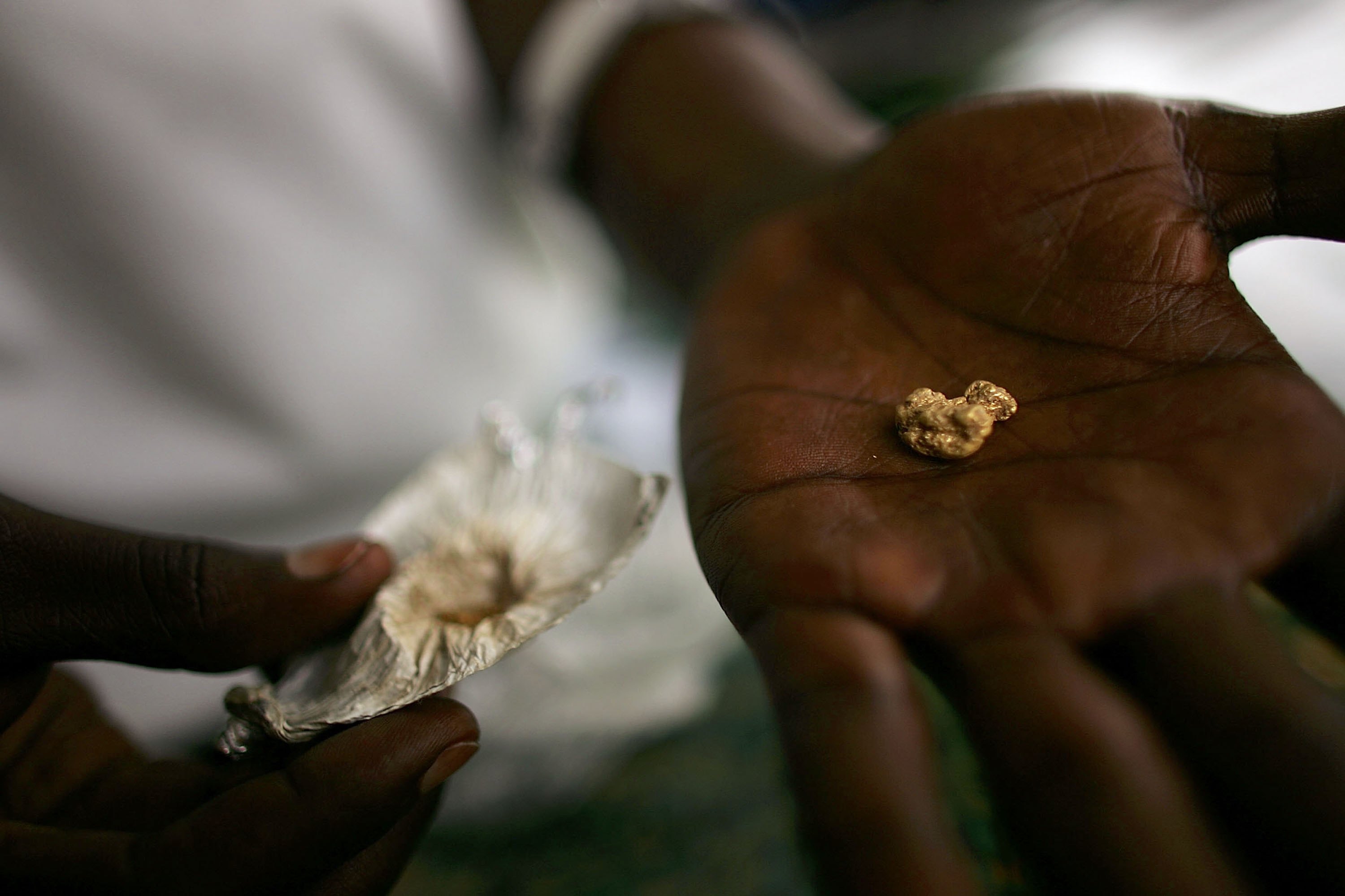
In 2019, Tanzania and Barrick Gold renegotiated the mineral development agreements (MDAs) for three of the country’s gold mines. The renegotiated deals provide for a 50-50 share of “economic benefits.” Since then, the government has entered a 55-45 sharing arrangement with Petra Diamonds for Tanzania’s only large-scale diamond mine, with the government receiving the larger share.3 These mines are already producing, but the government has also applied this sharing approach to deals for at least some new projects. The largest mine in the pipeline—Kabanga, which will produce nickel and cobalt—has signed a framework agreement with the government that provides for economic benefits to be “equitably shared.”4
This sharing arrangement is a significant shift away from the fiscal regime set out in Tanzanian legislation and common across the world. The typical regime is based on royalties and corporate income tax, without any adjustment mechanism to achieve a specified government share of mine profits overall. I analyzed this regime previously, benchmarking it against a range of other mining countries.5 I now analyze the Tanzanian sharing arrangement to establish whether it represents a better deal for the country. I then explore how the government could refine it as it negotiates deals for new projects in the pipeline. Lessons are drawn from the approach of Ecuador and the Philippines, which also target a specified share of a mine’s profits for the government but in different ways.
The economic model and data that I used for this analysis are available on the Natural Resource Governance Institute’s website here. I provide further information on my modeling approach in subsequent sections and the appendix.
1. Key difference between benefit-sharing approaches: Tanzania’s ceiling on the government share
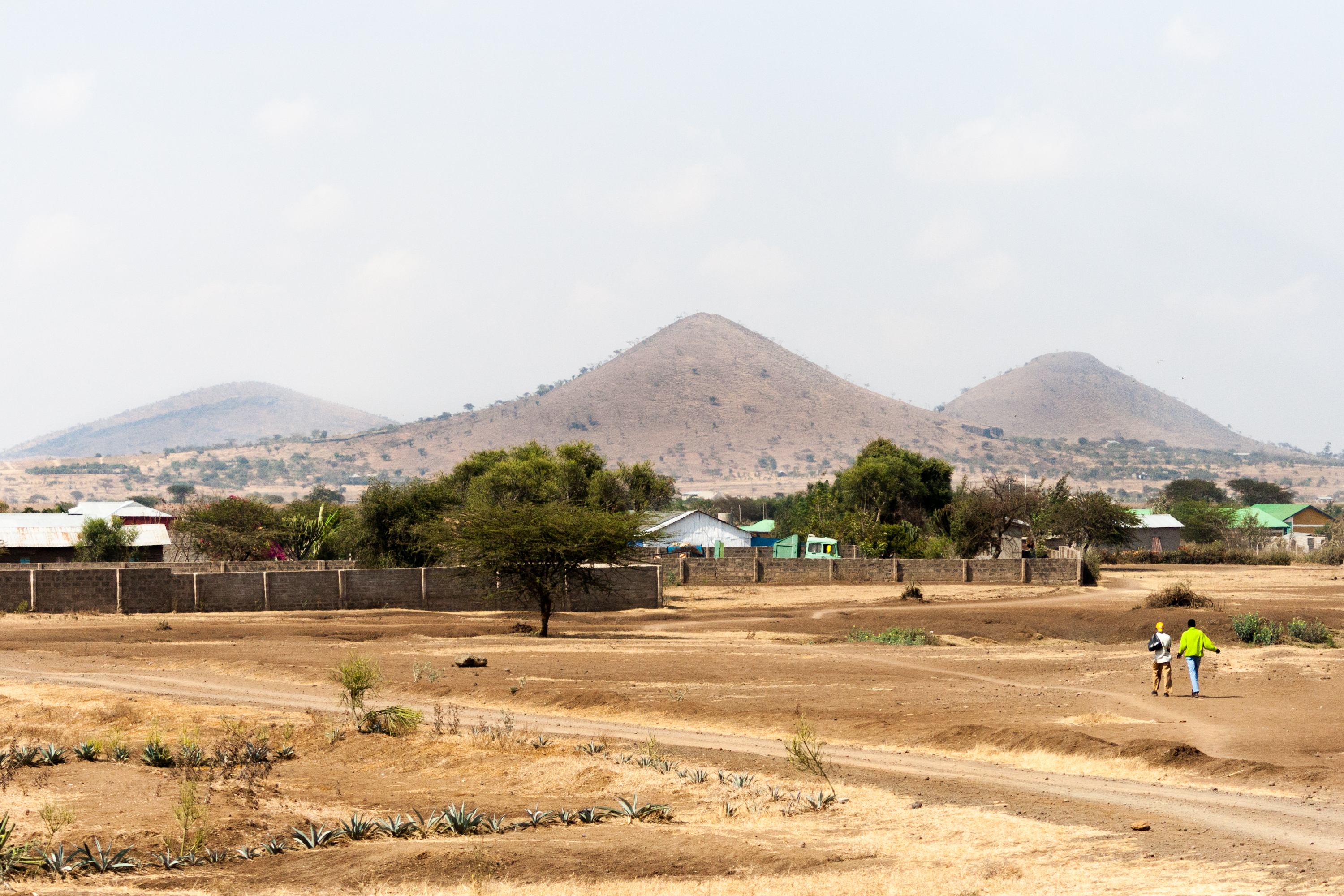
Public information on the structure of Tanzania’s sharing arrangements is limited. While the Mining (State Participation) Regulations 2022 provide for the government to negotiate the sharing of economic benefits on the basis of an “equitable sharing principle,” they do not fully set out its structure. The Barrick MDAs and agreements for other projects have not been disclosed. The framework agreement between the government and Barrick that informed the MDAs provides the most comprehensive outline of the structure that is publicly available.6 I therefore focus on this 50-50 arrangement, but also discuss the implications of a different split, such as the 55-45 agreed with Petra Diamonds, in my analysis. The three key elements of the sharing arrangement are set out below.
Definition of economic benefits. “Economic benefits” could be interpreted to mean different things. The broadest definition would entail not only direct financial benefits from the mine in the form of government revenues and company profits, but also benefits such as the creation of jobs and demand for goods and services. However, the Mining (State Participation) Regulations state that “economic benefits” comprise of government revenues directly payable by the company to the government,7 shareholder dividends and shareholder loan repayments. Therefore, by the end of a typical mine’s lifetime, its economic benefits should be broadly equivalent to its total pre-tax profit. These benefits are calculated on a cumulative basis from the start of a mine’s operations (that is, from the start of the license period). I understand that cumulation in this case is based on actual not discounted cash flow, and therefore does not account for the time value of money.8
Trigger for sharing mechanism. Sharing is triggered once cumulative, post-tax cash flow is positive, meaning that all exploration and development costs have been recouped. My understanding is that the timing of this trigger is set in advance using the mine life plan rather than based on actual performance.
Sharing mechanism. The mining company pays the taxes set out in the fiscal regime, such as royalty and corporate income tax, in line with the typical approach. However, after the sharing trigger, if one party’s cumulative share of economic benefits is greater than 50 percent at the end of a year, it must pay the other party the amount required to rebalance. This payment could be made at that point in time or, if the company has overpaid, treated as an advance payment of future taxes.
Several other countries require mines to pay a specified government share
The Ecuador and Philippines regimes also require a government share of profits of 50 percent. Each country’s definition of profits differs slightly. However, a more significant difference is that, unlike under the Tanzanian approach, if the Ecuador or Philippines government receives a share of more than 50 percent, the government does not have to compensate the mining company. In other words, their mechanisms act as a floor but not a ceiling on the government’s share.
Another key difference between the regimes is that, while the Tanzania and Ecuador regimes calculate the benefits accrued by the government or mining company on a cumulative basis, the Philippines regime does not. However, while cumulation is based on actual cash flow in the Tanzania regime, it is based on discounted cash flow in the Ecuador regime. This means that sharing is triggered in Ecuador only once the mining company has earned its minimum rate of return—that is, the return the company needs to be willing to develop the mine initially.9
Further details of the Ecuador and Philippines regimes are set out in the appendix.
Modeling the benefit-sharing arrangement for gold and nickel mines
I modeled how the Tanzania, Ecuador and Philippines approaches may work for a gold mine and a nickel mine of average profitability. I assumed a gold price of USD 1,600 per ounce and a nickel price of $17,000 per tonne, which are around the 10-year average between 2013 and 2022.10 In the figures below, “initial government benefits” are the revenues the government would have received without the sharing mechanism and “final government benefits” the revenues it ultimately receives after any rebalancing. I show only the results for the gold mine below, but the results for the nickel mine were similar.
Tanzania. As Figure 1 shows, the government receives benefits from the mine prior to the sharing trigger from input taxes, royalty and some corporate income tax payments. Sharing is triggered in year 7 of the project’s life. The government will have a cumulative share that is significantly greater than 50 percent at this point. It therefore must make a payment to the mining company or forgo future tax payments to rebalance. I modeled the latter, given it will probably be politically difficult for the government to make a direct payment to the company. Following this initial rebalancing, the fiscal regime continues to generate a larger initial share of the benefits for the government than for the company. The government therefore continues to forgo a portion of future tax payments to rebalance. At no point in this scenario does the sharing mechanism result in an increase in government revenue.
Figure 1. Tanzania sharing of benefits across the lifetime of a gold mine making average profits11
Ecuador. As Figure 2 shows, sharing is triggered in year 8 of the project’s life. This is a year later than with the Tanzania approach because, unlike with the Tanzania approach, the mining company is permitted to earn its minimum return before sharing. From this point until year 12, annual company returns are significantly greater than government revenues. Therefore, despite the government having received revenues in previous years, its share of cumulative benefits falls below 50 percent, and the company makes an additional payment. However, these payments do not result in the government and company receiving the same monetary amount each year. Sharing is based on discounted cash flow. The revenue the government received in the early years of the mine is worth more than the same monetary amount received by the company later. This reduces the size of the additional payments the company needs to make for cumulative benefits to be shared equally.
Figure 2. Ecuador sharing of benefits across the lifetime of average gold mine12
Philippines. As Figure 3 shows, the recovery period ends after three years of production, in year 7 of the project’s life. Because the basic government share is less than 50 percent of net mining revenue at this point until year 16, the mining company pays an additional government share. For the following few years, the basic government share is at least 50 percent of net mining revenue. This means the company does not make any additional payments. However, unlike with the Tanzania approach, the government does not have to compensate the company for receiving more than 50 percent of net mining revenue.
Figure 3. Philippines sharing of benefits across the lifetime of average gold mine13
2. Tanzania’s benefit-sharing arrangement could leave the country shortchanged

I reviewed the Tanzanian approach against the typical objectives of a fiscal regime: maximizing government revenue without deterring investment; reliable revenues; flexibility as profits change; and simplicity to limit tax avoidance risks.
Typical objectives of a fiscal regime
Maximizing government revenue without deterring investment. A fiscal regime should set the highest taxes that a mine can bear without discouraging investment. What this tax level is depends on the country’s wider investment climate. This is because investors often place greater weight in their investment decision on several non-fiscal factors, such as a country’s geology and policy predictability, than on the tax level.14
Reliable revenues. Many governments want a regime that generates some revenue for their budget each year irrespective of whether a mine is making low or high profits. Reliability is particularly important for countries that depend heavily on the mining sector to finance the budget. However, high taxes when a mine is making no or low profits can prevent low-profit mines from being developed or surviving downturns. A regime must therefore balance reliability with ensuring a wide range of mines are viable across different scenarios.
Flexibility as profits change. A regime should aim to capture any profit above the investor’s minimum return, with flexible (or “progressive”) taxes significantly increasing government take once this threshold has been reached.15
Simplicity. Governments are often concerned about tax avoidance.16 Some taxes (namely those based on profitability) are more difficult to measure than others, which makes them more susceptible to company manipulation. Governments therefore tend to want the regime to contain at least some simple taxes (such as royalties), depending on their tax administration capacity.
I set out below how the 50-50 regime performs against these criteria in relation to a new gold mine. I compared the performance of the 50-50 regime with the underlying regime. I also compared it with the Ecuador and Philippines regimes—with and without their sharing mechanisms to isolate their effect and draw lessons for Tanzania—as well as with some of the world’s other gold producers. Tanzania is competing with these countries for investment, and therefore how they compare is important. I also analyzed the impact of these regimes on a nickel mine and found similar results.
The benefit-sharing arrangement reduces government take
Tanzania’s 50-50 regime has a lower government take than the country’s underlying regime set out in legislation. This is because of the ceiling it imposes on the government’s share. This does not necessarily mean it will generate less government revenue overall, however. More mines could potentially be developed under the 50-50 regime if investors prefer it, thereby resulting in higher aggregate government revenues.
Figure 4 sets out how the government take differs between Tanzania’s two regimes, and how they compare to the regimes of Ecuador, the Philippines and several other gold producers. I used the average effective tax rate (AETR) to make this comparison.
The 50-50 regime appears to strike a reasonable balance between generating government revenue and competitiveness for a mine with average profitability. As Figure 4 shows, I estimate it has an AETR of around 54 percent.17 However, this is lower than for several other countries in my sample. Tanzania therefore probably has scope for slightly higher taxes than the 50-50 regime entails without reducing the country’s competitiveness. This is particularly the case given government efforts to improve the wider investment climate appear to be paying off. Control Risks considers Tanzania’s legal and tax risks to be on a downward trend.18 Indeed, I understand the government has negotiated a larger share in at least some other deals.
In contrast to the Tanzanian mechanism, Ecuador’s and the Philippines’ mechanisms both increase government take from a mine with average profitability, compared to the regimes that would otherwise be applicable. However, the Ecuador mechanism has a larger impact. This is because it does not count several significant taxes—such as import duties and withholding taxes on interest and dividends—toward the government’s share of benefits. The exclusion of these taxes increases the additional payment the mining company must make for the government to receive 50 percent of cumulative benefits.
Figure 4. Average effective tax rate for average gold mine with gold price of USD 1,600 per ounce19
The benefit-sharing arrangement both limits windfall profits capture and makes revenues unreliable
Figure 5 shows government take at different profit levels—measured in terms of government share of total benefits.20 A regime should set government take from low-profit mines to generate reliable revenues while still providing the minimum return to investors. A flexible regime would then have much higher government take from higher-profit mines. The AETR for these mines would be flat, with flexible instruments to capture windfall profits balanced out by reliable instruments such as royalties. This translates to government share of total benefits slightly increasing with profit.21
Figure 5. Government share of total benefits at different profit levels22
The instruments in Tanzania’s underlying regime make it relatively inflexible. Its corporate income tax and minority state equity mean that it should capture windfall profits reasonably well, if effectively administered. However, the regime also places high taxes on low-profit mines, largely because of a high royalty. As I noted in my previous analysis, the government could consider adjusting these instruments to make the underlying regime more flexible.23
The sharing mechanism also limits the flexibility of the regime since it is designed to preserve the share of government in total benefits, regardless of economic conditions. The mechanism results in the regime capturing a similar share of profits whether a mine generates low or high profits.24 This means the government must decide, when determining the split between government and mining company, whether to impose a large government take on low-profit mines and capture a large share of any windfall profits; or to provide more relief to low-profit mines but in doing so to capture a smaller share of windfall profits. The 50-50 split takes the latter approach, making low-profit mines more likely to be viable than with the underlying regime. However, the sharing mechanism means that this must come at the cost of a smaller government share of windfall profits.
The sharing mechanism also makes government revenues unreliable. This is because it makes all government revenues dependent on the size of total benefits. The government can receive only 50 percent of total benefits irrespective of which tax they were initially derived from. Low profits, which in turn mean total benefits are small, could therefore impact even the payment of taxes not directly based on profit.
As Figure 6 shows, my modeling suggests there may be years in which the government does not receive any revenues from a mine with low profits. In this scenario, these two years of no government revenues are caused by the build-up of benefits that the government receives prior to the sharing trigger. Once sharing is triggered, the government must forgo tax payments to rebalance and for 50-50 sharing to be achieved. With a mine of average profitability, total benefits are large enough that the government does not have to forgo all its tax payments in any year, as shown in Figure 1. However, with low profits, the mining company must retain all benefits for a period to rebalance.
While this example shows the potential impact of the government’s accumulation of benefits prior to the sharing trigger, periods of no or low profits at other points in the mine’s lifetime could also make revenues volatile. Therefore, while the sharing mechanism may still generate reasonable government revenues over the project’s lifetime, it appears to undermine the reliability of revenues from year to year. As a result, it appears to create a regime that neither captures a significant share of windfall profits compared to many of the countries in our sample nor provides reliable revenues when profits are low.
Figure 6. Tanzania sharing of benefits across the lifetime of a gold mine making low profits, with all benefits shared25
This lack of reliability could have significant repercussions for public trust. As noted above, I do not think it will be politically feasible for the government to make a direct payment to the mining company when the government has captured a greater share of the benefits than the agreed split. It is more likely that the government will forgo future tax payments. However, a scenario in which the government will need to forgo all tax payments in a given year will also be politically difficult. As a result, the sharing arrangement could create situations in which the government feels forced into entering supplementary arrangements to ensure it receives some revenues each year—for example, an arrangement that spreads the amount required to rebalance over several years.
Such arrangements, whether fully disclosed to the public or not, could lead to the sharing approach reducing public trust. This loss of trust would put pressure on the government to change the fiscal regime and even the wider legal and regulatory framework. If acted on, this could shake confidence in policy predictability and deter investment, as the country experienced following the sweeping reforms in 2017.26
In contrast to the Tanzania mechanism, the Ecuador mechanism helps increase flexibility. The mining company being able to earn its minimum return before sharing, and sharing being based on cumulative benefits, means the mechanism has a limited impact on low-profit mines. For higher-profit mines, it increases government take. In this way, it operates much like a windfall profit tax. Nonetheless, its flexibility could be improved further. The exclusion of some taxes from the government’s share of benefits means that even low-profit mines may need to make an additional payment. This is particularly impactful because the rest of the Ecuador regime imposes a relatively high burden on mines even when profits are low.
The Philippines’ mechanism improves the government’s ability to capture windfall profits. However, it risks increasing the burden on low-profit mines. This is because, while the limited taxes during the recovery period provide some relief, sharing is triggered before the mining company earns its minimum return and is based on annual not cumulative benefits. This also limits the scope to capture an even greater share of windfall profits through the sharing mechanism, as a larger government share would risk a higher burden on low-profit mines. A separate windfall profit tax would therefore be needed for this purpose instead.
The benefit-sharing arrangement increases tax avoidance risks for Tanzania
The Tanzania mechanism significantly increases the government’s exposure to tax avoidance risks. As noted above, all government revenues become dependent on profit. They therefore all become dependent on government capacity to effectively assess profit rather than just the government revenues from profit taxes.
Figure 7 shows the potential impact of tax avoidance practices increasing costs and therefore reducing total benefits. The increase in costs does not affect the payment of input and production taxes with the underlying regime. However, it does with the sharing mechanism as it means 50 percent of total benefits includes a lower value of the input and production taxes that would have been due to the government.
Figure 7. Hypothetical exposure to tax avoidance risk with Tanzania's fiscal regimes27
This feature of the mechanism exists regardless of the size of the split. A larger government share reduces the risk that tax avoidance will lower total benefits to the extent that the government’s share is less than the value of input and production taxes. However, it does not eliminate that risk.
The Ecuador and Philippines mechanisms, in contrast, do not significantly affect government exposure to tax avoidance risks. Determining the need for additional payments to government depends on government capacity to effectively measure profits. But because these regimes do not place a ceiling on the government’s share, tax avoidance that reduces profits would not affect the payment of input and production taxes.28
The Tanzania regime does contain measures intended to reduce tax avoidance risks related to financing costs. I understand that the Barrick MDAs treat related party loans as being interest free in the calculation of total benefits. The Mining (State Participation) Regulations also unusually provide for mandatory state equity in projects to give the government a share of any shareholder loan repayments. This provision is intended not only to generate larger government revenues directly, but also to reduce the incentive to shift profits through inflated financing costs.29
These protective measures are not tied to the structure of the sharing mechanism, however. They could be included in any regime. Indeed, the sharing mechanism appears to neutralize the impact of taking a share of loan repayments. The government can receive only 50 percent of economic benefits regardless of whether they are generated from a share of loan repayments or other revenue streams.
3. Tanzania may do better by not including the benefit-sharing mechanism in new deals

Setting not just a floor but also a ceiling on the government share has introduced three main risks into Tanzania’s regime: it potentially sets an unnecessarily low ceiling on government revenues (depending on the agreed split); it makes those revenues less reliable; and it increases their exposure to tax avoidance.
The government may not have anticipated some of these consequences because it initially developed the sharing arrangement for mines that were already producing. The largest costs for these mines have already been incurred and they are now profitable. This reduces the risk of the sharing mechanism making revenues unreliable and increasing the potential for tax avoidance. However, it would be advisable for the government to consider whether this approach is optimal for new mines. Particularly given the energy transition and resulting surge in demand for many of Tanzania’s minerals, there is even more to gain from a good deal and even more to lose from a bad deal.
A larger government share of benefits reduces the risk of unreliable revenues and tax avoidance. However, it does not eliminate this risk. Negotiating the split on a project basis, without any guardrails in legislation, increases the risk of a bad deal. Legislation provides only a limited methodology for calculating economic benefits and does not provide a range within which the split will be agreed. Given that the split essentially overrides the underlying fiscal regime set out in legislation, this lack of guardrails is concerning. It increases the impact of uneven capacity between the government and company negotiating teams, the likelihood of costly mistakes and the opportunity for corruption. An uneven fiscal regime is also more difficult to administer.30
The government could look to Ecuador and the Philippines’ regimes for ideas on how to refine its approach. By setting only a floor on the government share, their sharing mechanisms do not exacerbate the risk of unreliable revenues and tax avoidance. By allowing the mining company to earn its minimum return before sharing is triggered, Ecuador’s sharing mechanism performs more like a windfall profit tax. It therefore reduces the risk of making marginal mines unviable.31
Removing the ceiling from Tanzania’s sharing mechanism is complicated by the relatively high taxes of Tanzania’s underlying regime. A floor of 50 percent of profits results in Ecuador and the Philippines receiving additional payments because government take from other taxes in their regimes does not reach that threshold. This is not the case for Tanzania as government take already exceeds that floor.
Figure 8 shows my modeling of a gold mine of average profitability. The mechanism—without a ceiling and the calculation of benefits based on discounted cash flow to allow mining companies to earn their minimum return before sharing is triggered—does not have any effect on the share of benefits between the government and company. My modeling suggests the mechanism would also not have any effect on this share for mines of higher and lower profitability.
Figure 8. Tanzania sharing of benefits across the lifetime of a gold mine making average profits with no ceiling32
Removing the ceiling from the sharing mechanism will therefore likely result in most mines paying the tax level in the underlying regime. The government could of course increase the floor so that the mechanism does result in mines making additional payments. My modeling suggests a floor of close to 60 percent would trigger additional payments from a range of mines. However, this would not be advisable given the underlying regime already has higher taxes than most other countries in my sample. Increasing government take would further challenge Tanzania’s competitiveness, even if these additional payments were payable only once the mining company had earned its minimum return.
The adjustments I suggest would therefore make the sharing mechanism superfluous for most mines. The government could therefore decide not to pursue a sharing mechanism of any form in new deals given it becomes an unnecessary complication. Indeed, the government is better focusing on improvements to the underlying regime. As set out above, Tanzania’s taxes are less responsive to mine profitability than most other regimes I analyzed. The government could therefore consider a royalty rate that varies with prices.33 This would provide some relief to mines when prices are low, and capture more revenue for government when prices are high. The government could also review its approach to tackling tax avoidance risks from inflated financing costs. For example, rather than taking a share of any loan repayments, it could consider adopting a rule for the mining sector that is currently only in the Petroleum Act: that the interest rate on a loan should not exceed the lowest market rate available for such loans.34
Conclusion
The Tanzanian government should be commended for its willingness to pursue an innovative approach to mining taxation after years of frustration at the deals it had previously struck. However, without reassessing this approach, it risks leaving itself shortchanged again—particularly given the lack of guardrails in legislation. Considering the challenges with the arrangement I have identified, there may be a sense of déjà vu in the longer term with a public backlash against both mining companies and the government.
The government could adjust the mechanism before finalizing deals for new mines by borrowing elements from the Ecuador and Philippines regimes. However, unless the government has identified benefits from the sharing mechanism that a more typical regime does not offer, the best option is not to pursue a sharing mechanism of any form and instead to focus on improving the underlying regime.
Even if the government decides not to incorporate a sharing mechanism in any new deals, explaining to the public how it works in existing deals is critical. The current lack of public information and understanding of the mechanism risks undermining public trust in it. Part of this public sensitization should include disclosure of the contracts that contain the mechanism, as already required by the Tanzania Extractive Industries (Transparency and Accountability) Act 2015. The government could also consider publicly reporting the expected or observed economic benefits from the mines to which a sharing arrangement applies. This should also help increase public trust that the country is receiving the amount that it is due.
Appendix: Ecuador and Philippines regimes
Ecuador’s approach
The Ecuador regime requires mines to provide a government share of at least 50 percent of “accumulated benefits.” This requirement is established in the constitution of the country. It is primarily set out in the general regulations of the mining law.
Definition of accumulated benefits. “Accumulated benefits” are the sum of the government revenues specified in the regulations and any free cash flow available to the mining company.35 These benefits are calculated on a cumulative basis from the start of a mine’s operations (though the applicable government revenue streams are payable only from the start of production). This cumulation accounts for the time value of money. Cash flows are discounted to reflect that, the earlier they occur, the more they are worth to either party.36
Trigger for sharing mechanism. Sharing is triggered once cumulative, discounted free cash flow is positive. At this point, the mining company has recouped all exploration and development costs. Because the trigger is based on discounted cash flow, it will also have earned its minimum rate of return.
Sharing mechanism. The mining company pays the taxes set out in the fiscal regime in line with the taxes and royalties defined in legal and contractual provisions. After the sharing trigger, if cumulative government revenues are less than 50 percent of accumulated benefits at the end of the year, the company must pay a “sovereign adjustment” to increase the government share to 50 percent. However, if government revenues are more than 50 percent of accumulated benefits, the government does not have to compensate the company.
Philippines’ approach
The Philippines regime requires mines that operate under a financial or technical assistance agreement (FTAA) to provide a government share of at least 50 percent of annual “net mining revenue” after a cost recovery period. Any mine licensed to a foreign company must have a FTAA.37 This arrangement is primarily set out in a publicly available model FTAA. The financial or technical assistance agreement for a given project is subject to negotiations and therefore may differ slightly from others.38 I focus on the regime set out in the model FTAA.
Definition of “net mining revenue.” Net mining revenue is sales revenue (net of transport and processing charges) minus deductible expenses in a given year. Deductible expenses include, among other things, development costs after the start of production, operating costs, interest payments and royalties.
Trigger for sharing mechanism. The sharing mechanism is triggered at the end of the “recovery period.” The recovery period ends the earlier of five years from the start of production or the point at which all pre-production expenses have been recouped. The timing of this trigger is based on the actual performance of a mine rather than set in advance.
Sharing mechanism. The mining company pays the “basic government share” throughout the project’s lifetime. However, the composition of this basic government share up to the end of the recovery period and after the recovery period differs. A comprehensive list of the taxes included in the government share during these two periods can be found in the model FTAA and applicable legislation. The main components up to the end of the recovery period include excise tax, royalties and local business tax. The basic government share after the recovery period includes these taxes as well as import duties, corporate income tax, and withholding taxes on interest and dividends.
After the end of the recovery period, if the basic government share is less than 50 percent of net mining revenue in a given year, the mining company must pay an “additional government share” to increase the total government share to 50 percent of net mining revenue. However, if the basic government share is more than 50 percent of net mining revenue, the government does not have to compensate the company.
Modeling approach
I used an adapted version of the IMF’s Fiscal Analysis of Resource Industries (FARI) economic model published in 2016 for this analysis.39
I based my analysis on two mines: one produces gold doré and the other produces primarily nickel sulfide but also some cobalt. As the effects of a fiscal regime can differ depending on the specific cost, production and ultimate profitability of a mine, I created a range of mine profiles. I based the gold mine profiles on the characteristics of actual mines in Tanzania, using S&P Global Market Intelligence’s Capital IQ Pro database. The S&P database does not yet contain detailed economic data for any of Tanzania’s upcoming nickel mines, and therefore I developed rough approximations based on their potential size and the cost of other nickel mines across the world. I also made assumptions about the financing structure of these mines. I based these assumptions on the values used as common practice by industry and government analysts.
The assumptions I used for the two gold mine profiles referenced in this analysis are set out in Table 1. These assumptions result in a pre-tax internal rate of return of 42 percent for the average-profit mine and 17 percent for the low-profit mine.
Table 1. Key assumptions for modeled gold mine profiles
|
Parameter |
Average-profit mine |
Low-profit mine |
|
Peak production of gold |
350,000 ounces |
100,000 ounces |
|
Production life |
24 years |
16 years |
|
Development and expansion capital |
$300 million |
$450 million |
|
Replacement capital per year |
$40 million |
$8 million |
|
Operating cost |
$700 per ounce |
$800 per ounce |
|
Transport, treatment and refining charges (TC/RC) |
$3 per ounce |
$6 per ounce |
|
Debt-to-equity ratio |
50% |
50% |
|
Real discount rate of equity shareholders |
8% |
8% |
|
Real interest rate on debt |
6% |
6% |
|
Inflation rate |
2% |
2% |
The assumptions I used for the nickel mine profiles in this analysis are set out in Table 2. These assumptions result in a pre-tax internal rate of return of 35 percent for the average-profit mine and 16 percent for the low-profit mine.
Table 2. Key assumptions for modeled nickel mine profiles
|
Parameter |
Average-profit mine |
Low-profit mine |
|
Peak production of nickel |
40,000 tonnes |
15,000 tonnes |
|
Associated cobalt (percent of gross sales from nickel) |
15% |
5% |
|
Production life |
30 years |
10 years |
|
Development and expansion capital |
$1,600 million |
$450 million |
|
Replacement capital per year |
$20 million |
$6 million |
|
Operating cost |
$6,000 per tonne |
$8,000 per tonne |
|
Transport, treatment and refining charges (TC/RC) |
$2,600 per tonne |
$2,600 per tonne |
|
Debt-to-equity ratio |
50% |
50% |
|
Real discount rate of equity shareholders |
8% |
8% |
|
Real interest rate on debt |
6% |
6% |
|
Inflation rate |
2% |
2% |
I applied the fiscal regimes in my sample to these mine profiles. To keep the model and my analysis as simple as possible, I did not include taxes that are likely to comprise a relatively small proportion of total government revenue for a large-scale mine, such as annual license fees. I also did not model employment taxes that are ultimately paid by the mine employees rather than the companies. I also simplified some elements of the regimes. For example, while import duties vary according to trade agreements between countries (e.g., East Africa Community trade rules) and according to the goods and services imported, I assumed one rate for all imported inputs.
Acknowledgements
The author wishes to thank Thomas Lassourd, senior policy advisor, and Viola Tarus, policy advisor for tax and extractives, at the Intergovernmental Forum on Mining, Minerals, Metals and Sustainable Development, and Amir Shafaie, Moses Kulaba, Silas Olan’g, Sophia Rwegellera and William Davis of the Natural Resource Governance Institute, for reviewing this brief. He also wishes to thank Thomas Baunsgaard, deputy division chief of the Tax Policy Division at the International Monetary Fund, and Daniel Mulé, policy lead for extractive industries, tax and transparency at Oxfam, for their input.
Notes
-
1
With a gold price of USD 1,600 per ounce.
-
2
With a low-profit mine and a gold price of $1,600 per ounce.
-
3
Cecilia Jamasmie, “Petra Diamonds’ stake in Williamson to shrink as part of deal with Tanzania,” Mining.com, 13 December 2021, www.mining.com/petra-diamonds-stake-in-williamson-to-shrink-as-part-of-deal-with-tanzania.
-
4
Lifezone Metals, “Kabanga Nickel Signs Framework Agreement,” 19 January 2021, www.lifezonemetals.com/kabanga-nickel-signs-framework-agreement.
-
5
Thomas Scurfield and Silas Olan’g, “Magufuli Seeks the Right Balance for Tanzania’s Mining Fiscal Regime,” NRGI, 31 January 2019, www.resourcegovernance.org/blog/magufuli-seeks-right-balance-tanzania-mining-fiscal; Thomas Scurfield, “Tanzania Strikes a Better Balance with its Mining Fiscal Regime,” NRGI, 24 June 2020, www.resourcegovernance.org/blog/tanzania-strikes-better-balance-mining-fiscal-regime.
-
6
This framework agreement was published in a document setting out Barrick’s offer to buy the shares it did not already own in Acacia Mining, the previous owner of the Bulyanhulu, Buzwagi and North Mara mines in Tanzania. See Acacia Mining and Barrick Gold, Recommended Final Offer for Acacia Mining Plc by Barrick Gold Corporation, 2019, 66–79, s25.q4cdn.com/322814910/files/doc_downloads/acacia/Acacia-2.7-announcement.pdf.
-
7
The main revenue streams are import duty, skills development levy, royalty, corporate income tax, a share of dividends and shareholder loan repayments through state equity, and dividend withholding tax.
-
8
The earlier in time a shilling (Tanzania’s official currency unit) is received, the more it is worth. This is, first, because it can be used earlier; and second, because the future is uncertain, and no one can be sure they will receive that shilling in the future. To account for this time value of money, a “discount rate” is applied. In the sharing arrangement, this would mean that if the government received a shilling in year 1, the company would need to receive more than a shilling in year 2 for the benefits to be comparable. However, given cumulation here is based on actual cash flow, the company would need to receive only a shilling in year 2 for the benefits to be shared equally.
-
9
This provision for the company to earn its minimum return before sharing is triggered means Ecuador’s mechanism is similar to an R-based cash flow tax, commonly referred to as a Brown Tax. See, e.g., Robin Broadway and Michael Keen, “Theoretical perspectives on resource tax design,” in The Taxation of Petroleum and Minerals: Principles, Problems and Practice, edited by Philip Daniel, Michael Keen and Charles McPherson (Oxford: Routledge, 2010), 13–74.
-
10
Prices are taken from World Bank, “Commodities Price Data (The Pink Sheet),” www.worldbank.org/en/research/commodity-markets.
-
11
With a gold price of $1,600 per ounce.
-
12
With a gold price of $1,600 per ounce.
-
13
With a gold price of $1,600 per ounce.
-
14
The Fraser Institute survey estimates that, unless there are extremely harmful policies, around 60 percent of an investment decision tends to be based on a country’s geology. The other 40 percent comprises of several other factors, including political stability and policy predictability (given they affect the risk that investors will not be able to secure future returns generated by their investments), a conducive business environment and the tax level. See Julio Mejia and Elmira Aliakbari, Fraser Institute Annual Survey of Mining Companies 2022, (Fraser Institute, 2023), 8, www.fraserinstitute.org/studies/annual-survey-of-mining-companies-2022.
-
15
However, information gaps make it difficult for taxes to be structured to capture all excess profit. See Jean-Franҫois Wen, Progressive Taxation of Extractive Resources as Second-Best Optimal Policy (International Monetary Fund, 2018), www.imf.org/en/Publications/WP/Issues/2018/06/13/Progressive-Taxation-of-Extractive-Resources-as-Second-Best-Optimal-Policy-45923.
-
16
Recent research provides a sense of the potential revenue loss to governments from tax avoidance. The International Monetary Fund recently estimated that sub-Saharan African mining countries could be losing between $450 and $730 million in corporate income tax a year. See Sebastian Beer and Dan Devlin, Is There Money on the Table? Evidence on the Magnitude of Profit Shifting in the Extractive Industries (International Monetary Fund, 2021), www.imf.org/en/Publications/WP/Issues/2021/01/15/Is-There-Money-on-the-Table-Evidence-on-the-Magnitude-of-Profit-Shifting-in-the-Extractive-49983.
-
17
It is perhaps surprising that Tanzania’s 50-50 sharing arrangement generates an AETR greater than 50 percent (with a discount rate of 10 percent). This is despite AETR measuring government take as the share of pre-tax profits, which is larger than “economic benefits” (given economic benefits exclude interest payments). This outcome results from the 50-50 split being based on actual cash flow. The government receives revenue before the mining company through input and production taxes that do not depend on the mine making a profit. Because of these earlier revenues, the government receives a larger share on a discounted basis.
-
18
As reported in the S&P Global database. Legal risks are “expropriation, state contract alteration and contract enforcement risks.” Tax risks are “tax increase and tax inconsistency risks.” Control Risks scores these risks as still “very high” and “high” respectively (following Tanzania’s overhaul of extractives sector laws and other actions against existing mines in 2017) but reducing.
-
19
With a discount rate of 10 percent. While Ecuador’s sharing mechanism does not account for the labor profit share because none of it will go to the government from 2024 onwards, I have included it in the AETR because it is a tax on the project. The Democratic Republic of Congo regime has an excess profits tax that is triggered for a mine when the realized price is at least 25 percent higher than the price in its feasibility study. I assumed that the feasibility study has a price of $1,300 per ounce, so the excess profits tax is not triggered.
-
20
Total benefits in this case are a project’s revenues minus operating costs and replacement capital (but not minus exploration and development capital). This cash flow represents the money available to pay back the initial investment and provide a return. The government share of it is a common measure of progressivity.
-
21
Wen, Progressive Taxation of Extractive Resources as Second-Best Optimal Policy.
-
22
With a discount rate of 10 percent. The results for only some countries are shown to clearly depict each data point. The results for all the evaluated countries can be found in my model.
-
23
Scurfield, “Tanzania Strikes a Better Balance with its Mining Fiscal Regime.”
-
24
This feature is not fully reflected in Figure 5 given that “total benefits” use a slightly different definition of profits and are based on discounted cash flows.
-
25
With a gold price of $1,600 per ounce.
-
26
For example, an average 62 percent of respondents to the Fraser Institute surveys between 2017 and 2019 said the current implementation of Tanzania’s legal system would strongly discourage investment, and 73 percent said regulatory uncertainty would. See, e.g., Ashley Stedman, Jairo Yunis and Elmira Aliakbari, Fraser Institute Annual Survey of Mining Companies 2019 (Fraser Institute, 2020), www.fraserinstitute.org/studies/annual-survey-of-mining-companies-2019.
-
27
With a low-profit mine and a gold price of $1,600 per ounce.
-
28
Tax avoidance could extend the Philippines’ recovery period, and therefore delay the payment of some taxes including import duty and interest withholding tax, given the end of the recovery period depends on the reported profitability of a mine rather than an ex-ante assessment. However, the rule that the recovery period must end five years from the start of production regardless of whether pre-production expenses have been recouped limits the extent to which it can be extended.
-
29
The merits of these measures require further scrutiny. E.g., taking a share of loan repayments could result in lenders charging a higher interest rate to ensure they still recoup their loan and a minimum return. This would not only reduce taxable income but also make it harder for the government to assess whether an interest rate is reasonable, because it would not be comparable with industry benchmarks. It can also be difficult for a government to always determine whether a loan is from a related party or not. However, these considerations are outside the scope of this analysis.
-
30
Natural Resource Governance Institute (NRGI), Natural Resource Charter, 2nd edition, 2014, resourcegovernance.org/analysis-tools/publications/natural-resource-charter-2nd-ed.
-
31
Although its exclusion of several significant taxes from the government’s share of benefits means low-profit mines may still be impacted.
-
32
With a gold price of $1,600 per ounce.
-
33
Anna Fleming, Thomas Lassourd and David Manley, “Variable Royalties: an Answer to Volatile Mineral Prices?” in Handbook on the Future of Resource Taxation, African Tax Administration Forum and Intergovernmental Forum on Mining, Minerals, Metals and Sustainable Development (forthcoming), www.iisd.org/publications/brief/future-resource-taxation-roadmap.
-
34
Ensuring that interest rates used as a comparison apply to comparable assets with a similar risk profile is challenging, but rules of this nature have been successful in reducing profit shifting in other countries. See Beer and Devlin, Is There Money on the Table?.
-
35
The main taxes listed are VAT, royalty and corporate income tax. The regime also includes a share of pre-tax profits that is currently divided between the company’s workers and the government, with the portion received by the government included in its accumulated benefits. However, a recent court ruling means that all this labor profit share will go to workers from the start of 2024 and therefore none of it will be included in government benefits.
-
36
The discount rate used is specific to each mine and based on its weighted average cost of capital (WACC). I have assumed that WACC is around 7 percent in real terms. This is based on the typical discount rate for equity shareholders used by industry and government analysts of 8 percent in real terms, and the current average cost of debt for the mining sector as reported by Aswath Damodaran, Damodaran Online, www.pages.stern.nyu.edu/~adamodar.
-
37
Republic of the Philippines, Financial or Technical Assistance Agreement, mgb.gov.ph/attachments/article/79/PFC_FTAA.pdf.
-
38
For example, some terms in the original FTAA for an OceanaGold mine differed in some areas: Republic of the Philippines, Financial or Technical Assistance Agreement with Arimco Mining Corporation, 1994, www.resourcecontracts.org/contract/ocds-591adf-2792396017. I understand that the recently signed extension to this agreement has slightly different terms again.
-
39
A template of the FARI model and a user guide that explains all the concepts and workings of the model are available at International Monetary Fund, “Fiscal Analysis of Resource Industries,”www.imf.org/external/np/fad/fari.
Reforming National Oil Companies: Nine Recommendations
Some national oil companies (NOCs) have contributed heavily to successful efforts to harness benefits from the oil sector and drive broader national development. In other cases, however, NOCs have become inefficient managers of national resources, obstacles to private investment, drains on public coffers, or sources of patronage and corruption. As such, NOC reform—incremental in some cases, fundamental in others—lies at or near the top of the policy agendas of many oil-rich countries.
Building on existing literature, we surveyed 12 NOCs from diverse geographical and operational contexts to distill practical steps that policy-makers can take to make their countries' NOCs more effective and more accountable—to governments and to citizens. Our recommendations can be seen in both the executive summary and the full report.
The report's recommendations are based on the experiences of the following national oil companies:
- GNPC (Ghana)
- KMG (Kazakhstan)
- Petronas (Malaysia)
- Petrobras (Brazil)
- Saudi Aramco (Saudi Arabia)
- Sonangol (Angola)
- NIOC (Iran)
- NNPC (Nigeria)
- Pemex (Mexico)
- Statoil (Norway)
- PetroVietnam (Vietnam)
- SNH (Cameroon)
The nine recommendations for companies and the authorities who oversee them— described in detail in the report—are:
| Recommendation | Core features | |
| Defining and financing a commercial mandate |
1. Carefully define commercial and non-commercial roles. Limit non-commercial activities where sophisticated or expensive commercial activities heighten the risk and cost of conflicts of interest. |
|
|
2. Develop a workable revenue retention model. |
|
|
|
3. Procure external financing by listing some NOC shares on public stock exchanges or issuing external debt where appropriate. |
|
|
| Limiting political interference in technical decisions |
4. Define clear structures and roles for state shareholders. |
|
|
5. Empower professional, independent boards. |
|
|
|
6. Invest in NOC staff integrity and capacity. |
|
|
| Ensuring transparency and oversight |
7. Maximize public reporting of key data. |
|
|
8. Secure independent financial audits, and publish them. |
|
|
|
9. Choose an effective level of legislative oversight. |
|
|
Notes
-
1
With a gold price of USD 1,600 per ounce.
-
2
With a low-profit mine and a gold price of $1,600 per ounce.
-
3
Cecilia Jamasmie, “Petra Diamonds’ stake in Williamson to shrink as part of deal with Tanzania,” Mining.com, 13 December 2021, www.mining.com/petra-diamonds-stake-in-williamson-to-shrink-as-part-of-deal-with-tanzania.
-
4
Lifezone Metals, “Kabanga Nickel Signs Framework Agreement,” 19 January 2021, www.lifezonemetals.com/kabanga-nickel-signs-framework-agreement.
-
5
Thomas Scurfield and Silas Olan’g, “Magufuli Seeks the Right Balance for Tanzania’s Mining Fiscal Regime,” NRGI, 31 January 2019, www.resourcegovernance.org/blog/magufuli-seeks-right-balance-tanzania-mining-fiscal; Thomas Scurfield, “Tanzania Strikes a Better Balance with its Mining Fiscal Regime,” NRGI, 24 June 2020, www.resourcegovernance.org/blog/tanzania-strikes-better-balance-mining-fiscal-regime.
-
6
This framework agreement was published in a document setting out Barrick’s offer to buy the shares it did not already own in Acacia Mining, the previous owner of the Bulyanhulu, Buzwagi and North Mara mines in Tanzania. See Acacia Mining and Barrick Gold, Recommended Final Offer for Acacia Mining Plc by Barrick Gold Corporation, 2019, 66–79, s25.q4cdn.com/322814910/files/doc_downloads/acacia/Acacia-2.7-announcement.pdf.
-
7
The main revenue streams are import duty, skills development levy, royalty, corporate income tax, a share of dividends and shareholder loan repayments through state equity, and dividend withholding tax.
-
8
The earlier in time a shilling (Tanzania’s official currency unit) is received, the more it is worth. This is, first, because it can be used earlier; and second, because the future is uncertain, and no one can be sure they will receive that shilling in the future. To account for this time value of money, a “discount rate” is applied. In the sharing arrangement, this would mean that if the government received a shilling in year 1, the company would need to receive more than a shilling in year 2 for the benefits to be comparable. However, given cumulation here is based on actual cash flow, the company would need to receive only a shilling in year 2 for the benefits to be shared equally.
-
9
This provision for the company to earn its minimum return before sharing is triggered means Ecuador’s mechanism is similar to an R-based cash flow tax, commonly referred to as a Brown Tax. See, e.g., Robin Broadway and Michael Keen, “Theoretical perspectives on resource tax design,” in The Taxation of Petroleum and Minerals: Principles, Problems and Practice, edited by Philip Daniel, Michael Keen and Charles McPherson (Oxford: Routledge, 2010), 13–74.
-
10
Prices are taken from World Bank, “Commodities Price Data (The Pink Sheet),” www.worldbank.org/en/research/commodity-markets.
-
11
With a gold price of $1,600 per ounce.
-
12
With a gold price of $1,600 per ounce.
-
13
With a gold price of $1,600 per ounce.
-
14
The Fraser Institute survey estimates that, unless there are extremely harmful policies, around 60 percent of an investment decision tends to be based on a country’s geology. The other 40 percent comprises of several other factors, including political stability and policy predictability (given they affect the risk that investors will not be able to secure future returns generated by their investments), a conducive business environment and the tax level. See Julio Mejia and Elmira Aliakbari, Fraser Institute Annual Survey of Mining Companies 2022, (Fraser Institute, 2023), 8, www.fraserinstitute.org/studies/annual-survey-of-mining-companies-2022.
-
15
However, information gaps make it difficult for taxes to be structured to capture all excess profit. See Jean-Franҫois Wen, Progressive Taxation of Extractive Resources as Second-Best Optimal Policy (International Monetary Fund, 2018), www.imf.org/en/Publications/WP/Issues/2018/06/13/Progressive-Taxation-of-Extractive-Resources-as-Second-Best-Optimal-Policy-45923.
-
16
Recent research provides a sense of the potential revenue loss to governments from tax avoidance. The International Monetary Fund recently estimated that sub-Saharan African mining countries could be losing between $450 and $730 million in corporate income tax a year. See Sebastian Beer and Dan Devlin, Is There Money on the Table? Evidence on the Magnitude of Profit Shifting in the Extractive Industries (International Monetary Fund, 2021), www.imf.org/en/Publications/WP/Issues/2021/01/15/Is-There-Money-on-the-Table-Evidence-on-the-Magnitude-of-Profit-Shifting-in-the-Extractive-49983.
-
17
It is perhaps surprising that Tanzania’s 50-50 sharing arrangement generates an AETR greater than 50 percent (with a discount rate of 10 percent). This is despite AETR measuring government take as the share of pre-tax profits, which is larger than “economic benefits” (given economic benefits exclude interest payments). This outcome results from the 50-50 split being based on actual cash flow. The government receives revenue before the mining company through input and production taxes that do not depend on the mine making a profit. Because of these earlier revenues, the government receives a larger share on a discounted basis.
-
18
As reported in the S&P Global database. Legal risks are “expropriation, state contract alteration and contract enforcement risks.” Tax risks are “tax increase and tax inconsistency risks.” Control Risks scores these risks as still “very high” and “high” respectively (following Tanzania’s overhaul of extractives sector laws and other actions against existing mines in 2017) but reducing.
-
19
With a discount rate of 10 percent. While Ecuador’s sharing mechanism does not account for the labor profit share because none of it will go to the government from 2024 onwards, I have included it in the AETR because it is a tax on the project. The Democratic Republic of Congo regime has an excess profits tax that is triggered for a mine when the realized price is at least 25 percent higher than the price in its feasibility study. I assumed that the feasibility study has a price of $1,300 per ounce, so the excess profits tax is not triggered.
-
20
Total benefits in this case are a project’s revenues minus operating costs and replacement capital (but not minus exploration and development capital). This cash flow represents the money available to pay back the initial investment and provide a return. The government share of it is a common measure of progressivity.
-
21
Wen, Progressive Taxation of Extractive Resources as Second-Best Optimal Policy.
-
22
With a discount rate of 10 percent. The results for only some countries are shown to clearly depict each data point. The results for all the evaluated countries can be found in my model.
-
23
Scurfield, “Tanzania Strikes a Better Balance with its Mining Fiscal Regime.”
-
24
This feature is not fully reflected in Figure 5 given that “total benefits” use a slightly different definition of profits and are based on discounted cash flows.
-
25
With a gold price of $1,600 per ounce.
-
26
For example, an average 62 percent of respondents to the Fraser Institute surveys between 2017 and 2019 said the current implementation of Tanzania’s legal system would strongly discourage investment, and 73 percent said regulatory uncertainty would. See, e.g., Ashley Stedman, Jairo Yunis and Elmira Aliakbari, Fraser Institute Annual Survey of Mining Companies 2019 (Fraser Institute, 2020), www.fraserinstitute.org/studies/annual-survey-of-mining-companies-2019.
-
27
With a low-profit mine and a gold price of $1,600 per ounce.
-
28
Tax avoidance could extend the Philippines’ recovery period, and therefore delay the payment of some taxes including import duty and interest withholding tax, given the end of the recovery period depends on the reported profitability of a mine rather than an ex-ante assessment. However, the rule that the recovery period must end five years from the start of production regardless of whether pre-production expenses have been recouped limits the extent to which it can be extended.
-
29
The merits of these measures require further scrutiny. E.g., taking a share of loan repayments could result in lenders charging a higher interest rate to ensure they still recoup their loan and a minimum return. This would not only reduce taxable income but also make it harder for the government to assess whether an interest rate is reasonable, because it would not be comparable with industry benchmarks. It can also be difficult for a government to always determine whether a loan is from a related party or not. However, these considerations are outside the scope of this analysis.
-
30
Natural Resource Governance Institute (NRGI), Natural Resource Charter, 2nd edition, 2014, resourcegovernance.org/analysis-tools/publications/natural-resource-charter-2nd-ed.
-
31
Although its exclusion of several significant taxes from the government’s share of benefits means low-profit mines may still be impacted.
-
32
With a gold price of $1,600 per ounce.
-
33
Anna Fleming, Thomas Lassourd and David Manley, “Variable Royalties: an Answer to Volatile Mineral Prices?” in Handbook on the Future of Resource Taxation, African Tax Administration Forum and Intergovernmental Forum on Mining, Minerals, Metals and Sustainable Development (forthcoming), www.iisd.org/publications/brief/future-resource-taxation-roadmap.
-
34
Ensuring that interest rates used as a comparison apply to comparable assets with a similar risk profile is challenging, but rules of this nature have been successful in reducing profit shifting in other countries. See Beer and Devlin, Is There Money on the Table?.
-
35
The main taxes listed are VAT, royalty and corporate income tax. The regime also includes a share of pre-tax profits that is currently divided between the company’s workers and the government, with the portion received by the government included in its accumulated benefits. However, a recent court ruling means that all this labor profit share will go to workers from the start of 2024 and therefore none of it will be included in government benefits.
-
36
The discount rate used is specific to each mine and based on its weighted average cost of capital (WACC). I have assumed that WACC is around 7 percent in real terms. This is based on the typical discount rate for equity shareholders used by industry and government analysts of 8 percent in real terms, and the current average cost of debt for the mining sector as reported by Aswath Damodaran, Damodaran Online, www.pages.stern.nyu.edu/~adamodar.
-
37
Republic of the Philippines, Financial or Technical Assistance Agreement, mgb.gov.ph/attachments/article/79/PFC_FTAA.pdf.
-
38
For example, some terms in the original FTAA for an OceanaGold mine differed in some areas: Republic of the Philippines, Financial or Technical Assistance Agreement with Arimco Mining Corporation, 1994, www.resourcecontracts.org/contract/ocds-591adf-2792396017. I understand that the recently signed extension to this agreement has slightly different terms again.
-
39
A template of the FARI model and a user guide that explains all the concepts and workings of the model are available at International Monetary Fund, “Fiscal Analysis of Resource Industries,”www.imf.org/external/np/fad/fari.