
Time to Pivot: The Role of the Energy Transition and Investors in Forging Resilient Resource-Rich Country Outcomes

This is the second in a series of posts originally published by the Brookings Institution on the future of natural resource governance that builds upon a virtual October 2020 dialogue co-hosted by the Leveraging Transparency to Reduce Corruption project, the Natural Resource Governance Institute, and the Transparency and Accountability Initiative. The first post is here, and the third is here.
At a time when the world is confronting a global pandemic and unprecedented challenges related to climate change and inequality, the natural resource governance field must undertake concrete, urgent, and drastic changes in strategies and tactics to achieve much-needed progress. Here, we outline two core areas that demand focused attention and new ways of thinking: the energy transition and the role of investors.
The critical role of resource governance in the energy transition
Against the backdrop of the urgent realities of climate change, the pandemic, and the decline in oil prices, the necessity for oil- and gas-producing countries to immediately engage in the transition toward sustainable energy sources has come to the fore. This pivot must be central to a revamped natural resource governance field now and in the years to come. However, as needed as the transition is, it raises its own set of socio-economic challenges. It is imperative that the natural resource governance field addresses the issues which will result from reduced extractive revenue, stranded assets, and related risks. Moreover, the economic consequences of the transition will fall asymmetrically—with dramatic negative impacts on countries and communities dependent on oil, gas and coal revenues, and a rise in opportunities for those rich in transition minerals like copper, cobalt, and lithium.
Because many resource-rich countries struggle with effective governance, the natural resource governance field should support them with initiatives that build on past efforts and pivot to respond to current challenges. These include:
- Building an evidence base around how governance challenges will affect the energy transition and how the lessons learned in the natural resource governance field can be applied in this new reality
- Tapping into the overlapping expertise of currently siloed movements working toward a common goal by building coalitions among them
- Fostering informed public debate about the effects that the global energy transition is having, and will likely continue to have, on geopolitics, national development, and the country’s economic health (including a focus on realistic fiscal revenues)
- Supporting efforts by resource-rich countries to use increasingly available and affordable clean energy technologies to safeguard peoples’ health, environment, and energy needs
- Improving sector governance of the extractive and renewable energy sectors, both nationally and sub-nationally
- Supporting major efforts toward economic diversification
- Mitigating wind-down costs for vulnerable populations reliant on commodities that will decline in the energy transition
- Ensuring that citizens and communities in producing regions and those living far from capital cities have a substantive role in policy discussions and decisionmaking
The central role of those working to improve governance in resource-rich countries will continue as those nations transition into a new energy reality—one where there is a decarbonization imperative.
Just as misgovernance has impeded efforts in the past to translate extraction into development, it now threatens to stymie countries’ efforts to grapple with the decline of fossil fuels, take advantage of technological progress, and build economic resiliency in a low-carbon future. Unless critical issues of corruption, state capture, and mismanagement are addressed, a just energy transition will be impossible.
Consequently, activists, decisionmakers, funders, institutions, and researchers must work to realize a transition to a green economy in a way that does not widen inequality gaps either between resource-rich countries and others or between individuals in resource-rich countries.
As part of the energy transition, some levels of fossil fuel production will continue in the short term, while the demand for critical minerals for renewable energy generation will only increase moving forward. The natural resource governance field must therefore not abandon oversight and accountability efforts regarding mineral, oil, and gas extraction, which will continue to have a massive impact on the billions of people living in resource-rich countries.
At the same time, an accelerated rate of energy transition provides a moment for those working in the natural resource governance space to pivot as well. Activists, donors, and researchers should examine and probe how the expertise, lessons, and tools from extractives governance efforts might be applied to wind and solar energy and other sustainable resources.
The new challenges of the energy transition require a new perspective, including a revamped vocabulary and a new role for resource governance. This role must fully integrate economic and climate realities, address long-standing inequities and injustices, be mindful of politics, and (crucially) build resilience.
The natural resource governance field has a well of expertise that should not be left untapped. However, the levers that the field has historically relied on (technical advice, transparency, capacity building, and the like) have not always been enough to motivate changemakers around the world. Connecting the dots between current resource extraction, the energy transition, the extraction that will continue even in an energy system based on renewables, and the weak governance that can undermine each of those systems, will require new evidence for what works and new forms of coalition- and community-building.
Underpinning it all should be an awareness of the lessons the field has learned to date, how they can be applied in new contexts and with renewable energy sources to improve governance outcomes, and which revamped strategies are needed and new methods are most effective in promoting resilience and a sustainable energy future. Further, we need to be mindful that major geopolitical shifts will continue, with major implications for the energy field. In this context, the role of corporations and investors will also be key. We turn to the latter next.
The role of investors and international financial institutions
Investors and international financial institutions (IFIs) are a priority audience for lessons learned and anticipated transitions ahead. Governance dimensions need to be an important consideration in their influential decisionmaking.
Investors and IFIs are central players in the energy transition. Today, private capital is migrating from fossil fuel companies to those positioned as more sustainable. This past summer, for example, the market valuation of the electric vehicle and clean energy company Tesla exceeded that of the oil and gas giant ExxonMobil.
Investors and IFIs, however, can do more than make market-moving investments. They can promote environmental, social, and governance (ESG) factors; sustainable financing models; and the implementation of transparency and other good governance conditions when making loans or investments to mitigate structural factors that can undermine returns. Investors need to be attracted to the table for discussion and mutual learning, while IFIs need to further their work on governance throughout their funding.
This has never been more necessary given a recent explosion of interest from investors in ESG, especially decarbonization, not only in the United States and the European Union but also in emerging markets. Last year alone, the investment management giant BlackRock announced that it would put climate considerations at the heart of all investment strategies; more than two dozen institutional investors joined the UN-convened Net-Zero Asset Owner Alliance to align with the Paris Agreement; and shareholders pushed for climate action even at ExxonMobil.
The natural resource governance community can further this movement by allying with investors. The push for effective ESG should focus not just on country- or macro-level factors but also on specific companies and deals. The natural resource governance community should apply pressure on investors to take a sophisticated approach to impact—that is, demonstrating ESG outcomes, not just inputs.
Although investors have the potential to influence positive change, public interests and the interests of investors are not always aligned. As such, ensuring effective oversight over investors and the transactions that they broker can be just as important to improving governance as leveraging their influence to shape commercial or government practices in the first place. Investors, if they are seeking to act responsibly and sustainably, have a responsibility to improve their own policies and practices. Notably, they must ensure adequate transparency and due diligence for corruption and governance risks—both in their own operations and in the deals they finance.
Investors also have a pivotal role to play in sustainable financing to create a more resilient and sustainable future. In addition, conditionality in IFI lending may have a role to play. The natural resource governance field is rife with standards and measurements for good governance, from the EITI Standard to the Resource Governance Index to the Open Contracting Data Standard, that could be considered as requirements for lending.
Some participants in the October 2020 dialogue argued that IFIs need to impose stronger governance conditions during sovereign debt restructuring. IFI governance pre-conditions could also include transparency in climate risk assessments, requirements for governments to stop investing in oil and gas companies, and other sustainability initiatives.
Conditions imposed by outside actors obviously cannot deliver lasting change. While IFIs need to step up regarding governance in the support and funds they provide, meaningful change in countries requires capacity-building, fostering political will, and addressing political economy constraints.
Looking ahead
In the coming years, the energy transition and investor focus on ESG, particularly regarding decarbonization, will only strengthen and accelerate. Today, major oil and gas company Total announced that it will not be renewing its membership in the American Petroleum Institute, a powerful oil and gas lobbying group, as a result of the latter’s stance on climate, including its support for American political candidates who oppose the Paris Agreement.
The next decade will usher in staggering shifts in the political economy of energy as these trends continue. The natural resource governance field needs to transform itself as well: It must not miss the opportunity to proactively and positively shape these shifts by leveraging the lessons learned and expertise developed over the past three decades in new contexts. For this, we must also seize the opportunity to engage new actors and work in these new arenas—as we will discuss further in our third installment of this series.
Read the first entry of this series here, and the third entry here. Share your thoughts on these and other issues related to the future of natural resource governance on Twitter using #futureofNRG.
Clean Energy and Fossil Fuels in the Middle East: A Virtuous Cycle?

This post is part of the "Resource Governance and the Energy Transition" series.
Key messages:
- An energy transition in the Middle East requires financing. Governments heavily rely on selling hydrocarbons for this money.
- Governments can create a virtuous circle: invest in clean energy, to free up hydrocarbons for export, which can finance more clean energy.
- As hydrocarbon prices decline, the low-cost producers of the Middle East have an advantage and should be the last to leave the market. The world will demand proportionally more of the region’s oil and gas.
- However, the Achilles heel of the Middle East remains its undiversified economy, and the need for high prices to sustain governments’ spending.
- Diversification will ensure that Middle Eastern oil producers can sustain exports at lower prices, with less economic pain.
The coronavirus pandemic has overshadowed several issues that pre-crisis were top priorities for many governments and organizations around the world. One such agenda item is the energy transition, which refers to the transformation of our energy system from one that heavily relies on carbon-dioxide-emitting fossil fuels – coal, gas and oil – to one which is dominated by green and clean sources of energy. Although no one knows how long and how deep the current crisis is going to be, or what the shape of recovery will be, it is only a matter of time before the push for the energy transition will regain its pre-crisis fervor.
The world’s determination to fight climate change and green the energy mix is a concern for any oil and gas producer, and the more so for the large Middle Eastern oil exporters which sit on massive proven hydrocarbon reserves, expected to easily last another 60 years. (See figure below.) The risk of such assets becoming stranded and losing value is high, with dire consequences for these poorly diversified economies. This prospect is probably the most apparent and often discussed impact of the energy transition on Middle Eastern oil producers.
In reality, however, the picture is more complicated. The limited diversification of Middle Eastern oil exporters with regard to both their primary energy mix and their economies will conspire to increase – not decrease – cheap oil and gas exports from the region as the energy transition gets underway.
Reserves to production ratios
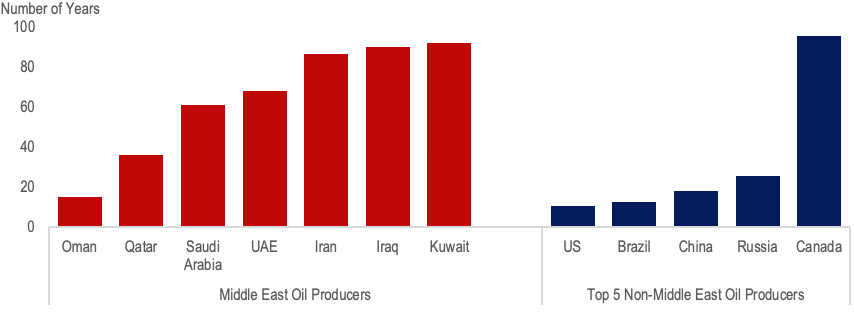 Click to enlarge
Source: BP. Statistical Review of World Energy, 2019
The domestic energy transition: Increasing oil and gas exports from the Middle East
The Middle East is truly a unique region with respect to its limited energy diversification, regardless of whether countries are net importers or exporters of oil and gas. The dominance of these two hydrocarbons in the region’s primary energy and electricity mix is remarkable. In countries like Kuwait and Saudi Arabia their contribution is nearly 100 percent. Outside the region, the mix is much more colourful as countries meet their energy needs from a greater variety of sources of energy, from fossil fuels to renewable and nuclear energy. Overall, the Middle East is the least diversified in the world with respect to the primary energy mix:
Electricity generation by fuel, 2018
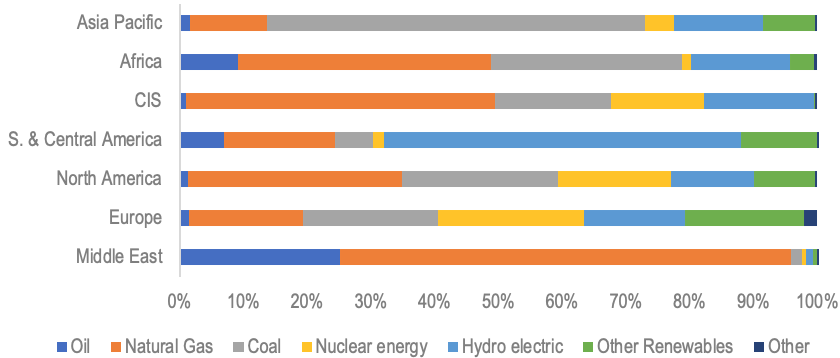 Click to enlarge
Source: BP. Statistical Review of World Energy, 2019
The region’s oil and gas exporters have set ambitious targets to diversify their energy and electricity mix. The United Arab Emirates (UAE), for instance, aims to obtain half of its primary energy from clean sources by 2050, from less than 2 percent in 2018. This should be a welcome move, from an environmental perspective, especially since the region encompasses some of the biggest carbon emitters (on a per capita basis) in the world. Also, economically speaking, greater use of green energy would free more oil and gas for exports.
The transition of a petroleum-based to a green economy, however, differs from elsewhere. Everywhere, the energy transition does not come cheap. Despite impressive falls in the operating costs of solar and wind power technologies, green energy still requires government support, oftentimes including financial support. For renewable energy, one has to count investment and the full system costs in power generation, not just the generation costs when the sun is shining and the wind is blowing, to take into account the problems of intermittency and lack of storage. For nuclear, the investment costs are substantial, thus making financing on purely commercial terms difficult to obtain and often requiring heavy government support.
In the Middle East, the public sector dominates the economy, especially as far as energy infrastructure is concerned, and the participation of the private sector remains modest. In addition, in many countries, governments have hardly any source of revenues independent from oil and gas. In Iraq, for instance, that dependence exceeds 90 percent. As long as government revenues in the region are dominated by hydrocarbons, hydrocarbon revenues will have to finance the new, clean energy infrastructure.
Once oil and gas have been replaced domestically with cleaner sources for power generation, a virtuous cycle will result: the more clean energy replaces oil and gas in producing countries, the more oil and gas will be available for them to export, and in this way to finance their own domestic energy transition. This reward can be substantial: Saudi Arabia, for example, on a hot day burns more than one million barrels of oil to produce power for cooling. The Middle East in this respect stands out from any other region around the world: here, clean energy substitutes fuels which can actually be sold at a profit. On the one hand, this ultimately provides an incentive to engage in the energy transition. On the other hand, this incentive is inextricably linked to exporting more oil and gas. Progressing the energy transition in the Middle East thus means incentivizing more oil and gas exports to the rest of the world.
A virtuous cycle
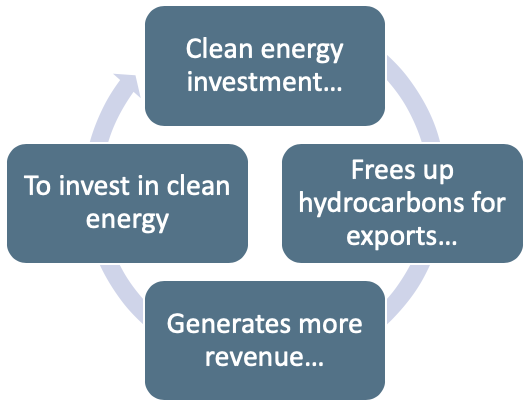
The global energy transition: Increasing oil and gas exports from the Middle East
When analysts discuss stranded assets, they typically take a long-term view of the post-oil and -gas age. However, there will be a considerable period when these energy sources will remain in demand throughout the energy transition, which may span decades. The market for oil and gas during this period will shrink and prices will decline accordingly. The low-cost producers, such as those in the Middle East, will clearly have an advantage and should be the last to leave the market. High-cost producers will be squeezed out first, as they find it hard to sustain production as oil prices decline.
In this respect, the more successful the global energy transition is, the more reliant the world’s economies will be on the Middle East, with significant implications for energy security and geopolitics. Here too, the energy transition will lead to more – not less – oil and gas exports from the Middle East.
No wonder the region’s national oil companies have been pursuing aggressive strategies to expand their production capacity throughout the oil and gas supply chain. In 2018, for instance, Saudi Aramco announced it would invest USD 500 billion over the next 10 years and the UAE’s national champion, ADNOC, announced an investment of $130 billion by 2023, both in oil and gas capacity expansion.
However, to capitalize on such a strategic position, economic diversification is fundamental. As it stands, despite cheap extraction costs for oil and gas, the cost of maintaining inefficient large economies is overwhelming. The Achilles heel of the Middle Eastern oil producers remains their lack of economic diversification and their need for higher prices to sustain their spending. One illustration of the scale of the challenge is the high fiscal breakeven oil prices that these countries require to balance their budget and which has constantly been above market prices in recent years, resulting in substantial budget deficits. Such a structural weakness easily spoils the region’s competitive advantage of being the low-cost producer.
Fiscal breakeven oil prices among Middle East and North Africa oil exporters (USD per barrel)
| 2017 | 2018 | 2019 | 2020* | 2021* | |
|---|---|---|---|---|---|
| Algeria | 91 | 101 | 105 | 157 | 109 |
| Bahrain | 113 | 118 | 106 | 96 | 84 |
| Iran, I.R. of | 65 | 68 | 244 | 389 | 320 |
| Kuwait | 46 | 54 | 53 | 61 | 60 |
| Libya | 103 | 69 | 49 | 58 | 70 |
| Oman | 97 | 97 | 93 | 87 | 80 |
| Qatar | 51 | 48 | 45 | 40 | 37 |
| Saudi Arabia | 84 | 89 | 83 | 76 | 66 |
| UAE | 62 | 64 | 67 | 69 | 61 |
* denotes projections by the IMF
Source: IMF. Regional Economic Outlook: Middle East and Central Asia (2019)
If Middle East oil and gas exporters diligently and successfully pursue economic diversification, they will be able to sustain exports at lower prices, with little economic pain.
What follows next, once the global energy transition progresses significantly, largely depends on whether the region’s oil and gas producers have wisely reinvested their hydrocarbon revenues, so that future income from financial investments will exceed that from hydrocarbon exports. If they do pursue that path, the wealth created from oil and gas will stay with those countries long after these resources’ importance to the economy has faded.