Senegal’s New JETP: Four Crucial Next Steps

In contrast to the JETPs already agreed with South Africa, Indonesia and Vietnam—countries that rely mainly on coal for their energy supply and are among the most polluting middle-income countries—Senegal is a new gas producer with a relatively low carbon footprint and significant unmet energy needs. Although few JETPs have been announced, this one stands out from the previous three, particularly in terms of scope, size and ambition.
Features of the new Senegalese JETP
Financing the development of renewable energies is a major challenge for countries like Senegal seeking to reconcile climate, energy access and development objectives. This JETP’s emphasis on promoting the role of renewable energies in Senegal is most welcome. While the country is poised to become a major gas producer, the government has focused on significantly increasing gas-to-power conversion to meet energy needs. This has risked neglecting the significant potential of renewable energies, to the detriment of these energy objectives. Indeed, prior to this announcement, no additional renewable energy capacity was planned beyond 2025, according to publicly available information. We therefore congratulate the government and international partners on ensuring that the benefits brought by renewables are not forgotten, but rather pursued.
However, the role of gas is an elephant in room that receives a mouse-sized reference in the political declaration (in the form of recognition as a “transition fuel,” a concession to the Senegalese government, whose initial JETP declarations a year ago were directly linked to ambitions to secure funding for gas projects). French President Emmanuel Macron himself was more definitive about the role of gas in the agreement, when he declared in an interview this morning: “... in the case of Senegal, we will allow it to develop its gas projects ... because gas is a transitional energy and we know that the planet will still need it...”
The JETP negotiations are taking place not only against the backdrop of the imminent start-up of gas production in Senegal and major ambitions for gas-to-electricity generation, but also amid a wave of European interest in Senegalese gas supplies to counter energy security risks following Russia’s most recent invasion of Ukraine. Clear communication on the interaction between JETP’s push for renewable energy and the question of Senegalese gas, including whether it is used domestically or exported, is therefore necessary.
For the average Senegalese, the size and price of the overall energy “pie” matters more than the size of the renewables slice alone.
Ultimately, the success of the JETP should be measured at least in part based on Senegal’s overall energy ambitions, not just the percentage of installed capacity that comes from renewables. For the average Senegalese, the size and price of the overall energy “pie” matters more than the size of the renewables slice alone.
Four steps to getting the JETP implementation off to a good start:
1. Remembering that this political declaration is only a first step, paving the way for a series of complex negotiations. If the South African JETP announced in 2021 is any indication, there are still many negotiations and uncertainties before the funds start flowing. (None have flowed to date in South Africa.). This applies in particular to the pace and composition of the EUR 2.5 billion of support mentioned in the recent announcement (for example, the proportion of grants and concessional loans, and their levels of concessionality). Also, while not all this amount will be in the form of borrowing, it will be important to ensure debt sustainability.
2. Allocating funds sooner rather than later. Given the international uncertainty and changing geopolitical dynamics of the energy transition, it is preferable to have the funds to be released by this JETP as quickly as possible, within the limits of absorption capacity. For South Africa, partners have not yet disbursed any of the USD 8.5 billion announced; the investment plan has only just been finalized.
3. Aligning the investment plan with national energy sector reforms that maximize the effect of public spending and induce private capital flows. In addition to helping reduce the high cost of capital for financing renewable energy projects, investments should support national reforms that facilitate the rapid growth of renewable energies and unprofitable projects in which profit-seeking investors will not invest, and support measures that mitigate the real and perceived risks of investing in renewable energy.
4. Achieving greater transparency and a more inclusive consultation process. As Senegal’s JETP process progresses (including around the investment plan and the associated process around the long-term low-carbon development strategy), it is essential that there is transparency and an inclusive consultation process that involves Senegalese civil society, the private sector and all key stakeholders. A participatory, people-centered approach to discussions on energy transition and the JETP has been lacking in Senegal to date, and it is worrying that the political declaration makes no real reference to the role of the Senegalese people in the next stages of the JETP process. We encourage the Senegalese government to prioritize consultation and inclusion to ensure the successful implementation of the JETP.
This JETP offers a unique opportunity to transform Senegal’s current energy system—improving access to cheap, clean and secure energy. Its success is important not only for Senegal, but also for the world, as it could serve as a model energy transition mechanism that could be replicated in several gas-producing countries.
One Year of War in Ukraine: The View from Resource-Rich Developing Countries

Listen to this post · One Year of War in Ukraine The View from Resource-Rich Developing Countries
Russia’s invasion of Ukraine has uniquely affected developing countries rich in oil, gas and minerals. Translating resource wealth into economic and energy pathways that benefit all citizens has been a longstanding challenge in such countries. A year of mixed messages, market turbulence and persistent vested interests have added further complexity. Policymakers in resource-rich countries—and their international partners—have three opportunities to advance economic and environmental sustainability.
Invest in renewables and equitable energy access
Coming on the heels of the pandemic recovery, the war in Ukraine threw the global energy transition into doubt. Prioritization of energy security pointed to a resurgence of demand for fossil fuels. Oil, gas, and coal prices rose as Europe scrambled to secure alternatives to Russian supply. Expectations across African gas-producing countries soared, and Colombian coal exporters were likewise buoyant as coal’s share of EU power generation reached its highest point since 2018.
Yet, a year later, policy responses to the war have actually turbocharged the global energy transition. Global capital expenditure on wind and solar assets surpassed investment in new and existing oil and gas wells for the first time. In 2021, wind and solar already made up 75 percent of all global power production capacity added, as fossil fuels additions hit a record low (14 percent). In pursuit of greater energy security, countries that have historically imported large amounts of oil, gas and coal have doubled down on domestic deployment of renewables. Europe launched its REPowerEU package less than three months after the invasion, promising an aggressive expansion of wind and solar power and new energy efficiency measures. Even if delivering on that ambition by 2030 remains a challenge, Europe made steady progress in 2022: wind and solar power generation reached record levels and exceeded gas generation for the first time. The U.S. Inflation Reduction Act represented the most significant expansion of public spending on the clean energy economy ever and has pressured the EU to keep up the pace of its own financial outlays.

As a result, policymakers need to plan for economic and energy pathways beyond fossil fuels. For the first time, the IEA’s World Energy Outlook (WEO) 2022 contains a prevailing policy scenario (called STEPS) that projects a global peak or plateau for all fossil fuels, with total fossil fuel demand falling steadily from “the mid-2020s.” Policymakers in low- and middle-income exporting countries need to factor the resilience of the global energy transition—and its implications for their countries’ revenues—into economic and energy transition planning. These countries should redouble efforts—and international partners should support them—to boost their own energy security through faster deployment of renewables.
Low- and middle-income fossil fuel-producing countries are particularly vulnerable to energy shocks. They were fully exposed to the turmoil, unlike wealthy countries that spent upwards of $500 billion to shield consumers from price shocks. Paradoxically even Africa’s largest oil producer, Nigeria, saw businesses struggle as diesel prices increased by more than 200 percent shortly after the invasion. And rising gas prices made utility-scale power generation much more expensive in markets like Côte d’Ivoire, Ghana and Nigeria. The IEA reported that the number of people without access to modern energy services rose for the first time in a decade. Around 75 million people (more than four times the population of Senegal) who recently gained access to electricity now risk losing the ability to pay for it, and 100 million people may be forced to revert to traditional biomass for cooking.
Investment in renewables, advocacy for international financial and technical support and equitable energy access are priorities. Annual clean energy investment in emerging and developing economies (excluding China) has remained flat since the 2015 Paris Agreement. And yet the IEA STEPS scenario makes clear that these countries require the greatest growth in renewables investment in the 2020s. To meet necessary energy demand growth, governments in developing oil- and gas-producing countries need to develop their pipeline of “shovel-ready” wind and solar projects. They can also work with international partners to prioritize public investment around hard-to-finance areas that will unlock large-scale private investment in renewables. Policymakers also need to develop governance frameworks that equitably share renewable energy’s developmental benefits, expand energy access and economic opportunities for the most vulnerable populations, and prevent harmful community impacts and corruption.
Improve minerals governance to seize energy transition opportunities
The conflict has heightened global concern about a stable supply of transition minerals. The accelerating energy transition and the impact of the conflict on the gas supply chain has spooked officials in major consumer countries, who see control of transition minerals as a matter of energy security. The world’s top three producing nations for each of lithium, cobalt and rare earths control more than three-quarters of the global output of each mineral. Processing of transition minerals is even more concentrated. This significantly increases the risk of supply chain disruptions due to trade restrictions, conflict, climate impacts or other shocks affecting major producing countries.
Officials in G7 countries are particularly concerned by China’s important role in the transition minerals supply chain, due to its significant domestic resources (e.g., 60 percent of global rare earths production in 2019), overseas investments, and key processing role in many commodities. Fears that Beijing could restrict access to minerals in case of a severe geopolitical crisis (around Taiwan, for example) have motivated initiatives such as the U.S.-led Mineral Security Partnership.
Competition for transition minerals opens economic opportunities for producing countries. The imperative of securing supply was on full display at this year’s African Mining Indaba, where Mineral Security Partnership envoys met with African officials to discuss financing and other support to transition mineral mining, processing and recycling. African countries such as the Democratic Republic of the Congo are already essential suppliers of metals for electric vehicles and of other transition minerals. And Africa’s geology is also relatively underexplored; many African countries have the potential and ambition to play a more important role in mineral supply. At the 2022 Summit of the Americas, Argentina and Chile launched a bilateral lithium working group, and Bolivia and Mexico have worked to foster regional cooperation around value generation, royalties and industry standards.
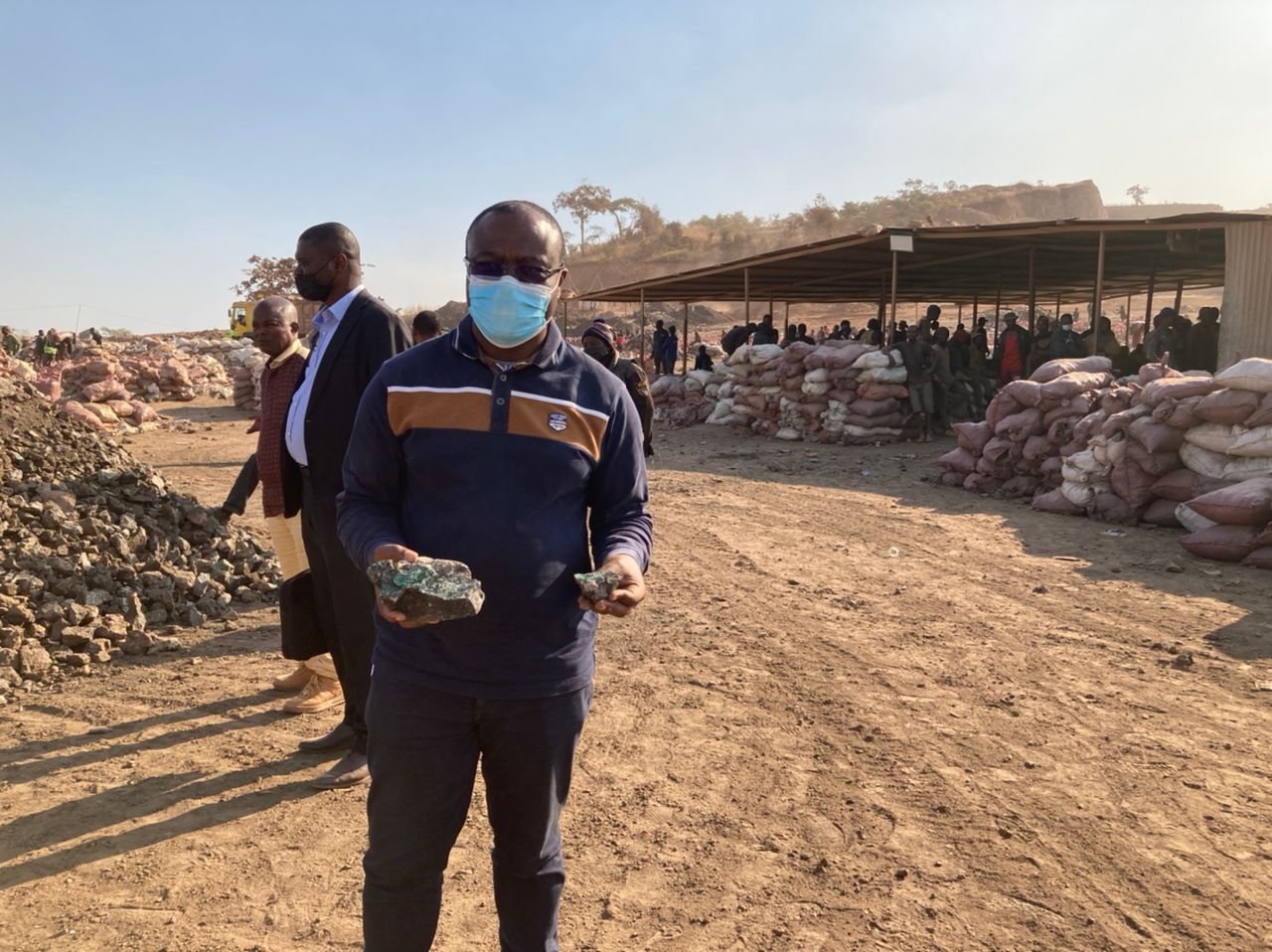
Good governance—increased transparency, open public dialogue and policy reforms that advance the public interest—is essential to seize opportunities. By prioritizing good governance, transition mineral-producing countries in Africa and Latin America can leverage the opportunities presented by competition for minerals in an accelerated energy transition. To deliver a “triple win” for their citizens, the environment, and the energy transition, many of these countries need to undertake urgent policy reforms, putting mining governance (including anticorruption measures) at the center of their policy plans.
Support the increasing range of anticorruption efforts
Kleptocrats have been put on notice. The 2022 energy crisis initially prompted an “anywhere but Russia" approach. However, there is a growing call for action against kleptocrats like Vladimir Putin who use fossil fuel wealth to perpetrate instability and aggression. A year on, in Europe and North America, policymakers have ramped up measures to crack down on dirty money flowing into their jurisdictions. From Nigeria to Angola, Azerbaijan to Belarus, those who steal wealth generated from their countries’ resources to invest in property and other luxuries are already being exposed, at home and abroad.
Leadership on anticorruption will help to secure economic opportunities. Growing demand for transition minerals brings its own corruption risks. Producing countries should ensure transparency over contracts, payments, commodity trading, and beneficial ownership; implement robust measures to prevent elites from capturing opportunities; and enforce accountability mechanisms to hold wrongdoers to account. And initiatives like the Mineral Security Partnership and EU Critical Raw Materials Act must be equally tough on corruption. By focusing on this good governance, policymakers can prevent public funds leaking out into private hands, and better respect local communities, protect the environment, and prevent disruptions and delays to supply. NRGI colleagues found that of three factors identified as shortening mineral production lead times, better governance is the only one within policymakers’ control.
Prioritizing the development of new economic and energy pathways, seizing opportunities presented by transition minerals and promoting good governance will help ensure policymakers in Africa and Latin America navigate the geopolitical and market forces unleashed by the war in Ukraine for the benefit of their citizens.
Net Zero is Impossible Without Africa’s Transition Minerals

This month, cinemagoers will flock to see Black Panther: Wakanda Forever, seeking thrills from superheroes in the fictional African country which is rich in a world-saving metal vibranium. Meanwhile, in the real Africa, world leaders have flocked to the COP27 climate conference in Egypt, aiming for progress on agreed emissions reductions.
While the top brass at COP are surely too busy to catch a movie, the return of the Black Panther should remind them that African mining is highly relevant to their goals: buried in the soil of the host continent are the metals critical to moving away from humanity’s reliance on fossil fuels.
The main task of world leaders and climate negotiators in Egypt is to secure the path to emissions reductions. Yet they’re paying scant attention to the metals needed to move away from high-emitting fossil fuels...
Road to COP27: Positioning Africa’s Civil Society and Citizens on Climate Change, Energy Transition and Extractives
With COP27 on the horizon, NRGI, Econews Africa, Oxfam, Publish What You Pay (PWYP) and Tax Justice Network Africa convened a series of webinars, "East And Southern Africa Civil Society Organization Energy Transition Joint Capacity-Building and Road To COP27," drawing on various experts and experiences from the continent. The series shared lessons and aimed to build a common voice on what the energy transition means for Africa and its people. The events took place between April and October 2022.
Watch them here:
Climate Change and Energy Transition: What Are They and What are the Issues?
Energy Transition and the Future of Oil, Coal and Gas Extraction
Exploring Sustainable Pathways to Energy Transition: Are Investments in Renewable Energies Sustainable for Africa?
Minerals and the Energy Transition: Key Findings and How Africa Can Leverage Its Potential
Positioning Africa’s Civil Society and Citizens on Climate Change, Energy Transition and Extractives in Readiness for COP27
Two events were also organized as part of the Alternative Mining Indaba:
The Resource Remix: Europe's Gas Crunch, African Supply, and the Energy Transition

The Resource Remix is a podcast from the Natural Resource Governance Institute exploring new futures for commodity-exporting countries in the energy transition.
In this third episode of NRGI's podcast, available on Apple Podcasts, Google Podcasts and Spotify, NRGI’s Silas Olan’g converses with Crystol Energy CEO Carole Nakhle and Theophilus Acheampong, economist and political risk analyst, and senior lecturer at the University of Dundee.
NRGI · The Resource Remix - Episode 3 - Europe's Gas Crunch, African Supply, and The Energy Transition
During their conversation, Nakhle, Acheampong and Olan’g explore the implications of Russia’s war in Ukraine on global energy markets, how it has prompted many countries to reevaluate their dependency on Russian oil and gas, and what Europe’s subsequent demand for gas means for African countries. They discuss whether the current geopolitical climate and market dynamic presents African oil- and gas-producing states with opportunities or risks.
With COP27 on the horizon, the three experts deliberate on whether recent developments will influence African producer countries’ energy transition plans, and to what extent. Acheampong points out how the crisis has exposed how energy security seems to come above all else, including achieving climate goals. With prevailing energy poverty across the African continent, Acheampong argues that African countries shouldn’t have to choose. Concurring, Nakhle affirms that, while domestic energy supply should be the priority for African countries, ensuring the energy transition and safeguarding energy security are not mutually exclusive. But, she adds, this hasn’t happened in practice so far, noting that governance should underpin any efforts to achieve both.
On to the topic of financing the energy transition, Olan’g highlights that the European Union, and other wealthy importers, haven’t yet met their existing climate finance commitments. Acheampong but adds that investment opportunities also exist elsewhere and must be considered.
***
Transcript:
Silsa Olan’g, NRGI: The 27th Conference of the Parties will take place in Egypt this November. The so-called African COP will be the first major climate conference in the wake of Russia's invasion of Ukraine. The war has had implications on global energy markets. Much attention has focused on how African countries from the Cape up to the Mediterranean have reacted to the shockwave. For many years now we have heard that fossil fuels must go. But suddenly European countries are hunting high and low for natural gas, including in Africa. This dash for gas has exposed double standards in energy access and achieving climate goals. What opportunities might resource-rich African states have in these tumultuous times? And how will this affect African governments and citizens’ agenda at COP27?
Welcome to The Resource Remix, a podcast from the Natural Resource Governance Institute. We bring listeners dynamic perspectives on the cutting-edge issues affecting countries rich in commodities in the context of the energy transition. I am Silas Olan’g. I have been with NRGI for more than a decade. And now serve as the organization's Africa energy transition advisor based in Dar es Salaam, Tanzania. Two guests join me today to dive into the prospects for African countries in this new energy market landscape. Our first guest speaking to us from London is Carole Nakhle. Carole is an energy economist, founder and chief executive officer of Crystol Energy, an advisory and research firm, and a member of NRGI’s Governing Board. Carole, welcome to NRGI’s podcast.
Carole Nakhle, Crystol Energy: Hello Silas. I am very happy to join you today.
SO: Thank you. We also welcome Theo Acheampong. Theo is an economist and political risk analyst and a lecturer at the University of Dundee in Scotland where he is speaking to us from today. Theo, you are most welcome to the podcast.
Theo Acheampong, University of Dundee: Thank you very much, a pleasure to be here.
SO: Thank you both so much for joining me in this episode.
Russian invasion has prompted moves by many countries to reassess their reliance on Russian oil and gas and reduce their dependence on its imports. Many articles have sprung up with commentators, discussing how world leaders desperate for energy are turning to Africa for its reserves of oil and gas, considering them as potential beneficiaries of Europe’s supply gap. In May, the EU published its energy strategy, but the strategy leaves many unanswered questions. Carole, now that it has been some months since the initial market shock, what is the clear-eyed view of the coming two to three years? Are some of the countries likely to profit from the current context of increased European demand? If so, which countries and in which way?
CN: Thank you, Silas. Well, first of all, before I answer the question, it is very important to clarify to the listeners and viewers that the crisis we are seeing today in Europe and elsewhere – because the record high gas prices that we are seeing currently are not only in Europe but also in Asia, even North America – it is not caused by Russia's invasion of Ukraine. It is, of course, that factor that the geopolitical development plays a very important role, but it would be naive to blame it all on the war, because some dynamics have been happening in gas markets over decades, including the development of LNG trade, which I think, last year or 2020, but probably last year, if I am not mistaken, for the first time overtakes pipeline trade. So, there is this globalization of gas markets. Of course, we are very far from what we have in oil markets, but the fact that you have more LNG trade happening than originally, markets that were independent of each other – so European would not really care about what was happening to the Asians, the Asians would not care what was happening in North America – this is not the case anymore today. Today if Asia catches a cold, Europe sneezes because of LNG trade, that's very important. I am saying that right up front, because it has implications for existing and potential producers, especially exporters of LNG, whether by pipeline, for example, from North Africa to Europe, or LNG exporters, including in West Africa, but even more so in East Africa, with the likes of Mozambique. They will be facing a completely different market than, for example, what they faced a few years ago.
Now to go back to your question about the outlook for the gas situation in Europe — what that means for African producers, current and future. And I insist on “the future” because we shouldn't underestimate the role that East Africa will play in the next few years. But, first, in the short term, if I focus on this winter, because gas demand increases in winter in Europe, I am more pessimistic because you've got to see usually gas demand increase around this time. If winter is going to be as cold as it was a year ago, then we should expect the most important consequence, which is higher prices. And we're already seeing record prices across Europe, and then in the longer term, after that, things should start to ease up. But I am an economist, so I have to say that high prices may be the solution to high prices, and I say it may be, because it depends also on what governments are doing, and see, as you highlighted, that in your opening remarks about the kind of contradictions and new terms that we are seeing. Because for years, if not decades, the rich countries, the OECD countries, blamed or recommended the developing countries for giving subsidies to their people, energy subsidies for self-use subsidies. Guess what? They are doing exactly the same today and giving subsidies to the rich and poor alike. So that is one aspect. I had to get it off my chest because it really bothers me as an economist.
But if we think about the high price signal, that is pushing consumers to adjust their demand. They are looking for an alternative, they are even thinking about which room to congregate into the winter and avoid using other rooms in the house if they have more than one room, let's say, in a house. We are seeing on the biggest scale the switching from gas to a targeted source of energy. Nuclear is one option, and renewables is another option. But ironically, we are seeing a shift to coal. We are seeing a shift to oil products, such as diesel. So that is another reversal and climate change and energy policies we are seeing in Europe. And they are scrambling to find alternatives for supplies coming from Russia because Russia for decades has been the largest, or was maybe, today's not anymore, the largest supplier of gas to the continent. But that means, maybe on the face of it, you would say, Okay, that's great. That will be an opportunity for African gas producers. But there are two things I want to highlight here.
First, they are not the only ones eyeing the European markets. You have American LNG increased by more than 70 percent compared to last year for the first quarter of this year. They love to send their gas to Europe, and don't forget the American-sanctioned Nord Stream 2, the pipeline coming from Russia to Europe from last year. So, it is not after the war. It was long before the war started. So, for the Americans, the European market is very attractive. So African producers will have to face the reality that there will be greater competition from the Middle East, Qatar, for example, from elsewhere. Everybody wants to send their gas to Europe. But the second thing, and that's a big question. Does Africa have the capacity to increase its exports beyond what they have today?
Let me focus on North Africa, and I leave it there, and then I let Theo elaborate more on sub-Saharan Africa. But look at Algeria, look at Egypt, especially Algeria, its export potential has been declining because its production has not been rising as fast as its consumption. So local consumption has been growing very fast because of different unattractive, irrational policies, economically speaking, and as a result, if they don't keep up with investment, if they don't keep up with increasing production, and they don't slow down the growth in demand, I think we should be realistic about how much more Africa can send to Europe. I'll leave it there, and we can elaborate on the rest later on.
SO: Thank you very much, Carol. From what you're saying, several established producers, Algeria, Angola and Nigeria seem already well positioned to benefit from this demand. As they are already reaping higher revenues from the spike in oil and gas prices. Countries with projects due to start within the next year or so, such as Mauritius and Senegal, I think they will likely also benefit from the higher prices. Others, on the other hand, where investment decisions on key LNG projects are still pending, could end up suffering larger financial risks than benefits. I am thinking of Mozambique, for example, given security challenges, and, of course, my own country, Tanzania, due to ongoing negotiations and outstanding project design processes. Is there a risk of heightened expectations not being made for certain producer countries, especially in sub-Saharan Africa? And what are the risks associated for some countries in attempting to meet European demand? Theo, I would really like to hear your views on this.
TA: Thank you very much, Silas. And again, it is a pleasure to be here. Let me also start with a much broader-level remark, and then we can look at the specifics.
I think what is interesting is that we live in quite extraordinary times. In my relatively short life, I have seen at least three crises, if not maybe four. From the financial crisis of 2008-2009, and then the commodities price lump of 2014-2017, then we had COVID, and, just as the recovery was gaining momentum, now we're dealing with the aftershocks of the Russia-Ukraine war or conflict, and, of course, that has had some major repercussions in terms of the global energy geopolitics or the dynamics. For me, what is kind of interesting, as you already allude to in your opening remarks, is the fact that there seems to be a change in tone.
Only from a year ago, when a lot of the European and Western nations were saying, we're going on net-zero, and the environment is the key consideration, but rather we've seen energy security and issues of access and affordability becoming the dominant theme in the global energy debate going forward. And of course, some have even said that it is quite hypocritical in a sense that some of the developing countries, including those in Africa, haven't been given as much of an opportunity to also develop their own domestic energy resources, which are mostly fossil fuels, by the way. But I think the tone has changed and because Europe especially is looking to fill its energy supplies with alternative sources, Africa, then, of course, comes strongly into the question. As you rightly pointed out, in terms of the gap, or the size that needs to be filled, a couple of numbers may be able to help you put things in a better context.
Then we look at specifically which of sub-Saharan African countries are likely to benefit. If so, when and how? So? We know that Russia has about 17 percent of the world’s production of natural gas. I checked some numbers. It is about 25 Tcf and about 40 percent of the European or EU import historically has come from Russia. If we look at the African context, Africa has just about 7 percent of the world’s production of natural gas, and you're expecting to ramp this up to about 350 billion kilometers or 12.4 Tcf. The earlier production is about 9 Tcf. And if you look at how much the size of the gap is, I don't think that African countries would be able to fill that in the short term.
So there are several issues, but it really comes down, in my view, to about four, some of which Carole talks about. The first one is the availability of spare capacity or how much countries would really be able to ramp up their production even the one year to be able to augment the sort of supply deficit that the Europeans are looking for. And related to that are also issues of logistics and infrastructure. If I take Nigeria, for example, which has the highest gas reserves in Africa at about 207 Tcf. Last year they were only able to produce 2 Tcf. And exported 1 Tcf out of that. Predominantly it comes down to financing issues. It comes down even to issues of theft of petroleum products, including the landscape or the regulatory landscape not being fully harmonized. So, I think it is not really a problem of reserves per se. But how fast African countries can ramp up that production. And this is where given the logistical issues, given that the gas markets are not fully formed, I don't really see any potential beneficiaries in at least the one-year outlook, I think. Of course, we've seen Italy trying to negotiate for more gas from the likes of Algeria and Egypt, and some of the production may go up, but in terms of sub-Saharan Africa, when I look at Nigeria, or Equatorial Guinea, or Mauritania, Senegal, or Mozambique, and Tanzania, or even Republic of Congo, I think, in the one year highly unlikely. Beyond that, in maybe two to three, you can even say four years, there is a possibility of that happening. But again, it takes a lot to develop these gas projects and policy will play a role, regulation will play a role, and ultimately even the direction of the war will play a role in terms of these alternative supplies from the likes of the US and the other Middle Eastern countries who are able to much more quickly ramp up capacity and take market share.
SO: Thank you very much. So yes, capacity is a real issue, and because we’re are looking into one year, two years is okay. But there is a big question as to how long Europe will continue demanding gas, given that they are also developing their own energy transition. So indeed, Europe is looking for gas now and not necessarily in the long term, which may lead to a disconnect somehow, because we're looking at, on the one hand, the capacity gap requires significant investment in Africa, for example, producing countries. On the other hand, Europe is also going for the countries, as you mentioned, the US and others. So I think Europe is looking really for renewables as well, and this is where the disconnect is.
This is a warning to gas-producing countries in Africa when setting their priorities, as you talk about setting up the policies, but if they are setting the policies looking into the European market, while the European market, again, is trying to focus on renewables, what does this mean in terms of a long-term engagement with Europe from African producer countries?
CN: What you're touching on is a very important question that I asked myself recently when I wrote an article on policy confusion that you are seeing across the Western countries, in particular the EU and North America, and the UK as well. In the sense that we see these governments are asking, oil companies are asking oil and gas producers across the world, including Africa, to produce more oil and gas, and send it across to Europe to help them temporarily with the crisis. But, as we all know, oil and gas projects are by their own nature long-term. So by the time you take the investment decision to commit the capital, it will take a couple of years before you start producing, and then you're not going to produce for a year or two. You are hoping to produce for the next 20-30 years, and if the outlook for those 20-30 years is hugely uncertain, then why would you bother and commit today? So this is really the fair position and questioning that existing producers are telling those consumers. Those consumers are telling them we want your gas, but only to help us through the crisis, to help us through this winter, and maybe next, until we beef up our capacity of nuclear and renewable energy.
But let me tell you an example of a country that doesn't often come to my mind. And this is a European country, Norway. So, just to understand the position of African countries. Let's look at a country in Norway, that is the closest to the EU in everything culturally, values, principles, legislations, regulations, you name it.
Norway made it very clear in May. The Minister of Energy said it openly. If Europe commits to buying more gas for the long term, we can help it replace Russian gas. And that's why, a month or two later, if I am not mistaken, there was EU-Norway energy cooperation where the EU openly said that it supports Norway's continuous exploration and production of oil and gas for 2030 and beyond. So that was a clear reassurance that the EU gave to Norway to say, we'll continue buying your oil and gas, continue investing. Why would it be a different position for African countries? So African countries should also get the same commitment from European customers who are desperate for gas that they want to maintain their gas demand for many years to come. if they don't want it., there is China on its own. If you look at the expected increase and the demand for China for the next few years on its own, it can capture all the additional capacity in expansion in liquified natural gas and LNG. So this goes back to the point I said earlier about the globalization of gas markets. It is not any more Europe on its own telling producers, “send me your gas.” If Europe is not going to be more linear and understand the position of oil and gas producers in Africa, Europe will lose it to Asian consumers who are very hungry for natural gas.
SO: Thank you very much. As we approach COP27, it is important to consider the impact of recent developments on the energy transition that we have been speaking about and the implications for African producer countries and their energy transition plans. Theo, you have shared elsewhere how wealthy countries have not delivered on their climate finance promise to sub-Saharan African countries. Some people have suggested that African countries shouldn’t pursue plans to extract gas in a world of crisis and gas supply crisis, balancing the climate crisis and gas supply crisis somewhat competing. And can be tricky. Should issues, such as who gets to extract fossil fuels and which projects are financed, be revisited in the pursuit of a more equitable energy transition? Is Europe’s sudden interest in African gas hypocritical, especially as Europe pressures African country to meet green goals or potential revenues from gas is worth it? Theo, you have spoken a lot about that.
TA: Yeah, very interesting question. And let me piggyback to what Carole said earlier. If Norway can still produce oil and gas in 2030 and beyond, if the UK in their new energy strategy clearly outlined the role of oil and gas, even in the US, again, oil and gas being a mainstay even in 2030 and beyond, then I ask myself, why must it be different for Africa in that sense? Because at the end of the day what this crisis has shown above all else is that energy security comes first. And Africa for that matter must also prioritize meeting its own domestic energy security needs. And then the rest, of course, for export to wherever the market may be. And as Carole actually told us, the market is not necessarily in Europe, and if you do a 30-40-year demand projection, the market is elsewhere outside of Europe, and the technology is also available now to even produce some of these fossil fuel resources and reduce the carbon intensity of that production process.
In my sort of limited world where I sit, I don't really see a disconnect between the climate objectives and energy security in terms of access and affordability, what we typically in literature will call “the energy trilemma,” and more so, for Africa, because, again, what this conflict has shown, and even COVID has also shown is that we have very fragile energy systems, you have deepening or prevailing energy poverty on the continent, and we need all the resources to be able to address those concerns around energy security, and in that regard the fewer choice to plug that gap, I don't think African countries should be forced into the binary whole of having to choose between renewables and/or oil and gas in that matter. When you even talk specifically about the overall emissions, if you take Africa as a whole, it is actually less than 4 percent of the total CO2 emissions cumulatively to date. If you look even specifically within the energy systems of many African countries, I argue, that it is largely already decarbonized except for South Africa, where coal is the most dominant. So I think the issue of the just and equitable transition is very much paramount at the heart of the continent.
But it shouldn't be made to look as though you have to choose one particular technology option and/or the other. When it comes to the financing issues again, this is where you see quite a bit of geopolitics also at play. So we know from some estimates, including a very recent study done by the climate policy initiative that Africa as a whole, needs about 250 billion every year between 2020 and 2030. We are already two years into that. If you look at last year's numbers and the flux, the continent got just a little around 30 billion coming in terms of these financing flows. And, interestingly, most of them actually went into mitigation, less into adaptation, where the research also shows African countries are heavily exposed, and even on the financing flows, many of these are coming in as loans interest-bearing commercial laws, and less as grants. So, in a sense, you see a lot of African countries caught in this quagmire. But I don't think that the solution should be one to force a technology choice on African countries, one even in Europe, the main producers as to exploring their oil and gas deposits and number two, the issue of the financing, I think, is going to be absolutely critical, especially at COP where many of the financing flows would need to be increased, and when it comes to things of the mitigation financing, and of course, the other one, which I forgot to mention, is the issue of loss and damage for historical emissions.
SO: I cannot agree with you more. Indeed, in a recent media appearance, my colleague, Thomas Scurfield also noted that European Union and wealthy countries, in general, must meet their existing climate and finance commitment before new European Union investment commitment and funding pledges can be taken seriously, particularly in Africa, where they have not made those bridges.
Building on sustainable and reliable domestic energy systems is another crucial aspect that's just mentioned. I think in the end, in the EU energy strategy this has not been clearly addressed, and many of the commentators in the Western media also noted that. But today, 600 million people in Africa still lack access to electricity and Europe wants to find as much gas as possible in Africa and other regions. It doesn’t sufficiently support energy access for market references on the need to diversify its own energy sources. I think, Carole, you mentioned this before. What are and should be the priorities for export business domestic consumption in Africa? I would like to hear from both of you.
CN: For long we all believed that in the case of gas, and in particular in the case of Africa especially, I think, the priority should be given to the local market, to the domestic market. Because if you want to really have economic development, you need to give access to energy.
You need to allow that access by developing the local market, by putting the regulations in place, the right pricing systems in place, to build the infrastructure. So if you have gas, and that's why gas by large remains a regional business, and a big chunk of the gas produced is consumed locally, why would it be any different in Africa? I think the main problem in Africa is domestically because of the institutional side, because of the investment climate, and these are things that African countries need to really work on improving the governance of the sector. If they are to seize your portion of the golden opportunity that no other country maybe has in this way, or onahe same scale, not only in terms of oil and gas resources and reserves.
We forget that Africa is very rich in the critical minerals needed for the energy transition. And that's why I will go back to the point that you made. We don't need to choose between oil and gas and green energy, because Africa is blessed with resources that allow the production of both to meet the energy transition while safeguarding energy security. But the experiences show that it is not if you have the resources in the ground you're going to benefit. Look at Venezuela — they have the largest proven reserves in the world, and yet they are not among the largest oil producers in the world because of what was well-known as the resource curse. So let me keep my answer brief to your question, and say, the domestic market should take precedence, but that will not be developed automatically, you need to put in place the right institutional framework to allow that to happen so that everybody benefits from the resources that you have, and the export market can be developed in parallel but should not be given priority over the domestic market.
TA: Just to add a bit to Carole's point, an interesting point, we've been doing some bit of exercise just to see if you doubled Africa's current electricity output to bridge the access deficit, how much more emissions would that contribute if you even had a major chunk of that coming by way of natural gas. And what is quite remarkable is that even if we double the output of power on the continent using the same energy mix as currently pertains, it Is still going to contribute less than 5 percent of the total cumulative greenhouse emissions in that regard. The point here is that seeking to export gas from Africa for me is not necessarily a bad idea, but as Carole said, the important thing is also to develop the regional gas markets.
I have been involved in a few studies, and you can find that there are significant constraints in terms of developing these markets. However, we have an opportunity now with the Africa Continental free trade area to work on some of these issues, such as having harmonized gas pricing, regime, the issues about the investment requirements, and I think some of the sovereign wealth funds on the continent need to think about pulling some of their resources together, because, after all, if the money is not going to be coming from Europe and other places, if they decide to pull out the investment, we still need to develop these gas markets and there are other groups of money even domestically on the continent, with the sovereign world funds, but also some of the pension funds, et cetera, to put into some of these investment. And of course, you need to address all the regulatory and political risk issues and ensure that you are pricing the gas appropriately and doing that based on what must go to industry, and which ones must go for domestic consumption. Because if we don't develop those regional gas markets, and it is all about export, export, export, then, unfortunately, it is still going to be, in my view, the same old colonial extractivist model, which has dominated the geopolitical order for the last 400 years, with very little trickle-down effects for livelihoods on the continent.
SO: Thank you. To what extent do you think COP27 will be a moment for settling some of these questions? Are there many questions still out there?
TA: I think going into COP27, there are three key things: the issue of energy access, the issue of climate financing, and all around the issue of just transition. But I think really what is important here is that historically, Africa has not had a unified strategy on most of these issues. I think, going into COP, we, as a continent, must present a unified strategy, and the strategy should detail, in my view, our unique circumstances, but also highlight the role that oil and gas would play as an important fuel choice for any decarbonization pathway for the continent. I am not talking about other continents. I am only talking specifically about oil in Africa. In that regard, both oil and gas and renewables would for sure play a big part of that agenda.
I am just worried that the attempt to force this different pathway like it is this and not that, is going to push a lot of the already existing assets for reserves and make them potentially even become stranded in the first instance, and that would already have a cascading impact on the worst energy poverty that we were talking about with about half of the continent not having access to electricity, so the strategy is important, highlighting unique circumstances, and also advocating for more of the financing flows on the continent. And lastly, things around the critical minerals for transition where many of the countries on the continent have one form or the other. But to really make an opportunity out of it, it must be developed on a regional basis.
SO: Thank you, Carole and Theo, for joining me today for this episode of the NRGI podcast. This has been a very interesting conversation, leaving us with a lot of food for thought on what really constitutes a just transition.
For our listeners: please check out the first two episodes on your preferred platforms. We are on SoundCloud, YouTube, Spotify, Apple Podcasts and Google Podcasts. Do join us in the next episode. Thank you.
Disclaimer: Views and opinions expressed in this podcast belong to the individuals featured and do not necessarily represent those of the Natural Resource Governance Institute. The recording and transcript have been edited and condensed for clarity.
NRGI's podcast The Resource Remix explores new futures for commodity-exporting countries in the energy transition.
Oil and Gas Will Not Illuminate a Path Forward for Lebanon

As millions of Lebanese scramble to meet their basic needs and keep the lights on, Lebanon urgently needs a new, more realistic vision of what fossil fuels can do for the country. For years, politicians in Beirut swore that “entering the club of oil producers” would transform Lebanon’s failing economy and crumbling power sector. But that narrative has gone quiet over the last year, after a first offshore well came up dry, the ruling class became unable to operate a functioning government, the pandemic upended daily life and the economy imploded. Now, further drilling offshore is delayed, a second licensing round is on hold, and most people are focused on survival. In this harsh climate, what’s still possible?
In a new briefing, we warn that Lebanon should not stake its economic or energy future on oil and gas. For the last decade, politicians have made vastly differing claims about the size of Lebanon’s natural resource wealth, all based on limited information. The actual size of the country’s reserves remains in doubt, and unless further drilling finds something significant, no company will agree to extract.
Time is also of the essence, because even if there aren’t more delays, Lebanon would not produce any oil or gas until the 2030s—well into the era when extractives companies will be walking away from high-cost deepwater projects in “frontier countries”. In truth, Lebanon’s offshore was already a marginal destination for investment even before the pandemic caused a global slump and the energy transition started picking up speed—despite official claims to the contrary.
What if Lebanon does make a sizable discovery, though, and production starts while oil companies are still interested and foreign demand is solid? While no one can put a reliable price tag on such a scenario, there is no cause to think that oil and gas exports would be an economic “turning point” or a solution to the current miseries. In fact, the experiences of other countries show that becoming a producer could make some of the country’s economic governance problems worse—leading to, for instance, unrealistic budgets, more unsustainable debt and more endemic corruption. At worst, relying too much on fossil fuel exports would prolong the consumption- and rent-based economic model that underpins the current crisis, merely shifting dependence to a new sector.
As delays and obstacles to exporting fossil fuels have grown, the government in Beirut has reimagined its hypothetical gas as a new, cheaper fuel for the power plants owned by Électricité du Liban (EDL), the mismanaged, perennially insolvent state-owned utility. This focus on cost savings is understandable, given the dire need for cash. Yet it could be misleading, as there is no guarantee that burning gas for power will make for significant savings. Routine dysfunction and delays around new gas-to-power projects could even add costs, including big penalties, flaring and the need to fall back on gas imports. The risks that there won’t be domestic buyers for Lebanese gas are very real, considering that the government’s promises to build new gas-fired power plants go back to at least 2010.
Solar and wind, meanwhile, have received far less attention, despite their high potential. Gas versus renewables isn’t necessarily an “either-or” choice for Lebanon, as neither could close the huge power supply gap by themselves and both face serious (and overlapping) commercial and technical headwinds. Yet renewables could offer Lebanon bigger long-term cost savings than gas-fired power, along with other upsides like improved energy security, less exposure to world fossil fuel prices and less pressure on the local supply of U.S. dollars, the key foreign currency in Lebanon’s inflationary, import-driven economy. Political leaders also need to ask whether they will be able to finance an electricity system that depends heavily on gas in the longer term, especially as foreign capital for fossil fuel projects dries up.
This outlook, though disappointing, offer a chance to create a new energy strategy for when the country’s economic and political fortunes improve. To start, the new government should facilitate a multistakeholder risk assessment for oil and gas, to help adjust expectations. It should also set fresh goals and targets for the power sector, describe how gas and renewables will work together in the domestic energy mix, and clarify EDL’s role going forward. Officials should also reassess the investment barriers to utility-grade solar and wind projects and find ways to help lower them. New institutions and regulations may still be needed as well—for instance, a long-delayed power regulator and a distributed renewable energy law.
Leaders should start work on this new strategy now, rather than waiting for foreign donors and international financial institutions to write it for them. As aid negotiations go on, these outsiders will demand preconditions and reforms related to energy, some of which may not be in the country’s best interests. Consider the failed French-led roadmap of 2020, which pressured the government to fast-track arguably unworkable plans for new gas-fired power plants, among other things, in exchange for $11 billion in soft loans. The new IMF talks, however uncertain their prospects may be, should not become the latest chance for an outside actor to shape the story of Lebanon’s energy future.
Starting early, the Ministry of Energy and Water should also communicate, and solicit feedback on, any new direction it wants to take in the energy sector. Assessing needs and managing public expectations will be critical for the success of any new strategy, and no plans should be made without wide-ranging consultations and dialogue, a step that politicians often ignore.
By the end of all this outreach and stocktaking, Lebanon should have a new narrative for what oil and gas can and can’t do for its economy and its citizens. And unlike the old one, this should be based more on facts and hard trade-offs, and less on unrealistic hopes and empty promises.
Rethinking expectations around the future of oil and gas in Lebanon
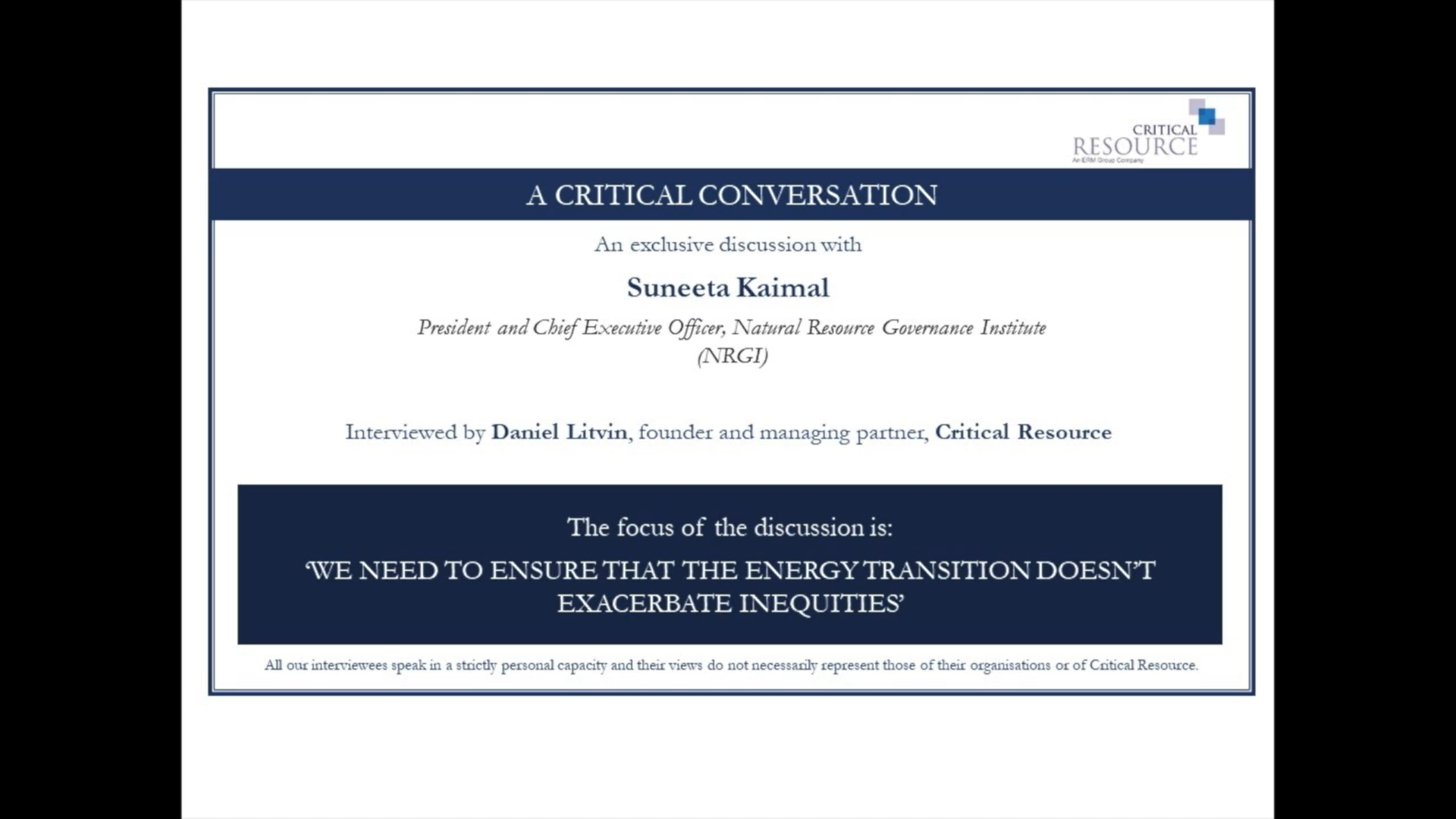
Improving Governance for a Just and Equitable Energy Transition: A 'Critical Conversation' with NRGI's Suneeta Kaimal

Critical Resource's latest "Critical Conversation" podcast features an exclusive discussion with President and CEO of the Natural Resource Governance Institute (NRGI), Suneeta Kaimal, on the opportunity and need for improved governance to manage a just and equitable transition to a decarbonized world.
Suneeta Kaimal was appointed President and CEO of NRGI in February 2021. Previously, she served as NRGI’s Chief Operating Officer and became interim president in 2020, she is also on the board of the International Centre for Not-For-Profit Law, and previously chaired the Open Government Partnership and Publish What You Pay.
This 30-minute conversation was recorded on 22 October 2021, and was moderated by Daniel Litvin, Founder and Managing Partner of Critical Resource.
Among the key points raised by Suneeta:
- The pandemic has been a litmus test for resource governance. Resource rich developing nations have been pushed back into poverty – by 2030 half of the world’s poor will be in resource rich countries.
- Increased tensions between China, the US and the EU are pulling resource rich developing nations in radically different directions, making it harder for them to understand the rules of the game. We need to stand up for the laws and policies we’ve worked together to create and address governance challenges to ensure a greener, more prosperous planet.
- Tax systems have failed to deliver – Sub-Saharan Africa loses $600m annually in lost taxes. For many years, companies have exploited asymmetries of capacity, power and knowledge, with government revenues eroded by lopsided agreements and unnecessary incentives. We need to thread the needle to design taxes that mobilise revenue and attract investment, while being flexible, simple and resilient to changing circumstances.
- Wealthier countries should wind down fossil fuel production first and fastest the hypocrisy of major economies is shocking. G20 countries have poured billions into fossil fuels since the start of the pandemic, and yet are asking low-income producers with small carbon footprints to transition faster than wealthier, high emitting producers. It’s economically and morally unjustifiable.
- We need to ensure that the energy transition doesn’t exacerbate or introduce new inequities. We have to stop repeating the errors of the past and see the energy transition as an opportunity to do things differently.
- The expected boom from mining ‘energy transition metals’ could help countries rich in these resources fund much-needed social spending. It could also engender reforms to the mining sector, making it a greener, more rights respecting industry that contributes to sustainable economic and social systems. However, corruption and mismanagement risks disrupting the supply of critical minerals and leave citizens worse off.
- It is naïve to assume that renewables won’t be prone to similar governance challenges that we’ve already seen in the extractive sector. Applying the lessons we have learnt from oil, gas and mining would enable us to create a greener future grounded in good governance.
This article was originally published on Critical Resource's website.
How National Oil Companies Can Play a Role in Renewable Energy and Diversification

The idea of NOCs investing in clean energy is attractive to both these companies and the governments that oversee them. For NOCs, reallocating part of their portfolio to renewable energy investments could be an opportunity to innovate and diversify their business at time when traditional oil and gas investments are increasingly risky. For the governments of oil-producing countries, the skills, influence and capital of NOCs could serve to promote the fledgling renewable energy sector and provide citizens with cleaner and more reliable energy.
Yet NOCs’ investments in renewables may not pay off everywhere. Many skills and practices developed in the oil and gas sector cannot be easily adapted to renewables. With some notable exceptions, many NOCs have historically struggled to invest in projects that deviate from the core profitability model that characterizes extraction.
In some countries NOCs are the institutions with the greatest capacity to deliver project. But can they become part of the solution to climate change? In a severe scenario, coordination challenges or conflicts of interest could mean that NOCs simultaneously fail to generate strong economic returns and stall broader national progress to develop clean energy markets.
Given these factors, when does it make sense for NOCs to shift toward renewable energy? What policy and governance mechanisms should officials put in place to ensure such a transition is a success? On 27 May, NRGI and IISD co-hosted the second in a series of webinars to explore these questions.
Angela Picciariello of ODI led the discussion and focused on the links between nationally defined sustainability goals and the strategic choices facing NOCs and governments.
Joe Amoako-Tuffour of the Economic Management Team of the Office of the Vice President of Ghana discussed how ideas on the future of the Ghana National Petroleum Corporation (GNPC) fit in with a broader set of policy challenges around building a thriving industry, generating reliable energy and maximizing the use of petroleum revenues in a new producer economy.
Devapriyo Das of the Danish company Ørsted (majority owned by the Danish government) shared lessons learned from the company’s transition away from fossil fuels to becoming a global leader in renewable energy.
Aaron Sayne of NRGI also contributed by posing a series of guiding questions for NOCs and governments to help structure these strategic decisions.
NOCs’ activities within the renewable energy market are still in the early stages, but several key themes have emerged that point to further areas of inquiry, within and across countries.
Intra-government coordination is crucial, and decisions about the evolution of an NOC’s mandate need to be linked to a coherent cross-government strategy. In Ghana, Amoako-Tuffour emphasized that decisions about what role GNPC can play in renewable energy generation or distribution do not depend on GNPC alone. There is a whole range of actors responsible for investment, regulation and revenue in the energy sector. Without careful coordination and strategic decision-making, actions by an NOC alone could fail or disrupt energy policy coherence. Picciariello posited that a clear definition of how the NOC fits into the energy space is critical.
There are different types of NOCs, and not all face the same challenges and opportunities. Sayne pointed out that a key question NOCs and government officials should ask when considering a shift toward renewables is, “What would this NOC bring to the table?” Some NOCs are cash-rich and may be able to drive investment in the sector. Others are small and nimble but could bring their management skills to an emerging industry. Some other NOCs, however, are so deeply entrenched in a status quo approach to oil and gas investment and in oil and gas's dominance of the economy that they may struggle to engage effectively with a new business model. As Amoako-Tuffour noted, the basic notion that an NOC might be interested in renewable energy investment does not necessarily mean that such a move is in the country’s best interest.
There are different types of renewables business models. Just as not all NOCs are the same, there are different ways of defining what it means for a company to “invest in renewables,” and these distinctions are important for national decision-making. One component of this is the type of renewable energy. Ørsted’s transformation has been driven by success in offshore wind, which involves technically-sophisticated projects with heavy upfront costs that require similar capabilities to offshore oil investments. Other types of renewable energy, such as solar farms, may have less obvious links to the core competencies of many NOCs. NOCs must also consider what form of investment makes most sense. Options range from passive minority participation in renewables projects to active partnerships with utilities or other partners to full transition into an integrated energy company.
Governance can either help draw investment, or drive it away. Das shared that Ørsted has been able to serve as a stable and reliable home for a growing number of investors interested in clean energy. He said, the company’s corporate governance instilled confidence that led to growth. In contrast, Sayne pointed out that other NOCs can arouse suspicion among investors, especially when the company’s activities are opaque or subject to heavy political interference in decision-making. If a company has a dominant role without appropriate corporate governance reforms, it could discourage investment in a country’s renewable sector.
Our discussion series aims to increase learning between experts in the extractives governance and climate change fields, who have too often worked in silos. NRGI and IISD will organize the third and final session in the webinar series in the coming weeks. Watch this space for more details.
IEA’s Ambitious Climate Scenario Underscores Need for More Transparency on Fossil Fuel Projects

The IEA experts have articulated several dramatic milestones that would be necessary to reach this critical goal, including:
- no approvals of new oil and gas field development and no new coal mines or mine extensions by this year
- electric vehicles reaching 60 percent of global car sales by 2030
- nearly 70 percent of global electricity generation produced from solar and wind by 2050.
Given that government and industry leaders rely on IEA scenarios in their planning, many hope that these urgent targets will spur much-needed climate action.
Beyond these headline prescriptions, the IEA makes another critical point: changes brought by the clean energy transformation will be challenging to implement, so decisions must be transparent and just. As the gap grows between government and company plans for future production and the levels consistent with a Paris-compliant world, there is increasing attention on how supply-side commitments from oil-producing countries might shape net-zero ambitions. These countries face significant economic shocks as the world decarbonizes: the IEA estimates that per capita income from oil and gas in producer countries would fall by 75 percent under its new net-zero scenario. Even if the world falls somewhat short of the Paris goals, governments in these countries face the prospect of dramatically lower revenues and public assets wasted by excessive concentration in a declining sector. Against this backdrop, citizens in low- and middle-income producer countries will inevitably face major uncertainties in the race to net zero. Access to basic information about how their social and economic prospects are shifting should not be one of them.
Governments and companies must disclose more information of relevance to the billion people that live in poverty in oil- and mineral-rich developing countries, and engage impacted citizens in producer countries as core stakeholders in energy transition policy dialogues. Despite the urgency of the economic challenge they face, many fossil fuel producers have not done enough to develop strong plans for economic diversification or inclusive development in a lower-carbon future.
The allure of oil and gas has thus far been powerfully addictive. Open dialogue between governments, companies, and citizens on the role of fossil fuel production in national economies will facilitate meaningful climate action and improve the prospects of countries that remain hooked on oil and gas. Globally inclusive dialogue is also needed around which countries should reduce production first; developing and emerging market producers are already calling on wealthy countries to lead the decline.
Today, too much information that is necessary for just and effective transition discussions remains hidden from view. Increasingly, debates will center on whether specific fossil fuel projects are viable or not—from both economic and climate perspectives. In many producer countries, the decision to halt or continue one or two key projects can affect the whole economy. Project-focused transparency efforts could support a just transition by helping citizens in producer countries assess the impacts and effectiveness of divestment and economic diversification plans. Greater transparency at this level would also help citizens hold government officials, multinational decision-makers and industry executives accountable for an equitable and well-managed process.
Governments and companies should disclose the following information about fossil fuel projects:
- Exposure to climate-related financial risk. To hold governments and companies to account and determine whether continued extraction or particular project configurations are in the national interest, citizens need: information about the viability of projects and national budgets under various transition scenarios (including the IEA net zero scenario); break-even prices, reserves and potential emissions of current and pending fossil fuel projects; and price and revenue forecasts used by financial authorities. The Extractive Industries Transparency Initiative (EITI) encourages the governments of its 55 implementing countries to disclose information that will further public understanding and debate around issues of revenue sustainability and resource dependence, including official production, commodity price and revenue projections. In practice, however, few countries publish this information, which must change. The EITI Standard should require, rather than merely encourage, these disclosures. The Standard should also require EITI supporting and member companies to disclose their own scenarios, assumptions and projections. United States and European regulators, who are also considering this issue, should also require this project-level information of fossil fuel companies globally.
- Plans for energy transition and production. Governments in producer countries should disclose information about their project divestment (and investment) and energy transition plans, and invite public debate on these topics. Oil companies—both private and state-owned—should also disclose production, energy transition, and responsible exit plans for their projects. They should also engage with stakeholders on the social and economic impacts that project continuation, wind down, or transfer would have on host governments and communities (e.g., impacts on payments to government and local employment, timelines and decommissioning plans). Governments and companies must also disclose the contracts that govern projects so that oversight actors can assess exploration and production rights, project amendment conditions, and adherence to decommissioning and asset sale obligations. At a minimum, both government and company actors should account for how much proposed projects will cost, their carbon footprints, and whether they align with climate goals.
- Financing and subsidization of carbon-intensive projects. Countries should disclose current and proposed spending on fossil fuel projects by national oil companies, public investment in fossil-fuel linked infrastructure, and the value of tax incentives and other subsidies they provide to support fossil fuel projects. They should also disclose the impact various transition scenarios would have on the return on public investment.
- Carbon intensity of production and reserves. Officials and executives should disclose the levels of greenhouse gas emissions (scope 1 and 2 emissions) associated with a project, as well as information necessary to assess the emissions associated with the eventual burning of those fuels, including emissions made abroad after export. This information is critical for informed public debate about the climate impact of a country’s extractive activities. In addition to disclosures around current production, citizens and investors need reliable information about undeveloped fossil fuel reserves, their embedded carbon content and the costs necessary to extract them to make equitable decisions about which countries need to phase out production fastest.
- Influence of fossil fuel interests on policymaking. In some producing countries, political leaders use fossil-fuel revenues to maintain their positions and power, giving them strong incentives to continue production. In others, fossil fuel companies enjoy considerable influence over policymakers. Governments and companies should disclose information that enables accountability actors to monitor channels of influence by vested interests. This information includes the identity of politically exposed beneficial owners with stakes in extractives projects, details about industry lobbying activities and political donations, and corporate reporting on compliance with “revolving door” policies and other integrity measures.
The IEA report makes the case for decisive and immediate climate action. The many necessary steps will require complex negotiation and coordination. But extractive sector companies and governments of producing countries can rapidly implement a core set of project-level, supply-side disclosures that would enable impacted stakeholders to assess project viability and contribute to energy transition plans. Increasing production-related commitments in nationally determined contributions is a clear opportunity. Reporting entities should leverage the readymade platforms and multi-stakeholder networks offered by transparency-oriented forums like the EITI and the Open Government Partnership, and draw on the considerable thinking that already exists on many of the key technical components and data standards that would be central to such disclosures.
What remains unclear, however, is whether an actor or group will take up the mantle of making this critical transparency a global priority and realizing it. We are working with partner organizations to explore how we can jointly push global leaders to step up. With more than 50 global and regional climate-focused gatherings taking place in the next six months, culminating in COP26 in November, the time is ripe.
New Oil- and Gas-Producing Countries Now Have an Online Home

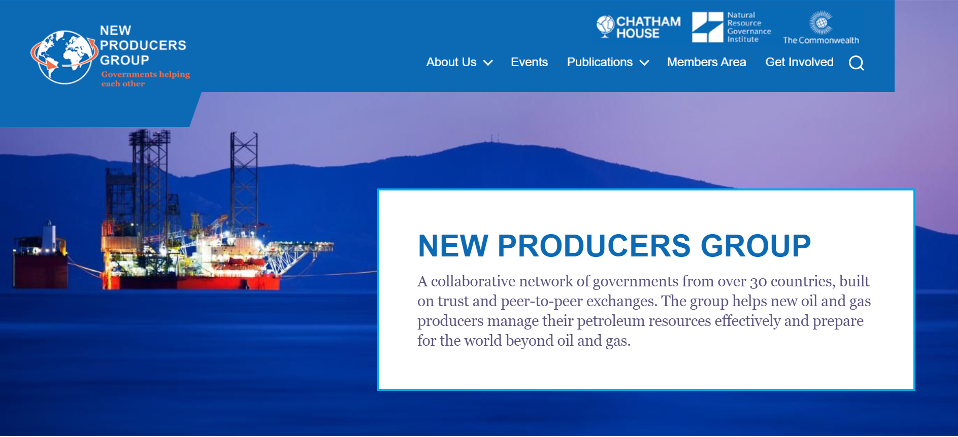
Oil and gas extraction has often failed to benefit citizens in producing countries, and in many cases has exacerbated corruption and environmental damage. The New Producers Group is a network of officials from countries newly producing oil and gas or exploring production, that aims to change that by sharing resources and expertise on how to better manage the sector.
The group—coordinated by NRGI, Chatham House, the Commonwealth Secretariat and more than 30 member countries—has launched a new website that assembles research, videos, and other tools to support governments to develop strong policies, oversight and accountability around oil and gas production.
Climate change has amplified the urgency of establishing responsible and effective management of oil and gas. Developing countries face new challenges in marrying their economic and climate ambitions, and the global commitment to shift away from fossil fuels. Excessive expectations about the benefits of oil and gas production can also lead new producers to take on outsized debt and stifle investment in renewable energy, which could hold more sustainable benefits for the country.
The website hosts publications on topics ranging from the energy transition to building accountability, a roadmap for the group’s plans, and a members’ area where participants can share information and connect with each other. The group is currently focusing its efforts on understanding how oil and gas producers can best prepare for the global energy transition, which was the theme of the group’s 2020 annual meeting.
I encourage you explore the site and share it with others working in this space.