Uganda’s Oil: Seven Recommendations After the Final Investment Decision

On Tuesday 1 February 2022, the project’s joint venture partners, TotalEnergies, China National Offshore Oil Corporation (CNOOC) and Uganda National Oil Company (UNOC), announced that a final investment decision (FID) for Uganda’s Lake Albert development project was reached, a major step in the country’s oil sector. The project covers two upstream blocks and the development of an export oil pipeline, the East African Crude Oil Pipeline (EACOP), which will transport most of the oil through Tanzania to then be shipped overseas. The deal will see investments of about US$10 billion in the development of crude oil production in East Africa, with first oil expected in 2025.
With the FID now announced, Uganda’s government has a few pending critical issues it will need to take into consideration if oil resources are to benefit current and future generations of citizens.
Getting the oil project financed
While FID has been announced, financing is yet to be secured for the development of EACOP, whose estimated cost has jumped from $3.5 billion to $5 billion due to increased costs as a result of production and transport disruptions caused by the COVID-19 pandemic, as well as an estimated additional $4 billion needed for the refinery and refined products pipeline.
For this reason, the joint venture partners in the Lake Albert project and the pipeline have turned to financing institutions. However, most institutions, including the International Finance Corporation (IFC), are hesitant to invest in the project due to the risks associated with the energy transition, as well as environmental and social concerns. The Ugandan government may instead have to turn to non-concessionary loans to finance their share in the joint venture, which could turn out to be expensive in the long run and may affect the returns from the project.
Uganda’s 15 percent equity in the upstream will be financed by the production share, but the Ugandan government needs to secure resources for the 15 percent shares in EACOP as well as the planned 40 percent equity in the refinery. Uganda’s government has fortunately already considered the size of the stake in the refinery it will take and is also already weighing options for allocating some of the shares to East Africa Community (EAC) partners and other institutional investors.
Taking into account investments in renewable energy
At the same time, a Memorandum of Understanding (MoU) was signed between TotalEnergies E&P and the Ministry of Energy and Mineral Development of Uganda for the development of large-scale renewable energy projects, confirmation of the reality of the energy transition, which may affect future oil prices. If the government invests substantial resources in the oil sector, lower returns caused by the risks associated with the energy transition may prevent these investments from delivering a viable return in the long term. The consequence is that some of the investments are likely to become stranded. If the resources are borrowed, it will be difficult for Uganda to repay these loans and this may result in default.
Ensuring long-term benefits from the oil sector
To reach the FID, the Ugandan government had to grant generous exemptions to the international oil companies and to key contractors involved in the project under the EACOP Act (2021). The government also facilitated the sale of Tullow Oil’s stake in Uganda’s oil sector. These compromises will have implications for the optimal design of the revenue management framework and may affect the amount of revenue that would accrue to the government from oil operations.
In addition, the government granted UNOC legal and beneficial ownership of the resources from crude oil operations to enable the company to meet the government’s financial obligations for the oil sector. While this is not inherently a challenge, an NRGI study on national oil companies (NOCs) underlined the importance of accountability mechanisms to ensure that resources under the control of NOCs are managed effectively.
The risks linked to the energy transition may impact how much revenue the project will make as prices are expected to fall over the lifetime of the project.
While oil prices can be volatile, with the FID reached and a break-even price of around $49, the project is now very likely to go ahead. However, the risks linked to the energy transition may impact how much revenue the project will make as prices are expected to fall over the lifetime of the project. If the world meets the Paris Agreement, the Climate Policy Initiative estimated that the Lake Albert project may produce only 81 percent of its reserves, resulting in lower revenues and an early end to production.
Uganda is also due to receive royalties from oil operations. NRGI estimates that royalties of 12.5 percent on average will amount to about $10.5 billion, based on crude oil price of $60 per barrel, with designated oil-producing local governments expected to receive about $630 million over the 25-year lifetime of the project, based on the same crude oil prices of $60 per barrel.
However, the government is yet to designate the local governments that will benefit from royalties. This may likely affect their preparedness to finalize development strategies and benefit from accrued oil revenues.
In order to translate the aspirations of the country into concrete revenues and long-term benefits for the country and its people from oil production, NRGI makes the following seven policy recommendations:
- Strengthen transparency and reporting provisions in the Public Finance Management Act (2015) to ensure that UNOC is managed in a transparent and efficient manner.
- In addition to the fiscal rules set out in the Charter of Fiscal Responsibility (CFR), develop a longer-term strategy to manage oil revenues, particularly in light of the long-term shift away from fossil fuels.
- Undertake periodic reviews of tax exemptions and incentives that may reduce government revenues from taxation of the oil and gas sector.
- Support the capacity of the private sector to engage in the oil sector to enhance backward linkages.
- Publish the list of local governments that will benefit from royalties and support the finalization of development strategies to ensure that local governments benefit from revenues accrued to them from oil production.
- Review the level of stake equity and consider using less risky support to the refinery, such as sovereign guarantees.
- Manage public and political expectations as the oil project may take longer than expected for substantive oil money to flow into government coffers and before local community benefits can be realized.
Governing Africa’s Extractive Resources in Uncertain Times: Perspectives from Ghana, Kenya, Nigeria, Uganda and Zimbabwe

Critical decisions surrounding this transition were at the heart of discussions at the first Africa Regional Extractive Industries Knowledge Hub (AFREIKH) online course, Introduction to Extractive Industry Governance: Policy and Practice, hosted by the Extractive Industries Center (EIC) at Nairobi’s Strathmore University Law School, in partnership with NRGI.
After the course concluded, participants cited the Africa-specific content and the opportunity to learn from peers and mentors as key draws. I spoke with six of our distinguished learners to find out more about what the energy transition means for development in Africa, and how to achieve good governance. These were:
- Feyisayo Ayeni, from Nigeria, operations lead at NC Future Concepts
- Nelly Busingye, from Uganda, development expert, civil society activist and PWYP Africa’s membership engagement manager
- Bernard Kwofie, from Ghana, independent consultant
- Wanjiku Manyara, from Kenya, general manager of the Petroleum Institute of East Africa based in Nairobi
- Thandazile Moyo, from Zimbabwe, researcher at the Minerals to Metals Initiative, University of Cape Town
- Learnmore Nyamudzanga, from Zimbabwe, independent consultant

Clockwise from upper left: Manyara, Moyo, Feyisayo, Nyamudzanga, Busingye, Kwofie.
As you’ll see below, their perspectives were candid, providing insight into what future interventions in the sector should look like. The issues facing the extractive sector are global, but some of the challenges are context-specific. This raises a question regarding the response and whether an Afrocentric approach to addressing problems in extractive sector governance is needed.
As we plan AFREIKH’s next course, we will continue to explore the insights and focus on Africa’s position in this rapidly changing environment. As countries around the world come together to join their efforts to combat climate change, Africa’s policy actors and leaders are challenged to engage in this global discussion and reshape their actions on climate change, the energy transition and the future of extractive industries to avert misgovernance of the extractive sector, mitigate climate risks and seize the opportunities from the energy transition.
Moses Kulaba: What are your thoughts about the potential impact of the energy transition on your country’s development?
Moyo: I am concerned that my country may be too slow in implementing clean energy strategies. As a Zimbabwean living in South Africa, I am familiar with the challenges associated with the use of thermal power, as both countries rely on this energy source. In addition, coal mining creates employment opportunities and contributes to the economy. Given this, I worry that these two countries may fail to take advantage of the opportunities presented by the transition.
Kwofie: Ghana has always been a resource-dependent country, and the discovery of oil and gas in commercial quantities has further increased the country’s resource base. In 2019, oil revenues accounted for nearly 10 percent of non-aid fiscal revenues, and this share is expected to double by 2022. Most households depend on liquefied petroleum gas for domestic activities, such as cooking and, in cities, lighting. Even though energy tariffs, including for electricity, are expensive, moving away from the current system to a new energy economy may lead to a wider energy gap and resource poverty. This could widen inequality and deny citizens access to affordable energy. Both the government and the economy will face fiscal challenges in the form of lost revenues from extraction, and the country will have to look for alternative sources of revenue mobilization. This may eventually impact infrastructure development and growth. The government may miss fiscal targets due to budget constraints.
Nyamudzanga: The reality is that our world is moving from fossil fuels to renewable resources and that fossil fuels have serious negative impacts on our environment. In my country, Zimbabwe, we have good policies but are not “walking the talk.” The issues around energy transition are looked at from a political point of view, which sometimes leads the government to turn a blind eye to the concrete impacts of climate change. In our country, we are experiencing droughts, heatwaves, floods and cyclones as a result of climate change, but at the same time we are celebrating investments in fossil fuels, using electricity from coal, upgrading our thermal power plants and still taking pride in new coal mining.
What should your country do in response to the quickening energy transition?
Kofie: Ghana’s government needs to develop the capacity of its experts to engage effectively with other players in the extractive sector and review its investment plans in the energy sector to focus more on renewable energy. The government should also avoid investing in long-term oil and gas projects and reconsider the national oil company’s focus on its role as an operator. And the government needs to start mobilizing private sector investment in clean energy.
Nyamudzanga: The energy transition must be phased and well managed to reduce energy poverty. Zimbabwe must begin implementing plans to replace fossil fuels with green and renewable energy, because that is the way the world is going. Climate change is real. The younger generation must lobby for this transition because they are the most affected.
Busingye: Uganda needs to facilitate debates on the energy transition. The energy transition is here with us. The various stakeholders must therefore come together to address it politically, socially and economically, so that the transition to greener energy is inclusive and just. Having completed this course, I would like to mobilize other civil society organizations to discuss the energy transition, focusing on the context of emerging producers like Uganda.
Manyara: The breadth and depth of the energy transition haven’t taken root in Kenya. As far as I can perceive, we need to sit down and create a roadmap and action plan for the country’s energy transition, which should then be entrenched and effectively implemented across all ministries’ policies. Developing an objective, pragmatic and realistic roadmap for energy transition in Kenya is paramount, and should not be done as a reaction to the approaches and views of other jurisdictions in the world. We, Kenyans, should discuss and shape this roadmap based on our own capacities and ambitions regarding energy transition.
What does energy transition mean to you and what is one message you have for leaders and policymakers in your country on what they should prioritize?
Moyo: Africa should think of “energy access,” not energy transition. Africa will provide “just energy access.”
Nyamudzanga: [We should] move away from fossil fuels such as coal, crude oil and gas and begin to use renewable energy such as hydro, wind and solar. Let us have policies that promote the use of climate-friendly renewable energy.
Ayeni: The energy transition is an opportunity for developing countries to leapfrog some of the challenges associated with fossil-based resources. I hope that our leaders and policymakers will prioritize the development of public institutions that foster better and sustainable decision-making. For my part, having taken the course, I have gained included an understanding of the specific challenges such as extractive revenue management and energy transition in the context of long-term sustainable development in resource-rich countries and the leading governance and policy strategies used to achieve this.
Respondents’ statements have been edited for length and clarity.
Oil and Gas Will Not Illuminate a Path Forward for Lebanon

As millions of Lebanese scramble to meet their basic needs and keep the lights on, Lebanon urgently needs a new, more realistic vision of what fossil fuels can do for the country. For years, politicians in Beirut swore that “entering the club of oil producers” would transform Lebanon’s failing economy and crumbling power sector. But that narrative has gone quiet over the last year, after a first offshore well came up dry, the ruling class became unable to operate a functioning government, the pandemic upended daily life and the economy imploded. Now, further drilling offshore is delayed, a second licensing round is on hold, and most people are focused on survival. In this harsh climate, what’s still possible?
In a new briefing, we warn that Lebanon should not stake its economic or energy future on oil and gas. For the last decade, politicians have made vastly differing claims about the size of Lebanon’s natural resource wealth, all based on limited information. The actual size of the country’s reserves remains in doubt, and unless further drilling finds something significant, no company will agree to extract.
Time is also of the essence, because even if there aren’t more delays, Lebanon would not produce any oil or gas until the 2030s—well into the era when extractives companies will be walking away from high-cost deepwater projects in “frontier countries”. In truth, Lebanon’s offshore was already a marginal destination for investment even before the pandemic caused a global slump and the energy transition started picking up speed—despite official claims to the contrary.
What if Lebanon does make a sizable discovery, though, and production starts while oil companies are still interested and foreign demand is solid? While no one can put a reliable price tag on such a scenario, there is no cause to think that oil and gas exports would be an economic “turning point” or a solution to the current miseries. In fact, the experiences of other countries show that becoming a producer could make some of the country’s economic governance problems worse—leading to, for instance, unrealistic budgets, more unsustainable debt and more endemic corruption. At worst, relying too much on fossil fuel exports would prolong the consumption- and rent-based economic model that underpins the current crisis, merely shifting dependence to a new sector.
As delays and obstacles to exporting fossil fuels have grown, the government in Beirut has reimagined its hypothetical gas as a new, cheaper fuel for the power plants owned by Électricité du Liban (EDL), the mismanaged, perennially insolvent state-owned utility. This focus on cost savings is understandable, given the dire need for cash. Yet it could be misleading, as there is no guarantee that burning gas for power will make for significant savings. Routine dysfunction and delays around new gas-to-power projects could even add costs, including big penalties, flaring and the need to fall back on gas imports. The risks that there won’t be domestic buyers for Lebanese gas are very real, considering that the government’s promises to build new gas-fired power plants go back to at least 2010.
Solar and wind, meanwhile, have received far less attention, despite their high potential. Gas versus renewables isn’t necessarily an “either-or” choice for Lebanon, as neither could close the huge power supply gap by themselves and both face serious (and overlapping) commercial and technical headwinds. Yet renewables could offer Lebanon bigger long-term cost savings than gas-fired power, along with other upsides like improved energy security, less exposure to world fossil fuel prices and less pressure on the local supply of U.S. dollars, the key foreign currency in Lebanon’s inflationary, import-driven economy. Political leaders also need to ask whether they will be able to finance an electricity system that depends heavily on gas in the longer term, especially as foreign capital for fossil fuel projects dries up.
This outlook, though disappointing, offer a chance to create a new energy strategy for when the country’s economic and political fortunes improve. To start, the new government should facilitate a multistakeholder risk assessment for oil and gas, to help adjust expectations. It should also set fresh goals and targets for the power sector, describe how gas and renewables will work together in the domestic energy mix, and clarify EDL’s role going forward. Officials should also reassess the investment barriers to utility-grade solar and wind projects and find ways to help lower them. New institutions and regulations may still be needed as well—for instance, a long-delayed power regulator and a distributed renewable energy law.
Leaders should start work on this new strategy now, rather than waiting for foreign donors and international financial institutions to write it for them. As aid negotiations go on, these outsiders will demand preconditions and reforms related to energy, some of which may not be in the country’s best interests. Consider the failed French-led roadmap of 2020, which pressured the government to fast-track arguably unworkable plans for new gas-fired power plants, among other things, in exchange for $11 billion in soft loans. The new IMF talks, however uncertain their prospects may be, should not become the latest chance for an outside actor to shape the story of Lebanon’s energy future.
Starting early, the Ministry of Energy and Water should also communicate, and solicit feedback on, any new direction it wants to take in the energy sector. Assessing needs and managing public expectations will be critical for the success of any new strategy, and no plans should be made without wide-ranging consultations and dialogue, a step that politicians often ignore.
By the end of all this outreach and stocktaking, Lebanon should have a new narrative for what oil and gas can and can’t do for its economy and its citizens. And unlike the old one, this should be based more on facts and hard trade-offs, and less on unrealistic hopes and empty promises.
Rethinking expectations around the future of oil and gas in Lebanon
Three Steps Toward an Equitable Energy Transition

When the curtain falls on COP26, a raft of action plans, pledges, compacts, coalitions and statements will have been announced. As “action-forcing moments,” these initiatives matter. But the choices made in countries around the world the other 50 weeks of the year, by actors ranging from national oil company officials and finance ministers to investors and activists, will equally determine the future for people and the planet.
Much of the spotlight in Glasgow is on promised cuts to fossil fuel consumption. Yet supply must also fall if we are to avoid catastrophe—the world needs to produce less oil, gas and coal starting now. Nearly two-thirds of already-discovered oil and gas would have to stay in the ground to keep within 1.5°C, and at current production levels, we’ll spend the global carbon budget by around 2030.
Each and every fossil fuel-producing country should support action on climate change for a simple reason: they are all vulnerable to it, and none more so than developing countries in the tropics. Yet an abrupt end to production would upend economic and political life in many of these countries, especially where leaders and citizens have staked their aspirations on getting more out of the ground.
At NRGI we believe that, at a minimum, wealthier, higher-emitting producers that have benefitted the most from extraction should wind down first and fastest. They should also make the deepest production cuts. Most lower-income producers have small carbon footprints, as well as pressing development and energy challenges. Pressuring them to wind down faster is economically unfair and morally unjustifiable.
The world cannot wait for wealthy nations to “lead” on fossil fuel production cuts. Many haven’t even acknowledged the limits of their moral authority on the topic, especially when toxic politics are stalling their own energy sector clean-ups. While the U.S., U.K., Canada and others just pledged to end financing for fossil fuel projects in low-income countries, G20 countries have poured $300 billion in new public money into fossil fuels since the pandemic started. Some countries—like the U.S., Canada and Australia—take the stage at events like COP to preach hard choices they won’t make for themselves. This sows mistrust and division, and complicates progress toward consensus.
In this tough political climate, we need solutions that don’t require a grand bargain. G20 countries must first honor their climate finance promises; supporting lower-income, fossil-dependent producing countries to transition to a post-oil, -gas or -coal economy is a critical complement. This includes investing in natural resource governance, which offers a road map to support quicker, fairer energy transitions for fossil fuel and mineral producers.
Here are three priorities that policy makers, activists and the international community must advance:
Increase dialogue and transparency around emissions and national economic risks from fossil fuel projects.
With a billion people already living in poverty in resource-rich developing countries, the stakes for adaptation and transition are high; yet fossil fuels represent one of the few avenues for much needed revenues for recovery and sustainable development. As a result, as demand wanes, some leaders will support costly, questionable handouts to extractives companies. Others with less altruistic aims will push through polluting, corrupt, possibly loss-making projects to keep their pockets lined.
Whatever their agendas, few politicians, in countries wealthy or poor, are likely to engineer fast, fair transitions by themselves. They will have to engage with—and be pushed by—activists, climate defenders, frontline communities, media, civic and trade organizations and research institutions, among others. If those actors are to play their critical roles, governments must first protect civic space and disclose more information on their energy transition plans. They should detail their future production goals, including what they’ll spend on subsidies and infrastructure. They should publish realistic scenarios for how transition could affect the health of their economies and the economics of particular fossil fuel projects. And they should be honest about the carbon-intensity of their production and reserves. This will help citizens hold leaders accountable, engage in more meaningful dialogue and shape new pathways for development.
International actors should also establish and implement strong and consistent standards. Extractives companies, for their part, must disclose more than the high-level information found now in most of their current climate risk disclosures, ESG metrics and sustainability reports. The data they publish should not just be for investors. Data should help stakeholders where the companies operate to understand how the companies’ transition plans—including divestment from specific projects—will impact national economic and development prospects. More broadly, fossil fuel companies can exacerbate governance and resource dependence risks in producing countries; climate disclosure standards must better and in a more nuanced fashion shed light on such risks. For this reason, norm-setting bodies must pay more attention to developing sector-specific standards, like the approach taken in the new Global Reporting Initiative Oil and Gas Standard.
Confront the risky bets that national oil companies are making.
The debate about how to cut supply cannot ignore national oil companies (NOCs), which produce over half of all oil and gas. Plans made by this “hidden half” of the industry matter at least as much as those of international oil companies, especially now that developing any new oil or gas fields conflicts with Paris goals. Leaders in resource-rich countries face a stark choice regarding new fossil fuel projects: investing public money in these projects will either undermine climate goals, or potentially cost their countries billions if climate goals are met.
Going forward, finance ministers and other economic decision-makers in countries with NOCs must reconsider whether letting NOCs grow is worth the risk. NOCs making risky bets in the oil and gas sector often do so by incurring largely hidden debt ultimately backed by government, meaning countries could be left responsible. Private oil and gas companies, for their part, should not try to pawn their risky assets onto state companies from poor countries; nor should they ask for tax breaks or other handouts.
Strategies to push NOCs to produce less must recognize that NOCs vary greatly in their openness to change, their vulnerability to the energy transition, and what they add to their economies and world emissions. Campaigners need context-specific, pragmatic strategies that don’t require NOC bosses to care about climate change—for example, pushing an NOC (or its financial backers) to recognize when its ambitions don’t make economic sense. Success along those lines would be a boon for the climate fight since countries with more risk-averse views on new extraction would produce less. It would also give fossil fuel-producing countries a better shot at building diversified, resilient economies as demand for what they currently produce wanes.
Fight corruption and promote good governance in critical mineral supply chains.
Thus far, COP has largely overlooked the flip side of fossil fuels’ decline: the projected quadrupling of the demand for clean technology minerals such as cobalt, lithium and copper that are needed for transition. As demand spikes, expectations in the countries producing them have surged, as prospects for a new mineral boom raise hopes for revenues to boost development. But mineral booms have often disappointed in the past, and these countries could also face rampant corruption—which, in turn, could disrupt supply.
Production surges could also feed an ugly, unjust “race to the bottom” that benefits rich consumer nations and producer-country elites while leaving citizens in host countries to pay the costs with their ecosystems, living standards and lives. Many countries with sizeable reserves of critical minerals have already suffered instability and destruction from poorly governed mining—these include the Democratic Republic of the Congo (home to half of known cobalt reserves), Myanmar (large deposits of rare earth minerals) and Bolivia (some of the world’s largest undeveloped lithium deposits). The energy transition should offer citizens in places like these something other than fresh disappointment.
Schemes to track and certify mineral supplies, while important, won’t alone promote a mineral boom that’s both fast and fair. The governments, companies and investors leading supply chain initiatives must also support forward-looking anticorruption and governance standards—for instance, by publishing all payments and mining contracts, avoiding corruption-prone agents and intermediaries, and disclosing companies’ true owners. They should also help producer countries strengthen their laws and institutions and encourage them to take important steps like auditing their state-owned mining companies or opening license awards to outside scrutiny.
These three actions can help governments and citizens in producing countries make more informed choices about their energy futures that protect the planet, strengthen their economies, and create fairer societies. The global energy transition should offer such chances to all, not just to those who have already excessively benefitted at the expense of others.
Suneeta Kaimal is president and chief executive officer of the Natural Resource Governance Institute (NRGI). Aaron Sayne is a senior governance officer at NRGI.
Five Steps Authorities in Ghana Can Take to Prepare for Energy Transition and Better Govern Oil, Gas and Mining

Ghana’s citizens and leaders have long hoped that their country’s natural resources will lead to prosperity. Yet the gold and oil beneath their feet and territorial waters have not wholly transformed the fortunes of everyday Ghanaians. But new research published yesterday shows that Ghana is learning from its past mistakes and improving the country’s extractive sector governance. Progress is gradual, however, and there remain significant gaps that require remedial action.
The 2021 Resource Governance Index (RGI) shows that oil sector governance in Ghana has moved into the “good” performance band. Governance of mining remains one level below, at “satisfactory.” Both ratings resulted from score increases of more than 10 points since the last assessment (in the 2017 edition of the index).
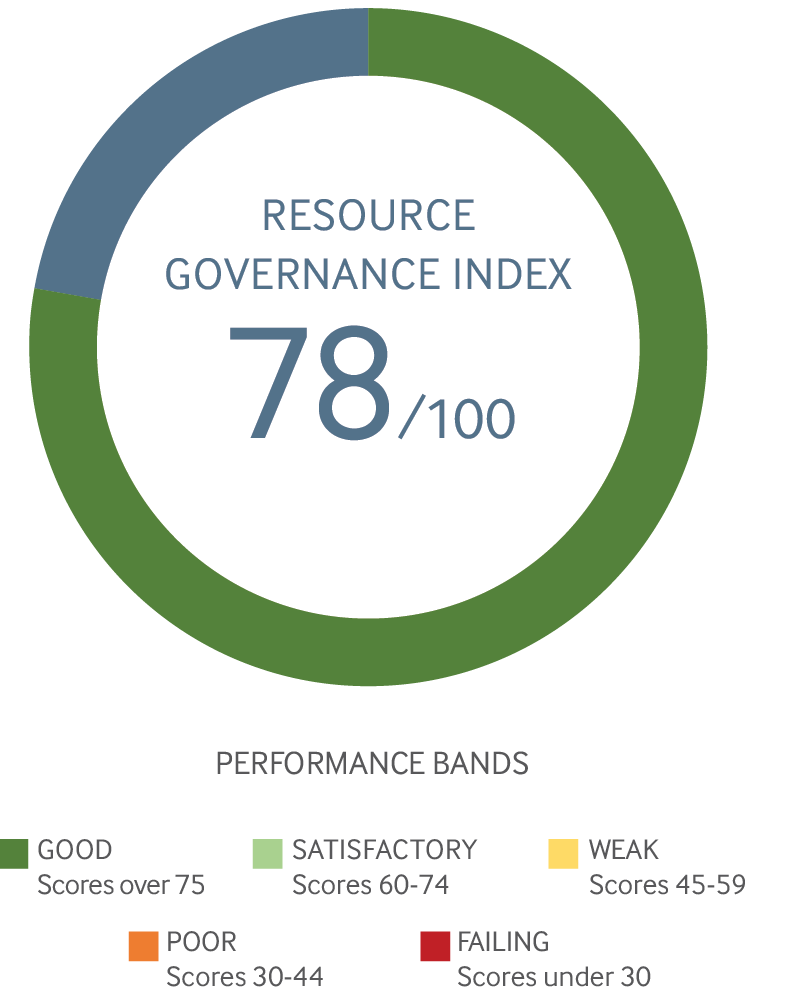
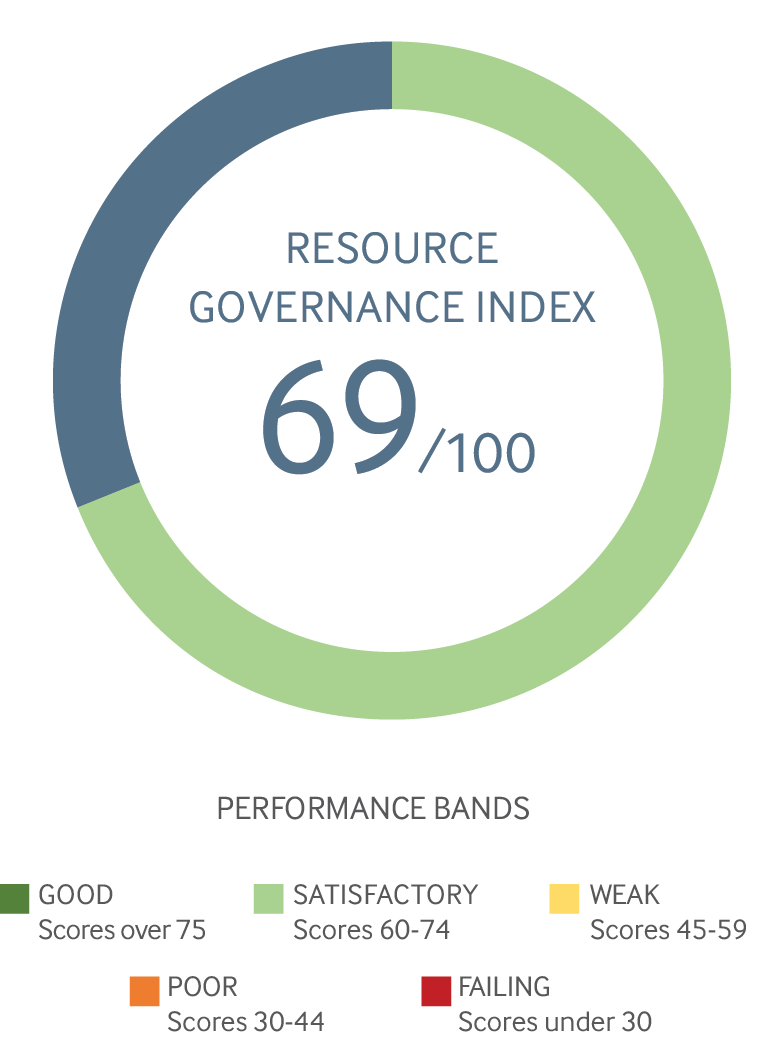
Despite these improvements significant gaps remain. So what can Ghanaian authorities and citizens do? What steps might be required to enhance extractive resource governance in Ghana? Below are some recommendations based both on the new RGI results and a recent national dialogue on extractive governance.
1. Take steps to design a long-term national development plan, to guide extractive resource governance among other sectors of the economy. This has the potential to deepen the contribution of the extractive sector to sustainable economic transformation in Ghana. Ghana lacks a clear strategic vision to drive the country’s overall development and guide government policy on extractive resource development as envisioned in the 1992 constitution. There is a clear mandate, under Article 87, for the National Development Planning Commission (NDPC), among other functions, to advise the president on development planning policy and strategy, and to study and make strategic analyses of macro-economic and structural reform options, including options for extractive sector governance. The importance of long-term national development planning to extractive governance is expressed in Section 21(2)(d) of the Petroleum Revenue Management Act (PRMA). This section makes it clear that any use of the Annual Budget Funding Amount (ABFA) should be guided by a medium-term expenditure framework, which must align with a long-term national development plan approved by parliament.
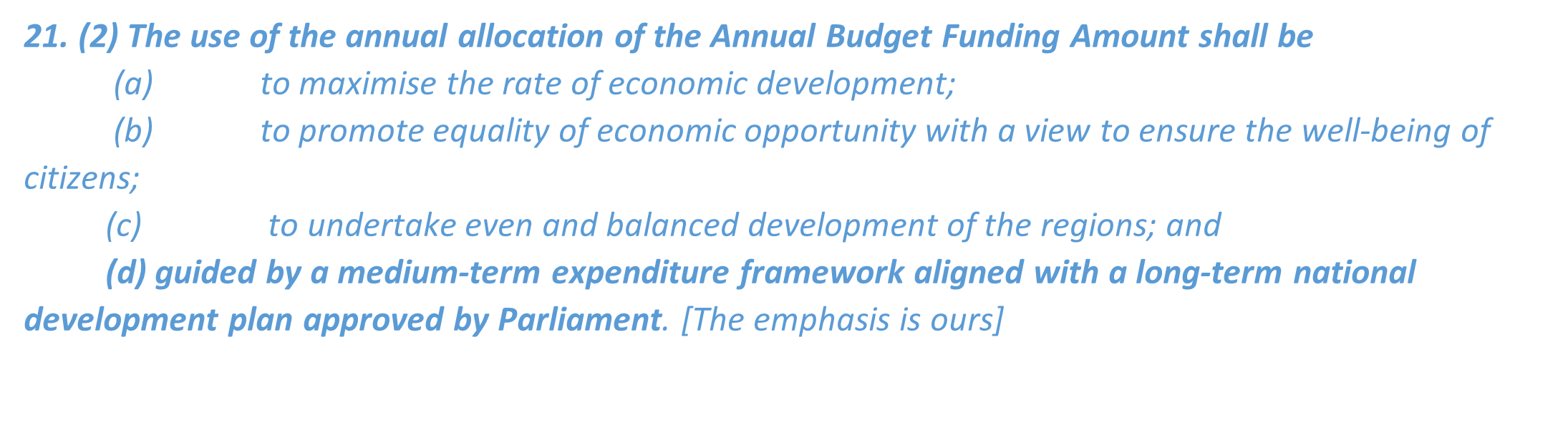
The aim of this PRMA requirement is to ensure that petroleum revenues contribute to broad and impactful economic development across the country. One of the NDPC’s key roles, therefore, as defined in both the 1992 constitution and the PRMA, is to develop a national development plan to guide the expenditure not only of petroleum revenues but of extractive revenues generally. The Public Interest and Accountability Committee (PIAC) has consistently underlined this, in terms of petroleum revenues, in its reports, including in the latest one. The current practice, which relies on medium-term strategic plans based on the manifestos of political party, limits the potential use of extractive revenues for inclusive growth and sustainable development.
2. Enact a minerals revenue management law akin to the PRMA to streamline the collection, allocation, use and management of all mineral revenues, including at the subnational level. Such a law should establish a sovereign wealth fund for mineral revenue and empower a public oversight body to monitor government accountability to the provisions of the law.
The RGI has never assessed sovereign wealth management in Ghana’s mining sector simply because there is no appreciable framework or fund to assess. Although the Minerals Development Fund (MDF) Act of 2016 and the amended Minerals Income Investment Fund (MIIF) Act of 2018 are modest attempts at managing mineral revenues, they, unlike the PRMA in the oil sector, did not create a mining sector sovereign wealth fund with clearly defined rules governing its management.
Additionally, there are accountability deficits inherent in these laws. Given that minerals are exhaustible resources and considering the positive impact mineral revenues could make if governed by an appropriate legal framework, the lack of a mining revenue management law akin to Ghana’s PRMA is a pressing resource governance issue.
3. Ensure that all resource-backed loan models set clear investment rules, transparent provisions, and accountable arrangements that are enforced by a legislative act, as this could improve parliamentary and public oversight on resource-backed loan for optimal benefits to citizens. Additionally, government should also make terms of resource-backed loans publicly available to promote more transparency, particularly on interest rates, fees, repayment schedules, restricting terms, and parties to the agreements.
4. Conduct energy transition risk assessments for GNPC and the broader extractive sector. Because the government lacks a blueprint for the ongoing energy transition away from fossil fuels, it’s hard to say how GNPC will fit into a future where oil becomes less sought-after. The government should develop a national blueprint on energy transition and take steps to assess the transition’s systematic financial risk on GNPC and use that as a basis to remodel GNPC’s strategic direction, human and financial capacity, and investment decisions. This assessment must take into consideration the advantages and disadvantages of entering new lines of businesses to diversify GNPC’s portfolio.
Crude oil price volatilities since 2013 coupled with the impact of the recent price fluctuations amid the COVID-19 pandemic and the consequential risks on broader extractive sector governance including GNPC related risks appear to have amplified energy transition concerns in Ghana.
Despite being highlighted in the 2017 RGI, GNPC’s expenditure on non-commercial activities remain a concern. PIAC in its 2020 annual report notes that GNPC spent a total amount of US$31,477,699.31 constituting 71.81 percent of the corporation’s administrative and other technical operations expenditure (Level B) receipts on sustainability & stakeholder relations and GNPC Foundation. GNPC has consistently categorized these expenditures as corporate social investments (CSI).
PIAC further notes that GNPC’s expenditure on CSI increased from GH₵41.49 million in 2018 to GH₵49.98 million in 2019, with the corporation’s guarantees (payment guarantees against default by the receiving state-owned enterprises (SOE)) for other SOEs cumulatively amounting to US$645,511,405.40 as of the end of 2019. In addition, as of the end of 2020, the corporation’s cumulative guarantees for other SOEs increased to US$694,824,551. Ultimately, expenditure pattern on CSI and SOE guarantees have consequences on the corporation’s progress toward achieving its core mandate as a commercial strategic vehicle for state participation in upstream exploration and production activities.
5. Revamp the operations of Prestea Sankofa Gold Limited and adopt best practice approaches in SOE governance going forward. An important issue that needs to be highlighted is the concerning state of the country’s mining sector SOE, Prestea Sankofa Gold Limited. The company’s operations have been suspended since 2016, affecting its 2017 RGI performance (41 out of 100 points) and meaning that it couldn’t be assessed as part of the 2021 RGI’s SOE subcomponent. On the other hand, its oil and gas sector peer and parent company, GNPC, achieved a good score in the 2017 RGI (75 out of 100 points) and improved its performance in the 2021 RGI, a reflection of sustained improvements in extractive SOE best practices. Given the significant role Pretsea Sankofa is expected to play in the gold mining sector, similar to GNPC’s in the oil and gas sector, the inability to assess the SOE subcomponent for Ghana’s mining sector in the 2021 RGI due to the stated lack of activities is disheartening. The government should therefore revive Prestea Sankofa’s operations, ensuring improved SOE governance inspired by GNPC, if not of higher standard.
Nasir Alfa Mohammed is an Accra-based policy advocacy officer with the Natural Resource Governance Institute (NRGI).
Three Ways the U.S. Can Help to Prevent Next-Generation Oil and Mining Corruption

By a wide margin, U.S. authorities have pursued more corruption cases in oil and mining than any other sector. In the last five years, U.S. authorities nabbed the bosses of a company called Unaoil that bribed officials in nine different countries, including Angola, Iraq and Syria. They seized a giant yacht allegedly purchased with proceeds from Nigerian oil trading schemes, and a swank Miami condo that a top Congolese official allegedly bought using embezzled oil funds. U.S. investigations revealed how an American hedge fund paid off officials to access the Congolese diamond industry; how state oil company bosses in Brazil, Ecuador and Venezuela took home bribes; how an Abu Dhabi oil fund helped run one of the largest-ever corruption schemes; and how oil and mining deals within the U.S. turned dirty as well.
As the Biden administration ramps up its anticorruption efforts, officials should pursue policies that heed lessons from these past investigations and that reflect the world’s fast-changing energy and mineral markets.
This week the administration gave clear signs of its commitment to anticorruption. The White House released a memorandum “establishing the fight against corruption as a core U.S. national security interest” and kicking off the process to develop an ambitious cross-agency anticorruption strategy. The Treasury Department recently issued the largest-ever use of the Magnitsky sanctions for anticorruption purposes. These events coincided with the UN General Assembly’s special session on anticorruption, where U.S. officials emphasized their intention to prioritize fighting graft. Meanwhile, on Capitol Hill, a bipartisan counter-kleptocracy caucus will launch this month as well.
In the coming weeks and months, the U.S. anticorruption agenda will take further shape, as the various agencies stand up new programs, key champions such as USAID administrator Samantha Power get up to speed, and the Summit for Democracy approaches, where fighting corruption and kleptocracy will be a main theme.
To stop corruption from ravaging the world’s oil and mineral industries and hindering the green energy transition, several U.S. agencies, including USAID, the State Department, the Treasury Department and the various climate-focused units, should prioritize the following actions. These ideas emerge from a study of over one hundred oil and mining corruption cases, and from the Natural Resource Governance Institute’s work in many resource-rich countries and international forums, and they complement leading recommendations from other NGOs and experts.
1. Prevent corruption in critical mineral supply chains
The International Energy Agency estimates that meeting Paris climate goals will require a quadrupling of the minerals used by clean energy technologies by 2040. For the countries that produce cobalt, lithium, copper and other critical minerals, especially those with weak institutions, this spike in demand could trigger surges in corruption like those associated with past oil booms, which contributed to authoritarianism and economic decline. For mineral-consuming countries like the U.S., corruption could threaten their energy transition plans by interrupting the steady supply of these commodities.
While much was made of the U.S. re-blacklisting mining magnate Dan Gertler over alleged corruption in the DRC, where Gertler’s companies control royalty streams from three of the world’s biggest cobalt projects, governance and corruption are barely on the agenda when it comes to the hot topic of clean technology supply chains. The U.S. could both help safeguard supplies and protect the interests of producer country citizens by correcting this trend. Specifically, U.S. technical assistance to producer countries, including through the State Department’s Energy Resource Governance Initiative (ERGI), should prioritize transparency, accountability and anticorruption, and should include support for civil society groups and other oversight actors. U.S. leadership could also push anticorruption onto the agendas of various international mineral supply chain initiatives and standards. Unless global standards include robust measures around transparency, beneficial ownership reporting, payment verification, anti-money laundering, conflict of interest procedures and other practices, the critical mineral boom could trigger an ugly “race to the bottom,” with consumer countries scrambling to secure supplies, a few well-connected parties getting rich off the rents, and producer-country citizens left facing the results.
2. Tackle oil sector corruption and kleptocracy as part of U.S. climate policy
In addition to anticorruption, the Biden administration has prioritized climate action, and the two agendas must intersect given the oil and gas industry’s predilection towards state capture and kleptocracy.In the Trump administration, the head of the Environmental Protection Agency and the Interior Department were former fossil fuel lobbyists. These appointments were among many recent reminders of how oil and gas producers, thanks to decades of lobbying, campaign donations and revolving-door staffing, exert undue influence over U.S. policy and climate debates. Much of this behavior falls in the categories of legal corruption or state capture, through which narrow vested interests influence public policy to suit their needs. Other oil-producing countries face a similar challenge: corruption and political agendas can cause leaders to greenlight fossil fuel projects, lavish the industry with subsidies and neglect greener energy sources, even when these steps run counter to climate goals and country’s own economic and environmental interests.
To guard against corruption, capture and political stalemates around decarbonization, the U.S. should encourage fossil fuel producing countries to accelerate transparency and oversight. First, citizens need basic information about the government’s fossil fuel activities and adaptation plans, including project-level data on reserves, production, breakeven price assumptions, carbon emissions and government spending. Second, transparency must increase wherever industry and government interact; this applies to lobbying, campaign donations, asset-development contracts, subsidy payments, as well as national oil company affairs.
The U.S. could advance this cause at the Summit for Democracy, via its participation in the Extractive Industries Transparency Initiative, the Open Government Partnership, and in the newly announced Net-Zero Producers Forum, which also includes Canada, Norway, Qatar and Saudi Arabia. This effort would be an important public sector counterpart to U.S. action to advance capital market climate risk disclosures.
Much more than transparency will be needed when it comes to oil-rich kleptocracies and their impact on global climate responses. Half of the world’s oil is produced by 13 authoritarian countries, including several run by kleptocratic regimes. Tackling kleptocracy is notoriously difficult, and U.S. officials should look closely at how Western enablers help kleptocrats to profit and thrive. Some players in the oil sector are complicit, as many Western investors, companies and service providers have supported suspicious deals involving the governments and national oil companies of Russia, Venezuela, Equatorial Guinea and other kleptocracies. Since these oil industries contribute to both global warming and kleptocracy, the role of these enablers is worth a careful look as part of the US’s wider approach to fighting kleptocracy.
3. Shower anticorruption attention on obvious areas of risk
In recent years, thanks to the Panama Papers and other revelations, international anticorruption efforts are devoting greater attention to how dirty money flows offshore, and the damage it then causes. As the U.S. responds to this vital agenda, such as by implementing the Corporate Transparency Act and, hopefully, expanding the U.S. Treasury’s Geographic Targeting Orders, officials should not overlook how the money escapes in the first place. Even a quick skim of the Justice Department’s asset seizure actions makes clear: a lot of dirty money comes from the oil or mineral sectors of resource-rich countries. And it often escapes from a few high-risk areas:
-
State-owned enterprises. National oil and mining companies feature in many corruption schemes, with Brazil’s Car Wash as the most prominent recent example. State-owned enterprises control large amounts of money and are themselves easily controlled by political elites—a recipe for corruption in contexts ranging from Russia to South Sudan, Iraq to Venezuela.
-
Commodity trading. The Justice Department has pursued big commodity trading cases, so U.S. authorities know how dirty, opaque and damaging this side of the industry can be. And yet, there has been no cross-agency response. As leading energy journalists Javier Blas and Jack Farchy recently argued, “It’s high time that politicians in the United States and elsewhere started paying attention” to the fact that traders are “scarcely regulated.”
-
The participation of political elites in the industry. Among the Kremlin allies facing U.S. sanctions are oligarchs who profited hugely off juicy contracts from Gazprom, the Russian national gas company. Political elites often hold interests in oil and mining companies and get rich off the proceeds—usually via inflated contracts or other lopsided deals. Beneficial ownership reporting is a necessary but insufficient response to this challenge. The Luanda Leaks revealed how U.S. entities supported the business ventures of Isabel dos Santos, despite knowing that her father was Angola’s president and other warning signs around the deals. Since oil and mining industries are widely politicized, the sector is a strategic area where the US could work to develop stronger standards regarding who constitutes an appropriate business partner.
As part of an evidence-based approach, the U.S. should learn from past cases and ramp up anticorruption interventions in these known areas of risk. In each one, stronger global standards, attention from regulators and law enforcement, attention from international financial institutions, technical assistance, support for civil society and other actions could make a huge difference. If the U.S. and its allies ignore these proven areas of corruption risk, they leave doors open for more dirty money to escape.
The above ideas resonate with many elements of last week’s White House anticorruption memo. As U.S. officials take this directive and turn it into policy, they can prevent another generation of oil and mining corruption and avert negative impacts on the lives of millions. The Summit for Democracy is one venue where the U.S. could lead on this work and acquire allies; COP 26 and the Open Government Partnership Summit are others.
As resource-producing countries face unprecedented change, corruption could derail their efforts to build more resilient economies, while also threatening U.S. climate, security and economic interests. Thanks to U.S. law enforcement action, we know a great deal about the dismal corruption record of the natural resource sector. These cases point to practical strategies the U.S. can now adopt to avoid a repeat of history.
IEA’s Ambitious Climate Scenario Underscores Need for More Transparency on Fossil Fuel Projects

The IEA experts have articulated several dramatic milestones that would be necessary to reach this critical goal, including:
- no approvals of new oil and gas field development and no new coal mines or mine extensions by this year
- electric vehicles reaching 60 percent of global car sales by 2030
- nearly 70 percent of global electricity generation produced from solar and wind by 2050.
Given that government and industry leaders rely on IEA scenarios in their planning, many hope that these urgent targets will spur much-needed climate action.
Beyond these headline prescriptions, the IEA makes another critical point: changes brought by the clean energy transformation will be challenging to implement, so decisions must be transparent and just. As the gap grows between government and company plans for future production and the levels consistent with a Paris-compliant world, there is increasing attention on how supply-side commitments from oil-producing countries might shape net-zero ambitions. These countries face significant economic shocks as the world decarbonizes: the IEA estimates that per capita income from oil and gas in producer countries would fall by 75 percent under its new net-zero scenario. Even if the world falls somewhat short of the Paris goals, governments in these countries face the prospect of dramatically lower revenues and public assets wasted by excessive concentration in a declining sector. Against this backdrop, citizens in low- and middle-income producer countries will inevitably face major uncertainties in the race to net zero. Access to basic information about how their social and economic prospects are shifting should not be one of them.
Governments and companies must disclose more information of relevance to the billion people that live in poverty in oil- and mineral-rich developing countries, and engage impacted citizens in producer countries as core stakeholders in energy transition policy dialogues. Despite the urgency of the economic challenge they face, many fossil fuel producers have not done enough to develop strong plans for economic diversification or inclusive development in a lower-carbon future.
The allure of oil and gas has thus far been powerfully addictive. Open dialogue between governments, companies, and citizens on the role of fossil fuel production in national economies will facilitate meaningful climate action and improve the prospects of countries that remain hooked on oil and gas. Globally inclusive dialogue is also needed around which countries should reduce production first; developing and emerging market producers are already calling on wealthy countries to lead the decline.
Today, too much information that is necessary for just and effective transition discussions remains hidden from view. Increasingly, debates will center on whether specific fossil fuel projects are viable or not—from both economic and climate perspectives. In many producer countries, the decision to halt or continue one or two key projects can affect the whole economy. Project-focused transparency efforts could support a just transition by helping citizens in producer countries assess the impacts and effectiveness of divestment and economic diversification plans. Greater transparency at this level would also help citizens hold government officials, multinational decision-makers and industry executives accountable for an equitable and well-managed process.
Governments and companies should disclose the following information about fossil fuel projects:
- Exposure to climate-related financial risk. To hold governments and companies to account and determine whether continued extraction or particular project configurations are in the national interest, citizens need: information about the viability of projects and national budgets under various transition scenarios (including the IEA net zero scenario); break-even prices, reserves and potential emissions of current and pending fossil fuel projects; and price and revenue forecasts used by financial authorities. The Extractive Industries Transparency Initiative (EITI) encourages the governments of its 55 implementing countries to disclose information that will further public understanding and debate around issues of revenue sustainability and resource dependence, including official production, commodity price and revenue projections. In practice, however, few countries publish this information, which must change. The EITI Standard should require, rather than merely encourage, these disclosures. The Standard should also require EITI supporting and member companies to disclose their own scenarios, assumptions and projections. United States and European regulators, who are also considering this issue, should also require this project-level information of fossil fuel companies globally.
- Plans for energy transition and production. Governments in producer countries should disclose information about their project divestment (and investment) and energy transition plans, and invite public debate on these topics. Oil companies—both private and state-owned—should also disclose production, energy transition, and responsible exit plans for their projects. They should also engage with stakeholders on the social and economic impacts that project continuation, wind down, or transfer would have on host governments and communities (e.g., impacts on payments to government and local employment, timelines and decommissioning plans). Governments and companies must also disclose the contracts that govern projects so that oversight actors can assess exploration and production rights, project amendment conditions, and adherence to decommissioning and asset sale obligations. At a minimum, both government and company actors should account for how much proposed projects will cost, their carbon footprints, and whether they align with climate goals.
- Financing and subsidization of carbon-intensive projects. Countries should disclose current and proposed spending on fossil fuel projects by national oil companies, public investment in fossil-fuel linked infrastructure, and the value of tax incentives and other subsidies they provide to support fossil fuel projects. They should also disclose the impact various transition scenarios would have on the return on public investment.
- Carbon intensity of production and reserves. Officials and executives should disclose the levels of greenhouse gas emissions (scope 1 and 2 emissions) associated with a project, as well as information necessary to assess the emissions associated with the eventual burning of those fuels, including emissions made abroad after export. This information is critical for informed public debate about the climate impact of a country’s extractive activities. In addition to disclosures around current production, citizens and investors need reliable information about undeveloped fossil fuel reserves, their embedded carbon content and the costs necessary to extract them to make equitable decisions about which countries need to phase out production fastest.
- Influence of fossil fuel interests on policymaking. In some producing countries, political leaders use fossil-fuel revenues to maintain their positions and power, giving them strong incentives to continue production. In others, fossil fuel companies enjoy considerable influence over policymakers. Governments and companies should disclose information that enables accountability actors to monitor channels of influence by vested interests. This information includes the identity of politically exposed beneficial owners with stakes in extractives projects, details about industry lobbying activities and political donations, and corporate reporting on compliance with “revolving door” policies and other integrity measures.
The IEA report makes the case for decisive and immediate climate action. The many necessary steps will require complex negotiation and coordination. But extractive sector companies and governments of producing countries can rapidly implement a core set of project-level, supply-side disclosures that would enable impacted stakeholders to assess project viability and contribute to energy transition plans. Increasing production-related commitments in nationally determined contributions is a clear opportunity. Reporting entities should leverage the readymade platforms and multi-stakeholder networks offered by transparency-oriented forums like the EITI and the Open Government Partnership, and draw on the considerable thinking that already exists on many of the key technical components and data standards that would be central to such disclosures.
What remains unclear, however, is whether an actor or group will take up the mantle of making this critical transparency a global priority and realizing it. We are working with partner organizations to explore how we can jointly push global leaders to step up. With more than 50 global and regional climate-focused gatherings taking place in the next six months, culminating in COP26 in November, the time is ripe.
Disclosures Pave the Way for Transparency in Resource-Backed Loans

During the commodity boom of the last two decades, many governments and state-owned enterprises in developing countries signed significant “resource-backed loans” (RBLs). These loans provide governments access to finance in exchange for, or collateralized by, future streams of income from natural resource wealth, such as oil and minerals; Chinese entities are the dominant lenders in this space. In NRGI’s 2020 study on RBLs, which explored the experience of RBL borrowers in sub-Saharan Africa and Latin America between 2004 and 2018, we found that Chinese entities account for $152 billion (more than 90 percent) of the total amount lent through identified RBLs.
NRGI and others have frequently criticized RBL deals for their opacity. Information about agreed terms and conditions is scant. At the time of our study, we lacked basic information, such as the interest rate, for 33 out of the 52 cases surveyed, and just one loan document was publicly accessible: the Sicomines loan that the Democratic Republic of the Congo (DRC) signed in 2011. But since the publication of our report a year ago, the transparency landscape has already showed signs of change.
Last week, AidData released a trove of loan agreements between Chinese entities and sovereign borrowers in developing countries. The researchers scoured debt information management systems, official registers and gazettes, and parliamentary websites to find 100 publicly available Chinese loan agreements in 24 countries. Their database, and accompanying “How China Lends” report comparing terms with other loan agreements from a benchmark sample, both confirms and expands our understanding of sovereign debt agreements involving Chinese state lenders.
One key finding of the report is the widespread use of far-reaching confidentiality clauses in the Chinese loan agreements meant to restrict borrowers from disclosing loan information. This confirms worries about opacity and the need to rein in confidentiality provisions in sovereign debt agreements, as previously highlighted. However, the fact that a significant number of Chinese loan agreements were publicly accessible despite these confidentiality provisions may point to a pathway to greater transparency: leveraging and building on borrower country laws and procedures requiring parliamentary ratification and/or disclosure of sovereign debt agreements. Carve-outs from confidentiality, where applicable law requires disclosure, are relatively common and is likely how many of the Chinese loan agreements ended up publicly disclosed and in the database notwithstanding the confidentiality clauses.
In addition to the Sicomines loan, the AidData database includes contracts for five more RBLs: three with the government of Ecuador, one with the government of Ghana and one with Venezuela’s state-owned enterprises (SOEs) PDVSA and BANDES. We featured these deals in the 2020 NRGI report, and the key terms we had reported in relation to loan amounts, interest and maturities were the same or very similar to those included in the contracts. (We plan to update our report’s dataset with insights from the AidData work, adding new details such as missing grace period information).
Access to the contracts allows us to better understand certain critical details about these loans. For example, while we and others have reported Ghana’s 2018 loan from Sinohydro, a Chinese SOE, as a $2 billion loan, the published agreement clarifies that the Chinese lenders offered $1.7 billion and that the Ghanaian government sought an additional $300 million elsewhere. The contracts also shed light on how the government has used Ghana’s bauxite revenues as collateral and how this approach fits within broader patterns of collateralization in Chinese lending described in the AidData report, namely the requirement to maintain a funded bank account with the lender that could be seized in case of non-payment. In Ghana’s case, the agreement specifies that bauxite proceeds be kept in an offshore escrow account and that the government entered into an escrow agreement with creditor Sinohydro.
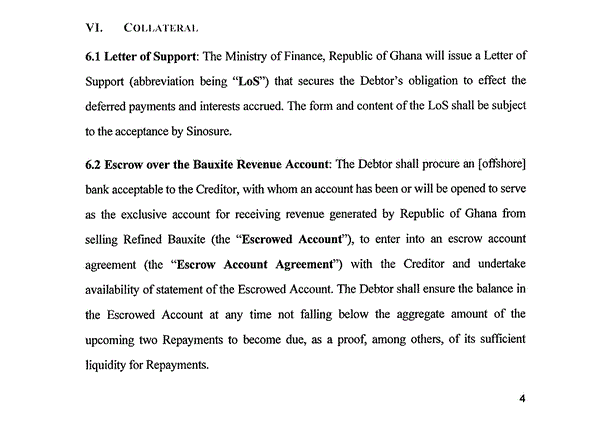
Disclosed loan agreements can also be useful for countries, like Guinea, with similar Chinese loans that are not yet disclosed. In 2017 the Guinean government signed an agreement with China for a $20 billion credit line, from which loans backed by bauxite receipts would be drawn with a group of Chinese state-owned companies and lenders. Information on the credit line and loans signed in 2018 was limited, but we now have the headline parameters through Guinea’s latest Extractive Industries Transparency Initiative (EITI) report (broadly aligned with EITI’s recent guidance on barter deals). Guinean civil society organizations and EITI Guinea have been instrumental in making this disclosure happen. The remaining challenge is access to the actual loan and infrastructure contracts that would unveil the overall commitments between the government and its Chinese partners. This would enable oversight actors to undertake a comprehensive risk assessment, both of the government’s ability to repay existing loans and whether it is advisable for the government to draw down further loans on the existing line of credit given the uncertain future economic context.
The need for transparency around loans and financing arrangements involving natural resources is not limited to those involving Chinese lenders. RBLs from commodity trading firms are often even more opaque than those from Chinese lenders and have destabilized economies in borrower countries. Transparency is also essential as governments use increasingly creative ways to raise finances leveraging their natural resources, as recent developments in the DRC and Ghana illustrate. The DRC’s commitment to disclose mining contracts, and civil society monitoring of the commitment, resulted in the recent publication of one such contract. In 2017, the country’s giant state-owned mineral company Gécamines sold its future mining royalty revenues from the Metalkol cobalt and copper project to Multree Limited, a company associated with Dan Gertler, who has faced U.S. sanctions on the basis of alleged corruption. While certain details of the deal remain unclear, it appears that Gécamines exchanged future royalties for an upfront payment of $55 million and Multree’s assumption of a $28 million debt owed by Gécamines to Metalkol. In Ghana, the government recently confirmed that it will resume its own controversial plan to sell an interest in future gold royalties to private investors through a stock exchange listing.
As many developing countries struggle with debt, increased transparency around Chinese lending and resource-based financing is critically important. Access to information about past deals will enable borrower countries seeking fresh financing or contemplating debt renegotiation to better structure and negotiate. And other lenders can use the information to lead by example in providing finance on more sustainable terms. Perhaps most importantly, sovereign debt transparency is also critical for civil society organizations and other oversight actors. According to the authors of the “How China Lends” report:
Disclosing all debt contracts, however difficult politically, should become the norm rather than the exception. This would give citizens the ability to hold their governments accountable for the debt contracts signed in their name. Public debt should be public.
Disclosure of sovereign loan agreements is a natural progression from the publication of oil, gas and mining contracts, which has improved markedly in recent years. In 2009, governments and companies expressed skepticism around the publication of these documents, but just over 10 years later at least 49 countries have officially disclosed contracts and over 20 companies publicly support the practice. Extractive sector contract transparency is now an established global norm endorsed by the IMF and required by EITI.
Given the similar public interest questions surrounding the management of public debt and the governance of natural resource wealth, those working for greater transparency of sovereign debt should build on these gains. RBLs are of particular importance—they are the intersection of extractives transparency and debt transparency. Momentum around greater sovereign debt transparency is building and this can only benefit the governance of natural resources.
Raw or Refined: Does Commodity Processing Help Resource-Dependent Countries to Diversify?

Developing countries dependent on the extraction of oil, gas, and minerals for government revenues, foreign exchange and economic activity face a critical development challenge. They suffer more from the economic volatility that comes with commodity price fluctuations and are also under pressure to diversify their economies before reserves run out.
Last year’s crash in oil prices due to the coronavirus pandemic and the accelerating transition away from fossil fuels both highlight the importance and urgency of this issue. For example, Nigeria experienced severe shortages of foreign exchange as oil prices crashed in 2020, making it challenging for many businesses to continue operations. Recent NRGI research shows that oil-dependent countries like Nigeria could suffer a larger, longer hit if the world meets the climate targets of the Paris agreement, with $400 billion of planned investments by national oil companies failing to break even.
For these and other reasons, supporting countries to reduce resource dependency and manage its consequences is a key part of NRGI’s overall strategy and 2021 agenda.
How do forward linkages affect resource dependency?
First, here is a quick primer on some of the key concepts around linkages and resource dependency.
- Resource dependency is a situation in which a country’s key economic indicators (such as GDP, government revenues, or foreign exchange earnings) rely on the production or export of natural resources.
- Volatility is the tendency for key economic variables to change rapidly – for example, the oil price has been extremely volatile since the start of the coronavirus pandemic.
- Linkages are relationships between different sectors of the economy, where operations in one sector help to grow another.
- For extractive industries, one “forward linkage” involves the downstream processing of a commodity to make it either more valuable as an export or more useful to the domestic economy, e.g., refining oil or extracting metals from raw ore.
Forward linkages can impact a country’s level of resource dependence. In several NRGI priority countries, governments and citizens see such forward linkages as a pathway to a more diversified and less resource-dependent economy.
Forward linkages in oil, gas and mining can lead a country toward economic diversification through:
- knowledge spillovers to other sectors (i.e., when knowledge acquired in one sector of the economy “spills over” to other sectors, raising their productivity)
- potential increases in private investment in infrastructure and other, non-extractive sectors
- provision of cheap inputs (i.e., commodities or resulting products like fuel) that make other sectors more competitive
- government revenues that authorities can reinvest in the development of other industries
But some analysts worry that doubling down on extractives may instead worsen dependency, leading to an even greater share of a country’s economic activity being tied to the sector.
Governments in resource-rich countries are increasingly seeking to establish or expand forward linkages to their extractive sectors. For example, a state company in Ghana is aiming to harness bauxite reserves and grow an integrated aluminum industry. Bolivia’s government is trying to use domestic gas supplies to produce petrochemicals. Mongolia and Uganda are both planning oil refineries, while Mexico’s government seeks to expand its refining capacity.
With many countries aiming to both reduce resource dependency and promote forward linkages, it is important to understand how these interact with one another in practice. As a starting point, NRGI commissioned a review of the existing literature in extractive forward linkages’ impacts on resource dependence.
This review found no consensus on whether forward linkages help to reduce or increase resource dependence. Rather, it revealed two general scenarios: in some cases linkages reduced extractive dependency, and in others where they appeared to have increased it.
Malaysia and Nigeria have both developed forward linkages from the petroleum sector (e.g., refining, petrochemicals), but have achieved very different results. In Malaysia, linkages have helped the country diversify, supporting the automotive, electronics and synthetic rubber industries in addition to a highly competitive plastics industry. By contrast, Nigeria’s oil refineries, which have operated at reduced capacity for decades, have struggled to satisfy domestic demand, 70-80 percent of which is met through imports. Moreover, Nigeria’s refineries also make heavy losses, which eat up public funds that the government could use to develop other sectors of the economy. Nigeria’s dependence on oil for export earnings worsened between 1965 (when its first refinery was built and oil accounted for 32 percent of exports) and 2018 (by which time oil had risen to 94 percent of exports).
So while forward linkages can provide a springboard to diversification (and thus reduce resource dependency), they can also at times worsen dependency. By drawing even more, often scarce, resources—such as skilled workers, power, private capital and public funds—into the sector, they can hinder rather than help the growth of other sectors, meaning that the country relies even more on extractives.
Another risk: domestic consumption of oil and natural gas for power locks a country into using fossil fuels even when switching to renewable sources would be environmentally and/or economically advantageous; this risk will become even more acute as the energy transition gathers speed and the cost of renewables falls further relative to fossil fuels.
Downstream viability and use of domestic inputs are critical for diversification
The impact of forward linkages on dependency is therefore highly context specific. Achieving a positive outcome depends on the presence of three factors:
Viability of downstream processing activities
Inefficient downstream activities—like Nigeria’s refineries—are less likely to help countries diversify. They often fail to deliver low-cost inputs to the wider economy. In addition, where downstream activities are inefficient, governments often use fiscal incentives to encourage in-country processing to take place anyway, which impacts public finances and can reduce countries’ ability to support diversification in other sectors. (N.B., government sometimes offer fiscal incentives even when such activities are efficient). Similarly, if extractives companies are forced to process commodities in-country even though processing is uncompetitive, this will reduce their profits and, consequently, the government’s tax revenues from the sector.

There are several key factors that contribute to efficiency in downstream processing, though these can differ significantly between commodities. For example, large annual production of the relevant upstream resource allows downstream activities to benefit from economies of scale, as in Saudi Arabia. Sizeable oil reserves and level of daily production have allowed Saudi Arabia to be a competitive refiner. By contrast, NRGI’s analysis of proposed gold smelting in the Kyrgyz Republic indicated that production there is too small for the proposed smelter to be commercially viable. Policies also critically matter; these include efforts to upgrade infrastructure, co-ordinate investments, set productivity targets and develop skills among workers.
Countries with large shares of a resource’s global production are also more able to incentivize (or even force) investors to establish downstream facilities domestically as there may be few alternatives for acquiring the refined resource. When Indonesia banned the export of raw nickel, processing activities in Indonesia grew substantially; now the country may be able to capture more value down the electric vehicle battery supply chain. Part of its success with nickel processing is because China, the main importer of nickel, found it hard to switch to other nickel exporters as Chinese smelters has been customized to Indonesia’s high-grade nickel ore. In order to maintain supply, investors constructed nine smelters in Indonesia by mid-2017. However, when Indonesia pursued a similar policy in its bauxite sector, this was unsuccessful, as the country had much lower market share and bauxite importers (and investors) were able to easily source bauxite from other suppliers.
Further, where downstream industries are competitive, they may be able to survive even when the country’s own reserves run out (using imported raw commodities), which can cushion the blow of reserve depletion. For example, time will tell whether Botswana’s diamond cutting and polishing sector will remain competitive once its reserves run out.
Extent to which forward linkages use inputs from other sectors
Downstream activities can increase demand for inputs from other sectors, which in turn helps those sectors grow. But not all forward linkages bring this benefit—some rely on imported inputs and have little impact on the rest of the economy. The type of forward linkage a country pursues therefore has critical implications for its diversification prospects. Policy can be decisive here as well. A plan to use forward linkages to diversify requires a government to develop a broader industrial strategy that considers, for example, the optimal sequencing of the processing activity and the sectors to which it will link. Malaysia has successfully accomplished this with its oil sector.
Depth of downstream processing
Different types of forward linkages also have different effects on price volatility; this is one of the most problematic impacts of resource dependency. Many processed extractive products have more stable prices than the raw commodities from which they are derived, which helps to reduce volatility. This works best where forward linkages are deeper – the more value that is added in downstream activities, the less volatile prices for the resulting products tend to be (and the less volatility this introduces to the economy).
If conditions and policies are right, forward linkages can help countries to diversify or to alleviate the effects of resource dependence. If they are not, countries can become even more dependent on oil, gas or minerals. This relationship is specific to the commodity, the linkage and the national and regional contexts and politics. For these reasons we at NRGI will support assessments of the plans of governments in our focus countries, and build and share expertise in this critical area of resource governance.
This post is based on a literature review by Amir Lebdioui and Pavel Bilek.
New Oil- and Gas-Producing Countries Now Have an Online Home

Oil and gas extraction has often failed to benefit citizens in producing countries, and in many cases has exacerbated corruption and environmental damage. The New Producers Group is a network of officials from countries newly producing oil and gas or exploring production, that aims to change that by sharing resources and expertise on how to better manage the sector.
The group—coordinated by NRGI, Chatham House, the Commonwealth Secretariat and more than 30 member countries—has launched a new website that assembles research, videos, and other tools to support governments to develop strong policies, oversight and accountability around oil and gas production.
Climate change has amplified the urgency of establishing responsible and effective management of oil and gas. Developing countries face new challenges in marrying their economic and climate ambitions, and the global commitment to shift away from fossil fuels. Excessive expectations about the benefits of oil and gas production can also lead new producers to take on outsized debt and stifle investment in renewable energy, which could hold more sustainable benefits for the country.
The website hosts publications on topics ranging from the energy transition to building accountability, a roadmap for the group’s plans, and a members’ area where participants can share information and connect with each other. The group is currently focusing its efforts on understanding how oil and gas producers can best prepare for the global energy transition, which was the theme of the group’s 2020 annual meeting.
I encourage you explore the site and share it with others working in this space.