
Uganda’s Energy Transition Plans Cannot Ignore Women

In 2006 the Ugandan government announced discovery of oil beneath and around Lake Albert, a geological region known as the Albertine Graben. The area’s women hoped that they might be among the local beneficiaries of the boom after the government and oil companies committed to offering them employment opportunities.
Oil production is due to start within the next two years, but so far pre-production activity has brought little economic development to women in the Albertine Graben. Among those yet to see benefits from the area’s intensifying industry are women in Buliisa district, located on the shores of lake Albert.
Impacts on women’s daily lives
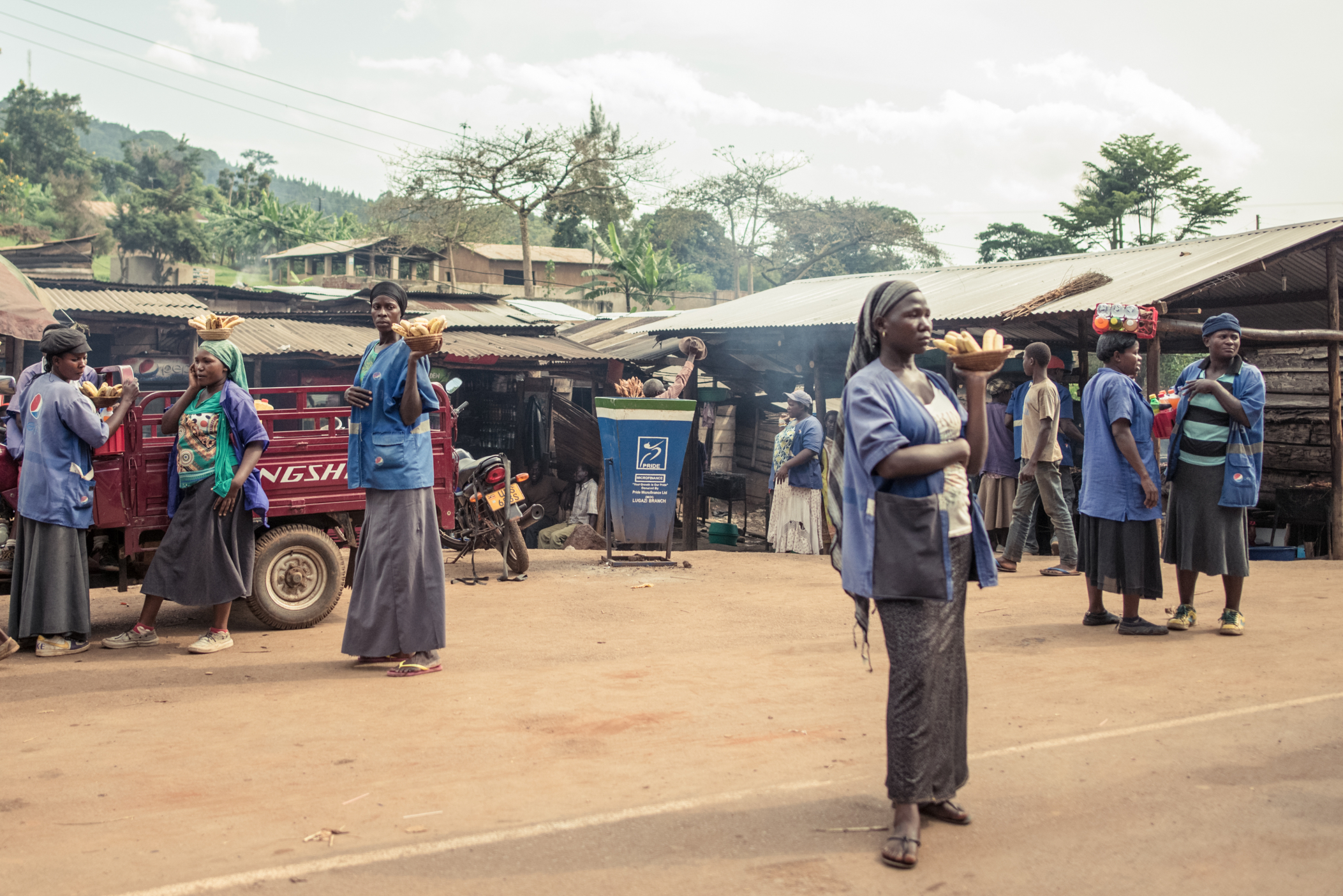
As in many extractive projects, the few jobs created have confined women to informal labor, in this case cleaning and road traffic signaling around construction sites.
In an unfortunately common paradox, the fossil fuel project has not even increased energy access for women. The Natural Resource Governance Institute (NRGI) and Buliisa Initiative for Rural Development Organization (BIRUDO) recently interviewed more than 70 community stakeholders in the district to ascertain the challenges to gender equity in Uganda’s energy transition. Their findings reveal that, after oil was discovered, the government took over for oil production much of the land that previously served as a source of firewood. This deprived rural women of fuel for cooking, which the authorities didn’t replace.
While the government compensated affected households, such schemes often favor male recipients. Paolyel Onencan, a gender equity campaigner and co-founder of BIRUDO, noted that “although it was a requirement for government compensation to be paid to a joint account, there was no follow-up to ensure that women received the money when it was finally withdrawn.”
Uganda has made significant progress on addressing gender issues in the oil, gas and mining sectors over the last ten years, for example through enhancement of gender and equity planning and budgeting in the energy and mineral development sector. However, as Uganda defines energy transition plans, the government must further consider the specific needs of women.
Funding green ambitions with black gold
On 5 December 2023, Uganda’s energy minister launched the country’s energy transition plan at the COP28 climate conference. The launch signaled Uganda’s commitment to achieving carbon neutrality by 2050 and ensuring universal access to electricity by 2040.
Yet, as a prospective oil producer, Uganda has framed the transition as one where oil and gas sector revenues will help finance the move toward green energy. With 80 percent of Uganda’s electricity currently coming from hydropower, the government is now committing to use the revenues generated by the oil and gas sector to support wind, solar and sustainable biomass projects to power isolated off-grid communities.
“We are fully focused on ensuring our energy security, so the oil and gas sector, which we are developing in a sustainable way environmentally, will support us in our energy transition plan by providing the required financing,” said Irene Bateebe, permanent secretary of the Ministry of Energy and Mineral Development.
The government has also committed to equity. According to Ali Ssekatawa, director of legal and corporate affairs at the Petroleum Authority of Uganda, the country’s oil and gas projects will not only create economic prosperity but also showcase the country’s commitment to long-term sustainability by putting people and the planet at the forefront.
Ensuring a just transition in Uganda
Last October, NRGI gathered key stakeholders to discuss requirements for a just, people-centered energy transition in Uganda.
This initial engagement, focused specially on gender and just transition, revealed that while Uganda’s energy transition planning contains general assumptions about gender equity, the government has yet to undertake research to highlight the actual challenges for women living in communities where extractives projects are taking place. What the eventual phase-down of oil and gas projects could mean for them remains unknown.
Nor is much known about how clean energy projects could potentially cause harm to women—or serve as a source of empowerment for them. If the government is to design targeted programs that accelerate a just, inclusive and sustainable energy transition in Uganda, officials must first identify and understand gender equity challenges and opportunities.
Based on our convenings and recent research, we recommend:
- Establishing a formal space for inclusive discussion on just transition. The government could establish a working group with representation from civil society and the private sector with the directive to mainstream gender equity in the energy transition. Its work could initially target the national equity guidelines for natural resource management (currently under development by the Ministry of Gender, Labor and Social Development), as well as the National Energy Transition Plan led by the Ministry of Energy and Minerals Development.
- Fostering the participation of women and women organizations in discussions and decisions about energy transition plans and policies. For this, the government must build additional capacities at the national and subnational levels so that officials can better engage in energy transition and gender issues. Such engagement could include encouraging rural women in Uganda to adopt cleaner cooking technologies through support to current initiatives like liquified petroleum gas (LPG) for cooking, spearheaded by the Ministry of Energy and Mineral Development.
- Formulating subnational energy transition plans in oil-rich parts of the country. Such plans, developed with government, would include programs to compensate or support women in informal jobs.
With these recommendations in mind, Ugandan officials can chart an energy future that benefits all members of affected communities.
Mexico’s energy and climate contradictions are laid bare at COP28
COP28 puts spotlight on state oil giants
Oil and gas companies stall on net zero plans
Can Uganda’s oil and gas sector thrive during ongoing energy transition?
Uganda’s Oil Refinery: Gauging the Government’s Stake

-
Uganda’s planned oil refinery will have several benefits for the country, including for its security of fuel supply and balance of payments.
-
The refinery could be reasonably profitable, generating an internal rate of return of 13 percent in a baseline scenario.
-
The government is planning to take a 40 percent stake but may ultimately pay a higher price for this equity than it expects. Even if it borrows to cover its upfront contribution to costs, it will need to divert around $330 million in present value terms from the national budget for loan repayments in the 2030s.
-
This price will increase if downside risks, such as cost overruns or lower global oil prices, materialize.
-
The government can take several steps to increase interest from other investors, including by reducing the risk of cost overruns, ensuring deregulated product prices continue, and providing less risky forms of state support such as tax incentives. These should reduce the need for the government to take a large stake.
French supermajor Total and Chinese state oil company CNOOC are currently developing Uganda’s first oil project. As part of this, they are constructing the East Africa Crude Oil Pipeline, which will have the capacity to export 216,000 barrels per day (bpd) of oil. The government is also pursuing construction of a refinery that will process 60,000 bpd when built.
The refinery will have several benefits. It should address Uganda’s problem with fuel supply, with current import routes from Kenyan and Tanzanian ports having suffered several disruptions. Fewer petroleum product imports will reduce the country’s foreign exchange needs. The government hopes that the refinery will also stimulate the birth of a petrochemical industry and generate thousands of jobs.
The key question for the government now is when and how the planned refinery will go ahead, including in relation to its planned equity stake. The government canceled its agreement with the Albertine Graben Refinery Consortium (AGRC), the companies selected to construct and operate the refinery, in June 2023 after AGRC failed to secure sufficient financing within the agreed timeframe. The government has been planning to take an equity stake of up to 40 percent in the refinery through the Uganda National Oil Company (UNOC). But the challenges with AGRC could encourage the government to take an even larger stake to ensure the project proceeds.
There is limited clarity on the price that the government might ultimately pay for its equity stake. To provide further clarity and thereby inform government decision-making, this paper's authors have analyzed the refinery’s economics and the implications for the government stake.
The authors’ modeling suggests that the refinery could be reasonably profitable. With their baseline assumptions, it generates an internal rate of return (IRR) of 13 percent.
With a construction cost of $4.5 billion and assuming debt financing of 70 percent, a government stake of 40 percent requires the government to contribute around $540 million. This is equivalent to about $440 million in present value terms (assuming a real discount rate of 8 percent). Given budgetary constraints, the authors expect that the government will borrow this money to avoid this upfront cost.
But borrowing is not a silver bullet. While UNOC ultimately makes a profit over the lifetime of the refinery in the authors' baseline, the government needs to divert around $330 million in present value terms from the budget to contribute to loan repayments in the 2030s.
The price that the government ultimately pays for a 40 percent stake will be impacted by a range of factors and uncertainties that affect the profitability of refineries. The authors analyzed five factors that will affect the profitability of the Ugandan refinery: construction cost, feedstock volume, global oil price, product prices and regional exports.
The government will pay a very different price to what it expected even if only some of these downside risks materialize. Taking a large equity stake could therefore generate substantial challenges for Uganda.
Given that the refinery will have considerable benefits for Ugandans, the government may decide this is a risk worth taking, and a price worth paying. However, the government may not need to expose the country to this amount of risk. It is unclear whether the failure of AGRC to raise sufficient financing relates to the refinery’s profitability or other reasons, particularly given the refinery is profitable in the authors' baseline. If the government can establish and address the reasons for AGRC’s fundraising failure, other investors may still be willing and able to provide most, if not all, the investment.
In this paper the authors identify several steps that the government can take to increase interest from other investors and thereby reduce the risk that the refinery hinders rather than helps Uganda’s development.
MINDEX: A Deeper Look at the Extractive Wealth of Nations

Sigmund Freud wrote that “it is impossible to escape the impression that people commonly use false standards of measurement.” The case of natural resource wealth measurements is no exception, as these estimations have been plagued by biases, statistical misconceptions and a misleading tendency to lump very different countries together as “resource-rich.”
Improving how we conceptualize, and measure, resource wealth and dependence is central to helping countries decide what role resources should play in their development. Better measurements will also help countries to navigate the global transition toward cleaner energy, which poses threats to some resource producers and creates opportunities for others.
This need led to the recent creation of the Multidimensional Indicator of Extractives-based Development (MINDEX), which provides a new and improved approach to measuring resource wealth and dependence. The MINDEX:
- Distinguishes between resource dependence (i.e., what proportion of key economic indicators comes from the resource sector) and resource (i.e., how rich a country is in natural resources per capita).
- Provides a framework for analyzing six different variables of resource wealth and dependence together, leading to a number of “case scenarios” that describe the role of resources in a country’s economy and the challenges that it may be facing to make the most of them.
- Differentiates between extractive resources, which allows us to see how policy challenges can vary from one extractive commodity to another.
In this post, we draw key lessons from a recent collaboration through which we’ve applied the MINDEX methodology to build profiles for six pilot countries (Algeria, Chile, Colombia, Democratic Republic of the Congo, Mongolia and Nigeria) that shed light on the varying dynamics and challenges countries face in managing their natural resources. (Access the profiles here.)
Challenges of acute mono-resource dependence: Nigeria
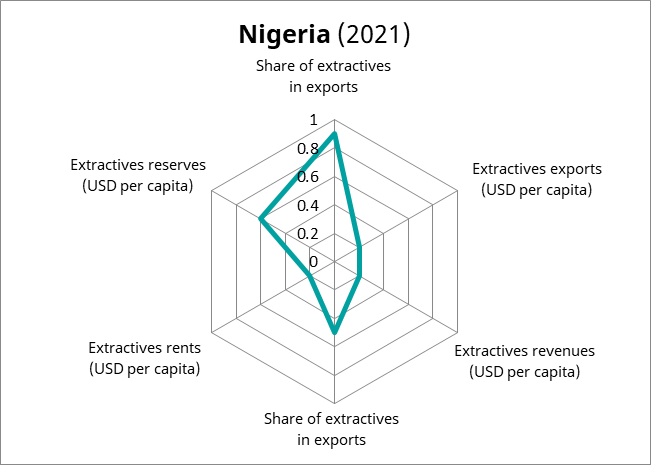
Nigeria ranks as the world’s 12th largest producer of oil and holds the largest natural gas reserves in Africa. Though the country also holds reserves of a variety of minerals (especially iron ore), the mining sector remains nascent, with insignificant contributions to the country’s export basket and fiscal revenues. As of 2021, Nigeria displayed a heavy dependence on oil and gas, but with relatively modest resource production per person, given the country’s large population. As can be seen in the figure below, in per capita terms, Nigeria has low extractive resource production (as approximated by rents), exports, revenues and reserves, but nevertheless a high share of extractives in total exports. Nigeria therefore should shift its focus from simply diversifying within the oil and gas sector to broadening its overall economic landscape. With a large and rapidly increasing population, relying solely on linkage development around oil and gas on e.g., processing oil and gas in-country may not meet diversification needs.
Unlike countries that are dependent on a variety of extractive resources, Nigeria’s over-reliance on oil and gas also exposes the country to severe risks related to the energy transition. Nigeria ranks 3rd globally for the highest carbon intensity in gas production and 22nd for oil. As carbon taxes rise, and consuming firms and investors increasingly prefer oil and gas that was produced with fewer emissions, Nigeria’s dependence on its relatively dirty oil and gas sector puts it in a challenging spot, underscoring the urgency with which government officials and other stakeholders should rethink its resource strategy.
Lessons multi-resource abundance: Colombia and Mongolia
The challenges of resource-based development can be very different across extractive sectors even within the same country. It can therefore be helpful to look at how a country’s resource wealth is divided between different extractive commodities. The cases of Colombia and Mongolia are informative in this regard.
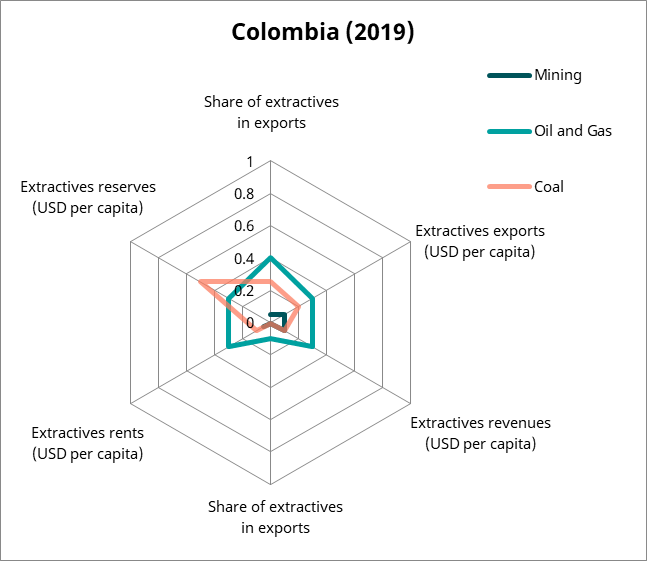
Though Colombia holds and extracts minerals (such as ferronickel and gold), fossil fuels make up the bulk of the country’s extractive resource wealth, with coal reserves estimated to be more valuable (at current prices) than its oil and gas reserves (though coal currently provides a much lower contribution to fiscal revenues and the export basket). Coal is most at risk of becoming a “stranded asset” (i.e., it is no longer commercially viable to produce it), followed by oil. So even though Colombia’s extractive resources are diversified between oil, gas and mining, most of its resource wealth will be threatened by the energy transition to green technologies. This is all the more important because some regions of Colombia depend heavily on coal.
Mongolia is endowed with a variety of extractive reserves, particularly gold, copper, coal and iron ore. Among these, coal is most at risk of becoming a stranded asset due to the energy transition.
Although the graphic below shows that Mongolia’s fossil fuel exports were slightly higher than mining exports (in 2018), the country’s MINDEX scores reveal that the broader economic weight and potential of the non-coal mining sector exceeds that of the country’s fossil fuel industry. Furthermore, Mongolia’s mineral reserves (not including coal) are considerably more valuable than the country’s fossil fuel reserves. In the future, the non-coal mining sector to will likely overtake fossil fuels as a main source of exports, especially as demand for coal declines with the energy transition.
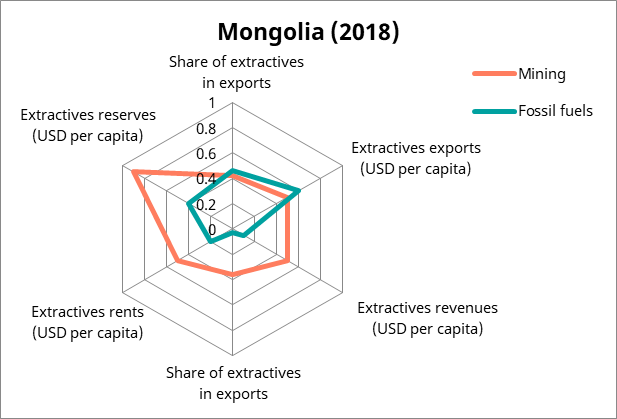
NB: in this figure, coal is classified as a fossil fuel rather than part of the mining sector.
Assessing policy changes amid evolving resource dynamics: Democratic Republic of the Congo
The DRC’s economy is highly dependent on the extractive sector. Extractives account for as much as 99 percent of the country’s exports in some years. Time analysis of the DRC’s MINDEX scores suggest that more resource revenues accrued to the government of DRC in 2014 than in 2010. This could be explained by the efforts from government to encourage more investment in mining, notably through a mining code revision process that began in 2012. However, resource production remains extremely low in comparison to the value of extractive reserves and the level of export dependency on extractives, suggesting that extraction capacity may be limited, or that there could be smuggling of extracted commodities.
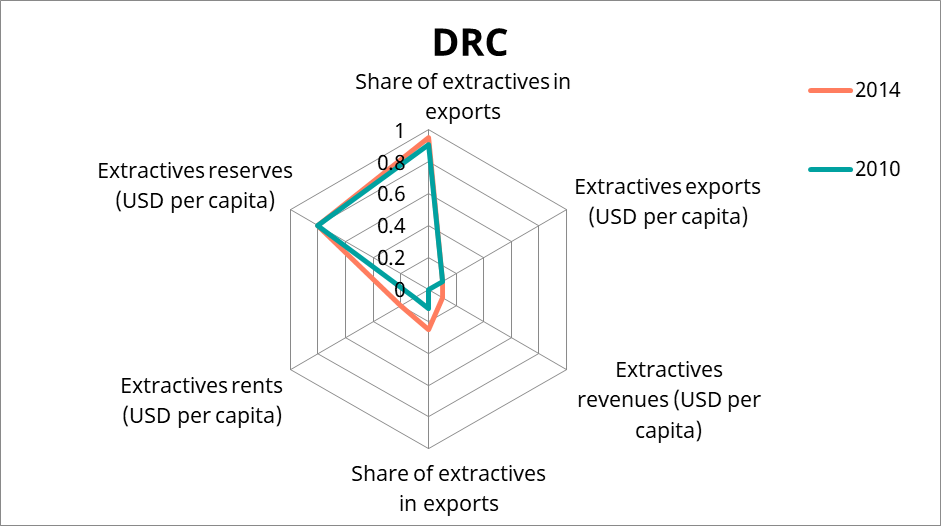
In conclusion, examining the different dimensions of extractives dependency can help us to understand the challenges facing resource-producing countries, and how to address them. The country profiles mentioned above present these kinds of insights, as well as a template for analyzing a country’s resource dependence.
For further information about the MINDEX, consult this published study.
Concerns mount only Lebanon's elite would strike it rich from an oil bonanza
Big Spenders: Swiss Trading Companies, African Oil and the Risks of Opacity
The sale of crude oil by governments and their national oil companies (NOCs) is one of the least scrutinized aspects of oil sector governance. This report is the first detailed examination of those sales, and focuses on the top ten oil exporting countries in sub-Saharan Africa. From 2011 to 2013, the governments of these countries sold over 2.3 billion barrels of oil. These sales, worth more than $250 billion, equal a staggering 56 percent of their combined government revenues.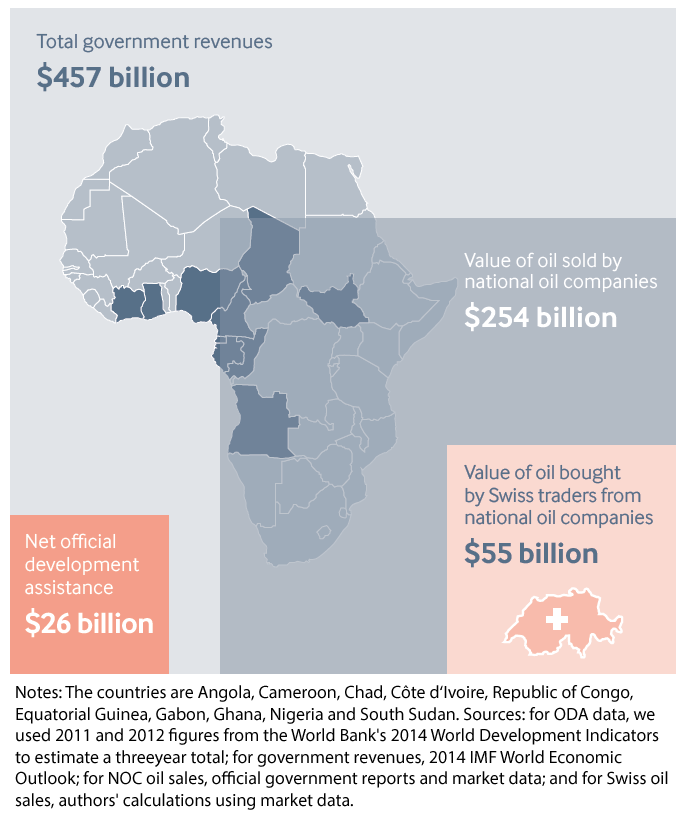
The Resource Governance Index Drives Reform in Uganda

In 2021, NRGI published RGI assessment results for 18 countries including Uganda, where it assessed both the mining and oil and gas sectors.
The challenge
The RGI assessment revealed two significant challenges in Uganda’s extractive sector.
First was the absence of fiscal rules governing revenue withdrawals from the Petroleum Fund. Once Uganda begins oil production, the resulting revenues will be deposited into the Petroleum Fund, held at the Bank of Uganda. Withdrawals from the Petroleum Fund will flow to the Consolidated Fund (to finance infrastructure and development). The remaining balance will be transferred to the Petroleum Revenue Investment Reserve (a sovereign wealth fund) to be invested outside the country. Fiscal rules would set guidelines on how much can be transferred to the Consolidated Fund for budgetary spending and how much should be transferred to the sovereign wealth fund. Resource-rich countries without relevant fiscal rules risk that political pressure results in pro-cyclical budgetary spending, which increases or decreases with volatile oil prices. This in turn risks a scenario in which the government fails to save any revenues in the sovereign wealth fund.
Second, NRGI’s assessment highlighted the absence of laws requiring the disclosure of the identities of beneficial owners of extractive companies. Such laws enhance transparency and accountability and mitigate corruption. Without them, Ugandans cannot know who ultimately owns the companies that benefit from extraction, and some extractives companies may evade taxes payments or hide improper relationships with powerful decisionmakers.
With low scores of 55 and 49 (out of 100) in the mining and oil and gas sectors respectively, the RGI results highlighted the pressing need for reforms in Uganda’s extractive sector and the need for greater transparency and accountability to ensure that resource revenues benefit Ugandans.
NRGI’s role
In response to its findings, NRGI recommended several key reforms to the Ugandan government. Among them, NRGI suggested making the identity of beneficial owners of companies engaging in extractive projects publicly available and implementing robust numerical rules governing deposits to and withdrawals from the Petroleum Fund, as well as firm rules governing the investment of oil revenues.
By providing technical assistance and financial support, NRGI played a critical role in driving engagement for these reforms. Between February and June 2022, NRGI prioritized engagement with the Ugandan government to push for the implementation of these recommendations. NRGI staff also met with key stakeholders, including the Ministry of Finance, civil society organizations and media partners such as CSCO, ACME and CSBAG, to develop capacity on transparency and accountability, petroleum revenue management, beneficial ownership disclosure and fiscal rules.
Impact
NRGI’s engagement with the government of Uganda resulted in significant legal and institutional policy reforms. Following a series of strategic meetings between NRGI and the Ministry of Finance, Planning and Economic Development, and in collaboration with the International Monetary Fund, the government of Uganda adopted fiscal rules for petroleum revenue management. The rule adopted by parliament provided that: “A maximum of oil revenue worth 0.8% of the preceding year’s estimated non-oil GDP outturn shall be transferred to the Consolidated Fund for budget operations. The balance shall be transferred to the Petroleum Revenue Investment Reserve (PRIR) for investment in accordance with the Public Finance Management Act (2015) as amended.” (Objective 3 of the CFR 2021-2025).
NRGI’s engagement with the government of Uganda resulted in significant legal and institutional policy reforms.
In addition, following NRGI’s engagement with the Ministry of Energy and Mineral Development and the Uganda National Oil Company, the parliament amended Uganda’s Companies Act to include a requirement for companies, including those in the extractives sector, to disclose their beneficial owners. The successful implementation of these amendments could serve as a catalyst for addressing potential corruption and elite capture of Uganda’s extractive sector.
These reforms are timely, given that Uganda is undergoing a major extractive sector transition, with the government keen to unlock the sector’s potential while avoiding the “resource curse.” NRGI’s analysis provided policymakers and citizens with a measurable lens through which to understand trends in performance and gaps, enhancing transparency and accountability in the extractives sector.
NRGI will continue to engage civil society organizations and other stakeholders to enhance their understanding of the rationale and importance of fiscal rules to better hold the government to account and ensure that the government adheres to the beneficial ownership provisions in the Companies Act.