
Responsible Exit Principles for Oil and Gas Companies

Asset transfers in the oil and gas industry are not new. Yet, as the energy transition accelerates, there is a growing risk that oil and gas companies sell assets in response to pressures to decarbonize. However, transferring assets to operators with lower standards can lead to higher emissions and increased risks. This briefing offers a framework to guide these transactions and ensure that environmental and operational integrity is upheld.
Designed for use by a range of stakeholders, these principles set out best practices to help companies manage financial, legal, environmental and reputational risks during asset transfers. They were developed with input from representatives of the oil and gas industry; investors, the financial, legal and accounting professions; the insurance industry; standard-setting bodies; academia; and civil society. All stakeholders can adopt and refine these standards to support a responsible, low-emissions future and harmonize regulatory practices across the industry.
These principles are relevant to:
- Buyers and sellers (public/state-owned/private) of upstream oil and gas assets to manage financial, environmental, legal and reputational risks.
- Financial institutions who can refer to these principles when determining whether and under what conditions to lend to, invest in, underwrite, advise or insure a company in the oil and gas sector
- Professional advisors (legal counsel, who can refer to these principles when drawing up contracts of sale; external auditors, who can assess the quality of optional disclosures in the notes to the financial statements and narrative disclosure; and consultants, who can weigh up the implications of these principles when advising on strategic priorities, including using M&A as a tool to accelerate business model transformation)
- Governments and financial regulators, who can use these principles to consider how best to regulate both decommissioning activities and asset transfers within their jurisdictions, including the impact such transfers may have on nationally determined contributions (NDCs), and the implications for fiscal policy.
- Host communities, civil society and other accountability actors who can monitor the terms and implementation of asset transfers to hold sellers and buyers accountable for their compliance (or non-compliance) with these principles, including as part of broader just transition considerations.
Related NRGI team members:

Nicola Woodroffe
Legal Analysis Lead

Erica Westenberg
Governance Programs Director
Ready, Set, Renegotiate! Senegal Reassesses Its Mining and Petroleum Contracts

Since the election of President Bassirou Diomaye Faye in March 2024, Senegal has embarked on a strategic shift by announcing its intention to renegotiate key contracts—including those signed with multinational companies in the mining, oil and gas sectors.
Since Faye’s inauguration, the government’s decision to renegotiate oil and gas contracts has evolved from an electoral promise to an active process, with the establishment this month of a special commission for the review of strategic contracts and the announcement of a sectoral audit. This reflects the new leadership’s commitment to a more transparent and effective management of natural resources.
This is not unheard of. Changes in political regime have triggered renegotiations in several countries, such as Bolivia in 2006, Liberia and Sierra Leone in 2008, and Guinea in 2011.
The success of the review and renegotiation process will depend on various legal, economic and political factors. The announcement of the review commission suggests the start of a contract review phase, allowing the government to decide whether to renegotiate and on which points. If this two-step approach is adopted, it is essential to continue rigorously assessing the potential costs and benefits.
Now is a tricky time to consider renegotiation, as several extractive projects in Senegal are entering production. Perceptions around European demand for Senegalese gas amid supply disruptions related to the Ukraine conflict, the impact of the energy transition, and the recent disengagement of companies like BP add a layer of complexity.

If renegotiations are transparent and well-managed, it could maximize long-term benefits for the state, while an opaque process could damage relations with partners, discourage future investments, and undermine citizens’ trust in the governance of their natural resources.
In this context, international experience offers several best practices. Pending specific guidance from the authorities, in this post we share five recommendations that officials and members of the renegotiation committee should consider to ensure success.
1. Build consensus on the objectives and roadmap of the process
Renegotiating extractive contracts carries risks. First, it is crucial to set realistic and achievable objectives based on a cost-benefit analysis with a clear scope. Clear objectives, covering areas such as taxation, local content, or environmental management, can limit political interference and use of discretionary power.
However, achieving consensus remains complex, as government priorities may differ in a given context. To frame the renegotiations, the government must provide the negotiation team with clear terms of reference, specifying the scope of renegotiation, and minimum requirements, particularly on specific points such as transparency, anticorruption, transfers of mining interests, taxation, environmental protection, risk management, and relations with local communities. A well-defined agreement model prepared in advance can help maintain consensus and ensure legal compliance.
The 2019 Petroleum Code allowed for the government and companies to agree to amend contracts, within 24 months of the code’s entry into force, to bring them into conformity with the new code. However, most contracts are still governed by the 1998 code. Negotiators could aim to align these contracts with current legislation while overcoming the challenges of stabilization clauses and previous attempts at compliance in 2019. In summary, the authorities should demand that companies “do their homework” before fully committing to the process.
2. Establish an effective and transparent communication strategy
In Senegal, although the objectives and terms of renegotiation are not yet public, transparency will become crucial. Clear communication is essential lest investors perceive the process as unfair or the government as capricious, thereby maintaining a stable investment climate. Informing citizens is also important to manage expectations, avoid negative perceptions, and strengthen the legitimacy of the outcomes. Senegalese citizens expect the government to clearly show how these renegotiations will improve their daily lives, particularly in terms of infrastructure financing, job creation, and sustainable development. Senegal must strike a balance between defending its national interests and maintaining investor confidence.
Best practices in renegotiation transparency, such as those observed in Guinea and the Democratic Republic of the Congo, where information on the process and the scope covered were published, demonstrate the need to make these elements public from the outset. Additionally, Senegal’s NC-EITI (National Committee for the Extractive Industries Transparency Initiative) can play a crucial role in monitoring documents related to renegotiations, as well as publishing amendments and changes in accordance with Requirement 2.4 of the EITI Standard. An effective communication strategy must not only convey the objectives and process to shape expectations and manage the impact on the investment climate, but also ensure the integrity of the renegotiation process.
3. Find the right balance in the composition of the renegotiation team
While the composition of the team should focus on sector-specific expertise, it is essential to open up to other skills and competencies, including independent experts. This will help incorporate best practices and avoid certain mistakes. To this end, we recommend:
- Empowering the committee. Having been present in Senegal for almost a decade, companies may have a background and relationships in the country and may appeal to other officials to resolve points of friction in negotiations. The government must ensure that communications with companies are conducted solely through the negotiation team, unless part of an accepted strategy. The negotiation team must have a clear mandate to conclude agreements, subject to executive or legislative approval. The limits of this power can influence the strength of the government’s negotiating position.
- Structuring the committee to reflect technical and political expertise. Including two distinct subcommittees would be additive: a multidisciplinary technical subcommittee for contract review and a political/strategic subcommittee. A purely technical committee may lack the political weight to engage the government in its decisions, posing the risk of disavowing negotiation outcomes, which could undermine the process. On the other hand, an overly political committee can hinder negotiations, and the necessary technical skills may be lacking. Finding a balance between technical expertise and political involvement is crucial.
- Including both experienced veterans and experts with fresh perspective. Officials structuring the committee should integrate members with a deep understanding of the initial negotiations and those responsible for overseeing and enforcing existing contracts. While it may seem unusual to retain the same individuals who negotiated the initial contracts, their expertise is essential for understanding the nuances of the contract and the established relationships. However, officials should also include individuals who were not involved in the initial process, without prior affinity with relationship management, to bring a fresh perspective and foster a positive dynamic for change.
4. Be cautious with external support
Renegotiating international contracts of this scale is complex. The effective use of external support (e.g., lawyers, tax experts, environmental specialists) can lead to positive outcomes in renegotiations, but officials should not presume that their involvement is necessary, especially internationally. The government must first assess the capabilities of its negotiation team and identify the need and relevance of external assistance. If officials identify a specific need, appropriate advisors must be chosen, especially in cases of market research and international standards. However, external support, particularly foreign, should remain secondary and should not undermine the authority of the negotiation team. Interventions by external advisors should be limited as much as possible in the process, and they should not replace local authorities. We recommend consulting external experts outside the negotiation room (e.g., between negotiation meetings to formulate positions or respond to company positions). The committee should define precise needs and choose competent advisors without conflicts of interest. The government’s renegotiation leaders should ensure smooth integration with local teams and select experts sensitive to local priorities while managing the associated costs. By adhering to these criteria, officials can optimize the effectiveness of external advice in renegotiation processes.
5. Prevent risks of corruption and weakening of sector governance
Senegal, still scarred by the PetroTim affair, has experienced the corruption risks of contract negotiation processes. To prevent renegotiation processes from compromising sector governance, it is crucial to adopt robust transparency and governance measures.
In Indonesia, for example, renegotiation objectives were defined by contract amendment guidelines, reviewed by parliament, and audited by an internal controller, which introduced a level of oversight and minimized political interference. Reliance on existing laws and regulations, which required regulatory changes for any alteration, also limited political interference. Restrictions on the participation of team members in the concerned industries were put in place to avoid conflicts of interest. Senegal should likewise establish strict governance mechanisms and ensure rigorous oversight to preserve the integrity of the process and avoid corrupt practices.
The renegotiation of oil and gas contracts in Senegal represents a decisive turning point in the management of natural resources. Faced with the challenges posed by political dynamics and the need to restore trust after the PetroTim affair, a rigorous and transparent approach is imperative. The establishment of an effective and transparent communication strategy, a strong and well-structured multidisciplinary renegotiation team, and the judicious use of external support are essential to ensure the success of this process.
To achieve better results in the process, it is also crucial that the government prevents renegotiations from dragging on, as this can be a strategy used by companies to exert economic pressure. By drawing on international best practices, the Senegalese state cannot only maximize long-term benefits but also attract potential investments and strengthen collective trust in the exploitation of natural resources.
We will continue to closely monitor the evolution of this process and provide additional recommendations as objectives become clearer and developments materialize.
El gran negocio de prestar a Pemex, bomba de tiempo
As Mexico Votes, State Oil Company Pemex Needs a New Direction

In less than two weeks Mexicans will vote for their next president. The outgoing leader, Andrés Manuel López Obrador, has made energy sovereignty and self-sufficiency one of the sustained themes of his presidency. AMLO, as he is universally known, has focused his energy aspirations on Pemex, the world’s most indebted national oil company. What Mexico’s next president does with Pemex will determine the country’s energy and fiscal future amid a rapidly changing outlook for fossil fuels.
Pemex faces unprecedented risk brought about by the quickening global energy transition away from hydrocarbons. At NRGI, we have described that risk in a new Spanish-language report, and summarize it below. We also offer some recommendations for the victor in June’s elections and the Pemex executives, including its director, whom the new president will appoint.
A risky business
National oil companies (NOCs) account for 55 percent of the world's oil production and yet they are moving more slowly than their private sector counterparts in terms of decarbonization planning.
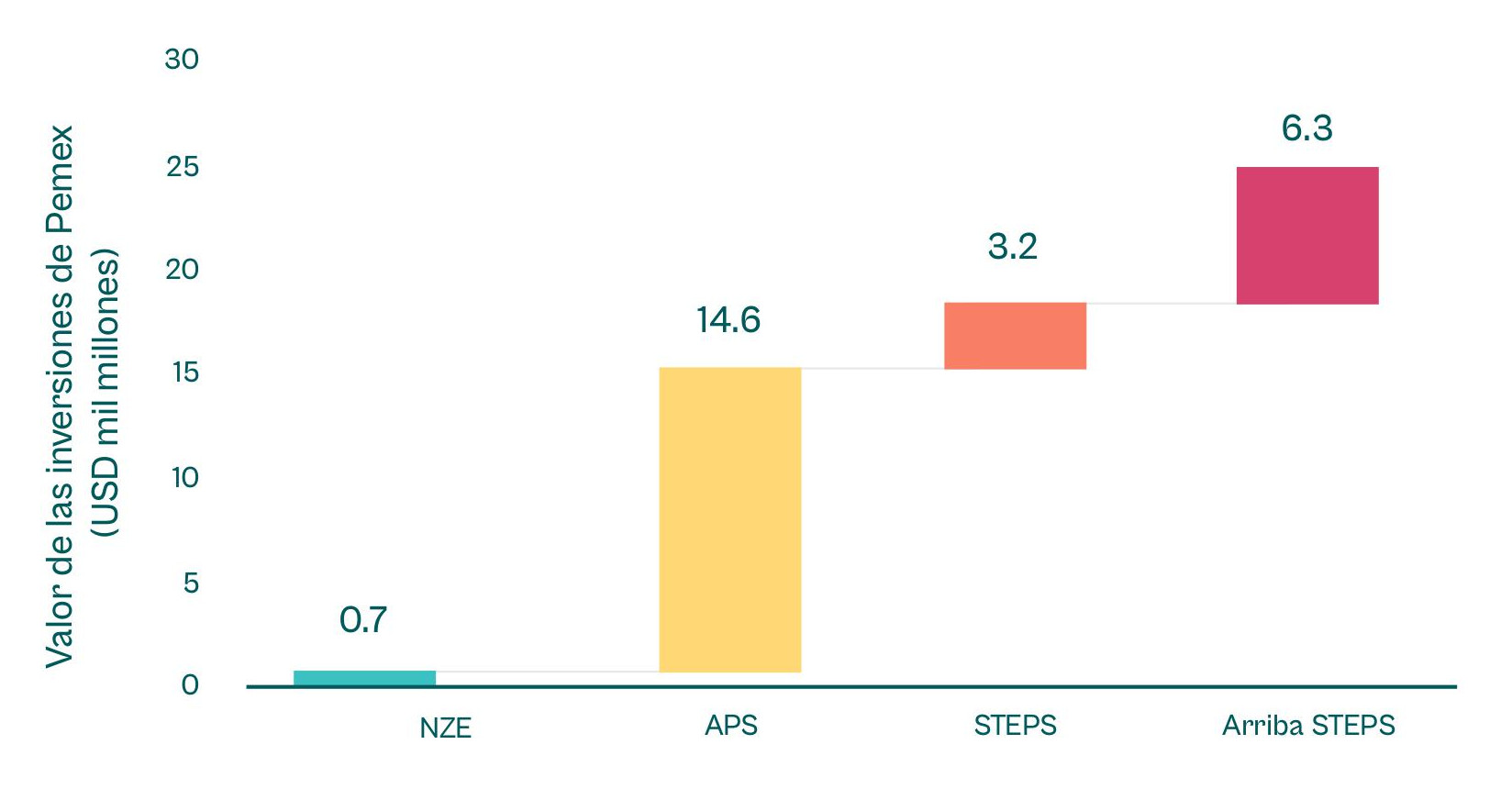
Among the 58 NOCs we studied last year, Pemex ranked 11th in terms of its exposure to transition risk. The biggest of these risks is the changing economics of the oil sector, with demand likely to markedly diminish in coming decades as countries seek to meet their emissions reduction goals. Mexico’s remaining oil reserves will be increasingly costly to extract, meaning that as global oil prices fall, Pemex may be caught out, its assets “stranded.” We found that approximately $10 billion in Pemex's expected investment over the coming decade would not break even under the International Energy Agency’s Announced Pledges Scenario for future oil demand. Given Pemex’s already problematic debt obligations, this presents the government with the specter of more bailouts to alleviate the company’s financial situation, generating an even deeper crisis.
Value of Pemex's upstream oil and gas investments breaking even in each of the IEA's scenarios.
In late 2022, Pemex presented a new business plan which, for the first time, explicitly referenced the energy transition. The plan recognized as risks the international hydrocarbon market contraction due to the increase in electric vehicles, and the downward trend in the demand for oil-derived plastics. While this recognition was an important first step, we still know little about what government officials and Pemex executives plan to do with respect to the transition.
In March 2024 Pemex released a sustainability plan that included more detail on some aspects of its intentions to reduce production emissions. But the plan did not address the transition risk in terms of falling global demand and prices.
Early dissemination of our findings in a workshop with climate and energy experts in Mexico yielded more insight:
- Pemex’s diversification plans remain somewhat vague, and their technical feasibility is uncertain.
- Pemex must be more transparent and accountable about its financial situation.
- Many sector insiders believe that the transition will be slow, and that Pemex will remain competitive.
We are confident that experts from Mexico’s oil and gas sector and its climate community can work with Pemex to improve understanding and communication of its plans.
How to improve Pemex’s future
Our research and consultations have led us to propose three categories of recommendation:
1. Pemex should further recognize and analyze transition risks.
This means more thorough scenario planning around market conditions, shared publicly. And Pemex officials should include more acknowledgement of transition risk in their financial reporting—not just in planning.
2. Pemex should adopt and adapt transition risk mitigation approaches from other oil companies.
Executives should look very carefully at large fields with high production costs. Factoring in lead times (7.5 years on average) and changing market conditions, these may not represent the bonanza that some imagine. One such find is the Kante field in Tabasco state; our analysis suggests that increased investment could be a financial misstep. Ambitions around producing more “no matter what” should give way to innovative thinking about Pemex’s potential role in a domestic energy transition.

Regarding diversification and downstream activities, executives have several opportunities. First, Pemex should better coordinate with CFE, Mexico’s state-owned electricity company. Both can play a fundamental role in advancing the energy transition. Leadership should build a coordinated and integrated vision and action plan that defines the role of each company.
Decision-makers must also carefully consider the viability of diversification options. For example, the two leading presidential candidates have been enthusiastic about expansion in petrochemical production. But petrochemicals only account for 12 percent of current oil demand and the global market may soon be oversupplied as many oil companies seek to expand. This presents a risk of overinvestment and therefore warrants caution.
3. Mexico’s next president should oversee key changes in the government’s approach to the oil and energy sectors.
Mexico’s energy ministry (SENER) should assume a transition planning role in which officials consider the transition risk and build synergies among the country’s state-owned energy companies.
Meanwhile, the finance ministry (SHCP) should review the conditions for financial support to Pemex in the interest of fiscal responsibility and transparency in the management of public resources.
Moreover, the state, as Pemex’s owner, has a crucial role in holding the company accountable. SENER, SHCP, the Congress of the Union and the Federal Superior Audit Office determine and supervise the company's ownership policy. These actors should therefore play a role in improving transition-related decision making within Pemex.
Whoever triumphs on 2 June must stop Pemex from making risky bets and have a clear vision for the company—and Mexico—in a world in transition.
Mexico’s risky bets
Learn more about the transition risks Pemex faces with new NRGI research.
Growing resource-backed loans seen threatening oil economy
Transición energética puede agravar crisis de Pemex y generar una en México: NRGI
Guidebook on Nigeria’s Energy Transition

Nigerian government has designed to transition from fossil fuels—oil, gas and coal—to renewable energy technologies, including institutional, policy, legal and fiscal frameworks.
It is informed by engagements with state and non-state actors including representatives of the government, the private sector, communities, youth and women’s groups, and by their views of the strengths and weaknesses of Nigeria’s energy transition plans. Accounting for Nigeria’s unique context and peculiarities as a fossil-fuel-dependent nation, the guidebook seeks to provide greater clarity on ways to navigate the energy transition for the Nigerian government, civil society, the media, the country’s citizens and the international community. It also seeks to mitigate transition led shocks and strengthen the overall transition process in Nigeria.
The guidebook can enhance stakeholder knowledge of Nigeria’s energy transition process and government action to accelerate the transition. This should encourage the adoption of a comprehensive plan aligned with the needs and realities of most Nigerians. The insights provided in the guidebook may also inspire and influence regional conversations across the African continent, creating a collective demand for a people-centered and just energy transition in multiple countries.”
Uganda: Behind the government’s refinery deal with UAE’s Alpha
Oil’s endgame will be in the Gulf
Responsible Change: How Governments Can Address Environmental, Social and Governance Challenges When Petroleum Assets Change Hands

-
As the world moves toward a future beyond oil and gas, petroleum assets will change hands, with different kinds of companies replacing others.
-
Since 2014, around USD 88 billion in assets have moved from publicly listed to private companies. The roles of sub-Saharan African and Latin American companies in their home countries have expanded.
-
Globally, the role of national oil companies (NOCs) is growing. NOCs have acquired around $24 billion in assets from non-NOCs since 2014.
-
The growing role of private and local companies and NOCs potentially gives producer countries greater control over their petroleum sectors, including the pace of an eventual phaseout.
-
However, these companies often have less capacity and fewer transparency, environmental, social and governance commitments than publicly listed international companies. This increases the risk that these companies’ operations will negatively impact the environment and communities, and that they will be unable to pay for decommissioning when production ends.
-
Many assets that sub-Saharan African and Latin American NOCs have acquired appear vulnerable to energy transition risks.
-
Governments should exercise approval rights over asset transfers to ensure buyers have requisite capacity to operate with high standards. They should ensure transparency to allow host communities and the public to better understand transfer impacts and how the government and/or companies will manage them, and strengthen regulations to address key issues arising from transfers including emissions management and reporting, and decommissioning funding.
-
Governments should require NOCs to make adequate disclosures about their acquisitions to ensure NOCs manage risks to the public purse.
As the world journeys towards a future beyond oil and gas, oil and gas assets will continue to change hands, with different kinds of companies filling the gap left behind by others.
There is growing concern that, as international oil companies (IOCs) face pressure to reduce emissions, they are selling upstream petroleum assets, in part, to shift emissions off their books and ostensibly achieve their decarbonization goals. On balance and at a global level, assets are moving from publicly listed to private companies and from companies with higher environmental commitments to those with weaker commitments. The result, according to some evidence, is that these sales do not simply transfer emissions to new parties but may increase them.
At the same time, some national oil companies (NOCs) seek to acquire assets left behind by the departure of IOCs to avoid production decline and ensure domestic energy supply.
This briefing shows how asset transfer trends may differ by region and country, and therefore present different risks and raise different policy considerations for producer country governments. It focuses on the Global South countries and regions in which the Natural Resource Governance Institute (NRGI) works.
NRGI analyzed upstream petroleum asset transfers from 2014 to the first half of 2023, using Rystad data to identify trends globally, at the sub-Saharan African and Latin American regional level, and in NRGI’s countries of focus.
This analysis shows that petroleum assets worldwide have moved primarily from publicly listed to private companies during the period studied. Since the start of 2014, around USD 88 billion in assets have moved from publicly listed to private companies. Both sub-Saharan Africa and Latin America have seen net divestment by publicly listed companies. In sub-Saharan Africa, there has been a transfer of around $23 billion in assets from publicly listed to private companies since the start of 2014, while in Latin America, around $11 billion in assets has moved from publicly listed to private companies.