
Making Senegal’s JETP Investment Plan a Feasible and Equitable Framework

Key messages
- The stakeholders responsible for implementing Senegal’s JETP must disclose more data related to this financial partnership. Greater transparency and improved stakeholder consultation will help ensure that projects are selected and implemented more equitably and are tailored to community needs.
- The Senegalese government must ensure that all projects within the JETP investment plan are consistent with other existing strategies and commitments regarding renewable energy, gas-fired power generation, coal phase-out, emissions reduction, economic growth, and electricity pricing. Any inconsistency between the JETP investment plan and government policy could jeopardize progress toward achieving energy sector goals and undermine the credibility of the agreement.
- The JETP investment plan includes many welcome projects, but it neglects certain types of support and guidance that would be highly sustainable and have a significant economic impact on Senegal. These shortcomings include insufficient capital allocated to the electricity grid, limited equity participation in grid-connected projects, inadequate subsidies for rural electrification, and the absence or inadequacy of guarantees and insurance provided by third parties.
Senegal has published its JETP investment plan, the result of substantial preparatory work. In its current form, the plan allocates approximately €2 billion in “quick win” projects against a total stated financing need of €9.5 billion, in support of ambitious objectives: universal access to electricity by 2030, 40 percent installed renewable energy capacity by 2030, and the electrification of 8,523 local authorities. Senegal’s JETP is intended to serve as both an energy transition instrument and a lever for inclusive development. However, its implementation is unfolding in a more fragile international context, underscoring the importance of credible, transparent, and reliable execution. Building trust in the mechanism now requires greater transparency, strict alignment with national planning frameworks, and financial decisions that make the JETP viable, inclusive, and sustainable.
Greater transparency in JETP implementation is essential, including a clear identification of the beneficiaries of JETP investments and the nature and modalities of the benefits they receive. The JETP is not merely a collection of credit lines and installed megawatts; it represents a promise of tangible improvements in citizens’ daily lives. In Senegal, this promise encompasses more equitable access to electricity, affordable tariffs, local economic opportunities, and a reduction in territorial and social disparities between urban and rural areas. Without reliable, accessible, and shared data, it becomes difficult to assess whether this promise is being fulfilled—or whether the JETP risks reproducing, or even exacerbating, existing inequalities. Accordingly, the briefing recommends consolidating the national energy baseline database (supply, demand, energy mix, and access disaggregated by location), publishing a clear and detailed project-by-project implementation timeline, and explicitly disclosing actual public budget expenditures. The operationalization of a JETP budget module and a public dashboard would transform the JETP from a technocratic commitment into a measurable social contract of trust among the state, its partners, and citizens.
The issue extends beyond transparency in the narrow sense. It also concerns the territorialization of the JETP through the precise identification of beneficiary communities; the urban–rural trade-offs involved; and the electrification approaches selected for each locality. It further requires ensuring meaningful participation by local authorities, communities, labor unions, and civil society—going beyond one-off consultations—and establishing specific accountability mechanisms that allow for course correction when social, territorial, or tariff-related outcomes diverge from stated objectives.
The success of the JETP also depends on its alignment with national energy policies and Senegal’s decarbonization pathway. Accelerated deployment of renewable energy will be economically viable only if investments in grid infrastructure—transmission lines, substations, and intermittency management—proceed at the same pace. Moreover, while Senegal has reaffirmed a target of 40 percent renewable energy capacity by 2030, long-term planning remains heavily oriented toward gas, with projections exceeding 3 gigawatts by 2050. Without clarifying the relationship between gas and renewable energy—and without a clear strategy for phasing out coal—the country risks locking in a gas-centered energy system, undermining both solar and wind potential and broader climate objectives.
Finally, financial decisions will determine whether the JETP is viable, inclusive, and sustainable. Although the overall financing profile is largely concessional, it exhibits notable weaknesses: heavy reliance on debt, a limited share of grants and subsidies, and highly imbalanced capital structures for renewable energy projects characterized by extremely low equity levels. The briefing recommends strengthening domestic investment participation (including sovereign wealth funds, insurers, and pension funds), increasing grant financing for segments with high social utility, and better protecting consumers from tariff and currency risks, as well as from payment and affordability shocks. Lastly, the concentration of projected disbursements in 2026–2027 calls for a realistic sequencing of investments and a gradual strengthening of government capacity for project procurement and management.
Faire du plan d’investissement JETP du Sénégal un cadre réalisable et équitable
Messages clés
- Les parties prenantes chargées de la mise en œuvre du JETP doivent divulguer davantage de données relatives á ce partenariat financier. Une plus grande transparence et une meilleure concertation des parties prenantes permettront de garantir que les projets soient sélectionnés et mis en œuvre de manière plus équitable, et adaptés aux besoins des communautés.
- Le gouvernement sénégalais doit veiller à ce que tous les projets du plan d’investissement du JETP soient cohérents avec les autres stratégies et engagements pris en matière d’énergies renouvelables, de production d’électricité à partir de gaz, de sortie du charbon, de réduction des émissions, de croissance économique, et du prix de l’électricité. Toute incohérence entre le plan investissements du JETP et la politique gouvernementale pourrait compromettre les progrès entrepris dans la réalisation des objectifs prioritaires du secteur énergétique et nuire à la crédibilité de l’accord.
- Le plan d’investissement du JETP comprend de nombreux projets bienvenus, mais néglige certains types de soutiens et d’accompagnements porteurs d’une grande durabilité et d’un impact économique significatif pour le Sénégal. Ces lacunes concernent notamment l’insuffisance des capitaux alloués au réseau électrique, une participation encore limitée au capital des projets raccordés au réseau, des niveaux de subventions trop faibles pour l’électrification rurale, ainsi que l’absence ou l’insuffisance de garanties et d’assurances fournies par des tiers.
Le Sénégal a publié son plan d'investissement JETP, fruit d'un travail important. Dans sa forme actuelle, elle alloue des projets « Quick Win » d'une valeur d'environ 2 milliards d'euros sur un besoin total exprimé de 9,5 milliards d'euros, servant des objectifs ambitieux (accès universel à l'électricité d'ici 2030, 40 % de la capacité renouvelable installée d'ici 2030, électrification de 8 523 autorités locales). Le JETP du Sénégal devrait être un outil de transition énergétique et un levier pour un développement inclusif. Cependant, sa mise en œuvre se fait dans un contexte international plus fragile, ce qui souligne l'importance d'une mise en œuvre fiable, transparente et crédible. Mais la confiance dans le mécanisme nécessite désormais une plus grande transparence, un alignement strict avec les plans nationaux et des décisions financières qui rendent le JETP viable, inclusif et durable.
Une transparence accrue sur la mise en œuvre du JETP et une description claire des bénéficiaires des investissements du JETP ainsi que la nature et les modalités de ces bénéfices est nécessaire, car le JETP n'est pas seulement un ensemble de lignes de crédit et de mégawatts installés : c'est la promesse d'une transformation concrète de la vie quotidienne des citoyens. Au Sénégal, cette promesse prévoit un accès plus égal à l'électricité, des factures abordables, des opportunités économiques locales et une réduction des divisions territoriales et sociales entre zones urbaines et rurales. Sans données fiables, accessibles et partagées, il devient difficile de vérifier si cette promesse est tenue ou, au contraire, si JETP risque de reproduire (voire d’aggraver) les inégalités existantes. Par conséquent, dans le briefing, il est recommandé de consolider la base de données de référence sur l'énergie (proposition, proposition, mix, accès distribué par zone), de publier un calendrier clair et détaillé de projet par projet, et d'indiquer clairement les dépenses budgétaires réelles de l'État. La mise en œuvre du module budgétaire JETP et du panel public transformera JETP d'un engagement technocratique en un contrat mesurable de confiance entre l'État, les partenaires et les citoyens. La question va d’ailleurs bien au-delà de la transparence au sens strict. Il s'agit également de la territorialisation du JETP à travers la définition précise des communautés bénéficiaires, les arbitrages urbain-rural, ainsi que les méthodes d'électrification choisies pour chaque localité ; garantir une participation efficace des autorités locales, des communautés, des syndicats et de la société civile, ce qui va au-delà de simples consultations ponctuelles ; et la mise en œuvre de mécanismes spécifiques de responsabilité permettant des ajustements de trajectoire lorsque les résultats sociaux, territoriaux ou tarifaires s'écartent des objectifs.
Le succès du JETP dépend également de son alignement avec les politiques énergétiques nationales et de la trajectoire de décarbonation du pays. Le déploiement accéléré des sources d'énergie renouvelable ne sera économiquement viable que si les investissements dans le réseau (lignes, sous-stations, gestion des discontinuités) se font au même rythme. De plus, bien que le Sénégal réaffirme un objectif de 40 % de capacité renouvelable d'ici 2030, la planification à long terme reste fortement axée sur le gaz, avec une prévision de plus de 3 GW d'ici 2050. Sans clarifier le lien entre le gaz et les énergies renouvelables (et sans stratégie claire pour éliminer progressivement le charbon) le pays risque de consolider son bilan énergétique autour du gaz, ce qui nuirait au potentiel solaire et éolien ainsi qu'aux objectifs climatiques.
Enfin, les décisions financières détermineront si JETP est viable, inclusive et durable. Bien que le profil global de financement soit majoritairement préférentiel, il présente des faiblesses : une forte dépendance à la dette, une proportion limitée de subventions et subventions, et une structure de capital très déséquilibrée pour les projets d'énergie renouvelable avec des niveaux de capital extrêmement faibles. Le briefing recommande de renforcer les investissements locaux (fonds souverains, assureurs, fonds de pension), d'augmenter les subventions pour les segments à forte utilité sociale, et de mieux protéger les consommateurs contre les risques tarifaires et monétaires ainsi que contre les points de paiement ou de paiement. Enfin, la concentration des paiements prévue pour 2026–2027 nécessite une séquence séquentielle réaliste et un renforcement progressif des capacités de rachat et de gestion des projets gouvernementaux.
Bold Mexican climate targets raise question: Really?

In an interview with EcoAméricas, Fernanda Ballesteros argues that Pemex must be central to Mexico's climate strategy. "The government should use its influence to align the state oil giant with national climate goals, incorporating explicit just transition measures into the company's operations."
Mexico has set an ambitious goal of cutting greenhouse gas emissions by more than a third in the next decade, but the pledge is at odds with the government’s loyalty to the state-run oil and gas sector and the fossil-fuel-guzzling state electric utility, climate and energy experts say.
Mexico in November vowed at the COP30 climate conference in Brazil to reduce emissions of global warming gases to between 364 and 404 megatons (Mt) of carbon dioxide equivalents by 2035 and to reach zero net emissions by 2050. Contained in a document outlining Mexico’s Nationally Determined Contribution (NDC) to the global climate struggle, the new targets at first glance stand out for their ambition compared with those of many other top-20 greenhouse gas emitting nations. Collectively, the world’s countries have pledged far smaller greenhouse gas reductions than are needed to meet the Paris Agreement goal of keeping global warming below 2 degrees Celsius.
Experts, however, say Mexico’s new emissions target is impossible unless the country stops promoting state-owned fossil-fuel production, ramps up renewable energy output, significantly increases its fleet of electric vehicles and expands carbon sequestration.
“I don’t see a way this can be achieved,” says Oscar Ocampo, economic development director for the Mexican Institute for Competitiveness in Mexico City. The new targets are not binding, he notes, adding, “They’re empty words.”
A top-ten polluter
Mexico produces 1.5% of the world’s greenhouse gases, placing it among the top dozen global climate polluters and second in Latin America. The country’s emissions continue to rise, albeit more slowly than they would have in the absence of emissions-reduction efforts. Net emissions—total emissions less those absorbed by “sinks” such as forests—reached 574 Mt of carbon dioxide equivalents in 2024, according to an inventory published by Mexico’s National Institute of Ecology and Climate Change.
Under the new NDC, sectors that emit the most greenhouse gases will make the largest cuts, starting with transportation and electricity generation, which represent 42% of emissions. At the same time, the government has vowed to reduce deforestation in Mexico—in recent years totaling at least 125,000 hectares (309,000 acres) annually—to zero by 2035, increasing the country’s capacity to absorb carbon dioxide.
Experts are skeptical. On one hand, Mexican President Claudia Sheinbaum, a climate scientist, has vowed to boost renewable energy, a departure from her green-power-averse predecessor, Andrés Manuel López Obrador.
The NDC calls for "clean" energy output to grow from about 24% of power generation today to 43% within a decade. On the other hand, Sheinbaum has also extended López Obrador’s fealty to the state-owned oil company, Petróleos Mexicanos (Pemex), and the Federal Electricity Commission (CFE), Mexico’s state utility. Their activities collectively account for more than a quarter of Mexico’s emissions.
The government continues to put Pemex’s survival ahead of its environmental priorities, experts say, budgeting US$14 billion this year to service the company’s debt and approving increased hydraulic fracturing, or fracking.
Reliance on carbon-intensive industries has legislative support. Reforms passed in March by the Mexican Congress ensure 54% of the grid’s electricity will be generated by the CFE, whose power stations rely heavily on fossil-fuel feedstocks. The reforms turned Pemex and the CFE into public companies and gave the government more control over energy regulation and transmission—an unsettling development for investors in wind and solar, which currently generate 12% of Mexico’s energy.
Shadow of Pemex
By simultaneously promoting renewables and propping up Pemex and the CFE, the president is trying to “have it a little bit both ways,” says Fernanda Ballesteros, the Natural Resource Governance Institute (NRGI) country manager for Mexico, (an independent, non-profit organization that supports informed, inclusive decision-making about natural resources and the energy transition).
Instead, says Ballesteros, the government should use its financial leverage over Pemex to demand tough reforms and cuts in methane emissions caused by flaring gas. The oil giant last year pledged to cut methane emissions by 30% by 2030, stop routine flaring, and operate as a net-zero company by 2050. But Pemex trails other state oil companies in emissions reductions, she says, and is effectively setting Mexico’s climate agenda. “This sends a really strong and unfortunate message,” she adds.
Meanwhile, the NDC’s promise to cut emissions in the transportation sector seemed hollow after the government decided to slap tariffs of 50% on Chinese-made cars as of January, experts say. China makes about a tenth of new cars sold in Mexico, most of them electric.
Some targets Mexico announced in Brazil rehash commitments made a year ago or more. The pledge to reach net-zero deforestation was first announced in 2015, says Anaid Velasco, head of research and public policy at the Mexican Center for Environmental Law in Mexico City. “It’s a target they’ve been repeating, repeating, repeating,” Velasco says.
Can climate action beat geopolitical headwinds in 2026?
Online

What can we expect in 2026 as countries enter the second half of this critical decade for climate action?
Speakers
Tulio Andrade - COP30 Chief Strategy and Alignment Officer
Tulio Andrade is the COP30 Strategy and Alignment Officer. Career diplomat since 2009, with postings in London and Tokyo. Served as Head for Climate Negotiation at Brazil's Foreign Ministry from 2023 to 2025, including at the 2023 Dubai Climate Summit (COP28), COP29, and the 2024 G20 Task-Force on a Global Mobilization against Climate Change (TF-CLIMA).
Jennifer Morgan - Senior fellow, Center for International Environment and Resource Policy and Climate Policy Lab, Tufts University.
Jennifer Morgan is currently a senior fellow at the Center for International Environment and Resource Policy and Climate Policy Lab at Tufts University. As State Secretary and Special Envoy for the Federal Foreign Office of Germany, she led the development and implementation of the groundbreaking Climate Foreign Policy strategy, which was approved by the Cabinet. Besides leading Germany’s delegation to the UNFCCC negotiations, she focused her time on building partnerships with developing countries and pursuing an all-of-society public diplomacy approach. She is a leading voice in the conversation on how foreign policy must evolve to address the urgent climate challenges of our time.
Erica Westenberg - Governance Programs Director, Natural Resource Governance Institute (NRGI)
Erica Westenberg is the Director of Governance Programs at the Natural Resource Governance Institute (NRGI). She is a lawyer and provides policy advice on transparency and good governance in resource-rich countries worldwide. Prior to joining NRGI, she was in the energy and infrastructure group at Skadden Arps, where she advised clients on energy, natural resource, and infrastructure projects and public-private partnerships in Asia, Latin America, the Middle East and the United States.
Alex Rafalowicz – Executive Director at the Fossil Fuel Non-Proliferation Treaty Initiative
Alex Rafalowicz has worked as a policy analyst, campaigner, organiser and strategist for climate justice for 15 years including with the Global Campaign to Demand Climate Justice, the Climate Action Network, and 350.Org. He has worked on digital and electoral campaigns across the Americas, Europe, and Australia. He has a first class honours degree in law from the Australian National University and Masters in Economics from the Indira Gandhi Institute for Development Research. He lives in Bogotá, Colombia with his family.
Exploring the Transition Minerals Landscape in Sub-Saharan Africa: A Case for the Congo Basin
Congo Basin Climate Commission Pavilion, COP30 Blue Zone

The global shift toward renewable energy, electric mobility, and digitalization has spurred unprecedented demand for critical minerals such as copper, cobalt, and manganese. These are minerals abundant in the Congo Basin and broader sub-Saharan Africa. These minerals are essential for technologies that power the clean energy transition, including electric vehicles, batteries and solar panels.
Yet, the current rush to secure these resources risks reproducing old patterns of exploitation—extractive systems marked by human rights violations, environmental degradation, and social inequality. In countries such as the Democratic Republic of Congo, mineral extraction has been linked to child labor, displacement and gender-based violence, highlighting the urgent need to rethink how the energy transition is governed.
This side event builds on a recent report examining critical minerals governance, human rights and regional cooperation. It situates the conversation within the Just Transition Work Programme at COP30, highlighting how the mineral-energy nexus links to broader debates on climate, energy, forests, and adaptation.
Featuring NRGI's

Ana Carolina González Espinosa
Senior Director for Programs and Latin America Director
La Amazonía viva contra la expansión petrolera
Norway Pavilion, COP30 Blue Zone

Este evento presentará un nuevo informe sobre los riesgos económicos, sociales y ambientales de la expansión petrolera en la Amazonía colombiana, elaborado por Earth Insight, OPIAC y el IISD.
Durante el evento, la discusión analizará cómo la expansión de la exploración fósil afecta a los pueblos indígenas y qué implicaciones puede tener para la economía y la seguridad energética de Colombia.
El panel también mostrará las herramientas disponibles para avanzar hacia una transición justa y sostenible, incluyendo el reconocimiento y la titulación de territorios indígenas, y ofrecerá perspectivas para la acción conjunta con socios y aliados internacionales.
Participarán representantes de OPIAC, Earth Insight, Parlamentarios por un Futuro Libre de Combustibles Fósiles, NRGI y el Ministerio de Ambiente de Colombia.
Participación de NRGI
Ana Carolina González Espinosa
Senior Director for Programs and Latin America Director
Envisioning Colombia’s Energy Transition: The Power of Narratives to Foster Equity and Justice

This page features NRGI’s contribution to the IDS Bulletin’s special issue on Just Energy Transitions, which brings together research and perspectives on how communities, governments and civil society can shape fairer pathways away from fossil fuels. In this edition, NRGI colleagues authored a chapter examining the role of public narratives in Colombia’s energy transition.
Colombia’s energy transition debate is marked by strong polarization and dominated by powerful political and economic interests. As the government’s proposal to phase out fossil fuels has gained international attention, many domestic narratives continue to marginalize the perspectives of civil society organisations and communities in fossil-fuel-producing regions.
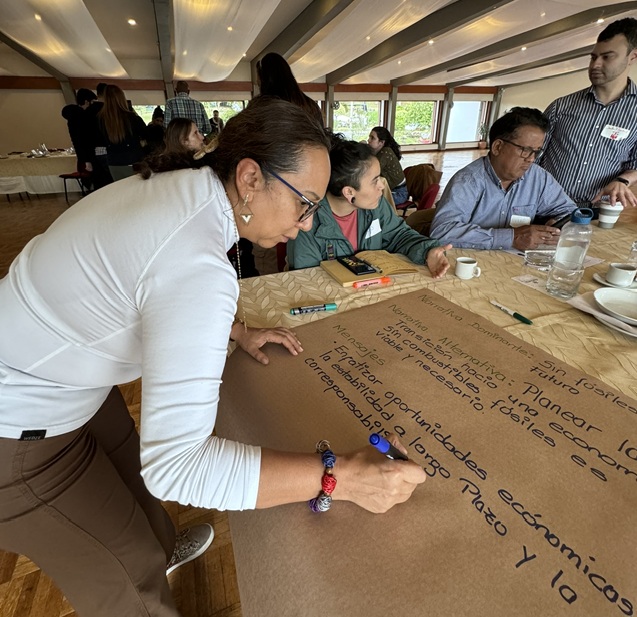
In response, NRGI and partners convened a diverse group of social actors to co-create a metanarrative and a set of alternative narratives rooted in justice, equity and inclusion. This chapter explores how these shared narratives can counterbalance exclusionary discourses, strengthen community voices and support a more just and inclusive transition pathway for the country.
The Power of Narratives in Colombia's Energy Transition
COP30: Funding Africa’s Path to a Just Fossil Fuel Phase Out

At COP30 in Belém, Nafi Quarshie, NRGI's Africa director joined a press briefing on how a global fossil fuel phase-out can be fair, financed, and achievable for Africa.
Her full remarks:
Africa comes to COP30 not to make excuses, but to make a case for fairness. Science is clear that fossil fuels must be phased out. Africa understands this, perhaps better than any other region in the world. But what COP30 and the global community must also understand is that Africa cannot phase out what it has not yet phased in.
Across our continent, over 600 million Africans still live without electricity, and another 900 million lack access to clean cooking. Yet our countries are being asked to abandon the fossil fuels that currently provide up to 40 percent of government revenues in some economies without credible, accessible, or predictable financial support to replace them.
That is not a transition; it is an economic cliff. So, when we speak of a “just transition,” Africa insists that justice must mean finance, fairness, and flexibility:
- Finance that is adequate and accessible.
- Fairness that recognizes different starting points.
- Flexibility that allows countries to sequence reforms while still growing and protecting their people.
Let us be honest, the COP process has not delivered on its financial promises to Africa. We have seen pledges made and broken. Africa needs about US$400 billion per year in climate finance and receives only US$47 billion. Meanwhile, the continent pays US$163 billion annually in interest to creditors.
Africa is not asking for charity. We expect climate finance obligations to be met. When we talk about “phasing out,” we must also talk about “financing in.”
So, what do we need COP30 to deliver? Three things: clarity, credibility, and commitment.
On clarity, we need a concrete, time-bound roadmap for phasing out fossil fuels that reflects different realities. Africa’s pathway cannot mirror Europe’s or North America’s. The transition in Africa must prioritize energy access, job creation, diversification, and development, not just emission reduction targets.
Second, credibility: We need real finance on the table, not recycled pledges, not loans that worsen the debt crisis. We need grant-based and concessional funding for clean energy, economic diversification, and social protection, complemented by debt relief and reform. That means scaling up existing financing facilities for both adaptation and mitigation, and reforming international financial institutions so they serve, not suffocate, developing economies.
Third, commitment: We need a global deal that treats Africa as a partner, not a casualty. Partnerships must unlock responsible private capital, technology, and skills transfer, and be built on transparency, accountability, and country ownership. Africa calls on COP30 to turn the Baku-to-Belém Roadmap into real action, delivering on past finance promises and aligning funding with our climate and development needs.
Africa is ready to move. But we cannot move with rhetoric; we move with resources.
Let me be clear: the question is not whether Africa will phase out fossil fuels. The question is whether COP30 and the world will invest in an African transition that is just and achievable. Without that investment, the phase-out agenda will fail not just for Africa, but for everyone.
For the avoidance of doubt, a world that can find US$6.6 trillion for defence, warfare, and ammunition can surely find US$1.3 trillion to secure humanity’s future.
If COP30 is to make history, it must not pretend that ambition can substitute for finance. We cannot transition on promises. What Africa demands and deserves is a funded, fair, and inclusive transition that leaves no one behind.
Thank you.
Youth-Led Insights: Co-creating a Just and Inclusive Energy Future (COP30)
Just Transition Pavilion

In a time of rapid change and uncertainty, ensuring a just and inclusive energy transition has never been more urgent. This session brings together youth leaders and senior policymakers to exchange ideas on how to expand access to affordable clean energy, create quality jobs, and build the skills needed for a low-carbon, climate-resilient future.
An interactive fireside chat will spotlight innovative approaches to renewable deployment, workforce development, and education reform that empower young people to shape the transition. The discussion will also highlight the role of youth organizations as bridges between generations and institutions, and as catalysts for people-centred energy policies that leave no one behind.
Summary of insights
NRGI’s Melissa Marengo reflected on how the green and digital transitions can better serve young people, women, and communities most affected by energy injustice. Her responses emphasized the need for systemic shifts in education, governance, and territorial justice to ensure that the energy transition is truly inclusive and equitable.
Moderator: How can we ensure that the green and digital transitions create inclusive and equitable opportunities, particularly for young people, women, and communities most affected by energy injustice? Where are we falling short, and what needs to change?
Melissa:
Right now, many policies and investments still overlook women, youth, and frontline communities. To correct this, we must:
- Evolve education systems in regions historically dependent on extractive industries to include renewable energy, environmental sciences, innovation, and social transformation. This opens new career pathways and equips young people with the skills needed for a sustainable future.
- Recognize AI as an opportunity for youth. Young people adapt quickly to new technologies and can use AI to innovate in renewable energy, environmental monitoring and beyond if given access and training.
- Ensure transitions are territorially just, meaning the communities most affected by extraction or pollution should be the first to benefit from renewable energy investments, not displaced by them.
- Decentralize decision-making, allowing local voices to actively shape transition plans.
- Remember that a just transition is ultimately about redistributing power, expanding opportunity, and recognizing those who have paid the highest price for the fossil-fuel economy.

Moderator: What solutions can integrate social fairness into regional and global energy transitions? And what future solutions might we not yet be thinking about?
Melissa:
A socially fair transition requires system-wide changes:
- Responsible fossil fuel exit: In fossil-fuel-dependent regions, education systems must introduce pathways linked to hydrocarbon project closure, environmental remediation, and ecosystem restoration, fields that will expand as countries phase out fossil fuels.
- Closing expertise gaps: For example, in Peru, several abandonment plans have been under evaluation for up to six years due to limited technical capacity. Building local expertise is essential.
- Strengthening governance frameworks: Human rights, transparency, and benefit-sharing should be core criteria in all transition-related investments. We must link mineral governance, renewable energy development, and fiscal systems to measurable social outcomes.
These steps ensure that the transition doesn’t simply clean the energy mix—it transforms opportunities and strengthens equity.
Moderator: What urgent actions are needed to align education and workforce development with the needs of the clean energy transition? Who should lead this coordination?
Melissa:
We need to anticipate, not react to, emerging transition skills:
- Redesign education and workforce systems to prepare young people for clean energy jobs before demand fully emerges.
- Integrate training on renewable energy technologies, environmental governance, circular economy, and social dialogue in both academic and technical programs. This ensures the workforce is technically skilled and socially and environmentally conscious.
- Shared leadership is essential: Governments should set national strategies, but coordination must involve local authorities, universities, industry, and civil society to ensure training reflects local realities.
- Financing matters: Funding for upskilling, retraining, and education, especially for women, youth, and workers in declining sectors, must be built into national transition plans from the outset.
Featuring NRGI's

Melissa Marengo
Portfolio Coordination Lead
National Oil Companies and the Energy Transition: Perspectives from Africa and Latin America (COP30)
WWF Pavillion, COP30 Blue Zone

National oil companies (NOCs) produce over half of the world’s oil and gas and sit at the center of the global energy transition. As demand for fossil fuels peaks and assets risk becoming stranded, NOCs and the economies that depend on them face profound economic and fiscal challenges. In many countries across Africa and Latin America, these companies are key employers and revenue sources and their transformation will shape the future of entire regions.
This event, co-organized by NRGI and Observatório do Clima, will explore how NOCs can adapt to shifting global energy markets and contribute to a just and orderly transition. Bringing perspectives from Africa and Latin America, the discussion will examine pathways for NOCs to drive economic diversification, protect public finances, and support communities through the changes ahead.
Speakers:
- Ke Rafitoson, Executive Director, Resource Justice
- Suely Araújo, Public Policy Coordinator, Observatório do Clima, Brazil
- Nafi Quarshie, Africa Director, NRGI
- Baptiste Albertone, Postdoctoral Researcher, TIDE Centre, University of
Oxford
Moderated by: Ke Rafitoson, Executive Director, Resource Justice Network
Session Highlights: Perspectives from Africa and Latin America
At this COP30 dialogue, NRGI’s Africa Director Nafi Quarshie brought perspectives from Uganda, Nigeria, and Ghana — three countries where national oil companies (NOCs) sit at the heart of economic stability and transition risk. Her interventions highlighted the scale of the challenge facing NOCs as fossil-fuel demand peaks, financing tightens, and global actors accelerate decarbonization. Below is a synthesis of her key insights.
Uganda: Navigating expansion in a transition-constrained world
Uganda’s National Oil Company (UNOC), established in 2015, is mandated to manage the state’s commercial interests and ensure petroleum resources are developed sustainably. With an estimated 6.5 billion barrels of reserves and 1.4–1.7 billion barrels recoverable, Uganda is advancing major upstream and midstream projects — including refinery development, pipeline infrastructure, and a newly acquired exploration block.
Nafi highlighted several pressures shaping UNOC’s future:
1. Mounting financial exposure: UNOC has already taken on loans to finance its share of the East African Crude Oil Pipeline (EACOP) and will require significant additional capital for refinery development and exploration. This deepens fiscal exposure at a time when global capital for oil is tightening.
2. Transition misalignment risk: Pursuing large-scale oil expansion in a global phase-down environment exposes Uganda to stranded-asset and revenue volatility risks, potentially diverting investment away from diversification.
3. Financing ESG commitments: UNOC’s ESG strategy includes methane-reduction measures, an LPG plant to capture fugitive gas, and a plan to plant 40 million trees. Despite early partnerships — such as with the Alliance for Climate Resilience — long-term financing remains unclear.
4. Revenue governance challenges: Recent amendments allow UNOC to retain a portion of petroleum revenues. Nafi underscored the importance of safeguards to ensure these funds support long-term national development, especially given recent cases where government borrowed funds only for UNOC to reinvest them in government securities.
Nigeria: Managing decline while building resilience
Nigeria faces the dual reality of an imminent decline in global oil demand and high domestic dependence: oil still accounts for 80% of forex earnings and around half of government revenue. Under the Petroleum Industry Act (2021), NNPC Ltd is now a commercial entity — but remains fully state-owned and central to Nigeria’s transition pathway.
Nafi emphasized four strategic imperatives:
1. A planned and managed decline: NNPC must optimize short-term value while preparing for long-term structural decline — including monetizing emitted gas, implementing a national decommissioning strategy, and ensuring divestments by international oil companies do not transfer environmental liabilities to local communities.
2. Real energy diversification: With electricity generation still 77 percent gas-based, NNPC must integrate gas monetization with growing investments in solar, wind, and emerging low-carbon technologies. Diversification is essential for subnational economies at high risk of insolvency.
3. Strengthening community resilience: Implementation of Host Community Development Trusts under the PIA remains slow. Nafi stressed the need for transparent governance, environmental remediation — particularly in Ogoniland — and investments in skills and livelihoods for women, youth, and oil-dependent communities.
4. Transforming NNPC for the Future: NNPC’s “Fit for the Future” strategy signals intent, but must be matched by stronger governance, methane-abatement financing, and alignment with Nigeria’s Energy Transition Plan. Over time, NNPC must position itself as a regional energy leader able to pivot toward a low-carbon business model.
Ghana: Declining oil fortunes and the urgency of diversification
Ghana’s GNPC, established in 1983, has been central to the country’s petroleum sector. Yet after production peaked in 2019, output has fallen for five consecutive years — from 71 million barrels in 2019 to 48 million in 2024. Revenues remain volatile and highly exposed to price fluctuations.
Nafi outlined critical vulnerabilities:
1. Structural revenue decline: Despite earning US$11.2 billion since 2010, Ghana’s petroleum revenues allocated to industrialization and social investments have fallen sharply — from 1.15% (2020) to 0.11% (2023). Declining output and global prioritization of renewables deepen fiscal risks.
2. Mounting debt and governance gaps: GNPC is owed over US$1.14 billion by government entities and is increasingly engaged in non-core activities, contributing to inefficiencies and debt accumulation. Its establishing law is nearly 40 years old and does not reflect energy transition realities.
3. Delayed diversification: GNPC’s recent pivot toward gas — including a new Gas Strategy and major infrastructure plans — may help in the near term but risks locking Ghana into carbon-intensive pathways. A clear renewable-energy and sustainability strategy is still lacking.
4. Social impact risks: Volatility in oil revenues directly affects education funding, agriculture, industrialization, and infrastructure delivery — weakening human capital development and widening inequalities.
Key Accountability Messages for Ghana
- GNPC must publish clear transition-risk assessments.
- Diversification beyond gas is non-negotiable.
- Debt and revenue governance require stronger transparency and long-term sustainability planning.
- Petroleum revenues must deliver real social value, especially in education, agriculture, and infrastructure.
What NOCs must deliver in a just and orderly transition
Nafi’s comparative reflections underscored three cross-cutting imperatives:
- Acknowledge transition risk. NOCs can no longer plan on perpetual fossil-fuel demand. Transparent risk assessments are now a governance necessity.
- Prioritize Diversification and Low-Carbon Pathways. Gas may offer short-term stability, but renewable energy, storage, and new clean technologies will define long-term competitiveness.
- Protect Communities and Public Finances. NOCs must embed strong environmental standards, methane abatement, fiscal responsibility, and community resilience strategies at the core of their transition plans.
Featuring NRGI's

Nafi Quarshie
Africa Director