
From Marginalization to Inclusive Empowerment: Women Shaping the Energy Transition

In the global pursuit of a sustainable energy future, the voices and experiences of women and marginalized groups often remain unheard and overlooked. Despite playing pivotal roles in driving the energy transition, women face barriers that hinder their inclusion and full participation in decision-making processes.
Yet, there is a growing urgency to amplify these voices, signaling the need for a more inclusive approach. Here, in observance of this year’s International Women’s Day theme of inclusion, we explore the key challenges and opportunities faced by different stakeholders in advancing gender equality within the extractives sector.
In 2023, NRGI engaged with diverse partners and stakeholders on gender-focused projects. Discussions from these events underscore three key factors in advancing gender equality in the energy transition.
Enhancing gender-inclusive decision-making processes
Across NRGI’s different engagements, including a workshop on gender and the energy transition with participants from the executive course on "Oil, Gas, and Mining Governance" in Oxford, United Kingdom, a clear consensus emerged: achieving a gender-equitable energy transition requires the inclusion of gender considerations in every stage of policymaking. This begins with ensuring women's active participation in decision-making processes, as emphasized by Georgette Barnes, an alumna of NRGI's executive course and president of Women in Mining, Ghana, and Winnie Mirembe, an alumna of NRGI's advanced course and executive director of Global Rights Alert, Uganda, during a recent just transition workshop hosted by NRGI in Accra, Ghana.
In Nigeria, NRGI conducted a series of just energy transition workshops in collaboration with the BudgIt Foundation to address the positive and negative impacts of the transition away from fossil fuels in the Niger Delta region, calling on government actors to include women at every step of decision-making processes. This involves engaging them in discussions around energy policies and around energy transition at government, subregional government, or at community levels.
Given the direct impact of energy transition plans on women's livelihoods and environments in resource-rich countries, government officials and civil society organization (CSO) staff should prioritize inclusive decision-making processes that involve communities, extractive companies and public bodies. They should also effectively communicate these plans at local levels to foster responsive and varied actions toward gender-just transition processes.
"A just energy transition should include all vulnerable groups in all aspects of the decision-making process, including women, and in a way that addresses women’s needs and tools that can favour their fair representation. Women should actively contribute to change, not just receive its benefits." Georgette Barnes during a workshop on a just transition hosted by NRGI in Accra, Ghana.
Unlocking the power of gender-disaggregated data
Unlocking the power of gender-relevant and gender-disaggregated data is vital for advancing gender equity and women's rights within the extractive industries. By directly collecting critical data from women, CSOs, governments and extractive companies can assess and map socio-economic circumstances and potential impacts before extractive projects begin.
During an NRGI’s workshop around gender-just natural resources governance in Oxford, participants emphasized the challenge of data accessibility, addressing the lack of gender-disaggregated data and its inadequate use.
Efforts by grassroots actors to collect and share gender-disaggregated data are essential. They help local governments and extractive companies to better understand the true impact of their actions on women and communities. In addition, they enable communities, CSOs, public authorities and private companies to more accurately assess the progress of women-centered policies.
However, decision-makers at governmental or corporate level often exclude women from discussions around extractives; when women do participate, their role is often informal and undervalued. NRGI research in Uganda, which involved consultation with 70 community stakeholders, underscored this disparity, highlighting the need for early assessment of communities' socioeconomic circumstances by local authorities and extractive companies.
Investing in gender-disaggregated data is crucial, as it exposes inequalities, informs women and communities about social and economic opportunities, and can help communities and local CSOs hold elected representatives accountable. CSOs and governments can advocate for extractive companies and investors to create effective funds that target gender-transformative action plans. Extractive companies’ social and environmental funds can include allocations for community consultations and gender-disaggregated data collection. This helps create sustainable and context-specific gender action plans for just transitions.
"Numerous countries across the African region have established systems and engaged stakeholders conducting valuable research on gender-sensitive and gender-disaggregated data, encompassing aspects such as local content contracts, training opportunities and employment figures," Mukupa Nsenduluka (Tax Justice Network Africa, Zambia, and NRGI's Executive Course alumna), who participated in a recent gender workshop organized by NRGI in Oxford, England.
Ensuring meaningful community consultations
Governments, companies and CSOs conducting consultations within extraction-impacted communities must ensure the meaningful participation of women, particularly indigenous women.
Empowering women through safe and inclusive consultation enables them to identify opportunities and advocate for transparency in negotiation around energy policies and extractive investment plans. However, despite the importance of community consultations play in every phase of extractive industry operations—from initial exploration to compensation —women often face exclusion from these discussions. Various factors contribute to this exclusion, including cultural norms, constraints imposed by formal community leaders, lack of formal land tenure, economic disparities, language barriers, and limited access to information about the consultation process.
Additionally, many women may not realize that they are directly being disadvantaged by external decisions, further hindering their active engagement in consultations that influence significant community-level decisions. We have also observed this through an ongoing NRGI analysis of a Colombian coal-producing region undergoing production phaseout. The analysis revealed challenges in assessing the different dynamics and gendered impacts on men and women in the region.
But change can happen. NRGI initiatives, such as establishing an experts committee and local civil society actors in Tunisia, resulted in improved decision-making at community level, as well as at government and corporate level, leading to increased phosphate production. This was achieved through constructive dialogue and openness between communities and local authorities. Similarly, collaborations in Colombia provided valuable insights into civil society participants’ views on energy transition plans. Replicating these collaborations to amplify women’s voices through community consultations can help civil society actors to influence decision-making processes in the energy transition.
As challenges and opportunities faced by women vary depending on their country’s natural resource and energy context, CSOs, governments and extractive companies should engage in participatory community consultations. They should also ensure that women have adequate spaces for obtaining information about and express concerns around transition processes that directly impact them.
Uganda’s Energy Transition Plans Cannot Ignore Women

In 2006 the Ugandan government announced discovery of oil beneath and around Lake Albert, a geological region known as the Albertine Graben. The area’s women hoped that they might be among the local beneficiaries of the boom after the government and oil companies committed to offering them employment opportunities.
Oil production is due to start within the next two years, but so far pre-production activity has brought little economic development to women in the Albertine Graben. Among those yet to see benefits from the area’s intensifying industry are women in Buliisa district, located on the shores of lake Albert.
Impacts on women’s daily lives
As in many extractive projects, the few jobs created have confined women to informal labor, in this case cleaning and road traffic signaling around construction sites.
In an unfortunately common paradox, the fossil fuel project has not even increased energy access for women. The Natural Resource Governance Institute (NRGI) and Buliisa Initiative for Rural Development Organization (BIRUDO) recently interviewed more than 70 community stakeholders in the district to ascertain the challenges to gender equity in Uganda’s energy transition. Their findings reveal that, after oil was discovered, the government took over for oil production much of the land that previously served as a source of firewood. This deprived rural women of fuel for cooking, which the authorities didn’t replace.
While the government compensated affected households, such schemes often favor male recipients. Paolyel Onencan, a gender equity campaigner and co-founder of BIRUDO, noted that “although it was a requirement for government compensation to be paid to a joint account, there was no follow-up to ensure that women received the money when it was finally withdrawn.”
Uganda has made significant progress on addressing gender issues in the oil, gas and mining sectors over the last ten years, for example through enhancement of gender and equity planning and budgeting in the energy and mineral development sector. However, as Uganda defines energy transition plans, the government must further consider the specific needs of women.
Funding green ambitions with black gold
On 5 December 2023, Uganda’s energy minister launched the country’s energy transition plan at the COP28 climate conference. The launch signaled Uganda’s commitment to achieving carbon neutrality by 2050 and ensuring universal access to electricity by 2040.
Yet, as a prospective oil producer, Uganda has framed the transition as one where oil and gas sector revenues will help finance the move toward green energy. With 80 percent of Uganda’s electricity currently coming from hydropower, the government is now committing to use the revenues generated by the oil and gas sector to support wind, solar and sustainable biomass projects to power isolated off-grid communities.
“We are fully focused on ensuring our energy security, so the oil and gas sector, which we are developing in a sustainable way environmentally, will support us in our energy transition plan by providing the required financing,” said Irene Bateebe, permanent secretary of the Ministry of Energy and Mineral Development.
The government has also committed to equity. According to Ali Ssekatawa, director of legal and corporate affairs at the Petroleum Authority of Uganda, the country’s oil and gas projects will not only create economic prosperity but also showcase the country’s commitment to long-term sustainability by putting people and the planet at the forefront.
Ensuring a just transition in Uganda
Last October, NRGI gathered key stakeholders to discuss requirements for a just, people-centered energy transition in Uganda.
This initial engagement, focused specially on gender and just transition, revealed that while Uganda’s energy transition planning contains general assumptions about gender equity, the government has yet to undertake research to highlight the actual challenges for women living in communities where extractives projects are taking place. What the eventual phase-down of oil and gas projects could mean for them remains unknown.
Nor is much known about how clean energy projects could potentially cause harm to women—or serve as a source of empowerment for them. If the government is to design targeted programs that accelerate a just, inclusive and sustainable energy transition in Uganda, officials must first identify and understand gender equity challenges and opportunities.
Based on our convenings and recent research, we recommend:
- Establishing a formal space for inclusive discussion on just transition. The government could establish a working group with representation from civil society and the private sector with the directive to mainstream gender equity in the energy transition. Its work could initially target the national equity guidelines for natural resource management (currently under development by the Ministry of Gender, Labor and Social Development), as well as the National Energy Transition Plan led by the Ministry of Energy and Minerals Development.
- Fostering the participation of women and women organizations in discussions and decisions about energy transition plans and policies. For this, the government must build additional capacities at the national and subnational levels so that officials can better engage in energy transition and gender issues. Such engagement could include encouraging rural women in Uganda to adopt cleaner cooking technologies through support to current initiatives like liquified petroleum gas (LPG) for cooking, spearheaded by the Ministry of Energy and Mineral Development.
- Formulating subnational energy transition plans in oil-rich parts of the country. Such plans, developed with government, would include programs to compensate or support women in informal jobs.
With these recommendations in mind, Ugandan officials can chart an energy future that benefits all members of affected communities.
Dispatches from COP28

Keep an eye on this page for video updates from NRGI colleagues in Dubai at COP28.
Engage with NRGI at COP28
Gender Justice and the Just Transition (Africa Climate Week 2023)
In-person
Open Society Foundation Africa will host a side event at the Africa Climate Summit 2023 on gender justice and the just transition.
Panelists:
- Nafi Chinery, Africa Director, Natural Resource Governance Institute
- Attiyah Waris, UN Independent Expert on Foreign Debt and Human Rights
- Yamide Dagnet, Director for Climate Justice, Global Program, Open Society Foundations
- Ruth Nyumbura, Senior Advisor on Movements Led Approaches to Gender and Climate Justice in Africa at the Global Fund for Women (GFW)
Moderator:
- Muthoni Wanyeki, Regional Director, Open Society-Africa
A Just Energy Transition Must Involve and Empower Women

This encounter was a stark reminder that in the quest to fight climate change and promote clean energies, we risk undermining women’s rights, unwittingly introducing new or reinforcing existing inequities. But these risks can be mitigated.
A just transition that empowers women and respects their rights is possible. To attain this crucial outcome, members of the international community, donors, private and public sector actors, and civil society organizations like ours must decisively commit to enabling, supporting and learning from women-led organizations and many others already building this inclusive pathway.
Women are essential allies and key agents in fostering an inclusive energy transition; one study concluded that when women are politically empowered, CO2 emissions were reduced by about 12 percent across 72 countries.
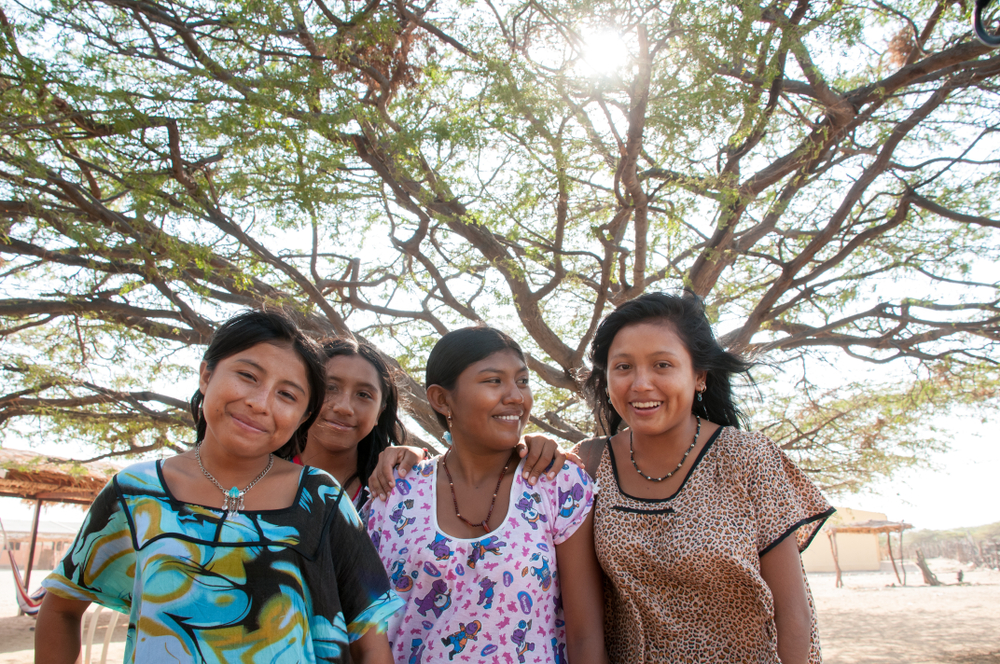
At NRGI we seek to learn from and contribute to the efforts led by numerous organizations and individuals around the world, and define a feminist agenda for our energy transition work. We want to ensure that the lived experience of women informs extractive sector decisions concerning future opportunities and harm elimination, and that women have voice and influence in these debates. We are prioritizing developing approaches to increase gender awareness in our programming in countries that need to transition out of fossil fuels, or that aim to scale up renewable energy technologies and the minerals needed as inputs to them. Ultimately, we want to ensure that women are part of every stage of these processes.
We want to ensure that the lived experience of women informs extractive sector decisions concerning future opportunities and harm elimination, and that women have voice and influence in these debates.
In fossil fuel-producing countries, a just energy transition requires that workers are compensated by those governments and companies who benefited from and are now phasing down coal and oil extraction. But, because men account for more than 83 percent of the formal workforce in mining, women—who depend heavily on indirect and informal jobs around the mine—risk not being included in those compensation arrangements. As company executives and government officials think about mine closure, compensation and job reconversion, they must ensure women are key stakeholders in these plans, as APEC has proposed. Environmental liabilities that these projects leave behind and that might disproportionaly affect women need to be considered. In addition, women need to inform decisions about the diversification of local and national economies. Development models that replace the extraction of fossil fuels must align with women’s needs, consumption patterns, and their visions for their land; models must also fully recognize and properly compensate women for their contributions.
As company executives and government officials think about mine closure, compensation and job reconversion, they must ensure women are key stakeholders in these plans.
On the other side of the energy transition, women hold 32 percent of jobs in the renewables sector; however they are not the main owners of small-scale clean energy projects. Given that globally women's labour force share (48 percent) is higher than the average employment rate in the oil and gas sectors (22 percent), government officials and companies have an opportunity to increase employment options in this area. By recognizing property rights and ensuring that benefit sharing mechanisms reflect women’s needs, governmental agencies and international and local development agencies can support women to take up roles such as clean energy entrepreneurs or contribute to consultations about large scale projects.
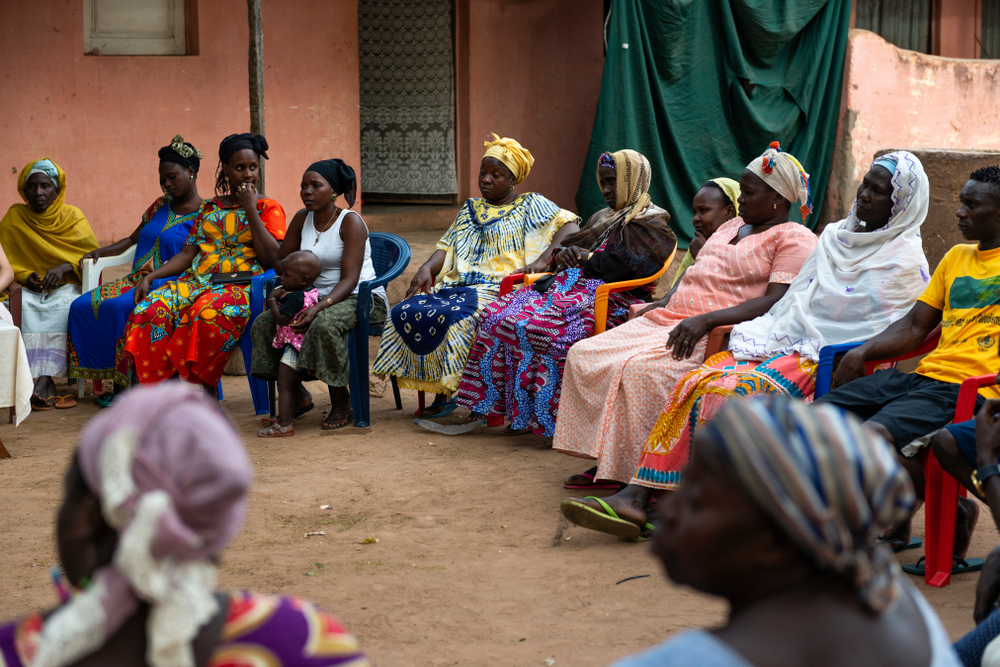
Government authorities and mining companies can enhance gender justice by changing the way transition minerals are extracted. Today, many women in the Democratic Republic of the Congo are part of the informal workforce extracting the cobalt that goes into the profitable business of electric vehicle batteries. Yet, they often hold the least profitable and most toxic jobs—crushing, sorting and sifting the mineral and processing the waste. Many suffer sexual violence in mining sites. Gender impact assessments are a key step to avoid such harms, provided mining companies act upon them and that women are part of decision-making processes. Defining appropriate policies and implementing them at international, national and local levels is another key step. In 2019, for instance, Mongolia’s government introduced a law aimed at raising women’s participation in the mining sector. As NRGI highlighted in a 2022 video project, Mongolian women played a crucial role in informing this policy and spreading awareness within mining-affected communities.
At NRGI we recognize, and applaud, the efforts made by feminist activists around the world to promote gender justice. We seek to learn from and build on this work, starting with pilot interventions in Colombia, Ghana, Nigeria and Uganda, which will include multistakeholder dialogues, building networks and supporting the work of national women-led organizations to empower women’s voices. Promoting equity has always been the core of our mission and, together with partners, we have contributed to key projects around gender and extractives. In 2023, we are taking this commitment to our newest areas of work. We are excited and committed to identifying our contribution to the important work of advancing equity in the energy transition. We will develop guidance for our teams to mainstream gender across our energy transition programs, and deepen old and new partnerships that allow us to be impactful.
The authors wish to thank the members of NRGI's gender working group for their contributions.
Gender justice and the energy transition
NRGI colleagues share why the energy transition must include women as key agents of change.
Primer: Gender and Extractives

This primer outlines the importance of gender transformative policy reforms in the extractive sector and provides guidance for incorporating these priorities into the cocreation process of the Open Government Partnership (OGP) action plan. It is intended for both government officials and civil society organizations engaging in the OGP. Stakeholders might also find it helpful when seeking to build support for these approaches in their domestic context.
The primer was developed by the World Resources Institute and the Natural Resource Governance Institute as part of a project funded by the World Bank through the OGP Multi-Donor Trust Fund. It aims to promote women’s rights and gender equality within extractive governance and to increase the number and impact of gender transformative OGP commitments concerning natural resources.
Key messages
- Transparency, accountability and inclusive participation must be at the core of every strategy to ensure just and sustainable natural resource governance and mitigate the negative impacts on women.
- OGP government Points Of Contact, civil society leaders, and other gender and extractive advocates can take a number of steps to strengthen equal opportunities in natural resources governance, and thus increase the quantity and quality of gender transformative commitments.
- By integrating the OGP process with ongoing extractives and gender initiatives both at home and internationally, governments can build political momentum, buttress the legitimacy of national and local plans, and strengthen the performance of extractive industry governance to address gender inequality, as well as concerns of, and opportunities for, marginalized gender groups and nonbinary people.
Gender and Extractive Governance: Lessons from Existing Legal and Policy Frameworks

Español »
Greater gender equality accompanies economic advancement. However, in countries rich in oil, gas and minerals, economic advancement has not served women and gender minorities as well as men. On the contrary, gender inequality is more pronounced in countries significantly reliant on the extractive sector. The negative impacts of overreliance on the extractive sector appear at both the national level and the sites of major extraction projects. While the gendered issues related to the extractive sector have been broadly acknowledged, efforts to address them are not well developed.
This report focuses on gender and governance of the extractive industries, and is part of the larger Gender and Extractives project, funded by the Open Government Partnership (OGP) and the World Bank Multi-Donor Trust Fund, and executed by the Natural Resource Governance Institute (NRGI) in partnership with the World Resources Institute (WRI). It aims to inform a new generation of gendered OGP commitments in relation to the extractive sector, building on the momentum created by the Break the Roles campaign and the growth in attention now paid to advancing gender equality in the extractive sector. The research examined the legal and policy frameworks in 12 OGP countries: Argentina, Canada, Colombia, Ghana, Indonesia, Kenya, Morocco, Mongolia, Nigeria, Peru, Sierra Leone and Tunisia, identifying 62 laws, policies, regulations, guidelines and other official documents that referenced the extractive sector and gender or women.
Key messages
- Women and gender minorities often face disproportionate harms from oil, gas and mineral extraction and may be less likely to access economic benefits or opportunities for political engagement.
- To evaluate how well gender-transformative change has been codified in official documents, this report examines how women and gender equality are referenced in the laws, regulations, policies and guidelines governing the extractive sector in 12 resource-rich countries.
- We found that some provisions in the reviewed documents could address the different needs of women, men and gender minorities if well implemented, but few documents specifically address the root causes of inequality.
- In some countries, archaic provisions prohibit or limit women’s participation in the sector, preventing them from working in more lucrative roles.
- Women were primarily characterized based on their perceived role as workers, as a vulnerable or marginalized group or as uniquely-impacted stakeholders. Some documents included quotas for women’s participation or benefit-sharing provisions, while others aimed to create broad changes to the culture around women’s participation.
- Few documents required the collection of gender-disaggregated data and most did not explicitly require transparency in gender-specific provisions or have verifiable plans or enforcement mechanisms.
-
To strengthen the potential of extractive governance legal frameworks to address gender equality, governments should:
- remove any provisions restricting women’s equal participation in the sector
- be ambitious about gender-transformative change
- explicitly require and enable the participation of women and gender minorities through verifiable goals and processes
- require data disaggregation and transparency
- complement ongoing broader national and international gender initiatives.
Beyond Revenues: Measuring and Valuing Environmental and Social Impacts in Extractive Sector Governance
Download the tool explorer.
Oil, gas and mining projects can generate substantial revenues for host countries. At the same time, extractive activities generate a range of other positive and negative economic, environmental, social, political, institutional and cultural impacts. Host countries must weigh the economic benefits of extractive projects against their environmental and social impacts.
However, environmental and social impacts are often assessed in separate processes and by separate institutions from those assessing financial revenues and the modeling, measuring and reporting of these impacts is rarely integrated with financial impacts.
This practice results in an incomplete picture of the extractive sector. A more integrated assessment of the impacts of extraction could help policymakers, regulators, companies, citizens and affected communities make more informed decisions on whether extraction should take place and on what terms and conditions.
To better understand whether more integrated modeling and measurement of environmental and social impacts can improve policymaking in the extractive sector, NRGI has undertaken a review of existing practices in measuring environmental and social impacts in the extractive sector of NRGI’s priority countries, including tools available for doing so.
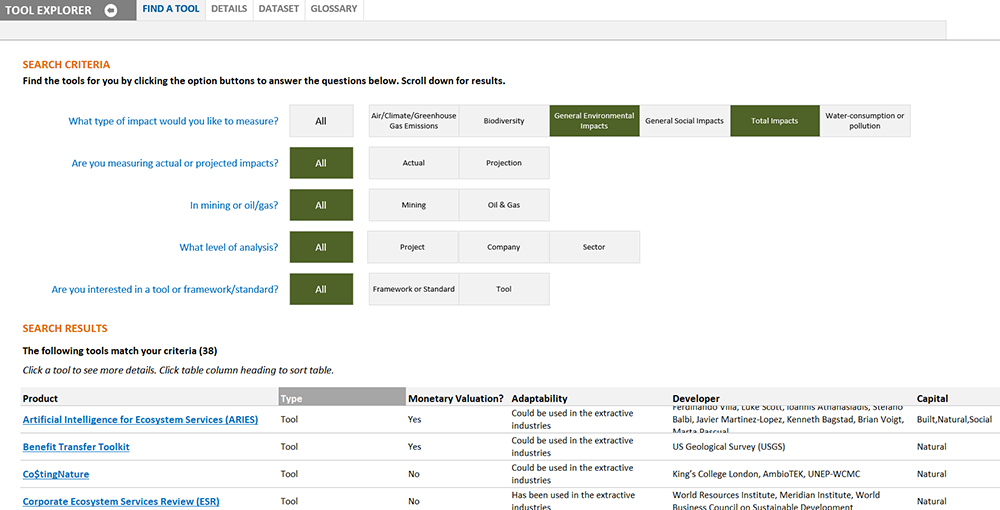
The organization has collated information on various tools, frameworks and standards into a database, the Tool Explorer, that allows users to search for tools based on their interest or needs, including the sector they are studying (whether oil and gas or mining), the type of impact they would like to measure and whether they are interested in modeling potential impacts or measuring actual impacts.
With this report and the accompanying Tool Explorer, NRGI aims to support a conversation on:
- Whether existing tools can adequately measure the environmental and social impacts of extraction.
- Whether the modeling of environmental and social impacts can be integrated with fiscal modeling to inform governments, companies and stakeholders in making the decision to extract or not.
- How extractive sector stakeholders can more effectively integrate the measurement of environmental and social impacts into the regulation and management of the sector to maximize benefits and minimize costs.
- Whether country-level or global-level processes and standards for measuring, valuing and reporting the environmental and social impacts generated by extractive projects can facilitate comparability and better understanding of how well these impacts are being managed.
However, measurement can only support better policymaking if all stakeholders consider the process valid and fair. NRGI proposes the following general principles for using measurement of environmental and social impacts in decision-making within the extractive sector. When used alongside qualitative approaches, these principles could help support an inclusive and transparent measurement process that promotes multi-stakeholder dialogue on extractive sector impacts.
| WHO |
Principle 1. Ensure inclusive multi-stakeholder measurement processes that enable meaningful participation of affected communities, with due regard for gender dynamics and the views of minority and marginalized groups. Principle 2. Involve interdisciplinary teams from the start. |
| WHEN |
Principle 3. Begin measurement of environmental and social impacts before extraction and continue through the life of the project and after closure. |
| WHAT |
Principle 4. Identify material impacts across capitals (built, financial, human, natural or social capital), project scenarios, geographic scales and time horizons. Principle 5. Include in stakeholder dialogue and decision-making frameworks both quantifiable impacts and those that cannot or should not be measured; and consider who bears the costs and benefits of these impacts. |
| HOW |
Principle 7. Ensure measurement approaches are appropriate to the policy question at hand and to the country and local context. Principle 8. Protect legal and customary rights throughout the measurement process, including free, prior and informed consent where applicable. Principle 9. Ensure measurement processes and results are transparent, timely and understandable. |
Explore tools, frameworks and standards for measuring environmental and social impacts.
Videos: NRGI perspectives on International Women’s Day 2023

Learn more about why a just energy must involve and respect women in this blog post and from NRGI colleagues in the videos below.
Suneeta Kaimal, president and chief executive officer
Tengi George-Ikoli, senior officer
Denis Gyeyir, Africa program officer
Aida Diop, senior Senegal program officer
Juliana Peña Niño, Latin America senior officer
Emma Dahmani, program and administrative assistant
A just energy transition must involve and empower women.
The Resource Remix: Ana Carolina González Espinosa and Daniel Kaufmann Discuss New Resource Governance Paradigms

In this second episode of NRGI's podcast, available on Apple Podcasts, Google Podcasts and Spotify, Ana Carolina González Espinosa converses with NRGI president emeritus Daniel Kaufmann about evolutions needed in the resource governance field in light of the climate emergency, the conflict in Ukraine, and other global challenges.
NRGI · The Resource Remix - Episode 2 - Toward New Resource Governance Paradigms
During their conversation, Kaufmann explains what is meant by resource governance, where the field of resource governance came from, and what important organizations have played a role in this field. They also discuss the results of the 2021 survey Kaufmann and colleagues conducted among hundreds of participants on the future of natural resource governance in the era of the energy transition. Kaufmann highlights some of the top priorities for reform cited by respondents, including protecting democracy, addressing state capture, high-level corruption, and climate emergency. Although these dimensions received very high priority, respondents were more pessimistic about the likelihood of progress in these areas, informs Kaufmann.
Looking at the systemic challenges facing the world today, Kaufmann and Gonzalez discusses the actors that must drive change and the bold strategies that should target these various stakeholders, including the state, the public and private sectors, and international institutions. Gonzalez stresses the importance of going beyond mobilizing traditional actors working in the natural resource governance field to bring about change. The organizations mentioned includes women's and youth organizations, indigenous and peace groups, and other grassroots movements operating differently from traditional NGOs.
Other dimensions explored includes the importance of changing the narrative of the global energy transition, which is driven primarily by the Global North, and the importance of including the voices of producer countries to push for more concrete commitments on climate finance to ensure that the energy transition is actually possible in these countries as well.
Daniel Kaufmann and Mario Picon also addressed a related topic in this commentary by the Brookings Institution.
***
Transcript
Ana Carolina González Espinosa: Some of the most critical issues in the world today are linked with the way we govern natural resources. From Russia’s war funded by oil revenues to the existential threat of climate emergency, many also relate to the commodities in the earth beneath us. For example, we want to transition to sustainable energy, so we reduce carbon emissions and fight climate change that can lead to so many of the world's natural resources.
But to do that, for these renewable energies to be used on a larger scale, the extraction of certain minerals that are needed has to be on a larger scale as well: the lithium and cobalt that go into electric car batteries, just to name some. And that also comes with an enormous challenge:
avoiding that the extraction of these minerals negatively impacts on countries and communities, and instead benefits them. So it is about governing natural resources in a way that avoids funding the world’s kleptocrats, or in a form that ensures communities and countries benefit from them.
And today, many people and organizations work to ensure this happens. But how do all these organizations and people get here, in what we call the natural resource governance field? And where should we go, given the new nature of the challenges that are emerging? Are the same policy recommendations of past decades are still relevant? Do we need to rethink our assumptions, and how? Do we need other models, pathways, bolder ideas about what resource governance is?
I am Ana Carolina González, senior director for programs at the Natural Resource Governance Institute. And these are the issues we at NRGI grapple with every day and also in this podcast series, The Resource Remix. It is my pleasure to welcome to this podcast NRGI’s former president and CEO Daniel Kaufmann. Dani is a pioneer in the field of governance at the World Bank, now affiliated with the University of the Philippines, the Brookings Institution, and Resources for Development. Welcome, Dani.
Daniel Kaufmann: Thank you very much. It is an enormous pleasure and honor to be with you and with the whole NRGI family again. And it’s such an important topic that you have outlined.
ACG: Dani, I started by speaking about some of the critical current events related to resource governance. You have been writing and presenting about this seismic shift for the past few years. But for those of us with shorter memories, can you quickly get us up to speed on what is meant by resource governance and where the field of resource governance came from?
DK: Thanks. I am glad you’re inquiring into this historical perspective, not only because without history, we misunderstand the present and we will keep repeating past mistakes in the future, but also because it puts into context the sense that the field of natural resource governance is at the crossroads right now. You see, contrary to popular beliefs, concerns about natural resource governance, which refers to the good stewardship of the natural resource features of the country for the benefit of all, for the growth development and benefit of all, did not just start in the U.K. and with the likes of Tony Blair and others two decades ago.
In fact, in the early 1700s, the British publication The Spectator wrote, “It is generally observed, that in countries of the greatest plenty, there is the poorest living.” So this is a longstanding concern, the increasing traction to the idea that resources might be more of an economic curse than a blessing began to emerge in the 1950s and ’60s with the analysis of challenges in developing countries. In the early ’90s, there were writings already about how countries rich in resources were unable to use that wealth to boost their economies, especially compared with non-resource-rich countries, and then the likes of Jeffrey Sachs and other academics, found a very strong correlation between natural resource abundance and poor economic performance. In the ’60s, thanks to the concerns in the Netherlands that they had just found plenty of natural gas and were earning fresh foreign exchange, a particular economic policy dimension of the resource curse garnered attention, namely the exchange rate of evaluation, which discouraged non-resource exports, the so-called Dutch disease. We can call this “Resource Curse 1.0,” and we are talking more than half a century ago, the very economic manifestations of the resource curse. Only after the turn of the century, that very economic focus begins to take on also a governance dimension, very seriously, beyond traditional economics, “Resource Curse 2.0.” And we enter at that point, what I would call, the “soft governance” era, which focuses very much on transparency in extractives, and particularly at the beginning, transparency of payments of the industry to governments, to have full disclosure, to the extent possible, which still has not happened until today.
NGOs, like Global Witness, were pioneers, which later led to the creation of Publish What You Pay. In this space they influence the U.K., and eventually, this leads to the inception of the Extractive Industries Transparency Initiative or EITI. And all this is also a predecessor to the support given by NRGI at that time, which was called Revenue Watch Institute, obviously Revenue Watch Institute, the predecessor of NRGI plays an important role in this process as well. Then about a decade ago, the increasing realization that transparency may be absolutely necessary, but it’s far from sufficient, results in an increasing focus on participation and accountability, or what we call sometimes “the TAP troika,” i.e., transparency, accountability, and participation. Among others, the notion of protection of civic space becomes important and we work hard to institutionalize those protections in initiatives like in the EITI and elsewhere, and that begins to happen.
And the evidence did show that improved transparency, improved participation and accountability could help mitigate some forms of corruption. And that is all part of this governance “Resource Curse 2.0” package. But again, more recently, it becomes clear that this focus was also insufficient, leading to the case we have been making for broadening the governance scope and natural resource governance, sometimes called “TAP plus.” So going beyond the TAP troika into very tough rule of law, reform issues, regulatory reform issues, public sector reforms, state-owned enterprise reform, particularly with national oil companies; and very timidly, a start with the so-called energy transition.
In brief, that is where we are now. But with two pending key dimensions, which we can discuss later of the resource course that we have not gotten the focus in the natural resource governance field that it deserves, even if there are some initiatives here and there, but they fit as a whole, one, which we can call the “Resource Curse 3.0,” and label it as the tough governance dimension. Let's call it for what it should be called: tyranny, conflict and climate crisis. And the other “Resource Curse 4.0” related, which is a corporate resource curse. It’s the corporate dimension of the resource curse—the capture by industry, like oligarchs, and their collusion with the kleptocrats.
ACG: And it is very interesting, Dani, that you take us back to very early days in history because when you discuss natural resource governance, what might think that it all started at least with some emblematic initiatives or conversations. I remember particularly that report Global Witness published in 1999 denouncing corruption in Angola in the oil sector and demanding companies to disclose the payments that were being made to the government as an incentive to avoid corruption. And then the emergency of Publish What You Pay, EITI, where NRGI actually took a very active part. But a lot of things had happened. And all the people are still, of course, interested in having information about these payments. What you see in the case of popular consultations in mining regions in Colombia or what you hear from local communities in South Africa that are asking for them to be included in just transition plans, is that people are no longer looking only for information, or even as you mentioned, for transparency, accountability and participation. People are no longer looking only to hold governments and companies to account. They want to decide, they want to influence decision-making. They want a share of power.
So while we have made important gains in transparency around the extraction of oil, gas, and minerals, we clearly aren’t where we need to be. You have been promoting major change for some time already, but do you think organizations in the field are asking these fundamental questions? I know that you took the lead in designing and implementing a survey, in which NRGI and a hundred other participants took part, in relation to these. So, you and your colleague are publishing a report on it. So what have you found?
DK: When we asked hundreds of respondents to identify the most important priorities for reforms, some of these very tough governance dimensions that we just mentioned—including the protection of democracy, addressing state capture and high-level corruption and the climate emergency—all came out addressed as a very high priority. That is not very surprising. But the same respondents were rather pessimistic about the likelihood of progress in those areas. There is a huge gap between stated priority and likelihood in their view. But that’s not the case when we ask them questions about the traditional ongoing areas of work in the field, such as continuing the work on disclosures and transparency that started 20 years ago. They don’t give it the absolute top priority, a bit lower, but the likelihood of being successful is fine. So consistent with that, there are lots of people in the field that are comfortable continuing with that trajectory, because at least the probability of failure is lower since it’s much lower hanging fruit.
Then when we asked these respondents about what kind of transitions were needed in the various natural resources. Those in the natural resource governance field were more gradualist and conservative regarding moving away from fossil fuels than those outside of the field, which is telling in itself. Surprising regarding this set of findings, civil society respondents—because we asked all stakeholders, industry, government, international financial institutions and civil society were involved—but civil society respondents on average were basically as risk-averse, as the respondents from the other stakeholders, governance and IFIs. I mean, there are some small differences, but you don’t find a huge difference there.
There were some exceptions, of course, there are rays of hope. And in terms of some respondents wanting and believing that something bolder is possible and giving also bolder type of recommendations as to what to do ahead. On average—this is not universal, it’s not a one-to-one correlation—but on average, that’s associated with younger and female respondents, interestingly enough. So that’s a message right there. They were not the norm though. The norm was risk aversion and comfort. So overall, we do find some risk aversion and measure of conformance, one of which is not really consistent with seismic global shifts that are taking place that we have been discussing. So the case in the report for much more audacity associated with concrete and bolder change is being made.
ACG: You mentioned that the respondents in the survey highlighted unsurprisingly, the effects of the COVID pandemic on the economy and the unsettling that comes with not knowing what is going to happen with the economy in producing countries. And also, of course, the climate crisis and the challenges that come with the energy transition, for example, for oil, gas and minerals producing countries because that is also consistent with what we have been observing in NRGI. And also the rising authoritarian regimes and the growing restrictions on civic space.
But a couple of additional changes that are important to take into consideration, and maybe are related to what you mentioned about the different role young people and women can play, is that there is an important change, and I am observing this as well, in terms of how the field can require multidisciplinary perspectives. And so the traditional organizations working mostly around resource governance need to add other movements to the conversation, right? We need to build bridges with other movements with the climate movements, the human rights organizations, tax organizations and other, because the challenges that we are facing today are so systemic that require us to build coalitions outside of the traditional actors, in what we call the natural resource governance field.
And even beyond them, something that the actors in the field might need to do as well is to acknowledge that with the social protests of the last few years, an important number of new actors of social movements have emerged also in producing countries, even in the context of deep restrictions to civic space. So even with people knowing that it’s difficult to participate, wanting to participate more. So women’s organizations, youth organizations, indigenous and peace organizations, or more grassroots movements and networks—they operate very differently from NGOs, but they are key actors when we think about how to make change happen. That is one thing I would like to stress—there is a need to build bridges also with these social movements.
And on the other hand, another change that I think has happened and requires the field to kind of be bothered is that, when we think about the actors that we need to target to push for change—the state, the public sector, remain key and central. And we know that we need bold strategies to target private sector. As you mentioned, like the corporate sector’s responsibility for resource governance and international institutions for change—that’s not very new either. But sometimes we might have overlooked the role of media narrative, not just to disseminate information. It is not just about influencing decision-makers but to influence public narrative. The way people see natural resources playing in their countries, in their territories, the power of moving the needle in public opinion, to then create a stronger and maybe longer-term incentive for decision-makers to act.
For example, how to influence the narrative of the global energy transition that is mainly driven by the Global North to include the voices of producing countries, to push for more concrete commitments in terms of climate finance, so we ensure the energy transition is actually possible in those countries as well. For that, you need to change narratives at a wider level and strategic communications and alliances are key for that.
So it looks like we might need some more paradigmatic change here. How can we make this possible, especially given what you’ve mentioned in terms of some risk aversion between organizations in the field and between other actors in the field. What are the opportunities that you see, but also the barriers that we might need to overcome? We have been, recently discussing in NRGI about encouraging such a discussion, but what do you think are the elements we should consider?
DK: We need to consider a bolder approach, whether that will signify paradigmatic change or not, that’s for another podcast. Let me give you just a few ideas and suggestions. I would ask, why aren't we making more progress now? You mentioned multidisciplinary approaches: this has been taking place for a long time and now more is needed, nobody will disagree with that. But a bolder version of that in the current situation is to say, we need the most extreme form of partnership, not only in terms of discipline but in terms of also the focus on good research and analysis and activism. The most extreme form of partnership is a merger. We did one almost 10 years ago, combining Revenue Watch with the Natural Resource Charter, and became NRGI, but they’re extremely rare.
The incentives in the field among NGOs, media, more user-friendly storytelling, and all that. That's very nice, and we have been discussing that for a very, very long time. But right now, as we see in the world and in the worst-governed places regarding hydrocarbons and so on, we need to protect and support the toughest type of investigative journalists and to get these stories out in places where everything is being banned, everything is secret, and journalists have been put in jail.
But in addition, why not consider a major scaling up in addressing the huge remaining misgovernance within fossil fuels themselves due to the actions and the capture by big oil, by the kleptocrats, by the rulers of oil-rich countries; that’s really tough. And how do we do it? It’s a different discussion. There are some staff at NRGI and other places that are working on that, but these are niche issues. These are not being integrated into the core of what the field should be doing.
Why also don't we fully expose without mincing words—we have to use a different language—the massive greenwashing in the whole ESG industry, by the corporates, which we can discuss at very much like.
Then take the national oil companies. Why continue to fiddle at the margin regarding taking a little measure here or there on additional disclosure and a few changes in corporate governance, when some of them are totally captured politically? It’s been high time for years to consider a very different model in those settings. Even if that's very politically difficult, instead of trying the same reforms at the margin in places, in organizations and institutions that may be unreformable.
ACG: Maybe also that I would add Dani is in terms of having the conversation, I totally agree with you. This is about having a conversation on a podcast, but it cannot be just that. It’s about who participates in the conversation and the form it takes. And again, who participates in the conversation, we need new voices, we need additional voices to the ones that have traditionally been associated with the ways of natural resource governance, including people in other fields, social movements, universities in the Global South, Global South think tanks… And journalists as actors, they are not just targets for us, as you say, to disseminate information, et cetera. They are very important actors in the field as well.
But in relation to the how, how do we get there? How do we promote this change that the field needs? How do we take these conversations that are happening maybe in podcasts or in many interesting meetings here and there in a specific context? What if we have this conversation in specific territories, in specific countries, and if we look for experience where those changes are already in play in the way organizations, communities, or other actors are pushing for resource governance in this new era, instead of a bottom-up approach to learning, to understanding what resource governance means today.
And what if we learn also from other movements; we are not the first movement to face the need for change, like the human rights movement has also faced many changes in the last decades. What if we pilot as we learn new ways of understanding this natural resource governance and innovative ways again to communicate and provide visibility to the process and to specific efforts that maybe are small, or we don’t know them yet. What if we provide some visibility to those? It is less about big words and more about interesting, even if small, actions.
DK: In terms of, very concretely speaking, the whole issue of bringing in different voices and addressing this problem of state capture: Let me mention a very concrete examples that the field could engage more with. One is my own country, Chile, with a newly elected, youngest president in the world, Boric. But at the same time, a new constitution is being drafted, we don't know yet if it's going to be approved by the whole population. But it is being drafted in the most participatory manner ever of any constitution anywhere. So we are having that as we speak. Now Chile is the number-one producer of copper in the world. So it would be extremely fertile to collaborate with that case study and draw the lessons of the art of the possible in this context.
ACG: I think I also remained positive about what can come. It’s not easy, path dependency is always there, this idea of continuing doing what how to do, what you have been doing for so long. But I think that the time has come when we need to be bolder and think about other layers because the challenges are so huge that we definitely need to build bridges with other movements and see how to push change forward. But the problem is also that the context might not be helping that much. So what do you think about the impact of the war in Ukraine, and how do you think these new trends in the international commodities market energy markets can actually maybe delay or maybe be an opportunity for this conversation and this major change to materialize?
DK: At the end of the day, it is a question of mindset and preparedness to take risks, because one way of looking at what's happening now is to say that there have been extremely adverse developments, and we know where they are. You have mentioned them, we have written about that. So it’s time to protect former gains, to hunker down and be very careful about going in directions of trying to address the enormity of these new challenges, because politically they may be intractable, and the probability of success is obviously much less than protecting early gains and continue to work on what we are accustomed to. So that would be a safer, risk-adverse way.
The other option is to say, maybe continue to do the same, that may be safer, and we will not have a huge failure, but the impact is going to be so small and we’re going to become irrelevant given the new developments. So there is absolutely no choice but to consider a strategy with much more audacity and boldness, and then the question becomes what to address.
Let's face it—and I mentioned and hinted at it earlier—we are in that era now (and you mentioned the war context, Putin’s invasion of Ukraine), in which it has become very clear that there are hydrocarbon-fueled wars and invasions of other countries. This is so well beyond these soft notions of governance—that we need more transparency than we have had in the past. So it is the notion that’s a completely different dimension of the resource curse. Because of that, we know that it is not just the climate crisis challenges, that we all know, and it’s been ongoing and it’s becoming worse, but there are major energy security considerations. As a result, many other countries in Europe and others are not only considering but are approving really fast major new investment plans. And also because the oil and gas prices have gone through the roof. So NRGI and others could be monitoring these proposals and actions in terms of more, not less, new investments in hydrocarbons, and particularly LNG and so on.
And obviously, there are enormous trade-offs with energy security and so on. There’s a bit less of a discussion because it’s so difficult politically to say, “no, this is absolutely disastrous for the climate crisis.”
We have to put it very starkly, at the end of the day, countries are going to face either stranded assets or climate catastrophe. So these two choices, unless we do something really, really boldly, and just calling into action and showing with the numbers, what is happening and showing also the differences, what can be done next year versus the next five years, is really important. And that’s why I put it into the mix.
We have to discuss issues like nuclear power. We also have to discuss demand destruction. Again, it’s a political taboo in the United States, with a carbon tax, and so on, but basically the obsession with oil consumption has to shift and it’s beginning to shift in some countries, and in fact, some European countries have decarbonized relatively quickly.
We are not talking enough about great examples in Africa. In Kenya, there is a large amount of electrification with renewables thanks to major wind and solar projects, in which the African Development Bank is involved. There are a number of other examples. Instead we focus so much on how much they're going to lose in revenues if they don't produce as much in terms of oil.
Of course, we have to be mindful: these countries are not the main carbon emitters. So that’s not where the main problem is. And they have not benefited from hydrocarbons the way the West has. So the issue is one of climate justice. But because of that, my suggestion for a topic that should take much more prominence is major compensation mechanism; a Marshall Plan-like mechanism may be needed. There is a concrete example of what some European Union countries and Canada did a few months ago with $8 billion for South Africa to start phasing out coal. So again, it’s not academic, it's about very concrete areas where things can change. And we need to think big and say, how do we scale these up? What would be the proposal?
If we’re going to have audacity, to really try new things, we’re going to take a risk and we are going to fail as well as succeed. So we do not want to fail at everything, but, and that’s a difference in mindset that needs to be changed. And that’s why the fresh blood, the new voices… And having frank conversations with boards, and with funders, is very important at this stage. The world has changed dramatically.
ACG: One of the things you mentioned was the impact of the war in Ukraine and the need to monitor what is happening out there in terms of new investments and new plans to expand gas and oil exploitation. It is something that we have been following very closely, especially because this raises a lot of expectations in the producing countries. You have already seen how countries in Africa like Tanzania or Senegal mention the possibility of expanding their old gas fields to supply the European market with their gas. And, of course, there are a lot of things to discuss, that we don't have time to discuss.
One of the things that we have recommended in our reports and blogs is that Europe needs to be clear about this, and needs to make bolder commitments in terms of not only providing itself with the energy that it deserves, so energy security is a priority—but also making sure that the energy transition in these [producing] countries is not delayed because of this new move. I think what you mentioned about the need for climate finance to be much more deliberate, meaningful and intentional to really move the needle on energy transition in these countries is very important.
And the other thing I wanted to mention is, it’s also about the model, because if we want to just expand renewable energies or other types of exploitation of critical minerals to provide those renewable energies in the same way that we have been developing in the last three or four or five decades, it is just not going to be possible. We need to listen to other movements. We need to listen to the climate movement, but we also need to listen to the communities that are proposing new development models as well. And to examine also our consumption patterns and see how they can be modified, and how we can learn from others as well.
DK: You said we need to listen. I would say we need to merge.
ACG: That too, definitely. We start by listening and then we need to merge and, and build bridges and build coalitions. Thank you, Dani. This has been a great conversation, definitely not the last one on this topic. It is clear from what we have discussed that at least our thoughts align in terms of the need for a bolder change. I would call it for maybe a new resource governance paradigm or different paradigms around natural research governance. Imagine from a different context and different regions, et cetera, but definitely, something that puts policy at the center, that builds bridges across movements and social movements and sectors and perspectives, and a natural resource governance framework that includes at least the hard tough reforms that you mentioned that are needed, including of course being more intentional about fighting kleptocracy and ensuring that people have a seat at the table in decision making. So thanks for these. And I hope we will have the time to continue this conversation and others in other Resource Remix podcasts.
DK: Thank you very much.
Disclaimer: Views and opinions expressed in this podcast belong to the individuals featured and do not necessarily represent those of the Natural Resource Governance Institute. The recording and transcript have been edited and condensed for clarity.
NRGI's podcast The Resource Remix explores new futures for commodity-exporting countries in the energy transition.