
Improving Governance for a Just and Equitable Energy Transition: A 'Critical Conversation' with NRGI's Suneeta Kaimal

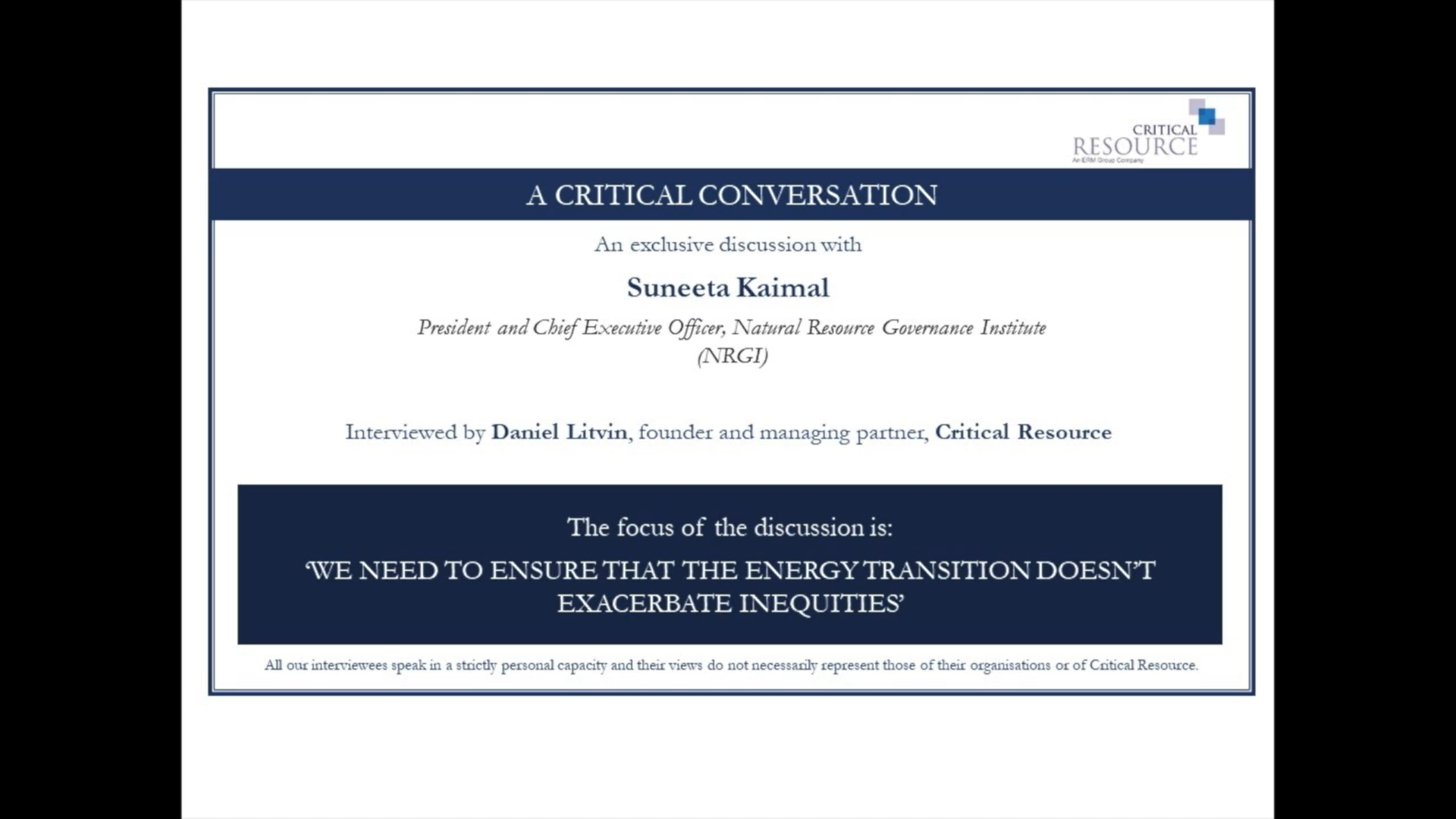
Critical Resource's latest "Critical Conversation" podcast features an exclusive discussion with President and CEO of the Natural Resource Governance Institute (NRGI), Suneeta Kaimal, on the opportunity and need for improved governance to manage a just and equitable transition to a decarbonized world.
Suneeta Kaimal was appointed President and CEO of NRGI in February 2021. Previously, she served as NRGI’s Chief Operating Officer and became interim president in 2020, she is also on the board of the International Centre for Not-For-Profit Law, and previously chaired the Open Government Partnership and Publish What You Pay.
This 30-minute conversation was recorded on 22 October 2021, and was moderated by Daniel Litvin, Founder and Managing Partner of Critical Resource.
Among the key points raised by Suneeta:
- The pandemic has been a litmus test for resource governance. Resource rich developing nations have been pushed back into poverty – by 2030 half of the world’s poor will be in resource rich countries.
- Increased tensions between China, the US and the EU are pulling resource rich developing nations in radically different directions, making it harder for them to understand the rules of the game. We need to stand up for the laws and policies we’ve worked together to create and address governance challenges to ensure a greener, more prosperous planet.
- Tax systems have failed to deliver – Sub-Saharan Africa loses $600m annually in lost taxes. For many years, companies have exploited asymmetries of capacity, power and knowledge, with government revenues eroded by lopsided agreements and unnecessary incentives. We need to thread the needle to design taxes that mobilise revenue and attract investment, while being flexible, simple and resilient to changing circumstances.
- Wealthier countries should wind down fossil fuel production first and fastest the hypocrisy of major economies is shocking. G20 countries have poured billions into fossil fuels since the start of the pandemic, and yet are asking low-income producers with small carbon footprints to transition faster than wealthier, high emitting producers. It’s economically and morally unjustifiable.
- We need to ensure that the energy transition doesn’t exacerbate or introduce new inequities. We have to stop repeating the errors of the past and see the energy transition as an opportunity to do things differently.
- The expected boom from mining ‘energy transition metals’ could help countries rich in these resources fund much-needed social spending. It could also engender reforms to the mining sector, making it a greener, more rights respecting industry that contributes to sustainable economic and social systems. However, corruption and mismanagement risks disrupting the supply of critical minerals and leave citizens worse off.
- It is naïve to assume that renewables won’t be prone to similar governance challenges that we’ve already seen in the extractive sector. Applying the lessons we have learnt from oil, gas and mining would enable us to create a greener future grounded in good governance.
This article was originally published on Critical Resource's website.
Women in Mining: A History of Legal Invisibility and Exclusion

This is the third in a series of posts from the Natural Resource Governance Institute and World Resources Institute research project on gender and extractives, carried out with support from the Open Government Partnership Multi-Donor Trust Fund, which is managed by the World Bank. Learn more about the project in this blog post.
As the Natural Resource Governance Institute (NRGI) and World Resources Institute (WRI) continue our research on gender, open government and extractives, we have found that creating gender-transformative governance frameworks will not only require adding new provisions to the existing body of laws and policies, but also removing archaic provisions that continue to hold women back.
In our research, we examine a sample of 12 countries’ extractive sector laws and policies that refer to gender or women, looking at how they were developed and at their implementation and impact. Several countries from our study have provisions in place that prohibit women from working underground, working at night or working in the extractive sector at all. In the countries that we analyzed, we found laws prohibiting women from working in mines in Argentina, Morocco, Nigeria, Sierra Leone and Tunisia. (Though the Sierra Leonian and Argentinian laws are still technically in force, they do not seem to be followed in practice.) Several other countries in our sample had similar laws in place before they were recently repealed or amended: Colombia (ban lifted in 2015/2016), Ghana (ban lifted in 2003), Indonesia (ban lifted in 2003), Kenya (ban lifted in 2007) and Mongolia (ban lifted in 2008). According to the World Bank, across the world, 60 countries still have laws on the books that restrict women’s employment in mining. These laws are most prevalent in sub-Saharan Africa, where one-third of countries prohibit women from working in mines.
As detailed in research by Kuntala Lahiri-Dutt, many of these laws originated from the British Mines and Collieries Act of 1842, which removed women from working in underground mines, due to a combination of genuine concern about the hazardous nature of the work and as a result of “moral panic” about men and women working together in dimly lit underground areas.
The same act also prohibited the use of child labor in mining, due to the dirty and dangerous nature of the work. While children are inherently vulnerable and need protection (including from dangerous work), the conflation of women and children, and the view that both required the same kind of protection, has been an enduring rationale for harmful stereotyping women and denying them equal rights.
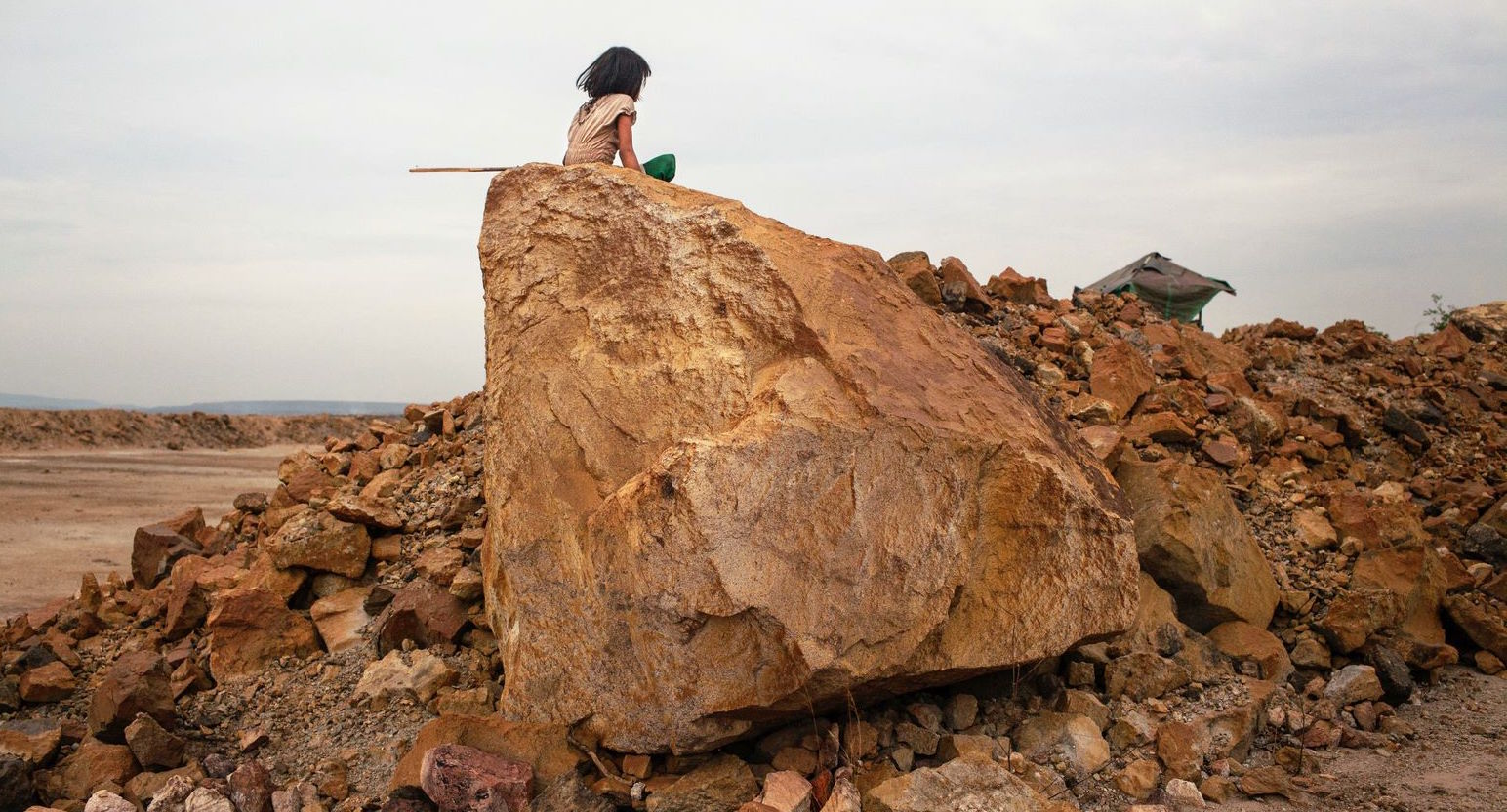
Though women had previously worked side-by-side with men in the mines, the Mines and Collieries Act had an immediate and profound impact on women’s employment. As Lahiri-Dutt details, rather than protecting women from dangerous work as it had intended, it instead deprived women of the gainful employment they had previously secured and instead forced them into other (even more) hazardous, less formal work.
The Mines and Collieries Act not only affected British women’s work but soon impacted women throughout the world. Through the British empire, parallel legislation was enacted in British colonies. In the 1920s and 1930s, the International Labour Organization (ILO) adopted several protectionist conventions around women’s labor in the mining industry, prohibiting women’s underground work and limiting women’s ability to work at night. These provisions became enshrined in the governing documents of ILO member states, pushing women further into lower-status, lower-wage work, particularly in the global south. Limits on women’s participation and narrow definitions of what it means to work in the sector have rendered women’s work throughout the extractives value chain largely invisible. This has translated into lack of unionization, poor organization and poor policies and protections.
Because women have been so long and pervasively excluded from the mining sector, we have a constructed view of mining as men’s work, and it is difficult to imagine women performing physically demanding jobs in underground mines. However, prior to the passage of the British act in 1842, women contributed to early mining throughout western Europe and were active prospectors in the American gold rushes. As Lahiri-Dutt explains, the biological essentialist view of women as weak and in need of unique protection from rigorous work ignores ample social and historical evidence from the contrary, and has led to significant structural inequality both within the extractive sector and beyond.
Today, while women’s overall participation in the global workforce is 47 percent, women make up only 22 percent of the oil and gas workforce and only 14 percent of the industrial mining workforce. Women’s participation in artisanal mining is estimated to be significantly higher, which speaks to how these prohibitions have forced women into work that is more dangerous and less formal, regulated and lucrative.
As detailed by the World Bank’s Rachel Perks and Katrin Schulz, prohibitions on women’s work continue to have a dramatic effect on women’s participation in the extractive sector and ultimately the wage gap. Technical mine site jobs, such as engineer, geologist and analyst, are often higher-paying than clerical or administrative jobs in the sector. However, because of these restrictive provisions and their legacies, women in the sector are overwhelmingly employed in lower-paid functions. For example, in Canada—which has one of the highest rates of women’s participation in the extractive sector in the world—only five percent of mine-site workers are women. Perks and Schulz find similar trends in Chile, Peru and Mongolia, where women are overwhelmingly involved in lower-paid administrative support work for the sector rather than in higher-paying mine-site roles.
Perceptions of oil, gas and mining as men’s work serve to undermine women’s advancement. In a 2017 study of the oil and gas industry, Boston Consulting Group found that men in the sector believe that women are less suited for certain roles and opportunities, such as expatriate positions and jobs in the field. However, their research found that women are often just as, if not more flexible than men, though they are routinely passed over for these opportunities.
Even though restrictive prohibitions on women’s work have been lifted in many countries, their legacies persist: centuries of women’s absence on mine sites have led to cultures and norms that still impact their unequal participation in the sector. Further, women’s lack of experience working in mining undergrounds has contributed to fewer women holding management or corporate board positions. A similar gap is observed in the oil and gas industry, where globally women hold only 10 to 30 percent of field jobs. This lack of experience contributes to women’s selection for leadership roles: there is a significant decline from women’s global participation in middle management (25 percent) to senior leadership roles (17 percent).
To address women’s participation in the extractives sector, a first step is for governments to remove provisions that restrict women’s employment from their laws and policies. However, in order to remedy the inequality wrought by decades of women’s exclusion from the extractive sector, a more aggressive strategy that focuses on job training, recruitment and cultural change will be necessary. As our research through this project continues, we examine whether and how the countries in our study are trying to remedy this historical legacy and promote and facilitate women’s equal participation throughout the sector, from mine sites to senior roles.
To learn more about this project and our findings, register for the 3 February webinar on the subject as part of the Radically Different: Gender justice in natural resources governance webinar series.
Time to Pivot: The Role of the Energy Transition and Investors in Forging Resilient Resource-Rich Country Outcomes

This is the second in a series of posts originally published by the Brookings Institution on the future of natural resource governance that builds upon a virtual October 2020 dialogue co-hosted by the Leveraging Transparency to Reduce Corruption project, the Natural Resource Governance Institute, and the Transparency and Accountability Initiative. The first post is here, and the third is here.
At a time when the world is confronting a global pandemic and unprecedented challenges related to climate change and inequality, the natural resource governance field must undertake concrete, urgent, and drastic changes in strategies and tactics to achieve much-needed progress. Here, we outline two core areas that demand focused attention and new ways of thinking: the energy transition and the role of investors.
The critical role of resource governance in the energy transition
Against the backdrop of the urgent realities of climate change, the pandemic, and the decline in oil prices, the necessity for oil- and gas-producing countries to immediately engage in the transition toward sustainable energy sources has come to the fore. This pivot must be central to a revamped natural resource governance field now and in the years to come. However, as needed as the transition is, it raises its own set of socio-economic challenges. It is imperative that the natural resource governance field addresses the issues which will result from reduced extractive revenue, stranded assets, and related risks. Moreover, the economic consequences of the transition will fall asymmetrically—with dramatic negative impacts on countries and communities dependent on oil, gas and coal revenues, and a rise in opportunities for those rich in transition minerals like copper, cobalt, and lithium.
Because many resource-rich countries struggle with effective governance, the natural resource governance field should support them with initiatives that build on past efforts and pivot to respond to current challenges. These include:
- Building an evidence base around how governance challenges will affect the energy transition and how the lessons learned in the natural resource governance field can be applied in this new reality
- Tapping into the overlapping expertise of currently siloed movements working toward a common goal by building coalitions among them
- Fostering informed public debate about the effects that the global energy transition is having, and will likely continue to have, on geopolitics, national development, and the country’s economic health (including a focus on realistic fiscal revenues)
- Supporting efforts by resource-rich countries to use increasingly available and affordable clean energy technologies to safeguard peoples’ health, environment, and energy needs
- Improving sector governance of the extractive and renewable energy sectors, both nationally and sub-nationally
- Supporting major efforts toward economic diversification
- Mitigating wind-down costs for vulnerable populations reliant on commodities that will decline in the energy transition
- Ensuring that citizens and communities in producing regions and those living far from capital cities have a substantive role in policy discussions and decisionmaking
The central role of those working to improve governance in resource-rich countries will continue as those nations transition into a new energy reality—one where there is a decarbonization imperative.
Just as misgovernance has impeded efforts in the past to translate extraction into development, it now threatens to stymie countries’ efforts to grapple with the decline of fossil fuels, take advantage of technological progress, and build economic resiliency in a low-carbon future. Unless critical issues of corruption, state capture, and mismanagement are addressed, a just energy transition will be impossible.
Consequently, activists, decisionmakers, funders, institutions, and researchers must work to realize a transition to a green economy in a way that does not widen inequality gaps either between resource-rich countries and others or between individuals in resource-rich countries.
As part of the energy transition, some levels of fossil fuel production will continue in the short term, while the demand for critical minerals for renewable energy generation will only increase moving forward. The natural resource governance field must therefore not abandon oversight and accountability efforts regarding mineral, oil, and gas extraction, which will continue to have a massive impact on the billions of people living in resource-rich countries.
At the same time, an accelerated rate of energy transition provides a moment for those working in the natural resource governance space to pivot as well. Activists, donors, and researchers should examine and probe how the expertise, lessons, and tools from extractives governance efforts might be applied to wind and solar energy and other sustainable resources.
The new challenges of the energy transition require a new perspective, including a revamped vocabulary and a new role for resource governance. This role must fully integrate economic and climate realities, address long-standing inequities and injustices, be mindful of politics, and (crucially) build resilience.
The natural resource governance field has a well of expertise that should not be left untapped. However, the levers that the field has historically relied on (technical advice, transparency, capacity building, and the like) have not always been enough to motivate changemakers around the world. Connecting the dots between current resource extraction, the energy transition, the extraction that will continue even in an energy system based on renewables, and the weak governance that can undermine each of those systems, will require new evidence for what works and new forms of coalition- and community-building.
Underpinning it all should be an awareness of the lessons the field has learned to date, how they can be applied in new contexts and with renewable energy sources to improve governance outcomes, and which revamped strategies are needed and new methods are most effective in promoting resilience and a sustainable energy future. Further, we need to be mindful that major geopolitical shifts will continue, with major implications for the energy field. In this context, the role of corporations and investors will also be key. We turn to the latter next.
The role of investors and international financial institutions
Investors and international financial institutions (IFIs) are a priority audience for lessons learned and anticipated transitions ahead. Governance dimensions need to be an important consideration in their influential decisionmaking.
Investors and IFIs are central players in the energy transition. Today, private capital is migrating from fossil fuel companies to those positioned as more sustainable. This past summer, for example, the market valuation of the electric vehicle and clean energy company Tesla exceeded that of the oil and gas giant ExxonMobil.
Investors and IFIs, however, can do more than make market-moving investments. They can promote environmental, social, and governance (ESG) factors; sustainable financing models; and the implementation of transparency and other good governance conditions when making loans or investments to mitigate structural factors that can undermine returns. Investors need to be attracted to the table for discussion and mutual learning, while IFIs need to further their work on governance throughout their funding.
This has never been more necessary given a recent explosion of interest from investors in ESG, especially decarbonization, not only in the United States and the European Union but also in emerging markets. Last year alone, the investment management giant BlackRock announced that it would put climate considerations at the heart of all investment strategies; more than two dozen institutional investors joined the UN-convened Net-Zero Asset Owner Alliance to align with the Paris Agreement; and shareholders pushed for climate action even at ExxonMobil.
The natural resource governance community can further this movement by allying with investors. The push for effective ESG should focus not just on country- or macro-level factors but also on specific companies and deals. The natural resource governance community should apply pressure on investors to take a sophisticated approach to impact—that is, demonstrating ESG outcomes, not just inputs.
Although investors have the potential to influence positive change, public interests and the interests of investors are not always aligned. As such, ensuring effective oversight over investors and the transactions that they broker can be just as important to improving governance as leveraging their influence to shape commercial or government practices in the first place. Investors, if they are seeking to act responsibly and sustainably, have a responsibility to improve their own policies and practices. Notably, they must ensure adequate transparency and due diligence for corruption and governance risks—both in their own operations and in the deals they finance.
Investors also have a pivotal role to play in sustainable financing to create a more resilient and sustainable future. In addition, conditionality in IFI lending may have a role to play. The natural resource governance field is rife with standards and measurements for good governance, from the EITI Standard to the Resource Governance Index to the Open Contracting Data Standard, that could be considered as requirements for lending.
Some participants in the October 2020 dialogue argued that IFIs need to impose stronger governance conditions during sovereign debt restructuring. IFI governance pre-conditions could also include transparency in climate risk assessments, requirements for governments to stop investing in oil and gas companies, and other sustainability initiatives.
Conditions imposed by outside actors obviously cannot deliver lasting change. While IFIs need to step up regarding governance in the support and funds they provide, meaningful change in countries requires capacity-building, fostering political will, and addressing political economy constraints.
Looking ahead
In the coming years, the energy transition and investor focus on ESG, particularly regarding decarbonization, will only strengthen and accelerate. Today, major oil and gas company Total announced that it will not be renewing its membership in the American Petroleum Institute, a powerful oil and gas lobbying group, as a result of the latter’s stance on climate, including its support for American political candidates who oppose the Paris Agreement.
The next decade will usher in staggering shifts in the political economy of energy as these trends continue. The natural resource governance field needs to transform itself as well: It must not miss the opportunity to proactively and positively shape these shifts by leveraging the lessons learned and expertise developed over the past three decades in new contexts. For this, we must also seize the opportunity to engage new actors and work in these new arenas—as we will discuss further in our third installment of this series.
Read the first entry of this series here, and the third entry here. Share your thoughts on these and other issues related to the future of natural resource governance on Twitter using #futureofNRG.