
Responsible Exit Principles for Oil and Gas Companies

Asset transfers in the oil and gas industry are not new. Yet, as the energy transition accelerates, there is a growing risk that oil and gas companies sell assets in response to pressures to decarbonize. However, transferring assets to operators with lower standards can lead to higher emissions and increased risks. This briefing offers a framework to guide these transactions and ensure that environmental and operational integrity is upheld.
Designed for use by a range of stakeholders, these principles set out best practices to help companies manage financial, legal, environmental and reputational risks during asset transfers. They were developed with input from representatives of the oil and gas industry; investors, the financial, legal and accounting professions; the insurance industry; standard-setting bodies; academia; and civil society. All stakeholders can adopt and refine these standards to support a responsible, low-emissions future and harmonize regulatory practices across the industry.
These principles are relevant to:
- Buyers and sellers (public/state-owned/private) of upstream oil and gas assets to manage financial, environmental, legal and reputational risks.
- Financial institutions who can refer to these principles when determining whether and under what conditions to lend to, invest in, underwrite, advise or insure a company in the oil and gas sector
- Professional advisors (legal counsel, who can refer to these principles when drawing up contracts of sale; external auditors, who can assess the quality of optional disclosures in the notes to the financial statements and narrative disclosure; and consultants, who can weigh up the implications of these principles when advising on strategic priorities, including using M&A as a tool to accelerate business model transformation)
- Governments and financial regulators, who can use these principles to consider how best to regulate both decommissioning activities and asset transfers within their jurisdictions, including the impact such transfers may have on nationally determined contributions (NDCs), and the implications for fiscal policy.
- Host communities, civil society and other accountability actors who can monitor the terms and implementation of asset transfers to hold sellers and buyers accountable for their compliance (or non-compliance) with these principles, including as part of broader just transition considerations.
Related NRGI team members:

Nicola Woodroffe
Legal Analysis Lead

Erica Westenberg
Governance Programs Director
Notes
-
1
International Energy Agency, The Role of Critical Minerals in Clean Energy Transitions (2021), www.iea.org/reports/the-role-of-critical-minerals-in-clean-energy-transitions.
-
2
In this report we refer to both Africa north and south of the Sahara. When we mean one of the sub-regions we specify as such.
-
3
IEA (2021); Clyde Russell, “Mining is key to energy transition, but it’s still unloved,” Reuters, 11 May 2022, www.reuters.com/business/energy/mining-is-key-energy-transition-its-still-unloved-russell-2022-05-11; Jairo Yunis and Elmira Aliakbari, Annual Survey of Mining Companies 2020 (Fraser Institute, 2021), www.fraserinstitute. org/studies/annual-survey-of-mining-companies-2020.
-
4
See, for example, Natural Resource Governance Institute, Natural Resource Charter 2nd edition (2014), resourcegovernance.org/approach/natural-resource-charter.
-
5
Natural Resource Governance Institute, Resource Governance Index: From Legal Reform to Implementation in Sub-Saharan Africa (2018), resourcegovernance.org/sites/default/files/documents/rgi-from-legal-reform-to-implementation-sub-saharan-africa.pdf.
-
6
Africa Climate Foundation, Geopolitics of Critical Minerals in Renewable Energy Supply Chains (2022), africanclimatefoundation.org/news_and_analysis/geopolitics-of-critical-minerals-in-renewable-energy-supply-chains/.
-
7
See for example, Cooper Inveen, “Atlantic Lithium’s Ghana mine poised to being production by 2024,” Reuters, 20 September 2022, www.reuters.com/article/ghana-mining-lithium/atlantic-lithiums-ghana-mine-poised-to-begin-production-by-2024-idUSKBN2QV0NQ?utm_source=substack&utm_me….
-
8
As demonstrated by recent discussions between a U.S.-led group of rich countries and mineral producers such as the Democratic Republic of Congo, Namibia and Tanzania. Julian Pecquet, “US looks to Africa to
diversify supply chain for critical minerals,” The Africa Report, 23 September 2022. www.theafricareport.com/243847/us-looks-to-africa-to-diversify-supply-chain-for-critical-minerals. -
9
Glada Llahn and Paul Stevens, The curse of the one-size-fits-all fix, UNU-WIDER Working Paper (United Nations University, 2017), www.wider.unu.edu/sites/default/files/wp2017-21.pdf. For further assessment of donors’ activities in the past, both positive and negative lessons, see: Joanna Buckley, Neil McCulloch and Nick Travis, Donor-supported approaches to improving extractives governance, UNU-WIDER Working Paper (United Nations University, 2017), www.wider.unu.edu/sites/default/files/wp2017-33.pdf; Siân Herbert and Laura Bolton, Donor activity in the extractives sector (Knowledge, evidence and learning for development, 2018), opendocs.ids.ac.uk/opendocs/bitstream/handle/20.500.12413/13589/Donor_activity_in_the_extractives_sector.pdf.
-
10
Although this estimate includes emissions resulting from the investments by each group. Lucas Chancel, “Global carbon inequality over 1990–2019,” Nature Sustainability (2022), doi. org/10.1038/s41893-022-00955-z.
-
11
For Further reading on this dilemma and the arguments between the proponents of “green growth” and “degrowth, see: Alex Bowen and Samuel Fankhauser, “The Green Growth Narrative: Paradigm Shift or Just Spin? Global Environmental Change-human and Policy Dimensions,” Global Environmental Change, 21 (2021), 1157-1159, DOI: I:10.1016/j. gloenvcha.2011.07.007; Kate Raworth, Doughnut Economics: Seven Ways to Think Like a 21st Century Economist, Random House Business Books, London, 2017; Jason Hickel, “What does degrowth mean? A few points of clarification,” Globalizations, 18:7 (2021), 1105-1111, DOI: 10.1080/14747731.2020.1812222.
-
12
McKinsey & Company, “The raw-materials challenges: How the metals and mining sector will be at the core of enabling the energy transition” (2022), www.mckinsey. com/industries/metals-and-mining/our-insights/the-raw-materials-challenge-how-the-metals-and-mining-sector-will-be-at-the-core-of-enabling-the-energy-transition.
-
13
McKinsey & Company, “Metal mining constraints on the electric mobility horizon” (2018), www.mckinsey.com/industries/oil-and-gas/our-insights/metal-mining-constraints-on-the-electric-mobility-horizon.
-
14
McKinsey (2018)
-
15
NRGI analysis, based on Net Zero Tracker. “Net Zero Tracker,” Energy and Climate Intelligence Unit, Data-Driven EnviroLab, NewClimate Institute, Oxford Net Zero (2022), zerotracker.net
-
16
Pratima Desai, “Low carbon world needs $1.7 trillion in mining investment,” Reuters, 10 May 2021, www.reuters.com/business/energy/low-carbon-world-needs-17-trillion-mining-investment-2021-05-10/
-
17
Based on S&P Global Market Intelligence data and U.S. Geological Survey, Mineral Commodity Summaries 2022, 2022, www.pubs.er.usgs.gov/publication/mcs2022. These sources sometimes differ significantly. An average is taken when the reported amounts are similar. When they are not, a third source is used to determine which is likely to be more accurate.
-
18
NRGI analysis based on reserves reported in the S&P Globaldatabase and U.S. Geological Survey (2022), and the mineral volumes in a standard electric vehicle in IEA (2021).
-
19
See for example, World Bank, “New World Bank Survey Brings Hope to Malawi’s Mineral Potential,” 22 September 2015, www.worldbank.org/en/news/feature/2015/09/22/new-world-bank-survey-brings-hope-to-malawis-mineral-potential.
-
20
International Energy Agency, Global Supply Chains of EV Batteries (2022), www.iea.org/reports/global-supply-chains-of-ev-batteries.
-
21
African Minerals Development Centre (AMDC), “Unveiled: The #AMDC’s Theory of Change: A prosperous and transformed Africa achieved through sustainable development of mineral and energy resources...” Twitter post (11 October 2022), www.twitter.com/AfricanAmdc/status/1579789353584164864.
-
22
Based on S&P Global data and U.S. Geological Survey (2022). These sources sometimes differ significantly. An average is taken when the reported amounts are similar. When they are not, a third source is used to determine which is likely to be more accurate.
-
23
The correlation between exploration and mineral reserves per square kilometer is 0.79. The figure compares exploration for all metals except gold from 2002 to 2021 with current value of transition mineral reserves. Exploration spend, reserves and prices from S&P Global Market Intelligence; land area data from www.worldpopulationreview.com.
-
24
The correlation between the Resource Governance Index and Policy Potential Index scores is 0.5. The NRGI Resource Governance Index measures the transparency and accountability of mining institutions. The Policy Potential Index (PPI) in the Fraser Institute survey shows the attractiveness of a country’s policies to investors. The PPI score reported in the figure is an average of the scores from 2017 to 2021 where available, and average across jurisdictions for countries that have several. Some countries have low survey response rates, between 5 to 9 respondents. Natural Resource Governance Institute, “Resource Governance Index 2017,” 2017, resourcegovernanceindex.org; Yunis and Aliakbari (2021).
-
25
African Minerals Development Centre, Desktop Review of African Geological Survey Organisation Capacities and Gaps (United Nations Economic Commission for Africa, 2018), archive.uneca.org/publications/desktop-review-african-geological-survey-organisation-capacities-and-gaps.
-
26
Antony Sguazzin, “South Africa Sets 900 Million Annual Mineral Exploration Target,” Bloomberg, 12 April 2022, www.bloomberg.com/news/articles/2022-04-12/s-africa-sets-900-million-annual-mineral-exploration-target.
-
27
Oil exploration investment is known to correlated strongly with the quality of governance in a country, and it seems likely that a similar pattern holds for mineral exploration. See James Cust and Harding Torfinn, “Institutions and the Location of Oil Exploration”, Journal of the European Economic Association (2019).
-
28
Richard Schodde, “Key issues affecting the time delay between discovery and development – is it getting harder and longer?” PDAC 2014, 3 March 2014, Toronto. minexconsulting.com/wp-content/uploads/2019/04/Schodde-presentation-to-PDAC-March-2014.pdf
-
29
Summary of five studies. The outlier is the McKinsey study (7 to 10 years), but this was based on “large-scale greenfield assets” only. Like findings of Schodde (2021), which highlights that large projects are quicker. McKinsey (2022); IEA (2021); Tehmina Khan, Trang Nguyen, Franziska Ohnsorge, and Richard Schodde, “From Commodity Discovery to Production,” Policy Research Working Paper (World Bank, 2016); Paul Manalo, “Top mines average time from discovery to production: 16.9 years,” Metals and Mining Research S&P Global Market Intelligence (2020); Schodde (2014).
-
30
IEA (2021)
-
31
Schodde (2021) and Khan et al. (2016)
-
32
David Humphreys, “The mining industry and the supply of critical minerals,” Critical Minerals Handbook, Gus Gunn (ed.), chapter 2, 2013.
-
33
Khan et al. (2016)
-
34
Several of the experts interviewed for this report suggested that this is the main opportunity for shortening lead times.
-
35
David Manley, Patrick R.P. Heller and William Davis, No Time to Waste: Governing Cobalt Amid the Energy Transition (Natural Resource Governance Institute, 2022), resourcegovernance.org/no-time-to-waste-governing-cobalt-amid-energy-transition.
-
36
Matt Renaud and Mustafa Kumral, “Out of the Comfort Zone: Quantifying Country Risk for Foreign Mining Project Investment Feasibilities,” Mining, Metallurgy & Exploration, 38, 2323-2335 (2021), www.doi.org/10.1007/s42461-021-00495-8.
-
37
Based on S&P Global data and U.S. Geological Survey (2022). These sources sometimes differ significantly. An average is taken when the reported amounts are similar. When they are not, a third source is used to determine which is likely to be more accurate.
-
38
Henry Sanderson, “Vedanta starts arbitration against Zambia after mines seized,“ Financial Times, 31 May 2019. www.ft.com/content/98b0c464-83a1-11e9-b592-5fe435b57a3b.
-
39
Julia Tilley, “Labour talks 217: Escondida and other stories,” S&P Global Market Intelligence, Metals and Mining Research, 23 February 2017.
-
40
Keval Dhokia, “Global copper pipeline challenged due to disruption,” S&P Global Market Intelligence, Metals and Mining Research, 18 June 2019.
-
41
Sudarshan Varadhan, “Indian state seeks permanent closure of Vedanta’s copper smelter: officials,” Reuters, 24 May 2018. www.reuters.com/article/us-vedanta-smelter-idUSKCN1IP1CX.
-
42
Dhokia (2019)
-
43
Misha Savic, Jan Bratanic and Thomas Biesheuvel, “Europe’s Biggest Lithium Mine Blocked as Rio Loses in Serbia,” Bloomberg, 20 January 2022, www.bloomberg.com/news/articles/2022-01-20/serbia-suspends-rio-tinto-s-2-4-billion-lithium-mine-project.
-
44
Tanzania Minerals Audit Agency, A Study on Viability to Construct a Copper Concentrate Smelter in Tanzania (2011), www.scribd.com/document/193187016/A-Study-on-Viability-to-Construct-a-Copper-Concentrate-Smelter-in-Tanzania1.
-
45
Africa Confidential, “Local processing row holds up rare earth mine,” 25 October 2022, www.africa-confidential.com/article-preview/id/14166/Local_processing_row_holds_up_rare_earth_mine.
-
46
Reuters, “Timeline: The battle for Simandou,” 22 January 2021, www.reuters.com/article/us-swiss-steinmetz-timeline-idUSKBN29R2AA.
-
47
Magnus Ericsson and Olof Löf, “Mining’s contribution to national economies between 1996 and 2016,” Mineral Economics, 223–250 (2019), doi.org/10.1007/s13563-019-00191-6.
-
48
Net savings plus education expenditure and minus energy depletion, mineral depletion, net forest depletion, and carbon dioxide and particulate emissions damage. NRGI analysis of World Bank, “World Development Indicators,” accessed 28 September 2022, www.databank.worldbank.org/source/world-development-indicators.
-
49
Anthony J. Venables, “Using Natural Resources for Development: Why Has It Proven So Difficult?” Journal of Economic Perspectives, 30:1, 161–184 (2016) doi. org/10.1257/jep.30.1.161.
-
50
Giorgia Albertin, Boriana Yontcheva, Dan Devlin, Hilary Devine, Marc Gerard, Sebastian Beer, Irena Jankulov Suljagic and Vimal V. Thakoor, Tax Avoidance in Sub-Saharan Africa’s Mining Sector, Departmental Paper No 2021/022 (International Monetary Fund, 2021), www.imf.org/en/Publications/Departmental-Papers-Policy-Papers/Issues/2021/09/27/Tax-Avoidance-in-Sub-Saharan-Africas-Mining-Sector-464850
-
51
See for example, South African Human Rights Commission, National Hearing on the Underlying Socio-economic Challenges of Mining-affected Communities in South Africa (2016), www.sahrc.org.za/home/21/files/SAHRC%20Mining%20communities%20report%20FINAL.pdf
-
52
See, for example, Claude Kabemba, “How mineral resources can fuel the development of Africa in the context of post-Covid economic recovery,” Publish What You Pay Annual Conference, 14-15 March 2021, www.sarwatch.co.za/how-mineral-resources-can-fuel-the-development-of-africa-in-the-context-of-post-covid-economic-recovery.
-
53
See, for example, African Development Bank, Request for Expressions of Interest, 2022, www.afdb.org/sites/default/files/reoi_green_minerals_strategy_approach_paper_002.pdf.
-
54
Other partners currently include African Legal Support Facility, Africa Finance Corporation, Afreximbank, United Nations Economic Commission for Africa and United Nations Development Programme.
-
55
African Development Bank, “Why Africa is the next renewables powerhouse,” 7 December 2018, www.afdb.org/en/news-and-events/why-africa-is-the-next-renewables-powerhouse-18822
-
56
Manley et al (2022)
-
57
Through Power Africa (www.usaid.gov/powerafrica), for example.
-
58
Reserves data is from S&P Global Market Intelligence and U.S. Geological Survey. The above ground assets of a country comprise its power and transport infrastructure, human capital and other productive capabilities, level of environmental protection and investment climate. They have been converted to a regional index of 0-100.
The data is from multiple sources: African Development Bank, The Africa Infrastructure Development Index (AIDI) 2020, 2020, www.afdb.org/en/documents/economic-brief-africa-infrastructure-development-index-aidi-2020-july-2020; World Bank, “World Development Indicators”; African Development Bank, Electricity Regulatory Index (ERI) for Africa, 2021, 2021, africa-energy-portal.org/reports/electricity-regulatory-index-eri-africa-2021-edition; World Intellectual Property Organization, Global Innovation Index (GII) 2021, 2021, www.wipo.int/publications/en/details.jsp?id=4560; Harvard Growth Lab, “The Atlas of Economic Complexity,” accessed 20 September 2022, www.atlas.cid.harvard.edu/; Environmental Protection Index, “2022 Environmental Protection Index (2022),” accessed 20 September 2022, www.epi.yale.edu/; World Bank, “Doing Business 2020,” accessed 20 September 2022, www.worldbank.org/en/programs/business-enabling-environment/doing-business-legacy; S&P Global, “Control Risks Country Risk Summary,” accessed 20 September 2022, www.capitaliq.spglobal.com. -
59
Southern African Development Community and African Minerals Development Centre, Developing a Regional Mining Vision for the Southern African Development Community (SADC), 2018.
-
60
Manley et al (2022)
-
61
Emily Hersh, Alex Grant and Chris Berry, So, You Want to make Batteries Too? (Payne Institute, 2020), www.payneinstitute.mines.edu/so-you-want-to-make-batteries-better-too
-
62
Ibid.
-
63
See for example, African Development Bank, Lithium-Cobalt Value Chain Analysis for Mineral Based Industrialization in Africa (2021), www.afdb.org/en/documents/lithium-cobalt-value-chain-analysis-mineral-based-industrialization-Africa.
-
64
McKinsey & Company, Power to move: Accelerating the electric transport transition in sub-Saharan Africa (2022), www.mckinsey.com/industries/automotive-and-assembly/our-insights/power-to-move-accelerating-the-electric-transport-transition-in-sub- aharan-africa.
-
65
BloombergNEF, The Cost of Producing Battery Precursors in the DRC (2021), about. bnef.com/blog/producing-battery-materials-in-the-drc-could-lower-supply-chain-emissions-and-add-value-to-the-countrys-cobalt.
-
66
Mohua Mukherjee, India’s Mass-Market Clean Mobility Initiatives and its Unique, Customized Business Models for Light Electric Vehicles (The Oxford Institute for Energy Studies, 2022), www.oxfordenergy.org/publications/indias-mass-market-clean-mobility-initiatives-and-its-unique-customized-business-models-for-light-electric-vehicles.
-
67
Rwanda Ministry of Infrastructure, Strategic Paper on Electric Mobility Adaption in Rwanda (2021), www.mininfra.gov.rw/fileadmin/user_upload/Mininfra/Publications/Laws_Orders_and_Instructions/Transport/16062021_Strategic_Paper_for_e-mobility_adapta….
-
68
Manley et al (2022)
-
69
IEA (2022)
-
70
See for example World Gold Council, Responsible gold mining and value distribution, 2013 report (2013), www.gold.org/goldhub/research/responsible-gold-mining-and-value-distribution-2013-report.
-
71
World Gold Council (2013). Mining Shared Value has indicated these figures are representative of wider sector trends.
-
72
Jeff Geipel, Mining Shared Value, interview with authors, 25 September 2022.
-
73
Government of Canada, “Minerals Sector Employment,” January 2019, www.nrcan.gc.ca/science-data/science-research/earth-sciences/earth-sciences-resources/earth-sciences-federal-programs/minerals-sector-employment/16739; Mets Ignited, “METS in Australia,” accessed 28 September 2022, www.metsignited.org/australian-mets-sector/.
-
74
Aaron Cosbey and Isabelle Ramdoo, Guidance for Governments: Local Content Policies (Intergovernmental Forum on Mining, Minerals, Metals and Sustainable Development, 2018), igf-guidance-for-governments-local-content.pdf; International Finance Corporation, Guide to Getting Started in Local Procurement (2011), www.ifc.org/wps/wcm/connect/topics_ext_content/ifc_external_corporate_site/sustainability-at-ifc/publications/publications_handbook_guidetogettingsta…; Mining Shared Value and Engineers Without Borders, The Mining Local Procurement Reporting Mechanism (LPRM) (2017), www.miningsharedvalue.org/mininglprm.
-
75
See for example, activities of the Industrial Development Corporation (www.idc.co.za) and Anglo American’s Zimele programs (www.southafrica.angloamerican.com/our-difference/zimele)
-
76
Southern Africa Resource Watch, From Harmonisation of Policies to the Manufacturing of Lithium Batteries in Southern Africa: Collaboration between DRC and Zambia (2022), www.sarwatch.co.za/publication/from-harmonisation-of-policies-to-the-manufacturing-of-lithium-batteries-in-southern-africa-collaboration-between-drc-….
-
77
Jeff Geipel, Mining Shared Value, interview with authors, 25 September 2022.
-
78
Giorgia Albertin et al (2021). Note that the definition of mineral-dependent does not overlap with which countries have substantial reserves of transition minerals.
-
79
Ibid. The IMF estimates the 15 mineral-rich countries earned mining revenues equals 2 percent of GDP on average. This amounts to $13 billion a year.
-
80
For example, if companies were to adhere to more responsible tax practices such as the B Team Responsible Tax Principles. See The B Team, “Advancing Responsible Tax Practice,” accessed 28 September 2022, www.bteam.org/our-work/causes/governance/advancing-responsible-tax-practice.
-
81
Yannick Bouterige, Céline de Quatrebarbes and Bertrand Laporte, Mining Taxation in Africa: What Evolution in 2018? (International Centre for Tax and Development, 2020), www.ictd.ac/publication/mining-taxation-africa-recent-evolution.
-
82
Giorgia Albertin et al (2021).
-
83
For example, a study of contracts on resourcecontracts.org revealed that Burkina Faso, Burundi, Guinea, Madagascar and Mali had agreed stabilization clauses lasting 30- 34 years on average—significantly longer than necessary to ensure the bankability of projects. Intergovernmental Forum on Mining, Minerals, Metals and Sustainable Development, Insights on Incentives: Tax Competition in Mining (2019), www.iisd.org/sites/default/files/publications/insights-incentives-tax-competition-mining.pdf; Natural Resource Governance Institute, resourcecontracts.org.
-
84
NRGI analysis using S&P Global mineral reserves and price data. Prices are near-term forecasts and therefore may be elevated compared to the longer-term trend.
-
85
NRGI analysis. On average, 16 percent of mining sales revenue has gone to tax payments. See Robert Pitman and Kaisa Toroskainen, Beneath the surface: The Case for Oversight of Extractive Industry Suppliers (Natural Resource Governance Institute, 2020) resourcegovernance.org/analysis-tools/publications/beneath-surface-oversight-extractive-industry-suppliers.
This figure aligns with estimates in other studies: Olle Östensson, Local content, supply chains, and shared infrastructure, UNU-WIDER Working Paper (United Nations University, 2017), www.researchgate.net/publication/337699966_Local_content_supply_chains_and_shared_infrastructure; Price Waterhouse Coopers, Total Tax Contribution: A study of the economic contribution mining companies make to public finances (2010), www.pwc.co.uk/assets/pdf/ttc-mining-study-1.pdf. -
86
Anthony J. Venables (2016) and Natural Resource Governance Institute (2014).
-
87
NRGI (2017), “Resource Governance Index 2017.” There was a small improvement in a smaller sample of countries covered by the 2021 edition of the Resource Governance Institute.
-
88
Anna Fleming, Thomas Lassourd and David Manley, “Variable Royalties: an Answer to Volatile Mineral Prices?” in Handbook on the Future of Resource Taxation, African Tax Administration Forum and Intergovernmental Forum on Mining, Minerals, Metals and Sustainable Development (forthcoming),www.iisd.org/publications/brief/future-resource-taxation-roadmap.
-
89
Robert Pitman, “Contract Disclosure Policy and Practice Tracker,” accessed 15 October 2022, docs.google.com/spreadsheets/d/1FXEeD43jw6VYHV8yS-8KJ5-rR5l0XtKxVQZBWzr-ohY.
-
90
Based on membership of the Extractive Industries Transparency Initiative (www.eiti.org/countries).
-
91
Natural Resource Governance Institute, “Chile country profile,” accessed 5 October 2022, www.resourcegovernanceindex.org/country-profiles/CHL/mining.
-
92
Transparency International, “Corruption Perceptions Index 2021,” www.transparency.org/en/cpi/2021.
-
93
United Nations Office on Drugs and Crime, Corruption and Sustainable Development (no date), www.anticorruptionday.org/documents/actagainstcorruption/print/corr18_fs_DEVELOPMENT_en.pdf
-
94
K.C. Michaels, Louis Maréchal and Benjamin Katz, “Why is ESG so important to critical mineral supplies, and what can we do about it?” (International Energy Agency, 2022) www.iea.org/commentaries/why-is-esg-so-important-to-critical-mineral-supplies-and-what-can-we-do-about-it
-
95
Extractive Industries Transparency Initiative, Making the grade: Strengthening governance of critical minerals, www.eiti.org/documents/strengthening-governance-critical-minerals.
-
96
Extractive Industries Transparency Initiative, EITI Standard 2019, eiti.org/collections/ eiti-standard#EITI-Requirements-2019; Organisation for Economic Co-operation and Development, OECD Due Diligence Guidance for Responsible Supply Chains of Minerals from Conflict-Affected and High-Risk Areas (2016), www.oecd.org/daf/inv/mne/OECD-Due-Diligence-Guidance-Minerals-Edition3.pdf; Alexandra Gillies, Sebastian Sahla, Matthieu Salomon and Tom Shipley, Diagnosing Corruption in the Extractive Sector: A Tool for Research and Action (Natural Resource Governance Institute, 2021) www.resourcegovernance.org/analysis-tools/publications/diagnosing-corruption-extractive-sector-tool-research-and-actionrespectively.
-
97
Colombia National Mining Agency, Management and Corruption Risk Matrices of the ANM approved by the Institutional Management
and Performance Committee on 01/27/2022 (2022), www.anm.gov.co/?q=documentos_para_comentarios_ciudadania; Robert Pitman and Kaisa Toroskainen, “BHP, Others Increase Scrutiny of Subcontracting Corruption Risks” (Natural Resource Governance Institute, 2018) www.resourcegovernance.org/blog/bhp-others-increase-scrutiny-subcontracting-corruption-risks. -
98
Alexandra Gillies, “Will Extractive Companies Move Away from Corruption- Prone Intermediaries?”, (Natural Resource Governance Institute, 2019) www.resourcegovernance.org/blog/extractive-companies-corruption-intermediaries-middlemen-oil.
-
99
Natural Resource Governance Institute, Anticorruption Guidance for Partners of State-Owned Enterprises (2022), soe-anticorruption.resourcegovernance.org/chapters/avoiding-high-risk-agents
-
100
Favour Ime and Louise Russell-Prywata, “Beneficial ownership transparency and the fight against grand corruption in Nigeria” (Open Ownership, 2022), www.openownership.org/en/blog/beneficial-ownership-transparency-and-the-fight-against-grand-corruption-in-nigeria.
-
101
Nqobile Dludla, “South Africa mine dam wall collapses, Killing 1 and injuring 40,” Reuters, 11 September 2022, www.reuters.com/world/africa/south-africa-mine-dam-wall-collapses-killing-three-injuring-40-2022-09-11.
-
102
Kirsten Hund and Erik Reed, “A low-carbon future must protect the world’s forests” (World Bank, 2019), www.blogs.worldbank.org/voices/low-carbon-future-must-protect-worlds-forests.
-
103
NRGIcalculationsusingscope1,2and3 emissions (excluding fugitive methane and emissions from the combustion of coal) reported by Lindsay Delevingne, Will Glazener, Liesbet Grégoir and Kimberly Henderson, “Climate risk and decarbonisation: What every mining CEO needs to know,” McKinsey & Company, 2020 www.mckinsey.com/business-functions/sustainability/our-insights/climate-risk-and-decarbonization-what-every-mining-ceo-needs-to-know. Total global emissions are for 2019 from Climate Watch, “Global Historical Emissions,” accessed 18 September 2022, www.climatewatchdata.org/ghg-emissions?end_year=2019&start_year=1990.
-
104
See for example, Éléonore Lèbre, Martin Stringer, Kamila Svobodova, John R. Owen, Deanna Kemp, Claire Côte, Andrea Arratia-Solar and Rick K. Valenta, “The social and environmental complexities of extracting energy transition metals,” Nature Communications, 11: 4823 (2020), www.nature.com/articles/s41467-020-18661-9#MOESM1.
-
105
IEA (2021)
-
106
Ibid.
-
107
World Bank, “Climate Change Knowledge Portal,” accessed 28 September 2022, www.climateknowledgeportal.worldbank.org.
-
108
NRGI (2017)
-
109
Cameroon is one exception, with its new cadastre system preventing licenses being granted that overlap protected areas. Several companies also have a no-go policy, though only for World Heritage sites. See for example ICMM, “ICMM calls for stronger legal protection of World Heritage Sites,” 2016, www.icmm.com/en-gb/news/2016/icmm-calls-for-protection-of-world-heritage-sites.
-
110
Abbi Buxton, People and nature first: safeguards needed in mining exploration (International Institute for Environment and Development, 2021) www.iied.org/20736iied.
-
111
See for example in Colombia: Lorenzo Cotula, Investment disputes from below: whose rights matter? (International Institute for Environment and Development, 2020), www.iied.org/investment-disputes-below-whose-rights-matter.
-
112
Nicola Woodroffe and Tim Grice, Beyond Revenues: Measuring and Valuing Environmental and Social Impacts in Extractive Sector Governance (Natural Resource Governance Institute, 2019), www.resourcegovernance.org/analysis-tools/publications/beyond-revenues-measuring-environmental-social-impacts.
-
113
IFC, E&S Performance Standards (2012), www.ifc.org/wps/wcm/connect/topics_ext_content/ifc_external_corporate_site/sustainability-at-ifc/policies-standards/performance-standards; IGF, Environmental and Social Impact Assessments (2020), www.igfmining.org/our-work/environmental-and-social-impact-assessments.
-
114
Daniel Whyte, “Forest finance: how Gabon earned the first payment for conservation in Africa,” Climate Tracker, 8 December 2021, www.climatetracker.org/forest-protection-first-payment-gabon-africa.
-
115
See for example Taako Edema George, Kiemo Karatu, and Andama Edward, “An evaluation of the environmental impact assessment practice in Uganda: challenges and opportunities for achieving sustainable development,” Heliyon 6(9), 2020, www.ncbi.nlm.nih.gov/pmc/articles/PMC7505666.
-
116
See for example Organisation for Economic Co-operation and Development, Guiding Principles for Durable Extractive Contracts (2019), www.oecd.org/dev/Guiding_Principles_for_durable_ extractive_contracts.pdf; United Nations Human Rights Office
of the High Commissioner, Principles for Responsible Contracts: Integrating the Management of Human Rights Risks into State-Investor Contract Negotiations- Guidance for Negotiators (2015), www.ohchr.org/%20Documents/Publications/Principles_ResponsibleContracts_HR_PUB_15_1_EN.pdf; and NRGI (2014). -
117
See for example Reuters, “South Africa’s Gold Fields bets on solar to cut costs and carbon,” 13 October 2022, www.reuters.com/business/sustainable-business/south-africas-gold-fields-bets-solar-cut-costs-carbon-2022-10-13.
-
118
U.N. Climate Change Conference UK 2021, “Glasgow Leaders’ Declaration on Forests and Land Use,” 2021, ukcop26.org/glasgow-leaders-declaration-on-forests-and-land-use.
-
119
Frances Seymour, Tony La Vina and Kristen Hite, Evidence linking community-level tenure and forest condition: An annotated bibliography (Climate and Land Use Alliance, 2015), www.climateandlandusealliance.org/wp-content/uploads/2015/08/Community_level_tenure_and_forest_condition_bibliography.pdf.
-
120
Peter G. Veit, “9 Facts about Community Land and Climate Mitigation” (World Resources Institute, 2021) files.wri.org/d8/s3fs-public/2021-10/9-facts-about-community-land-and-climate-mitigation.pdf.
-
121
Development Bank of Southern Africa, African Environmental Assessment Legislation Handbook: Consultation Draft, 2021, www.dbsa.org/african-environmental-assessment-legislation-handbook.
-
122
United Nations Development Programme, Participatory Environmental Monitoring Committees in Mining Contexts, 2019, www.undp.org/publications/participatory-environmental-monitoring-committees-mining-contexts.
-
123
Jonathan Watts, “Murders of environment and land defenders hit record high,” The Guardian, 13 September 2021, www.theguardian.com/environment/2021/sep/13/murders-environment-land-defenders-record-high.
-
124
NRGI (2017), “Resource Governance Index 2017.” There was a small improvement in a smaller sample of countries covered by the 2021 edition of the Resource Governance Institute.
Framework for people-powered energy transitions
Notes
-
1
International Energy Agency, The Role of Critical Minerals in Clean Energy Transitions (2021), www.iea.org/reports/the-role-of-critical-minerals-in-clean-energy-transitions.
-
2
In this report we refer to both Africa north and south of the Sahara. When we mean one of the sub-regions we specify as such.
-
3
IEA (2021); Clyde Russell, “Mining is key to energy transition, but it’s still unloved,” Reuters, 11 May 2022, www.reuters.com/business/energy/mining-is-key-energy-transition-its-still-unloved-russell-2022-05-11; Jairo Yunis and Elmira Aliakbari, Annual Survey of Mining Companies 2020 (Fraser Institute, 2021), www.fraserinstitute. org/studies/annual-survey-of-mining-companies-2020.
-
4
See, for example, Natural Resource Governance Institute, Natural Resource Charter 2nd edition (2014), resourcegovernance.org/approach/natural-resource-charter.
-
5
Natural Resource Governance Institute, Resource Governance Index: From Legal Reform to Implementation in Sub-Saharan Africa (2018), resourcegovernance.org/sites/default/files/documents/rgi-from-legal-reform-to-implementation-sub-saharan-africa.pdf.
-
6
Africa Climate Foundation, Geopolitics of Critical Minerals in Renewable Energy Supply Chains (2022), africanclimatefoundation.org/news_and_analysis/geopolitics-of-critical-minerals-in-renewable-energy-supply-chains/.
-
7
See for example, Cooper Inveen, “Atlantic Lithium’s Ghana mine poised to being production by 2024,” Reuters, 20 September 2022, www.reuters.com/article/ghana-mining-lithium/atlantic-lithiums-ghana-mine-poised-to-begin-production-by-2024-idUSKBN2QV0NQ?utm_source=substack&utm_me….
-
8
As demonstrated by recent discussions between a U.S.-led group of rich countries and mineral producers such as the Democratic Republic of Congo, Namibia and Tanzania. Julian Pecquet, “US looks to Africa to
diversify supply chain for critical minerals,” The Africa Report, 23 September 2022. www.theafricareport.com/243847/us-looks-to-africa-to-diversify-supply-chain-for-critical-minerals. -
9
Glada Llahn and Paul Stevens, The curse of the one-size-fits-all fix, UNU-WIDER Working Paper (United Nations University, 2017), www.wider.unu.edu/sites/default/files/wp2017-21.pdf. For further assessment of donors’ activities in the past, both positive and negative lessons, see: Joanna Buckley, Neil McCulloch and Nick Travis, Donor-supported approaches to improving extractives governance, UNU-WIDER Working Paper (United Nations University, 2017), www.wider.unu.edu/sites/default/files/wp2017-33.pdf; Siân Herbert and Laura Bolton, Donor activity in the extractives sector (Knowledge, evidence and learning for development, 2018), opendocs.ids.ac.uk/opendocs/bitstream/handle/20.500.12413/13589/Donor_activity_in_the_extractives_sector.pdf.
-
10
Although this estimate includes emissions resulting from the investments by each group. Lucas Chancel, “Global carbon inequality over 1990–2019,” Nature Sustainability (2022), doi. org/10.1038/s41893-022-00955-z.
-
11
For Further reading on this dilemma and the arguments between the proponents of “green growth” and “degrowth, see: Alex Bowen and Samuel Fankhauser, “The Green Growth Narrative: Paradigm Shift or Just Spin? Global Environmental Change-human and Policy Dimensions,” Global Environmental Change, 21 (2021), 1157-1159, DOI: I:10.1016/j. gloenvcha.2011.07.007; Kate Raworth, Doughnut Economics: Seven Ways to Think Like a 21st Century Economist, Random House Business Books, London, 2017; Jason Hickel, “What does degrowth mean? A few points of clarification,” Globalizations, 18:7 (2021), 1105-1111, DOI: 10.1080/14747731.2020.1812222.
-
12
McKinsey & Company, “The raw-materials challenges: How the metals and mining sector will be at the core of enabling the energy transition” (2022), www.mckinsey. com/industries/metals-and-mining/our-insights/the-raw-materials-challenge-how-the-metals-and-mining-sector-will-be-at-the-core-of-enabling-the-energy-transition.
-
13
McKinsey & Company, “Metal mining constraints on the electric mobility horizon” (2018), www.mckinsey.com/industries/oil-and-gas/our-insights/metal-mining-constraints-on-the-electric-mobility-horizon.
-
14
McKinsey (2018)
-
15
NRGI analysis, based on Net Zero Tracker. “Net Zero Tracker,” Energy and Climate Intelligence Unit, Data-Driven EnviroLab, NewClimate Institute, Oxford Net Zero (2022), zerotracker.net
-
16
Pratima Desai, “Low carbon world needs $1.7 trillion in mining investment,” Reuters, 10 May 2021, www.reuters.com/business/energy/low-carbon-world-needs-17-trillion-mining-investment-2021-05-10/
-
17
Based on S&P Global Market Intelligence data and U.S. Geological Survey, Mineral Commodity Summaries 2022, 2022, www.pubs.er.usgs.gov/publication/mcs2022. These sources sometimes differ significantly. An average is taken when the reported amounts are similar. When they are not, a third source is used to determine which is likely to be more accurate.
-
18
NRGI analysis based on reserves reported in the S&P Globaldatabase and U.S. Geological Survey (2022), and the mineral volumes in a standard electric vehicle in IEA (2021).
-
19
See for example, World Bank, “New World Bank Survey Brings Hope to Malawi’s Mineral Potential,” 22 September 2015, www.worldbank.org/en/news/feature/2015/09/22/new-world-bank-survey-brings-hope-to-malawis-mineral-potential.
-
20
International Energy Agency, Global Supply Chains of EV Batteries (2022), www.iea.org/reports/global-supply-chains-of-ev-batteries.
-
21
African Minerals Development Centre (AMDC), “Unveiled: The #AMDC’s Theory of Change: A prosperous and transformed Africa achieved through sustainable development of mineral and energy resources...” Twitter post (11 October 2022), www.twitter.com/AfricanAmdc/status/1579789353584164864.
-
22
Based on S&P Global data and U.S. Geological Survey (2022). These sources sometimes differ significantly. An average is taken when the reported amounts are similar. When they are not, a third source is used to determine which is likely to be more accurate.
-
23
The correlation between exploration and mineral reserves per square kilometer is 0.79. The figure compares exploration for all metals except gold from 2002 to 2021 with current value of transition mineral reserves. Exploration spend, reserves and prices from S&P Global Market Intelligence; land area data from www.worldpopulationreview.com.
-
24
The correlation between the Resource Governance Index and Policy Potential Index scores is 0.5. The NRGI Resource Governance Index measures the transparency and accountability of mining institutions. The Policy Potential Index (PPI) in the Fraser Institute survey shows the attractiveness of a country’s policies to investors. The PPI score reported in the figure is an average of the scores from 2017 to 2021 where available, and average across jurisdictions for countries that have several. Some countries have low survey response rates, between 5 to 9 respondents. Natural Resource Governance Institute, “Resource Governance Index 2017,” 2017, resourcegovernanceindex.org; Yunis and Aliakbari (2021).
-
25
African Minerals Development Centre, Desktop Review of African Geological Survey Organisation Capacities and Gaps (United Nations Economic Commission for Africa, 2018), archive.uneca.org/publications/desktop-review-african-geological-survey-organisation-capacities-and-gaps.
-
26
Antony Sguazzin, “South Africa Sets 900 Million Annual Mineral Exploration Target,” Bloomberg, 12 April 2022, www.bloomberg.com/news/articles/2022-04-12/s-africa-sets-900-million-annual-mineral-exploration-target.
-
27
Oil exploration investment is known to correlated strongly with the quality of governance in a country, and it seems likely that a similar pattern holds for mineral exploration. See James Cust and Harding Torfinn, “Institutions and the Location of Oil Exploration”, Journal of the European Economic Association (2019).
-
28
Richard Schodde, “Key issues affecting the time delay between discovery and development – is it getting harder and longer?” PDAC 2014, 3 March 2014, Toronto. minexconsulting.com/wp-content/uploads/2019/04/Schodde-presentation-to-PDAC-March-2014.pdf
-
29
Summary of five studies. The outlier is the McKinsey study (7 to 10 years), but this was based on “large-scale greenfield assets” only. Like findings of Schodde (2021), which highlights that large projects are quicker. McKinsey (2022); IEA (2021); Tehmina Khan, Trang Nguyen, Franziska Ohnsorge, and Richard Schodde, “From Commodity Discovery to Production,” Policy Research Working Paper (World Bank, 2016); Paul Manalo, “Top mines average time from discovery to production: 16.9 years,” Metals and Mining Research S&P Global Market Intelligence (2020); Schodde (2014).
-
30
IEA (2021)
-
31
Schodde (2021) and Khan et al. (2016)
-
32
David Humphreys, “The mining industry and the supply of critical minerals,” Critical Minerals Handbook, Gus Gunn (ed.), chapter 2, 2013.
-
33
Khan et al. (2016)
-
34
Several of the experts interviewed for this report suggested that this is the main opportunity for shortening lead times.
-
35
David Manley, Patrick R.P. Heller and William Davis, No Time to Waste: Governing Cobalt Amid the Energy Transition (Natural Resource Governance Institute, 2022), resourcegovernance.org/no-time-to-waste-governing-cobalt-amid-energy-transition.
-
36
Matt Renaud and Mustafa Kumral, “Out of the Comfort Zone: Quantifying Country Risk for Foreign Mining Project Investment Feasibilities,” Mining, Metallurgy & Exploration, 38, 2323-2335 (2021), www.doi.org/10.1007/s42461-021-00495-8.
-
37
Based on S&P Global data and U.S. Geological Survey (2022). These sources sometimes differ significantly. An average is taken when the reported amounts are similar. When they are not, a third source is used to determine which is likely to be more accurate.
-
38
Henry Sanderson, “Vedanta starts arbitration against Zambia after mines seized,“ Financial Times, 31 May 2019. www.ft.com/content/98b0c464-83a1-11e9-b592-5fe435b57a3b.
-
39
Julia Tilley, “Labour talks 217: Escondida and other stories,” S&P Global Market Intelligence, Metals and Mining Research, 23 February 2017.
-
40
Keval Dhokia, “Global copper pipeline challenged due to disruption,” S&P Global Market Intelligence, Metals and Mining Research, 18 June 2019.
-
41
Sudarshan Varadhan, “Indian state seeks permanent closure of Vedanta’s copper smelter: officials,” Reuters, 24 May 2018. www.reuters.com/article/us-vedanta-smelter-idUSKCN1IP1CX.
-
42
Dhokia (2019)
-
43
Misha Savic, Jan Bratanic and Thomas Biesheuvel, “Europe’s Biggest Lithium Mine Blocked as Rio Loses in Serbia,” Bloomberg, 20 January 2022, www.bloomberg.com/news/articles/2022-01-20/serbia-suspends-rio-tinto-s-2-4-billion-lithium-mine-project.
-
44
Tanzania Minerals Audit Agency, A Study on Viability to Construct a Copper Concentrate Smelter in Tanzania (2011), www.scribd.com/document/193187016/A-Study-on-Viability-to-Construct-a-Copper-Concentrate-Smelter-in-Tanzania1.
-
45
Africa Confidential, “Local processing row holds up rare earth mine,” 25 October 2022, www.africa-confidential.com/article-preview/id/14166/Local_processing_row_holds_up_rare_earth_mine.
-
46
Reuters, “Timeline: The battle for Simandou,” 22 January 2021, www.reuters.com/article/us-swiss-steinmetz-timeline-idUSKBN29R2AA.
-
47
Magnus Ericsson and Olof Löf, “Mining’s contribution to national economies between 1996 and 2016,” Mineral Economics, 223–250 (2019), doi.org/10.1007/s13563-019-00191-6.
-
48
Net savings plus education expenditure and minus energy depletion, mineral depletion, net forest depletion, and carbon dioxide and particulate emissions damage. NRGI analysis of World Bank, “World Development Indicators,” accessed 28 September 2022, www.databank.worldbank.org/source/world-development-indicators.
-
49
Anthony J. Venables, “Using Natural Resources for Development: Why Has It Proven So Difficult?” Journal of Economic Perspectives, 30:1, 161–184 (2016) doi. org/10.1257/jep.30.1.161.
-
50
Giorgia Albertin, Boriana Yontcheva, Dan Devlin, Hilary Devine, Marc Gerard, Sebastian Beer, Irena Jankulov Suljagic and Vimal V. Thakoor, Tax Avoidance in Sub-Saharan Africa’s Mining Sector, Departmental Paper No 2021/022 (International Monetary Fund, 2021), www.imf.org/en/Publications/Departmental-Papers-Policy-Papers/Issues/2021/09/27/Tax-Avoidance-in-Sub-Saharan-Africas-Mining-Sector-464850
-
51
See for example, South African Human Rights Commission, National Hearing on the Underlying Socio-economic Challenges of Mining-affected Communities in South Africa (2016), www.sahrc.org.za/home/21/files/SAHRC%20Mining%20communities%20report%20FINAL.pdf
-
52
See, for example, Claude Kabemba, “How mineral resources can fuel the development of Africa in the context of post-Covid economic recovery,” Publish What You Pay Annual Conference, 14-15 March 2021, www.sarwatch.co.za/how-mineral-resources-can-fuel-the-development-of-africa-in-the-context-of-post-covid-economic-recovery.
-
53
See, for example, African Development Bank, Request for Expressions of Interest, 2022, www.afdb.org/sites/default/files/reoi_green_minerals_strategy_approach_paper_002.pdf.
-
54
Other partners currently include African Legal Support Facility, Africa Finance Corporation, Afreximbank, United Nations Economic Commission for Africa and United Nations Development Programme.
-
55
African Development Bank, “Why Africa is the next renewables powerhouse,” 7 December 2018, www.afdb.org/en/news-and-events/why-africa-is-the-next-renewables-powerhouse-18822
-
56
Manley et al (2022)
-
57
Through Power Africa (www.usaid.gov/powerafrica), for example.
-
58
Reserves data is from S&P Global Market Intelligence and U.S. Geological Survey. The above ground assets of a country comprise its power and transport infrastructure, human capital and other productive capabilities, level of environmental protection and investment climate. They have been converted to a regional index of 0-100.
The data is from multiple sources: African Development Bank, The Africa Infrastructure Development Index (AIDI) 2020, 2020, www.afdb.org/en/documents/economic-brief-africa-infrastructure-development-index-aidi-2020-july-2020; World Bank, “World Development Indicators”; African Development Bank, Electricity Regulatory Index (ERI) for Africa, 2021, 2021, africa-energy-portal.org/reports/electricity-regulatory-index-eri-africa-2021-edition; World Intellectual Property Organization, Global Innovation Index (GII) 2021, 2021, www.wipo.int/publications/en/details.jsp?id=4560; Harvard Growth Lab, “The Atlas of Economic Complexity,” accessed 20 September 2022, www.atlas.cid.harvard.edu/; Environmental Protection Index, “2022 Environmental Protection Index (2022),” accessed 20 September 2022, www.epi.yale.edu/; World Bank, “Doing Business 2020,” accessed 20 September 2022, www.worldbank.org/en/programs/business-enabling-environment/doing-business-legacy; S&P Global, “Control Risks Country Risk Summary,” accessed 20 September 2022, www.capitaliq.spglobal.com. -
59
Southern African Development Community and African Minerals Development Centre, Developing a Regional Mining Vision for the Southern African Development Community (SADC), 2018.
-
60
Manley et al (2022)
-
61
Emily Hersh, Alex Grant and Chris Berry, So, You Want to make Batteries Too? (Payne Institute, 2020), www.payneinstitute.mines.edu/so-you-want-to-make-batteries-better-too
-
62
Ibid.
-
63
See for example, African Development Bank, Lithium-Cobalt Value Chain Analysis for Mineral Based Industrialization in Africa (2021), www.afdb.org/en/documents/lithium-cobalt-value-chain-analysis-mineral-based-industrialization-Africa.
-
64
McKinsey & Company, Power to move: Accelerating the electric transport transition in sub-Saharan Africa (2022), www.mckinsey.com/industries/automotive-and-assembly/our-insights/power-to-move-accelerating-the-electric-transport-transition-in-sub- aharan-africa.
-
65
BloombergNEF, The Cost of Producing Battery Precursors in the DRC (2021), about. bnef.com/blog/producing-battery-materials-in-the-drc-could-lower-supply-chain-emissions-and-add-value-to-the-countrys-cobalt.
-
66
Mohua Mukherjee, India’s Mass-Market Clean Mobility Initiatives and its Unique, Customized Business Models for Light Electric Vehicles (The Oxford Institute for Energy Studies, 2022), www.oxfordenergy.org/publications/indias-mass-market-clean-mobility-initiatives-and-its-unique-customized-business-models-for-light-electric-vehicles.
-
67
Rwanda Ministry of Infrastructure, Strategic Paper on Electric Mobility Adaption in Rwanda (2021), www.mininfra.gov.rw/fileadmin/user_upload/Mininfra/Publications/Laws_Orders_and_Instructions/Transport/16062021_Strategic_Paper_for_e-mobility_adapta….
-
68
Manley et al (2022)
-
69
IEA (2022)
-
70
See for example World Gold Council, Responsible gold mining and value distribution, 2013 report (2013), www.gold.org/goldhub/research/responsible-gold-mining-and-value-distribution-2013-report.
-
71
World Gold Council (2013). Mining Shared Value has indicated these figures are representative of wider sector trends.
-
72
Jeff Geipel, Mining Shared Value, interview with authors, 25 September 2022.
-
73
Government of Canada, “Minerals Sector Employment,” January 2019, www.nrcan.gc.ca/science-data/science-research/earth-sciences/earth-sciences-resources/earth-sciences-federal-programs/minerals-sector-employment/16739; Mets Ignited, “METS in Australia,” accessed 28 September 2022, www.metsignited.org/australian-mets-sector/.
-
74
Aaron Cosbey and Isabelle Ramdoo, Guidance for Governments: Local Content Policies (Intergovernmental Forum on Mining, Minerals, Metals and Sustainable Development, 2018), igf-guidance-for-governments-local-content.pdf; International Finance Corporation, Guide to Getting Started in Local Procurement (2011), www.ifc.org/wps/wcm/connect/topics_ext_content/ifc_external_corporate_site/sustainability-at-ifc/publications/publications_handbook_guidetogettingsta…; Mining Shared Value and Engineers Without Borders, The Mining Local Procurement Reporting Mechanism (LPRM) (2017), www.miningsharedvalue.org/mininglprm.
-
75
See for example, activities of the Industrial Development Corporation (www.idc.co.za) and Anglo American’s Zimele programs (www.southafrica.angloamerican.com/our-difference/zimele)
-
76
Southern Africa Resource Watch, From Harmonisation of Policies to the Manufacturing of Lithium Batteries in Southern Africa: Collaboration between DRC and Zambia (2022), www.sarwatch.co.za/publication/from-harmonisation-of-policies-to-the-manufacturing-of-lithium-batteries-in-southern-africa-collaboration-between-drc-….
-
77
Jeff Geipel, Mining Shared Value, interview with authors, 25 September 2022.
-
78
Giorgia Albertin et al (2021). Note that the definition of mineral-dependent does not overlap with which countries have substantial reserves of transition minerals.
-
79
Ibid. The IMF estimates the 15 mineral-rich countries earned mining revenues equals 2 percent of GDP on average. This amounts to $13 billion a year.
-
80
For example, if companies were to adhere to more responsible tax practices such as the B Team Responsible Tax Principles. See The B Team, “Advancing Responsible Tax Practice,” accessed 28 September 2022, www.bteam.org/our-work/causes/governance/advancing-responsible-tax-practice.
-
81
Yannick Bouterige, Céline de Quatrebarbes and Bertrand Laporte, Mining Taxation in Africa: What Evolution in 2018? (International Centre for Tax and Development, 2020), www.ictd.ac/publication/mining-taxation-africa-recent-evolution.
-
82
Giorgia Albertin et al (2021).
-
83
For example, a study of contracts on resourcecontracts.org revealed that Burkina Faso, Burundi, Guinea, Madagascar and Mali had agreed stabilization clauses lasting 30- 34 years on average—significantly longer than necessary to ensure the bankability of projects. Intergovernmental Forum on Mining, Minerals, Metals and Sustainable Development, Insights on Incentives: Tax Competition in Mining (2019), www.iisd.org/sites/default/files/publications/insights-incentives-tax-competition-mining.pdf; Natural Resource Governance Institute, resourcecontracts.org.
-
84
NRGI analysis using S&P Global mineral reserves and price data. Prices are near-term forecasts and therefore may be elevated compared to the longer-term trend.
-
85
NRGI analysis. On average, 16 percent of mining sales revenue has gone to tax payments. See Robert Pitman and Kaisa Toroskainen, Beneath the surface: The Case for Oversight of Extractive Industry Suppliers (Natural Resource Governance Institute, 2020) resourcegovernance.org/analysis-tools/publications/beneath-surface-oversight-extractive-industry-suppliers.
This figure aligns with estimates in other studies: Olle Östensson, Local content, supply chains, and shared infrastructure, UNU-WIDER Working Paper (United Nations University, 2017), www.researchgate.net/publication/337699966_Local_content_supply_chains_and_shared_infrastructure; Price Waterhouse Coopers, Total Tax Contribution: A study of the economic contribution mining companies make to public finances (2010), www.pwc.co.uk/assets/pdf/ttc-mining-study-1.pdf. -
86
Anthony J. Venables (2016) and Natural Resource Governance Institute (2014).
-
87
NRGI (2017), “Resource Governance Index 2017.” There was a small improvement in a smaller sample of countries covered by the 2021 edition of the Resource Governance Institute.
-
88
Anna Fleming, Thomas Lassourd and David Manley, “Variable Royalties: an Answer to Volatile Mineral Prices?” in Handbook on the Future of Resource Taxation, African Tax Administration Forum and Intergovernmental Forum on Mining, Minerals, Metals and Sustainable Development (forthcoming),www.iisd.org/publications/brief/future-resource-taxation-roadmap.
-
89
Robert Pitman, “Contract Disclosure Policy and Practice Tracker,” accessed 15 October 2022, docs.google.com/spreadsheets/d/1FXEeD43jw6VYHV8yS-8KJ5-rR5l0XtKxVQZBWzr-ohY.
-
90
Based on membership of the Extractive Industries Transparency Initiative (www.eiti.org/countries).
-
91
Natural Resource Governance Institute, “Chile country profile,” accessed 5 October 2022, www.resourcegovernanceindex.org/country-profiles/CHL/mining.
-
92
Transparency International, “Corruption Perceptions Index 2021,” www.transparency.org/en/cpi/2021.
-
93
United Nations Office on Drugs and Crime, Corruption and Sustainable Development (no date), www.anticorruptionday.org/documents/actagainstcorruption/print/corr18_fs_DEVELOPMENT_en.pdf
-
94
K.C. Michaels, Louis Maréchal and Benjamin Katz, “Why is ESG so important to critical mineral supplies, and what can we do about it?” (International Energy Agency, 2022) www.iea.org/commentaries/why-is-esg-so-important-to-critical-mineral-supplies-and-what-can-we-do-about-it
-
95
Extractive Industries Transparency Initiative, Making the grade: Strengthening governance of critical minerals, www.eiti.org/documents/strengthening-governance-critical-minerals.
-
96
Extractive Industries Transparency Initiative, EITI Standard 2019, eiti.org/collections/ eiti-standard#EITI-Requirements-2019; Organisation for Economic Co-operation and Development, OECD Due Diligence Guidance for Responsible Supply Chains of Minerals from Conflict-Affected and High-Risk Areas (2016), www.oecd.org/daf/inv/mne/OECD-Due-Diligence-Guidance-Minerals-Edition3.pdf; Alexandra Gillies, Sebastian Sahla, Matthieu Salomon and Tom Shipley, Diagnosing Corruption in the Extractive Sector: A Tool for Research and Action (Natural Resource Governance Institute, 2021) www.resourcegovernance.org/analysis-tools/publications/diagnosing-corruption-extractive-sector-tool-research-and-actionrespectively.
-
97
Colombia National Mining Agency, Management and Corruption Risk Matrices of the ANM approved by the Institutional Management
and Performance Committee on 01/27/2022 (2022), www.anm.gov.co/?q=documentos_para_comentarios_ciudadania; Robert Pitman and Kaisa Toroskainen, “BHP, Others Increase Scrutiny of Subcontracting Corruption Risks” (Natural Resource Governance Institute, 2018) www.resourcegovernance.org/blog/bhp-others-increase-scrutiny-subcontracting-corruption-risks. -
98
Alexandra Gillies, “Will Extractive Companies Move Away from Corruption- Prone Intermediaries?”, (Natural Resource Governance Institute, 2019) www.resourcegovernance.org/blog/extractive-companies-corruption-intermediaries-middlemen-oil.
-
99
Natural Resource Governance Institute, Anticorruption Guidance for Partners of State-Owned Enterprises (2022), soe-anticorruption.resourcegovernance.org/chapters/avoiding-high-risk-agents
-
100
Favour Ime and Louise Russell-Prywata, “Beneficial ownership transparency and the fight against grand corruption in Nigeria” (Open Ownership, 2022), www.openownership.org/en/blog/beneficial-ownership-transparency-and-the-fight-against-grand-corruption-in-nigeria.
-
101
Nqobile Dludla, “South Africa mine dam wall collapses, Killing 1 and injuring 40,” Reuters, 11 September 2022, www.reuters.com/world/africa/south-africa-mine-dam-wall-collapses-killing-three-injuring-40-2022-09-11.
-
102
Kirsten Hund and Erik Reed, “A low-carbon future must protect the world’s forests” (World Bank, 2019), www.blogs.worldbank.org/voices/low-carbon-future-must-protect-worlds-forests.
-
103
NRGIcalculationsusingscope1,2and3 emissions (excluding fugitive methane and emissions from the combustion of coal) reported by Lindsay Delevingne, Will Glazener, Liesbet Grégoir and Kimberly Henderson, “Climate risk and decarbonisation: What every mining CEO needs to know,” McKinsey & Company, 2020 www.mckinsey.com/business-functions/sustainability/our-insights/climate-risk-and-decarbonization-what-every-mining-ceo-needs-to-know. Total global emissions are for 2019 from Climate Watch, “Global Historical Emissions,” accessed 18 September 2022, www.climatewatchdata.org/ghg-emissions?end_year=2019&start_year=1990.
-
104
See for example, Éléonore Lèbre, Martin Stringer, Kamila Svobodova, John R. Owen, Deanna Kemp, Claire Côte, Andrea Arratia-Solar and Rick K. Valenta, “The social and environmental complexities of extracting energy transition metals,” Nature Communications, 11: 4823 (2020), www.nature.com/articles/s41467-020-18661-9#MOESM1.
-
105
IEA (2021)
-
106
Ibid.
-
107
World Bank, “Climate Change Knowledge Portal,” accessed 28 September 2022, www.climateknowledgeportal.worldbank.org.
-
108
NRGI (2017)
-
109
Cameroon is one exception, with its new cadastre system preventing licenses being granted that overlap protected areas. Several companies also have a no-go policy, though only for World Heritage sites. See for example ICMM, “ICMM calls for stronger legal protection of World Heritage Sites,” 2016, www.icmm.com/en-gb/news/2016/icmm-calls-for-protection-of-world-heritage-sites.
-
110
Abbi Buxton, People and nature first: safeguards needed in mining exploration (International Institute for Environment and Development, 2021) www.iied.org/20736iied.
-
111
See for example in Colombia: Lorenzo Cotula, Investment disputes from below: whose rights matter? (International Institute for Environment and Development, 2020), www.iied.org/investment-disputes-below-whose-rights-matter.
-
112
Nicola Woodroffe and Tim Grice, Beyond Revenues: Measuring and Valuing Environmental and Social Impacts in Extractive Sector Governance (Natural Resource Governance Institute, 2019), www.resourcegovernance.org/analysis-tools/publications/beyond-revenues-measuring-environmental-social-impacts.
-
113
IFC, E&S Performance Standards (2012), www.ifc.org/wps/wcm/connect/topics_ext_content/ifc_external_corporate_site/sustainability-at-ifc/policies-standards/performance-standards; IGF, Environmental and Social Impact Assessments (2020), www.igfmining.org/our-work/environmental-and-social-impact-assessments.
-
114
Daniel Whyte, “Forest finance: how Gabon earned the first payment for conservation in Africa,” Climate Tracker, 8 December 2021, www.climatetracker.org/forest-protection-first-payment-gabon-africa.
-
115
See for example Taako Edema George, Kiemo Karatu, and Andama Edward, “An evaluation of the environmental impact assessment practice in Uganda: challenges and opportunities for achieving sustainable development,” Heliyon 6(9), 2020, www.ncbi.nlm.nih.gov/pmc/articles/PMC7505666.
-
116
See for example Organisation for Economic Co-operation and Development, Guiding Principles for Durable Extractive Contracts (2019), www.oecd.org/dev/Guiding_Principles_for_durable_ extractive_contracts.pdf; United Nations Human Rights Office
of the High Commissioner, Principles for Responsible Contracts: Integrating the Management of Human Rights Risks into State-Investor Contract Negotiations- Guidance for Negotiators (2015), www.ohchr.org/%20Documents/Publications/Principles_ResponsibleContracts_HR_PUB_15_1_EN.pdf; and NRGI (2014). -
117
See for example Reuters, “South Africa’s Gold Fields bets on solar to cut costs and carbon,” 13 October 2022, www.reuters.com/business/sustainable-business/south-africas-gold-fields-bets-solar-cut-costs-carbon-2022-10-13.
-
118
U.N. Climate Change Conference UK 2021, “Glasgow Leaders’ Declaration on Forests and Land Use,” 2021, ukcop26.org/glasgow-leaders-declaration-on-forests-and-land-use.
-
119
Frances Seymour, Tony La Vina and Kristen Hite, Evidence linking community-level tenure and forest condition: An annotated bibliography (Climate and Land Use Alliance, 2015), www.climateandlandusealliance.org/wp-content/uploads/2015/08/Community_level_tenure_and_forest_condition_bibliography.pdf.
-
120
Peter G. Veit, “9 Facts about Community Land and Climate Mitigation” (World Resources Institute, 2021) files.wri.org/d8/s3fs-public/2021-10/9-facts-about-community-land-and-climate-mitigation.pdf.
-
121
Development Bank of Southern Africa, African Environmental Assessment Legislation Handbook: Consultation Draft, 2021, www.dbsa.org/african-environmental-assessment-legislation-handbook.
-
122
United Nations Development Programme, Participatory Environmental Monitoring Committees in Mining Contexts, 2019, www.undp.org/publications/participatory-environmental-monitoring-committees-mining-contexts.
-
123
Jonathan Watts, “Murders of environment and land defenders hit record high,” The Guardian, 13 September 2021, www.theguardian.com/environment/2021/sep/13/murders-environment-land-defenders-record-high.
-
124
NRGI (2017), “Resource Governance Index 2017.” There was a small improvement in a smaller sample of countries covered by the 2021 edition of the Resource Governance Institute.
Power to the People: Perspectives on Nigeria’s Energy Transition Plan

Nigeria’s economy is the largest in Sub-Saharan Africa, with vast natural resources including oil and the continent’s largest gas reserves. However, according to the International Energy Agency, over 140 million Nigerians—70 percent of the country’s population—lack access to energy. In response, the government of Nigeria aims to achieve universal energy access by 2030 and is implementing several policies and initiatives to increase access to clean and affordable energy for its citizens. But how can the government achieve this ambitious goal?
“Empowering communities with reliable and affordable energy is not just a necessity; it is a catalyst for socio-economic progress. It fuels education, healthcare, and economic activities, paving the way for sustainable development” says Enebi Opaluwa, a senior research and policy analyst at BudgIT Nigeria, and a participant in the 2023 edition of the advanced course “Natural Resource Governance and Energy Transition: Policies and Practice”, co-organized by NRGI and the NADEL Center for Development and Cooperation at ETH Zurich. (The 2024 edition starts next week.)
After the course took place, we spoke with Nigerian participants, most of whom chose to focus on maximizing community benefits and managing diversification during the course. By enrolling in this path, participants learned about policies to enhance citizen engagement and mitigate socioeconomic impacts and conflicts related to extraction. They also studied tools for managing revenue distribution at the national and subnational levels, and the implementation of local content policies and national and local development plans.
A financing gap and changing regulations
“In Nigeria, many of the current policies and efforts to increase energy access are directed toward ensuring increased access to electricity for clean cooking, clean sources of energy, and energy transport, but there are gaps and barriers that prevent these policies from achieving their goal, including affordability, cultural factors and financing,” says Opaluwa.
“Financing is a key issue,” agreed Agwu Ojowu, a senior consultant for Africa Practice. He points out that the Nigerian government faces financial constraints in investing in the necessary energy and infrastructure system for delivering energy from new sources to citizens. The challenge is exacerbated in highly regulated markets, where existing providers discourage private investment needed for cleaner energy sources. Excessive regulation and market capture dynamics make it difficult for new players to enter these markets, posing obstacles to the introduction of more sustainable energy solutions
In response to this challenge, the Nigerian government passed a constitutional reform bill that allows individual states within the country to supply electricity, breaking the monopoly of the federal government over power provision. State governments can now independently explore the electricity generation business and transmit and distribute electricity in areas covered by the national grid and in remote areas. “This dually regulated system is less convoluted and allows the government to,” says Ojowu. This new process and innovation must be managed appropriately, with strong frameworks to build the capacity of states to manage this new development, the participants agreed.
In alignment with the participant’s perspective on the recent bill empowering individual states to supply electricity, the potential for state governments to distribute electricity across the national grid and in remote areas is a notable opportunity. However, Chichi Nwosu, a principal consultant at CRowland, a Nigerian development consultancy, underscores a significant challenge. She points out that the lack of employment opportunities stands as a major barrier, hindering local communities from reaping the benefits of this opportunity. This obstacle is rooted in socioeconomic implications and the unaffordability of social security for these communities. Addressing this employment gap becomes crucial for ensuring that the positive outcomes of the new bill are more inclusive and impactful for local populations.
“Emphasizing community engagement from the outset is paramount for fostering investments and ensuring that policies resonate with and benefit the local population.” - Agwu Ojowu
“Having well-crafted policies and legislation is crucial, and effective implementation is essential. However, without active involvement from local communities during the development stage, the successful implementation and dissemination of these policies become challenging,” explains Ojowu. “Emphasizing community engagement from the outset is paramount for fostering investments and ensuring that policies resonate with and benefit the local population.” Many communities exhibit “cash upfront rent-seeking behavior” whereby they agree to receiving cash handouts at the start of projects taking place locally. He argues that this has prevented local communities from benefiting from extractive projects and playing an active role in the sustainable development of their local economy because it precludes more significant investments in infrastructure, health services that would likely be more beneficial to communities in the long run.
Communities need education on the energy transition
“There is a need to raise awareness and sensitize local communities on the energy transition,” says Kolawole Kolade, a program officer on climate change adaptation and energy accountability at the Paradigm Leadership Support Initiative. Kolade explains that it is essential for government officials and civil society organizations to involve local communities in the decision-making and policy-making processes, so that citizens can actively understand the impact the transition has on the socio-economic development of their communities.
Community and stakeholder awareness is particularly important in the context of Nigeria’s new Energy Transition Plan, explains Nwosu. The plan was developed with the ambitious goal to achieve net-zero emissions in terms of Nigeria’s energy consumption. “This is a bold plan,” says Ojowu. “There is a need to build a climate change awareness culture in Nigeria.” He believes that authorities should include climate change awareness in curricula across all levels of education. He says that citizens across the entire country should be aware of what the climate change adaptation and mitigation measures the government can take—and that they, the citizens, must ensure that these goals are met. Enebi adds that the government should propose and implement education courses and other initiatives (including public hearings and media campaigns) to educate the population on the energy transition and its impacts, both at the national and local level.
Giving communities a role and a voice
“Currently, there is a gap between central and national governments, particularly when it comes to the energy transition agenda,” adds Enebi. He says that the energy transition plan focuses on attracting investments, but it lacks specificity about the federal government’s responsibilities going forward, as well as ways in which local communities can participate in to ensure the plan moves in the right direction.
“Even at the subnational level, relevant actors do not thoroughly understand what their role is in the context of the energy transition and climate change.” - Kolawole Kolade
Enebi suggests that civil society organizations advocate for clearer milestones and ways to measure the plan’s progress. One way government authorities could achieve this could be by incorporating citizen participation in budgetary processes, whereby the government provides citizens with easily digested information around budgeting during the approval and audit stages, so that they can participate and play an active role at the approval stage during public hearings. “This process should be applied to the energy transition plan,” says Enebi.
“Even at the subnational level, relevant actors do not thoroughly understand what their role is in the context of the energy transition and climate change,” says Kolawole. “There is a need at the federal level to create a framework for subnational governments to look into their responsibilities and have a tool to track their progress.” Civil society organizations should drive engagement and bridge the gap between the government and local communities on knowledge gaps around the energy transition plan, he adds.
Environmental concerns
“Environmental injustice should also be an important pillar of the energy transition plan,” says Enebi. “The energy transition will happen, but at the cost of the environment.” The plan should focus on ensuring that this conversation is at the forefront of discussions among Nigeria’s key decision-makers, politicians and local communities. This is particularly important as international oil companies increasingly divest assets to national oil companies leaving extant environmental pollution unremediated, Enebi adds.
Ojowu suggests that while engaging with local communities, the government should prioritize environmental regulation that is inclusive and consultative, fostering economic activities and alternative livelihoods beyond the oil sector. This is key in ensuring that local communities rely to a greater extent on other sectors, such as fishing and other sources of livelihood, so that there is a sustainable future that does not depend on oil or encourage oil pollution.
A unique learning opportunity
Regarding the advanced course itself as a platform to reflect on Nigeria’s challenges and opportunities in the context of the energy transition, participants particularly valued engagement with other participants from all over the world. “The peer-to-peer learning has allowed me to understand the similar challenges that other countries are currently facing,” said Enebi. “This has been very helpful in identifying potential opportunities and solutions.”
Ojuwu particularly enjoyed learning more about the tax and budget aspects of natural resource governance. The technical knowledge provided during the path on local communities allowed Kolade to further explore Nigeria’s gaps when it comes to community engagement tools, and this is something he is excited to continue working on. And Nwosu highlighted the importance of meeting participants who are active in same space, and how this enables them to share knowledge and collectively drive change with the aim of pushing for a just and inclusive energy transition.
The advanced course empowers participants to improve natural resource governance, especially around the energy transition.
Notes
-
1
International Energy Agency, The Role of Critical Minerals in Clean Energy Transitions (2021), www.iea.org/reports/the-role-of-critical-minerals-in-clean-energy-transitions.
-
2
In this report we refer to both Africa north and south of the Sahara. When we mean one of the sub-regions we specify as such.
-
3
IEA (2021); Clyde Russell, “Mining is key to energy transition, but it’s still unloved,” Reuters, 11 May 2022, www.reuters.com/business/energy/mining-is-key-energy-transition-its-still-unloved-russell-2022-05-11; Jairo Yunis and Elmira Aliakbari, Annual Survey of Mining Companies 2020 (Fraser Institute, 2021), www.fraserinstitute. org/studies/annual-survey-of-mining-companies-2020.
-
4
See, for example, Natural Resource Governance Institute, Natural Resource Charter 2nd edition (2014), resourcegovernance.org/approach/natural-resource-charter.
-
5
Natural Resource Governance Institute, Resource Governance Index: From Legal Reform to Implementation in Sub-Saharan Africa (2018), resourcegovernance.org/sites/default/files/documents/rgi-from-legal-reform-to-implementation-sub-saharan-africa.pdf.
-
6
Africa Climate Foundation, Geopolitics of Critical Minerals in Renewable Energy Supply Chains (2022), africanclimatefoundation.org/news_and_analysis/geopolitics-of-critical-minerals-in-renewable-energy-supply-chains/.
-
7
See for example, Cooper Inveen, “Atlantic Lithium’s Ghana mine poised to being production by 2024,” Reuters, 20 September 2022, www.reuters.com/article/ghana-mining-lithium/atlantic-lithiums-ghana-mine-poised-to-begin-production-by-2024-idUSKBN2QV0NQ?utm_source=substack&utm_me….
-
8
As demonstrated by recent discussions between a U.S.-led group of rich countries and mineral producers such as the Democratic Republic of Congo, Namibia and Tanzania. Julian Pecquet, “US looks to Africa to
diversify supply chain for critical minerals,” The Africa Report, 23 September 2022. www.theafricareport.com/243847/us-looks-to-africa-to-diversify-supply-chain-for-critical-minerals. -
9
Glada Llahn and Paul Stevens, The curse of the one-size-fits-all fix, UNU-WIDER Working Paper (United Nations University, 2017), www.wider.unu.edu/sites/default/files/wp2017-21.pdf. For further assessment of donors’ activities in the past, both positive and negative lessons, see: Joanna Buckley, Neil McCulloch and Nick Travis, Donor-supported approaches to improving extractives governance, UNU-WIDER Working Paper (United Nations University, 2017), www.wider.unu.edu/sites/default/files/wp2017-33.pdf; Siân Herbert and Laura Bolton, Donor activity in the extractives sector (Knowledge, evidence and learning for development, 2018), opendocs.ids.ac.uk/opendocs/bitstream/handle/20.500.12413/13589/Donor_activity_in_the_extractives_sector.pdf.
-
10
Although this estimate includes emissions resulting from the investments by each group. Lucas Chancel, “Global carbon inequality over 1990–2019,” Nature Sustainability (2022), doi. org/10.1038/s41893-022-00955-z.
-
11
For Further reading on this dilemma and the arguments between the proponents of “green growth” and “degrowth, see: Alex Bowen and Samuel Fankhauser, “The Green Growth Narrative: Paradigm Shift or Just Spin? Global Environmental Change-human and Policy Dimensions,” Global Environmental Change, 21 (2021), 1157-1159, DOI: I:10.1016/j. gloenvcha.2011.07.007; Kate Raworth, Doughnut Economics: Seven Ways to Think Like a 21st Century Economist, Random House Business Books, London, 2017; Jason Hickel, “What does degrowth mean? A few points of clarification,” Globalizations, 18:7 (2021), 1105-1111, DOI: 10.1080/14747731.2020.1812222.
-
12
McKinsey & Company, “The raw-materials challenges: How the metals and mining sector will be at the core of enabling the energy transition” (2022), www.mckinsey. com/industries/metals-and-mining/our-insights/the-raw-materials-challenge-how-the-metals-and-mining-sector-will-be-at-the-core-of-enabling-the-energy-transition.
-
13
McKinsey & Company, “Metal mining constraints on the electric mobility horizon” (2018), www.mckinsey.com/industries/oil-and-gas/our-insights/metal-mining-constraints-on-the-electric-mobility-horizon.
-
14
McKinsey (2018)
-
15
NRGI analysis, based on Net Zero Tracker. “Net Zero Tracker,” Energy and Climate Intelligence Unit, Data-Driven EnviroLab, NewClimate Institute, Oxford Net Zero (2022), zerotracker.net
-
16
Pratima Desai, “Low carbon world needs $1.7 trillion in mining investment,” Reuters, 10 May 2021, www.reuters.com/business/energy/low-carbon-world-needs-17-trillion-mining-investment-2021-05-10/
-
17
Based on S&P Global Market Intelligence data and U.S. Geological Survey, Mineral Commodity Summaries 2022, 2022, www.pubs.er.usgs.gov/publication/mcs2022. These sources sometimes differ significantly. An average is taken when the reported amounts are similar. When they are not, a third source is used to determine which is likely to be more accurate.
-
18
NRGI analysis based on reserves reported in the S&P Globaldatabase and U.S. Geological Survey (2022), and the mineral volumes in a standard electric vehicle in IEA (2021).
-
19
See for example, World Bank, “New World Bank Survey Brings Hope to Malawi’s Mineral Potential,” 22 September 2015, www.worldbank.org/en/news/feature/2015/09/22/new-world-bank-survey-brings-hope-to-malawis-mineral-potential.
-
20
International Energy Agency, Global Supply Chains of EV Batteries (2022), www.iea.org/reports/global-supply-chains-of-ev-batteries.
-
21
African Minerals Development Centre (AMDC), “Unveiled: The #AMDC’s Theory of Change: A prosperous and transformed Africa achieved through sustainable development of mineral and energy resources...” Twitter post (11 October 2022), www.twitter.com/AfricanAmdc/status/1579789353584164864.
-
22
Based on S&P Global data and U.S. Geological Survey (2022). These sources sometimes differ significantly. An average is taken when the reported amounts are similar. When they are not, a third source is used to determine which is likely to be more accurate.
-
23
The correlation between exploration and mineral reserves per square kilometer is 0.79. The figure compares exploration for all metals except gold from 2002 to 2021 with current value of transition mineral reserves. Exploration spend, reserves and prices from S&P Global Market Intelligence; land area data from www.worldpopulationreview.com.
-
24
The correlation between the Resource Governance Index and Policy Potential Index scores is 0.5. The NRGI Resource Governance Index measures the transparency and accountability of mining institutions. The Policy Potential Index (PPI) in the Fraser Institute survey shows the attractiveness of a country’s policies to investors. The PPI score reported in the figure is an average of the scores from 2017 to 2021 where available, and average across jurisdictions for countries that have several. Some countries have low survey response rates, between 5 to 9 respondents. Natural Resource Governance Institute, “Resource Governance Index 2017,” 2017, resourcegovernanceindex.org; Yunis and Aliakbari (2021).
-
25
African Minerals Development Centre, Desktop Review of African Geological Survey Organisation Capacities and Gaps (United Nations Economic Commission for Africa, 2018), archive.uneca.org/publications/desktop-review-african-geological-survey-organisation-capacities-and-gaps.
-
26
Antony Sguazzin, “South Africa Sets 900 Million Annual Mineral Exploration Target,” Bloomberg, 12 April 2022, www.bloomberg.com/news/articles/2022-04-12/s-africa-sets-900-million-annual-mineral-exploration-target.
-
27
Oil exploration investment is known to correlated strongly with the quality of governance in a country, and it seems likely that a similar pattern holds for mineral exploration. See James Cust and Harding Torfinn, “Institutions and the Location of Oil Exploration”, Journal of the European Economic Association (2019).
-
28
Richard Schodde, “Key issues affecting the time delay between discovery and development – is it getting harder and longer?” PDAC 2014, 3 March 2014, Toronto. minexconsulting.com/wp-content/uploads/2019/04/Schodde-presentation-to-PDAC-March-2014.pdf
-
29
Summary of five studies. The outlier is the McKinsey study (7 to 10 years), but this was based on “large-scale greenfield assets” only. Like findings of Schodde (2021), which highlights that large projects are quicker. McKinsey (2022); IEA (2021); Tehmina Khan, Trang Nguyen, Franziska Ohnsorge, and Richard Schodde, “From Commodity Discovery to Production,” Policy Research Working Paper (World Bank, 2016); Paul Manalo, “Top mines average time from discovery to production: 16.9 years,” Metals and Mining Research S&P Global Market Intelligence (2020); Schodde (2014).
-
30
IEA (2021)
-
31
Schodde (2021) and Khan et al. (2016)
-
32
David Humphreys, “The mining industry and the supply of critical minerals,” Critical Minerals Handbook, Gus Gunn (ed.), chapter 2, 2013.
-
33
Khan et al. (2016)
-
34
Several of the experts interviewed for this report suggested that this is the main opportunity for shortening lead times.
-
35
David Manley, Patrick R.P. Heller and William Davis, No Time to Waste: Governing Cobalt Amid the Energy Transition (Natural Resource Governance Institute, 2022), resourcegovernance.org/no-time-to-waste-governing-cobalt-amid-energy-transition.
-
36
Matt Renaud and Mustafa Kumral, “Out of the Comfort Zone: Quantifying Country Risk for Foreign Mining Project Investment Feasibilities,” Mining, Metallurgy & Exploration, 38, 2323-2335 (2021), www.doi.org/10.1007/s42461-021-00495-8.
-
37
Based on S&P Global data and U.S. Geological Survey (2022). These sources sometimes differ significantly. An average is taken when the reported amounts are similar. When they are not, a third source is used to determine which is likely to be more accurate.
-
38
Henry Sanderson, “Vedanta starts arbitration against Zambia after mines seized,“ Financial Times, 31 May 2019. www.ft.com/content/98b0c464-83a1-11e9-b592-5fe435b57a3b.
-
39
Julia Tilley, “Labour talks 217: Escondida and other stories,” S&P Global Market Intelligence, Metals and Mining Research, 23 February 2017.
-
40
Keval Dhokia, “Global copper pipeline challenged due to disruption,” S&P Global Market Intelligence, Metals and Mining Research, 18 June 2019.
-
41
Sudarshan Varadhan, “Indian state seeks permanent closure of Vedanta’s copper smelter: officials,” Reuters, 24 May 2018. www.reuters.com/article/us-vedanta-smelter-idUSKCN1IP1CX.
-
42
Dhokia (2019)
-
43
Misha Savic, Jan Bratanic and Thomas Biesheuvel, “Europe’s Biggest Lithium Mine Blocked as Rio Loses in Serbia,” Bloomberg, 20 January 2022, www.bloomberg.com/news/articles/2022-01-20/serbia-suspends-rio-tinto-s-2-4-billion-lithium-mine-project.
-
44
Tanzania Minerals Audit Agency, A Study on Viability to Construct a Copper Concentrate Smelter in Tanzania (2011), www.scribd.com/document/193187016/A-Study-on-Viability-to-Construct-a-Copper-Concentrate-Smelter-in-Tanzania1.
-
45
Africa Confidential, “Local processing row holds up rare earth mine,” 25 October 2022, www.africa-confidential.com/article-preview/id/14166/Local_processing_row_holds_up_rare_earth_mine.
-
46
Reuters, “Timeline: The battle for Simandou,” 22 January 2021, www.reuters.com/article/us-swiss-steinmetz-timeline-idUSKBN29R2AA.
-
47
Magnus Ericsson and Olof Löf, “Mining’s contribution to national economies between 1996 and 2016,” Mineral Economics, 223–250 (2019), doi.org/10.1007/s13563-019-00191-6.
-
48
Net savings plus education expenditure and minus energy depletion, mineral depletion, net forest depletion, and carbon dioxide and particulate emissions damage. NRGI analysis of World Bank, “World Development Indicators,” accessed 28 September 2022, www.databank.worldbank.org/source/world-development-indicators.
-
49
Anthony J. Venables, “Using Natural Resources for Development: Why Has It Proven So Difficult?” Journal of Economic Perspectives, 30:1, 161–184 (2016) doi. org/10.1257/jep.30.1.161.
-
50
Giorgia Albertin, Boriana Yontcheva, Dan Devlin, Hilary Devine, Marc Gerard, Sebastian Beer, Irena Jankulov Suljagic and Vimal V. Thakoor, Tax Avoidance in Sub-Saharan Africa’s Mining Sector, Departmental Paper No 2021/022 (International Monetary Fund, 2021), www.imf.org/en/Publications/Departmental-Papers-Policy-Papers/Issues/2021/09/27/Tax-Avoidance-in-Sub-Saharan-Africas-Mining-Sector-464850
-
51
See for example, South African Human Rights Commission, National Hearing on the Underlying Socio-economic Challenges of Mining-affected Communities in South Africa (2016), www.sahrc.org.za/home/21/files/SAHRC%20Mining%20communities%20report%20FINAL.pdf
-
52
See, for example, Claude Kabemba, “How mineral resources can fuel the development of Africa in the context of post-Covid economic recovery,” Publish What You Pay Annual Conference, 14-15 March 2021, www.sarwatch.co.za/how-mineral-resources-can-fuel-the-development-of-africa-in-the-context-of-post-covid-economic-recovery.
-
53
See, for example, African Development Bank, Request for Expressions of Interest, 2022, www.afdb.org/sites/default/files/reoi_green_minerals_strategy_approach_paper_002.pdf.
-
54
Other partners currently include African Legal Support Facility, Africa Finance Corporation, Afreximbank, United Nations Economic Commission for Africa and United Nations Development Programme.
-
55
African Development Bank, “Why Africa is the next renewables powerhouse,” 7 December 2018, www.afdb.org/en/news-and-events/why-africa-is-the-next-renewables-powerhouse-18822
-
56
Manley et al (2022)
-
57
Through Power Africa (www.usaid.gov/powerafrica), for example.
-
58
Reserves data is from S&P Global Market Intelligence and U.S. Geological Survey. The above ground assets of a country comprise its power and transport infrastructure, human capital and other productive capabilities, level of environmental protection and investment climate. They have been converted to a regional index of 0-100.
The data is from multiple sources: African Development Bank, The Africa Infrastructure Development Index (AIDI) 2020, 2020, www.afdb.org/en/documents/economic-brief-africa-infrastructure-development-index-aidi-2020-july-2020; World Bank, “World Development Indicators”; African Development Bank, Electricity Regulatory Index (ERI) for Africa, 2021, 2021, africa-energy-portal.org/reports/electricity-regulatory-index-eri-africa-2021-edition; World Intellectual Property Organization, Global Innovation Index (GII) 2021, 2021, www.wipo.int/publications/en/details.jsp?id=4560; Harvard Growth Lab, “The Atlas of Economic Complexity,” accessed 20 September 2022, www.atlas.cid.harvard.edu/; Environmental Protection Index, “2022 Environmental Protection Index (2022),” accessed 20 September 2022, www.epi.yale.edu/; World Bank, “Doing Business 2020,” accessed 20 September 2022, www.worldbank.org/en/programs/business-enabling-environment/doing-business-legacy; S&P Global, “Control Risks Country Risk Summary,” accessed 20 September 2022, www.capitaliq.spglobal.com. -
59
Southern African Development Community and African Minerals Development Centre, Developing a Regional Mining Vision for the Southern African Development Community (SADC), 2018.
-
60
Manley et al (2022)
-
61
Emily Hersh, Alex Grant and Chris Berry, So, You Want to make Batteries Too? (Payne Institute, 2020), www.payneinstitute.mines.edu/so-you-want-to-make-batteries-better-too
-
62
Ibid.
-
63
See for example, African Development Bank, Lithium-Cobalt Value Chain Analysis for Mineral Based Industrialization in Africa (2021), www.afdb.org/en/documents/lithium-cobalt-value-chain-analysis-mineral-based-industrialization-Africa.
-
64
McKinsey & Company, Power to move: Accelerating the electric transport transition in sub-Saharan Africa (2022), www.mckinsey.com/industries/automotive-and-assembly/our-insights/power-to-move-accelerating-the-electric-transport-transition-in-sub- aharan-africa.
-
65
BloombergNEF, The Cost of Producing Battery Precursors in the DRC (2021), about. bnef.com/blog/producing-battery-materials-in-the-drc-could-lower-supply-chain-emissions-and-add-value-to-the-countrys-cobalt.
-
66
Mohua Mukherjee, India’s Mass-Market Clean Mobility Initiatives and its Unique, Customized Business Models for Light Electric Vehicles (The Oxford Institute for Energy Studies, 2022), www.oxfordenergy.org/publications/indias-mass-market-clean-mobility-initiatives-and-its-unique-customized-business-models-for-light-electric-vehicles.
-
67
Rwanda Ministry of Infrastructure, Strategic Paper on Electric Mobility Adaption in Rwanda (2021), www.mininfra.gov.rw/fileadmin/user_upload/Mininfra/Publications/Laws_Orders_and_Instructions/Transport/16062021_Strategic_Paper_for_e-mobility_adapta….
-
68
Manley et al (2022)
-
69
IEA (2022)
-
70
See for example World Gold Council, Responsible gold mining and value distribution, 2013 report (2013), www.gold.org/goldhub/research/responsible-gold-mining-and-value-distribution-2013-report.
-
71
World Gold Council (2013). Mining Shared Value has indicated these figures are representative of wider sector trends.
-
72
Jeff Geipel, Mining Shared Value, interview with authors, 25 September 2022.
-
73
Government of Canada, “Minerals Sector Employment,” January 2019, www.nrcan.gc.ca/science-data/science-research/earth-sciences/earth-sciences-resources/earth-sciences-federal-programs/minerals-sector-employment/16739; Mets Ignited, “METS in Australia,” accessed 28 September 2022, www.metsignited.org/australian-mets-sector/.
-
74
Aaron Cosbey and Isabelle Ramdoo, Guidance for Governments: Local Content Policies (Intergovernmental Forum on Mining, Minerals, Metals and Sustainable Development, 2018), igf-guidance-for-governments-local-content.pdf; International Finance Corporation, Guide to Getting Started in Local Procurement (2011), www.ifc.org/wps/wcm/connect/topics_ext_content/ifc_external_corporate_site/sustainability-at-ifc/publications/publications_handbook_guidetogettingsta…; Mining Shared Value and Engineers Without Borders, The Mining Local Procurement Reporting Mechanism (LPRM) (2017), www.miningsharedvalue.org/mininglprm.
-
75
See for example, activities of the Industrial Development Corporation (www.idc.co.za) and Anglo American’s Zimele programs (www.southafrica.angloamerican.com/our-difference/zimele)
-
76
Southern Africa Resource Watch, From Harmonisation of Policies to the Manufacturing of Lithium Batteries in Southern Africa: Collaboration between DRC and Zambia (2022), www.sarwatch.co.za/publication/from-harmonisation-of-policies-to-the-manufacturing-of-lithium-batteries-in-southern-africa-collaboration-between-drc-….
-
77
Jeff Geipel, Mining Shared Value, interview with authors, 25 September 2022.
-
78
Giorgia Albertin et al (2021). Note that the definition of mineral-dependent does not overlap with which countries have substantial reserves of transition minerals.
-
79
Ibid. The IMF estimates the 15 mineral-rich countries earned mining revenues equals 2 percent of GDP on average. This amounts to $13 billion a year.
-
80
For example, if companies were to adhere to more responsible tax practices such as the B Team Responsible Tax Principles. See The B Team, “Advancing Responsible Tax Practice,” accessed 28 September 2022, www.bteam.org/our-work/causes/governance/advancing-responsible-tax-practice.
-
81
Yannick Bouterige, Céline de Quatrebarbes and Bertrand Laporte, Mining Taxation in Africa: What Evolution in 2018? (International Centre for Tax and Development, 2020), www.ictd.ac/publication/mining-taxation-africa-recent-evolution.
-
82
Giorgia Albertin et al (2021).
-
83
For example, a study of contracts on resourcecontracts.org revealed that Burkina Faso, Burundi, Guinea, Madagascar and Mali had agreed stabilization clauses lasting 30- 34 years on average—significantly longer than necessary to ensure the bankability of projects. Intergovernmental Forum on Mining, Minerals, Metals and Sustainable Development, Insights on Incentives: Tax Competition in Mining (2019), www.iisd.org/sites/default/files/publications/insights-incentives-tax-competition-mining.pdf; Natural Resource Governance Institute, resourcecontracts.org.
-
84
NRGI analysis using S&P Global mineral reserves and price data. Prices are near-term forecasts and therefore may be elevated compared to the longer-term trend.
-
85
NRGI analysis. On average, 16 percent of mining sales revenue has gone to tax payments. See Robert Pitman and Kaisa Toroskainen, Beneath the surface: The Case for Oversight of Extractive Industry Suppliers (Natural Resource Governance Institute, 2020) resourcegovernance.org/analysis-tools/publications/beneath-surface-oversight-extractive-industry-suppliers.
This figure aligns with estimates in other studies: Olle Östensson, Local content, supply chains, and shared infrastructure, UNU-WIDER Working Paper (United Nations University, 2017), www.researchgate.net/publication/337699966_Local_content_supply_chains_and_shared_infrastructure; Price Waterhouse Coopers, Total Tax Contribution: A study of the economic contribution mining companies make to public finances (2010), www.pwc.co.uk/assets/pdf/ttc-mining-study-1.pdf. -
86
Anthony J. Venables (2016) and Natural Resource Governance Institute (2014).
-
87
NRGI (2017), “Resource Governance Index 2017.” There was a small improvement in a smaller sample of countries covered by the 2021 edition of the Resource Governance Institute.
-
88
Anna Fleming, Thomas Lassourd and David Manley, “Variable Royalties: an Answer to Volatile Mineral Prices?” in Handbook on the Future of Resource Taxation, African Tax Administration Forum and Intergovernmental Forum on Mining, Minerals, Metals and Sustainable Development (forthcoming),www.iisd.org/publications/brief/future-resource-taxation-roadmap.
-
89
Robert Pitman, “Contract Disclosure Policy and Practice Tracker,” accessed 15 October 2022, docs.google.com/spreadsheets/d/1FXEeD43jw6VYHV8yS-8KJ5-rR5l0XtKxVQZBWzr-ohY.
-
90
Based on membership of the Extractive Industries Transparency Initiative (www.eiti.org/countries).
-
91
Natural Resource Governance Institute, “Chile country profile,” accessed 5 October 2022, www.resourcegovernanceindex.org/country-profiles/CHL/mining.
-
92
Transparency International, “Corruption Perceptions Index 2021,” www.transparency.org/en/cpi/2021.
-
93
United Nations Office on Drugs and Crime, Corruption and Sustainable Development (no date), www.anticorruptionday.org/documents/actagainstcorruption/print/corr18_fs_DEVELOPMENT_en.pdf
-
94
K.C. Michaels, Louis Maréchal and Benjamin Katz, “Why is ESG so important to critical mineral supplies, and what can we do about it?” (International Energy Agency, 2022) www.iea.org/commentaries/why-is-esg-so-important-to-critical-mineral-supplies-and-what-can-we-do-about-it
-
95
Extractive Industries Transparency Initiative, Making the grade: Strengthening governance of critical minerals, www.eiti.org/documents/strengthening-governance-critical-minerals.
-
96
Extractive Industries Transparency Initiative, EITI Standard 2019, eiti.org/collections/ eiti-standard#EITI-Requirements-2019; Organisation for Economic Co-operation and Development, OECD Due Diligence Guidance for Responsible Supply Chains of Minerals from Conflict-Affected and High-Risk Areas (2016), www.oecd.org/daf/inv/mne/OECD-Due-Diligence-Guidance-Minerals-Edition3.pdf; Alexandra Gillies, Sebastian Sahla, Matthieu Salomon and Tom Shipley, Diagnosing Corruption in the Extractive Sector: A Tool for Research and Action (Natural Resource Governance Institute, 2021) www.resourcegovernance.org/analysis-tools/publications/diagnosing-corruption-extractive-sector-tool-research-and-actionrespectively.
-
97
Colombia National Mining Agency, Management and Corruption Risk Matrices of the ANM approved by the Institutional Management
and Performance Committee on 01/27/2022 (2022), www.anm.gov.co/?q=documentos_para_comentarios_ciudadania; Robert Pitman and Kaisa Toroskainen, “BHP, Others Increase Scrutiny of Subcontracting Corruption Risks” (Natural Resource Governance Institute, 2018) www.resourcegovernance.org/blog/bhp-others-increase-scrutiny-subcontracting-corruption-risks. -
98
Alexandra Gillies, “Will Extractive Companies Move Away from Corruption- Prone Intermediaries?”, (Natural Resource Governance Institute, 2019) www.resourcegovernance.org/blog/extractive-companies-corruption-intermediaries-middlemen-oil.
-
99
Natural Resource Governance Institute, Anticorruption Guidance for Partners of State-Owned Enterprises (2022), soe-anticorruption.resourcegovernance.org/chapters/avoiding-high-risk-agents
-
100
Favour Ime and Louise Russell-Prywata, “Beneficial ownership transparency and the fight against grand corruption in Nigeria” (Open Ownership, 2022), www.openownership.org/en/blog/beneficial-ownership-transparency-and-the-fight-against-grand-corruption-in-nigeria.
-
101
Nqobile Dludla, “South Africa mine dam wall collapses, Killing 1 and injuring 40,” Reuters, 11 September 2022, www.reuters.com/world/africa/south-africa-mine-dam-wall-collapses-killing-three-injuring-40-2022-09-11.
-
102
Kirsten Hund and Erik Reed, “A low-carbon future must protect the world’s forests” (World Bank, 2019), www.blogs.worldbank.org/voices/low-carbon-future-must-protect-worlds-forests.
-
103
NRGIcalculationsusingscope1,2and3 emissions (excluding fugitive methane and emissions from the combustion of coal) reported by Lindsay Delevingne, Will Glazener, Liesbet Grégoir and Kimberly Henderson, “Climate risk and decarbonisation: What every mining CEO needs to know,” McKinsey & Company, 2020 www.mckinsey.com/business-functions/sustainability/our-insights/climate-risk-and-decarbonization-what-every-mining-ceo-needs-to-know. Total global emissions are for 2019 from Climate Watch, “Global Historical Emissions,” accessed 18 September 2022, www.climatewatchdata.org/ghg-emissions?end_year=2019&start_year=1990.
-
104
See for example, Éléonore Lèbre, Martin Stringer, Kamila Svobodova, John R. Owen, Deanna Kemp, Claire Côte, Andrea Arratia-Solar and Rick K. Valenta, “The social and environmental complexities of extracting energy transition metals,” Nature Communications, 11: 4823 (2020), www.nature.com/articles/s41467-020-18661-9#MOESM1.
-
105
IEA (2021)
-
106
Ibid.
-
107
World Bank, “Climate Change Knowledge Portal,” accessed 28 September 2022, www.climateknowledgeportal.worldbank.org.
-
108
NRGI (2017)
-
109
Cameroon is one exception, with its new cadastre system preventing licenses being granted that overlap protected areas. Several companies also have a no-go policy, though only for World Heritage sites. See for example ICMM, “ICMM calls for stronger legal protection of World Heritage Sites,” 2016, www.icmm.com/en-gb/news/2016/icmm-calls-for-protection-of-world-heritage-sites.
-
110
Abbi Buxton, People and nature first: safeguards needed in mining exploration (International Institute for Environment and Development, 2021) www.iied.org/20736iied.
-
111
See for example in Colombia: Lorenzo Cotula, Investment disputes from below: whose rights matter? (International Institute for Environment and Development, 2020), www.iied.org/investment-disputes-below-whose-rights-matter.
-
112
Nicola Woodroffe and Tim Grice, Beyond Revenues: Measuring and Valuing Environmental and Social Impacts in Extractive Sector Governance (Natural Resource Governance Institute, 2019), www.resourcegovernance.org/analysis-tools/publications/beyond-revenues-measuring-environmental-social-impacts.
-
113
IFC, E&S Performance Standards (2012), www.ifc.org/wps/wcm/connect/topics_ext_content/ifc_external_corporate_site/sustainability-at-ifc/policies-standards/performance-standards; IGF, Environmental and Social Impact Assessments (2020), www.igfmining.org/our-work/environmental-and-social-impact-assessments.
-
114
Daniel Whyte, “Forest finance: how Gabon earned the first payment for conservation in Africa,” Climate Tracker, 8 December 2021, www.climatetracker.org/forest-protection-first-payment-gabon-africa.
-
115
See for example Taako Edema George, Kiemo Karatu, and Andama Edward, “An evaluation of the environmental impact assessment practice in Uganda: challenges and opportunities for achieving sustainable development,” Heliyon 6(9), 2020, www.ncbi.nlm.nih.gov/pmc/articles/PMC7505666.
-
116
See for example Organisation for Economic Co-operation and Development, Guiding Principles for Durable Extractive Contracts (2019), www.oecd.org/dev/Guiding_Principles_for_durable_ extractive_contracts.pdf; United Nations Human Rights Office
of the High Commissioner, Principles for Responsible Contracts: Integrating the Management of Human Rights Risks into State-Investor Contract Negotiations- Guidance for Negotiators (2015), www.ohchr.org/%20Documents/Publications/Principles_ResponsibleContracts_HR_PUB_15_1_EN.pdf; and NRGI (2014). -
117
See for example Reuters, “South Africa’s Gold Fields bets on solar to cut costs and carbon,” 13 October 2022, www.reuters.com/business/sustainable-business/south-africas-gold-fields-bets-solar-cut-costs-carbon-2022-10-13.
-
118
U.N. Climate Change Conference UK 2021, “Glasgow Leaders’ Declaration on Forests and Land Use,” 2021, ukcop26.org/glasgow-leaders-declaration-on-forests-and-land-use.
-
119
Frances Seymour, Tony La Vina and Kristen Hite, Evidence linking community-level tenure and forest condition: An annotated bibliography (Climate and Land Use Alliance, 2015), www.climateandlandusealliance.org/wp-content/uploads/2015/08/Community_level_tenure_and_forest_condition_bibliography.pdf.
-
120
Peter G. Veit, “9 Facts about Community Land and Climate Mitigation” (World Resources Institute, 2021) files.wri.org/d8/s3fs-public/2021-10/9-facts-about-community-land-and-climate-mitigation.pdf.
-
121
Development Bank of Southern Africa, African Environmental Assessment Legislation Handbook: Consultation Draft, 2021, www.dbsa.org/african-environmental-assessment-legislation-handbook.
-
122
United Nations Development Programme, Participatory Environmental Monitoring Committees in Mining Contexts, 2019, www.undp.org/publications/participatory-environmental-monitoring-committees-mining-contexts.
-
123
Jonathan Watts, “Murders of environment and land defenders hit record high,” The Guardian, 13 September 2021, www.theguardian.com/environment/2021/sep/13/murders-environment-land-defenders-record-high.
-
124
NRGI (2017), “Resource Governance Index 2017.” There was a small improvement in a smaller sample of countries covered by the 2021 edition of the Resource Governance Institute.
From Marginalization to Inclusive Empowerment: Women Shaping the Energy Transition

In the global pursuit of a sustainable energy future, the voices and experiences of women and marginalized groups often remain unheard and overlooked. Despite playing pivotal roles in driving the energy transition, women face barriers that hinder their inclusion and full participation in decision-making processes.
Yet, there is a growing urgency to amplify these voices, signaling the need for a more inclusive approach. Here, in observance of this year’s International Women’s Day theme of inclusion, we explore the key challenges and opportunities faced by different stakeholders in advancing gender equality within the extractives sector.
In 2023, NRGI engaged with diverse partners and stakeholders on gender-focused projects. Discussions from these events underscore three key factors in advancing gender equality in the energy transition.
Enhancing gender-inclusive decision-making processes
Across NRGI’s different engagements, including a workshop on gender and the energy transition with participants from the executive course on "Oil, Gas, and Mining Governance" in Oxford, United Kingdom, a clear consensus emerged: achieving a gender-equitable energy transition requires the inclusion of gender considerations in every stage of policymaking. This begins with ensuring women's active participation in decision-making processes, as emphasized by Georgette Barnes, an alumna of NRGI's executive course and president of Women in Mining, Ghana, and Winnie Mirembe, an alumna of NRGI's advanced course and executive director of Global Rights Alert, Uganda, during a recent just transition workshop hosted by NRGI in Accra, Ghana.
In Nigeria, NRGI conducted a series of just energy transition workshops in collaboration with the BudgIt Foundation to address the positive and negative impacts of the transition away from fossil fuels in the Niger Delta region, calling on government actors to include women at every step of decision-making processes. This involves engaging them in discussions around energy policies and around energy transition at government, subregional government, or at community levels.
Given the direct impact of energy transition plans on women's livelihoods and environments in resource-rich countries, government officials and civil society organization (CSO) staff should prioritize inclusive decision-making processes that involve communities, extractive companies and public bodies. They should also effectively communicate these plans at local levels to foster responsive and varied actions toward gender-just transition processes.
"A just energy transition should include all vulnerable groups in all aspects of the decision-making process, including women, and in a way that addresses women’s needs and tools that can favour their fair representation. Women should actively contribute to change, not just receive its benefits." Georgette Barnes during a workshop on a just transition hosted by NRGI in Accra, Ghana.
Unlocking the power of gender-disaggregated data
Unlocking the power of gender-relevant and gender-disaggregated data is vital for advancing gender equity and women's rights within the extractive industries. By directly collecting critical data from women, CSOs, governments and extractive companies can assess and map socio-economic circumstances and potential impacts before extractive projects begin.
During an NRGI’s workshop around gender-just natural resources governance in Oxford, participants emphasized the challenge of data accessibility, addressing the lack of gender-disaggregated data and its inadequate use.
Efforts by grassroots actors to collect and share gender-disaggregated data are essential. They help local governments and extractive companies to better understand the true impact of their actions on women and communities. In addition, they enable communities, CSOs, public authorities and private companies to more accurately assess the progress of women-centered policies.
However, decision-makers at governmental or corporate level often exclude women from discussions around extractives; when women do participate, their role is often informal and undervalued. NRGI research in Uganda, which involved consultation with 70 community stakeholders, underscored this disparity, highlighting the need for early assessment of communities' socioeconomic circumstances by local authorities and extractive companies.
Investing in gender-disaggregated data is crucial, as it exposes inequalities, informs women and communities about social and economic opportunities, and can help communities and local CSOs hold elected representatives accountable. CSOs and governments can advocate for extractive companies and investors to create effective funds that target gender-transformative action plans. Extractive companies’ social and environmental funds can include allocations for community consultations and gender-disaggregated data collection. This helps create sustainable and context-specific gender action plans for just transitions.
"Numerous countries across the African region have established systems and engaged stakeholders conducting valuable research on gender-sensitive and gender-disaggregated data, encompassing aspects such as local content contracts, training opportunities and employment figures," Mukupa Nsenduluka (Tax Justice Network Africa, Zambia, and NRGI's Executive Course alumna), who participated in a recent gender workshop organized by NRGI in Oxford, England.
Ensuring meaningful community consultations
Governments, companies and CSOs conducting consultations within extraction-impacted communities must ensure the meaningful participation of women, particularly indigenous women.
Empowering women through safe and inclusive consultation enables them to identify opportunities and advocate for transparency in negotiation around energy policies and extractive investment plans. However, despite the importance of community consultations play in every phase of extractive industry operations—from initial exploration to compensation —women often face exclusion from these discussions. Various factors contribute to this exclusion, including cultural norms, constraints imposed by formal community leaders, lack of formal land tenure, economic disparities, language barriers, and limited access to information about the consultation process.
Additionally, many women may not realize that they are directly being disadvantaged by external decisions, further hindering their active engagement in consultations that influence significant community-level decisions. We have also observed this through an ongoing NRGI analysis of a Colombian coal-producing region undergoing production phaseout. The analysis revealed challenges in assessing the different dynamics and gendered impacts on men and women in the region.
But change can happen. NRGI initiatives, such as establishing an experts committee and local civil society actors in Tunisia, resulted in improved decision-making at community level, as well as at government and corporate level, leading to increased phosphate production. This was achieved through constructive dialogue and openness between communities and local authorities. Similarly, collaborations in Colombia provided valuable insights into civil society participants’ views on energy transition plans. Replicating these collaborations to amplify women’s voices through community consultations can help civil society actors to influence decision-making processes in the energy transition.
As challenges and opportunities faced by women vary depending on their country’s natural resource and energy context, CSOs, governments and extractive companies should engage in participatory community consultations. They should also ensure that women have adequate spaces for obtaining information about and express concerns around transition processes that directly impact them.
Notes
-
1
International Energy Agency, The Role of Critical Minerals in Clean Energy Transitions (2021), www.iea.org/reports/the-role-of-critical-minerals-in-clean-energy-transitions.
-
2
In this report we refer to both Africa north and south of the Sahara. When we mean one of the sub-regions we specify as such.
-
3
IEA (2021); Clyde Russell, “Mining is key to energy transition, but it’s still unloved,” Reuters, 11 May 2022, www.reuters.com/business/energy/mining-is-key-energy-transition-its-still-unloved-russell-2022-05-11; Jairo Yunis and Elmira Aliakbari, Annual Survey of Mining Companies 2020 (Fraser Institute, 2021), www.fraserinstitute. org/studies/annual-survey-of-mining-companies-2020.
-
4
See, for example, Natural Resource Governance Institute, Natural Resource Charter 2nd edition (2014), resourcegovernance.org/approach/natural-resource-charter.
-
5
Natural Resource Governance Institute, Resource Governance Index: From Legal Reform to Implementation in Sub-Saharan Africa (2018), resourcegovernance.org/sites/default/files/documents/rgi-from-legal-reform-to-implementation-sub-saharan-africa.pdf.
-
6
Africa Climate Foundation, Geopolitics of Critical Minerals in Renewable Energy Supply Chains (2022), africanclimatefoundation.org/news_and_analysis/geopolitics-of-critical-minerals-in-renewable-energy-supply-chains/.
-
7
See for example, Cooper Inveen, “Atlantic Lithium’s Ghana mine poised to being production by 2024,” Reuters, 20 September 2022, www.reuters.com/article/ghana-mining-lithium/atlantic-lithiums-ghana-mine-poised-to-begin-production-by-2024-idUSKBN2QV0NQ?utm_source=substack&utm_me….
-
8
As demonstrated by recent discussions between a U.S.-led group of rich countries and mineral producers such as the Democratic Republic of Congo, Namibia and Tanzania. Julian Pecquet, “US looks to Africa to
diversify supply chain for critical minerals,” The Africa Report, 23 September 2022. www.theafricareport.com/243847/us-looks-to-africa-to-diversify-supply-chain-for-critical-minerals. -
9
Glada Llahn and Paul Stevens, The curse of the one-size-fits-all fix, UNU-WIDER Working Paper (United Nations University, 2017), www.wider.unu.edu/sites/default/files/wp2017-21.pdf. For further assessment of donors’ activities in the past, both positive and negative lessons, see: Joanna Buckley, Neil McCulloch and Nick Travis, Donor-supported approaches to improving extractives governance, UNU-WIDER Working Paper (United Nations University, 2017), www.wider.unu.edu/sites/default/files/wp2017-33.pdf; Siân Herbert and Laura Bolton, Donor activity in the extractives sector (Knowledge, evidence and learning for development, 2018), opendocs.ids.ac.uk/opendocs/bitstream/handle/20.500.12413/13589/Donor_activity_in_the_extractives_sector.pdf.
-
10
Although this estimate includes emissions resulting from the investments by each group. Lucas Chancel, “Global carbon inequality over 1990–2019,” Nature Sustainability (2022), doi. org/10.1038/s41893-022-00955-z.
-
11
For Further reading on this dilemma and the arguments between the proponents of “green growth” and “degrowth, see: Alex Bowen and Samuel Fankhauser, “The Green Growth Narrative: Paradigm Shift or Just Spin? Global Environmental Change-human and Policy Dimensions,” Global Environmental Change, 21 (2021), 1157-1159, DOI: I:10.1016/j. gloenvcha.2011.07.007; Kate Raworth, Doughnut Economics: Seven Ways to Think Like a 21st Century Economist, Random House Business Books, London, 2017; Jason Hickel, “What does degrowth mean? A few points of clarification,” Globalizations, 18:7 (2021), 1105-1111, DOI: 10.1080/14747731.2020.1812222.
-
12
McKinsey & Company, “The raw-materials challenges: How the metals and mining sector will be at the core of enabling the energy transition” (2022), www.mckinsey. com/industries/metals-and-mining/our-insights/the-raw-materials-challenge-how-the-metals-and-mining-sector-will-be-at-the-core-of-enabling-the-energy-transition.
-
13
McKinsey & Company, “Metal mining constraints on the electric mobility horizon” (2018), www.mckinsey.com/industries/oil-and-gas/our-insights/metal-mining-constraints-on-the-electric-mobility-horizon.
-
14
McKinsey (2018)
-
15
NRGI analysis, based on Net Zero Tracker. “Net Zero Tracker,” Energy and Climate Intelligence Unit, Data-Driven EnviroLab, NewClimate Institute, Oxford Net Zero (2022), zerotracker.net
-
16
Pratima Desai, “Low carbon world needs $1.7 trillion in mining investment,” Reuters, 10 May 2021, www.reuters.com/business/energy/low-carbon-world-needs-17-trillion-mining-investment-2021-05-10/
-
17
Based on S&P Global Market Intelligence data and U.S. Geological Survey, Mineral Commodity Summaries 2022, 2022, www.pubs.er.usgs.gov/publication/mcs2022. These sources sometimes differ significantly. An average is taken when the reported amounts are similar. When they are not, a third source is used to determine which is likely to be more accurate.
-
18
NRGI analysis based on reserves reported in the S&P Globaldatabase and U.S. Geological Survey (2022), and the mineral volumes in a standard electric vehicle in IEA (2021).
-
19
See for example, World Bank, “New World Bank Survey Brings Hope to Malawi’s Mineral Potential,” 22 September 2015, www.worldbank.org/en/news/feature/2015/09/22/new-world-bank-survey-brings-hope-to-malawis-mineral-potential.
-
20
International Energy Agency, Global Supply Chains of EV Batteries (2022), www.iea.org/reports/global-supply-chains-of-ev-batteries.
-
21
African Minerals Development Centre (AMDC), “Unveiled: The #AMDC’s Theory of Change: A prosperous and transformed Africa achieved through sustainable development of mineral and energy resources...” Twitter post (11 October 2022), www.twitter.com/AfricanAmdc/status/1579789353584164864.
-
22
Based on S&P Global data and U.S. Geological Survey (2022). These sources sometimes differ significantly. An average is taken when the reported amounts are similar. When they are not, a third source is used to determine which is likely to be more accurate.
-
23
The correlation between exploration and mineral reserves per square kilometer is 0.79. The figure compares exploration for all metals except gold from 2002 to 2021 with current value of transition mineral reserves. Exploration spend, reserves and prices from S&P Global Market Intelligence; land area data from www.worldpopulationreview.com.
-
24
The correlation between the Resource Governance Index and Policy Potential Index scores is 0.5. The NRGI Resource Governance Index measures the transparency and accountability of mining institutions. The Policy Potential Index (PPI) in the Fraser Institute survey shows the attractiveness of a country’s policies to investors. The PPI score reported in the figure is an average of the scores from 2017 to 2021 where available, and average across jurisdictions for countries that have several. Some countries have low survey response rates, between 5 to 9 respondents. Natural Resource Governance Institute, “Resource Governance Index 2017,” 2017, resourcegovernanceindex.org; Yunis and Aliakbari (2021).
-
25
African Minerals Development Centre, Desktop Review of African Geological Survey Organisation Capacities and Gaps (United Nations Economic Commission for Africa, 2018), archive.uneca.org/publications/desktop-review-african-geological-survey-organisation-capacities-and-gaps.
-
26
Antony Sguazzin, “South Africa Sets 900 Million Annual Mineral Exploration Target,” Bloomberg, 12 April 2022, www.bloomberg.com/news/articles/2022-04-12/s-africa-sets-900-million-annual-mineral-exploration-target.
-
27
Oil exploration investment is known to correlated strongly with the quality of governance in a country, and it seems likely that a similar pattern holds for mineral exploration. See James Cust and Harding Torfinn, “Institutions and the Location of Oil Exploration”, Journal of the European Economic Association (2019).
-
28
Richard Schodde, “Key issues affecting the time delay between discovery and development – is it getting harder and longer?” PDAC 2014, 3 March 2014, Toronto. minexconsulting.com/wp-content/uploads/2019/04/Schodde-presentation-to-PDAC-March-2014.pdf
-
29
Summary of five studies. The outlier is the McKinsey study (7 to 10 years), but this was based on “large-scale greenfield assets” only. Like findings of Schodde (2021), which highlights that large projects are quicker. McKinsey (2022); IEA (2021); Tehmina Khan, Trang Nguyen, Franziska Ohnsorge, and Richard Schodde, “From Commodity Discovery to Production,” Policy Research Working Paper (World Bank, 2016); Paul Manalo, “Top mines average time from discovery to production: 16.9 years,” Metals and Mining Research S&P Global Market Intelligence (2020); Schodde (2014).
-
30
IEA (2021)
-
31
Schodde (2021) and Khan et al. (2016)
-
32
David Humphreys, “The mining industry and the supply of critical minerals,” Critical Minerals Handbook, Gus Gunn (ed.), chapter 2, 2013.
-
33
Khan et al. (2016)
-
34
Several of the experts interviewed for this report suggested that this is the main opportunity for shortening lead times.
-
35
David Manley, Patrick R.P. Heller and William Davis, No Time to Waste: Governing Cobalt Amid the Energy Transition (Natural Resource Governance Institute, 2022), resourcegovernance.org/no-time-to-waste-governing-cobalt-amid-energy-transition.
-
36
Matt Renaud and Mustafa Kumral, “Out of the Comfort Zone: Quantifying Country Risk for Foreign Mining Project Investment Feasibilities,” Mining, Metallurgy & Exploration, 38, 2323-2335 (2021), www.doi.org/10.1007/s42461-021-00495-8.
-
37
Based on S&P Global data and U.S. Geological Survey (2022). These sources sometimes differ significantly. An average is taken when the reported amounts are similar. When they are not, a third source is used to determine which is likely to be more accurate.
-
38
Henry Sanderson, “Vedanta starts arbitration against Zambia after mines seized,“ Financial Times, 31 May 2019. www.ft.com/content/98b0c464-83a1-11e9-b592-5fe435b57a3b.
-
39
Julia Tilley, “Labour talks 217: Escondida and other stories,” S&P Global Market Intelligence, Metals and Mining Research, 23 February 2017.
-
40
Keval Dhokia, “Global copper pipeline challenged due to disruption,” S&P Global Market Intelligence, Metals and Mining Research, 18 June 2019.
-
41
Sudarshan Varadhan, “Indian state seeks permanent closure of Vedanta’s copper smelter: officials,” Reuters, 24 May 2018. www.reuters.com/article/us-vedanta-smelter-idUSKCN1IP1CX.
-
42
Dhokia (2019)
-
43
Misha Savic, Jan Bratanic and Thomas Biesheuvel, “Europe’s Biggest Lithium Mine Blocked as Rio Loses in Serbia,” Bloomberg, 20 January 2022, www.bloomberg.com/news/articles/2022-01-20/serbia-suspends-rio-tinto-s-2-4-billion-lithium-mine-project.
-
44
Tanzania Minerals Audit Agency, A Study on Viability to Construct a Copper Concentrate Smelter in Tanzania (2011), www.scribd.com/document/193187016/A-Study-on-Viability-to-Construct-a-Copper-Concentrate-Smelter-in-Tanzania1.
-
45
Africa Confidential, “Local processing row holds up rare earth mine,” 25 October 2022, www.africa-confidential.com/article-preview/id/14166/Local_processing_row_holds_up_rare_earth_mine.
-
46
Reuters, “Timeline: The battle for Simandou,” 22 January 2021, www.reuters.com/article/us-swiss-steinmetz-timeline-idUSKBN29R2AA.
-
47
Magnus Ericsson and Olof Löf, “Mining’s contribution to national economies between 1996 and 2016,” Mineral Economics, 223–250 (2019), doi.org/10.1007/s13563-019-00191-6.
-
48
Net savings plus education expenditure and minus energy depletion, mineral depletion, net forest depletion, and carbon dioxide and particulate emissions damage. NRGI analysis of World Bank, “World Development Indicators,” accessed 28 September 2022, www.databank.worldbank.org/source/world-development-indicators.
-
49
Anthony J. Venables, “Using Natural Resources for Development: Why Has It Proven So Difficult?” Journal of Economic Perspectives, 30:1, 161–184 (2016) doi. org/10.1257/jep.30.1.161.
-
50
Giorgia Albertin, Boriana Yontcheva, Dan Devlin, Hilary Devine, Marc Gerard, Sebastian Beer, Irena Jankulov Suljagic and Vimal V. Thakoor, Tax Avoidance in Sub-Saharan Africa’s Mining Sector, Departmental Paper No 2021/022 (International Monetary Fund, 2021), www.imf.org/en/Publications/Departmental-Papers-Policy-Papers/Issues/2021/09/27/Tax-Avoidance-in-Sub-Saharan-Africas-Mining-Sector-464850
-
51
See for example, South African Human Rights Commission, National Hearing on the Underlying Socio-economic Challenges of Mining-affected Communities in South Africa (2016), www.sahrc.org.za/home/21/files/SAHRC%20Mining%20communities%20report%20FINAL.pdf
-
52
See, for example, Claude Kabemba, “How mineral resources can fuel the development of Africa in the context of post-Covid economic recovery,” Publish What You Pay Annual Conference, 14-15 March 2021, www.sarwatch.co.za/how-mineral-resources-can-fuel-the-development-of-africa-in-the-context-of-post-covid-economic-recovery.
-
53
See, for example, African Development Bank, Request for Expressions of Interest, 2022, www.afdb.org/sites/default/files/reoi_green_minerals_strategy_approach_paper_002.pdf.
-
54
Other partners currently include African Legal Support Facility, Africa Finance Corporation, Afreximbank, United Nations Economic Commission for Africa and United Nations Development Programme.
-
55
African Development Bank, “Why Africa is the next renewables powerhouse,” 7 December 2018, www.afdb.org/en/news-and-events/why-africa-is-the-next-renewables-powerhouse-18822
-
56
Manley et al (2022)
-
57
Through Power Africa (www.usaid.gov/powerafrica), for example.
-
58
Reserves data is from S&P Global Market Intelligence and U.S. Geological Survey. The above ground assets of a country comprise its power and transport infrastructure, human capital and other productive capabilities, level of environmental protection and investment climate. They have been converted to a regional index of 0-100.
The data is from multiple sources: African Development Bank, The Africa Infrastructure Development Index (AIDI) 2020, 2020, www.afdb.org/en/documents/economic-brief-africa-infrastructure-development-index-aidi-2020-july-2020; World Bank, “World Development Indicators”; African Development Bank, Electricity Regulatory Index (ERI) for Africa, 2021, 2021, africa-energy-portal.org/reports/electricity-regulatory-index-eri-africa-2021-edition; World Intellectual Property Organization, Global Innovation Index (GII) 2021, 2021, www.wipo.int/publications/en/details.jsp?id=4560; Harvard Growth Lab, “The Atlas of Economic Complexity,” accessed 20 September 2022, www.atlas.cid.harvard.edu/; Environmental Protection Index, “2022 Environmental Protection Index (2022),” accessed 20 September 2022, www.epi.yale.edu/; World Bank, “Doing Business 2020,” accessed 20 September 2022, www.worldbank.org/en/programs/business-enabling-environment/doing-business-legacy; S&P Global, “Control Risks Country Risk Summary,” accessed 20 September 2022, www.capitaliq.spglobal.com. -
59
Southern African Development Community and African Minerals Development Centre, Developing a Regional Mining Vision for the Southern African Development Community (SADC), 2018.
-
60
Manley et al (2022)
-
61
Emily Hersh, Alex Grant and Chris Berry, So, You Want to make Batteries Too? (Payne Institute, 2020), www.payneinstitute.mines.edu/so-you-want-to-make-batteries-better-too
-
62
Ibid.
-
63
See for example, African Development Bank, Lithium-Cobalt Value Chain Analysis for Mineral Based Industrialization in Africa (2021), www.afdb.org/en/documents/lithium-cobalt-value-chain-analysis-mineral-based-industrialization-Africa.
-
64
McKinsey & Company, Power to move: Accelerating the electric transport transition in sub-Saharan Africa (2022), www.mckinsey.com/industries/automotive-and-assembly/our-insights/power-to-move-accelerating-the-electric-transport-transition-in-sub- aharan-africa.
-
65
BloombergNEF, The Cost of Producing Battery Precursors in the DRC (2021), about. bnef.com/blog/producing-battery-materials-in-the-drc-could-lower-supply-chain-emissions-and-add-value-to-the-countrys-cobalt.
-
66
Mohua Mukherjee, India’s Mass-Market Clean Mobility Initiatives and its Unique, Customized Business Models for Light Electric Vehicles (The Oxford Institute for Energy Studies, 2022), www.oxfordenergy.org/publications/indias-mass-market-clean-mobility-initiatives-and-its-unique-customized-business-models-for-light-electric-vehicles.
-
67
Rwanda Ministry of Infrastructure, Strategic Paper on Electric Mobility Adaption in Rwanda (2021), www.mininfra.gov.rw/fileadmin/user_upload/Mininfra/Publications/Laws_Orders_and_Instructions/Transport/16062021_Strategic_Paper_for_e-mobility_adapta….
-
68
Manley et al (2022)
-
69
IEA (2022)
-
70
See for example World Gold Council, Responsible gold mining and value distribution, 2013 report (2013), www.gold.org/goldhub/research/responsible-gold-mining-and-value-distribution-2013-report.
-
71
World Gold Council (2013). Mining Shared Value has indicated these figures are representative of wider sector trends.
-
72
Jeff Geipel, Mining Shared Value, interview with authors, 25 September 2022.
-
73
Government of Canada, “Minerals Sector Employment,” January 2019, www.nrcan.gc.ca/science-data/science-research/earth-sciences/earth-sciences-resources/earth-sciences-federal-programs/minerals-sector-employment/16739; Mets Ignited, “METS in Australia,” accessed 28 September 2022, www.metsignited.org/australian-mets-sector/.
-
74
Aaron Cosbey and Isabelle Ramdoo, Guidance for Governments: Local Content Policies (Intergovernmental Forum on Mining, Minerals, Metals and Sustainable Development, 2018), igf-guidance-for-governments-local-content.pdf; International Finance Corporation, Guide to Getting Started in Local Procurement (2011), www.ifc.org/wps/wcm/connect/topics_ext_content/ifc_external_corporate_site/sustainability-at-ifc/publications/publications_handbook_guidetogettingsta…; Mining Shared Value and Engineers Without Borders, The Mining Local Procurement Reporting Mechanism (LPRM) (2017), www.miningsharedvalue.org/mininglprm.
-
75
See for example, activities of the Industrial Development Corporation (www.idc.co.za) and Anglo American’s Zimele programs (www.southafrica.angloamerican.com/our-difference/zimele)
-
76
Southern Africa Resource Watch, From Harmonisation of Policies to the Manufacturing of Lithium Batteries in Southern Africa: Collaboration between DRC and Zambia (2022), www.sarwatch.co.za/publication/from-harmonisation-of-policies-to-the-manufacturing-of-lithium-batteries-in-southern-africa-collaboration-between-drc-….
-
77
Jeff Geipel, Mining Shared Value, interview with authors, 25 September 2022.
-
78
Giorgia Albertin et al (2021). Note that the definition of mineral-dependent does not overlap with which countries have substantial reserves of transition minerals.
-
79
Ibid. The IMF estimates the 15 mineral-rich countries earned mining revenues equals 2 percent of GDP on average. This amounts to $13 billion a year.
-
80
For example, if companies were to adhere to more responsible tax practices such as the B Team Responsible Tax Principles. See The B Team, “Advancing Responsible Tax Practice,” accessed 28 September 2022, www.bteam.org/our-work/causes/governance/advancing-responsible-tax-practice.
-
81
Yannick Bouterige, Céline de Quatrebarbes and Bertrand Laporte, Mining Taxation in Africa: What Evolution in 2018? (International Centre for Tax and Development, 2020), www.ictd.ac/publication/mining-taxation-africa-recent-evolution.
-
82
Giorgia Albertin et al (2021).
-
83
For example, a study of contracts on resourcecontracts.org revealed that Burkina Faso, Burundi, Guinea, Madagascar and Mali had agreed stabilization clauses lasting 30- 34 years on average—significantly longer than necessary to ensure the bankability of projects. Intergovernmental Forum on Mining, Minerals, Metals and Sustainable Development, Insights on Incentives: Tax Competition in Mining (2019), www.iisd.org/sites/default/files/publications/insights-incentives-tax-competition-mining.pdf; Natural Resource Governance Institute, resourcecontracts.org.
-
84
NRGI analysis using S&P Global mineral reserves and price data. Prices are near-term forecasts and therefore may be elevated compared to the longer-term trend.
-
85
NRGI analysis. On average, 16 percent of mining sales revenue has gone to tax payments. See Robert Pitman and Kaisa Toroskainen, Beneath the surface: The Case for Oversight of Extractive Industry Suppliers (Natural Resource Governance Institute, 2020) resourcegovernance.org/analysis-tools/publications/beneath-surface-oversight-extractive-industry-suppliers.
This figure aligns with estimates in other studies: Olle Östensson, Local content, supply chains, and shared infrastructure, UNU-WIDER Working Paper (United Nations University, 2017), www.researchgate.net/publication/337699966_Local_content_supply_chains_and_shared_infrastructure; Price Waterhouse Coopers, Total Tax Contribution: A study of the economic contribution mining companies make to public finances (2010), www.pwc.co.uk/assets/pdf/ttc-mining-study-1.pdf. -
86
Anthony J. Venables (2016) and Natural Resource Governance Institute (2014).
-
87
NRGI (2017), “Resource Governance Index 2017.” There was a small improvement in a smaller sample of countries covered by the 2021 edition of the Resource Governance Institute.
-
88
Anna Fleming, Thomas Lassourd and David Manley, “Variable Royalties: an Answer to Volatile Mineral Prices?” in Handbook on the Future of Resource Taxation, African Tax Administration Forum and Intergovernmental Forum on Mining, Minerals, Metals and Sustainable Development (forthcoming),www.iisd.org/publications/brief/future-resource-taxation-roadmap.
-
89
Robert Pitman, “Contract Disclosure Policy and Practice Tracker,” accessed 15 October 2022, docs.google.com/spreadsheets/d/1FXEeD43jw6VYHV8yS-8KJ5-rR5l0XtKxVQZBWzr-ohY.
-
90
Based on membership of the Extractive Industries Transparency Initiative (www.eiti.org/countries).
-
91
Natural Resource Governance Institute, “Chile country profile,” accessed 5 October 2022, www.resourcegovernanceindex.org/country-profiles/CHL/mining.
-
92
Transparency International, “Corruption Perceptions Index 2021,” www.transparency.org/en/cpi/2021.
-
93
United Nations Office on Drugs and Crime, Corruption and Sustainable Development (no date), www.anticorruptionday.org/documents/actagainstcorruption/print/corr18_fs_DEVELOPMENT_en.pdf
-
94
K.C. Michaels, Louis Maréchal and Benjamin Katz, “Why is ESG so important to critical mineral supplies, and what can we do about it?” (International Energy Agency, 2022) www.iea.org/commentaries/why-is-esg-so-important-to-critical-mineral-supplies-and-what-can-we-do-about-it
-
95
Extractive Industries Transparency Initiative, Making the grade: Strengthening governance of critical minerals, www.eiti.org/documents/strengthening-governance-critical-minerals.
-
96
Extractive Industries Transparency Initiative, EITI Standard 2019, eiti.org/collections/ eiti-standard#EITI-Requirements-2019; Organisation for Economic Co-operation and Development, OECD Due Diligence Guidance for Responsible Supply Chains of Minerals from Conflict-Affected and High-Risk Areas (2016), www.oecd.org/daf/inv/mne/OECD-Due-Diligence-Guidance-Minerals-Edition3.pdf; Alexandra Gillies, Sebastian Sahla, Matthieu Salomon and Tom Shipley, Diagnosing Corruption in the Extractive Sector: A Tool for Research and Action (Natural Resource Governance Institute, 2021) www.resourcegovernance.org/analysis-tools/publications/diagnosing-corruption-extractive-sector-tool-research-and-actionrespectively.
-
97
Colombia National Mining Agency, Management and Corruption Risk Matrices of the ANM approved by the Institutional Management
and Performance Committee on 01/27/2022 (2022), www.anm.gov.co/?q=documentos_para_comentarios_ciudadania; Robert Pitman and Kaisa Toroskainen, “BHP, Others Increase Scrutiny of Subcontracting Corruption Risks” (Natural Resource Governance Institute, 2018) www.resourcegovernance.org/blog/bhp-others-increase-scrutiny-subcontracting-corruption-risks. -
98
Alexandra Gillies, “Will Extractive Companies Move Away from Corruption- Prone Intermediaries?”, (Natural Resource Governance Institute, 2019) www.resourcegovernance.org/blog/extractive-companies-corruption-intermediaries-middlemen-oil.
-
99
Natural Resource Governance Institute, Anticorruption Guidance for Partners of State-Owned Enterprises (2022), soe-anticorruption.resourcegovernance.org/chapters/avoiding-high-risk-agents
-
100
Favour Ime and Louise Russell-Prywata, “Beneficial ownership transparency and the fight against grand corruption in Nigeria” (Open Ownership, 2022), www.openownership.org/en/blog/beneficial-ownership-transparency-and-the-fight-against-grand-corruption-in-nigeria.
-
101
Nqobile Dludla, “South Africa mine dam wall collapses, Killing 1 and injuring 40,” Reuters, 11 September 2022, www.reuters.com/world/africa/south-africa-mine-dam-wall-collapses-killing-three-injuring-40-2022-09-11.
-
102
Kirsten Hund and Erik Reed, “A low-carbon future must protect the world’s forests” (World Bank, 2019), www.blogs.worldbank.org/voices/low-carbon-future-must-protect-worlds-forests.
-
103
NRGIcalculationsusingscope1,2and3 emissions (excluding fugitive methane and emissions from the combustion of coal) reported by Lindsay Delevingne, Will Glazener, Liesbet Grégoir and Kimberly Henderson, “Climate risk and decarbonisation: What every mining CEO needs to know,” McKinsey & Company, 2020 www.mckinsey.com/business-functions/sustainability/our-insights/climate-risk-and-decarbonization-what-every-mining-ceo-needs-to-know. Total global emissions are for 2019 from Climate Watch, “Global Historical Emissions,” accessed 18 September 2022, www.climatewatchdata.org/ghg-emissions?end_year=2019&start_year=1990.
-
104
See for example, Éléonore Lèbre, Martin Stringer, Kamila Svobodova, John R. Owen, Deanna Kemp, Claire Côte, Andrea Arratia-Solar and Rick K. Valenta, “The social and environmental complexities of extracting energy transition metals,” Nature Communications, 11: 4823 (2020), www.nature.com/articles/s41467-020-18661-9#MOESM1.
-
105
IEA (2021)
-
106
Ibid.
-
107
World Bank, “Climate Change Knowledge Portal,” accessed 28 September 2022, www.climateknowledgeportal.worldbank.org.
-
108
NRGI (2017)
-
109
Cameroon is one exception, with its new cadastre system preventing licenses being granted that overlap protected areas. Several companies also have a no-go policy, though only for World Heritage sites. See for example ICMM, “ICMM calls for stronger legal protection of World Heritage Sites,” 2016, www.icmm.com/en-gb/news/2016/icmm-calls-for-protection-of-world-heritage-sites.
-
110
Abbi Buxton, People and nature first: safeguards needed in mining exploration (International Institute for Environment and Development, 2021) www.iied.org/20736iied.
-
111
See for example in Colombia: Lorenzo Cotula, Investment disputes from below: whose rights matter? (International Institute for Environment and Development, 2020), www.iied.org/investment-disputes-below-whose-rights-matter.
-
112
Nicola Woodroffe and Tim Grice, Beyond Revenues: Measuring and Valuing Environmental and Social Impacts in Extractive Sector Governance (Natural Resource Governance Institute, 2019), www.resourcegovernance.org/analysis-tools/publications/beyond-revenues-measuring-environmental-social-impacts.
-
113
IFC, E&S Performance Standards (2012), www.ifc.org/wps/wcm/connect/topics_ext_content/ifc_external_corporate_site/sustainability-at-ifc/policies-standards/performance-standards; IGF, Environmental and Social Impact Assessments (2020), www.igfmining.org/our-work/environmental-and-social-impact-assessments.
-
114
Daniel Whyte, “Forest finance: how Gabon earned the first payment for conservation in Africa,” Climate Tracker, 8 December 2021, www.climatetracker.org/forest-protection-first-payment-gabon-africa.
-
115
See for example Taako Edema George, Kiemo Karatu, and Andama Edward, “An evaluation of the environmental impact assessment practice in Uganda: challenges and opportunities for achieving sustainable development,” Heliyon 6(9), 2020, www.ncbi.nlm.nih.gov/pmc/articles/PMC7505666.
-
116
See for example Organisation for Economic Co-operation and Development, Guiding Principles for Durable Extractive Contracts (2019), www.oecd.org/dev/Guiding_Principles_for_durable_ extractive_contracts.pdf; United Nations Human Rights Office
of the High Commissioner, Principles for Responsible Contracts: Integrating the Management of Human Rights Risks into State-Investor Contract Negotiations- Guidance for Negotiators (2015), www.ohchr.org/%20Documents/Publications/Principles_ResponsibleContracts_HR_PUB_15_1_EN.pdf; and NRGI (2014). -
117
See for example Reuters, “South Africa’s Gold Fields bets on solar to cut costs and carbon,” 13 October 2022, www.reuters.com/business/sustainable-business/south-africas-gold-fields-bets-solar-cut-costs-carbon-2022-10-13.
-
118
U.N. Climate Change Conference UK 2021, “Glasgow Leaders’ Declaration on Forests and Land Use,” 2021, ukcop26.org/glasgow-leaders-declaration-on-forests-and-land-use.
-
119
Frances Seymour, Tony La Vina and Kristen Hite, Evidence linking community-level tenure and forest condition: An annotated bibliography (Climate and Land Use Alliance, 2015), www.climateandlandusealliance.org/wp-content/uploads/2015/08/Community_level_tenure_and_forest_condition_bibliography.pdf.
-
120
Peter G. Veit, “9 Facts about Community Land and Climate Mitigation” (World Resources Institute, 2021) files.wri.org/d8/s3fs-public/2021-10/9-facts-about-community-land-and-climate-mitigation.pdf.
-
121
Development Bank of Southern Africa, African Environmental Assessment Legislation Handbook: Consultation Draft, 2021, www.dbsa.org/african-environmental-assessment-legislation-handbook.
-
122
United Nations Development Programme, Participatory Environmental Monitoring Committees in Mining Contexts, 2019, www.undp.org/publications/participatory-environmental-monitoring-committees-mining-contexts.
-
123
Jonathan Watts, “Murders of environment and land defenders hit record high,” The Guardian, 13 September 2021, www.theguardian.com/environment/2021/sep/13/murders-environment-land-defenders-record-high.
-
124
NRGI (2017), “Resource Governance Index 2017.” There was a small improvement in a smaller sample of countries covered by the 2021 edition of the Resource Governance Institute.
ICMM announces initiative to simplify responsible mining standards
Notes
-
1
International Energy Agency, The Role of Critical Minerals in Clean Energy Transitions (2021), www.iea.org/reports/the-role-of-critical-minerals-in-clean-energy-transitions.
-
2
In this report we refer to both Africa north and south of the Sahara. When we mean one of the sub-regions we specify as such.
-
3
IEA (2021); Clyde Russell, “Mining is key to energy transition, but it’s still unloved,” Reuters, 11 May 2022, www.reuters.com/business/energy/mining-is-key-energy-transition-its-still-unloved-russell-2022-05-11; Jairo Yunis and Elmira Aliakbari, Annual Survey of Mining Companies 2020 (Fraser Institute, 2021), www.fraserinstitute. org/studies/annual-survey-of-mining-companies-2020.
-
4
See, for example, Natural Resource Governance Institute, Natural Resource Charter 2nd edition (2014), resourcegovernance.org/approach/natural-resource-charter.
-
5
Natural Resource Governance Institute, Resource Governance Index: From Legal Reform to Implementation in Sub-Saharan Africa (2018), resourcegovernance.org/sites/default/files/documents/rgi-from-legal-reform-to-implementation-sub-saharan-africa.pdf.
-
6
Africa Climate Foundation, Geopolitics of Critical Minerals in Renewable Energy Supply Chains (2022), africanclimatefoundation.org/news_and_analysis/geopolitics-of-critical-minerals-in-renewable-energy-supply-chains/.
-
7
See for example, Cooper Inveen, “Atlantic Lithium’s Ghana mine poised to being production by 2024,” Reuters, 20 September 2022, www.reuters.com/article/ghana-mining-lithium/atlantic-lithiums-ghana-mine-poised-to-begin-production-by-2024-idUSKBN2QV0NQ?utm_source=substack&utm_me….
-
8
As demonstrated by recent discussions between a U.S.-led group of rich countries and mineral producers such as the Democratic Republic of Congo, Namibia and Tanzania. Julian Pecquet, “US looks to Africa to
diversify supply chain for critical minerals,” The Africa Report, 23 September 2022. www.theafricareport.com/243847/us-looks-to-africa-to-diversify-supply-chain-for-critical-minerals. -
9
Glada Llahn and Paul Stevens, The curse of the one-size-fits-all fix, UNU-WIDER Working Paper (United Nations University, 2017), www.wider.unu.edu/sites/default/files/wp2017-21.pdf. For further assessment of donors’ activities in the past, both positive and negative lessons, see: Joanna Buckley, Neil McCulloch and Nick Travis, Donor-supported approaches to improving extractives governance, UNU-WIDER Working Paper (United Nations University, 2017), www.wider.unu.edu/sites/default/files/wp2017-33.pdf; Siân Herbert and Laura Bolton, Donor activity in the extractives sector (Knowledge, evidence and learning for development, 2018), opendocs.ids.ac.uk/opendocs/bitstream/handle/20.500.12413/13589/Donor_activity_in_the_extractives_sector.pdf.
-
10
Although this estimate includes emissions resulting from the investments by each group. Lucas Chancel, “Global carbon inequality over 1990–2019,” Nature Sustainability (2022), doi. org/10.1038/s41893-022-00955-z.
-
11
For Further reading on this dilemma and the arguments between the proponents of “green growth” and “degrowth, see: Alex Bowen and Samuel Fankhauser, “The Green Growth Narrative: Paradigm Shift or Just Spin? Global Environmental Change-human and Policy Dimensions,” Global Environmental Change, 21 (2021), 1157-1159, DOI: I:10.1016/j. gloenvcha.2011.07.007; Kate Raworth, Doughnut Economics: Seven Ways to Think Like a 21st Century Economist, Random House Business Books, London, 2017; Jason Hickel, “What does degrowth mean? A few points of clarification,” Globalizations, 18:7 (2021), 1105-1111, DOI: 10.1080/14747731.2020.1812222.
-
12
McKinsey & Company, “The raw-materials challenges: How the metals and mining sector will be at the core of enabling the energy transition” (2022), www.mckinsey. com/industries/metals-and-mining/our-insights/the-raw-materials-challenge-how-the-metals-and-mining-sector-will-be-at-the-core-of-enabling-the-energy-transition.
-
13
McKinsey & Company, “Metal mining constraints on the electric mobility horizon” (2018), www.mckinsey.com/industries/oil-and-gas/our-insights/metal-mining-constraints-on-the-electric-mobility-horizon.
-
14
McKinsey (2018)
-
15
NRGI analysis, based on Net Zero Tracker. “Net Zero Tracker,” Energy and Climate Intelligence Unit, Data-Driven EnviroLab, NewClimate Institute, Oxford Net Zero (2022), zerotracker.net
-
16
Pratima Desai, “Low carbon world needs $1.7 trillion in mining investment,” Reuters, 10 May 2021, www.reuters.com/business/energy/low-carbon-world-needs-17-trillion-mining-investment-2021-05-10/
-
17
Based on S&P Global Market Intelligence data and U.S. Geological Survey, Mineral Commodity Summaries 2022, 2022, www.pubs.er.usgs.gov/publication/mcs2022. These sources sometimes differ significantly. An average is taken when the reported amounts are similar. When they are not, a third source is used to determine which is likely to be more accurate.
-
18
NRGI analysis based on reserves reported in the S&P Globaldatabase and U.S. Geological Survey (2022), and the mineral volumes in a standard electric vehicle in IEA (2021).
-
19
See for example, World Bank, “New World Bank Survey Brings Hope to Malawi’s Mineral Potential,” 22 September 2015, www.worldbank.org/en/news/feature/2015/09/22/new-world-bank-survey-brings-hope-to-malawis-mineral-potential.
-
20
International Energy Agency, Global Supply Chains of EV Batteries (2022), www.iea.org/reports/global-supply-chains-of-ev-batteries.
-
21
African Minerals Development Centre (AMDC), “Unveiled: The #AMDC’s Theory of Change: A prosperous and transformed Africa achieved through sustainable development of mineral and energy resources...” Twitter post (11 October 2022), www.twitter.com/AfricanAmdc/status/1579789353584164864.
-
22
Based on S&P Global data and U.S. Geological Survey (2022). These sources sometimes differ significantly. An average is taken when the reported amounts are similar. When they are not, a third source is used to determine which is likely to be more accurate.
-
23
The correlation between exploration and mineral reserves per square kilometer is 0.79. The figure compares exploration for all metals except gold from 2002 to 2021 with current value of transition mineral reserves. Exploration spend, reserves and prices from S&P Global Market Intelligence; land area data from www.worldpopulationreview.com.
-
24
The correlation between the Resource Governance Index and Policy Potential Index scores is 0.5. The NRGI Resource Governance Index measures the transparency and accountability of mining institutions. The Policy Potential Index (PPI) in the Fraser Institute survey shows the attractiveness of a country’s policies to investors. The PPI score reported in the figure is an average of the scores from 2017 to 2021 where available, and average across jurisdictions for countries that have several. Some countries have low survey response rates, between 5 to 9 respondents. Natural Resource Governance Institute, “Resource Governance Index 2017,” 2017, resourcegovernanceindex.org; Yunis and Aliakbari (2021).
-
25
African Minerals Development Centre, Desktop Review of African Geological Survey Organisation Capacities and Gaps (United Nations Economic Commission for Africa, 2018), archive.uneca.org/publications/desktop-review-african-geological-survey-organisation-capacities-and-gaps.
-
26
Antony Sguazzin, “South Africa Sets 900 Million Annual Mineral Exploration Target,” Bloomberg, 12 April 2022, www.bloomberg.com/news/articles/2022-04-12/s-africa-sets-900-million-annual-mineral-exploration-target.
-
27
Oil exploration investment is known to correlated strongly with the quality of governance in a country, and it seems likely that a similar pattern holds for mineral exploration. See James Cust and Harding Torfinn, “Institutions and the Location of Oil Exploration”, Journal of the European Economic Association (2019).
-
28
Richard Schodde, “Key issues affecting the time delay between discovery and development – is it getting harder and longer?” PDAC 2014, 3 March 2014, Toronto. minexconsulting.com/wp-content/uploads/2019/04/Schodde-presentation-to-PDAC-March-2014.pdf
-
29
Summary of five studies. The outlier is the McKinsey study (7 to 10 years), but this was based on “large-scale greenfield assets” only. Like findings of Schodde (2021), which highlights that large projects are quicker. McKinsey (2022); IEA (2021); Tehmina Khan, Trang Nguyen, Franziska Ohnsorge, and Richard Schodde, “From Commodity Discovery to Production,” Policy Research Working Paper (World Bank, 2016); Paul Manalo, “Top mines average time from discovery to production: 16.9 years,” Metals and Mining Research S&P Global Market Intelligence (2020); Schodde (2014).
-
30
IEA (2021)
-
31
Schodde (2021) and Khan et al. (2016)
-
32
David Humphreys, “The mining industry and the supply of critical minerals,” Critical Minerals Handbook, Gus Gunn (ed.), chapter 2, 2013.
-
33
Khan et al. (2016)
-
34
Several of the experts interviewed for this report suggested that this is the main opportunity for shortening lead times.
-
35
David Manley, Patrick R.P. Heller and William Davis, No Time to Waste: Governing Cobalt Amid the Energy Transition (Natural Resource Governance Institute, 2022), resourcegovernance.org/no-time-to-waste-governing-cobalt-amid-energy-transition.
-
36
Matt Renaud and Mustafa Kumral, “Out of the Comfort Zone: Quantifying Country Risk for Foreign Mining Project Investment Feasibilities,” Mining, Metallurgy & Exploration, 38, 2323-2335 (2021), www.doi.org/10.1007/s42461-021-00495-8.
-
37
Based on S&P Global data and U.S. Geological Survey (2022). These sources sometimes differ significantly. An average is taken when the reported amounts are similar. When they are not, a third source is used to determine which is likely to be more accurate.
-
38
Henry Sanderson, “Vedanta starts arbitration against Zambia after mines seized,“ Financial Times, 31 May 2019. www.ft.com/content/98b0c464-83a1-11e9-b592-5fe435b57a3b.
-
39
Julia Tilley, “Labour talks 217: Escondida and other stories,” S&P Global Market Intelligence, Metals and Mining Research, 23 February 2017.
-
40
Keval Dhokia, “Global copper pipeline challenged due to disruption,” S&P Global Market Intelligence, Metals and Mining Research, 18 June 2019.
-
41
Sudarshan Varadhan, “Indian state seeks permanent closure of Vedanta’s copper smelter: officials,” Reuters, 24 May 2018. www.reuters.com/article/us-vedanta-smelter-idUSKCN1IP1CX.
-
42
Dhokia (2019)
-
43
Misha Savic, Jan Bratanic and Thomas Biesheuvel, “Europe’s Biggest Lithium Mine Blocked as Rio Loses in Serbia,” Bloomberg, 20 January 2022, www.bloomberg.com/news/articles/2022-01-20/serbia-suspends-rio-tinto-s-2-4-billion-lithium-mine-project.
-
44
Tanzania Minerals Audit Agency, A Study on Viability to Construct a Copper Concentrate Smelter in Tanzania (2011), www.scribd.com/document/193187016/A-Study-on-Viability-to-Construct-a-Copper-Concentrate-Smelter-in-Tanzania1.
-
45
Africa Confidential, “Local processing row holds up rare earth mine,” 25 October 2022, www.africa-confidential.com/article-preview/id/14166/Local_processing_row_holds_up_rare_earth_mine.
-
46
Reuters, “Timeline: The battle for Simandou,” 22 January 2021, www.reuters.com/article/us-swiss-steinmetz-timeline-idUSKBN29R2AA.
-
47
Magnus Ericsson and Olof Löf, “Mining’s contribution to national economies between 1996 and 2016,” Mineral Economics, 223–250 (2019), doi.org/10.1007/s13563-019-00191-6.
-
48
Net savings plus education expenditure and minus energy depletion, mineral depletion, net forest depletion, and carbon dioxide and particulate emissions damage. NRGI analysis of World Bank, “World Development Indicators,” accessed 28 September 2022, www.databank.worldbank.org/source/world-development-indicators.
-
49
Anthony J. Venables, “Using Natural Resources for Development: Why Has It Proven So Difficult?” Journal of Economic Perspectives, 30:1, 161–184 (2016) doi. org/10.1257/jep.30.1.161.
-
50
Giorgia Albertin, Boriana Yontcheva, Dan Devlin, Hilary Devine, Marc Gerard, Sebastian Beer, Irena Jankulov Suljagic and Vimal V. Thakoor, Tax Avoidance in Sub-Saharan Africa’s Mining Sector, Departmental Paper No 2021/022 (International Monetary Fund, 2021), www.imf.org/en/Publications/Departmental-Papers-Policy-Papers/Issues/2021/09/27/Tax-Avoidance-in-Sub-Saharan-Africas-Mining-Sector-464850
-
51
See for example, South African Human Rights Commission, National Hearing on the Underlying Socio-economic Challenges of Mining-affected Communities in South Africa (2016), www.sahrc.org.za/home/21/files/SAHRC%20Mining%20communities%20report%20FINAL.pdf
-
52
See, for example, Claude Kabemba, “How mineral resources can fuel the development of Africa in the context of post-Covid economic recovery,” Publish What You Pay Annual Conference, 14-15 March 2021, www.sarwatch.co.za/how-mineral-resources-can-fuel-the-development-of-africa-in-the-context-of-post-covid-economic-recovery.
-
53
See, for example, African Development Bank, Request for Expressions of Interest, 2022, www.afdb.org/sites/default/files/reoi_green_minerals_strategy_approach_paper_002.pdf.
-
54
Other partners currently include African Legal Support Facility, Africa Finance Corporation, Afreximbank, United Nations Economic Commission for Africa and United Nations Development Programme.
-
55
African Development Bank, “Why Africa is the next renewables powerhouse,” 7 December 2018, www.afdb.org/en/news-and-events/why-africa-is-the-next-renewables-powerhouse-18822
-
56
Manley et al (2022)
-
57
Through Power Africa (www.usaid.gov/powerafrica), for example.
-
58
Reserves data is from S&P Global Market Intelligence and U.S. Geological Survey. The above ground assets of a country comprise its power and transport infrastructure, human capital and other productive capabilities, level of environmental protection and investment climate. They have been converted to a regional index of 0-100.
The data is from multiple sources: African Development Bank, The Africa Infrastructure Development Index (AIDI) 2020, 2020, www.afdb.org/en/documents/economic-brief-africa-infrastructure-development-index-aidi-2020-july-2020; World Bank, “World Development Indicators”; African Development Bank, Electricity Regulatory Index (ERI) for Africa, 2021, 2021, africa-energy-portal.org/reports/electricity-regulatory-index-eri-africa-2021-edition; World Intellectual Property Organization, Global Innovation Index (GII) 2021, 2021, www.wipo.int/publications/en/details.jsp?id=4560; Harvard Growth Lab, “The Atlas of Economic Complexity,” accessed 20 September 2022, www.atlas.cid.harvard.edu/; Environmental Protection Index, “2022 Environmental Protection Index (2022),” accessed 20 September 2022, www.epi.yale.edu/; World Bank, “Doing Business 2020,” accessed 20 September 2022, www.worldbank.org/en/programs/business-enabling-environment/doing-business-legacy; S&P Global, “Control Risks Country Risk Summary,” accessed 20 September 2022, www.capitaliq.spglobal.com. -
59
Southern African Development Community and African Minerals Development Centre, Developing a Regional Mining Vision for the Southern African Development Community (SADC), 2018.
-
60
Manley et al (2022)
-
61
Emily Hersh, Alex Grant and Chris Berry, So, You Want to make Batteries Too? (Payne Institute, 2020), www.payneinstitute.mines.edu/so-you-want-to-make-batteries-better-too
-
62
Ibid.
-
63
See for example, African Development Bank, Lithium-Cobalt Value Chain Analysis for Mineral Based Industrialization in Africa (2021), www.afdb.org/en/documents/lithium-cobalt-value-chain-analysis-mineral-based-industrialization-Africa.
-
64
McKinsey & Company, Power to move: Accelerating the electric transport transition in sub-Saharan Africa (2022), www.mckinsey.com/industries/automotive-and-assembly/our-insights/power-to-move-accelerating-the-electric-transport-transition-in-sub- aharan-africa.
-
65
BloombergNEF, The Cost of Producing Battery Precursors in the DRC (2021), about. bnef.com/blog/producing-battery-materials-in-the-drc-could-lower-supply-chain-emissions-and-add-value-to-the-countrys-cobalt.
-
66
Mohua Mukherjee, India’s Mass-Market Clean Mobility Initiatives and its Unique, Customized Business Models for Light Electric Vehicles (The Oxford Institute for Energy Studies, 2022), www.oxfordenergy.org/publications/indias-mass-market-clean-mobility-initiatives-and-its-unique-customized-business-models-for-light-electric-vehicles.
-
67
Rwanda Ministry of Infrastructure, Strategic Paper on Electric Mobility Adaption in Rwanda (2021), www.mininfra.gov.rw/fileadmin/user_upload/Mininfra/Publications/Laws_Orders_and_Instructions/Transport/16062021_Strategic_Paper_for_e-mobility_adapta….
-
68
Manley et al (2022)
-
69
IEA (2022)
-
70
See for example World Gold Council, Responsible gold mining and value distribution, 2013 report (2013), www.gold.org/goldhub/research/responsible-gold-mining-and-value-distribution-2013-report.
-
71
World Gold Council (2013). Mining Shared Value has indicated these figures are representative of wider sector trends.
-
72
Jeff Geipel, Mining Shared Value, interview with authors, 25 September 2022.
-
73
Government of Canada, “Minerals Sector Employment,” January 2019, www.nrcan.gc.ca/science-data/science-research/earth-sciences/earth-sciences-resources/earth-sciences-federal-programs/minerals-sector-employment/16739; Mets Ignited, “METS in Australia,” accessed 28 September 2022, www.metsignited.org/australian-mets-sector/.
-
74
Aaron Cosbey and Isabelle Ramdoo, Guidance for Governments: Local Content Policies (Intergovernmental Forum on Mining, Minerals, Metals and Sustainable Development, 2018), igf-guidance-for-governments-local-content.pdf; International Finance Corporation, Guide to Getting Started in Local Procurement (2011), www.ifc.org/wps/wcm/connect/topics_ext_content/ifc_external_corporate_site/sustainability-at-ifc/publications/publications_handbook_guidetogettingsta…; Mining Shared Value and Engineers Without Borders, The Mining Local Procurement Reporting Mechanism (LPRM) (2017), www.miningsharedvalue.org/mininglprm.
-
75
See for example, activities of the Industrial Development Corporation (www.idc.co.za) and Anglo American’s Zimele programs (www.southafrica.angloamerican.com/our-difference/zimele)
-
76
Southern Africa Resource Watch, From Harmonisation of Policies to the Manufacturing of Lithium Batteries in Southern Africa: Collaboration between DRC and Zambia (2022), www.sarwatch.co.za/publication/from-harmonisation-of-policies-to-the-manufacturing-of-lithium-batteries-in-southern-africa-collaboration-between-drc-….
-
77
Jeff Geipel, Mining Shared Value, interview with authors, 25 September 2022.
-
78
Giorgia Albertin et al (2021). Note that the definition of mineral-dependent does not overlap with which countries have substantial reserves of transition minerals.
-
79
Ibid. The IMF estimates the 15 mineral-rich countries earned mining revenues equals 2 percent of GDP on average. This amounts to $13 billion a year.
-
80
For example, if companies were to adhere to more responsible tax practices such as the B Team Responsible Tax Principles. See The B Team, “Advancing Responsible Tax Practice,” accessed 28 September 2022, www.bteam.org/our-work/causes/governance/advancing-responsible-tax-practice.
-
81
Yannick Bouterige, Céline de Quatrebarbes and Bertrand Laporte, Mining Taxation in Africa: What Evolution in 2018? (International Centre for Tax and Development, 2020), www.ictd.ac/publication/mining-taxation-africa-recent-evolution.
-
82
Giorgia Albertin et al (2021).
-
83
For example, a study of contracts on resourcecontracts.org revealed that Burkina Faso, Burundi, Guinea, Madagascar and Mali had agreed stabilization clauses lasting 30- 34 years on average—significantly longer than necessary to ensure the bankability of projects. Intergovernmental Forum on Mining, Minerals, Metals and Sustainable Development, Insights on Incentives: Tax Competition in Mining (2019), www.iisd.org/sites/default/files/publications/insights-incentives-tax-competition-mining.pdf; Natural Resource Governance Institute, resourcecontracts.org.
-
84
NRGI analysis using S&P Global mineral reserves and price data. Prices are near-term forecasts and therefore may be elevated compared to the longer-term trend.
-
85
NRGI analysis. On average, 16 percent of mining sales revenue has gone to tax payments. See Robert Pitman and Kaisa Toroskainen, Beneath the surface: The Case for Oversight of Extractive Industry Suppliers (Natural Resource Governance Institute, 2020) resourcegovernance.org/analysis-tools/publications/beneath-surface-oversight-extractive-industry-suppliers.
This figure aligns with estimates in other studies: Olle Östensson, Local content, supply chains, and shared infrastructure, UNU-WIDER Working Paper (United Nations University, 2017), www.researchgate.net/publication/337699966_Local_content_supply_chains_and_shared_infrastructure; Price Waterhouse Coopers, Total Tax Contribution: A study of the economic contribution mining companies make to public finances (2010), www.pwc.co.uk/assets/pdf/ttc-mining-study-1.pdf. -
86
Anthony J. Venables (2016) and Natural Resource Governance Institute (2014).
-
87
NRGI (2017), “Resource Governance Index 2017.” There was a small improvement in a smaller sample of countries covered by the 2021 edition of the Resource Governance Institute.
-
88
Anna Fleming, Thomas Lassourd and David Manley, “Variable Royalties: an Answer to Volatile Mineral Prices?” in Handbook on the Future of Resource Taxation, African Tax Administration Forum and Intergovernmental Forum on Mining, Minerals, Metals and Sustainable Development (forthcoming),www.iisd.org/publications/brief/future-resource-taxation-roadmap.
-
89
Robert Pitman, “Contract Disclosure Policy and Practice Tracker,” accessed 15 October 2022, docs.google.com/spreadsheets/d/1FXEeD43jw6VYHV8yS-8KJ5-rR5l0XtKxVQZBWzr-ohY.
-
90
Based on membership of the Extractive Industries Transparency Initiative (www.eiti.org/countries).
-
91
Natural Resource Governance Institute, “Chile country profile,” accessed 5 October 2022, www.resourcegovernanceindex.org/country-profiles/CHL/mining.
-
92
Transparency International, “Corruption Perceptions Index 2021,” www.transparency.org/en/cpi/2021.
-
93
United Nations Office on Drugs and Crime, Corruption and Sustainable Development (no date), www.anticorruptionday.org/documents/actagainstcorruption/print/corr18_fs_DEVELOPMENT_en.pdf
-
94
K.C. Michaels, Louis Maréchal and Benjamin Katz, “Why is ESG so important to critical mineral supplies, and what can we do about it?” (International Energy Agency, 2022) www.iea.org/commentaries/why-is-esg-so-important-to-critical-mineral-supplies-and-what-can-we-do-about-it
-
95
Extractive Industries Transparency Initiative, Making the grade: Strengthening governance of critical minerals, www.eiti.org/documents/strengthening-governance-critical-minerals.
-
96
Extractive Industries Transparency Initiative, EITI Standard 2019, eiti.org/collections/ eiti-standard#EITI-Requirements-2019; Organisation for Economic Co-operation and Development, OECD Due Diligence Guidance for Responsible Supply Chains of Minerals from Conflict-Affected and High-Risk Areas (2016), www.oecd.org/daf/inv/mne/OECD-Due-Diligence-Guidance-Minerals-Edition3.pdf; Alexandra Gillies, Sebastian Sahla, Matthieu Salomon and Tom Shipley, Diagnosing Corruption in the Extractive Sector: A Tool for Research and Action (Natural Resource Governance Institute, 2021) www.resourcegovernance.org/analysis-tools/publications/diagnosing-corruption-extractive-sector-tool-research-and-actionrespectively.
-
97
Colombia National Mining Agency, Management and Corruption Risk Matrices of the ANM approved by the Institutional Management
and Performance Committee on 01/27/2022 (2022), www.anm.gov.co/?q=documentos_para_comentarios_ciudadania; Robert Pitman and Kaisa Toroskainen, “BHP, Others Increase Scrutiny of Subcontracting Corruption Risks” (Natural Resource Governance Institute, 2018) www.resourcegovernance.org/blog/bhp-others-increase-scrutiny-subcontracting-corruption-risks. -
98
Alexandra Gillies, “Will Extractive Companies Move Away from Corruption- Prone Intermediaries?”, (Natural Resource Governance Institute, 2019) www.resourcegovernance.org/blog/extractive-companies-corruption-intermediaries-middlemen-oil.
-
99
Natural Resource Governance Institute, Anticorruption Guidance for Partners of State-Owned Enterprises (2022), soe-anticorruption.resourcegovernance.org/chapters/avoiding-high-risk-agents
-
100
Favour Ime and Louise Russell-Prywata, “Beneficial ownership transparency and the fight against grand corruption in Nigeria” (Open Ownership, 2022), www.openownership.org/en/blog/beneficial-ownership-transparency-and-the-fight-against-grand-corruption-in-nigeria.
-
101
Nqobile Dludla, “South Africa mine dam wall collapses, Killing 1 and injuring 40,” Reuters, 11 September 2022, www.reuters.com/world/africa/south-africa-mine-dam-wall-collapses-killing-three-injuring-40-2022-09-11.
-
102
Kirsten Hund and Erik Reed, “A low-carbon future must protect the world’s forests” (World Bank, 2019), www.blogs.worldbank.org/voices/low-carbon-future-must-protect-worlds-forests.
-
103
NRGIcalculationsusingscope1,2and3 emissions (excluding fugitive methane and emissions from the combustion of coal) reported by Lindsay Delevingne, Will Glazener, Liesbet Grégoir and Kimberly Henderson, “Climate risk and decarbonisation: What every mining CEO needs to know,” McKinsey & Company, 2020 www.mckinsey.com/business-functions/sustainability/our-insights/climate-risk-and-decarbonization-what-every-mining-ceo-needs-to-know. Total global emissions are for 2019 from Climate Watch, “Global Historical Emissions,” accessed 18 September 2022, www.climatewatchdata.org/ghg-emissions?end_year=2019&start_year=1990.
-
104
See for example, Éléonore Lèbre, Martin Stringer, Kamila Svobodova, John R. Owen, Deanna Kemp, Claire Côte, Andrea Arratia-Solar and Rick K. Valenta, “The social and environmental complexities of extracting energy transition metals,” Nature Communications, 11: 4823 (2020), www.nature.com/articles/s41467-020-18661-9#MOESM1.
-
105
IEA (2021)
-
106
Ibid.
-
107
World Bank, “Climate Change Knowledge Portal,” accessed 28 September 2022, www.climateknowledgeportal.worldbank.org.
-
108
NRGI (2017)
-
109
Cameroon is one exception, with its new cadastre system preventing licenses being granted that overlap protected areas. Several companies also have a no-go policy, though only for World Heritage sites. See for example ICMM, “ICMM calls for stronger legal protection of World Heritage Sites,” 2016, www.icmm.com/en-gb/news/2016/icmm-calls-for-protection-of-world-heritage-sites.
-
110
Abbi Buxton, People and nature first: safeguards needed in mining exploration (International Institute for Environment and Development, 2021) www.iied.org/20736iied.
-
111
See for example in Colombia: Lorenzo Cotula, Investment disputes from below: whose rights matter? (International Institute for Environment and Development, 2020), www.iied.org/investment-disputes-below-whose-rights-matter.
-
112
Nicola Woodroffe and Tim Grice, Beyond Revenues: Measuring and Valuing Environmental and Social Impacts in Extractive Sector Governance (Natural Resource Governance Institute, 2019), www.resourcegovernance.org/analysis-tools/publications/beyond-revenues-measuring-environmental-social-impacts.
-
113
IFC, E&S Performance Standards (2012), www.ifc.org/wps/wcm/connect/topics_ext_content/ifc_external_corporate_site/sustainability-at-ifc/policies-standards/performance-standards; IGF, Environmental and Social Impact Assessments (2020), www.igfmining.org/our-work/environmental-and-social-impact-assessments.
-
114
Daniel Whyte, “Forest finance: how Gabon earned the first payment for conservation in Africa,” Climate Tracker, 8 December 2021, www.climatetracker.org/forest-protection-first-payment-gabon-africa.
-
115
See for example Taako Edema George, Kiemo Karatu, and Andama Edward, “An evaluation of the environmental impact assessment practice in Uganda: challenges and opportunities for achieving sustainable development,” Heliyon 6(9), 2020, www.ncbi.nlm.nih.gov/pmc/articles/PMC7505666.
-
116
See for example Organisation for Economic Co-operation and Development, Guiding Principles for Durable Extractive Contracts (2019), www.oecd.org/dev/Guiding_Principles_for_durable_ extractive_contracts.pdf; United Nations Human Rights Office
of the High Commissioner, Principles for Responsible Contracts: Integrating the Management of Human Rights Risks into State-Investor Contract Negotiations- Guidance for Negotiators (2015), www.ohchr.org/%20Documents/Publications/Principles_ResponsibleContracts_HR_PUB_15_1_EN.pdf; and NRGI (2014). -
117
See for example Reuters, “South Africa’s Gold Fields bets on solar to cut costs and carbon,” 13 October 2022, www.reuters.com/business/sustainable-business/south-africas-gold-fields-bets-solar-cut-costs-carbon-2022-10-13.
-
118
U.N. Climate Change Conference UK 2021, “Glasgow Leaders’ Declaration on Forests and Land Use,” 2021, ukcop26.org/glasgow-leaders-declaration-on-forests-and-land-use.
-
119
Frances Seymour, Tony La Vina and Kristen Hite, Evidence linking community-level tenure and forest condition: An annotated bibliography (Climate and Land Use Alliance, 2015), www.climateandlandusealliance.org/wp-content/uploads/2015/08/Community_level_tenure_and_forest_condition_bibliography.pdf.
-
120
Peter G. Veit, “9 Facts about Community Land and Climate Mitigation” (World Resources Institute, 2021) files.wri.org/d8/s3fs-public/2021-10/9-facts-about-community-land-and-climate-mitigation.pdf.
-
121
Development Bank of Southern Africa, African Environmental Assessment Legislation Handbook: Consultation Draft, 2021, www.dbsa.org/african-environmental-assessment-legislation-handbook.
-
122
United Nations Development Programme, Participatory Environmental Monitoring Committees in Mining Contexts, 2019, www.undp.org/publications/participatory-environmental-monitoring-committees-mining-contexts.
-
123
Jonathan Watts, “Murders of environment and land defenders hit record high,” The Guardian, 13 September 2021, www.theguardian.com/environment/2021/sep/13/murders-environment-land-defenders-record-high.
-
124
NRGI (2017), “Resource Governance Index 2017.” There was a small improvement in a smaller sample of countries covered by the 2021 edition of the Resource Governance Institute.
Responsible Change: How Governments Can Address Environmental, Social and Governance Challenges When Petroleum Assets Change Hands

-
As the world moves toward a future beyond oil and gas, petroleum assets will change hands, with different kinds of companies replacing others.
-
Since 2014, around USD 88 billion in assets have moved from publicly listed to private companies. The roles of sub-Saharan African and Latin American companies in their home countries have expanded.
-
Globally, the role of national oil companies (NOCs) is growing. NOCs have acquired around $24 billion in assets from non-NOCs since 2014.
-
The growing role of private and local companies and NOCs potentially gives producer countries greater control over their petroleum sectors, including the pace of an eventual phaseout.
-
However, these companies often have less capacity and fewer transparency, environmental, social and governance commitments than publicly listed international companies. This increases the risk that these companies’ operations will negatively impact the environment and communities, and that they will be unable to pay for decommissioning when production ends.
-
Many assets that sub-Saharan African and Latin American NOCs have acquired appear vulnerable to energy transition risks.
-
Governments should exercise approval rights over asset transfers to ensure buyers have requisite capacity to operate with high standards. They should ensure transparency to allow host communities and the public to better understand transfer impacts and how the government and/or companies will manage them, and strengthen regulations to address key issues arising from transfers including emissions management and reporting, and decommissioning funding.
-
Governments should require NOCs to make adequate disclosures about their acquisitions to ensure NOCs manage risks to the public purse.
As the world journeys towards a future beyond oil and gas, oil and gas assets will continue to change hands, with different kinds of companies filling the gap left behind by others.
There is growing concern that, as international oil companies (IOCs) face pressure to reduce emissions, they are selling upstream petroleum assets, in part, to shift emissions off their books and ostensibly achieve their decarbonization goals. On balance and at a global level, assets are moving from publicly listed to private companies and from companies with higher environmental commitments to those with weaker commitments. The result, according to some evidence, is that these sales do not simply transfer emissions to new parties but may increase them.
At the same time, some national oil companies (NOCs) seek to acquire assets left behind by the departure of IOCs to avoid production decline and ensure domestic energy supply.
This briefing shows how asset transfer trends may differ by region and country, and therefore present different risks and raise different policy considerations for producer country governments. It focuses on the Global South countries and regions in which the Natural Resource Governance Institute (NRGI) works.
NRGI analyzed upstream petroleum asset transfers from 2014 to the first half of 2023, using Rystad data to identify trends globally, at the sub-Saharan African and Latin American regional level, and in NRGI’s countries of focus.
This analysis shows that petroleum assets worldwide have moved primarily from publicly listed to private companies during the period studied. Since the start of 2014, around USD 88 billion in assets have moved from publicly listed to private companies. Both sub-Saharan Africa and Latin America have seen net divestment by publicly listed companies. In sub-Saharan Africa, there has been a transfer of around $23 billion in assets from publicly listed to private companies since the start of 2014, while in Latin America, around $11 billion in assets has moved from publicly listed to private companies.
Notes
-
1
International Energy Agency, The Role of Critical Minerals in Clean Energy Transitions (2021), www.iea.org/reports/the-role-of-critical-minerals-in-clean-energy-transitions.
-
2
In this report we refer to both Africa north and south of the Sahara. When we mean one of the sub-regions we specify as such.
-
3
IEA (2021); Clyde Russell, “Mining is key to energy transition, but it’s still unloved,” Reuters, 11 May 2022, www.reuters.com/business/energy/mining-is-key-energy-transition-its-still-unloved-russell-2022-05-11; Jairo Yunis and Elmira Aliakbari, Annual Survey of Mining Companies 2020 (Fraser Institute, 2021), www.fraserinstitute. org/studies/annual-survey-of-mining-companies-2020.
-
4
See, for example, Natural Resource Governance Institute, Natural Resource Charter 2nd edition (2014), resourcegovernance.org/approach/natural-resource-charter.
-
5
Natural Resource Governance Institute, Resource Governance Index: From Legal Reform to Implementation in Sub-Saharan Africa (2018), resourcegovernance.org/sites/default/files/documents/rgi-from-legal-reform-to-implementation-sub-saharan-africa.pdf.
-
6
Africa Climate Foundation, Geopolitics of Critical Minerals in Renewable Energy Supply Chains (2022), africanclimatefoundation.org/news_and_analysis/geopolitics-of-critical-minerals-in-renewable-energy-supply-chains/.
-
7
See for example, Cooper Inveen, “Atlantic Lithium’s Ghana mine poised to being production by 2024,” Reuters, 20 September 2022, www.reuters.com/article/ghana-mining-lithium/atlantic-lithiums-ghana-mine-poised-to-begin-production-by-2024-idUSKBN2QV0NQ?utm_source=substack&utm_me….
-
8
As demonstrated by recent discussions between a U.S.-led group of rich countries and mineral producers such as the Democratic Republic of Congo, Namibia and Tanzania. Julian Pecquet, “US looks to Africa to
diversify supply chain for critical minerals,” The Africa Report, 23 September 2022. www.theafricareport.com/243847/us-looks-to-africa-to-diversify-supply-chain-for-critical-minerals. -
9
Glada Llahn and Paul Stevens, The curse of the one-size-fits-all fix, UNU-WIDER Working Paper (United Nations University, 2017), www.wider.unu.edu/sites/default/files/wp2017-21.pdf. For further assessment of donors’ activities in the past, both positive and negative lessons, see: Joanna Buckley, Neil McCulloch and Nick Travis, Donor-supported approaches to improving extractives governance, UNU-WIDER Working Paper (United Nations University, 2017), www.wider.unu.edu/sites/default/files/wp2017-33.pdf; Siân Herbert and Laura Bolton, Donor activity in the extractives sector (Knowledge, evidence and learning for development, 2018), opendocs.ids.ac.uk/opendocs/bitstream/handle/20.500.12413/13589/Donor_activity_in_the_extractives_sector.pdf.
-
10
Although this estimate includes emissions resulting from the investments by each group. Lucas Chancel, “Global carbon inequality over 1990–2019,” Nature Sustainability (2022), doi. org/10.1038/s41893-022-00955-z.
-
11
For Further reading on this dilemma and the arguments between the proponents of “green growth” and “degrowth, see: Alex Bowen and Samuel Fankhauser, “The Green Growth Narrative: Paradigm Shift or Just Spin? Global Environmental Change-human and Policy Dimensions,” Global Environmental Change, 21 (2021), 1157-1159, DOI: I:10.1016/j. gloenvcha.2011.07.007; Kate Raworth, Doughnut Economics: Seven Ways to Think Like a 21st Century Economist, Random House Business Books, London, 2017; Jason Hickel, “What does degrowth mean? A few points of clarification,” Globalizations, 18:7 (2021), 1105-1111, DOI: 10.1080/14747731.2020.1812222.
-
12
McKinsey & Company, “The raw-materials challenges: How the metals and mining sector will be at the core of enabling the energy transition” (2022), www.mckinsey. com/industries/metals-and-mining/our-insights/the-raw-materials-challenge-how-the-metals-and-mining-sector-will-be-at-the-core-of-enabling-the-energy-transition.
-
13
McKinsey & Company, “Metal mining constraints on the electric mobility horizon” (2018), www.mckinsey.com/industries/oil-and-gas/our-insights/metal-mining-constraints-on-the-electric-mobility-horizon.
-
14
McKinsey (2018)
-
15
NRGI analysis, based on Net Zero Tracker. “Net Zero Tracker,” Energy and Climate Intelligence Unit, Data-Driven EnviroLab, NewClimate Institute, Oxford Net Zero (2022), zerotracker.net
-
16
Pratima Desai, “Low carbon world needs $1.7 trillion in mining investment,” Reuters, 10 May 2021, www.reuters.com/business/energy/low-carbon-world-needs-17-trillion-mining-investment-2021-05-10/
-
17
Based on S&P Global Market Intelligence data and U.S. Geological Survey, Mineral Commodity Summaries 2022, 2022, www.pubs.er.usgs.gov/publication/mcs2022. These sources sometimes differ significantly. An average is taken when the reported amounts are similar. When they are not, a third source is used to determine which is likely to be more accurate.
-
18
NRGI analysis based on reserves reported in the S&P Globaldatabase and U.S. Geological Survey (2022), and the mineral volumes in a standard electric vehicle in IEA (2021).
-
19
See for example, World Bank, “New World Bank Survey Brings Hope to Malawi’s Mineral Potential,” 22 September 2015, www.worldbank.org/en/news/feature/2015/09/22/new-world-bank-survey-brings-hope-to-malawis-mineral-potential.
-
20
International Energy Agency, Global Supply Chains of EV Batteries (2022), www.iea.org/reports/global-supply-chains-of-ev-batteries.
-
21
African Minerals Development Centre (AMDC), “Unveiled: The #AMDC’s Theory of Change: A prosperous and transformed Africa achieved through sustainable development of mineral and energy resources...” Twitter post (11 October 2022), www.twitter.com/AfricanAmdc/status/1579789353584164864.
-
22
Based on S&P Global data and U.S. Geological Survey (2022). These sources sometimes differ significantly. An average is taken when the reported amounts are similar. When they are not, a third source is used to determine which is likely to be more accurate.
-
23
The correlation between exploration and mineral reserves per square kilometer is 0.79. The figure compares exploration for all metals except gold from 2002 to 2021 with current value of transition mineral reserves. Exploration spend, reserves and prices from S&P Global Market Intelligence; land area data from www.worldpopulationreview.com.
-
24
The correlation between the Resource Governance Index and Policy Potential Index scores is 0.5. The NRGI Resource Governance Index measures the transparency and accountability of mining institutions. The Policy Potential Index (PPI) in the Fraser Institute survey shows the attractiveness of a country’s policies to investors. The PPI score reported in the figure is an average of the scores from 2017 to 2021 where available, and average across jurisdictions for countries that have several. Some countries have low survey response rates, between 5 to 9 respondents. Natural Resource Governance Institute, “Resource Governance Index 2017,” 2017, resourcegovernanceindex.org; Yunis and Aliakbari (2021).
-
25
African Minerals Development Centre, Desktop Review of African Geological Survey Organisation Capacities and Gaps (United Nations Economic Commission for Africa, 2018), archive.uneca.org/publications/desktop-review-african-geological-survey-organisation-capacities-and-gaps.
-
26
Antony Sguazzin, “South Africa Sets 900 Million Annual Mineral Exploration Target,” Bloomberg, 12 April 2022, www.bloomberg.com/news/articles/2022-04-12/s-africa-sets-900-million-annual-mineral-exploration-target.
-
27
Oil exploration investment is known to correlated strongly with the quality of governance in a country, and it seems likely that a similar pattern holds for mineral exploration. See James Cust and Harding Torfinn, “Institutions and the Location of Oil Exploration”, Journal of the European Economic Association (2019).
-
28
Richard Schodde, “Key issues affecting the time delay between discovery and development – is it getting harder and longer?” PDAC 2014, 3 March 2014, Toronto. minexconsulting.com/wp-content/uploads/2019/04/Schodde-presentation-to-PDAC-March-2014.pdf
-
29
Summary of five studies. The outlier is the McKinsey study (7 to 10 years), but this was based on “large-scale greenfield assets” only. Like findings of Schodde (2021), which highlights that large projects are quicker. McKinsey (2022); IEA (2021); Tehmina Khan, Trang Nguyen, Franziska Ohnsorge, and Richard Schodde, “From Commodity Discovery to Production,” Policy Research Working Paper (World Bank, 2016); Paul Manalo, “Top mines average time from discovery to production: 16.9 years,” Metals and Mining Research S&P Global Market Intelligence (2020); Schodde (2014).
-
30
IEA (2021)
-
31
Schodde (2021) and Khan et al. (2016)
-
32
David Humphreys, “The mining industry and the supply of critical minerals,” Critical Minerals Handbook, Gus Gunn (ed.), chapter 2, 2013.
-
33
Khan et al. (2016)
-
34
Several of the experts interviewed for this report suggested that this is the main opportunity for shortening lead times.
-
35
David Manley, Patrick R.P. Heller and William Davis, No Time to Waste: Governing Cobalt Amid the Energy Transition (Natural Resource Governance Institute, 2022), resourcegovernance.org/no-time-to-waste-governing-cobalt-amid-energy-transition.
-
36
Matt Renaud and Mustafa Kumral, “Out of the Comfort Zone: Quantifying Country Risk for Foreign Mining Project Investment Feasibilities,” Mining, Metallurgy & Exploration, 38, 2323-2335 (2021), www.doi.org/10.1007/s42461-021-00495-8.
-
37
Based on S&P Global data and U.S. Geological Survey (2022). These sources sometimes differ significantly. An average is taken when the reported amounts are similar. When they are not, a third source is used to determine which is likely to be more accurate.
-
38
Henry Sanderson, “Vedanta starts arbitration against Zambia after mines seized,“ Financial Times, 31 May 2019. www.ft.com/content/98b0c464-83a1-11e9-b592-5fe435b57a3b.
-
39
Julia Tilley, “Labour talks 217: Escondida and other stories,” S&P Global Market Intelligence, Metals and Mining Research, 23 February 2017.
-
40
Keval Dhokia, “Global copper pipeline challenged due to disruption,” S&P Global Market Intelligence, Metals and Mining Research, 18 June 2019.
-
41
Sudarshan Varadhan, “Indian state seeks permanent closure of Vedanta’s copper smelter: officials,” Reuters, 24 May 2018. www.reuters.com/article/us-vedanta-smelter-idUSKCN1IP1CX.
-
42
Dhokia (2019)
-
43
Misha Savic, Jan Bratanic and Thomas Biesheuvel, “Europe’s Biggest Lithium Mine Blocked as Rio Loses in Serbia,” Bloomberg, 20 January 2022, www.bloomberg.com/news/articles/2022-01-20/serbia-suspends-rio-tinto-s-2-4-billion-lithium-mine-project.
-
44
Tanzania Minerals Audit Agency, A Study on Viability to Construct a Copper Concentrate Smelter in Tanzania (2011), www.scribd.com/document/193187016/A-Study-on-Viability-to-Construct-a-Copper-Concentrate-Smelter-in-Tanzania1.
-
45
Africa Confidential, “Local processing row holds up rare earth mine,” 25 October 2022, www.africa-confidential.com/article-preview/id/14166/Local_processing_row_holds_up_rare_earth_mine.
-
46
Reuters, “Timeline: The battle for Simandou,” 22 January 2021, www.reuters.com/article/us-swiss-steinmetz-timeline-idUSKBN29R2AA.
-
47
Magnus Ericsson and Olof Löf, “Mining’s contribution to national economies between 1996 and 2016,” Mineral Economics, 223–250 (2019), doi.org/10.1007/s13563-019-00191-6.
-
48
Net savings plus education expenditure and minus energy depletion, mineral depletion, net forest depletion, and carbon dioxide and particulate emissions damage. NRGI analysis of World Bank, “World Development Indicators,” accessed 28 September 2022, www.databank.worldbank.org/source/world-development-indicators.
-
49
Anthony J. Venables, “Using Natural Resources for Development: Why Has It Proven So Difficult?” Journal of Economic Perspectives, 30:1, 161–184 (2016) doi. org/10.1257/jep.30.1.161.
-
50
Giorgia Albertin, Boriana Yontcheva, Dan Devlin, Hilary Devine, Marc Gerard, Sebastian Beer, Irena Jankulov Suljagic and Vimal V. Thakoor, Tax Avoidance in Sub-Saharan Africa’s Mining Sector, Departmental Paper No 2021/022 (International Monetary Fund, 2021), www.imf.org/en/Publications/Departmental-Papers-Policy-Papers/Issues/2021/09/27/Tax-Avoidance-in-Sub-Saharan-Africas-Mining-Sector-464850
-
51
See for example, South African Human Rights Commission, National Hearing on the Underlying Socio-economic Challenges of Mining-affected Communities in South Africa (2016), www.sahrc.org.za/home/21/files/SAHRC%20Mining%20communities%20report%20FINAL.pdf
-
52
See, for example, Claude Kabemba, “How mineral resources can fuel the development of Africa in the context of post-Covid economic recovery,” Publish What You Pay Annual Conference, 14-15 March 2021, www.sarwatch.co.za/how-mineral-resources-can-fuel-the-development-of-africa-in-the-context-of-post-covid-economic-recovery.
-
53
See, for example, African Development Bank, Request for Expressions of Interest, 2022, www.afdb.org/sites/default/files/reoi_green_minerals_strategy_approach_paper_002.pdf.
-
54
Other partners currently include African Legal Support Facility, Africa Finance Corporation, Afreximbank, United Nations Economic Commission for Africa and United Nations Development Programme.
-
55
African Development Bank, “Why Africa is the next renewables powerhouse,” 7 December 2018, www.afdb.org/en/news-and-events/why-africa-is-the-next-renewables-powerhouse-18822
-
56
Manley et al (2022)
-
57
Through Power Africa (www.usaid.gov/powerafrica), for example.
-
58
Reserves data is from S&P Global Market Intelligence and U.S. Geological Survey. The above ground assets of a country comprise its power and transport infrastructure, human capital and other productive capabilities, level of environmental protection and investment climate. They have been converted to a regional index of 0-100.
The data is from multiple sources: African Development Bank, The Africa Infrastructure Development Index (AIDI) 2020, 2020, www.afdb.org/en/documents/economic-brief-africa-infrastructure-development-index-aidi-2020-july-2020; World Bank, “World Development Indicators”; African Development Bank, Electricity Regulatory Index (ERI) for Africa, 2021, 2021, africa-energy-portal.org/reports/electricity-regulatory-index-eri-africa-2021-edition; World Intellectual Property Organization, Global Innovation Index (GII) 2021, 2021, www.wipo.int/publications/en/details.jsp?id=4560; Harvard Growth Lab, “The Atlas of Economic Complexity,” accessed 20 September 2022, www.atlas.cid.harvard.edu/; Environmental Protection Index, “2022 Environmental Protection Index (2022),” accessed 20 September 2022, www.epi.yale.edu/; World Bank, “Doing Business 2020,” accessed 20 September 2022, www.worldbank.org/en/programs/business-enabling-environment/doing-business-legacy; S&P Global, “Control Risks Country Risk Summary,” accessed 20 September 2022, www.capitaliq.spglobal.com. -
59
Southern African Development Community and African Minerals Development Centre, Developing a Regional Mining Vision for the Southern African Development Community (SADC), 2018.
-
60
Manley et al (2022)
-
61
Emily Hersh, Alex Grant and Chris Berry, So, You Want to make Batteries Too? (Payne Institute, 2020), www.payneinstitute.mines.edu/so-you-want-to-make-batteries-better-too
-
62
Ibid.
-
63
See for example, African Development Bank, Lithium-Cobalt Value Chain Analysis for Mineral Based Industrialization in Africa (2021), www.afdb.org/en/documents/lithium-cobalt-value-chain-analysis-mineral-based-industrialization-Africa.
-
64
McKinsey & Company, Power to move: Accelerating the electric transport transition in sub-Saharan Africa (2022), www.mckinsey.com/industries/automotive-and-assembly/our-insights/power-to-move-accelerating-the-electric-transport-transition-in-sub- aharan-africa.
-
65
BloombergNEF, The Cost of Producing Battery Precursors in the DRC (2021), about. bnef.com/blog/producing-battery-materials-in-the-drc-could-lower-supply-chain-emissions-and-add-value-to-the-countrys-cobalt.
-
66
Mohua Mukherjee, India’s Mass-Market Clean Mobility Initiatives and its Unique, Customized Business Models for Light Electric Vehicles (The Oxford Institute for Energy Studies, 2022), www.oxfordenergy.org/publications/indias-mass-market-clean-mobility-initiatives-and-its-unique-customized-business-models-for-light-electric-vehicles.
-
67
Rwanda Ministry of Infrastructure, Strategic Paper on Electric Mobility Adaption in Rwanda (2021), www.mininfra.gov.rw/fileadmin/user_upload/Mininfra/Publications/Laws_Orders_and_Instructions/Transport/16062021_Strategic_Paper_for_e-mobility_adapta….
-
68
Manley et al (2022)
-
69
IEA (2022)
-
70
See for example World Gold Council, Responsible gold mining and value distribution, 2013 report (2013), www.gold.org/goldhub/research/responsible-gold-mining-and-value-distribution-2013-report.
-
71
World Gold Council (2013). Mining Shared Value has indicated these figures are representative of wider sector trends.
-
72
Jeff Geipel, Mining Shared Value, interview with authors, 25 September 2022.
-
73
Government of Canada, “Minerals Sector Employment,” January 2019, www.nrcan.gc.ca/science-data/science-research/earth-sciences/earth-sciences-resources/earth-sciences-federal-programs/minerals-sector-employment/16739; Mets Ignited, “METS in Australia,” accessed 28 September 2022, www.metsignited.org/australian-mets-sector/.
-
74
Aaron Cosbey and Isabelle Ramdoo, Guidance for Governments: Local Content Policies (Intergovernmental Forum on Mining, Minerals, Metals and Sustainable Development, 2018), igf-guidance-for-governments-local-content.pdf; International Finance Corporation, Guide to Getting Started in Local Procurement (2011), www.ifc.org/wps/wcm/connect/topics_ext_content/ifc_external_corporate_site/sustainability-at-ifc/publications/publications_handbook_guidetogettingsta…; Mining Shared Value and Engineers Without Borders, The Mining Local Procurement Reporting Mechanism (LPRM) (2017), www.miningsharedvalue.org/mininglprm.
-
75
See for example, activities of the Industrial Development Corporation (www.idc.co.za) and Anglo American’s Zimele programs (www.southafrica.angloamerican.com/our-difference/zimele)
-
76
Southern Africa Resource Watch, From Harmonisation of Policies to the Manufacturing of Lithium Batteries in Southern Africa: Collaboration between DRC and Zambia (2022), www.sarwatch.co.za/publication/from-harmonisation-of-policies-to-the-manufacturing-of-lithium-batteries-in-southern-africa-collaboration-between-drc-….
-
77
Jeff Geipel, Mining Shared Value, interview with authors, 25 September 2022.
-
78
Giorgia Albertin et al (2021). Note that the definition of mineral-dependent does not overlap with which countries have substantial reserves of transition minerals.
-
79
Ibid. The IMF estimates the 15 mineral-rich countries earned mining revenues equals 2 percent of GDP on average. This amounts to $13 billion a year.
-
80
For example, if companies were to adhere to more responsible tax practices such as the B Team Responsible Tax Principles. See The B Team, “Advancing Responsible Tax Practice,” accessed 28 September 2022, www.bteam.org/our-work/causes/governance/advancing-responsible-tax-practice.
-
81
Yannick Bouterige, Céline de Quatrebarbes and Bertrand Laporte, Mining Taxation in Africa: What Evolution in 2018? (International Centre for Tax and Development, 2020), www.ictd.ac/publication/mining-taxation-africa-recent-evolution.
-
82
Giorgia Albertin et al (2021).
-
83
For example, a study of contracts on resourcecontracts.org revealed that Burkina Faso, Burundi, Guinea, Madagascar and Mali had agreed stabilization clauses lasting 30- 34 years on average—significantly longer than necessary to ensure the bankability of projects. Intergovernmental Forum on Mining, Minerals, Metals and Sustainable Development, Insights on Incentives: Tax Competition in Mining (2019), www.iisd.org/sites/default/files/publications/insights-incentives-tax-competition-mining.pdf; Natural Resource Governance Institute, resourcecontracts.org.
-
84
NRGI analysis using S&P Global mineral reserves and price data. Prices are near-term forecasts and therefore may be elevated compared to the longer-term trend.
-
85
NRGI analysis. On average, 16 percent of mining sales revenue has gone to tax payments. See Robert Pitman and Kaisa Toroskainen, Beneath the surface: The Case for Oversight of Extractive Industry Suppliers (Natural Resource Governance Institute, 2020) resourcegovernance.org/analysis-tools/publications/beneath-surface-oversight-extractive-industry-suppliers.
This figure aligns with estimates in other studies: Olle Östensson, Local content, supply chains, and shared infrastructure, UNU-WIDER Working Paper (United Nations University, 2017), www.researchgate.net/publication/337699966_Local_content_supply_chains_and_shared_infrastructure; Price Waterhouse Coopers, Total Tax Contribution: A study of the economic contribution mining companies make to public finances (2010), www.pwc.co.uk/assets/pdf/ttc-mining-study-1.pdf. -
86
Anthony J. Venables (2016) and Natural Resource Governance Institute (2014).
-
87
NRGI (2017), “Resource Governance Index 2017.” There was a small improvement in a smaller sample of countries covered by the 2021 edition of the Resource Governance Institute.
-
88
Anna Fleming, Thomas Lassourd and David Manley, “Variable Royalties: an Answer to Volatile Mineral Prices?” in Handbook on the Future of Resource Taxation, African Tax Administration Forum and Intergovernmental Forum on Mining, Minerals, Metals and Sustainable Development (forthcoming),www.iisd.org/publications/brief/future-resource-taxation-roadmap.
-
89
Robert Pitman, “Contract Disclosure Policy and Practice Tracker,” accessed 15 October 2022, docs.google.com/spreadsheets/d/1FXEeD43jw6VYHV8yS-8KJ5-rR5l0XtKxVQZBWzr-ohY.
-
90
Based on membership of the Extractive Industries Transparency Initiative (www.eiti.org/countries).
-
91
Natural Resource Governance Institute, “Chile country profile,” accessed 5 October 2022, www.resourcegovernanceindex.org/country-profiles/CHL/mining.
-
92
Transparency International, “Corruption Perceptions Index 2021,” www.transparency.org/en/cpi/2021.
-
93
United Nations Office on Drugs and Crime, Corruption and Sustainable Development (no date), www.anticorruptionday.org/documents/actagainstcorruption/print/corr18_fs_DEVELOPMENT_en.pdf
-
94
K.C. Michaels, Louis Maréchal and Benjamin Katz, “Why is ESG so important to critical mineral supplies, and what can we do about it?” (International Energy Agency, 2022) www.iea.org/commentaries/why-is-esg-so-important-to-critical-mineral-supplies-and-what-can-we-do-about-it
-
95
Extractive Industries Transparency Initiative, Making the grade: Strengthening governance of critical minerals, www.eiti.org/documents/strengthening-governance-critical-minerals.
-
96
Extractive Industries Transparency Initiative, EITI Standard 2019, eiti.org/collections/ eiti-standard#EITI-Requirements-2019; Organisation for Economic Co-operation and Development, OECD Due Diligence Guidance for Responsible Supply Chains of Minerals from Conflict-Affected and High-Risk Areas (2016), www.oecd.org/daf/inv/mne/OECD-Due-Diligence-Guidance-Minerals-Edition3.pdf; Alexandra Gillies, Sebastian Sahla, Matthieu Salomon and Tom Shipley, Diagnosing Corruption in the Extractive Sector: A Tool for Research and Action (Natural Resource Governance Institute, 2021) www.resourcegovernance.org/analysis-tools/publications/diagnosing-corruption-extractive-sector-tool-research-and-actionrespectively.
-
97
Colombia National Mining Agency, Management and Corruption Risk Matrices of the ANM approved by the Institutional Management
and Performance Committee on 01/27/2022 (2022), www.anm.gov.co/?q=documentos_para_comentarios_ciudadania; Robert Pitman and Kaisa Toroskainen, “BHP, Others Increase Scrutiny of Subcontracting Corruption Risks” (Natural Resource Governance Institute, 2018) www.resourcegovernance.org/blog/bhp-others-increase-scrutiny-subcontracting-corruption-risks. -
98
Alexandra Gillies, “Will Extractive Companies Move Away from Corruption- Prone Intermediaries?”, (Natural Resource Governance Institute, 2019) www.resourcegovernance.org/blog/extractive-companies-corruption-intermediaries-middlemen-oil.
-
99
Natural Resource Governance Institute, Anticorruption Guidance for Partners of State-Owned Enterprises (2022), soe-anticorruption.resourcegovernance.org/chapters/avoiding-high-risk-agents
-
100
Favour Ime and Louise Russell-Prywata, “Beneficial ownership transparency and the fight against grand corruption in Nigeria” (Open Ownership, 2022), www.openownership.org/en/blog/beneficial-ownership-transparency-and-the-fight-against-grand-corruption-in-nigeria.
-
101
Nqobile Dludla, “South Africa mine dam wall collapses, Killing 1 and injuring 40,” Reuters, 11 September 2022, www.reuters.com/world/africa/south-africa-mine-dam-wall-collapses-killing-three-injuring-40-2022-09-11.
-
102
Kirsten Hund and Erik Reed, “A low-carbon future must protect the world’s forests” (World Bank, 2019), www.blogs.worldbank.org/voices/low-carbon-future-must-protect-worlds-forests.
-
103
NRGIcalculationsusingscope1,2and3 emissions (excluding fugitive methane and emissions from the combustion of coal) reported by Lindsay Delevingne, Will Glazener, Liesbet Grégoir and Kimberly Henderson, “Climate risk and decarbonisation: What every mining CEO needs to know,” McKinsey & Company, 2020 www.mckinsey.com/business-functions/sustainability/our-insights/climate-risk-and-decarbonization-what-every-mining-ceo-needs-to-know. Total global emissions are for 2019 from Climate Watch, “Global Historical Emissions,” accessed 18 September 2022, www.climatewatchdata.org/ghg-emissions?end_year=2019&start_year=1990.
-
104
See for example, Éléonore Lèbre, Martin Stringer, Kamila Svobodova, John R. Owen, Deanna Kemp, Claire Côte, Andrea Arratia-Solar and Rick K. Valenta, “The social and environmental complexities of extracting energy transition metals,” Nature Communications, 11: 4823 (2020), www.nature.com/articles/s41467-020-18661-9#MOESM1.
-
105
IEA (2021)
-
106
Ibid.
-
107
World Bank, “Climate Change Knowledge Portal,” accessed 28 September 2022, www.climateknowledgeportal.worldbank.org.
-
108
NRGI (2017)
-
109
Cameroon is one exception, with its new cadastre system preventing licenses being granted that overlap protected areas. Several companies also have a no-go policy, though only for World Heritage sites. See for example ICMM, “ICMM calls for stronger legal protection of World Heritage Sites,” 2016, www.icmm.com/en-gb/news/2016/icmm-calls-for-protection-of-world-heritage-sites.
-
110
Abbi Buxton, People and nature first: safeguards needed in mining exploration (International Institute for Environment and Development, 2021) www.iied.org/20736iied.
-
111
See for example in Colombia: Lorenzo Cotula, Investment disputes from below: whose rights matter? (International Institute for Environment and Development, 2020), www.iied.org/investment-disputes-below-whose-rights-matter.
-
112
Nicola Woodroffe and Tim Grice, Beyond Revenues: Measuring and Valuing Environmental and Social Impacts in Extractive Sector Governance (Natural Resource Governance Institute, 2019), www.resourcegovernance.org/analysis-tools/publications/beyond-revenues-measuring-environmental-social-impacts.
-
113
IFC, E&S Performance Standards (2012), www.ifc.org/wps/wcm/connect/topics_ext_content/ifc_external_corporate_site/sustainability-at-ifc/policies-standards/performance-standards; IGF, Environmental and Social Impact Assessments (2020), www.igfmining.org/our-work/environmental-and-social-impact-assessments.
-
114
Daniel Whyte, “Forest finance: how Gabon earned the first payment for conservation in Africa,” Climate Tracker, 8 December 2021, www.climatetracker.org/forest-protection-first-payment-gabon-africa.
-
115
See for example Taako Edema George, Kiemo Karatu, and Andama Edward, “An evaluation of the environmental impact assessment practice in Uganda: challenges and opportunities for achieving sustainable development,” Heliyon 6(9), 2020, www.ncbi.nlm.nih.gov/pmc/articles/PMC7505666.
-
116
See for example Organisation for Economic Co-operation and Development, Guiding Principles for Durable Extractive Contracts (2019), www.oecd.org/dev/Guiding_Principles_for_durable_ extractive_contracts.pdf; United Nations Human Rights Office
of the High Commissioner, Principles for Responsible Contracts: Integrating the Management of Human Rights Risks into State-Investor Contract Negotiations- Guidance for Negotiators (2015), www.ohchr.org/%20Documents/Publications/Principles_ResponsibleContracts_HR_PUB_15_1_EN.pdf; and NRGI (2014). -
117
See for example Reuters, “South Africa’s Gold Fields bets on solar to cut costs and carbon,” 13 October 2022, www.reuters.com/business/sustainable-business/south-africas-gold-fields-bets-solar-cut-costs-carbon-2022-10-13.
-
118
U.N. Climate Change Conference UK 2021, “Glasgow Leaders’ Declaration on Forests and Land Use,” 2021, ukcop26.org/glasgow-leaders-declaration-on-forests-and-land-use.
-
119
Frances Seymour, Tony La Vina and Kristen Hite, Evidence linking community-level tenure and forest condition: An annotated bibliography (Climate and Land Use Alliance, 2015), www.climateandlandusealliance.org/wp-content/uploads/2015/08/Community_level_tenure_and_forest_condition_bibliography.pdf.
-
120
Peter G. Veit, “9 Facts about Community Land and Climate Mitigation” (World Resources Institute, 2021) files.wri.org/d8/s3fs-public/2021-10/9-facts-about-community-land-and-climate-mitigation.pdf.
-
121
Development Bank of Southern Africa, African Environmental Assessment Legislation Handbook: Consultation Draft, 2021, www.dbsa.org/african-environmental-assessment-legislation-handbook.
-
122
United Nations Development Programme, Participatory Environmental Monitoring Committees in Mining Contexts, 2019, www.undp.org/publications/participatory-environmental-monitoring-committees-mining-contexts.
-
123
Jonathan Watts, “Murders of environment and land defenders hit record high,” The Guardian, 13 September 2021, www.theguardian.com/environment/2021/sep/13/murders-environment-land-defenders-record-high.
-
124
NRGI (2017), “Resource Governance Index 2017.” There was a small improvement in a smaller sample of countries covered by the 2021 edition of the Resource Governance Institute.
From the Amazon Summit to Climate Negotiations: The Importance of a Shared Vision

At the Amazon Summit in Belém do Pará and in various international climate meetings, including Climate Week in New York, the agenda on the future of the Amazon has regained prominence. This is largely thanks to the leadership of Brazil’s president, Luiz Inácio Lula da Silva, and Colombia’s president Gustavo Petro, despite their different approaches to oil and gas exploitation in the Amazon basin.
The widespread growth of illicit activities in all Amazon countries is limiting their ability to implement joint measures for conservation and sustainable development. Including the Amazon as an essential part of climate negotiations could help reach these objectives. To that end, a common vision is required through a systematic approach that combines political, economic, and social considerations.
Facing a point of no return
The Amazon basin is home to the planet’s most extensive tropical forests, serving as a crucial carbon sink to mitigate the effects of climate change. But alarming estimates by scientists from 2021 warn that the Amazon would turn the carbon sink into a carbon emissions source, with estimates that deforestation is nearing 20 percent, a point at which the region would lose its regenerative capacity.
This would lead to a point of no return with permanent change to the water cycle in the Amazon basin, resulting in extensive forest loss, drought, flooding, and a conversion to savanna ecosystems. This scenario would accelerate climate change at local and global levels, creating a catastrophic loss of biological diversity with devastating planetary impacts, especially for local populations.
Since Lula da Silva took office as President of Brazil, his progressive climate positions, as a global leader on the issue, have led to a reduction of deforestation levels in the Brazilian Amazon to the lowest level in six years, with a 33 percent drop in the first six months of his administration. This is a notable decrease despite the policies put in place by his predecessor, Jair Bolsonaro. Similarly, Colombia reported a positive decline in deforestation, which experts estimate has fallen by 26 percent in the Amazon in 2022 and by 29 percent for the country overall.
However, not all countries have demonstrated strong signs of a clear public policy commitment to fight deforestation and to conserve these vital ecosystems, let alone an energy transition policy. For instance, Peru, despite having ratified treaties and international agreements to fight deforestation, has not managed to reduce its deforestation rates, nor curb the encroachment of illicit economies. In 2022 alone, the Amazonas department experienced deforestation of over 6,000 hectares, which is a new upturn after the historic spike of 2020. These figures reflect weakened environmental institutions in the country, undermined by legislative proposals that run counter to the goals of environmental prevention and protection of Indigenous Peoples. Peru kept a low profile at the Amazon Summit, with no concrete proposals put forward.
The Belém Declaration: a step forward
During the Amazon summit, members of the Amazon Cooperation Treaty Organization (ACTO) signed the Belém Declaration, which includes 113 objectives and cross-cutting principles for implementation across 18 thematic areas. These objectives include strengthening cooperation against illicit activities, the creation of the Intergovernmental Scientific and Technical Panel for the Amazon to reduce deforestation, and establishing a working group to evaluate a financial mechanism for Amazon cooperation within the ACTO framework. This mechanism aims to facilitate cooperation and the allocation of non-reimbursable financial resources. The declaration sends a message to developed countries, urging them to finance tropical forest conservation and deliver the funds already pledged under the Paris Agreement commitments.
The Belém Declaration lacks specific targets to curb deforestation and growing illicit economies. In addition, the request by Indigenous Peoples representatives and civil society organizations to protect 80 percent of the Amazon by 2025 was not approved. There was also no consensus on the reduction of dependence on fossil fuels, nor on specific targets for the eight countries of the Amazon biome to begin a progressive change in their energy systems.
The Amazon basin countries have different approaches in this regard. Gustavo Petro was explicit in his position to prohibit fossil fuel exploration and exploitation throughout the Amazon, while Brazil continues to promote the development of hydrocarbon activities. Ecuador is a different case, as the country held a national referendum to keep the crude oil in the ground indefinitely in Block 43, which overlaps with the Yasuni National Park. Nonetheless, the Guillermo Lasso administration has repeatedly highlighted the economic losses that this decision will entail for the State and for local communities. The Peruvian government has also diverged from the objective of eliminating fossil fuel development, continuing instead to promote hydrocarbon exploitation and the development of new oil fields.
Seizing the opportunity of climate negotiations
“The global warming era has ended, and the era of global boiling has begun.” These alarming remarks by United Nations Secretary General António Gutérres amplified the call for renewed climate action and underscored the need to accelerate a just and equitable transition from fossil fuels to renewable energies, stopping the expansion of oil and gas and gradually eliminating carbon by 2040.
Gutérres’ declaration was a preamble for Climate Week, held in New York, leading up to the annual negotiations to be held at the next Conference of the Parties (COP), in less than two months in the United Arab Emirates, a country that has come under fire for being one of the largest fossil fuel producers in the world.
During Climate Week, President Petro shared his country’s approach, with Brazil and other ACTO member countries, to “revitalize the amazon rainforest,” emphasizing the need to allocate sufficient financial resources to “replace the productive and predatory activities that have taken place there.” Petro has also proposed swapping foreign debt for investment in Amazon conservation, a consideration included in the Belém Declaration.
Similarly, President Lula urged developed countries to meet their climate finance commitments, arguing that a USD100 billion funding plan was already insufficient to address the alarming rate of Amazon deforestation.
The remarks made by Colombia’s and Brazil’s leaders were geared toward attracting financial resources in the context of the upcoming COPs, especially COP30 in Belém do Pará in 2025. This may partly explain the reactivation of and efforts to shore up the institutional structures of the ACTO, and the need to develop a shared vision for governance in this biome, as well as joint initiatives with other tropical countries such as the Democratic Republic of Congo, and Indonesia.
The upcoming climate negotiations offer a unique opportunity for the Amazon basin countries to prevent the region from reaching the dreaded “point of no return” while securing the international financing needed. The Belém Declaration provides a good starting point. But its successful implementation hinges on the ability of ACTO countries to align objectives and set concrete joint minimum targets to curb deforestation and illicit activities, and to formulate security and energy transition policies. Coordinating these efforts presents a key challenge for the region, given the varying priorities and specific political, economic, and social contexts in each country.
From Declaration to implementation
While the Belém Declaration addresses crucial aspects of Amazon basin governance, successful implementation will require more than rhetoric and urgency alone. ACTO countries need to agree on a shared action plan that is applicable in each territory. There are still no region-wide strategies of this nature, meaning that the risk of reaching a point of no return is still afoot. Critical issues remain, such as rising deforestation in several countries, the encroachment of illicit economies in the Amazon basin, or rising violence in the triple border between Brazil, Colombia, and Peru, an area currently under dispute among various armed groups. In addition, governance problems erode states’ ability to implement effective strategies.
In part, ACTO’s historic passiveness and the limitations of the Belém Declaration in failing to enshrine concrete and ambitions commitments to reduce deforestation or gradually eliminate fossil fuels can be explained by each member country’s differing visions and capacity.
To build a common vision for the Amazon, the approach cannot be solely environmental; a system-wide view is needed, encompassing political, economic, and social factors. The level of consensus and engagement that the countries in the Amazon biome can reach and translate into an action plan for the Belém Declaration will be key for successful outcomes from the next COP, and to position the Amazon at the center of the global climate debate. To secure meaningful climate funds for the Amazon, the governments of the region must demonstrate firm and strategic commitments. They need to undertake coordinated strategies to guarantee the conservation and sustainable development of this essential biome for the global climate.
This post has been translated from Spanish.
Notes
-
1
International Energy Agency, The Role of Critical Minerals in Clean Energy Transitions (2021), www.iea.org/reports/the-role-of-critical-minerals-in-clean-energy-transitions.
-
2
In this report we refer to both Africa north and south of the Sahara. When we mean one of the sub-regions we specify as such.
-
3
IEA (2021); Clyde Russell, “Mining is key to energy transition, but it’s still unloved,” Reuters, 11 May 2022, www.reuters.com/business/energy/mining-is-key-energy-transition-its-still-unloved-russell-2022-05-11; Jairo Yunis and Elmira Aliakbari, Annual Survey of Mining Companies 2020 (Fraser Institute, 2021), www.fraserinstitute. org/studies/annual-survey-of-mining-companies-2020.
-
4
See, for example, Natural Resource Governance Institute, Natural Resource Charter 2nd edition (2014), resourcegovernance.org/approach/natural-resource-charter.
-
5
Natural Resource Governance Institute, Resource Governance Index: From Legal Reform to Implementation in Sub-Saharan Africa (2018), resourcegovernance.org/sites/default/files/documents/rgi-from-legal-reform-to-implementation-sub-saharan-africa.pdf.
-
6
Africa Climate Foundation, Geopolitics of Critical Minerals in Renewable Energy Supply Chains (2022), africanclimatefoundation.org/news_and_analysis/geopolitics-of-critical-minerals-in-renewable-energy-supply-chains/.
-
7
See for example, Cooper Inveen, “Atlantic Lithium’s Ghana mine poised to being production by 2024,” Reuters, 20 September 2022, www.reuters.com/article/ghana-mining-lithium/atlantic-lithiums-ghana-mine-poised-to-begin-production-by-2024-idUSKBN2QV0NQ?utm_source=substack&utm_me….
-
8
As demonstrated by recent discussions between a U.S.-led group of rich countries and mineral producers such as the Democratic Republic of Congo, Namibia and Tanzania. Julian Pecquet, “US looks to Africa to
diversify supply chain for critical minerals,” The Africa Report, 23 September 2022. www.theafricareport.com/243847/us-looks-to-africa-to-diversify-supply-chain-for-critical-minerals. -
9
Glada Llahn and Paul Stevens, The curse of the one-size-fits-all fix, UNU-WIDER Working Paper (United Nations University, 2017), www.wider.unu.edu/sites/default/files/wp2017-21.pdf. For further assessment of donors’ activities in the past, both positive and negative lessons, see: Joanna Buckley, Neil McCulloch and Nick Travis, Donor-supported approaches to improving extractives governance, UNU-WIDER Working Paper (United Nations University, 2017), www.wider.unu.edu/sites/default/files/wp2017-33.pdf; Siân Herbert and Laura Bolton, Donor activity in the extractives sector (Knowledge, evidence and learning for development, 2018), opendocs.ids.ac.uk/opendocs/bitstream/handle/20.500.12413/13589/Donor_activity_in_the_extractives_sector.pdf.
-
10
Although this estimate includes emissions resulting from the investments by each group. Lucas Chancel, “Global carbon inequality over 1990–2019,” Nature Sustainability (2022), doi. org/10.1038/s41893-022-00955-z.
-
11
For Further reading on this dilemma and the arguments between the proponents of “green growth” and “degrowth, see: Alex Bowen and Samuel Fankhauser, “The Green Growth Narrative: Paradigm Shift or Just Spin? Global Environmental Change-human and Policy Dimensions,” Global Environmental Change, 21 (2021), 1157-1159, DOI: I:10.1016/j. gloenvcha.2011.07.007; Kate Raworth, Doughnut Economics: Seven Ways to Think Like a 21st Century Economist, Random House Business Books, London, 2017; Jason Hickel, “What does degrowth mean? A few points of clarification,” Globalizations, 18:7 (2021), 1105-1111, DOI: 10.1080/14747731.2020.1812222.
-
12
McKinsey & Company, “The raw-materials challenges: How the metals and mining sector will be at the core of enabling the energy transition” (2022), www.mckinsey. com/industries/metals-and-mining/our-insights/the-raw-materials-challenge-how-the-metals-and-mining-sector-will-be-at-the-core-of-enabling-the-energy-transition.
-
13
McKinsey & Company, “Metal mining constraints on the electric mobility horizon” (2018), www.mckinsey.com/industries/oil-and-gas/our-insights/metal-mining-constraints-on-the-electric-mobility-horizon.
-
14
McKinsey (2018)
-
15
NRGI analysis, based on Net Zero Tracker. “Net Zero Tracker,” Energy and Climate Intelligence Unit, Data-Driven EnviroLab, NewClimate Institute, Oxford Net Zero (2022), zerotracker.net
-
16
Pratima Desai, “Low carbon world needs $1.7 trillion in mining investment,” Reuters, 10 May 2021, www.reuters.com/business/energy/low-carbon-world-needs-17-trillion-mining-investment-2021-05-10/
-
17
Based on S&P Global Market Intelligence data and U.S. Geological Survey, Mineral Commodity Summaries 2022, 2022, www.pubs.er.usgs.gov/publication/mcs2022. These sources sometimes differ significantly. An average is taken when the reported amounts are similar. When they are not, a third source is used to determine which is likely to be more accurate.
-
18
NRGI analysis based on reserves reported in the S&P Globaldatabase and U.S. Geological Survey (2022), and the mineral volumes in a standard electric vehicle in IEA (2021).
-
19
See for example, World Bank, “New World Bank Survey Brings Hope to Malawi’s Mineral Potential,” 22 September 2015, www.worldbank.org/en/news/feature/2015/09/22/new-world-bank-survey-brings-hope-to-malawis-mineral-potential.
-
20
International Energy Agency, Global Supply Chains of EV Batteries (2022), www.iea.org/reports/global-supply-chains-of-ev-batteries.
-
21
African Minerals Development Centre (AMDC), “Unveiled: The #AMDC’s Theory of Change: A prosperous and transformed Africa achieved through sustainable development of mineral and energy resources...” Twitter post (11 October 2022), www.twitter.com/AfricanAmdc/status/1579789353584164864.
-
22
Based on S&P Global data and U.S. Geological Survey (2022). These sources sometimes differ significantly. An average is taken when the reported amounts are similar. When they are not, a third source is used to determine which is likely to be more accurate.
-
23
The correlation between exploration and mineral reserves per square kilometer is 0.79. The figure compares exploration for all metals except gold from 2002 to 2021 with current value of transition mineral reserves. Exploration spend, reserves and prices from S&P Global Market Intelligence; land area data from www.worldpopulationreview.com.
-
24
The correlation between the Resource Governance Index and Policy Potential Index scores is 0.5. The NRGI Resource Governance Index measures the transparency and accountability of mining institutions. The Policy Potential Index (PPI) in the Fraser Institute survey shows the attractiveness of a country’s policies to investors. The PPI score reported in the figure is an average of the scores from 2017 to 2021 where available, and average across jurisdictions for countries that have several. Some countries have low survey response rates, between 5 to 9 respondents. Natural Resource Governance Institute, “Resource Governance Index 2017,” 2017, resourcegovernanceindex.org; Yunis and Aliakbari (2021).
-
25
African Minerals Development Centre, Desktop Review of African Geological Survey Organisation Capacities and Gaps (United Nations Economic Commission for Africa, 2018), archive.uneca.org/publications/desktop-review-african-geological-survey-organisation-capacities-and-gaps.
-
26
Antony Sguazzin, “South Africa Sets 900 Million Annual Mineral Exploration Target,” Bloomberg, 12 April 2022, www.bloomberg.com/news/articles/2022-04-12/s-africa-sets-900-million-annual-mineral-exploration-target.
-
27
Oil exploration investment is known to correlated strongly with the quality of governance in a country, and it seems likely that a similar pattern holds for mineral exploration. See James Cust and Harding Torfinn, “Institutions and the Location of Oil Exploration”, Journal of the European Economic Association (2019).
-
28
Richard Schodde, “Key issues affecting the time delay between discovery and development – is it getting harder and longer?” PDAC 2014, 3 March 2014, Toronto. minexconsulting.com/wp-content/uploads/2019/04/Schodde-presentation-to-PDAC-March-2014.pdf
-
29
Summary of five studies. The outlier is the McKinsey study (7 to 10 years), but this was based on “large-scale greenfield assets” only. Like findings of Schodde (2021), which highlights that large projects are quicker. McKinsey (2022); IEA (2021); Tehmina Khan, Trang Nguyen, Franziska Ohnsorge, and Richard Schodde, “From Commodity Discovery to Production,” Policy Research Working Paper (World Bank, 2016); Paul Manalo, “Top mines average time from discovery to production: 16.9 years,” Metals and Mining Research S&P Global Market Intelligence (2020); Schodde (2014).
-
30
IEA (2021)
-
31
Schodde (2021) and Khan et al. (2016)
-
32
David Humphreys, “The mining industry and the supply of critical minerals,” Critical Minerals Handbook, Gus Gunn (ed.), chapter 2, 2013.
-
33
Khan et al. (2016)
-
34
Several of the experts interviewed for this report suggested that this is the main opportunity for shortening lead times.
-
35
David Manley, Patrick R.P. Heller and William Davis, No Time to Waste: Governing Cobalt Amid the Energy Transition (Natural Resource Governance Institute, 2022), resourcegovernance.org/no-time-to-waste-governing-cobalt-amid-energy-transition.
-
36
Matt Renaud and Mustafa Kumral, “Out of the Comfort Zone: Quantifying Country Risk for Foreign Mining Project Investment Feasibilities,” Mining, Metallurgy & Exploration, 38, 2323-2335 (2021), www.doi.org/10.1007/s42461-021-00495-8.
-
37
Based on S&P Global data and U.S. Geological Survey (2022). These sources sometimes differ significantly. An average is taken when the reported amounts are similar. When they are not, a third source is used to determine which is likely to be more accurate.
-
38
Henry Sanderson, “Vedanta starts arbitration against Zambia after mines seized,“ Financial Times, 31 May 2019. www.ft.com/content/98b0c464-83a1-11e9-b592-5fe435b57a3b.
-
39
Julia Tilley, “Labour talks 217: Escondida and other stories,” S&P Global Market Intelligence, Metals and Mining Research, 23 February 2017.
-
40
Keval Dhokia, “Global copper pipeline challenged due to disruption,” S&P Global Market Intelligence, Metals and Mining Research, 18 June 2019.
-
41
Sudarshan Varadhan, “Indian state seeks permanent closure of Vedanta’s copper smelter: officials,” Reuters, 24 May 2018. www.reuters.com/article/us-vedanta-smelter-idUSKCN1IP1CX.
-
42
Dhokia (2019)
-
43
Misha Savic, Jan Bratanic and Thomas Biesheuvel, “Europe’s Biggest Lithium Mine Blocked as Rio Loses in Serbia,” Bloomberg, 20 January 2022, www.bloomberg.com/news/articles/2022-01-20/serbia-suspends-rio-tinto-s-2-4-billion-lithium-mine-project.
-
44
Tanzania Minerals Audit Agency, A Study on Viability to Construct a Copper Concentrate Smelter in Tanzania (2011), www.scribd.com/document/193187016/A-Study-on-Viability-to-Construct-a-Copper-Concentrate-Smelter-in-Tanzania1.
-
45
Africa Confidential, “Local processing row holds up rare earth mine,” 25 October 2022, www.africa-confidential.com/article-preview/id/14166/Local_processing_row_holds_up_rare_earth_mine.
-
46
Reuters, “Timeline: The battle for Simandou,” 22 January 2021, www.reuters.com/article/us-swiss-steinmetz-timeline-idUSKBN29R2AA.
-
47
Magnus Ericsson and Olof Löf, “Mining’s contribution to national economies between 1996 and 2016,” Mineral Economics, 223–250 (2019), doi.org/10.1007/s13563-019-00191-6.
-
48
Net savings plus education expenditure and minus energy depletion, mineral depletion, net forest depletion, and carbon dioxide and particulate emissions damage. NRGI analysis of World Bank, “World Development Indicators,” accessed 28 September 2022, www.databank.worldbank.org/source/world-development-indicators.
-
49
Anthony J. Venables, “Using Natural Resources for Development: Why Has It Proven So Difficult?” Journal of Economic Perspectives, 30:1, 161–184 (2016) doi. org/10.1257/jep.30.1.161.
-
50
Giorgia Albertin, Boriana Yontcheva, Dan Devlin, Hilary Devine, Marc Gerard, Sebastian Beer, Irena Jankulov Suljagic and Vimal V. Thakoor, Tax Avoidance in Sub-Saharan Africa’s Mining Sector, Departmental Paper No 2021/022 (International Monetary Fund, 2021), www.imf.org/en/Publications/Departmental-Papers-Policy-Papers/Issues/2021/09/27/Tax-Avoidance-in-Sub-Saharan-Africas-Mining-Sector-464850
-
51
See for example, South African Human Rights Commission, National Hearing on the Underlying Socio-economic Challenges of Mining-affected Communities in South Africa (2016), www.sahrc.org.za/home/21/files/SAHRC%20Mining%20communities%20report%20FINAL.pdf
-
52
See, for example, Claude Kabemba, “How mineral resources can fuel the development of Africa in the context of post-Covid economic recovery,” Publish What You Pay Annual Conference, 14-15 March 2021, www.sarwatch.co.za/how-mineral-resources-can-fuel-the-development-of-africa-in-the-context-of-post-covid-economic-recovery.
-
53
See, for example, African Development Bank, Request for Expressions of Interest, 2022, www.afdb.org/sites/default/files/reoi_green_minerals_strategy_approach_paper_002.pdf.
-
54
Other partners currently include African Legal Support Facility, Africa Finance Corporation, Afreximbank, United Nations Economic Commission for Africa and United Nations Development Programme.
-
55
African Development Bank, “Why Africa is the next renewables powerhouse,” 7 December 2018, www.afdb.org/en/news-and-events/why-africa-is-the-next-renewables-powerhouse-18822
-
56
Manley et al (2022)
-
57
Through Power Africa (www.usaid.gov/powerafrica), for example.
-
58
Reserves data is from S&P Global Market Intelligence and U.S. Geological Survey. The above ground assets of a country comprise its power and transport infrastructure, human capital and other productive capabilities, level of environmental protection and investment climate. They have been converted to a regional index of 0-100.
The data is from multiple sources: African Development Bank, The Africa Infrastructure Development Index (AIDI) 2020, 2020, www.afdb.org/en/documents/economic-brief-africa-infrastructure-development-index-aidi-2020-july-2020; World Bank, “World Development Indicators”; African Development Bank, Electricity Regulatory Index (ERI) for Africa, 2021, 2021, africa-energy-portal.org/reports/electricity-regulatory-index-eri-africa-2021-edition; World Intellectual Property Organization, Global Innovation Index (GII) 2021, 2021, www.wipo.int/publications/en/details.jsp?id=4560; Harvard Growth Lab, “The Atlas of Economic Complexity,” accessed 20 September 2022, www.atlas.cid.harvard.edu/; Environmental Protection Index, “2022 Environmental Protection Index (2022),” accessed 20 September 2022, www.epi.yale.edu/; World Bank, “Doing Business 2020,” accessed 20 September 2022, www.worldbank.org/en/programs/business-enabling-environment/doing-business-legacy; S&P Global, “Control Risks Country Risk Summary,” accessed 20 September 2022, www.capitaliq.spglobal.com. -
59
Southern African Development Community and African Minerals Development Centre, Developing a Regional Mining Vision for the Southern African Development Community (SADC), 2018.
-
60
Manley et al (2022)
-
61
Emily Hersh, Alex Grant and Chris Berry, So, You Want to make Batteries Too? (Payne Institute, 2020), www.payneinstitute.mines.edu/so-you-want-to-make-batteries-better-too
-
62
Ibid.
-
63
See for example, African Development Bank, Lithium-Cobalt Value Chain Analysis for Mineral Based Industrialization in Africa (2021), www.afdb.org/en/documents/lithium-cobalt-value-chain-analysis-mineral-based-industrialization-Africa.
-
64
McKinsey & Company, Power to move: Accelerating the electric transport transition in sub-Saharan Africa (2022), www.mckinsey.com/industries/automotive-and-assembly/our-insights/power-to-move-accelerating-the-electric-transport-transition-in-sub- aharan-africa.
-
65
BloombergNEF, The Cost of Producing Battery Precursors in the DRC (2021), about. bnef.com/blog/producing-battery-materials-in-the-drc-could-lower-supply-chain-emissions-and-add-value-to-the-countrys-cobalt.
-
66
Mohua Mukherjee, India’s Mass-Market Clean Mobility Initiatives and its Unique, Customized Business Models for Light Electric Vehicles (The Oxford Institute for Energy Studies, 2022), www.oxfordenergy.org/publications/indias-mass-market-clean-mobility-initiatives-and-its-unique-customized-business-models-for-light-electric-vehicles.
-
67
Rwanda Ministry of Infrastructure, Strategic Paper on Electric Mobility Adaption in Rwanda (2021), www.mininfra.gov.rw/fileadmin/user_upload/Mininfra/Publications/Laws_Orders_and_Instructions/Transport/16062021_Strategic_Paper_for_e-mobility_adapta….
-
68
Manley et al (2022)
-
69
IEA (2022)
-
70
See for example World Gold Council, Responsible gold mining and value distribution, 2013 report (2013), www.gold.org/goldhub/research/responsible-gold-mining-and-value-distribution-2013-report.
-
71
World Gold Council (2013). Mining Shared Value has indicated these figures are representative of wider sector trends.
-
72
Jeff Geipel, Mining Shared Value, interview with authors, 25 September 2022.
-
73
Government of Canada, “Minerals Sector Employment,” January 2019, www.nrcan.gc.ca/science-data/science-research/earth-sciences/earth-sciences-resources/earth-sciences-federal-programs/minerals-sector-employment/16739; Mets Ignited, “METS in Australia,” accessed 28 September 2022, www.metsignited.org/australian-mets-sector/.
-
74
Aaron Cosbey and Isabelle Ramdoo, Guidance for Governments: Local Content Policies (Intergovernmental Forum on Mining, Minerals, Metals and Sustainable Development, 2018), igf-guidance-for-governments-local-content.pdf; International Finance Corporation, Guide to Getting Started in Local Procurement (2011), www.ifc.org/wps/wcm/connect/topics_ext_content/ifc_external_corporate_site/sustainability-at-ifc/publications/publications_handbook_guidetogettingsta…; Mining Shared Value and Engineers Without Borders, The Mining Local Procurement Reporting Mechanism (LPRM) (2017), www.miningsharedvalue.org/mininglprm.
-
75
See for example, activities of the Industrial Development Corporation (www.idc.co.za) and Anglo American’s Zimele programs (www.southafrica.angloamerican.com/our-difference/zimele)
-
76
Southern Africa Resource Watch, From Harmonisation of Policies to the Manufacturing of Lithium Batteries in Southern Africa: Collaboration between DRC and Zambia (2022), www.sarwatch.co.za/publication/from-harmonisation-of-policies-to-the-manufacturing-of-lithium-batteries-in-southern-africa-collaboration-between-drc-….
-
77
Jeff Geipel, Mining Shared Value, interview with authors, 25 September 2022.
-
78
Giorgia Albertin et al (2021). Note that the definition of mineral-dependent does not overlap with which countries have substantial reserves of transition minerals.
-
79
Ibid. The IMF estimates the 15 mineral-rich countries earned mining revenues equals 2 percent of GDP on average. This amounts to $13 billion a year.
-
80
For example, if companies were to adhere to more responsible tax practices such as the B Team Responsible Tax Principles. See The B Team, “Advancing Responsible Tax Practice,” accessed 28 September 2022, www.bteam.org/our-work/causes/governance/advancing-responsible-tax-practice.
-
81
Yannick Bouterige, Céline de Quatrebarbes and Bertrand Laporte, Mining Taxation in Africa: What Evolution in 2018? (International Centre for Tax and Development, 2020), www.ictd.ac/publication/mining-taxation-africa-recent-evolution.
-
82
Giorgia Albertin et al (2021).
-
83
For example, a study of contracts on resourcecontracts.org revealed that Burkina Faso, Burundi, Guinea, Madagascar and Mali had agreed stabilization clauses lasting 30- 34 years on average—significantly longer than necessary to ensure the bankability of projects. Intergovernmental Forum on Mining, Minerals, Metals and Sustainable Development, Insights on Incentives: Tax Competition in Mining (2019), www.iisd.org/sites/default/files/publications/insights-incentives-tax-competition-mining.pdf; Natural Resource Governance Institute, resourcecontracts.org.
-
84
NRGI analysis using S&P Global mineral reserves and price data. Prices are near-term forecasts and therefore may be elevated compared to the longer-term trend.
-
85
NRGI analysis. On average, 16 percent of mining sales revenue has gone to tax payments. See Robert Pitman and Kaisa Toroskainen, Beneath the surface: The Case for Oversight of Extractive Industry Suppliers (Natural Resource Governance Institute, 2020) resourcegovernance.org/analysis-tools/publications/beneath-surface-oversight-extractive-industry-suppliers.
This figure aligns with estimates in other studies: Olle Östensson, Local content, supply chains, and shared infrastructure, UNU-WIDER Working Paper (United Nations University, 2017), www.researchgate.net/publication/337699966_Local_content_supply_chains_and_shared_infrastructure; Price Waterhouse Coopers, Total Tax Contribution: A study of the economic contribution mining companies make to public finances (2010), www.pwc.co.uk/assets/pdf/ttc-mining-study-1.pdf. -
86
Anthony J. Venables (2016) and Natural Resource Governance Institute (2014).
-
87
NRGI (2017), “Resource Governance Index 2017.” There was a small improvement in a smaller sample of countries covered by the 2021 edition of the Resource Governance Institute.
-
88
Anna Fleming, Thomas Lassourd and David Manley, “Variable Royalties: an Answer to Volatile Mineral Prices?” in Handbook on the Future of Resource Taxation, African Tax Administration Forum and Intergovernmental Forum on Mining, Minerals, Metals and Sustainable Development (forthcoming),www.iisd.org/publications/brief/future-resource-taxation-roadmap.
-
89
Robert Pitman, “Contract Disclosure Policy and Practice Tracker,” accessed 15 October 2022, docs.google.com/spreadsheets/d/1FXEeD43jw6VYHV8yS-8KJ5-rR5l0XtKxVQZBWzr-ohY.
-
90
Based on membership of the Extractive Industries Transparency Initiative (www.eiti.org/countries).
-
91
Natural Resource Governance Institute, “Chile country profile,” accessed 5 October 2022, www.resourcegovernanceindex.org/country-profiles/CHL/mining.
-
92
Transparency International, “Corruption Perceptions Index 2021,” www.transparency.org/en/cpi/2021.
-
93
United Nations Office on Drugs and Crime, Corruption and Sustainable Development (no date), www.anticorruptionday.org/documents/actagainstcorruption/print/corr18_fs_DEVELOPMENT_en.pdf
-
94
K.C. Michaels, Louis Maréchal and Benjamin Katz, “Why is ESG so important to critical mineral supplies, and what can we do about it?” (International Energy Agency, 2022) www.iea.org/commentaries/why-is-esg-so-important-to-critical-mineral-supplies-and-what-can-we-do-about-it
-
95
Extractive Industries Transparency Initiative, Making the grade: Strengthening governance of critical minerals, www.eiti.org/documents/strengthening-governance-critical-minerals.
-
96
Extractive Industries Transparency Initiative, EITI Standard 2019, eiti.org/collections/ eiti-standard#EITI-Requirements-2019; Organisation for Economic Co-operation and Development, OECD Due Diligence Guidance for Responsible Supply Chains of Minerals from Conflict-Affected and High-Risk Areas (2016), www.oecd.org/daf/inv/mne/OECD-Due-Diligence-Guidance-Minerals-Edition3.pdf; Alexandra Gillies, Sebastian Sahla, Matthieu Salomon and Tom Shipley, Diagnosing Corruption in the Extractive Sector: A Tool for Research and Action (Natural Resource Governance Institute, 2021) www.resourcegovernance.org/analysis-tools/publications/diagnosing-corruption-extractive-sector-tool-research-and-actionrespectively.
-
97
Colombia National Mining Agency, Management and Corruption Risk Matrices of the ANM approved by the Institutional Management
and Performance Committee on 01/27/2022 (2022), www.anm.gov.co/?q=documentos_para_comentarios_ciudadania; Robert Pitman and Kaisa Toroskainen, “BHP, Others Increase Scrutiny of Subcontracting Corruption Risks” (Natural Resource Governance Institute, 2018) www.resourcegovernance.org/blog/bhp-others-increase-scrutiny-subcontracting-corruption-risks. -
98
Alexandra Gillies, “Will Extractive Companies Move Away from Corruption- Prone Intermediaries?”, (Natural Resource Governance Institute, 2019) www.resourcegovernance.org/blog/extractive-companies-corruption-intermediaries-middlemen-oil.
-
99
Natural Resource Governance Institute, Anticorruption Guidance for Partners of State-Owned Enterprises (2022), soe-anticorruption.resourcegovernance.org/chapters/avoiding-high-risk-agents
-
100
Favour Ime and Louise Russell-Prywata, “Beneficial ownership transparency and the fight against grand corruption in Nigeria” (Open Ownership, 2022), www.openownership.org/en/blog/beneficial-ownership-transparency-and-the-fight-against-grand-corruption-in-nigeria.
-
101
Nqobile Dludla, “South Africa mine dam wall collapses, Killing 1 and injuring 40,” Reuters, 11 September 2022, www.reuters.com/world/africa/south-africa-mine-dam-wall-collapses-killing-three-injuring-40-2022-09-11.
-
102
Kirsten Hund and Erik Reed, “A low-carbon future must protect the world’s forests” (World Bank, 2019), www.blogs.worldbank.org/voices/low-carbon-future-must-protect-worlds-forests.
-
103
NRGIcalculationsusingscope1,2and3 emissions (excluding fugitive methane and emissions from the combustion of coal) reported by Lindsay Delevingne, Will Glazener, Liesbet Grégoir and Kimberly Henderson, “Climate risk and decarbonisation: What every mining CEO needs to know,” McKinsey & Company, 2020 www.mckinsey.com/business-functions/sustainability/our-insights/climate-risk-and-decarbonization-what-every-mining-ceo-needs-to-know. Total global emissions are for 2019 from Climate Watch, “Global Historical Emissions,” accessed 18 September 2022, www.climatewatchdata.org/ghg-emissions?end_year=2019&start_year=1990.
-
104
See for example, Éléonore Lèbre, Martin Stringer, Kamila Svobodova, John R. Owen, Deanna Kemp, Claire Côte, Andrea Arratia-Solar and Rick K. Valenta, “The social and environmental complexities of extracting energy transition metals,” Nature Communications, 11: 4823 (2020), www.nature.com/articles/s41467-020-18661-9#MOESM1.
-
105
IEA (2021)
-
106
Ibid.
-
107
World Bank, “Climate Change Knowledge Portal,” accessed 28 September 2022, www.climateknowledgeportal.worldbank.org.
-
108
NRGI (2017)
-
109
Cameroon is one exception, with its new cadastre system preventing licenses being granted that overlap protected areas. Several companies also have a no-go policy, though only for World Heritage sites. See for example ICMM, “ICMM calls for stronger legal protection of World Heritage Sites,” 2016, www.icmm.com/en-gb/news/2016/icmm-calls-for-protection-of-world-heritage-sites.
-
110
Abbi Buxton, People and nature first: safeguards needed in mining exploration (International Institute for Environment and Development, 2021) www.iied.org/20736iied.
-
111
See for example in Colombia: Lorenzo Cotula, Investment disputes from below: whose rights matter? (International Institute for Environment and Development, 2020), www.iied.org/investment-disputes-below-whose-rights-matter.
-
112
Nicola Woodroffe and Tim Grice, Beyond Revenues: Measuring and Valuing Environmental and Social Impacts in Extractive Sector Governance (Natural Resource Governance Institute, 2019), www.resourcegovernance.org/analysis-tools/publications/beyond-revenues-measuring-environmental-social-impacts.
-
113
IFC, E&S Performance Standards (2012), www.ifc.org/wps/wcm/connect/topics_ext_content/ifc_external_corporate_site/sustainability-at-ifc/policies-standards/performance-standards; IGF, Environmental and Social Impact Assessments (2020), www.igfmining.org/our-work/environmental-and-social-impact-assessments.
-
114
Daniel Whyte, “Forest finance: how Gabon earned the first payment for conservation in Africa,” Climate Tracker, 8 December 2021, www.climatetracker.org/forest-protection-first-payment-gabon-africa.
-
115
See for example Taako Edema George, Kiemo Karatu, and Andama Edward, “An evaluation of the environmental impact assessment practice in Uganda: challenges and opportunities for achieving sustainable development,” Heliyon 6(9), 2020, www.ncbi.nlm.nih.gov/pmc/articles/PMC7505666.
-
116
See for example Organisation for Economic Co-operation and Development, Guiding Principles for Durable Extractive Contracts (2019), www.oecd.org/dev/Guiding_Principles_for_durable_ extractive_contracts.pdf; United Nations Human Rights Office
of the High Commissioner, Principles for Responsible Contracts: Integrating the Management of Human Rights Risks into State-Investor Contract Negotiations- Guidance for Negotiators (2015), www.ohchr.org/%20Documents/Publications/Principles_ResponsibleContracts_HR_PUB_15_1_EN.pdf; and NRGI (2014). -
117
See for example Reuters, “South Africa’s Gold Fields bets on solar to cut costs and carbon,” 13 October 2022, www.reuters.com/business/sustainable-business/south-africas-gold-fields-bets-solar-cut-costs-carbon-2022-10-13.
-
118
U.N. Climate Change Conference UK 2021, “Glasgow Leaders’ Declaration on Forests and Land Use,” 2021, ukcop26.org/glasgow-leaders-declaration-on-forests-and-land-use.
-
119
Frances Seymour, Tony La Vina and Kristen Hite, Evidence linking community-level tenure and forest condition: An annotated bibliography (Climate and Land Use Alliance, 2015), www.climateandlandusealliance.org/wp-content/uploads/2015/08/Community_level_tenure_and_forest_condition_bibliography.pdf.
-
120
Peter G. Veit, “9 Facts about Community Land and Climate Mitigation” (World Resources Institute, 2021) files.wri.org/d8/s3fs-public/2021-10/9-facts-about-community-land-and-climate-mitigation.pdf.
-
121
Development Bank of Southern Africa, African Environmental Assessment Legislation Handbook: Consultation Draft, 2021, www.dbsa.org/african-environmental-assessment-legislation-handbook.
-
122
United Nations Development Programme, Participatory Environmental Monitoring Committees in Mining Contexts, 2019, www.undp.org/publications/participatory-environmental-monitoring-committees-mining-contexts.
-
123
Jonathan Watts, “Murders of environment and land defenders hit record high,” The Guardian, 13 September 2021, www.theguardian.com/environment/2021/sep/13/murders-environment-land-defenders-record-high.
-
124
NRGI (2017), “Resource Governance Index 2017.” There was a small improvement in a smaller sample of countries covered by the 2021 edition of the Resource Governance Institute.
Triple Win: How Mining Can Benefit Africa’s Citizens, Their Environment and the Energy Transition

Key messages
-
Africa’s metals are essential to the rapid transition of energy systems away from fossil fuels. Africa holds 19 percent of the global reserves of metals required to make a standard battery-powered electric vehicle. The continent has at least a fifth of the world’s reserves in a dozen minerals that are critical for the energy transition.
-
This time must be different. Africans have not benefited sufficiently from mining in the past, and mining has led to deforestation and pollution. The mining industry has contributed eight percent of total government revenues in the 15 most mining-dependent African economies but has generated few opportunities for African businesses in supplier segments and value chains using the minerals. Furthermore, globally, the metal mining industry contributes 10 percent of emissions on average and indirectly causes seven percent of deforestation.
-
A triple-win is possible and necessary. A better deal for Africans will help reduce risks for investors, and support global industry efforts to secure more metals. While protecting the environment from mining will ensure efforts to move to a more sustainable way of life are not in vain. Mining governance must work for each of African citizens, the environment and the energy transition if it is to work for any of them.
-
Time is of the essence. There are only 28 years remaining until countries representing two-thirds of the global economy aim to have “net zero” emissions, yet it takes on average 17 years for the mining industry to develop a mineral discovery and start production.
-
Success doesn’t require “reinventing the wheel.” Numerous existing policy approaches will help. Seven stand out that require the combined action of international and regional authorities, companies and governments:
-
Establish “no-go” environmental zones
-
Fund geological surveys
-
Develop value chains, including those that will benefit Africa’s own energy transition
-
Fund renewable energy for mining, processing and battery production
-
Support the development of African suppliers to mining companies
-
Transfer knowledge
-
Coordinate across the region
-
-
These won’t work unless the foundations of governance are in place. This means improved governmental capacity to design and implement policies, and transparent, accountable, and corruption-free governments and companies. Seventy percent of African countries with transition mineral reserves rank in the bottom half of indices measuring corruption. While only 16 percent of current producers systematically disclose all or most mining contracts.
A triple win for Africans, their environment and the energy transition
The world faces three related challenges. First: To stop average global temperatures from rising by more than 1.5 degrees, or at least well below 2 degrees, humankind must accelerate the ongoing transition from fossil fuel energy to renewable energy. Second: Governments of countries constituting two-thirds of the world economy aim to reach net zero emissions by 2050, only 28 years from now. Last: The technologies needed for the transition are metal-intensive, and so transition requires a significant expansion in metal supply.1
However, mining and processing these metals creates two further challenges. These industries themselves emit large amounts of carbon dioxide, and cause deforestation and local pollution. It is in humanity’s interest to ensure that this destruction does not counteract the climate benefits of energy transition.
Also, many of the mineral reserves needed for the energy transition are in Africa.2 The history of mining in Africa is riddled with injustices, and few Africans can claim to have benefited from mineral extraction. Without further policy change, this will continue. Africans will see their minerals used to decarbonize the economies of wealthier countries and will not themselves benefit from the extraction—all while enduring some of the worst impacts of climate change. African officials and civil society actors have made clear that mining must change to benefit Africans in mineral-rich countries.
Meeting African demands is in the interest of energy transition industries and humanity more broadly. Mining companies must invest more in getting minerals out of the ground and processing them but have been reluctant so far.
This is because they have sought to avoid oversupplying markets and causing a slump, are uncertain of the pace of the energy transition, and wary of the risks of operating in parts of Africa.3 But mining companies can reduce these risks by forging better deals with mining countries to create more harmony between the governments, businesses and various parties involved in mining and the various industries producing technologies for the energy transition.
This is a “triple-win,” a set of policies to ensure that:
-
people in African mining countries benefit from mining
-
the global transition benefits from an increased supply of metals
-
mining damage to the environment and communities is minimized and mitigated so that pursing the transition is worthwhile
Furthermore, any one party only benefits if everyone else wins too. Cooperation is key.
How to achieve a triple win
Fortunately, this does not require a complete revolution in how governments and companies govern and operate within the mining sector. Officials, executives, and civil society actors know well and agree upon the broad areas of required policy.4 However, some changes to these established governance programs are still needed. This is to address four emerging problems.
First, development partners should identify successful approaches and fund and scale these across the continent, rather than reducing funding for economic development programs to focus on more explicitly climate-related work.
Second, African governments, with the support of development partners, must close the gap between policies and their implementation; many countries have passed quality policies but failed to implement them.5
Third, global powers have heightened concerns around energy security and increased awareness of the economic clout that dominance of clean energy technologies will provide. Government leaders are scrambling to create national renewable energy and e-mobility industries in China, Europe and North America. This has changed the parameters that climate donors and development partners must work within.6
Fourth, there is a dilemma between increasing mineral supply to meet climate goals and improving governance, an often decades-long process. Companies have exacerbated this by wanting to profit from current high prices, whilst also calling for speed in the name of addressing the climate crisis.7 While governments in mining countries fear missing out on the current boom in demand for their metals.
The race between the industrialized countries to develop their own industries to produce energy transition technologies and the urgency in preventing further catastrophic climate change puts low-income mining countries in a strong position to demand more benefits.8 But it could also encourage people with the power to make these decisions to strike backroom deals and fast-track extraction. Such impatience has previously worsened governance in the long-run and resulted in fewer benefits for citizens and more risks for companies.
The world therefore needs a rapid improvement in mining governance. Yet, in the past, donor programs have sometimes failed to achieve governance goals by pushing them too rapidly.9
Despite these challenges, all parties share an interest and have the potential to implement a triple-win deal. Climate policy makers in governments meeting at COP27; donors and international finance institutions in both the climate and development space; international authorities and African regional authorities (such as the African Union and African Development Bank); mining companies, energy transition technology industries and their investors (who are particularly incentivised to think short-term); governments in mining countries in Africa who owe a better deal to their people:
Humanity cannot afford to repeat the mistakes that have beset Africa’s mining in the past. To achieve a triple win, this time must be different.
Policies for a mining triple win
A triple-win in mining is exemplified in the following seven policy recommendations, derived from the huge breadth of studies on these subjects. The remainder of the report gives details and additional recommendations. These ideas require further study but can form an agenda for discussion among various stakeholders and could inform the African Green Minerals Strategy and implementation of the Africa Mining Vision.
- Establish mining no-go zones
Once prospectors discover reserves, companies and governments are subject to strong incentives to develop them. Once a mine is developed, environmental protection is typically weak. To prevent environmental destruction, governments should establish areas in which exploration is unlawful. These areas should include not only UNESCO World Heritage Sites, but vast tracts of forest and areas of valuable biodiversity. To create the incentive to maintain these zones, donors should link them with global financing, such as the funding that a group of them have committed to protecting the Congolese forests. Donors should predicate other policies recommended here on the condition that mining, processing plants and other linked industries are never established in a no-go zone. - Fund geological surveys
To expand Africa’s mineral reserves, donors should fund surveys to reduce geological risk. The World Bank and others already fund such surveys, but more funding is needed. These surveys should also be conducted far outside no-go zones. If surveys identify more reserves outside these zones, governments may find it easier to stop extraction inside the zones. Private sector companies should have access to the data for exploration, and governments should improve their geological data management. - Develop value chains, including those that benefit Africa’s own energy transition
Southern Africa’s efforts to develop nickel, manganese and cobalt battery production might result in exporting Precursor material (see Figure 5). In addition, there is large potential demand in the region for electric two- and three-wheel vehicles, and stationary battery storage for use in household electrification and mini-grids. African industries based on lithium, iron and phosphate battery chemistry may also be viable. Africa doesn’t currently produce much lithium, but African companies could start first with battery assembly and eventually ascend the value chain to produce cells and cathodes, ultimately using Africa’s own minerals to feed these processes. - Fund renewable energy for mining, processing, and battery production
Africa has greater potential than most other regions to produce metals and processed goods in a low-emission way, but investors’ risks are prohibitive. Climate donors and development partners could increase funds to governments and companies to de-risk renewable energy projects that power mining, processors, and the other energy-intensive activities along battery/ electric vehicle value chains. - Support African suppliers to the mining industry
A competitive supply base for the mining sector would generate jobs for Africans and lower mining costs for the transition. But African businesses struggle to attract capital. African companies providing goods and services to the mining sector could benefit from funds jointly capitalized by governments, mining companies, and regional and international financial institutions, in addition to private capital. - Transfer knowledge
Establishment of competitive supplier companies and industries along these value chains requires African managers and workers with more skills and knowledge. Foreign and local companies should partner more, and donors should fund universities and other researchers in the region. - Coordinate across the region
Supplier companies and industries must operate at scale to be competitive, and multiple countries must cooperate to share minerals, workers and infrastructure to support robust value chains. Governments could coordinate to develop large-scale companies, and multinational mining companies could coordinate to set clear goods and services needs to inform supplier development plans. But regionalization will benefit some countries more than others. To encourage cooperation, the proposed the Southern African Development Community (SADC) Regional Mining Vision suggests mechanisms to coordinate and redistribute benefits across countries.
These policies must rest on firm foundations of governance, otherwise they will be poorly designed, unimplemented and unfollowed. In addition to pursuing these policy areas, donors and development partners, governments, and companies should continue to focus on improving government capacities and promote transparent and accountable public and corporate governance and anticorruption. Policy makers should heed the proliferating lessons from many years of governance programs. Including by partnering with African civil society to design and implement these policies to ensure that citizens’ views are considered, to tap the available expertise in these organizations, and as a check on governments and companies.
1. A win for the energy transition

Energy transition requires more investment in mining
Resource-intensive consumption by the wealthy is a major contributor to planetary warming. In 2019, the richest 10 percent of humanity (mostly in North America, Europe, but also the rich in East Asia and elsewhere) were responsible for 48 percent of global emissions. The bottom 50 percent were responsible for only 12 percent.10 In addition, climate change is impacting the poorest regions and the poorest people the most, because of both their geography and the sparse resources these societies must cope with change. Accelerating the energy transition should not further propagate such injustices. Resource-intensive consumption probably needs to fall.11
However, until that time, manufacturers of the technologies required to decarbonize consumption require metals. In this way the energy transition is driving a shift from fossil fuel dependence to metal dependence. For instance, battery electric vehicles (BEVs) require twice the metal of a standard internal combustion engine car. Solar and wind plants respectively require three and four times the metal needed for an energy-equivalent gas- fired power plant.12 This increases demand for both rarer “critical minerals” like cobalt as well as relatively abundant metals such as copper and aluminium. All these metals and minerals required in the “transition industries” that produce technology for the energy transition we call “transition metals and minerals.”
Manufacturers can obtain a portion of metal supply from recycling. But recycling is unlikely to replace the need to mine in the near future. Recycling of cobalt and lithium may only supply five and ten percent of the respective markets by 2030.13 As transition technologies such as BEVs, electric grid infrastructure and wind turbines proliferate, the amount of metal in circulation will fall short of expanding demand. In the future recycling might become a larger part of the solution as more metal comes into circulation, product design improves to aid the separation of metals during recycling, and recycling itself evolves to use less energy.
Furthermore, while technological innovation can translate into less reliance for some metals, it can also lead to increased demand for others. Engineers have already responded to metal scarcity; for example, the nickel, manganese and cobalt (NMC) 811 battery chemistry uses a quarter less cobalt than the original NMC 111 battery. Yet, the NMC 811 also uses 75 percent more nickel, a metal that the European Union and US Geological Survey recently added to their critical mineral lists.14
Therefore, until consumption is less resource- intensive and recycling is more viable, manufacturers will require miners to extract more metal from the ground—and quickly. Only 28 years remain until countries representing about two-thirds of the global economy aim to have “net zero” emissions.15 Reaching that goal requires producing millions of electric vehicles, wind turbines, and other transition technologies in the coming decades.
This in turn requires an even steeper surge in investment. Meeting climate goals may require a tripling of investment from 2021 to 2036, from about $0.5 trillion to $1.7 trillion.16 But so far companies have been unwilling to invest sufficiently in mines to accelerate the energy transition despite higher prices, which might slow the transition; the time it takes to develop mines is long and getting longer; and protests, disputes and other disruptions are all slowing supply. Africa, however, may hold the answer.
Africa is an essential source of transition minerals
The African continent already dominates global reserves of several transition minerals. (See Figure 1.)17 African countries hold 19 percent of the global reserves of metals required to make a standard battery electric vehicle.18 Most of Africa’s transition minerals discovered so far are in southern Africa.
Not only does mining in Africa already matter for the energy transition, but the continent is still relatively unexplored and has the lowest concentration of known mineral wealth in the world. (See Figure 2.) More exploration would likely reveal new deposits to accelerate the transition and unlock new subsoil wealth for Africans.
Attracting exploration investment partly requires reducing geological risk for companies. To do this, African governments can fund geological surveys to provide companies with an initial indication of where reserves might be located. Companies can then confirm this potential with more intensive exploration. But these surveys are expensive. The World Bank has therefore been providing support. Recent World Bank-funded surveys have indicated the potential for significant reserves in Malawi and Uganda, for example.19 More funding for surveys from donors would reveal more minerals that would both supply the energy transition and benefit African government treasuries and mining industries. New surveys are especially needed as many previous surveys were conducted before the recognition that certain minerals are critical to transition technology.20 As the African Development Bank’s African Mineral Development Centre theory of change advocates, governments should also cooperate on surveys with neighboring countries.21 Geology doesn’t respect national boundaries; knowledge about minerals on one side of a border can help exploration efforts on the other.
Discovery of new reserves in less environmentally sensitive areas could also reduce the push to explore in the most environmentally sensitive areas such as rainforests and sea beds. However, to truly be part of a triple win, governments, regional and international authorities should only commission surveys far away from these areas—establishing them as “no-go zones” where exploration and extraction are forbidden.
Figure 1. Africa’s shares of global reserves of transition minerals22
Figure 2. Comparison of exploration and mineral reserves per square kilometer across each region in the world23
Better mining governance can accelerate the transition
Better governance can accelerate investment and shorten mine development times
Figure 3. Comparison of countries’ mining governance quality and attractiveness to mining investors across the world24
Africa is underexplored in part because mining authorities have inadequately managed geological data, and mining companies have considered much of the continent commercially risky.25 For example, a South African strategy to boost exploration cites poor policy implementation, insufficient electricity, strikes and community unrest, and poor geological data.26 Better governance—by ensuring mining communities benefit and in turn providing a more secure environment for investors—is strongly associated with increased exploration activity.27 And quality of mining governance positively correlates with investors’ perception of country attractiveness. (See Figure 3.)
Increased exploration is only one part of the solution. Discovery does not automatically lead to development. By amount of metal reserves discovered since 1950, companies have developed just over half of projects across the world.28 Even mines that companies develop take an average of 17 years from discovery to the start of production.29 For copper mines, most of this time (12.5 years) was for discovery, exploration, studies and permitting. The rest was for construction planning (1.8 years) and for construction (2.6 years).30
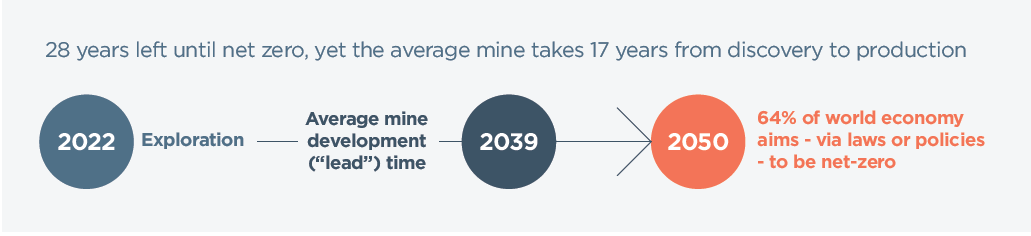
Three factors shorten lead times.31 Higher market prices for minerals can hasten development, but at a delay. The price increases that began in 2004 only resulted in an acceleration in mine production in 2012. During that eight-year period the price of copper tripled.32 Nor is this a solution for the energy transition as it would increase costs for transition industries.
Two other factors are conducive to accelerating the energy transition. First physical qualities: large and high quality of deposit; mineral type (e.g., lithium and gold are faster than nickel and copper); shallower deposit depths; and further developing existing mines rather than starting from scratch with a greenfield development.
Two, higher-quality governance facilitates development. One study has indicated that if African countries improved their quality of governance to the level of Chile, they could shorten mine lead times by an average of two to three years.33 Policy makers cannot control most of the physical factors of mining and market price, but they can control governance. Specifically, they can focus on improving management of surveys and permitting phases to shorten lead times while still ensuring fair deals for their countries’ minerals.34
Better governance can reduce disruptions to the highly concentrated supply of minerals across Africa
Stable supply relies on stable relationships between mining companies, governments and communities. Discontent leads to disruption which is a risk particularly for industries that require transition minerals that are geographically concentrated.
Resources can be concentrated both at the national level, as seen in Figure 4, and at the mine level. For example, in 2020, four mines— Kamoto, Tenke Fungurume, Metalkol RTR and Etoile—all in the Democratic Republic of the Congo (DRC), produced 41 percent of global cobalt supply.35 In such cases a single company dispute with a government or local community risks cutting off large shares of global supply. These disruptions also increase risks to lenders who require higher interest rates from companies, thereby increasing costs and reducing returns.36
Figure 4. African countries with large shares of global transition mineral reserves37
Mining Disruptions
Tax disputes and expropriation. In 2019 Vedanta became involved in a tax dispute with the Zambian government, leading to the seizure of its Konkola Copper Mines subsidiary, removing 90,000 tons per year of mined copper output and 310,000 tons per year of smelter capacity from global supply.38
Labor strikes. Mining analysts typically assume strikes results in five percent of global production lost each year.39
In 2019, workers at the world’s largest copper producer, Codelco, began a strike at its Chuquicamata mine, removing 393 tons per day of copper from the market.40
Environment. Vedanta’s 400,000-ton-per-year Tuticorin smelter in the Indian state of Tamil Nadu has been offline since May 2018 after the company failed to protect the local environment.41
A similar dispute between MMG Ltd. and the local community caused local output at Peru’s Las Bambas mine to drop 10 percent year-on-year.42
Serbia withdrew Rio Tinto’s exploration permit in early 2022 after protests over plans for a large lithium mine.43
Export bans. Governments ban mineral exports to encourage domestic downstream processing industries. In the case of Indonesia this has led to the development of some domestic processing, but it has taken a long time and in some cases has not happened. Tanzania attempted to establish domestic copper smelting by banning concentrate exports for several years, but failed due to insufficient economies of scale.44 A the time of writing, the country’s Ngualla mine—the world’s fifth largest rare earth deposit—is currently stalled due to a government requirement for local refining.45
Corruption. Alleged corruption and the resulting legal processes have held up development of the Simandou iron ore deposit in Guinea. The resource was discovered in the 1990s yet remains undeveloped. It holds the world’s largest untapped iron ore deposits.46
2. A win for citizens in Africa’s mining countries

Listen to African governments and civil societies’ demands for better deals
The extent to which African countries have benefited from past mining booms is unclear. Some studies suggest that many countries did benefit from the last boom, but that these benefits were less than many citizens hoped for. For example, socioeconomic indicators such as those in the Human Development Index on average improved in African countries with large mining sectors.47
However, performance has varied. Analysis of the “adjusted net saving rate”, which measures the amount each country saves and invests in economic assets less the decline in subsoil and other natural assets, indicates that countries like Zimbabwe and DRC have through disastrous governance effectively sold the national wealth for less than nothing.48
Even countries that show higher adjusted net saving rates could possibly have benefited more with stronger governance.49 For example, while governments do generate significant revenue from mining, recent IMF research suggests companies’ avoidance of corporate income tax could be costing 15 African mining countries around $600 million annually.50 Governments have also struggled to develop local supplier bases (“backward linkages”) and to add value to their raw minerals through processing (“forward linkages”). In some cases, citizens living near mining sites have struggled to benefit at all.51
As African governments and civil society have made clear, things must change. African civil society organizations have consistently called for a “new deal” in which mining draws on more locally sourced inputs and supplies downstream industries on the continent rather than simply feeding exports.52 Government officials in mining countries as well as the African Union (AU) and other regional bodies have echoed these demands, which are also informing the African Green Minerals Strategy. 53 54
Following are key elements of a mining triple win. Some of the recommendations are not new, but African governments and their development partners have yet to systematically invest in them. Doing so now is crucial.
Develop E-mobility and battery storage value chains
Several African governments and regional bodies aim to establish industries within the battery value chain, for both e-mobility and electricity storage. The move to establish these and other value chains for energy transition technologies in Africa has climate benefits too; it could translate into cheaper and greener products for manufacturing elsewhere. Unlike most high-income countries, African states have significant spare renewable energy potential.55 Some high-emission industrial activity—such as metal smelting—could relocate to Africa.
Figure 5: An electric vehicle battery value chain
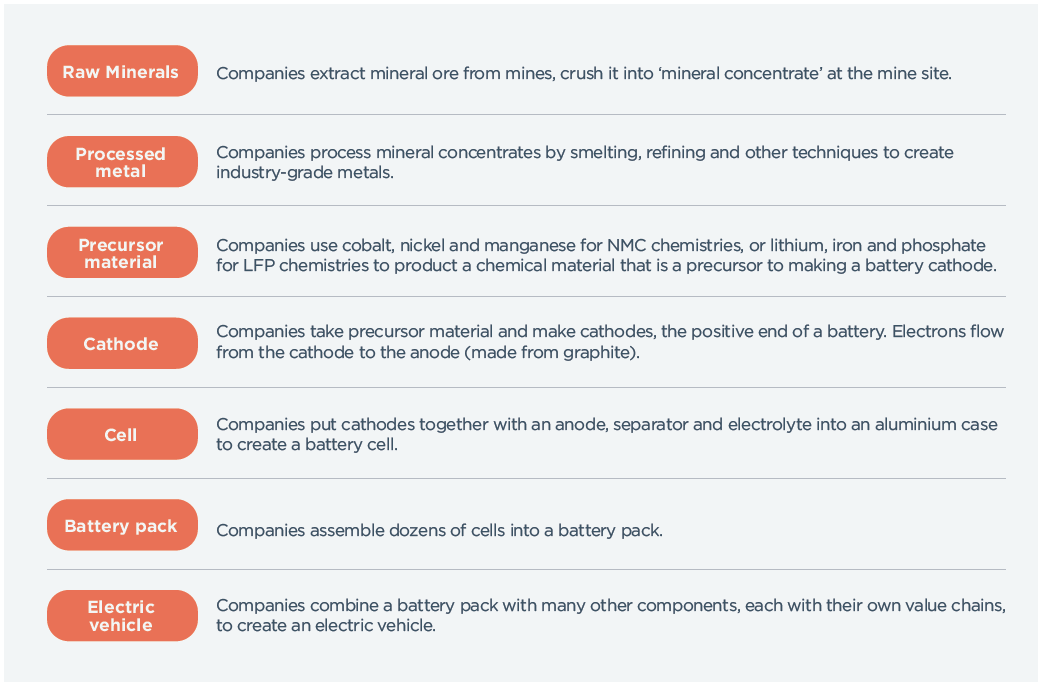
However, few African countries with mineral reserves have succeeded in efforts to establish industries downstream from mining. To change that, policymakers should:
Secure a supply of minerals and pool supply to achieve scale
Most processes along the battery chain benefit from scale economies, which require a large supply of inputs. This supply must be dependable to ensure plants are constantly running near capacity. No single African country has all the minerals required to produce batteries, particularly lithium. Countries will need to pool mineral supply to achieve the minimum scale and reliability in case supply from one mine stops. (See page 14 and 15) And with a significant amount of production already committed to overseas buyers through offtake agreements, governments will need options for securing supply for an African value chain. Increased exploration and discoveries will go some way to reducing this tension.
Provide cheap, reliable, and green energy
Metal processing requires substantial amounts of energy. Yet the DRC and much of southern Africa are short of industrial quantities of energy. The much-delayed Inga hydropower plants in the DRC will export their energy to South Africa. But if the Grand Inga dam is finally built, it could allow the DRC to process cobalt and copper with low carbon emissions.56 The international community should expand its support to increase the availability of cheap, reliable, and green energy in Africa for industry. Ensuring there is surplus energy for households could also induce local communities to accept the industries operating near where they live.57
Coordinate across the region
Governments in the region will have to closely collaborate and partner to create an African battery production industry. Recognizing this, the DRC and Zambia have established a “Joint Battery Council.”
Figure 6. Location of Africa’s battery mineral reserves and above ground assets needed for downstream industries 58
The African Continental Free Trade Agreement (AfCFTA) and other existing sub-regional free trade agreements will also facilitate coordination. But the location and benefits of activity will not be equal, particularly as some countries already have more capacity than others (as highlighted by their “above ground assets” in Figure 6). Those with the most minerals but the least potential to benefit could block efforts to coordinate. As a failed attempt at establishing a regional coltan refinery in South Africa showed, regional authorities must explore mechanisms for sharing not just the profits from an activity but also the wider economic benefits with producer countries.
The proposed SADC Regional Mining Vision proposes ways to ensure that disadvantaged countries can also supply other inputs, e.g., a common fund that pays the additional cost of transporting inputs from countries with weak transport infrastructure to where the activity is taking place.59
Develop large downstream markets for electric vehicles (particularly two- and three-wheelers)
Paradoxically, proximity to the mineral source is only a small factor in the location of downstream industries, since processed metals are relatively easy and inexpensive to transport. However, transport cost is still relevant for products closer to the raw extraction stage. Zambia has succeeded in developing copper smelting and refining to reduce the weight of exports, from concentrates to cathodes. Conversely, there is only a small manufacturing sector using this copper.
More important than proximity to the mineral source is the proximity to downstream markets, making some parts of the value chain more viable than others. This matters across the value chain. Cobalt from mines in DRC and Zambia, despite its high grade, usually contains many impurities. The next link in the battery value chain is producing ‘battery precursor material’, chemicals that are a precursor to making battery cathodes, themselves the ‘positive’ end of a battery. To produce precursors material, companies need to remove the impurities in mined cobalt. This process is more viable if companies locate the process plants near a cluster of other chemical plants.60
The next link involves creating battery cathodes. But these are difficult for companies to transport, so companies tend to locate cathode production close to battery cell manufacturing, the next link in the value chain.61 Lastly, cell manufacturing tends to be located close to EV manufacturers to benefit from quicker, more flexible delivery to customers.
Therefore, African industries along the battery value chain will be more viable if there is a market for battery-powered vehicles close by. It is even better if this market is large, since companies then benefit from scale economies.62 These factors matter in deciding which types of batteries to attempt to produce in Africa.
Given the DRC’s huge cobalt reserves, regional discussions have focused on developing industries in the nickel, manganese, and cobalt (NMC) battery value chain.63 NMC batteries are currently used in electric cars like the Nissan Leaf, Volkswagen e-Golf and Hyundai Kona. However, the African market for such cars is likely to remain small. Few people in Africa can afford them, and they require a reliable grid and charging infrastructure. Electric cars of any kind might only be a small part of the future African market: perhaps only 14 percent of EVs in Africa will be cars (of any type) by 2040.64
This makes it difficult for companies to be viable along the full value chain from mine to electric vehicle in southern Africa. One study suggests that producing battery precursor material could be viable if countries can coordinate to provide a reliable supply of minerals to a precursor chemical plant.65 But given the difficulties of transporting cathodes, processes further downstream from precursor production may be unviable until there is a large regional market for electric vehicles that use NMC batteries.
Conversely, Africa, following trends in India, is more likely to adopt electric two- and three- wheelers.66 Current two- and three-wheel electric vehicle models use an alternative battery chemistry: lithium, iron, and phosphate (LFP). LFP chemistries are also used in stationary power storage, useful for providing off-grid electricity for Africa’s dispersed population.
Therefore, in addition to developing part of the NMC battery value chain, African industries based on the LFP battery chemistry might also be viable.
Given Africa doesn’t currently produce much lithium, African industry might start at the other end of the value chain, with assembling battery packs from imported cells. South Africa already does this, assembling battery packs for mining equipment and refrigeration.
To go further up the chain, African industries need to invest in cell manufacturing plants. There is currently little incentive for investors, but three things could change this: a larger regional LFP market, more lithium discoveries and regional coordination on a lithium refinery.
Figure 7. Two options in locating parts of a battery value chain in Africa
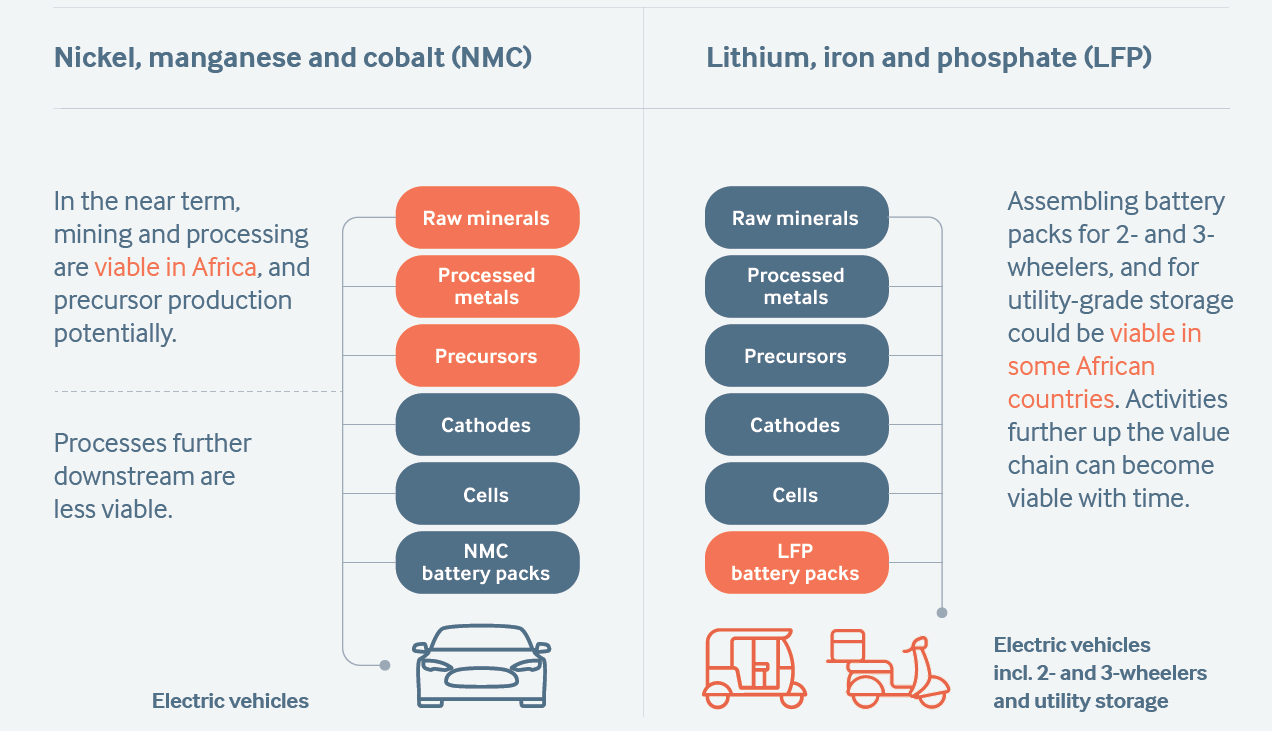
Although the African market for electric two- and three-wheeled vehicles is growing rapidly, it needs to grow even faster to support a viable set of battery and EV production industries. There are different ways that governments could help a market to grow. Governments often protected infant markets from foreign competition. But protection on its own rarely worked. Governments have had more success by promoting local companies instead. Rwanda’s recent e-mobility strategy paper suggests a promising shift in this direction.67 Donors could support multinational companies to invest in the sector (including in joint ventures with local companies) and fund EV infrastructure (such as battery swap stations).
The AfCFTA can also help to develop this market for African producers by enabling African countries to focus on different links in the value chain. However, to realize this potential, governments must significantly reduce non-tariff barriers, such as procedural delays at borders. Governments within the trading region must also define and implement the AfCFTA Rules of Origin—the percentage of African materials used—to determine whether the AfCFTA applies. This will prevent foreign makers of semi- manufactured goods from avoiding tariffs and undercutting African producers.
Be ready for changes to battery technologies
The battery chemistries in demand today may not be the batteries of the future.68 Lithium-ion batteries—like NMC and LFP batteries—will likely dominate for at least the next decade.69 But the cobalt content in NMC chemistries has already fallen significantly, and there is growing interest from manufacturers in sodium-ion batteries. Some capabilities are transferable between some battery technologies—for example, between different lithium-ion batteries, and between lithium-ion and sodium-ion batteries—but not between others. Policy makers must consider that investments made for one battery chemistry may become “stranded.” African countries can insulate themselves from this risk in part by developing chemistries suited to the region’s needs and geological mineral profile. Local and foreign companies, researchers and international partners could collaborate to create appropriate technologies.
Nurture mining suppliers
Both the energy transition and African countries could benefit significantly if governments nurture competitive local companies
Developing African suppliers to the mining industry has perhaps the most potential among all the benefits countries can derive from mining. Suppliers provide products and services to mining companies. This can range from products such pick-up trucks, tyres, drills, conveyor belts, and specific replacement parts, and services such as catering, surveying, and human resource management. To name only few of a whole host of products and services that suppliers provide. There are also many other mining and processing tasks that a mining company that holds the mining license might also sub-contract to other companies. In total, the procurement of goods and services usually amounts to 50 to 70 percent of all money spent in host countries. Usually more than payments to governments, worker salaries and wages, and community investment combined (see Figure 8).70
Figure 8. Example of mining company spending in a producer country71
For the international community and companies, efficient local suppliers lead to lower costs for mining companies.72
Mining companies need to import fewer goods, and local expertise solves local problems. By procuring more
from the local market and establishing a wide network of local suppliers, the mining industry also has stronger ties to their host countries, reducing disputes and discontent.
The countries that have achieved the most development from mining - such as Canada, Australia, Chile, and South Africa - all have significant supplier industries. In both Australia and Canada there are more people employed at supplier firms than in mining itself.73
However, in African countries outside South Africa, much of procurement value is spent on imported goods resold by domestic suppliers, without creating many jobs, transferring business knowledge to other economic sectors, or substantially reduce mining costs. The challenge is to develop competitive African companies that can produce more of the supply chain themselves.
Policies to nurture competitive African suppliers
The Intergovernmental Forum on Mining, Minerals, Metals and Sustainable Development (IGF), the International Finance Corporation (IFC) and Mining Shared Value have contributed to a growing understanding of what works best in developing supplier companies in Africa.74
African governments have often favored “local content” rules that stipulate how much mining companies should procure from local markets. But these have yielded mixed results. Governments usually do not monitor mining company procurement, and some mining companies have procured from suppliers with local political links rather than the most competitive. Most importantly, governments have often failed to pair local content rules with support to develop businesses that can meet mining companies’ demand. This is particularly important because cheap imports from China and other large developing economies means that African countries will struggle to create viable supply companies without government intervention.
But there are alternative approaches:
Funding for local entrepreneurs would overcome most African companies’ capital constraints. This could come from the government and companies, as is the case in South Africa.75 Development finance institutions and donors could also capitalize venture funds for this purpose.76 To encourage regional coordination on supplier development, regional authorities like the African Development Bank could manage some of these funds at a regional level.
Consult
Governments should research and consult business to identify what goods and services to target for supplying to the mining industry. The Ghana Minerals Commission and Chamber of Mines worked together to create a list of goods and services that companies must procure from Ghanaian suppliers, rather than using a blanket total percentage as a requirement.77
Coordinate for scale
Supplier companies need scale economies to be competitive. A single mine is generally too small to create enough demand. However, mining companies working through industry chambers can coordinate and pool their demand for suppliers. At a regional level, mining countries could coordinate to create even more scale for suppliers. The proposed SADC Regional Mining Vision and the ECOWAS Model Mining and Minerals Development Act identify this as an opportunity; they suggest that a country should recognize local content created in other member states. The DRC- Zambia partnership on copper and cobalt mining is one opportunity to experiment with coordination for scale.
Learn from experienced suppliers
Many African countries lack operational capabilities and managerial knowledge. Those African businesses that have succeeded have learned from others. Joint ventures, where internationally competitive supplier firms partner with local suppliers, facilitate learning. In Canada and Australia, mining companies require large-scale suppliers to form joint ventures with Indigenous suppliers, allowing the Indigenous companies to develop their own capacity. Donors could also support trade fairs between foreign and African mining suppliers to help entrepreneurs network.
Market development and trade barriers
As with developing value chains, the African Continental Free Trade Area will be important in helping supplier companies develop.
Create jobs within supplier companies
Share of direct mining employment is already high and further growth is limited, so creating jobs with suppliers has more potential
Even though the mining sector is capital- intensive, companies still employ significant numbers of people. Workers involved in core mining activities tend to make above-average salaries in most countries.
In contrast to the share of procurement between host and investor countries, the share of Africans that are direct employees is already much higher. While expatriates from outside the continent commonly hold the most senior management roles in African mining, most direct employees—both permanent and contract staff—are nationals.
There are several reasons. One is cost. Internationally competitive salaries for expatriates are much higher than the equivalent African salaries and transporting and housing expatriates is hugely costly. Host country citizens are likely to enhance their skills and capacities by working in mining operations, which often involve on-the-job training. Companies can also exert much more control and monitoring of activities “inside the fence” compared to the activities of suppliers of goods and services.
Governments do aim to increase the share of national citizens in the direct employment of mining companies. Governments use “demand-side policies” that impose quotas and percentage limits on expatriate employees. “Supply-side policies” conversely entail developing skills, including the prerequisite competencies that act as a foundation for core mining tasks (for example mathematics and vocational education). Companies and the international community can facilitate government efforts by supporting standardization and increasing certification for skills that workers have acquired.
However, employment policies are unlikely to yield many more jobs. Automation and other industry changes mean direct employment will likely decline.
Governments could focus instead on training, prioritizing technical education and highly skilled mid-to-upper management. However, programs should focus on employees within supplier firms, rather than those directly employed by mining companies. Employment policies might best focus on developing supplier companies and helping them employ more Africans.
Collect and manage tax revenues
African countries earn significant sums from mining, despite large-scale tax avoidance by companies. Effective revenue management remains a priority.
Many African government officials and civil society actors are concerned that corporate tax abusers have cheated their public accounts of billions of dollars of tax revenue. The International Monetary Fund (IMF) estimated that treasuries across the 15 most mineral-dependent countries in sub-Saharan Africa have potentially lost $600 million a year from companies avoiding mining corporate income tax.78
This estimated tax loss is equal to about 5 percent of the total revenues the governments of these 15 countries earned from mining.79 Addressing tax abuse80 might increase revenues by this amount, but governments must also look elsewhere for further revenue. First, given how little exploration has occurred in Africa, improving governance (rather than just reducing tax rates), could radically expand the tax base.
A second area of focus is tax rate adjustment. While legislated tax rates have recently increased across the region,81 rates negotiated in contracts for individual projects remain low in many countries. This is due in part to governments competing to attract investment by offering tax incentives that are often unnecessarily generous.82
Given the relationship shown in Figure 3, governments can make their countries more attractive to investors by improving other areas of governance, rather than lowering tax rates. Such missteps are particularly costly for governments that have legally agreed with companies that they will not change contract terms like taxes (known as stabilization clauses).83
Despite these issues, African governments still collect substantial amounts from mining companies. For the 15 most mineral-rich countries in sub-Saharan Africa, 8 percent of total government revenues. Across the continent more generally, Africa’s transition mineral reserves are currently worth about $2.97 trillion.84 Based on past collection rates including losses from tax abuse, and assuming no improvement in tax collection, Africa’s transition mineral reserves could generate $475 billion in taxes over the life of the reserves.85
Furthermore, despite the benefits of value chain development and supplier policies, collecting and investing taxes remains the best way for governments of mineral-dependent economies to fund programs to alleviate poverty and to diversify their economies. These economies have suffered from volatile metal prices and “Dutch disease,” which inhibits growth of other export sectors. Investing mining revenues in developing the rest of the economy ensures that these economies no longer depend on just one industry and helps lift citizens out of poverty.86
Therefore, how governments use the tax revenues they receive is still of paramount importance. A country’s “adjusted net saving rate” is one indicator of performance in revenue management. When compared to the potential revenues a government could collect (measured as resource rent), the adjusted net savings gives an approximate measure of how well countries actually collect and spend taxes from mining industries. By this measure, performance varies considerably. Since 2000, Zambia has received about the same rent per unit of GDP as Guinea, but Zambia’s adjusted savings rate has been 17 percent, while Guinea’s rate has been -11 percent. However, most African mining countries do not have fiscal rules for mining, and of those that do, few place controls on how governments spend the revenues.87 The potential boom in revenues from transition minerals serves as a reminder of the importance of a robust revenue management framework.
Some countries have successfully implemented policies to collect and transform mining revenues into sustainable development
Below are a few examples that governments and donors could further support, strengthen and adopt:
Sierra Leone has moved away from negotiating tax terms for individual projects, reducing the risk of mistakes. Mali has reduced the stability period permitted in contracts from 30 years—significantly longer than necessary to ensure the bankability of projects—to 12 years from the issuance of a mining license.
Experiment with new tax designs
Governments are experimenting with new tax designs that balance the need to attract investment while minimizing the opportunities for companies to avoid taxes. Governments in Côte d’Ivoire, Guinea and Mauritania, among others, have levied “variable royalties” that accommodate the inherent volatility of metal markets while still being easier to administer than corporate income taxes which companies find relatively easy to avoid paying.88
Resource tax authorities
Despite frequent changes to its tax code and disputes with taxpayers, Zambian authorities and donors have invested in the Zambia Tax Authority and mining ministry, significantly expanding the expertise and information they have to monitor the copper mining industry.
Coordinate and share expertise across the region
Several pan-African bodies are supporting tax policy making and administration; these include the African Development Bank, the African
Tax Administration Forum and the African Tax Institute. Providing capacity building support on economic modeling, sharing expertise and experience across countries, and working on international aspects of taxation that can help tax officials perform their roles more effectively.
Disclose contract and payments to governments
Some governments have been increasingly transparent, enabling more public scrutiny, and therefore increasing the incentive for governments and companies to sign fair deals. However, there is room for much more progress: specifically within sub-Saharan Africa, 44 percent of countries have legislated contract disclosure, while only 16 percent systematically disclose all or most mining contracts.89 Eighty-five percent in this group also disclose payments, though not always in a timely, accessible way.90
Manage government revenues
Having collected revenues, a government must spend or save them wisely, and avoid problems of economic volatility, inflation and waste. Outside of Africa, Chile has done this effectively with its copper earnings. Chile has a rule that determines how much of its mining revenues the government can spend on present day needs and how much it must invest for longer-term projects. As copper revenues are so volatile, officials use its Economic and Social Stabilization Fund to save surplus revenues until the next downturn.91
Stamp out corruption
Corruption tends to worsen during booms; everyone has a role in combating it now
Seventy percent of African countries with transition mineral reserves rank in the bottom half of Transparency International’s Corruption Perceptions Index.92
Corruption reduces the benefits from mining for most Africans, while increasing the risk of social and environmental harm.93 It also disrupts mineral supply by deterring investment, nurturing arbitrary and unpredictable regulatory environments, and potentially exposing companies to long-term liability and sanctions.94
Past commodity booms corresponded with an increase in corruption, and this could reoccur as the world scrambles to meet the demand of transition minerals.95 As profits soar, public and private sector actors are more likely to embrace risks, including engaging in or turning a blind eye to graft. During booms, government officials and company executives engage in frenzied, fast-paced dealmaking, which can facilitate corruption.
The integration of downstream companies (for example battery and EV players) in order to secure mineral supplies also means company executives are assuming new roles and negotiating unprecedented deals. They are managing unfamiliar risks, while regulators and oversight actors struggle to keep up, particularly as the dominance of powerful multinational companies across multiple stages of the supply chain can inhibit accountability.
How to fight corruption
Governments, the international community, and companies must all act to fight corruption. The following practices are derived from the Extractive Industries Transparency Initiative (EITI) Standard, the Organisation for Economic Co-operation and Development (OECD) Due Diligence Guidance for Responsible Chains of Minerals, and NRGI’s work on corruption in the extractive sector.96
Identify risks and develop mitigation plans
Governments and companies should proactively identify risks in their strategies, policies and activities, particularly in specific areas where corruption regularly occurs, including: the award of licenses, permits and approvals; the procurement of goods and services; state-owned enterprise activities; and commodity trading. Some examples of good practice are emerging. Colombia’s mining agency recently mapped risks and released the analysis for public consultation, while mining company BHP now requires its subcontractors to provide beneficial ownership information.97 Companies should also support other entities, such as their suppliers and customers, to integrate these checks.
Reduce the use of agents and intermediaries
One common form of corruption is company staff paying bribes to public officials via agents and intermediaries. Companies should follow the example of trader Trafigura, which has committed to no longer hiring third parties to perform “business development” functions.98 They should exert extensive control over relationships with any remaining intermediaries.99
Increase transparency
It is easier for authorities and civil societies to uncover corruption if companies and governments officials disclose contracts, payments and the beneficial owners of assets. As noted on the previous page, contract and payment disclosures are increasing, albeit not quickly enough. Beneficial ownership transparency is particularly lagging, though recent reforms by Ghanaian and Nigerian authorities to increase the coverage of their requirements are promising.100
Support oversight actors
Transparency is not a solution on its own, however. Governments, as well as donors in the international community, must support civil society organizations, journalists, whistleblowers, and other anticorruption actors.
Link international assistance to anticorruption
The international community has a critical role in ensuring that African countries receive investment to develop their minerals and establish supply and value chains. Donors should acknowledge strong government efforts to tackle corruption with enhanced assistance.
Disable kleptocracy
Some transition minerals originate in countries where the political leadership systematically misappropriates the nation’s resources, to benefit a small group of elites rather than the wider population. When engaging in such kleptocratic contexts, companies and the international community should assess whether their activities enable or strengthen kleptocracy, discontinue those which do, and disclose these assessments and the chosen responses.
African officials and civil society actors have made clear that mining must change to benefit Africans in mineral-rich countries. Meeting African demands is in the interest of energy transition industries and humanity more broadly.
3. A win for the environment and communities

Protect forests, water sources and biodiverse areas from the forthcoming surge in mining
Mining damage might increase as the energy transition progresses
Poorly practiced mining is environmentally destructive, threatens local communities and jeopardizes the planet-wide benefits of the energy transition. The collapse of a South African tailings dam in September 2022 swept away houses, polluted rivers and damaged thousands of hectares of farmland; this is just one recent example of the damage mining can cause.101 Mining indirectly causes seven percent of global deforestation,102 and contributes 10 percent of global emissions.103
Mining’s impact on the environment could worsen.104 The surge in demand for metals could encourage more activity in particularly environmentally sensitive areas. For example, the spike in coltan prices in 2002 led to a rush of mining in Kahuzi-Biega National Park in eastern DRC. IEA analysis suggests that the life-cycle emissions of clean energy are still significantly lower than for fossil fuel technologies, but future production will involve more energy- intensive processes.105 New discoveries are revealing deposits with lower ore grades, which require more extraction, and thus more emissions, to unearth the same quantity of minerals. The mining of many transition minerals requires particularly high water use, and some transition minerals, such as hard-rock lithium (Africa’s likely primary source of lithium), carry particularly high contamination risks.106 The start of lithium mining in countries such as Mali and Namibia could therefore exacerbate increasingly frequent droughts.107
Knowledge on how to protect the environment has improved, but practice is weak
Many governments now require mining companies to produce environmental and social impact assessments (ESIAs) and resulting environmental management plans (EMPs).108 These procedures have sometimes reduced the risk of environmental harm, however, their design and use are often problematic. Environmental risk from a mine can be so severe that even with a rigorous EMP, the expected damage outweighs any benefits that the project could generate for the country. But such mines often proceed nevertheless.
There are a range of solutions. One is setting no-go zones for exploration. (See also page 11.) Few governments exert control over company exploration, despite laws often providing them with the authority to do so.109 Several African governments have issued exploration licenses in environmental protection zones, some of which do not sufficiently cover areas of environmental importance, including large tracts of intact forest in the Congo Basin.110 Once a company discovers a deposit, authorities have difficulty stopping exploitation of the mineral because of powerful financial incentives and corruption. But in some cases, exploration licenses provide companies with the legal right to mine following discovery. In some cases, companies sue governments that withhold a mining license after discovery, even if this is due to environmental risk.111
Governments could improve their licensing decisions by incorporating environmental factors into their economic modeling, but this rarely happens.112
Generally, different governmental authorities are responsible for assessing environmental risks and the economic viability and benefits of a project, with little cooperation between them. Furthermore, authorities often allow mining companies to choose a method of measuring anticipated environmental damage, and sometimes waive the requirement for quantitative measures entirely, making assessments difficult to use in models. Authorities should in these cases consider existing guidance on good practice from the International Finance Corporation and IGF.113
Even with strong valuation tools, host governments often undervalue the environment. Officials often feel pressure to prioritize short- term revenues and jobs. Initiatives like the Central African Forestry Initiative to provide financing to Gabon to maintain its forests would change this calculus.114 Governments publishing clear criteria for investors on what constitutes unacceptable environmental risk would also help.
Having decided to extract, governments also often struggle to prevent risks from materializing. Hiring and equipping skilled staff is difficult.115 As companies use their own methods to measure damage, governments struggle to ensure that companies comply with regulatory benchmarks. Rapidly evolving mining technology and changing ecological understanding of environmental damage make it difficult for governments to protect the environment. Government efforts to increase environmental protection over time are often constrained by mining contracts, many of which still stabilize environmental provisions contrary to advice from the Organization for Economic Co-operation and Development and the United Nations.116
Regarding emissions from mining activities, governments may find carbon taxes a useful tool for incentivizing mining companies to reduce the greenhouse gases they produce. Many governments would need to strengthen their administrative capacities before carbon taxes are feasible, and stabilization clauses in mining contracts may also prevent their introduction. In the meantime, governments and the international community have some options for facilitating emissions reductions in the meantime. For example, while some companies are already turning to renewables to power their mines, they could increase support to expanding renewable energy systems in mining countries to further accelerate this shift.117
Local communities’ voices are currently constrained
Communities within forests and other vulnerable areas have a critical role in protecting the environment directly, as recognized at COP26.118 For example, various studies have shown that deforestation is lower in areas managed by Indigenous peoples given their experience of, and interest in, sustaining it for their livelihoods and future generations.119 Community management of land is also often more cost- effective than government and company schemes. Nevertheless, the international community provides little climate finance to support this practice.120
Given that environmental damage severely affects local communities, companies and governments must allow community members to participate in the decision to extract. In principle, governments and companies have increasingly recognized the need for “free prior and informed consent” from communities before allowing extraction.
However, this engagement is often meaningless. A recent survey of 26 African countries found that seven do not require public consultation until after companies have completed a draft ESIA, rather than during the drafting process.121 Even when companies do consult communities, they are rarely required to take local views into account.
Communities face similar challenges in monitoring the implementation of EMPs. While there are exceptions such as Ghana and Guinea, governments in many African countries do not systematically disclose these documents. African governments could learn from Latin America, where several countries have introduced participatory environmental monitoring committees—though such practices can only achieve so much without addressing the growing government hostility toward and violence against environmental defenders and community leaders.122 123
Figure 9. ESIA disclosures in law and in practice in African mining countries124
Conclusion
Africa’s mineral wealth is essential for the energy transition and for the hundreds of millions of people currently living in poverty in African mining countries. Whether and how governments and companies move to further extract this mineral wealth is not only economically and environmentally important for Africa, but also for the vital importance of protecting the world’s rapidly diminishing forests.
Everyone therefore has an interest in mining governance. We all need a triple- win in mining. But governments and companies have a generally poor track record in governance of the sector.
Few citizens in mining countries have benefited as much as they should have, corrupt actors have gotten away with ill-gotten riches, and investors remain reluctant to invest in some parts of Africa.
Some efforts by governments and development partners have helped to improve governance but given the possibility that African citizens could miss out on the next mining boom—and the need to supply an energy transition— these efforts must be both expanded and accelerated. With so much hanging in the balance, officials and executives cannot repeat past mistakes.
This report has highlighted some of the most promising approaches for obtaining a triple-win.
Developing downstream industries within e-mobility, battery storage value and indeed many other value chains; and developing a competitive supplier base within Africa would both benefit Africans and facilitate the energy transition. Improving how governments collect and manage tax payments from mining companies remains critical, both to fund programs to alleviate poverty and diversify economies dangerously dependent on the volatile mining sector.
Furthermore, authorities won’t achieve a triple win until they establish and maintain no-go zones for mining and better resource environmental protection agencies. Companies must do their part and uphold the highest standards of environmental protection. Finally, none of these policies will succeed unless governments and companies are more transparent, held to account and stop corruption among their ranks.
Governments of countries responsible for two-thirds of the world economy aim reach net-zero emissions by 2050—28 years from now. But climate donors, development partners, companies, and governments have much less time to improve mining governance. Proceeding from the recommendations here, all parties must immediately engage in this vital task.
Acknowledgments
Internal contributors and reviewers:
Lee Bailey, William Davies, Susannah Fitzgerald, Gabriela Flores, Andrea Furnaro, Patrick Heller, Phesheya Nxumalo, Matthieu Salomon, Amir Shafaie.
External contributors and reviewers:
Jerry Adhajie (ANRC), Kwasi Ampofo (BNEF), Jeff Geipel (Mining Shared Value), Richard Goode (independent), Paul Jourdan (independent), Amir Lebdioui (School of Oriental & Africa Studies, London School of Economics), Brendan Schwartz (IIED) and John Sloan (UNECA).
Notes
-
1
International Energy Agency, The Role of Critical Minerals in Clean Energy Transitions (2021), www.iea.org/reports/the-role-of-critical-minerals-in-clean-energy-transitions.
-
2
In this report we refer to both Africa north and south of the Sahara. When we mean one of the sub-regions we specify as such.
-
3
IEA (2021); Clyde Russell, “Mining is key to energy transition, but it’s still unloved,” Reuters, 11 May 2022, www.reuters.com/business/energy/mining-is-key-energy-transition-its-still-unloved-russell-2022-05-11; Jairo Yunis and Elmira Aliakbari, Annual Survey of Mining Companies 2020 (Fraser Institute, 2021), www.fraserinstitute. org/studies/annual-survey-of-mining-companies-2020.
-
4
See, for example, Natural Resource Governance Institute, Natural Resource Charter 2nd edition (2014), resourcegovernance.org/approach/natural-resource-charter.
-
5
Natural Resource Governance Institute, Resource Governance Index: From Legal Reform to Implementation in Sub-Saharan Africa (2018), resourcegovernance.org/sites/default/files/documents/rgi-from-legal-reform-to-implementation-sub-saharan-africa.pdf.
-
6
Africa Climate Foundation, Geopolitics of Critical Minerals in Renewable Energy Supply Chains (2022), africanclimatefoundation.org/news_and_analysis/geopolitics-of-critical-minerals-in-renewable-energy-supply-chains/.
-
7
See for example, Cooper Inveen, “Atlantic Lithium’s Ghana mine poised to being production by 2024,” Reuters, 20 September 2022, www.reuters.com/article/ghana-mining-lithium/atlantic-lithiums-ghana-mine-poised-to-begin-production-by-2024-idUSKBN2QV0NQ?utm_source=substack&utm_me….
-
8
As demonstrated by recent discussions between a U.S.-led group of rich countries and mineral producers such as the Democratic Republic of Congo, Namibia and Tanzania. Julian Pecquet, “US looks to Africa to
diversify supply chain for critical minerals,” The Africa Report, 23 September 2022. www.theafricareport.com/243847/us-looks-to-africa-to-diversify-supply-chain-for-critical-minerals. -
9
Glada Llahn and Paul Stevens, The curse of the one-size-fits-all fix, UNU-WIDER Working Paper (United Nations University, 2017), www.wider.unu.edu/sites/default/files/wp2017-21.pdf. For further assessment of donors’ activities in the past, both positive and negative lessons, see: Joanna Buckley, Neil McCulloch and Nick Travis, Donor-supported approaches to improving extractives governance, UNU-WIDER Working Paper (United Nations University, 2017), www.wider.unu.edu/sites/default/files/wp2017-33.pdf; Siân Herbert and Laura Bolton, Donor activity in the extractives sector (Knowledge, evidence and learning for development, 2018), opendocs.ids.ac.uk/opendocs/bitstream/handle/20.500.12413/13589/Donor_activity_in_the_extractives_sector.pdf.
-
10
Although this estimate includes emissions resulting from the investments by each group. Lucas Chancel, “Global carbon inequality over 1990–2019,” Nature Sustainability (2022), doi. org/10.1038/s41893-022-00955-z.
-
11
For Further reading on this dilemma and the arguments between the proponents of “green growth” and “degrowth, see: Alex Bowen and Samuel Fankhauser, “The Green Growth Narrative: Paradigm Shift or Just Spin? Global Environmental Change-human and Policy Dimensions,” Global Environmental Change, 21 (2021), 1157-1159, DOI: I:10.1016/j. gloenvcha.2011.07.007; Kate Raworth, Doughnut Economics: Seven Ways to Think Like a 21st Century Economist, Random House Business Books, London, 2017; Jason Hickel, “What does degrowth mean? A few points of clarification,” Globalizations, 18:7 (2021), 1105-1111, DOI: 10.1080/14747731.2020.1812222.
-
12
McKinsey & Company, “The raw-materials challenges: How the metals and mining sector will be at the core of enabling the energy transition” (2022), www.mckinsey. com/industries/metals-and-mining/our-insights/the-raw-materials-challenge-how-the-metals-and-mining-sector-will-be-at-the-core-of-enabling-the-energy-transition.
-
13
McKinsey & Company, “Metal mining constraints on the electric mobility horizon” (2018), www.mckinsey.com/industries/oil-and-gas/our-insights/metal-mining-constraints-on-the-electric-mobility-horizon.
-
14
McKinsey (2018)
-
15
NRGI analysis, based on Net Zero Tracker. “Net Zero Tracker,” Energy and Climate Intelligence Unit, Data-Driven EnviroLab, NewClimate Institute, Oxford Net Zero (2022), zerotracker.net
-
16
Pratima Desai, “Low carbon world needs $1.7 trillion in mining investment,” Reuters, 10 May 2021, www.reuters.com/business/energy/low-carbon-world-needs-17-trillion-mining-investment-2021-05-10/
-
17
Based on S&P Global Market Intelligence data and U.S. Geological Survey, Mineral Commodity Summaries 2022, 2022, www.pubs.er.usgs.gov/publication/mcs2022. These sources sometimes differ significantly. An average is taken when the reported amounts are similar. When they are not, a third source is used to determine which is likely to be more accurate.
-
18
NRGI analysis based on reserves reported in the S&P Globaldatabase and U.S. Geological Survey (2022), and the mineral volumes in a standard electric vehicle in IEA (2021).
-
19
See for example, World Bank, “New World Bank Survey Brings Hope to Malawi’s Mineral Potential,” 22 September 2015, www.worldbank.org/en/news/feature/2015/09/22/new-world-bank-survey-brings-hope-to-malawis-mineral-potential.
-
20
International Energy Agency, Global Supply Chains of EV Batteries (2022), www.iea.org/reports/global-supply-chains-of-ev-batteries.
-
21
African Minerals Development Centre (AMDC), “Unveiled: The #AMDC’s Theory of Change: A prosperous and transformed Africa achieved through sustainable development of mineral and energy resources...” Twitter post (11 October 2022), www.twitter.com/AfricanAmdc/status/1579789353584164864.
-
22
Based on S&P Global data and U.S. Geological Survey (2022). These sources sometimes differ significantly. An average is taken when the reported amounts are similar. When they are not, a third source is used to determine which is likely to be more accurate.
-
23
The correlation between exploration and mineral reserves per square kilometer is 0.79. The figure compares exploration for all metals except gold from 2002 to 2021 with current value of transition mineral reserves. Exploration spend, reserves and prices from S&P Global Market Intelligence; land area data from www.worldpopulationreview.com.
-
24
The correlation between the Resource Governance Index and Policy Potential Index scores is 0.5. The NRGI Resource Governance Index measures the transparency and accountability of mining institutions. The Policy Potential Index (PPI) in the Fraser Institute survey shows the attractiveness of a country’s policies to investors. The PPI score reported in the figure is an average of the scores from 2017 to 2021 where available, and average across jurisdictions for countries that have several. Some countries have low survey response rates, between 5 to 9 respondents. Natural Resource Governance Institute, “Resource Governance Index 2017,” 2017, resourcegovernanceindex.org; Yunis and Aliakbari (2021).
-
25
African Minerals Development Centre, Desktop Review of African Geological Survey Organisation Capacities and Gaps (United Nations Economic Commission for Africa, 2018), archive.uneca.org/publications/desktop-review-african-geological-survey-organisation-capacities-and-gaps.
-
26
Antony Sguazzin, “South Africa Sets 900 Million Annual Mineral Exploration Target,” Bloomberg, 12 April 2022, www.bloomberg.com/news/articles/2022-04-12/s-africa-sets-900-million-annual-mineral-exploration-target.
-
27
Oil exploration investment is known to correlated strongly with the quality of governance in a country, and it seems likely that a similar pattern holds for mineral exploration. See James Cust and Harding Torfinn, “Institutions and the Location of Oil Exploration”, Journal of the European Economic Association (2019).
-
28
Richard Schodde, “Key issues affecting the time delay between discovery and development – is it getting harder and longer?” PDAC 2014, 3 March 2014, Toronto. minexconsulting.com/wp-content/uploads/2019/04/Schodde-presentation-to-PDAC-March-2014.pdf
-
29
Summary of five studies. The outlier is the McKinsey study (7 to 10 years), but this was based on “large-scale greenfield assets” only. Like findings of Schodde (2021), which highlights that large projects are quicker. McKinsey (2022); IEA (2021); Tehmina Khan, Trang Nguyen, Franziska Ohnsorge, and Richard Schodde, “From Commodity Discovery to Production,” Policy Research Working Paper (World Bank, 2016); Paul Manalo, “Top mines average time from discovery to production: 16.9 years,” Metals and Mining Research S&P Global Market Intelligence (2020); Schodde (2014).
-
30
IEA (2021)
-
31
Schodde (2021) and Khan et al. (2016)
-
32
David Humphreys, “The mining industry and the supply of critical minerals,” Critical Minerals Handbook, Gus Gunn (ed.), chapter 2, 2013.
-
33
Khan et al. (2016)
-
34
Several of the experts interviewed for this report suggested that this is the main opportunity for shortening lead times.
-
35
David Manley, Patrick R.P. Heller and William Davis, No Time to Waste: Governing Cobalt Amid the Energy Transition (Natural Resource Governance Institute, 2022), resourcegovernance.org/no-time-to-waste-governing-cobalt-amid-energy-transition.
-
36
Matt Renaud and Mustafa Kumral, “Out of the Comfort Zone: Quantifying Country Risk for Foreign Mining Project Investment Feasibilities,” Mining, Metallurgy & Exploration, 38, 2323-2335 (2021), www.doi.org/10.1007/s42461-021-00495-8.
-
37
Based on S&P Global data and U.S. Geological Survey (2022). These sources sometimes differ significantly. An average is taken when the reported amounts are similar. When they are not, a third source is used to determine which is likely to be more accurate.
-
38
Henry Sanderson, “Vedanta starts arbitration against Zambia after mines seized,“ Financial Times, 31 May 2019. www.ft.com/content/98b0c464-83a1-11e9-b592-5fe435b57a3b.
-
39
Julia Tilley, “Labour talks 217: Escondida and other stories,” S&P Global Market Intelligence, Metals and Mining Research, 23 February 2017.
-
40
Keval Dhokia, “Global copper pipeline challenged due to disruption,” S&P Global Market Intelligence, Metals and Mining Research, 18 June 2019.
-
41
Sudarshan Varadhan, “Indian state seeks permanent closure of Vedanta’s copper smelter: officials,” Reuters, 24 May 2018. www.reuters.com/article/us-vedanta-smelter-idUSKCN1IP1CX.
-
42
Dhokia (2019)
-
43
Misha Savic, Jan Bratanic and Thomas Biesheuvel, “Europe’s Biggest Lithium Mine Blocked as Rio Loses in Serbia,” Bloomberg, 20 January 2022, www.bloomberg.com/news/articles/2022-01-20/serbia-suspends-rio-tinto-s-2-4-billion-lithium-mine-project.
-
44
Tanzania Minerals Audit Agency, A Study on Viability to Construct a Copper Concentrate Smelter in Tanzania (2011), www.scribd.com/document/193187016/A-Study-on-Viability-to-Construct-a-Copper-Concentrate-Smelter-in-Tanzania1.
-
45
Africa Confidential, “Local processing row holds up rare earth mine,” 25 October 2022, www.africa-confidential.com/article-preview/id/14166/Local_processing_row_holds_up_rare_earth_mine.
-
46
Reuters, “Timeline: The battle for Simandou,” 22 January 2021, www.reuters.com/article/us-swiss-steinmetz-timeline-idUSKBN29R2AA.
-
47
Magnus Ericsson and Olof Löf, “Mining’s contribution to national economies between 1996 and 2016,” Mineral Economics, 223–250 (2019), doi.org/10.1007/s13563-019-00191-6.
-
48
Net savings plus education expenditure and minus energy depletion, mineral depletion, net forest depletion, and carbon dioxide and particulate emissions damage. NRGI analysis of World Bank, “World Development Indicators,” accessed 28 September 2022, www.databank.worldbank.org/source/world-development-indicators.
-
49
Anthony J. Venables, “Using Natural Resources for Development: Why Has It Proven So Difficult?” Journal of Economic Perspectives, 30:1, 161–184 (2016) doi. org/10.1257/jep.30.1.161.
-
50
Giorgia Albertin, Boriana Yontcheva, Dan Devlin, Hilary Devine, Marc Gerard, Sebastian Beer, Irena Jankulov Suljagic and Vimal V. Thakoor, Tax Avoidance in Sub-Saharan Africa’s Mining Sector, Departmental Paper No 2021/022 (International Monetary Fund, 2021), www.imf.org/en/Publications/Departmental-Papers-Policy-Papers/Issues/2021/09/27/Tax-Avoidance-in-Sub-Saharan-Africas-Mining-Sector-464850
-
51
See for example, South African Human Rights Commission, National Hearing on the Underlying Socio-economic Challenges of Mining-affected Communities in South Africa (2016), www.sahrc.org.za/home/21/files/SAHRC%20Mining%20communities%20report%20FINAL.pdf
-
52
See, for example, Claude Kabemba, “How mineral resources can fuel the development of Africa in the context of post-Covid economic recovery,” Publish What You Pay Annual Conference, 14-15 March 2021, www.sarwatch.co.za/how-mineral-resources-can-fuel-the-development-of-africa-in-the-context-of-post-covid-economic-recovery.
-
53
See, for example, African Development Bank, Request for Expressions of Interest, 2022, www.afdb.org/sites/default/files/reoi_green_minerals_strategy_approach_paper_002.pdf.
-
54
Other partners currently include African Legal Support Facility, Africa Finance Corporation, Afreximbank, United Nations Economic Commission for Africa and United Nations Development Programme.
-
55
African Development Bank, “Why Africa is the next renewables powerhouse,” 7 December 2018, www.afdb.org/en/news-and-events/why-africa-is-the-next-renewables-powerhouse-18822
-
56
Manley et al (2022)
-
57
Through Power Africa (www.usaid.gov/powerafrica), for example.
-
58
Reserves data is from S&P Global Market Intelligence and U.S. Geological Survey. The above ground assets of a country comprise its power and transport infrastructure, human capital and other productive capabilities, level of environmental protection and investment climate. They have been converted to a regional index of 0-100.
The data is from multiple sources: African Development Bank, The Africa Infrastructure Development Index (AIDI) 2020, 2020, www.afdb.org/en/documents/economic-brief-africa-infrastructure-development-index-aidi-2020-july-2020; World Bank, “World Development Indicators”; African Development Bank, Electricity Regulatory Index (ERI) for Africa, 2021, 2021, africa-energy-portal.org/reports/electricity-regulatory-index-eri-africa-2021-edition; World Intellectual Property Organization, Global Innovation Index (GII) 2021, 2021, www.wipo.int/publications/en/details.jsp?id=4560; Harvard Growth Lab, “The Atlas of Economic Complexity,” accessed 20 September 2022, www.atlas.cid.harvard.edu/; Environmental Protection Index, “2022 Environmental Protection Index (2022),” accessed 20 September 2022, www.epi.yale.edu/; World Bank, “Doing Business 2020,” accessed 20 September 2022, www.worldbank.org/en/programs/business-enabling-environment/doing-business-legacy; S&P Global, “Control Risks Country Risk Summary,” accessed 20 September 2022, www.capitaliq.spglobal.com. -
59
Southern African Development Community and African Minerals Development Centre, Developing a Regional Mining Vision for the Southern African Development Community (SADC), 2018.
-
60
Manley et al (2022)
-
61
Emily Hersh, Alex Grant and Chris Berry, So, You Want to make Batteries Too? (Payne Institute, 2020), www.payneinstitute.mines.edu/so-you-want-to-make-batteries-better-too
-
62
Ibid.
-
63
See for example, African Development Bank, Lithium-Cobalt Value Chain Analysis for Mineral Based Industrialization in Africa (2021), www.afdb.org/en/documents/lithium-cobalt-value-chain-analysis-mineral-based-industrialization-Africa.
-
64
McKinsey & Company, Power to move: Accelerating the electric transport transition in sub-Saharan Africa (2022), www.mckinsey.com/industries/automotive-and-assembly/our-insights/power-to-move-accelerating-the-electric-transport-transition-in-sub- aharan-africa.
-
65
BloombergNEF, The Cost of Producing Battery Precursors in the DRC (2021), about. bnef.com/blog/producing-battery-materials-in-the-drc-could-lower-supply-chain-emissions-and-add-value-to-the-countrys-cobalt.
-
66
Mohua Mukherjee, India’s Mass-Market Clean Mobility Initiatives and its Unique, Customized Business Models for Light Electric Vehicles (The Oxford Institute for Energy Studies, 2022), www.oxfordenergy.org/publications/indias-mass-market-clean-mobility-initiatives-and-its-unique-customized-business-models-for-light-electric-vehicles.
-
67
Rwanda Ministry of Infrastructure, Strategic Paper on Electric Mobility Adaption in Rwanda (2021), www.mininfra.gov.rw/fileadmin/user_upload/Mininfra/Publications/Laws_Orders_and_Instructions/Transport/16062021_Strategic_Paper_for_e-mobility_adapta….
-
68
Manley et al (2022)
-
69
IEA (2022)
-
70
See for example World Gold Council, Responsible gold mining and value distribution, 2013 report (2013), www.gold.org/goldhub/research/responsible-gold-mining-and-value-distribution-2013-report.
-
71
World Gold Council (2013). Mining Shared Value has indicated these figures are representative of wider sector trends.
-
72
Jeff Geipel, Mining Shared Value, interview with authors, 25 September 2022.
-
73
Government of Canada, “Minerals Sector Employment,” January 2019, www.nrcan.gc.ca/science-data/science-research/earth-sciences/earth-sciences-resources/earth-sciences-federal-programs/minerals-sector-employment/16739; Mets Ignited, “METS in Australia,” accessed 28 September 2022, www.metsignited.org/australian-mets-sector/.
-
74
Aaron Cosbey and Isabelle Ramdoo, Guidance for Governments: Local Content Policies (Intergovernmental Forum on Mining, Minerals, Metals and Sustainable Development, 2018), igf-guidance-for-governments-local-content.pdf; International Finance Corporation, Guide to Getting Started in Local Procurement (2011), www.ifc.org/wps/wcm/connect/topics_ext_content/ifc_external_corporate_site/sustainability-at-ifc/publications/publications_handbook_guidetogettingsta…; Mining Shared Value and Engineers Without Borders, The Mining Local Procurement Reporting Mechanism (LPRM) (2017), www.miningsharedvalue.org/mininglprm.
-
75
See for example, activities of the Industrial Development Corporation (www.idc.co.za) and Anglo American’s Zimele programs (www.southafrica.angloamerican.com/our-difference/zimele)
-
76
Southern Africa Resource Watch, From Harmonisation of Policies to the Manufacturing of Lithium Batteries in Southern Africa: Collaboration between DRC and Zambia (2022), www.sarwatch.co.za/publication/from-harmonisation-of-policies-to-the-manufacturing-of-lithium-batteries-in-southern-africa-collaboration-between-drc-….
-
77
Jeff Geipel, Mining Shared Value, interview with authors, 25 September 2022.
-
78
Giorgia Albertin et al (2021). Note that the definition of mineral-dependent does not overlap with which countries have substantial reserves of transition minerals.
-
79
Ibid. The IMF estimates the 15 mineral-rich countries earned mining revenues equals 2 percent of GDP on average. This amounts to $13 billion a year.
-
80
For example, if companies were to adhere to more responsible tax practices such as the B Team Responsible Tax Principles. See The B Team, “Advancing Responsible Tax Practice,” accessed 28 September 2022, www.bteam.org/our-work/causes/governance/advancing-responsible-tax-practice.
-
81
Yannick Bouterige, Céline de Quatrebarbes and Bertrand Laporte, Mining Taxation in Africa: What Evolution in 2018? (International Centre for Tax and Development, 2020), www.ictd.ac/publication/mining-taxation-africa-recent-evolution.
-
82
Giorgia Albertin et al (2021).
-
83
For example, a study of contracts on resourcecontracts.org revealed that Burkina Faso, Burundi, Guinea, Madagascar and Mali had agreed stabilization clauses lasting 30- 34 years on average—significantly longer than necessary to ensure the bankability of projects. Intergovernmental Forum on Mining, Minerals, Metals and Sustainable Development, Insights on Incentives: Tax Competition in Mining (2019), www.iisd.org/sites/default/files/publications/insights-incentives-tax-competition-mining.pdf; Natural Resource Governance Institute, resourcecontracts.org.
-
84
NRGI analysis using S&P Global mineral reserves and price data. Prices are near-term forecasts and therefore may be elevated compared to the longer-term trend.
-
85
NRGI analysis. On average, 16 percent of mining sales revenue has gone to tax payments. See Robert Pitman and Kaisa Toroskainen, Beneath the surface: The Case for Oversight of Extractive Industry Suppliers (Natural Resource Governance Institute, 2020) resourcegovernance.org/analysis-tools/publications/beneath-surface-oversight-extractive-industry-suppliers.
This figure aligns with estimates in other studies: Olle Östensson, Local content, supply chains, and shared infrastructure, UNU-WIDER Working Paper (United Nations University, 2017), www.researchgate.net/publication/337699966_Local_content_supply_chains_and_shared_infrastructure; Price Waterhouse Coopers, Total Tax Contribution: A study of the economic contribution mining companies make to public finances (2010), www.pwc.co.uk/assets/pdf/ttc-mining-study-1.pdf. -
86
Anthony J. Venables (2016) and Natural Resource Governance Institute (2014).
-
87
NRGI (2017), “Resource Governance Index 2017.” There was a small improvement in a smaller sample of countries covered by the 2021 edition of the Resource Governance Institute.
-
88
Anna Fleming, Thomas Lassourd and David Manley, “Variable Royalties: an Answer to Volatile Mineral Prices?” in Handbook on the Future of Resource Taxation, African Tax Administration Forum and Intergovernmental Forum on Mining, Minerals, Metals and Sustainable Development (forthcoming),www.iisd.org/publications/brief/future-resource-taxation-roadmap.
-
89
Robert Pitman, “Contract Disclosure Policy and Practice Tracker,” accessed 15 October 2022, docs.google.com/spreadsheets/d/1FXEeD43jw6VYHV8yS-8KJ5-rR5l0XtKxVQZBWzr-ohY.
-
90
Based on membership of the Extractive Industries Transparency Initiative (www.eiti.org/countries).
-
91
Natural Resource Governance Institute, “Chile country profile,” accessed 5 October 2022, www.resourcegovernanceindex.org/country-profiles/CHL/mining.
-
92
Transparency International, “Corruption Perceptions Index 2021,” www.transparency.org/en/cpi/2021.
-
93
United Nations Office on Drugs and Crime, Corruption and Sustainable Development (no date), www.anticorruptionday.org/documents/actagainstcorruption/print/corr18_fs_DEVELOPMENT_en.pdf
-
94
K.C. Michaels, Louis Maréchal and Benjamin Katz, “Why is ESG so important to critical mineral supplies, and what can we do about it?” (International Energy Agency, 2022) www.iea.org/commentaries/why-is-esg-so-important-to-critical-mineral-supplies-and-what-can-we-do-about-it
-
95
Extractive Industries Transparency Initiative, Making the grade: Strengthening governance of critical minerals, www.eiti.org/documents/strengthening-governance-critical-minerals.
-
96
Extractive Industries Transparency Initiative, EITI Standard 2019, eiti.org/collections/ eiti-standard#EITI-Requirements-2019; Organisation for Economic Co-operation and Development, OECD Due Diligence Guidance for Responsible Supply Chains of Minerals from Conflict-Affected and High-Risk Areas (2016), www.oecd.org/daf/inv/mne/OECD-Due-Diligence-Guidance-Minerals-Edition3.pdf; Alexandra Gillies, Sebastian Sahla, Matthieu Salomon and Tom Shipley, Diagnosing Corruption in the Extractive Sector: A Tool for Research and Action (Natural Resource Governance Institute, 2021) www.resourcegovernance.org/analysis-tools/publications/diagnosing-corruption-extractive-sector-tool-research-and-actionrespectively.
-
97
Colombia National Mining Agency, Management and Corruption Risk Matrices of the ANM approved by the Institutional Management
and Performance Committee on 01/27/2022 (2022), www.anm.gov.co/?q=documentos_para_comentarios_ciudadania; Robert Pitman and Kaisa Toroskainen, “BHP, Others Increase Scrutiny of Subcontracting Corruption Risks” (Natural Resource Governance Institute, 2018) www.resourcegovernance.org/blog/bhp-others-increase-scrutiny-subcontracting-corruption-risks. -
98
Alexandra Gillies, “Will Extractive Companies Move Away from Corruption- Prone Intermediaries?”, (Natural Resource Governance Institute, 2019) www.resourcegovernance.org/blog/extractive-companies-corruption-intermediaries-middlemen-oil.
-
99
Natural Resource Governance Institute, Anticorruption Guidance for Partners of State-Owned Enterprises (2022), soe-anticorruption.resourcegovernance.org/chapters/avoiding-high-risk-agents
-
100
Favour Ime and Louise Russell-Prywata, “Beneficial ownership transparency and the fight against grand corruption in Nigeria” (Open Ownership, 2022), www.openownership.org/en/blog/beneficial-ownership-transparency-and-the-fight-against-grand-corruption-in-nigeria.
-
101
Nqobile Dludla, “South Africa mine dam wall collapses, Killing 1 and injuring 40,” Reuters, 11 September 2022, www.reuters.com/world/africa/south-africa-mine-dam-wall-collapses-killing-three-injuring-40-2022-09-11.
-
102
Kirsten Hund and Erik Reed, “A low-carbon future must protect the world’s forests” (World Bank, 2019), www.blogs.worldbank.org/voices/low-carbon-future-must-protect-worlds-forests.
-
103
NRGIcalculationsusingscope1,2and3 emissions (excluding fugitive methane and emissions from the combustion of coal) reported by Lindsay Delevingne, Will Glazener, Liesbet Grégoir and Kimberly Henderson, “Climate risk and decarbonisation: What every mining CEO needs to know,” McKinsey & Company, 2020 www.mckinsey.com/business-functions/sustainability/our-insights/climate-risk-and-decarbonization-what-every-mining-ceo-needs-to-know. Total global emissions are for 2019 from Climate Watch, “Global Historical Emissions,” accessed 18 September 2022, www.climatewatchdata.org/ghg-emissions?end_year=2019&start_year=1990.
-
104
See for example, Éléonore Lèbre, Martin Stringer, Kamila Svobodova, John R. Owen, Deanna Kemp, Claire Côte, Andrea Arratia-Solar and Rick K. Valenta, “The social and environmental complexities of extracting energy transition metals,” Nature Communications, 11: 4823 (2020), www.nature.com/articles/s41467-020-18661-9#MOESM1.
-
105
IEA (2021)
-
106
Ibid.
-
107
World Bank, “Climate Change Knowledge Portal,” accessed 28 September 2022, www.climateknowledgeportal.worldbank.org.
-
108
NRGI (2017)
-
109
Cameroon is one exception, with its new cadastre system preventing licenses being granted that overlap protected areas. Several companies also have a no-go policy, though only for World Heritage sites. See for example ICMM, “ICMM calls for stronger legal protection of World Heritage Sites,” 2016, www.icmm.com/en-gb/news/2016/icmm-calls-for-protection-of-world-heritage-sites.
-
110
Abbi Buxton, People and nature first: safeguards needed in mining exploration (International Institute for Environment and Development, 2021) www.iied.org/20736iied.
-
111
See for example in Colombia: Lorenzo Cotula, Investment disputes from below: whose rights matter? (International Institute for Environment and Development, 2020), www.iied.org/investment-disputes-below-whose-rights-matter.
-
112
Nicola Woodroffe and Tim Grice, Beyond Revenues: Measuring and Valuing Environmental and Social Impacts in Extractive Sector Governance (Natural Resource Governance Institute, 2019), www.resourcegovernance.org/analysis-tools/publications/beyond-revenues-measuring-environmental-social-impacts.
-
113
IFC, E&S Performance Standards (2012), www.ifc.org/wps/wcm/connect/topics_ext_content/ifc_external_corporate_site/sustainability-at-ifc/policies-standards/performance-standards; IGF, Environmental and Social Impact Assessments (2020), www.igfmining.org/our-work/environmental-and-social-impact-assessments.
-
114
Daniel Whyte, “Forest finance: how Gabon earned the first payment for conservation in Africa,” Climate Tracker, 8 December 2021, www.climatetracker.org/forest-protection-first-payment-gabon-africa.
-
115
See for example Taako Edema George, Kiemo Karatu, and Andama Edward, “An evaluation of the environmental impact assessment practice in Uganda: challenges and opportunities for achieving sustainable development,” Heliyon 6(9), 2020, www.ncbi.nlm.nih.gov/pmc/articles/PMC7505666.
-
116
See for example Organisation for Economic Co-operation and Development, Guiding Principles for Durable Extractive Contracts (2019), www.oecd.org/dev/Guiding_Principles_for_durable_ extractive_contracts.pdf; United Nations Human Rights Office
of the High Commissioner, Principles for Responsible Contracts: Integrating the Management of Human Rights Risks into State-Investor Contract Negotiations- Guidance for Negotiators (2015), www.ohchr.org/%20Documents/Publications/Principles_ResponsibleContracts_HR_PUB_15_1_EN.pdf; and NRGI (2014). -
117
See for example Reuters, “South Africa’s Gold Fields bets on solar to cut costs and carbon,” 13 October 2022, www.reuters.com/business/sustainable-business/south-africas-gold-fields-bets-solar-cut-costs-carbon-2022-10-13.
-
118
U.N. Climate Change Conference UK 2021, “Glasgow Leaders’ Declaration on Forests and Land Use,” 2021, ukcop26.org/glasgow-leaders-declaration-on-forests-and-land-use.
-
119
Frances Seymour, Tony La Vina and Kristen Hite, Evidence linking community-level tenure and forest condition: An annotated bibliography (Climate and Land Use Alliance, 2015), www.climateandlandusealliance.org/wp-content/uploads/2015/08/Community_level_tenure_and_forest_condition_bibliography.pdf.
-
120
Peter G. Veit, “9 Facts about Community Land and Climate Mitigation” (World Resources Institute, 2021) files.wri.org/d8/s3fs-public/2021-10/9-facts-about-community-land-and-climate-mitigation.pdf.
-
121
Development Bank of Southern Africa, African Environmental Assessment Legislation Handbook: Consultation Draft, 2021, www.dbsa.org/african-environmental-assessment-legislation-handbook.
-
122
United Nations Development Programme, Participatory Environmental Monitoring Committees in Mining Contexts, 2019, www.undp.org/publications/participatory-environmental-monitoring-committees-mining-contexts.
-
123
Jonathan Watts, “Murders of environment and land defenders hit record high,” The Guardian, 13 September 2021, www.theguardian.com/environment/2021/sep/13/murders-environment-land-defenders-record-high.
-
124
NRGI (2017), “Resource Governance Index 2017.” There was a small improvement in a smaller sample of countries covered by the 2021 edition of the Resource Governance Institute.
CSDD Directive: Is the EU Opening the Door for Corruption?

In her September State of the Union address, European Commission President Ursula von der Leyen was unequivocal about the harm corruption inflicts on democracies.
“Corruption erodes trust in our institutions. So we must fight back with the full force of the law,” she said.
Combating corruption would be at the forefront of the Commission’s legislative agenda in the coming year, she added. Central to this agenda is transforming the impact that EU companies have on the planet.
The European Commission has recently initiated a raft of new laws spanning different areas – but all with the same broad aim of ensuring that EU companies are not complicit in environmental or human rights abuses around the world.
From a historic regulation requiring companies to prove that their supply chains aren’t fueling global deforestation to a directive forcing companies to disclose their businesses’ social and environmental impacts, the momentum for companies operating out of the world’s largest trading bloc to behave responsibly and sustainably is growing – and has overwhelming public support.
A key weapon in this growing legislative armoury is the Corporate Sustainability Due Diligence Directive (CSDDD).
The proposed CSDDD text published by the European Commission earlier this year will require company directors to take into account the human rights, climate and environmental impacts of their businesses. It will apply not just to a company’s own operations, but its subsidiaries and supply chains, including direct and indirect business relationships.
The CSDDD is a potentially critical tool in tackling the damage caused by the extractive industries – which are responsible for half of the world’s carbon emissions and more than 80% of biodiversity loss. It could also help underpin the reforms needed for a just energy transition.
A breeding ground for corruption
Yet, as it stands, the proposed CSDDD has a glaring omission, which could undermine its effectiveness. Unlike other legislation the EU is pushing through to ensure its businesses behave responsibly around the world, the CSDDD proposal places no due diligence requirements on companies to tackle corruption.
This matters because corruption is often inextricably linked to human rights and environmental abuses. The absence of anti-corruption safeguards in its due diligence requirements can also have grave implications for energy and national security.
Corruption is more prevalent in the extractives sector than any other: one in five transnational bribery cases involve extractives, and corruption often aggravates environmental, social, and human rights abuses.
Meanwhile, Russia’s assault on Ukraine – and the energy crisis it has precipitated – has brutally exposed the perils of doing business with corrupt, kleptocratic and autocratic regimes.
There are reports that European and US energy companies and commodity traders, including BP, Shell, Wintershall Dea, ExxonMobil, TotalEnergies, Equinor, OMV, and Trafigura, have contributed over $95 billion to the Russian government via oil and gas projects since the invasion of Crimea in 2014.
Until August 2022, TotalEnergies held a 49% stake in a Russian gas field that allegedly provides fuel that ends up in Russian fighter jets. Investigators traced the Kerosene supply chain of two military bases, Morozovskaya and Malshevo, to the gas field in Siberia which TotalEnergies co-owned.
Global Witness has also identified that BP will net an estimated £580 million this year from its nearly 20% stake in Rosneft, which it still holds despite promises to sell earlier this year.
Beyond Russia’s invasion of Ukraine, corruption has contributed to instability in many other parts of the world – and will continue to do so unless governments – with the help of international and regional institutions, and in collaboration with civil society – commit to more integrity, transparency and accountability along with strong and enforceable anticorruption policies.
Among the legion of examples, is the elite capture of South Sudan’s state-owned oil company, which helped divert oil revenues to security services and militias accused of serious human rights abuses. In Libya, the illicit trade of oil and gas directly funded armed groups, including those responsible for trafficking migrants across the Mediterranean.
Corruption breeds conditions that lead to social and political unrest, as well as environmental destruction. It deters responsible investment, and diverts revenues away from the public purse, preventing communities and populations from benefiting from such investments.
The world is moving to a low-carbon future, and demand for the minerals used in green technology is skyrocketing. In this context, tackling the corruption that has blighted the extractive sector for so long is more crucial than ever. The CSDDD can and should play a role.
To do so, however, it is vital that EU legislators strengthen the directive with specific governance and anti-corruption requirements: by adding a definition of ‘adverse governance impacts’ and including key anti-corruption conventions in the Directive’s Annex, they can boost the CSDDD’s ability to foster resilient and sustainable value chains in key high-risk economic sectors such as oil, gas and mining. With some amendments down on these issues, there is still hope.
The case for doing so is clear cut, the benefits potentially immense. On International Anti-Corruption Day, and in the year which marks the 20th anniversary of the UN Convention against Corruption, the time is well overdue for governments, the private sector and EU legislators to live up to their commitments – and translate Ursula von der Leyen’s fine words into action.
Originally published on the Euractiv website.
Notes
-
1
International Energy Agency, The Role of Critical Minerals in Clean Energy Transitions (2021), www.iea.org/reports/the-role-of-critical-minerals-in-clean-energy-transitions.
-
2
In this report we refer to both Africa north and south of the Sahara. When we mean one of the sub-regions we specify as such.
-
3
IEA (2021); Clyde Russell, “Mining is key to energy transition, but it’s still unloved,” Reuters, 11 May 2022, www.reuters.com/business/energy/mining-is-key-energy-transition-its-still-unloved-russell-2022-05-11; Jairo Yunis and Elmira Aliakbari, Annual Survey of Mining Companies 2020 (Fraser Institute, 2021), www.fraserinstitute. org/studies/annual-survey-of-mining-companies-2020.
-
4
See, for example, Natural Resource Governance Institute, Natural Resource Charter 2nd edition (2014), resourcegovernance.org/approach/natural-resource-charter.
-
5
Natural Resource Governance Institute, Resource Governance Index: From Legal Reform to Implementation in Sub-Saharan Africa (2018), resourcegovernance.org/sites/default/files/documents/rgi-from-legal-reform-to-implementation-sub-saharan-africa.pdf.
-
6
Africa Climate Foundation, Geopolitics of Critical Minerals in Renewable Energy Supply Chains (2022), africanclimatefoundation.org/news_and_analysis/geopolitics-of-critical-minerals-in-renewable-energy-supply-chains/.
-
7
See for example, Cooper Inveen, “Atlantic Lithium’s Ghana mine poised to being production by 2024,” Reuters, 20 September 2022, www.reuters.com/article/ghana-mining-lithium/atlantic-lithiums-ghana-mine-poised-to-begin-production-by-2024-idUSKBN2QV0NQ?utm_source=substack&utm_me….
-
8
As demonstrated by recent discussions between a U.S.-led group of rich countries and mineral producers such as the Democratic Republic of Congo, Namibia and Tanzania. Julian Pecquet, “US looks to Africa to
diversify supply chain for critical minerals,” The Africa Report, 23 September 2022. www.theafricareport.com/243847/us-looks-to-africa-to-diversify-supply-chain-for-critical-minerals. -
9
Glada Llahn and Paul Stevens, The curse of the one-size-fits-all fix, UNU-WIDER Working Paper (United Nations University, 2017), www.wider.unu.edu/sites/default/files/wp2017-21.pdf. For further assessment of donors’ activities in the past, both positive and negative lessons, see: Joanna Buckley, Neil McCulloch and Nick Travis, Donor-supported approaches to improving extractives governance, UNU-WIDER Working Paper (United Nations University, 2017), www.wider.unu.edu/sites/default/files/wp2017-33.pdf; Siân Herbert and Laura Bolton, Donor activity in the extractives sector (Knowledge, evidence and learning for development, 2018), opendocs.ids.ac.uk/opendocs/bitstream/handle/20.500.12413/13589/Donor_activity_in_the_extractives_sector.pdf.
-
10
Although this estimate includes emissions resulting from the investments by each group. Lucas Chancel, “Global carbon inequality over 1990–2019,” Nature Sustainability (2022), doi. org/10.1038/s41893-022-00955-z.
-
11
For Further reading on this dilemma and the arguments between the proponents of “green growth” and “degrowth, see: Alex Bowen and Samuel Fankhauser, “The Green Growth Narrative: Paradigm Shift or Just Spin? Global Environmental Change-human and Policy Dimensions,” Global Environmental Change, 21 (2021), 1157-1159, DOI: I:10.1016/j. gloenvcha.2011.07.007; Kate Raworth, Doughnut Economics: Seven Ways to Think Like a 21st Century Economist, Random House Business Books, London, 2017; Jason Hickel, “What does degrowth mean? A few points of clarification,” Globalizations, 18:7 (2021), 1105-1111, DOI: 10.1080/14747731.2020.1812222.
-
12
McKinsey & Company, “The raw-materials challenges: How the metals and mining sector will be at the core of enabling the energy transition” (2022), www.mckinsey. com/industries/metals-and-mining/our-insights/the-raw-materials-challenge-how-the-metals-and-mining-sector-will-be-at-the-core-of-enabling-the-energy-transition.
-
13
McKinsey & Company, “Metal mining constraints on the electric mobility horizon” (2018), www.mckinsey.com/industries/oil-and-gas/our-insights/metal-mining-constraints-on-the-electric-mobility-horizon.
-
14
McKinsey (2018)
-
15
NRGI analysis, based on Net Zero Tracker. “Net Zero Tracker,” Energy and Climate Intelligence Unit, Data-Driven EnviroLab, NewClimate Institute, Oxford Net Zero (2022), zerotracker.net
-
16
Pratima Desai, “Low carbon world needs $1.7 trillion in mining investment,” Reuters, 10 May 2021, www.reuters.com/business/energy/low-carbon-world-needs-17-trillion-mining-investment-2021-05-10/
-
17
Based on S&P Global Market Intelligence data and U.S. Geological Survey, Mineral Commodity Summaries 2022, 2022, www.pubs.er.usgs.gov/publication/mcs2022. These sources sometimes differ significantly. An average is taken when the reported amounts are similar. When they are not, a third source is used to determine which is likely to be more accurate.
-
18
NRGI analysis based on reserves reported in the S&P Globaldatabase and U.S. Geological Survey (2022), and the mineral volumes in a standard electric vehicle in IEA (2021).
-
19
See for example, World Bank, “New World Bank Survey Brings Hope to Malawi’s Mineral Potential,” 22 September 2015, www.worldbank.org/en/news/feature/2015/09/22/new-world-bank-survey-brings-hope-to-malawis-mineral-potential.
-
20
International Energy Agency, Global Supply Chains of EV Batteries (2022), www.iea.org/reports/global-supply-chains-of-ev-batteries.
-
21
African Minerals Development Centre (AMDC), “Unveiled: The #AMDC’s Theory of Change: A prosperous and transformed Africa achieved through sustainable development of mineral and energy resources...” Twitter post (11 October 2022), www.twitter.com/AfricanAmdc/status/1579789353584164864.
-
22
Based on S&P Global data and U.S. Geological Survey (2022). These sources sometimes differ significantly. An average is taken when the reported amounts are similar. When they are not, a third source is used to determine which is likely to be more accurate.
-
23
The correlation between exploration and mineral reserves per square kilometer is 0.79. The figure compares exploration for all metals except gold from 2002 to 2021 with current value of transition mineral reserves. Exploration spend, reserves and prices from S&P Global Market Intelligence; land area data from www.worldpopulationreview.com.
-
24
The correlation between the Resource Governance Index and Policy Potential Index scores is 0.5. The NRGI Resource Governance Index measures the transparency and accountability of mining institutions. The Policy Potential Index (PPI) in the Fraser Institute survey shows the attractiveness of a country’s policies to investors. The PPI score reported in the figure is an average of the scores from 2017 to 2021 where available, and average across jurisdictions for countries that have several. Some countries have low survey response rates, between 5 to 9 respondents. Natural Resource Governance Institute, “Resource Governance Index 2017,” 2017, resourcegovernanceindex.org; Yunis and Aliakbari (2021).
-
25
African Minerals Development Centre, Desktop Review of African Geological Survey Organisation Capacities and Gaps (United Nations Economic Commission for Africa, 2018), archive.uneca.org/publications/desktop-review-african-geological-survey-organisation-capacities-and-gaps.
-
26
Antony Sguazzin, “South Africa Sets 900 Million Annual Mineral Exploration Target,” Bloomberg, 12 April 2022, www.bloomberg.com/news/articles/2022-04-12/s-africa-sets-900-million-annual-mineral-exploration-target.
-
27
Oil exploration investment is known to correlated strongly with the quality of governance in a country, and it seems likely that a similar pattern holds for mineral exploration. See James Cust and Harding Torfinn, “Institutions and the Location of Oil Exploration”, Journal of the European Economic Association (2019).
-
28
Richard Schodde, “Key issues affecting the time delay between discovery and development – is it getting harder and longer?” PDAC 2014, 3 March 2014, Toronto. minexconsulting.com/wp-content/uploads/2019/04/Schodde-presentation-to-PDAC-March-2014.pdf
-
29
Summary of five studies. The outlier is the McKinsey study (7 to 10 years), but this was based on “large-scale greenfield assets” only. Like findings of Schodde (2021), which highlights that large projects are quicker. McKinsey (2022); IEA (2021); Tehmina Khan, Trang Nguyen, Franziska Ohnsorge, and Richard Schodde, “From Commodity Discovery to Production,” Policy Research Working Paper (World Bank, 2016); Paul Manalo, “Top mines average time from discovery to production: 16.9 years,” Metals and Mining Research S&P Global Market Intelligence (2020); Schodde (2014).
-
30
IEA (2021)
-
31
Schodde (2021) and Khan et al. (2016)
-
32
David Humphreys, “The mining industry and the supply of critical minerals,” Critical Minerals Handbook, Gus Gunn (ed.), chapter 2, 2013.
-
33
Khan et al. (2016)
-
34
Several of the experts interviewed for this report suggested that this is the main opportunity for shortening lead times.
-
35
David Manley, Patrick R.P. Heller and William Davis, No Time to Waste: Governing Cobalt Amid the Energy Transition (Natural Resource Governance Institute, 2022), resourcegovernance.org/no-time-to-waste-governing-cobalt-amid-energy-transition.
-
36
Matt Renaud and Mustafa Kumral, “Out of the Comfort Zone: Quantifying Country Risk for Foreign Mining Project Investment Feasibilities,” Mining, Metallurgy & Exploration, 38, 2323-2335 (2021), www.doi.org/10.1007/s42461-021-00495-8.
-
37
Based on S&P Global data and U.S. Geological Survey (2022). These sources sometimes differ significantly. An average is taken when the reported amounts are similar. When they are not, a third source is used to determine which is likely to be more accurate.
-
38
Henry Sanderson, “Vedanta starts arbitration against Zambia after mines seized,“ Financial Times, 31 May 2019. www.ft.com/content/98b0c464-83a1-11e9-b592-5fe435b57a3b.
-
39
Julia Tilley, “Labour talks 217: Escondida and other stories,” S&P Global Market Intelligence, Metals and Mining Research, 23 February 2017.
-
40
Keval Dhokia, “Global copper pipeline challenged due to disruption,” S&P Global Market Intelligence, Metals and Mining Research, 18 June 2019.
-
41
Sudarshan Varadhan, “Indian state seeks permanent closure of Vedanta’s copper smelter: officials,” Reuters, 24 May 2018. www.reuters.com/article/us-vedanta-smelter-idUSKCN1IP1CX.
-
42
Dhokia (2019)
-
43
Misha Savic, Jan Bratanic and Thomas Biesheuvel, “Europe’s Biggest Lithium Mine Blocked as Rio Loses in Serbia,” Bloomberg, 20 January 2022, www.bloomberg.com/news/articles/2022-01-20/serbia-suspends-rio-tinto-s-2-4-billion-lithium-mine-project.
-
44
Tanzania Minerals Audit Agency, A Study on Viability to Construct a Copper Concentrate Smelter in Tanzania (2011), www.scribd.com/document/193187016/A-Study-on-Viability-to-Construct-a-Copper-Concentrate-Smelter-in-Tanzania1.
-
45
Africa Confidential, “Local processing row holds up rare earth mine,” 25 October 2022, www.africa-confidential.com/article-preview/id/14166/Local_processing_row_holds_up_rare_earth_mine.
-
46
Reuters, “Timeline: The battle for Simandou,” 22 January 2021, www.reuters.com/article/us-swiss-steinmetz-timeline-idUSKBN29R2AA.
-
47
Magnus Ericsson and Olof Löf, “Mining’s contribution to national economies between 1996 and 2016,” Mineral Economics, 223–250 (2019), doi.org/10.1007/s13563-019-00191-6.
-
48
Net savings plus education expenditure and minus energy depletion, mineral depletion, net forest depletion, and carbon dioxide and particulate emissions damage. NRGI analysis of World Bank, “World Development Indicators,” accessed 28 September 2022, www.databank.worldbank.org/source/world-development-indicators.
-
49
Anthony J. Venables, “Using Natural Resources for Development: Why Has It Proven So Difficult?” Journal of Economic Perspectives, 30:1, 161–184 (2016) doi. org/10.1257/jep.30.1.161.
-
50
Giorgia Albertin, Boriana Yontcheva, Dan Devlin, Hilary Devine, Marc Gerard, Sebastian Beer, Irena Jankulov Suljagic and Vimal V. Thakoor, Tax Avoidance in Sub-Saharan Africa’s Mining Sector, Departmental Paper No 2021/022 (International Monetary Fund, 2021), www.imf.org/en/Publications/Departmental-Papers-Policy-Papers/Issues/2021/09/27/Tax-Avoidance-in-Sub-Saharan-Africas-Mining-Sector-464850
-
51
See for example, South African Human Rights Commission, National Hearing on the Underlying Socio-economic Challenges of Mining-affected Communities in South Africa (2016), www.sahrc.org.za/home/21/files/SAHRC%20Mining%20communities%20report%20FINAL.pdf
-
52
See, for example, Claude Kabemba, “How mineral resources can fuel the development of Africa in the context of post-Covid economic recovery,” Publish What You Pay Annual Conference, 14-15 March 2021, www.sarwatch.co.za/how-mineral-resources-can-fuel-the-development-of-africa-in-the-context-of-post-covid-economic-recovery.
-
53
See, for example, African Development Bank, Request for Expressions of Interest, 2022, www.afdb.org/sites/default/files/reoi_green_minerals_strategy_approach_paper_002.pdf.
-
54
Other partners currently include African Legal Support Facility, Africa Finance Corporation, Afreximbank, United Nations Economic Commission for Africa and United Nations Development Programme.
-
55
African Development Bank, “Why Africa is the next renewables powerhouse,” 7 December 2018, www.afdb.org/en/news-and-events/why-africa-is-the-next-renewables-powerhouse-18822
-
56
Manley et al (2022)
-
57
Through Power Africa (www.usaid.gov/powerafrica), for example.
-
58
Reserves data is from S&P Global Market Intelligence and U.S. Geological Survey. The above ground assets of a country comprise its power and transport infrastructure, human capital and other productive capabilities, level of environmental protection and investment climate. They have been converted to a regional index of 0-100.
The data is from multiple sources: African Development Bank, The Africa Infrastructure Development Index (AIDI) 2020, 2020, www.afdb.org/en/documents/economic-brief-africa-infrastructure-development-index-aidi-2020-july-2020; World Bank, “World Development Indicators”; African Development Bank, Electricity Regulatory Index (ERI) for Africa, 2021, 2021, africa-energy-portal.org/reports/electricity-regulatory-index-eri-africa-2021-edition; World Intellectual Property Organization, Global Innovation Index (GII) 2021, 2021, www.wipo.int/publications/en/details.jsp?id=4560; Harvard Growth Lab, “The Atlas of Economic Complexity,” accessed 20 September 2022, www.atlas.cid.harvard.edu/; Environmental Protection Index, “2022 Environmental Protection Index (2022),” accessed 20 September 2022, www.epi.yale.edu/; World Bank, “Doing Business 2020,” accessed 20 September 2022, www.worldbank.org/en/programs/business-enabling-environment/doing-business-legacy; S&P Global, “Control Risks Country Risk Summary,” accessed 20 September 2022, www.capitaliq.spglobal.com. -
59
Southern African Development Community and African Minerals Development Centre, Developing a Regional Mining Vision for the Southern African Development Community (SADC), 2018.
-
60
Manley et al (2022)
-
61
Emily Hersh, Alex Grant and Chris Berry, So, You Want to make Batteries Too? (Payne Institute, 2020), www.payneinstitute.mines.edu/so-you-want-to-make-batteries-better-too
-
62
Ibid.
-
63
See for example, African Development Bank, Lithium-Cobalt Value Chain Analysis for Mineral Based Industrialization in Africa (2021), www.afdb.org/en/documents/lithium-cobalt-value-chain-analysis-mineral-based-industrialization-Africa.
-
64
McKinsey & Company, Power to move: Accelerating the electric transport transition in sub-Saharan Africa (2022), www.mckinsey.com/industries/automotive-and-assembly/our-insights/power-to-move-accelerating-the-electric-transport-transition-in-sub- aharan-africa.
-
65
BloombergNEF, The Cost of Producing Battery Precursors in the DRC (2021), about. bnef.com/blog/producing-battery-materials-in-the-drc-could-lower-supply-chain-emissions-and-add-value-to-the-countrys-cobalt.
-
66
Mohua Mukherjee, India’s Mass-Market Clean Mobility Initiatives and its Unique, Customized Business Models for Light Electric Vehicles (The Oxford Institute for Energy Studies, 2022), www.oxfordenergy.org/publications/indias-mass-market-clean-mobility-initiatives-and-its-unique-customized-business-models-for-light-electric-vehicles.
-
67
Rwanda Ministry of Infrastructure, Strategic Paper on Electric Mobility Adaption in Rwanda (2021), www.mininfra.gov.rw/fileadmin/user_upload/Mininfra/Publications/Laws_Orders_and_Instructions/Transport/16062021_Strategic_Paper_for_e-mobility_adapta….
-
68
Manley et al (2022)
-
69
IEA (2022)
-
70
See for example World Gold Council, Responsible gold mining and value distribution, 2013 report (2013), www.gold.org/goldhub/research/responsible-gold-mining-and-value-distribution-2013-report.
-
71
World Gold Council (2013). Mining Shared Value has indicated these figures are representative of wider sector trends.
-
72
Jeff Geipel, Mining Shared Value, interview with authors, 25 September 2022.
-
73
Government of Canada, “Minerals Sector Employment,” January 2019, www.nrcan.gc.ca/science-data/science-research/earth-sciences/earth-sciences-resources/earth-sciences-federal-programs/minerals-sector-employment/16739; Mets Ignited, “METS in Australia,” accessed 28 September 2022, www.metsignited.org/australian-mets-sector/.
-
74
Aaron Cosbey and Isabelle Ramdoo, Guidance for Governments: Local Content Policies (Intergovernmental Forum on Mining, Minerals, Metals and Sustainable Development, 2018), igf-guidance-for-governments-local-content.pdf; International Finance Corporation, Guide to Getting Started in Local Procurement (2011), www.ifc.org/wps/wcm/connect/topics_ext_content/ifc_external_corporate_site/sustainability-at-ifc/publications/publications_handbook_guidetogettingsta…; Mining Shared Value and Engineers Without Borders, The Mining Local Procurement Reporting Mechanism (LPRM) (2017), www.miningsharedvalue.org/mininglprm.
-
75
See for example, activities of the Industrial Development Corporation (www.idc.co.za) and Anglo American’s Zimele programs (www.southafrica.angloamerican.com/our-difference/zimele)
-
76
Southern Africa Resource Watch, From Harmonisation of Policies to the Manufacturing of Lithium Batteries in Southern Africa: Collaboration between DRC and Zambia (2022), www.sarwatch.co.za/publication/from-harmonisation-of-policies-to-the-manufacturing-of-lithium-batteries-in-southern-africa-collaboration-between-drc-….
-
77
Jeff Geipel, Mining Shared Value, interview with authors, 25 September 2022.
-
78
Giorgia Albertin et al (2021). Note that the definition of mineral-dependent does not overlap with which countries have substantial reserves of transition minerals.
-
79
Ibid. The IMF estimates the 15 mineral-rich countries earned mining revenues equals 2 percent of GDP on average. This amounts to $13 billion a year.
-
80
For example, if companies were to adhere to more responsible tax practices such as the B Team Responsible Tax Principles. See The B Team, “Advancing Responsible Tax Practice,” accessed 28 September 2022, www.bteam.org/our-work/causes/governance/advancing-responsible-tax-practice.
-
81
Yannick Bouterige, Céline de Quatrebarbes and Bertrand Laporte, Mining Taxation in Africa: What Evolution in 2018? (International Centre for Tax and Development, 2020), www.ictd.ac/publication/mining-taxation-africa-recent-evolution.
-
82
Giorgia Albertin et al (2021).
-
83
For example, a study of contracts on resourcecontracts.org revealed that Burkina Faso, Burundi, Guinea, Madagascar and Mali had agreed stabilization clauses lasting 30- 34 years on average—significantly longer than necessary to ensure the bankability of projects. Intergovernmental Forum on Mining, Minerals, Metals and Sustainable Development, Insights on Incentives: Tax Competition in Mining (2019), www.iisd.org/sites/default/files/publications/insights-incentives-tax-competition-mining.pdf; Natural Resource Governance Institute, resourcecontracts.org.
-
84
NRGI analysis using S&P Global mineral reserves and price data. Prices are near-term forecasts and therefore may be elevated compared to the longer-term trend.
-
85
NRGI analysis. On average, 16 percent of mining sales revenue has gone to tax payments. See Robert Pitman and Kaisa Toroskainen, Beneath the surface: The Case for Oversight of Extractive Industry Suppliers (Natural Resource Governance Institute, 2020) resourcegovernance.org/analysis-tools/publications/beneath-surface-oversight-extractive-industry-suppliers.
This figure aligns with estimates in other studies: Olle Östensson, Local content, supply chains, and shared infrastructure, UNU-WIDER Working Paper (United Nations University, 2017), www.researchgate.net/publication/337699966_Local_content_supply_chains_and_shared_infrastructure; Price Waterhouse Coopers, Total Tax Contribution: A study of the economic contribution mining companies make to public finances (2010), www.pwc.co.uk/assets/pdf/ttc-mining-study-1.pdf. -
86
Anthony J. Venables (2016) and Natural Resource Governance Institute (2014).
-
87
NRGI (2017), “Resource Governance Index 2017.” There was a small improvement in a smaller sample of countries covered by the 2021 edition of the Resource Governance Institute.
-
88
Anna Fleming, Thomas Lassourd and David Manley, “Variable Royalties: an Answer to Volatile Mineral Prices?” in Handbook on the Future of Resource Taxation, African Tax Administration Forum and Intergovernmental Forum on Mining, Minerals, Metals and Sustainable Development (forthcoming),www.iisd.org/publications/brief/future-resource-taxation-roadmap.
-
89
Robert Pitman, “Contract Disclosure Policy and Practice Tracker,” accessed 15 October 2022, docs.google.com/spreadsheets/d/1FXEeD43jw6VYHV8yS-8KJ5-rR5l0XtKxVQZBWzr-ohY.
-
90
Based on membership of the Extractive Industries Transparency Initiative (www.eiti.org/countries).
-
91
Natural Resource Governance Institute, “Chile country profile,” accessed 5 October 2022, www.resourcegovernanceindex.org/country-profiles/CHL/mining.
-
92
Transparency International, “Corruption Perceptions Index 2021,” www.transparency.org/en/cpi/2021.
-
93
United Nations Office on Drugs and Crime, Corruption and Sustainable Development (no date), www.anticorruptionday.org/documents/actagainstcorruption/print/corr18_fs_DEVELOPMENT_en.pdf
-
94
K.C. Michaels, Louis Maréchal and Benjamin Katz, “Why is ESG so important to critical mineral supplies, and what can we do about it?” (International Energy Agency, 2022) www.iea.org/commentaries/why-is-esg-so-important-to-critical-mineral-supplies-and-what-can-we-do-about-it
-
95
Extractive Industries Transparency Initiative, Making the grade: Strengthening governance of critical minerals, www.eiti.org/documents/strengthening-governance-critical-minerals.
-
96
Extractive Industries Transparency Initiative, EITI Standard 2019, eiti.org/collections/ eiti-standard#EITI-Requirements-2019; Organisation for Economic Co-operation and Development, OECD Due Diligence Guidance for Responsible Supply Chains of Minerals from Conflict-Affected and High-Risk Areas (2016), www.oecd.org/daf/inv/mne/OECD-Due-Diligence-Guidance-Minerals-Edition3.pdf; Alexandra Gillies, Sebastian Sahla, Matthieu Salomon and Tom Shipley, Diagnosing Corruption in the Extractive Sector: A Tool for Research and Action (Natural Resource Governance Institute, 2021) www.resourcegovernance.org/analysis-tools/publications/diagnosing-corruption-extractive-sector-tool-research-and-actionrespectively.
-
97
Colombia National Mining Agency, Management and Corruption Risk Matrices of the ANM approved by the Institutional Management
and Performance Committee on 01/27/2022 (2022), www.anm.gov.co/?q=documentos_para_comentarios_ciudadania; Robert Pitman and Kaisa Toroskainen, “BHP, Others Increase Scrutiny of Subcontracting Corruption Risks” (Natural Resource Governance Institute, 2018) www.resourcegovernance.org/blog/bhp-others-increase-scrutiny-subcontracting-corruption-risks. -
98
Alexandra Gillies, “Will Extractive Companies Move Away from Corruption- Prone Intermediaries?”, (Natural Resource Governance Institute, 2019) www.resourcegovernance.org/blog/extractive-companies-corruption-intermediaries-middlemen-oil.
-
99
Natural Resource Governance Institute, Anticorruption Guidance for Partners of State-Owned Enterprises (2022), soe-anticorruption.resourcegovernance.org/chapters/avoiding-high-risk-agents
-
100
Favour Ime and Louise Russell-Prywata, “Beneficial ownership transparency and the fight against grand corruption in Nigeria” (Open Ownership, 2022), www.openownership.org/en/blog/beneficial-ownership-transparency-and-the-fight-against-grand-corruption-in-nigeria.
-
101
Nqobile Dludla, “South Africa mine dam wall collapses, Killing 1 and injuring 40,” Reuters, 11 September 2022, www.reuters.com/world/africa/south-africa-mine-dam-wall-collapses-killing-three-injuring-40-2022-09-11.
-
102
Kirsten Hund and Erik Reed, “A low-carbon future must protect the world’s forests” (World Bank, 2019), www.blogs.worldbank.org/voices/low-carbon-future-must-protect-worlds-forests.
-
103
NRGIcalculationsusingscope1,2and3 emissions (excluding fugitive methane and emissions from the combustion of coal) reported by Lindsay Delevingne, Will Glazener, Liesbet Grégoir and Kimberly Henderson, “Climate risk and decarbonisation: What every mining CEO needs to know,” McKinsey & Company, 2020 www.mckinsey.com/business-functions/sustainability/our-insights/climate-risk-and-decarbonization-what-every-mining-ceo-needs-to-know. Total global emissions are for 2019 from Climate Watch, “Global Historical Emissions,” accessed 18 September 2022, www.climatewatchdata.org/ghg-emissions?end_year=2019&start_year=1990.
-
104
See for example, Éléonore Lèbre, Martin Stringer, Kamila Svobodova, John R. Owen, Deanna Kemp, Claire Côte, Andrea Arratia-Solar and Rick K. Valenta, “The social and environmental complexities of extracting energy transition metals,” Nature Communications, 11: 4823 (2020), www.nature.com/articles/s41467-020-18661-9#MOESM1.
-
105
IEA (2021)
-
106
Ibid.
-
107
World Bank, “Climate Change Knowledge Portal,” accessed 28 September 2022, www.climateknowledgeportal.worldbank.org.
-
108
NRGI (2017)
-
109
Cameroon is one exception, with its new cadastre system preventing licenses being granted that overlap protected areas. Several companies also have a no-go policy, though only for World Heritage sites. See for example ICMM, “ICMM calls for stronger legal protection of World Heritage Sites,” 2016, www.icmm.com/en-gb/news/2016/icmm-calls-for-protection-of-world-heritage-sites.
-
110
Abbi Buxton, People and nature first: safeguards needed in mining exploration (International Institute for Environment and Development, 2021) www.iied.org/20736iied.
-
111
See for example in Colombia: Lorenzo Cotula, Investment disputes from below: whose rights matter? (International Institute for Environment and Development, 2020), www.iied.org/investment-disputes-below-whose-rights-matter.
-
112
Nicola Woodroffe and Tim Grice, Beyond Revenues: Measuring and Valuing Environmental and Social Impacts in Extractive Sector Governance (Natural Resource Governance Institute, 2019), www.resourcegovernance.org/analysis-tools/publications/beyond-revenues-measuring-environmental-social-impacts.
-
113
IFC, E&S Performance Standards (2012), www.ifc.org/wps/wcm/connect/topics_ext_content/ifc_external_corporate_site/sustainability-at-ifc/policies-standards/performance-standards; IGF, Environmental and Social Impact Assessments (2020), www.igfmining.org/our-work/environmental-and-social-impact-assessments.
-
114
Daniel Whyte, “Forest finance: how Gabon earned the first payment for conservation in Africa,” Climate Tracker, 8 December 2021, www.climatetracker.org/forest-protection-first-payment-gabon-africa.
-
115
See for example Taako Edema George, Kiemo Karatu, and Andama Edward, “An evaluation of the environmental impact assessment practice in Uganda: challenges and opportunities for achieving sustainable development,” Heliyon 6(9), 2020, www.ncbi.nlm.nih.gov/pmc/articles/PMC7505666.
-
116
See for example Organisation for Economic Co-operation and Development, Guiding Principles for Durable Extractive Contracts (2019), www.oecd.org/dev/Guiding_Principles_for_durable_ extractive_contracts.pdf; United Nations Human Rights Office
of the High Commissioner, Principles for Responsible Contracts: Integrating the Management of Human Rights Risks into State-Investor Contract Negotiations- Guidance for Negotiators (2015), www.ohchr.org/%20Documents/Publications/Principles_ResponsibleContracts_HR_PUB_15_1_EN.pdf; and NRGI (2014). -
117
See for example Reuters, “South Africa’s Gold Fields bets on solar to cut costs and carbon,” 13 October 2022, www.reuters.com/business/sustainable-business/south-africas-gold-fields-bets-solar-cut-costs-carbon-2022-10-13.
-
118
U.N. Climate Change Conference UK 2021, “Glasgow Leaders’ Declaration on Forests and Land Use,” 2021, ukcop26.org/glasgow-leaders-declaration-on-forests-and-land-use.
-
119
Frances Seymour, Tony La Vina and Kristen Hite, Evidence linking community-level tenure and forest condition: An annotated bibliography (Climate and Land Use Alliance, 2015), www.climateandlandusealliance.org/wp-content/uploads/2015/08/Community_level_tenure_and_forest_condition_bibliography.pdf.
-
120
Peter G. Veit, “9 Facts about Community Land and Climate Mitigation” (World Resources Institute, 2021) files.wri.org/d8/s3fs-public/2021-10/9-facts-about-community-land-and-climate-mitigation.pdf.
-
121
Development Bank of Southern Africa, African Environmental Assessment Legislation Handbook: Consultation Draft, 2021, www.dbsa.org/african-environmental-assessment-legislation-handbook.
-
122
United Nations Development Programme, Participatory Environmental Monitoring Committees in Mining Contexts, 2019, www.undp.org/publications/participatory-environmental-monitoring-committees-mining-contexts.
-
123
Jonathan Watts, “Murders of environment and land defenders hit record high,” The Guardian, 13 September 2021, www.theguardian.com/environment/2021/sep/13/murders-environment-land-defenders-record-high.
-
124
NRGI (2017), “Resource Governance Index 2017.” There was a small improvement in a smaller sample of countries covered by the 2021 edition of the Resource Governance Institute.
Podcasting for the People in Congo

In Swahili, tetea means defend and mazingira means environment. It’s a fitting title for the podcast that Daniel Makasi launched in Goma, a city in the eastern Democratic Republic of the Congo, in September 2022.
In its relatively short lifespan, the Tetea Mazingira podcast has featured women who work in the extractive sector (a group disproportionately impacted by mining); highlighted the harsh reality facing children living near mines; and shown how logging companies operating without proper consent have ignored the rights of Indigenous Pygmy communities. In short, it has provided in-depth, expert analysis of the DRC’s mining, forestry and hydrocarbon industries, and broadcast testimony from those directly affected by extraction.
A platform for amplifying peoples’ voices and exposing the harm they face from the extractive industries was sorely needed.
As in many resource-rich countries, foreign and domestic actors in the DRC have denied the majority of the population the social and economic benefits of the nation’s abundant natural wealth. And the public service that Tetea Mazingira offers will remain critical, given that the DRC holds vast quantities of the minerals needed for a clean energy transition.
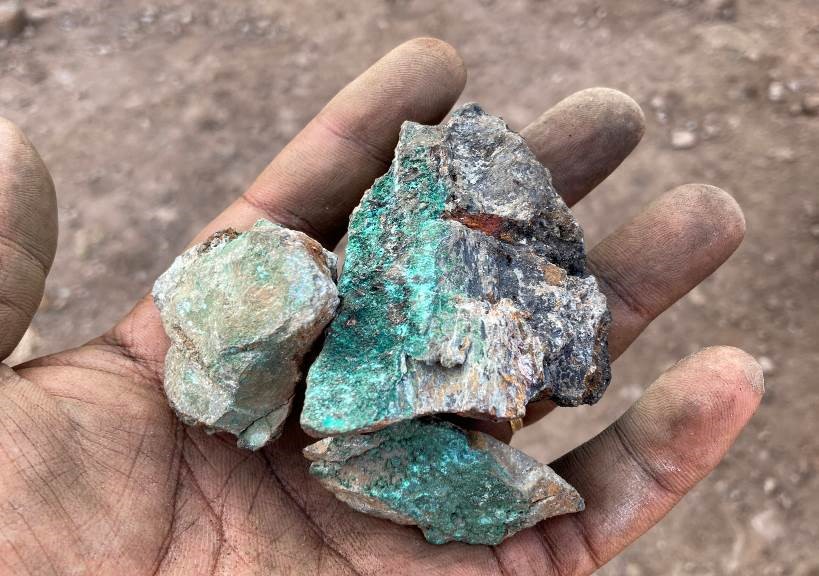
“We have a great duty to communicate about the sustainable management of our resources,” says Makasi. “At the moment, it’s about the energy transition. Who exploits where, why and who wins what. In the DRC we have the strategic minerals to help the world make this energy transition, but what will the Congolese people gain while their minerals are being exploited? This transition has to be fair, equitable and inclusive.”
Resilience
Makasi was born and still lives in Goma, the capital of North Kivu province. The city is home to around two million people.
“We live with many threats,” says Makasi. “We are still learning to be resilient despite all the difficulties we face–security challenges, but also the presence here of toxic gas [which is released because of volcanic activity and which kills many people every year].”
Fifteen miles from Goma is also Mount Nyiragongo, one of the world’s most active volcanoes that spews the planet’s fastest flowing lava. In May 2021, the volcano erupted, forcing 400,000 people from their homes and leaving at least 32 dead.

These are just some of the many social and environmental challenges faced by the people of North Kivu province: from foreign mining companies that encroach on community land without consultation or contribution to local development programs, to a population forced to use firewood because they lack electricity (thereby contributing to the deforestation ravaging the DRC’s tropical forests)—all against the backdrop of dire threats to their security from armed conflict.
Makasi’s desire to play his part in overcoming these problems set him on his current path.
He initially studied accounting, but changed direction because of his passion for the environment, and subsequently gained a degree in environment and sustainable development. Makasi started working in radio in 2015, before he’d even finished his degree–and was soon focusing on environmental stories.
“As an environmentalist, part of my motivation is to give a voice to people who are affected by environmental problems, and also approach experts to share their experience with us, to share the results of their research.”
“As an environmentalist, part of my motivation is to give a voice to people who are affected by environmental problems, and also approach experts to share their experience with us, to share the results of their research,” he says.
In 2019, Makasi received a grant from the Natural Resource Governance Institute (NRGI) to attend a summer school course on the governance of extractive industries at Bisson Catholic University of Central Africa campus in Cameroon, where he learned to interpret mining revenues data published via the Extractive Industries Transparency Initiative. He says that NRGI resources are “among my key tools when designing and producing my podcasts. I regularly consult NRGI news and blog posts to feed my inspiration.”
Global reach
Makasi’s switch from radio broadcasting to podcasting follows a global trend–there are an estimated three million podcasts across the world–and came after he undertook research which showed podcasting could greatly expand his audience. Podcasts are downloadable anywhere in the world, and have a reach far beyond the limits of the FM radio frequency on which he previously relied. “Now my shows can be heard far away from Goma, far away from the DRC,” he says.
In fact, people listen to Tetea Mazingira in more than 50 countries; these include other Francophone African nations such as Burkina Faso, Cameroon, Chad, Madagascar, Niger, Republic of Congo and Senegal.
“With the tools that are in place, it’s easy to map where the podcasts are being listened to and how many downloads they have, unlike the radio, where we don’t know who’s listening. We’ve even recently started to broadcast via YouTube’s new tool, YouTube Podcast,” says Makasi.
“We’ve interviewed people who defend the rights of minorities and discussed the regulation that’s meant to make their voices heard. We’ve also covered the problems surrounding the exploitation of methane gas in our region’s lakes, and the stories of the fishermen enduring the pollution because of it. When we cover these issues, we also have to approach the communities that are at risk, and not ignore that it’s also a business opportunity for people who can be employed in companies to exploit methane gas,” he adds.
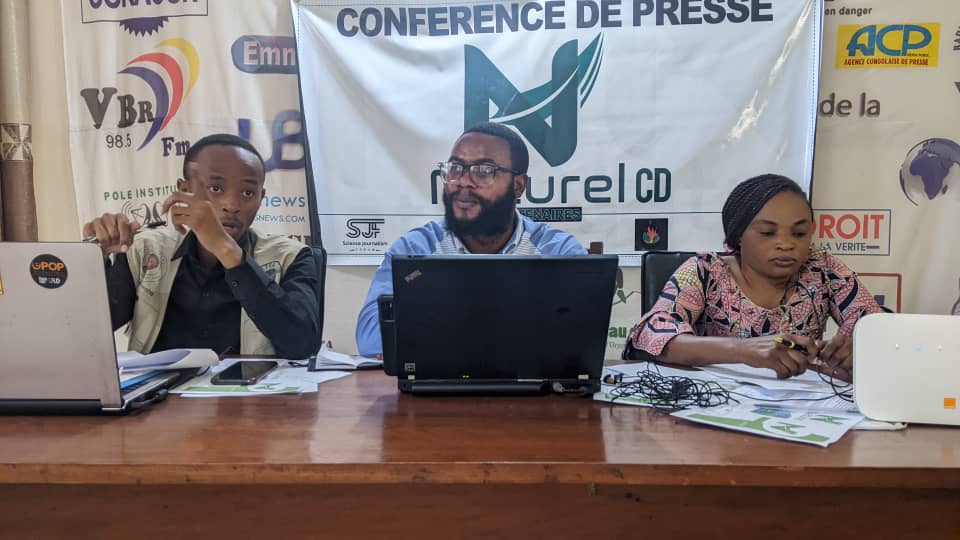
Makasi also draws inspiration from interacting with listeners, who share their questions and ideas for programs, helping shape the podcast’s direction, making it truly inclusive and reflecting their concerns.
Podcasts can also be broadcast on the radio, which remains an important channel in the DRC. Five radio stations in North Kivu province now include Tetea Mazingira in their schedules. Among them is the Tayna Community Radio, which broadcasts Tetea Mazingira twice a week on the FM band, and has a listenership of about two million listeners, according to January 2021 estimates by Radio Tayna's management.
Some local authorities, Agence Congolaise de la Presse ACP/Nord-Kivu (a national news agency in the Democratic Republic of Congo), and a network of reporters who write on biodiversity, are interested in producing other podcast episodes on natural resource governance, climate change and natural disaster issues in North Kivu province and DRC. With such collaborations Tetea Mazingira’s reach could continue to grow.
“We want to make the voices of our communities and experts heard through our podcasts so that those who are far from the DRC know the challenges we face,” says Makasi.
Tetea Mazingira will continue to raise awareness of the challenges posed by natural resource extraction in the DRC–and equip the public with the vital information needed to tackle them.
Notes
-
1
International Energy Agency, The Role of Critical Minerals in Clean Energy Transitions (2021), www.iea.org/reports/the-role-of-critical-minerals-in-clean-energy-transitions.
-
2
In this report we refer to both Africa north and south of the Sahara. When we mean one of the sub-regions we specify as such.
-
3
IEA (2021); Clyde Russell, “Mining is key to energy transition, but it’s still unloved,” Reuters, 11 May 2022, www.reuters.com/business/energy/mining-is-key-energy-transition-its-still-unloved-russell-2022-05-11; Jairo Yunis and Elmira Aliakbari, Annual Survey of Mining Companies 2020 (Fraser Institute, 2021), www.fraserinstitute. org/studies/annual-survey-of-mining-companies-2020.
-
4
See, for example, Natural Resource Governance Institute, Natural Resource Charter 2nd edition (2014), resourcegovernance.org/approach/natural-resource-charter.
-
5
Natural Resource Governance Institute, Resource Governance Index: From Legal Reform to Implementation in Sub-Saharan Africa (2018), resourcegovernance.org/sites/default/files/documents/rgi-from-legal-reform-to-implementation-sub-saharan-africa.pdf.
-
6
Africa Climate Foundation, Geopolitics of Critical Minerals in Renewable Energy Supply Chains (2022), africanclimatefoundation.org/news_and_analysis/geopolitics-of-critical-minerals-in-renewable-energy-supply-chains/.
-
7
See for example, Cooper Inveen, “Atlantic Lithium’s Ghana mine poised to being production by 2024,” Reuters, 20 September 2022, www.reuters.com/article/ghana-mining-lithium/atlantic-lithiums-ghana-mine-poised-to-begin-production-by-2024-idUSKBN2QV0NQ?utm_source=substack&utm_me….
-
8
As demonstrated by recent discussions between a U.S.-led group of rich countries and mineral producers such as the Democratic Republic of Congo, Namibia and Tanzania. Julian Pecquet, “US looks to Africa to
diversify supply chain for critical minerals,” The Africa Report, 23 September 2022. www.theafricareport.com/243847/us-looks-to-africa-to-diversify-supply-chain-for-critical-minerals. -
9
Glada Llahn and Paul Stevens, The curse of the one-size-fits-all fix, UNU-WIDER Working Paper (United Nations University, 2017), www.wider.unu.edu/sites/default/files/wp2017-21.pdf. For further assessment of donors’ activities in the past, both positive and negative lessons, see: Joanna Buckley, Neil McCulloch and Nick Travis, Donor-supported approaches to improving extractives governance, UNU-WIDER Working Paper (United Nations University, 2017), www.wider.unu.edu/sites/default/files/wp2017-33.pdf; Siân Herbert and Laura Bolton, Donor activity in the extractives sector (Knowledge, evidence and learning for development, 2018), opendocs.ids.ac.uk/opendocs/bitstream/handle/20.500.12413/13589/Donor_activity_in_the_extractives_sector.pdf.
-
10
Although this estimate includes emissions resulting from the investments by each group. Lucas Chancel, “Global carbon inequality over 1990–2019,” Nature Sustainability (2022), doi. org/10.1038/s41893-022-00955-z.
-
11
For Further reading on this dilemma and the arguments between the proponents of “green growth” and “degrowth, see: Alex Bowen and Samuel Fankhauser, “The Green Growth Narrative: Paradigm Shift or Just Spin? Global Environmental Change-human and Policy Dimensions,” Global Environmental Change, 21 (2021), 1157-1159, DOI: I:10.1016/j. gloenvcha.2011.07.007; Kate Raworth, Doughnut Economics: Seven Ways to Think Like a 21st Century Economist, Random House Business Books, London, 2017; Jason Hickel, “What does degrowth mean? A few points of clarification,” Globalizations, 18:7 (2021), 1105-1111, DOI: 10.1080/14747731.2020.1812222.
-
12
McKinsey & Company, “The raw-materials challenges: How the metals and mining sector will be at the core of enabling the energy transition” (2022), www.mckinsey. com/industries/metals-and-mining/our-insights/the-raw-materials-challenge-how-the-metals-and-mining-sector-will-be-at-the-core-of-enabling-the-energy-transition.
-
13
McKinsey & Company, “Metal mining constraints on the electric mobility horizon” (2018), www.mckinsey.com/industries/oil-and-gas/our-insights/metal-mining-constraints-on-the-electric-mobility-horizon.
-
14
McKinsey (2018)
-
15
NRGI analysis, based on Net Zero Tracker. “Net Zero Tracker,” Energy and Climate Intelligence Unit, Data-Driven EnviroLab, NewClimate Institute, Oxford Net Zero (2022), zerotracker.net
-
16
Pratima Desai, “Low carbon world needs $1.7 trillion in mining investment,” Reuters, 10 May 2021, www.reuters.com/business/energy/low-carbon-world-needs-17-trillion-mining-investment-2021-05-10/
-
17
Based on S&P Global Market Intelligence data and U.S. Geological Survey, Mineral Commodity Summaries 2022, 2022, www.pubs.er.usgs.gov/publication/mcs2022. These sources sometimes differ significantly. An average is taken when the reported amounts are similar. When they are not, a third source is used to determine which is likely to be more accurate.
-
18
NRGI analysis based on reserves reported in the S&P Globaldatabase and U.S. Geological Survey (2022), and the mineral volumes in a standard electric vehicle in IEA (2021).
-
19
See for example, World Bank, “New World Bank Survey Brings Hope to Malawi’s Mineral Potential,” 22 September 2015, www.worldbank.org/en/news/feature/2015/09/22/new-world-bank-survey-brings-hope-to-malawis-mineral-potential.
-
20
International Energy Agency, Global Supply Chains of EV Batteries (2022), www.iea.org/reports/global-supply-chains-of-ev-batteries.
-
21
African Minerals Development Centre (AMDC), “Unveiled: The #AMDC’s Theory of Change: A prosperous and transformed Africa achieved through sustainable development of mineral and energy resources...” Twitter post (11 October 2022), www.twitter.com/AfricanAmdc/status/1579789353584164864.
-
22
Based on S&P Global data and U.S. Geological Survey (2022). These sources sometimes differ significantly. An average is taken when the reported amounts are similar. When they are not, a third source is used to determine which is likely to be more accurate.
-
23
The correlation between exploration and mineral reserves per square kilometer is 0.79. The figure compares exploration for all metals except gold from 2002 to 2021 with current value of transition mineral reserves. Exploration spend, reserves and prices from S&P Global Market Intelligence; land area data from www.worldpopulationreview.com.
-
24
The correlation between the Resource Governance Index and Policy Potential Index scores is 0.5. The NRGI Resource Governance Index measures the transparency and accountability of mining institutions. The Policy Potential Index (PPI) in the Fraser Institute survey shows the attractiveness of a country’s policies to investors. The PPI score reported in the figure is an average of the scores from 2017 to 2021 where available, and average across jurisdictions for countries that have several. Some countries have low survey response rates, between 5 to 9 respondents. Natural Resource Governance Institute, “Resource Governance Index 2017,” 2017, resourcegovernanceindex.org; Yunis and Aliakbari (2021).
-
25
African Minerals Development Centre, Desktop Review of African Geological Survey Organisation Capacities and Gaps (United Nations Economic Commission for Africa, 2018), archive.uneca.org/publications/desktop-review-african-geological-survey-organisation-capacities-and-gaps.
-
26
Antony Sguazzin, “South Africa Sets 900 Million Annual Mineral Exploration Target,” Bloomberg, 12 April 2022, www.bloomberg.com/news/articles/2022-04-12/s-africa-sets-900-million-annual-mineral-exploration-target.
-
27
Oil exploration investment is known to correlated strongly with the quality of governance in a country, and it seems likely that a similar pattern holds for mineral exploration. See James Cust and Harding Torfinn, “Institutions and the Location of Oil Exploration”, Journal of the European Economic Association (2019).
-
28
Richard Schodde, “Key issues affecting the time delay between discovery and development – is it getting harder and longer?” PDAC 2014, 3 March 2014, Toronto. minexconsulting.com/wp-content/uploads/2019/04/Schodde-presentation-to-PDAC-March-2014.pdf
-
29
Summary of five studies. The outlier is the McKinsey study (7 to 10 years), but this was based on “large-scale greenfield assets” only. Like findings of Schodde (2021), which highlights that large projects are quicker. McKinsey (2022); IEA (2021); Tehmina Khan, Trang Nguyen, Franziska Ohnsorge, and Richard Schodde, “From Commodity Discovery to Production,” Policy Research Working Paper (World Bank, 2016); Paul Manalo, “Top mines average time from discovery to production: 16.9 years,” Metals and Mining Research S&P Global Market Intelligence (2020); Schodde (2014).
-
30
IEA (2021)
-
31
Schodde (2021) and Khan et al. (2016)
-
32
David Humphreys, “The mining industry and the supply of critical minerals,” Critical Minerals Handbook, Gus Gunn (ed.), chapter 2, 2013.
-
33
Khan et al. (2016)
-
34
Several of the experts interviewed for this report suggested that this is the main opportunity for shortening lead times.
-
35
David Manley, Patrick R.P. Heller and William Davis, No Time to Waste: Governing Cobalt Amid the Energy Transition (Natural Resource Governance Institute, 2022), resourcegovernance.org/no-time-to-waste-governing-cobalt-amid-energy-transition.
-
36
Matt Renaud and Mustafa Kumral, “Out of the Comfort Zone: Quantifying Country Risk for Foreign Mining Project Investment Feasibilities,” Mining, Metallurgy & Exploration, 38, 2323-2335 (2021), www.doi.org/10.1007/s42461-021-00495-8.
-
37
Based on S&P Global data and U.S. Geological Survey (2022). These sources sometimes differ significantly. An average is taken when the reported amounts are similar. When they are not, a third source is used to determine which is likely to be more accurate.
-
38
Henry Sanderson, “Vedanta starts arbitration against Zambia after mines seized,“ Financial Times, 31 May 2019. www.ft.com/content/98b0c464-83a1-11e9-b592-5fe435b57a3b.
-
39
Julia Tilley, “Labour talks 217: Escondida and other stories,” S&P Global Market Intelligence, Metals and Mining Research, 23 February 2017.
-
40
Keval Dhokia, “Global copper pipeline challenged due to disruption,” S&P Global Market Intelligence, Metals and Mining Research, 18 June 2019.
-
41
Sudarshan Varadhan, “Indian state seeks permanent closure of Vedanta’s copper smelter: officials,” Reuters, 24 May 2018. www.reuters.com/article/us-vedanta-smelter-idUSKCN1IP1CX.
-
42
Dhokia (2019)
-
43
Misha Savic, Jan Bratanic and Thomas Biesheuvel, “Europe’s Biggest Lithium Mine Blocked as Rio Loses in Serbia,” Bloomberg, 20 January 2022, www.bloomberg.com/news/articles/2022-01-20/serbia-suspends-rio-tinto-s-2-4-billion-lithium-mine-project.
-
44
Tanzania Minerals Audit Agency, A Study on Viability to Construct a Copper Concentrate Smelter in Tanzania (2011), www.scribd.com/document/193187016/A-Study-on-Viability-to-Construct-a-Copper-Concentrate-Smelter-in-Tanzania1.
-
45
Africa Confidential, “Local processing row holds up rare earth mine,” 25 October 2022, www.africa-confidential.com/article-preview/id/14166/Local_processing_row_holds_up_rare_earth_mine.
-
46
Reuters, “Timeline: The battle for Simandou,” 22 January 2021, www.reuters.com/article/us-swiss-steinmetz-timeline-idUSKBN29R2AA.
-
47
Magnus Ericsson and Olof Löf, “Mining’s contribution to national economies between 1996 and 2016,” Mineral Economics, 223–250 (2019), doi.org/10.1007/s13563-019-00191-6.
-
48
Net savings plus education expenditure and minus energy depletion, mineral depletion, net forest depletion, and carbon dioxide and particulate emissions damage. NRGI analysis of World Bank, “World Development Indicators,” accessed 28 September 2022, www.databank.worldbank.org/source/world-development-indicators.
-
49
Anthony J. Venables, “Using Natural Resources for Development: Why Has It Proven So Difficult?” Journal of Economic Perspectives, 30:1, 161–184 (2016) doi. org/10.1257/jep.30.1.161.
-
50
Giorgia Albertin, Boriana Yontcheva, Dan Devlin, Hilary Devine, Marc Gerard, Sebastian Beer, Irena Jankulov Suljagic and Vimal V. Thakoor, Tax Avoidance in Sub-Saharan Africa’s Mining Sector, Departmental Paper No 2021/022 (International Monetary Fund, 2021), www.imf.org/en/Publications/Departmental-Papers-Policy-Papers/Issues/2021/09/27/Tax-Avoidance-in-Sub-Saharan-Africas-Mining-Sector-464850
-
51
See for example, South African Human Rights Commission, National Hearing on the Underlying Socio-economic Challenges of Mining-affected Communities in South Africa (2016), www.sahrc.org.za/home/21/files/SAHRC%20Mining%20communities%20report%20FINAL.pdf
-
52
See, for example, Claude Kabemba, “How mineral resources can fuel the development of Africa in the context of post-Covid economic recovery,” Publish What You Pay Annual Conference, 14-15 March 2021, www.sarwatch.co.za/how-mineral-resources-can-fuel-the-development-of-africa-in-the-context-of-post-covid-economic-recovery.
-
53
See, for example, African Development Bank, Request for Expressions of Interest, 2022, www.afdb.org/sites/default/files/reoi_green_minerals_strategy_approach_paper_002.pdf.
-
54
Other partners currently include African Legal Support Facility, Africa Finance Corporation, Afreximbank, United Nations Economic Commission for Africa and United Nations Development Programme.
-
55
African Development Bank, “Why Africa is the next renewables powerhouse,” 7 December 2018, www.afdb.org/en/news-and-events/why-africa-is-the-next-renewables-powerhouse-18822
-
56
Manley et al (2022)
-
57
Through Power Africa (www.usaid.gov/powerafrica), for example.
-
58
Reserves data is from S&P Global Market Intelligence and U.S. Geological Survey. The above ground assets of a country comprise its power and transport infrastructure, human capital and other productive capabilities, level of environmental protection and investment climate. They have been converted to a regional index of 0-100.
The data is from multiple sources: African Development Bank, The Africa Infrastructure Development Index (AIDI) 2020, 2020, www.afdb.org/en/documents/economic-brief-africa-infrastructure-development-index-aidi-2020-july-2020; World Bank, “World Development Indicators”; African Development Bank, Electricity Regulatory Index (ERI) for Africa, 2021, 2021, africa-energy-portal.org/reports/electricity-regulatory-index-eri-africa-2021-edition; World Intellectual Property Organization, Global Innovation Index (GII) 2021, 2021, www.wipo.int/publications/en/details.jsp?id=4560; Harvard Growth Lab, “The Atlas of Economic Complexity,” accessed 20 September 2022, www.atlas.cid.harvard.edu/; Environmental Protection Index, “2022 Environmental Protection Index (2022),” accessed 20 September 2022, www.epi.yale.edu/; World Bank, “Doing Business 2020,” accessed 20 September 2022, www.worldbank.org/en/programs/business-enabling-environment/doing-business-legacy; S&P Global, “Control Risks Country Risk Summary,” accessed 20 September 2022, www.capitaliq.spglobal.com. -
59
Southern African Development Community and African Minerals Development Centre, Developing a Regional Mining Vision for the Southern African Development Community (SADC), 2018.
-
60
Manley et al (2022)
-
61
Emily Hersh, Alex Grant and Chris Berry, So, You Want to make Batteries Too? (Payne Institute, 2020), www.payneinstitute.mines.edu/so-you-want-to-make-batteries-better-too
-
62
Ibid.
-
63
See for example, African Development Bank, Lithium-Cobalt Value Chain Analysis for Mineral Based Industrialization in Africa (2021), www.afdb.org/en/documents/lithium-cobalt-value-chain-analysis-mineral-based-industrialization-Africa.
-
64
McKinsey & Company, Power to move: Accelerating the electric transport transition in sub-Saharan Africa (2022), www.mckinsey.com/industries/automotive-and-assembly/our-insights/power-to-move-accelerating-the-electric-transport-transition-in-sub- aharan-africa.
-
65
BloombergNEF, The Cost of Producing Battery Precursors in the DRC (2021), about. bnef.com/blog/producing-battery-materials-in-the-drc-could-lower-supply-chain-emissions-and-add-value-to-the-countrys-cobalt.
-
66
Mohua Mukherjee, India’s Mass-Market Clean Mobility Initiatives and its Unique, Customized Business Models for Light Electric Vehicles (The Oxford Institute for Energy Studies, 2022), www.oxfordenergy.org/publications/indias-mass-market-clean-mobility-initiatives-and-its-unique-customized-business-models-for-light-electric-vehicles.
-
67
Rwanda Ministry of Infrastructure, Strategic Paper on Electric Mobility Adaption in Rwanda (2021), www.mininfra.gov.rw/fileadmin/user_upload/Mininfra/Publications/Laws_Orders_and_Instructions/Transport/16062021_Strategic_Paper_for_e-mobility_adapta….
-
68
Manley et al (2022)
-
69
IEA (2022)
-
70
See for example World Gold Council, Responsible gold mining and value distribution, 2013 report (2013), www.gold.org/goldhub/research/responsible-gold-mining-and-value-distribution-2013-report.
-
71
World Gold Council (2013). Mining Shared Value has indicated these figures are representative of wider sector trends.
-
72
Jeff Geipel, Mining Shared Value, interview with authors, 25 September 2022.
-
73
Government of Canada, “Minerals Sector Employment,” January 2019, www.nrcan.gc.ca/science-data/science-research/earth-sciences/earth-sciences-resources/earth-sciences-federal-programs/minerals-sector-employment/16739; Mets Ignited, “METS in Australia,” accessed 28 September 2022, www.metsignited.org/australian-mets-sector/.
-
74
Aaron Cosbey and Isabelle Ramdoo, Guidance for Governments: Local Content Policies (Intergovernmental Forum on Mining, Minerals, Metals and Sustainable Development, 2018), igf-guidance-for-governments-local-content.pdf; International Finance Corporation, Guide to Getting Started in Local Procurement (2011), www.ifc.org/wps/wcm/connect/topics_ext_content/ifc_external_corporate_site/sustainability-at-ifc/publications/publications_handbook_guidetogettingsta…; Mining Shared Value and Engineers Without Borders, The Mining Local Procurement Reporting Mechanism (LPRM) (2017), www.miningsharedvalue.org/mininglprm.
-
75
See for example, activities of the Industrial Development Corporation (www.idc.co.za) and Anglo American’s Zimele programs (www.southafrica.angloamerican.com/our-difference/zimele)
-
76
Southern Africa Resource Watch, From Harmonisation of Policies to the Manufacturing of Lithium Batteries in Southern Africa: Collaboration between DRC and Zambia (2022), www.sarwatch.co.za/publication/from-harmonisation-of-policies-to-the-manufacturing-of-lithium-batteries-in-southern-africa-collaboration-between-drc-….
-
77
Jeff Geipel, Mining Shared Value, interview with authors, 25 September 2022.
-
78
Giorgia Albertin et al (2021). Note that the definition of mineral-dependent does not overlap with which countries have substantial reserves of transition minerals.
-
79
Ibid. The IMF estimates the 15 mineral-rich countries earned mining revenues equals 2 percent of GDP on average. This amounts to $13 billion a year.
-
80
For example, if companies were to adhere to more responsible tax practices such as the B Team Responsible Tax Principles. See The B Team, “Advancing Responsible Tax Practice,” accessed 28 September 2022, www.bteam.org/our-work/causes/governance/advancing-responsible-tax-practice.
-
81
Yannick Bouterige, Céline de Quatrebarbes and Bertrand Laporte, Mining Taxation in Africa: What Evolution in 2018? (International Centre for Tax and Development, 2020), www.ictd.ac/publication/mining-taxation-africa-recent-evolution.
-
82
Giorgia Albertin et al (2021).
-
83
For example, a study of contracts on resourcecontracts.org revealed that Burkina Faso, Burundi, Guinea, Madagascar and Mali had agreed stabilization clauses lasting 30- 34 years on average—significantly longer than necessary to ensure the bankability of projects. Intergovernmental Forum on Mining, Minerals, Metals and Sustainable Development, Insights on Incentives: Tax Competition in Mining (2019), www.iisd.org/sites/default/files/publications/insights-incentives-tax-competition-mining.pdf; Natural Resource Governance Institute, resourcecontracts.org.
-
84
NRGI analysis using S&P Global mineral reserves and price data. Prices are near-term forecasts and therefore may be elevated compared to the longer-term trend.
-
85
NRGI analysis. On average, 16 percent of mining sales revenue has gone to tax payments. See Robert Pitman and Kaisa Toroskainen, Beneath the surface: The Case for Oversight of Extractive Industry Suppliers (Natural Resource Governance Institute, 2020) resourcegovernance.org/analysis-tools/publications/beneath-surface-oversight-extractive-industry-suppliers.
This figure aligns with estimates in other studies: Olle Östensson, Local content, supply chains, and shared infrastructure, UNU-WIDER Working Paper (United Nations University, 2017), www.researchgate.net/publication/337699966_Local_content_supply_chains_and_shared_infrastructure; Price Waterhouse Coopers, Total Tax Contribution: A study of the economic contribution mining companies make to public finances (2010), www.pwc.co.uk/assets/pdf/ttc-mining-study-1.pdf. -
86
Anthony J. Venables (2016) and Natural Resource Governance Institute (2014).
-
87
NRGI (2017), “Resource Governance Index 2017.” There was a small improvement in a smaller sample of countries covered by the 2021 edition of the Resource Governance Institute.
-
88
Anna Fleming, Thomas Lassourd and David Manley, “Variable Royalties: an Answer to Volatile Mineral Prices?” in Handbook on the Future of Resource Taxation, African Tax Administration Forum and Intergovernmental Forum on Mining, Minerals, Metals and Sustainable Development (forthcoming),www.iisd.org/publications/brief/future-resource-taxation-roadmap.
-
89
Robert Pitman, “Contract Disclosure Policy and Practice Tracker,” accessed 15 October 2022, docs.google.com/spreadsheets/d/1FXEeD43jw6VYHV8yS-8KJ5-rR5l0XtKxVQZBWzr-ohY.
-
90
Based on membership of the Extractive Industries Transparency Initiative (www.eiti.org/countries).
-
91
Natural Resource Governance Institute, “Chile country profile,” accessed 5 October 2022, www.resourcegovernanceindex.org/country-profiles/CHL/mining.
-
92
Transparency International, “Corruption Perceptions Index 2021,” www.transparency.org/en/cpi/2021.
-
93
United Nations Office on Drugs and Crime, Corruption and Sustainable Development (no date), www.anticorruptionday.org/documents/actagainstcorruption/print/corr18_fs_DEVELOPMENT_en.pdf
-
94
K.C. Michaels, Louis Maréchal and Benjamin Katz, “Why is ESG so important to critical mineral supplies, and what can we do about it?” (International Energy Agency, 2022) www.iea.org/commentaries/why-is-esg-so-important-to-critical-mineral-supplies-and-what-can-we-do-about-it
-
95
Extractive Industries Transparency Initiative, Making the grade: Strengthening governance of critical minerals, www.eiti.org/documents/strengthening-governance-critical-minerals.
-
96
Extractive Industries Transparency Initiative, EITI Standard 2019, eiti.org/collections/ eiti-standard#EITI-Requirements-2019; Organisation for Economic Co-operation and Development, OECD Due Diligence Guidance for Responsible Supply Chains of Minerals from Conflict-Affected and High-Risk Areas (2016), www.oecd.org/daf/inv/mne/OECD-Due-Diligence-Guidance-Minerals-Edition3.pdf; Alexandra Gillies, Sebastian Sahla, Matthieu Salomon and Tom Shipley, Diagnosing Corruption in the Extractive Sector: A Tool for Research and Action (Natural Resource Governance Institute, 2021) www.resourcegovernance.org/analysis-tools/publications/diagnosing-corruption-extractive-sector-tool-research-and-actionrespectively.
-
97
Colombia National Mining Agency, Management and Corruption Risk Matrices of the ANM approved by the Institutional Management
and Performance Committee on 01/27/2022 (2022), www.anm.gov.co/?q=documentos_para_comentarios_ciudadania; Robert Pitman and Kaisa Toroskainen, “BHP, Others Increase Scrutiny of Subcontracting Corruption Risks” (Natural Resource Governance Institute, 2018) www.resourcegovernance.org/blog/bhp-others-increase-scrutiny-subcontracting-corruption-risks. -
98
Alexandra Gillies, “Will Extractive Companies Move Away from Corruption- Prone Intermediaries?”, (Natural Resource Governance Institute, 2019) www.resourcegovernance.org/blog/extractive-companies-corruption-intermediaries-middlemen-oil.
-
99
Natural Resource Governance Institute, Anticorruption Guidance for Partners of State-Owned Enterprises (2022), soe-anticorruption.resourcegovernance.org/chapters/avoiding-high-risk-agents
-
100
Favour Ime and Louise Russell-Prywata, “Beneficial ownership transparency and the fight against grand corruption in Nigeria” (Open Ownership, 2022), www.openownership.org/en/blog/beneficial-ownership-transparency-and-the-fight-against-grand-corruption-in-nigeria.
-
101
Nqobile Dludla, “South Africa mine dam wall collapses, Killing 1 and injuring 40,” Reuters, 11 September 2022, www.reuters.com/world/africa/south-africa-mine-dam-wall-collapses-killing-three-injuring-40-2022-09-11.
-
102
Kirsten Hund and Erik Reed, “A low-carbon future must protect the world’s forests” (World Bank, 2019), www.blogs.worldbank.org/voices/low-carbon-future-must-protect-worlds-forests.
-
103
NRGIcalculationsusingscope1,2and3 emissions (excluding fugitive methane and emissions from the combustion of coal) reported by Lindsay Delevingne, Will Glazener, Liesbet Grégoir and Kimberly Henderson, “Climate risk and decarbonisation: What every mining CEO needs to know,” McKinsey & Company, 2020 www.mckinsey.com/business-functions/sustainability/our-insights/climate-risk-and-decarbonization-what-every-mining-ceo-needs-to-know. Total global emissions are for 2019 from Climate Watch, “Global Historical Emissions,” accessed 18 September 2022, www.climatewatchdata.org/ghg-emissions?end_year=2019&start_year=1990.
-
104
See for example, Éléonore Lèbre, Martin Stringer, Kamila Svobodova, John R. Owen, Deanna Kemp, Claire Côte, Andrea Arratia-Solar and Rick K. Valenta, “The social and environmental complexities of extracting energy transition metals,” Nature Communications, 11: 4823 (2020), www.nature.com/articles/s41467-020-18661-9#MOESM1.
-
105
IEA (2021)
-
106
Ibid.
-
107
World Bank, “Climate Change Knowledge Portal,” accessed 28 September 2022, www.climateknowledgeportal.worldbank.org.
-
108
NRGI (2017)
-
109
Cameroon is one exception, with its new cadastre system preventing licenses being granted that overlap protected areas. Several companies also have a no-go policy, though only for World Heritage sites. See for example ICMM, “ICMM calls for stronger legal protection of World Heritage Sites,” 2016, www.icmm.com/en-gb/news/2016/icmm-calls-for-protection-of-world-heritage-sites.
-
110
Abbi Buxton, People and nature first: safeguards needed in mining exploration (International Institute for Environment and Development, 2021) www.iied.org/20736iied.
-
111
See for example in Colombia: Lorenzo Cotula, Investment disputes from below: whose rights matter? (International Institute for Environment and Development, 2020), www.iied.org/investment-disputes-below-whose-rights-matter.
-
112
Nicola Woodroffe and Tim Grice, Beyond Revenues: Measuring and Valuing Environmental and Social Impacts in Extractive Sector Governance (Natural Resource Governance Institute, 2019), www.resourcegovernance.org/analysis-tools/publications/beyond-revenues-measuring-environmental-social-impacts.
-
113
IFC, E&S Performance Standards (2012), www.ifc.org/wps/wcm/connect/topics_ext_content/ifc_external_corporate_site/sustainability-at-ifc/policies-standards/performance-standards; IGF, Environmental and Social Impact Assessments (2020), www.igfmining.org/our-work/environmental-and-social-impact-assessments.
-
114
Daniel Whyte, “Forest finance: how Gabon earned the first payment for conservation in Africa,” Climate Tracker, 8 December 2021, www.climatetracker.org/forest-protection-first-payment-gabon-africa.
-
115
See for example Taako Edema George, Kiemo Karatu, and Andama Edward, “An evaluation of the environmental impact assessment practice in Uganda: challenges and opportunities for achieving sustainable development,” Heliyon 6(9), 2020, www.ncbi.nlm.nih.gov/pmc/articles/PMC7505666.
-
116
See for example Organisation for Economic Co-operation and Development, Guiding Principles for Durable Extractive Contracts (2019), www.oecd.org/dev/Guiding_Principles_for_durable_ extractive_contracts.pdf; United Nations Human Rights Office
of the High Commissioner, Principles for Responsible Contracts: Integrating the Management of Human Rights Risks into State-Investor Contract Negotiations- Guidance for Negotiators (2015), www.ohchr.org/%20Documents/Publications/Principles_ResponsibleContracts_HR_PUB_15_1_EN.pdf; and NRGI (2014). -
117
See for example Reuters, “South Africa’s Gold Fields bets on solar to cut costs and carbon,” 13 October 2022, www.reuters.com/business/sustainable-business/south-africas-gold-fields-bets-solar-cut-costs-carbon-2022-10-13.
-
118
U.N. Climate Change Conference UK 2021, “Glasgow Leaders’ Declaration on Forests and Land Use,” 2021, ukcop26.org/glasgow-leaders-declaration-on-forests-and-land-use.
-
119
Frances Seymour, Tony La Vina and Kristen Hite, Evidence linking community-level tenure and forest condition: An annotated bibliography (Climate and Land Use Alliance, 2015), www.climateandlandusealliance.org/wp-content/uploads/2015/08/Community_level_tenure_and_forest_condition_bibliography.pdf.
-
120
Peter G. Veit, “9 Facts about Community Land and Climate Mitigation” (World Resources Institute, 2021) files.wri.org/d8/s3fs-public/2021-10/9-facts-about-community-land-and-climate-mitigation.pdf.
-
121
Development Bank of Southern Africa, African Environmental Assessment Legislation Handbook: Consultation Draft, 2021, www.dbsa.org/african-environmental-assessment-legislation-handbook.
-
122
United Nations Development Programme, Participatory Environmental Monitoring Committees in Mining Contexts, 2019, www.undp.org/publications/participatory-environmental-monitoring-committees-mining-contexts.
-
123
Jonathan Watts, “Murders of environment and land defenders hit record high,” The Guardian, 13 September 2021, www.theguardian.com/environment/2021/sep/13/murders-environment-land-defenders-record-high.
-
124
NRGI (2017), “Resource Governance Index 2017.” There was a small improvement in a smaller sample of countries covered by the 2021 edition of the Resource Governance Institute.