
How to Fight Corruption in Transition Mineral-Producing Countries: A Must for Meeting Climate and Energy Transition Goals

To meet climate goals, the world must urgently move away from fossil fuels toward low-carbon energy infrastructure. Yet this infrastructure—including wind turbines, solar panels and electric vehicles (EVs)—requires a wide array of minerals as inputs. The International Energy Agency (IEA) estimates that meeting Paris Agreement climate targets will require at least a quadrupling by 2040 of demand for minerals used in low-carbon technologies. For some minerals, the demand could even reach 30 times current levels by 2040.
But with soaring demand comes ever-greater risk of corruption. Past commodity booms have unleashed large waves of corruption, and even the anticipation of a boom can incentivize problematic behavior. Fast-paced deal-making and the promise of soaring profits increases private and public sector actors’ risk appetites, particularly around entities like state-owned companies. To further complicate matters, the energy transition relies on minerals found in countries where corruption is a severe challenge: large portions of the world’s cobalt, nickel, copper, lithium and rare earth minerals are mined and processed in countries that rank poorly in Transparency International’s Corruption Perceptions Index.
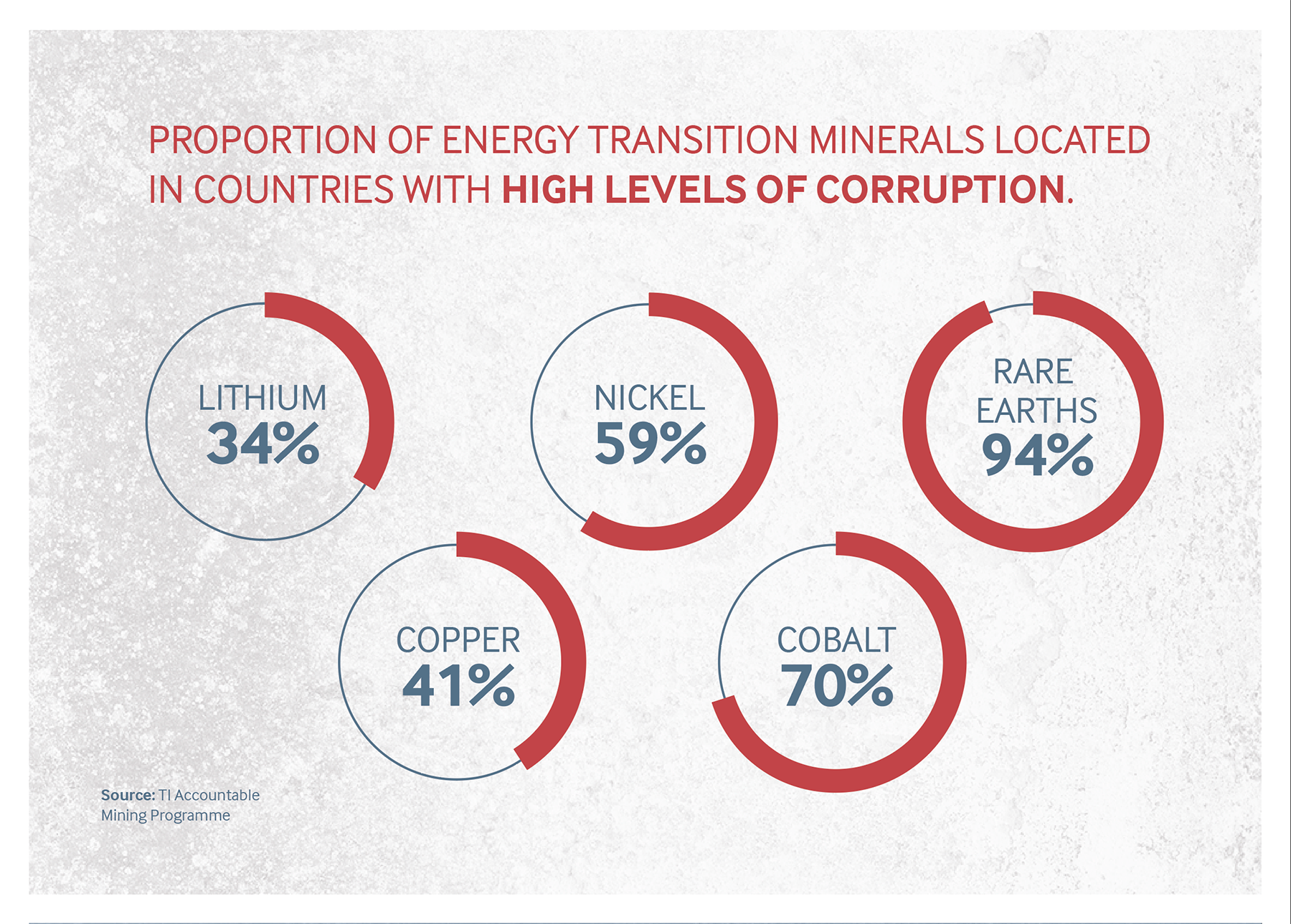
The risks are real and growing. The history of mining is riddled with injustices, from the destruction of local environments to at times devastating harm to local communities. If the energy transition is to be fair and just, we cannot have a situation where mineral-rich countries and communities endure the upheaval and damage of mining without any of the benefits—especially if their minerals are then used to support an energy transition happening elsewhere. There cannot be any “sacrifice zones” in mineral-rich countries in the name of an energy transition in the most developed parts of the world. And if the same elites pocket all of the financial benefits of mining at the expense of the public, how can this ever be just?
If the energy transition is to be fair and just, we cannot have a situation where mineral-rich countries and communities endure the upheaval and damage of mining without any of the benefits.
Our partner Gay Ordenes, Asia director and anticorruption lead at the Extractive Industries Transparency Initiative (EITI) notes: “The energy transition’s demand for minerals has the potential to increase governance and corruption risks in mineral-rich countries. As discussed in a new EITI report, the implications of this range from the local to the global level—from the potential for environmental damage and harm to local communities to supply chain disruptions that could jeopardize global decarbonization goals. Concerted efforts to strengthen governance and fight corruption are needed to tackle this challenge.”
Working together to effect change
The scale of the challenge is as large as it is important. Given the urgent need for action and diverse expertise existing around the world on this topic, since March 2022, NRGI has coordinated an Expert Group on Preventing Corruption in Transition Mineral Supply Chains alongside partners in the OECD Centre for Responsible Business Conduct and EITI.
The group consists of experts from from civil society, governments, academia and international organizations, including among others representatives from Transparency International, USAID, the Sustainable Minerals Institute and the IEA.
NRGI and its close partners in the expert group are now launching key anticorruption recommendations on transition minerals, targeting governments, businesses, investors, international organizations and others working in the climate space. These recommendations can help decisionmakers to better protect local communities and the environment, limit corruption risks, and ensure that corrupt actors are held to account for their wrongdoing.
Implementation of these recommendations is not only best practice for companies across mineral supply chains, but can also help enable responsible business conduct, increase investment in mining communities and lead to more resilient and secure supply of minerals critical to the green transition.
Rashad Abelson, legal expert at the OECD Centre for Responsible Business Conduct, notes: “Effectively addressing corruption in the minerals sector requires a ‘whole of supply chain’ approach and urgent mobilization of all stakeholders to tackle corruption issues from different angles (e.g. tax transparency, beneficial ownership, supply chain due diligence, mine site licencing). That is why we were happy to work with this diverse expert group to learn from one another about respective policy areas and share expertise to help develop this document. Implementation of these recommendations is not only best practice for companies across mineral supply chains, but can also help enable responsible business conduct, increase investment in mining communities and lead to more resilient and secure supply of minerals critical to the green transition.”
In 2023, expert group members will engage further with governments, businesses, investors and international organizations about the changes they should be making to prevent corruption in transition mineral supply chains. To this end we will explore different avenues, from legislation like the upcoming EU Critical Raw Materials Act to strengthened industry standards.
Equity and Good Governance Are Essential for the Energy Transition

As governments around the world scramble to boost oil and gas production and/or secure alternative supplies after Russia’s invasion of Ukraine, the resulting energy crisis feels like more than just a bump in the road for the global energy transition. Still more confusing is what our colleagues aptly describe as the “minefield of potentially mixed and misread messages” about the energy transition intentions of wealthier nations, few of which are close to achieving compliance with the Paris climate goals. The EU has proposed to label gas-fired power generation as “green” but then Germany doubled down on ambitious 100 percent renewable energy power plans, calling renewables “the energy of freedom.” The Biden administration stressed the need to reduce dependence “on oil in general” and then called on U.S. oil and gas producers to ramp up supply as quickly as possible, scarcely a week later.
In this confusing atmosphere the Tyndall report, “Phaseout Pathways for Fossil Fuel Production Within Paris-compliant Carbon Budgets,” is a welcome and essential map. Its most significant contribution is to apportion responsibility for winding down production based on equity considerations — an approach we at the Natural Resource Governance Institute (NRGI) strongly support. Wealthier countries should cut fossil fuel production first and fastest because they depend less on oil and gas revenues and have greater capacity to finance the energy transition. The report divides producers into five groups, the wealthiest of which would need to entirely phase out production by 2031 (a 98 percent drop from today’s levels!), for a better than even chance of avoiding warming above 1.5°C. Critically, and even more relevant to delivering a just transition, the report also concludes that “[a]n equitable transition will require wealthy high-emitting nations [to] make substantial and ongoing financial transfers to poorer nations to facilitate their low-carbon development...”
If the world is to have any chance to avoid climate catastrophe, there’s not enough carbon space for lower-income countries to develop their vast reserves of fossil fuels—even if the wealthiest countries cut their fossil fuel production to zero today.
This last point is the report’s punchline. Although the call for financial transfers is nothing new, the report further justifies their critical importance to a just energy transition by putting yet another inequity in sharp relief: the global carbon budget—the space left in the atmosphere for additional carbon pollution—is now too small to allow for any countries to use or produce fossil fuels on any scale approximating that has historically fueled development in rich countries. In other words, if the world is to have any chance to avoid climate catastrophe, there’s not enough carbon space for lower-income countries to develop their vast reserves of fossil fuels—even if the wealthiest countries cut their fossil fuel production to zero today. Of course, the reason humanity is in this mess is almost entirely the decades of stalling and insufficient climate action on the part of the world’s wealthiest countries, which are overwhelmingly responsible for the historical emissions now driving dangerous climate impacts. It is only fair that in addition to cutting their own production first and fastest the wealthiest producers finance the energy transition of lower-income producers.
Climate finance should include debt relief and support to improved governance of transition planning. The Civil Society Equity Review referenced by the report, and endorsed by hundreds of civil society organizations from across the world, holds valuable recommendations for supporting a fair shares phase out. Through our programming, NRGI will support lower-income oil and gas producers to hold rich countries to account for their climate finance commitments and obligations, the fulfillment of which is fundamental to just energy transition.
The report also clearly sets out the speed, scale and sequencing of the production cuts required of all countries, differentiated by respective capacities for each of the five groups, for a 50-50 chance of limiting warming to 1.5°C—a previously missing link in the field. This gives all countries a framework for plotting their energy transitions, mapping the (fast shrinking) space in which they can safely and fairly maneuver. Critically, the pathways presented are intended to help explore the consequences of national policies and decisions, not “…to prescribe precise budgets or pathways for specific nations.”
If the transition is to be equitable, no one should expect lower-income producers to begin cutting production until and unless they (a) receive support needed for development pathways that replace fossil fuels revenues, and (b) see a rapid oil and gas phase out in the wealthy countries responsible for most of global production. Through NRGI’s work supporting resource-rich developing countries as they navigate the transition, we see the vital importance of building sustainable development pathways independent of fossil fuel extraction. The wealthiest countries most responsible for global climate change still fall appallingly short of their own international climate finance commitments, let alone their additional obligations to support lower-income countries dependent on oil and gas revenues.
Country-level governance
Governance is central to a just transition. Careful management and coordination of efforts to wind down oil and gas production is essential to ensure fairness across countries, minimize negative economic and political impacts, and safeguard the lives and livelihoods of the most vulnerable.
Governments in some low-income producer countries have already embarked on important energy transition planning efforts. For example, Nigeria’s Inter-Ministerial Committee on Climate Change is now considering a national energy transition plan, and Ghana has recently launched a national Energy Transition Steering Committee. To address the scale of the challenge they must simultaneously consider and integrate three dimensions of a just energy transition:
- Increased energy generation and access, including rapid transition to renewable energy systems.
- Economic diversification to sectors that don’t rely on a fossil fuel-based energy system.
- Support for people affected by the wind-down of fossil fuel production.
As governments make difficult decisions about the future of their countries’ extractive sectors and pathways to sustainable development, they should also build citizens’ understanding of the options and support for these decisions. Too often officials restrict access to relevant information and analysis and take decisions behind closed doors. NRGI supports greater citizen participation and transparency, and therefore facilitates informed, open dialogue to promote more sustainable decisions about the future of oil and gas production. Additional elements of a well-governed energy transition include:
- Public processes and accountability to develop a shared, pro-citizen, vision beyond oil, one free of control by narrow interests that benefit directly from fossil fuel production.
- Rigorous analysis, based on verifiable information, about the risks of continued dependence, and the likely impact of various transition scenarios on the viability of the country’s economic model, development strategy and priorities, and related policy questions.
- Strong coordination across public agencies to align public financial management, energy and climate strategies.
International governance
Internationally, the most urgent challenge relates to governance of finance for each of the three dimensions of a just energy transition outlined above. First, rich countries and multilateral donors must provide greater support for improved governance of energy transition planning in lower-income producer countries. At a minimum, donors and investors should support countries with the strongest record and commitments to good governance of fossil fuel extraction, and steer clear of producers with corrupt and repressive governments. And international oil companies should skirt partnerships with national oil companies when it’s likely the collaboration will propagate corruption or kleptocracy. It shouldn’t take a war for investors and international oil companies to do what’s right.
Second, players in the multilateral concessional finance system must streamline and rationalize the current patchwork quilt of partial, overlapping sources of finance available to support different dimensions of the energy transition in lower-income countries. A recent evaluation of rich countries’ (dismal) record in mobilizing resources toward their $100 billion climate finance commitment reveals a litany of accounting problems requiring attention.
Annual spending on clean energy in emerging and developing countries must increase seven-fold by 2030.
Many energy transition-related needs in lower-income oil-producing countries don’t actually qualify for “climate finance” because emissions reductions associated with reduced production of oil are counted in importing countries. This points to the third finance governance challenge, which extends well beyond the energy transition: across the board, available public and private finance is grossly insufficient to meet environmental and developmental needs. Annual spending on clean energy in emerging and developing countries must increase seven-fold by 2030, according to the International Energy Agency. This is a glaring gap that rich countries must quickly help to bridge to enable a timely fossil fuel phaseout by lower-income producers and for global sustainable development generally.
Shifting winds make these tough times to contemplate a fossil fuel phaseout, but energy transition planning remains the only route forward. The Tyndall report is therefore a valuable and timely contribution to the field. Good governance is critical to promoting sustainable, inclusive development, and it must be front and center of fossil fuel phaseout efforts.
Learn more about NRGI's work to advance a just energy transition.
How Have Governments of Resource-Rich Countries Used Their Sovereign Wealth Funds During the Crisis?

Governments dependent on revenues from commodities like oil, gas, copper, bauxite, zinc and cobalt are suffering serious budget crises. While many have sought support from the international financial institutions, made drastic spending cuts, or borrowed heavily—sometimes at high interest rates—a few are blessed with large sovereign wealth funds (SWFs) or entered the crisis with low debt levels.
This “fiscal space” means that these governments are able to borrow quickly and cheaply or have money in the bank. They can increase spending during the crisis, respond to emergencies and lower taxes when necessary. They are also less dependent on bilateral donors, international financial institutions and private creditors, whether foreign or domestic. In short, these governments have the freedom to help their people when it matters most, without being beholden to others’ interests.
Among resource-dependent countries, Azerbaijan, Botswana, Chile, Colombia, Peru, Kazakhstan, Kuwait, Myanmar, Namibia, Norway, Qatar, Russia, Saudi Arabia, Tanzania, Timor-Leste, Trinidad and Tobago, and the United Arab Emirates are among those that entered the crisis with enough fiscal space to cushion the impact of the coronavirus pandemic. The American resource-dependent states of New Mexico, North Dakota and Wyoming were also well prepared. Debt levels are relatively low in each. Most have relatively large and liquid SWFs.
Having sufficient fiscal space directly impacts on people’s lives. Botswana, for instance, has used its fiscal space to subsidize salaries at affected firms, build fuel and grain reserves, purchase medical equipment, and increase loans to tax-compliant businesses. Timor-Leste is providing USD 300 in cash to more than 214,000 households, subsidizing wages for formal sector workers, purchasing emergency rice, paying overseas student stipends and deferring utility bills.
Four remarkable sovereign wealth fund trends
One might expect these measures to be financed by SWF savings, causing a large drawdown in SWF assets under management. Yet out of the approximately USD 3.7 trillion in assets held in primarily resource-financed sovereign wealth funds (“natural resource funds”), governments have only announced withdrawals of about USD 100 billion more than they had expected last year, with withdrawals led by Russia, Mexico, Norway and Peru. (See table below.) Some of the world’s largest natural resource funds, such as the Abu Dhabi Investment Authority, Brunei Investment Agency and Investment Corporation of Dubai, do not publish withdrawal data. But the USD 100 billion in withdrawals represents a mere 3 percent of assets under management belonging to those funds that do disclose. The percentage is likely to grow as governments make more announcements or the crisis persists.
Part of the reason for the dearth of withdrawals is that, for some governments, especially those with the largest SWFs, it makes more sense to borrow than to draw down their SWF savings. Interest rates on sovereign debt are at an all-time low, sometimes near zero for countries with good credit ratings, while expected returns on SWFs with long-term investment horizons are usually between 4 to 6 percent in real terms. Investors are betting that these countries will emerge from the crisis at a competitive advantage. Therefore, a government can make money by borrowing cheaply and investing that money for the future.
For example, Qatar has chosen to borrow USD 7.6 billion to finance its budget deficit despite holding about USD 300 billion in assets in its sovereign wealth fund. Kuwait has not tapped its USD 530 billion Future Generations Fund due to legal restrictions, and has covered its budget shortfall through normal revenue collection and other precautionary savings; it may have to consider modifying its fiscal rules next year once it depletes its General Reserve Fund.
Countries with poor credit ratings do not have this option. Sovereign spreads have actually increased for countries with weak credit ratings, indicating that investors suspect hard times ahead and sovereign defaults among many highly indebted nations.
In fact, credit is more expensive for the likes of Ghana, Mongolia, and Nigeria than before the crisis, even though each has at least one SWF. This shows that having a SWF does not itself improve investor confidence that a government will be able to repay its debts. Sovereign debt investors look at future fiscal needs and revenue generation potential, then compare them to the government’s assets (including SWF savings) and liabilities (including debt) to determine the probability of default. This is what determines interest rates on sovereign debt. The market treats SWF savings as just one government asset among many and, in countries with small funds relative to the size of the economy, not necessarily an important one.
Table. Significant withdrawals from sovereign wealth funds due to commodity price crash and the coronavirus crisis
| Country and SWF(s) | Action | Assets under management (latest figure) | SWF assets as a percentage of 2019 GDP |
| Angola - FSDEA | The President authorized the Minister of Finance to withdraw up to USD 1.5 billion to cover the deficit due to the oil price crash | USD 3.7 billion | 4% |
| Azerbaijan – SOFAZ | Government withdrew USD 2.7 billion more than expected in the first quarter of 2020 | USD 41.3 billion | 86% |
| Botswana – Pula Fund | Government has withdrawn approximately USD 300 million from the Pula Fund (Government Account) and Liquidity Portfolio since the crisis began | USD 1.3 billion | 7% |
| Colombia – Oil Savings and Stabilization Fund (FAE) | Government aims to withdraw approximately USD 3.2 billion from FAE | USD 3.9 billion | 1% |
| Chile – ESSF and PRF | Government withdrew USD 2 billion from its Economic and Social Stabilization Fund (ESSF) in April, but has not touched its Pension Reserve Fund (PRF) | ESSF – USD 10.5 billion PRF – USD 10.4 billion |
4% |
| Ghana – GSF | Government has withdrawn USD 200 million from the Ghana Stabilization Fund (GSF), one of the Ghana Petroleum Funds; the Ghana Heritage Fund (GHF) has not been touched | GSF – USD 334 million GHF – USD 539 million |
1.5% |
| Iran – National Development Fund | Government may withdraw up to USD 1.1 billion to cover the budget shortfall | Unknown | - |
| Kazakhstan – National Fund | Government liquidated USD 1.1 billion in assets | USD 60 billion | 33% |
| Mexico – Oil Revenues Stabilization Fund (FEIP) | Government may withdraw up to USD 5.4 billion to cover the deficit | USD 8.1 billion | 0.6% |
| Nigeria – NSIA and ECA | Government to withdraw USD 150 million from the Stabilization Fund of the Nigeria Sovereign Investment Authority (NSIA); this is in addition to the approximately USD 250 million withdrawn from the Excess Crude Account (ECA) this year | NSIA – USD 1.75 billion ECA – USD 72 million |
0.5% |
| Norway – Government Pension Fund Global | Government plans to withdraw USD 37 billion from its SWF this year, in line with the government’s structural balanced budget rule | USD 1 trillion | 248% |
| Peru – Fiscal Stabilization Fund | Government is likely to empty its USD 5.4 billion fund in addition to borrowing more than USD 13 billion | USD 5.4 billion | 2% |
| Russia – National Welfare Fund | Federal government could draw down on as much as one third of its fund this year alone | USD 130 billion | 7.5% |
| Timor-Leste – Petroleum Fund | Government withdrew an extra USD 250 million for 2020 | USD 18.1 billion | 1065% |
| Trinidad and Tobago – Heritage and Stabilization Fund | Government plans to withdraw up to USD 1.5 billion from the fund this year | USD 6.3 billion | 26% |
A second trend is that those governments that have made unexpectedly large withdrawals from their SWFs have not liquidated many SWFs assets, such as stocks or real estate. That is because they had adequate cash reserves before March 2020. Norway, for instance, has not had to liquidate assets to pay for the government’s USD 37 billion SWF withdrawal. Sovereign wealth funds generate cash from natural resource sales and maturing bonds. This cash is needed to pay for capital calls and expenses. However, since the end of 2019 they have held excess cash because stocks were viewed as overvalued, meaning a market downturn was expected. The funds with adequate cash reserves were each following strict asset allocation and portfolio rebalancing rules that forced them to hold excess cash. SWFs have been well served by implementing clear investment guidelines prior to the crisis.
A third surprise is that some governments that have fiscal savings or fiscal space are not using them. Part of the reason is that fiscal rules in some jurisdictions are unable to adjust to boom-bust cycles. For instance, while the Canadian province of Alberta and many U.S. states such as Alaska, New Mexico and North Dakota have large resource-financed SWFs, most have strict rules preventing the government from accessing the principal, even in case of emergency. At the national level, Ghana and Nigeria could empty their SWFs by modifying legislation or using escape clauses to maintain spending and/or curb debt accumulation, as Peru is doing. Instead, some governments are borrowing or making drastic spending cuts, including to key areas such as healthcare and education. Others, like Myanmar and Tanzania, have thus far muted their fiscal responses to the crisis, despite ample fiscal space and no legal constraints on spending. The reasons are unclear, though they may be linked to domestic politics or bureaucratic culture.
Finally, some interesting trends in asset management have emerged. Some SWFs have scooped up big-name stocks cheaply. For instance, since the crisis began, Saudi Arabia’s USD 325 billion Public Investment Fund (PIF) purchased more than USD 9 billion in shares of companies including Carnival Cruise Line, Live Nation, Boeing, Bank of America, Citigroup, Disney and Facebook. The Qatar Investment Authority (QIA) and the plethora of UAE funds have also been proactive, for instance in renewable energy, vaccine makers and online learning.
Another asset management trend is growing divestment from fossil fuels. Norway’s SWF recently made news when it divested from USD 13 billion in fossil fuel investments. Six of the largest SWFs have committed to a degree of investor activism, considering the energy transition in their asset allocations and encouraging companies to address climate change risks. This is part of a broader trend. Institutional investors with assets under management of USD 14 trillion, such as university endowments, pension funds, religious organizations, foundations and even the governments of Ireland and New York City have also made commitments to divest from fossil fuels.
Some SWFs continue to bet on fossil fuels—for instance, PIF now holds major stakes in BP, Shell, Total, Suncor and Equinor; the QIA is financing new oil and gas exploration in Brazil, Côte d’Ivoire and Namibia; and Timor-Leste invested USD 650 million in its own Greater Sunrise field—however, it is likely that the trend will continue toward divestment. After all, the energy sector has been the worst-performing sector on the stock market over the last decade.
Policy implications
Fiscal prudence has served many countries well. Having fiscal space has meant less pressure to cut healthcare, education or infrastructure, take on unsustainable debt, raise taxes during a pandemic or accept financing conditions from foreign powers. The cases of Botswana, Chile, Peru, Kazakhstan, Namibia, Tanzania, Timor-Leste and Trinidad and Tobago show that even low- to middle-income countries can adopt this strategy. They are likely to emerge from the crisis with relatively stronger economies and in better shape than most resource-rich countries.
Fiscal space serves as insurance against future crises from any number of potential sources, whether natural disaster, financial crisis or pandemic. It also improves the quality of public investment and prevents over-borrowing by granting governments the room to smooth their spending during the economic booms and busts that are typical in resource-dependent countries. To develop their economies, governments should invest in infrastructure and social services up to their absorptive capacity limits, but must also maintain enough fiscal space to respond to the unexpected.
Countries in serious fiscal crises provide cautionary tales. Algeria, Nigeria and Venezuela each had a large SWF that officials emptied during the good years. Angola, Ecuador, Gabon, Mozambique, the Republic of Congo, Suriname and Zambia each borrowed heavily in the good years. These countries, and others, are now facing tough decisions as the pandemic and its economic fallout spread.
At the same time, there is significant room for improving the performance of SWFs. As the subnational cases show, fiscal rules must be well designed to be effective tools for fiscal stabilization. Many are either pro-cyclical or not fit-for-purpose. The result is that many SWFs fail at their macroeconomic raison d’être. While structural balanced budget rules have worked well in Chile and Norway, expenditure rules may be more appropriate for low- to middle-income countries since they are simpler to implement and have higher rates of compliance.
Investment guidelines have served SWFs well during the crisis. Fund managers may wish to strengthen rules around asset allocation, prohibited asset classes, rebalancing and risk management following the crisis. They may also wish to consider the benefits of divestment from fossil fuels. This would not just help fight climate change but also diversify their economies away from natural resource dependence, an imperative for many resource-rich countries as they face the energy transition, and is likely to lead to higher real long-run returns.
Finally, having a large SWF also does not necessarily make resource-dependent governments responsible managers of public money. In fact, around 50 percent of SWFs are so opaque that they could be deemed slush funds. Just 18 out of approximately 50 governments with traditional SWFs publish annual returns information. In other words, we do not actually know how most are performing. Despite improvements over the past decade, SWF managers should aim higher when it comes to funds’ transparency and disclosure practices.