
Democratizing the Benefits of Natural Resources: Anticorruption and Public Accountability in the Extractive Sector and Energy Transition

Ahead of the Summit for Democracy, NRGI and several of its partner organizations came together to propose five commitments that governments could make to address the challenge of corruption in the extractive sector and energy transition.
Proposed country commitments for the 2021-2022 Summit for Democracy
Corruption in the oil, gas and mineral sector undermines the efforts of resource-rich countries to democratize, prosper and address the climate crisis. More foreign bribery cases originate in the extractive sector than any other industry; from Brazil to Iraq to Angola, the sector has spawned some of the world’s largest and most damaging corruption schemes; oil-producers in particular struggle to democratize. Huge portions of the illicit financial flows that spread around the world originate from this sector. The Pandora Papers leak, like others before it, further reveals how political insiders capture wealth from the oil, gas and mining sector and hide it overseas.
To fight this scourge, we propose five commitments that governments of resource-producing countries could make as part of their participation in the Summit for Democracy:
- Adopt and implement basic elements of extractive sector transparency.
- Prevent corruption in critical mineral supply chains.
- Tackle oil sector state capture and kleptocracy, as part of climate action.
- Address major nodes of corruption risk: state-owned enterprise procurement, commodity trading and the participation of political elites in the extractive industries.
- Support civil society, protect civic space and promote gender equality.
Most of the proposed commitments address the summit theme of “addressing and fighting corruption,” and item 3.5 relates to “defending against authoritarianism.” Many are commitments that countries could make in connection to their domestic oil, gas and mining industries, while others offer opportunities for leading economies to catalyze global progress. Advancing this agenda would help strengthen democracies all over the world by empowering citizens and preventing corrupt interests from capturing resource wealth. The commitments would also help diffuse potential threats to climate action and the energy transition. Below we provide further detail about the five commitments.
1. Adopt and implement basic elements of extractive sector transparency
These commitments represent basic standards all resource-producing countries should adopt, and many reflect the recommendations of the Open Government Partnership and the Extractive Industries Transparency Initiative (EITI). Diverse countries have already adopted these measures, proving they are feasible and helpful. However, major transparency gaps remain.
For resource-producing countries:
- 1.1. Join the EITI and ensure that civil society actors can fully, actively and effectively engage in the process.
- 1.2. Disclose all payments received from extractive sector companies and commodity traders on a projectby-project basis.
- 1.3. Publicly disclose unredacted versions of all extractive sector contracts and licenses, including annexes and amendments.
- 1.4. Require the public disclosure of beneficial ownership information for all companies that apply for or hold exploration or production licenses.
- 1.5. Enshrine in national mining and energy laws the standard of free, prior and informed consent (FPIC) for Indigenous peoples. Consent should be free from coercion, acquired prior to each project development phase, and informed through access to all relevant project information.
- 1.6. Publish annual reports on the assessment and collection activities of resource revenue collecting authorities, including taxpayer and contractor audit and compliance activities, in line with the IMF Fiscal Transparency Code.
For countries home to large extractive companies (e.g., U.S., Australia, Japan, South Africa, China, Brazil):
- 1.7. Enact robust extractive sector payment reporting requirements along the lines of those contained in the EU’s Accounting and Transparency Directives.
The above disclosures should meet international open data formats, be free to access and follow leading practices on gender-disaggregated data disclosure.
2. Prevent corruption in critical mineral supply chains
Meeting Paris climate goals will require a quadrupling by 2040 of the minerals currently used by clean energy technologies. For the countries that produce cobalt, lithium, copper and other critical minerals, especially those with weak institutions, this spike in demand could trigger surges in corruption and authoritarianism, like those associated with past oil booms. Yet currently, corruption receives scant attention from various critical mineral and green technology supply chain initiatives.
For governments of large consumer nations (e.g., G7 members):
- 2.1. Convene supply chain participants (governments, companies, civil society organizations) to identify and commit to the anticorruption standards that should be fully implemented across global supply chains. This would help advance recent announcements made by the U.S. and Canada and the EU.
- 2.2. Deliver technical assistance to governments of developing producer countries that prioritizes transparency, accountability and anticorruption; and support civil society and other oversight actors to work in this area.
For governments of countries that produce critical minerals (e.g., Argentina, Australia, Brazil, Canada, Chile, DRC, Peru, Philippines, U.S., Zambia):
- 2.3. Implement the transparency agenda noted in part 1.
- 2.4. Strengthen accountability and public oversight in the mining sector, including by supporting civil society and protecting civic space. (See part 5.)
- 2.5. Enact anticorruption reforms, such as those highlighted in part 4.
3. Tackle oil sector state capture and kleptocracy, as part of climate action
Efforts to combat corruption and climate change must intersect, especially given the oil and gas industry’s tendencies toward state capture and kleptocracy. In many oil-producing democracies, secrecy and the undue influence enjoyed by the fossil fuel industry can undermine public accountability, leading officials to greenlight new fossil fuel projects, lavish the industry with subsidies, allow national oil companies to spend on potential stranded assets, and neglect greener energy sources. But oil is not only found in democracies: half the world’s oil is produced by 13 authoritarian countries, including several kleptocracies. In these nations, foreign enablers working in the oil sector help kleptocrats to thrive.
For governments of fossil fuel-producing countries:
- 3.1. To facilitate public debate, disclose basic information about fossil fuel activities and adaptation plans to facilitate public debate, including project-level data on reserves, production, breakeven price assumptions, greenhouse gas emissions (scope 1, 2 and 3), government subsidies and national oil company spending.
- 3.2. Introduce these disclosures as part of the Net-Zero Producers Forum (initial members: U.S., Norway, Canada, Saudi Arabia, Qatar).
- 3.3. Strengthen integrity and scrutiny where government and the fossil fuel industry interact, including lobbying, campaign finance, asset development contracts, subsidy payments and national oil company affairs. Commitments should include government actions, such as OGP’s recommendations on political integrity, requirements for fossil fuel companies to disclose political contributions, plus resources for civil society.
For governments committing to counter kleptocracy:
- 3.4. Identify how anti-kleptocracy policies and sanctions can account for climate issues unique to the oil sector, including the risks kleptocracies could pose to supply-side climate action.
- 3.5. Advance more stringent standards for companies working in kleptocratic contexts, such as restrictions on partnering with political elites and integrity measures when engaging with state-owned enterprises.
4. Address major nodes of corruption risk: state-owned enterprise procurement, commodity trading and the participation of political elites in extractive industries
As recent asset seizure and foreign bribery cases, the Panama and Pandora Papers and other revelations make clear, much of the dirty money flowing around the world originated in the extractive sector. Three practices frequently feature in corruption schemes across countries. If the anticorruption efforts ignore such proven areas of risk, they leave doors wide open for more illicit funds to escape.
For governments of resource-producing countries:
- 4.1. Implement state-owned enterprise (SOE) procurement reform including: robust due diligence systems (such as the reforms Petrobras adopted following the “Car Wash” scandal); beneficial ownership transparency requirements for suppliers; and open contracting systems.
- 4.2. Require SOEs to: publish detailed commodity trading data including the beneficial owners of the trading companies they work with; reform their buyer selection processes including by using open tenders; and prohibit the use of agents in trading deals.
- 4.3. Adopt and actively enforce restrictions on public officials holding interests in the extractives sector; implement asset disclosure requirements; require beneficial ownership transparency and screening throughout the extractive supply chain.
- 4.4. Require proactive political lobbying disclosures for extractive companies or for corporate actors more broadly.
For governments of trading hubs such as Singapore, Switzerland, the U.K. and U.S.:
- 4.5. Strengthen currently scant regulation of commodity trading firms, including by requiring payment disclosures.
For leading economies and multilateral organizations:
- 4.6. Fund anticorruption activities initiatives targeting SOEs, commodity trading and extractive sector political capture, including by enforcement agencies and civil society.
5. Support civil society, protect civic space and promote gender equality
A free and active civil society and media are essential to the prevention of extractive sector corruption. In particular, women and gender non-binary people in civil society and at a community level play an important role in demanding accountability from decisionmakers and companies, but often face barriers due to gender inequality.
Governments should:
- 5.1. Invest in support to civil society actors and journalists to undertake anticorruption work, including investigations, oversight and policy advocacy, in the areas noted above, and use their diplomatic leverage to deter threats against them.
- 5.2. Develop, strengthen and implement legal frameworks to protect the rights of activists, journalists and independent media, and dismantle laws and policies that hinder free civil society and media.
- 5.3. Promote the participation of women and gender non-binary people in governance initiatives such as the EITI and in community consultation and consent processes; invest in understanding the gender-differentiated impacts of extractive corruption in affected communities, including sexual extortion; and ensure grievance mechanisms are accessible to women and gender non-binary people and sensitive to gendered forms of corruption.
The Natural Resource Governance Institute (NRGI), the ONE Campaign, Oxfam-America, Publish What You Pay (PWYP), PWYP-U.S. and the Transparency International Accountable Mining Programme welcome dialogue and discussion about these proposed summit commitments.
Politics Are Holding Back Implementation of Extractive Sector Transparency Rules

“Our country has good rules, it’s the implementation that fails.” This is a common refrain we hear from partners working on natural resource governance, ranging from civil society actors pushing for contract transparency in the Democratic Republic of Congo (DRC) to those advocating for improved state-owned enterprise (SOE) governance in Mongolia.
We know good laws and regulations aren’t enough to achieve good governance; the ability and willingness to follow through with them is key. So why do so many resource-rich countries fail to adequately implement their “good rules”?
Two decades of experience from the transparency, participation and accountability (TPA) field has led to a growing appreciation of the need to better integrate politics. As detailed in a recent discussion paper for the Executive Session on the Politics of Extractive Industries, this applies throughout the extractives “transparency lifecycle.” This resonates with our experience that political considerations can make or break the implementation of extractive sector transparency commitments.

At the Natural Resource Governance Institute (NRGI) we’re increasingly considering the “implementation gap.” We define this gap as the difference between adopted rules and their implementation in practice. The 2017 Resource Governance Index (RGI) started measuring this gap, finding that the worse a country’s overall sector governance, the wider its implementation gap. The gap was also a focus of a subsequent sub-Saharan Africa analysis. That report found that of 22 countries that had revised their sector laws between 2000 and 2016, all but two exhibited an implementation gap, keeping them from realizing benefits from the investment in legal reforms.
Identifying and measuring implementation gaps remains central to the RGI, with early findings from the 2021 edition showing both progress in addressing gaps (e.g., in Guinea) and areas where gaps are particularly pronounced (e.g., around local impacts in Peru).
So, what are the political causes of—and potential responses to—implementation gaps? Here we draw on NRGI’s country experience to answer these questions and consider the implications for NRGI and others committed to sector policy reform.
Political causes of implementation gaps
Our experience and a review of relevant literature points to two broad interrelated categories of causes for gaps: (i) political factors, and (ii) administrative constraints and shortcomings in rulemaking processes. Even for the second category, the underlying causes may be primarily political. For example, choices by parliament or ministers or competition between ministries and SOEs can result in a lack of resources or capacity within institutions tasked with implementation or oversight, or insufficient coordination between policymakers and implementers.
Within the political factors category, we have identified a few specific causes behind implementation gaps. A common cause is resistance by different governmental actors, to protect political or economic interests (including potentially private or individual interests), often through parallel governance structures. In many countries, there are unclear or overlapping governance structures both horizontally—between parallel agencies such as ministries and SOEs —and vertically—between national and local agencies. In these situations, even if the law assigns implementation responsibility to a specific agency, this may not always correspond to political realities and power dynamics, with other actors potentially blocking implementation.
In the extractive sector, powerful SOEs can play an important role in this dynamic. For example, in the DRC, implementation of the country’s contract transparency rules has been particularly challenging for contracts agreed by SOEs. The DRC’s mining SOEs play a critical de facto role in licensing, and international actors have investigated transactions to which they are party, potentially contributing to an aversion to transparency among SOE decisionmakers. While the law charges a technical unit of the Ministry of Mines with implementing contract disclosure, in practice this unit has at times struggled to access documents from SOEs, which answer to a different ministry.
Another common political factor behind implementation gaps is a decline in prominence on the political agenda of an issue, which disincentivizes political leaders (and the individuals and institutions who answer to them) from implementing related rules. Once a law is passed, momentum behind reforms often fades, as political gains in many instances derive from the passage of laws rather than implementation. This aligns with a broader dynamic identified in the discussion paper: where political leaders’ chief motivation for adopting a policy is reputational gain, preparing for elections or responding to scandal or political pressure, implementation can be weak or fleeting. Such dynamics have led to countries signing up to transparency commitments such as the Extractive Industries Transparency Initiative (EITI) for optics reasons, but then demonstrating limited appetite to significantly implement the commitments.
This echoes what we have heard from civil society activists and journalists in Tanzania, namely that, under the previous government, the ruling party promised during elections to advance transparency to appease citizen pressure and to respond to international transparency norms. While this led to passage of the Tanzania Extractive Industries (Transparency and Accountability) Act in 2015, endorsing several transparency requirements, the government viewed transparency as an agenda driven by the opposition, clashing with its focus on infrastructure development and industrialization. After the 2015 elections, authorities showed little interest in implementing the law.
Competing sources of norms also contribute to implementation gaps. International transparency norms, generally championed by international and national civil society organizations, sometimes fail to connect with the approaches and priorities of community-based organizations, which tend to prioritize more direct impacts (e.g., jobs, environmental damage, use of land) or of regional bodies (e.g., African Union), which tend to focus on industrialization and structural transformation.
These disconnects can weaken support for and oversight of implementation. For example, in Tanzania, national civil society actors felt that the officials in the former government portrayed international transparency norms as externally driven, costly and not a high national priority. These dynamics may be partly why some donors’ approaches are shifting to focus on prioritizing local work, and ensuring that that work informs global norms instead of working from the global to the local level.
Mind (or better yet close) the gap
What does this mean for an organization like NRGI and others working on extractive sector governance? We set out below some initial guiding thoughts:
Consider implementation early and often. As a first step we must factor implementation—and the risk of gaps and their political causes—into various parts of our work, including when selecting where and how we work, who we work with, and the content of our analysis and recommendations.
Ultimately, governments are responsible for implementation, but other actors such as international development agencies, donors, technical advisors, regional bodies, and civil society organizations can play a role in avoiding implementation gaps in the first place as well. This includes by identifying (and pushing for rectification of) shortcomings in policy and legal designs that can hinder implementation. The same actors can also look to support potential responses to implementation blockages, including by strengthening oversight and demand for implementation.
International development agencies, donors, technical advisors, regional bodies, and civil society organizations play a key part in shaping laws aimed at realizing extractive sector transparency. But too often these actors are driven by—and rewarded for—securing the establishment and formal adoption of norms. Civil society organizations must take care to not declare victory when a law is passed and not move on too quickly to campaigning for the next norm. Similarly, development agencies, donors, and governments should ensure that when linking reforms to incentives (e.g., financing), they prioritize effective implementation and continued compliance, and not just initial commitment.
Development partners and civil society organizations should embed implementation considerations in their technical assistance and advocacy, in both a political and a technical sense. On the technical side, they should push for legislation that clearly specifies the actor responsible for implementation, includes a budget and timeframe for implementation, and avoids conflict between various laws or excessive fragmentation between different implementing actors. More broadly, both national NGOs and international norm setters should advocate for practical and context-appropriate rules, sensitive to the trade-off between “best practice” and “implementability.”
Understanding the incentives for and against implementation. International development actors, including NRGI, should consult political agendas and key constituencies such as implementing agencies early on to gauge their incentives for (or disincentives against) implementation. Actors should also look to align their advocacy with existing and upcoming official technical assistance programs endorsed by the government where possible. In Mongolia for example, advocacy by NRGI and Mongolian civil society actors for implementing the greater SOE transparency set out in the Glass Accounts Law was supported by oversight actors such as auditors and the political agendas of certain social movements and political parties. Coordinating this advocacy with official technical assistance to SOEs by the Asian Development Bank further helped to address the implementation gap.
Boost demand for implementation. As with the Mongolia example, oversight actors demanding implementation play an important role, especially where government incentives for implementation are weak. The influential 2012 Global Integrity and CIPE report on implementation gaps put it well; the “implementation gap will be eradicated only when the supply of sound laws is met by corresponding demand on the ground to implement them.” NRGI aims to complement our legal reform and advocacy work by partnering with organizations that actively monitor implementation after laws are passed. In the DRC, we partnered with local CSOs to produce lists of non-disclosed contracts and submit them to government and international partners. In Ghana, NRGI followed its technical assistance and advocacy around the country’s petroleum law with the convening of a civil society group to monitor the country’s first oil bid round, with a focus on implementation of transparency rules. Civic space is vital to such efforts. Without freedom of speech, citizens are reluctant to speak out against lack of implementation. Hence the importance of initiatives to preserve this space, such as that of EITI.
Different actors have different roles to play around the implementation gap. Larger international institutions can contribute technical and financial resources in more politically informed ways to promote implementation, while national actors are better placed to influence underlying political incentives. At NRGI we aim both to lead on closing the implementation gap in natural resource governance and to further sensitize other actors, including our partners in civil society and government, to this critical issue.
Amir Shafaie is the legal and economic programs director at the Natural Resource Governance Institute (NRGI). Moses Kulaba is the East Africa manager at NRGI. Kaisa Toroskainen is a former Africa program officer at NRGI.
This post also appeared on the CCSI blog.
A New Tool in the Fight Against Corruption in the Extractive Industries

Perennial headlines leave little doubt about the prevalence and severity of extractive sector corruption. We’ve learned that commodity traders and supplier companies have bribed officials to snap up lucrative deals. The children of presidents have used national oil companies to enrich themselves and their friends. Corrupt individuals are cashing in on rising global demand for critical minerals.
It’s therefore no secret that corruption is one of the greatest obstacles to the accountable and sustainable management of natural resources. It can undermine the efforts of resource-rich countries to reduce poverty, diversify their economies, achieve democratic governance and address the climate crisis. Corruption’s destabilizing impacts are global too, with foreign actors enabling corruption schemes and moving illicit funds around the world.
For actors who want to prevent corruption and its damaging effects, juicy news stories highlight the problem, but don’t often point to a clear way forward. The sector is complex, technical and opaque in nature. Corruption’s forms vary from country to country, and they can crop up all along the extractive industries decision chain. Powerful figures are often implicated, making anticorruption a very sensitive issue to discuss. Effective solutions often depend on action by multiple stakeholders, including political leaders, civil society actors and private sector executives; that kind of coordinated action can be difficult to orchestrate. In the face of this complexity and sensitivity, anticorruption actors struggle to find a starting point.
That’s where NRGI’s new tool can help.
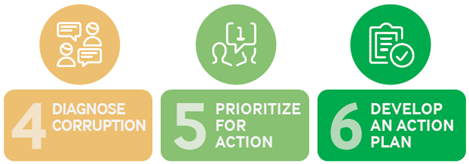
Via the tool’s six-step process, anticorruption actors identify and understand the most concerning forms of corruption in their countries’ extractive sector through a participatory research process. Based on this analysis, they then develop an action plan tailored to the corruption risks and anticorruption opportunities that define their current context.

The NRGI tool has a few defining hallmarks. It is highly adaptable, with users choosing which parts of the sector—such as licensing, revenue collection or state-owned enterprises—to focus their analysis and action-planning on. The tool’s research guides reflect the specificities of the extractive sector, drawing on NRGI’s sector expertise and its analysis of over one hundred oil, gas or mining corruption cases.
When identifying common corruption forms across the sector, we conceive of corruption broadly and include systemic forms of corruption such as state capture as well as the role of corruption’s foreign enablers.
Finally, the tool prioritizes multistakeholder participation and action planning so that the findings translate into real-world change.
Country-specific multi-stakeholder groups of the Extractive Industries Transparency Initiative (EITI) will be the tool’s initial users. In 2019, the EITI identified addressing corruption as one of its top priorities and we hope that this tool can contribute toward realizing that ambition. EITI stakeholders in Mongolia are now completing a pilot of the tool, a diagnostic that delved into the corruption risks found in mining operations, including the country’s regulatory and procurement systems.
But the tool is not EITI-specific. It’s a public resource and we encourage anticorruption agencies, civil society groups, international aid donors and others to use it too.
We launched this project in April 2020 with support from Deutsche Gesellschaft für Internationale Zusammenarbeit (GIZ). To inform the tool’s design, we reviewed 17 existing assessment tools, consulted with a range of experts, and organized several rounds of peer review. We’ve benefited from generous contributions from a range of experts and practitioners and are especially grateful for our collaboration with the EITI and Transparency International’s Accountable Mining Program.
In the coming months, we will add additional modules on the energy transition, artisanal mining and other topics, and make further improvements based on user experiences in Mongolia and additional countries.
We are excited to launch the first version of the tool, and eager to partner with others to deploy it widely. We encourage anyone interested in finding out more to contact NRGI senior governance officer Matthieu Salomon (msalomon@resourcegovernance.org).
From Data to Impact: Ensuring Extractives Data Serves Citizens in Eurasia

Some have assumed that disclosure of data automatically implies oversight pressure on government and business stakeholders, which in turn leads to accountable behavior by these actors. But experience has shown that this once-presumed cause-and-effect chain is not linear. A much more complex set of conditions must exist in harmony to produce tangible governance results. These conditions range from the existence of democratic institutions to the capacities of the oversight actors involved. Important international platforms such as the Extractive Industries Transparency Initiative and Open Government Partnership help to create transparency “pockets” by promoting universal rules and standards, but in general, these efforts do not have a spillover effect and have not led to systemic change in Eurasian countries. The work does however lead to more active results-oriented dialogue among stakeholders; it’s absolutely necessary, yet insufficient on its own.
PWYP and NRGI have engaged in discussions with civil society partners in Eurasia to identify a roadmap for continuing the journey from data disclosure to tangible use of data for improving natural resource governance in the region. In addition to further develop the capacity of civil society experts to analyze data, actual demonstrations of how data can be used to demand accountability will help to narrow the gap. PWYP Eurasia therefore established the Eurasia Data Working Group, which in turn spurred the creation of pilot data analysis projects in Kazakhstan, the Kyrgyz Republic and Ukraine.
Through these projects, researchers have used publicly available data to pinpoint concrete governance flaws and generated recommendations for stakeholders. The authors of the analyses aimed to establish a clear link between data and tangible governance results, and focused on governance challenges at the subnational level. Narrowing the focus and scope of the analysis to a very specific and relatable governance shortcoming is the most important aspect of this work. These cases clearly demonstrate the role of data disclosure in creating practical and robust recommendations for concrete governance improvement, and pave the way for substantive dialogue among stakeholders.
Each of these pilot analyses will contribute to the advocacy strategy of the local PWYP coalitions and can serve as one of the civil society tactics to be used more broadly in the Eurasia region and beyond.
View the reports:
Социальные платежи компании ССГПО (Соколовско-Сарбайское горно-обогатительное производственное объединение, г. Рудный, Костанайская область), Civil Expertise, Kazakhstan (English Summary)
Экологические платежи недропользователей и природоохранные мероприятия, реализуемые за счет бюджета, ECHO coalition, Kazakhstan (English Summary)
Анализ реализации социального пакета на объектах недропользования общего государственного значения: Таласская область, Кыргызская Республика, PWYP Kyrgyzstan coalition (English Summary)
Impact of financial (rent) payments from the extractive industry for the local community development (on the example of two pilot communities from different regions of Ukraine), Local Economic Development Agency of Yavoriv District, Ukraine (Summary)
IEA’s Ambitious Climate Scenario Underscores Need for More Transparency on Fossil Fuel Projects

The IEA experts have articulated several dramatic milestones that would be necessary to reach this critical goal, including:
- no approvals of new oil and gas field development and no new coal mines or mine extensions by this year
- electric vehicles reaching 60 percent of global car sales by 2030
- nearly 70 percent of global electricity generation produced from solar and wind by 2050.
Given that government and industry leaders rely on IEA scenarios in their planning, many hope that these urgent targets will spur much-needed climate action.
Beyond these headline prescriptions, the IEA makes another critical point: changes brought by the clean energy transformation will be challenging to implement, so decisions must be transparent and just. As the gap grows between government and company plans for future production and the levels consistent with a Paris-compliant world, there is increasing attention on how supply-side commitments from oil-producing countries might shape net-zero ambitions. These countries face significant economic shocks as the world decarbonizes: the IEA estimates that per capita income from oil and gas in producer countries would fall by 75 percent under its new net-zero scenario. Even if the world falls somewhat short of the Paris goals, governments in these countries face the prospect of dramatically lower revenues and public assets wasted by excessive concentration in a declining sector. Against this backdrop, citizens in low- and middle-income producer countries will inevitably face major uncertainties in the race to net zero. Access to basic information about how their social and economic prospects are shifting should not be one of them.
Governments and companies must disclose more information of relevance to the billion people that live in poverty in oil- and mineral-rich developing countries, and engage impacted citizens in producer countries as core stakeholders in energy transition policy dialogues. Despite the urgency of the economic challenge they face, many fossil fuel producers have not done enough to develop strong plans for economic diversification or inclusive development in a lower-carbon future.
The allure of oil and gas has thus far been powerfully addictive. Open dialogue between governments, companies, and citizens on the role of fossil fuel production in national economies will facilitate meaningful climate action and improve the prospects of countries that remain hooked on oil and gas. Globally inclusive dialogue is also needed around which countries should reduce production first; developing and emerging market producers are already calling on wealthy countries to lead the decline.
Today, too much information that is necessary for just and effective transition discussions remains hidden from view. Increasingly, debates will center on whether specific fossil fuel projects are viable or not—from both economic and climate perspectives. In many producer countries, the decision to halt or continue one or two key projects can affect the whole economy. Project-focused transparency efforts could support a just transition by helping citizens in producer countries assess the impacts and effectiveness of divestment and economic diversification plans. Greater transparency at this level would also help citizens hold government officials, multinational decision-makers and industry executives accountable for an equitable and well-managed process.
Governments and companies should disclose the following information about fossil fuel projects:
- Exposure to climate-related financial risk. To hold governments and companies to account and determine whether continued extraction or particular project configurations are in the national interest, citizens need: information about the viability of projects and national budgets under various transition scenarios (including the IEA net zero scenario); break-even prices, reserves and potential emissions of current and pending fossil fuel projects; and price and revenue forecasts used by financial authorities. The Extractive Industries Transparency Initiative (EITI) encourages the governments of its 55 implementing countries to disclose information that will further public understanding and debate around issues of revenue sustainability and resource dependence, including official production, commodity price and revenue projections. In practice, however, few countries publish this information, which must change. The EITI Standard should require, rather than merely encourage, these disclosures. The Standard should also require EITI supporting and member companies to disclose their own scenarios, assumptions and projections. United States and European regulators, who are also considering this issue, should also require this project-level information of fossil fuel companies globally.
- Plans for energy transition and production. Governments in producer countries should disclose information about their project divestment (and investment) and energy transition plans, and invite public debate on these topics. Oil companies—both private and state-owned—should also disclose production, energy transition, and responsible exit plans for their projects. They should also engage with stakeholders on the social and economic impacts that project continuation, wind down, or transfer would have on host governments and communities (e.g., impacts on payments to government and local employment, timelines and decommissioning plans). Governments and companies must also disclose the contracts that govern projects so that oversight actors can assess exploration and production rights, project amendment conditions, and adherence to decommissioning and asset sale obligations. At a minimum, both government and company actors should account for how much proposed projects will cost, their carbon footprints, and whether they align with climate goals.
- Financing and subsidization of carbon-intensive projects. Countries should disclose current and proposed spending on fossil fuel projects by national oil companies, public investment in fossil-fuel linked infrastructure, and the value of tax incentives and other subsidies they provide to support fossil fuel projects. They should also disclose the impact various transition scenarios would have on the return on public investment.
- Carbon intensity of production and reserves. Officials and executives should disclose the levels of greenhouse gas emissions (scope 1 and 2 emissions) associated with a project, as well as information necessary to assess the emissions associated with the eventual burning of those fuels, including emissions made abroad after export. This information is critical for informed public debate about the climate impact of a country’s extractive activities. In addition to disclosures around current production, citizens and investors need reliable information about undeveloped fossil fuel reserves, their embedded carbon content and the costs necessary to extract them to make equitable decisions about which countries need to phase out production fastest.
- Influence of fossil fuel interests on policymaking. In some producing countries, political leaders use fossil-fuel revenues to maintain their positions and power, giving them strong incentives to continue production. In others, fossil fuel companies enjoy considerable influence over policymakers. Governments and companies should disclose information that enables accountability actors to monitor channels of influence by vested interests. This information includes the identity of politically exposed beneficial owners with stakes in extractives projects, details about industry lobbying activities and political donations, and corporate reporting on compliance with “revolving door” policies and other integrity measures.
The IEA report makes the case for decisive and immediate climate action. The many necessary steps will require complex negotiation and coordination. But extractive sector companies and governments of producing countries can rapidly implement a core set of project-level, supply-side disclosures that would enable impacted stakeholders to assess project viability and contribute to energy transition plans. Increasing production-related commitments in nationally determined contributions is a clear opportunity. Reporting entities should leverage the readymade platforms and multi-stakeholder networks offered by transparency-oriented forums like the EITI and the Open Government Partnership, and draw on the considerable thinking that already exists on many of the key technical components and data standards that would be central to such disclosures.
What remains unclear, however, is whether an actor or group will take up the mantle of making this critical transparency a global priority and realizing it. We are working with partner organizations to explore how we can jointly push global leaders to step up. With more than 50 global and regional climate-focused gatherings taking place in the next six months, culminating in COP26 in November, the time is ripe.