
Managing Senegal’s Oil and Gas Revenues

Key messages
- The oil and gas sector it is not expected to transform Senegal’s economy or public finances. Fields that have received a final investment decision are are unlikely to generate revenues over 3 percent of GDP.
- Senegal already possesses some of the institutions needed to promote good revenue management of oil and gas revenues, including: (1) a relatively transparent and comprehensive annual budgeting process; (2) robust compliance with Extractive Industries Transparency Initiative (EITI) standards; (3) a relatively free and vibrant media.
- Given Senegal’s acute domestic investment needs, the government’s new sovereign wealth fund proposal may be ill-timed. Such funds are not the best vehicle for investing natural resource wealth domestically. Instead, the government should consider investing these funds through the budget. It could also be advisable to employ an expenditure rule limiting government spending, or a non-resource current balance rule preventing governments from squandering resource revenues by running a deficit in other areas, combined with a capital expenditure growth rule to mandate investment.
- The national oil company, PETROSEN’s debt accumulation and revenue retention pose significant risks for public finances over the coming years. The government should consider strengthening oversight of PETROSEN, for instance by appointing independent board members, publishing independent audits and clarifying the company’s dividend policy.
- Some fishing communities in Senegal are concerned about the impact of oil and gas projects on their livelihoods. If these negative impacts are confirmed, the authors of this report recommend that the government consider compensation through environmental and social management plans, as opposed to allocating a fixed share of resource revenues to sub-national governments.
One Year on From the Russian Invasion: Impacts for the Middle East and North Africa

Transcript:
The Middle East and North Africa region has been impacted by the Russian invasion of Ukraine—especially the region’s energy sector. Here I will highlight three important elements.One is the renewed interest of many European countries in the oil and gas sector of the region, mainly Italy. Italy has been very open about its renewed interest in North Africa—Algeria and Libya. And we’ve seen ENI sign deals with Sonatrach in Algeria and the Libyan National Oil Corporation, and to develop new gas fields and existing fields as part of Italy’s energy diversification plan. We also saw high-level EU leadership going into Cairo in June 2022 to sign a memorandum of understanding with Israel and Egypt to allow these two countries to export gas to the European Union. Also, we have seen easing between Germany and Qatar about contracts—new contracts of for export of LNG to the European continent; before the invasion that was not an easy discussion between the countries, and even between the EU and LNG providers like Qatar.
The second trend has been an acceleration when it comes to clean energy and renewables. We’ve seen, again, the European Union signing deals with countries of the region, mainly a partnership with Morocco, to support clean energy in Morocco that will also serve some of the EU’s needs for clean energy. At the same time, we’ve seen pledges from the Gulf countries like Saudi Arabia and UAE to push for more investment in clean energy. Again, that could serve European needs as well as other parts of the world. There was also a big announcement about the need to further accelerate the energy transition. The region is taking action; Saudi Arabia has created a critical mineral fund to invest inside and outside the region in new minerals that are critical for the energy transition.
The third point is energy security. This was an opportunity for some countries in the region, mainly Saudi Arabia and the UAE and other producing countries, to remind us that it’s a fragile world that still needs oil and gas to move into what is being called now “orderly transition.” And we have seen Saudi Arabia and the UAE be very open about the issue of not breaking the oil sector by pushing to stop investing in oil and gas. That was very loud in the region as well. And the UAE is carrying that message into COP28 which it will host in November 2023. And lastly on energy security: the Ukraine crisis did help to seal a deal between two enemy countries, Lebanon and Israel, on their maritime border. There were many different reasons that that deal happened, but one element was that the world needed more gas, and if that deal would help with providing more gas, they thought, “Let's do it.”
These are the main messages we have seen, and these are the main highlights from the region after almost one year of the war between Russia and Ukraine.
The Future is Now: NRGI’s 2023 Priorities

Our work at the Natural Resource Governance Institute contributes to fair, prosperous and sustainable societies by advancing citizen and government efforts in resource-rich countries to:
- Drive systemic change to avoid harms from mining and equitably benefit from the responsible scale up of transition minerals necessary to avert global climate catastrophe.
- Build inclusive economies that end dependence on fossil fuels and advance a just energy transition for citizens.
- Manage revenues from natural resources accountably in response to citizen priorities.
Through dramatic upheavals—from global pandemic, through historic market volatility, to the kleptocracy that enables Russian aggression, and the explosion in demand for transition minerals—we have helped our partners navigate uncertainty with timely, relevant and rigorous support.
In 2023, we will draw lessons from our work since the launch of our strategy in 2020, including a review our progress on diversity, equity and inclusion. We will deepen our support to the energy transition, and adopt more impact-oriented, politically astute approaches. And reflecting our evolved priorities and identity, we will launch a new website and updated branding.
Having undertaken major strategic and organizational transformations, NRGI’s future is now.
Ensuring transition mineral good governance
In 2023, mindful of the historic opportunities for people to benefit from the rising demand in minerals critical to green technologies, and the potential for corruption and harm that often accompanies such booms, we are ramping up our programming on transition mineral governance. We are launching new work in Chile, focused on enhancing good governance and inclusive management of lithium. We are deepening our engagement in the Democratic Republic of the Congo to build an inclusive vision for the management of cobalt in the public interest and more accountable relationships between governments, companies and communities. We are supporting effective policies on taxation, licensing and value addition, and will engage civil society and policy makers at regional forums like the African Mining Indaba and Alternative Mining Indaba and across several regional institutions in Africa and Latin America. And we will work with partners to implement strategies to prevent supply chain corruption.
Supporting just and sustainable societies
In view of elections both recent (Colombia) and upcoming (Nigeria), we will ensure that our policy analysis informs public debate on how to reduce dependence on fossil fuels in producing countries. The strategies and governance of national oil companies will be a major focus, including in Ghana and Mexico. As countries like Nigeria and Senegal assess the role of gas in their ambitions to improve populations’ energy access we will help citizens and policy makers understand the pros and cons of these gas-to-power approaches, including how they relate to the development of renewable energy. We will invest heavily in building people-centered energy transition dialogues in Colombia, DRC, Ghana, Nigeria and Tunisia, convening inclusive conversations to help partners envision a low-carbon future that meets the needs of all citizens.
Internationally, we will build on last year’s partnerships and advocacy to amplify the voice and influence of low- and middle-income resource-producing countries in debates about transition finance and the pace and shape of the decline in production and use of fossil fuels. With an eye on the COP28 climate conference in the United Arab Emirates, we will work with civil society actors and policy makers across the Middle East and North Africa to understand specific regional challenges and advocate for international support to advance the energy transition.
We will further research just energy transition partnerships and support international dialogue around how they might accelerate transition in gas-producing countries. NRGI and its partners will also further advocate for stronger international governance standards to foster accountability in the energy transition, including via the much-needed evolution of the global Extractive Industries Transparency Initiative standard.
Building on lessons from 2022, as a globally connected, locally rooted organization, we will continue to prompt inclusive, evidence-based debate and decision making in resource-rich countries and amplify those priorities on the global stage. In 2023, working in partnership with reformers around the world, we aim to ensure that the future we seek begins now.
Top photo by Estivillml/Envato
Colombia: Inclusion and Upgraded Governance Are the Keys to Petro’s Energy Transition Ambition

This is a shortened translation of a longer Spanish-language post.
On 7 August, Colombia turned a new page in its history. For the first time South America’s second-most populous country will be governed by a left-wing president and an Afro-Colombian vice-president who is a seasoned leader of social movements. More than 11 million citizens (50.44 percent of those voting) gave President Gustavo Petro and Vice President Francia Márquez Mina their mandate.
Petro boldly stated in his inaugural address that “we are willing to move to an economy without coal and without oil.” But how can the government and Colombians translate these green ambitions into concrete results?
In addition to addressing fiscal and energy supply challenges, the government must commit to good governance of the energy transition away from fossil fuels. The transition must include diverse voices and be transparent. Authorities must define clear policy frameworks for managing the progressive decline in production of fossil fuels, the need for economic diversification and the new governance challenges of renewable energies and transition minerals.
Petro's energy transition agenda
President Petro’s proposal to limit oil extraction has positioned him as a changemaker in the global energy transition. During his campaign, he invited other leaders in the region to form an “anti-oil bloc” to move economies away from fossil fuels and create a Latin American front to fight climate change. A few days ago, he received a letter signed by more than 80 parliamentarians from 30 countries that are part of the movement called “Call of Parliamentarians for a Future Free of Fossil Fuels” expressing their support to his proposal. Indeed, as an oil-producing and oil-dependent country, Colombia could become a laboratory for the innovation of transition policies, with much to contribute to other producing countries and global efforts to mitigate warming.
In line with Colombia’s updated commitments to the Paris Agreement—51 percent reduction in greenhouse gas emissions by 2030 and zero net emissions by 2050—during the campaign, Petro argued that Colombia should cease licensing for new hydrocarbon exploration and for large-scale open pit mines; ban the exploration and exploitation of offshore and non-conventional hydrocarbon deposits; and stop fracking pilot projects.
Petro also proposed promoting non-conventional renewable energy sources and earmarking the exploitation of fossil fuel reserves for domestic consumption, given their low levels (7.6 years’ worth of oil and 8 years’ worth of gas). In addition, he pointed out that Ecopetrol (which is majority state-owned), should play a fundamental role in the transition by redirecting part of its exploration budget toward a new energy transition fund.
After winning the election, Petro moderated some of these proposals. In his inaugural speech, he pointed out that although his commitment to decarbonization remains, Colombia is not a major contributor to global emissions. He also placed a greater focus on the role of international cooperation. The newly appointed finance minister, José Antonio Ocampo, has indicated that gas exploration will probably continue and that oil exports should continue in the short term. In a recent interview, the new mining minister, Irene Vélez, also commented that this process would take more than a decade and that the government would discuss the extraction of minerals necessary for technologies needed for the energy transition.
Top-down decision-making, general exclusion of affected communities and negative project impacts have generated a high level of socio-environmental conflict in the territories where extraction takes place.
Former president Iván Duque took important steps toward the energy transition by promoting investments in renewable energies, some green hydrogen pilot projects and transition minerals. But his administration also prioritized the expansion of fossil fuel extraction. He supported the coal industry to increase its competitiveness in the Asian market, promoted offshore hydrocarbon exploration projects, and encouraged pilot fracking projects to increase gas supply. Top-down decision-making, general exclusion of affected communities and negative project impacts have generated a high level of socio-environmental conflict in the territories where extraction takes place. This perpetuated a trend that began in the early 2000s.
Four challenges to Colombia’s energy transition
If Colombia does not initiate a broad discussion and take steps toward a just transition, in a few years it could end up with stranded assets and investments with low economic, social and environmental returns that could increase inequality. However, President Petro will have to lead this process in a scenario of great economic uncertainty linked to inflation and the risks of a global recession—in addition to the difficult fiscal situation resulting from the coronavirus pandemic.
Fiscal policy
In the past, as much as 25 percent of government income has come from hydrocarbons. Managing the progressive decline in hydrocarbon production means replacing taxes on oil and gas with new sources of revenue.
The new government has proposed imminent tax reform with the aim of raising COP 25 trillion (approximately USD 5.5 billion). The success of this proposal will be a key indicator of how and when the government might cover the gap that would be left by an eventual reduction in oil and gas taxes and royalties.
The redefinition of Ecopetrol’s role will be of great significance since its profits are an important contributor to the state budget. It is an efficient company that has achieved good financial results in recent years despite the pandemic and its profits will help to cover this year’s fiscal deficit.
The energy crunch resulting from the war in Ukraine will likely sustain the recent increase in hydrocarbon prices for some time to come.
Government officials will also need to decide whether or not to maintain the commitment to the promotion of the exploitation of minerals, which have contributed less to government coffers than oil and gas. The new government has announced a mining moratorium during its first 100 days so that officials can review compliance with regulations, but in other declarations has opened the door to further exploitation of transition minerals such as nickel and copper. Should authorities further pursue those commodities, they should also develop a modern taxation framework as well as enforceable socio-environmental standards adapted to the new importance of these metals.
Finally, the pace of the global energy transition is a key consideration for Colombia’s revenues in the short term. It is likely that in the long-term oil and coal prices will decrease. But the energy crunch resulting from the war in Ukraine will likely sustain the recent increase in hydrocarbon prices for some time to come. Petro has shown a willingness to take advantage of the boom in the short term.
Trade deficit
Another economic challenge to consider relates to the current account deficit. In 2021, the oil industry represented 33 percent of the total value of Colombian exports. Along with coal and other minerals, oil and its derivatives account for about 56 percent of the total value of the country’s foreign sales and generate annual foreign exchange earnings of about USD 20 billion. Likewise, oil license bid rounds and mining investments are a main source of foreign direct investment (USD 7.6 billion in 2020). In this context, the new minister of finance has suggested the need to continue exporting oil to avoid a problem in the balance of payments.
Energy supply
In 2018, 70 percent of Colombia’s energy supply derived from fossil fuels (40 percent on oil and derivatives, 21 percent on natural gas and 9 percent on coal.) Liquid fuels derived from oil are especially important in the transport sector (96 percent of consumption) while gas is key for industry and households. In this context, the government must define a path for its progressive reduction at the same time as it ensures energy access for the most vulnerable communities. Renewables energies will play a key role.
Clean energy governance
In order to multiply investments in renewable energy, the government should establish clearer governance frameworks. The development of clean energy projects has generated strong criticism and opposition from local communities due to the absence of free, prior and informed consultation, environmental and social impacts, and a lack of understanding of the relationship between communities and their lands. This is especially relevant in La Guajira, a multicultural and multilingual department of Colombia with a 42 percent indigenous population, high levels of poverty and limited access to electricity, but with enormous potential for wind and solar energy (wind speeds exceed 9.8 meters per second, twice the world average, and solar radiation is between 6 and 7 kilowatt hours per square meter per day, 60 percent higher than the global average). It is essential that the government, elected with the support of ethnic minorities, resolves these tensions and ensures that local populations receive the benefits of the transition.
The way forward
In general, the new government has the challenge of building adequate governance for the transition, keeping in tune with social expectations, while meeting the needs of an economy recovering from the pandemic. Implementing policies to move away from fossil fuels will be complex from a political and economic point of view, so it is very important to guarantee a democratic process and avoid the influence of undue interests in the process.
The eyes of the world are on how Colombia, a country dependent on oil production, can make its own just energy transition.
Among other elements, officials planning for the transition should:
- disclose the possible impacts of the different transition scenarios and disseminate this information to different stakeholders.
- ensure broad and territorial participation in defining and implementing the transition, including the most vulnerable groups.
- articulate clear measures for the diversification of the economy and compensation that will allow those most affected by the transition to benefit.
Robust governance will also require a high degree of interinstitutional coordination, especially between public institutions, including at the local level, to avoid contradictory messages about the transition process and the future of extractive industries. The energy transition requires policies at all these levels and necessitates an interdisciplinary perspective. It may also require additional regulatory frameworks in new areas such as transition minerals or renewable energies as officials and citizens come to better understand the conditions of these markets and global trends, as well as the implications for communities.
The eyes of the world are on how Colombia, a country dependent on oil production, can make its own just energy transition. There is a huge potential to generate lessons useful to other countries. The challenges are vast, both fiscally and in terms of energy access. But the Petro administration can meet these and other challenges by establishing adequate governance of the transition. For this, Petro will need to cultivate a broad national consensus that includes the territories and a diversity of voices. The support of allies at the international level will also be essential.
Governing Africa’s Extractive Resources in Uncertain Times: Perspectives from Ghana, Kenya, Nigeria, Uganda and Zimbabwe

Critical decisions surrounding this transition were at the heart of discussions at the first Africa Regional Extractive Industries Knowledge Hub (AFREIKH) online course, Introduction to Extractive Industry Governance: Policy and Practice, hosted by the Extractive Industries Center (EIC) at Nairobi’s Strathmore University Law School, in partnership with NRGI.
After the course concluded, participants cited the Africa-specific content and the opportunity to learn from peers and mentors as key draws. I spoke with six of our distinguished learners to find out more about what the energy transition means for development in Africa, and how to achieve good governance. These were:
- Feyisayo Ayeni, from Nigeria, operations lead at NC Future Concepts
- Nelly Busingye, from Uganda, development expert, civil society activist and PWYP Africa’s membership engagement manager
- Bernard Kwofie, from Ghana, independent consultant
- Wanjiku Manyara, from Kenya, general manager of the Petroleum Institute of East Africa based in Nairobi
- Thandazile Moyo, from Zimbabwe, researcher at the Minerals to Metals Initiative, University of Cape Town
- Learnmore Nyamudzanga, from Zimbabwe, independent consultant

Clockwise from upper left: Manyara, Moyo, Feyisayo, Nyamudzanga, Busingye, Kwofie.
As you’ll see below, their perspectives were candid, providing insight into what future interventions in the sector should look like. The issues facing the extractive sector are global, but some of the challenges are context-specific. This raises a question regarding the response and whether an Afrocentric approach to addressing problems in extractive sector governance is needed.
As we plan AFREIKH’s next course, we will continue to explore the insights and focus on Africa’s position in this rapidly changing environment. As countries around the world come together to join their efforts to combat climate change, Africa’s policy actors and leaders are challenged to engage in this global discussion and reshape their actions on climate change, the energy transition and the future of extractive industries to avert misgovernance of the extractive sector, mitigate climate risks and seize the opportunities from the energy transition.
Moses Kulaba: What are your thoughts about the potential impact of the energy transition on your country’s development?
Moyo: I am concerned that my country may be too slow in implementing clean energy strategies. As a Zimbabwean living in South Africa, I am familiar with the challenges associated with the use of thermal power, as both countries rely on this energy source. In addition, coal mining creates employment opportunities and contributes to the economy. Given this, I worry that these two countries may fail to take advantage of the opportunities presented by the transition.
Kwofie: Ghana has always been a resource-dependent country, and the discovery of oil and gas in commercial quantities has further increased the country’s resource base. In 2019, oil revenues accounted for nearly 10 percent of non-aid fiscal revenues, and this share is expected to double by 2022. Most households depend on liquefied petroleum gas for domestic activities, such as cooking and, in cities, lighting. Even though energy tariffs, including for electricity, are expensive, moving away from the current system to a new energy economy may lead to a wider energy gap and resource poverty. This could widen inequality and deny citizens access to affordable energy. Both the government and the economy will face fiscal challenges in the form of lost revenues from extraction, and the country will have to look for alternative sources of revenue mobilization. This may eventually impact infrastructure development and growth. The government may miss fiscal targets due to budget constraints.
Nyamudzanga: The reality is that our world is moving from fossil fuels to renewable resources and that fossil fuels have serious negative impacts on our environment. In my country, Zimbabwe, we have good policies but are not “walking the talk.” The issues around energy transition are looked at from a political point of view, which sometimes leads the government to turn a blind eye to the concrete impacts of climate change. In our country, we are experiencing droughts, heatwaves, floods and cyclones as a result of climate change, but at the same time we are celebrating investments in fossil fuels, using electricity from coal, upgrading our thermal power plants and still taking pride in new coal mining.
What should your country do in response to the quickening energy transition?
Kofie: Ghana’s government needs to develop the capacity of its experts to engage effectively with other players in the extractive sector and review its investment plans in the energy sector to focus more on renewable energy. The government should also avoid investing in long-term oil and gas projects and reconsider the national oil company’s focus on its role as an operator. And the government needs to start mobilizing private sector investment in clean energy.
Nyamudzanga: The energy transition must be phased and well managed to reduce energy poverty. Zimbabwe must begin implementing plans to replace fossil fuels with green and renewable energy, because that is the way the world is going. Climate change is real. The younger generation must lobby for this transition because they are the most affected.
Busingye: Uganda needs to facilitate debates on the energy transition. The energy transition is here with us. The various stakeholders must therefore come together to address it politically, socially and economically, so that the transition to greener energy is inclusive and just. Having completed this course, I would like to mobilize other civil society organizations to discuss the energy transition, focusing on the context of emerging producers like Uganda.
Manyara: The breadth and depth of the energy transition haven’t taken root in Kenya. As far as I can perceive, we need to sit down and create a roadmap and action plan for the country’s energy transition, which should then be entrenched and effectively implemented across all ministries’ policies. Developing an objective, pragmatic and realistic roadmap for energy transition in Kenya is paramount, and should not be done as a reaction to the approaches and views of other jurisdictions in the world. We, Kenyans, should discuss and shape this roadmap based on our own capacities and ambitions regarding energy transition.
What does energy transition mean to you and what is one message you have for leaders and policymakers in your country on what they should prioritize?
Moyo: Africa should think of “energy access,” not energy transition. Africa will provide “just energy access.”
Nyamudzanga: [We should] move away from fossil fuels such as coal, crude oil and gas and begin to use renewable energy such as hydro, wind and solar. Let us have policies that promote the use of climate-friendly renewable energy.
Ayeni: The energy transition is an opportunity for developing countries to leapfrog some of the challenges associated with fossil-based resources. I hope that our leaders and policymakers will prioritize the development of public institutions that foster better and sustainable decision-making. For my part, having taken the course, I have gained included an understanding of the specific challenges such as extractive revenue management and energy transition in the context of long-term sustainable development in resource-rich countries and the leading governance and policy strategies used to achieve this.
Respondents’ statements have been edited for length and clarity.
Oil and Gas Will Not Illuminate a Path Forward for Lebanon

As millions of Lebanese scramble to meet their basic needs and keep the lights on, Lebanon urgently needs a new, more realistic vision of what fossil fuels can do for the country. For years, politicians in Beirut swore that “entering the club of oil producers” would transform Lebanon’s failing economy and crumbling power sector. But that narrative has gone quiet over the last year, after a first offshore well came up dry, the ruling class became unable to operate a functioning government, the pandemic upended daily life and the economy imploded. Now, further drilling offshore is delayed, a second licensing round is on hold, and most people are focused on survival. In this harsh climate, what’s still possible?
In a new briefing, we warn that Lebanon should not stake its economic or energy future on oil and gas. For the last decade, politicians have made vastly differing claims about the size of Lebanon’s natural resource wealth, all based on limited information. The actual size of the country’s reserves remains in doubt, and unless further drilling finds something significant, no company will agree to extract.
Time is also of the essence, because even if there aren’t more delays, Lebanon would not produce any oil or gas until the 2030s—well into the era when extractives companies will be walking away from high-cost deepwater projects in “frontier countries”. In truth, Lebanon’s offshore was already a marginal destination for investment even before the pandemic caused a global slump and the energy transition started picking up speed—despite official claims to the contrary.
What if Lebanon does make a sizable discovery, though, and production starts while oil companies are still interested and foreign demand is solid? While no one can put a reliable price tag on such a scenario, there is no cause to think that oil and gas exports would be an economic “turning point” or a solution to the current miseries. In fact, the experiences of other countries show that becoming a producer could make some of the country’s economic governance problems worse—leading to, for instance, unrealistic budgets, more unsustainable debt and more endemic corruption. At worst, relying too much on fossil fuel exports would prolong the consumption- and rent-based economic model that underpins the current crisis, merely shifting dependence to a new sector.
As delays and obstacles to exporting fossil fuels have grown, the government in Beirut has reimagined its hypothetical gas as a new, cheaper fuel for the power plants owned by Électricité du Liban (EDL), the mismanaged, perennially insolvent state-owned utility. This focus on cost savings is understandable, given the dire need for cash. Yet it could be misleading, as there is no guarantee that burning gas for power will make for significant savings. Routine dysfunction and delays around new gas-to-power projects could even add costs, including big penalties, flaring and the need to fall back on gas imports. The risks that there won’t be domestic buyers for Lebanese gas are very real, considering that the government’s promises to build new gas-fired power plants go back to at least 2010.
Solar and wind, meanwhile, have received far less attention, despite their high potential. Gas versus renewables isn’t necessarily an “either-or” choice for Lebanon, as neither could close the huge power supply gap by themselves and both face serious (and overlapping) commercial and technical headwinds. Yet renewables could offer Lebanon bigger long-term cost savings than gas-fired power, along with other upsides like improved energy security, less exposure to world fossil fuel prices and less pressure on the local supply of U.S. dollars, the key foreign currency in Lebanon’s inflationary, import-driven economy. Political leaders also need to ask whether they will be able to finance an electricity system that depends heavily on gas in the longer term, especially as foreign capital for fossil fuel projects dries up.
This outlook, though disappointing, offer a chance to create a new energy strategy for when the country’s economic and political fortunes improve. To start, the new government should facilitate a multistakeholder risk assessment for oil and gas, to help adjust expectations. It should also set fresh goals and targets for the power sector, describe how gas and renewables will work together in the domestic energy mix, and clarify EDL’s role going forward. Officials should also reassess the investment barriers to utility-grade solar and wind projects and find ways to help lower them. New institutions and regulations may still be needed as well—for instance, a long-delayed power regulator and a distributed renewable energy law.
Leaders should start work on this new strategy now, rather than waiting for foreign donors and international financial institutions to write it for them. As aid negotiations go on, these outsiders will demand preconditions and reforms related to energy, some of which may not be in the country’s best interests. Consider the failed French-led roadmap of 2020, which pressured the government to fast-track arguably unworkable plans for new gas-fired power plants, among other things, in exchange for $11 billion in soft loans. The new IMF talks, however uncertain their prospects may be, should not become the latest chance for an outside actor to shape the story of Lebanon’s energy future.
Starting early, the Ministry of Energy and Water should also communicate, and solicit feedback on, any new direction it wants to take in the energy sector. Assessing needs and managing public expectations will be critical for the success of any new strategy, and no plans should be made without wide-ranging consultations and dialogue, a step that politicians often ignore.
By the end of all this outreach and stocktaking, Lebanon should have a new narrative for what oil and gas can and can’t do for its economy and its citizens. And unlike the old one, this should be based more on facts and hard trade-offs, and less on unrealistic hopes and empty promises.
Rethinking expectations around the future of oil and gas in Lebanon
National Oil Companies and Climate Change: Economic Challenges and Potential Responses

The event produced three key lessons:
- Political will is crucial; governments must drive the energy transition. This is valid for both producer country governments, which should direct their NOCs in line with national strategic and political priorities, and wealthy consumer country governments, which must provide climate finance to enable developing and emerging producer countries to overcome the serious challenges of transition.
- Tunnel vision is deadly. NOCs can’t continue on the costly assumption the oil market won’t change. Climate advocates must increasingly consider the developmental challenges of producer countries and the needs, and potential roles, of NOCs.
- Economic diversification is key. Oil- and gas-producing countries have struggled with diversification for decades. Solving this is even more urgent now as producer countries must start actively investing in the long-term future. New producers should avoid making investments from the beginning that lock the country into a high-carbon pathway.
No more business as usual
Making incremental reductions in emissions compared to a business-as-usual baseline is no longer enough to mitigate the effects of climate change. This is because of the rapid and fundamental transformation in the way we produce and consume energy. This change creates a challenge for companies whose core business is extraction of oil and gas, and especially for governments heavily dependent on revenues from NOCs.
These companies and governments should consider any new oil and gas investments in light of the significant uncertainty about future demand for their products and the economic returns they will generate, as well as their impact on climate change targets. Meanwhile, the status quo approach in many countries—whereby NOCs reinvest most of their oil revenues straight back into the sector—poses a growing risk to efforts to move away from fossil fuels.
Global oil production would have to decline by 4 percent every year from 2020 to 2030 to be consistent with a 1.5°C pathway, according to the Production Gap Report. Yet current government plans and projections indicate an average 2 percent annual increase. This raises the question: what is the role for NOCs in a world of climate change adaptation and declining oil?
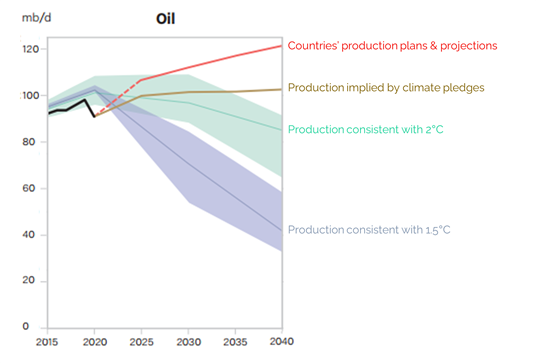
Experts weigh in
Executives from two NOCs, Colombia’s Ecopetrol and Uganda’s UNOC, joined our online event to share their approaches to energy transition. Valérie Marcel of Chatham House, one of the world’s leading experts on NOCs, also contributed.
Juan Manuel Rojas shared Ecopetrol’s climate change strategy, based on four pillars. While still focused on oil and gas, Ecopetrol aims to diversify its business into other sources of energy. The company bid for 51 percent of ISA, the state electricity grid operator. While many NOCs aim to reduce their direct operational emissions—so-called scopes 1 and 2—Ecopetrol’s energy transition strategy also targets scope 3, the indirect emissions that occur in its products’ value chain. The company aims to reduce emissions across scopes 1, 2 and 3 by 50 percent by 2050.
Asked to what extent these changes are driven by investors (88.5 percent of the company is state-owned and the rest is held by private investors), Juan Manuel observed that often those investors are sceptical of the importance of energy transition. From a financial perspective, many investors prefer their holdings to focus on one business area: if they want more electricity or more renewables, they would make those choices themselves. This creates a key tension in NOCs’ diversification efforts.
Peter Muliisa of UNOC shared Uganda’s challenges as new petroleum producer and a country with pressing socio-economic development needs. Like other countries in Africa, Uganda is highly vulnerable to climate change, and many officials and citizens see oil revenue as a means to help the country cope. However, with the global energy transition underway, UNOC has expressed a desire to develop a clear strategy on what the company needs to do to avoid exacerbating the effects of climate change on Uganda. Peter shared that, as a first step, early discussions are under way on how to restructure UNOC as an energy company rather than an oil company, ensuring Ugandans increasingly gain access to clean energy.
However, the government’s green light for construction of the East Africa Crude Oil Pipeline, which will carry Uganda’s oil to the Tanzanian coast, raises the question of potentially stranded assets. Peter explained that Ugandan officials hope to export oil through the pipeline before energy demand significantly shifts to renewables, but that the energy transition may affect longer-term production in the country.
Valérie Marcel, drawing also on the experience of these two companies, observed that NOCs have two purposes: to deliver revenues to governments and to meet energy demand in their countries (including often non-commercially). While clean energy is generally profitable, it does not create economic rents in the way oil does, which raises challenges for the countries’ economic strategies and government revenues. The second part of NOCs’ mandate could point to a role for NOCs in supplying renewable energy domestically. However, while NOCs can focus on reducing their costs or operational emissions, transitioning to renewable energy requires clear direction from their governments and consistent development strategies and climate policies, especially given the political consequences of lost economic rents.
Finally, Valérie underlined that the transition will affect different types of NOCs variously: high-cost versus low-cost, exporting versus importing, gas-focused versus oil-focused. Will it be easier for NOCs in new producing countries to transition than for established producers? In some ways yes, she said, as they are not yet locked into an oil development pathway. However, these producers often lack the financial resources needed for such a transition.
Our discussion series aims to increase learning between experts in the extractives governance and climate change fields, who have too often worked in silos. The following event, on 27 May, explored whether NOCs should get directly involved in renewable energy investment and economic diversification.
For the audio recording, please listen on SoundCloud.