
Low Oil Prices Impose Difficult Choices in Uganda
This article originally appeared in Uganda's New Vision newspaper on 4 June 2015. This version replaces a previous reference to 6.5 billion barrels of estimated oil inventory with another figure: recoverable reserves of 1.4 billion barrels.
Uganda's Ministry of Energy and Mineral Development (PEPD) recently extended the deadline for firms to submit bids in its first-ever round of licensing for six oil blocks in the Albertine Graben. The extension is intended to encourage more companies to apply, after the ministry received a disappointing collection of bids in the first go-round. This struggle to find appropriate investors is the latest consequence for the country of the sharp fall in global oil prices.
Exploration for hydrocarbons in Uganda gained momentum as oil prices were rising in the early 2000s. The first licenses were awarded between 2001 and 2005, during which time the price of oil doubled from $20 to $40 per barrel. The first commercially viable discoveries were made in 2006 and 2007, while prices were on their way up to over $100 a barrel. Prices dropped during the financial crisis of late 2008 but quickly rebounded to remain above $100 for the better part of the last five years.
Development of Ugandas oil sector

During that period, as the projects were being developed, the government invested in passing laws (Petroleum Bills, Public Finance Bill), developing regulations and training its workforce. But recently, just as everyone thought actual production of the 1.4 billion barrel recoverable reserves was only a few years away, prices have dropped—by more than 40 percent over the last year. Current prices are dangerously close to the break-even point for Ugandan oil fields. (The break-even is the minimum price of oil at which a given project is economically viable, estimated in Uganda to be between $50 and $60 per barrel.) If prices remain at current levels, investors interest in Ugandan oil could be jeopardized.

Description: Crude Oil (petroleum), simple average of three spot prices; Dated Brent, West Texas Intermediate, and the Dubai Fateh, US Dollars per Barrel
Source: http://www.indexmundi.com/
Did Uganda miss an opportunity? Not really. It merely reacted to the whims of the commodity price cycle. Uganda became an attractive oil territory when oil prices, and oil companies exploration budgets, were on the rise. Because there was no history of oil production in the country, time was needed to prepare the ground for an operational oil-producing field. And more time will be needed to develop the infrastructure necessary to refine part of that oil into gasoline, and export the rest to the coast of Kenya, 1,300km away. By the time Uganda is finally able to sell its oil, we dont know what the price of oil will be, though few analysts still believe it will rise to $100 any time soon.
The nascent Ugandan oil industry is currently experiencing its first shock; the three international companies involved in oil production have respectively cut their investment budgets by between 20 and 30 percent, including downsizing of their staff in Uganda. Uncertainty over future prices is prevailing. As Prof. Emmanuel Tumusiime-Mutebile of the Bank of Uganda described during a multi-stakeholder dialogue in February, this means that investors will delay major investments until prices rise sustainably over break-even points. These delays will likely impact the countrys plans for a $4 billion oil refinery and a $3.5 billion pipeline. The 2018 target for oil production has been abandoned, with a consensus forming around 2020 at the earliest.
Oil revenues were expected to be an increasingly important source of financing for public investment. Using long-term real prices of $75 per barrel, we estimated last year that annual government revenues from oil could reach up to $3.3 billion at peak production, twice the international assistance received in 2012 and more than half the current national budget. Postponing the receipt of these revenues will have implications for future investment plans in the country.
For example, consider a number of planned infrastructure developments that were to be funded primarily through external debt. These include the construction of a railway, estimated to cost about $8 billion, linking the country to both Rwanda and Kenya; a new bridge over the Nile; the Karuma and Isimba hydropower dams; an expressway from Kampala to Entebbe airport; and a proposed expansion of the international airport itself. Although these loans are not directly linked to oil revenues, any delay in oil production will make it harder for the government to meet its repayment schedule. The recent experience of Ghana should certainly serve as a caution in favour of fiscal restraint when oil is discovered.
On the positive side, the delay in oil production provides an opportunity for the government to further strengthen its legal and institutional framework, including the development of a national oil company, and make sure the right infrastructure is in place to benefit from domestic refining of crude oil. Additional efforts at governance reforms could also make the government more accountable to Ugandan citizens regarding choices are made in the natural resource sectors, and current public spending decisions. Demand for information is prevalent among the media, civil society and the wider population, amid increasing use of social media. And Uganda has yet to sign up to the Extractive Industries Transparency Initiative, publish its oil and mining contracts, or join the Open Government Partnership.
Decreasing the focus on oil production may also help Uganda develop other, more labour-intensive sectors of its economy, a need highlighted recently by DfID (UK) chief economist Stefan Dercon. Financing will be a challenge. The same scarce capital is needed to finance both oil-related infrastructure and social and economic investments that will promote diversification. The seeming abundance of loans from Chinese banks can appear like a way out of such difficult choices, but it could also leave the country saddled with debt if oil revenues do not materialize.
Some commentators are seeing the glass half-empty. We dont; we believe that Uganda can come out of the current period of low oil prices with a growing economy and healthy finances, by setting up systematic processes to ensure transparent budgetary choices today, and embracing, on its own terms, international initiatives that provide platforms and support to undertake accountability reforms.
Paul Bagabo is a Uganda-based consultant with the Natural Resource Governance Institute (NRGI). Thomas Lassourd is a senior economic analyst at NRGI.
Why Weren't Governments Better Prepared for the Commodity Price Crash?
Headlines about resource-rich economies faltering under crashing commodity price pressures fill the news. "Venezuela in a bind as Nicolas Maduro faces default dilemma" warns the Financial Times. "Alberta premier considers sales tax to fix ailing, oil-based economy" says the Canadian Press. "Iran says it can no longer afford Ahmadinejad's cash handouts" reports the Guardian.
Yet for every crisis, there is a story of a government having planned in advance for exactly this circumstance. Some governments spent years paying down public debt so they could borrow when needed. Others saved money in a sovereign wealth fund upon which they might draw during a downturn. Still others invested to diversify their economies, making them less vulnerable to commodity price cycles or unexpected declines in production in the first place.
| Some well prepared and poorly prepared governments of resource-rich countries | |
| Well prepared | Poorly prepared |
| Bolivia | Alberta (Canada) |
| Brunei Darussalam | Congo, Rep. of |
| Chile | Equatorial Guinea |
| Libya | Iran |
| Norway | Malaysia |
| Peru | Mexico |
| Qatar | Mongolia |
| Saudi Arabia | South Sudan |
| Timor-Leste | Venezuela |
| United Arab Emirates | Zambia |
| We use the label "well prepared government" here to mean one that meets two conditions: (1) the government is in a sustainable fiscal position in absolute terms, meaning that it has low public debt levels and/or relatively large holdings of foreign assets to withstand a prolonged commodity price slump; and (2) the government acted in a fiscally responsible manner relative to its degree of capital scarcity in the decade(s) prior to the commodity crash, meaning that, if it was capital-rich a significant portion of resource revenues were saved, whereas if it was capital-scarce it was investing well in human and physical infrastructure. | |
Neither geography nor level of economic development nor degree of democracy explains why one government would be well prepared for a price downturn while another would not. Successes and failures can be found on every continent, in developed and emerging economies, and across authoritarian and democratic countries.
Stability for some…
Most successes have emerged from a consensus—often codified in law—that fiscal stability and sustainability principles ought to drive public finance decisions. Peru, for instance, passed the Fiscal Responsibility and Transparency Law in 1999, following decades of economic crises. The law established Peru's fiscal rules—a deficit limit and an expenditure growth rule—which were then reviewed in 2013. The result was a reduction in public debt from 44 percent of GDP in 2004 to 20 percent of GDP in 2012, one of the lowest rates in Latin America. At the same time, the government established the Fiscal Stabilization Fund (FSF) to accumulate fiscal surpluses. Today the FSF holds approximately $9 billion, equal to 4.6 percent of GDP.
In another example, Norway's political parties jointly committed to its fiscal rule in 1990. The rule set the non-oil budget deficit at 4 percent, which is the expected long-term return on savings in the country's sovereign wealth fund. Similar to the Peruvian case, Norway established its rule after decades of financial mismanagement, including two banking crises. Norway's sovereign wealth fund has accumulated $884 billion, making every Norwegian a krone millionaire ($173,000 per capita) on paper.
Timor-Leste has also taken a long-term view to managing its natural resource wealth. In 2005, the Petroleum Fund Act was passed establishing a fiscal rule that limits annual spending to 3 percent of petroleum wealth, unless justified to parliament. Any excess is saved in the Petroleum Fund. In recent years, Timor-Leste has spent beyond this limit to invest in electricity, housing, and education, among other items. Still, since the law was passed, the government has never run a fiscal deficit and built up $15.7 billion in savings ($13,000 USD per capita) as of July 2014. Even as oil prices collapsed, the Timor-Leste 2015 budget only called for $70 million in borrowing (4.5 percent of the budget)—a smaller percentage than in Chile or Saudi Arabia.
… and crises for others
Not all countries have done so well. Some resource-rich states have faced major financial and economic crises, and even violent conflict. These countries have little in common other than the absence (or abandonment) of a long-term macroeconomic framework during or even prior to their respective commodity booms. For example, Venezuela witnessed an enormous increase in government spending and widening budget deficits starting with the rise of oil prices in 2005. The government has run a fiscal deficit in every year since 2005, even during oil boom periods. The IMF estimates that in 2015 the Venezuelan budget deficit could reach nearly 20 percent of GDP.
The government's response has been to extend price and exchange rate controls, first introduced in 2003, and nationalize a number of companies that provide basic goods and services. These have led to shortages of imports, a growing foreign currency black market, hyperinflation, and demonstrations on the streets, rather than generating the type of growth and stability the government expected. Prices of credit default swaps on Venezuelan public debt suggest a 60 percent chance of default in the next year and a 90 percent probability of default in the next five years.
In mineral-rich Mongolia, exuberance around mining prospects contributed to a huge public and private sector spending boom starting in 2006 and that accelerated in 2010. The crash in mineral prices, including a 38 percent drop in copper prices—and consequent decline in fiscal revenues—has underscored the government's structural deficit (a budget deficit adjusted to strip out the effects of economic cycles). Mongolia has been left exceedingly vulnerable to further shocks. In the IMF's words, "Mongolia is […] at high risk of debt distress." The government and its state-owned companies are currently paying some of the world's highest interest rates on international sovereign debt markets due to perceived financial risk. The Trade and Development Bank of Mongolia, a government-guaranteed, state-owned institution, is now borrowing at over 8 percent annually in real terms on international financial markets. The government itself is borrowing at 4-6 percent more annually than Vietnam, another fast-growing Asian emerging market.
In both of these cases problems started before the 2012-14 commodity slump. In each, and in others (e.g., Equatorial Guinea, Mexico, Malaysia, Iran, South Sudan, Trinidad and Tobago, Yemen), the government was in structural deficit before the crash. This means that, prior to the crash, in each, public spending was not generating the growth (and non-resource tax revenue) necessary to meet public sector obligations over the long-term without relying on revenues generated from oil, gas or mining.
Unrealistic expectations drove overspending
Unrealistic expectations around resource revenues have also played a role in overspending and debt crises. In Ghana and Mongolia, for instance, claims of vast national wealth dominated the political discourse in the years preceding the start of major resource production. These assertions directly contributed to consumption-driven booms in both countries. Recently, Ghana has been forced into signing an IMF bailout agreement. While it saved slightly less than $500 million in oil revenues in two sovereign wealth funds from 2012 to 2014, the government borrowed approximately $7 billion on international financial markets, at interest rates approximately 5 percent higher than the rate of return on sovereign wealth fund assets. The Ghanaian experience highlights the dangers of over-exuberance when new discoveries are made.
A lack of transparency in public finances can exacerbate overspending. In the Republic of Congo, opaque reporting practices led external observers to believe that the country was well prepared for the current crisis, when in reality national savings were smaller than expected.
Beyond the immediate fiscal crises, budget cuts (e.g., Iran cutting cash transfers), asset sales (e.g., Russia raiding the National Wealth Fund, earmarked for public pensions), and tax increases (e.g., Alberta's plans to raise corporate and income taxes), the commodity price crash is impacting longer-term macro-fiscal plans. For instance, Papua New Guinea has delayed implementation of its sovereign wealth fund. There is also less interest in creating new funds in regions where large oil or mining projects have been delayed (e.g., Afghanistan, Liberia, Sierra Leone).
At the same time, some governments are adapting the lessons of the past into draft laws on managing natural resource wealth. For example, Mongolia has tabled a Future Heritage Fund bill which calls for a portion of windfall revenues to be saved in a new fund. And oil-rich Bojonegoro regency in Indonesia is planning to establish a fiscal rule and a fund to save a portion of its subnational government share of oil revenues.
Common success factors
We can point to a few commonalities among the resource-rich governments that have successfully countered fiscal revenue volatility and maintained fiscal responsibility despite having or expecting vast oil, gas or mineral wealth. First, each country has a history of sticking to a macroeconomic framework, whether or not the framework is rooted in the constitution, in a law, or in a policy document. In most cases, this is reflected in a formalized fiscal rule which generates a fiscal surplus. The fiscal surplus is then saved in a sovereign wealth fund or used to pay down public debt.
According to IMF staff estimates, national governments comply with fiscal rules approximately 60 percent of the time. Balanced budget rules are broken most often since they are complex and therefore difficult to enforce. Expenditure rules and debt rules are easier to enforce, particularly in emerging economies—since the data required for their determination is easily available and the calculations are fairly simple to carry out—which helps explain the higher rates of compliance. Expenditure rules (and revenue rules) generally have the added benefit of being counter-cyclical, making them particularly appropriate for emerging resource-rich economies.
Second, most countries have competent and powerful ministries of finance as well as strong oversight of their public finances, either through parliament or independent fiscal watchdogs.
Third, in many cases, leaders committed to long-term fiscal sustainability, resisting temptations to over-spend on projects that curry popular favor—especially on expensive but low-return status projects like stadiums. Political resoluteness by powerful individuals has often been key to sticking to a fiscal framework.
Finally, in most democratic countries, political consensus has played an important role in compliance with fiscal rules or fiscal sustainability and stability principles. Both Norway and Timor-Leste, for instance, have generally controlled spending, even in good times, by virtue of a cross-party political commitment to fiscal responsibility. While we don't have all the answers, recent experiences may help us better manage future commodity price booms—and busts.
NRGI revenue management data tools
NRGI is building visual tools and a database of indicators to help policymakers, media and researchers better understand macroeconomic preparedness for commodity revenue shocks. Below we present a sample of this work. We welcome comments on how to improve our approach.
Visual tool 1: Government revenues and expenditures over time in resource-rich countries, which shows budget balances.
Visual tool 2: Change in government revenue and expenditure over time in resource-rich countries, which illustrates government fiscal policy responses to volatility.
Measures of commodity price crash preparedness for selected countries
| Measures of preparedness | ||||||||
| Fiscal rules | Fund | History of volatility management and fiscal sustainability | Net debt (percentage of GDP, 2014 est.) | Gross debt (percentage of GDP, 2014 est.) | Expenditure volatility | CDS spread (Jan 2015) | Expected budget balance (2015) | |
| Chile | Yes (structural balance) | Yes (Pension Reserve Fund and Economic and Social Stabilization Fund) | Strong | -5.10% | 13.90% | Low | 60 BPS | -8.9% |
| Saudi Arabia | No | Yes (SAMA Foreign Holdings) | Strong | -97.10% | 1.60% | Low | 60 BPS | -20% |
| Peru | Yes (structural deficit; expenditure rule; subnational debt ceiling) | Yes (Fiscal Stabilization Fund) | Moderate-Strong | 3.40% | 20.70% | Low | 120 BPS | -8.8% |
| Russia | Yes (expenditure rule; suspended in 2010) | Yes (Reserve Fund and National Wealth Fund) | Moderate | N/A | 17.90% | Moderate | 190 BPS | -19% |
| Mongolia | Yes (balanced budget, expenditure, revenue and debt rules; some operational in the future) | Yes (Fiscal Stability Fund) | Moderate | N/A | 76.50% | High | 550 BPS | -38% |
| Venezuela | No | Yes (Macroeconomic Stabilization Fund) | Poor | N/A | 45.60% | High | 750 BPS | -88% |
|
Table sources and methodology:
|
||||||||
Andrew Bauer is a senior economic analyst at the Natural Resource Governance Institute (NRGI). David Mihalyi is an NRGI economic analyst.
Governance and the Lucrative Extractive Industries
Note: This interview first appeared in the newsletter of the New South Wales Independent Commission Against Corruption (ICAC) in June 2015.
Economist Daniel Kaufmann believes natural resource governance is the greatest developmental challenge of the next decade. As president of the Natural Resource Governance Institute, US-based Dr Kaufmann leads an organisation that aims to ensure that people – ultimately – are the greatest beneficiaries of their country’s own oil, gas and mineral resources. In November this year, Dr Kaufmann will speak at the biennial Australian Public Sector Anti-Corruption Conference in Brisbane.
In June last year, the Revenue Watch Institute and the Natural Resource Charter combined to become the Natural Resource Governance Institute (NRGI). What prompted the new identity?

Dr Daniel Kaufmann of the Natural Resource Governance Institute will speak at APSACC in November. The biennial anti-corruption conference will be held in Brisbane this year.
United, rebranded and re-launched as NRGI, we bring together the intellectual and research strength, independence, field-based expertise, and innovative approaches needed to take our work to the next level. Together with our colleagues and partners, we aim to make a difference in the countries where we operate, and also champion global governance reforms in natural resources.
In describing NRGI’s role briefly, is it appropriate to say it aims to influence and teach governments to better manage their natural resources for public good?
Support to governments is one important component of our work, but there is more. Broadly, NRGI helps people to realise the benefits of their countries’ endowments of oil, gas and minerals. We do this through technical advice, advocacy, applied research, policy analysis and capacity development. We work with (and also learn from) innovative agents of change within not just government ministries, but also civil society organisations, the media, legislatures, the private sector, and international institutions – promoting accountable and effective governance in the extractive industries.
Your Resource Governance Index (RGI) report reveals that, of the 58 countries measured, 80% failed to achieve good governance in their extractive sectors. You describe this as a governance deficit. Findings from that report, however, show that satisfactory performance in resource governance is possible in some countries, including several emerging economies. Which country would you describe as a major success story?
The governance deficit is real and clearly codified in the RGI report. The plight of many resource-rich countries nowadays is symptomatic of such deficit, which has been further exposed by the fall in commodity prices. But a number of countries have shown that good governance in extractives is possible.
Some are in the industrialised world, some are in Africa, Asia and particularly in Latin America. Colombia’s petroleum sector, for instance, is noteworthy. Its solid institutional framework, including an open licensing process, and good reporting practices and safeguards, earned Colombia a score of 74 out of 100. The government publishes comprehensive information on the management of the oil sector, and the country also recently joined the the Extractive Industries Transparency Initiative (EITI), and follows extensive audit requirements. Ecopetrol, the national oil company, has shown good transparency standards too since its restructuring in 2003. However, more can still be done to improve the governance of the sector in Colombia.
Although not ranked among the very top performers, Timor-Leste was another noteworthy example of a success story, with a score of 68/100, ranking 13th out of 58 countries. The country has set up a comprehensive legal framework and an independent licensing process, along with extensive audit requirements, and releases substantial data on many aspects of the hydrocarbons industry, including on almost all petroleum contracts, and is performing well in EITI.
Western Australia is the focus of the Australian contingent of the 2013 RGI. It ranks fourth out of the 58 countries; a great result. In relation to the category of safeguards and quality controls WA received a “partial” score of 65 out of 100. But it performed extremely well on rankings of overall governance, accountability, democracy and the rule of law, receiving a score of 96 out of 100. Are there any specific comments you would like to make in relation to Australia’s RGI report card that year or results from the forthcoming index?
As you suggest, Western Australia ranked well overall. Among others, this is the result of very high overall performance on national-level governance, accountability, democracy and the rule of law. On some particular other aspects, however, there was room for improvement, such as on the quality of some government reports, incomplete oversight of the licensing process, and a lack of robust conflict-of-interest disclosure requirements (including the absence of a specific requirement for government officials with a role in the oversight of the mining sector to disclose their financial interests in extractive activities). It was also noted that information regarding exploration and mining licences is publicly available, but there is no general role for the legislature in their approval.
Let me note that the RGI report was issued in 2013 and based on data collected in 2012. In the meantime, changes are taking place in many countries. The RGI is a major data collection and analysis project; one that has now started for the next such report, with data being collected this year.
Are there any observations you would like to make about Australia’s corruption/anti-corruption practices?
I approach this with a bit of humility, since I am not an expert on Australia, and there are many in your own country, including obviously in public service! Let me try to contribute by raising a few issues, drawing from international experience and evidence from around the world. Taking a global comparative perspective and looking at worldwide indicators (including our own Worldwide Governance Indicators, or WGI), it is evident that, generally, Australia has done relatively well controlling corruption; yet, in looking ahead it may also be able to do even better.
The first question relates to “direction of travel”: the data suggests that, in 2005, Australia ranked among the top 10 countries in terms of corruption control; in fact it was 9th and it maintained this ranking until later in the decade. Yet, according to the more recent data from the WGI, it slipped to 14th. These are relative rankings among over 200 countries, so it is still performing satisfactorily overall, but there is a question about a possible downward trend, and if so, why. Further, why not aspire to be among the top five countries in the world?
The second question relates to variations across jurisdictions within Australia. The seriousness of the efforts by the Independent Commission Against Corruption in NSW are well known globally, while questions arise about a more lax approach by other states, such as Victoria, for instance. Related to this significant variation across states is the question about why Australia doesn’t have a national anti-corruption body with investigative powers at the federal level. And it is also important to unbundle corruption and analyse whether there are particularly vulnerable aspects, such as in political and party finance, in trade unions and in the media.
The final question is about how Australia could do better in the global effort to combat corruption; for instance, by tough implementation of the Organisation for Economic Co-operation and Development’s (OECD) foreign bribery regulations, by enacting legislation mandating transparency in the payments by Australian mining multinationals, and also by becoming a fully implementing country in the EITI, which already has 48 member countries.
You head an organisation that is now approaching 100 members of staff based in over a dozen countries. Your staff work with actors in a lucrative industry. What strategies does NRGI employ to ensure it maintains its independence and that good internal governance is achieved?
Good governance and integrity has to start at home, so we work hard at it within our organisation. We have an independent governing board that oversees us, which is comprised of notables and experts of the highest integrity, representing the key stakeholders who oversee us. We have also built up a large advisory council of experts. And we continuously strive to do better.
For instance, last year Transparify, a new group that rates organisations in terms of their transparency regarding funding sources, gave us three out of five stars. Some may have considered that satisfactory. Not us, so we reviewed our practices and implemented a plan to become as transparent as possible. We were recently awarded the maximum five stars by Transparify, singling us out because of our major improvement in a short period of time.
The NRGI’s five-year strategy places importance on partnerships. Please explain what you mean by this.
Simply, it means concretely working with others. We walk the talk, as illustrated by the fact that we engaged in the most extreme form of partnership, namely a marriage – the merger of two organisations that became NRGI.
There are other partnerships as well, such as the work we do together with many non-governmental organisations and training institutions in many countries; the partnership we have with EITI globally; as well as collaborative work with a number of implementing governments and parliaments regarding their reform programs in extractive industries.
We also have a special partnership with a number of international foundations (such as with the Hewlett, Gates and Open Society Foundations), as well as with some governmental donor agencies, such as UK’s Department for International Development, and a bit more modestly with the World Bank and Australia’s Department of Foreign Affairs and Trade. The pending task of transforming natural resource governance is arguably the development challenge of the decade, and no single organizsation can make a difference alone.
On a personal level, reflecting back on your career, are there any insights you would like to give?
Llifelong learning is key and one must extend oneself beyond the narrow confines of one’s own original specialisation, embracing a multidisciplinary approach. Rigorous analysis with sophisticated statistical tools is important for sound evidence-based policy analysis and advice. But they should not be applied to economic matters alone; they should also be integrated into political and governance challenges.
Related to that, partnerships and teamwork has also been crucial. When it comes to research, policy analysis and concrete projects I have worked with hundreds of co-authors and partners in many countries.
Finally, persistence – in forging ahead with your convictions regarding what matters for contributing to development is important, as is speaking truth to power in sensitive fields – such as governance and anti-corruption, where one is unlikely to win many popularity contests.
Resource Resilience: How to Break the Commodities Cycle
This article originally appeared in World Politics Review on 26 May 2015.
The past year has seen dramatic declines in the prices of global commodities. Between June 2014 and the beginning of this year, crude oil prices fell by 50 percent to around $50 a barrel. Similarly, mineral prices have seen a drastic fall since the peak of the " commodity supercycle " in early 2011. Between then and April of this year, iron ore prices fell by 70 percent, coal prices by 54 percent and copper prices by 40 percent.
Many countries dependent on revenues from these commodities have been hit hard. Venezuela is unable to import food and medicine to satisfy the basic needs of its population due to the lack of petrodollars. Russia's economy is expected to contract by 3.8 percent this year, as a result of the oil price fall combined with Western sanctions over the Ukraine crisis, which have sent the ruble tumbling. Nigeria is slashing its budget, which would require a petroleum price of $122 per barrel to balance out.
Mineral-exporting countries, especially those in developing markets in Africa, have also felt the brunt. Sierra Leone's two largest iron ore mines had to close in late 2014 after running out of cash and not being able to repay creditors. With iron ore accounting for a quarter of Sierra Leone's economy and half of its exports, the International Monetary Fund forecasts the economy to contract by 13 percent this year. Mozambique, deemed the most promising source of untapped coking coal, only exported 7 million tons of coal last year —17 percent of what was projected four years ago—with companies facing an uphill battle just to cover their operating costs. Rio Tinto sold its coal concessions in Mozambique for $50 million late last year after having acquired them for $4.2 billion three years earlier. Zambia saw its fiscal deficit widen due to falling copper prices last year, and the national currency, the kwacha, was the worst- performing currency in Africa.
While the recent fall in prices has been significant across the board, large price fluctuations are nothing new in the commodities sector. The World Bank energy index, for example, fell by 48 percent in 1986 as a result of slowed economic activity in industrialized countries. Similar drops occurred in the metals and minerals index between 1988 and 1993 and the agriculture index between 1974 and 1982.
Over time, commodity price fluctuations are inevitable. This raises the question of what countries dependent on commodity exports can learn from past mistakes, and what measures they can take to build resilience against commodity cycles. This article describes the strategies various countries have employed—including budgeting mechanisms that account for price fluctuations, natural resource funds and economic diversification strategies—and considers the challenges and opportunities of each approach.
Managing revenue volatility
A key to breaking the commodity cycle trap is more strategic management of resource revenues. Without a mechanism in place to regulate when and how resource revenues are spent, revenue volatility leads to expenditure volatility. If government budgets are not insulated from revenue volatility, governments will either have to make major budget cuts when revenues decrease from previous years or to borrow against uncertain and unpredictable future revenues.
Annual budget adjustments make development-planning efforts impossible. Infrastructure projects, for example, are multiyear investments and cannot be properly implemented with stop-and-go spending. Massive public sector layoffs or decreasing wages for public servants such as teachers and nurses can create political crises. Borrowing is one way around this, but borrowing can lead, and has led, to debt crises when the revenues from natural resources consistently fall below forecasts.
Large expenditure increases when new projects come online or prices spike can also be risky if the economy cannot absorb additional government spending. This may result in high inflation rates and real exchange rate appreciation, which in turn can reduce the competitiveness of the non-resource-based tradable sector, thereby increasing a country's dependence on commodity exports.
The Economist dubbed this phenomenon "Dutch Disease" in 1977, after the Netherlands experienced deindustrialization following large gas discoveries in 1959. Dutch Disease can be partly addressed by directing government spending to areas that increase productivity, such as investments in infrastructure, health and education.
However, in countries where short-term budget flows exceed yearly budgetary needs or capacity, or in countries that already provide ample public goods, governments need a mechanism to save commodity revenues until a point where the money can be spent efficiently. The necessity for a mechanism to manage resource revenues increases as resource revenues grow as a percentage of total revenues. For many countries, natural resource funds may appear to be an attractive solution, but they, too, come with a number of challenges.
Natural resource funds
Several resource-rich countries have set up natural resource funds, or sovereign wealth funds, to stabilize government expenditures; to save for future generations; to sterilize capital inflows to avoid overheating the economy; to earmark revenues from the extractive sector for particular purposes; or to ring-fence the revenues to try to avoid mismanagement. Natural resource funds have become increasingly popular around the world; 30 of the 45 funds that are currently active were established in the past 15 years.
However, the objectives of the funds are often unclear, and even when they are clear, the rules are not always followed. While Chile, Norway and Saudi Arabia were successful at using stabilization funds to smooth budget expenditure growth between 2001 and 2013, expenditures in Kazakhstan, Venezuela and Trinidad and Tobago increased and decreased with oil revenues during the same period despite similar stabilization funds.
Kazakhstan, for example, established its National Fund in 2000 to stabilize its budget and save for future generations. While the deposit rules outline that oil and gas revenues should be channeled into the fund, the list of companies whose taxes are deposited can be changed arbitrarily from year to year. Furthermore, the withdrawal rules have been changed three times in seven years, and the lack of independence between Parliament and the management council of the fund impedes effective oversight, resulting in large expenditure swings.
Norway, on the other hand, has been successful in adhering to the withdrawal rules it set in 2001. These call for a limit on the non-oil structural deficit —the permanent deficit that excludes oil revenues— of 4 percent of the assets of the fund. Since 4 percent is the expected long-term real return on the fund, this rule effectively only allows for the returns on the fund to be spent. Norway's fund is fully integrated in the government's annual budget, with supervisory bodies at all levels of the fund management, and Parliament must approve any withdrawal from the fund.
Canada's energy-rich province of Alberta illustrates that poorly designed savings funds will not necessarily lead to the stated goal. In 1976, the province set up the Alberta Heritage Savings Fund to set aside revenues for future generations. But Alberta only made two relatively small deposits between 1987 and 2013, both at times when production and oil prices were at all-time highs. While such spending of resource revenues through the national budget might be justified if targeted at investments that support long-term objectives, in Alberta the majority of the province's oil revenue spending led to inflation and unsustainable consumption. The fund did not have clear deposit rules, so it could not constrain political pressure to spend rather than save the revenues. The recent oil price drop and the resulting economic slump help explain why Alberta rejected its conservative governing party earlier this month for the first time in more than four decades, with the province's new premier-elect pledging to end the boom and bust cycle.
East Timor's Petroleum Fund, on the other hand, has been relatively successful at saving oil revenues since setting up institutions to manage them more efficiently. After achieving independence from Indonesia in 2002, and with its infrastructure, education and health sectors in shambles, East Timor established a fund in 2005 to stabilize spending and save oil revenues, following the model of Norway. The deposit rules require all oil and gas revenues to be deposited in the fund, and withdrawals are limited to the interest earned on the petroleum wealth of the country, with excess withdrawals needing approval from Parliament. The fund was invested in bonds and equities abroad to prevent East Timor's domestic economy from overheating.
In 2011, East Timor presented a 20-year development plan, which foresaw spending a portion of the oil revenues up front in infrastructure and human capital projects. These investments are expected to provide a higher return for the Timorese population than the foreign treasury bonds in which the fund was invested. Moreover, investments in infrastructure and human capital are needed to address critical development needs, including access to health care, education and electricity, as well as to create a foundation for more private sector investment. The challenge for East Timor going forward will be to design robust public investment plans for the additional front-loaded expenditures, and then to return to a sustainable spending path thereafter.
These examples show that natural resource funds are only as effective as the rules that govern them and the adherence of the organizations that manage them. To improve the governance of these funds, the following criteria should be met:
First of all, funds should set up clear objectives, such as saving for future generations or stabilizing budget expenditures. Without such objectives, it is hard to define the rules that govern the fund.
Second, they should establish fiscal rules that are aligned with the fund objectives. These rules, including both deposit and withdrawal rules, should be legally binding for successive governments, so as to act as a commitment mechanism.
Third, funds should establish investment rules to outline where the deposited money can be invested, depending on the risk profile the country is willing to take and whether the fund can only invest abroad or also domestically.
Fourth, funds should clarify institutional structures and rules of conduct. Roles and responsibilities need to be clearly defined in the law, regulations and policy documents. Strong ethical requirements and conflict of interest standards should be enforced.
Fifth, funds must require regular and extensive disclosure audits, as transparency is a prerequisite for accountability and compliance.
And finally, funds must establish strong independent oversight bodies. Internal control mechanisms are often not enough to ensure good governance and compliance. Therefore, external independent bodies should audit policymakers and fund managers to enforce the rules.
While meeting these requirements can ensure that resource revenues are managed wisely and are used to support macroeconomic stability, the challenge for resource-rich countries is to become less reliant on a few exported commodities and to diversify into other sectors.
Diversifying the economy
A more fundamental way for countries to buffer themselves against the commodities cycle is to break their dependence on natural resources by diversifying their economies. There is strong empirical evidence that economic diversification leads to higher long-term economic growth. Ricardo Hausmann and Cesar Hidalgo have shown that a country's economic growth is determined not only by the amount it exports, but also by the composition of exports. The more complex and technologically advanced the exports of a country, the higher the long-term economic growth is likely to be.
In addition, countries that are diversified are less susceptible to the price and production shocks of a small number of commodities. They will also be better prepared for the eventual depletion of nonrenewable resources. And they will offer better employment opportunities for their people, since the extractive sector is generally not labor-intensive.
Drawing lessons from how the United States and Canada industrialized their economies, Albert Hirschman suggested that policymakers can leverage three types of extractive sector linkages to promote diversification. First, there are fiscal linkages: the use of revenues from the resource sector to promote other sectors. Second, there are production linkages, including backward linkages through investments in services and goods used to produce the commodities, and forward linkages through investments in services and goods used to process the commodities. Finally, there are consumption linkages: the demand resulting from the incomes earned in the commodities sector. This section will explore all three types of linkage in more detail.
Fiscal linkages. Fiscal linkages consist of channeling the revenues from commodity exports toward other sectors. Governments may use revenues either to improve the business environment more generally or to target specific sectors.
For example, Malaysia has made use of a combination of these policies to support its long-term development plans since its independence from Britain in 1957. Heavily reliant on rubber and tin exports in the early years of independence, Malaysia used the revenue earnings from these sectors to increase agricultural productivity and reduce poverty. Tin and rubber revenues were used to subsidize and incentivize the development of the palm oil sector and to set up the Palm Oil Research Institute of Malaysia (PORIM) to increase yield rates.
In the early 1970s, Malaysia embarked on an aggressive export-oriented industrialization strategy. Cheap labor, industrial parks and fiscal incentives were used to attract manufacturing companies. In the 1980s, revenues from the oil and gas sector were used to support and provide special treatment to the electronics, transportation and automobile sectors. This was accompanied by policy measures to incentivize skilled immigration, create polytechnic institutions and establish academic institutions with strong ties to Australia and Canada to promote skills and technological transfers. And in 2006, Malaysia embarked on its third industrial development plan, which is set to run through 2020 and targets high-tech industries. These policies have contributed to Malaysia's growth, earning it a spot as one of 13 countries with average growth of more than 7 percent per year for 25 years or more, as identified by the Commission on Growth and Development.
Chile is another country that has been successful at using its resource base to promote other economic sectors. Rather than aiming to move into more complex industrial sectors, Chile has targeted public investments to create thriving pine tree, salmon and wine industries, none of which were traditionally produced in the country. These sectors were supported through incentives such as export subsidies, credit lines, the sharing of startup costs and the promotion of technologies to adapt these agriculture and aquaculture projects to Chile's environment. In 2006, the government established the Innovation for Competitiveness Fund, which channels copper revenues to finance Chile's 15-year Innovation and Competitiveness strategy. As part of this strategy, the government has identified seven clusters with high export potential, including tourism and agriculture, which could be supported and promoted for further diversification efforts. While Chile has experienced solid growth over the past 20 years and was one of Latin America's fastest-growing economies in the last decade, the country still faces the challenges of ensuring equitable and inclusive growth and reducing inequality.
Production linkages. Production linkages, both backward and forward, are the most direct way to leverage the resource sector for broader economic development.
The London-based multinational mining company Anglo American has estimated that in 2013, about half of its expenditures went to suppliers —five times more than the amount paid to governments. In response to figures like these, governments have pushed for the local procurement of these goods and services through incentives and "local content" regulations.
Norway has been relatively successful at creating backward linkages. The country did not have the expertise to supply offshore oil rigs when oil was first discovered in 1969. In 1972, Norway passed the Royal Decree, requiring that all operations were obliged to source from Norwegian companies unless they were not competitive in terms of quality, service and price. The 1985 Petroleum Act further stipulated local content provisions to be used to allocate licenses in the North Sea.
As a result, Norway's licensing bidding rounds provided preferential treatment to Norwegian companies in all bidding rounds between 1974 and 1994. The licenses also included provisions requiring the transfer of skills and technologies to Norway's infant domestic petroleum industry. In 1994, Norway joined the European Economic Area, a single market with the European Union, and as a condition of membership was not allowed to continue with its preferential treatment policies. However, by that point, the backward linkages were already established, and today Norway is exporting its offshore service expertise to the rest of the world.
Fewer countries have successfully implemented forward linkages, associated with the processing of raw commodities. One exception is Botswana. Botswana is often hailed as one of the best performers in sub- Saharan Africa, with high economic growth rates and prudent macroeconomic management. However, the country has been highly dependent on exports of raw diamonds since its independence from Britain in 1966, and various diversification attempts have failed. This can largely be traced back to the country's having few comparative advantages. It is landlocked, with two-thirds of its territory covered by desert, and it has a small internal market.
Since the 1980s, Botswana has attempted to develop a diamond cutting and polishing industry. Originally, De Beers, the major diamond producer in the country, argued that the cutting and polishing industry would not be economically viable, and therefore did not support the government's efforts. Only in 2005, when De Beers had to renew its 25-year mining license, was the government able to pressure the company to commit to treat the diamonds in-country. Sixteen cutting and polishing companies were licensed to operate in Botswana, with allocation of raw diamonds dependent on the hiring and training of Botswanan nationals.
In 2013, De Beers moved its global sorting, aggregation and sales operations from London to Gaborone, making Botswana the new trading hub for rough diamonds from its own mines and those in neighboring Namibia and South Africa, and even from as far away as Canada. In the long run, Botswana aims to attract jewelers and retailers to build up sufficient expertise to sustain this activity even when rough diamond production in the country falls.
Indonesia has taken more drastic measures to process its minerals in country. The government imposed export taxes on unprocessed minerals in 2009 and an export ban in 2014. Industry strongly pushed back on the ban, particularly because the country lacked the requisite beneficiation capacity, including infrastructure and skilled labor, and both production and exports fell as a result. However, despite the global commodity price fall, the policy has had some success, with 11 new nickel smelters scheduled to be built in Indonesia in the coming years. Newmont Mining Corporation, one of the fiercest critics of the government policy, is also moving ahead with its expansion plans for an Indonesian copper smelter. While Indonesia's bold policy decision set back the mining sector and the economy in the short run, it remains to be seen whether it will benefit the country's diversification strategy in the long run.
Consumption linkages. Consumption linkages arise with the demand for goods and services from incomes earned in the commodities sector. In the 1960s and 1970s, import-substitution policies in Chile and Malaysia, for example, targeted consumption linkages by increasing the price of imported goods through tariffs and nontrade barriers. However, these policies have largely been abolished since the early 1980s, as it has become widely acknowledged that the long-term benefits of an open economy outweigh those of protecting domestic producers from international competition. With falling logistics and transportation costs and the abolition of import-substitution policies, consumption demand has increasingly leaked abroad via imports.
However, there is space for governments to target sectors that benefit from natural protective barriers. These may include service sectors that require a local presence, agricultural produce that is highly perishable and construction materials that have high transport-to-value ratios, such as cement. There is no one set path for resource-rich countries to diversify into other sectors. Production and consumption linkages can be more straightforward because of their connection to an "anchor project," but countries that have been relatively successful at diversification have also done so through fiscal linkages. It is important that targeting policies are not made on an ad hoc basis, but are based on an assessment of comparative advantage that accounts for policy goals, future prospects and regional market growth. It is important that such policies are flexible and are reviewed on a regular basis to reflect economic developments and to avoid supporting failing sectors.
Lessons learned
For resource-rich countries to break the commodities cycle, prudent macroeconomic management is a prerequisite. This entails controlling revenue volatility from export earnings and keeping a close eye on inflation and exchange rates to prevent the economy from overheating and other tradable sectors from suffering. Well-governed natural resource funds can help by smoothing government expenditure, sterilizing the economy from resource revenues and helping to earmark resource revenues for investment projects that increase productivity.
Diversifying out of the commodities sector is a difficult undertaking, and not many countries have succeeded. Most have not been able to secure macroeconomic stability in the first place, in part because the temptation to spend available revenues is strong.
There is no single diversification path, as the optimal strategies largely depend on a country's comparative advantages and bargaining position. Botswana, for example, was only able to drive a hard bargain to move downstream because it is the second-biggest diamond producer in the world, and De Beers could not afford to lose access to such an important source.
What is certain is that breaking the commodity cycle requires fiscal discipline, a medium- to long-term development plan, integrated governmental policies to capture available linkages and targeted sectoral support. What is also certain is that commodities booms inevitably turn to busts, as the recent price downturn has once again illustrated. When they do, the importance of breaking resource dependency becomes clear.
Lisa Sachs is the director of the Columbia Center on Sustainable Investment (CCSI). Nicolas Maennling leads the economics and policy research at CCSI.
Lisa Sachs will be among experts from around the world to discuss these issues at the forthcoming NRGI conference on 25 and 26 June in Oxford.
A Taxing Question Arises When Commodity Prices Fall
At the end of the last commodity super cycle in the mid-1980s, the future looked bleak for producing countries. The Prebisch-Singer hypothesis suggested that commodity prices would continue falling relative to the price of manufactured goods – which was not good for countries that were selling their resources in order to finance industrial expansion. The consensus around the likelihood of sustained low prices was strong among most experts, including those at the World Bank and IMF. This translated into support for low taxes on extraction companies as a means to incentivize investment, particularly if a country had few other means for obtaining foreign exchange. The result was that throughout the 1990s many countries, particularly in sub-Saharan Africa (including Zambia, Tanzania and Guinea), set low tax regimes.
A few years later, commodity prices started to rise, undoing much of the rationale for the regimes. Given the way resource deals were structured, the rise in prices disproportionately benefited companies rather than countries, which led after some time to a wave of unilateral tax increases and contract renegotiations, often labelled “resource nationalism” by industry analysts.
Fast forward to 2015 and commodity markets are probably undergoing a similar transition into an era of low prices. Prices have slumped: most commodities have lost half of their value since July 2014. Such a sharp decline is not unprecedented. For example, in 2008 prices fell even more precipitously. However, this latest slump appears likely to be longer-lasting, with signs that another “commodity super cycle” has ended. How are governments adapting their tax policies to the “new normal”?
Some governments have already made changes, and companies have seized such opportunities to renegotiate deals where possible. The UK has cut taxes, particularly for companies operating older fields within Great Britain. Mexico has reduced the tax burden on its privatized oil sector, while Argentina has decreased taxes both at central and provincial levels. China has reduced taxes on iron ore, Egypt has reduced to zero its share of profit oil in a large contract with BP, and Iraq is renegotiating its service contracts to reduce the government's exposure to oil prices.
However, many countries have thus far resisted tax cuts. Peru has ruled out tax cuts on mining, in light of the government’s desire to use mining revenues to invest in supporting growth in other sectors of the economy—although it might be compromising on environmental regulations by doing so. Norway is facing a 15 percent fall in investments in its oil industry and (and consequent job reductions) due to the fall in oil prices, but its government has so far resisted reducing taxes.
These different reactions illustrate a tension around the revision of fiscal terms, stemming from two often conflicting tax policy objectives: stability of laws and contracts on the one hand, and flexibility around changing circumstances on the other.
There are ways to maintain policy or contractual stability through changing price environments, with mechanisms such as windfall or super-profit taxes, which adjust the tax burden in response to some market change and so limit the need to alter the fiscal regime itself. Governments have employed a variety of approaches which incorporates rate changes in response to some measure of either return on investments, the market value of production, physical units produced, or a proxy metric for costs such as the depth of an oil well or the number of years a project has been operating. These are what we call here “variable rate taxes.”
Using data collected by the Columbia Center for Sustainable Investment, we’ve made a back-of-the-envelope calculation of the number of petroleum fiscal regimes that use variable rates, shown in the diagram below. There were 29 countries in the sample employing 34 variable rate taxes between them – some countries have two such taxes in their regimes. The majority of countries have some form of tax or fiscal instrument that incorporates a variable rate, a quarter have rates that are directly responsive to changes in commodity prices (i.e., the value of production in the diagram), and a tenth have a tax instrument that is based on some measure of the rate of return made by the taxpayer.
|
Use of variable rates in fiscal instruments in petroleum fiscal regimes |
|
|
|
Source: Columbia Center for Sustainable Investment and authors’ calculations. |
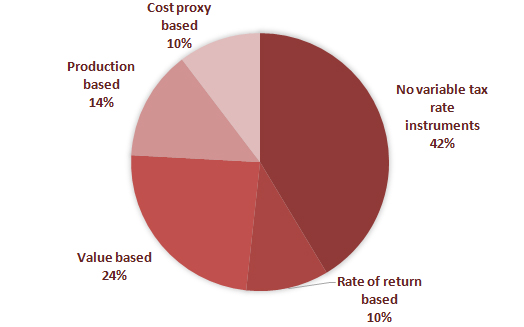
Rate-of-return-based taxes are theoretically the most appealing to both investors and governments as they are the least likely to limit investment decisions. However, they do not appear to be used very often. One reason often given is that they are complex, although this assertion is somewhat questionable: typically these taxes use the same or very similar tax bases as corporate income taxes, so the additional burden on companies and tax administrations is likely to be negligible.
Value-of-production-based taxes provide flexibility around changing prices and are the most common of the variable rate tax regimes. However, these often meet resistance from investors, as attested to by experience of the Zambian government’s attempts to install a variable rate royalty, a reform called the “windfall tax.” The lobbying by companies in Zambia reflected a particular weakness of these types of tax instruments: their rates to differ according to differences in costs and thus may deter investment in high-cost projects, or when prices are low.
Another possible source of resistance among investors is that, in some cases, variable rate tax regimes do not give rise to tax credits for investing companies in their home countries, unlike standard corporate income taxes. This can reduce producer countries’ appeal to companies, and make it more difficult for governments to negotiate such tax regimes.
Rather than prioritizing stability of fiscal laws and contractual terms such as those described above, some governments prioritize continuity of extractive operations, principally because the industry provides crucial jobs and foreign currency. Such objectives sometimes require that governments make tax concessions to companies when the prices of commodities drop. However these type of concessions are difficult to implement not only for governments which lack strong, long-standing relationships with industry, but also because tax policy changes do not uniformly track with price cycles. As Australia discovered, cutting taxes when prices are low can be fairly easy, but increasing them when prices rise can be almost impossible when the full might of the industry lobbyists is brought to bear on the government.
There is no ideal way to provide stability in a volatile economic environment. Both companies and governments have legitimate reasons for calling the other party to the negotiation table at different stages of a project. Rather than sticking to rigid stabilization clauses and hopeful myths about the existence of perfect, untouchable contracts—or going through a sector-wide review at each turn of the market—both governments and companies would be better off acknowledging the need for regular adjustments to contract and fiscal terms, and negotiating legal agreements that provide such flexibility.
Politicians who dream of billion dollar investments, from West Africa to Indonesia, are feeling the pressure to cut taxes. We recommend that they take a look at the obverse side of the coin before rushing to the negotiation table. One of the most immediate consequences of the crash in prices has been the industry’s drive to cut costs, after years of cost inflation during the boom. This means that the actual impact of the price crash on their profitability may not be as large as the price decrease itself, although the consequences may be felt with some delay while the industry finds solutions to its belt-tightening challenges. Indeed, a recent study from the University of Oxford shows that for every one percent decrease in the oil price in one year, oil companies’ costs decreased by 0.5 percent the next year.
Resource companies have already postponed or cut $100 billion in investments. But as previous commodity cycles have shown, these leaner times will not last. Therefore if government officials decide to give tax breaks to projects in economic distress, they should be careful in limiting these breaks in time and scope, in order to restore a progressive fiscal regime when prices rise.
Companies and their host governments must address the immediate issue of declining profitability and investments. But the silver lining is that any new renegotiation of fiscal terms could be an opportunity to craft better tax regimes and mechanisms for absorbing volatility. These would allow the industry to withstand the current drop in prices while ensuring a fair split of revenues, and preventing disputes in the future.
Thomas Lassourd and David Manley are economic analysts at the Natural Resource Governance Institute.
Watch experts from around the world discuss these issues on 26 June at the NRGI conference in Oxford.
We would like to thank Salli Swartz of Artus Wise Partners for her helpful comments on this article.
May 2015 Letter from the President
Dear friends and colleagues,
I write to share some NRGI developments and a few thoughts in the midst of what admittedly are uncertain times globally.
Let me first focus on the shrinking civil society space in many resource-rich countries. Further entrenchment of authoritarian governments (in increasingly “managed” democracies) and the radicalization of factions that oppose them has resulted in increased civil strife and violence, and a squeeze on civic space in the middle.
Add to this the economic slowdown in Europe and China, the recent drop in commodity prices, and high-level corruption scandals in a number of countries, and it is evident that we are facing a new and complex reality. This current environment of multiple “lows”—low tolerance, low prices, and low growth—poses fresh challenges as well as opportunities, and warrants rethinking and adaptation, including for us at NRGI.
The picture is particularly grim in many oil-rich countries, such as Azerbaijan, Russia and Venezuela. We have found that in most resource-rich countries, many of which are members of the Extractive Industries Transparency Initiative (EITI), the now-past period of high prices coincided with growing constraints on civil society.
This is of grave concern, since civil society engagement is essential if transparency initiatives are to be effective in making governments accountable to their citizens. Recently, a concerted push led to EITI’s adoption of a protocol for assessment of civil society environments in EITI countries. The protocol is already being applied in practice: Azerbaijan has just been held to account by the EITI international board (on which I serve) and the country has been downgraded from “compliant” to “candidate” status. At issue is the systematic and growing government-led persecution of civil society leaders and organizations. During my visit to Baku last week (to present at the Asian Development Bank annual meetings), I met with many stakeholders to review and discuss the multiple challenges faced by civil society in Azerbaijan, and I participated in constructive discussions aimed at moving the country out of dire straits.
When harnessed accountably, oil is still a valuable national asset, even if its market value has fallen; likewise with minerals. With the plunge in commodity prices has come much understandable anxiety, in many corners—from ministry offices and legislative chambers to corporate executive suites. In fact, extractive companies face a rather different reality today, due to the drop in prices; the changing landscape in governance and politics; and enhanced scrutiny of corporate accountability, tax avoidance and corruption. Engaging with companies, as well as governments, civil society, parliaments and media, is an integral part of NRGI’s strategy.
With partners, we are working on the challenges and opportunities brought by lower prices, including in areas of governance improvements, such as reductions in inefficient, unequitable and fiscally onerous subsidies; the revamp of state companies and natural resource funds; and approaches to improving subnational governance and addressing corruption in extractives.
In the past boom decade, innovations in natural resource analysis, policy advice and advocacy surfaced, yet the actual implementation of governance and policy reforms in the extractives sector fell short. We must learn from this experience if decisive progress is to take place in the coming decade. We must operate more effectively by infusing technocratic solutions with a smart dose of governance and political economy considerations. The causes and consequences of Brazil’s Petrobras corruption scandal make up one cautionary tale about the risk of over-reliance on technocratic solutions alone. Similarly, sensible strategies and reform initiatives (such as the revamp of the national oil company) by Nigeria’s new government must address corruption in key institutions while taking into account political incentives.
It is also the case that that the drop in oil prices can be used as a fig leaf. While some governments may point to low prices as an explanation for their troubles, the fundamental determinants of their woes are more self-inflicted than external: in countries like Venezuela, Ghana and Sierra Leone, prior mismanagement and misguided policies are the root cause.
Meanwhile, we at NRGI are deepening our capacity building and shared learning offerings, such as the recently completed natural resource global course with the Central European University in Budapest, an innovative training of trainers held in Bogota, and the regional training on data in extractives held in Istanbul. We launched an online reader series on key aspects of oil, gas and mining governance, and look forward to a flagship course with senior policy-makers to be held with the Blavatnik School at Oxford University, as well as the upcoming regional summer course in Africa.
Encouragingly, we are also witnessing some results from the hard policy analysis and advocacy work around mandatory disclosure of extractive companies’ payments to governments. Statoil’s watershed reporting and Tullow’s now-annual project-level disclosures show that some companies recognize the benefits of transparency and are taking initiative, in some cases prodded by new regulations. Yet even as moves by Statoil and Tullow undermine the oil lobby’s arguments against transparency, most of the oil majors are still stuck in the opacity of the past.
Governments in the industrialized world, often unduly influenced by industry, must step up as well: further progress on implementing payment disclosure legislation ought to take place in the coming months in the UK, US and Canada. In tandem with securing these revenue transparency gains, we will work on furthering the disclosure of contracts and the identities of beneficial owners of extractive companies. Transparency is a prerequisite for advancement that we have yet to fully attain.
We face a landscape with many challenges and crises, but also new opportunities. We look forward to making progress in partnership with you all.
Best regards,
Daniel Kaufmann
President, Natural Resource Governance Institute
The Natural Resource Governance Institute (NRGI) helps people to realize the benefits of their countries’ endowments of oil, gas and minerals. We do this through technical advice, advocacy, applied research, policy analysis, and capacity development. We work with innovative agents of change within government ministries, civil society, the media, legislatures, the private sector, and international institutions to promote accountable and effective governance in the extractive industries. For more information, please see: www.resourcegovernance.org.
Webinar Recap: National Oil Companies' Roles in Renewable Energy and Economic Diversification
Diversification and Cooperation in a Decarbonizing World: Climate strategies for fossil-fuel dependent countries
Governments must support a just transition for oil workers and their communities