
Announcing the 2021 Resource Governance Index: Assessments of Oil, Gas and Mining Governance in 18 Countries

Read the report.
The coronavirus pandemic and the accelerating climate crisis have brought the natural resource sector to a critical juncture. How countries govern their oil, gas and mining sectors will determine how well countries can realize value and manage revenues from their resources and how natural resources can contribute to recovery and ultimately sustainable and inclusive development for people living in resource-rich countries.
At the Natural Resource Governance Institute (NRGI), we are committed to increasing transparency and accountability in the extractive sector. One of our flagship contributions in pursuit of this mission is the Resource Governance Index (RGI), a free data tool that helps key stakeholders—government officials, staff at civil society organizations, oversight actors and private sector executives—to better understand the state of resource governance in countries around the world. But understanding resource governance is only the first step. We produce the RGI as a global benchmark, country and sector diagnostic tool, and a roadmap for policy and practice reforms at the global, regional and country levels.
We last released the index in 2017, empowering and enabling public officials, communities and organizations to push for greater transparency, accountability, and reform within the oil, gas and mining sectors. The 2017 edition resulted in enhanced disclosures by government ministries, increased transparency of traditionally opaque state-owned enterprises, and the use of the RGI by civil society organizations and journalists in their roles as oversight actors. Concrete and tangible reforms have come from shining a light on resource-producing countries’ natural resource management.
We are therefore pleased to announce the launch of the 2021 Resource Governance Index. This year we have taken a new approach, with the staggered release of 18 country assessments over the coming months. First up is Guinea, launching on 16 June. Following that we will publish country data and analysis for Azerbaijan, Colombia (oil and gas, and mining), Democratic Republic of Congo (oil and gas, and mining), Ghana (oil and gas, and mining), Guyana, Lebanon, Mexico (oil and gas, and mining), Mongolia, Morocco, Myanmar, Nigeria, Peru, Qatar, Senegal (oil and gas, and mining), Tanzania (oil and gas, and mining), Tunisia (oil and gas, and mining) and Uganda (oil and gas, and mining). And toward the end of the year, NRGI will release a global analysis.
Each RGI assessment is the result of a robust research process. Researchers and peer reviewers from the assessed countries answered an extensive questionnaire covering all aspects of resource governance, from the allocation of extraction rights to environmental regulations and through to the management of the revenues generated by oil, gas and mining sectors. NRGI staff then undertook a rigorous data review process before we calculated the index.
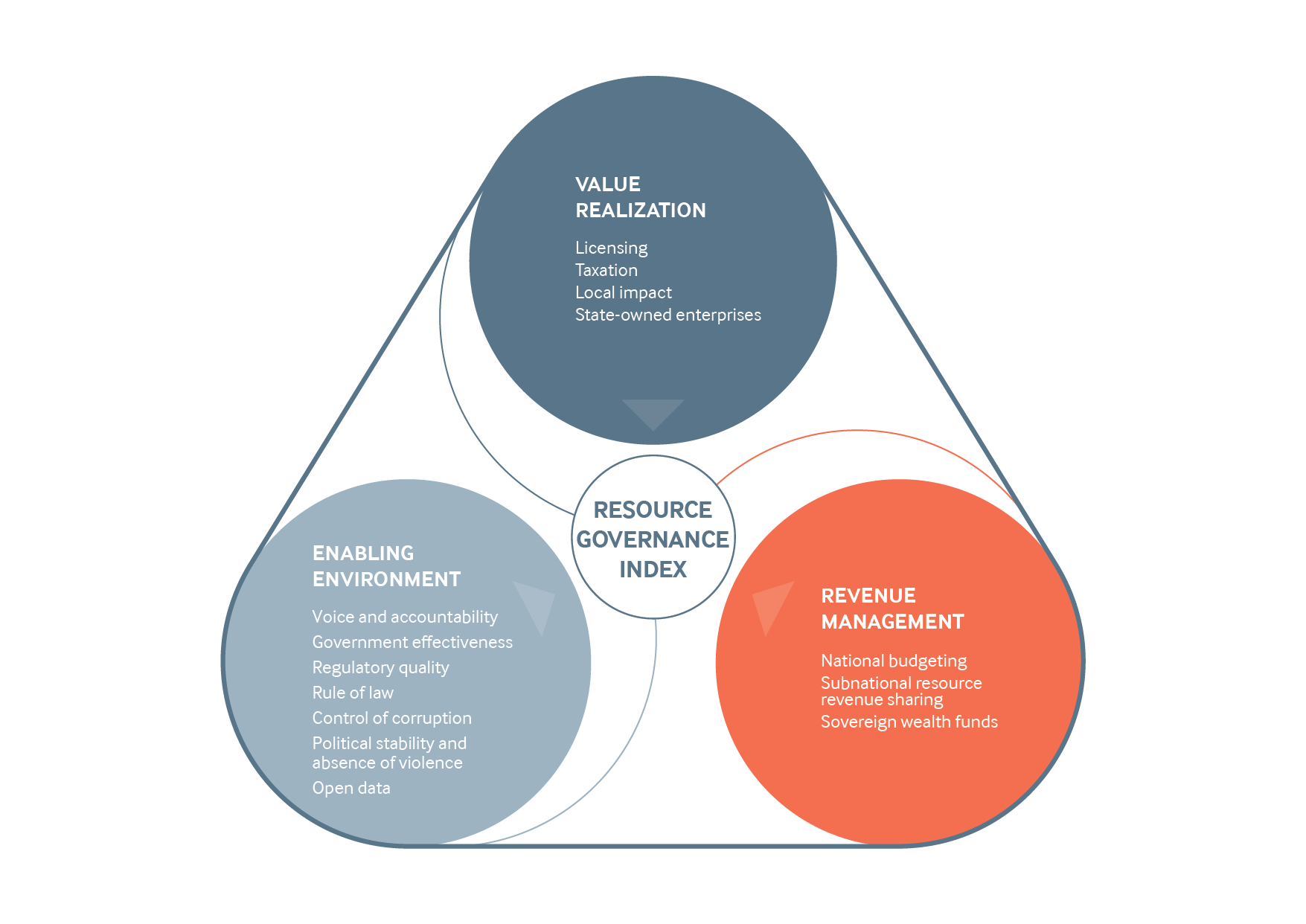
The composite or RGI score is made up of three components. Two measure key characteristics of the extractives sector – value realization and revenue management – and a third captures the broader context of governance — the enabling environment. These three overarching dimensions of governance consist of 14 subcomponents, which comprise 51 indicators, which are calculated by aggregating 136 questions.
This edition’s narrower country focus will allow us to prioritize the translation of the RGI findings into more tangible impact through individualized country programs, which will include public events as well as strategic stakeholder consultations and ongoing engagement with governments, parliaments, civil society partners and the private sector.
We hope that the 2021 Resource Governance Index will provide key change-makers with the tools to advocate for more transparency, accountability and drive reform in the resource governance sector. We look forward to engaging with partners to discuss the findings and move directly to improvements in governance of these crucial commodities.
From Data to Impact: Ensuring Extractives Data Serves Citizens in Eurasia

Some have assumed that disclosure of data automatically implies oversight pressure on government and business stakeholders, which in turn leads to accountable behavior by these actors. But experience has shown that this once-presumed cause-and-effect chain is not linear. A much more complex set of conditions must exist in harmony to produce tangible governance results. These conditions range from the existence of democratic institutions to the capacities of the oversight actors involved. Important international platforms such as the Extractive Industries Transparency Initiative and Open Government Partnership help to create transparency “pockets” by promoting universal rules and standards, but in general, these efforts do not have a spillover effect and have not led to systemic change in Eurasian countries. The work does however lead to more active results-oriented dialogue among stakeholders; it’s absolutely necessary, yet insufficient on its own.
PWYP and NRGI have engaged in discussions with civil society partners in Eurasia to identify a roadmap for continuing the journey from data disclosure to tangible use of data for improving natural resource governance in the region. In addition to further develop the capacity of civil society experts to analyze data, actual demonstrations of how data can be used to demand accountability will help to narrow the gap. PWYP Eurasia therefore established the Eurasia Data Working Group, which in turn spurred the creation of pilot data analysis projects in Kazakhstan, the Kyrgyz Republic and Ukraine.
Through these projects, researchers have used publicly available data to pinpoint concrete governance flaws and generated recommendations for stakeholders. The authors of the analyses aimed to establish a clear link between data and tangible governance results, and focused on governance challenges at the subnational level. Narrowing the focus and scope of the analysis to a very specific and relatable governance shortcoming is the most important aspect of this work. These cases clearly demonstrate the role of data disclosure in creating practical and robust recommendations for concrete governance improvement, and pave the way for substantive dialogue among stakeholders.
Each of these pilot analyses will contribute to the advocacy strategy of the local PWYP coalitions and can serve as one of the civil society tactics to be used more broadly in the Eurasia region and beyond.
View the reports:
Социальные платежи компании ССГПО (Соколовско-Сарбайское горно-обогатительное производственное объединение, г. Рудный, Костанайская область), Civil Expertise, Kazakhstan (English Summary)
Экологические платежи недропользователей и природоохранные мероприятия, реализуемые за счет бюджета, ECHO coalition, Kazakhstan (English Summary)
Анализ реализации социального пакета на объектах недропользования общего государственного значения: Таласская область, Кыргызская Республика, PWYP Kyrgyzstan coalition (English Summary)
Impact of financial (rent) payments from the extractive industry for the local community development (on the example of two pilot communities from different regions of Ukraine), Local Economic Development Agency of Yavoriv District, Ukraine (Summary)
Newly Implemented Law Gives Mongolians Visibility Into State Mining Companies

Монгол »
In 2020, Mongolian citizens received dividends from Erdenes Tavan Tolgoi, a state-owned coal miner, after many years of holding a part of the shares in the company. This showed that citizens can directly benefit from extractive state-owned enterprises (SOEs). However, this case was an exception rather than regular practice, as many SOEs are running at losses, have been involved in corruption scandals, and have accumulated debts at alarming rates (as much as 40 trillion tugrugs, or around the country’s gross domestic product). SOE governance issues have been at the top of the policy agenda for some time and the parliament is planning to discuss and amend the State and Local Property Law which regulates SOEs.
To contribute to the reforms, NRGI published an independent assessment of Erdenes Mongol, the state-owned company that controls major mining and mining linked projects in Mongolia, in June 2019. Our findings led us to recommend that the company increase its transparency, including by improving its compliance with Mongolia’s Glass Accounts Law. Adopted in 2014, this law sets information disclosure requirements for government entities, including SOEs; the information is disclosed through a centralized data portal along with the individual companies’ websites.
Specific disclosure requirements differ for various types of SOEs. At a minimum, SOEs must disclose their procurement plans and reports. Fully state controlled companies must disclose a host of other data including annual budgets, procurement-related tenders, audit reports, borrowing and information on staffing. Most importantly, they must disclose detailed data on individual cash transactions above the relatively low threshold of five million tugrugs (approximately USD 1,750).
This transparency law had been poorly implemented until 2020. Perhaps in relation to increasing involvement of SOEs in major mining projects, the new government heard calls from the opposition and civil society actors for improved implementation of the law. Many companies started adding thousands of records to the data portal. We at NRGI supported the Council for Sustainable Development and Social Responsibility (CSS) to monitor compliance by mining SOEs. The CSS’ work confirms that, despite some problems, the level of disclosures by SOEs picked up significantly.
The disclosures can be illuminating. Some of the biggest SOEs in mining—such as Erdenes Mongol, copper producer Erdenet, fluorspar and gold miner Monrostvetment, and the country’s largest coal producer, Erdenes Tavan Tolgoi—have made their financial and operational information public, many of them for the first time. Mongolian citizens now have unprecedented visibility into the financial performance of the top mining companies; they can learn about who buys from the companies, who the companies’ biggest suppliers are, and the sheer size and variety of SOEs.
Citizens’ interest in SOE disclosures through the Glass Accounts Law has added to the momentum. After it was revealed that an SOE paid for a manager’s children’s school tuition, this led the former manager (who is now the current minister of mining and heavy industry) to repay the company. Another SOE announced that it would scrap plans to purchase a luxury Lexus SUV in response to public outrage. These cases demonstrate the value of such disclosures and the importance of informed citizenry. However, as thousands of records become available, finding relevant information may be made difficult by many factors, and a few scandals made public might likely be the tip of the iceberg.
In a recent report, NRGI notes that spending on suppliers in the extractive industries is a major financial flow worth many hundreds of billions of dollars a year globally. At this scale, it substantially affects how much profit and taxable income the extractive industries generate and provides an important opportunity for countries to build local content. It also presents a possibility for corrupt interests to profit.
To grasp this opportunity and mitigate corruption risks, citizens and the government of Mongolia should make the most of Glass Accounts, which is an important gain in transparency. The government making the data simple and easy to analyze is the first step, according to CSS’ monitoring. Using machine-readable formats to collect and disclose data on the Glass Accounts portal will reduce data entry mistakes, and allow users to easily analyze across companies and periods. Civil society organizations and government agencies should also dive deeper into this extensive new data to promote accountability, improved governance and increased performance of SOEs. For this purpose, citizens and officials alike should hone their skills to analyze data; they can do this by improving data visualizations of the portal and by offering training and tools for data analysis, especially for civil society and media representatives who focus on SOE governance issues.
Enhanced data analysis and deeper dives into the trove of available information will serve to inform policy reform decisions on SOEs, which is on the agenda of the current parliament. The data will allow to further discussions on policies related to financing and debt positions of SOEs, and their procurement and sales systems—reforms which would improve the benefits of SOEs for the citizens of Mongolia. Advocates of improved SOE governance in other countries, as well as participants in efforts like the Extractive Industries Transparency Initiative, could also take note of Mongolia’s innovation.
It’s Time to Talk: Sonatrach and the Energy Transition in Algeria

العربية »
This post is part of the "Resource Governance and the Energy Transition" series.
Last week Algerian football supporters attacked the headquarters of Algeria’s national oil company, Sonatrach. They were angry at the company, accusing it of not paying the salaries at Mouloudia d'Alger, the football club it owns. The attackers blamed this state of affairs for the average results of the club in the Algerian league.
If Algerians can be so angered by poor football performance, imagine their wrath when Sonatrach’s revenues decrease because of the global changes affecting the oil and gas sector. Such a downturn could mean that the company will be unable to continue to play a pivotal role in the economy of Algeria. We are entering an era of energy transition where resource-dependent countries, their state-owned companies and their populations need to prepare, get fit and build a strategy that will help them win the competition.
The coronavirus pandemic accelerated many trends that were already underway, including the energy transition away from fossil fuels toward renewables. The faster this transition, the more it threatens national oil companies and governments reliant on oil revenues—unless they prepare well.
Governments of Middle Eastern and North African (MENA) countries that rely on oil and gas for revenues cannot ignore the global march toward clean energy; they must react and secure a stable future for their citizens. To that end, we at NRGI have produced a new briefing, “National Oil Companies and Energy Transition in the Middle East and North Africa” (a companion piece to the report Risky Bet: National Oil Companies in the Energy Transition). Algeria’s Sonatrach is one of three MENA NOCs that we examine, along with Qatar Petroleum and Saudi Aramco. And it appears to be most vulnerable to the accelerating energy transition.
Algeria, the largest oil and gas producer in North Africa, is heavily dependent on hydrocarbons for exports and government revenues, with oil and gas accounting for 60 percent of government revenues. Sonatrach controls over 75 percent of the country’s hydrocarbon production; it is the cornerstone of the economy, which makes it crucial that Sonatrach management and government officials heed global shifts.
A new corporate strategy?
National oil companies with dwindling proven reserves and a heavy share of high-cost geological assets among their potential future portfolios face serious possibilities of “stranded investments,” and could struggle to maintain expected production volumes, revenues and transfers to state treasuries. NRGI analysis shows that national oil companies in the MENA region could invest more than $66 billion in oil and gas projects that would not break even if the world keeps to its climate commitments. Sonatrach’s portfolio is the most vulnerable in this regard, with $12 billion in project spending (more than 25 percent of the company’s budgeted capital expenditure) slated for projects with a break-even price between $40 and $70.
Alongside the prospect of investing in high-cost projects, Sonatrach must continue to supply the ever-growing domestic demand for natural gas, which is sold to citizens at subsidized prices, thereby reducing the share available for revenue-generating exports. These challenges reverberate through the company’s portfolio, limiting access to finance and partnerships that would aid its diversification.
Sonatrach’s current approach to mitigate this uncertainty largely revolves around a shift to liquefied natural gas (LNG). This includes investing in existing and new LNG projects to diversify its gas export portfolio. The success of this approach hinges on the availability of domestic reserves and technology to unlock gas at a competitive cost—and on whether the demand for gas holds up or yields to increasingly cheaper renewable energy. In addition, Sonatrach must demonstrate commercial abilities to become an LNG trader (not just a supplier), expand internationally to secure a flexible and diverse portfolio, and harness financial resources to take positions in the gas value chain. However, we know that Sonatrach had to halve its spending in 2020 due to the collapse in the oil price, at the time limiting its capacity to expand into growth markets such as chemicals and plastics.
State of the government-Sonatrach relationship
Alongside the Algerian government, Sonatrach, like many national oil companies, shoulders significant financial responsibility for the wellbeing of citizens. Reduction in oil and gas revenues increases this pressure. So beyond the company’s business and investment strategies, the government of Algeria must reexamine the fiscal relationship between Sonatrach and the state, as long-held expectations about available fiscal transfers (of taxes, dividends and other payments by the company to the government) may be unmet. The International Monetary Fund (IMF) estimates Algeria’s fiscal break-even price—the oil price necessary in order to meet expected spending while balancing the national budget—at $92 per barrel. That figure increases monthly, and more so amid the pandemic. Based on the new budget, Sonatrach seems likely to set the price of oil at $135 for the barrel to break even fiscally—a price which is unlikely to materialize anytime soon (or possibly ever). This contrasts with many oil companies and analysts assuming the oil price for the next few decades will average $60 a barrel. Even as the pandemic abates, low oil prices are likely to prevail and price spikes will be the exception. Therefore, the government end its dependency on Sonatrach and seek new sources of cash.
Let’s talk energy transition
Sonatrach lacks funds and low-cost reserves and therefore will be less resilient to declining prices than the regional giants Saudi Aramco or Qatar Petroleum. It is therefore imperative for Sonatrach to conduct rigorous risk analysis around capital allocation decisions. Ultimately, both the government and Sonatrach must re-examine the company’s conventional assumptions about public expenditures, and the government must clearly define and explain to citizens the institution’s role in the country’s energy transition.
As profit margins shrink across the industry there is less margin for error, and so efficiency and integrity are more important than ever. Sonatrach should redouble its investments in transparency and corporate governance reform.
Already, Sonatrach has recently taken steps to improve its governance and transparency. In the 2017 edition of the Resource Governance Index (RGI), which assessed performance using 2015-2016 data, Sonatrach scored 47 out of 100 possible points, ranking 31st out of 52 assessed state-owned enterprises, a performance considered “weak” by the RGI. In a 2020 interim RGI assessment, Sonatrach scored 65 points out of a possible 100, which indicates an increase of 18 points and a transition from the weak to satisfactory performance band. That is a positive evolution that should continue.
Finally, the Algerian government and Sonatrach should create an inclusive space for the public to engage with government officials and company staff on the impact of energy transition on the country’s oil and gas sector. Together all stakeholders should debate solutions to the challenge presented by the shift to clean energy—citizen-oriented solutions.