
Supporting EITI to Strengthen Global Extractives Governance Standards

The Extractive Industries Transparency Initiative (EITI) is a global standard for open and accountable management of oil, gas and minerals, led by a coalition of government, companies and civil society. NRGI was instrumental in the founding of EITI and several NRGI staff have since served on its board. NRGI leads advocacy efforts and provides technical expertise to expand EITI’s disclosure norms. NRGI experts supported the development of the EITI Civil Society Protocol, help shape EITI policies, lead the formulation of EITI’s approach to climate risks and the energy transition, and support accountability actors to analyze EITI data to inform reform.
NRGI helps countries leverage EITI processes and norms to advance broader policy reforms—e.g., contract and beneficial ownership transparency in Ghana and state-owned enterprise reforms in Guinea, Indonesia, Mongolia and Myanmar.
NRGI also uses its technical expertise and cross-stakeholder credibility to lead the negotiation and drafting of the most complex EITI Standard provisions.
NRGI’s EITI interventions have so far resulted in the requirement of:
- 21 new countries to start disclosing extractives contracts from 2021 onwards
- 40+ new countries to start disclosing project-level payments from companies to governments
- SOEs in 35 countries to expand disclosures to include transfers, retained earnings, reinvestment and third-party financing information
- EITI reports in over 50 countries to disclose material environmental payments from companies to governments, and employment data disaggregated by gender.
Going forward NRGI will ensure impactful implementation of these new requirements, and continue to ensure that national innovations shape global policy improvements.
The Resource Governance Index Drives Reform

The RGI has compelled governments to improve their performance. Guinea’s Ministry of Mines and Geology engaged closely with NRGI to change the governance of the mining sector, leading to the publication of the first RGI interim evaluation, which highlights areas in which Guinea has improved since the 2017 edition was released. The Guinean government made many disclosures as a direct result of the RGI’s findings.
In Tunisia, RGI findings led the Tunisian state-owned enterprise (SOE), la Compagnie des Phosphates de Gafsa (CPG), to engage with NRGI staff to understand its 2017 RGI score, which is notable given the traditional reluctance of Tunisian SOEs to engage with civil society actors. As a result of this engagement CPG has begun to disclose phosphate revenue information on its website.
In Azerbaijan, NRGI was asked to provide analysis to the ministry of finance, the state oil company and the state oil fund on how to improve the country’s rating for the next iteration of the RGI. NRGI recommendations helped inform the basis of a transparency report prepared by auditing firm Baker Tilly for Azerbaijan’s Commission on Transparency in the Extractive Industry.
Qatar Petroleum, the national oil company of Qatar, approached NRGI regarding its RGI score. The company’s general counsel met with NRGI to discuss ways to improve performance and NRGI advised the SOE to publicly disclose annual and sustainability reports. Subsequent to the meeting, Qatar Petroleum published annual and sustainability plans for the past 14 and eight years respectively, for the first time, on its website.
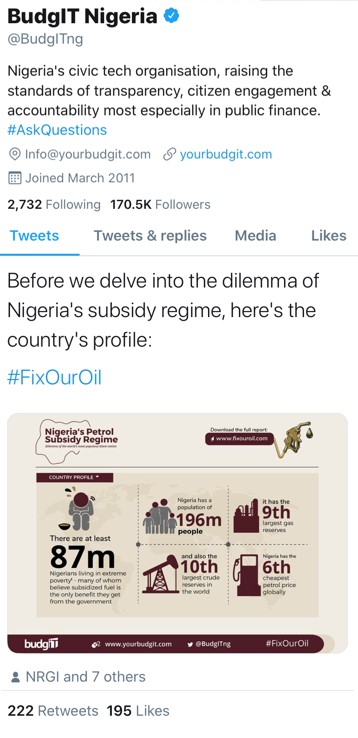
Civil society organizations and journalists in dozens of resource-rich countries have used RGI data to diagnose governance successes and shortcomings. In Nigeria, BudgIt used the RGI to support advocacy around contract transparency and the governance of the SOE NNPC by creating infographics and sharing them through social media channels. In Ukraine, Dixi Group used the RGI to support its advocacy around the development of the “Law on Ensuring Transparency in the Extractive Industries,” which was then passed. Newspapers from Mexico to Myanmar have referenced the RGI in articles about resource governance. In these instances, the most relevant findings are translated into pertinent, accessible messages for a country’s citizens.
Using RGI data, NRGI found that in all but two African countries, there is an “implementation gap” between what laws say and how resource governance works in practice. This insight, and others uncovered in the report, have provided a further foundation from which to engage our stakeholders in Africa, and globally. The index data have been leveraged in research by the United Nations Economic Commission for Africa on the state of African governance, referenced in a Swiss federal council report on gold trade and human rights violations and used in a study on the state of extractives disclosures by the European Commission.
The RGI is also a resource for the private sector and investors. Morgan Stanley’s emerging markets bonds group has begun using the RGI to assess potential investments in resource-rich countries. In at least one instance, the group used RGI findings to inform discussions with a resource-rich government in which they are considering investment. Further, multinational investment bank Citi reported using RGI data extensively for the bank’s environmental, social and governance work.
Supporting Social Media Debates About Nigeria's Oil Sector
Social media have become important channels for Nigerians to simply and quickly exchange information about the governance of the country’s critically important oil sector. NRGI has provided support to organizations that are pioneering ways to make resource governance content more easily digestible and actionable, including on social media. This support has taken the form of grants to BudgIT (with more than 165,000 Twitter followers) and capacity building for staff of the Nigeria Extractive Industries Transparency Initiative (NEITI).
The Nigeria National Petroleum Corporation (NNPC) regularly publishes reports detailing its finances and operations. Using NRGI funding, BudgIT staff translate NNPC reports and other oil sector-related publications into simple infographics. With NEITI, NRGI’s media development team provided curriculum development support to help create a framework for a social media influencers’ capacity development strategy.
The #FixOurOil hashtag has become a digital forum for debates around the sector, with much of the discussion initiated and informed by BudgIT and NEITI content. Gabriel Okeowo, BudgIT’s principal lead, says that “with NRGI’s support, BudgIT has been able to reach over 5 million Nigerians via digital and physical channels.” And with BudgIT’s support, NEITI trainees acquired skills for developing tools such as short videos and infographics.
Massive and Misunderstood: Data-Driven Insights into National Oil Companies
- National oil companies (NOCs) produce the majority of the world’s oil and gas.They dominate the production landscape in some of the world’s most oil-rich countries, including Saudi Arabia, Mexico, Venezuela and Iran, and play a central role in the oil and gas sector in many emerging producers. In 2017, NOCs that published data on their assets reported combined assets of $3.1 trillion.
- At least 25 countries are “NOC-dependent,” meaning that the national oil company collects revenues equivalent to more than 20 percent of all government revenues. The fiscal health of many countries – and governments’ ability to use oil revenues to finance development – depend heavily on how well the NOC is run, how much revenue it is required to transfer to the state, and the quality of its spending.
- Many NOCs carry big debts, sometimes as much as 10 or even 20 percent of their countries’ GDP. Several NOCs have required multi-billion-dollar government bailouts in recent years, becoming a costly drain on public finances.
- Sixty-two percent of NOCs exhibit “weak,” “poor” or “failing” performance on public transparency, as measured by the Resource Governance Index. International transparency actors should promote better NOC reporting on expenditures, transfers to the government and the breakdown of oil and gas production from different sources. NOCs and their governments should develop key performance indicators based clear goals, and benchmark rigorously.
- NRGI’s National Oil Company Database, available at www.nationaloilcompanydata.org, provides the largest set of open data on NOC production, revenues, spending and transfers to government in the world, with more than 70,000 data points from 71 NOCs worldwide from 2011 to 2017.
National oil companies (NOCs) produce the majority of the world’s oil and gas, pumping out an estimated 85 million barrels of oil equivalent per day. Within their home countries, NOCs influence the degree to which billions of people benefit (or suffer) from their countries’ hydrocarbon assets. Many of these companies manage multi-billion-dollar portfolios of public assets, execute complex projects across their territories and at sea, employ citizens in the tens or hundreds of thousands, and perform a range of public services from providing energy to building infrastructure. Despite their importance, NOCs are poorly understood thanks to weak and uneven reporting, sparse research, and an absence of publicly available comparative data.
Without solid information, governments, oversight bodies and market players struggle to assess NOC performance and develop strategies for how these influential entities can generate greater benefits for citizens.
To help address this gap, Natural Resource Governance Institute (NRGI) assembled a database on NOC production, revenue generation, fiscal transfers to the state, and operational and financial performance that covers 71 companies headquartered in 61 countries worldwide, from 2011 to 2017. The database resides at www.nationaloilcompanydata.org.
This report explores key findings from analysis of the data.
Read the press release. Watch the trailer. Use the database. Access the R code behind the analysis.
Dive into the data
NRGI's National Oil Company Database compiles information crucial to understanding these underanalyzed players in markets and the energy transition.
Contract Disclosure Secured in Tunisia
The challenge
Since Tunisia’s 2011 revolution, governance of the country’s oil, gas and mining sectors has transformed from a taboo subject to one at the heart of reform discussions.
The extractives sector is viewed with considerable skepticism: information on reserves, rights allocation, resource revenues and their management has been historically scarce. Increasing awareness of and access to information on natural resource governance issues are priorities for many actors in the young democracy.
The government’s disclosure of extraction contracts struck with companies—an important starting point for those who seek to understand natural resources in Tunisia and elsewhere—is a step toward building trust in a clouded sector. Bringing this disclosure about in Tunisia required the involvement of international initiatives and the participation of many Tunisian stakeholders, from government of officials and civil society organizations to parliamentarians and journalists.
NRGI's role
NRGI has pursued various lines of simultaneous work to boost transparency and accountability in Tunisia.
Supported by NRGI, Tunisian civil society had pushed, ultimately unsuccessfully, for a contract disclosure provision in the 2014 constitution. This set the stage for what came next.
In 2014, NRGI and local partners launched a media platform in Arabic on the extractives sector in Tunisia, which boosted the sector’s visibility. The site is now managed, administered and populated by journalists trained by NRGI. It includes training materials, monthly quizzes and other key resources.
NRGI conducted workshops with 16 civil society organizations from different regions on extractive contracts; potential benefits of and constraints on disclosure; the relevance of access-to-information laws; and international experience with contract disclosure. The training helped shape dialogue and civil society advocacy positions.
In parallel, Tunisian authorities sought to strengthen their own knowledge. Lawmakers and their staff were keenly interested in international experience with contract disclosure, particularly with respect to issues such as confidentiality clauses and the disclosure of “sensitive information.” The Ministry of Energy and Mines and the legal department within the prime minister’s office reached out to NRGI to convene a discussion around contract publication. In March 2016, with NRGI’s help, representatives from relevant government ministries, the national oil company, parliamentarians, the anticorruption authority and civil society organizations participated in a roundtable discussion.
Official response followed: in April 2016, the country’s anticorruption authority joined the strong and growing call for contract disclosure.
In June 2016, NRGI released a report previously shared with government decisionmakers that detailed five steps toward disclosing oil, gas and mining contracts.
Impact
Following years of multi-stakeholder work, and concurrent with the report’s release, Tunisia’s government in June 2016 published 50 of the country’s oil contracts, and shortly thereafter announced second-level contract disclosures. As of January, 157 resource-related contracts had been released, along with annexes.
These releases were important milestones in a broader campaign for extractive sector transparency in the country. It was the most visible of many tangible gains, but the process was incremental, and intensely collaborative.
The government’s actions can be understood, at least in part, as a response to civil society players supported, trained and enabled by NRGI and peer organizations.
Anyone should be able to use contract data, and many Tunisian stakeholders require training. Institutionalizing pro-transparency measures so that they last longer than a single administration is equally important. NRGI is issuing a grant for civil society to research these contracts, with the resulting analysis due for publication mid-2017.
A website that provides an open data platform for disclosed resource contracts was launched in October 2016, and NRGI is training media and civil society actors to parse the contents. The 129 hydrocarbon investment contracts and associated documents published on the site initially lacked summaries of key contract terms. In December 2016, the Columbia Center on Sustainable Investment, an NRGI partner, trained two Tunisian legal experts on the annotation process.
This systematic national approach to contract transparency is a first for Tunisia and the Middle East and North Africa region. In addition to the obvious transparency impact, many involved foresee a governance impact, addressing broader mistrust within and between Tunisian society and government. Highly polarized and divided political rivals have taken up the cause of transparency, and recognize that natural resource governance is essential for ensuring a prosperous, democratic Tunisia.
Much work remains on contract transparency and disclosure in Tunisia. But advocates now have a firm foothold.
2013 Resource Governance Index
Extractive Company Disclosure of Project-Level Greenhouse Gas Emissions is Critical

Climate change and the transition to a low-carbon economy present the citizens of oil-, gas- and mineral-producing countries with both risks and opportunities. The reality is that extractive projects that emit high quantities of greenhouse gasses (GHGs) as part of their operation will become less competitive, risking that some investments will become “stranded”—i.e., economically unviable. But the Extractive Industries Transparency Initiative (EITI), a global standard for the good governance of natural resources, can play a crucial role in preventing this outcome.
Civil society organizations as well as some EITI member governments are therefore asking oil and mining companies to disclose granular, project-specific greenhouse gas (GHG) emissions data. With this information, governments can plan for the risks that the energy transition will bring to projects in which they have invested a significant amount of public finance, and citizens groups can exercise oversight of government decisions.
While the energy transition is imperative, in the near term it will have significant implications for government revenues, jobs, and business opportunities, and these must be better understood. And for that, GHG data are essential. Among all climate risk disclosures, GHG emissions are a top priority (even though there are other key disclosures as well, such as information about reserves).
Many oil and gas companies have so far resisted demands from the public and investors for more meaningfully detailed GHG disclosures, claiming that they already disclose GHG emissions data through multiple evolving disclosure initiatives. Granted, many large publicly listed extractives companies publish GHG emissions data in their own sustainability reports or through the CDP, a disclosure system for climate change information.
Most of these disclosures meet voluntary market-led standards including the recommendations of the Task Force on Climate-Related Financial Disclosures (TCFD), or the Sustainability Reporting Guidance for the Oil and Gas Industry. Moreover, governments and regulators, including the EU and the U.S. Securities and Exchange Commission, are taking steps to mandate these disclosures, while the newly formed International Sustainability Standards Board (ISSB) is developing a new set of standards to serve as a “global baseline,” with high-level backing from the G7, the G20, and finance ministers and central bank governors from over 40 jurisdictions.
But these emerging initiatives do not meet the data needs of key stakeholders; nor is the dissemination, public use, and impact of such disclosures by any means assured. The emerging disclosure architecture for GHG emissions is largely investor-focused. And while company-wide figures can help investors, these data are practically useless for government officials and citizens who seek to understand how company risks and opportunities impact specific jurisdictions and communities. For this they need project-level data.
Such granular detail would also aid investors, allowing them to see precise risks within asset portfolios. For example, project-level emissions data in Repsol’s 2021 CDP disclosures showed that one asset, the PM3 oil field in Malaysia, produced as much as 31 percent of the company’s annual scope 1 emissions in 2020. Project-level data also allows investors to understand how companies work to address their emissions. Repsol sold PM3 in 2021, a potential example of how companies may be using asset transfers to make questionable progress toward their emissions reduction targets. Acknowledging this trend, non-profit organizations Ceres and the Environmental Defense Fund recently recommended asset-level emissions disclosure as part of a set of climate principles for mergers and acquisitions in the oil and gas sector. They developed the guidance in consultation with a range of asset managers, private equity firms, banks, and oil and gas companies.
Civil society and government advocacy for project-level reporting of GHG emissions for oil, gas and mining companies has recently focused on EITI. Including such a provision in the EITI standard makes eminent sense for three reasons.
First, EITI is an extractives-specific governance standard, and this is an extractives-specific governance issue. Second, EITI focuses on government and company disclosures that policy makers and citizens can use—precisely the stakeholders that the evolving investor-focused initiatives have left out. And these EITI disclosures tend to be granular, often when relevant at the project level. Third, and perhaps most importantly, EITI has an advanced participatory implementation structure that supports national-level discussion and engagement between companies, governments and civil society—which the existing disclosure initiatives for GHG emissions reporting do not provide.
Company executives have suggested that bringing GHG emissions reporting into EITI could be duplicative. But it need not be. Among other sources of data, the EITI generally accepts routine disclosures through official websites, journals or publications. This means that most companies could comply with an EITI GHG disclosure guidance by simply adding a project-level breakdown to the GHG reporting they already make through the CDP or their own sustainability reports.
In fact, of the 10 exploration and production companies represented on the global EITI board, three—Anglo American, BHP and Newmont—do this already; while a further three—Equinor, Kosmos Energy and Royal Dutch Shell—provide country-level data that in some instances is close to project-level in detail. For these companies an EITI recommendation for project-level reporting would simply level the playing field, bringing the practices of less-forthcoming companies up to their high standards. Importantly, this would include national oil companies and privately held companies, which fly under the radar of most international reporting standards, but not EITI.
Members of the EITI board—including representatives of rich countries supporting the initiative, emerging countries, industry and civil society—are deciding on a new EITI standard which will govern the initiative for at least the next three years. They owe it to citizens and policymakers in producing countries, to investors, and to the future of the planet to ensure meaningful transparency about GHG emissions. It is time for disaggregated data disclosures of GHG emissions in EITI.
Photo by bhumann34 for Pixabay
The EITI Standard now promotes GHG emissions disclosure by companies for the first time.
National Oil Company Database Update: How Did NOCs Respond to the 2020 Price Decline?

On 18 May, NRGI published the latest update of the National Oil Company Database, a free website that provides standardized and contextualized data on 71 national oil companies (NOCs), covering production, revenues and spending. NRGI updates the database semiannually—in May and December—using information published in official company or government reports.
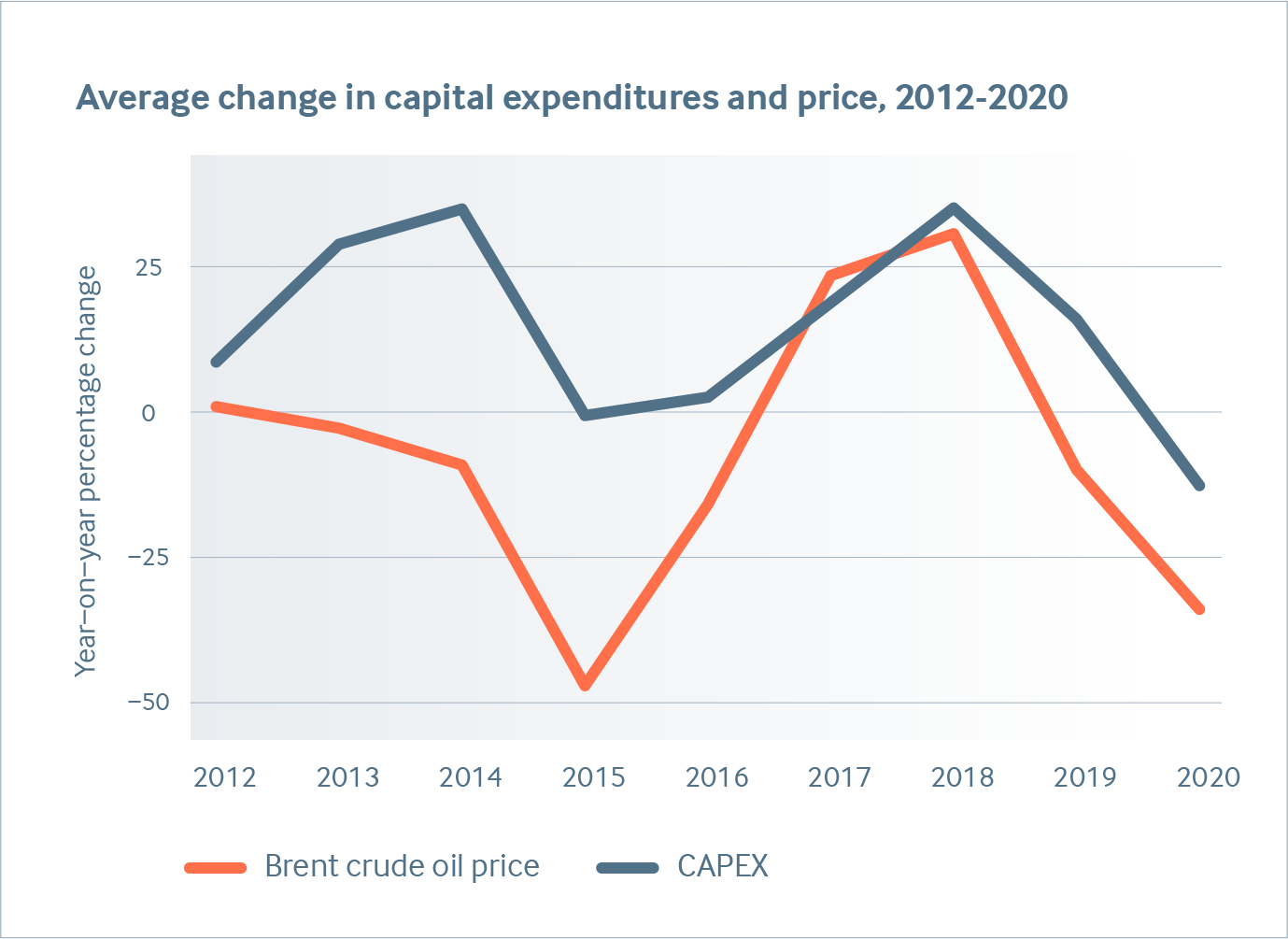
With data now extending through 2020 for most companies and through 2021 data for nine others, NRGI has examined how NOCs responded to the sharp decline in oil prices in 2020 in this infographic. Since the lows in 2020, prices have climbed throughout 2021, reaching record highs this year. However, the way NOCs responded in 2020 may indicate how companies will—or won’t—change course in the face of the longer-term market decline anticipated as the energy transition unfolds.
As expected, financial transfers from NOCs to governments declined in 2020, reaching a new low for the decade covered by the database (2011-2021). However, this is not to say that contributions were not significant: transfers from NOCs accounted for well over 50 percent of the $600 billion governments collected from upstream oil and gas extraction in 2020. In terms of spending, NOCs appear to be increasingly reactive to market conditions, as our analysis shows a clear reduction in NOC capital expenditures in 2020. During the previous price decline in 2015, NOC investment growth stalled but didn’t drop (on average).
The energy transition could result in hundreds of billions of dollars of NOC investments in new projects becoming stranded, so it is particularly concerning that many companies remain opaque. For 2020, total revenue information is absent for around half of NOCs, as some do not report at all and others report with significant delays. Also notable absences in this update are Russia’s state-owned enterprises, Rosneft and Gazprom. Their annual reporting would typically be out by this point in the year, and while some news outlets have reported profit data, we have not been able to access any official reports for 2021.
In this round of data collection, we found a few large NOCs (Petrobras, Ecopetrol and Equinor) disclosing capital guidance on planned investments for decarbonization initiatives. This information is crucial to analyzing the energy transition pathways of national oil companies and we will continue researching decarbonization spending to include historical data as an indicator in future editions.
NRGI is using the National Oil Company Database extensively in its research and work on national oil companies and the energy transition. The purpose of the database is to advance public knowledge, and my NRGI colleagues and I find it encouraging to see the database being utilized as a resource in the production of vital research on the future of fossil fuel production such as the Production Gap Report, the EBRD’s Transition Report, and the Environmental Defense Fund’s Transferred Emissions report.
We designed the database with the researcher and data analyst in mind. The website provides several options for downloading data, a repository of original sources, and R code for analysis. Anyone utilizing the National Oil Company Database should contact us at nocdata@resourcegovernance.org with any questions or suggestions.
The next update of the National Oil Company Database is scheduled for December 2022.
The Resource Remix: Suneeta Kaimal and Joseph Asunka Discuss Democracy and Natural Resources in Africa in New Podcast

In this debut episode, available on Apple Podcasts, Google Podcasts and Spotify, NRGI president and CEO Suneeta Kaimal is joined by Afrobarometer CEO Joseph Asunka. Afrobarometer conducts public attitude surveys on democracy, governance, the economy and society in more than 30 African countries.
NRGI · The Resource Remix - Episode 1 - Democracy and Natural Resources in Africa
During their conversation, Kaimal and Asunka explore the importance of citizens’ voices in key decision-making processes, what the energy transitions means for Africa, and the challenges corruption continues to pose to governance and sustainable development.
Asunka shares how Afrobarometer documents the different ways that ordinary people engage with their governments and leaders. Survey findings have shown that those surveyed see corruption as a persistent and major problem, which has increased over time, and worsened due to the ongoing pandemic and restrictions brought to contain the virus.
They discuss the importance of going beyond having strong governance and transparency policies and frameworks, noting a lack of implementation across the continent, as underlined by NRGI’s 2021 Resource Governance Index. Both agree that, without available information, civil society organizations and citizens are unable to monitor how resources and revenues are managed, especially in the context of narrowing civic space and the increasing pace of the energy transition. They also discuss recent political transitions in Sudan and Guinea.
Both note that addressing these key issues requires strong partnerships and collaboration, continued transparency and more work towards accountability, leveraging on recent advances in areas such as contract transparency and beneficial ownership.
Transcript
Suneeta Kaimal, NRGI: Thank you all so much for joining the first episode of The Resource Remix, the new podcast from the Natural Resource Governance Institute. We bring listeners dynamic perspectives on the cutting-edge issues affecting countries rich in commodities, from cobalt to natural gas to lithium. The need to transition to a post-oil future and the pandemic present these countries with a range of unique challenges and opportunities.
Please join us for future episodes in this series as we talk with some of the most innovative thinkers and practitioners seeking to shine a light on ways forward in this most critical and fascinating time.
I am Suneeta Kaimal. I have been with NRGI for more than a decade and now have the honor of serving as its president and CEO. I may be a veteran of NRGI, but this is the first time I am hosting a podcast, so please go easy on me.
Our guest today is Joe Asunka whom I have had the pleasure of knowing now for eight years. We met when Joe was part of the Global Development and Population program at the Hewlett Foundation, which is one of NRGI’s founding funders. He recently returned to his native Ghana, where he is now CEO of Afrobarometer. Joe welcome, and thank you so much for joining me in this first episode.
Joe Asunka, Afrobarometer: Thank you Suneeta, and really, thank you for having me on your first episode, I am really grateful and honored.
SK: It’s a pleasure to have you. So let’s just start with a question for the listeners who may not be that familiar with your organization. Can you tell us a little bit about Afrobarometer, and what its mission is?
JA: Thanks for the question and thanks to your listeners for the opportunity to share with you what Afrobarometer is and what we do. Afrobarometer is an African network of research organizations that conducts public opinion and public attitudes surveys across the continent.
And, as the name implies, at Afrobarometer we’re trying to measure something, measuring people’s attitudes opinions about issues of governance, the economy, quality of life and civic engagement, among other things.
We are currently working in about 30 plus countries. And for each round of the survey, we started in 1999. So we’ve been two decades into it now, and we have done eight rounds of the survey. Each survey takes about two years to complete.
We just completed the eighth round in 34 countries, and we have just started to launch the ninth round of the surveys. It is in the ninth round that we want to be able to get up to 40 countries and hope that coverage would give us more leverage in terms of engaging more with African leaders, especially at the regional level, in bringing people’s voices to inform policymaking.
The core mission for the Afrobarometer is that we believe that people’s voices matter when it comes to policymaking, because decisions about policy and development are all about the people, and we think we need to put people at the center of all those decisions to ensure that their priorities, their preferences, and what they experience daily in their lives, is reflected in what leaders do in policies.
SK: Thanks, I couldn’t agree more. I think in many ways, coming off of the spike of the pandemic and dealing with so many economic, political and social upheavals around the continent and around the world, being able to hear that voice of the people is more important now than ever before.
I’m curious, given how many surveys you conduct, if you could talk a little bit about what you think one of the most interesting survey findings is of late, and why.
JA: One that I would highlight is the growing demand for a deeper form of democratic governance. And I say so because when we asked respondents, and I mean the last decade, to choose between two options in terms of governance, whether they want an effective government that may not be accountable or an accountable government even if it is not that effective, most of our respondents go for the latter. They want an accountable government even if that government is not very effective. And this is surprising because, generally, people would think that in Africa everybody cares about the economy, their lives, livelihoods, not governance.
But what we’ve seen starting from a decade ago, when we had only about 50 percent of the population saying they prefer an accountable government to an effective one that is not accountable, that has grown over time. And now it’s almost 70 percent of the population wanting accountable governance. And I think that debunked a lot of myths about Africa and what Africans want because what we have documented is that they want a deeper and meaningful form of governance than just delivering economic benefits.
SK: Thanks so much, Joe, so interesting, and obviously we know from many resource-rich developing countries that corruption is actually one of the major obstacles, not only to that accountable governance but also, of course, ultimately, to sustainable development.
I’m curious if you can talk a little bit about some of the recent Afrobarometer surveys, in which we know Africans have shared that corruption problems are actually getting worse and that in many instances governments simply aren’t doing enough to address them. Could you describe for us, what key trends in citizen perception we’re seeing around corruption, and how should that inform the strategies, the interventions, the work that organizations like the Natural Resource Governance Institute, but also our partners across Africa, should be focused on?
JA: Measuring corruption has always focused on the elite level expert opinion in terms of what the practices are like in each country. But from our surveys, we get to experience and hear the ordinary, the day-to-day lives of people, and how they experience different types of corruption. And our documentation has shown there are steady views about the levels of corruption, especially in the recent, maybe in the past five years, and after covid had hit.
That perception and view that corruption is the major problem, has actually increased over time. And so, in many ways, many things influence this.
First, starting with national elections. There are lots of people who get this, that elections and the way they are run are not clean enough and that there’s a lot of dirty money that goes into politics. Both are making politics very expensive, which then means that people who get into government find ways to recoup some of their expenses in order to pay off their debt.
And then, of course, they start amassing some of that wealth towards the next election. What happens, because of the increasing cost of elections, people get this feeling that corruption is likely to become rampant because politicians will have to pay their debts once they are in office. So that’s one trigger that we see consistently, people reporting higher levels of corruption among certain public offices.
The second piece is when it comes to issues of procurement. There are lots of scandals on procurement that easily leak into the public domain, and as long as people hear about how procurement processes have been used to siphon public resources for private gain, that just fuels our perception. We’ve seen lots of those stories being the basis for what people think is happening in their communities, within their countries. And you cannot begrudge them because if these scandals continue to be the case, of course, it gives us a signal that this is what is happening, that there are some levels of corruption in the public sector.
The final thing I want to note here is, usually, certain expenditures that governments embark on are not well explained to the public. And once people hear about those extravagant expenses so, for example, if the country wants to buy a presidential jet to the tune of 100 million dollars and there’s no explanation to the public as to why and what is the rationale for it, that can provoke that view that public officials just want to use public monies for benefits that are not necessarily in the interest of the public. That fuels those views that corruption is rampant on the continent. And as I said, in the past 10 years, we have seen it take up and up and up, and people feeling that corruption is rampant in their countries.
SK: Thanks so much, Joe. I want to pick up on a couple of points that you made. First of all, around the gap between having these great policies on the books and great frameworks, but then not actually seeing that implemented in practice and, as you are aware, in the 2017 Resource Governance Index, we found this trend, looking in countries around the world of a growing gap between great policies on paper and poorer practices, and we actually in our new 2021 Resource Governance Index are seeing the persistence of that trend, and so I think this is an issue that collectively we really need to address.
I think, by contrast, we are seeing good progress on contract transparency, increasingly on transparency of suppliers as well, which speaks to hopefully a positive trend or a tipping point around that. But, as you said, one of the most important things is making sure that there is that active civil society that can participate when information is becoming available and to push that public debate, that public dialogue and its civil society, its citizens, the media as well. And we know that one of the challenges to democratic accountability is the closing of civic space and media coming under increased pressure in many countries around the world, but also many countries in Africa. And so I am wondering if you could talk a little bit about any insights you’re getting from your surveys on citizen engagement and the ability to actually hold governments to account.
JA: So it comes back to leadership responsiveness, to citizen engagement, and I think the closing of civic space, which seemed to have been on the rise, even in the pre-pandemic period. At the same time, we’ve gotten to a point, where the pandemic may have created even more problems for us because what we had tried to salvage initially may have been undermined by the onset of covid-19, which just creates more opportunities for governments to shut down dissenting views and the like.
And what we are generally trying to do is document the different ways that ordinary people engage with their leaders, both at a local level, nationally and globally.
And over time, some of the areas we document are people’s participation in community meetings, getting together with other people to reset particular issue that is of concern to them, contacting their leaders, whether it is local or national leaders. And then, the act of engaging with leaders in ways that can bring an outcome of interest to them. And what we have when it comes to contacting leaders, local leaders tend to be the most contacted. Whether it is the religious leaders or traditional leaders at the community level, they are the ones that people mostly go to. When it comes to elected leaders, the contact is a little less, and perhaps for a good reason that elected leaders are not always in the communities, and so they don’t get to contact them.
Nonetheless, elected leaders, as opposed to being responsive and listening to the constituents in some way… what we have learned from our surveys is that the citizens do not think that the elected leaders actually make time to listen to them. And this is a concern we documented all over and over again, that elected leaders, except during elections, never make time to listen to ordinary people. So when it comes to whether or not people feel like they can make a difference, when they actively engage in a process, it’s only a few people who think so, not more than 30 percent of our respondents. But we realized that people who feel like their engagement can make a difference are the ones who actively do the engagement, so it’s like self-efficacy. They believe, “that my actions will lead to a good outcome or an outcome that I am looking for,” or at least influence the outcome in some way. It’s a big driver of whether or not people actually engage, whether with their elected leaders in town hall conversations, or even local leaders.
What I am trying to figure out, especially in thinking about how to reactivate civic engagement, one of the benefits we’ve seen in the covid period is that everybody has realized that governments with lockdowns and media censorship, in the name of the covid-19, has reawakened people because in the last survey we did, between 2019 and June 2021, what we documented was that, even though Africans were committed and willing to accept lockdowns and comply with them because of their health reasons, a large majority is now concerned and think that the governments may use it to increase their power.
That is a big fear on the part of people that civic space is likely to get worse after the pandemic, because some of the measures that were put in place as temporary may be beneficial to setting actors in power, and they may not be willing to let go of those actions, interventions that they put in place. And this is a fear that a lot of people that we’ve spoken to have expressed. But we also see a positive value out of this. Because people are aware of the risk that the covid-19 might pose to civic space, it is possible that people are more willing now to wake up and fight against the tendency to close civic space.
For civil society organizations working in this space, I think, mobilizing people, especially when it comes to social movements against civic space closure, might be much easier now given the awareness of people and the fear that they expressed to us that they think that governments might use this to increase their power.
SK: And I am curious: we’ve seen so much political upheaval frankly around the world in the pandemic, but also within Africa, political and social changes over the past few years, even just recently tremendous upheaval in Guinea, there have been crackdowns on media in Nigeria, there’s been governments overturned in Tunisia, new leadership in Tanzania and Zambia, and elections that are also accompanied by internet shutdowns in Uganda and the Congo. What you said earlier about the elections and corruption is so interesting and it brought to mind Indonesia, where there’s a very similar problem where you pay for votes, and so it breeds this kind of clientelism that is incredibly undermining to democratic accountability.
I am curious: as you reflect on these trends, political upheaval across the continent, do you see common threads that unite these political moments? And as you look into your crystal ball for the future, do you see trends or opportunities to shift politics across the region?
JA: I think, in many ways, many of the shifts that we have experienced in the recent past, I like to call them, the highs and the lows on the continent in terms of the changes. Of course, these are very different types of changes across the continent and there may not be a common thread across all of them, but they are setting on the line issues that one can identify. When we talk about the highs in terms of what really happened then it sounds very positive, talking about Malawi and the Supreme Court intervention in that fraudulent election that ended up having the opposition come into power. It was a really positive sign for everybody. And now the government coming into power under those conditions does give people the motivation, the signal that positive things can happen when institutions work the way they are supposed to. The same thing happened in Zambia with credible elections that delivered the victory to the opposition, which, by and large, young people played a big role in that process. One would say: given that Africa is a very youthful population, the younger generation really needs to do something, they can change the way politics is done on the continent. Those two are positive signals. And of course, power alternation is possible even in places where we have not seen power alternation in a long while.
When you look at some of the changes, even though they are not common thread, we know that they are positive changes that are worth emulating and continuing to build on, so that if the Supreme Court in Malawi is stable to do this, that means the institution of the judiciary can work well if we mean to actually strengthen them to do their work well. The same thing in Zambia, we know that the younger generation can make a difference when they mobilize and want to have effective change.
SK: Thanks Joe, and I think what is interesting and what you are saying is that there are these different trends or moments that are challenges from a political perspective, but also opening spaces and opportunities. And one of the things that we have seen in terms of the possible manifestations and social unrest is that, in the context of the pandemic and also in the context of the energy transition, natural resources, which already had significant expectations around them for benefiting the public good, are now seeing even less benefit. So there is this significant risk that this will drive greater social unrest. And the energy transition is something that is on a lot of people’s minds, while also their concerns that say, we have to focus on the here and now, we need to focus on meeting the needs of our citizens and our populations. And in some African countries, the energy transition is seen as this kind of agenda that is imposed from afar.
So I am curious, Joe, if you can talk a little bit about the perspective that you are hearing from citizens, also from governments, on the energy transition, and how to consider the prioritization amongst the many challenges that people are facing on the African continent.
JA: So for the energy transition, even though we haven’t asked specific questions to our respondents in terms of what their perspectives are, it suffices to say two things. One, the reality is going to hit everybody. How far or how long it is going to take to hit everybody is what the concern should be for several natural resource-rich countries.
I think the challenge is the short-term nature of the way governance, governing actually works on the continent, and if for countries like Ghana elections are held regularly, then that long-term thinking, what will fossil fuels become in the next 10, 20 or 30 years. It feels too distant a future for politicians who are in power now, or who will come to power in the next four years. To stop and then think about what that means, they are just probably not on the radar. They may think about it, but to take it into account in terms of strategizing for what happens in the next 50 years to ensure that countries are still on track and can continue to finance their development is probably not the case.
And this is where I see the work of NRGI and other actors in this space to be so crucial because we don’t see the danger that is looming, that if fossil fuels become less profitable, and that is going to be the case because over time commodity prices keep fluctuating and governments feel it. They know that when prices drop this is what happens to their budgets.
But then, if the prices were to drop even much lower than what they are now, and they remain consistently so for the next 10 years, how are you going to survive? And I think this is where I just hope that institutions like yourselves with the expertise do this kind of modeling and the scenarios that may emerge, as the value of resources, and especially as fossil fuels begin to decline because they are going to decline regardless. It’s not somebody’s choice. But that climate change agenda for sure, and other issues that we want to address to ensure that the climate, or at least our world remains habitable for us for years to come. The change is necessarily going to come. What does a scenario look like for different countries? I think that would be a super useful way of really awakening governments, even if they are thinking short-term, to know that even in that short-term it can have disastrous consequences if you continue to rely on them.
I don’t think that governments are not aware of this. Surely, they have experts in there, who know and are aware of this. It comes down then to how to activate them to be more conscious about taking practical steps towards planning for the transition. And I know that your institution and others have been thinking about this transition and how do you then bring that into governments and make sure that the scenarios play out in their heads and their faces in a way that enables them to take concrete steps and actions to address them.
SK: Absolutely, thanks Joe, and I think this is, as you said, why we are feeling this urgency around resource governance because, on the one hand, we know that there will be a decline in fossil fuels, how slow, how fast, those are the questions, who goes first, and making sure that that’s fair and equitable, is such an important conversation.
But on the other hand, there is this tremendous opportunity as well with the minerals that are critical to the energy transition. Making sure that countries balance both how to seize the opportunities around critical minerals and how to manage the risks around the fossil fuel decline just puts natural resource governance really at the center of the conversation and even more critical than before.
One question that I wanted to pick up on from some of your former work, Joe, is that there have been many organizations within the development space, within the transparency, participation and accountability space, really critical to that model of democratic, accountable governance that you spoke of, but haven’t necessarily seen an end to systemic racism, to exclusion, to injustice, to inequality. I think many of us in the development field, in the transparency, participation, accountability fields, are querying what we need to do differently to be able to really shift power, to be able to shift agendas.
So I am curious: what advice you would give for global organizations like NRGI who are seeking to advance this agenda of decolonizing development and how should we be doing our work differently to be effective, but also to be really addressing this persistence of inequity and exclusion.
JA: Let me start by saying that I have always firmly believed in partnerships. I think the issues we all work on, whether it is governance, people’s livelihood, or the economy and the health of the economy, they are all interconnected. We live in such an interconnected world that any issue, any action we take, or the intervention we implement, has implications at all levels of government. This is where the partnerships and interconnectedness come in because when you talk of shifting power, my view of it is more about creating partnerships that are of equal footing and taking advantage of each person, each partners’ comparative advantage. I think that’s one level of it, so thinking about power-shifting, and not just saying, “I have power, and this is yours, I give it to you, take it and that’s your power now,” that is not the case. Global institutions like yours and local institutions that operate on the African continent like ours - we have different strengths. The strengths that institutions like yours bring into the frame may not necessarily exist in some of the local partners on the continent who know the context we work on. This is where I see the complementarities coming in, in thinking about ways that we can advance our collective agendas, global agendas, such as illicit financial flows, and trying to stop the leakage of public resources into different locations. That is a global effort that requires everybody’s hands on deck.
If it comes to local issues like, whether it is budget or procurement issues, that combination of expertise from external sources and local expertise, working together and taking advantage of each other’s comparative advantage to advance their agenda, is super critical. So I would say shifting power in that sense, that is it is not somebody giving power to one but that the partnerships are on equal footing.
The second component is about openness and transparency about the partnership and the relationships that exist, and always it comes down to resources. The budgets that we’re going to use to run a particular program, how open are we about the whole envelope, and what goes into one. And I think anytime you have a partnership, where there is no common understanding of the resource envelope, then the power dynamics begin to play in. How do you take away that power dynamic and make sure that there’s visibility in the resource envelope that allows you to then work with each other in a way that is clearly on equal footing and everybody understands what it is, what is the amount, what is the resource, what envelope we’re working on, what are we hoping to achieve, and with what we have, are we able to deliver on the outcome that we hope for? I think if we do those two things well, I see that to be a clear basis for shifting power, that our operations are transparent, we are talking about our resource envelope with everybody, and that we operate on an equal footing and we just take advantage of each part, our comparative advantage. And once that is done, I don’t think there’s any further way to shift the paradigm in partnering in that way.
SK: Thanks Joe, I have to say, as you know, NRGI does work in partnership on many different levels, but I think it’s so important to do that listening, that learning, that acting in the spirit of that partnership, and I think that’s something we can all do better.
I wanted to just ask a couple of last questions. Obviously, the world has been in so much upheaval and all of us are trying to figure out what the right path and course are for our organizations in this moment. And so, Joe, as you have just recently taken up the helm at Afrobarometer, I am curious, what is it that keeps you up at night, what are you really worried about, not with the organization, but as you think about the world at large, and what are you excited about? What are you seeing on the horizon, that maybe gives you that spark of hope to persevere?
JA: Overall, I think my biggest concern in terms of general development on the continent is the sense of general frustration that we have documented from our findings, that the extent to which people want democratic and accountable governance, endless supply of it, the gap is just too big and it’s beginning to widen, that people are looking for this real form of democracy that will deliver accountability, deliver responsiveness to settlers. And yet on the supply side, people are completely not satisfied with the way democracy works.
And we have seen that just tick down from 1999 to date. It has just been a downward trajectory. And unfortunately, in the last round, it just went even further down in terms of people’s satisfaction with democracy. So there’s this anxiety in me that if people are increasingly being frustrated, and several of our respondents also tell they feel that their countries are going in the wrong direction. So you have, especially in Africa, a very youthful population that is getting increasingly frustrated with the way democracy works and they feel that their countries are not really heading in the right direction.
We are just sitting on a time bomb, and something might just explode. I think that’s a big risk, and that is something in terms of development that I am really concerned about. How do we bridge the gap between the demand and the supply of democratic governance?
But then it takes me to what keeps me excited. I know that the work that we do in this space does have an impact because anytime we go to speak to people, whether they are in a very remote location or a gated community, we get the same sense, people really get to engage and talk about their frustrations and their feelings. It used to be the case that people would say, doing public opinion in Africa may not work because people are busy with their lives and they may not have time to talk, but I can assure your listeners that whenever you sit down with somebody to talk about these issues, this is when you see people open up and speak. There’s always a sense that people may not tell you the right thing, but that we have found to be very false, even if people think you are from the government because often in our surveys, we end the survey by asking, “who do you think sent us?”. Sometimes people will say, “We think it’s the government that sent you.” Partly because of the types of questions we ask, even though we tell people upfront that we are from civil society, it is even at that point that people are ready to vent their frustrations. They are ready to engage, and they try to give their reasons why they say what they say in response to your questions.
I get excited by the fact that we’re able to gather all this evidence and put it together and then bring it to the staff of policymakers present it to them in ways that they can incorporate in their work.
We believe that because we make the data available publicly, we know that lots of institutions use this data in ways that are beneficial for policymaking, even if they don’t acknowledge the data in any way, and that is not the purpose for gathering the data. We want the data to be used to influence policy. So I get excited about the fact that I am working in an institution that is able to deliver on that front.
SK: Thank you so much, Joe, and thank you for taking the time today to join me for this first episode of NRGI’s new podcast. I think one of the big takeaways is the importance of continuing the conversation at all levels. And I just want to thank you for sharing your perspective, your experience, your expertise, and also for the good work of the Afrobarometer.
JA: Thank you so much. And thank you to you and the NRGI team, I have appreciated your work all along and I really value what you do. I know you have a big role to play going forward, especially with the energy transition and climate change. These are critical issues that take several actors to address. And I am glad that you are here. I look forward to engaging with you further.
NRGI's podcast The Resource Remix explores new futures for commodity-exporting countries in the energy transition.
Five Steps Authorities in Ghana Can Take to Prepare for Energy Transition and Better Govern Oil, Gas and Mining

Ghana’s citizens and leaders have long hoped that their country’s natural resources will lead to prosperity. Yet the gold and oil beneath their feet and territorial waters have not wholly transformed the fortunes of everyday Ghanaians. But new research published yesterday shows that Ghana is learning from its past mistakes and improving the country’s extractive sector governance. Progress is gradual, however, and there remain significant gaps that require remedial action.
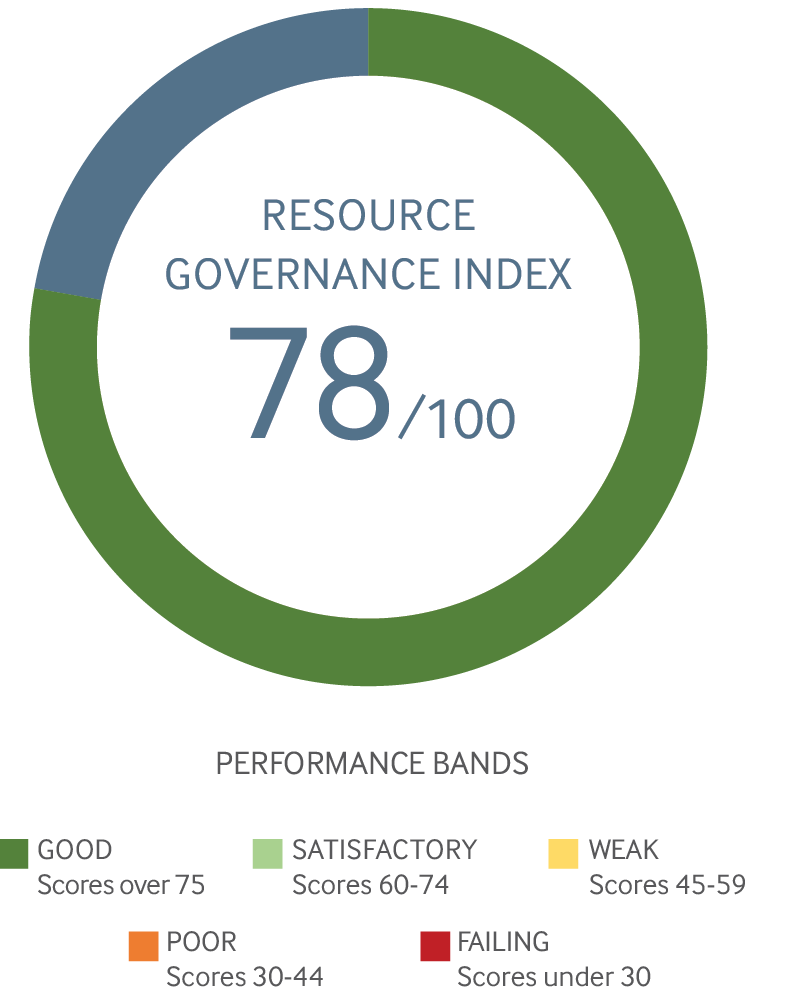
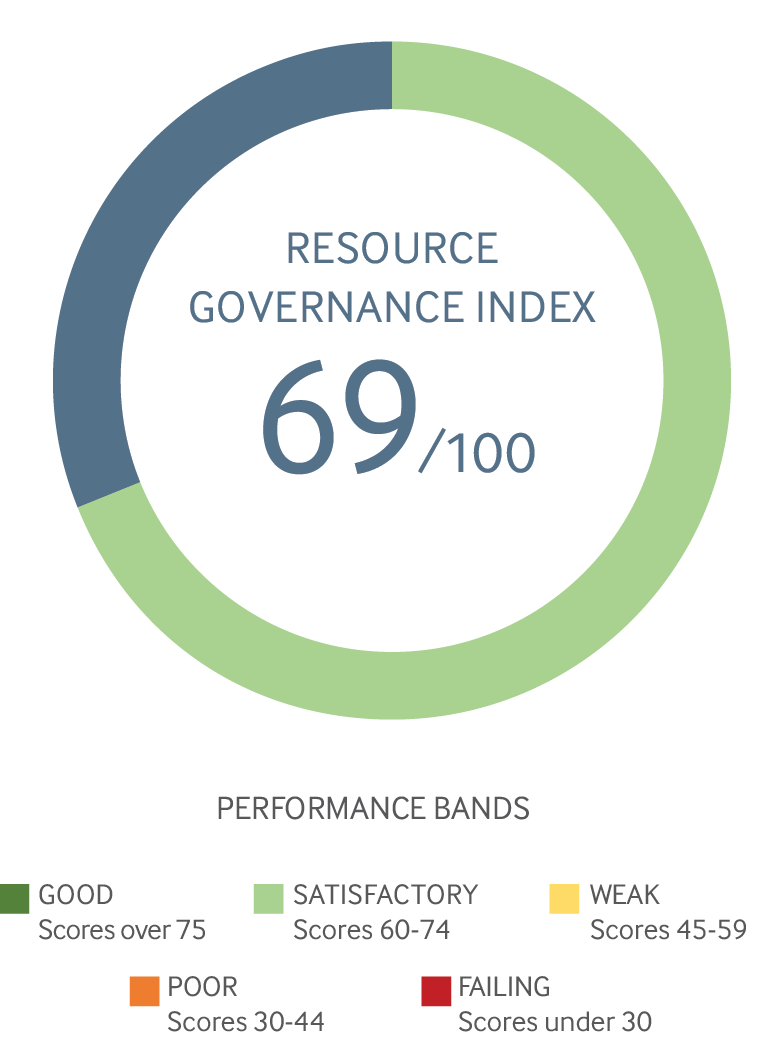
The 2021 Resource Governance Index (RGI) shows that oil sector governance in Ghana has moved into the “good” performance band. Governance of mining remains one level below, at “satisfactory.” Both ratings resulted from score increases of more than 10 points since the last assessment (in the 2017 edition of the index).
Despite these improvements significant gaps remain. So what can Ghanaian authorities and citizens do? What steps might be required to enhance extractive resource governance in Ghana? Below are some recommendations based both on the new RGI results and a recent national dialogue on extractive governance.
1. Take steps to design a long-term national development plan, to guide extractive resource governance among other sectors of the economy. This has the potential to deepen the contribution of the extractive sector to sustainable economic transformation in Ghana. Ghana lacks a clear strategic vision to drive the country’s overall development and guide government policy on extractive resource development as envisioned in the 1992 constitution. There is a clear mandate, under Article 87, for the National Development Planning Commission (NDPC), among other functions, to advise the president on development planning policy and strategy, and to study and make strategic analyses of macro-economic and structural reform options, including options for extractive sector governance. The importance of long-term national development planning to extractive governance is expressed in Section 21(2)(d) of the Petroleum Revenue Management Act (PRMA). This section makes it clear that any use of the Annual Budget Funding Amount (ABFA) should be guided by a medium-term expenditure framework, which must align with a long-term national development plan approved by parliament.
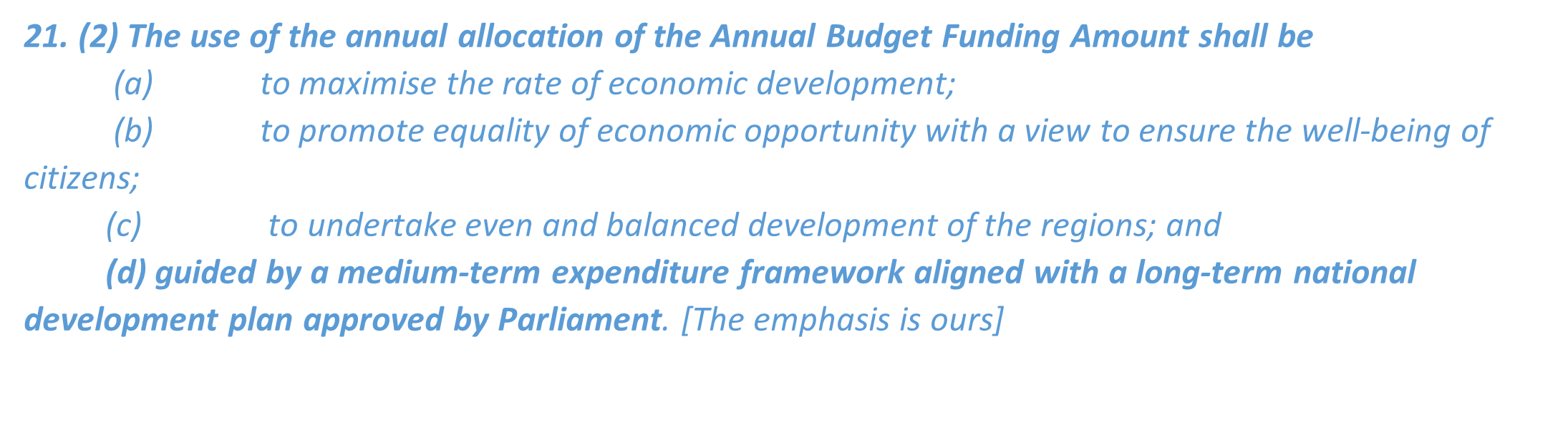
The aim of this PRMA requirement is to ensure that petroleum revenues contribute to broad and impactful economic development across the country. One of the NDPC’s key roles, therefore, as defined in both the 1992 constitution and the PRMA, is to develop a national development plan to guide the expenditure not only of petroleum revenues but of extractive revenues generally. The Public Interest and Accountability Committee (PIAC) has consistently underlined this, in terms of petroleum revenues, in its reports, including in the latest one. The current practice, which relies on medium-term strategic plans based on the manifestos of political party, limits the potential use of extractive revenues for inclusive growth and sustainable development.
2. Enact a minerals revenue management law akin to the PRMA to streamline the collection, allocation, use and management of all mineral revenues, including at the subnational level. Such a law should establish a sovereign wealth fund for mineral revenue and empower a public oversight body to monitor government accountability to the provisions of the law.
The RGI has never assessed sovereign wealth management in Ghana’s mining sector simply because there is no appreciable framework or fund to assess. Although the Minerals Development Fund (MDF) Act of 2016 and the amended Minerals Income Investment Fund (MIIF) Act of 2018 are modest attempts at managing mineral revenues, they, unlike the PRMA in the oil sector, did not create a mining sector sovereign wealth fund with clearly defined rules governing its management.
Additionally, there are accountability deficits inherent in these laws. Given that minerals are exhaustible resources and considering the positive impact mineral revenues could make if governed by an appropriate legal framework, the lack of a mining revenue management law akin to Ghana’s PRMA is a pressing resource governance issue.
3. Ensure that all resource-backed loan models set clear investment rules, transparent provisions, and accountable arrangements that are enforced by a legislative act, as this could improve parliamentary and public oversight on resource-backed loan for optimal benefits to citizens. Additionally, government should also make terms of resource-backed loans publicly available to promote more transparency, particularly on interest rates, fees, repayment schedules, restricting terms, and parties to the agreements.
4. Conduct energy transition risk assessments for GNPC and the broader extractive sector. Because the government lacks a blueprint for the ongoing energy transition away from fossil fuels, it’s hard to say how GNPC will fit into a future where oil becomes less sought-after. The government should develop a national blueprint on energy transition and take steps to assess the transition’s systematic financial risk on GNPC and use that as a basis to remodel GNPC’s strategic direction, human and financial capacity, and investment decisions. This assessment must take into consideration the advantages and disadvantages of entering new lines of businesses to diversify GNPC’s portfolio.
Crude oil price volatilities since 2013 coupled with the impact of the recent price fluctuations amid the COVID-19 pandemic and the consequential risks on broader extractive sector governance including GNPC related risks appear to have amplified energy transition concerns in Ghana.
Despite being highlighted in the 2017 RGI, GNPC’s expenditure on non-commercial activities remain a concern. PIAC in its 2020 annual report notes that GNPC spent a total amount of US$31,477,699.31 constituting 71.81 percent of the corporation’s administrative and other technical operations expenditure (Level B) receipts on sustainability & stakeholder relations and GNPC Foundation. GNPC has consistently categorized these expenditures as corporate social investments (CSI).
PIAC further notes that GNPC’s expenditure on CSI increased from GH₵41.49 million in 2018 to GH₵49.98 million in 2019, with the corporation’s guarantees (payment guarantees against default by the receiving state-owned enterprises (SOE)) for other SOEs cumulatively amounting to US$645,511,405.40 as of the end of 2019. In addition, as of the end of 2020, the corporation’s cumulative guarantees for other SOEs increased to US$694,824,551. Ultimately, expenditure pattern on CSI and SOE guarantees have consequences on the corporation’s progress toward achieving its core mandate as a commercial strategic vehicle for state participation in upstream exploration and production activities.
5. Revamp the operations of Prestea Sankofa Gold Limited and adopt best practice approaches in SOE governance going forward. An important issue that needs to be highlighted is the concerning state of the country’s mining sector SOE, Prestea Sankofa Gold Limited. The company’s operations have been suspended since 2016, affecting its 2017 RGI performance (41 out of 100 points) and meaning that it couldn’t be assessed as part of the 2021 RGI’s SOE subcomponent. On the other hand, its oil and gas sector peer and parent company, GNPC, achieved a good score in the 2017 RGI (75 out of 100 points) and improved its performance in the 2021 RGI, a reflection of sustained improvements in extractive SOE best practices. Given the significant role Pretsea Sankofa is expected to play in the gold mining sector, similar to GNPC’s in the oil and gas sector, the inability to assess the SOE subcomponent for Ghana’s mining sector in the 2021 RGI due to the stated lack of activities is disheartening. The government should therefore revive Prestea Sankofa’s operations, ensuring improved SOE governance inspired by GNPC, if not of higher standard.
Nasir Alfa Mohammed is an Accra-based policy advocacy officer with the Natural Resource Governance Institute (NRGI).