
Three Steps Toward an Equitable Energy Transition

When the curtain falls on COP26, a raft of action plans, pledges, compacts, coalitions and statements will have been announced. As “action-forcing moments,” these initiatives matter. But the choices made in countries around the world the other 50 weeks of the year, by actors ranging from national oil company officials and finance ministers to investors and activists, will equally determine the future for people and the planet.
Much of the spotlight in Glasgow is on promised cuts to fossil fuel consumption. Yet supply must also fall if we are to avoid catastrophe—the world needs to produce less oil, gas and coal starting now. Nearly two-thirds of already-discovered oil and gas would have to stay in the ground to keep within 1.5°C, and at current production levels, we’ll spend the global carbon budget by around 2030.
Each and every fossil fuel-producing country should support action on climate change for a simple reason: they are all vulnerable to it, and none more so than developing countries in the tropics. Yet an abrupt end to production would upend economic and political life in many of these countries, especially where leaders and citizens have staked their aspirations on getting more out of the ground.
At NRGI we believe that, at a minimum, wealthier, higher-emitting producers that have benefitted the most from extraction should wind down first and fastest. They should also make the deepest production cuts. Most lower-income producers have small carbon footprints, as well as pressing development and energy challenges. Pressuring them to wind down faster is economically unfair and morally unjustifiable.
The world cannot wait for wealthy nations to “lead” on fossil fuel production cuts. Many haven’t even acknowledged the limits of their moral authority on the topic, especially when toxic politics are stalling their own energy sector clean-ups. While the U.S., U.K., Canada and others just pledged to end financing for fossil fuel projects in low-income countries, G20 countries have poured $300 billion in new public money into fossil fuels since the pandemic started. Some countries—like the U.S., Canada and Australia—take the stage at events like COP to preach hard choices they won’t make for themselves. This sows mistrust and division, and complicates progress toward consensus.
In this tough political climate, we need solutions that don’t require a grand bargain. G20 countries must first honor their climate finance promises; supporting lower-income, fossil-dependent producing countries to transition to a post-oil, -gas or -coal economy is a critical complement. This includes investing in natural resource governance, which offers a road map to support quicker, fairer energy transitions for fossil fuel and mineral producers.
Here are three priorities that policy makers, activists and the international community must advance:
Increase dialogue and transparency around emissions and national economic risks from fossil fuel projects.
With a billion people already living in poverty in resource-rich developing countries, the stakes for adaptation and transition are high; yet fossil fuels represent one of the few avenues for much needed revenues for recovery and sustainable development. As a result, as demand wanes, some leaders will support costly, questionable handouts to extractives companies. Others with less altruistic aims will push through polluting, corrupt, possibly loss-making projects to keep their pockets lined.
Whatever their agendas, few politicians, in countries wealthy or poor, are likely to engineer fast, fair transitions by themselves. They will have to engage with—and be pushed by—activists, climate defenders, frontline communities, media, civic and trade organizations and research institutions, among others. If those actors are to play their critical roles, governments must first protect civic space and disclose more information on their energy transition plans. They should detail their future production goals, including what they’ll spend on subsidies and infrastructure. They should publish realistic scenarios for how transition could affect the health of their economies and the economics of particular fossil fuel projects. And they should be honest about the carbon-intensity of their production and reserves. This will help citizens hold leaders accountable, engage in more meaningful dialogue and shape new pathways for development.
International actors should also establish and implement strong and consistent standards. Extractives companies, for their part, must disclose more than the high-level information found now in most of their current climate risk disclosures, ESG metrics and sustainability reports. The data they publish should not just be for investors. Data should help stakeholders where the companies operate to understand how the companies’ transition plans—including divestment from specific projects—will impact national economic and development prospects. More broadly, fossil fuel companies can exacerbate governance and resource dependence risks in producing countries; climate disclosure standards must better and in a more nuanced fashion shed light on such risks. For this reason, norm-setting bodies must pay more attention to developing sector-specific standards, like the approach taken in the new Global Reporting Initiative Oil and Gas Standard.
Confront the risky bets that national oil companies are making.
The debate about how to cut supply cannot ignore national oil companies (NOCs), which produce over half of all oil and gas. Plans made by this “hidden half” of the industry matter at least as much as those of international oil companies, especially now that developing any new oil or gas fields conflicts with Paris goals. Leaders in resource-rich countries face a stark choice regarding new fossil fuel projects: investing public money in these projects will either undermine climate goals, or potentially cost their countries billions if climate goals are met.
Going forward, finance ministers and other economic decision-makers in countries with NOCs must reconsider whether letting NOCs grow is worth the risk. NOCs making risky bets in the oil and gas sector often do so by incurring largely hidden debt ultimately backed by government, meaning countries could be left responsible. Private oil and gas companies, for their part, should not try to pawn their risky assets onto state companies from poor countries; nor should they ask for tax breaks or other handouts.
Strategies to push NOCs to produce less must recognize that NOCs vary greatly in their openness to change, their vulnerability to the energy transition, and what they add to their economies and world emissions. Campaigners need context-specific, pragmatic strategies that don’t require NOC bosses to care about climate change—for example, pushing an NOC (or its financial backers) to recognize when its ambitions don’t make economic sense. Success along those lines would be a boon for the climate fight since countries with more risk-averse views on new extraction would produce less. It would also give fossil fuel-producing countries a better shot at building diversified, resilient economies as demand for what they currently produce wanes.
Fight corruption and promote good governance in critical mineral supply chains.
Thus far, COP has largely overlooked the flip side of fossil fuels’ decline: the projected quadrupling of the demand for clean technology minerals such as cobalt, lithium and copper that are needed for transition. As demand spikes, expectations in the countries producing them have surged, as prospects for a new mineral boom raise hopes for revenues to boost development. But mineral booms have often disappointed in the past, and these countries could also face rampant corruption—which, in turn, could disrupt supply.
Production surges could also feed an ugly, unjust “race to the bottom” that benefits rich consumer nations and producer-country elites while leaving citizens in host countries to pay the costs with their ecosystems, living standards and lives. Many countries with sizeable reserves of critical minerals have already suffered instability and destruction from poorly governed mining—these include the Democratic Republic of the Congo (home to half of known cobalt reserves), Myanmar (large deposits of rare earth minerals) and Bolivia (some of the world’s largest undeveloped lithium deposits). The energy transition should offer citizens in places like these something other than fresh disappointment.
Schemes to track and certify mineral supplies, while important, won’t alone promote a mineral boom that’s both fast and fair. The governments, companies and investors leading supply chain initiatives must also support forward-looking anticorruption and governance standards—for instance, by publishing all payments and mining contracts, avoiding corruption-prone agents and intermediaries, and disclosing companies’ true owners. They should also help producer countries strengthen their laws and institutions and encourage them to take important steps like auditing their state-owned mining companies or opening license awards to outside scrutiny.
These three actions can help governments and citizens in producing countries make more informed choices about their energy futures that protect the planet, strengthen their economies, and create fairer societies. The global energy transition should offer such chances to all, not just to those who have already excessively benefitted at the expense of others.
Suneeta Kaimal is president and chief executive officer of the Natural Resource Governance Institute (NRGI). Aaron Sayne is a senior governance officer at NRGI.
Improving Governance for a Just and Equitable Energy Transition: A 'Critical Conversation' with NRGI's Suneeta Kaimal

Critical Resource's latest "Critical Conversation" podcast features an exclusive discussion with President and CEO of the Natural Resource Governance Institute (NRGI), Suneeta Kaimal, on the opportunity and need for improved governance to manage a just and equitable transition to a decarbonized world.
Suneeta Kaimal was appointed President and CEO of NRGI in February 2021. Previously, she served as NRGI’s Chief Operating Officer and became interim president in 2020, she is also on the board of the International Centre for Not-For-Profit Law, and previously chaired the Open Government Partnership and Publish What You Pay.
This 30-minute conversation was recorded on 22 October 2021, and was moderated by Daniel Litvin, Founder and Managing Partner of Critical Resource.
Among the key points raised by Suneeta:
- The pandemic has been a litmus test for resource governance. Resource rich developing nations have been pushed back into poverty – by 2030 half of the world’s poor will be in resource rich countries.
- Increased tensions between China, the US and the EU are pulling resource rich developing nations in radically different directions, making it harder for them to understand the rules of the game. We need to stand up for the laws and policies we’ve worked together to create and address governance challenges to ensure a greener, more prosperous planet.
- Tax systems have failed to deliver – Sub-Saharan Africa loses $600m annually in lost taxes. For many years, companies have exploited asymmetries of capacity, power and knowledge, with government revenues eroded by lopsided agreements and unnecessary incentives. We need to thread the needle to design taxes that mobilise revenue and attract investment, while being flexible, simple and resilient to changing circumstances.
- Wealthier countries should wind down fossil fuel production first and fastest the hypocrisy of major economies is shocking. G20 countries have poured billions into fossil fuels since the start of the pandemic, and yet are asking low-income producers with small carbon footprints to transition faster than wealthier, high emitting producers. It’s economically and morally unjustifiable.
- We need to ensure that the energy transition doesn’t exacerbate or introduce new inequities. We have to stop repeating the errors of the past and see the energy transition as an opportunity to do things differently.
- The expected boom from mining ‘energy transition metals’ could help countries rich in these resources fund much-needed social spending. It could also engender reforms to the mining sector, making it a greener, more rights respecting industry that contributes to sustainable economic and social systems. However, corruption and mismanagement risks disrupting the supply of critical minerals and leave citizens worse off.
- It is naïve to assume that renewables won’t be prone to similar governance challenges that we’ve already seen in the extractive sector. Applying the lessons we have learnt from oil, gas and mining would enable us to create a greener future grounded in good governance.
This article was originally published on Critical Resource's website.
The G7 Missed a Crucial Ingredient for a Green and Equitable Future. Here’s a Way Forward.

Last weekend leaders of the G7 group of wealthy countries recommitted to the value of democratic, open societies and declared lofty ambitions around the pandemic response, economic recovery, climate change and global infrastructure. But they left out a crucial element. Improved governance in resource-rich countries is essential for the billion people who live in poverty in countries abundant in oil, gas and minerals. Without it, they will be excluded from the “clean, green growth” needed for an effective global energy transition. Fortunately the major gatherings in the months ahead—notably the G7 interior ministers meeting in September and the COP26 climate summit in November—offer an opportunity for G7 governments to address the gap in their plans.
Here are five ways they can correct their course:
Wind down fossil fuel production and support low-income producer countries on governance fundamentals needed for the transition to clean energy
The G7 “advanced economies” have yet to fulfil their pledge to mobilize $100 billion in public or private funding to support energy transition in developing countries. Low-income resource-rich countries need support to transition to a future in which fossil fuel extraction delivers dramatically less income. At the same time, enabling them to decarbonize and diversify into renewables will require a major shift in incentives. G7 governments should:
- Promote a core set of government and company disclosure requirements on fossil fuel projects in all countries; this will enable the public to assess every project’s viability under different climate scenarios.
- Support accountability and economic planning capacity in low-income countries, to help align political incentives and capabilities around a sustainable path forward. G7 countries must fund the identification of options for lower-income countries that are more attractive than fossil fuel extraction.
- Lead by example and take more decisive action to wind down their own countries’ production of oil, gas and coal. It is unrealistic, and unfair, for wealthy countries to expect low-income countries to abandon the sector when G7 countries continue to license new petroleum fields.
Enact and support global standards on critical minerals governance
The G7 meeting and communiqué rightly touched upon the importance of resilience in the global supply chain of critical minerals from the perspective of economic recovery and jobs in their own countries, and called for sharing of best practice to address threats to supply. However, addressing governance and corruption risks in producing countries were missing from the G7 conclusions. Failing to address these risks will impact reliability of supplies and thereby threaten the clean energy transition which relies on increased use of minerals such as cobalt and lithium; it will also diminish the potential for citizens of producer countries to benefit from the extraction of these minerals. G7 governments should:
- Promote robust governance standards in mineral supply chain initiatives.
- Prioritize transparency, accountability, anticorruption and support to civil society in their assistance to low-income critical mineral producer countries.
Deploy the new infrastructure initiative with an emphasis on financial support, accountability and debt transparency
Last weekend the G7 announced a new approach to financing the significant infrastructure needs of low- and middle-income countries. The aim is to enable these countries to build back better post-pandemic, with a focus on quality infrastructure supporting “clean and green growth” based on the principles of transparency, sustainability and collaboration. (In recent decades, many resource-rich countries have financed infrastructure upgrades with opaque resource-backed loans, often from China.)
The initiative has been cast in the media, and will likely be viewed from low-income countries, as an attempt to compete with China, given the important role that the country has played in financing infrastructure in much of the world. Developing countries will likely view this increased interest and competition around infrastructure as positive. However, no announcements of specific financial support accompanied the G7’s plan.
In order for their new infrastructure initiative to succeed, the G7 governments should:
- Raise the bar on sovereign debt transparency, so that citizens can assess the impact of different financing options, including on resource-backed loans. Publication of key loan terms and loan agreements is essential. Greater transparency in direct G7 country lending will be important, as will a broader G7 push for transparency from private creditors. (In resource-producing countries, loans from commodity trading firms are often even more opaque than those from Chinese lenders and have destabilized whole economies.)
- Support borrower countries in adopting transparent debt approval and management processes.
- Follow through on the commitment to consult openly and collaborate with developing country governments, including as part of the new proposal development taskforce.
- Commit significant funding in the near term to get the initiative off the ground.
Include the concerns of resource-rich developing countries in global tax reforms
Tax avoidance and evasion are longstanding challenges for resource-producing countries. The G7 acknowledged the need to end the “40-year race to the bottom” on international tax—a welcome step. However, the G7 commitment doesn’t serve resource-rich developing countries. The proposed global minimum corporate tax rate of 15 percent is likely too low to prevent profit shifting in the extractive sector as producer country tax rates for the sector are often significantly higher. Developing countries are also unlikely to acquire much additional revenue from applying the 15 percent rate to profits booked in low-tax jurisdictions as the G7 is silent on who collects those, suggesting that most will go to multinational companies’ headquarters jurisdictions, as per an OECD proposal. The emphasis on allocating taxation rights to “market countries” (i.e., where goods or services are consumed) rather than producer countries also means that resource-rich countries may even end up with less revenue than they collect now unless the sector is exempted (as was previously agreed in the OECD context).
G7 governments should integrate the concerns of resource-rich developing countries into the OECD/G20 Inclusive Framework when these tax reforms are refined later this year.
Tackle fossil fuel sector corruption, state capture and kleptocracy—with a climate lens
Corruption is an overlooked threat to a successful energy transition. In fossil fuel-producing countries, corruption and narrow political agendas can mean that leaders invest more in oil, gas and coal projects; lavish these industries with subsidies; and block progress on greener energy—even when doing so runs counter to climate goals and citizens’ economic and environmental interests. Elites behind fossil fuel company lobbying and campaign donations can (often legally) influence or even direct energy and climate policy.
Half of the world’s oil is produced by 13 authoritarian countries, including several run by kleptocratic regimes with few incentives to move away from fossil fuel production. Meanwhile, as we have discussed above, the boom in demand for minerals required for clean energy could also trigger surges in corruption like those associated with past oil booms. G7 governments, including the G7 interior ministers meeting in September with their focus on strengthening international action against corruption and kleptocracies, should:
- Explicitly acknowledge the extractive sector as high-risk and recognize that strong action on anticorruption in fossil fuels and critical minerals is also good climate policy.
- Build on the commitment to greater beneficial ownership disclosure by requiring greater transparency in areas where the fossil fuel industry and governments interact, such as lobbying and government contracting, commodity trading, subsidy payments and national oil company finance.
- Seek fresh responses and modes of cooperation, including punishment for Western enablers who help kleptocrats to profit and thrive.
Leaders of G7 countries must turn their rhetoric into reality in the months ahead; they can do so by urgently prioritizing the governance of fossil fuels and critical minerals in producer countries, and making concrete commitments as described here. The “green revolution” cannot otherwise succeed.
This post was written by a group of NRGI experts.
G7 Countries Cannot Secure Critical Minerals Without Tackling Governance and Corruption

For the U.S., EU and U.K., achieving this will involve honing strategies around supply of “critical minerals” such as cobalt and lithium needed for cleaner technologies like electric vehicles. Just today, the White House released a report on supply chain resilience with a focus on expanding critical minerals production, particularly domestically. Critical minerals will likely be high on the section of the G7 agenda around economic resilience of the global economy, especially given the interplay with geopolitical tensions with China and concerns that the U.K., this year’s G7 host, is lagging in the race for these crucial commodities.
Earlier this year, much was made of the U.S. re-blacklisting controversial mining magnate Dan Gertler over alleged corruption in the Democratic Republic of Congo (DRC), where Gertler’s companies control royalty streams from three of the world’s biggest cobalt projects. Gertler’s is not the only case of suspected corruption in the mining sector, yet governance and corruption are barely on the agenda when it comes to the white-hot topic of clean technology supply chains. If the G7 countries ignore mineral governance and corruption risks, they will be unable to secure reliable supplies; they also diminish the potential for citizens of producer countries to benefit from the extraction of these minerals.
As demand rises, consumer countries cannot just rely on mining “closer to home”
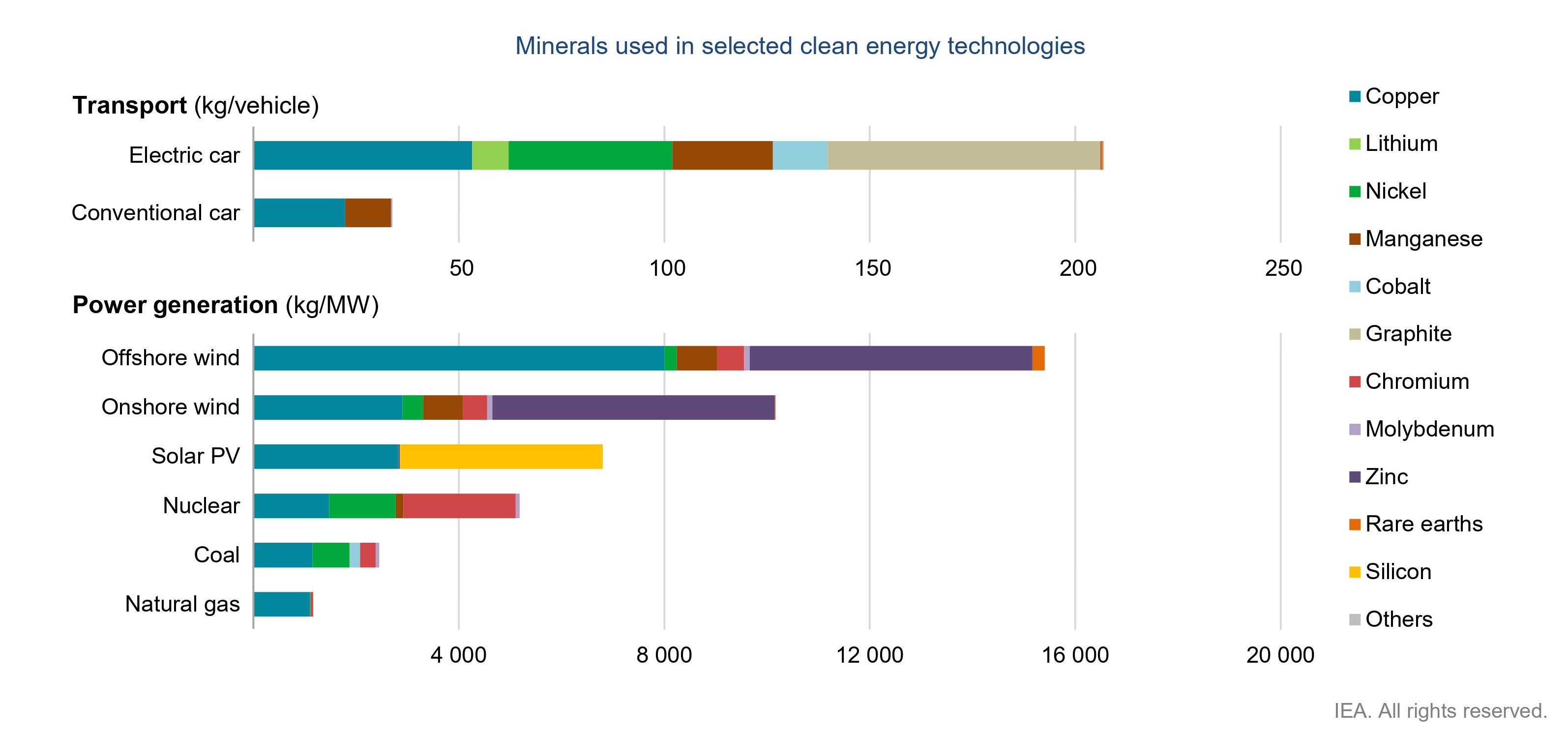
The need for greater quantities of clean technology minerals is ever more apparent. A recent IEA report underscored that cleaner transportation and power generation technologies use significantly more critical minerals than existing technologies. How this trend will shape the market remains difficult to predict. Supply sources can change as price increases entice new entrants, and demand can evolve as companies use alternative technologies and fewer (or recycled) minerals.
Click to enlarge
As G7 countries unveil climate commitments that rely on battery and other clean technologies, securing critical mineral supplies has shot up the policy agenda, with major consumers such as the U.S. and the EU focusing on securing supplies closer to home. As the Biden administration recognizes, these efforts are unlikely to suffice, given the geographical concentration of resources and the magnitude of mineral requirements in the clean energy transition.

Click to enlarge
Developing countries and emerging markets will likely remain important suppliers for the foreseeable future given the predicted increase in critical mineral demand and likely opposition to more mining in places like Europe. The IEA finds that high reliance on the DRC for cobalt (the DRC is currently responsible for around 70 percent of global production) is set to persist. For copper, expanding supply will likely require growing production in places such as DRC, Indonesia, Mongolia and Peru.
Major consumer countries should invest in improved mining governance in critical mineral producer countries
In many countries with large critical mineral deposits, mining sector governance remains weak, vulnerable to corruption and tied to concerns around political instability. These challenges are neither new nor easily overcome. But they are an essential part of the critical mineral supply puzzle, and therefore essential to achieving the G7’s economic resilience and energy transition objectives. Without effective policies and well-governed institutions in major producer countries, effective scale-up and stable supply will be elusive.
The DRC, the world’s largest cobalt producer and a major supplier of copper, must improve the fundamentals of mining governance. This includes granting mining projects to efficient and qualified companies (rather than well-connected cronies) and addressing the challenges of artisanal and small-scale mining that represents 15 to 30 percent of Congolese cobalt production. For countries such as Bolivia, with its huge undeveloped lithium deposits, a strong government understanding of where economic opportunities lie is essential. Otherwise, governments risk chasing rainbows, such as insisting on sometimes infeasible in-country processing of raw commodities, thereby delaying and disrupting projects without increasing benefits for citizens.
As demand for critical minerals increases, two possible scenarios emerge for mineral-rich developing countries. The first is an acceleration of corruption, political instability and resource dependency of the kind associated with previous commodity booms—especially in oil—and a governance “race to the bottom,” where host countries compromise on standards and fiscal terms as consumer countries clamour to capture market share. This path is a minefield for Western companies as well as producer countries. In the second scenario producer countries mature their mining sectors to meet the demand, with the proceeds contributing to (rather than undermining) their stability and economic wellbeing.
To make this second scenario more likely, leading consumer economies including G7 members should provide increased support and technical assistance to producer country governments seeking to improve sector laws, institutions and practices, and prioritize transparency, accountability and anticorruption within these programs. G7 governments could establish a trust fund for concerted investment in capacity development and accountability, including support for industry regulators, anticorruption actors and civil society players. The U.S.-led Energy Resource Governance Initiative (ERGI), which engages developing country producers, as well as the UN could be other key influencers.
G7 countries should also prioritize governance in their mineral supply chain initiatives. Unfortunately multilateral discussions of the issue have barely touched on better resource governance in producer countries. Efforts such as the OECD’s Due Diligence Guidance and public-private partnerships such as the Global Battery Alliance are laudable, but they tend to focus on tracking and certifying where mineral flows originate, stemming from very valid concerns around connections to child labor and conflict. They lack focus on governance problems (though a recent OECD report on corruption risks is a promising start). Discussions on transparency in critical minerals, including in the IEA report, have focused on market transparency (e.g., greater information on reserves, demand, processing capacity and pricing) and technological solutions such as blockchain. These are important, but miss some of the more glaring governance threats to stable supply.
The governments and companies leading supply chain initiatives must advance forward-looking anticorruption and governance standards. Such measures should prominently feature in standards such as the OECD guidance, legislation in the European Union and other consumer jurisdictions, new systems in producer countries, and the policies of mining and battery companies and sector investors. Such measures include:
- Disclosure of the identities of beneficial owners of companies participating in the critical mineral supply chain, to reduce the risks posed by politically exposed persons and other inappropriate players.
- Disclosure of mineral contracts/licenses and payments, to support public oversight.
- Stronger company anticorruption policies, with robust measures for assessing corruption risks, avoiding high-risk third parties and responding to wrongdoing.
- Producing country commitments such as audits of state-owned mining companies, competitive tenders for major procurement, and transparent licensing and commodity-trading regimes.
By prioritizing this agenda, G7 countries and others can shore up critical mineral supply chains in ways that advance their energy transition and economic resilience objectives while also reinforcing their broader commitments to good governance, anti-corruption and financing development.
Three Ways the U.S. Can Help to Prevent Next-Generation Oil and Mining Corruption

By a wide margin, U.S. authorities have pursued more corruption cases in oil and mining than any other sector. In the last five years, U.S. authorities nabbed the bosses of a company called Unaoil that bribed officials in nine different countries, including Angola, Iraq and Syria. They seized a giant yacht allegedly purchased with proceeds from Nigerian oil trading schemes, and a swank Miami condo that a top Congolese official allegedly bought using embezzled oil funds. U.S. investigations revealed how an American hedge fund paid off officials to access the Congolese diamond industry; how state oil company bosses in Brazil, Ecuador and Venezuela took home bribes; how an Abu Dhabi oil fund helped run one of the largest-ever corruption schemes; and how oil and mining deals within the U.S. turned dirty as well.
As the Biden administration ramps up its anticorruption efforts, officials should pursue policies that heed lessons from these past investigations and that reflect the world’s fast-changing energy and mineral markets.
This week the administration gave clear signs of its commitment to anticorruption. The White House released a memorandum “establishing the fight against corruption as a core U.S. national security interest” and kicking off the process to develop an ambitious cross-agency anticorruption strategy. The Treasury Department recently issued the largest-ever use of the Magnitsky sanctions for anticorruption purposes. These events coincided with the UN General Assembly’s special session on anticorruption, where U.S. officials emphasized their intention to prioritize fighting graft. Meanwhile, on Capitol Hill, a bipartisan counter-kleptocracy caucus will launch this month as well.
In the coming weeks and months, the U.S. anticorruption agenda will take further shape, as the various agencies stand up new programs, key champions such as USAID administrator Samantha Power get up to speed, and the Summit for Democracy approaches, where fighting corruption and kleptocracy will be a main theme.
To stop corruption from ravaging the world’s oil and mineral industries and hindering the green energy transition, several U.S. agencies, including USAID, the State Department, the Treasury Department and the various climate-focused units, should prioritize the following actions. These ideas emerge from a study of over one hundred oil and mining corruption cases, and from the Natural Resource Governance Institute’s work in many resource-rich countries and international forums, and they complement leading recommendations from other NGOs and experts.
1. Prevent corruption in critical mineral supply chains
The International Energy Agency estimates that meeting Paris climate goals will require a quadrupling of the minerals used by clean energy technologies by 2040. For the countries that produce cobalt, lithium, copper and other critical minerals, especially those with weak institutions, this spike in demand could trigger surges in corruption like those associated with past oil booms, which contributed to authoritarianism and economic decline. For mineral-consuming countries like the U.S., corruption could threaten their energy transition plans by interrupting the steady supply of these commodities.
While much was made of the U.S. re-blacklisting mining magnate Dan Gertler over alleged corruption in the DRC, where Gertler’s companies control royalty streams from three of the world’s biggest cobalt projects, governance and corruption are barely on the agenda when it comes to the hot topic of clean technology supply chains. The U.S. could both help safeguard supplies and protect the interests of producer country citizens by correcting this trend. Specifically, U.S. technical assistance to producer countries, including through the State Department’s Energy Resource Governance Initiative (ERGI), should prioritize transparency, accountability and anticorruption, and should include support for civil society groups and other oversight actors. U.S. leadership could also push anticorruption onto the agendas of various international mineral supply chain initiatives and standards. Unless global standards include robust measures around transparency, beneficial ownership reporting, payment verification, anti-money laundering, conflict of interest procedures and other practices, the critical mineral boom could trigger an ugly “race to the bottom,” with consumer countries scrambling to secure supplies, a few well-connected parties getting rich off the rents, and producer-country citizens left facing the results.
2. Tackle oil sector corruption and kleptocracy as part of U.S. climate policy
In addition to anticorruption, the Biden administration has prioritized climate action, and the two agendas must intersect given the oil and gas industry’s predilection towards state capture and kleptocracy.In the Trump administration, the head of the Environmental Protection Agency and the Interior Department were former fossil fuel lobbyists. These appointments were among many recent reminders of how oil and gas producers, thanks to decades of lobbying, campaign donations and revolving-door staffing, exert undue influence over U.S. policy and climate debates. Much of this behavior falls in the categories of legal corruption or state capture, through which narrow vested interests influence public policy to suit their needs. Other oil-producing countries face a similar challenge: corruption and political agendas can cause leaders to greenlight fossil fuel projects, lavish the industry with subsidies and neglect greener energy sources, even when these steps run counter to climate goals and country’s own economic and environmental interests.
To guard against corruption, capture and political stalemates around decarbonization, the U.S. should encourage fossil fuel producing countries to accelerate transparency and oversight. First, citizens need basic information about the government’s fossil fuel activities and adaptation plans, including project-level data on reserves, production, breakeven price assumptions, carbon emissions and government spending. Second, transparency must increase wherever industry and government interact; this applies to lobbying, campaign donations, asset-development contracts, subsidy payments, as well as national oil company affairs.
The U.S. could advance this cause at the Summit for Democracy, via its participation in the Extractive Industries Transparency Initiative, the Open Government Partnership, and in the newly announced Net-Zero Producers Forum, which also includes Canada, Norway, Qatar and Saudi Arabia. This effort would be an important public sector counterpart to U.S. action to advance capital market climate risk disclosures.
Much more than transparency will be needed when it comes to oil-rich kleptocracies and their impact on global climate responses. Half of the world’s oil is produced by 13 authoritarian countries, including several run by kleptocratic regimes. Tackling kleptocracy is notoriously difficult, and U.S. officials should look closely at how Western enablers help kleptocrats to profit and thrive. Some players in the oil sector are complicit, as many Western investors, companies and service providers have supported suspicious deals involving the governments and national oil companies of Russia, Venezuela, Equatorial Guinea and other kleptocracies. Since these oil industries contribute to both global warming and kleptocracy, the role of these enablers is worth a careful look as part of the US’s wider approach to fighting kleptocracy.
3. Shower anticorruption attention on obvious areas of risk
In recent years, thanks to the Panama Papers and other revelations, international anticorruption efforts are devoting greater attention to how dirty money flows offshore, and the damage it then causes. As the U.S. responds to this vital agenda, such as by implementing the Corporate Transparency Act and, hopefully, expanding the U.S. Treasury’s Geographic Targeting Orders, officials should not overlook how the money escapes in the first place. Even a quick skim of the Justice Department’s asset seizure actions makes clear: a lot of dirty money comes from the oil or mineral sectors of resource-rich countries. And it often escapes from a few high-risk areas:
-
State-owned enterprises. National oil and mining companies feature in many corruption schemes, with Brazil’s Car Wash as the most prominent recent example. State-owned enterprises control large amounts of money and are themselves easily controlled by political elites—a recipe for corruption in contexts ranging from Russia to South Sudan, Iraq to Venezuela.
-
Commodity trading. The Justice Department has pursued big commodity trading cases, so U.S. authorities know how dirty, opaque and damaging this side of the industry can be. And yet, there has been no cross-agency response. As leading energy journalists Javier Blas and Jack Farchy recently argued, “It’s high time that politicians in the United States and elsewhere started paying attention” to the fact that traders are “scarcely regulated.”
-
The participation of political elites in the industry. Among the Kremlin allies facing U.S. sanctions are oligarchs who profited hugely off juicy contracts from Gazprom, the Russian national gas company. Political elites often hold interests in oil and mining companies and get rich off the proceeds—usually via inflated contracts or other lopsided deals. Beneficial ownership reporting is a necessary but insufficient response to this challenge. The Luanda Leaks revealed how U.S. entities supported the business ventures of Isabel dos Santos, despite knowing that her father was Angola’s president and other warning signs around the deals. Since oil and mining industries are widely politicized, the sector is a strategic area where the US could work to develop stronger standards regarding who constitutes an appropriate business partner.
As part of an evidence-based approach, the U.S. should learn from past cases and ramp up anticorruption interventions in these known areas of risk. In each one, stronger global standards, attention from regulators and law enforcement, attention from international financial institutions, technical assistance, support for civil society and other actions could make a huge difference. If the U.S. and its allies ignore these proven areas of corruption risk, they leave doors open for more dirty money to escape.
The above ideas resonate with many elements of last week’s White House anticorruption memo. As U.S. officials take this directive and turn it into policy, they can prevent another generation of oil and mining corruption and avert negative impacts on the lives of millions. The Summit for Democracy is one venue where the U.S. could lead on this work and acquire allies; COP 26 and the Open Government Partnership Summit are others.
As resource-producing countries face unprecedented change, corruption could derail their efforts to build more resilient economies, while also threatening U.S. climate, security and economic interests. Thanks to U.S. law enforcement action, we know a great deal about the dismal corruption record of the natural resource sector. These cases point to practical strategies the U.S. can now adopt to avoid a repeat of history.