
One Year of War in Ukraine: The View from Resource-Rich Developing Countries

Listen to this post · One Year of War in Ukraine The View from Resource-Rich Developing Countries
Russia’s invasion of Ukraine has uniquely affected developing countries rich in oil, gas and minerals. Translating resource wealth into economic and energy pathways that benefit all citizens has been a longstanding challenge in such countries. A year of mixed messages, market turbulence and persistent vested interests have added further complexity. Policymakers in resource-rich countries—and their international partners—have three opportunities to advance economic and environmental sustainability.
Invest in renewables and equitable energy access
Coming on the heels of the pandemic recovery, the war in Ukraine threw the global energy transition into doubt. Prioritization of energy security pointed to a resurgence of demand for fossil fuels. Oil, gas, and coal prices rose as Europe scrambled to secure alternatives to Russian supply. Expectations across African gas-producing countries soared, and Colombian coal exporters were likewise buoyant as coal’s share of EU power generation reached its highest point since 2018.
Yet, a year later, policy responses to the war have actually turbocharged the global energy transition. Global capital expenditure on wind and solar assets surpassed investment in new and existing oil and gas wells for the first time. In 2021, wind and solar already made up 75 percent of all global power production capacity added, as fossil fuels additions hit a record low (14 percent). In pursuit of greater energy security, countries that have historically imported large amounts of oil, gas and coal have doubled down on domestic deployment of renewables. Europe launched its REPowerEU package less than three months after the invasion, promising an aggressive expansion of wind and solar power and new energy efficiency measures. Even if delivering on that ambition by 2030 remains a challenge, Europe made steady progress in 2022: wind and solar power generation reached record levels and exceeded gas generation for the first time. The U.S. Inflation Reduction Act represented the most significant expansion of public spending on the clean energy economy ever and has pressured the EU to keep up the pace of its own financial outlays.

As a result, policymakers need to plan for economic and energy pathways beyond fossil fuels. For the first time, the IEA’s World Energy Outlook (WEO) 2022 contains a prevailing policy scenario (called STEPS) that projects a global peak or plateau for all fossil fuels, with total fossil fuel demand falling steadily from “the mid-2020s.” Policymakers in low- and middle-income exporting countries need to factor the resilience of the global energy transition—and its implications for their countries’ revenues—into economic and energy transition planning. These countries should redouble efforts—and international partners should support them—to boost their own energy security through faster deployment of renewables.
Low- and middle-income fossil fuel-producing countries are particularly vulnerable to energy shocks. They were fully exposed to the turmoil, unlike wealthy countries that spent upwards of $500 billion to shield consumers from price shocks. Paradoxically even Africa’s largest oil producer, Nigeria, saw businesses struggle as diesel prices increased by more than 200 percent shortly after the invasion. And rising gas prices made utility-scale power generation much more expensive in markets like Côte d’Ivoire, Ghana and Nigeria. The IEA reported that the number of people without access to modern energy services rose for the first time in a decade. Around 75 million people (more than four times the population of Senegal) who recently gained access to electricity now risk losing the ability to pay for it, and 100 million people may be forced to revert to traditional biomass for cooking.
Investment in renewables, advocacy for international financial and technical support and equitable energy access are priorities. Annual clean energy investment in emerging and developing economies (excluding China) has remained flat since the 2015 Paris Agreement. And yet the IEA STEPS scenario makes clear that these countries require the greatest growth in renewables investment in the 2020s. To meet necessary energy demand growth, governments in developing oil- and gas-producing countries need to develop their pipeline of “shovel-ready” wind and solar projects. They can also work with international partners to prioritize public investment around hard-to-finance areas that will unlock large-scale private investment in renewables. Policymakers also need to develop governance frameworks that equitably share renewable energy’s developmental benefits, expand energy access and economic opportunities for the most vulnerable populations, and prevent harmful community impacts and corruption.

Improve minerals governance to seize energy transition opportunities
The conflict has heightened global concern about a stable supply of transition minerals. The accelerating energy transition and the impact of the conflict on the gas supply chain has spooked officials in major consumer countries, who see control of transition minerals as a matter of energy security. The world’s top three producing nations for each of lithium, cobalt and rare earths control more than three-quarters of the global output of each mineral. Processing of transition minerals is even more concentrated. This significantly increases the risk of supply chain disruptions due to trade restrictions, conflict, climate impacts or other shocks affecting major producing countries.
Officials in G7 countries are particularly concerned by China’s important role in the transition minerals supply chain, due to its significant domestic resources (e.g., 60 percent of global rare earths production in 2019), overseas investments, and key processing role in many commodities. Fears that Beijing could restrict access to minerals in case of a severe geopolitical crisis (around Taiwan, for example) have motivated initiatives such as the U.S.-led Mineral Security Partnership.
Competition for transition minerals opens economic opportunities for producing countries. The imperative of securing supply was on full display at this year’s African Mining Indaba, where Mineral Security Partnership envoys met with African officials to discuss financing and other support to transition mineral mining, processing and recycling. African countries such as the Democratic Republic of the Congo are already essential suppliers of metals for electric vehicles and of other transition minerals. And Africa’s geology is also relatively underexplored; many African countries have the potential and ambition to play a more important role in mineral supply. At the 2022 Summit of the Americas, Argentina and Chile launched a bilateral lithium working group, and Bolivia and Mexico have worked to foster regional cooperation around value generation, royalties and industry standards.
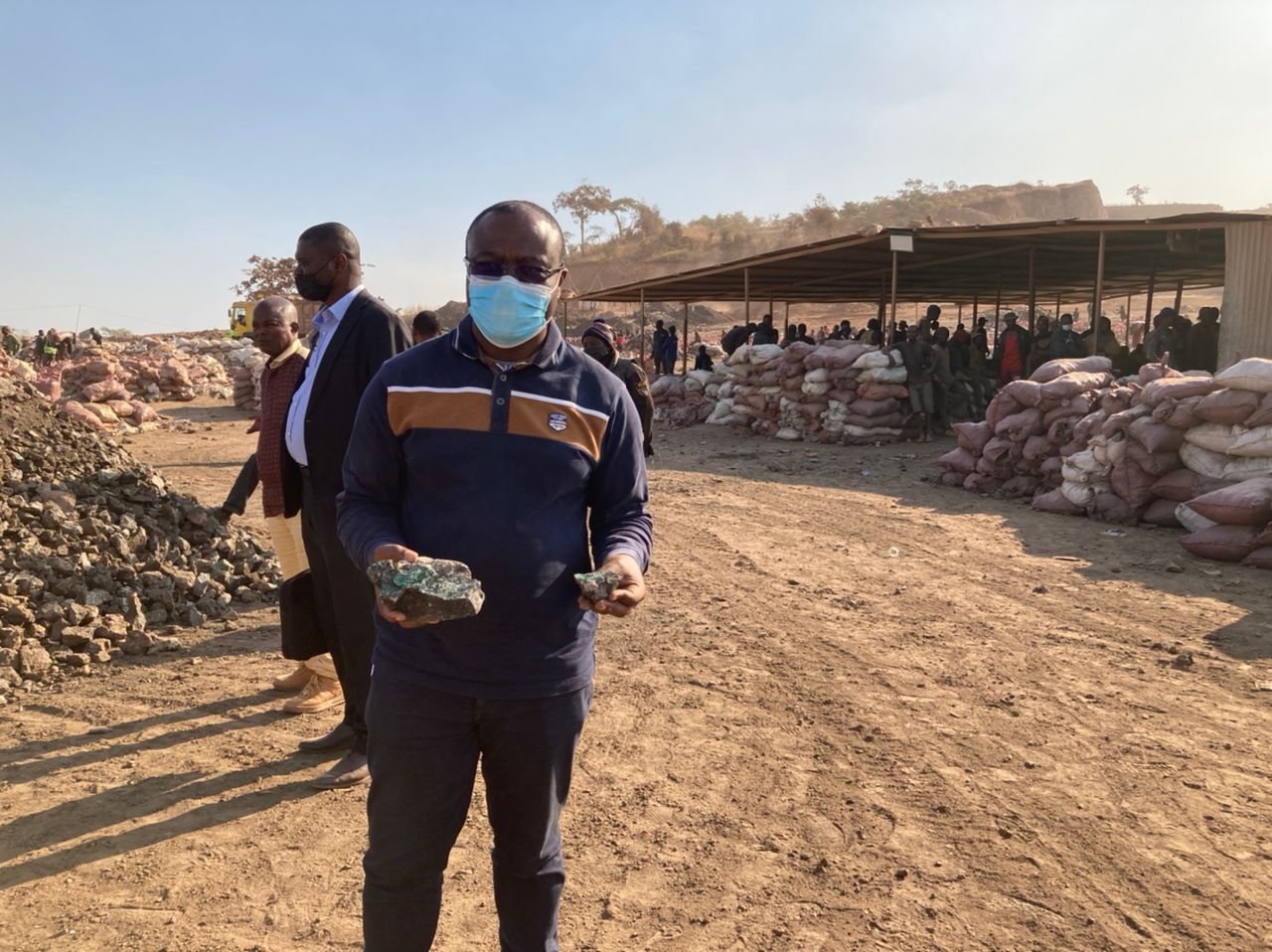
Good governance—increased transparency, open public dialogue and policy reforms that advance the public interest—is essential to seize opportunities. By prioritizing good governance, transition mineral-producing countries in Africa and Latin America can leverage the opportunities presented by competition for minerals in an accelerated energy transition. To deliver a “triple win” for their citizens, the environment, and the energy transition, many of these countries need to undertake urgent policy reforms, putting mining governance (including anticorruption measures) at the center of their policy plans.
Support the increasing range of anticorruption efforts
Kleptocrats have been put on notice. The 2022 energy crisis initially prompted an “anywhere but Russia" approach. However, there is a growing call for action against kleptocrats like Vladimir Putin who use fossil fuel wealth to perpetrate instability and aggression. A year on, in Europe and North America, policymakers have ramped up measures to crack down on dirty money flowing into their jurisdictions. From Nigeria to Angola, Azerbaijan to Belarus, those who steal wealth generated from their countries’ resources to invest in property and other luxuries are already being exposed, at home and abroad.
Leadership on anticorruption will help to secure economic opportunities. Growing demand for transition minerals brings its own corruption risks. Producing countries should ensure transparency over contracts, payments, commodity trading, and beneficial ownership; implement robust measures to prevent elites from capturing opportunities; and enforce accountability mechanisms to hold wrongdoers to account. And initiatives like the Mineral Security Partnership and EU Critical Raw Materials Act must be equally tough on corruption. By focusing on this good governance, policymakers can prevent public funds leaking out into private hands, and better respect local communities, protect the environment, and prevent disruptions and delays to supply. NRGI colleagues found that of three factors identified as shortening mineral production lead times, better governance is the only one within policymakers’ control.
Prioritizing the development of new economic and energy pathways, seizing opportunities presented by transition minerals and promoting good governance will help ensure policymakers in Africa and Latin America navigate the geopolitical and market forces unleashed by the war in Ukraine for the benefit of their citizens.
Constellation of Crises: Why Tackling Extractive-Sector Corruption Is Crucial in 2023

Corruption has plagued many resource-rich countries for decades, yet a constellation of crises requires renewed focus on the fight against corruption in 2023. A boom in demand for transition minerals that underpin renewable technologies poses major corruption risks, while actors with vested interests in fossil fuels stand in the way of a greener future. At the same time, kleptocrats in resource-rich countries continue to threaten democracy and security.
A boom in transition minerals poses major corruption risks
The International Energy Agency (IEA) projects that meeting Paris Agreement goals will require at least a quadrupling by 2040 of demand for minerals used in technologies like solar panels, wind turbines and electric vehicles. We know that past commodity booms have unleashed large waves of corruption. Fast-paced dealmaking and the promise of soaring profits serve to increase the risk tolerance of private and public sector actors alike—all while regulators struggle to keep up. The history of mining is already riddled with injustice, by which elites have grown richer at the expense of local communities and nature. And large amounts of key minerals are in countries that rank poorly on Transparency International’s Corruption Perceptions Index. Action is needed now to address these burgeoning corruption risks, which threaten to both disrupt transition mineral supply and hinder a just energy transition. USAID administrator Samantha Power, IEA, the OECD and others have recognized that these minerals may become an even more significant node of corruption in the future.
Actors with vested interests in fossil fuels may derail effective climate action
Global Witness found that fossil fuel lobbyists at COP27 outnumbered the representatives of the ten nations most impacted by the climate crisis. Research from Influence Map has shown that the five largest publicly traded oil and gas companies spent over USD 1 billion on misleading climate-related branding and lobbying in the three years following the 2015 Paris Agreement.
Actors with vested interests in fossil fuels may seek to manipulate or influence energy transition policies and practices
Yet undue influence risks extend beyond international oil companies; some national oil companies (NOCs) are susceptible to being used by corrupt ruling elites for their own personal or political benefits, creating particular risks that we have identified in targeted guidance. Actors with vested interests in fossil fuels may seek to manipulate or influence energy transition policies and practices (thanks to the opacity of government decision-making around energy transition policies and public subsidies) in ways that advance their own private interests but fail to protect the wellbeing of the country’s population or the global interest of avoiding climate disaster. NOCs produce half of the world’s oil and gas, and are responsible for 40 percent of capital investment in the global oil and gas industry. At NRGI we found that NOCs planned to invest more than $400 billion in costly oil and gas projects that will break even only if humanity exceeds its emissions targets and allows the global temperature to rise more than 2 degrees Celsius.
Resource-rich kleptocrats threaten democracy and security
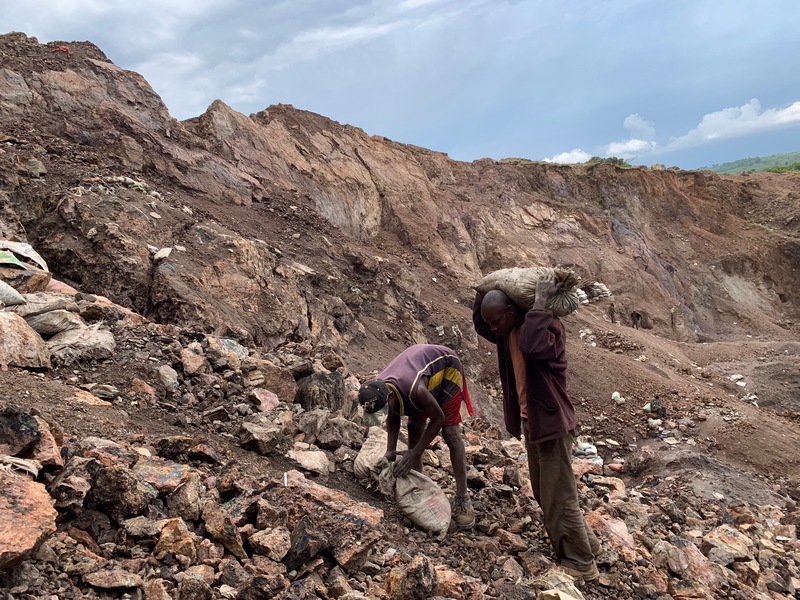
Countries with authoritarian regimes produce much of the world’s oil, with these revenues propping up kleptocratic actors across the world. Russia’s war on Ukraine has shown the devastating impact of such regimes, and the ways in which natural resource wealth can often power conflict and aggression. Some of the best-known Russian oligarchs made their fortunes in the natural resource sectors, often enabled by European and U.S. energy companies and commodity traders that have turned a blind eye to Putin’s aggression. BP, Royal Dutch Shell, Wintershall Dea, ExxonMobil, TotalEnergies, Equinor, OMV and Trafigura have contributed over $95 billion to the Russian government via oil and gas projects since the invasion of Crimea in 2014. Combatting kleptocrats will be impossible without concerted action to address the source of their power: expropriated natural resource wealth. And this is not limited to the oil sector. Minerals have helped fuel conflict and authoritarianism in countries like the Democratic Republic of the Congo, Myanmar, Sierra Leone and Sudan, often aided by private military contractors such as the Wagner Group.
Call to action: Where next for anticorruption efforts in 2023?
Amid these challenges—as well as rising poverty and inequality—a concerted effort to tackle natural resource corruption is needed now more than ever. Transnational problems require transnational solutions, so cooperation will be key in the efforts to squeeze the space for corrupt actors to operate. There are important efforts to work together across civil society to tackle the many ways in which corruption can harm the planet, with a growing network of campaigners working to ensure integrity in climate governance and finance and taking on illegal logging and wildlife trafficking.
But unfortunately key decisionmakers are missing opportunities. They’re wavering on legislation to strengthen corporate due diligence, and backsliding on key anticorruption achievements such as public registers of beneficial ownership information.
To tackle extractive-sector corruption head-on, government officials, international organizations, aid donors, and activists from the anticorruption, extractives governance and climate communities should together push for stronger rules and enforcement, better community engagement, and crackdowns on actors with vested interests in fossil fuels and all those who enable them.
In 2023, NRGI will continue to work closely with our partners in the anticorruption space to support these efforts through:
- Advocating to governments, businesses, investors and international organizations on the need to tackle corruption in the transition mineral sector, using recommendations NRGI developed alongside experts from around the world and key opportunities like the EU Critical Raw Materials Act.
- Supporting stakeholders in resource-rich countries (including Chile, DRC and Guinea) to tackle corruption with our Corruption Diagnostic Tool, highlighting lessons from pilot projects, and publishing new modules on topics such as artisanal and small-scale mining and actors with vested interested in fossil fuels.
- Identifying key studies to better understand how actors with vested interests in fossil fuel production within and around NOCs may unduly influence policies and practices around energy transition at the national level for their own benefits and at the expense of climate action for the public interest.
This post is adapted from opening remarks made by NRGI president and CEO Suneeta Kaimal during a plenary session at the International Anti-Corruption Conference (IACC) in Washington, D.C. in December 2022.
How to Fight Corruption in Transition Mineral-Producing Countries: A Must for Meeting Climate and Energy Transition Goals

To meet climate goals, the world must urgently move away from fossil fuels toward low-carbon energy infrastructure. Yet this infrastructure—including wind turbines, solar panels and electric vehicles (EVs)—requires a wide array of minerals as inputs. The International Energy Agency (IEA) estimates that meeting Paris Agreement climate targets will require at least a quadrupling by 2040 of demand for minerals used in low-carbon technologies. For some minerals, the demand could even reach 30 times current levels by 2040.
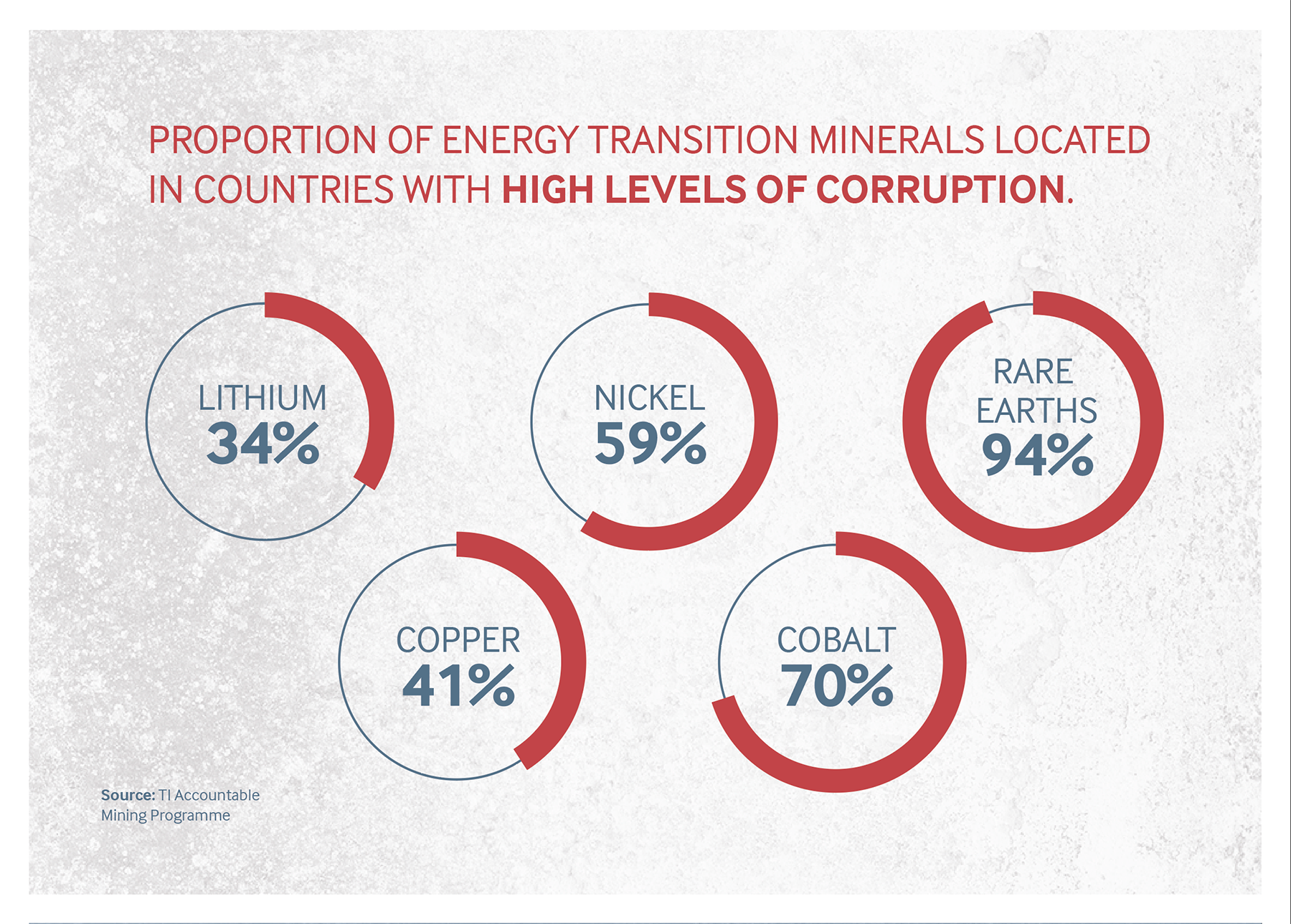
But with soaring demand comes ever-greater risk of corruption. Past commodity booms have unleashed large waves of corruption, and even the anticipation of a boom can incentivize problematic behavior. Fast-paced deal-making and the promise of soaring profits increases private and public sector actors’ risk appetites, particularly around entities like state-owned companies. To further complicate matters, the energy transition relies on minerals found in countries where corruption is a severe challenge: large portions of the world’s cobalt, nickel, copper, lithium and rare earth minerals are mined and processed in countries that rank poorly in Transparency International’s Corruption Perceptions Index.
The risks are real and growing. The history of mining is riddled with injustices, from the destruction of local environments to at times devastating harm to local communities. If the energy transition is to be fair and just, we cannot have a situation where mineral-rich countries and communities endure the upheaval and damage of mining without any of the benefits—especially if their minerals are then used to support an energy transition happening elsewhere. There cannot be any “sacrifice zones” in mineral-rich countries in the name of an energy transition in the most developed parts of the world. And if the same elites pocket all of the financial benefits of mining at the expense of the public, how can this ever be just?
If the energy transition is to be fair and just, we cannot have a situation where mineral-rich countries and communities endure the upheaval and damage of mining without any of the benefits.
Our partner Gay Ordenes, Asia director and anticorruption lead at the Extractive Industries Transparency Initiative (EITI) notes: “The energy transition’s demand for minerals has the potential to increase governance and corruption risks in mineral-rich countries. As discussed in a new EITI report, the implications of this range from the local to the global level—from the potential for environmental damage and harm to local communities to supply chain disruptions that could jeopardize global decarbonization goals. Concerted efforts to strengthen governance and fight corruption are needed to tackle this challenge.”
Working together to effect change
The scale of the challenge is as large as it is important. Given the urgent need for action and diverse expertise existing around the world on this topic, since March 2022, NRGI has coordinated an Expert Group on Preventing Corruption in Transition Mineral Supply Chains alongside partners in the OECD Centre for Responsible Business Conduct and EITI.
The group consists of experts from from civil society, governments, academia and international organizations, including among others representatives from Transparency International, USAID, the Sustainable Minerals Institute and the IEA.
NRGI and its close partners in the expert group are now launching key anticorruption recommendations on transition minerals, targeting governments, businesses, investors, international organizations and others working in the climate space. These recommendations can help decisionmakers to better protect local communities and the environment, limit corruption risks, and ensure that corrupt actors are held to account for their wrongdoing.
Implementation of these recommendations is not only best practice for companies across mineral supply chains, but can also help enable responsible business conduct, increase investment in mining communities and lead to more resilient and secure supply of minerals critical to the green transition.
Rashad Abelson, legal expert at the OECD Centre for Responsible Business Conduct, notes: “Effectively addressing corruption in the minerals sector requires a ‘whole of supply chain’ approach and urgent mobilization of all stakeholders to tackle corruption issues from different angles (e.g. tax transparency, beneficial ownership, supply chain due diligence, mine site licencing). That is why we were happy to work with this diverse expert group to learn from one another about respective policy areas and share expertise to help develop this document. Implementation of these recommendations is not only best practice for companies across mineral supply chains, but can also help enable responsible business conduct, increase investment in mining communities and lead to more resilient and secure supply of minerals critical to the green transition.”
In 2023, expert group members will engage further with governments, businesses, investors and international organizations about the changes they should be making to prevent corruption in transition mineral supply chains. To this end we will explore different avenues, from legislation like the upcoming EU Critical Raw Materials Act to strengthened industry standards.
U.K. Slaps Glencore With Major Bribery Fine. Will It Clean Up Its Act?

Today Glencore Energy (UK) Ltd was sentenced to pay GBP 281 million, the largest ever penalty handed down to a company in a U.K. court, after pleading guilty in June this year to all seven charges of bribery brought against the company. The charges brought by the British government’s Serious Fraud Office (SFO) relate to Glencore’s oil operations in Cameroon, Côte d’Ivoire, Equatorial Guinea, Nigeria and South Sudan from 2011 to 2016, with over USD 28 million paid via employees and agents to secure preferential access to oil, including increased cargoes, valuable grades of oil, and preferable dates of delivery.
Investigations into these bribes have been equally international in scope; the SFO worked in parallel with the U.S. and collaboratively with Dutch and Swiss prosecutors on this case. The European cases are still ongoing and sentencing is due on 21 November in the broader U.S. case, the scope of which also includes bribery in Brazil, Democratic Republic of the Congo and Venezuela. Glencore PLC has already stated that it expects to pay up to USD 1.5 billion to settle bribery and market manipulations cases this year, including a separate case in Brazil in connection with the Lava Jato probe.
The question now is: what happens next? With a win under their belt, will this case lead to more ambition from U.K. authorities in their fight against extractive sector corruption? As one of the world’s major trading markets and with many companies across the extractive supply chain listed in London, the U.K. could play a crucial role in holding corrupt actors to account. With extractives corruption undercutting efforts to deliver a just energy transition, getting to grips with this problem would also support the U.K.’s wider climate policy agenda. And, with the costs of corruption cases soaring, will Glencore buckle under the pressure of its swashbuckling reputation and implement the seismic change needed to become a responsible industry player?
The Glencore conviction is a welcome win for the SFO, particularly after recent struggles in cases with Unaoil and ENRC. This case could kickstart a concerted effort from the U.K. to tackle extractives sector corruption more effectively, including using expertise that the SFO has developed from this case to tackle other allegations of commodity trading corruption. The U.K. has already made welcome progress on tackling illicit financial flows, many of which originate in the extractives sector, with two bills passing through Parliament this year that will help address money launderers’ abuse of U.K. property and companies. Yet a spate of integrity scandals has also shown the scope for private interests to unduly influence policy decisions, and highlight the ways in which members of the U.K.’s political class have aided kleptocratic elites enriched by their countries’ resources.
Three reforms needed in the U.K.
The Glencore conviction highlights three key areas where the U.K. government could drive change, beyond tightening up its general anticorruption defences. With the U.K. recently pledging to address corruption in its critical minerals strategy, implementing the following reforms would go some way to transforming this commitment into something more tangible:
First, authorities in the U.K. and Switzerland—the world’s foremost commodity trading hubs—should jointly push for a global and binding standard to ensure that companies disclose trading payments to all governments and state-owned enterprises (SOEs). A 2019 Extractive Industries Transparency Initiative (EITI) requirement was an important first step in recognition of the need for more transparency from countries, businesses and civil society actors alike. With Switzerland expressing interest in these changes, the ball is now in the U.K.’s court to push the agenda forward.
Second, the U.K. should hold to account both individuals and corporations who engage in corrupt behavior; the SFO show now prosecute the 11 individuals still under investigation in this case. Even large fines may be insufficient to deter wrongdoing if big companies can price them in as the “cost of doing business” and so executive accountability is essential. Where other allegations of extractive sector corruption exist, the U.K. should use all the tools at its disposal to ensure consequences for wrongdoing, including Unexplained Wealth Orders, Account Freezing Orders and targeted anticorruption sanctions.
Last, reforms and resourcing to better support the SFO will be essential if the organization is to effectively and assertively fight corruption. As the first-ever U.K. corporate conviction for Section 1 offenses under the Bribery Act, this landmark case should also spur the SFO into pursuing more ambitious investigations and prosecutions. This should include investigating the full picture of corruption allegations against companies like Glencore, and better identifying and compensating victims, who have been notably absent from this case.
Glencore's acts of contrition (or lack thereof?)
Understanding whether or where progress is being made within Glencore itself is unfortunately more complicated. There has been a changing of the guard, with many key figures retiring in recent years, including at the very top. Long-term leader Ivan Glasenberg stepped aside for Gary Nagle in 2021, who has stated that “we want to complete these investigations, put a line under that and move forward.”
Drawing a line under these investigations may, however, be more easily said than done. In recent weeks, an investor group has launched a lawsuit against the company, apparently related to losses linked to its recent bribery cases. The company also faces yet another investigation, with Zambia’s Anti-Corruption Commission launching a probe into an alleged payment to a political party. If Glencore is serious about moving forward, it must demonstrate a genuine shift in its culture and practices.
While Glencore’s efforts to enhance its ethics and compliance procedures and review some of its operations are welcome, these changes alone are insufficient. Earlier this year, we joined our partners—Global Witness, Oxfam America, Public Eye, Resource Matters and RAID—to outline how the company could atone its wrongdoing and avoid future violations.
We recommend that Glencore review engagements with Russian SOEs, adopt and publish measures to reduce corruption risks in business with SOEs, and make transparent its transactions with SOEs in all countries. Glencore should also cease all relations with Dan Gertler, who the U.S. sanctioned in 2017 for high-level corruption yet still receives substantial royalties from deals in the DRC. Although Gertler denies any wrongdoing, the DRC is estimated to have lost a staggering USD 3.71 billion (at least) from the deals he was involved in, alongside Glencore and ENRC.
This is the crux of our concern; Glencore is yet to show a real willingness to engage seriously with efforts to compensate victims in countries where its corruption took place. Carefully worded corporate statements can state the facts of wrongdoing, but they fail to meaningfully grapple with its consequences.
Top photo by Photo by Marlon Trottmann for Shutterstock
Glencore must take action
NRGI and partners' recommendations for the commodity trader
The Resource Remix: Ana Carolina González Espinosa and Daniel Kaufmann Discuss New Resource Governance Paradigms

In this second episode of NRGI's podcast, available on Apple Podcasts, Google Podcasts and Spotify, Ana Carolina González Espinosa converses with NRGI president emeritus Daniel Kaufmann about evolutions needed in the resource governance field in light of the climate emergency, the conflict in Ukraine, and other global challenges.
NRGI · The Resource Remix - Episode 2 - Toward New Resource Governance Paradigms
During their conversation, Kaufmann explains what is meant by resource governance, where the field of resource governance came from, and what important organizations have played a role in this field. They also discuss the results of the 2021 survey Kaufmann and colleagues conducted among hundreds of participants on the future of natural resource governance in the era of the energy transition. Kaufmann highlights some of the top priorities for reform cited by respondents, including protecting democracy, addressing state capture, high-level corruption, and climate emergency. Although these dimensions received very high priority, respondents were more pessimistic about the likelihood of progress in these areas, informs Kaufmann.
Looking at the systemic challenges facing the world today, Kaufmann and Gonzalez discusses the actors that must drive change and the bold strategies that should target these various stakeholders, including the state, the public and private sectors, and international institutions. Gonzalez stresses the importance of going beyond mobilizing traditional actors working in the natural resource governance field to bring about change. The organizations mentioned includes women's and youth organizations, indigenous and peace groups, and other grassroots movements operating differently from traditional NGOs.
Other dimensions explored includes the importance of changing the narrative of the global energy transition, which is driven primarily by the Global North, and the importance of including the voices of producer countries to push for more concrete commitments on climate finance to ensure that the energy transition is actually possible in these countries as well.
Daniel Kaufmann and Mario Picon also addressed a related topic in this commentary by the Brookings Institution.
***
Transcript
Ana Carolina González Espinosa: Some of the most critical issues in the world today are linked with the way we govern natural resources. From Russia’s war funded by oil revenues to the existential threat of climate emergency, many also relate to the commodities in the earth beneath us. For example, we want to transition to sustainable energy, so we reduce carbon emissions and fight climate change that can lead to so many of the world's natural resources.
But to do that, for these renewable energies to be used on a larger scale, the extraction of certain minerals that are needed has to be on a larger scale as well: the lithium and cobalt that go into electric car batteries, just to name some. And that also comes with an enormous challenge:
avoiding that the extraction of these minerals negatively impacts on countries and communities, and instead benefits them. So it is about governing natural resources in a way that avoids funding the world’s kleptocrats, or in a form that ensures communities and countries benefit from them.
And today, many people and organizations work to ensure this happens. But how do all these organizations and people get here, in what we call the natural resource governance field? And where should we go, given the new nature of the challenges that are emerging? Are the same policy recommendations of past decades are still relevant? Do we need to rethink our assumptions, and how? Do we need other models, pathways, bolder ideas about what resource governance is?
I am Ana Carolina González, senior director for programs at the Natural Resource Governance Institute. And these are the issues we at NRGI grapple with every day and also in this podcast series, The Resource Remix. It is my pleasure to welcome to this podcast NRGI’s former president and CEO Daniel Kaufmann. Dani is a pioneer in the field of governance at the World Bank, now affiliated with the University of the Philippines, the Brookings Institution, and Resources for Development. Welcome, Dani.
Daniel Kaufmann: Thank you very much. It is an enormous pleasure and honor to be with you and with the whole NRGI family again. And it’s such an important topic that you have outlined.
ACG: Dani, I started by speaking about some of the critical current events related to resource governance. You have been writing and presenting about this seismic shift for the past few years. But for those of us with shorter memories, can you quickly get us up to speed on what is meant by resource governance and where the field of resource governance came from?
DK: Thanks. I am glad you’re inquiring into this historical perspective, not only because without history, we misunderstand the present and we will keep repeating past mistakes in the future, but also because it puts into context the sense that the field of natural resource governance is at the crossroads right now. You see, contrary to popular beliefs, concerns about natural resource governance, which refers to the good stewardship of the natural resource features of the country for the benefit of all, for the growth development and benefit of all, did not just start in the U.K. and with the likes of Tony Blair and others two decades ago.
In fact, in the early 1700s, the British publication The Spectator wrote, “It is generally observed, that in countries of the greatest plenty, there is the poorest living.” So this is a longstanding concern, the increasing traction to the idea that resources might be more of an economic curse than a blessing began to emerge in the 1950s and ’60s with the analysis of challenges in developing countries. In the early ’90s, there were writings already about how countries rich in resources were unable to use that wealth to boost their economies, especially compared with non-resource-rich countries, and then the likes of Jeffrey Sachs and other academics, found a very strong correlation between natural resource abundance and poor economic performance. In the ’60s, thanks to the concerns in the Netherlands that they had just found plenty of natural gas and were earning fresh foreign exchange, a particular economic policy dimension of the resource curse garnered attention, namely the exchange rate of evaluation, which discouraged non-resource exports, the so-called Dutch disease. We can call this “Resource Curse 1.0,” and we are talking more than half a century ago, the very economic manifestations of the resource curse. Only after the turn of the century, that very economic focus begins to take on also a governance dimension, very seriously, beyond traditional economics, “Resource Curse 2.0.” And we enter at that point, what I would call, the “soft governance” era, which focuses very much on transparency in extractives, and particularly at the beginning, transparency of payments of the industry to governments, to have full disclosure, to the extent possible, which still has not happened until today.
NGOs, like Global Witness, were pioneers, which later led to the creation of Publish What You Pay. In this space they influence the U.K., and eventually, this leads to the inception of the Extractive Industries Transparency Initiative or EITI. And all this is also a predecessor to the support given by NRGI at that time, which was called Revenue Watch Institute, obviously Revenue Watch Institute, the predecessor of NRGI plays an important role in this process as well. Then about a decade ago, the increasing realization that transparency may be absolutely necessary, but it’s far from sufficient, results in an increasing focus on participation and accountability, or what we call sometimes “the TAP troika,” i.e., transparency, accountability, and participation. Among others, the notion of protection of civic space becomes important and we work hard to institutionalize those protections in initiatives like in the EITI and elsewhere, and that begins to happen.
And the evidence did show that improved transparency, improved participation and accountability could help mitigate some forms of corruption. And that is all part of this governance “Resource Curse 2.0” package. But again, more recently, it becomes clear that this focus was also insufficient, leading to the case we have been making for broadening the governance scope and natural resource governance, sometimes called “TAP plus.” So going beyond the TAP troika into very tough rule of law, reform issues, regulatory reform issues, public sector reforms, state-owned enterprise reform, particularly with national oil companies; and very timidly, a start with the so-called energy transition.
In brief, that is where we are now. But with two pending key dimensions, which we can discuss later of the resource course that we have not gotten the focus in the natural resource governance field that it deserves, even if there are some initiatives here and there, but they fit as a whole, one, which we can call the “Resource Curse 3.0,” and label it as the tough governance dimension. Let's call it for what it should be called: tyranny, conflict and climate crisis. And the other “Resource Curse 4.0” related, which is a corporate resource curse. It’s the corporate dimension of the resource curse—the capture by industry, like oligarchs, and their collusion with the kleptocrats.
ACG: And it is very interesting, Dani, that you take us back to very early days in history because when you discuss natural resource governance, what might think that it all started at least with some emblematic initiatives or conversations. I remember particularly that report Global Witness published in 1999 denouncing corruption in Angola in the oil sector and demanding companies to disclose the payments that were being made to the government as an incentive to avoid corruption. And then the emergency of Publish What You Pay, EITI, where NRGI actually took a very active part. But a lot of things had happened. And all the people are still, of course, interested in having information about these payments. What you see in the case of popular consultations in mining regions in Colombia or what you hear from local communities in South Africa that are asking for them to be included in just transition plans, is that people are no longer looking only for information, or even as you mentioned, for transparency, accountability and participation. People are no longer looking only to hold governments and companies to account. They want to decide, they want to influence decision-making. They want a share of power.
So while we have made important gains in transparency around the extraction of oil, gas, and minerals, we clearly aren’t where we need to be. You have been promoting major change for some time already, but do you think organizations in the field are asking these fundamental questions? I know that you took the lead in designing and implementing a survey, in which NRGI and a hundred other participants took part, in relation to these. So, you and your colleague are publishing a report on it. So what have you found?
DK: When we asked hundreds of respondents to identify the most important priorities for reforms, some of these very tough governance dimensions that we just mentioned—including the protection of democracy, addressing state capture and high-level corruption and the climate emergency—all came out addressed as a very high priority. That is not very surprising. But the same respondents were rather pessimistic about the likelihood of progress in those areas. There is a huge gap between stated priority and likelihood in their view. But that’s not the case when we ask them questions about the traditional ongoing areas of work in the field, such as continuing the work on disclosures and transparency that started 20 years ago. They don’t give it the absolute top priority, a bit lower, but the likelihood of being successful is fine. So consistent with that, there are lots of people in the field that are comfortable continuing with that trajectory, because at least the probability of failure is lower since it’s much lower hanging fruit.
Then when we asked these respondents about what kind of transitions were needed in the various natural resources. Those in the natural resource governance field were more gradualist and conservative regarding moving away from fossil fuels than those outside of the field, which is telling in itself. Surprising regarding this set of findings, civil society respondents—because we asked all stakeholders, industry, government, international financial institutions and civil society were involved—but civil society respondents on average were basically as risk-averse, as the respondents from the other stakeholders, governance and IFIs. I mean, there are some small differences, but you don’t find a huge difference there.
There were some exceptions, of course, there are rays of hope. And in terms of some respondents wanting and believing that something bolder is possible and giving also bolder type of recommendations as to what to do ahead. On average—this is not universal, it’s not a one-to-one correlation—but on average, that’s associated with younger and female respondents, interestingly enough. So that’s a message right there. They were not the norm though. The norm was risk aversion and comfort. So overall, we do find some risk aversion and measure of conformance, one of which is not really consistent with seismic global shifts that are taking place that we have been discussing. So the case in the report for much more audacity associated with concrete and bolder change is being made.
ACG: You mentioned that the respondents in the survey highlighted unsurprisingly, the effects of the COVID pandemic on the economy and the unsettling that comes with not knowing what is going to happen with the economy in producing countries. And also, of course, the climate crisis and the challenges that come with the energy transition, for example, for oil, gas and minerals producing countries because that is also consistent with what we have been observing in NRGI. And also the rising authoritarian regimes and the growing restrictions on civic space.
But a couple of additional changes that are important to take into consideration, and maybe are related to what you mentioned about the different role young people and women can play, is that there is an important change, and I am observing this as well, in terms of how the field can require multidisciplinary perspectives. And so the traditional organizations working mostly around resource governance need to add other movements to the conversation, right? We need to build bridges with other movements with the climate movements, the human rights organizations, tax organizations and other, because the challenges that we are facing today are so systemic that require us to build coalitions outside of the traditional actors, in what we call the natural resource governance field.
And even beyond them, something that the actors in the field might need to do as well is to acknowledge that with the social protests of the last few years, an important number of new actors of social movements have emerged also in producing countries, even in the context of deep restrictions to civic space. So even with people knowing that it’s difficult to participate, wanting to participate more. So women’s organizations, youth organizations, indigenous and peace organizations, or more grassroots movements and networks—they operate very differently from NGOs, but they are key actors when we think about how to make change happen. That is one thing I would like to stress—there is a need to build bridges also with these social movements.
And on the other hand, another change that I think has happened and requires the field to kind of be bothered is that, when we think about the actors that we need to target to push for change—the state, the public sector, remain key and central. And we know that we need bold strategies to target private sector. As you mentioned, like the corporate sector’s responsibility for resource governance and international institutions for change—that’s not very new either. But sometimes we might have overlooked the role of media narrative, not just to disseminate information. It is not just about influencing decision-makers but to influence public narrative. The way people see natural resources playing in their countries, in their territories, the power of moving the needle in public opinion, to then create a stronger and maybe longer-term incentive for decision-makers to act.
For example, how to influence the narrative of the global energy transition that is mainly driven by the Global North to include the voices of producing countries, to push for more concrete commitments in terms of climate finance, so we ensure the energy transition is actually possible in those countries as well. For that, you need to change narratives at a wider level and strategic communications and alliances are key for that.
So it looks like we might need some more paradigmatic change here. How can we make this possible, especially given what you’ve mentioned in terms of some risk aversion between organizations in the field and between other actors in the field. What are the opportunities that you see, but also the barriers that we might need to overcome? We have been, recently discussing in NRGI about encouraging such a discussion, but what do you think are the elements we should consider?
DK: We need to consider a bolder approach, whether that will signify paradigmatic change or not, that’s for another podcast. Let me give you just a few ideas and suggestions. I would ask, why aren't we making more progress now? You mentioned multidisciplinary approaches: this has been taking place for a long time and now more is needed, nobody will disagree with that. But a bolder version of that in the current situation is to say, we need the most extreme form of partnership, not only in terms of discipline but in terms of also the focus on good research and analysis and activism. The most extreme form of partnership is a merger. We did one almost 10 years ago, combining Revenue Watch with the Natural Resource Charter, and became NRGI, but they’re extremely rare.
The incentives in the field among NGOs, media, more user-friendly storytelling, and all that. That's very nice, and we have been discussing that for a very, very long time. But right now, as we see in the world and in the worst-governed places regarding hydrocarbons and so on, we need to protect and support the toughest type of investigative journalists and to get these stories out in places where everything is being banned, everything is secret, and journalists have been put in jail.
But in addition, why not consider a major scaling up in addressing the huge remaining misgovernance within fossil fuels themselves due to the actions and the capture by big oil, by the kleptocrats, by the rulers of oil-rich countries; that’s really tough. And how do we do it? It’s a different discussion. There are some staff at NRGI and other places that are working on that, but these are niche issues. These are not being integrated into the core of what the field should be doing.
Why also don't we fully expose without mincing words—we have to use a different language—the massive greenwashing in the whole ESG industry, by the corporates, which we can discuss at very much like.
Then take the national oil companies. Why continue to fiddle at the margin regarding taking a little measure here or there on additional disclosure and a few changes in corporate governance, when some of them are totally captured politically? It’s been high time for years to consider a very different model in those settings. Even if that's very politically difficult, instead of trying the same reforms at the margin in places, in organizations and institutions that may be unreformable.
ACG: Maybe also that I would add Dani is in terms of having the conversation, I totally agree with you. This is about having a conversation on a podcast, but it cannot be just that. It’s about who participates in the conversation and the form it takes. And again, who participates in the conversation, we need new voices, we need additional voices to the ones that have traditionally been associated with the ways of natural resource governance, including people in other fields, social movements, universities in the Global South, Global South think tanks… And journalists as actors, they are not just targets for us, as you say, to disseminate information, et cetera. They are very important actors in the field as well.
But in relation to the how, how do we get there? How do we promote this change that the field needs? How do we take these conversations that are happening maybe in podcasts or in many interesting meetings here and there in a specific context? What if we have this conversation in specific territories, in specific countries, and if we look for experience where those changes are already in play in the way organizations, communities, or other actors are pushing for resource governance in this new era, instead of a bottom-up approach to learning, to understanding what resource governance means today.
And what if we learn also from other movements; we are not the first movement to face the need for change, like the human rights movement has also faced many changes in the last decades. What if we pilot as we learn new ways of understanding this natural resource governance and innovative ways again to communicate and provide visibility to the process and to specific efforts that maybe are small, or we don’t know them yet. What if we provide some visibility to those? It is less about big words and more about interesting, even if small, actions.
DK: In terms of, very concretely speaking, the whole issue of bringing in different voices and addressing this problem of state capture: Let me mention a very concrete examples that the field could engage more with. One is my own country, Chile, with a newly elected, youngest president in the world, Boric. But at the same time, a new constitution is being drafted, we don't know yet if it's going to be approved by the whole population. But it is being drafted in the most participatory manner ever of any constitution anywhere. So we are having that as we speak. Now Chile is the number-one producer of copper in the world. So it would be extremely fertile to collaborate with that case study and draw the lessons of the art of the possible in this context.
ACG: I think I also remained positive about what can come. It’s not easy, path dependency is always there, this idea of continuing doing what how to do, what you have been doing for so long. But I think that the time has come when we need to be bolder and think about other layers because the challenges are so huge that we definitely need to build bridges with other movements and see how to push change forward. But the problem is also that the context might not be helping that much. So what do you think about the impact of the war in Ukraine, and how do you think these new trends in the international commodities market energy markets can actually maybe delay or maybe be an opportunity for this conversation and this major change to materialize?
DK: At the end of the day, it is a question of mindset and preparedness to take risks, because one way of looking at what's happening now is to say that there have been extremely adverse developments, and we know where they are. You have mentioned them, we have written about that. So it’s time to protect former gains, to hunker down and be very careful about going in directions of trying to address the enormity of these new challenges, because politically they may be intractable, and the probability of success is obviously much less than protecting early gains and continue to work on what we are accustomed to. So that would be a safer, risk-adverse way.
The other option is to say, maybe continue to do the same, that may be safer, and we will not have a huge failure, but the impact is going to be so small and we’re going to become irrelevant given the new developments. So there is absolutely no choice but to consider a strategy with much more audacity and boldness, and then the question becomes what to address.
Let's face it—and I mentioned and hinted at it earlier—we are in that era now (and you mentioned the war context, Putin’s invasion of Ukraine), in which it has become very clear that there are hydrocarbon-fueled wars and invasions of other countries. This is so well beyond these soft notions of governance—that we need more transparency than we have had in the past. So it is the notion that’s a completely different dimension of the resource curse. Because of that, we know that it is not just the climate crisis challenges, that we all know, and it’s been ongoing and it’s becoming worse, but there are major energy security considerations. As a result, many other countries in Europe and others are not only considering but are approving really fast major new investment plans. And also because the oil and gas prices have gone through the roof. So NRGI and others could be monitoring these proposals and actions in terms of more, not less, new investments in hydrocarbons, and particularly LNG and so on.
And obviously, there are enormous trade-offs with energy security and so on. There’s a bit less of a discussion because it’s so difficult politically to say, “no, this is absolutely disastrous for the climate crisis.”
We have to put it very starkly, at the end of the day, countries are going to face either stranded assets or climate catastrophe. So these two choices, unless we do something really, really boldly, and just calling into action and showing with the numbers, what is happening and showing also the differences, what can be done next year versus the next five years, is really important. And that’s why I put it into the mix.
We have to discuss issues like nuclear power. We also have to discuss demand destruction. Again, it’s a political taboo in the United States, with a carbon tax, and so on, but basically the obsession with oil consumption has to shift and it’s beginning to shift in some countries, and in fact, some European countries have decarbonized relatively quickly.
We are not talking enough about great examples in Africa. In Kenya, there is a large amount of electrification with renewables thanks to major wind and solar projects, in which the African Development Bank is involved. There are a number of other examples. Instead we focus so much on how much they're going to lose in revenues if they don't produce as much in terms of oil.
Of course, we have to be mindful: these countries are not the main carbon emitters. So that’s not where the main problem is. And they have not benefited from hydrocarbons the way the West has. So the issue is one of climate justice. But because of that, my suggestion for a topic that should take much more prominence is major compensation mechanism; a Marshall Plan-like mechanism may be needed. There is a concrete example of what some European Union countries and Canada did a few months ago with $8 billion for South Africa to start phasing out coal. So again, it’s not academic, it's about very concrete areas where things can change. And we need to think big and say, how do we scale these up? What would be the proposal?
If we’re going to have audacity, to really try new things, we’re going to take a risk and we are going to fail as well as succeed. So we do not want to fail at everything, but, and that’s a difference in mindset that needs to be changed. And that’s why the fresh blood, the new voices… And having frank conversations with boards, and with funders, is very important at this stage. The world has changed dramatically.
ACG: One of the things you mentioned was the impact of the war in Ukraine and the need to monitor what is happening out there in terms of new investments and new plans to expand gas and oil exploitation. It is something that we have been following very closely, especially because this raises a lot of expectations in the producing countries. You have already seen how countries in Africa like Tanzania or Senegal mention the possibility of expanding their old gas fields to supply the European market with their gas. And, of course, there are a lot of things to discuss, that we don't have time to discuss.
One of the things that we have recommended in our reports and blogs is that Europe needs to be clear about this, and needs to make bolder commitments in terms of not only providing itself with the energy that it deserves, so energy security is a priority—but also making sure that the energy transition in these [producing] countries is not delayed because of this new move. I think what you mentioned about the need for climate finance to be much more deliberate, meaningful and intentional to really move the needle on energy transition in these countries is very important.
And the other thing I wanted to mention is, it’s also about the model, because if we want to just expand renewable energies or other types of exploitation of critical minerals to provide those renewable energies in the same way that we have been developing in the last three or four or five decades, it is just not going to be possible. We need to listen to other movements. We need to listen to the climate movement, but we also need to listen to the communities that are proposing new development models as well. And to examine also our consumption patterns and see how they can be modified, and how we can learn from others as well.
DK: You said we need to listen. I would say we need to merge.
ACG: That too, definitely. We start by listening and then we need to merge and, and build bridges and build coalitions. Thank you, Dani. This has been a great conversation, definitely not the last one on this topic. It is clear from what we have discussed that at least our thoughts align in terms of the need for a bolder change. I would call it for maybe a new resource governance paradigm or different paradigms around natural research governance. Imagine from a different context and different regions, et cetera, but definitely, something that puts policy at the center, that builds bridges across movements and social movements and sectors and perspectives, and a natural resource governance framework that includes at least the hard tough reforms that you mentioned that are needed, including of course being more intentional about fighting kleptocracy and ensuring that people have a seat at the table in decision making. So thanks for these. And I hope we will have the time to continue this conversation and others in other Resource Remix podcasts.
DK: Thank you very much.
Disclaimer: Views and opinions expressed in this podcast belong to the individuals featured and do not necessarily represent those of the Natural Resource Governance Institute. The recording and transcript have been edited and condensed for clarity.
NRGI's podcast The Resource Remix explores new futures for commodity-exporting countries in the energy transition.
Democratizing the Benefits of Natural Resources: Anticorruption and Public Accountability in the Extractive Sector and Energy Transition

Ahead of the Summit for Democracy, NRGI and several of its partner organizations came together to propose five commitments that governments could make to address the challenge of corruption in the extractive sector and energy transition.
Proposed country commitments for the 2021-2022 Summit for Democracy
Corruption in the oil, gas and mineral sector undermines the efforts of resource-rich countries to democratize, prosper and address the climate crisis. More foreign bribery cases originate in the extractive sector than any other industry; from Brazil to Iraq to Angola, the sector has spawned some of the world’s largest and most damaging corruption schemes; oil-producers in particular struggle to democratize. Huge portions of the illicit financial flows that spread around the world originate from this sector. The Pandora Papers leak, like others before it, further reveals how political insiders capture wealth from the oil, gas and mining sector and hide it overseas.
To fight this scourge, we propose five commitments that governments of resource-producing countries could make as part of their participation in the Summit for Democracy:
- Adopt and implement basic elements of extractive sector transparency.
- Prevent corruption in critical mineral supply chains.
- Tackle oil sector state capture and kleptocracy, as part of climate action.
- Address major nodes of corruption risk: state-owned enterprise procurement, commodity trading and the participation of political elites in the extractive industries.
- Support civil society, protect civic space and promote gender equality.
Most of the proposed commitments address the summit theme of “addressing and fighting corruption,” and item 3.5 relates to “defending against authoritarianism.” Many are commitments that countries could make in connection to their domestic oil, gas and mining industries, while others offer opportunities for leading economies to catalyze global progress. Advancing this agenda would help strengthen democracies all over the world by empowering citizens and preventing corrupt interests from capturing resource wealth. The commitments would also help diffuse potential threats to climate action and the energy transition. Below we provide further detail about the five commitments.
1. Adopt and implement basic elements of extractive sector transparency
These commitments represent basic standards all resource-producing countries should adopt, and many reflect the recommendations of the Open Government Partnership and the Extractive Industries Transparency Initiative (EITI). Diverse countries have already adopted these measures, proving they are feasible and helpful. However, major transparency gaps remain.
For resource-producing countries:
- 1.1. Join the EITI and ensure that civil society actors can fully, actively and effectively engage in the process.
- 1.2. Disclose all payments received from extractive sector companies and commodity traders on a projectby-project basis.
- 1.3. Publicly disclose unredacted versions of all extractive sector contracts and licenses, including annexes and amendments.
- 1.4. Require the public disclosure of beneficial ownership information for all companies that apply for or hold exploration or production licenses.
- 1.5. Enshrine in national mining and energy laws the standard of free, prior and informed consent (FPIC) for Indigenous peoples. Consent should be free from coercion, acquired prior to each project development phase, and informed through access to all relevant project information.
- 1.6. Publish annual reports on the assessment and collection activities of resource revenue collecting authorities, including taxpayer and contractor audit and compliance activities, in line with the IMF Fiscal Transparency Code.
For countries home to large extractive companies (e.g., U.S., Australia, Japan, South Africa, China, Brazil):
- 1.7. Enact robust extractive sector payment reporting requirements along the lines of those contained in the EU’s Accounting and Transparency Directives.
The above disclosures should meet international open data formats, be free to access and follow leading practices on gender-disaggregated data disclosure.
2. Prevent corruption in critical mineral supply chains
Meeting Paris climate goals will require a quadrupling by 2040 of the minerals currently used by clean energy technologies. For the countries that produce cobalt, lithium, copper and other critical minerals, especially those with weak institutions, this spike in demand could trigger surges in corruption and authoritarianism, like those associated with past oil booms. Yet currently, corruption receives scant attention from various critical mineral and green technology supply chain initiatives.
For governments of large consumer nations (e.g., G7 members):
- 2.1. Convene supply chain participants (governments, companies, civil society organizations) to identify and commit to the anticorruption standards that should be fully implemented across global supply chains. This would help advance recent announcements made by the U.S. and Canada and the EU.
- 2.2. Deliver technical assistance to governments of developing producer countries that prioritizes transparency, accountability and anticorruption; and support civil society and other oversight actors to work in this area.
For governments of countries that produce critical minerals (e.g., Argentina, Australia, Brazil, Canada, Chile, DRC, Peru, Philippines, U.S., Zambia):
- 2.3. Implement the transparency agenda noted in part 1.
- 2.4. Strengthen accountability and public oversight in the mining sector, including by supporting civil society and protecting civic space. (See part 5.)
- 2.5. Enact anticorruption reforms, such as those highlighted in part 4.
3. Tackle oil sector state capture and kleptocracy, as part of climate action
Efforts to combat corruption and climate change must intersect, especially given the oil and gas industry’s tendencies toward state capture and kleptocracy. In many oil-producing democracies, secrecy and the undue influence enjoyed by the fossil fuel industry can undermine public accountability, leading officials to greenlight new fossil fuel projects, lavish the industry with subsidies, allow national oil companies to spend on potential stranded assets, and neglect greener energy sources. But oil is not only found in democracies: half the world’s oil is produced by 13 authoritarian countries, including several kleptocracies. In these nations, foreign enablers working in the oil sector help kleptocrats to thrive.
For governments of fossil fuel-producing countries:
- 3.1. To facilitate public debate, disclose basic information about fossil fuel activities and adaptation plans to facilitate public debate, including project-level data on reserves, production, breakeven price assumptions, greenhouse gas emissions (scope 1, 2 and 3), government subsidies and national oil company spending.
- 3.2. Introduce these disclosures as part of the Net-Zero Producers Forum (initial members: U.S., Norway, Canada, Saudi Arabia, Qatar).
- 3.3. Strengthen integrity and scrutiny where government and the fossil fuel industry interact, including lobbying, campaign finance, asset development contracts, subsidy payments and national oil company affairs. Commitments should include government actions, such as OGP’s recommendations on political integrity, requirements for fossil fuel companies to disclose political contributions, plus resources for civil society.
For governments committing to counter kleptocracy:
- 3.4. Identify how anti-kleptocracy policies and sanctions can account for climate issues unique to the oil sector, including the risks kleptocracies could pose to supply-side climate action.
- 3.5. Advance more stringent standards for companies working in kleptocratic contexts, such as restrictions on partnering with political elites and integrity measures when engaging with state-owned enterprises.
4. Address major nodes of corruption risk: state-owned enterprise procurement, commodity trading and the participation of political elites in extractive industries
As recent asset seizure and foreign bribery cases, the Panama and Pandora Papers and other revelations make clear, much of the dirty money flowing around the world originated in the extractive sector. Three practices frequently feature in corruption schemes across countries. If the anticorruption efforts ignore such proven areas of risk, they leave doors wide open for more illicit funds to escape.
For governments of resource-producing countries:
- 4.1. Implement state-owned enterprise (SOE) procurement reform including: robust due diligence systems (such as the reforms Petrobras adopted following the “Car Wash” scandal); beneficial ownership transparency requirements for suppliers; and open contracting systems.
- 4.2. Require SOEs to: publish detailed commodity trading data including the beneficial owners of the trading companies they work with; reform their buyer selection processes including by using open tenders; and prohibit the use of agents in trading deals.
- 4.3. Adopt and actively enforce restrictions on public officials holding interests in the extractives sector; implement asset disclosure requirements; require beneficial ownership transparency and screening throughout the extractive supply chain.
- 4.4. Require proactive political lobbying disclosures for extractive companies or for corporate actors more broadly.
For governments of trading hubs such as Singapore, Switzerland, the U.K. and U.S.:
- 4.5. Strengthen currently scant regulation of commodity trading firms, including by requiring payment disclosures.
For leading economies and multilateral organizations:
- 4.6. Fund anticorruption activities initiatives targeting SOEs, commodity trading and extractive sector political capture, including by enforcement agencies and civil society.
5. Support civil society, protect civic space and promote gender equality
A free and active civil society and media are essential to the prevention of extractive sector corruption. In particular, women and gender non-binary people in civil society and at a community level play an important role in demanding accountability from decisionmakers and companies, but often face barriers due to gender inequality.
Governments should:
- 5.1. Invest in support to civil society actors and journalists to undertake anticorruption work, including investigations, oversight and policy advocacy, in the areas noted above, and use their diplomatic leverage to deter threats against them.
- 5.2. Develop, strengthen and implement legal frameworks to protect the rights of activists, journalists and independent media, and dismantle laws and policies that hinder free civil society and media.
- 5.3. Promote the participation of women and gender non-binary people in governance initiatives such as the EITI and in community consultation and consent processes; invest in understanding the gender-differentiated impacts of extractive corruption in affected communities, including sexual extortion; and ensure grievance mechanisms are accessible to women and gender non-binary people and sensitive to gendered forms of corruption.
The Natural Resource Governance Institute (NRGI), the ONE Campaign, Oxfam-America, Publish What You Pay (PWYP), PWYP-U.S. and the Transparency International Accountable Mining Programme welcome dialogue and discussion about these proposed summit commitments.
Leading Companies Issue Commitments on Beneficial Ownership: Will It Help Prevent Corruption?

This week six large extractive companies have committed to several actions to advance the cause of beneficial ownership transparency. Their joint statement is a welcome endorsement of this important anticorruption measure. Whether the commitments help tackle the tough realities of oil, gas and mining sector corruption will depend on how and by whom they are implemented.
Beneficial ownership transparency enjoys significant momentum, which this new statement and the accompanying programs help to propel. Beneficial ownership refers to the actual people who, directly or indirectly, ultimately own or control a company. One hundred and ten countries have adopted laws that require beneficial ownership reporting of one kind of another, including the Unites States’ passage of the Corporate Transparency Act earlier this year. Many of these efforts (though not in the U.S., notably) will result in publicly available registers of who ultimately controls and benefits from companies, as exist already in the U.K. and elsewhere. In the extractive sector, the Extractive Industries Transparency Initiative (EITI) requires its member countries to publish the identities of the beneficial owners of companies that apply for or hold oil, gas or mining licenses, and countries have made commendable progress in meeting this standard.
Many private sector actors have supported this evolution. Way back in 2012, as the EITI was revising its rules, I remember that it was a mining sector representative who first put the idea of beneficial ownership reporting on the table. At a recent EITI event a BHP executive reminded us of why businesses support beneficial ownership: beneficial ownership transparency makes it harder for problematic actors (firms owned by politicians, for example) to gain unfair access to business opportunities; it makes their due diligence cheaper and easier; and it signals a commitment to openness and integrity to all sector players. Privately, representatives of large companies share stories of government officials pushing them to work with local companies with unknown or problematic owners; beneficial ownership transparency helps diffuse these situations without companies having to pick a fight with their government counterparts.
Making commitments meaningful
In the statement the companies make three commitments:
- Support beneficial ownership transparency in public forums and when engaging with other companies
- Disclose their own ownership information, and where feasible, that of their joint venture partners
- Identify and use beneficial ownership data in their due diligence processes
1. Widen the pool of company supporters
AngloAmerican, BHP, Glencore, Newmont, Repsol and Rio Tinto deserve credit for publishing this statement, as do the EITI, Open Ownership and the B Team for facilitating the process. It contains meaningful commitments for advancing beneficial ownership transparency, and for using ownership information to prevent corruption. Of course, it could have gone further, but it’s a notable step forward.
The commitments are imminently feasible, with many reflecting existing corporate practices and the existing expectations for EITI supporting companies. Beneficial ownership transparency also advances the interests of most ethical companies. For these reasons, it is disappointing that only 6 of the EITI’s 68 supporting companies signed on. The European supermajors BP, Eni, Shell and Total, as well as transparency leaders Equinor and Kosmos are particularly notable absentees. Given recent corruption scandals, other commodity traders should follow Glencore and sign on too. Their absence and others begs the question: what part of this modest statement do these companies oppose, and why?
Recruiting more signatories will help add meaning to the EITI’s “supporting company” moniker and bring about the collective action dynamics that EITI and its partners are trying to create.
2. Shine light on the highest-risk beneficial owners
As described in U.S. court documents, when employees of the large commodity trader Vitol bribed officials in Brazil, Ecuador and Mexico, they routed the bribes through shell companies that they had hired as service providers. Former employees of Gunvor and Glencore recently pled guilty to helping execute similar schemes in Ecuador and Nigeria, respectively. In other scenarios, large foreign companies partnered with smaller companies in production joint ventures, allocated supply contracts to smaller companies, or bought oil from small intermediaries. Investigations then revealed the owners of the smaller companies included politicians, their proxies or other inappropriate parties.
In such cases, visibility into the ownership of the smaller company—the minority partner, the service provider, the supplier, or the trading intermediary—is what would really help to prevent (or support the investigation of) corruption. Therefore, the practice of beneficial ownership disclosure must extend to these players, not just large multinationals.
To be clear, ownership information about publicly traded multinational companies—especially full information about their subsidiaries and corporate structure—is important for integrity reasons as well as to inform discussions about tax justice, i.e., whether a company is using its structure to lower its tax liabilities in its home or host countries. But when it comes to corruption, it’s smaller anonymous companies that do much of the dirty work.
A few of the new commitments, if executed well, could help prompt this wider pool of extractive sector players to be more transparent about their owners. The companies indicate that they will “encourage other companies, including joint venture partners, contractors and suppliers, to publicly disclose their beneficial owners.” Robust implementation of this measure should produce visible results. The companies could, for instance, begin by encouraging their suppliers in certain high-risk countries to publicly disclose their ownership information, and then gather this information in one place so that it is accessible (and therefore useful).
Another commitment presents an additional starting point. In one of the statement’s strongest parts, the companies indicate that, along with publishing their own ownership information, they will, “where feasible, for any partially owned entities, also publicly disclose the other legal owners of the entities. Where not feasible, disclose the reasons why.” As longstanding, high value partnerships, joint ventures are indeed a sensible place for companies to begin pushing their counterparties to disclose ownership information. Glencore and Rio Tinto, two of the statement’s signatories, have already illustrated the feasibility and value of this effort by publishing ownership information for their JV partners. Other companies could quickly follow suit.
Our research and consultations suggest a third starting point, which does not appear in the statement. Many extractive sector corruption cases feature agents and intermediaries, especially the business development agents that companies use when seeking new contracts or licenses. We generally recommend that companies stop using business development agents, especially when seeking deals from governments and state-owned companies. If companies continue to use agents, publishing their names and beneficial owners is a straightforward way to inject some integrity into relationships that have repeatedly proven vulnerable to corruption.
3. Use beneficial ownership information to avoid enabling corruption
Several commitments pertain to how companies will use beneficial ownership data in their due diligence processes. This is great, as it’s only by actively using this information that corruption will reduce.
Big companies from countries with active anti-bribery regimes, including most EITI supporting companies, already use ownership information when conducting due diligence on third parties. The more crucial question is: what standards does the company apply when reviewing this ownership information and deciding how to act? Some past corruption cases indicate that companies were fully aware of the ethical or corruption risks posed by an entity’s owners, but worked with them anyway. In 2008, U.S. hedge fund Och-Ziff commissioned due diligence on companies owned by mining investor Dan Gertler – a highly controversial figure who is now subject to US anticorruption sanctions. The due diligence reported he was: “a political [sic] exposed person….happy to use his political influence against those with whom he is in dispute;” named on compliance watch lists and UN reports; and that he “keeps what can only be described as unsavory business associates.” Och-Ziff went ahead with the deal, but eventually faced US bribery charges regarding its business with Gertler and paid a USD 213 million criminal fine. Shell knowingly negotiated with a former oil minister to acquire an oil block that the official had previously awarded to his own company. Isabel dos Santos, daughter of the former president of Angola, enjoyed dozens of high-profile business partners despite the suspicious origins of some of her wealth.
One of the statement’s commitments points to a way forward: companies could set some basic ground rules about who is, and isn’t, acceptable to work with. Such ex ante restrictions help because they reduce the number of discretionary decisions that company personnel make around specific deals, decisions often made in moments when pressure to get the deal done runs high. In their statement, the signatories say they will “publicly commit to avoid partnering or contracting with companies assessed as high corruption risk that decline to identify their beneficial owners unless appropriate mitigation measures are implemented to reduce corruption risk.” This is a useful step toward projecting beneficial ownership reporting across the sector, though the qualifier about mitigation measures creates an unnecessary gray area. Companies could adopt and disclose additional ex ante standards; these might include prohibitions against working with entities whose beneficial owners include officials with influence over the business in question, or with individuals credibly shown to have engaged in corruption where evidence of remediation is not found.
In the anticorruption guidance that NRGI will publish later this year, we will also recommend that companies apply a harm-based screening to the beneficial ownership information they collect. In other words, companies should ask: will partnering with this entity or individual harm citizens of the country where we are working? Could it make corruption worse? These differ from the questions a company would ask about its own legal risks.
My NRGI colleagues and I are pleased to be in dialogue with a number of EITI supporting companies about how to enhance their anticorruption controls, including around beneficial ownership transparency and the use of that information, so as to prevent well-established patterns of corruption from repeating and causing still further harm. The statement issued this week by the six companies marks a step forward in this effort, and its broad and robust implementation could mark further progress still.
Alexandra Gillies is an advisor at NRGI and leads the organization’s anticorruption programs. She is the author of Crude Intentions: How Oil Corruption Contaminates the World.
A New Tool in the Fight Against Corruption in the Extractive Industries

Perennial headlines leave little doubt about the prevalence and severity of extractive sector corruption. We’ve learned that commodity traders and supplier companies have bribed officials to snap up lucrative deals. The children of presidents have used national oil companies to enrich themselves and their friends. Corrupt individuals are cashing in on rising global demand for critical minerals.
It’s therefore no secret that corruption is one of the greatest obstacles to the accountable and sustainable management of natural resources. It can undermine the efforts of resource-rich countries to reduce poverty, diversify their economies, achieve democratic governance and address the climate crisis. Corruption’s destabilizing impacts are global too, with foreign actors enabling corruption schemes and moving illicit funds around the world.
For actors who want to prevent corruption and its damaging effects, juicy news stories highlight the problem, but don’t often point to a clear way forward. The sector is complex, technical and opaque in nature. Corruption’s forms vary from country to country, and they can crop up all along the extractive industries decision chain. Powerful figures are often implicated, making anticorruption a very sensitive issue to discuss. Effective solutions often depend on action by multiple stakeholders, including political leaders, civil society actors and private sector executives; that kind of coordinated action can be difficult to orchestrate. In the face of this complexity and sensitivity, anticorruption actors struggle to find a starting point.
That’s where NRGI’s new tool can help.
Via the tool’s six-step process, anticorruption actors identify and understand the most concerning forms of corruption in their countries’ extractive sector through a participatory research process. Based on this analysis, they then develop an action plan tailored to the corruption risks and anticorruption opportunities that define their current context.
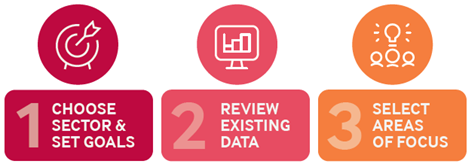
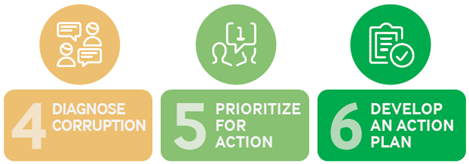
The NRGI tool has a few defining hallmarks. It is highly adaptable, with users choosing which parts of the sector—such as licensing, revenue collection or state-owned enterprises—to focus their analysis and action-planning on. The tool’s research guides reflect the specificities of the extractive sector, drawing on NRGI’s sector expertise and its analysis of over one hundred oil, gas or mining corruption cases.
When identifying common corruption forms across the sector, we conceive of corruption broadly and include systemic forms of corruption such as state capture as well as the role of corruption’s foreign enablers.
Finally, the tool prioritizes multistakeholder participation and action planning so that the findings translate into real-world change.
Country-specific multi-stakeholder groups of the Extractive Industries Transparency Initiative (EITI) will be the tool’s initial users. In 2019, the EITI identified addressing corruption as one of its top priorities and we hope that this tool can contribute toward realizing that ambition. EITI stakeholders in Mongolia are now completing a pilot of the tool, a diagnostic that delved into the corruption risks found in mining operations, including the country’s regulatory and procurement systems.
But the tool is not EITI-specific. It’s a public resource and we encourage anticorruption agencies, civil society groups, international aid donors and others to use it too.
We launched this project in April 2020 with support from Deutsche Gesellschaft für Internationale Zusammenarbeit (GIZ). To inform the tool’s design, we reviewed 17 existing assessment tools, consulted with a range of experts, and organized several rounds of peer review. We’ve benefited from generous contributions from a range of experts and practitioners and are especially grateful for our collaboration with the EITI and Transparency International’s Accountable Mining Program.
In the coming months, we will add additional modules on the energy transition, artisanal mining and other topics, and make further improvements based on user experiences in Mongolia and additional countries.
We are excited to launch the first version of the tool, and eager to partner with others to deploy it widely. We encourage anyone interested in finding out more to contact NRGI senior governance officer Matthieu Salomon (msalomon@resourcegovernance.org).
G7 Countries Cannot Secure Critical Minerals Without Tackling Governance and Corruption

For the U.S., EU and U.K., achieving this will involve honing strategies around supply of “critical minerals” such as cobalt and lithium needed for cleaner technologies like electric vehicles. Just today, the White House released a report on supply chain resilience with a focus on expanding critical minerals production, particularly domestically. Critical minerals will likely be high on the section of the G7 agenda around economic resilience of the global economy, especially given the interplay with geopolitical tensions with China and concerns that the U.K., this year’s G7 host, is lagging in the race for these crucial commodities.
Earlier this year, much was made of the U.S. re-blacklisting controversial mining magnate Dan Gertler over alleged corruption in the Democratic Republic of Congo (DRC), where Gertler’s companies control royalty streams from three of the world’s biggest cobalt projects. Gertler’s is not the only case of suspected corruption in the mining sector, yet governance and corruption are barely on the agenda when it comes to the white-hot topic of clean technology supply chains. If the G7 countries ignore mineral governance and corruption risks, they will be unable to secure reliable supplies; they also diminish the potential for citizens of producer countries to benefit from the extraction of these minerals.
As demand rises, consumer countries cannot just rely on mining “closer to home”
The need for greater quantities of clean technology minerals is ever more apparent. A recent IEA report underscored that cleaner transportation and power generation technologies use significantly more critical minerals than existing technologies. How this trend will shape the market remains difficult to predict. Supply sources can change as price increases entice new entrants, and demand can evolve as companies use alternative technologies and fewer (or recycled) minerals.
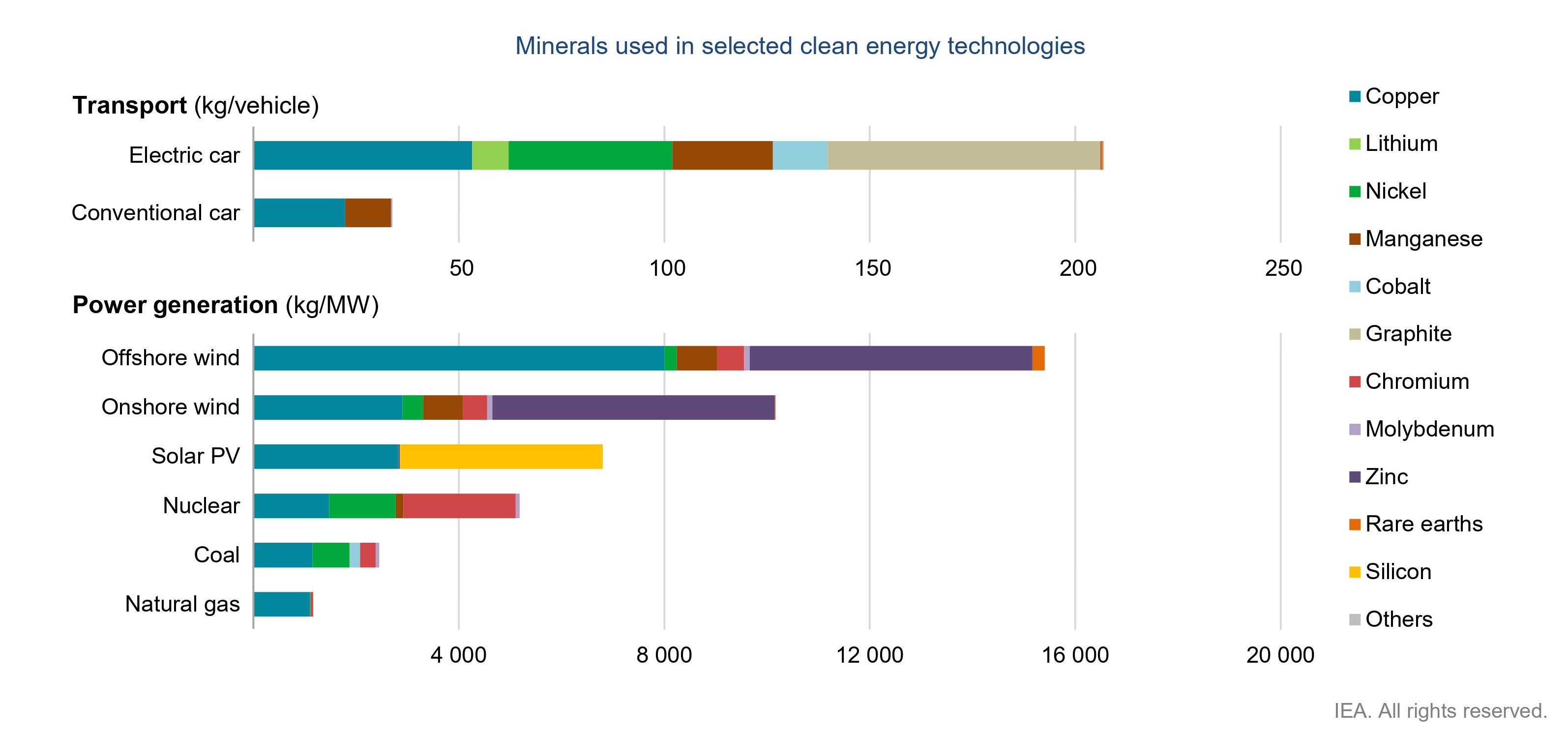
Click to enlarge
As G7 countries unveil climate commitments that rely on battery and other clean technologies, securing critical mineral supplies has shot up the policy agenda, with major consumers such as the U.S. and the EU focusing on securing supplies closer to home. As the Biden administration recognizes, these efforts are unlikely to suffice, given the geographical concentration of resources and the magnitude of mineral requirements in the clean energy transition.

Click to enlarge
Developing countries and emerging markets will likely remain important suppliers for the foreseeable future given the predicted increase in critical mineral demand and likely opposition to more mining in places like Europe. The IEA finds that high reliance on the DRC for cobalt (the DRC is currently responsible for around 70 percent of global production) is set to persist. For copper, expanding supply will likely require growing production in places such as DRC, Indonesia, Mongolia and Peru.
Major consumer countries should invest in improved mining governance in critical mineral producer countries
In many countries with large critical mineral deposits, mining sector governance remains weak, vulnerable to corruption and tied to concerns around political instability. These challenges are neither new nor easily overcome. But they are an essential part of the critical mineral supply puzzle, and therefore essential to achieving the G7’s economic resilience and energy transition objectives. Without effective policies and well-governed institutions in major producer countries, effective scale-up and stable supply will be elusive.
The DRC, the world’s largest cobalt producer and a major supplier of copper, must improve the fundamentals of mining governance. This includes granting mining projects to efficient and qualified companies (rather than well-connected cronies) and addressing the challenges of artisanal and small-scale mining that represents 15 to 30 percent of Congolese cobalt production. For countries such as Bolivia, with its huge undeveloped lithium deposits, a strong government understanding of where economic opportunities lie is essential. Otherwise, governments risk chasing rainbows, such as insisting on sometimes infeasible in-country processing of raw commodities, thereby delaying and disrupting projects without increasing benefits for citizens.
As demand for critical minerals increases, two possible scenarios emerge for mineral-rich developing countries. The first is an acceleration of corruption, political instability and resource dependency of the kind associated with previous commodity booms—especially in oil—and a governance “race to the bottom,” where host countries compromise on standards and fiscal terms as consumer countries clamour to capture market share. This path is a minefield for Western companies as well as producer countries. In the second scenario producer countries mature their mining sectors to meet the demand, with the proceeds contributing to (rather than undermining) their stability and economic wellbeing.
To make this second scenario more likely, leading consumer economies including G7 members should provide increased support and technical assistance to producer country governments seeking to improve sector laws, institutions and practices, and prioritize transparency, accountability and anticorruption within these programs. G7 governments could establish a trust fund for concerted investment in capacity development and accountability, including support for industry regulators, anticorruption actors and civil society players. The U.S.-led Energy Resource Governance Initiative (ERGI), which engages developing country producers, as well as the UN could be other key influencers.
G7 countries should also prioritize governance in their mineral supply chain initiatives. Unfortunately multilateral discussions of the issue have barely touched on better resource governance in producer countries. Efforts such as the OECD’s Due Diligence Guidance and public-private partnerships such as the Global Battery Alliance are laudable, but they tend to focus on tracking and certifying where mineral flows originate, stemming from very valid concerns around connections to child labor and conflict. They lack focus on governance problems (though a recent OECD report on corruption risks is a promising start). Discussions on transparency in critical minerals, including in the IEA report, have focused on market transparency (e.g., greater information on reserves, demand, processing capacity and pricing) and technological solutions such as blockchain. These are important, but miss some of the more glaring governance threats to stable supply.
The governments and companies leading supply chain initiatives must advance forward-looking anticorruption and governance standards. Such measures should prominently feature in standards such as the OECD guidance, legislation in the European Union and other consumer jurisdictions, new systems in producer countries, and the policies of mining and battery companies and sector investors. Such measures include:
- Disclosure of the identities of beneficial owners of companies participating in the critical mineral supply chain, to reduce the risks posed by politically exposed persons and other inappropriate players.
- Disclosure of mineral contracts/licenses and payments, to support public oversight.
- Stronger company anticorruption policies, with robust measures for assessing corruption risks, avoiding high-risk third parties and responding to wrongdoing.
- Producing country commitments such as audits of state-owned mining companies, competitive tenders for major procurement, and transparent licensing and commodity-trading regimes.
By prioritizing this agenda, G7 countries and others can shore up critical mineral supply chains in ways that advance their energy transition and economic resilience objectives while also reinforcing their broader commitments to good governance, anti-corruption and financing development.
Three Ways the U.S. Can Help to Prevent Next-Generation Oil and Mining Corruption

By a wide margin, U.S. authorities have pursued more corruption cases in oil and mining than any other sector. In the last five years, U.S. authorities nabbed the bosses of a company called Unaoil that bribed officials in nine different countries, including Angola, Iraq and Syria. They seized a giant yacht allegedly purchased with proceeds from Nigerian oil trading schemes, and a swank Miami condo that a top Congolese official allegedly bought using embezzled oil funds. U.S. investigations revealed how an American hedge fund paid off officials to access the Congolese diamond industry; how state oil company bosses in Brazil, Ecuador and Venezuela took home bribes; how an Abu Dhabi oil fund helped run one of the largest-ever corruption schemes; and how oil and mining deals within the U.S. turned dirty as well.
As the Biden administration ramps up its anticorruption efforts, officials should pursue policies that heed lessons from these past investigations and that reflect the world’s fast-changing energy and mineral markets.
This week the administration gave clear signs of its commitment to anticorruption. The White House released a memorandum “establishing the fight against corruption as a core U.S. national security interest” and kicking off the process to develop an ambitious cross-agency anticorruption strategy. The Treasury Department recently issued the largest-ever use of the Magnitsky sanctions for anticorruption purposes. These events coincided with the UN General Assembly’s special session on anticorruption, where U.S. officials emphasized their intention to prioritize fighting graft. Meanwhile, on Capitol Hill, a bipartisan counter-kleptocracy caucus will launch this month as well.
In the coming weeks and months, the U.S. anticorruption agenda will take further shape, as the various agencies stand up new programs, key champions such as USAID administrator Samantha Power get up to speed, and the Summit for Democracy approaches, where fighting corruption and kleptocracy will be a main theme.
To stop corruption from ravaging the world’s oil and mineral industries and hindering the green energy transition, several U.S. agencies, including USAID, the State Department, the Treasury Department and the various climate-focused units, should prioritize the following actions. These ideas emerge from a study of over one hundred oil and mining corruption cases, and from the Natural Resource Governance Institute’s work in many resource-rich countries and international forums, and they complement leading recommendations from other NGOs and experts.
1. Prevent corruption in critical mineral supply chains
The International Energy Agency estimates that meeting Paris climate goals will require a quadrupling of the minerals used by clean energy technologies by 2040. For the countries that produce cobalt, lithium, copper and other critical minerals, especially those with weak institutions, this spike in demand could trigger surges in corruption like those associated with past oil booms, which contributed to authoritarianism and economic decline. For mineral-consuming countries like the U.S., corruption could threaten their energy transition plans by interrupting the steady supply of these commodities.
While much was made of the U.S. re-blacklisting mining magnate Dan Gertler over alleged corruption in the DRC, where Gertler’s companies control royalty streams from three of the world’s biggest cobalt projects, governance and corruption are barely on the agenda when it comes to the hot topic of clean technology supply chains. The U.S. could both help safeguard supplies and protect the interests of producer country citizens by correcting this trend. Specifically, U.S. technical assistance to producer countries, including through the State Department’s Energy Resource Governance Initiative (ERGI), should prioritize transparency, accountability and anticorruption, and should include support for civil society groups and other oversight actors. U.S. leadership could also push anticorruption onto the agendas of various international mineral supply chain initiatives and standards. Unless global standards include robust measures around transparency, beneficial ownership reporting, payment verification, anti-money laundering, conflict of interest procedures and other practices, the critical mineral boom could trigger an ugly “race to the bottom,” with consumer countries scrambling to secure supplies, a few well-connected parties getting rich off the rents, and producer-country citizens left facing the results.
2. Tackle oil sector corruption and kleptocracy as part of U.S. climate policy
In addition to anticorruption, the Biden administration has prioritized climate action, and the two agendas must intersect given the oil and gas industry’s predilection towards state capture and kleptocracy.In the Trump administration, the head of the Environmental Protection Agency and the Interior Department were former fossil fuel lobbyists. These appointments were among many recent reminders of how oil and gas producers, thanks to decades of lobbying, campaign donations and revolving-door staffing, exert undue influence over U.S. policy and climate debates. Much of this behavior falls in the categories of legal corruption or state capture, through which narrow vested interests influence public policy to suit their needs. Other oil-producing countries face a similar challenge: corruption and political agendas can cause leaders to greenlight fossil fuel projects, lavish the industry with subsidies and neglect greener energy sources, even when these steps run counter to climate goals and country’s own economic and environmental interests.
To guard against corruption, capture and political stalemates around decarbonization, the U.S. should encourage fossil fuel producing countries to accelerate transparency and oversight. First, citizens need basic information about the government’s fossil fuel activities and adaptation plans, including project-level data on reserves, production, breakeven price assumptions, carbon emissions and government spending. Second, transparency must increase wherever industry and government interact; this applies to lobbying, campaign donations, asset-development contracts, subsidy payments, as well as national oil company affairs.
The U.S. could advance this cause at the Summit for Democracy, via its participation in the Extractive Industries Transparency Initiative, the Open Government Partnership, and in the newly announced Net-Zero Producers Forum, which also includes Canada, Norway, Qatar and Saudi Arabia. This effort would be an important public sector counterpart to U.S. action to advance capital market climate risk disclosures.
Much more than transparency will be needed when it comes to oil-rich kleptocracies and their impact on global climate responses. Half of the world’s oil is produced by 13 authoritarian countries, including several run by kleptocratic regimes. Tackling kleptocracy is notoriously difficult, and U.S. officials should look closely at how Western enablers help kleptocrats to profit and thrive. Some players in the oil sector are complicit, as many Western investors, companies and service providers have supported suspicious deals involving the governments and national oil companies of Russia, Venezuela, Equatorial Guinea and other kleptocracies. Since these oil industries contribute to both global warming and kleptocracy, the role of these enablers is worth a careful look as part of the US’s wider approach to fighting kleptocracy.
3. Shower anticorruption attention on obvious areas of risk
In recent years, thanks to the Panama Papers and other revelations, international anticorruption efforts are devoting greater attention to how dirty money flows offshore, and the damage it then causes. As the U.S. responds to this vital agenda, such as by implementing the Corporate Transparency Act and, hopefully, expanding the U.S. Treasury’s Geographic Targeting Orders, officials should not overlook how the money escapes in the first place. Even a quick skim of the Justice Department’s asset seizure actions makes clear: a lot of dirty money comes from the oil or mineral sectors of resource-rich countries. And it often escapes from a few high-risk areas:
-
State-owned enterprises. National oil and mining companies feature in many corruption schemes, with Brazil’s Car Wash as the most prominent recent example. State-owned enterprises control large amounts of money and are themselves easily controlled by political elites—a recipe for corruption in contexts ranging from Russia to South Sudan, Iraq to Venezuela.
-
Commodity trading. The Justice Department has pursued big commodity trading cases, so U.S. authorities know how dirty, opaque and damaging this side of the industry can be. And yet, there has been no cross-agency response. As leading energy journalists Javier Blas and Jack Farchy recently argued, “It’s high time that politicians in the United States and elsewhere started paying attention” to the fact that traders are “scarcely regulated.”
-
The participation of political elites in the industry. Among the Kremlin allies facing U.S. sanctions are oligarchs who profited hugely off juicy contracts from Gazprom, the Russian national gas company. Political elites often hold interests in oil and mining companies and get rich off the proceeds—usually via inflated contracts or other lopsided deals. Beneficial ownership reporting is a necessary but insufficient response to this challenge. The Luanda Leaks revealed how U.S. entities supported the business ventures of Isabel dos Santos, despite knowing that her father was Angola’s president and other warning signs around the deals. Since oil and mining industries are widely politicized, the sector is a strategic area where the US could work to develop stronger standards regarding who constitutes an appropriate business partner.
As part of an evidence-based approach, the U.S. should learn from past cases and ramp up anticorruption interventions in these known areas of risk. In each one, stronger global standards, attention from regulators and law enforcement, attention from international financial institutions, technical assistance, support for civil society and other actions could make a huge difference. If the U.S. and its allies ignore these proven areas of corruption risk, they leave doors open for more dirty money to escape.
The above ideas resonate with many elements of last week’s White House anticorruption memo. As U.S. officials take this directive and turn it into policy, they can prevent another generation of oil and mining corruption and avert negative impacts on the lives of millions. The Summit for Democracy is one venue where the U.S. could lead on this work and acquire allies; COP 26 and the Open Government Partnership Summit are others.
As resource-producing countries face unprecedented change, corruption could derail their efforts to build more resilient economies, while also threatening U.S. climate, security and economic interests. Thanks to U.S. law enforcement action, we know a great deal about the dismal corruption record of the natural resource sector. These cases point to practical strategies the U.S. can now adopt to avoid a repeat of history.