
EITI is a Sleeping Giant. It's Time to Wake It Up.
Remarks by Suneeta Kaimal, NRGI President and CEO, at the EITI Global Conference 2026

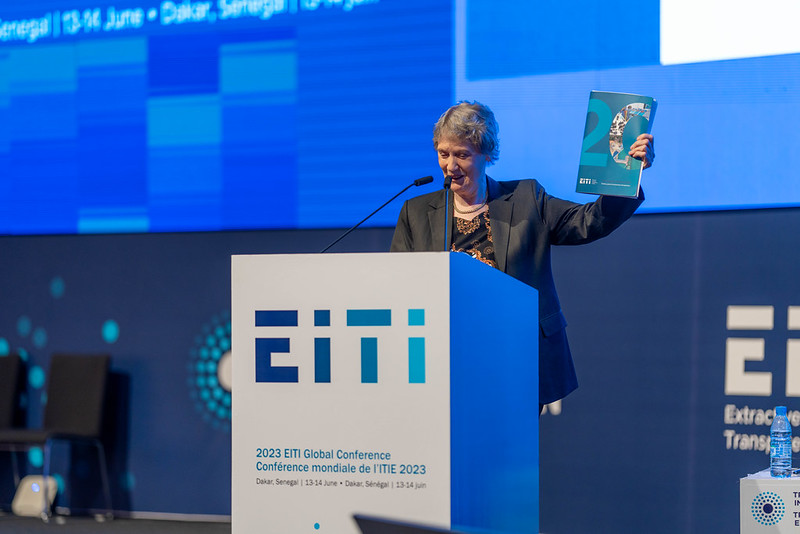
At the opening plenary of the EITI Global Conference in Brussels on 8 October, Suneeta Kaimal called on governments, companies and civil society to turn two decades of progress on transparency into greater accountability. As new resource deals reshape the global economy, she argued that EITI's standards and principles offer powerful tools to scrutinize these agreements, but only if they are put to use, deals are made public and civic space is protected.
Remarks delivered during the plenary session “Building trust in uncertain times,” 8 October 2026. The text follows below.
Three words. Buried in the fine print of the frameworks reshaping the global resource economy. Three words whose implementation could decide whether this new wave of resource deals delivers on our shared ambition: that wealth below the ground benefits the people who live above it.
You've heard it this morning: oil, gas and mining are at the top of political and economic agendas. Energy dominance. Economic growth. National security. [And we’ve heard ambition from leadership like Minister Diof]. This should be an unprecedented opportunity for the low- and middle-income countries that hold much of these resources.
Instead, deals are struck at breakneck speed, under enormous pressure, and often on imbalanced terms. What's on the table is no longer just royalties and tax rates. It is security guarantees. It is health funding. Governments are being asked to trade long-term access to their resources to meet today's urgent needs.
Speed and pressure crowd out accountability. Over 200 mining projects were announced this year alone, most of them shrouded in opacity. Human rights abuses linked to transition minerals surged 73% in the past year. And the foundations we relied on before — rule of law and international cooperation — are crumbling.
So where is the bulwark? NRGI reviewed recent frameworks and roadmaps that guide new resource deals and agreements. And time and again, we found those three surprising, and powerful words: the EITI Standard.
Three words that carry twenty years of hard-won gains. Contract transparency. Beneficial ownership. Anti-corruption. Revenue management. Environmental and social transparency. State-owned enterprises. Civil society participation.
EITI is a sleeping giant. It is already written into the architecture of the new resource economy. Even as some leaders dismiss transparency and accountability, references to the EITI Standard abound.
Take the G7. They've struggled to agree on much lately. Yet their critical minerals roadmap names the EITI values and principles as criteria for standards-based markets, including the rule of law and guarding against bribery and corruption.
Or the World Bank Group. The IFC Performance Standards influence how many of these deals are financed. They reference EITI requirements on contract and revenue transparency, and they are under review right now.
The EU's approach to minerals partnerships. The African Union's Green Minerals Strategy. A draft Chinese industry mining code. Each cites the EITI Standard, opening a door to hold the most powerful players in the sector accountable.
But a framework is not a deal. The deals are where the rubber hits the road and most are done behind closed doors. Only when resource deals and partnerships are made public can we bring the power of these EITI references to bear. To shape their terms and ensure EITI best practices are implemented.
Waking the giant falls to each of us in this room.
For civil society: Every reference to EITI is a promise we can hold up: show us the contract. Show us who owns the company. Show us where the money went.
But that only happens if civil society can speak out, can gather peacefully and can organize without fear. CIVICUS rates 43 EITI implementing countries as having closed, repressed or obstructed civic space. Forty-three. The recent statement on civic space by the EITI Board is welcome, but insufficient. Civic space must be a meaningful and mandatory test in the upcoming validations, not merely a principle we reaffirm.
For supporting countries: you helped make this Standard a global norm. Now uphold it in your policies, the transparency and terms of your deal-making, and your aid budgets. Where competition is tough on price or technology, higher standards are how you stand apart and build resilient supply chains.
For producer countries: these references are bargaining power. When a partner cites the EITI Standard, hold them to it. Make partnerships transparent. Make accountability part of the price of access.
For companies: good governance means stable projects. Opaque deals made under pressure are the ones that tend to unravel, in courts, in parliaments, on the streets. Rather than competing efforts, let’s use what we have, and keep evolving it. Demand that EITI norms are not just cited but implemented in the way you operate.
And for us in EITI as a whole: we must take up the space we have earned. Decisions taken today will impact generations to come, and the work of EITI must keep pace. The recent guidance on government-to-government deals, value addition strategies, and the new global database all head the right direction. But we must act on them today, not years from now in the next Standard.
More than twenty years ago, NRGI was among the civil society organizations who called for the EITI Standard, alongside reformers from government and industry. We've been supporters and critical friends ever since. Together, we made transparency an expectation rather than an exception. Together, we won a seat for independent civil society alongside governments and companies — a superpower, if we defend it and wield it.
“The EITI Standard” is a giant we built together. Twenty years of hard-won gains, waiting to be unleashed. Let's wake it up. Thank you.
Natural Resource Governance: A Matter of Life and Death

Anthony Bebbington, International Program Director for Natural Resources and Climate Justice at the Ford Foundation, argues that resource governance is no longer only a question of who gains and who loses. It is a question of what is allowed to live, by whose authority and on what ethical grounds.
“Is a River Alive?”
This question, the title of a book by Robert Macfarlane, is not often asked in the natural resource governance community. But might posing questions like this open productive pathways? Pathways that lead not to the familiar trope of counter-posing development and nature, but that instead center responsibility, legitimacy and ethics. If one was to entertain the idea that rivers, forests and soils are life forms, then decisions that lead to their modification or destruction in the process of creating value would have to be understood as decisions to transform, redistribute and end opportunities to live, or to live well. Natural resource governance would then have to grapple explicitly with the ethical and existential questions that can otherwise be hidden by environmental impact assessments, budget sheets and growth models. It would accept that the governance of extractive industries is as much a politics of incommensurability as one of optimization.
In both its theory and its practice, natural resource governance has been mostly concerned with the steering of interests and incentives, of rents and taxes, of benefit sharing and compensation, of conflicts and their resolution, and of the behavior of companies, governments and organized civil society. It has elevated technical, institutional and managerial questions, and has understood itself as a field focused on the governance of wealth creation and distribution, rather than on the administration of life and death.
In many cultures, mountains, rivers and forests are understood as life forms and are governed and respected accordingly.
That said, there are spaces where these more existential questions are present. The ever-stronger debate on no-go zones raises these concerns, as do conversations in faith communities, popular culture, legal scholarship, creative industries and especially among Indigenous Peoples. Films such as Avatar and Dune, whatever else one thinks about them, are relentless in insisting that resource extraction is about decisions over what lives, and what dies, and the exercise of power to enforce those decisions. The papal encyclical, Laudato Si, did something similar, albeit more cautiously, insisting on the moral imperative of caring for creation in the face of extraction – a perspective also present in other faith traditions. The still nascent but emerging jurisprudence and legal scholarship on the rights of nature does not necessarily argue that abiotic nature is alive, but it gets close when it asserts a river’s status as a bearer of rights that merit legal protection against resource extraction (assertions that have sometimes prevailed in the courtroom). The growing scholarship on more-than-human life and “Earth Beings” entertains the same possibilities, and even if it may not pass its own judgement on whether abiotic nature is alive, it does recognize that in many cultures, mountains, rivers and forests are understood as life forms and are governed and respected accordingly.
For many in the natural resource industries, these contributions might be viewed as theoretical, unrealistic and anti-development. But those same voices are often quite comfortable with the idea that a corporation is a legal person with rights and obligations. And yet it would seem far harder to argue that a corporation is a being than to make the same claim for rivers, soils or forests.
My purpose here is not to be dramatic, nor to argue that resource extraction cannot create important opportunities—I come from a region that in large measure lived from coal mining and associated industries, and whose economy has really struggled since their demise. To ask bigger and ethical questions about resource extraction is not to argue against resource extraction in all its forms, nor to question that the good governance of resource extraction can make important contributions to human development—it clearly has done, and I grew up seeing many of those contributions. Rather, my purpose is to ask those of us in the natural resource governance field to live with the discomforts that we should live with. It is neither helpful nor honest to discuss resource governance or development governance without also centering the fact that these are fields that steer decisions about which and whose forms of living—human and biotic—will gain, and which and whose forms of living will suffer and, in some instances, be extinguished.
Recently, I was in a region experiencing vertiginous increases in mineral extraction, processing, capital investment and job creation. We spent time with Indigenous Peoples who not so long ago came out of isolation. Kind, funny, dignified and thoughtful, they are forced to navigate the sweeping transformations this growing resource extraction economy imposes on their lives with little to no support. The asymmetries of power this creates are appallingly large, and one came away with the sense that these communities are not being heard and have been largely left on their own to bear the costs. In a case like this, on what ethical grounds, and on the basis of what claims to legitimacy, are some able to decide that a form of life—in this case human—just doesn’t matter enough to stop it from slowly dying out. Is it sufficient to argue that the creation of tens of thousands of jobs justifies this? Is it adequate to argue that “we are the elected government”, or “we are a nationally strategic project” and therefore mandated to decide on these trade-offs? This is not clear, just as it is not obvious that citizens really intend their vote to give the governments they elect the power to decide what forms of life should prosper and which should die. Indeed, the idea that we might be delegating such power evokes a whole range of historical cataclysms.
As Earth is pushed up against or past almost all its planetary boundaries, the resource governance discussion is now more than anything else a discussion about what is allowed to live, and what not, why, when, by whom, and on what grounds. On what basis is the power to make such decisions given to those who govern natural resources? Discussing this should place ethicists, humanists, faith leaders, Indigenous Peoples and artists (for instance) alongside technocrats, company managers, bureaucrats, policymakers and scholars in a shared project of placing these really hard questions at the center of natural resource governance.
Decisions about extraction will become even more focused on wealth and war, and even less concerned with the flourishing of all life in all its wonder and glory.
Some of these difficult conversations about ethics, legitimacy and authority are already happening, but they should become much more central to the field. Building on Lisa Sachs’ recent commentary, to deepen such conversations would be a conscious effort to approach resource governance not only from within wider approaches to development, but also within wider approaches to democracy that understand democratic process as existing in service of life—all life. After so many centuries of unequally distributed harms, and in a context in which small groups of plutocrats and autocrats seek to steer ever more of our decisionmaking on issues of huge consequence, this centering of life and ethics seems a critical path in the face of the real risk that decisions about extraction will become even more focused on wealth and war, and even less concerned with the flourishing of all life in all its wonder and glory.

Anthony Bebbington is International Program Director for Natural Resources and Climate Justice at the Ford Foundation. He is a member of the National Academy of Sciences and the American Academy of Arts and Sciences and a Guggenheim Fellow, and has held professorships at the Universities of Melbourne, Manchester and Clark, along with Australian Research Council Laureate and Economic and Social Research Council professorial chairs. He has served as board chair of the Climate and Land Use Alliance and the TAI Collaborative, as a board member of Oxfam America, and has worked at the World Bank. He is an incoming trustee of the Natural Resource Charter Limited (NRCL), NRGI’s UK-registered charity. His work focuses on environmental and climate governance, extractive industries, rural livelihoods, social movements and non-governmental organizations. He contributed this piece as part of NRGI's 20th anniversary thought piece series on the future of resource governance.
From Standard to Action: Does the EITI Remain Relevant?

Dwindling civil society funding, intensifying geopolitics and the accelerating pressure of the energy transition are all compelling organizations to make hard choices about where to invest their time and resources. Against this backdrop, many in civil society are asking whether the Extractive Industries Transparency Initiative (EITI), underpinned by the latest 2023 standard, is still relevant to the accountability challenges producer countries face today.
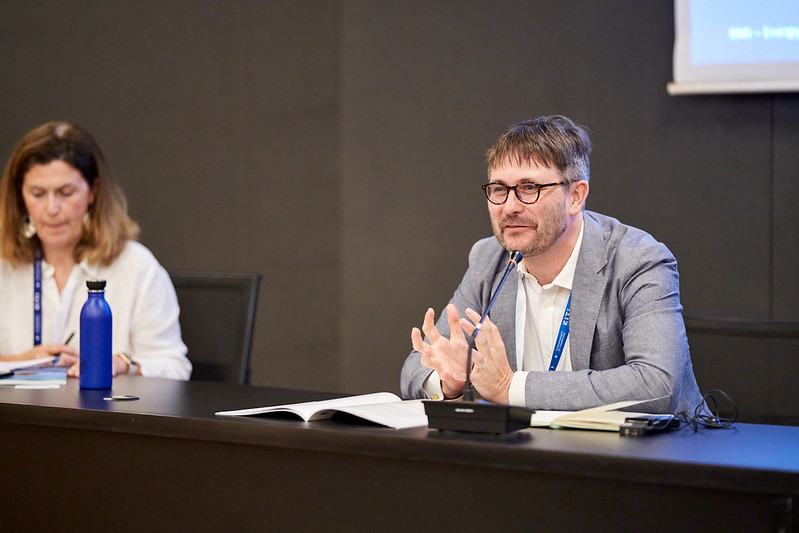
To explore this question, the Natural Resource Governance Institute (NRGI), the Transparency International Accountable Mining Programme, and the Resource Justice Network (RJN), with support from the Extractives Global Programmatic Support (EGPS) Multi-Donor Trust Fund, hosted a virtual event on 23 April 2026, bringing together civil society, private sector and government officials from over 30 EITI implementing countries. The answer was a cautious but clear conclusion: the updated Standard contains important new tools, but civil society and government reformers must work to turn disclosure into accountability.
How the 2023 standard is rooted to the current moment
Ketakandriana Rafitoson, Executive Director of the Resource Justice Network, opened by emphasizing the role EITI has played for the resource governance movement — and warning that if civil society leaves these spaces, transparency risks being privatized: shaped by commercial confidentiality and industry preferences rather than accountability to citizens and affected communities. Pilar Acosta of Transparency International Australia then walked participants through the key evolutions in the 2023 standard, highlighting how they responded to:
- New forms of corruption, including those linked to fast-tracked licensing and opaque ownership in critical mineral sectors;
- Energy transition risks, linked to urgent climate pressures, the critical minerals boom, and ongoing efforts to transition away from fossil fuels; and
- A volatile geopolitical landscape reshaping who controls extractive industries and on what terms.
How the 2023 standard is being used
The heart of the session was a set of case studies from RJN network members, each illustrating how the standard is being used on the ground.
Kazakhstan — pushing for transparency of greenhouse gas (GHG) emissions. Danila Bekturganov of Civil Expertise NGO drew on a new study assessing the disclosure of greenhouse gas emissions from Kazakhstan's extractive sector. The findings are stark: while Kazakhstan has a developed national accounting system for GHG emissions, the data it collects is largely shielded from public view. A legal gap between the definition of "pollutant emissions" and "greenhouse gas emissions" in Kazakhstani law means that companies can, and do, classify actual GHG data as commercial secrets. Civil society is using EITI Requirements 3.4 on GHG emissions, and 6.4 on environmental impacts of extractive activities to push for change within the multi-stakeholder group, and to argue that EITI reporting should include disaggregated, project-level GHG data. As Kazakhstan aligns its economy with a carbon neutrality target of 2060 and faces increasing pressure from the EU's Carbon Border Adjustment Mechanism (CBAM), this transparency gap carries real economic and political consequences.
Togo — scrutinizing fast-tracked licenses. Pius Kossi Kougblenou of ACOMB described how civil society in Togo is using the 2023 standard to hold the line on discretionary and fast-tracked mining license allocations. Analysis of EITI reporting revealed that data on license transfers and approvals had not been fully communicated by the relevant government directorate, and that Togo's multi-stakeholder group had not yet established a methodology to assess procedural deviations. Using Requirement 2.2, civil society is pushing for systematic publication of license award and transfer data, a complete and verifiable mining cadastre and genuine traceability of decision-making processes.
Philippines — grounding Free, Prior and Informed Consent (FPIC) in reality. Beverly Besmanos of Bantay Kita / Publish What You Pay Philippines described how Filipino civil society is using the 2023 standard to move beyond revenue tracking and focus on the upstream integrity of mining projects, particularly the quality of FPIC processes. Bantay Kita conducts "ground-truthing" to verify whether the consent reported by companies aligns with the actual experiences of Indigenous communities. They have submitted shadow reports to EITI International highlighting the harassment and red-tagging — the practice of publicly labeling activists as communist or terrorists, regardless of their political association, which has been linked to harassment, surveillance, arrests and killings — of environmental defenders. They are also pushing for the passage of a Philippine EITI law that would make community consultation disclosures a legal mandate rather than a voluntary exercise. With 90% of Philippine nickel exported to China, Bantay Kita is also investigating opaque investment structures and shadow ownership designed to bypass national laws — what Beverly called the rise of "corrosive capital."
Zambia — unlocking power purchase agreements. Tamika Halwiindi of Transparency International Zambia offered a compelling case of innovative EITI implementation. Zambia's mining sector consumes over half of the national power supply, and a history of expensive, opaque power purchase agreements has saddled the country's state utility with significant debt. Drawing on Requirement 2.4 on contract transparency, civil society has successfully pushed for a register of power purchase and supply agreements to be published on the Zambia EITI Fusion portal, showing contracting parties, contract duration, and agreed capacity. Comprehensive disclosure is not yet in place, but the direction of travel is clear — and the work sets a precedent other implementing countries could replicate.
Barriers to implementation
Participants then split into discussion groups on the main barriers to implementation and the changes that would most strengthen EITI as a tool for action. Three recurring themes emerged:
First, enforcement remains inconsistent. There are currently no sanctions for extractive companies that fail to provide EITI reports, and many of the new provisions—including on subsidies, reserves and greenhouse gas disclosure—remain encouraged rather than mandatory. Without consequences, EITI risks becoming a reputational shield for the companies and governments least committed to reform.
Second, major blind spots remain around state-to-state deals and subnational implementation. Resource-backed loans, infrastructure-for-minerals agreements, offtake arrangements, and development corridor projects largely fall outside EITI's remit, yet these are increasingly how extractive deals get done. Meanwhile EITI implementation concentrates at the central government level, leaving the communities where extraction actually happens with limited access to the initiative.
Third, civic space restrictions are limiting civil society's ability to play its role. Through the targeting of environmental defenders to shrinking participation in intergovernmental processes and the absence of institutionalized local CSO selection, civil society faces real barriers to influencing multi-stakeholder groups and national EITI processes. Governments and companies must actively support the civic space needed to make the standard work — not merely tolerate it. At the same time, participants were clear that civil society itself must be proactive: the 2023 standard creates real opportunities, but only if organizations take them up creatively and push national EITI processes to act on them.
A cautious conclusion
The 2023 EITI Standard is better calibrated than its predecessors to the corruption risks, energy transition pressures, and geopolitical shifts reshaping extractive industries today. But a stronger standard does not automatically produce stronger accountability. The case studies and discussions from this event made clear that disclosure requirements only deliver results when civil society and government reformers actively turn them into political leverage: demanding disaggregated data, challenging fast-tracked licenses, exposing opaque ownership, and pushing multi-stakeholder groups to use every available provision. With civic space shrinking and extractive deals outpacing the mechanisms meant to hold them to account, that work is more urgent than ever.
Financing Africa’s Energy Future: Outcomes from Future of Energy Conference 2025

On 27 August 2025 our CEO, Suneeta Kaimal, delivered the keynote address on Day 2 of the Future of Energy Conference (FEC) 2025, where she discussed strategies for an inclusive and sustainable energy future in Africa.
This year’s theme, “Financing Africa’s Energy Future: Unlocking Investments for Energy Access and Economic Transformation” responds to the enduring challenges of energy poverty. Over 600 million Africans lack electricity and nearly a billion rely on traditional biomass for cooking.
Last month, at the fourth Financing for Development Conference in Seville, Kenya helped drive the launch of a bold new coalition, joined by Benin, Sierra Leone, Somalia and others. Together, they committed to taxing premium air travel to raise new, additional, and predictable flows of public finance for sustainable development.
If implemented globally, this measure alone could raise more than $80 billion in revenue—not loans or aid—every year. To put this in perspective: the International Energy Agency (IEA) estimates that achieving universal access to modern energy in Africa requires only $25 billion each year.
At first glance, this is just another tax. But it is far more significant. It represents the kind of financial innovation that African leaders can replicate, scale up, and channel to unlock energy access and economic transformations for Africa.
The challenge of this moment
Let me step back for a moment to explain “why” we need such innovation now, more than ever.
$500 billion. $500 billion, along with related infrastructure spending, is the estimated cost for sub-Saharan Africa to close the energy poverty gap and transition its energy system to a sustainable basis. $500billion. That is a stunning figure.
By contrast, in 2023, financing for clean and renewable energy in all developing countries, not just sub-Saharan Africa, reached only $22 billion. Think about that. $500 billion needed for sub-Saharan Africa alone, $22 billion available for all developing countries.
Just a year ago, many still believed that bridging this massive financing gap might be achieved through “blended finance”. Blended finance is the idea that we use relatively small amounts of public finance to de-risk and leverage much larger flows of private investment. That was how the EU and the US managed to recover from the 2008 financial crisis.
The promise of this “billions to trillions” narrative was that if African governments covered the risks and offered something like 9 percent yields on bonds intended to drive energy transition investments, then private investors would come flooding in. Multiplying public money by ten, a hundred, even a thousand times.
But actual results show that the “billions to trillions” idea is an illusion. The Blended Finance Task Force found that, rather than multipliers of ten, 100, or 1,000, the results are closer to 0.3, which means that every dollar in public money brings only 30 cents in private finance.
If you combine that reality with plummeting international development assistance levels and the constant chaos of tariff wars, one thing is clear: the rules of this game will not address Africa’s needs to finance energy access and sustainable development.
So, the challenge Ben Boakye, the Executive Director of ACEP, put to us yesterday is the right one: how do we innovate to meet the rightful expectations and aspirations for energy access of the next generation— those in this room and beyond. If as the keynote speaker, you thought I would have the answers, sorry to disappoint. I’m counting on all of you for that.
But building on NRGI’s work with partners in government, and in civil society around the world, I’ll share some insights into what must change to enable lasting, innovative financing solutions.

Strategic, inclusive just energy transitions
Successful financing starts with a strategic, inclusive vision for just energy transitions. There is no single path for defining the energy and economic futures of countries. We need context-specific solutions that are aligned with the country’s development ambitions and reflect the voices and needs of different populations.
Here in Ghana and in Nigeria, we have collaborated with partners to launch national dialogues, ensuring that energy transition plans align with public priorities. In Ghana’s oil-producing regions, we have engaged with communities to amplify the concerns of fisherfolk, women, and youth.
In Senegal, we trained civil society partners to understand and engage with public consultations on the Just Energy Transition Partnership, and to raise concerns about energy access and equity.
Building such strategic, inclusive visions ensures that the financing that is raised is directed towards the needs and ambitions of the people and their national development plans.
Changing the color of money
The second change needed is the color of the money.
Even promising initiatives like Senegal’s Just Energy Transition Partnership risk pushing countries further into the debt trap. Of the financing pledged for the JETP, only 6.6 percent is in grants. More than 80 percent is structured as loans. Instead of creating fiscal space for investments in rural electrification or retraining workers, it risks adding pressure to unsustainable debt.
Governments across Africa spend nearly 17 percent of their revenues on debt service—the highest of any developing region. Over half of Africans now live in countries that spend more on debt than on health or education.
New lending models are needed to mobilize private capital. But these must offer African nations fair interest rates that recognize their growth trajectories and avoid overburdening public budgets. They must also be paired with technical and technological support for renewables, addressing barriers to licensing and intellectual property.
Reinvigorating domestic resource mobilization
Finally, we must reinvigorate domestic resource mobilization, the primary engine of sustainable development financing.
Africa holds immense resources – including 30 percent of the world’s transition mineral reserves. African countries can leverage the global demand for minerals for strategic bargaining to move up the value chain, diversify their economies and increase public resources.
Take Zambia. They have attracted European support for a planned cobalt refinery and to facilitate investment in an electricity interconnector between Zambia and Tanzania. That will reduce the impact of increasing drought risks on their hydro capacity.
Value addition like this is not feasible in all countries and contexts, but such regional collaboration can overcome constraints such as scale, supply of inputs, and small downstream markets, and help unlock more benefits from the mining sectors. In doing so, countries can move concertedly up the value chain, increasing domestic financing for just energy transitions and advancing renewable technologies at home.

The opportunity is now
Strategic, inclusive just transitions. Changing the color of the money. Reinvigorating domestic resource mobilization. These are not small asks— they require long-term, sustained, and concerted focus. The influence of rich, consumer countries still limits the scale of financing and compromises sovereignty over energy and resources. And rich countries must not be allowed to abdicate their roles and responsibilities.
But there are opportunities to shift the global conversation today. Or at least, next week at the Second Climate Week in Addis Ababa.
The UN climate regime has, for too long, been silent on the issue of minerals that are critical to delivering just transitions. The UN Secretary General himself said: “The race to net zero cannot trample over the poor.” As a member of the UN Panel on Critical Energy Transition Minerals, I and many others pushed hard for principles and actions for a new mining paradigm to guide the renewables revolution toward justice.
At the Second Climate Week in Addis next week, we have an opportunity to elevate the issue of minerals governance onto the UN Climate agenda through the Just Transition Work Program. Join us at the Africa Climate Summit and on the road to COP 30 to issue a strong, united call for multilateral action and outcomes that center the needs and ambitions of Africans for improved transition mineral governance, just energy transitions and fair financing.
The Seville coalition showed that African leaders are already bringing practical, innovative ideas to the table. They must now be resolute in forging their own paths as the aid paradigm crumbles. By bringing the political will and ambition to scale, replicate and channel innovative sources of finance to energy transition priorities, we can ensure that bold ideas lead to real progress and that real progress leads to economic and energy transformation for all Africans.
Future of Energy Conference 2025
Accra, Ghana
Our CEO, Suneeta Kaimal, delivered the keynote address on Day 2 of the Future of Energy Conference (FEC) 2025, where she discussed strategies for an inclusive and sustainable energy future in Africa.
This year’s theme, “Financing Africa’s Energy Future: Unlocking Investments for Energy Access and Economic Transformation,” responds to the enduring challenges of energy poverty. Over 600 million Africans lack electricity and nearly a billion rely on traditional biomass for cooking.
Full transcript:
Thank you to Ben and Charles for hosting us and for the opportunity to be here with distinguished colleagues, partners, and friends from around the world. I would like to extend a special welcome to the participants in the NRGI-ACEP 2025 Summer School on the Governance of Extractive Industries. You are the next generation of leaders whose ideas and innovations will shape Africa’s energy future. If you will please stand for a moment of recognition.
Last month, at the fourth Financing for Development Conference in Seville, Kenya helped drive the launch of a bold new coalition, joined by Benin, Sierra Leone, Somalia and others. Together, they committed to taxing premium air travel to raise new, additional, and predictable flows of public finance for sustainable development.
If implemented globally, this measure alone could raise more than $80 billion in revenue—not loans or aid—every year. To put this in perspective: the International Energy Agency (IEA) estimates that achieving universal access to modern energy in Africa requires only $25 billion each year.
At first glance, this is just another tax. But it is far more significant. It represents the kind of financial innovation that African leaders can replicate, scale up, and channel to unlock energy access and economic transformations for Africa.
The challenge of this moment
Let me step back for a moment to explain “why” we need such innovation now, more than ever.
$500 billion. $500 billion, along with related infrastructure spending, is the estimated cost for sub-Saharan Africa to close the energy poverty gap and transition its energy system to a sustainable basis. $500billion. That is a stunning figure.
By contrast, in 2023, financing for clean and renewable energy in all developing countries, not just sub-Saharan Africa, reached only $22 billion. Think about that. $500 billion needed for sub-Saharan Africa alone, $22 billion available for all developing countries.
Just a year ago, many still believed that bridging this massive financing gap might be achieved through “blended finance”. Blended finance is the idea that we use relatively small amounts of public finance to de-risk and leverage much larger flows of private investment. That was how the EU and the US managed to recover from the 2008 financial crisis.
The promise of this “billions to trillions” narrative was that if African governments covered the risks and offered something like 9 percent yields on bonds intended to drive energy transition investments, then private investors would come flooding in. Multiplying public money by ten, a hundred, even a thousand times.
But actual results show that the “billions to trillions” idea is an illusion. The Blended Finance Task Force found that, rather than multipliers of ten, 100, or 1,000, the results are closer to 0.3, which means that every dollar in public money brings only 30 cents in private finance.
If you combine that reality with plummeting international development assistance levels and the constant chaos of tariff wars, one thing is clear: the rules of this game will not address Africa’s needs to finance energy access and sustainable development.
So, the challenge Ben Boakye, the Executive Director of ACEP, put to us yesterday is the right one: how do we innovate to meet the rightful expectations and aspirations for energy access of the next generation— those in this room and beyond. If as the keynote speaker, you thought I would have the answers, sorry to disappoint. I’m counting on all of you for that.
But building on NRGI’s work with partners in government, and in civil society around the world, I’ll share some insights into what must change to enable lasting, innovative financing solutions.
Strategic, inclusive just energy transitions
Successful financing starts with a strategic, inclusive vision for just energy transitions. There is no single path for defining the energy and economic futures of countries. We need context-specific solutions that are aligned with the country’s development ambitions and reflect the voices and needs of different populations.
Here in Ghana and in Nigeria, we have collaborated with partners to launch national dialogues, ensuring that energy transition plans align with public priorities. In Ghana’s oil-producing regions, we have engaged with communities to amplify the concerns of fisherfolk, women, and youth.
In Senegal, we trained civil society partners to understand and engage with public consultations on the Just Energy Transition Partnership, and to raise concerns about energy access and equity.
Building such strategic, inclusive visions ensures that the financing that is raised is directed towards the needs and ambitions of the people and their national development plans.
Changing the color of money
The second change needed is the color of the money.
Even promising initiatives like Senegal’s Just Energy Transition Partnership risk pushing countries further into the debt trap. Of the financing pledged for the JETP, only 6.6 percent is in grants. More than 80 percent is structured as loans. Instead of creating fiscal space for investments in rural electrification or retraining workers, it risks adding pressure to unsustainable debt.
Governments across Africa spend nearly 17 percent of their revenues on debt service—the highest of any developing region. Over half of Africans now live in countries that spend more on debt than on health or education.
New lending models are needed to mobilize private capital. But these must offer African nations fair interest rates that recognize their growth trajectories and avoid overburdening public budgets. They must also be paired with technical and technological support for renewables, addressing barriers to licensing and intellectual property.
Reinvigorating domestic resource mobilization
Finally, we must reinvigorate domestic resource mobilization, the primary engine of sustainable development financing.
Africa holds immense resources – including 30 percent of the world’s transition mineral reserves. African countries can leverage the global demand for minerals for strategic bargaining to move up the value chain, diversify their economies and increase public resources.
Take Zambia. They have attracted European support for a planned cobalt refinery and to facilitate investment in an electricity interconnector between Zambia and Tanzania. That will reduce the impact of increasing drought risks on their hydro capacity.
Value addition like this is not feasible in all countries and contexts, but such regional collaboration can overcome constraints such as scale, supply of inputs, and small downstream markets, and help unlock more benefits from the mining sectors. In doing so, countries can move concertedly up the value chain, increasing domestic financing for just energy transitions and advancing renewable technologies at home.
The opportunity is now
Strategic, inclusive just transitions. Changing the color of the money. Reinvigorating domestic resource mobilization. These are not small asks— they require long-term, sustained, and concerted focus. The influence of rich, consumer countries still limits the scale of financing and compromises sovereignty over energy and resources. And rich countries must not be allowed to abdicate their roles and responsibilities.
But there are opportunities to shift the global conversation today. Or at least, next week at the Second Climate Week in Addis Ababa.
The UN climate regime has, for too long, been silent on the issue of minerals that are critical to delivering just transitions. The UN Secretary General himself said: “The race to net zero cannot trample over the poor.” As a member of the UN Panel on Critical Energy Transition Minerals, I and many others pushed hard for principles and actions for a new mining paradigm to guide the renewables revolution toward justice.
At the Second Climate Week in Addis next week, we have an opportunity to elevate the issue of minerals governance onto the UN Climate agenda through the Just Transition Work Program. Join us at the Africa Climate Summit and on the road to COP 30 to issue a strong, united call for multilateral action and outcomes that center the needs and ambitions of Africans for improved transition mineral governance, just energy transitions and fair financing.
The Seville coalition showed that African leaders are already bringing practical, innovative ideas to the table. They must now be resolute in forging their own paths as the aid paradigm crumbles. By bringing the political will and ambition to scale, replicate and channel innovative sources of finance to energy transition priorities, we can ensure that bold ideas lead to real progress and that real progress leads to economic and energy transformation for all Africans.

Keynote at FEC 2025

Suneeta Kaimal
President and Chief Executive Officer, NRGI Governing Board ex officio
‘This Moment Counts for Reinvention and Resilience, Not Retreat’: Anticorruption Priorities in Mining

By its very nature, the fight against corruption is a difficult task. Those who engage in corrupt practices often wield significant power, using it to silence or intimidate those who seek change. But giving up the fight against corruption is not an option if we want to build a fairer future, and high risks surrounding transition minerals poses a major challenge to a just energy transition. Working together is essential to counter the growing challenges anticorruption actors face, especially in an increasingly hostile political climate.
NRGI recently hosted a webinar to launch its report Ten Red Flags for Corruption Risk in Transition Minerals Licensing and Contracting. During the event, we heard from civil society actors, law enforcement officials, investigative journalists and members of the investor community about the corruption they encounter in their work, and how best to tackle it. Three key themes emerged:
- Collaboration is key: As political commitment to anticorruption and sustainability falters, the need to work collaboratively, and better understand the role of markets and actors with financial leverage in driving change, is crucial.
- Broadening our definition of corruption: We need to ensure we pay more attention to state capture, and the gap between those who benefit from the energy transition and those who suffer its impacts.
- Protecting civic space is urgent: All actors must step up to protect civic space and fundamental freedoms, which are under perilous threat in many countries where minerals are extracted.
Read final reflections below from our panellists on what they consider the most important changes needed to tackle corruption in the mining sector, and to stay motivated despite difficult headwinds.
Ketakandriana Rafitoson, Executive Director of Publish What You Pay
‘Backsliding on the FCPA and sustainability regulations is sending the message to companies that they can prioritize profit over people. But there are pillars of anticorruption standards left standing, such as the UN Convention Against Corruption, which should be updated to include considerations around the extractive industries. This is essential to protect future generations, who will be the ultimate losers of this backsliding. That is who we must keep fighting for. It isn’t an easy fight, but we need to keep advocating for strong transparency and anticorruption measures in licensing and contracting processes.
And civil society needs to be smart, we need to engage more with investors and financial institutions to ensure that they apply responsible business practices and conduct rigorous due diligence. While the loss of U.S. leadership is a setback, civil society has never relied solely on one country or funding stream to drive change. The response must be to adapt, strengthen regional coordination, and find new avenues for accountability in an increasingly hostile landscape. This moment counts for reinvention and resilience, not retreat.’
Dian Patria, KPK (Corruption Eradication Commission, Indonesia)
‘When we talk about corruption in mining we have to think about two things. We need to talk about corruption in the form of state capture, and corruption in the form of bribery. State capture is not easy to investigate because it is embedded in the way regulations are made, so this is the biggest challenge for us. But when we talk about corruption in mining, we need to make sure that we are not only considering bribery. In Indonesia there have been concerning regulatory developments, and we need to look more closely at these as at risk of state capture. For example, universities and religious institutions are now able to acquire mining permits. Another example is that there is no non-tax revenue for cobalt in Indonesia, unlike nickel.
For me, market and public pressure are a key part of the answer to this problem, as is ensuring that only legally mined minerals can be sold on the market. This is an area where global action is needed, because it can help generate the political will needed for change within mineral producing countries.’
Léa Peruchon, Forbidden Stories
‘Today, two thirds of the world’s natural resources are extracted in countries where press freedom is in very serious danger, such as Iran, China, Iraq, Saudi Arabia, and DRC. We need more access to information, more reporting, and more cross-border collaborations.’
Dr Stephen Barrie, Church of England Pensions Board
‘Transparency in the mining sector is a means rather than an end in itself; its usefulness relies on disclosures being analyzed, used, interrogated and for that to be done broadly by all parts of civil society, as well as investors and companies themselves. Related to this, it is important for investors to recognize that we have responsibilities and opportunities to set robust expectations and standards on responsible business conduct. We have an interest in protecting civic space, in addressing corruption and in supporting flourishing civil society more broadly, connected to our investments. These are two connected points that the investor community can take forward to support anticorruption efforts in this space.’
Aaron Sayne, NRGI
‘My point may seem big picture but I think it is important to make: we need to reinvigorate and broaden what we mean by corruption. Right now, we can see all sorts of actors – governments, companies, investors, courts, some media and donors – describing corruption very narrowly. Essentially, they describe it as financial crime or bribery and treat it as a sort of passe topic. But I think we need to push back against that, especially in the transition minerals space, and ask more broadly: who is this transition really for? Who really benefits? And who bears most of the cost? If the gap between those two groups is too broad, that is itself strong evidence of corruption. Because it shows that entrusted public power is being abused for private gain. We should think about it like that, and talk about it like that, even if we can’t prove that some crime happened.’
Watch the full webinar for more insights from our panelists:
Urgent need to address serious human rights concerns in Azerbaijan in the lead-up to COP29
Azerbaijan: End Crackdown on Independent Activism and Release Political Prisoners
We, the undersigned organizations and individuals, strongly condemn the ongoing crackdown against civil society in Azerbaijan that has targeted a broad range of individuals, including human rights activists, journalists, political opposition members, and leaders of nongovernmental organizations. In particular, we call for the immediate and unconditional release of Dr. Gubad Ibadoghlu, who was violently and wrongfully arrested a year ago today.
Dr. Ibadoghlu is a well-known academic and anti-corruption expert who has taught and conducted research on public finance management and good governance, most recently at the London School of Economics. He also has served as chairman of the Azerbaijan Democracy and Prosperity Movement, an organization he has unsuccessfully tried to register as a political party since 2021. Previously, Dr. Ibadoghlu had led the Economic Research Center, an Azerbaijani nongovernmental organization working on anti-corruption and budget transparency issues until the government effectively closed it in 2014. Shortly afterward, Dr. Ibadoghlu began living in exile. He had returned to Azerbaijan in July 2023 to visit his family.
On 23 July, about 20 Azerbaijani police in civilian clothes violently arrested Dr. Ibadoghlu and his wife, Irada Bayramova, after cars without official markings rammed their vehicle, manufacturing a traffic accident. Police assaulted the couple during the arrest. Bayramova was released after several hours, but the authorities brought charges against Dr. Ibadoghlu based on blatantly fabricated offences related to counterfeit currency and to extremist religious materials.
Despite numerous appeals, Dr. Ibadoghlu spent nine months in a pre-trial detention facility before being transferred to house arrest, where he remains. During his detention, Dr. Ibadoghlu’s chronic health conditions deteriorated sharply as a result of the authorities’ refusal to provide him with adequate medical treatment. If convicted, he could face up to 17 years in prison.
Azerbaijani human rights groups estimate that hundreds of people are behind bars in Azerbaijan on politically motivated charges, at least several of whom are known to be in poor health. Azerbaijan has refused to heed numerous calls by human rights organizations and its bilateral and multilateral partners to release everyone who is unjustly imprisoned and to end the crackdown against government critics.
In an April 2024 urgent resolution, the European Parliament called on Azerbaijan to release all political prisoners and noted a number of measures that European authorities could consider if Azerbaijan failed to do so, including suspending the European Commission’s strategic energy partnership with Azerbaijan and imposing targeted sanctions on Azerbaijani officials.
The European Union’s other institutions and its member states, other key international actors and organizations, such as the Council of Europe, the Organization for Security and Cooperation in Europe, and the European Bank for Reconstruction and Development, as well as companies with business interests in Azerbaijan, should support and join in making these calls, to help ensure that the Azerbaijani authorities follow through on them as a matter of priority.
Azerbaijan is under a global spotlight this year, as host to the United Nations climate conference (COP29), to be held in Baku in November. In the lead-up to COP29, United Nations Framework Convention for Climate Change (UNFCCC) member states should press Azerbaijan’s government, publicly and privately, to respect its human rights obligations, including by immediately and unconditionally releasing arbitrarily detained activists and human rights defenders. These countries should recommend concrete, structural reforms to ensure that positive changes endure beyond COP29.
Given the dire human rights situation in Azerbaijan, the UNFCCC Secretariat should work with the government of Azerbaijan to provide space for diverse civil society participation in the climate conference, including by individuals and groups critical of the government. Robust and rights-respecting climate action requires the full and meaningful participation of civil society in climate negotiations, including the outcome of COP29.
We urge the government of Azerbaijan to uphold the commitments it has as a member of numerous multilateral organizations and initiatives that have human rights elements, and the obligations it has as a party to key international human rights treaties, by taking the following steps:
- Drop all charges against Dr. Ibadoghlu and against other human rights defenders, journalists, and civil society activists which have no credible foundation and were brought as retaliation for their legitimate work, protected by international human rights norms;
- Release all individuals wrongfully held on spurious grounds, immediately and unconditionally;
- Allow Dr. Ibadoghlu to travel abroad, unhindered and to the country of his choice, to reunite with his family, and to receive the medical care he urgently needs;
- Cease the use of criminal prosecution as a tool to suppress government critics and members of civil society;
- Lift restrictions on civil society by amending laws related to registration of nongovernmental groups and media in accordance with international standards.
Signatories
Organizations
- Amnesty International
- Crude Accountability
- Daphne Caruana Galizia Foundation
- Freedom Now
- Human Rights Foundation
- Human Rights Watch
- International Partnership for Human Rights
- Natural Resource Governance Institute
- Norwegian Helsinki Committee
- Publish What You Pay
- The Secretariat of the Steering Committee of the Eastern Partnership Civil Society Forum
Individuals
- Charles M. Becker, Associate Chair, Economics Department, Duke University
- Tomila Lankina, Professor, International Relations Department, London School of Economics
- Arien Mack, Professor of Psychology, New School University; Editor of Social Research
- Simon Taylor, Director, Hawkmoth; Co-Founder and Board member, Global Witness
- Marcel Thum, Professor of Economics, Technische Universität Dresden
The rise in civic space violations poses a significant risk to the energy transition and resource governance.
GIJN Webinar: Investigating the Extractives Industry in Africa
Africa is home to a substantial amount of the global mineral wealth. The continent, according to the Natural Resource Governance Institute (NRGI), holds about 30% of the world’s oil, gas, and mineral resources. This includes up to 92% of the world’s platinum and chromium reserves, 56% of cobalt, 54% of manganese, and 40% of its gold. Africa also has 9.5% of global crude oil reserves and 8% of gas reserves.
Given the immense mineral riches in Africa, the extractive industry on the continent is, naturally, a global focal point. Many of the brutal and deadly wars in Africa are linked to the battle for control of these extractive resources.
However, the most impactful mining activities—and their adverse ripple effects—often occur in remote areas of Africa, which have access challenges and significant security risks, resulting in a dearth of accountability reporting.
The Global Investigative Journalism Network (GIJN) hosted a webinar to equip investigative journalists with the knowledge and tools to enhance their watchdog reporting on Africa’s mining sector. In this online workshop, free to all journalists across Africa and beyond, GIJN brought together three experts who will discuss the tips and tools for investigating the extractives industry, where to find resources, and areas for possible investigation.
Elie Kabore is an investigative journalist in Burkina Faso with 17 years of experience in investigative journalism. A publishing director at the online newspaper Mines Actu Burkina, he specializes in reporting about the mining sector. Kabore is the author of several investigations into corruption, money laundering, and illicit finance, and is a trainer for the Norbert Zongo Unit for Investigative Journalism in West Africa (CENOZO).
Alexandre Brutelle is a director and one of the co-founders of the Environmental Investigative Forum (EIF), a consortium of watchdog journalists and experts on the environment and climate change around the world. Alexandre, who coordinated that collaborative effort that led to the development of the #MineAlertAfrica tool, is an investigative journalist, mentor, and trainer who specializes in cross-border collaboration and environmental issues.
Nafi Chinery is NRGI's Africa director. She builds and coordinates relationships between governments, civil society actors, and communities, focused on changing narratives about the future of the oil, gas, and mining sectors. She also co-leads NRGI’s program on just energy transition. She spoke, among other things, about NRGI’s guide to covering extractives.
The moderator was Asha Mwilu, founder and executive director, Debunk Media.
NRGI has developed an online guide to reporting on natural resources governance.
Featuring NRGI's

Nafi Quarshie
Africa Director