
High-Level Opening of Together4Transparency: The House Transparency Built (COP31)
Special Event Room 6, Blue Zone, COP31, Antalya
Transparency is the backbone of the Paris Agreement. Under the Enhanced Transparency Framework, countries report on their climate action and support, so the world can see whether commitments are being met. The #Together4Transparency initiative, launched by the UNFCCC at COP27, brings governments, UN agencies and non-state actors together to make that framework work.
Countries are at different stages, from those with years of comprehensive reporting to those just starting out. This high-level opening looks at what transparency has built along the way: stronger institutions, better data, closer coordination across government, and space for subnational governments, the private sector, academia and civil society to take part. It will also ask what it takes to keep that political ownership going and to make sure transparency information shapes NDCs, long-term strategies and investment decisions.
Laury Haytayan, NRGI’s Middle East and North Africa director, will speak on the panel about the role of non-state actors in opening up national transparency systems.
Speakers include:
- Xuehong Wang, Director, Transparency Division, UNFCCC secretariat
- Trigg Talley, Visiting Professor of the Practice, University of Maryland School of Public Policy
- Rachel Harris, Director, NDC and Transparency Capacity Building, Department of Climate Change, Energy, the Environment and Water, Australia
- Suzanne Lekoyiet, Task Manager, UNEP
- Laury Haytayan, Middle East and North Africa Director, NRGI
Moderated by Kaveh Guilanpour, C2ES.
Featuring NRGI’s

Laury Haytayan
Middle East and North Africa Director
Electricity at the Heart of a Just Energy Transition
A Shared Regional Vision for the Future of Energy in the Middle East and North Africa

Developed by civil society partners from five countries, this roadmap sets out five shared priorities for fairer, more transparent and resilient electricity systems in the Middle East and North Africa.
Electricity is central to a just energy transition in the Middle East and North Africa. Reliable, affordable electricity supports livelihoods, essential services and economic development. How the sector is governed will shape countries’ ability to expand renewable energy, strengthen energy security and deliver benefits for communities.
This regional civil society roadmap sets out a shared agenda for electricity sector reform, identifying five priorities:
- Reforming subsidy and pricing policies to strengthen investment in electricity.
- Strengthening transparency, accountability and access to information.
- Improving governance and institutional coordination.
- Strengthening the role of civil society and the media.
- Expanding regional cooperation and electricity interconnection.
For each priority, the roadmap outlines common challenges, calls for reform and commitments by participants. It invites governments, regulators, electricity utilities, regional institutions, international partners, civil society and the media to turn these priorities into concrete policies, initiatives and partnerships.
About this roadmap
During 2025 and 2026, the Natural Resource Governance Institute (NRGI) convened stakeholders from Morocco, Tunisia, Egypt, Lebanon and Iraq to identify shared priorities for a just energy transition in the Middle East and North Africa. Four representatives from each country participated, drawn from government, civil society and the media.
Participants compared national priorities and identified electricity governance as a shared concern and a regional priority for collective advocacy and action. Civil society partners then reconvened to develop this regional roadmap. It reflects their collective priorities, informed by technical expertise and national perspectives contributed by government representatives, experts and media participants throughout the process.
The roadmap is a resource for civil society, policymakers and others working to build fairer, more resilient electricity systems across the region.
NRGI’s role was to convene and facilitate the process. The priorities, calls to action and commitments in this roadmap are the shared views of the relevant participants and do not necessarily represent the positions of NRGI.
Beyond Extraction: Why COP32 Must Redefine Africa's Role in the Global Energy Transition

As the world prepares for COP31 in Turkey, Nana Dr. Antwi-Boasiako Amoah, Chair of the African Group of Negotiators on Climate Change, looks ahead to COP32 in Ethiopia in 2027. He argues that COP32 offers Africa an opportunity to redefine its role in the global energy transition, using its critical minerals to build stronger economies, deepen regional cooperation and secure a fairer share of the value they create.
In 2027, COP will return to Sub-Saharan Africa for the first time in 15 years. When historians reflect on this moment, Africa should be remembered not just as the host of another climate conference, but as the continent that helped redefine action at the intersection of climate and development transformation.
If this lofty ambition is to be realized, it will depend on how the continent comes together to leverage and govern its critical transition minerals. Around the world, governments and other non-state actors, especially the private sector, are investing trillions of dollars in clean energy technologies and infrastructure. Demand for the minerals needed for clean energy technologies is expected to continue rising sharply over the coming decades.
Africa is well placed to benefit from this new minerals boom, as it is rich in many critical mineral reserves. To name just a few examples: the Democratic Republic of the Congo remains central to global cobalt production; Zambia and the DRC anchor one of the world's richest copper belts; Guinea is indispensable to global bauxite supply; and South Africa continues to play a leading role in platinum group metals.
It is clear that the success of the global energy transition will depend significantly on Africa and her resources. Yet, there remains a real risk that Africa could be left looted unless the transition is deliberately designed to create value for the continent. This paradox defines our era.
Twenty years ago, the global resource governance movement transformed the conversation from one centered on extraction of resources to one focused on inclusive development through transparency, accountability and citizen participation. Organizations such as the Natural Resource Governance Institute (NRGI), together with governments, civil society and international partners, helped place accountability, transparency and better governance at the heart of resource management.
Today's challenge is different. Africa must not only govern its minerals better. It must negotiate its future better.
For more than three decades, the African Group of Negotiators (AGN) has helped shape international climate negotiations by advancing African priorities on adaptation, climate finance and Loss and Damage. COP32 now offers the opportunity to extend that leadership to one of the defining issues of this century: the governance and diplomacy of critical minerals.
Across the world, major economies are redesigning industrial strategies around secure mineral supply chains. The European Union's Critical Raw Materials Act, the United States-led Forum on Resource Geostrategic Engagement, China's International Economic and Trade Cooperation Initiative on Green Mining and Minerals and similar initiatives elsewhere reflect a profound geopolitical shift. Minerals are no longer simply commodities; they have become strategic assets.
Africa's greatest strategic asset is therefore not simply its mineral endowment. It is its collective bargaining power.
For too long, success has been measured by how many tons of minerals leave African ports. That is the wrong measure. Success should be judged by whether mineral wealth creates decent jobs, reliable energy systems, stronger public institutions, competitive industries, technological capability and lasting prosperity for African citizens.
This requires a new generation of mineral diplomacy. Not diplomacy centered solely on concession agreements, but diplomacy that connects climate ambition with industrial policy, infrastructure investment, technology transfer, regional integration and economic resilience.
But better deals alone will not deliver transformation. Without transparent institutions, accountable governance and public trust, even the most ambitious mineral partnerships will fail to deliver on their promise.
History has shown that mineral booms can fuel corruption, environmental degradation, elite capture and community conflict when governance is weak. Conversely, countries with transparent licensing systems, contract disclosure, beneficial ownership transparency, sound fiscal management, environmental accountability and meaningful citizen participation are better positioned to attract responsible investment. This enables them to convert mineral wealth into long-term development.
Governance is the defining key in this regard. Strong governance strengthens investor confidence while ensuring that mineral wealth contributes to sustainable and inclusive development. So, good governance is not an obstacle to investment. It is one of its greatest competitive advantages. The challenge before Africa is not to choose between negotiating better partnerships and strengthening governance, but to recognize that the two are inseparable.
The meetings of the parties under the UNFCCC, usually referred to as COP, have often been criticized for being heavy on talk and light on implementation. We are determined that COP32 should be different. It presents an opportunity for Africa to champion an African Minerals and Just Transition Compact—a practical framework that aligns climate ambition with development ambition and builds on existing African Union frameworks, including Africa’s Green Minerals Strategy, to strengthen coherence and collective action. The Compact would establish a new partnership between producer and consumer countries rooted in good governance and based on shared prosperity rather than simple resource extraction.
We believe such a Compact should rest on four principles.
First, mineral partnerships should promote long-term economic transformation built on a clear, measurable ambition: by 2040, African countries should collectively double the share of value retained from their transition mineral resources. Estimates from the African Development Bank (AfDB) suggest that less than 20 percent of the total value of many mineral value chains is currently retained on the continent. Today, most African countries capture only a small fraction of the total value generated along mineral supply chains, often limited to royalties, taxes and low-value extraction activities, while the bulk of value accrues through processing, manufacturing and downstream industries located elsewhere. Doubling this share would thus require a more equitable capture of tax and fiscal revenues from mining, alongside harnessing increased value from processing and manufacturing. This in turn would depend on skills development, technology transfer, energy and infrastructure development and regional economic integration.
Second, Africa should focus on regional value chains instead of isolated national projects. By leveraging the African Continental Free Trade Area (AfCFTA), coordinated policies and strategic infrastructure, countries can collectively maximize the benefits of mineral development.
Third, climate and development finance must support mineral-producing economies in building productive capacity, not only in expanding extraction. Multilateral development banks (MDBs), climate funds and development partners should establish a dedicated facility, anchored in the MDB Joint Coordination Framework on Critical Minerals, with an initial capitalization of US$25 billion to provide concessional finance for geological data, renewable energy, transport corridors, industrial parks, research and innovation, governance reforms and workforce development. This figure reflects indicative estimates of the scale of investment required across priority areas, drawing on analyses by institutions such as the AfDB, IEA and World Bank on the infrastructure, industrial and governance investments needed to support mineral-based development.
Fourth, transparency, accountable institutions, contract disclosure, beneficial ownership, environmental stewardship and meaningful community participation must become defining features of responsible mineral partnerships.
To put this Compact into action, we will need to enter a new era of cooperation between producer and consumer countries. We believe there is momentum in this direction, and 2027 can be a turning point: leveraging the opportunities presented by African leadership of COP32 and UK leadership of the G20 to co-develop this new framework grounded in mutual accountability, local value creation and long-term economic transformation.
Remember, Africa does not seek to slow the global energy transition. On the contrary, our countries have contributed the least to climate change while experiencing some of its most severe impacts. Africa has every interest in seeing the transition succeed. But success cannot be measured only by the speed of global decarbonization. It must also be measured by whether the transition creates opportunity where the critical minerals originate. A fair and just transition is what Africa demands, and this Compact will help to deliver it.

Nana Dr. Antwi-Boasiako Amoah chairs the African Group of Negotiators (AGN) on Climate Change for 2026–2027, representing Africa's 54 countries in UN climate negotiations. He is Director of Adaptation, Climate Resilience and Risk Management at Ghana's Environmental Protection Authority and previously served as Lead Negotiator on National Adaptation Plans for the G77 and China. He also lectures part-time at the University of Ghana's Centre for Climate Change and Sustainability Studies. He contributed this piece as part of NRGI's 20th anniversary thought piece series on the future of resource governance.
Natural Resource Governance: A Matter of Life and Death

Anthony Bebbington, International Program Director for Natural Resources and Climate Justice at the Ford Foundation, argues that resource governance is no longer only a question of who gains and who loses. It is a question of what is allowed to live, by whose authority and on what ethical grounds.
“Is a River Alive?”
This question, the title of a book by Robert Macfarlane, is not often asked in the natural resource governance community. But might posing questions like this open productive pathways? Pathways that lead not to the familiar trope of counter-posing development and nature, but that instead center responsibility, legitimacy and ethics. If one was to entertain the idea that rivers, forests and soils are life forms, then decisions that lead to their modification or destruction in the process of creating value would have to be understood as decisions to transform, redistribute and end opportunities to live, or to live well. Natural resource governance would then have to grapple explicitly with the ethical and existential questions that can otherwise be hidden by environmental impact assessments, budget sheets and growth models. It would accept that the governance of extractive industries is as much a politics of incommensurability as one of optimization.
In both its theory and its practice, natural resource governance has been mostly concerned with the steering of interests and incentives, of rents and taxes, of benefit sharing and compensation, of conflicts and their resolution, and of the behavior of companies, governments and organized civil society. It has elevated technical, institutional and managerial questions, and has understood itself as a field focused on the governance of wealth creation and distribution, rather than on the administration of life and death.
In many cultures, mountains, rivers and forests are understood as life forms and are governed and respected accordingly.
That said, there are spaces where these more existential questions are present. The ever-stronger debate on no-go zones raises these concerns, as do conversations in faith communities, popular culture, legal scholarship, creative industries and especially among Indigenous Peoples. Films such as Avatar and Dune, whatever else one thinks about them, are relentless in insisting that resource extraction is about decisions over what lives, and what dies, and the exercise of power to enforce those decisions. The papal encyclical, Laudato Si, did something similar, albeit more cautiously, insisting on the moral imperative of caring for creation in the face of extraction – a perspective also present in other faith traditions. The still nascent but emerging jurisprudence and legal scholarship on the rights of nature does not necessarily argue that abiotic nature is alive, but it gets close when it asserts a river’s status as a bearer of rights that merit legal protection against resource extraction (assertions that have sometimes prevailed in the courtroom). The growing scholarship on more-than-human life and “Earth Beings” entertains the same possibilities, and even if it may not pass its own judgement on whether abiotic nature is alive, it does recognize that in many cultures, mountains, rivers and forests are understood as life forms and are governed and respected accordingly.
For many in the natural resource industries, these contributions might be viewed as theoretical, unrealistic and anti-development. But those same voices are often quite comfortable with the idea that a corporation is a legal person with rights and obligations. And yet it would seem far harder to argue that a corporation is a being than to make the same claim for rivers, soils or forests.
My purpose here is not to be dramatic, nor to argue that resource extraction cannot create important opportunities—I come from a region that in large measure lived from coal mining and associated industries, and whose economy has really struggled since their demise. To ask bigger and ethical questions about resource extraction is not to argue against resource extraction in all its forms, nor to question that the good governance of resource extraction can make important contributions to human development—it clearly has done, and I grew up seeing many of those contributions. Rather, my purpose is to ask those of us in the natural resource governance field to live with the discomforts that we should live with. It is neither helpful nor honest to discuss resource governance or development governance without also centering the fact that these are fields that steer decisions about which and whose forms of living—human and biotic—will gain, and which and whose forms of living will suffer and, in some instances, be extinguished.
Recently, I was in a region experiencing vertiginous increases in mineral extraction, processing, capital investment and job creation. We spent time with Indigenous Peoples who not so long ago came out of isolation. Kind, funny, dignified and thoughtful, they are forced to navigate the sweeping transformations this growing resource extraction economy imposes on their lives with little to no support. The asymmetries of power this creates are appallingly large, and one came away with the sense that these communities are not being heard and have been largely left on their own to bear the costs. In a case like this, on what ethical grounds, and on the basis of what claims to legitimacy, are some able to decide that a form of life—in this case human—just doesn’t matter enough to stop it from slowly dying out. Is it sufficient to argue that the creation of tens of thousands of jobs justifies this? Is it adequate to argue that “we are the elected government”, or “we are a nationally strategic project” and therefore mandated to decide on these trade-offs? This is not clear, just as it is not obvious that citizens really intend their vote to give the governments they elect the power to decide what forms of life should prosper and which should die. Indeed, the idea that we might be delegating such power evokes a whole range of historical cataclysms.
As Earth is pushed up against or past almost all its planetary boundaries, the resource governance discussion is now more than anything else a discussion about what is allowed to live, and what not, why, when, by whom, and on what grounds. On what basis is the power to make such decisions given to those who govern natural resources? Discussing this should place ethicists, humanists, faith leaders, Indigenous Peoples and artists (for instance) alongside technocrats, company managers, bureaucrats, policymakers and scholars in a shared project of placing these really hard questions at the center of natural resource governance.
Decisions about extraction will become even more focused on wealth and war, and even less concerned with the flourishing of all life in all its wonder and glory.
Some of these difficult conversations about ethics, legitimacy and authority are already happening, but they should become much more central to the field. Building on Lisa Sachs’ recent commentary, to deepen such conversations would be a conscious effort to approach resource governance not only from within wider approaches to development, but also within wider approaches to democracy that understand democratic process as existing in service of life—all life. After so many centuries of unequally distributed harms, and in a context in which small groups of plutocrats and autocrats seek to steer ever more of our decisionmaking on issues of huge consequence, this centering of life and ethics seems a critical path in the face of the real risk that decisions about extraction will become even more focused on wealth and war, and even less concerned with the flourishing of all life in all its wonder and glory.
Anthony Bebbington is International Program Director for Natural Resources and Climate Justice at the Ford Foundation. He is a member of the National Academy of Sciences and the American Academy of Arts and Sciences and a Guggenheim Fellow, and has held professorships at the Universities of Melbourne, Manchester and Clark, along with Australian Research Council Laureate and Economic and Social Research Council professorial chairs. He has served as board chair of the Climate and Land Use Alliance and the TAI Collaborative, as a board member of Oxfam America, and has worked at the World Bank. He is an incoming trustee of the Natural Resource Charter Limited (NRCL), NRGI’s UK-registered charity. His work focuses on environmental and climate governance, extractive industries, rural livelihoods, social movements and non-governmental organizations. He contributed this piece as part of NRGI's 20th anniversary thought piece series on the future of resource governance.
Responsible Exits and Closures: Global Lessons for Local Action
Bogota, Colombia

As the energy transition accelerates, responsible exits from extractive activities have become a pressing priority. This event, held in Colombia, brings together Colombian and international experts to share lessons and experiences from mine closure and transition processes around the world.
Through dialogue tables and expert reflections, we’ll explore what makes exits truly responsible, focusing on governance, territorial planning, legal frameworks, alternative livelihoods and the social and human rights dimensions of closure.
The goal: to connect global lessons with local action and help shape just, inclusive, and sustainable transitions in Colombia and across Latin America.
Speakers:
Anthony Bebbington, Director, International Program, Natural Resources and Climate Justice, Ford Foundation
Deanna Kemp, Director, Centre for Social Responsibility in Mining – University of Queensland
Camilo León, Program Officer for the Andean Region, Ford Foundation
Sarah Mackenzie, Senior Manager, Research and Knowledge Transfer, CSRM
Haley St. Denis, Lead, Just Transitions, IHRB
Nicola Woodroffe, Lead, Legal Analysis, NRGI
This event is co-organized with CREER, the Center for Responsible Mining and Energy Transitions, which works to advance just and sustainable resource governance.
Featuring NRGI's

Nicola Woodroffe
Legal Analysis Lead
Mining Standards Explained

As demand for minerals to power the energy transition grows, so does the need for responsible mining. Certification schemes and performance standards aim to promote better environmental, social, and governance practices—but do they go far enough?
This short explainer video unpacks the role of mining standards, how they work, and their limitations. It explores the risks of relying on voluntary initiatives and why stronger regulations are essential to ensuring a fairer and more sustainable mining sector.
Lost Wealth in Senegal's Mining Sector

NRGI senior economic analyst William Davis appeared on West Africa Democracy Radio (WADR) to discuss and explore key findings from the NRGI report Tax Avoidance, Tax Evasion and Trade Misinvoicing: Risks to Senegal’s Mining Sector. Among his remarks, he said:
Tax avoidance is legal strategies that companies use to reduce their tax bill. Tax evasion is when taxpayers hide incomes from tax authorities or lie about their taxable income, which is illegal. Trade misinvoicing can be a type of tax avoidance or tax evasion or motivated by other illicit motives such as money laundering or hiding illicit wealth overseas. Trade misinvoicing is distorting what is declared to customs about the value of goods or services that are being traded internationally.
Published under USAID/TRACES program, this report highlights critical risks in Senegal’s extractive sector, emphasizing the need for transparency and accountability to safeguard national revenues. Tune in to learn more about the report’s impact and recommendations for Senegal’s economic resilience.
Tune in
Listen to the full interview at the West Africa Democracy Radio (WADR) and explore how stronger fiscal oversight could ensure that Senegal’s natural resources contribute meaningfully to national development.
The Impact of the Global Energy Transition on Mining Dynamics in Africa’s Highly Biodiverse Countries
Cali, Colombia

This panel explored the challenges and opportunities associated with mineral extraction in African countries like the Democratic Republic of the Congo (DRC) and Ghana, within the framework of the global energy transition. It will focus on issues related to environmental sustainability, conflicts, forest protection and development.
The panel also aimed to identify ways in which illegal extraction can be tackled in their countries, including measures to improve traceability and accountability in the global market. The lessons learned from this panel will feed into Colombia's initiative to strengthen international cooperation and traceability on minerals and gold, aiming to reduce conflict and contribute to peace, while protecting biodiversity.
Panelists
- Benjamin Boakye, Executive Director, Africa Center for Energy Policy - ACEP (Ghana)
- Moise Liboto, DRC Country Manager, NRGI
- Jean-Pierre Okenda, Country Manager, Resource Matters (DRC)
- Nafi Chinery, Africa Director, NRGI (Moderator)
*Translation available
Featuring NRGI's

Nafi Quarshie
Africa Director

Moise Liboto Makuta
DRC Country Manager
Risk and Reward in Ghana’s Agyapa Gold Royalties Deal: Eight Points for Consideration

Key messages
-
In an attempt to raise capital in difficult times, Ghanaian officials have embarked on a plan to leverage the country’s gold royalties in what the government has called an “innovative financing solution.”
-
Under the plan, the government has created a royalty company and assigned a substantial portion of its future gold royalties to this company. It hopes to raise non-debt cash up front by floating almost half its shares in this company on the London and Ghana stock exchanges.
-
The Agyapa deal might be a creative solution to Ghana’s current economic constraints, but it is also fraught with risks. Most of Ghana’s current gold production is included in the deal. Stakes are high.
-
Further consideration and public consultation might create the opportunity to strengthen the deal for the benefit of Ghana.
In an attempt to raise capital in difficult times, Ghanaian officials have embarked on a plan to leverage the country’s gold royalties in what the government has called an “innovative financing solution.” Under the plan, Ghana will assign a significant portion of its future gold mining royalties to an offshore company it has created in return for cash up front (estimated at approximately USD 500 million). The government plans to raise the money by listing the company on the London and Ghana stock exchanges while retaining majority ownership. But the news has raised alarm among civil society organizations. The largest opposition party has promised to repudiate the deal should it win the elections later this year, while the special prosecutor has called for a halt to the plans until completion of a corruption risk assessment.
Despite the current outcry, the plan has been in the works since 2018 with the passage of the Minerals Income Investment Fund Act. The act established a corporate government entity called the Minerals Income Investment Fund. The fund has the right to receive and invest mineral royalties and other related income that Ghana receives from mining companies. Pursuant to the act, the fund created a royalty company called Agyapa Royalties Limited (Agyapa) in Jersey. Under a series of complex agreements approved by parliament in August, the fund has allocated the rights to just over 75 percent of royalties from several gold mining leases to Agyapa’s wholly owned Ghana subsidiary, ARG Royalties Ghana Limited (ARG) for $1 billion. These leases represent most of Ghana’s current gold production. The fund has assigned this money to Agyapa as consideration for Agyapa’s shares. The fund plans to then raise capital by selling 49 percent of these shares on both the London and Ghana stock exchanges in an initial public offering (IPO).
Structure of Ghana's Agyapa deal
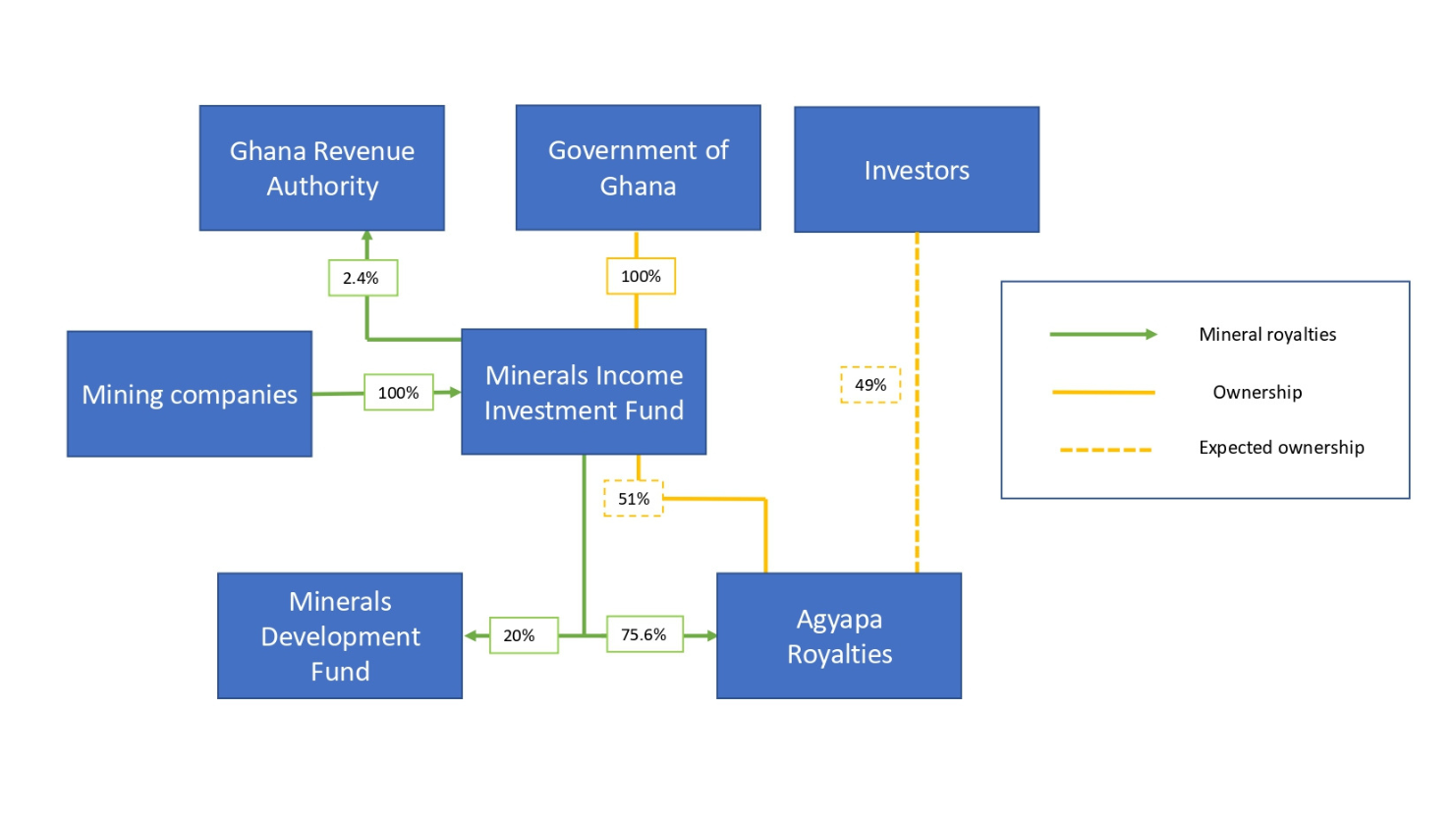
The government has touted the deal as a means to raise non-debt funding for development while dismissing suggestions that this move is driven by desperation. Like so many others, though, Ghana’s economy is in dire straits amid the pandemic.
While governments in richer countries have responded to the economic crisis with large spending programs and plentiful credit to businesses, Ghana’s options are more limited. Its budget has been under stress for some time, dragged down by immense debt (nearly 70 percent of GDP). The government had borrowed, in part, in anticipation of growing petroleum revenues (which reached over 10 percent of budget revenues last year), but is now finding it increasingly difficult to repay after the oil price collapse. Conventional credit is becoming increasingly expensive to raise.
Ghana has experimented with unconventional borrowing in the past, including taking multiple resource-backed loans in exchange for bauxite, cocoa and oil cargoes. It also collateralized portions of revenue from value-added tax to fund an education trust fund in 2018.
But gold prices have soared during the crisis, with prices exceeding $2,000 per ounce in August. The government has indicated it is keen to capitalize on this moment to fund infrastructure and human capital development without incurring repayment obligations or interest payments.

The Minerals Income Investment Fund Act may lay the groundwork for creative solutions to Ghana’s economic needs. However, the deal at hand raises a number of concerns as to whether the terms represent the best deal for Ghana, even under present circumstances. Government officials may wish to:
1. Consider reducing the scope of the agreement
Given the novel arrangement, the government might have chosen to start small. Instead, the deal is expansive in scope and open-ended (a concern initially raised by Ghana’s attorney general). The government will allocate 75.6 percent of royalties from 16 areas under production or development. (Together these currently comprise 48 mining leases.) Based on our research, these mining leases essentially cover all of Ghana’s current industrial gold production. The deal also includes prospecting licenses and any mining leases that may be later granted in the areas covered by these prospecting licenses. This means the volume of gold production involved in the deal is as yet unknown. The duration of the arrangements is equally indeterminate. The arrangements would apply until the last of the mining leases has expired or been terminated without any further extension or renewal. The deal could therefore endure for decades.
While the government has pointed to private-sector precedents, commodity-backed sovereign financing more often takes the form of resource-backed loans. As a point of comparison, typical resource-backed loan agreements studied by NRGI set out either the total volume or total value of resources and interest to be repaid. This makes their valuation much more straightforward than in this case. The Agapya arrangement runs the risk of being mispriced/undervalued by both the government and investors. Moreover, by offering as much as 49 percent in the IPO, the government also loses the potential benefit of selling additional shares later at a higher price while retaining majority ownership.
A deal with a more limited scope would be less risky for Ghana.
2. Consider safeguards against the risk of undervaluation
Some analysts have argued that the $1 billion valuation put forward by government is too low. At current gold prices, Agyapa may annually receive $150 to $200 million (our estimate) in revenues net of administrative fees, for many years to come. Depending on the market’s assumptions on both price and volume of future gold production, there is indeed potential that investors value this deal at a much higher price. In a traditional IPO, the offering price is set by investment banks (the underwriters) based on the amount of money the company wants to raise and a gauging of investor interest. If the actual price at which the shares start to trade on the open market is higher than the offering price, the profits accrue to IPO investors (mostly large institutional investors or clients of the investment banks). While the government’s shares would also appreciate in value, the government would only realize this gain by selling additional shares and further reducing its level of ownership. Given the uncertainties, Ghanaian officials should consider an approach that might better enable the government to capture the market-determined value of the shares. This might be done through a Dutch auction IPO or other mechanism, though such other approaches also come with their own risks. The government should therefore explain how the approach it chooses best allows it to capture the true market value of the shares.
3. Disclose assumptions underlying the valuation of the deal
The price at which Agyapa shares are ultimately sold will be closely watched. But the basis for evaluating the deal should not be whether the $1 billion valuation is ultimately mispriced or not. Rather, the key financial question is whether the capital raised through these means is ultimately any cheaper than other forms of available financing.
One way to compare would be to calculate the internal rate of return (IRR) from the stream of forgone royalties. Analysts could then readily compare that figure with the interest rate the government pays on conventional loans to assess value for money. If the IRR is much higher than the interest rate(s) the government is paying, this would indicate the deal is actually more expensive for the government than conventional loans. No one can know this figure for sure until the deal ends (i.e., once royalties are no longer being paid out to Agyapa). But the government should disclose its own modelling and reveal what interest rate or IRR it has used in its current valuation.
4. Protect the right to adjust fiscal terms
A stability clause included in at least one version of the royalties investment agreement prevents changes to the royalty rate that would have a “material adverse effect” on ARG (since investors would be relying on the royalty stream). For possibly decades to come, this clause would limit the government’s ability to reduce royalty rates for the mining leases included in the agreement, even if such a reduction would, for example, encourage companies to maintain gold production in times of financial difficulty. Meanwhile, Ghana’s mining act caps stability agreements with mining companies at 15 years.
The agreement caps the royalty rates at a rate specified in the agreement for each mining lease. Presumably this means the government could raise the royalty rate, but Agyapa would not be entitled to royalties above the agreed rates. At the very least, the agreement should specify that the government may increase fiscal terms but that Agyapa is not entitled to benefit from any increases above the specified rate, for the avoidance of doubt.
5. Consider including anti-dilution provisions and a dividend policy to preserve influence over Agyapa
The government of Ghana has asserted that it is not mortgaging future revenues for a lump sum of cash today. Per the government, as 51 percent shareholder the Minerals Income Investment Fund will hold two seats on the board of Agyapa, will exercise its right to vote for the other directors, and will receive a majority of the future dividends. However, an agreement establishing the relationship between the fund and Agyapa includes several clauses that may limit the fund’s (and therefore the Ghanaian government’s) future control over Agyapa’s decisions. These clauses include commitments by the fund and the government to not use voting rights to prevent Agyapa from making decisions for the benefit of the shareholders of the company as a whole or in a manner that would require the company to make decisions solely for the benefit of the fund or Ghana.
The Ghanaian government’s level of control over the board is also uncertain. Under the agreement the fund is able to appoint two directors as long as it maintains at least 30 percent equity in the company, but a majority of the directors must be independent. The fund is able to vote on independent directors as a shareholder. However, the relationship agreement prevents the fund from exercising its voting rights against a shareholder resolution to appoint any independent director and from using voting rights to remove any independent director appointed by the board. The agreement defines “independent director” using the definition set out in the U.K. Corporate Governance Code, which includes “represents a significant shareholder” as a factor likely to impede independence. It is also not clear that Ghana will be able to retain majority ownership should the board seek to raise additional equity financing in future to expand the business. The agreements scrutinized by parliament and the company’s articles of association do not contain any provisions that would prevent the company from reducing or “diluting” the fund’s percentage ownership by issuing additional shares.
In general, the relationship agreement is meant to establish Agyapa as an independent commercial entity, free to pursue its own profitability without considering Ghana’s budgetary needs. It is questionable whether Agyapa will be able to diversify its portfolio by acquiring new assets (a stated government ambition for the company) while at the same time distributing proceeds from the IPO to the fund and distributing meaningful dividends annually (at least at the outset) while the fund maintains 51 percent ownership in perpetuity.
Nevertheless, anti-dilution provisions (for example, requiring approval of the fund-appointed directors to issue additional shares) and a clear dividend policy might provide Ghana with some protection of its interests, although it might also affect Agyapa’s commerciality.
6. Consider the risk of severe knock-on effect on other loans
By pledging one of Ghana’s larger and more reliable revenue streams to Agyapa investors for years to come, the government will have fewer funds with which to repay Ghana’s existing domestic and international lenders. Investors closely watch the ratio of interest payments to government revenue, and Ghana is already performing quite poorly in this respect. (Half of its revenues now go toward interest payments, a key consideration given by S&P for its recent downgrade.)
If the Agyapa deal is successful, future governments may be tempted to raise further funds on the back of other sources of income. If lenders ultimately perceive that Ghana’s debt repayment capacity is deteriorating, they will demand higher interest when rolling over existing, much larger loans. In such a scenario, any benefit from the Agyapa deal may be outweighed by overall borrowing costs.
The government should clarify to the public how it plans to guard against such risks and ensure that additional costs for medium-term financing needs do not outweigh any short-term gains.
7. Ensure parliamentary oversight of use of mineral income flowing to the fund
The government has said that the proceeds from the deal will finance infrastructure and socioeconomic development. Plans floated include new health facilities, developing a university jewelry course, building a mineral refinery, and developing road networks in mining communities. However, it is unclear whether monies will be remitted to the treasury and spent through the normal budgetary process, subject to parliamentary oversight. The act only requires the fund to distribute the investment income it receives in accordance with an investment policy statement and any directives by the minister of finance. To ensure the most effective use of the capital raised, the government should clarify the process for investing the proceeds from the IPO and ensure necessary safeguards for spending it wisely.
8. Build consensus
Ghana’s present challenges warrant unconventional thinking. But the many open questions around the deal and the strong opposition in parliament and by civil society actors may actually deter investors and lead to a much poorer valuation than could otherwise be achieved with consensus. Further public consultations could create the opportunity to improve the structure of the Agyapa deal and close gaps in the act to ensure that the people of Ghana ultimately benefit from their resources. After all, under the constitution Ghana’s minerals are held in trust for the people of Ghana.