
Electricity at the Heart of a Just Energy Transition
A Shared Regional Vision for the Future of Energy in the Middle East and North Africa

Developed by civil society partners from five countries, this roadmap sets out five shared priorities for fairer, more transparent and resilient electricity systems in the Middle East and North Africa.
Electricity is central to a just energy transition in the Middle East and North Africa. Reliable, affordable electricity supports livelihoods, essential services and economic development. How the sector is governed will shape countries’ ability to expand renewable energy, strengthen energy security and deliver benefits for communities.
This regional civil society roadmap sets out a shared agenda for electricity sector reform, identifying five priorities:
- Reforming subsidy and pricing policies to strengthen investment in electricity.
- Strengthening transparency, accountability and access to information.
- Improving governance and institutional coordination.
- Strengthening the role of civil society and the media.
- Expanding regional cooperation and electricity interconnection.
For each priority, the roadmap outlines common challenges, calls for reform and commitments by participants. It invites governments, regulators, electricity utilities, regional institutions, international partners, civil society and the media to turn these priorities into concrete policies, initiatives and partnerships.
About this roadmap
During 2025 and 2026, the Natural Resource Governance Institute (NRGI) convened stakeholders from Morocco, Tunisia, Egypt, Lebanon and Iraq to identify shared priorities for a just energy transition in the Middle East and North Africa. Four representatives from each country participated, drawn from government, civil society and the media.
Participants compared national priorities and identified electricity governance as a shared concern and a regional priority for collective advocacy and action. Civil society partners then reconvened to develop this regional roadmap. It reflects their collective priorities, informed by technical expertise and national perspectives contributed by government representatives, experts and media participants throughout the process.
The roadmap is a resource for civil society, policymakers and others working to build fairer, more resilient electricity systems across the region.
NRGI’s role was to convene and facilitate the process. The priorities, calls to action and commitments in this roadmap are the shared views of the relevant participants and do not necessarily represent the positions of NRGI.
What Happens After a Mining License Is Granted? Inside Indonesia's First Resource Governance Assessment

Indonesia is the first country assessed under NRGI's new Resource Governance Assessment. It finds strong foundations for mineral governance, alongside significant gaps between the rules, how they are implemented and what the public can see.
Just over a year after public outcry over nickel mining in Raja Ampat led the Indonesian government to revoke four of the region’s five nickel mining permits, the issue is back in the spotlight. New research published by Greenpeace Indonesia in late July reported that three nickel mining licenses are in process for eastern Waigeo, Raja Ampat’s largest island. The one permit that was not revoked, held by state-owned PT Gag Nikel, resumed operations in September 2025.
The renewed debate comes as Indonesia’s mineral resources, particularly nickel, are becoming increasingly important to global energy transition supply chains and to the country’s own downstream industrial ambitions. It is a reminder that Indonesia's mineral governance challenge is no longer simply about writing better laws or improving how mining rights are awarded. It also raises a broader question: what happens after a license is granted?
As NRGI argued in its commentary on the Raja Ampat case, the episode has exposed the gap between formal governance arrangements and their implementation in practice. Over the past two decades, Indonesia has introduced major regulatory reforms, digital licensing systems and stronger institutional frameworks for managing its mineral resources. But information about contracts, company ownership, compliance, government oversight and payments remains much harder for the public to access once mining is underway.
These questions formed part of the backdrop for the launch of Indonesia's Licensing and Taxation component of the Natural Resource Governance Institute's (NRGI) Resource Governance Assessment (RGA), in Jakarta on 5 August 2026. Developed in partnership with the Research Center for Politics and Government at Universitas Gadjah Mada (PolGov UGM), it is the first assessment published under the RGA; Chile, Senegal and Zambia will follow.
The RGA succeeds NRGI’s Resource Governance Index (RGI), but rather than ranking countries, it examines individual countries in greater depth and combines a common set of core indicators with optional ones chosen to reflect national priorities.
Opening the event, Erica Westenberg, NRGI's Governance Program Director, emphasized that the assessment is intended as a starting point for policymakers, industry, civil society and researchers to discuss where governance systems work well and where they need to improve.
Strong foundations, uneven transparency
Indonesia scores 52 out of 100 overall: 41 for licensing, 57 for taxation. But the detailed findings reveal a much more uneven picture.
Indonesia has substantially strengthened the administration of mining licenses. Digital platforms such as Minerba One Map Indonesia (MOMI), Minerba One Data Indonesia (MODI) and the Indonesia EITI Extractive Data Portal have expanded public access to concession and licensing information, and the country has established a comprehensive legal framework governing mining taxation and royalties. The assessment scores it 92 for pre-licensing processes and 100 for the rules governing taxation and royalties.
There are significant gaps elsewhere. Indonesia scores 33 for beneficial ownership disclosure and 0 for public access to mining contracts. Information on production, compliance, inspections, sanctions and license amendments is fragmented across institutions.
Taxation shows the same split. Indonesia has strong rules governing mining taxes and royalties, but public disclosure of company- and project-level payments remains limited. Payments to government score 58, while transparency around quasi-fiscal expenditures involving state-owned enterprises receives a score of 0.
Indonesia's taxation score is lower than the 84 it received in NRGI's 2017 Resource Governance Index, but the two are not directly comparable: the earlier RGI covered oil and gas as well as minerals and used a different methodology, with less ambitious criteria for good practice. The difference should not be read as evidence that Indonesia's taxation governance has deteriorated.
Indonesia's next phase of reform is less about creating new rules than implementing existing ones consistently and expanding public access to information.
What do the findings mean in practice?
At the launch, participants took the findings further.
Aryanto Nugroho, national coordinator of Publish What You Pay Indonesia, connected the findings to Indonesia's downstreaming agenda. While much of the policy debate focuses on downstreaming, he pointed out that it depends on what happens upstream, including how mining rights are governed.
Elvita Trisnawati researcher at the Indonesia Center for Environmental Law (ICEL) described what the findings mean for communities. Licensing procedures have become more transparent before permits are issued, she said, but once mining begins communities can still struggle to access information about compliance, environmental monitoring and government oversight.
Both point to the same issue. Without transparency after licenses are awarded, it is harder for communities to see how mining is governed or who benefits from it.
Where reform could focus next
Participants also challenged the assessment itself. Beneficial ownership was one area of debate, with some arguing that recent implementation efforts may not have been fully reflected in the findings, and questioning whether data collection had captured developments across relevant agencies.
The RGA is designed to invite this kind of debate. Its findings are an evidence base for governments, civil society, industry and researchers to examine and challenge, not a set of fixed conclusions.
Indonesia already has substantial digital infrastructure in place. Connecting MOMI, MODI and SIMBARA with beneficial ownership and revenue information would make it possible to follow the chain from license allocation and ownership through production, taxation and revenue collection, and would extend public accountability across the mining lifecycle.
The renewed attention to mining in Raja Ampat shows why implementation of the legal framework and public access to information matter. This first assessment sets out where Indonesia's mineral governance is strong and where it is not. Further components will examine revenue management, socio-environmental impacts and the energy transition.
Read the Indonesia Assessment
Where Indonesia's mining governance is strong, where it falls short, and what the scores mean in practice.
Still Have Questions About the RGA?
Common questions on scoring, methodology and how the RGA differs from the Resource Governance Index.
From Pledges to Practice: Accelerating Progress Using Lessons from ICMM’s Contract Disclosure Journey

Oxfam, NRGI and RJN's new brief evaluates mining company performance on contract disclosure and shares recommendations for improvements.
In September 2021, International Council on Mining and Metals (ICMM) member companies made a commitment to publish their mineral development contracts with governments. This was an important step in the decades long shift toward contract transparency as an established global norm.
Four years later, this brief reflects on lessons learned from the implementation of the commitment as three major policy processes—the creation of the Consolidated Mining Standard Initiative (CMSI), the revision of the International Finance Corporation (IFC) Sustainability Framework and the upcoming 2026 Extractive Industries Transparency Initiative (EITI) Global Conference—are poised to shape approaches to contract transparency for the years to come.
The rise of contract transparency
Over the past two decades, contract disclosure has shifted from a niche reform to an expectation backed by governments, investors, companies and civil society.
Contracts governing oil, gas and mining projects outline critical obligations on taxes, environmental management, community benefits, and more. Publishing these agreements builds trust, reduces corruption risks, and increases stability. Over the past two decades, contract disclosure has shifted from a niche reform to an expectation backed by governments, investors, companies and civil society.
Members of ICMM helped accelerate this shift by engaging in policy dialogue and through early statements of support. Then in 2021, ICMM made a high-profile commitment: its member companies would begin publishing their mineral development contracts with governments.
The ICMM commitment—four years on
As part of our ongoing efforts to support ICMM members to publish contracts, we carried out a review to determine the extent that the commitment had led to public disclosure of contracts by ICMM companies. We found that eight of 24 ICMM companies now publish contracts—up from just three before the commitment. Continued disclosures by Orano, Rio Tinto and South32; and new disclosures by Glencore, Hydro, Newmont, MMG and Sibanye-Stillwater, reflect meaningful momentum. What is more is that each of these companies is publishing many documents that are not required to be made public under the commitment, most notably contracts agreed before 2021.
Key lessons to accelerate progress
- Encouragements alone do rarely lead to consistent uptake
Companies that did not disclose largely interpreted the requirement as not applying to their contracts. Standards like the CMSI and IFC can strengthen uptake by turning encouragements into requirements. If they are unable to do this they should set clear pathways for companies to achieve encouraged practices. - Retroactive disclosure is possible
Most disclosed contracts were older, voluntary releases—challenging the idea that pre-2021 agreements must remain outside contract transparency requirements. - Companies need clearer, harmonized guidance
ICMM’s new guidance is useful but differs in some areas from EITI practice, particularly around its narrow definition of “contracts” and exclusion of agreements with Indigenous Peoples and communities. Aligning standards with the latest EITI guidance note would ensure a harmonized approach to contract transparency across standards. - More detailed assurance will support meaningful transparency
Current ICMM assurance processes do not provide sufficient information for stakeholders to assess whether commitments are being met. Requiring more thorough assurance reports, particularly on which contracts were published and how, and why other contracts were not required to be made public, would improve accountability and confidence around contract transparency standards.
A moment of opportunity
With the CMSI nearing finalization, the IFC updating its Sustainability Framework and EITI preparing for its 2026 Global Conference, the coming year offers rare chances to lock in stronger requirements, clearer guidance and more accountable disclosure systems.
ICMM’s contract transparency commitment was an important milestone. The next phase is ensuring that implementation aligns with ambition. Stronger standards across CMSI, IFC and EITI can help ensure that contract disclosure becomes routine practice, supporting trust, accountability and better governance at a time when global demand for minerals is rapidly increasing.
From pledges to practice
A new briefing published with the Resource Justice Network on lessons from ICMM’s contract disclosure commitment.
The DRC-Zambia Battery Plant: Key Considerations for Governments in 2024

- The partnership between the Democratic Republic of the Congo and Zambia to develop battery precursors is central to Africa’s ambitions to add more value to its minerals. However, public information about the project is limited.
- Based on available information, the location of the precursor plant remains a source of disagreement. Regional bodies have a key role in developing mechanisms to ensure an equitable share of benefits irrespective of which country hosts the plant.
- The Congolese and Zambian governments should consider the challenges in attempting to source the required minerals from the two countries alone, and explore wider regional coordination to meet the need for nickel and manganese.
- The role of other global actors, such as the U.S., EU and China, remains unclear, but how the DRC and Zambia navigate the geopolitical complexities will be critical for the project’s success.
- Greater transparency and stakeholder consultation will help the governments make the difficult decisions necessary for the project to go ahead and increase the likelihood of it benefiting the Congolese and Zambian peoples.
African countries are gearing up to play a pivotal role in the production of clean energy technologies for the global energy transition, and not just as suppliers of raw minerals. They seek to maximize their role in regional and global value chains by adding value to the resources extracted from their soil.
One key initiative is the partnership between the Democratic Republic of the Congo (DRC) and Zambia to produce nickel, manganese and cobalt (NMC) battery precursors. A precursor is an intermediate input to a complete battery, which the two countries aim to ultimately also produce. However, without a large regional market for the electric vehicles that use these batteries, production of complete batteries will be challenging. For now, the focus is on producing and exporting precursors that foreign battery manufacturers will use.
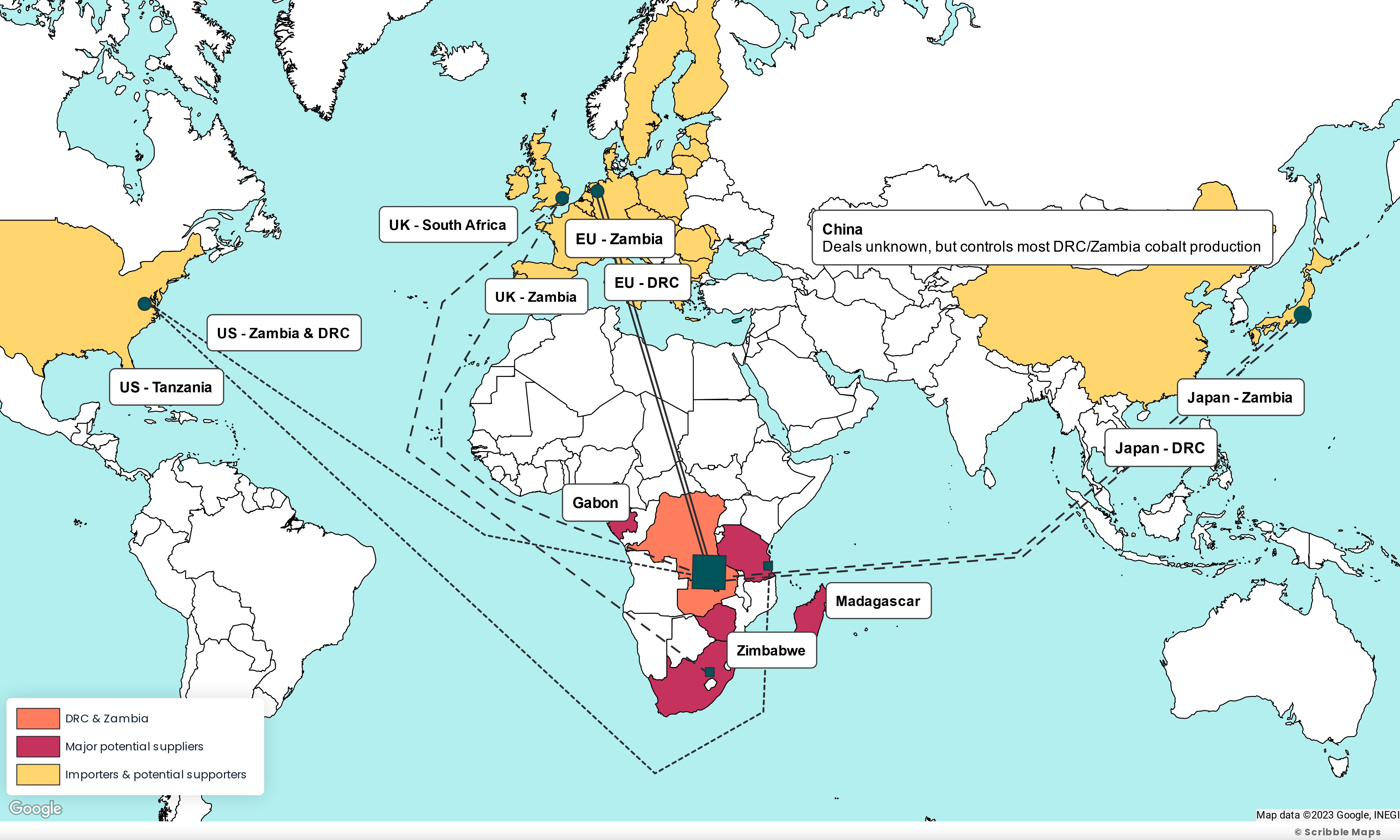
Planning for the precursor plant got properly underway in 2023, though details have been scarce. The status of a long-awaited pre-feasibility study is uncertain. There are conflicting statements about whether it has been completed and if it will be made public. The two countries have not disclosed their cooperation agreement or subsequent framework agreement. Various memoranda of understanding (MOUs) between these two countries and the United States and European Union are in the public domain, but further details remain behind closed doors, at least until roadmaps (action plans referenced in the EU MOUs) are developed next year. Little is known about other agreements that could impact the mineral sector and therefore the project—such as those between the DRC and Japan; Zambia and Japan; and Zambia and the United Kingdom. China’s dominance of cobalt production in the DRC and Zambia, including through state-owned companies, means it could have a significant influence on the precursor plant, but its role is uncertain.
Congolese and Zambian civil society actors are concerned about the lack of information and limited stakeholder consultation. In November 2023 they established the Pamoja Critical Minerals Forum to monitor and engage the governments on these plans and ensure that the plans reflect community voices.
Based on available information, we see four issues around the precursor initiative that the two governments should consider in 2024:
- Precursor plant location
- Mineral sourcing
- Role of international deals
- Transparency and multistakeholder engagement
Precursor plant location
Stakeholders suggest that this remains a point of disagreement between the DRC and Zambia. The governments initially agreed to construct the precursor plant in a cross-border special economic zone, but it seems that this shared site may be ultimately deemed unviable. The plant will therefore likely sit in one country or the other, and both countries aim to be the host. They have provisionally respectively earmarked the special economic zones of Kinsevere in DRC and Sub-Sahara Gemstone Exchange Industrial Park in Zambia.
Starting the project will be challenging regardless of its location. The independent prefeasibility study will likely recommend a location for the plant to maximize its economic viability and minimize environmental and social harms. To bolster the project’s prospects, the governments should accept the study’s recommendation in the absence of any major concerns. While it will not be easy for either country to agree to having the plant in the other, they can explore mechanisms to ensure an equitable share of benefits with the help of the regional bodies already active in the project such as the African Union’s African Minerals Development Centre, the African Development Bank, the UN Economic Commission for Africa and Afreximbank. For example, the country that does not host the plant could get a share of government revenues that the plant generates and have certain opportunities reserved for its workers, goods and services. This is a critical test for regional coordination: the proof of concept that the African Green Minerals Strategy calls for to catalyze other and wider coordination efforts.
Mineral sourcing
Stakeholders suggest that the governments aim to source all the required nickel, manganese and cobalt only from the two countries. The capacity of the plant and specific precursor design (including the ratio of nickel, manganese and cobalt) that the governments target will partly determine the feasibility of this approach. These parameters will be clearer after completion of the prefeasibility study. The plant that was initially envisaged would be large by global standards, producing around 100,000 tonnes (t) of NMC (622) precursors (one of the most common types currently demanded) a year. This would require around 48,000 t of nickel, 15,000 t of manganese and 16,000 t of cobalt that has been refined into sulfate.
The DRC and Zambia will find it challenging to source a sufficient amount of ores of the three metals and refine them into sulfates without involving other countries in the region. Neither the DRC nor Zambia currently refines any cobalt production into sulfate, but prospects are promising. Plans for a cobalt sulfate plant are advancing in Zambia, and World Bank analysis suggests a plant could also be viable in the DRC.
Production of nickel and manganese sulfate is less certain, however. Zambia produced around 4,000 t of nickel in 2022. First Quantum’s large nickel mine, Enterprise, started production in Zambia this year, which will add a massive 30,000 t a year on average. Nevertheless, this volume may still be insufficient for Zambia to meet the precursor plant’s needs on its own even if refining facilities were constructed and all production was supplied to the plant. Nickel exploration in the DRC is underway. Given only 19 percent of the country has been properly explored, this exploration may yield discoveries. However, with nickel mines taking an average 17.5 years from discovery to production, supplying the precursor plant is a far-off prospect.
Time is also a factor for manganese. Manganese is mined in the DRC and Zambia, currently by artisanal and small-scale operators. Formalizing these operations, including to reassure potential buyers of the precursors that the supply chain meets high ESG standards, and going on to build refining capabilities will be challenging.
The two countries could potentially meet these challenges over time, but there is no time to waste. The rapid evolution of battery technologies and global scramble for minerals mean that the longer this project takes to come to fruition, the harder it will be to attract investors and secure minerals for the precursor plant from the DRC, Zambia or elsewhere that haven’t already been tied up in long-term offtake agreements. The two governments should therefore utilize the African Continental Free Trade Agreement and start engaging other African countries on potential supply. Gabon and Madagascar have been cited as potential suppliers of battery grade manganese and nickel, respectively. Other countries, such as Tanzania, Zimbabwe and South Africa, are also possibilities. However some of these countries, such as South Africa, may actually harbor their own battery ambitions: further highlighting the importance of regional coordination to determine an approach from which all countries benefit.
Role of international deals
There is little information in the public domain on the specific support that the U.S. and EU intend to provide to the DRC and Zambia’s precursor ambitions. G7 support for the Lobito Corridor railway appears to have the most momentum currently. This project could increase investment prospects for value addition in DRC and Zambia by improving the route to market, but the railway could also be used to export unprocessed minerals. The implications for the precursor plant are therefore currently unclear.
It remains to be seen whether U.S. and EU will “put their money where their mouth is” in terms of specific support to the plant, and what the DRC and Zambia commit to in exchange. While the precursor plant could become a focal project of the U.S.-led Mineral Security Partnership or an EU strategic project under the bloc’s Critical Raw Materials Act, none of the parties have given such an indication.
Private investment and financing for the project will also depend on whether the U.S. enables buyers of mineral products processed in the DRC or Zambia to benefit from incentives offered by U.S. legislation. Only minerals processed in the U.S. or a country with which it has a free trade agreement qualify for the Inflation Reduction Act’s electric vehicle tax credits, for example. As the Carnegie Endowment’s Zainab Usman has highlighted, adjustments to the African Growth and Opportunity Act or other legislative instruments are needed for the DRC and Zambia (and other African countries) to qualify. Eligibility for U.S. incentives would increase the likely demand for DRC-Zambian precursors, and as a result, the attractiveness of the project to investors.
In the meantime, Chinese authorities and companies are not standing still amid all the talk and action from G7 countries. How the DRC and Zambia leverage this geopolitical competition while navigating the resulting complexities will be critical. It remains to be seen how these various actors will manage Chinese dominance of cobalt production when establishing supply for the precursor plant. Morocco’s experience may generate lessons as it seeks to utilize Chinese investment in battery manufacturing and its U.S. free trade agreement to export batteries to the U.S. and Europe.
Agreements between the likes of the U.S. and EU and other African mining countries could also impact the prospects of the precursor plant. For example, the U.S. is supporting the construction of nickel refining facilities in Tanzania but the deal stipulates that the battery-grade nickel will be exported to the U.S. Gabon, currently an exporter of manganese ore, could need similar support to start refining. While Gabon would benefit from the commencement of refined nickel exports irrespective of their destination, a deal that prevents exports to other parts of Africa could inadvertently stymie regional integration and the more transformative impacts that it would bring. Significant coordination is therefore required between both African governments and other governments.
International deals that could affect the DRC-Zambia precursor plans
Transparency and multistakeholder engagement
The Pamoja joint statement calls for greater transparency around plans and deals related to the precursor project and transition minerals more generally. Initially, this applies to disclosure of the prefeasibility study once completed and any inter-state deals not yet in the public domain. Going forward, the Congolese and Zambian governments should disclose subsequent agreements such as the EU roadmaps as well as any between the governments and investors in mining and value addition projects. The governments should also increase consultation with other stakeholders, including civil society actors.
The stakes are high for the DRC and Zambia with these projects. More transparency will help catch mistakes and ensure that the projects generate the intended benefits for the Congolese and Zambian peoples. Greater public awareness of the various opportunities and trade-offs should provide the governments with space to make difficult decisions—for example, the location of the precursor plant and sourcing of minerals. Building more public consensus and trust will also support the credibility of long-term planning and stability of the regulatory framework, and therefore increase the ability of the DRC and Zambia to attract investment.
People in the DRC and Zambia could benefit greatly from precursor production in their countries, particularly if the associated energy and transport infrastructure is leveraged for wider use. However, government efforts in other policy areas will be at least as important. For example, as Zambia aims to significantly increase copper production, the government should ensure it manages the upstream effectively. Other value addition opportunities, such as scaling up copper manufacturing in DRC, also hold at least as much, if not more, promise. Given that the complexities of the precursor project risk absorbing large amounts of the governments’ time, money and political capital, officials must weigh the opportunity costs carefully.