
Toward a New Horizon: A Just Energy Transition in Colombia’s Putumayo Region

This week, leaders of Amazonian countries are gathering in Colombia for the 5th Summit of Presidents of the Amazon Cooperation Treaty Organization (ACTO). This meeting will be critical for making strategic decisions to protect the biome and coordinate efforts ahead of COP30 in Brazil.
The Colombian Amazon faces a silent threat: the risk of reaching a point of no return. Rapid forest loss, driven by extractive activities, illegal economies and weak governance, endangers not only a vital ecosystem but also the lives of the communities who inhabit it—and, ultimately, the planet itself.
“Putumayo is Amazonia, the Amazon is life, life is our very existence on Earth.”
said a young woman during the NRGI Narratives for a Just Energy Transition workshop in 2024.
Why Putumayo?
Putumayo is a gateway to the Amazon, rich in biodiversity and cultural heritage. It is home to Indigenous peoples, farming communities, and Afro-descendant groups. Nearly 68 percent of its land remains covered by natural ecosystems like forests, rivers, and wetlands. Around 22 percent of its population belongs to ethnic groups, including more than 14 Indigenous communities.
Yet, this richness contrasts with the challenges the region faces. Eleven percent of its population lives in poverty. It is one of Colombia’s least electrified regions and struggles with the presence of armed groups, illicit crops, and illegal mining. On top of this, Putumayo has long been an oil-producing hub for Colombia’s Amazon.
Oil extraction has shaped its economy since the 1960s. But times are changing. Global demand for oil is expected to peak around 2030 and then decline. In Putumayo, that decline is already happening. Production has dropped nearly 50 percent since 2015 and could fall by two-thirds by 2035.
This downturn creates uncertainty for jobs, public revenue, and local economies. But it also opens an opportunity to rethink development models and chart a new path: one that is fair, sustainable, and community-driven.
A space for dialogue on a just transition
To support this shift, NRGI and its partners have been creating spaces for dialogue and learning in Putumayo. These forums aim to strengthen local knowledge on environmental protection, economic diversification, and social justice during the energy transition.
In June 2025, we hosted the event “Just Energy Transition and Deforestation in Putumayo: Strategies to Avoid an Amazonian Tipping Point.” It brought together government officials, academics, Indigenous leaders, community representatives, and civil society groups.
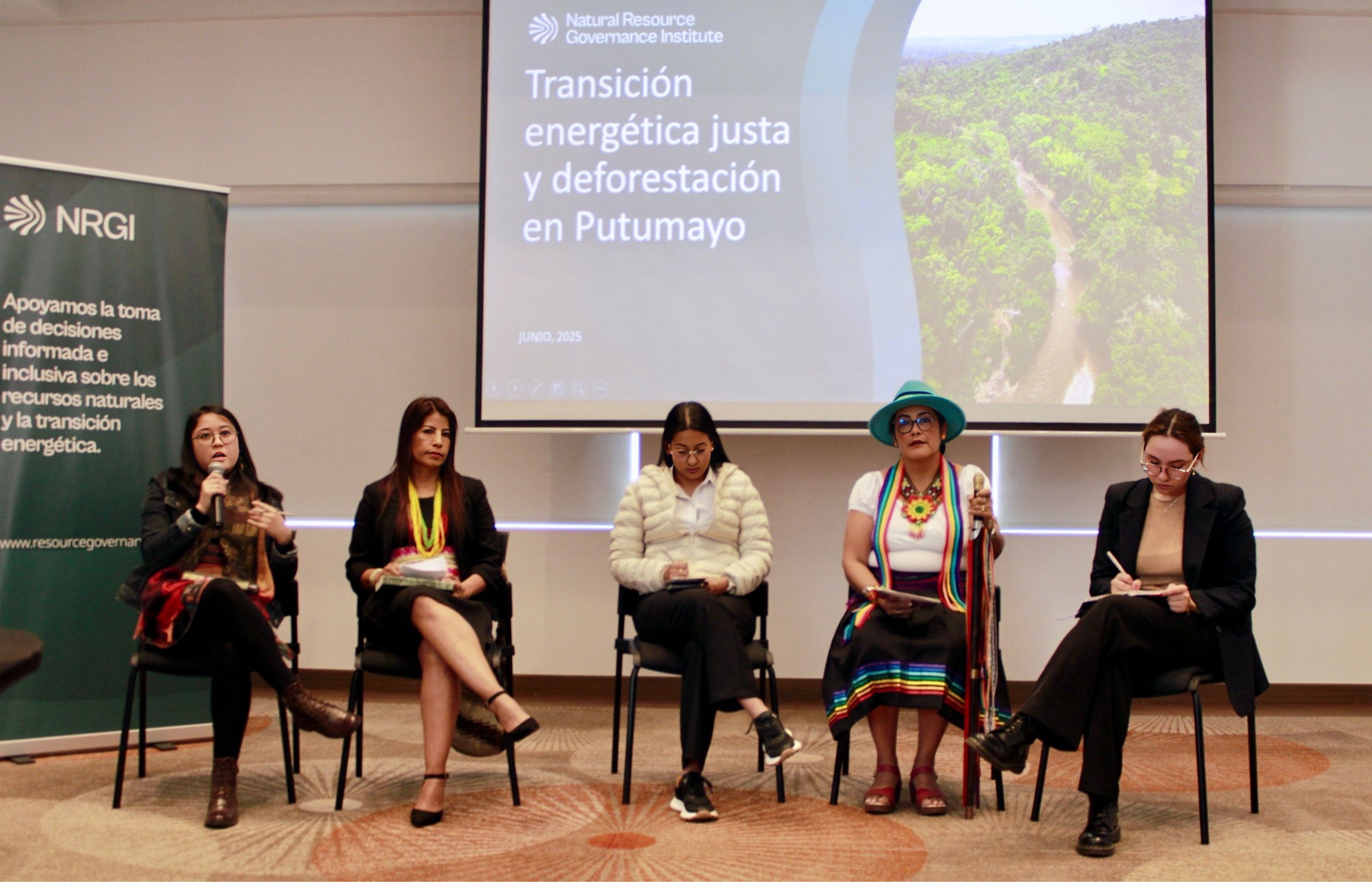
The conversations focused on three major issues: how to diversify the economy, how to manage a responsible exit from the oil sector, and how to protect ecosystems and communities from the dual threats of oil decline and deforestation.
“We must feed communities’ curiosity so they can shape the policies that affect their future.”
One clear message emerged: communities need access to clear and timely information. Without it, meaningful participation in decisions about land use and the energy transition is impossible. As one local leader said, “We must feed communities’ curiosity so they can shape the policies that affect their future.”
From oil decline to strategic planning
Falling production raises pressing questions about Putumayo’s future. Local actors agree that Colombia still lacks a comprehensive policy for a just transition—one that connects economic, social, cultural and environmental dimensions. Without it, there is a real danger of replacing one extractive industry with another, such as moving from oil to large-scale copper mining, and repeating an unsustainable model.
Participants at the event identified three priorities for moving forward:
- Address environmental liabilities. Clean up contaminated water sources and clearly assign financial responsibility for remediation.
- Diversify the economy. Strengthen sustainable value chains like cocoa, coffee, Amazonian fruits, and ecotourism. Explore opportunities in the bioeconomy and renewable energy, while addressing land tenure issues and ensuring real participation from Indigenous, Afro-descendant, and rural communities.
- Plan responsible oil sector exits. Guarantee proper closure of wells and infrastructure, manage financial and legal risks, and protect labor, social, and environmental rights. Prior consultation must be meaningful, not a bureaucratic checkbox.
A just transition must reflect local needs, safeguard civic space and foster dialogue among actors in a territory still grappling with armed groups.
Women’s voices: justice at the heart of the transition
Women in Putumayo are making their voices heard. They are demanding that the transition not only includes communities but also addresses their specific needs. Ignoring these perspectives would mean imposing solutions disconnected from local realities and worldviews.
“We are the only species on this planet capable of stopping climate change.”
Their demands echo those of Indigenous Peoples and social movements: recognize ancestral knowledge and avoid one-size-fits-all models for diverse ethnic groups. For women leaders, the transition must put social and environmental justice first. It is about protecting ecosystems that sustain life and reaffirming humanity’s relationship with nature.
As they remind us: “We are the only species on this planet capable of stopping climate change.”
A shared horizon
Putumayo’s future must be defined now. Moving beyond oil is inevitable—not only because reserves are finite but because global and local dynamics demand it. The alternative must be built on an integrated vision: robust policies, strategic projects, environmental restoration, institutional trust, and above all, strong community participation.
This is not just about replacing lost revenues. It is about transforming the economic structure of the region based on justice, equity, sustainability, and respect for life.
Avoiding an Amazon tipping point requires bold and coordinated decisions. Resources may be limited, but collective action can make a just energy transition not only possible but urgent and real.
NRGI remains committed to working alongside Putumayo’s communities and local actors to achieve a future that is fair, prosperous, sustainable, and in harmony with one of the world’s most vital ecosystems.
Beyond Oil: Rethinking the Amazon’s Future

As the world races to address the climate crisis, the urgency of transitioning to renewable energy is undeniable. But in the Amazon—one of the planet’s most vital ecosystems—oil extraction continues to exact a high price. Extracting oil and gas in the Amazon is no minor activity. It means drilling into the earth, carving roads into dense forests, polluting rivers and disrupting the lives of local communities. In the Peruvian Amazon alone, more than 1,460 oil spills were recorded between 1997 and 2023, mostly caused by operational failures and corrosion of infrastructure. These incidents have left deep environmental and social scars that are difficult to repair.
An industry in decline
Oil production in the Peruvian Amazon is steadily declining. A lack of investment, depleted reserves, international competition and the global shift towards clean energy have it a risky and increasingly unprofitable activity. Pushing ahead with new oil projects in the rainforest is a financial gamble e—one that could cost the Peruvian state, local communities and the Amazon itself dearly.
These risks aren’t just economic. Oil expansion has led to human rights violations, health threats to vulnerable and no-contact populations and the erosion of Indigenous rights. Many communities have not been adequately informed or consulted about these projects, directly violating their right to free, prior and informed consent. In the case of Indigenous peoples in voluntary isolation, any contact at all could threaten their survival.
And yet, Peru’s state-owned company, Perupetro, continues to push for new exploration in the Amazon, one of the world’s most ecologically and culturally precious regions. 25 of the 31 areas presented as investment opportunities are in the Peruvian jungle, with 14 of them in Loreto—covering nearly 6 million hectares or 16 percent of the department’s total area. These areas overlap with the territories of over 400 Indigenous communities, lands inhabited by Indigenous Peoples in voluntary isolation (PIACI for its acronym in Spanish) and ecosystems, such as the Pastaza Fan and the Pacaya Samiria National Reserve, which are vital to the planet's health.
Rethinking Loreto’s economic model
It’s true that many regional and local governments have historically relied on oil revenues to fund public works and basic services. But this era is ending. Continuing to rely on this unstable source of revenue puts local economies and the well-being of people at risk.
A new economic model for Loreto is not an option. It’s a necessity. Diversifying the region’s economy, including by investing in sustainable industries and centering local voices, is key to building a more secure and inclusive future.
The world is changing. The energy transition is already underway. The Amazon can —and must—be part of this shift. The region deserves a different future in which its biodiversity is valued, the rights of its people respected and alternative pathways to well-being are established. Moving beyond oil isn’t just possible. It’s urgent.
Amazonia: challenges and threats
Would you like to learn more about the extraction of hydrocarbons and the illegal mining of gold in the Peruvian Amazon?
Illegal Gold Mining: A Growing Threat to the Peruvian Amazon

Illegal gold mining has become one of the biggest threats to the Peruvian Amazon and important region to the world because of its role in regulating the climate and its extraordinary biodiversity. This illicit activity is expanding rapidly across several departments in the region, including Loreto, Madre de Dios, Amazonas, Huánuco and San Martín, and has already affected more than 30 districts in the country.
Distinguishing informal mining —which is undergoing a legal formalization process, from illegal mining—which operates entirely outside the law, often operating in prohibited areas using toxic substances and disregarding environmental and safety regulations—is crucial.
A highly profitable but deeply destructive activity
Illegal gold extraction is an extremely lucrative business. A single dredge can generate over USD 135,000 per month, which explains the rapid growth of this illicit trade. However, behind this profitability lies a trail of increasingly severe environmental, social, cultural and economic destruction.
In recent years, the situation has particularly worsened in Loreto, Peru’s largest department, whose geography facilitates the expansion of illegal mining along its rivers. While oil extraction was historically the main economic driver in Loreto, illegal mining has shown steady growth, fueled by rising gold prices, weakened territorial control and unclear formalization policies.
Today, much of this activity is concentrated in the Nanay River basin, one of Loreto’s five major watersheds and the main water source for its capital, Iquitos. By the end of 2024, 210 dredges were operating there out of the 280 identified across the department.
Criminal networks and weakened state control
Illegal mining in Loreto is not an isolated activity. It is closely linked to broader criminal networks and other illegal economies controlled by transnational criminal organizations. These groups influence public decision-making through political pressure, media manipulation and corruption.
Between 2021 and 2024, 25 legislative bills related to informal mining were submitted, 23 of which promoted the deregulation of the sector and weakened the state's ability to control it. While Loreto has not yet experienced full state capture, there are growing concerns that certain private interests are shaping public policies to their advantage.
Impact on communities
The expansion of illegal mining impacts local populations and Indigenous communities directly. While some communities maintain effective territorial control and denounce illegal activities, others have become involved, either by providing labor or by offering support services.
This creates internal tension, weakens social cohesion and fosters economic dependence on illicit activities.
An urgent challenge, a possible opportunity
Loreto faces a significant challenge. However, there is still an opportunity to reverse the situation and strengthen governance across its territories. This requires firm commitment from the Government, national institutions, clarity in formalization policies, and substantial improvements to monitoring and enforcement mechanisms.
The future of Loreto—and of the Peruvian Amazon—must be based on sustainable development that respects life, the rights of communities and the integrity of ecosystems.
Amazonia: challenges and threats
Would you like to learn more about the extraction of hydrocarbons and the illegal mining of gold in the Peruvian Amazon?
Gold Mining in the Amazon and COP16: The Importance of a Binding Global Agreement on Mineral Trade

This week, the 16th Conference of the Parties (COP16) for the Convention on Biological Diversity began in Cali, Colombia. The organizers expect the participation of more than 12,000 people from around the world, including official delegations and civil society representatives. For Colombia, one of the most “megadiverse” countries in the world, this is an opportunity to showcase its international leadership in advancing policies to protect the planet’s biodiversity. The biodiversity COP in Cali precedes the climate COP30, which will take place in Belém do Pará, Brazil at the end of 2025.
Both events offer a forum for high-impact solutions from Latin America in response to global environmental crises. The worldwide decline in biodiversity is just as critical as global warming. According to the Intergovernmental Science-Policy Platform on Biodiversity and Ecosystem Services (IPBES), the state of nature is in freefall, and planetary resources are so depleted that we are on the brink of species extinctions and massive human migrations. Phenomena such as deforestation, overexploitation of oceans and soils, and air and water pollution are disrupting the natural functioning of the planet, pushing humanity and life itself to the edge of an abyss.
One of the most emblematic regions in terms of biological diversity is the Amazon rainforest. A major threat to the Amazon is the expansion of gold mining, which is characterized by high levels of informality, illegality, and connections with criminal groups that challenge state control over vast territories.
Illegal gold mining in the Colombian and Peruvian Amazon
The MAAP Initiative estimates that, “as of 2018, there was a historical mining deforestation footprint of over 963,000 hectares across the entire Amazon. Between 2019 and 2023, [the MAAP Initiative estimates] that the mining deforestation footprint grew by over 944,000 hectares (2.3 million acres). Thus, of the total accumulated mining deforestation footprint of over 1.9 million hectares (4.7 million acres), about half has occurred in just the past five years (...) of the total accumulated mining, over half has occurred in Brazil (55 percent, covering over 1 million hectares), followed by Guyana (15 percent), Suriname (12 percent), Venezuela (7 percent), and Peru (7 percent, covering 135,625 hectares)”. Expert Timothy Killeen describes illegal gold mining in the Amazon as an “ecological disaster for floodplains and local communities.”
In recent years, this phenomenon has grown exponentially. Illegal gold mining has become one of Peru’s most pressing issues, with severe economic, social, political and environmental consequences. Deforestation, water and soil contamination, and the destruction of natural habitats are just some of its serious environmental impacts.
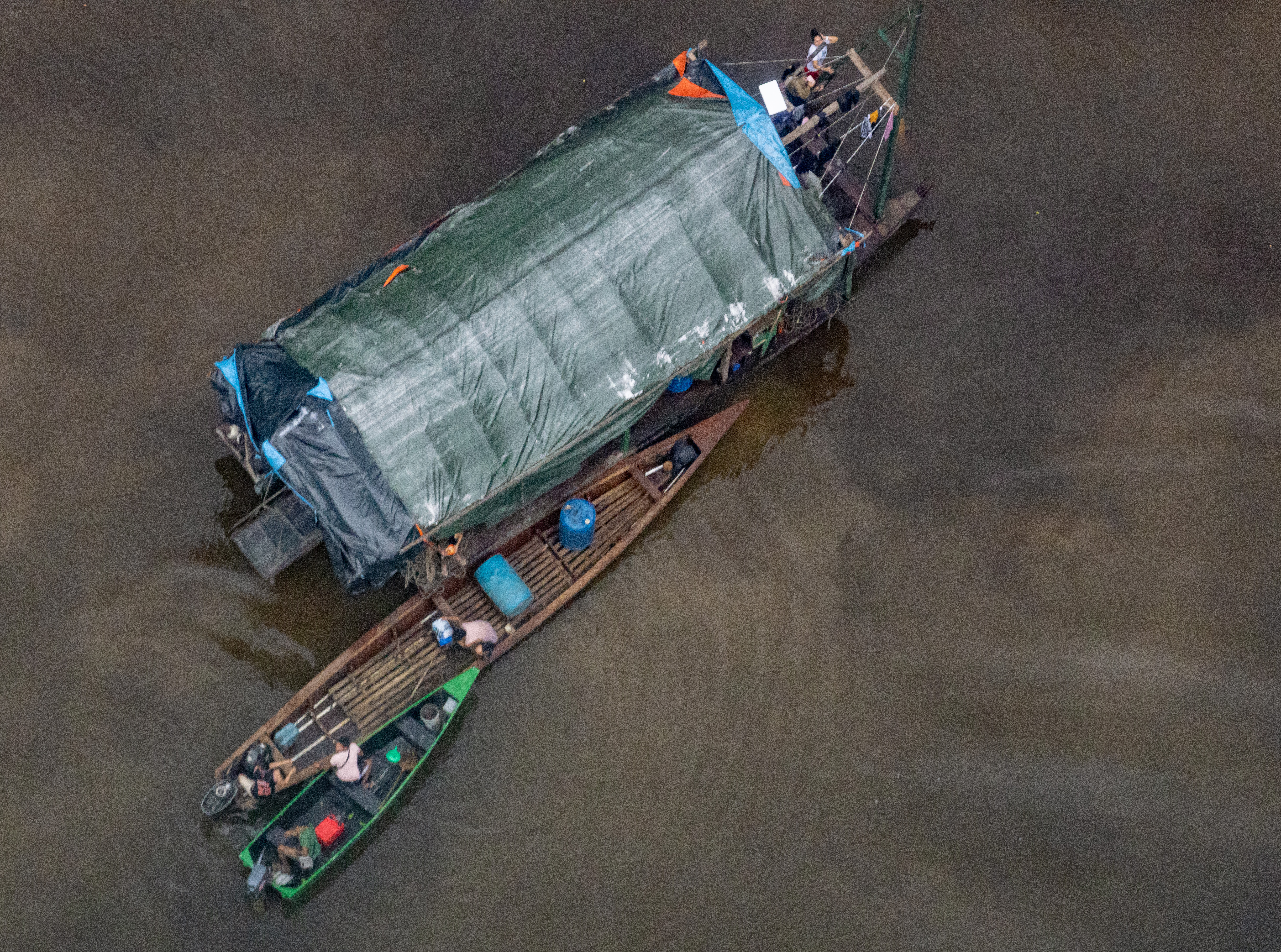
Another recent MAAP report indicates that between 2021 and September 2023, gold mining deforested 23,881 hectares in Peru’s Madre de Dios region, affecting Indigenous communities and protected areas. In Colombia, deforestation in the Amazon is closely tied to the presence of illegal armed groups that control areas where illegal mining takes place. In 2023, the country recorded a historic drop in deforestation, with a 38 percent reduction in the Amazon alone, from 71,185 hectares in 2022 to 44,274 hectares in 2023—the lowest in the past 23 years. However, the Ministry of Environment has warned that deforestation could increase in 2024 due to threats from illegal armed groups against local communities and public officials from the National Environmental System, who are responsible for monitoring protected areas and combating deforestation.
In the Colombian Amazon armed groups funded by illegal mining, local communities, Indigenous peoples, and gold trading companies converge, creating a complex landscape for addressing illegal economies and deforestation in a context of violence. According to the Organization of American States, as of 2022, 80 percent of the country’s gold production came from illegal extraction.
Illegal mining is also linked to child labor, human trafficking, sexual exploitation, and the murder of multiple environmental defenders. In Peru, various reports highlight the presence of illegal armed groups controlling mining operations in different regions, fostering insecurity and fear among local communities. In Loreto, areas such as Nanay have seen an expansion of gold mining, even in territories where the Peruvian state can no longer maintain control.
In both countries, illegal gold mining is a multimillion-dollar business. In Colombia, illegal actors forced officials to leave the Amacayacu National Natural Park (in the Amazonas department), resulting in a lack of state presence and governance in the area. In Peru, this illicit activity, which generates higher profits than drug trafficking, causes annual losses of more than 22.7 billion soles (approximately USD 6 billion), according to a report by V&C Analistas. A Global Financial Integrity report estimates that the illicit gold trade in Colombia exceeded USD 5.6 billion between 2010 and 2018.
The complexity of this issue deepens when related crimes and the legal and political factors that enable its perpetuation are considered. Illegal mining does not operate in isolation but is closely tied to criminal networks that thrive on impunity, corruption, and infiltration of state institutions.
There are discrepancies between the reported amounts of production and exports of gold in these countries. In recent years, India and the United Arab Emirates have increased their imports of gold from Peru, Colombia, Ecuador, Bolivia and Brazil, alongside other main gold importers like Switzerland, the United States and Canada. According to an investigation by Ojo Publico, there are many shortcomings in the stated due diligence policies from companies buying gold from Amazonian countries.
Opportunity to advance a binding global agreement on mineral trade
What measures can be taken at an event like COP16 to address a phenomenon like this? COP16 is raising awareness of the issue through dozens of official and civil society events dedicated to sharing information and presenting solutions. The Colombian government is also promoting a concrete official initiative: a "Joint voluntary declaration on responsible mining practices for the protection of life and the environment," which officials will present on 29 October as part of the official activities.
The Colombian government expects that various countries will join the declaration through a declaration of intent to promote the signing of a global agreement. This initiative builds on other efforts related to traceability and socio-environmental standards in mining. Recent guidance from the United Nations Panel on Critical Energy Transition Minerals includes an actionable recommendation is to establish a “global framework for traceability, transparency and accountability along the entire mineral value chain—from mining to recycling—to strengthen due diligence, facilitate corporate accountability and build a global market for critical energy transition minerals.”
Thus, the Colombian initiative aims to create a multi-stakeholder group that will ultimately result, among other things, in a proposal for a binding international agreement to operationalize this recommendation for traceability, transparency and accountability.
This is a great opportunity to strengthen the implementation of social, environmental, and accountability standards in mining. Implementing traceability mechanisms and due diligence is essential to prevent minerals from being sourced through extraction processes that involve environmental destruction, child labor, organized crime, and other unacceptable practices in any value chain. While this initiative is not limited to the case of illegal gold mining and has broader ambitions, including transition minerals, it can contribute something fundamental: ensuring that gold extracted under conditions of environmental destruction and organized crime is not traded with impunity on the global market.
The diplomatic path to advance this initiative, as well as its alignment with other processes like the one initiated by the United Nations Panel on Critical Energy Transition Minerals, remains to be defined. However, the opportunity is on the table, and countries—especially those committed to protecting the planet’s biodiversity—should seize it.