
International public finance for gas and renewable power in Africa: What is available?

African governments face steep and rising costs as they work to expand electricity access and build lower-carbon power systems. Domestic revenues, household resources and local capital markets cannot meet these needs, leaving countries heavily reliant on external financing. At the same time, global public finance for energy is shifting: many funders have sharply reduced support for gas power, while investment in solar and wind is growing but remains far below what is required.
About this slidedeck
This slidedeck consolidates the latest evidence on what international public finance is actually available for gas and renewable power in Africa. It reviews trends across development finance institutions, export credit agencies and other public funders; clarifies which types of projects still attract support; and explains why funding for others—especially gas power—has become scarce.
The material is intended for policymakers, civil society organizations, energy planners and development partners who need a realistic picture of financing options for power generation. It also outlines the practical conditions that can help countries unlock more investment, including clear transition plans, transparency on emissions and spending, and stronger pipelines of bankable projects.
Key insights include the rapid decline in international support for new gas-fired power, the uneven but rising investment in renewables, the concentration of funding in a small number of countries, and the limited availability of alternatives such as Chinese finance or transition finance
Financing Africa’s Energy Future: Outcomes from Future of Energy Conference 2025

On 27 August 2025 our CEO, Suneeta Kaimal, delivered the keynote address on Day 2 of the Future of Energy Conference (FEC) 2025, where she discussed strategies for an inclusive and sustainable energy future in Africa.
This year’s theme, “Financing Africa’s Energy Future: Unlocking Investments for Energy Access and Economic Transformation” responds to the enduring challenges of energy poverty. Over 600 million Africans lack electricity and nearly a billion rely on traditional biomass for cooking.
Last month, at the fourth Financing for Development Conference in Seville, Kenya helped drive the launch of a bold new coalition, joined by Benin, Sierra Leone, Somalia and others. Together, they committed to taxing premium air travel to raise new, additional, and predictable flows of public finance for sustainable development.
If implemented globally, this measure alone could raise more than $80 billion in revenue—not loans or aid—every year. To put this in perspective: the International Energy Agency (IEA) estimates that achieving universal access to modern energy in Africa requires only $25 billion each year.
At first glance, this is just another tax. But it is far more significant. It represents the kind of financial innovation that African leaders can replicate, scale up, and channel to unlock energy access and economic transformations for Africa.
The challenge of this moment
Let me step back for a moment to explain “why” we need such innovation now, more than ever.
$500 billion. $500 billion, along with related infrastructure spending, is the estimated cost for sub-Saharan Africa to close the energy poverty gap and transition its energy system to a sustainable basis. $500billion. That is a stunning figure.
By contrast, in 2023, financing for clean and renewable energy in all developing countries, not just sub-Saharan Africa, reached only $22 billion. Think about that. $500 billion needed for sub-Saharan Africa alone, $22 billion available for all developing countries.
Just a year ago, many still believed that bridging this massive financing gap might be achieved through “blended finance”. Blended finance is the idea that we use relatively small amounts of public finance to de-risk and leverage much larger flows of private investment. That was how the EU and the US managed to recover from the 2008 financial crisis.
The promise of this “billions to trillions” narrative was that if African governments covered the risks and offered something like 9 percent yields on bonds intended to drive energy transition investments, then private investors would come flooding in. Multiplying public money by ten, a hundred, even a thousand times.
But actual results show that the “billions to trillions” idea is an illusion. The Blended Finance Task Force found that, rather than multipliers of ten, 100, or 1,000, the results are closer to 0.3, which means that every dollar in public money brings only 30 cents in private finance.
If you combine that reality with plummeting international development assistance levels and the constant chaos of tariff wars, one thing is clear: the rules of this game will not address Africa’s needs to finance energy access and sustainable development.
So, the challenge Ben Boakye, the Executive Director of ACEP, put to us yesterday is the right one: how do we innovate to meet the rightful expectations and aspirations for energy access of the next generation— those in this room and beyond. If as the keynote speaker, you thought I would have the answers, sorry to disappoint. I’m counting on all of you for that.
But building on NRGI’s work with partners in government, and in civil society around the world, I’ll share some insights into what must change to enable lasting, innovative financing solutions.

Strategic, inclusive just energy transitions
Successful financing starts with a strategic, inclusive vision for just energy transitions. There is no single path for defining the energy and economic futures of countries. We need context-specific solutions that are aligned with the country’s development ambitions and reflect the voices and needs of different populations.
Here in Ghana and in Nigeria, we have collaborated with partners to launch national dialogues, ensuring that energy transition plans align with public priorities. In Ghana’s oil-producing regions, we have engaged with communities to amplify the concerns of fisherfolk, women, and youth.
In Senegal, we trained civil society partners to understand and engage with public consultations on the Just Energy Transition Partnership, and to raise concerns about energy access and equity.
Building such strategic, inclusive visions ensures that the financing that is raised is directed towards the needs and ambitions of the people and their national development plans.
Changing the color of money
The second change needed is the color of the money.
Even promising initiatives like Senegal’s Just Energy Transition Partnership risk pushing countries further into the debt trap. Of the financing pledged for the JETP, only 6.6 percent is in grants. More than 80 percent is structured as loans. Instead of creating fiscal space for investments in rural electrification or retraining workers, it risks adding pressure to unsustainable debt.
Governments across Africa spend nearly 17 percent of their revenues on debt service—the highest of any developing region. Over half of Africans now live in countries that spend more on debt than on health or education.
New lending models are needed to mobilize private capital. But these must offer African nations fair interest rates that recognize their growth trajectories and avoid overburdening public budgets. They must also be paired with technical and technological support for renewables, addressing barriers to licensing and intellectual property.
Reinvigorating domestic resource mobilization
Finally, we must reinvigorate domestic resource mobilization, the primary engine of sustainable development financing.
Africa holds immense resources – including 30 percent of the world’s transition mineral reserves. African countries can leverage the global demand for minerals for strategic bargaining to move up the value chain, diversify their economies and increase public resources.
Take Zambia. They have attracted European support for a planned cobalt refinery and to facilitate investment in an electricity interconnector between Zambia and Tanzania. That will reduce the impact of increasing drought risks on their hydro capacity.
Value addition like this is not feasible in all countries and contexts, but such regional collaboration can overcome constraints such as scale, supply of inputs, and small downstream markets, and help unlock more benefits from the mining sectors. In doing so, countries can move concertedly up the value chain, increasing domestic financing for just energy transitions and advancing renewable technologies at home.

The opportunity is now
Strategic, inclusive just transitions. Changing the color of the money. Reinvigorating domestic resource mobilization. These are not small asks— they require long-term, sustained, and concerted focus. The influence of rich, consumer countries still limits the scale of financing and compromises sovereignty over energy and resources. And rich countries must not be allowed to abdicate their roles and responsibilities.
But there are opportunities to shift the global conversation today. Or at least, next week at the Second Climate Week in Addis Ababa.
The UN climate regime has, for too long, been silent on the issue of minerals that are critical to delivering just transitions. The UN Secretary General himself said: “The race to net zero cannot trample over the poor.” As a member of the UN Panel on Critical Energy Transition Minerals, I and many others pushed hard for principles and actions for a new mining paradigm to guide the renewables revolution toward justice.
At the Second Climate Week in Addis next week, we have an opportunity to elevate the issue of minerals governance onto the UN Climate agenda through the Just Transition Work Program. Join us at the Africa Climate Summit and on the road to COP 30 to issue a strong, united call for multilateral action and outcomes that center the needs and ambitions of Africans for improved transition mineral governance, just energy transitions and fair financing.
The Seville coalition showed that African leaders are already bringing practical, innovative ideas to the table. They must now be resolute in forging their own paths as the aid paradigm crumbles. By bringing the political will and ambition to scale, replicate and channel innovative sources of finance to energy transition priorities, we can ensure that bold ideas lead to real progress and that real progress leads to economic and energy transformation for all Africans.
Future of Energy Conference 2025
Accra, Ghana
Our CEO, Suneeta Kaimal, delivered the keynote address on Day 2 of the Future of Energy Conference (FEC) 2025, where she discussed strategies for an inclusive and sustainable energy future in Africa.
This year’s theme, “Financing Africa’s Energy Future: Unlocking Investments for Energy Access and Economic Transformation,” responds to the enduring challenges of energy poverty. Over 600 million Africans lack electricity and nearly a billion rely on traditional biomass for cooking.
Full transcript:
Thank you to Ben and Charles for hosting us and for the opportunity to be here with distinguished colleagues, partners, and friends from around the world. I would like to extend a special welcome to the participants in the NRGI-ACEP 2025 Summer School on the Governance of Extractive Industries. You are the next generation of leaders whose ideas and innovations will shape Africa’s energy future. If you will please stand for a moment of recognition.
Last month, at the fourth Financing for Development Conference in Seville, Kenya helped drive the launch of a bold new coalition, joined by Benin, Sierra Leone, Somalia and others. Together, they committed to taxing premium air travel to raise new, additional, and predictable flows of public finance for sustainable development.
If implemented globally, this measure alone could raise more than $80 billion in revenue—not loans or aid—every year. To put this in perspective: the International Energy Agency (IEA) estimates that achieving universal access to modern energy in Africa requires only $25 billion each year.
At first glance, this is just another tax. But it is far more significant. It represents the kind of financial innovation that African leaders can replicate, scale up, and channel to unlock energy access and economic transformations for Africa.
The challenge of this moment
Let me step back for a moment to explain “why” we need such innovation now, more than ever.
$500 billion. $500 billion, along with related infrastructure spending, is the estimated cost for sub-Saharan Africa to close the energy poverty gap and transition its energy system to a sustainable basis. $500billion. That is a stunning figure.
By contrast, in 2023, financing for clean and renewable energy in all developing countries, not just sub-Saharan Africa, reached only $22 billion. Think about that. $500 billion needed for sub-Saharan Africa alone, $22 billion available for all developing countries.
Just a year ago, many still believed that bridging this massive financing gap might be achieved through “blended finance”. Blended finance is the idea that we use relatively small amounts of public finance to de-risk and leverage much larger flows of private investment. That was how the EU and the US managed to recover from the 2008 financial crisis.
The promise of this “billions to trillions” narrative was that if African governments covered the risks and offered something like 9 percent yields on bonds intended to drive energy transition investments, then private investors would come flooding in. Multiplying public money by ten, a hundred, even a thousand times.
But actual results show that the “billions to trillions” idea is an illusion. The Blended Finance Task Force found that, rather than multipliers of ten, 100, or 1,000, the results are closer to 0.3, which means that every dollar in public money brings only 30 cents in private finance.
If you combine that reality with plummeting international development assistance levels and the constant chaos of tariff wars, one thing is clear: the rules of this game will not address Africa’s needs to finance energy access and sustainable development.
So, the challenge Ben Boakye, the Executive Director of ACEP, put to us yesterday is the right one: how do we innovate to meet the rightful expectations and aspirations for energy access of the next generation— those in this room and beyond. If as the keynote speaker, you thought I would have the answers, sorry to disappoint. I’m counting on all of you for that.
But building on NRGI’s work with partners in government, and in civil society around the world, I’ll share some insights into what must change to enable lasting, innovative financing solutions.
Strategic, inclusive just energy transitions
Successful financing starts with a strategic, inclusive vision for just energy transitions. There is no single path for defining the energy and economic futures of countries. We need context-specific solutions that are aligned with the country’s development ambitions and reflect the voices and needs of different populations.
Here in Ghana and in Nigeria, we have collaborated with partners to launch national dialogues, ensuring that energy transition plans align with public priorities. In Ghana’s oil-producing regions, we have engaged with communities to amplify the concerns of fisherfolk, women, and youth.
In Senegal, we trained civil society partners to understand and engage with public consultations on the Just Energy Transition Partnership, and to raise concerns about energy access and equity.
Building such strategic, inclusive visions ensures that the financing that is raised is directed towards the needs and ambitions of the people and their national development plans.
Changing the color of money
The second change needed is the color of the money.
Even promising initiatives like Senegal’s Just Energy Transition Partnership risk pushing countries further into the debt trap. Of the financing pledged for the JETP, only 6.6 percent is in grants. More than 80 percent is structured as loans. Instead of creating fiscal space for investments in rural electrification or retraining workers, it risks adding pressure to unsustainable debt.
Governments across Africa spend nearly 17 percent of their revenues on debt service—the highest of any developing region. Over half of Africans now live in countries that spend more on debt than on health or education.
New lending models are needed to mobilize private capital. But these must offer African nations fair interest rates that recognize their growth trajectories and avoid overburdening public budgets. They must also be paired with technical and technological support for renewables, addressing barriers to licensing and intellectual property.
Reinvigorating domestic resource mobilization
Finally, we must reinvigorate domestic resource mobilization, the primary engine of sustainable development financing.
Africa holds immense resources – including 30 percent of the world’s transition mineral reserves. African countries can leverage the global demand for minerals for strategic bargaining to move up the value chain, diversify their economies and increase public resources.
Take Zambia. They have attracted European support for a planned cobalt refinery and to facilitate investment in an electricity interconnector between Zambia and Tanzania. That will reduce the impact of increasing drought risks on their hydro capacity.
Value addition like this is not feasible in all countries and contexts, but such regional collaboration can overcome constraints such as scale, supply of inputs, and small downstream markets, and help unlock more benefits from the mining sectors. In doing so, countries can move concertedly up the value chain, increasing domestic financing for just energy transitions and advancing renewable technologies at home.
The opportunity is now
Strategic, inclusive just transitions. Changing the color of the money. Reinvigorating domestic resource mobilization. These are not small asks— they require long-term, sustained, and concerted focus. The influence of rich, consumer countries still limits the scale of financing and compromises sovereignty over energy and resources. And rich countries must not be allowed to abdicate their roles and responsibilities.
But there are opportunities to shift the global conversation today. Or at least, next week at the Second Climate Week in Addis Ababa.
The UN climate regime has, for too long, been silent on the issue of minerals that are critical to delivering just transitions. The UN Secretary General himself said: “The race to net zero cannot trample over the poor.” As a member of the UN Panel on Critical Energy Transition Minerals, I and many others pushed hard for principles and actions for a new mining paradigm to guide the renewables revolution toward justice.
At the Second Climate Week in Addis next week, we have an opportunity to elevate the issue of minerals governance onto the UN Climate agenda through the Just Transition Work Program. Join us at the Africa Climate Summit and on the road to COP 30 to issue a strong, united call for multilateral action and outcomes that center the needs and ambitions of Africans for improved transition mineral governance, just energy transitions and fair financing.
The Seville coalition showed that African leaders are already bringing practical, innovative ideas to the table. They must now be resolute in forging their own paths as the aid paradigm crumbles. By bringing the political will and ambition to scale, replicate and channel innovative sources of finance to energy transition priorities, we can ensure that bold ideas lead to real progress and that real progress leads to economic and energy transformation for all Africans.

Keynote at FEC 2025

Suneeta Kaimal
President and Chief Executive Officer, NRGI Governing Board ex officio
Beyond Raw Deals: Future-Proofing African Mining Through Regional Action

Africa’s vast reserves of transition minerals position the continent as a key supplier for the future. However, the historical pattern of extracting and exporting these minerals with minimal processing has prevented many African nations from maximizing the economic benefits, leaving them with little more than environmental scars and unrealized potential. To address this imbalance, African governments must move beyond isolated strategies and embrace a well-planned regional integration approach while tackling persistent financing challenges that have constrained adequate investment in value chain development.
The need for regional collaboration
Prioritizing regional collaboration can help African nations achieve economies of scale, develop shared infrastructure, attract sustainable investment and drive local value addition. Several regional initiatives aim to streamline efforts in bolstering Africa’s mineral value chains. The African Minerals Development Centre, established in 2013 by the African Union Heads of State and Government, was designed to advance the African Mining Vision. More recently, the formation of the Africa Minerals Strategy Group in 2024 signals a renewed commitment to facilitating intergovernmental collaboration, tapping into the continent’s collective mineral wealth for mutual benefits. Despite these efforts, political instability, limited institutional capacity, and competition for foreign direct investment (FDI) continue to stall progress, prompting many countries to prioritize their individual interests.
The fragmented approach has yielded little in terms of transition financing, value addition and overall sustainable development. It underscores the need for governments, mining companies, investors and communities to address the challenges hindering effective regional cooperation and drive a collective vision that enhances each country's investment profile and paves the way for a prosperous future in the African mining sector.
A call to action from African Mining Indaba 2025
At the recent African Mining Indaba 2025, stakeholders reinforced this message, emphasizing the need for a well-defined regional strategy. They stressed that African governments and industry players must adopt a robust strategic roadmap for processing minerals within Africa rather than exporting raw materials. This is essential to ensure that the continent’s mining sector remains resilient and future-ready. The strategy must integrate sustainable practices, technological advancements, regulatory reforms and meaningful community engagement, with actionable and measurable goals set for the short, medium and long term. Additionally, governments must define a cohesive Africa Green Mineral Strategy that outlines critical steps toward mineral-based industrialization.
However, the success of such a strategy hinges on securing adequate financing to support in-country and cross-border value addition. The absence of strong financing mechanisms remains a significant barrier to realizing economic benefits from Africa’s transition minerals. African mining projects often struggle to secure adequate funding due to high-risk perceptions. Many investors view Africa as an uncertain environment due to political instability and regulatory inconsistencies. Relatively high taxation rates and inadequate legal frameworks in some countries deter long-term investments.
Steps to strengthen Africa’s mining sector
Recognizing the financing challenges facing African countries, NRGI, in collaboration with the Minerals Commission of Ghana and the Africa Center for Energy Policy (ACEP), convened a high-level dialogue on the sidelines of the 2025 Africa Mining Indaba in Cape Town to explore innovative financing mechanisms and strategic partnerships for strengthening the continent’s mineral value chains.
Below are the key actionable steps from the dialogue for African governments and stakeholders.
1. Commit to regional collaboration for stronger mineral value chains
Regional cooperation can optimize infrastructure, foster specialization and boost global competitiveness. Countries like the Democratic Republic of the Congo (DRC) and Zambia are taking steps to shift from being “landlocked” to “land-linked” through collaboration to strengthen their mineral value chains. African governments must actively support and implement regional initiatives that reinforce cross-border mineral integration.
2. Develop and implement a long-term value addition strategy
While several African countries have adopted policies to advance mineral value chains, governments must back these efforts up with a well-defined, long-term strategy. Clear goals, feasibility assessments and pathways to value addition can attract investment, enhance industrial policies and ensure policy consistency. Drawing lessons from successful regional and global models can inform these strategies.
3. Leverage domestic and regional financing mechanisms
African governments and regional bodies must ensure strong governance frameworks to maximize long-term benefits from innovative financing mechanisms, such as sovereign wealth funds and local stock exchange listings. Institutions like the African Development Bank and Africa Finance Corporation are playing a role, and the proposed African Credit Rating Agency could further unlock capital markets for infrastructure and energy investments.
4. Engage external investors for sustainable partnerships
Foreign direct investment remains critical, but investors must shift from short-term gains to long-term sustainability. Initiatives such as the investor-led Global Investor Commission on Mining 2030 aim to align investments with development goals. African governments and development partners should proactively engage investors to create mutually beneficial partnerships.
5. Implement strong environmental, social and governance principles while considering contextualization
Strong environmental, social and governance (ESG) protections not only ensure communities benefit from their mineral resources, but also secure investment. While voluntary standards help, governments must implement robust regulatory frameworks tailored to Africa’s realities. ESG compliance should be clear and achievable.
Tax Avoidance, Tax Evasion and Trade Misinvoicing: Risks to Senegal’s Mining Sector

Key messages
- Tax evasion, trade misinvoicing and multinational companies’ efforts to avoid tax are important risks in the extractive sector, especially in developing countries, including Senegal.
- Senegal’s extractive governance arrangements are strong in many areas, including in preventing multinational tax avoidance.
- However, there is cause for concern in two areas: misinvoicing of international trade (imports and exports), and cost inflation by subcontractors in the extractive industries. Quantitative estimates of trade misinvoicing suggest the former is a significant problem for Senegal (including for its mining sector), which could lead to the loss of 1–3 percent of the country’s tax revenues.
- Authorities in Senegal should address such risks, especially before the country begins large-scale oil and gas production. Unless they do so, revenues from the country’s hydrocarbon resources will be at risk.
- Measures that Senegal can take include strengthening the tax authorities—especially customs and auditing accounts of extractive industry suppliers.
Senegal’s extractive industries could provide 8–9 percent of state revenues until 2030. But efforts by companies or individuals to dodge their tax responsibilities could reduce the contribution the sector makes. Evidence suggests, for example, that multinational corporations shift around 35 percent of their profits to tax havens. This problem affects the extractive industries and is particularly acute in developing countries such as Senegal.
Flows of funds linked to corruption, illegal mining, money laundering and avoiding regulations can also undermine resource-rich countries’ ability to benefit from their extractive industries. Senegal appears to be significantly affected by these problems. Various estimates have suggested that the country could be losing 1-12 percent of its tax revenues each year, due to various types of the illicit financial flows mentioned above, with a significant share linked to the mining sector. The wide range of estimates underscores the need for better data.
This report includes estimates of Senegal’s tax revenue losses due to trade misinvoicing (false customs declarations): losses of USD57 million to $153 million (1–3 percent of tax revenues) depending on the method used, with a substantial share linked to the mining sector. If reclaimed, these amounts could be large enough to double the size of Senegal’s cash transfer support program for households.
How do such losses occur? Though Senegal’s tax system is strong in many ways and officials have high capacity for overseeing the taxes of mining companies, there are still weaknesses. For instance, Senegal could strengthen coordination and information sharing between the tax department and the Ministry of Mines. The country may also need to acquire more capacity to audit oil and gas companies for tax purposes, including through hiring geologists. In addition, Senegal may be losing tax revenues due to trade misinvoicing.
Gold exports to the United Arab Emirates appear to be particularly affected, although by themselves they would account for a minority of the tax revenue losses that Senegal experiences. According to the country’s national statistical agency, another major source of tax losses in the extractive industries is the under-declaration of the value of minerals, where these are processed in Senegal by the mining company (or a part of the same group). A further potential area of vulnerability is subcontractors in the extractive industries. When subcontractors based abroad supply extractive companies in Senegal from the same multinational group, the subcontractors can be used to inflate costs. Such subcontractors capture a substantial share of gross revenues from the extractive sector and can benefit from tax treaties that allow them to avoid taxes.
The Senegalese authorities should also remain vigilant to the risks of tax treaty abuse, given that several multinational companies operating in the extractive industries benefit from tax treaties that Senegal has signed with other countries (either directly, or indirectly via bilateral investment treaties). This report identifies a number of policies to address these problems. For example, it recommends that Senegal’s government and parliamentarians strengthen the country’s tax authority (Direction Générale des Impôts et des Domaines) with more personnel, and remain vigilant to the risks posed by tax treaties and bilateral investment treaties. To the Direction Générale des Impôts et des Domaines, the report recommends that officials improve co-ordination between the tax authority and the Ministry of Mines, and information sharing with customs authorities of Senegal’s trading partners, to help prevent trade misinvoicing.
Dispatches from COP28

Keep an eye on this page for video updates from NRGI colleagues in Dubai at COP28.
Engage with NRGI at COP28
Managing Senegal’s Oil and Gas Revenues

Key messages
- The oil and gas sector it is not expected to transform Senegal’s economy or public finances. Fields that have received a final investment decision are are unlikely to generate revenues over 3 percent of GDP.
- Senegal already possesses some of the institutions needed to promote good revenue management of oil and gas revenues, including: (1) a relatively transparent and comprehensive annual budgeting process; (2) robust compliance with Extractive Industries Transparency Initiative (EITI) standards; (3) a relatively free and vibrant media.
- Given Senegal’s acute domestic investment needs, the government’s new sovereign wealth fund proposal may be ill-timed. Such funds are not the best vehicle for investing natural resource wealth domestically. Instead, the government should consider investing these funds through the budget. It could also be advisable to employ an expenditure rule limiting government spending, or a non-resource current balance rule preventing governments from squandering resource revenues by running a deficit in other areas, combined with a capital expenditure growth rule to mandate investment.
- The national oil company, PETROSEN’s debt accumulation and revenue retention pose significant risks for public finances over the coming years. The government should consider strengthening oversight of PETROSEN, for instance by appointing independent board members, publishing independent audits and clarifying the company’s dividend policy.
- Some fishing communities in Senegal are concerned about the impact of oil and gas projects on their livelihoods. If these negative impacts are confirmed, the authors of this report recommend that the government consider compensation through environmental and social management plans, as opposed to allocating a fixed share of resource revenues to sub-national governments.
Risk and Reward in Ghana’s Agyapa Gold Royalties Deal: Eight Points for Consideration

Key messages
-
In an attempt to raise capital in difficult times, Ghanaian officials have embarked on a plan to leverage the country’s gold royalties in what the government has called an “innovative financing solution.”
-
Under the plan, the government has created a royalty company and assigned a substantial portion of its future gold royalties to this company. It hopes to raise non-debt cash up front by floating almost half its shares in this company on the London and Ghana stock exchanges.
-
The Agyapa deal might be a creative solution to Ghana’s current economic constraints, but it is also fraught with risks. Most of Ghana’s current gold production is included in the deal. Stakes are high.
-
Further consideration and public consultation might create the opportunity to strengthen the deal for the benefit of Ghana.
In an attempt to raise capital in difficult times, Ghanaian officials have embarked on a plan to leverage the country’s gold royalties in what the government has called an “innovative financing solution.” Under the plan, Ghana will assign a significant portion of its future gold mining royalties to an offshore company it has created in return for cash up front (estimated at approximately USD 500 million). The government plans to raise the money by listing the company on the London and Ghana stock exchanges while retaining majority ownership. But the news has raised alarm among civil society organizations. The largest opposition party has promised to repudiate the deal should it win the elections later this year, while the special prosecutor has called for a halt to the plans until completion of a corruption risk assessment.
Despite the current outcry, the plan has been in the works since 2018 with the passage of the Minerals Income Investment Fund Act. The act established a corporate government entity called the Minerals Income Investment Fund. The fund has the right to receive and invest mineral royalties and other related income that Ghana receives from mining companies. Pursuant to the act, the fund created a royalty company called Agyapa Royalties Limited (Agyapa) in Jersey. Under a series of complex agreements approved by parliament in August, the fund has allocated the rights to just over 75 percent of royalties from several gold mining leases to Agyapa’s wholly owned Ghana subsidiary, ARG Royalties Ghana Limited (ARG) for $1 billion. These leases represent most of Ghana’s current gold production. The fund has assigned this money to Agyapa as consideration for Agyapa’s shares. The fund plans to then raise capital by selling 49 percent of these shares on both the London and Ghana stock exchanges in an initial public offering (IPO).
Structure of Ghana's Agyapa deal
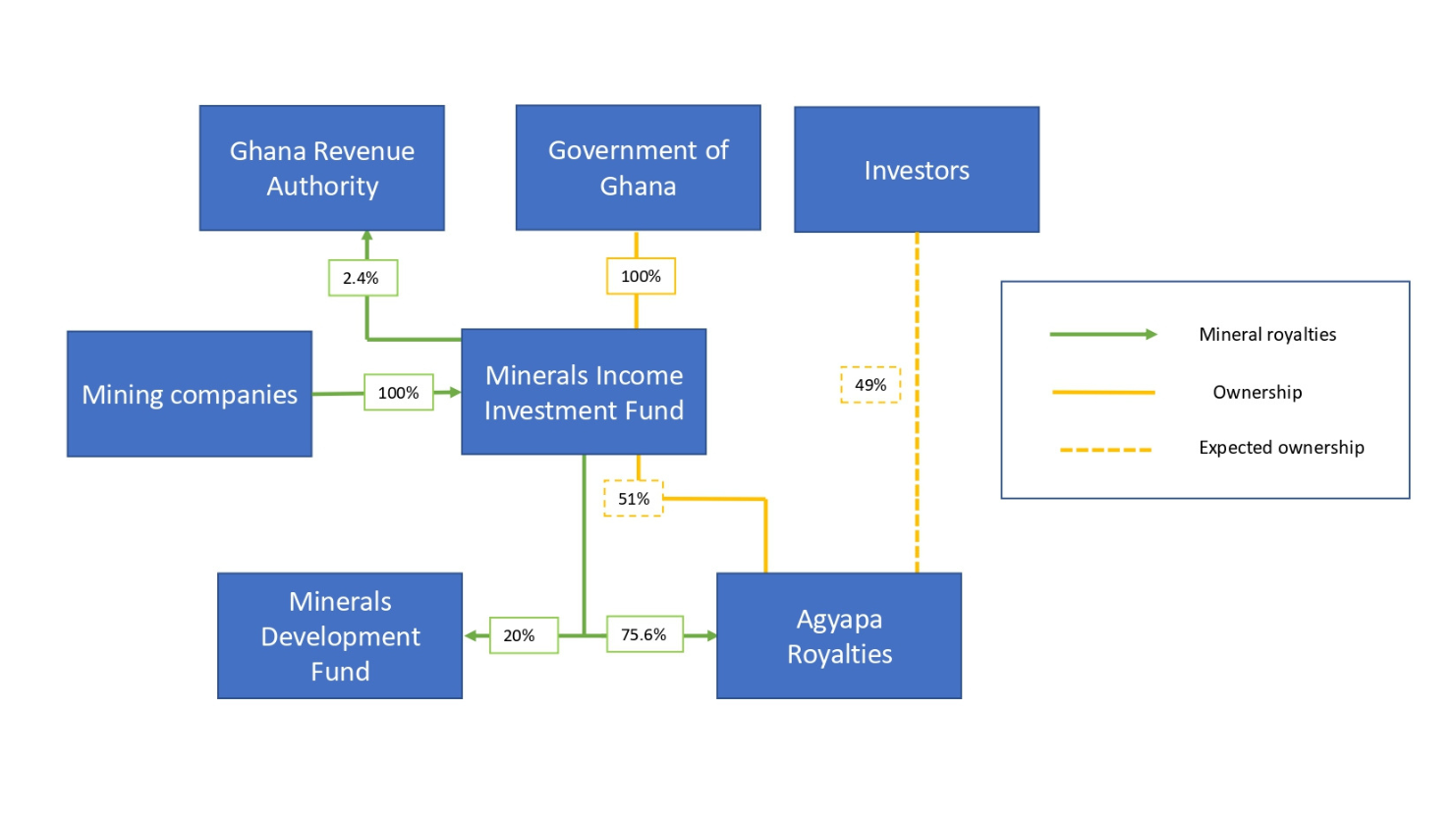
The government has touted the deal as a means to raise non-debt funding for development while dismissing suggestions that this move is driven by desperation. Like so many others, though, Ghana’s economy is in dire straits amid the pandemic.
While governments in richer countries have responded to the economic crisis with large spending programs and plentiful credit to businesses, Ghana’s options are more limited. Its budget has been under stress for some time, dragged down by immense debt (nearly 70 percent of GDP). The government had borrowed, in part, in anticipation of growing petroleum revenues (which reached over 10 percent of budget revenues last year), but is now finding it increasingly difficult to repay after the oil price collapse. Conventional credit is becoming increasingly expensive to raise.
Ghana has experimented with unconventional borrowing in the past, including taking multiple resource-backed loans in exchange for bauxite, cocoa and oil cargoes. It also collateralized portions of revenue from value-added tax to fund an education trust fund in 2018.
But gold prices have soared during the crisis, with prices exceeding $2,000 per ounce in August. The government has indicated it is keen to capitalize on this moment to fund infrastructure and human capital development without incurring repayment obligations or interest payments.

The Minerals Income Investment Fund Act may lay the groundwork for creative solutions to Ghana’s economic needs. However, the deal at hand raises a number of concerns as to whether the terms represent the best deal for Ghana, even under present circumstances. Government officials may wish to:
1. Consider reducing the scope of the agreement
Given the novel arrangement, the government might have chosen to start small. Instead, the deal is expansive in scope and open-ended (a concern initially raised by Ghana’s attorney general). The government will allocate 75.6 percent of royalties from 16 areas under production or development. (Together these currently comprise 48 mining leases.) Based on our research, these mining leases essentially cover all of Ghana’s current industrial gold production. The deal also includes prospecting licenses and any mining leases that may be later granted in the areas covered by these prospecting licenses. This means the volume of gold production involved in the deal is as yet unknown. The duration of the arrangements is equally indeterminate. The arrangements would apply until the last of the mining leases has expired or been terminated without any further extension or renewal. The deal could therefore endure for decades.
While the government has pointed to private-sector precedents, commodity-backed sovereign financing more often takes the form of resource-backed loans. As a point of comparison, typical resource-backed loan agreements studied by NRGI set out either the total volume or total value of resources and interest to be repaid. This makes their valuation much more straightforward than in this case. The Agapya arrangement runs the risk of being mispriced/undervalued by both the government and investors. Moreover, by offering as much as 49 percent in the IPO, the government also loses the potential benefit of selling additional shares later at a higher price while retaining majority ownership.
A deal with a more limited scope would be less risky for Ghana.
2. Consider safeguards against the risk of undervaluation
Some analysts have argued that the $1 billion valuation put forward by government is too low. At current gold prices, Agyapa may annually receive $150 to $200 million (our estimate) in revenues net of administrative fees, for many years to come. Depending on the market’s assumptions on both price and volume of future gold production, there is indeed potential that investors value this deal at a much higher price. In a traditional IPO, the offering price is set by investment banks (the underwriters) based on the amount of money the company wants to raise and a gauging of investor interest. If the actual price at which the shares start to trade on the open market is higher than the offering price, the profits accrue to IPO investors (mostly large institutional investors or clients of the investment banks). While the government’s shares would also appreciate in value, the government would only realize this gain by selling additional shares and further reducing its level of ownership. Given the uncertainties, Ghanaian officials should consider an approach that might better enable the government to capture the market-determined value of the shares. This might be done through a Dutch auction IPO or other mechanism, though such other approaches also come with their own risks. The government should therefore explain how the approach it chooses best allows it to capture the true market value of the shares.
3. Disclose assumptions underlying the valuation of the deal
The price at which Agyapa shares are ultimately sold will be closely watched. But the basis for evaluating the deal should not be whether the $1 billion valuation is ultimately mispriced or not. Rather, the key financial question is whether the capital raised through these means is ultimately any cheaper than other forms of available financing.
One way to compare would be to calculate the internal rate of return (IRR) from the stream of forgone royalties. Analysts could then readily compare that figure with the interest rate the government pays on conventional loans to assess value for money. If the IRR is much higher than the interest rate(s) the government is paying, this would indicate the deal is actually more expensive for the government than conventional loans. No one can know this figure for sure until the deal ends (i.e., once royalties are no longer being paid out to Agyapa). But the government should disclose its own modelling and reveal what interest rate or IRR it has used in its current valuation.
4. Protect the right to adjust fiscal terms
A stability clause included in at least one version of the royalties investment agreement prevents changes to the royalty rate that would have a “material adverse effect” on ARG (since investors would be relying on the royalty stream). For possibly decades to come, this clause would limit the government’s ability to reduce royalty rates for the mining leases included in the agreement, even if such a reduction would, for example, encourage companies to maintain gold production in times of financial difficulty. Meanwhile, Ghana’s mining act caps stability agreements with mining companies at 15 years.
The agreement caps the royalty rates at a rate specified in the agreement for each mining lease. Presumably this means the government could raise the royalty rate, but Agyapa would not be entitled to royalties above the agreed rates. At the very least, the agreement should specify that the government may increase fiscal terms but that Agyapa is not entitled to benefit from any increases above the specified rate, for the avoidance of doubt.
5. Consider including anti-dilution provisions and a dividend policy to preserve influence over Agyapa
The government of Ghana has asserted that it is not mortgaging future revenues for a lump sum of cash today. Per the government, as 51 percent shareholder the Minerals Income Investment Fund will hold two seats on the board of Agyapa, will exercise its right to vote for the other directors, and will receive a majority of the future dividends. However, an agreement establishing the relationship between the fund and Agyapa includes several clauses that may limit the fund’s (and therefore the Ghanaian government’s) future control over Agyapa’s decisions. These clauses include commitments by the fund and the government to not use voting rights to prevent Agyapa from making decisions for the benefit of the shareholders of the company as a whole or in a manner that would require the company to make decisions solely for the benefit of the fund or Ghana.
The Ghanaian government’s level of control over the board is also uncertain. Under the agreement the fund is able to appoint two directors as long as it maintains at least 30 percent equity in the company, but a majority of the directors must be independent. The fund is able to vote on independent directors as a shareholder. However, the relationship agreement prevents the fund from exercising its voting rights against a shareholder resolution to appoint any independent director and from using voting rights to remove any independent director appointed by the board. The agreement defines “independent director” using the definition set out in the U.K. Corporate Governance Code, which includes “represents a significant shareholder” as a factor likely to impede independence. It is also not clear that Ghana will be able to retain majority ownership should the board seek to raise additional equity financing in future to expand the business. The agreements scrutinized by parliament and the company’s articles of association do not contain any provisions that would prevent the company from reducing or “diluting” the fund’s percentage ownership by issuing additional shares.
In general, the relationship agreement is meant to establish Agyapa as an independent commercial entity, free to pursue its own profitability without considering Ghana’s budgetary needs. It is questionable whether Agyapa will be able to diversify its portfolio by acquiring new assets (a stated government ambition for the company) while at the same time distributing proceeds from the IPO to the fund and distributing meaningful dividends annually (at least at the outset) while the fund maintains 51 percent ownership in perpetuity.
Nevertheless, anti-dilution provisions (for example, requiring approval of the fund-appointed directors to issue additional shares) and a clear dividend policy might provide Ghana with some protection of its interests, although it might also affect Agyapa’s commerciality.
6. Consider the risk of severe knock-on effect on other loans
By pledging one of Ghana’s larger and more reliable revenue streams to Agyapa investors for years to come, the government will have fewer funds with which to repay Ghana’s existing domestic and international lenders. Investors closely watch the ratio of interest payments to government revenue, and Ghana is already performing quite poorly in this respect. (Half of its revenues now go toward interest payments, a key consideration given by S&P for its recent downgrade.)
If the Agyapa deal is successful, future governments may be tempted to raise further funds on the back of other sources of income. If lenders ultimately perceive that Ghana’s debt repayment capacity is deteriorating, they will demand higher interest when rolling over existing, much larger loans. In such a scenario, any benefit from the Agyapa deal may be outweighed by overall borrowing costs.
The government should clarify to the public how it plans to guard against such risks and ensure that additional costs for medium-term financing needs do not outweigh any short-term gains.
7. Ensure parliamentary oversight of use of mineral income flowing to the fund
The government has said that the proceeds from the deal will finance infrastructure and socioeconomic development. Plans floated include new health facilities, developing a university jewelry course, building a mineral refinery, and developing road networks in mining communities. However, it is unclear whether monies will be remitted to the treasury and spent through the normal budgetary process, subject to parliamentary oversight. The act only requires the fund to distribute the investment income it receives in accordance with an investment policy statement and any directives by the minister of finance. To ensure the most effective use of the capital raised, the government should clarify the process for investing the proceeds from the IPO and ensure necessary safeguards for spending it wisely.
8. Build consensus
Ghana’s present challenges warrant unconventional thinking. But the many open questions around the deal and the strong opposition in parliament and by civil society actors may actually deter investors and lead to a much poorer valuation than could otherwise be achieved with consensus. Further public consultations could create the opportunity to improve the structure of the Agyapa deal and close gaps in the act to ensure that the people of Ghana ultimately benefit from their resources. After all, under the constitution Ghana’s minerals are held in trust for the people of Ghana.