
Institutional capacities for a just transition in coal regions: the case of La Jagua de Ibirico, Colombia

Since 2020, the Colombian department of Cesar – and specifically the municipality of La Jagua de Ibirico – has suffered serious social and economic consequences after one of the country’s most active coal companies halted operations.
These events aggravated the crises in an area already affected by armed conflict and social inequality.
This report explores the fallout of the coal industry’s departure and uses these lessons to recommend how other coal-dependent governments can avoid these problems and plan for a just transition that lessens the blow of coal’s decline.
Just Transitions From Coal in Colombia

This policy brief highlights challenges for a just transition from thermal coal in Colombia, in order to inform policy, development cooperation and private finance, research and on-the-ground projects and to offer insights for researchers and practitioners in other contexts. It is based on two reports from the project Just Transitions from Coal in Colombia, Indonesia and South Africa, which drew on workshops, interviews, quantitative analysis and literature reviews conducted between 2022 and 2024, with a focus on two departments that produce the majority of thermal coal for export: Cesar and La Guajira.
The transition from thermal coal in Colombia’s Caribbean region presents a complex set of economic, environmental and sociocultural challenges, demanding a multifaceted approach to ensure a just energy transition and attracting attention from a wide variety of civil society and development cooperation organizations. Workshop insights and case studies from the thermal coal-producing departments of Cesar and La Guajira highlight the challenges of unplanned mine closures, including economic dependencies, environmental degradation, sociocultural and institutional factors. The authors describe these, then address opportunities for a just transition that surmount these barriers, with recommendations to conclude.
Cross-Country Reflections on Coal and Just Transitions in Colombia, South Africa and Indonesia
The experts discussed on the current policy landscape for just transitions from coal in the context of Colombia, South Africa and Indonesia. One expert representing each country highlighted the unique barriers each country faces in phasing out coal production and reflect on how civil society can support just energy transitions. This panel conversation was followed by remarks by discussant Kerstin Mohr and an open Q&A.
Panel discussion:
- Juliana Peña Niño (National Resource Governance Institute), Colombia
- Ilham Rizqian Fahreza Surya (Institution for Essential Services Reform), Indonesia
- Muhammed Patel (Trade and Industrial Policy Strategies), South Africa
MINDEX: A Deeper Look at the Extractive Wealth of Nations

Sigmund Freud wrote that “it is impossible to escape the impression that people commonly use false standards of measurement.” The case of natural resource wealth measurements is no exception, as these estimations have been plagued by biases, statistical misconceptions and a misleading tendency to lump very different countries together as “resource-rich.”
Improving how we conceptualize, and measure, resource wealth and dependence is central to helping countries decide what role resources should play in their development. Better measurements will also help countries to navigate the global transition toward cleaner energy, which poses threats to some resource producers and creates opportunities for others.
This need led to the recent creation of the Multidimensional Indicator of Extractives-based Development (MINDEX), which provides a new and improved approach to measuring resource wealth and dependence. The MINDEX:
- Distinguishes between resource dependence (i.e., what proportion of key economic indicators comes from the resource sector) and resource (i.e., how rich a country is in natural resources per capita).
- Provides a framework for analyzing six different variables of resource wealth and dependence together, leading to a number of “case scenarios” that describe the role of resources in a country’s economy and the challenges that it may be facing to make the most of them.
- Differentiates between extractive resources, which allows us to see how policy challenges can vary from one extractive commodity to another.
In this post, we draw key lessons from a recent collaboration through which we’ve applied the MINDEX methodology to build profiles for six pilot countries (Algeria, Chile, Colombia, Democratic Republic of the Congo, Mongolia and Nigeria) that shed light on the varying dynamics and challenges countries face in managing their natural resources. (Access the profiles here.)
Challenges of acute mono-resource dependence: Nigeria
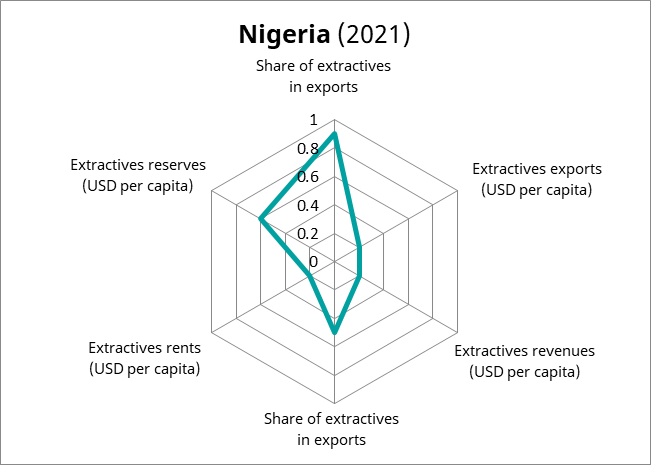
Nigeria ranks as the world’s 12th largest producer of oil and holds the largest natural gas reserves in Africa. Though the country also holds reserves of a variety of minerals (especially iron ore), the mining sector remains nascent, with insignificant contributions to the country’s export basket and fiscal revenues. As of 2021, Nigeria displayed a heavy dependence on oil and gas, but with relatively modest resource production per person, given the country’s large population. As can be seen in the figure below, in per capita terms, Nigeria has low extractive resource production (as approximated by rents), exports, revenues and reserves, but nevertheless a high share of extractives in total exports. Nigeria therefore should shift its focus from simply diversifying within the oil and gas sector to broadening its overall economic landscape. With a large and rapidly increasing population, relying solely on linkage development around oil and gas on e.g., processing oil and gas in-country may not meet diversification needs.
Unlike countries that are dependent on a variety of extractive resources, Nigeria’s over-reliance on oil and gas also exposes the country to severe risks related to the energy transition. Nigeria ranks 3rd globally for the highest carbon intensity in gas production and 22nd for oil. As carbon taxes rise, and consuming firms and investors increasingly prefer oil and gas that was produced with fewer emissions, Nigeria’s dependence on its relatively dirty oil and gas sector puts it in a challenging spot, underscoring the urgency with which government officials and other stakeholders should rethink its resource strategy.
Lessons multi-resource abundance: Colombia and Mongolia
The challenges of resource-based development can be very different across extractive sectors even within the same country. It can therefore be helpful to look at how a country’s resource wealth is divided between different extractive commodities. The cases of Colombia and Mongolia are informative in this regard.
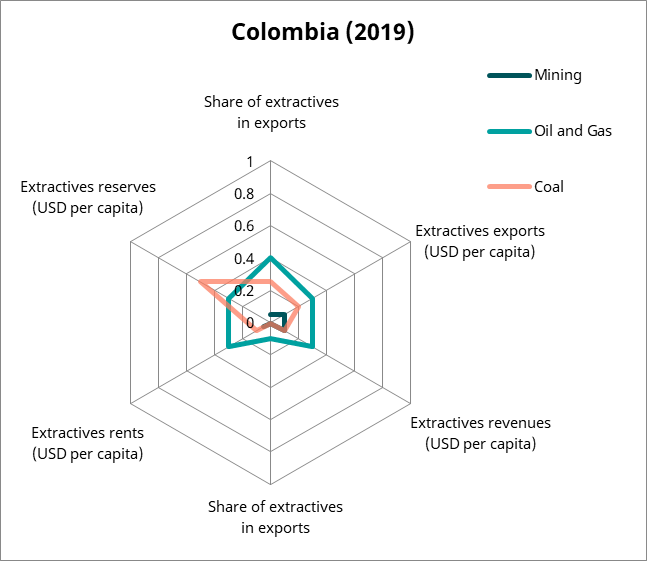
Though Colombia holds and extracts minerals (such as ferronickel and gold), fossil fuels make up the bulk of the country’s extractive resource wealth, with coal reserves estimated to be more valuable (at current prices) than its oil and gas reserves (though coal currently provides a much lower contribution to fiscal revenues and the export basket). Coal is most at risk of becoming a “stranded asset” (i.e., it is no longer commercially viable to produce it), followed by oil. So even though Colombia’s extractive resources are diversified between oil, gas and mining, most of its resource wealth will be threatened by the energy transition to green technologies. This is all the more important because some regions of Colombia depend heavily on coal.
Mongolia is endowed with a variety of extractive reserves, particularly gold, copper, coal and iron ore. Among these, coal is most at risk of becoming a stranded asset due to the energy transition.
Although the graphic below shows that Mongolia’s fossil fuel exports were slightly higher than mining exports (in 2018), the country’s MINDEX scores reveal that the broader economic weight and potential of the non-coal mining sector exceeds that of the country’s fossil fuel industry. Furthermore, Mongolia’s mineral reserves (not including coal) are considerably more valuable than the country’s fossil fuel reserves. In the future, the non-coal mining sector to will likely overtake fossil fuels as a main source of exports, especially as demand for coal declines with the energy transition.
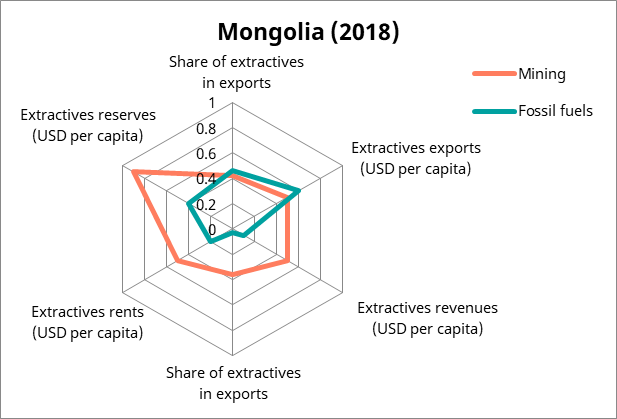
NB: in this figure, coal is classified as a fossil fuel rather than part of the mining sector.
Assessing policy changes amid evolving resource dynamics: Democratic Republic of the Congo
The DRC’s economy is highly dependent on the extractive sector. Extractives account for as much as 99 percent of the country’s exports in some years. Time analysis of the DRC’s MINDEX scores suggest that more resource revenues accrued to the government of DRC in 2014 than in 2010. This could be explained by the efforts from government to encourage more investment in mining, notably through a mining code revision process that began in 2012. However, resource production remains extremely low in comparison to the value of extractive reserves and the level of export dependency on extractives, suggesting that extraction capacity may be limited, or that there could be smuggling of extracted commodities.
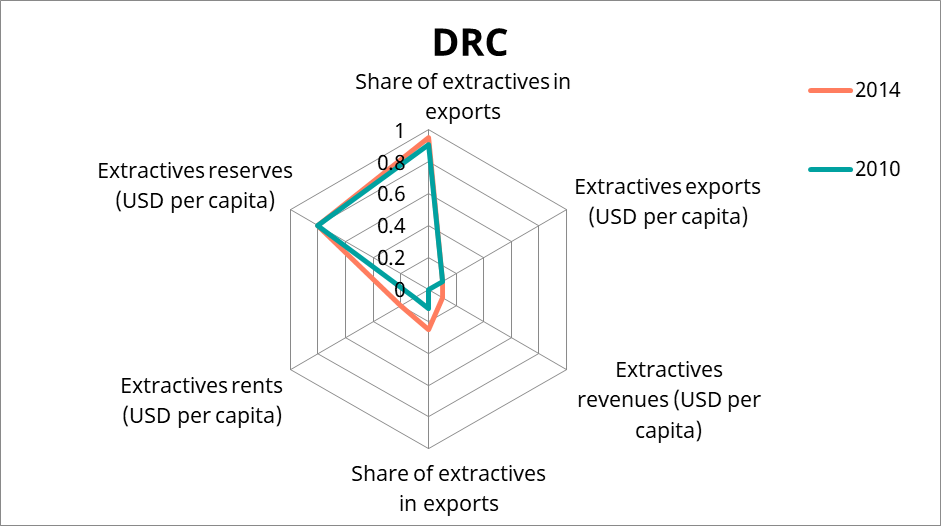
In conclusion, examining the different dimensions of extractives dependency can help us to understand the challenges facing resource-producing countries, and how to address them. The country profiles mentioned above present these kinds of insights, as well as a template for analyzing a country’s resource dependence.
For further information about the MINDEX, consult this published study.
New Strategic Minerals Videos: Supply Chains and Governance Challenges in Andean Countries

Español »
The urgency of the global transition to clean energy sources and the need to implement the Paris climate agreement, coupled with economic recovery from the coronavirus pandemic, have significant implications for the extractive industries. This means new challenges and opportunities along the supply chains of minerals such as lithium and copper, demand for which continues to grow because of their use in green energy generation technologies. In parallel, polluting minerals such as coal face the possibility of becoming “stranded assets,” resources that have lost their value due to changes in global energy consumption.
In this context, the Natural Resource Governance Institute (NRGI), with the support of the German Cooperation (GIZ), has produced videos on three topics: coal in Colombia, lithium in Bolivia and Chile, and copper in Peru. These videos explore perspectives on critical minerals and governance challenges in South America’s Andean countries and can serve as a starting point for much-needed dialogue.
Bolivia and Chile: Challenges and gaps for the industrialization of lithium and its inclusion in global chains
There are high expectations around lithium due to the projected growth in demand for batteries for electric vehicles, in which lithium is a key component. However, enthusiasts must better understand projections of the lithium market and the battery industry in a context of greater dynamism in the global energy transition.
Changes in the energy matrix will lead to a greater demand for lithium, so countries with significant lithium reserves must consider the feasibility of adding value to its production to participate in the global market. In addition, to strengthen the governance of the sector, governments must plan how to manage the social and environmental impacts. The growth in demand for lithium is an opportunity to discuss the energy transition, mining governance, as well as the increase in electromobility in producing countries such as Bolivia and Chile.
Peru: Environmental and social impacts around the copper supply chain
Copper is the main export of Peru, the second-largest exporter of copper concentrate in the world. As an important source of foreign exchange and revenue, copper contributes significantly to Peru’s national economy.
In the context of energy transition and the use of new technologies for the mineral-intensive generation of renewable energy, demand for copper (needed in most green technology) will grow. However, Peru has a series of governance problems, such as mining conflicts related to water and land access, as well as poor citizen participation. The government, with the support of different actors, must urgently strengthen mining governance so that the sector contributes to economic recovery, respecting the rights of the populations and with policies that promote the development of economic linkages, following criteria of sustainability and inclusive employment.
Colombia: Coal supply chain in a context of energy transition
Thermal coal is Colombia's second-largest export, after oil, and is an important source of economic activity and tax revenue. However, despite the abundance and quality of reserves, Colombia’s thermal coal industry faces a difficult future likely characterized by a long-term structural decline in demand, influenced by the increase in electricity generation from renewable sources versus fossil fuels, of which coal is the dirtiest.
The International Energy Agency forecasts that coal prices will ultimately decline, in all scenarios, and coal is at risk of becoming a stranded asset — hence the urgency for the transition to other forms of energy generation and the search for alternative economic activities for the regions dependent on this mineral. The transition to other forms and sources of energy opens the door to new governance models for natural resources. To reap those benefits, governments and other actors involved must therefore agree on a just transition plan that strengthens productive capacity, promotes new economic sectors and solves environmental liabilities.