
NRGI Submission to the Sixth Just Transition Work Programme Dialogue: Minerals and Equitable Value Chains
NRGI submitted its views to the UNFCCC ahead of the Sixth Dialogue of the United Arab Emirates Just Transition Work Programme (JTWP), held in Baku, Azerbaijan, on 10–11 September 2026. The dialogue focused on just transition pathways for the industry sector, including technology, innovation and equitable value chains.
Drawing on our work in resource-rich low- and middle-income countries, the submission examines how mineral-producing countries can translate growing demand for transition minerals into lasting development benefits. It explores opportunities to retain more value through mineral processing and related industries, while addressing economic risks and environmental and social harms.
NRGI identifies priorities for national action and international cooperation:
- Ground mineral value addition strategies in national development goals, economic feasibility, market analysis and rigorous assessment of costs and benefits.
- Involve citizens in decision-making, protect community rights and tackle corruption.
- Provide technical and financial support to strengthen national strategies, institutions and regulatory capacity.
- Ensure mineral-producing countries help shape international rules and partnerships affecting their development prospects.
The submission also considers how the JTWP and the Just Transition Mechanism can support these efforts through finance, technology transfer and institutional capacity building.
Beyond Extraction: Why COP32 Must Redefine Africa's Role in the Global Energy Transition

As the world prepares for COP31 in Turkey, Nana Dr. Antwi-Boasiako Amoah, Chair of the African Group of Negotiators on Climate Change, looks ahead to COP32 in Ethiopia in 2027. He argues that COP32 offers Africa an opportunity to redefine its role in the global energy transition, using its critical minerals to build stronger economies, deepen regional cooperation and secure a fairer share of the value they create.
In 2027, COP will return to Sub-Saharan Africa for the first time in 15 years. When historians reflect on this moment, Africa should be remembered not just as the host of another climate conference, but as the continent that helped redefine action at the intersection of climate and development transformation.
If this lofty ambition is to be realized, it will depend on how the continent comes together to leverage and govern its critical transition minerals. Around the world, governments and other non-state actors, especially the private sector, are investing trillions of dollars in clean energy technologies and infrastructure. Demand for the minerals needed for clean energy technologies is expected to continue rising sharply over the coming decades.
Africa is well placed to benefit from this new minerals boom, as it is rich in many critical mineral reserves. To name just a few examples: the Democratic Republic of the Congo remains central to global cobalt production; Zambia and the DRC anchor one of the world's richest copper belts; Guinea is indispensable to global bauxite supply; and South Africa continues to play a leading role in platinum group metals.
It is clear that the success of the global energy transition will depend significantly on Africa and her resources. Yet, there remains a real risk that Africa could be left looted unless the transition is deliberately designed to create value for the continent. This paradox defines our era.
Twenty years ago, the global resource governance movement transformed the conversation from one centered on extraction of resources to one focused on inclusive development through transparency, accountability and citizen participation. Organizations such as the Natural Resource Governance Institute (NRGI), together with governments, civil society and international partners, helped place accountability, transparency and better governance at the heart of resource management.
Today's challenge is different. Africa must not only govern its minerals better. It must negotiate its future better.
For more than three decades, the African Group of Negotiators (AGN) has helped shape international climate negotiations by advancing African priorities on adaptation, climate finance and Loss and Damage. COP32 now offers the opportunity to extend that leadership to one of the defining issues of this century: the governance and diplomacy of critical minerals.
Across the world, major economies are redesigning industrial strategies around secure mineral supply chains. The European Union's Critical Raw Materials Act, the United States-led Forum on Resource Geostrategic Engagement, China's International Economic and Trade Cooperation Initiative on Green Mining and Minerals and similar initiatives elsewhere reflect a profound geopolitical shift. Minerals are no longer simply commodities; they have become strategic assets.
Africa's greatest strategic asset is therefore not simply its mineral endowment. It is its collective bargaining power.
For too long, success has been measured by how many tons of minerals leave African ports. That is the wrong measure. Success should be judged by whether mineral wealth creates decent jobs, reliable energy systems, stronger public institutions, competitive industries, technological capability and lasting prosperity for African citizens.
This requires a new generation of mineral diplomacy. Not diplomacy centered solely on concession agreements, but diplomacy that connects climate ambition with industrial policy, infrastructure investment, technology transfer, regional integration and economic resilience.
But better deals alone will not deliver transformation. Without transparent institutions, accountable governance and public trust, even the most ambitious mineral partnerships will fail to deliver on their promise.
History has shown that mineral booms can fuel corruption, environmental degradation, elite capture and community conflict when governance is weak. Conversely, countries with transparent licensing systems, contract disclosure, beneficial ownership transparency, sound fiscal management, environmental accountability and meaningful citizen participation are better positioned to attract responsible investment. This enables them to convert mineral wealth into long-term development.
Governance is the defining key in this regard. Strong governance strengthens investor confidence while ensuring that mineral wealth contributes to sustainable and inclusive development. So, good governance is not an obstacle to investment. It is one of its greatest competitive advantages. The challenge before Africa is not to choose between negotiating better partnerships and strengthening governance, but to recognize that the two are inseparable.
The meetings of the parties under the UNFCCC, usually referred to as COP, have often been criticized for being heavy on talk and light on implementation. We are determined that COP32 should be different. It presents an opportunity for Africa to champion an African Minerals and Just Transition Compact—a practical framework that aligns climate ambition with development ambition and builds on existing African Union frameworks, including Africa’s Green Minerals Strategy, to strengthen coherence and collective action. The Compact would establish a new partnership between producer and consumer countries rooted in good governance and based on shared prosperity rather than simple resource extraction.
We believe such a Compact should rest on four principles.
First, mineral partnerships should promote long-term economic transformation built on a clear, measurable ambition: by 2040, African countries should collectively double the share of value retained from their transition mineral resources. Estimates from the African Development Bank (AfDB) suggest that less than 20 percent of the total value of many mineral value chains is currently retained on the continent. Today, most African countries capture only a small fraction of the total value generated along mineral supply chains, often limited to royalties, taxes and low-value extraction activities, while the bulk of value accrues through processing, manufacturing and downstream industries located elsewhere. Doubling this share would thus require a more equitable capture of tax and fiscal revenues from mining, alongside harnessing increased value from processing and manufacturing. This in turn would depend on skills development, technology transfer, energy and infrastructure development and regional economic integration.
Second, Africa should focus on regional value chains instead of isolated national projects. By leveraging the African Continental Free Trade Area (AfCFTA), coordinated policies and strategic infrastructure, countries can collectively maximize the benefits of mineral development.
Third, climate and development finance must support mineral-producing economies in building productive capacity, not only in expanding extraction. Multilateral development banks (MDBs), climate funds and development partners should establish a dedicated facility, anchored in the MDB Joint Coordination Framework on Critical Minerals, with an initial capitalization of US$25 billion to provide concessional finance for geological data, renewable energy, transport corridors, industrial parks, research and innovation, governance reforms and workforce development. This figure reflects indicative estimates of the scale of investment required across priority areas, drawing on analyses by institutions such as the AfDB, IEA and World Bank on the infrastructure, industrial and governance investments needed to support mineral-based development.
Fourth, transparency, accountable institutions, contract disclosure, beneficial ownership, environmental stewardship and meaningful community participation must become defining features of responsible mineral partnerships.
To put this Compact into action, we will need to enter a new era of cooperation between producer and consumer countries. We believe there is momentum in this direction, and 2027 can be a turning point: leveraging the opportunities presented by African leadership of COP32 and UK leadership of the G20 to co-develop this new framework grounded in mutual accountability, local value creation and long-term economic transformation.
Remember, Africa does not seek to slow the global energy transition. On the contrary, our countries have contributed the least to climate change while experiencing some of its most severe impacts. Africa has every interest in seeing the transition succeed. But success cannot be measured only by the speed of global decarbonization. It must also be measured by whether the transition creates opportunity where the critical minerals originate. A fair and just transition is what Africa demands, and this Compact will help to deliver it.

Nana Dr. Antwi-Boasiako Amoah chairs the African Group of Negotiators (AGN) on Climate Change for 2026–2027, representing Africa's 54 countries in UN climate negotiations. He is Director of Adaptation, Climate Resilience and Risk Management at Ghana's Environmental Protection Authority and previously served as Lead Negotiator on National Adaptation Plans for the G77 and China. He also lectures part-time at the University of Ghana's Centre for Climate Change and Sustainability Studies. He contributed this piece as part of NRGI's 20th anniversary thought piece series on the future of resource governance.
From Minerals to Development: New Connections for a New Era

As leaders gather in New York to discuss how the UN can advance the principles and recommendations of the Secretary General’s Panel on Critical Energy Transition Minerals, Lisa Sachs, of the Columbia Center on Sustainable Investment, shares why now is the time for long-term resource governance practioners to ask new questions, be honest about where we have fallen short, and join our work with other, related sectors.
For twenty years, those of us working on resource governance have been making the case that mining sits at the heart of sustainable development, and that resource-rich countries can convert their mineral wealth into broad-based development. A robust field grew to tackle the multidimensional challenges of resource governance with increasingly sophisticated tools: open fiscal models, contract databases, model laws, global multi-stakeholder initiatives, consolidated industry standards, and many trainings. In doing so, without quite noticing, those working on resource governance built a field with its own terms, boundaries, and sense of itself as complete. And yet, despite steadily better tools, the trajectory for resource-rich countries has not changed as we hoped.
Better tools, familiar challenges
Minerals are more central to the global economy than ever, and we are still asking many of the questions we asked two decades ago. Conflicts over land, fiscal promises that go unmet, environmental damage, projects stalled by mistrust; both the headlines and the framing questions at conferences are reminiscent of two decades ago. Few mining communities are meaningfully better off, and a quarter century into the era of transparency (of contracts, payments, and budget), we often cannot say how value is divided. From what we can see, wealth has not meaningfully improved the lives of the citizens of many resource-rich countries. Two years ago, the UN Secretary-General convened a multi-stakeholder panel on critical minerals, framed around not repeating the patterns of extraction and exploitation; a call to action that reflected concern from low and middle income countries that two decades of effort had not bent the curve. The panel worked admirably (and swiftly) to produce a report that consolidated twenty years of recommendations. But it did not grapple with why those efforts had fallen short.
Part of the answer is that resource-based development is genuinely hard. A single project involves multiple companies, a national government, local and regional authorities, the communities on the land, financiers, off-takers, and the home governments of the investors, each with its own interests, time horizon, and leverage. Geography compounds the challenge: value chains are spread globally: the mine in one country, processing often elsewhere, and the market in yet another country, with value and impacts unevenly distributed. And much of what determines the outcome happens behind closed doors.
Even when the terms are known, we are not agreed on what a ‘good deal’ looks like. For some, a fair outcome is one where the state captures the bulk of the value and the project advances the country’s own development strategy. For others, the measure is whether communities who bear the impacts negotiate their own terms. There is no agreed standard for decisive terms like shared-use infrastructure, dispute settlement, closure liabilities, audit rights, or the corporate structuring behind a deal's tax and legal exposure.
The benefits and the costs of mining fall unevenly by their nature: revenue accrues to the capital while the disruption lands on the community, gains arrive over decades while costs arrive at the start, one generation consents and another lives with the result. A deal can be fair to the state and unfair to the people nearest the mine; fair at signing and unfair twenty years on. While those of us in the field have at times recognized some of the inherent tensions and trade-offs, we have rarely found a framing that holds all of these elements in view at once. Part of the reason is that the field is divided along the same lines as the trade-offs: experts often specialize in one area: fiscal terms, community benefit, environmental and legal safeguards, dispute settlement, corruption.
When we do come together to talk about these intersectional components, we continue to do so within the framing of the natural resource sector as its own field, with its own technical features, institutions, standards and debates. But treating resource governance as self-contained is precisely what has kept it from working. We have become very good at governing the mineral and have left the system that gives the mineral its value to others. In reality, resource governance is a challenge inseparable from the larger fields of development, geopolitics, and international finance. Whether a mineral endowment becomes development is decided by the capital that builds power systems and ports, by the energy planning that determines where processing is viable, and by the international financial architecture that determines fiscal space and borrowing costs, and by geopolitics with its ever-powerful carrots and sticks. Resource governance is inherently part of all of this, and shaped by it at every turn. Yet the field has built its standards, its contracts, and its transparency mechanisms largely apart from the international financial institutions, the energy planners, and the fiscal, financial, and public-investment decisions that set the result.
This is a rare moment of attention for a set of issues that spent years at the margins. Minerals are in the news daily, capital and political attention have returned, and new actors who have never worked on resource governance are shaping the agenda. Many arrive as if there had never been a field at all, which risks discarding two decades of hard evidence about what works and what does not. But it is also telling that these new actors are finding the field largely the same as we found it twenty years ago.
Why now is the time to rethink
For those of us who have been working in the field for decades, there are two powerful reasons that now is the time for a rethink. First, several of the most physical constraints to resource-based development have shifted. Clean power can now be produced affordably and locally where the planning is done to support it. Markets that were assumed to be global and centralized are becoming more regional, as more regions move to build their own capacity and secure their own supply. And the recognition that integration and regional coordination are necessary has grown. And second, supply-security concerns and the return of industrial policy have opened real room for integrated, development-oriented strategies that were politically unattractive a decade ago. The barrier to integrated, development-oriented resource strategies is now mainly institutional and architectural: whether the field organizes itself to work across the systems it has always been part of.
The most valuable thing twenty years of work leaves us with is not fixed answers but a set of hard-won learnings, including, most importantly, the limits of the approaches we have tried. Those who have spent decades in this field should not cling to what we have been trying this whole time; that would be misreading both the evidence and the moment. Defending a position we have held for so long risks entrenches an old framing even as its assumptions prove flawed and the systems beneath it move.
But the depth of experience is critical: we know what was tried, what mattered, and why earlier efforts fell short. When the same questions are asked anew, the institutions and individuals who have engaged deeply in that work are best placed to reflect on how to think differently about the questions and the answers, so that we do not repeat the patterns of the past. Doing so requires a level of reflection and reckoning that may be uncomfortable to longstanding leaders in the field. And yet, knowing the terrain well enough to reframe the question – and push the conversation forward, rather than defend or replay the past, is an essential contribution two decades in this field can offer.
The task now is to foreground the interconnections, where the outcomes are actually decided. A processing facility is viable when the energy system has been planned to power it affordably. A mineral corridor pays off when the transport and the industrial capacity around it are sequenced together rather than negotiated piece by piece. Shared water infrastructure can serve the mine, the farms, and the cities downstream when it is planned at the basin level rather than built in parallel. An endowment becomes development when its financing is tied to a costed investment plan inside a national or regional strategy. A larger government take and a tangible community benefit become less of a fight over a fixed sum when the project is built into a development strategy that enlarges what there is to share. Affordable power, regional markets, and secured demand come together when they are sequenced as one. Seen as one system, the trade-offs that looked fixed start to give.
This matters to the people who fund the work as much as the people who do it. The opportunity is to back new thinking—including interdisciplinary work that does not fit neatly in any one silo. To draw on the people who carry decades of experience, not to ask them to defend what they built, but to ask what it taught. That work matters now in a way it has not before, with the questions open again and the moment ready for different answers.
Lisa Sachs is the Director of the Columbia Center on Sustainable Investment (CCSI). She is a globally recognized expert and leading voice on climate finance, sustainable investment, and natural resource governance, and a leading voice on how laws, policies, and financial architecture shape global investment flows in support of development and climate objectives. She advises governments around the world along with multilateral development banks, UN agencies, and intergovernmental organizations, and works closely with companies, investors, and civil society to translate research into practical policy and investment reforms. Lisa contributed this piece as part of NRGI's 20th anniversary thought piece series on the future of resource governance.
Corruption in Mineral Value Addition: Why It Matters

Many mineral-producing countries are pursuing value addition to capture more economic benefits from mining and strengthen their position in global supply chains. This briefing examines how corruption can undermine those ambitions—making value-addition efforts less fair, less reliable and more costly—and outlines practical steps to manage the risks.
Key messages
Value addition can make mineral supply chains fairer and more reliable—if decisions are made with integrity.
Corruption in mineral value addition is occurring across a wide range of countries, minerals and technologies, yet anticorruption is missing from many current initiatives. In some contexts, it is being actively weakened.
Politicians and companies in many countries are promoting value-addition projects that are unlikely to happen or to be economically viable. These claims deserve scrutiny.
Corruption in value addition undermines fairness by funneling wealth and opportunities to a privileged few, while harming vulnerable communities.
Corruption can also make mineral supply chains less reliable, delaying projects, discouraging investment and cutting output.
Governments, companies, investors and international initiatives can take concrete steps to mitigate corruption risks in mineral value addition.
This briefing explores how corruption can undermine efforts to promote mineral value addition, a growing priority for mineral-producing countries amid the energy transition and shifting geopolitical dynamics. Using real-world examples across regions, minerals and processing stages, it examines how corruption distorts policy choices, project selection and implementation, with consequences for fairness, public revenues, investment and supply-chain reliability. The briefing concludes with practical recommendations for governments, companies, investors and multilateral organizations.
Global Commodities Forum 2025 Panel 2 - Critical Energy Transition Minerals - Principle on benefit-sharing, value addition and economic diversification
Palais des Nations

The global demand for critical energy transition minerals offers developing countries a chance to diversify their economies, reduce dependence on raw exports and strengthen their role in global supply chains. With effective governance and local value addition, these resources can drive industrial growth and support a just, sustainable energy transition.
UNCTAD, as co-leader of the UN Secretary-General’s Panel on Critical Energy Transition Minerals, is helping shape frameworks for fair benefit-sharing, transparency and sustainability across mineral value chains.
At the Global Commodities Forum, the session “Critical Energy Transition Minerals – Principles on Benefit-Sharing, Value Addition and Economic Diversification” will explore practical steps to turn these principles into action and ensure mineral wealth drives equitable development.
- How can the global trade system evolve to better support developing countries in achieving value addition, diversification and industrial upgrading?
- What global mechanisms can ensure inclusive access to technologies for responsible mining and innovation across the value chain?
- How can international investment frameworks mobilize development-driven capital for midstream and downstream activities while protecting national development goals?
- What role can South–South and triangular cooperation play in building regional industrial ecosystems and shared value chains?
- How can UNCTAD further support developing countries in leveraging critical minerals for structural transformation and sustainable development?
NRGI staff on the panel

Susannah Fitzgerald
Critical Minerals Governance Senior Officer
From mines to clean tech: securing ethical, sustainable mineral supply chains for a competitive and clean Europe
Brussels, Belgium
How can the EU ensure the ethical sourcing, decarbonisation, traceability and sustainability of critical energy transition minerals? This session will bring together voices from industry, civil society and policy to share best practices and innovative solutions for reducing environmental, social and governance (ESG) risks throughout the supply chain.
Suneeta Kaimal, NRGI’s President and CEO, will join the discussion to spotlight the role of transparency, accountability and equity in building more resilient and responsible supply chains.
Speakers:
Suneeta Kaimal, President and CEO, Natural Resource Governance Institute
Ditte Juul Jørgensen, Director General for Energy, European Commission
Selwin Hart, Special Adviser and Assistant Secretary-General for Climate Action, United Nations
Florian Anderhuber, Deputy Director-General, Director Energy & Climate, Euromines
Eric Buisson, Critical Minerals Analyst, International Energy Agency
Peter Kovacs, Senior Adviser, European Commission
Moderator:
Monika Zsigri, Head of Unit, European Commission
This event is hosted as part of the European Sustainable Energy Week (EUSEW), organised by the European Climate, Infrastructure and Environment Executive Agency (CINEA) and the European Commission’s Directorate-General for Energy.
Featuring NRGI's

Suneeta Kaimal
President and Chief Executive Officer, NRGI Governing Board ex officio
Critical Raw Materials for Energy Transition: Bottlenecks and Civil Society Solutions
Washington, D.C.

As the global race for technological dominance accelerates, so too does the urgency surrounding access to critical raw materials—the backbone of clean energy systems and AI innovation. Yet rising geopolitical tensions and supply chain vulnerabilities raise a critical question: How can we ensure a sustainable, equitable, and secure supply of these vital resources?
On Wednesday, 23 April 2025, Devex and the Open Society Foundations hosted a high-level panel discussion exploring solutions to these challenges. The event will address options for optimizing the use of critical minerals, including strategies for supply diversification, enhancing transparency and upholding environmental and social standards. It will also emphasize the role of international cooperation in preventing exploitation and ensuring more equitable outcomes.
Suneeta Kaimal, President and CEO of the Natural Resource Governance Institute (NRGI), joined fellow speakers from academia, the minerals and energy sectors and leading think tanks. Together, they will explore how to foster meaningful collaboration, raise public awareness and generate actionable insights to shape a more just and secure energy transition.
Featuring NRGI's
Suneeta Kaimal
President and Chief Executive Officer, NRGI Governing Board ex officio
Transition Minerals in Mexico: Global Strategies to Enhance Equitable Value Addition

The event is part of the broader global debate on the equitable value addition of transition minerals, a topic that has gained attention from the United Nations Secretary-General’s Panel on Critical Minerals for the Energy Transition.
This webinar aimed to raise awareness about the crucial importance of value addition in Mexico's economic development and its connection to the country's energy transition.
Speakers:
- Fernanda Ballesteros, Mexico Country Manager, NRGI
- Thomas Scurfield, Africa Senior Economic Analyst, NRGI
- Chinmayi Shalya, Senior Investigator, Swaniti Global
- Sebastián Galarza, Executive Director, Centro Movilidad Sostenible
- Luisa Sierra, Director, IDEA
- Juan Luis Dammert, Latin America Director, NRGI
Featuring NRGI's

Fernanda Ballesteros
Mexico Country Manager

Thomas Scurfield
Senior Economic Analyst

Juan Luis Dammert
Contributor
Regional Dialogue on Mineral Supply Chains (IGF Annual Meeting)

Part of the 20th IGF Annual General Meeting (AGM), themed Redefining Mining: Balancing the Need for Minerals with Protecting People and the Planet, this session included speakers from three major global mining regions to discuss regional initiatives to strengthen mineral supply chains. Panelists considered efforts to collaborate across regions regarding areas of common interest.
Moderator
- Oluwatoyin Ojo, Senior Legal Counsel and Head of Partnerships, ALSF
Speakers
- Maureen Coulas, Deputy Director, Lands and Minerals Sector, Natural Resources Canada
- Jean Marie Kanda Ntumba, Board Member, Congolese Battery Council
- Thomas Scurfield, Africa Senior Economic Analyst, NRGI
Featuring NRGI's
Thomas Scurfield
Senior Economic Analyst
The DRC-Zambia Battery Plant: Key Considerations for Governments in 2024

- The partnership between the Democratic Republic of the Congo and Zambia to develop battery precursors is central to Africa’s ambitions to add more value to its minerals. However, public information about the project is limited.
- Based on available information, the location of the precursor plant remains a source of disagreement. Regional bodies have a key role in developing mechanisms to ensure an equitable share of benefits irrespective of which country hosts the plant.
- The Congolese and Zambian governments should consider the challenges in attempting to source the required minerals from the two countries alone, and explore wider regional coordination to meet the need for nickel and manganese.
- The role of other global actors, such as the U.S., EU and China, remains unclear, but how the DRC and Zambia navigate the geopolitical complexities will be critical for the project’s success.
- Greater transparency and stakeholder consultation will help the governments make the difficult decisions necessary for the project to go ahead and increase the likelihood of it benefiting the Congolese and Zambian peoples.
African countries are gearing up to play a pivotal role in the production of clean energy technologies for the global energy transition, and not just as suppliers of raw minerals. They seek to maximize their role in regional and global value chains by adding value to the resources extracted from their soil.
One key initiative is the partnership between the Democratic Republic of the Congo (DRC) and Zambia to produce nickel, manganese and cobalt (NMC) battery precursors. A precursor is an intermediate input to a complete battery, which the two countries aim to ultimately also produce. However, without a large regional market for the electric vehicles that use these batteries, production of complete batteries will be challenging. For now, the focus is on producing and exporting precursors that foreign battery manufacturers will use.
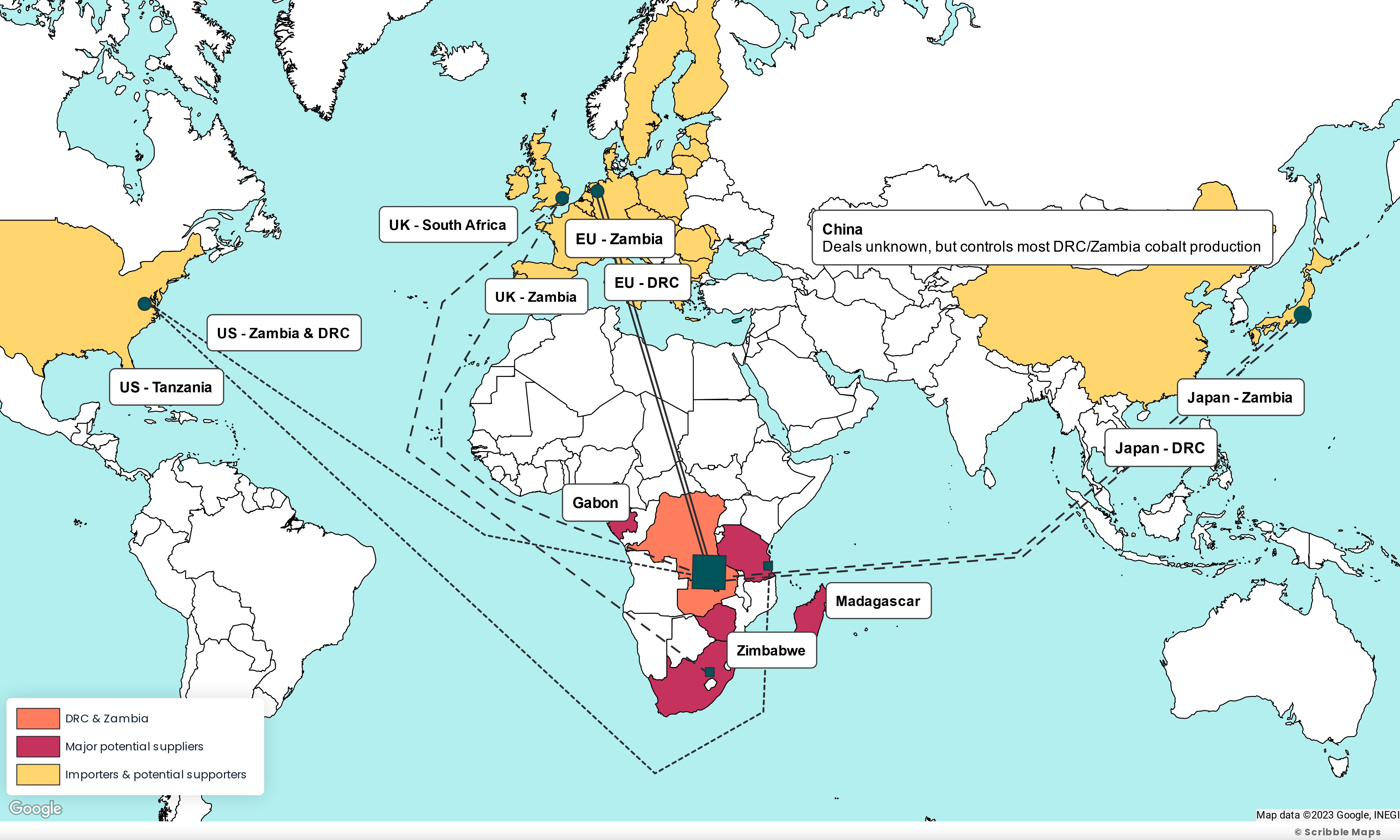
Planning for the precursor plant got properly underway in 2023, though details have been scarce. The status of a long-awaited pre-feasibility study is uncertain. There are conflicting statements about whether it has been completed and if it will be made public. The two countries have not disclosed their cooperation agreement or subsequent framework agreement. Various memoranda of understanding (MOUs) between these two countries and the United States and European Union are in the public domain, but further details remain behind closed doors, at least until roadmaps (action plans referenced in the EU MOUs) are developed next year. Little is known about other agreements that could impact the mineral sector and therefore the project—such as those between the DRC and Japan; Zambia and Japan; and Zambia and the United Kingdom. China’s dominance of cobalt production in the DRC and Zambia, including through state-owned companies, means it could have a significant influence on the precursor plant, but its role is uncertain.
Congolese and Zambian civil society actors are concerned about the lack of information and limited stakeholder consultation. In November 2023 they established the Pamoja Critical Minerals Forum to monitor and engage the governments on these plans and ensure that the plans reflect community voices.
Based on available information, we see four issues around the precursor initiative that the two governments should consider in 2024:
- Precursor plant location
- Mineral sourcing
- Role of international deals
- Transparency and multistakeholder engagement
Precursor plant location
Stakeholders suggest that this remains a point of disagreement between the DRC and Zambia. The governments initially agreed to construct the precursor plant in a cross-border special economic zone, but it seems that this shared site may be ultimately deemed unviable. The plant will therefore likely sit in one country or the other, and both countries aim to be the host. They have provisionally respectively earmarked the special economic zones of Kinsevere in DRC and Sub-Sahara Gemstone Exchange Industrial Park in Zambia.
Starting the project will be challenging regardless of its location. The independent prefeasibility study will likely recommend a location for the plant to maximize its economic viability and minimize environmental and social harms. To bolster the project’s prospects, the governments should accept the study’s recommendation in the absence of any major concerns. While it will not be easy for either country to agree to having the plant in the other, they can explore mechanisms to ensure an equitable share of benefits with the help of the regional bodies already active in the project such as the African Union’s African Minerals Development Centre, the African Development Bank, the UN Economic Commission for Africa and Afreximbank. For example, the country that does not host the plant could get a share of government revenues that the plant generates and have certain opportunities reserved for its workers, goods and services. This is a critical test for regional coordination: the proof of concept that the African Green Minerals Strategy calls for to catalyze other and wider coordination efforts.
Mineral sourcing
Stakeholders suggest that the governments aim to source all the required nickel, manganese and cobalt only from the two countries. The capacity of the plant and specific precursor design (including the ratio of nickel, manganese and cobalt) that the governments target will partly determine the feasibility of this approach. These parameters will be clearer after completion of the prefeasibility study. The plant that was initially envisaged would be large by global standards, producing around 100,000 tonnes (t) of NMC (622) precursors (one of the most common types currently demanded) a year. This would require around 48,000 t of nickel, 15,000 t of manganese and 16,000 t of cobalt that has been refined into sulfate.
The DRC and Zambia will find it challenging to source a sufficient amount of ores of the three metals and refine them into sulfates without involving other countries in the region. Neither the DRC nor Zambia currently refines any cobalt production into sulfate, but prospects are promising. Plans for a cobalt sulfate plant are advancing in Zambia, and World Bank analysis suggests a plant could also be viable in the DRC.
Production of nickel and manganese sulfate is less certain, however. Zambia produced around 4,000 t of nickel in 2022. First Quantum’s large nickel mine, Enterprise, started production in Zambia this year, which will add a massive 30,000 t a year on average. Nevertheless, this volume may still be insufficient for Zambia to meet the precursor plant’s needs on its own even if refining facilities were constructed and all production was supplied to the plant. Nickel exploration in the DRC is underway. Given only 19 percent of the country has been properly explored, this exploration may yield discoveries. However, with nickel mines taking an average 17.5 years from discovery to production, supplying the precursor plant is a far-off prospect.
Time is also a factor for manganese. Manganese is mined in the DRC and Zambia, currently by artisanal and small-scale operators. Formalizing these operations, including to reassure potential buyers of the precursors that the supply chain meets high ESG standards, and going on to build refining capabilities will be challenging.
The two countries could potentially meet these challenges over time, but there is no time to waste. The rapid evolution of battery technologies and global scramble for minerals mean that the longer this project takes to come to fruition, the harder it will be to attract investors and secure minerals for the precursor plant from the DRC, Zambia or elsewhere that haven’t already been tied up in long-term offtake agreements. The two governments should therefore utilize the African Continental Free Trade Agreement and start engaging other African countries on potential supply. Gabon and Madagascar have been cited as potential suppliers of battery grade manganese and nickel, respectively. Other countries, such as Tanzania, Zimbabwe and South Africa, are also possibilities. However some of these countries, such as South Africa, may actually harbor their own battery ambitions: further highlighting the importance of regional coordination to determine an approach from which all countries benefit.
Role of international deals
There is little information in the public domain on the specific support that the U.S. and EU intend to provide to the DRC and Zambia’s precursor ambitions. G7 support for the Lobito Corridor railway appears to have the most momentum currently. This project could increase investment prospects for value addition in DRC and Zambia by improving the route to market, but the railway could also be used to export unprocessed minerals. The implications for the precursor plant are therefore currently unclear.
It remains to be seen whether U.S. and EU will “put their money where their mouth is” in terms of specific support to the plant, and what the DRC and Zambia commit to in exchange. While the precursor plant could become a focal project of the U.S.-led Mineral Security Partnership or an EU strategic project under the bloc’s Critical Raw Materials Act, none of the parties have given such an indication.
Private investment and financing for the project will also depend on whether the U.S. enables buyers of mineral products processed in the DRC or Zambia to benefit from incentives offered by U.S. legislation. Only minerals processed in the U.S. or a country with which it has a free trade agreement qualify for the Inflation Reduction Act’s electric vehicle tax credits, for example. As the Carnegie Endowment’s Zainab Usman has highlighted, adjustments to the African Growth and Opportunity Act or other legislative instruments are needed for the DRC and Zambia (and other African countries) to qualify. Eligibility for U.S. incentives would increase the likely demand for DRC-Zambian precursors, and as a result, the attractiveness of the project to investors.
In the meantime, Chinese authorities and companies are not standing still amid all the talk and action from G7 countries. How the DRC and Zambia leverage this geopolitical competition while navigating the resulting complexities will be critical. It remains to be seen how these various actors will manage Chinese dominance of cobalt production when establishing supply for the precursor plant. Morocco’s experience may generate lessons as it seeks to utilize Chinese investment in battery manufacturing and its U.S. free trade agreement to export batteries to the U.S. and Europe.
Agreements between the likes of the U.S. and EU and other African mining countries could also impact the prospects of the precursor plant. For example, the U.S. is supporting the construction of nickel refining facilities in Tanzania but the deal stipulates that the battery-grade nickel will be exported to the U.S. Gabon, currently an exporter of manganese ore, could need similar support to start refining. While Gabon would benefit from the commencement of refined nickel exports irrespective of their destination, a deal that prevents exports to other parts of Africa could inadvertently stymie regional integration and the more transformative impacts that it would bring. Significant coordination is therefore required between both African governments and other governments.
International deals that could affect the DRC-Zambia precursor plans
Transparency and multistakeholder engagement
The Pamoja joint statement calls for greater transparency around plans and deals related to the precursor project and transition minerals more generally. Initially, this applies to disclosure of the prefeasibility study once completed and any inter-state deals not yet in the public domain. Going forward, the Congolese and Zambian governments should disclose subsequent agreements such as the EU roadmaps as well as any between the governments and investors in mining and value addition projects. The governments should also increase consultation with other stakeholders, including civil society actors.
The stakes are high for the DRC and Zambia with these projects. More transparency will help catch mistakes and ensure that the projects generate the intended benefits for the Congolese and Zambian peoples. Greater public awareness of the various opportunities and trade-offs should provide the governments with space to make difficult decisions—for example, the location of the precursor plant and sourcing of minerals. Building more public consensus and trust will also support the credibility of long-term planning and stability of the regulatory framework, and therefore increase the ability of the DRC and Zambia to attract investment.
People in the DRC and Zambia could benefit greatly from precursor production in their countries, particularly if the associated energy and transport infrastructure is leveraged for wider use. However, government efforts in other policy areas will be at least as important. For example, as Zambia aims to significantly increase copper production, the government should ensure it manages the upstream effectively. Other value addition opportunities, such as scaling up copper manufacturing in DRC, also hold at least as much, if not more, promise. Given that the complexities of the precursor project risk absorbing large amounts of the governments’ time, money and political capital, officials must weigh the opportunity costs carefully.