
What Happens After a Mining License Is Granted? Inside Indonesia's First Resource Governance Assessment

Indonesia is the first country assessed under NRGI's new Resource Governance Assessment. It finds strong foundations for mineral governance, alongside significant gaps between the rules, how they are implemented and what the public can see.
Just over a year after public outcry over nickel mining in Raja Ampat led the Indonesian government to revoke four of the region’s five nickel mining permits, the issue is back in the spotlight. New research published by Greenpeace Indonesia in late July reported that three nickel mining licenses are in process for eastern Waigeo, Raja Ampat’s largest island. The one permit that was not revoked, held by state-owned PT Gag Nikel, resumed operations in September 2025.
The renewed debate comes as Indonesia’s mineral resources, particularly nickel, are becoming increasingly important to global energy transition supply chains and to the country’s own downstream industrial ambitions. It is a reminder that Indonesia's mineral governance challenge is no longer simply about writing better laws or improving how mining rights are awarded. It also raises a broader question: what happens after a license is granted?
As NRGI argued in its commentary on the Raja Ampat case, the episode has exposed the gap between formal governance arrangements and their implementation in practice. Over the past two decades, Indonesia has introduced major regulatory reforms, digital licensing systems and stronger institutional frameworks for managing its mineral resources. But information about contracts, company ownership, compliance, government oversight and payments remains much harder for the public to access once mining is underway.
These questions formed part of the backdrop for the launch of Indonesia's Licensing and Taxation component of the Natural Resource Governance Institute's (NRGI) Resource Governance Assessment (RGA), in Jakarta on 5 August 2026. Developed in partnership with the Research Center for Politics and Government at Universitas Gadjah Mada (PolGov UGM), it is the first assessment published under the RGA; Chile, Senegal and Zambia will follow.
The RGA succeeds NRGI’s Resource Governance Index (RGI), but rather than ranking countries, it examines individual countries in greater depth and combines a common set of core indicators with optional ones chosen to reflect national priorities.
Opening the event, Erica Westenberg, NRGI's Governance Program Director, emphasized that the assessment is intended as a starting point for policymakers, industry, civil society and researchers to discuss where governance systems work well and where they need to improve.
Strong foundations, uneven transparency
Indonesia scores 52 out of 100 overall: 41 for licensing, 57 for taxation. But the detailed findings reveal a much more uneven picture.
Indonesia has substantially strengthened the administration of mining licenses. Digital platforms such as Minerba One Map Indonesia (MOMI), Minerba One Data Indonesia (MODI) and the Indonesia EITI Extractive Data Portal have expanded public access to concession and licensing information, and the country has established a comprehensive legal framework governing mining taxation and royalties. The assessment scores it 92 for pre-licensing processes and 100 for the rules governing taxation and royalties.
There are significant gaps elsewhere. Indonesia scores 33 for beneficial ownership disclosure and 0 for public access to mining contracts. Information on production, compliance, inspections, sanctions and license amendments is fragmented across institutions.
Taxation shows the same split. Indonesia has strong rules governing mining taxes and royalties, but public disclosure of company- and project-level payments remains limited. Payments to government score 58, while transparency around quasi-fiscal expenditures involving state-owned enterprises receives a score of 0.
Indonesia's taxation score is lower than the 84 it received in NRGI's 2017 Resource Governance Index, but the two are not directly comparable: the earlier RGI covered oil and gas as well as minerals and used a different methodology, with less ambitious criteria for good practice. The difference should not be read as evidence that Indonesia's taxation governance has deteriorated.
Indonesia's next phase of reform is less about creating new rules than implementing existing ones consistently and expanding public access to information.
What do the findings mean in practice?
At the launch, participants took the findings further.
Aryanto Nugroho, national coordinator of Publish What You Pay Indonesia, connected the findings to Indonesia's downstreaming agenda. While much of the policy debate focuses on downstreaming, he pointed out that it depends on what happens upstream, including how mining rights are governed.
Elvita Trisnawati researcher at the Indonesia Center for Environmental Law (ICEL) described what the findings mean for communities. Licensing procedures have become more transparent before permits are issued, she said, but once mining begins communities can still struggle to access information about compliance, environmental monitoring and government oversight.
Both point to the same issue. Without transparency after licenses are awarded, it is harder for communities to see how mining is governed or who benefits from it.
Where reform could focus next
Participants also challenged the assessment itself. Beneficial ownership was one area of debate, with some arguing that recent implementation efforts may not have been fully reflected in the findings, and questioning whether data collection had captured developments across relevant agencies.
The RGA is designed to invite this kind of debate. Its findings are an evidence base for governments, civil society, industry and researchers to examine and challenge, not a set of fixed conclusions.
Indonesia already has substantial digital infrastructure in place. Connecting MOMI, MODI and SIMBARA with beneficial ownership and revenue information would make it possible to follow the chain from license allocation and ownership through production, taxation and revenue collection, and would extend public accountability across the mining lifecycle.
The renewed attention to mining in Raja Ampat shows why implementation of the legal framework and public access to information matter. This first assessment sets out where Indonesia's mineral governance is strong and where it is not. Further components will examine revenue management, socio-environmental impacts and the energy transition.
Read the Indonesia Assessment
Where Indonesia's mining governance is strong, where it falls short, and what the scores mean in practice.
Still Have Questions About the RGA?
Common questions on scoring, methodology and how the RGA differs from the Resource Governance Index.
Red Flags, Green Future: Tackling Corruption in Mining Licensing

Conflicts over access to the minerals needed for the energy transition are sparking all over the globe, from geopolitical disputes to grassroots protests. Just last month, Global Witness reported more than 100 instances of mining-related protests and violence annually in the top ten producers of copper, cobalt, lithium and nickel alone. Much of this unrest centers on at least one of two critical questions: who has the rights to extract these minerals, and how are they treating nearby communities and ecosystems?
In most countries with transition minerals, mining cannot legally proceed without a license. For mining firms, securing a license can be a time-consuming and costly burden—one that can sometimes lead to corrupt practices. “Fast-tracking” licensing and permitting processes has become go-to of the mining lobby—and many companies have had success. In recent years, jurisdictions including the European Union, Norway and Brazil have announced new strategies or developed rules to deliver on this demand, with politicians in many more countries pushing for similar changes.
Yet, the steps in licensing processes that are the most time-consuming are often those that provide the best safeguards against the harms of mining for communities and nature. These include securing free, prior and informed consent (FPIC), carrying out meaningful community consultation, and conducting environmental and social impact assessments. Achieving efficiencies and better decision-making around licensing is possible—but it requires scaling up resources, facilitating better training, and ensuring knowledge transfer for ministries and officials, rather than cutting corners on these essential steps.
Red flags for corruption risk in licensing
At NRGI, our experience examining corruption in the high-risk licensing and contracting stages of the decision chain for extractives projects means that we watch these developments with interest—and no small amount of alarm. In part, this concern inspired our new research, launched today, on corruption risks in the licensing and contracting of transition mineral projects.
Our report, Ten Red Flags, draws on the methodology of our 2017 report Twelve Red Flags, which examined corruption risks in licensing and contracting across the extractives sector. Looking at 10 different transition minerals since 2010, we reviewed over 100 cases of alleged corruption, identifying 53 that met our evidence threshold across 30 countries. These cases occurred in high-, middle-, and low-income countries across five continents, and involved a diverse range of minerals. Alarmingly, we found that most countries with the largest transition mineral reserves have experienced cases of corruption. Nearly two-thirds of all reserves are in countries where corruption has been documented, and eight out of the 10 countries with the highest reserves had reported cases.
The risk of corruption in licensing and contracting is a global problem. The following countries appeared multiple times in our database as the home jurisdictions of companies involved in corruption cases: Australia, Canada, China, Russia, Switzerland, the U.K. and the U.S. There is an unfortunate tendency among higher-income countries like these, many of which depend on minerals sourced elsewhere to power their energy transitions, to see corruption as a problem of lower- and middle-income countries. Our findings firmly refute this narrative and reaffirm the shared responsibility of all countries to investigate and prosecute corruption, including foreign bribery.
Map: Corruption as a global problem
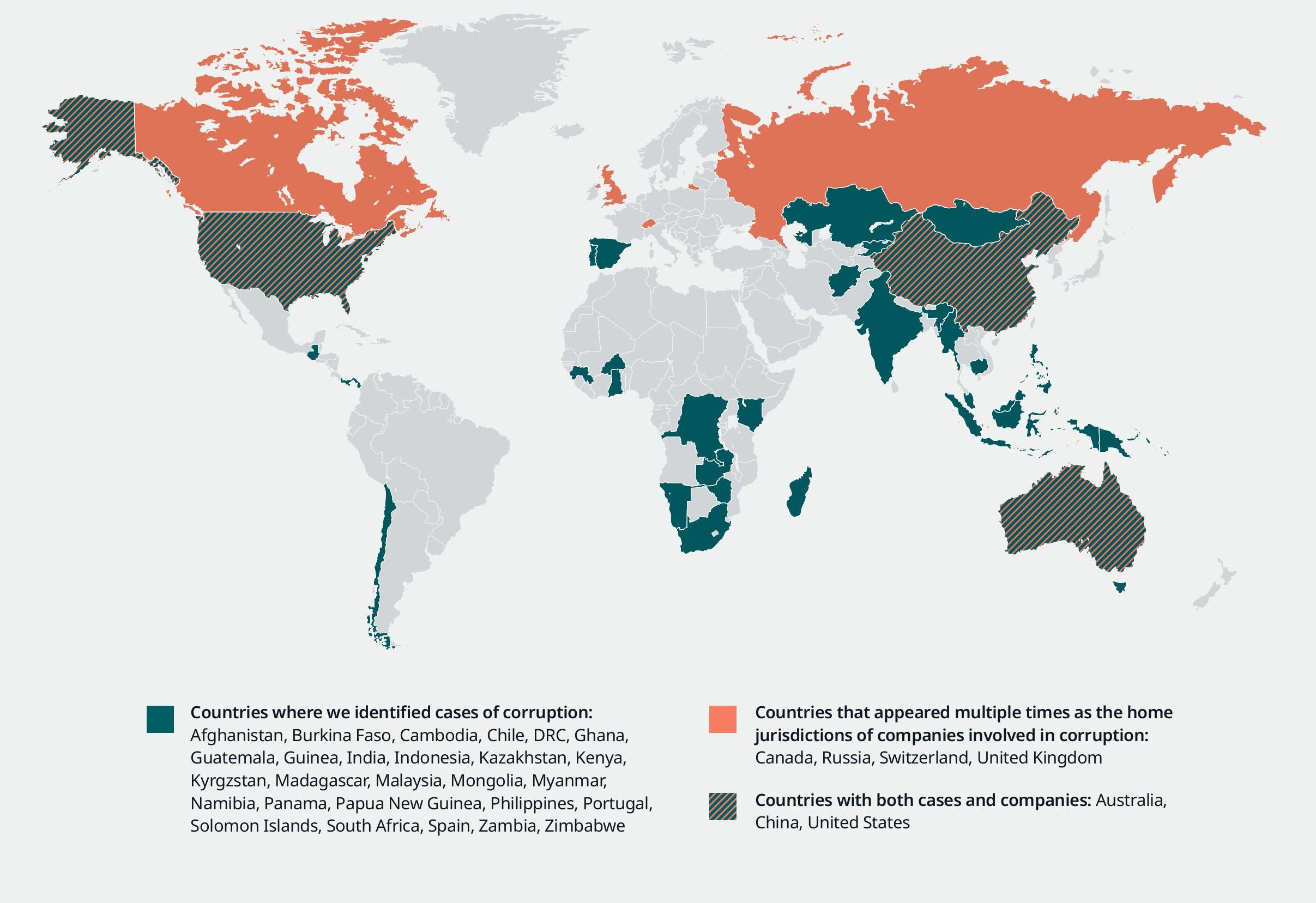
For each of these cases, we identified red flags that indicate corruption risk. These cover the types of companies granted licenses or contracts, the ways companies unduly influence decisions and decision-makers—often with implications for democratic processes—and how officials circumvent proper processes. While many of these corruption risks will be familiar to those working in the extractives sector, this report highlights emerging concerns, including the longer-term time scales of some corruption schemes, how corruption can flare up around elections, and its connection to social and environmental harms.
The consequences of corruption in licensing and contracting
The impacts of corruption are stark. Some government officials and mining company executives are already exploiting corruption around licenses and contracts to deny citizens and communities of their fair share of the benefits of mining transition minerals. With corruption starting in the licensing and contracting phase, companies are able to neglect and harm vulnerable populations and ecosystems with impunity. Corruption also delays mineral production, sometimes for years. In this way corruption in the licensing and contracting of transition minerals projects is actively undermining a just energy transition.
A swift transition away from polluting fossil fuels is essential to fight climate change, but this shift must also be just to ensure long-term sustainability and avoid breaching planetary boundaries. Decisions by authorities in producing countries about licensing and contracting process for new transition mineral extraction are integral to this effort. Authorities must take these decisions carefully to prevent mining communities, particularly in lower- and middle-income countries, from becoming sacrifice zones.
By providing officials, companies, regulators and enforcement agencies, civil society and journalists with the “clues” to identify corruption risks, we aim to contribute to the safeguarding of a just and equitable energy transition.
Corruption risks in transition minerals threaten a just energy transition
Learn about the ten red flags and how to address them.
Ten Red Flags for Corruption Risk in Transition Minerals Licensing and Contracting

Key messages
- Corruption in the licensing and contracting of transition minerals projects is undermining a just energy transition.
- Some government officials and mining company executives are already using corruption around licenses and contracts to deny citizens and communities a fair share of the benefits of mining transition minerals. Through corruption that starts in the licensing and contracting phase, companies are neglecting and harming vulnerable populations and ecosystems with impunity. And corruption is delaying mineral production, sometimes for years.
- Corruption in transition mineral supply chains is a global problem, with our study identifying 53 cases of corruption in 30 countries across five continents, involving a diverse range of minerals. Corruption cases have been documented in 8 out of the 10 countries with the highest levels of transition mineral reserves. The companies involved in these cases are often based in the world’s wealthiest or most powerful countries, including Australia, Canada, China, Russia, Switzerland, the U.K. and the U.S.
- Most of the corruption cases identified followed a familiar pattern, with red flags surrounding the types of company granted licenses or contracts, the ways in which companies have sought to unduly influence decisions and decision-makers—often with implications for democratic processes, and how officials have circumvented proper processes.
- Efforts to skip or shorten essential safeguards around licensing and contracting processes can lead to greater problems in the future, as production is slowed or stopped entirely by legal proceedings, shutdowns, protests and strikes.
As the world moves away from fossil fuels, there is a growing demand for renewable energy technologies—and the minerals and metals needed to build them. To reach net zero globally by 2050, the International Energy Agency estimates that the world will require six times more mineral inputs in 2040 than in 2021. For some minerals, the demand could even reach 30 times current levels. Demand remained strong in 2023, despite more volatility in prices. While the development of new technologies or policies to reduce consumption and increase circularity could have a crucial mitigating impact on this demand, the coming decades will no doubt see many new mines come online.
As demand for these essential materials booms, there is risk of a corresponding increase in corruption, with harmful impacts on communities and nature, the state budgets of mining countries, and humanity’s collective ability to realise a just energy transition. In past commodity booms, fast-paced dealmaking and the promise of windfall profits encouraged graft and self-dealing. At the same time, the scale and pace of activity hampered the ability of oversight actors to keep pace with developments in the sector, making it harder to spot corrupt behavior. These problems could easily repeat themselves in transition mineral projects, not least given the added pressure of tackling the climate crisis.
Other characteristics of the current mineral boom could further increase corruption risks. First, NRGI’s research finds that many players in today’s transition mineral supply chains are assuming new roles in different stages of the supply chain and negotiating unprecedented deals, such as in cobalt supply chains.
As offtakers and consumer product companies manage unfamiliar risks and dominate multiple stages of the supply chain, their anticorruption processes may be poorly equipped, perhaps even intentionally, to address the challenges posed in the extraction and processing of transition minerals.
Second, reserves of key transition minerals are concentrated in countries that have struggled to control corruption. Transparency International Australia identified that as much as 94 percent of rare earth reserves and 70 percent of cobalt reserves are found in countries that score poorly on Transparency International’s Corruption Perceptions Index. Some minerals, such as rare earth elements, are found in countries with contested governments or ongoing violent conflict.
Corruption in mineral supply chains threatens a just energy transition both by increasing the risk of harms associated with mining, and delaying and disrupting the supply of minerals needed to deliver the necessary scale-up in renewable technologies required to fight climate change. Taking steps now to identify, prevent and redress corruption can help avoid the mistakes and harmful outcomes of the past, as well as new harms, lost opportunities and the reproduction of inequities.
ResourceContracts.org
A repository of mining, oil and gas contracts

Nigerian Media Illuminates Oil Scandal
The challenge
In 1998, one of the richest oil blocks in Africa, Nigeria’s OPL 245, was awarded to Malabu Oil and Gas on the instructions of then-military dictator General Sani Abacha. Malabu was co-owned by then-petroleum minister Dan Etete, which made the move highly controversial. The Nigerian media organization Premium Times picked up the story, but developing sources with knowledge of the Malabu case was difficult, as was getting other Nigerian media to report on the scandal.
Journalists in resource-rich countries like Nigeria face considerable obstacles in covering opaque and convoluted pacts between government actors and companies. Effective reporting on resource deals is a crucial means of holding Nigerian decision-makers to account and keeping citizens informed about a critical sector.
NRGI's role
Through its Media for Oil Reform program, the NRGI supports Premium Times and Nigerian journalists covering extractives sectors, including Dapo Olorunyomi, Premium Times’ publisher (who was editor-in-chief as at the start of the NRGI grant in 2015), and Joshua Olufemi, a reporter.
The Media for Oil Reform program’s fellowship provides professional capacity development that is designed to help senior and mid-career journalists deepen their mastery of oil and gas reporting. NRGI also runs a master class on oil and gas reporting for a wider group of Nigerian journalists and provides grants to select media houses.
Impact
Premium Times led Nigerian media’s coverage of the Malabu oil scandal. A breakthrough in the Times reporting coincided with the receipt of NRGI institutional grants—the grants not only supported reporting on the scandal as news was breaking, but also supported important follow-up reporting. Overall, nine investigative stories were developed and published thanks to the grant.
The reporting continues to make important revelations. On 26 January 2017, Idris Akinbajo reported that Nigeria’s anti-graft agency, the Economic and Financial Crimes Commission (EFCC), had secured a court order demanding that Shell and Eni return OPL 245 to the Nigerian government. The article went on to note that 70 percent of the USD 1.1 billion Shell and Eni paid to a Nigerian government account went to Etete, who then transferred half of the amount to accounts controlled by a Nigerian national wanted for fraud in Italy.
The EFCC in March led a nine-count charge against Etete and other conspirators. In late May, Akinbajo and colleague Samuel Ogundipe reported that the Nigerian government told a U.K. high court that the transfer of money to Etete’s account was illegal according to Nigerian law.
The Malabu story and the lawsuits around the case are convoluted and constantly evolving. NRGI will continue to support Akinbajo and his peers, who have committed to continue their aggressive coverage of the scandal.
Getting a Better Deal from the Extractive Sector
by Raja Kaul and Antoine Heuty with Alvina Norma
This comprehensive report from Revenue Watch Institute demonstrates the need for more equitable terms in natural resource contracts and the pivotal role that the contract process can play in economic recovery and development.
In 2006, as part of its wider reconstruction effort, the government of Liberia conducted a review and renegotiation of its contracts with the Firestone rubber company and the ArcelorMittal steel company. The resulting amended contracts offered Liberia significant gains, in areas from taxes and corporate governance rules to environmental and social issues such as housing and education.
The amended contracts were embraced not only by Liberia's legislature and general public, but also by Firestone and ArcelorMittal, the latter increasing its investment in Liberia from $1.0 to $1.5 billion. The successful negotiations have also caught the attention of other African governments seeking to ensure that their countries maximize value from natural resource concessions.
Prepared for the Office of the President of Liberia by RWI senior economist Antoine Heuty and Raja Kaul, who was closely involved with Liberia Firestone and ArcelorMittal negotiations, the report includes forewords by President Ellen Johnson Sirleaf of the Republic of Liberia and Open Society Institute chairman George Soros.
Natural Resource Charter (2nd ed.)
The Natural Resource Charter is a set of principles to guide governments' and societies' use of natural resources so these economic opportunities result in maximum and sustained returns for a country's citizens. It outlines tools and policy options designed to avoid the mismanagement of diminishing natural riches, and ensure their ongoing benefits.
The charter is organized around 12 core precepts offering guidance on key decisions governments face, beginning with whether to extract resources and ending with how generated revenue can produce maximum good for citizens.
First launched in 2010 at the annual meetings of the International Monetary Fund and the World Bank, the charter was written by an independent group of practitioners and academics, under the governance of an oversight board composed of distinguished international figures with first-hand experience of the challenges faced by resource-rich countries. It relaunched at the 2014 Natural Resource Charter Conference in Oxford, England.
See More:
 Natural Resource Charter - Arabic (2mb)
 Natural Resource Charter - Bahasa Indonesia (305kb)
 Natural Resource Charter - French (310kb)
 Natural Resource Charter - Mongolian (630kb)
 Natural Resource Charter - Russian (431kb)
 Natural Resource Charter - Spanish (301kb)
The charter's framework and body of experts form an integral part of the Natural Resource Governance Institute.
Read more about the framework and its applications around the world.
Boom or Bust: Will Mineral-Rich Countries Benefit from the Energy Transition?

The energy transition is driving demand for minerals needed for low-carbon technologies, such as solar panels, wind turbines and electric vehicles. This demand could grow by up to 900 percent for some minerals over the next two decades, yet technological innovations also make these projections uncertain. According a new report from the Extractive Industries Transparency Initiative (EITI), produced by the University of Queensland, EITI implementing countries will likely play a substantial role in satisfying growing demand.
Government officials in many mineral-rich countries are excited about the mining sector’s economic promise. They are hoping for new investments that will bring in revenues, jobs and opportunities for local businesses.
But the prospects for converting natural resource wealth into sustainable development outcomes hinge on good governance (addressed in this new report from the Natural Resource Governance Institute [NRGI]). History points to the corruption and public finance risks that a mining boom can bring, including bribery in licensing, inadequate environmental and social assessments and lost revenues due to weak tax collection. In some cases, the mere anticipation of an uptick in investment could destabilize economies in mineral-rich countries.
Corruption in licensing and procurement
The business opportunities associated with a mining boom could be vulnerable to corruption. One key risk relates to the award of mining licenses. In many countries, authorities rush to approve new mines, with governments seeking to speed licensing processes. Peru, for example, has streamlined community consultations, and Brazil has introduced a policy to expedite approvals for mines of strategic importance. As flurries of applications stretch the capacities of government departments, companies may be increasingly tempted to offer bribes to speed up approvals, especially in a highly speculative context characterized by geopolitical competition between economic superpowers to secure transition mineral supply.
Officials may also feel pressure to cut corners and bypass due diligence checks, increasing the risk of politically connected (or/and unqualified) companies acquiring mining rights, or of weak or manipulated socio-environmental assessments. This can be particularly problematic since some transition minerals are located in unmined, environmentally fragile areas, in countries that are sensitive to environmental and social impacts. For example, mining projects in the “lithium triangle”—which comprises Argentina, Chile and Bolivia—could further strain the region’s limited water resources.
Similarly, the procurement of goods and services by mining companies can be vulnerable to corruption. Research by the OECD has found this to be a key risk area in the mining sector.
Transparency and multi-stakeholder dialogue can help to mitigate these risks. Governments should clearly justify any “fast-tracked” awards processes and commit sufficient time and resources to due diligence checks. Mining companies can support anti-corruption efforts through commitments to strong business integrity practices and due diligence processes across their business units. The EITI’s expectations for supporting companies, to which many of the world’s largest mining companies are committed, provides a starting point.
Uncertainty around public finances
Even if a country has abundant mineral reserves, weak governance and a lack of transparency can foil potential investment. For example, countries may struggle to attract high-quality, responsible mining companies in the absence of robust, publicly available geological data. Yet only four EITI implementing countries—Colombia, Indonesia, Kazakhstan and Mongolia—have adopted the CRIRSCO good practice guidance for public reporting of exploration results, mineral resources and mineral reserves.
Even if the sector grows, producing countries and investors will not be in a position to take fully informed decisions because of the uncertainty around economic prospects. Price volatility may lead to unpredictable revenue flows and macroeconomic planning challenges. Governments may collect less revenue than officials anticipate as a result of opaque tax structuring by companies operating across transition mineral value chains. In 2018, Chile had to create a committee to supervise lithium contracts after allegations of transfer pricing abuse.
Governments of resource-rich countries should promote transparency and accountability of the sector to mitigate these risks and realize their mining potential. They should publish more detailed information on the reserves and economic potential of transition minerals; strengthen oversight of companies’ revenue flows and financial relationships; and promote policies that support long-term economic planning and transparent decision-making.
Opacity in commodity trading and state participation
As resource-rich countries seek to take advantage of global competition for transition minerals, some are expanding the role of state-owned enterprises (SOEs) in the mining sector. For example, in the Democratic Republic of the Congo, the state recently established the Entreprise Générale du Cobalt (EGC) to manage all artisanally mined cobalt. In Indonesia, SOEs manage trade of tin, nickel, bauxite and other minerals.
Lack of transparency of revenue flows between governments and SOEs is a known risk, especially where SOEs are involved in the sale of the state’s share of production. While the oil and gas sector has been particularly vulnerable to corruption in commodity trading, the mining sector could face similar risks as governments increasingly involve SOEs to seize opportunities coming from growing demand for transition minerals.
For countries that foresee a strong role for SOEs, it is important that authorities identify associated governance and corruption risks and institute measures for mitigation, both for partners of SOEs and the SOEs themselves. Like companies in the private sector, there is no reason why SOEs cannot commit to high integrity standards across their business units and establish processes for risk assessments and due diligence checks, including when dealing with commodity traders.
Based on past experiences, only a well-managed mining sector will contribute to sustainable development in mineral-rich countries. Without high governance safeguards and real anti-corruption efforts, countries will lose out on potential revenues, deter investment, miss the opportunity to diversify their economies and increase risks of negative socio-environmental impacts. The result will be a mining boom that fails to deliver on its economic promises and an energy transition that may not advance global decarbonization at the speed needed – or advance it at the expense of the citizens of mineral-rich countries.
This post appears also on the EITI website.