
Anticorruption Guidance for Partners of State-Owned Enterprises

It also recommends measures SOEs can take to strengthen their anticorruption safeguards. The guidance for private-sector companies has five parts:
- Conducting due diligence on SOEs
- Avoiding high-risk agents
- Responding to political exposure
- Safeguarding payments
- Protecting joint ventures from corruption
The final section identifies corresponding recommendations for SOEs in each of these five areas.
By adopting stronger safeguards against corruption, international companies and SOEs can avoid costly scandals that hamper their performance and damage their reputations. These reforms would also help protect the interests of resource-producing countries. Past cases clearly show the kinds of economic, social and political damage corruption can cause.
Countering corruption
NRGI has developed an online tool to support state-owned enterprises and those who partner with them to address corruption risk.
One Year of War in Ukraine: The View from Resource-Rich Developing Countries

Listen to this post · One Year of War in Ukraine The View from Resource-Rich Developing Countries
Russia’s invasion of Ukraine has uniquely affected developing countries rich in oil, gas and minerals. Translating resource wealth into economic and energy pathways that benefit all citizens has been a longstanding challenge in such countries. A year of mixed messages, market turbulence and persistent vested interests have added further complexity. Policymakers in resource-rich countries—and their international partners—have three opportunities to advance economic and environmental sustainability.
Invest in renewables and equitable energy access
Coming on the heels of the pandemic recovery, the war in Ukraine threw the global energy transition into doubt. Prioritization of energy security pointed to a resurgence of demand for fossil fuels. Oil, gas, and coal prices rose as Europe scrambled to secure alternatives to Russian supply. Expectations across African gas-producing countries soared, and Colombian coal exporters were likewise buoyant as coal’s share of EU power generation reached its highest point since 2018.
Yet, a year later, policy responses to the war have actually turbocharged the global energy transition. Global capital expenditure on wind and solar assets surpassed investment in new and existing oil and gas wells for the first time. In 2021, wind and solar already made up 75 percent of all global power production capacity added, as fossil fuels additions hit a record low (14 percent). In pursuit of greater energy security, countries that have historically imported large amounts of oil, gas and coal have doubled down on domestic deployment of renewables. Europe launched its REPowerEU package less than three months after the invasion, promising an aggressive expansion of wind and solar power and new energy efficiency measures. Even if delivering on that ambition by 2030 remains a challenge, Europe made steady progress in 2022: wind and solar power generation reached record levels and exceeded gas generation for the first time. The U.S. Inflation Reduction Act represented the most significant expansion of public spending on the clean energy economy ever and has pressured the EU to keep up the pace of its own financial outlays.

As a result, policymakers need to plan for economic and energy pathways beyond fossil fuels. For the first time, the IEA’s World Energy Outlook (WEO) 2022 contains a prevailing policy scenario (called STEPS) that projects a global peak or plateau for all fossil fuels, with total fossil fuel demand falling steadily from “the mid-2020s.” Policymakers in low- and middle-income exporting countries need to factor the resilience of the global energy transition—and its implications for their countries’ revenues—into economic and energy transition planning. These countries should redouble efforts—and international partners should support them—to boost their own energy security through faster deployment of renewables.
Low- and middle-income fossil fuel-producing countries are particularly vulnerable to energy shocks. They were fully exposed to the turmoil, unlike wealthy countries that spent upwards of $500 billion to shield consumers from price shocks. Paradoxically even Africa’s largest oil producer, Nigeria, saw businesses struggle as diesel prices increased by more than 200 percent shortly after the invasion. And rising gas prices made utility-scale power generation much more expensive in markets like Côte d’Ivoire, Ghana and Nigeria. The IEA reported that the number of people without access to modern energy services rose for the first time in a decade. Around 75 million people (more than four times the population of Senegal) who recently gained access to electricity now risk losing the ability to pay for it, and 100 million people may be forced to revert to traditional biomass for cooking.
Investment in renewables, advocacy for international financial and technical support and equitable energy access are priorities. Annual clean energy investment in emerging and developing economies (excluding China) has remained flat since the 2015 Paris Agreement. And yet the IEA STEPS scenario makes clear that these countries require the greatest growth in renewables investment in the 2020s. To meet necessary energy demand growth, governments in developing oil- and gas-producing countries need to develop their pipeline of “shovel-ready” wind and solar projects. They can also work with international partners to prioritize public investment around hard-to-finance areas that will unlock large-scale private investment in renewables. Policymakers also need to develop governance frameworks that equitably share renewable energy’s developmental benefits, expand energy access and economic opportunities for the most vulnerable populations, and prevent harmful community impacts and corruption.
Improve minerals governance to seize energy transition opportunities
The conflict has heightened global concern about a stable supply of transition minerals. The accelerating energy transition and the impact of the conflict on the gas supply chain has spooked officials in major consumer countries, who see control of transition minerals as a matter of energy security. The world’s top three producing nations for each of lithium, cobalt and rare earths control more than three-quarters of the global output of each mineral. Processing of transition minerals is even more concentrated. This significantly increases the risk of supply chain disruptions due to trade restrictions, conflict, climate impacts or other shocks affecting major producing countries.
Officials in G7 countries are particularly concerned by China’s important role in the transition minerals supply chain, due to its significant domestic resources (e.g., 60 percent of global rare earths production in 2019), overseas investments, and key processing role in many commodities. Fears that Beijing could restrict access to minerals in case of a severe geopolitical crisis (around Taiwan, for example) have motivated initiatives such as the U.S.-led Mineral Security Partnership.
Competition for transition minerals opens economic opportunities for producing countries. The imperative of securing supply was on full display at this year’s African Mining Indaba, where Mineral Security Partnership envoys met with African officials to discuss financing and other support to transition mineral mining, processing and recycling. African countries such as the Democratic Republic of the Congo are already essential suppliers of metals for electric vehicles and of other transition minerals. And Africa’s geology is also relatively underexplored; many African countries have the potential and ambition to play a more important role in mineral supply. At the 2022 Summit of the Americas, Argentina and Chile launched a bilateral lithium working group, and Bolivia and Mexico have worked to foster regional cooperation around value generation, royalties and industry standards.
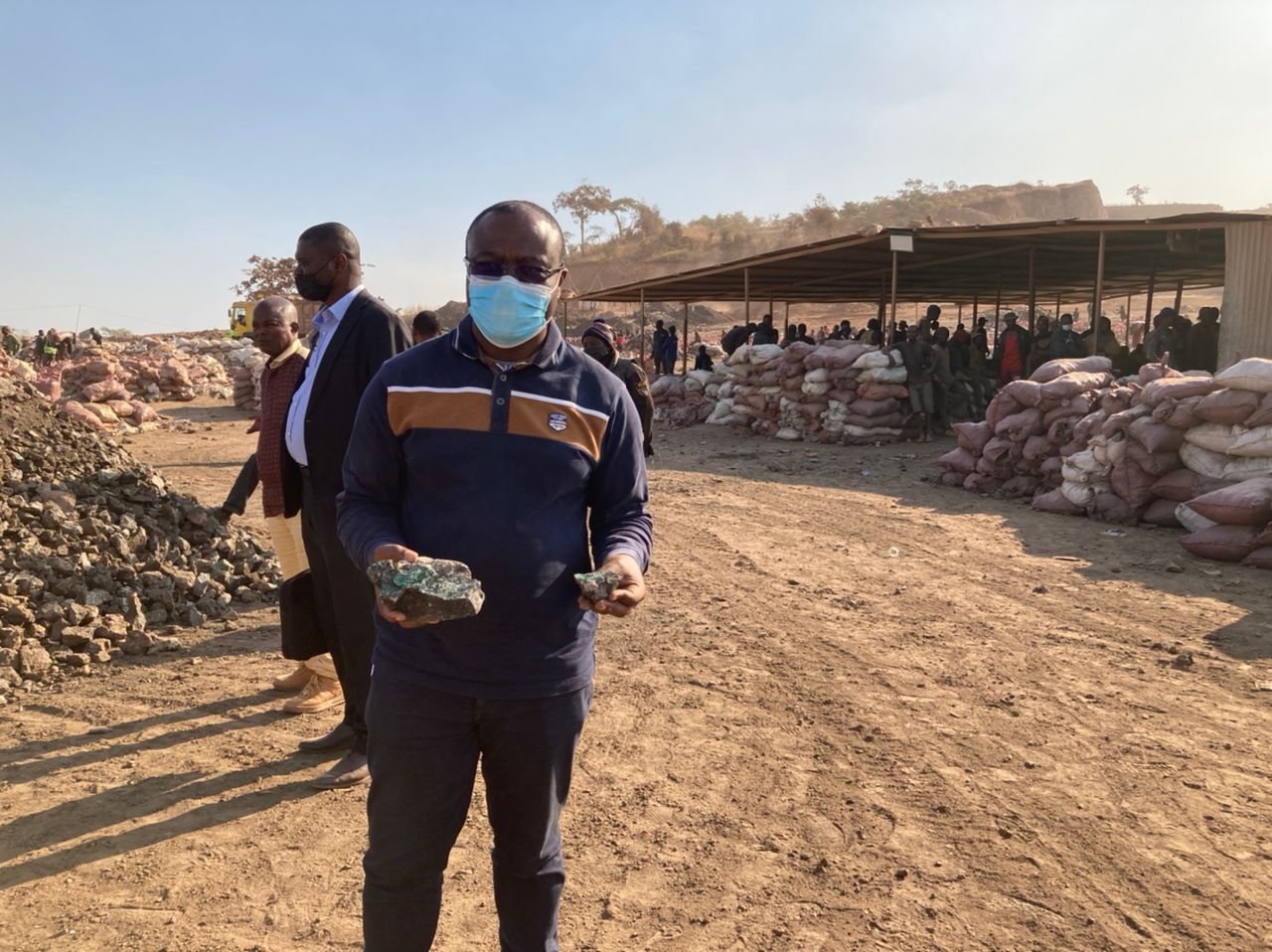
Good governance—increased transparency, open public dialogue and policy reforms that advance the public interest—is essential to seize opportunities. By prioritizing good governance, transition mineral-producing countries in Africa and Latin America can leverage the opportunities presented by competition for minerals in an accelerated energy transition. To deliver a “triple win” for their citizens, the environment, and the energy transition, many of these countries need to undertake urgent policy reforms, putting mining governance (including anticorruption measures) at the center of their policy plans.
Support the increasing range of anticorruption efforts
Kleptocrats have been put on notice. The 2022 energy crisis initially prompted an “anywhere but Russia" approach. However, there is a growing call for action against kleptocrats like Vladimir Putin who use fossil fuel wealth to perpetrate instability and aggression. A year on, in Europe and North America, policymakers have ramped up measures to crack down on dirty money flowing into their jurisdictions. From Nigeria to Angola, Azerbaijan to Belarus, those who steal wealth generated from their countries’ resources to invest in property and other luxuries are already being exposed, at home and abroad.
Leadership on anticorruption will help to secure economic opportunities. Growing demand for transition minerals brings its own corruption risks. Producing countries should ensure transparency over contracts, payments, commodity trading, and beneficial ownership; implement robust measures to prevent elites from capturing opportunities; and enforce accountability mechanisms to hold wrongdoers to account. And initiatives like the Mineral Security Partnership and EU Critical Raw Materials Act must be equally tough on corruption. By focusing on this good governance, policymakers can prevent public funds leaking out into private hands, and better respect local communities, protect the environment, and prevent disruptions and delays to supply. NRGI colleagues found that of three factors identified as shortening mineral production lead times, better governance is the only one within policymakers’ control.
Prioritizing the development of new economic and energy pathways, seizing opportunities presented by transition minerals and promoting good governance will help ensure policymakers in Africa and Latin America navigate the geopolitical and market forces unleashed by the war in Ukraine for the benefit of their citizens.
U.K. Slaps Glencore With Major Bribery Fine. Will It Clean Up Its Act?

Today Glencore Energy (UK) Ltd was sentenced to pay GBP 281 million, the largest ever penalty handed down to a company in a U.K. court, after pleading guilty in June this year to all seven charges of bribery brought against the company. The charges brought by the British government’s Serious Fraud Office (SFO) relate to Glencore’s oil operations in Cameroon, Côte d’Ivoire, Equatorial Guinea, Nigeria and South Sudan from 2011 to 2016, with over USD 28 million paid via employees and agents to secure preferential access to oil, including increased cargoes, valuable grades of oil, and preferable dates of delivery.
Investigations into these bribes have been equally international in scope; the SFO worked in parallel with the U.S. and collaboratively with Dutch and Swiss prosecutors on this case. The European cases are still ongoing and sentencing is due on 21 November in the broader U.S. case, the scope of which also includes bribery in Brazil, Democratic Republic of the Congo and Venezuela. Glencore PLC has already stated that it expects to pay up to USD 1.5 billion to settle bribery and market manipulations cases this year, including a separate case in Brazil in connection with the Lava Jato probe.
The question now is: what happens next? With a win under their belt, will this case lead to more ambition from U.K. authorities in their fight against extractive sector corruption? As one of the world’s major trading markets and with many companies across the extractive supply chain listed in London, the U.K. could play a crucial role in holding corrupt actors to account. With extractives corruption undercutting efforts to deliver a just energy transition, getting to grips with this problem would also support the U.K.’s wider climate policy agenda. And, with the costs of corruption cases soaring, will Glencore buckle under the pressure of its swashbuckling reputation and implement the seismic change needed to become a responsible industry player?
The Glencore conviction is a welcome win for the SFO, particularly after recent struggles in cases with Unaoil and ENRC. This case could kickstart a concerted effort from the U.K. to tackle extractives sector corruption more effectively, including using expertise that the SFO has developed from this case to tackle other allegations of commodity trading corruption. The U.K. has already made welcome progress on tackling illicit financial flows, many of which originate in the extractives sector, with two bills passing through Parliament this year that will help address money launderers’ abuse of U.K. property and companies. Yet a spate of integrity scandals has also shown the scope for private interests to unduly influence policy decisions, and highlight the ways in which members of the U.K.’s political class have aided kleptocratic elites enriched by their countries’ resources.
Three reforms needed in the U.K.
The Glencore conviction highlights three key areas where the U.K. government could drive change, beyond tightening up its general anticorruption defences. With the U.K. recently pledging to address corruption in its critical minerals strategy, implementing the following reforms would go some way to transforming this commitment into something more tangible:
First, authorities in the U.K. and Switzerland—the world’s foremost commodity trading hubs—should jointly push for a global and binding standard to ensure that companies disclose trading payments to all governments and state-owned enterprises (SOEs). A 2019 Extractive Industries Transparency Initiative (EITI) requirement was an important first step in recognition of the need for more transparency from countries, businesses and civil society actors alike. With Switzerland expressing interest in these changes, the ball is now in the U.K.’s court to push the agenda forward.
Second, the U.K. should hold to account both individuals and corporations who engage in corrupt behavior; the SFO show now prosecute the 11 individuals still under investigation in this case. Even large fines may be insufficient to deter wrongdoing if big companies can price them in as the “cost of doing business” and so executive accountability is essential. Where other allegations of extractive sector corruption exist, the U.K. should use all the tools at its disposal to ensure consequences for wrongdoing, including Unexplained Wealth Orders, Account Freezing Orders and targeted anticorruption sanctions.
Last, reforms and resourcing to better support the SFO will be essential if the organization is to effectively and assertively fight corruption. As the first-ever U.K. corporate conviction for Section 1 offenses under the Bribery Act, this landmark case should also spur the SFO into pursuing more ambitious investigations and prosecutions. This should include investigating the full picture of corruption allegations against companies like Glencore, and better identifying and compensating victims, who have been notably absent from this case.
Glencore's acts of contrition (or lack thereof?)
Understanding whether or where progress is being made within Glencore itself is unfortunately more complicated. There has been a changing of the guard, with many key figures retiring in recent years, including at the very top. Long-term leader Ivan Glasenberg stepped aside for Gary Nagle in 2021, who has stated that “we want to complete these investigations, put a line under that and move forward.”
Drawing a line under these investigations may, however, be more easily said than done. In recent weeks, an investor group has launched a lawsuit against the company, apparently related to losses linked to its recent bribery cases. The company also faces yet another investigation, with Zambia’s Anti-Corruption Commission launching a probe into an alleged payment to a political party. If Glencore is serious about moving forward, it must demonstrate a genuine shift in its culture and practices.
While Glencore’s efforts to enhance its ethics and compliance procedures and review some of its operations are welcome, these changes alone are insufficient. Earlier this year, we joined our partners—Global Witness, Oxfam America, Public Eye, Resource Matters and RAID—to outline how the company could atone its wrongdoing and avoid future violations.
We recommend that Glencore review engagements with Russian SOEs, adopt and publish measures to reduce corruption risks in business with SOEs, and make transparent its transactions with SOEs in all countries. Glencore should also cease all relations with Dan Gertler, who the U.S. sanctioned in 2017 for high-level corruption yet still receives substantial royalties from deals in the DRC. Although Gertler denies any wrongdoing, the DRC is estimated to have lost a staggering USD 3.71 billion (at least) from the deals he was involved in, alongside Glencore and ENRC.
This is the crux of our concern; Glencore is yet to show a real willingness to engage seriously with efforts to compensate victims in countries where its corruption took place. Carefully worded corporate statements can state the facts of wrongdoing, but they fail to meaningfully grapple with its consequences.
Top photo by Photo by Marlon Trottmann for Shutterstock
Glencore must take action
NRGI and partners' recommendations for the commodity trader
Europe’s Demand for Africa’s Gas: Toward More Responsible Engagement in a Just Energy Transition

Through the publication on 18 May of its external energy strategy, the EU somewhat clarified its approach to diversifying gas supplies. The strategy is of course written from a European perspective; its implications for African producer countries require a bit of dissection. These implications are important given live debates around the role of gas in Africa’s future and more broadly, including at the G7 level.
The EU strategy (and the broader “REPowerEU” package in which it sits) indicates that Europe is seeking a short-term injection of additional gas—but also that it is accelerating its transition to cleaner energy sources. The EU is therefore unlikely to seek longer-term (post-2030) sources of gas. Current and prospective African gas producers ought to take note and adapt accordingly. If European interest in African gas is indeed primarily short-term, responsible EU-Africa engagement would require European officials to clarify their intentions and needs, and relevant African policymakers to ensure that related expectations in their countries are realistic given likely future scenarios.
With such clarity, the handful of African countries ready now (or soon) to start or increase gas production can seize a short-term opportunity to increase public revenues. But given major uncertainties around the future of gas, officials in these and other countries should focus primarily on building more sustainable economies and domestic energy systems, not investing billions of dollars of public capital in long-term gas projects that face tough obstacles and risk carbon lock-in.
There is a bigger opportunity in Europe’s energy rethink for African countries: they can use it to push the EU to follow through on its promises of financing and technology for renewable energy growth in Africa. Europe could couple the realization of these commitments with near-term gas procurement from certain African countries, contributing to long-term partnerships in service of a just energy transition.
Implications for African gas: Timing is everything
Some of the main reactions to the EU strategy have focused on important areas of climate-related concern. The strategy also brings mixed messages for policymakers in countries evaluating opportunities to export gas.
Europe’s main tool for reducing Russian gas imports will be reducing gas consumption.
The REPowerEU plan details how Europe will expedite its energy transition in the wake of the Russian invasion of Ukraine. Europe’s main tool for reducing Russian gas imports will be reducing gas consumption. The plan doubles down on a previous objective to lower consumption by 30 percent by 2030 (around 100 billion cubic meters (bcm)); it details European aims to reduce consumption by a further 11 percent (35 bcm) by 2030 through a combination of energy efficiency and clean energy substitution.
Alongside the reduction in consumption, the EU envisions an increase in gas imports from non-Russian sources: mostly of liquefied natural gas (LNG) (an additional 50 bcm), but also pipeline gas (an additional 10 bcm or more).
So, for whom is this an opportunity, and for how long? On this, the strategy is less clear.
One point of ambiguity concerns the timeframe for increased non-Russian gas imports. The strategy references the need “over the coming years” but omits further detail. Nevertheless, this will likely sync with the strengthened plans around reduced gas consumption by 2030, meaning that if the EU sticks to its decarbonization objectives it is unlikely to need much additional longer-term supply (i.e., for 2030-2050) given its 2050 net-zero target.
A second point of ambiguity relates to the prospective sources of additional supply. The EU has already advanced some deals for short-term supply, including a political agreement with the U.S. for additional LNG imports of at least 15 bcm in 2022 and approximately 50 bcm annually until at least 2030. The 50 bcm would cover all of the EU’s planned increase in LNG supply, meaning there may not be any opportunities for other producers. And yet the strategy also references separate efforts to source gas (e.g., LNG from Egypt and Israel, and piped gas from Algeria and Azerbaijan) and specifically mentions the “untapped LNG potential” of countries in sub-Saharan Africa.
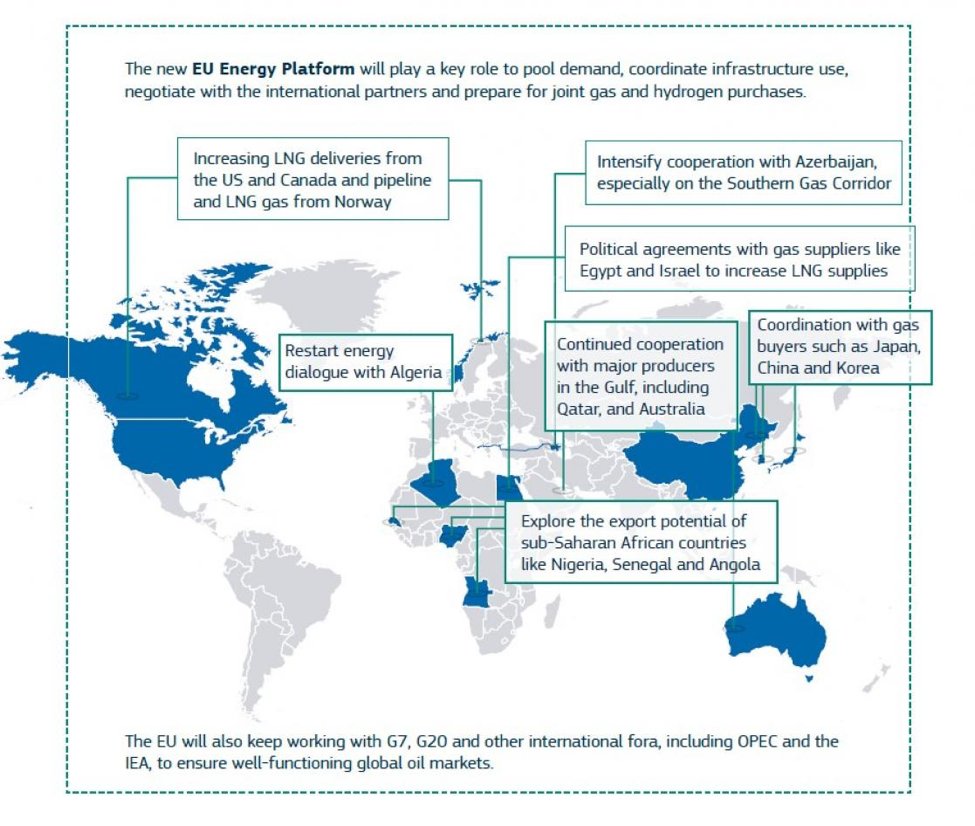
And so it seems that within Africa the opportunity is for existing producers, or those with projects on the cusp of production, that can supply gas before 2030. These could include Angola, Egypt and Nigeria insofar as they can quickly ramp up production. Senegal has already sold the LNG from its initial GTA project, due to start producing in 2023, to Asian buyers, but a final investment decision on a second phase is possible within the next year and production on that phase could start within the next few years.
More generally, expansion of projects with existing infrastructure would be particularly attractive to Europe for a few reasons. It could potentially avoid signing long-term commitments that trigger investments. European officials could also argue that expansions do not constitute development of “new oil and gas fields,” which the IEA has deemed incompatible with achieving net zero by 2050. European demand is unlikely to be much of an opportunity for other countries (or other projects in the above countries) that can only export in the longer-term (2030-2050); these would clearly constitute “new production.”
Europe’s identification of other potential sources of LNG may just be insurance against the possibility that EU-U.S. negotiations fail to result in the full supply of 50 bcm—or a tactic to increase European leverage in those negotiations. Like any insurance policy, this one may not be used, and ultimately significant European demand for additional African supply may not materialize even in the near term. And it may be that Europe wants the “insurance” but isn’t willing to pay the “premium”—or at least not a very high one—in the form of long-term gas purchase agreements necessary to secure financing for projects or funding new infrastructure. If the EU does not plan to make big, long-term investments in African LNG in that way, the responsible course would be to say so explicitly now, rather than leave prospective African suppliers to interpret ambiguities in the strategy.
Officials in producing countries should note these nuances and recognize that Europe and other importers generally prefer to have a diversity of producers, though Europe’s climate considerations may temper the EU’s preference. Many producing countries may never reach the “front of the queue.” Responsible engagement by officials in producing countries would mean avoiding significant risk when jostling for position—by entering a “race to the bottom” negotiation, investing significant public capital to de-risk projects for investors, or getting locked into oversized domestic gas infrastructure that may crowd out cheaper renewable energy alternatives.
EU energy strategy: Missed opportunity on just transition?
In its strategy the EU states that a “just and socially fair” transition is integral to its external energy policy. In practice, its plans around supplier diversification seem shortsightedly agnostic as to where supplies originate—essentially anywhere but Russia.
In a truly just transition, the EU would reduce rather than increase gas imports from countries such as the U.S. and Qatar, as these wealthier countries should be among the first to cut production in a just fossil fuel phaseout. As researchers and advocates for an equitable transition are increasingly recognizing, countries with more urgent development needs should have priority within the remaining carbon budget given their lower capacity to finance their own even more challenging energy transitions. In the absence of an agreed international framework for managed phaseout of fossil fuels, such priority access for developing producers is unlikely. But the EU should support the development of such a framework—or at least apply just principles where it can, as in its international energy strategy.
If consumer countries fail to adopt good governance criteria when selecting future energy suppliers, they risk repeating the mistakes of the past, when Western companies and governments served as key enablers of Putin’s catastrophic kleptocracy. The EU has laid important groundwork on this front, with democratic values and good governance/transparency as key principles for partnerships under its Global Gateway initiative. However, plans to intensify cooperation with authoritarian regimes as part of the EU’s gas diversification strategy raise concerns about its commitment to avoid enabling corrupt regimes.
As part of a responsible engagement the EU and its prospective African gas suppliers should account for the risk that citizens in these African countries may view gas export to the EU as coming at the expense of domestic energy plans.
Developing countries’ domestic energy needs, particularly in Africa where about 600 million people (around half of the population) lack access to electricity, are essential to a just transition. The EU should prioritize delivering on its stated support for increasing renewables in such countries. The strategy’s recognition that renewable energy exports to Europe (e.g., as green hydrogen) should not adversely impact a country’s domestic energy access is significant; the EU should develop this further. But the EU strategy is noticeably silent on the potential impact of increased gas exports to Europe on domestic energy needs in gas-producing countries. This is particularly relevant for discussions around sub-Saharan African gas producers, given the significance (rightly or wrongly) assigned to gas in strategies for addressing domestic energy needs. As part of a responsible engagement the EU and its prospective African gas suppliers should account for the risk that citizens in these African countries may view gas export to the EU as coming at the expense of domestic energy plans. This could accelerate resentment as Europe uses African gas while objecting to gas-supported electrification within Africa for climate reasons.
A way forward
More broadly, the EU should redouble its engagement around ensuring a just transition for developing countries that produce, or aim to produce, fossil fuels. The strategy’s reference to these countries’ interest in exporting green energy shows that the EU appreciates the importance of replacing revenue sources that lower-income countries will lose as part of the energy transition. The EU should support such long-term “revenue smoothing.” This could be part of an Africa-EU green energy initiative inclusive of partnerships of the type launched with South Africa at COP26.
The EU and producer countries should not over-rely on the idea included in the strategy that combining gas cooperation with long-term energy cooperation on hydrogen can “avoid stranded assets and ensure the green transition.” Avoiding stranded assets should be a priority, but not based on an overly broad assumption that fossil fuel infrastructure can be repurposed for other uses.
The EU should instead avoid stranded asset risk in the first place by being as clear as possible on likely future gas demand. With that clarity, African gas-producing countries can determine whether and how they can benefit in the short-term, while avoiding the temptation to sink billions of dollars in public capital in projects predicated on long-term European demand.
A Call to Action: Advancing Civic Space in the Extractive Sector

Shrinking civic space in resource-rich countries
Civic space is under threat from forces within and across borders. Russian authorities have grievously compromised the sovereignty of the Ukrainian people; they have also brutally suppressed opposition to the invasion within Russia as part of a sustained crackdown on Russians’ civic freedoms. In Myanmar, the military government abused pandemic emergency measures to further restrict civic space; we’ve seen the same trend in Uganda. And in Nigeria brutality by police and security forces reached a terrible peak in 2021.
In countries where the call for transition to clean energy threatens interests vested in the fossil fuel sector, civil society is coming under increasing threat. The challenges faced by Ghanaian organizations questioning the Aker Energy deal is one example.
Efforts to strengthen and defend civic space have been central to the NRGI’s work since its founding. At the global level, we help to design and implement civic space safeguards through multi-stakeholder initiatives like the Extractive Industries Transparency Initiative (EITI) and the Open Government Partnership (OGP). In meetings of the EITI international board, NRGI fought for the adoption and implementation of the EITI Civil Society Protocol. Yet too often governments and companies balk at enforcing these protocols when it comes to calling out specific countries—as happened recently in the Philippines.
In parallel with these standards, NRGI works in resource-producing countries with local civil society and media actors to build their sector expertise and to guard against harassment and intimidation. We also work with governments to promote multi-stakeholder dialogue and bolster the legal framework for civic participation.

But translating pledges into action remains a challenge. Although the government of Niger rejoined EITI in February 2020, just weeks later civil society actors again accused authorities of harassing and arresting activists. The authorities justified their actions citing pandemic restrictions.
In Nigeria, NRGI is working closely with our partners to help citizens confront challenges in civic space. Authorities’ repression of freedom of speech and association in recent years complicates the accountability processes fundamental to strong resource governance. It also compromises citizens’ ability to engage in needed dialogue about the country’s preparation for the energy transition. Police crackdowns on protest and social media shutdowns during the pandemic meant that citizens were largely in the dark as government oil revenues declined. Late last year one of the most vocal civil society organizations, CISLAC, endured unwarranted harassment. Frontline reformists and advocates feel threatened with the marked fall of Nigeria’s performance in the World Press Freedom Index. Combined with the closure of internationally supported programs providing funding and technical support to oil-sector reform, this shrinkage in civic space risks foreclosing public dialogue on Nigeria’s economic future—which is more essential now as the energy transition gains momentum.

Charting a path forward
NRGI and our partners are reconceptualizing our work to advance resource governance in increasingly constrained and politically hostile environments. Together with Publish What You Pay (PWYP), Oxfam America, the International Center for Not-for-Profit Law and the Institute for Development Studies, we recently explored how we might adapt our objectives and approaches, brainstormed new strategies for protecting civic space, and examined the challenges associated with a just energy transition.
Building on these discussions and lessons learned, NRGI seeks to evolve its work to advance civic space and resource governance efforts in the following ways:
- Build more effective and diverse coalitions. Internal conflicts are hampering many existing coalitions. Resolving them, although no easy task, would make them more effective and less vulnerable to government backlash. In NRGI priority countries, we will work with PWYP and others to invest in dispute resolution, replicate models of successful coalitions, and encourage the diversification of coalition membership. Critical to this work will be more effective analysis of political economy, as we have undertaken in Nigeria, to identify the points of influence and actors to leverage amid closing civic space. We will also support and equip our partners to engage in and contribute to national debates on emerging topics related to just transition.
- Connect actors across country, regional and international dialogues. Authoritarian regimes are replicating their playbook across countries. We will in turn seek to connect advocacy across countries, for greater collaboration and impact, specifically to strengthen negotiation opportunities for lower-income countries in the context of the energy transition. One immediate task is to define and effectively advance a just transition agenda for resource-rich countries, and ensure that national agendas influence global climate action. We will engage more in relevant international forums like climate COPs, working with global partners and facilitating participation from civil society organizations of resource-producing countries.
- Support the translation of policy into effective practice. Where strong policies exist to protect civic space, we will use our influence and that of our partners to ensure strong implementation. For example, we will use our role on the EITI international board to push for a stronger implementation of the civic space protocol. We will also support the establishment of the OGP Civic Space Learning Network.
- Call out kleptocratic regimes and practices that enable them. We will leverage the global attention on Russia to call out the risks of seeking fossil fuels from other autocratic regimes. We will support calls for divestment to result in economic opportunities for democratic and reform-minded states. In parallel, we will advocate strengthening safeguards to ensure that economic opportunities related to critical minerals for the energy transition do not reinforce autocratic regimes.
To support these efforts, we call on a range of actors to take action:
- Bilateral and philanthropic foundation funders should strengthen long-term plans to support capacity development and coalition-building efforts, seeking to reinforce existing mechanisms for dialogue and participation—not creating new competing platforms.
- Multi-stakeholder initiatives like EITI and OGP should commit to more efficiently translating their standards into implementation; and to enforcing the standards they set—even in tough cases.
- Extractive sector and energy companies should speak up and support the protection of civic space, which is key to positive economic outcomes.
- Investors should strengthen criteria related to civic space protection in their business decisions, and encourage companies and governments to ensure the protection of civic space as essential to environmental, social and governance (ESG) considerations and a positive investment climate.
- International financial institutions should make greater use of their lending power to call for action to support civic space.
Civic space remains the cornerstone of resource governance and essential to the pursuit of more sustainable and equitable societies. Together with our partners, NRGI is committed to making the necessary pivots to respond to evolving civic space challenges.
How to Stop Oil Companies From Propping Up Kleptocrats

Divestments by these Western oil companies contribute to the crisis now facing Russia’s oil and gas sector, one of the largest in the world. Even in the absence of sanctions on energy exports, oil companies as well as commodity traders, insurance providers, banks, and other industry players are backing away from the country. This leaves Russia without buyers for its crude oil and has sent the stock value of Russian oil companies plummeting. In the longer term, divestments could delay key projects, such as the ExxonMobil-operated Sakhalin oil and gas fields, and deprive the industry of the financing and technology it needs to sustain its growth...
Read the full commentary.
Gillies subsequently spoke on a related topic to National Public Radio (U.S.):
Gillies also addressed a related topic in this short documentary by VICE News:
The Russia-Ukraine war has led to a range of new challenges and opportunities for developing countries rich in oil, gas and minerals.
Democratizing the Benefits of Natural Resources: Anticorruption and Public Accountability in the Extractive Sector and Energy Transition

Ahead of the Summit for Democracy, NRGI and several of its partner organizations came together to propose five commitments that governments could make to address the challenge of corruption in the extractive sector and energy transition.
Proposed country commitments for the 2021-2022 Summit for Democracy
Corruption in the oil, gas and mineral sector undermines the efforts of resource-rich countries to democratize, prosper and address the climate crisis. More foreign bribery cases originate in the extractive sector than any other industry; from Brazil to Iraq to Angola, the sector has spawned some of the world’s largest and most damaging corruption schemes; oil-producers in particular struggle to democratize. Huge portions of the illicit financial flows that spread around the world originate from this sector. The Pandora Papers leak, like others before it, further reveals how political insiders capture wealth from the oil, gas and mining sector and hide it overseas.
To fight this scourge, we propose five commitments that governments of resource-producing countries could make as part of their participation in the Summit for Democracy:
- Adopt and implement basic elements of extractive sector transparency.
- Prevent corruption in critical mineral supply chains.
- Tackle oil sector state capture and kleptocracy, as part of climate action.
- Address major nodes of corruption risk: state-owned enterprise procurement, commodity trading and the participation of political elites in the extractive industries.
- Support civil society, protect civic space and promote gender equality.
Most of the proposed commitments address the summit theme of “addressing and fighting corruption,” and item 3.5 relates to “defending against authoritarianism.” Many are commitments that countries could make in connection to their domestic oil, gas and mining industries, while others offer opportunities for leading economies to catalyze global progress. Advancing this agenda would help strengthen democracies all over the world by empowering citizens and preventing corrupt interests from capturing resource wealth. The commitments would also help diffuse potential threats to climate action and the energy transition. Below we provide further detail about the five commitments.
1. Adopt and implement basic elements of extractive sector transparency
These commitments represent basic standards all resource-producing countries should adopt, and many reflect the recommendations of the Open Government Partnership and the Extractive Industries Transparency Initiative (EITI). Diverse countries have already adopted these measures, proving they are feasible and helpful. However, major transparency gaps remain.
For resource-producing countries:
- 1.1. Join the EITI and ensure that civil society actors can fully, actively and effectively engage in the process.
- 1.2. Disclose all payments received from extractive sector companies and commodity traders on a projectby-project basis.
- 1.3. Publicly disclose unredacted versions of all extractive sector contracts and licenses, including annexes and amendments.
- 1.4. Require the public disclosure of beneficial ownership information for all companies that apply for or hold exploration or production licenses.
- 1.5. Enshrine in national mining and energy laws the standard of free, prior and informed consent (FPIC) for Indigenous peoples. Consent should be free from coercion, acquired prior to each project development phase, and informed through access to all relevant project information.
- 1.6. Publish annual reports on the assessment and collection activities of resource revenue collecting authorities, including taxpayer and contractor audit and compliance activities, in line with the IMF Fiscal Transparency Code.
For countries home to large extractive companies (e.g., U.S., Australia, Japan, South Africa, China, Brazil):
- 1.7. Enact robust extractive sector payment reporting requirements along the lines of those contained in the EU’s Accounting and Transparency Directives.
The above disclosures should meet international open data formats, be free to access and follow leading practices on gender-disaggregated data disclosure.
2. Prevent corruption in critical mineral supply chains
Meeting Paris climate goals will require a quadrupling by 2040 of the minerals currently used by clean energy technologies. For the countries that produce cobalt, lithium, copper and other critical minerals, especially those with weak institutions, this spike in demand could trigger surges in corruption and authoritarianism, like those associated with past oil booms. Yet currently, corruption receives scant attention from various critical mineral and green technology supply chain initiatives.
For governments of large consumer nations (e.g., G7 members):
- 2.1. Convene supply chain participants (governments, companies, civil society organizations) to identify and commit to the anticorruption standards that should be fully implemented across global supply chains. This would help advance recent announcements made by the U.S. and Canada and the EU.
- 2.2. Deliver technical assistance to governments of developing producer countries that prioritizes transparency, accountability and anticorruption; and support civil society and other oversight actors to work in this area.
For governments of countries that produce critical minerals (e.g., Argentina, Australia, Brazil, Canada, Chile, DRC, Peru, Philippines, U.S., Zambia):
- 2.3. Implement the transparency agenda noted in part 1.
- 2.4. Strengthen accountability and public oversight in the mining sector, including by supporting civil society and protecting civic space. (See part 5.)
- 2.5. Enact anticorruption reforms, such as those highlighted in part 4.
3. Tackle oil sector state capture and kleptocracy, as part of climate action
Efforts to combat corruption and climate change must intersect, especially given the oil and gas industry’s tendencies toward state capture and kleptocracy. In many oil-producing democracies, secrecy and the undue influence enjoyed by the fossil fuel industry can undermine public accountability, leading officials to greenlight new fossil fuel projects, lavish the industry with subsidies, allow national oil companies to spend on potential stranded assets, and neglect greener energy sources. But oil is not only found in democracies: half the world’s oil is produced by 13 authoritarian countries, including several kleptocracies. In these nations, foreign enablers working in the oil sector help kleptocrats to thrive.
For governments of fossil fuel-producing countries:
- 3.1. To facilitate public debate, disclose basic information about fossil fuel activities and adaptation plans to facilitate public debate, including project-level data on reserves, production, breakeven price assumptions, greenhouse gas emissions (scope 1, 2 and 3), government subsidies and national oil company spending.
- 3.2. Introduce these disclosures as part of the Net-Zero Producers Forum (initial members: U.S., Norway, Canada, Saudi Arabia, Qatar).
- 3.3. Strengthen integrity and scrutiny where government and the fossil fuel industry interact, including lobbying, campaign finance, asset development contracts, subsidy payments and national oil company affairs. Commitments should include government actions, such as OGP’s recommendations on political integrity, requirements for fossil fuel companies to disclose political contributions, plus resources for civil society.
For governments committing to counter kleptocracy:
- 3.4. Identify how anti-kleptocracy policies and sanctions can account for climate issues unique to the oil sector, including the risks kleptocracies could pose to supply-side climate action.
- 3.5. Advance more stringent standards for companies working in kleptocratic contexts, such as restrictions on partnering with political elites and integrity measures when engaging with state-owned enterprises.
4. Address major nodes of corruption risk: state-owned enterprise procurement, commodity trading and the participation of political elites in extractive industries
As recent asset seizure and foreign bribery cases, the Panama and Pandora Papers and other revelations make clear, much of the dirty money flowing around the world originated in the extractive sector. Three practices frequently feature in corruption schemes across countries. If the anticorruption efforts ignore such proven areas of risk, they leave doors wide open for more illicit funds to escape.
For governments of resource-producing countries:
- 4.1. Implement state-owned enterprise (SOE) procurement reform including: robust due diligence systems (such as the reforms Petrobras adopted following the “Car Wash” scandal); beneficial ownership transparency requirements for suppliers; and open contracting systems.
- 4.2. Require SOEs to: publish detailed commodity trading data including the beneficial owners of the trading companies they work with; reform their buyer selection processes including by using open tenders; and prohibit the use of agents in trading deals.
- 4.3. Adopt and actively enforce restrictions on public officials holding interests in the extractives sector; implement asset disclosure requirements; require beneficial ownership transparency and screening throughout the extractive supply chain.
- 4.4. Require proactive political lobbying disclosures for extractive companies or for corporate actors more broadly.
For governments of trading hubs such as Singapore, Switzerland, the U.K. and U.S.:
- 4.5. Strengthen currently scant regulation of commodity trading firms, including by requiring payment disclosures.
For leading economies and multilateral organizations:
- 4.6. Fund anticorruption activities initiatives targeting SOEs, commodity trading and extractive sector political capture, including by enforcement agencies and civil society.
5. Support civil society, protect civic space and promote gender equality
A free and active civil society and media are essential to the prevention of extractive sector corruption. In particular, women and gender non-binary people in civil society and at a community level play an important role in demanding accountability from decisionmakers and companies, but often face barriers due to gender inequality.
Governments should:
- 5.1. Invest in support to civil society actors and journalists to undertake anticorruption work, including investigations, oversight and policy advocacy, in the areas noted above, and use their diplomatic leverage to deter threats against them.
- 5.2. Develop, strengthen and implement legal frameworks to protect the rights of activists, journalists and independent media, and dismantle laws and policies that hinder free civil society and media.
- 5.3. Promote the participation of women and gender non-binary people in governance initiatives such as the EITI and in community consultation and consent processes; invest in understanding the gender-differentiated impacts of extractive corruption in affected communities, including sexual extortion; and ensure grievance mechanisms are accessible to women and gender non-binary people and sensitive to gendered forms of corruption.
The Natural Resource Governance Institute (NRGI), the ONE Campaign, Oxfam-America, Publish What You Pay (PWYP), PWYP-U.S. and the Transparency International Accountable Mining Programme welcome dialogue and discussion about these proposed summit commitments.
Leading Companies Issue Commitments on Beneficial Ownership: Will It Help Prevent Corruption?

This week six large extractive companies have committed to several actions to advance the cause of beneficial ownership transparency. Their joint statement is a welcome endorsement of this important anticorruption measure. Whether the commitments help tackle the tough realities of oil, gas and mining sector corruption will depend on how and by whom they are implemented.
Beneficial ownership transparency enjoys significant momentum, which this new statement and the accompanying programs help to propel. Beneficial ownership refers to the actual people who, directly or indirectly, ultimately own or control a company. One hundred and ten countries have adopted laws that require beneficial ownership reporting of one kind of another, including the Unites States’ passage of the Corporate Transparency Act earlier this year. Many of these efforts (though not in the U.S., notably) will result in publicly available registers of who ultimately controls and benefits from companies, as exist already in the U.K. and elsewhere. In the extractive sector, the Extractive Industries Transparency Initiative (EITI) requires its member countries to publish the identities of the beneficial owners of companies that apply for or hold oil, gas or mining licenses, and countries have made commendable progress in meeting this standard.
Many private sector actors have supported this evolution. Way back in 2012, as the EITI was revising its rules, I remember that it was a mining sector representative who first put the idea of beneficial ownership reporting on the table. At a recent EITI event a BHP executive reminded us of why businesses support beneficial ownership: beneficial ownership transparency makes it harder for problematic actors (firms owned by politicians, for example) to gain unfair access to business opportunities; it makes their due diligence cheaper and easier; and it signals a commitment to openness and integrity to all sector players. Privately, representatives of large companies share stories of government officials pushing them to work with local companies with unknown or problematic owners; beneficial ownership transparency helps diffuse these situations without companies having to pick a fight with their government counterparts.
Making commitments meaningful
In the statement the companies make three commitments:
- Support beneficial ownership transparency in public forums and when engaging with other companies
- Disclose their own ownership information, and where feasible, that of their joint venture partners
- Identify and use beneficial ownership data in their due diligence processes
1. Widen the pool of company supporters
AngloAmerican, BHP, Glencore, Newmont, Repsol and Rio Tinto deserve credit for publishing this statement, as do the EITI, Open Ownership and the B Team for facilitating the process. It contains meaningful commitments for advancing beneficial ownership transparency, and for using ownership information to prevent corruption. Of course, it could have gone further, but it’s a notable step forward.
The commitments are imminently feasible, with many reflecting existing corporate practices and the existing expectations for EITI supporting companies. Beneficial ownership transparency also advances the interests of most ethical companies. For these reasons, it is disappointing that only 6 of the EITI’s 68 supporting companies signed on. The European supermajors BP, Eni, Shell and Total, as well as transparency leaders Equinor and Kosmos are particularly notable absentees. Given recent corruption scandals, other commodity traders should follow Glencore and sign on too. Their absence and others begs the question: what part of this modest statement do these companies oppose, and why?
Recruiting more signatories will help add meaning to the EITI’s “supporting company” moniker and bring about the collective action dynamics that EITI and its partners are trying to create.
2. Shine light on the highest-risk beneficial owners
As described in U.S. court documents, when employees of the large commodity trader Vitol bribed officials in Brazil, Ecuador and Mexico, they routed the bribes through shell companies that they had hired as service providers. Former employees of Gunvor and Glencore recently pled guilty to helping execute similar schemes in Ecuador and Nigeria, respectively. In other scenarios, large foreign companies partnered with smaller companies in production joint ventures, allocated supply contracts to smaller companies, or bought oil from small intermediaries. Investigations then revealed the owners of the smaller companies included politicians, their proxies or other inappropriate parties.
In such cases, visibility into the ownership of the smaller company—the minority partner, the service provider, the supplier, or the trading intermediary—is what would really help to prevent (or support the investigation of) corruption. Therefore, the practice of beneficial ownership disclosure must extend to these players, not just large multinationals.
To be clear, ownership information about publicly traded multinational companies—especially full information about their subsidiaries and corporate structure—is important for integrity reasons as well as to inform discussions about tax justice, i.e., whether a company is using its structure to lower its tax liabilities in its home or host countries. But when it comes to corruption, it’s smaller anonymous companies that do much of the dirty work.
A few of the new commitments, if executed well, could help prompt this wider pool of extractive sector players to be more transparent about their owners. The companies indicate that they will “encourage other companies, including joint venture partners, contractors and suppliers, to publicly disclose their beneficial owners.” Robust implementation of this measure should produce visible results. The companies could, for instance, begin by encouraging their suppliers in certain high-risk countries to publicly disclose their ownership information, and then gather this information in one place so that it is accessible (and therefore useful).
Another commitment presents an additional starting point. In one of the statement’s strongest parts, the companies indicate that, along with publishing their own ownership information, they will, “where feasible, for any partially owned entities, also publicly disclose the other legal owners of the entities. Where not feasible, disclose the reasons why.” As longstanding, high value partnerships, joint ventures are indeed a sensible place for companies to begin pushing their counterparties to disclose ownership information. Glencore and Rio Tinto, two of the statement’s signatories, have already illustrated the feasibility and value of this effort by publishing ownership information for their JV partners. Other companies could quickly follow suit.
Our research and consultations suggest a third starting point, which does not appear in the statement. Many extractive sector corruption cases feature agents and intermediaries, especially the business development agents that companies use when seeking new contracts or licenses. We generally recommend that companies stop using business development agents, especially when seeking deals from governments and state-owned companies. If companies continue to use agents, publishing their names and beneficial owners is a straightforward way to inject some integrity into relationships that have repeatedly proven vulnerable to corruption.
3. Use beneficial ownership information to avoid enabling corruption
Several commitments pertain to how companies will use beneficial ownership data in their due diligence processes. This is great, as it’s only by actively using this information that corruption will reduce.
Big companies from countries with active anti-bribery regimes, including most EITI supporting companies, already use ownership information when conducting due diligence on third parties. The more crucial question is: what standards does the company apply when reviewing this ownership information and deciding how to act? Some past corruption cases indicate that companies were fully aware of the ethical or corruption risks posed by an entity’s owners, but worked with them anyway. In 2008, U.S. hedge fund Och-Ziff commissioned due diligence on companies owned by mining investor Dan Gertler – a highly controversial figure who is now subject to US anticorruption sanctions. The due diligence reported he was: “a political [sic] exposed person….happy to use his political influence against those with whom he is in dispute;” named on compliance watch lists and UN reports; and that he “keeps what can only be described as unsavory business associates.” Och-Ziff went ahead with the deal, but eventually faced US bribery charges regarding its business with Gertler and paid a USD 213 million criminal fine. Shell knowingly negotiated with a former oil minister to acquire an oil block that the official had previously awarded to his own company. Isabel dos Santos, daughter of the former president of Angola, enjoyed dozens of high-profile business partners despite the suspicious origins of some of her wealth.
One of the statement’s commitments points to a way forward: companies could set some basic ground rules about who is, and isn’t, acceptable to work with. Such ex ante restrictions help because they reduce the number of discretionary decisions that company personnel make around specific deals, decisions often made in moments when pressure to get the deal done runs high. In their statement, the signatories say they will “publicly commit to avoid partnering or contracting with companies assessed as high corruption risk that decline to identify their beneficial owners unless appropriate mitigation measures are implemented to reduce corruption risk.” This is a useful step toward projecting beneficial ownership reporting across the sector, though the qualifier about mitigation measures creates an unnecessary gray area. Companies could adopt and disclose additional ex ante standards; these might include prohibitions against working with entities whose beneficial owners include officials with influence over the business in question, or with individuals credibly shown to have engaged in corruption where evidence of remediation is not found.
In the anticorruption guidance that NRGI will publish later this year, we will also recommend that companies apply a harm-based screening to the beneficial ownership information they collect. In other words, companies should ask: will partnering with this entity or individual harm citizens of the country where we are working? Could it make corruption worse? These differ from the questions a company would ask about its own legal risks.
My NRGI colleagues and I are pleased to be in dialogue with a number of EITI supporting companies about how to enhance their anticorruption controls, including around beneficial ownership transparency and the use of that information, so as to prevent well-established patterns of corruption from repeating and causing still further harm. The statement issued this week by the six companies marks a step forward in this effort, and its broad and robust implementation could mark further progress still.
Alexandra Gillies is an advisor at NRGI and leads the organization’s anticorruption programs. She is the author of Crude Intentions: How Oil Corruption Contaminates the World.
A New Tool in the Fight Against Corruption in the Extractive Industries

Perennial headlines leave little doubt about the prevalence and severity of extractive sector corruption. We’ve learned that commodity traders and supplier companies have bribed officials to snap up lucrative deals. The children of presidents have used national oil companies to enrich themselves and their friends. Corrupt individuals are cashing in on rising global demand for critical minerals.
It’s therefore no secret that corruption is one of the greatest obstacles to the accountable and sustainable management of natural resources. It can undermine the efforts of resource-rich countries to reduce poverty, diversify their economies, achieve democratic governance and address the climate crisis. Corruption’s destabilizing impacts are global too, with foreign actors enabling corruption schemes and moving illicit funds around the world.
For actors who want to prevent corruption and its damaging effects, juicy news stories highlight the problem, but don’t often point to a clear way forward. The sector is complex, technical and opaque in nature. Corruption’s forms vary from country to country, and they can crop up all along the extractive industries decision chain. Powerful figures are often implicated, making anticorruption a very sensitive issue to discuss. Effective solutions often depend on action by multiple stakeholders, including political leaders, civil society actors and private sector executives; that kind of coordinated action can be difficult to orchestrate. In the face of this complexity and sensitivity, anticorruption actors struggle to find a starting point.
That’s where NRGI’s new tool can help.
Via the tool’s six-step process, anticorruption actors identify and understand the most concerning forms of corruption in their countries’ extractive sector through a participatory research process. Based on this analysis, they then develop an action plan tailored to the corruption risks and anticorruption opportunities that define their current context.
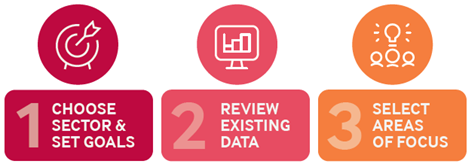
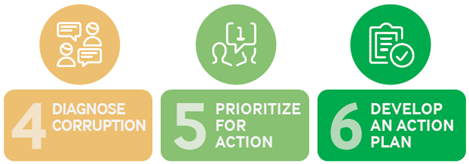
The NRGI tool has a few defining hallmarks. It is highly adaptable, with users choosing which parts of the sector—such as licensing, revenue collection or state-owned enterprises—to focus their analysis and action-planning on. The tool’s research guides reflect the specificities of the extractive sector, drawing on NRGI’s sector expertise and its analysis of over one hundred oil, gas or mining corruption cases.
When identifying common corruption forms across the sector, we conceive of corruption broadly and include systemic forms of corruption such as state capture as well as the role of corruption’s foreign enablers.
Finally, the tool prioritizes multistakeholder participation and action planning so that the findings translate into real-world change.
Country-specific multi-stakeholder groups of the Extractive Industries Transparency Initiative (EITI) will be the tool’s initial users. In 2019, the EITI identified addressing corruption as one of its top priorities and we hope that this tool can contribute toward realizing that ambition. EITI stakeholders in Mongolia are now completing a pilot of the tool, a diagnostic that delved into the corruption risks found in mining operations, including the country’s regulatory and procurement systems.
But the tool is not EITI-specific. It’s a public resource and we encourage anticorruption agencies, civil society groups, international aid donors and others to use it too.
We launched this project in April 2020 with support from Deutsche Gesellschaft für Internationale Zusammenarbeit (GIZ). To inform the tool’s design, we reviewed 17 existing assessment tools, consulted with a range of experts, and organized several rounds of peer review. We’ve benefited from generous contributions from a range of experts and practitioners and are especially grateful for our collaboration with the EITI and Transparency International’s Accountable Mining Program.
In the coming months, we will add additional modules on the energy transition, artisanal mining and other topics, and make further improvements based on user experiences in Mongolia and additional countries.
We are excited to launch the first version of the tool, and eager to partner with others to deploy it widely. We encourage anyone interested in finding out more to contact NRGI senior governance officer Matthieu Salomon (msalomon@resourcegovernance.org).
Three Ways the U.S. Can Help to Prevent Next-Generation Oil and Mining Corruption

By a wide margin, U.S. authorities have pursued more corruption cases in oil and mining than any other sector. In the last five years, U.S. authorities nabbed the bosses of a company called Unaoil that bribed officials in nine different countries, including Angola, Iraq and Syria. They seized a giant yacht allegedly purchased with proceeds from Nigerian oil trading schemes, and a swank Miami condo that a top Congolese official allegedly bought using embezzled oil funds. U.S. investigations revealed how an American hedge fund paid off officials to access the Congolese diamond industry; how state oil company bosses in Brazil, Ecuador and Venezuela took home bribes; how an Abu Dhabi oil fund helped run one of the largest-ever corruption schemes; and how oil and mining deals within the U.S. turned dirty as well.
As the Biden administration ramps up its anticorruption efforts, officials should pursue policies that heed lessons from these past investigations and that reflect the world’s fast-changing energy and mineral markets.
This week the administration gave clear signs of its commitment to anticorruption. The White House released a memorandum “establishing the fight against corruption as a core U.S. national security interest” and kicking off the process to develop an ambitious cross-agency anticorruption strategy. The Treasury Department recently issued the largest-ever use of the Magnitsky sanctions for anticorruption purposes. These events coincided with the UN General Assembly’s special session on anticorruption, where U.S. officials emphasized their intention to prioritize fighting graft. Meanwhile, on Capitol Hill, a bipartisan counter-kleptocracy caucus will launch this month as well.
In the coming weeks and months, the U.S. anticorruption agenda will take further shape, as the various agencies stand up new programs, key champions such as USAID administrator Samantha Power get up to speed, and the Summit for Democracy approaches, where fighting corruption and kleptocracy will be a main theme.
To stop corruption from ravaging the world’s oil and mineral industries and hindering the green energy transition, several U.S. agencies, including USAID, the State Department, the Treasury Department and the various climate-focused units, should prioritize the following actions. These ideas emerge from a study of over one hundred oil and mining corruption cases, and from the Natural Resource Governance Institute’s work in many resource-rich countries and international forums, and they complement leading recommendations from other NGOs and experts.
1. Prevent corruption in critical mineral supply chains
The International Energy Agency estimates that meeting Paris climate goals will require a quadrupling of the minerals used by clean energy technologies by 2040. For the countries that produce cobalt, lithium, copper and other critical minerals, especially those with weak institutions, this spike in demand could trigger surges in corruption like those associated with past oil booms, which contributed to authoritarianism and economic decline. For mineral-consuming countries like the U.S., corruption could threaten their energy transition plans by interrupting the steady supply of these commodities.
While much was made of the U.S. re-blacklisting mining magnate Dan Gertler over alleged corruption in the DRC, where Gertler’s companies control royalty streams from three of the world’s biggest cobalt projects, governance and corruption are barely on the agenda when it comes to the hot topic of clean technology supply chains. The U.S. could both help safeguard supplies and protect the interests of producer country citizens by correcting this trend. Specifically, U.S. technical assistance to producer countries, including through the State Department’s Energy Resource Governance Initiative (ERGI), should prioritize transparency, accountability and anticorruption, and should include support for civil society groups and other oversight actors. U.S. leadership could also push anticorruption onto the agendas of various international mineral supply chain initiatives and standards. Unless global standards include robust measures around transparency, beneficial ownership reporting, payment verification, anti-money laundering, conflict of interest procedures and other practices, the critical mineral boom could trigger an ugly “race to the bottom,” with consumer countries scrambling to secure supplies, a few well-connected parties getting rich off the rents, and producer-country citizens left facing the results.
2. Tackle oil sector corruption and kleptocracy as part of U.S. climate policy
In addition to anticorruption, the Biden administration has prioritized climate action, and the two agendas must intersect given the oil and gas industry’s predilection towards state capture and kleptocracy.In the Trump administration, the head of the Environmental Protection Agency and the Interior Department were former fossil fuel lobbyists. These appointments were among many recent reminders of how oil and gas producers, thanks to decades of lobbying, campaign donations and revolving-door staffing, exert undue influence over U.S. policy and climate debates. Much of this behavior falls in the categories of legal corruption or state capture, through which narrow vested interests influence public policy to suit their needs. Other oil-producing countries face a similar challenge: corruption and political agendas can cause leaders to greenlight fossil fuel projects, lavish the industry with subsidies and neglect greener energy sources, even when these steps run counter to climate goals and country’s own economic and environmental interests.
To guard against corruption, capture and political stalemates around decarbonization, the U.S. should encourage fossil fuel producing countries to accelerate transparency and oversight. First, citizens need basic information about the government’s fossil fuel activities and adaptation plans, including project-level data on reserves, production, breakeven price assumptions, carbon emissions and government spending. Second, transparency must increase wherever industry and government interact; this applies to lobbying, campaign donations, asset-development contracts, subsidy payments, as well as national oil company affairs.
The U.S. could advance this cause at the Summit for Democracy, via its participation in the Extractive Industries Transparency Initiative, the Open Government Partnership, and in the newly announced Net-Zero Producers Forum, which also includes Canada, Norway, Qatar and Saudi Arabia. This effort would be an important public sector counterpart to U.S. action to advance capital market climate risk disclosures.
Much more than transparency will be needed when it comes to oil-rich kleptocracies and their impact on global climate responses. Half of the world’s oil is produced by 13 authoritarian countries, including several run by kleptocratic regimes. Tackling kleptocracy is notoriously difficult, and U.S. officials should look closely at how Western enablers help kleptocrats to profit and thrive. Some players in the oil sector are complicit, as many Western investors, companies and service providers have supported suspicious deals involving the governments and national oil companies of Russia, Venezuela, Equatorial Guinea and other kleptocracies. Since these oil industries contribute to both global warming and kleptocracy, the role of these enablers is worth a careful look as part of the US’s wider approach to fighting kleptocracy.
3. Shower anticorruption attention on obvious areas of risk
In recent years, thanks to the Panama Papers and other revelations, international anticorruption efforts are devoting greater attention to how dirty money flows offshore, and the damage it then causes. As the U.S. responds to this vital agenda, such as by implementing the Corporate Transparency Act and, hopefully, expanding the U.S. Treasury’s Geographic Targeting Orders, officials should not overlook how the money escapes in the first place. Even a quick skim of the Justice Department’s asset seizure actions makes clear: a lot of dirty money comes from the oil or mineral sectors of resource-rich countries. And it often escapes from a few high-risk areas:
-
State-owned enterprises. National oil and mining companies feature in many corruption schemes, with Brazil’s Car Wash as the most prominent recent example. State-owned enterprises control large amounts of money and are themselves easily controlled by political elites—a recipe for corruption in contexts ranging from Russia to South Sudan, Iraq to Venezuela.
-
Commodity trading. The Justice Department has pursued big commodity trading cases, so U.S. authorities know how dirty, opaque and damaging this side of the industry can be. And yet, there has been no cross-agency response. As leading energy journalists Javier Blas and Jack Farchy recently argued, “It’s high time that politicians in the United States and elsewhere started paying attention” to the fact that traders are “scarcely regulated.”
-
The participation of political elites in the industry. Among the Kremlin allies facing U.S. sanctions are oligarchs who profited hugely off juicy contracts from Gazprom, the Russian national gas company. Political elites often hold interests in oil and mining companies and get rich off the proceeds—usually via inflated contracts or other lopsided deals. Beneficial ownership reporting is a necessary but insufficient response to this challenge. The Luanda Leaks revealed how U.S. entities supported the business ventures of Isabel dos Santos, despite knowing that her father was Angola’s president and other warning signs around the deals. Since oil and mining industries are widely politicized, the sector is a strategic area where the US could work to develop stronger standards regarding who constitutes an appropriate business partner.
As part of an evidence-based approach, the U.S. should learn from past cases and ramp up anticorruption interventions in these known areas of risk. In each one, stronger global standards, attention from regulators and law enforcement, attention from international financial institutions, technical assistance, support for civil society and other actions could make a huge difference. If the U.S. and its allies ignore these proven areas of corruption risk, they leave doors open for more dirty money to escape.
The above ideas resonate with many elements of last week’s White House anticorruption memo. As U.S. officials take this directive and turn it into policy, they can prevent another generation of oil and mining corruption and avert negative impacts on the lives of millions. The Summit for Democracy is one venue where the U.S. could lead on this work and acquire allies; COP 26 and the Open Government Partnership Summit are others.
As resource-producing countries face unprecedented change, corruption could derail their efforts to build more resilient economies, while also threatening U.S. climate, security and economic interests. Thanks to U.S. law enforcement action, we know a great deal about the dismal corruption record of the natural resource sector. These cases point to practical strategies the U.S. can now adopt to avoid a repeat of history.