
Rethinking Resilience in East Africa (COP31)
Uganda Pavilion, Blue Zone, COP31, Antalya
At COP31, the Centre for Energy, Finance and Development (CEFD) is hosting a panel on how East African countries can strengthen energy security while advancing green industrialization.
The discussion will examine the economic and fiscal trade-offs of large-scale investment in refining infrastructure, what those investments mean for energy security, and alternative ways to build energy resilience. Panelists will look at diversified fuel supply, regional trade and infrastructure, and how development finance can support industrial development on a low-carbon pathway.
The central question: how can African countries strengthen energy security while managing fiscal risks and advancing their development priorities?
NRGI’s Patrick Stephenson will speak on the panel.
Featuring NRGI’s

Patrick Stephenson
Ghana Country Manager
Notes
-
1
Government of Ghana and Barari DV Ghana Ltd, Mining Lease Agreement (2023), www.mincom.gov.gh/wp-content/uploads/2023/11/BDL_ML-AGREEMENT_102023_31.pdf
-
2
See e.g. Kizito Cudjoe, “IEA flags ‘historical mistakes’ in lithium agreement,” B&FT Online, 30 November 2023, thebftonline.com/2023/11/30/iea-flags-historical-mistakes-in-lithium-agreement; Bright Simons, “Ghana’s lithium deal: Separating fact from fiction,” The Africa Report, 22 December 2023, www.theafricareport.com/331005/ghanas-lithium-deal-separating-fact-from-fiction; Kofi Ansah and Fui Tsikata, “Why Ghana’s lithium agreement is good,” Graphic Online, 11 December 2023, www.graphic.com.gh/features/opinion/why-ghanas-lithium-agreement-is-good-kofi-ansah-fui-tsikata-shares-opinion.html.
-
3
This requirement is set out in provision 1.b. of the second schedule: Government of Ghana and Barari DV Ghana Ltd, Mining Lease Agreement.
-
4
Government of Ghana and Barari DV Ghana Ltd, Mining Lease Agreement.
-
5
As indicated in the agreement, provisions in laws such as the Minerals and Mining Act 2006 as amended, Income Tax Act 2015 as amended and Value Added Tax Act 2013 as amended also apply to the Ewoyaa mine.
-
6
The strict definition of “free carried interest” involves the government paying for its share from the future dividends or profits that would otherwise have been distributed to it—as is the case with carried interest—but with no interest accruing on the amount payable by the government. However, in many countries it is interpreted as free equity, for which the government does not incur any cost either at the time of acquiring it or in the future. We understand that the government is currently interpreting the Ghanaian provision in this way.
-
7
Depending on the multinational structure of a company, double taxation treaties between Ghana and other jurisdictions may significantly reduce the effective rates of withholding taxes. Government officials have indicated that existing treaties do not currently impact the applicability of the fiscal regime for producing mines. It remains to be seen whether they will impact the Ewoyaa mine. For a summary of withholding tax limits in existing treaties, see PWC, “Worldwide Tax Summaries—Ghana,” accessed 12 June 2024, taxsummaries.pwc.com/ghana/corporate/withholding-taxes.
-
8
Lithium is currently produced from two main sources: hard rock and brine. The known lithium deposits in Africa, including Ghana, are hard rock. The “Lithium Triangle” in Latin America of Argentina, Bolivia and Chile has brine deposits. Extraction of lithium from hard rock uses conventional mining techniques, while extraction from brine involves pumping the brine to the surface before concentrating it through evaporation. The economics of brine operations are different to those of hard rock operations. We therefore do not include the fiscal regimes of countries with brine operations as comparators.
-
9
The Fraser Institute survey of mining companies estimates that, unless there are extremely harmful policies, around 60 percent of an investment decision tends to be based on a country’s geology. The other 40 percent comprises several other factors, including political stability and policy predictability (given they affect the risk that investors will not be able to secure future returns generated by their investments), a conducive business environment and the tax level. See Julio Mejia and Elmira Aliakbari, Fraser Institute Annual Survey of Mining Companies 2023 (Fraser Institute, 2024), https://www.fraserinstitute.org/studies/annual-survey-of-mining-companies-2023.
-
10
Information gaps make it difficult for taxes to be designed to capture all excess profit. See Jean-Franҫois Wen, Progressive Taxation of Extractive Resources as Second-Best Optimal Policy (International Monetary Fund, 2018), www.imf.org/en/Publications/WP/Issues/2018/06/13/Progressive-Taxation-of-Extractive-Resources-as-Second-Best-Optimal-Policy-45923.
-
11
Atlantic Lithium, Ewoyaa Definitive Feasibility Study (2023), static1.squarespace.com/static/61711d27ed0db12cacbcfb5a/t/649d3f851c02121fcf7bffcd/1688027016483/2023.06.29+-+Project+Update+-+Ewoyaa+Definitive+Feasibility+Study+%28ASX%29.pdf.
-
12
Spodumene concentrate pricing tends to be based on 6 percent lithium oxide content. Atlantic Lithium has priced its SC5.5 production using the formula (5.5/6)*SC6 Price*0.95.
-
13
Wood Mackenzie found in 2017 that four out of five mining projects are over budget by an average of 43 percent; an EY study of large mining projects in 2021 found an average cost overrun of 39 percent: Mark Kuvshinikov, Piotr Pikul and Robert Samek, “Getting big mining projects right: Lessons from (and for) the industry,” Wood Mackenzie, 8 February 2017, www.mckinsey.com/industries/metals-and-mining/our-insights/getting-big-mining-projects-right-lessons-from-and-for-the-industry; EY, How rethinking project management can boost mining’s capital productivity (2021), assets.ey.com/content/dam/ey-sites/ey-com/en_gl/topics/mining-metals/ey-how-better-project-management-can-boost-minings-capital-productivity-final.pdf?download.
-
14
James Mickleboro, “Here’s the lithium price forecast through to 2027,” The Motley Fool, 23 January 2024, www.fool.com.au/2024/01/23/heres-the-lithium-price-forecast-through-to-2027.
-
15
Kabah Atawoge, “We’ve not given Barari DV 10-year tax holiday—Minerals Commission CEO,” Citi Newsroom, 16 December 2023, citinewsroom.com/2023/12/weve-not-given-barari-dv-10-year-tax-holiday-minerals-commission-ceo.
-
16
Atlantic Lithium, “Project development update,” 22 November 2023, www.investegate.co.uk/announcement/rns/atlantic-lithium-limited-npv-di---all/project-development-update/7895763. Energy costs tend to account for around 15 percent of the operating expenditure of hard rock lithium mines (according to S&P Global data). With a simplifying assumption that all this energy is provided as electricity, an electricity subsidy of 50 percent would result in a 7.5 percent reduction in operating expenditure. On this basis, we estimate that the government could lose around $100 million in electricity revenues but, with effective tax administration, gain around $50 million from higher profit taxes and state dividends: a net loss of around $50 million.
-
17
On a 100 percent equity basis, i.e. before accounting for any debt financing: Atlantic Lithium Limited, “Mining Lease Granted for Ewoyaa Lithium Project,” London Stock Exchange, 20 October 2023, www.londonstockexchange.com/news-article/ALL/mining-lease-granted-for-ewoyaa-lithium-project/16174954. Our reliance on publicly available information means that our model suggests a slightly different post-tax IRR of 90 percent on a 100 percent equity basis.
-
18
The AETR measures only the proportionate split of mine profits between the government and investor, not the magnitude of profits. A high AETR may therefore still provide the investor with a large profit in absolute terms. If so, and particularly if the investor makes only a modest initial investment, a high AETR will not necessarily prevent a high post-tax IRR.
-
19
This operating cost is net of secondary product credits: Atlantic Lithium, “Charging the Change,” February 2024, www.rns-pdf.londonstockexchange.com/rns/6891B_1-2024-2-1.pdf.
-
20
Sabrina Jardim, “Atlantic achieves positive drilling results at Ewoyaa target,” Mining Weekly, 7 May 2024, www.miningweekly.com/article/atlantic-achieves-positive-drilling-results-at-ewoyaa-target-2024-05-07.
-
21
For example, only 11 percent of survey respondents said that current implementation of the legal system would be a strong deterrent to investment in Ghana, compared to 67 percent of respondents in relation to DRC; 5 percent of respondents said that regulatory uncertainty would be a strong deterrent to investment in Ghana, compared to 52 percent of respondents in relation to Zimbabwe: Mejia and Aliakbari, Fraser Institute Annual Survey of Mining Companies 2023.
-
22
Alexandra Readhead, Preventing Base Erosion: South Africa’s Interest Limitation Rules (NRGI, 2017), resourcegovernance.org/sites/default/files/documents/preventing-base-erosion-south-africa-limitation-rule.pdf.
-
23
The specific limit needs to balance the objective of protecting the tax base and ensuring companies can deduct legitimate financing costs. Consultations, including with companies, will be required to ensure an appropriate limit is set. For further discussion of this approach, see Dan Devlin, Limiting the Impact of Excessive Interest Deductions on Mining Revenue (Intergovernmental Forum on Mining, Minerals, Metals and Sustainable Development and Organisation for Economic Co-operation and Development, 2018), www.igfmining.org/resource/limiting-the-impact-of-excessive-interest-deductions-on-mining-revenue. Another approach, taken by Senegal, is to limit the interest rate on loans between related parties; however, this relies on effective identification of related parties: PWC, “Senegal—Corporate deductions,” accessed 12 July 2024, www.taxsummaries.pwc.com/senegal/corporate/deductions.
-
24
Alexander Malden and Edna Osei, Ghana’s Gold Mining Revenues: An Analysis of Company Disclosures (NRGI, 2018), www.resourcegovernance.org/analysis-tools/publications/ghanas-gold-mining-revenues-analysis-company-disclosures.
-
25
The Income Tax Act has a thin capitalization limit that prevents interest payments for any debt above 75 percent of the project capital to be deducted from the corporate income tax base. However, it will not protect state dividends. A company can pay back any loan and interest payments before the government receives any dividends. Debt financing from related companies could therefore be used to reduce dividend payments to the government.
-
26
For example, the government has responded to the challenge of limited dividends by requiring advanced payments in some of the renegotiated development agreements. In years when the government does not receive any dividends from a mine, a higher rate of royalty or corporate income tax is levied (though the terminology in the agreements is slightly different).
-
27
EITI requirement 2.4, which requires contract disclosure, defines a contract as “any contract, concession, production-sharing agreement or other agreement granted by, or entered into by, the government which provides the terms attached to the exploitation of oil, gas and mineral resources”: EITI, “EITI Requirements,” 12 June 2023, eiti.org/eiti-requirements.
-
28
See e.g. Erdenes MGL LLC, Ivanhoe Oyu Tolgoi (BVI) Ltd, Oyu Tolgoi Netherlands BV and Oyu Tolgoi LLC, Amended and Restated Shareholders’ Agreement (2011), www.resourcecontracts.org/contract/ocds-591adf-4472360738/view#/pdf.
-
29
Our modeling suggests that if, in addition to these lower prices and higher development costs, operating costs are more than 15 percent higher than Atlantic Lithium assumes, the post-tax IRR is still sufficient to secure investment in Ewoyaa; but the mine could reach its economic limit, and therefore Barari could stop producing, before the reserves are exhausted.
-
30
The Minerals Development Fund Act 2016 (Act 912) provides for 20 percent of royalty revenue to be deposited in the Minerals Development Fund; 50 percent of this amount is to be allocated to the Office of the Administrator of Stool Lands (OASL, which retains 10 percent of this) and 20 percent to the Mining Community Development Scheme. The remainder is to be distributed to various central government entities.
-
31
These agreements contain a royalty rate schedule that ranges from 3 percent to 5 percent depending on the price. Civil society has proposed a schedule for Ewoyaa that has 10 percent as the lowest rate.
-
32
Anna Fleming, David Manley and Thomas Lassourd, Variable Royalties: An answer to volatile mineral prices (African Tax Administration Forum and Intergovernmental Forum on Mining, Minerals, Metals and Sustainable Development, 2022), www.igfmining.org/wp-content/uploads/2022/11/variable-royalties-an-answer-to-volatile-mineral-prices.pdf.
-
33
A template of the FARI model and a paper that explains the concepts and workings of the model are available at IMF, “Fiscal Analysis of Resource Industries,” https://www.imf.org/external/np/fad/fari
-
34
Aswath Damodaran, “Damodaran Online,” accessed 19 June 2024, pages.stern.nyu.edu/~adamodar/.
New Challenges, Enduring Lessons: The Future of NOCs in Sub-Saharan Africa


Nicolas Lippolis is Founder and Executive Director of the Centre for Energy, Finance and Development (CEFD) and contributed this piece as part of NRGI's 20th anniversary thought piece series on the future of resource governance.
The accelerating global energy transition has placed national oil companies (NOCs) under growing scrutiny. NRGI, among other civil society organizations, has extensively documented NOCs’ exposure to transition risks, including potentially stranded assets, long-term demand contraction, and tightening access to external finance. At the same time, it is increasingly acknowledged that NOCs can also play a constructive role in the energy transition by leveraging their capabilities to support decarbonization and broader economic transformation.
To unlock their potential to deliver both economic transformation and just energy transitions, African NOCs require tailored, nuanced analysis. Unlike in many other regions, NOCs in Sub-Saharan Africa function primarily as sector regulators rather than integrated operators. Their historical mandate has been to maximize state revenues and ensure domestic energy supply, including through the development of mid- and downstream sectors—but not necessarily to lead technological innovation efforts. This difference is essential for understanding how these companies have responded to the sector’s transformations and what paths lie open before them.
Today, African NOCs find themselves at the intersection of several powerful trends. Governments across the continent continue to face urgent development priorities, including expanding energy access, supporting industrialization, and generating fiscal revenues. These pressures help explain why many governments continue to view hydrocarbons as part of their development pathway, even as the global energy transition accelerates and questions are raised regarding the long-term viability of hydrocarbon-based development strategies.
At the same time, many international oil companies (IOCs) have been retreating from African upstream assets due to declining basin attractiveness, portfolio reassessments, and, in some cases, challenging operating environments. This changing landscape makes the strategic choices facing African NOCs more consequential than ever.
Financing choices in reaction to a changing global energy landscape
Recent IOC divestments from mature hydrocarbon assets in Sub-Saharan Africa have produced two broadly distinct classes of response, depending on the size and institutional maturity of producer countries.
In smaller producers, NOCs have been mobilized to take over oil blocks vacated by IOCs. The risks here are considerable and, in some cases, already materializing. A notable case is that of the Gabon Oil Company’s (GOC) US$1 billion acquisition of six oil blocks from Assala Energy. The deal was financed through an oil-backed loan from commodity trader Gunvor that granted the trader unusual latitude over pricing and cost calculations, and has added further financial stress to a state already allocating over half its expenditures to debt service.
In a smaller but structurally similar arrangement, in the Republic of Congo, the SNPC (National Petroleum Company of Congo) has reportedly contracted a US$200–300 million loan from Geneva-based trader Mercuria to acquire Eni’s rights over the M’Boundi oil field. The transaction has attracted criticism—observers argue that SNPC is assuming control of a mature and potentially declining asset despite lacking the technical and financial capabilities needed, meaning the acquisition could prove more burdensome than profitable.
An even more brazen transaction was avoided in Ghana in July 2021, when a coalition of civil society organizations successfully opposed the Ghana National Petroleum Corporation’s proposed US$1.65 billion acquisition of Aker Energy’s offshore assets after uncovering a Bank of America appraisal valuing the oil field at just US$300 million. The asset was eventually reverted to Ghana at no cost, further underscoring the potential harm of the proposed deal.
Senegal, a new producer, has so far not replicated this approach, despite some signs of increased NOC ambition. Following the exit of BP and Kosmos Energy from the Yakaar-Teranga gas field, Petrosen has expressed interest in taking over the project. However, the financial commitments and technical requirements involved appear to exceed the Senegalese state’s current capabilities, particularly considering its worsening sovereign debt crisis. Its delicate financial situation has, however, not held it back from announcing ambitions to engage in onshore exploration or to build a new refinery. Supporters of a greater role for Petrosen argue that increased national participation could help secure domestic gas supplies, support gas-to-power ambitions, and capture a larger share of future project revenues.
Responses in mature oil economies: Nigeria and Angola
Responses differ in Sub-Saharan Africa’s two largest producers, which possess the region’s most mature oil sectors. While some companies are pursuing corporatization and commercial restructuring, others remain primarily regulatory entities with limited operational responsibilities and very different reform priorities.
In response to declining production and subdued IOC investment, the Angolan and Nigerian governments introduced legislative reforms—in 2019 and 2021, respectively—that established more arm’s-length relationships between NOCs and oil sector policymaking. This was a deliberate effort to reduce the conflation of regulatory and commercial functions that had historically characterized both Sonangol and NNPC (formerly “Nigerian National Petroleum Corporation”). Besides improving the credibility of oil sector reforms, the “corporatization” of the two NOCs is intended as a first step toward eventual access to domestic stock markets and international private capital.
The results have been uneven. In Nigeria, the NNPC was restructured into a limited liability company (“Nigerian National Petroleum Company Limited”) in 2022, though it remains entirely government-owned, with no set date for the proposed stock market listing. NNPC’s corporatization has nonetheless been accompanied by improvements in corporate disclosures and the creation of a new Sustainability Department, which, together with a strengthened NNPC New Energy Limited (NNEL) subsidiary, is leading efforts to respond to the decarbonization of the global economy.
In Nigeria, natural gas sits at the center of energy transition policy. Accordingly, NNPC has recently published a Gas Master Plan intended to support the government’s Decade of Gas agenda through gas commercialization, infrastructure development, power generation, gas-based industrialization, liquefied petroleum gas (LPG) expansion, and the elimination of routine gas flaring. However, upstream hydrocarbon production has been disappointing, leading to a wholesale change in the company’s leadership and board in 2025.
The corporatization of Angola’s Sonangol, largely considered the region’s most competent NOC, has also faced some hiccups. Sonangol’s role in Angola’s oil economy was significantly downsized following the creation of a new regulatory agency in 2019 and the divestment of most of its assets in non-core areas of activity, allowing the company to focus on obtaining better value from core commercial operations. Yet while Sonangol’s profitability has improved, the promised domestic listing of 30 percent of its shares has been repeatedly postponed, with the latest date set for 2027. The listing process has been complicated by the challenges of advancing corporate governance reforms, rationalizing an oversized workforce, and reconciling commercial objectives with Sonangol’s continued involvement in strategic public investment projects such as refineries and oil storage terminals. Together, these activities underscore the company’s enduring role as a central instrument of state policy (Heller, 2011).
Sonangol’s strategic role is also reflected in its growing involvement in the new “green economy.” The company has built two solar power plants, in partnership with Azule Energy (a BP–Eni joint venture) and TotalEnergies, respectively. It has also acquired licenses to explore for critical minerals, reflecting Angola’s growing ambitions for the sector. These initiatives reflect a broader trend among some African NOCs to explore opportunities beyond traditional oil and gas activities, although the commercial viability and strategic coherence of such diversification efforts remain uncertain.
The Way Forward for African NOCs
Variations in the recent trajectories of African NOCs suggest that the way forward is not uniform, but is best conceived as a gradient that tracks the institutional development of each company. Any assessment of African NOCs should recognize that the continent faces a dual challenge: managing transition-related risks and opportunities while simultaneously addressing persistent energy poverty and infrastructure deficits. Effective reform strategies will therefore need to balance long-term climate considerations with near-term development and energy security objectives.
As shown by questionable investments in Gabon, Ghana, and Congo, the classic transparency agenda promoted by NRGI remains essential for less institutionally consolidated NOCs, where companies must increase the transparency of their oil sales, improve oversight of their activities, and strengthen corporate governance.
Tackling the NOC-commodity trader nexus could also go a long way toward preventing some of the most harmful transactions. Reform programs could address areas such as procurement, contract management, and revenue administration. In particular, it is important to strengthen regulatory and legal frameworks related to the selection of buyers, terms of sale negotiations, and contract awards for the sale of host states’ equity oil and the oil allocated to them in production sharing agreements. Rather than aspiring to wide-ranging governance reform, such targeted interventions would directly tackle sources of fiscal and illicit financial flow risk.
The challenges look quite different in the larger oil economies such as Angola and Nigeria, where IOC divestments have been relatively limited in the former or mostly taken over by domestic private operators in the latter. For both Sonangol and NNPC, the main challenge is to deliver on the mandates set by oil sector reforms and advance in their corporatization. This will entail introducing rigorous reporting standards, enhancing transparency and disclosure requirements, strengthening corporate governance mechanisms, and securing greater operational autonomy from political authorities, while reducing the influence of patronage structures that have historically shaped both companies. Here, African NOCs can draw valuable lessons from other NOCs that have undergone partial stock market listings, including Brazil’s Petrobras, Colombia’s Ecopetrol, and Norway’s Equinor.
At the same time, Sonangol and NNPC face the unique challenge of advancing their corporatization while still playing limited roles as operators and, in the case of Angola, facing projected declines in oil and gas production. Moreover, they are reforming at a time of heightened awareness of the risks posed by climate change and the global energy transition, which threaten their core business while also creating new opportunities for diversification.
In conclusion, there is no “one-size-fits-all” path to harness the full potential of African NOCs. Further nuanced research is essential, and could deepen comparative analysis across African producers, identifying lessons from both successful and unsuccessful reform experiences and examining how different institutional models affect transparency, financial performance, and resilience to energy transition risks.
Beyond research, the continued engagement between policymakers and civil society groups at national, regional, and global levels will be critical for progress. With its 20-year track record of combining robust analysis with trusted engagement, NRGI will no doubt remain an important source of comparative knowledge and a model for other civil society organizations seeking to promote the management of natural resources in the service of shared and sustainable prosperity.
Notes
-
1
Government of Ghana and Barari DV Ghana Ltd, Mining Lease Agreement (2023), www.mincom.gov.gh/wp-content/uploads/2023/11/BDL_ML-AGREEMENT_102023_31.pdf
-
2
See e.g. Kizito Cudjoe, “IEA flags ‘historical mistakes’ in lithium agreement,” B&FT Online, 30 November 2023, thebftonline.com/2023/11/30/iea-flags-historical-mistakes-in-lithium-agreement; Bright Simons, “Ghana’s lithium deal: Separating fact from fiction,” The Africa Report, 22 December 2023, www.theafricareport.com/331005/ghanas-lithium-deal-separating-fact-from-fiction; Kofi Ansah and Fui Tsikata, “Why Ghana’s lithium agreement is good,” Graphic Online, 11 December 2023, www.graphic.com.gh/features/opinion/why-ghanas-lithium-agreement-is-good-kofi-ansah-fui-tsikata-shares-opinion.html.
-
3
This requirement is set out in provision 1.b. of the second schedule: Government of Ghana and Barari DV Ghana Ltd, Mining Lease Agreement.
-
4
Government of Ghana and Barari DV Ghana Ltd, Mining Lease Agreement.
-
5
As indicated in the agreement, provisions in laws such as the Minerals and Mining Act 2006 as amended, Income Tax Act 2015 as amended and Value Added Tax Act 2013 as amended also apply to the Ewoyaa mine.
-
6
The strict definition of “free carried interest” involves the government paying for its share from the future dividends or profits that would otherwise have been distributed to it—as is the case with carried interest—but with no interest accruing on the amount payable by the government. However, in many countries it is interpreted as free equity, for which the government does not incur any cost either at the time of acquiring it or in the future. We understand that the government is currently interpreting the Ghanaian provision in this way.
-
7
Depending on the multinational structure of a company, double taxation treaties between Ghana and other jurisdictions may significantly reduce the effective rates of withholding taxes. Government officials have indicated that existing treaties do not currently impact the applicability of the fiscal regime for producing mines. It remains to be seen whether they will impact the Ewoyaa mine. For a summary of withholding tax limits in existing treaties, see PWC, “Worldwide Tax Summaries—Ghana,” accessed 12 June 2024, taxsummaries.pwc.com/ghana/corporate/withholding-taxes.
-
8
Lithium is currently produced from two main sources: hard rock and brine. The known lithium deposits in Africa, including Ghana, are hard rock. The “Lithium Triangle” in Latin America of Argentina, Bolivia and Chile has brine deposits. Extraction of lithium from hard rock uses conventional mining techniques, while extraction from brine involves pumping the brine to the surface before concentrating it through evaporation. The economics of brine operations are different to those of hard rock operations. We therefore do not include the fiscal regimes of countries with brine operations as comparators.
-
9
The Fraser Institute survey of mining companies estimates that, unless there are extremely harmful policies, around 60 percent of an investment decision tends to be based on a country’s geology. The other 40 percent comprises several other factors, including political stability and policy predictability (given they affect the risk that investors will not be able to secure future returns generated by their investments), a conducive business environment and the tax level. See Julio Mejia and Elmira Aliakbari, Fraser Institute Annual Survey of Mining Companies 2023 (Fraser Institute, 2024), https://www.fraserinstitute.org/studies/annual-survey-of-mining-companies-2023.
-
10
Information gaps make it difficult for taxes to be designed to capture all excess profit. See Jean-Franҫois Wen, Progressive Taxation of Extractive Resources as Second-Best Optimal Policy (International Monetary Fund, 2018), www.imf.org/en/Publications/WP/Issues/2018/06/13/Progressive-Taxation-of-Extractive-Resources-as-Second-Best-Optimal-Policy-45923.
-
11
Atlantic Lithium, Ewoyaa Definitive Feasibility Study (2023), static1.squarespace.com/static/61711d27ed0db12cacbcfb5a/t/649d3f851c02121fcf7bffcd/1688027016483/2023.06.29+-+Project+Update+-+Ewoyaa+Definitive+Feasibility+Study+%28ASX%29.pdf.
-
12
Spodumene concentrate pricing tends to be based on 6 percent lithium oxide content. Atlantic Lithium has priced its SC5.5 production using the formula (5.5/6)*SC6 Price*0.95.
-
13
Wood Mackenzie found in 2017 that four out of five mining projects are over budget by an average of 43 percent; an EY study of large mining projects in 2021 found an average cost overrun of 39 percent: Mark Kuvshinikov, Piotr Pikul and Robert Samek, “Getting big mining projects right: Lessons from (and for) the industry,” Wood Mackenzie, 8 February 2017, www.mckinsey.com/industries/metals-and-mining/our-insights/getting-big-mining-projects-right-lessons-from-and-for-the-industry; EY, How rethinking project management can boost mining’s capital productivity (2021), assets.ey.com/content/dam/ey-sites/ey-com/en_gl/topics/mining-metals/ey-how-better-project-management-can-boost-minings-capital-productivity-final.pdf?download.
-
14
James Mickleboro, “Here’s the lithium price forecast through to 2027,” The Motley Fool, 23 January 2024, www.fool.com.au/2024/01/23/heres-the-lithium-price-forecast-through-to-2027.
-
15
Kabah Atawoge, “We’ve not given Barari DV 10-year tax holiday—Minerals Commission CEO,” Citi Newsroom, 16 December 2023, citinewsroom.com/2023/12/weve-not-given-barari-dv-10-year-tax-holiday-minerals-commission-ceo.
-
16
Atlantic Lithium, “Project development update,” 22 November 2023, www.investegate.co.uk/announcement/rns/atlantic-lithium-limited-npv-di---all/project-development-update/7895763. Energy costs tend to account for around 15 percent of the operating expenditure of hard rock lithium mines (according to S&P Global data). With a simplifying assumption that all this energy is provided as electricity, an electricity subsidy of 50 percent would result in a 7.5 percent reduction in operating expenditure. On this basis, we estimate that the government could lose around $100 million in electricity revenues but, with effective tax administration, gain around $50 million from higher profit taxes and state dividends: a net loss of around $50 million.
-
17
On a 100 percent equity basis, i.e. before accounting for any debt financing: Atlantic Lithium Limited, “Mining Lease Granted for Ewoyaa Lithium Project,” London Stock Exchange, 20 October 2023, www.londonstockexchange.com/news-article/ALL/mining-lease-granted-for-ewoyaa-lithium-project/16174954. Our reliance on publicly available information means that our model suggests a slightly different post-tax IRR of 90 percent on a 100 percent equity basis.
-
18
The AETR measures only the proportionate split of mine profits between the government and investor, not the magnitude of profits. A high AETR may therefore still provide the investor with a large profit in absolute terms. If so, and particularly if the investor makes only a modest initial investment, a high AETR will not necessarily prevent a high post-tax IRR.
-
19
This operating cost is net of secondary product credits: Atlantic Lithium, “Charging the Change,” February 2024, www.rns-pdf.londonstockexchange.com/rns/6891B_1-2024-2-1.pdf.
-
20
Sabrina Jardim, “Atlantic achieves positive drilling results at Ewoyaa target,” Mining Weekly, 7 May 2024, www.miningweekly.com/article/atlantic-achieves-positive-drilling-results-at-ewoyaa-target-2024-05-07.
-
21
For example, only 11 percent of survey respondents said that current implementation of the legal system would be a strong deterrent to investment in Ghana, compared to 67 percent of respondents in relation to DRC; 5 percent of respondents said that regulatory uncertainty would be a strong deterrent to investment in Ghana, compared to 52 percent of respondents in relation to Zimbabwe: Mejia and Aliakbari, Fraser Institute Annual Survey of Mining Companies 2023.
-
22
Alexandra Readhead, Preventing Base Erosion: South Africa’s Interest Limitation Rules (NRGI, 2017), resourcegovernance.org/sites/default/files/documents/preventing-base-erosion-south-africa-limitation-rule.pdf.
-
23
The specific limit needs to balance the objective of protecting the tax base and ensuring companies can deduct legitimate financing costs. Consultations, including with companies, will be required to ensure an appropriate limit is set. For further discussion of this approach, see Dan Devlin, Limiting the Impact of Excessive Interest Deductions on Mining Revenue (Intergovernmental Forum on Mining, Minerals, Metals and Sustainable Development and Organisation for Economic Co-operation and Development, 2018), www.igfmining.org/resource/limiting-the-impact-of-excessive-interest-deductions-on-mining-revenue. Another approach, taken by Senegal, is to limit the interest rate on loans between related parties; however, this relies on effective identification of related parties: PWC, “Senegal—Corporate deductions,” accessed 12 July 2024, www.taxsummaries.pwc.com/senegal/corporate/deductions.
-
24
Alexander Malden and Edna Osei, Ghana’s Gold Mining Revenues: An Analysis of Company Disclosures (NRGI, 2018), www.resourcegovernance.org/analysis-tools/publications/ghanas-gold-mining-revenues-analysis-company-disclosures.
-
25
The Income Tax Act has a thin capitalization limit that prevents interest payments for any debt above 75 percent of the project capital to be deducted from the corporate income tax base. However, it will not protect state dividends. A company can pay back any loan and interest payments before the government receives any dividends. Debt financing from related companies could therefore be used to reduce dividend payments to the government.
-
26
For example, the government has responded to the challenge of limited dividends by requiring advanced payments in some of the renegotiated development agreements. In years when the government does not receive any dividends from a mine, a higher rate of royalty or corporate income tax is levied (though the terminology in the agreements is slightly different).
-
27
EITI requirement 2.4, which requires contract disclosure, defines a contract as “any contract, concession, production-sharing agreement or other agreement granted by, or entered into by, the government which provides the terms attached to the exploitation of oil, gas and mineral resources”: EITI, “EITI Requirements,” 12 June 2023, eiti.org/eiti-requirements.
-
28
See e.g. Erdenes MGL LLC, Ivanhoe Oyu Tolgoi (BVI) Ltd, Oyu Tolgoi Netherlands BV and Oyu Tolgoi LLC, Amended and Restated Shareholders’ Agreement (2011), www.resourcecontracts.org/contract/ocds-591adf-4472360738/view#/pdf.
-
29
Our modeling suggests that if, in addition to these lower prices and higher development costs, operating costs are more than 15 percent higher than Atlantic Lithium assumes, the post-tax IRR is still sufficient to secure investment in Ewoyaa; but the mine could reach its economic limit, and therefore Barari could stop producing, before the reserves are exhausted.
-
30
The Minerals Development Fund Act 2016 (Act 912) provides for 20 percent of royalty revenue to be deposited in the Minerals Development Fund; 50 percent of this amount is to be allocated to the Office of the Administrator of Stool Lands (OASL, which retains 10 percent of this) and 20 percent to the Mining Community Development Scheme. The remainder is to be distributed to various central government entities.
-
31
These agreements contain a royalty rate schedule that ranges from 3 percent to 5 percent depending on the price. Civil society has proposed a schedule for Ewoyaa that has 10 percent as the lowest rate.
-
32
Anna Fleming, David Manley and Thomas Lassourd, Variable Royalties: An answer to volatile mineral prices (African Tax Administration Forum and Intergovernmental Forum on Mining, Minerals, Metals and Sustainable Development, 2022), www.igfmining.org/wp-content/uploads/2022/11/variable-royalties-an-answer-to-volatile-mineral-prices.pdf.
-
33
A template of the FARI model and a paper that explains the concepts and workings of the model are available at IMF, “Fiscal Analysis of Resource Industries,” https://www.imf.org/external/np/fad/fari
-
34
Aswath Damodaran, “Damodaran Online,” accessed 19 June 2024, pages.stern.nyu.edu/~adamodar/.
The Price of Instability: Oil Shocks, Energy Transitions and MENA's Economic Future

The ongoing conflict in Iran, Lebanon and across the region is devastating lives and livelihoods, and driving significant uncertainty across the Middle East and North Africa (MENA). While much remains unclear, it is certain there will be far-reaching implications for economic stability, energy markets and policy trajectories—particularly in the Gulf Cooperation Council (GCC) countries and Iraq.
While much attention has focused on immediate effects, less explored are the medium- to long-term structural impacts on regional economies and energy strategies.
This webinar brings together leading experts from the worlds of business, politics and civil society to examine the "price of instability"—how the conflict may reshape oil and gas markets, fiscal stability, investment patterns and energy transition pathways across MENA. It will also explore how governments, especially in the GCC and Iraq, may adapt their policies in response to evolving risks and opportunities.
The discussion will combine energy market analysis, macroeconomic perspectives and geopolitical insights to provide a forward-looking view of the region’s resilience and strategic choices in a more volatile environment.
Speakers:
- Carole Nakhle, CEO, Crystol Energy
- Rola Dashti, Kuwaiti economist and senior public leader
- Lina Khatib, Associate Fellow, Chatham House
Moderator:
- Laury Haytayan, Regional Director, Natural Resource Governance Institute
This webinar will be conducted in Arabic with simultaneous English interpretation.
Notes
-
1
Government of Ghana and Barari DV Ghana Ltd, Mining Lease Agreement (2023), www.mincom.gov.gh/wp-content/uploads/2023/11/BDL_ML-AGREEMENT_102023_31.pdf
-
2
See e.g. Kizito Cudjoe, “IEA flags ‘historical mistakes’ in lithium agreement,” B&FT Online, 30 November 2023, thebftonline.com/2023/11/30/iea-flags-historical-mistakes-in-lithium-agreement; Bright Simons, “Ghana’s lithium deal: Separating fact from fiction,” The Africa Report, 22 December 2023, www.theafricareport.com/331005/ghanas-lithium-deal-separating-fact-from-fiction; Kofi Ansah and Fui Tsikata, “Why Ghana’s lithium agreement is good,” Graphic Online, 11 December 2023, www.graphic.com.gh/features/opinion/why-ghanas-lithium-agreement-is-good-kofi-ansah-fui-tsikata-shares-opinion.html.
-
3
This requirement is set out in provision 1.b. of the second schedule: Government of Ghana and Barari DV Ghana Ltd, Mining Lease Agreement.
-
4
Government of Ghana and Barari DV Ghana Ltd, Mining Lease Agreement.
-
5
As indicated in the agreement, provisions in laws such as the Minerals and Mining Act 2006 as amended, Income Tax Act 2015 as amended and Value Added Tax Act 2013 as amended also apply to the Ewoyaa mine.
-
6
The strict definition of “free carried interest” involves the government paying for its share from the future dividends or profits that would otherwise have been distributed to it—as is the case with carried interest—but with no interest accruing on the amount payable by the government. However, in many countries it is interpreted as free equity, for which the government does not incur any cost either at the time of acquiring it or in the future. We understand that the government is currently interpreting the Ghanaian provision in this way.
-
7
Depending on the multinational structure of a company, double taxation treaties between Ghana and other jurisdictions may significantly reduce the effective rates of withholding taxes. Government officials have indicated that existing treaties do not currently impact the applicability of the fiscal regime for producing mines. It remains to be seen whether they will impact the Ewoyaa mine. For a summary of withholding tax limits in existing treaties, see PWC, “Worldwide Tax Summaries—Ghana,” accessed 12 June 2024, taxsummaries.pwc.com/ghana/corporate/withholding-taxes.
-
8
Lithium is currently produced from two main sources: hard rock and brine. The known lithium deposits in Africa, including Ghana, are hard rock. The “Lithium Triangle” in Latin America of Argentina, Bolivia and Chile has brine deposits. Extraction of lithium from hard rock uses conventional mining techniques, while extraction from brine involves pumping the brine to the surface before concentrating it through evaporation. The economics of brine operations are different to those of hard rock operations. We therefore do not include the fiscal regimes of countries with brine operations as comparators.
-
9
The Fraser Institute survey of mining companies estimates that, unless there are extremely harmful policies, around 60 percent of an investment decision tends to be based on a country’s geology. The other 40 percent comprises several other factors, including political stability and policy predictability (given they affect the risk that investors will not be able to secure future returns generated by their investments), a conducive business environment and the tax level. See Julio Mejia and Elmira Aliakbari, Fraser Institute Annual Survey of Mining Companies 2023 (Fraser Institute, 2024), https://www.fraserinstitute.org/studies/annual-survey-of-mining-companies-2023.
-
10
Information gaps make it difficult for taxes to be designed to capture all excess profit. See Jean-Franҫois Wen, Progressive Taxation of Extractive Resources as Second-Best Optimal Policy (International Monetary Fund, 2018), www.imf.org/en/Publications/WP/Issues/2018/06/13/Progressive-Taxation-of-Extractive-Resources-as-Second-Best-Optimal-Policy-45923.
-
11
Atlantic Lithium, Ewoyaa Definitive Feasibility Study (2023), static1.squarespace.com/static/61711d27ed0db12cacbcfb5a/t/649d3f851c02121fcf7bffcd/1688027016483/2023.06.29+-+Project+Update+-+Ewoyaa+Definitive+Feasibility+Study+%28ASX%29.pdf.
-
12
Spodumene concentrate pricing tends to be based on 6 percent lithium oxide content. Atlantic Lithium has priced its SC5.5 production using the formula (5.5/6)*SC6 Price*0.95.
-
13
Wood Mackenzie found in 2017 that four out of five mining projects are over budget by an average of 43 percent; an EY study of large mining projects in 2021 found an average cost overrun of 39 percent: Mark Kuvshinikov, Piotr Pikul and Robert Samek, “Getting big mining projects right: Lessons from (and for) the industry,” Wood Mackenzie, 8 February 2017, www.mckinsey.com/industries/metals-and-mining/our-insights/getting-big-mining-projects-right-lessons-from-and-for-the-industry; EY, How rethinking project management can boost mining’s capital productivity (2021), assets.ey.com/content/dam/ey-sites/ey-com/en_gl/topics/mining-metals/ey-how-better-project-management-can-boost-minings-capital-productivity-final.pdf?download.
-
14
James Mickleboro, “Here’s the lithium price forecast through to 2027,” The Motley Fool, 23 January 2024, www.fool.com.au/2024/01/23/heres-the-lithium-price-forecast-through-to-2027.
-
15
Kabah Atawoge, “We’ve not given Barari DV 10-year tax holiday—Minerals Commission CEO,” Citi Newsroom, 16 December 2023, citinewsroom.com/2023/12/weve-not-given-barari-dv-10-year-tax-holiday-minerals-commission-ceo.
-
16
Atlantic Lithium, “Project development update,” 22 November 2023, www.investegate.co.uk/announcement/rns/atlantic-lithium-limited-npv-di---all/project-development-update/7895763. Energy costs tend to account for around 15 percent of the operating expenditure of hard rock lithium mines (according to S&P Global data). With a simplifying assumption that all this energy is provided as electricity, an electricity subsidy of 50 percent would result in a 7.5 percent reduction in operating expenditure. On this basis, we estimate that the government could lose around $100 million in electricity revenues but, with effective tax administration, gain around $50 million from higher profit taxes and state dividends: a net loss of around $50 million.
-
17
On a 100 percent equity basis, i.e. before accounting for any debt financing: Atlantic Lithium Limited, “Mining Lease Granted for Ewoyaa Lithium Project,” London Stock Exchange, 20 October 2023, www.londonstockexchange.com/news-article/ALL/mining-lease-granted-for-ewoyaa-lithium-project/16174954. Our reliance on publicly available information means that our model suggests a slightly different post-tax IRR of 90 percent on a 100 percent equity basis.
-
18
The AETR measures only the proportionate split of mine profits between the government and investor, not the magnitude of profits. A high AETR may therefore still provide the investor with a large profit in absolute terms. If so, and particularly if the investor makes only a modest initial investment, a high AETR will not necessarily prevent a high post-tax IRR.
-
19
This operating cost is net of secondary product credits: Atlantic Lithium, “Charging the Change,” February 2024, www.rns-pdf.londonstockexchange.com/rns/6891B_1-2024-2-1.pdf.
-
20
Sabrina Jardim, “Atlantic achieves positive drilling results at Ewoyaa target,” Mining Weekly, 7 May 2024, www.miningweekly.com/article/atlantic-achieves-positive-drilling-results-at-ewoyaa-target-2024-05-07.
-
21
For example, only 11 percent of survey respondents said that current implementation of the legal system would be a strong deterrent to investment in Ghana, compared to 67 percent of respondents in relation to DRC; 5 percent of respondents said that regulatory uncertainty would be a strong deterrent to investment in Ghana, compared to 52 percent of respondents in relation to Zimbabwe: Mejia and Aliakbari, Fraser Institute Annual Survey of Mining Companies 2023.
-
22
Alexandra Readhead, Preventing Base Erosion: South Africa’s Interest Limitation Rules (NRGI, 2017), resourcegovernance.org/sites/default/files/documents/preventing-base-erosion-south-africa-limitation-rule.pdf.
-
23
The specific limit needs to balance the objective of protecting the tax base and ensuring companies can deduct legitimate financing costs. Consultations, including with companies, will be required to ensure an appropriate limit is set. For further discussion of this approach, see Dan Devlin, Limiting the Impact of Excessive Interest Deductions on Mining Revenue (Intergovernmental Forum on Mining, Minerals, Metals and Sustainable Development and Organisation for Economic Co-operation and Development, 2018), www.igfmining.org/resource/limiting-the-impact-of-excessive-interest-deductions-on-mining-revenue. Another approach, taken by Senegal, is to limit the interest rate on loans between related parties; however, this relies on effective identification of related parties: PWC, “Senegal—Corporate deductions,” accessed 12 July 2024, www.taxsummaries.pwc.com/senegal/corporate/deductions.
-
24
Alexander Malden and Edna Osei, Ghana’s Gold Mining Revenues: An Analysis of Company Disclosures (NRGI, 2018), www.resourcegovernance.org/analysis-tools/publications/ghanas-gold-mining-revenues-analysis-company-disclosures.
-
25
The Income Tax Act has a thin capitalization limit that prevents interest payments for any debt above 75 percent of the project capital to be deducted from the corporate income tax base. However, it will not protect state dividends. A company can pay back any loan and interest payments before the government receives any dividends. Debt financing from related companies could therefore be used to reduce dividend payments to the government.
-
26
For example, the government has responded to the challenge of limited dividends by requiring advanced payments in some of the renegotiated development agreements. In years when the government does not receive any dividends from a mine, a higher rate of royalty or corporate income tax is levied (though the terminology in the agreements is slightly different).
-
27
EITI requirement 2.4, which requires contract disclosure, defines a contract as “any contract, concession, production-sharing agreement or other agreement granted by, or entered into by, the government which provides the terms attached to the exploitation of oil, gas and mineral resources”: EITI, “EITI Requirements,” 12 June 2023, eiti.org/eiti-requirements.
-
28
See e.g. Erdenes MGL LLC, Ivanhoe Oyu Tolgoi (BVI) Ltd, Oyu Tolgoi Netherlands BV and Oyu Tolgoi LLC, Amended and Restated Shareholders’ Agreement (2011), www.resourcecontracts.org/contract/ocds-591adf-4472360738/view#/pdf.
-
29
Our modeling suggests that if, in addition to these lower prices and higher development costs, operating costs are more than 15 percent higher than Atlantic Lithium assumes, the post-tax IRR is still sufficient to secure investment in Ewoyaa; but the mine could reach its economic limit, and therefore Barari could stop producing, before the reserves are exhausted.
-
30
The Minerals Development Fund Act 2016 (Act 912) provides for 20 percent of royalty revenue to be deposited in the Minerals Development Fund; 50 percent of this amount is to be allocated to the Office of the Administrator of Stool Lands (OASL, which retains 10 percent of this) and 20 percent to the Mining Community Development Scheme. The remainder is to be distributed to various central government entities.
-
31
These agreements contain a royalty rate schedule that ranges from 3 percent to 5 percent depending on the price. Civil society has proposed a schedule for Ewoyaa that has 10 percent as the lowest rate.
-
32
Anna Fleming, David Manley and Thomas Lassourd, Variable Royalties: An answer to volatile mineral prices (African Tax Administration Forum and Intergovernmental Forum on Mining, Minerals, Metals and Sustainable Development, 2022), www.igfmining.org/wp-content/uploads/2022/11/variable-royalties-an-answer-to-volatile-mineral-prices.pdf.
-
33
A template of the FARI model and a paper that explains the concepts and workings of the model are available at IMF, “Fiscal Analysis of Resource Industries,” https://www.imf.org/external/np/fad/fari
-
34
Aswath Damodaran, “Damodaran Online,” accessed 19 June 2024, pages.stern.nyu.edu/~adamodar/.
A New Partnership to Embed Learning in Transition Minerals Policymaking

Amid the global rush for transition minerals, essential for a range of energy technologies, policymakers across Africa, Asia and Latin America need to make major decisions far faster than existing learning models can support. Governments are weighing complex choices about leveraging resources for economic growth, value addition, industrial policy, infrastructure, fiscal terms, environmental safeguards and protection of communities, yet the ways countries traditionally learn from one another—study tours, stand-alone workshops, generic technical guidance—have not kept pace.
During the Natural Resource Governance Institute’s (NRGI) convening at The Rockefeller Foundation’s Bellagio Center in 2024, government officials and experts from across the Global South reflected on what is needed to support countries to build diversified minerals supply chains while enhancing the well-being of communities and support national economic development objectives. One message stood out: the need for practical, real-time learning that speaks directly to the policy challenges that countries are confronting now, not tools that sit outside the policymaking process.
That recognition—voiced directly by policymakers—is the starting point for the South–South Transition Minerals Learning Platform, which NRGI and partners launched last week in Bali, Indonesia, with support from The Rockefeller Foundation. The launch followed a four-day international dialogue co-hosted by the Indonesian government and NRGI on “Unlocking Equitable Mineral Value Addition,” which gathered officials from 10 Global South countries to share experiences, ideas and opportunities to drive sustainable development of economic opportunities around the global race for transition minerals.

The platform is built around a simple but powerful idea: countries learn best from one another when that learning is directly connected to the policy challenges they are confronting. This represents an evolution from dialogue to co-production of knowledge: countries working together, in real time, to develop, test, and refine practices that respond to their own development priorities.
Indonesia’s own experience featured prominently in these early exchanges. Participants discussed how the government combined export restrictions with investment incentives and sustained policy coordination to push investment into domestic mineral processing. Despite external pressure from trading partners to lift raw-material export bans, Indonesia prioritized national development objectives as part of a broader industrial strategy. This approach has helped catalyse large-scale downstream investment, industrial parks and skills development, while also underscoring the importance of continual regulatory adjustment and institutional capacity to manage trade-offs during implementation.

The inaugural meeting of the Platform enabled participants to map their priority challenges and shape the initial learning agenda. Our discussions focused on real policy choices governments are weighing now—including how to assess the commercial and infrastructure requirements for value addition and linkages to national development strategy—providing a concrete foundation for the collaborative work ahead.
Together, we aim to foster continuous engagement: participants will meet regularly through regional and thematic workshops, virtual exchanges and targeted research collaborations. These mechanisms ensure that South–South learning is sustained, with countries identifying learning priorities, continually sharing experiences, and testing new approaches. The approach responds to what policymakers have consistently emphasized: the most valuable knowledge sharing comes from peers. Participants in the Platform launch emphasized the important role it can play in grounding policymaking in learning and evidence.
“For Indonesia, downstream industrialization has never been about copying models from elsewhere. It has been about making clear policy choices, learning through implementation, and continuously adjusting based on what works and what does not. This dialogue showed the value of countries learning directly from one another - sharing not just successes, but also the challenges and trade-offs involved in turning mineral wealth into long-term economic value.” Septian Hario Seto, Executive Secretary, National Economic Council of Indonesia
Looking ahead, the next year represents an opportunity to deepen this community of practice and generate the evidence and peer-to-peer learning governments need most. As this work unfolds, NRGI and The Rockefeller Foundation are committed to supporting decisionmakers as they research practices to inform policies that advance economic opportunity, safeguard communities and the environment, and ensure that the energy transition delivers meaningful benefits across the Global South.
Notes
-
1
Government of Ghana and Barari DV Ghana Ltd, Mining Lease Agreement (2023), www.mincom.gov.gh/wp-content/uploads/2023/11/BDL_ML-AGREEMENT_102023_31.pdf
-
2
See e.g. Kizito Cudjoe, “IEA flags ‘historical mistakes’ in lithium agreement,” B&FT Online, 30 November 2023, thebftonline.com/2023/11/30/iea-flags-historical-mistakes-in-lithium-agreement; Bright Simons, “Ghana’s lithium deal: Separating fact from fiction,” The Africa Report, 22 December 2023, www.theafricareport.com/331005/ghanas-lithium-deal-separating-fact-from-fiction; Kofi Ansah and Fui Tsikata, “Why Ghana’s lithium agreement is good,” Graphic Online, 11 December 2023, www.graphic.com.gh/features/opinion/why-ghanas-lithium-agreement-is-good-kofi-ansah-fui-tsikata-shares-opinion.html.
-
3
This requirement is set out in provision 1.b. of the second schedule: Government of Ghana and Barari DV Ghana Ltd, Mining Lease Agreement.
-
4
Government of Ghana and Barari DV Ghana Ltd, Mining Lease Agreement.
-
5
As indicated in the agreement, provisions in laws such as the Minerals and Mining Act 2006 as amended, Income Tax Act 2015 as amended and Value Added Tax Act 2013 as amended also apply to the Ewoyaa mine.
-
6
The strict definition of “free carried interest” involves the government paying for its share from the future dividends or profits that would otherwise have been distributed to it—as is the case with carried interest—but with no interest accruing on the amount payable by the government. However, in many countries it is interpreted as free equity, for which the government does not incur any cost either at the time of acquiring it or in the future. We understand that the government is currently interpreting the Ghanaian provision in this way.
-
7
Depending on the multinational structure of a company, double taxation treaties between Ghana and other jurisdictions may significantly reduce the effective rates of withholding taxes. Government officials have indicated that existing treaties do not currently impact the applicability of the fiscal regime for producing mines. It remains to be seen whether they will impact the Ewoyaa mine. For a summary of withholding tax limits in existing treaties, see PWC, “Worldwide Tax Summaries—Ghana,” accessed 12 June 2024, taxsummaries.pwc.com/ghana/corporate/withholding-taxes.
-
8
Lithium is currently produced from two main sources: hard rock and brine. The known lithium deposits in Africa, including Ghana, are hard rock. The “Lithium Triangle” in Latin America of Argentina, Bolivia and Chile has brine deposits. Extraction of lithium from hard rock uses conventional mining techniques, while extraction from brine involves pumping the brine to the surface before concentrating it through evaporation. The economics of brine operations are different to those of hard rock operations. We therefore do not include the fiscal regimes of countries with brine operations as comparators.
-
9
The Fraser Institute survey of mining companies estimates that, unless there are extremely harmful policies, around 60 percent of an investment decision tends to be based on a country’s geology. The other 40 percent comprises several other factors, including political stability and policy predictability (given they affect the risk that investors will not be able to secure future returns generated by their investments), a conducive business environment and the tax level. See Julio Mejia and Elmira Aliakbari, Fraser Institute Annual Survey of Mining Companies 2023 (Fraser Institute, 2024), https://www.fraserinstitute.org/studies/annual-survey-of-mining-companies-2023.
-
10
Information gaps make it difficult for taxes to be designed to capture all excess profit. See Jean-Franҫois Wen, Progressive Taxation of Extractive Resources as Second-Best Optimal Policy (International Monetary Fund, 2018), www.imf.org/en/Publications/WP/Issues/2018/06/13/Progressive-Taxation-of-Extractive-Resources-as-Second-Best-Optimal-Policy-45923.
-
11
Atlantic Lithium, Ewoyaa Definitive Feasibility Study (2023), static1.squarespace.com/static/61711d27ed0db12cacbcfb5a/t/649d3f851c02121fcf7bffcd/1688027016483/2023.06.29+-+Project+Update+-+Ewoyaa+Definitive+Feasibility+Study+%28ASX%29.pdf.
-
12
Spodumene concentrate pricing tends to be based on 6 percent lithium oxide content. Atlantic Lithium has priced its SC5.5 production using the formula (5.5/6)*SC6 Price*0.95.
-
13
Wood Mackenzie found in 2017 that four out of five mining projects are over budget by an average of 43 percent; an EY study of large mining projects in 2021 found an average cost overrun of 39 percent: Mark Kuvshinikov, Piotr Pikul and Robert Samek, “Getting big mining projects right: Lessons from (and for) the industry,” Wood Mackenzie, 8 February 2017, www.mckinsey.com/industries/metals-and-mining/our-insights/getting-big-mining-projects-right-lessons-from-and-for-the-industry; EY, How rethinking project management can boost mining’s capital productivity (2021), assets.ey.com/content/dam/ey-sites/ey-com/en_gl/topics/mining-metals/ey-how-better-project-management-can-boost-minings-capital-productivity-final.pdf?download.
-
14
James Mickleboro, “Here’s the lithium price forecast through to 2027,” The Motley Fool, 23 January 2024, www.fool.com.au/2024/01/23/heres-the-lithium-price-forecast-through-to-2027.
-
15
Kabah Atawoge, “We’ve not given Barari DV 10-year tax holiday—Minerals Commission CEO,” Citi Newsroom, 16 December 2023, citinewsroom.com/2023/12/weve-not-given-barari-dv-10-year-tax-holiday-minerals-commission-ceo.
-
16
Atlantic Lithium, “Project development update,” 22 November 2023, www.investegate.co.uk/announcement/rns/atlantic-lithium-limited-npv-di---all/project-development-update/7895763. Energy costs tend to account for around 15 percent of the operating expenditure of hard rock lithium mines (according to S&P Global data). With a simplifying assumption that all this energy is provided as electricity, an electricity subsidy of 50 percent would result in a 7.5 percent reduction in operating expenditure. On this basis, we estimate that the government could lose around $100 million in electricity revenues but, with effective tax administration, gain around $50 million from higher profit taxes and state dividends: a net loss of around $50 million.
-
17
On a 100 percent equity basis, i.e. before accounting for any debt financing: Atlantic Lithium Limited, “Mining Lease Granted for Ewoyaa Lithium Project,” London Stock Exchange, 20 October 2023, www.londonstockexchange.com/news-article/ALL/mining-lease-granted-for-ewoyaa-lithium-project/16174954. Our reliance on publicly available information means that our model suggests a slightly different post-tax IRR of 90 percent on a 100 percent equity basis.
-
18
The AETR measures only the proportionate split of mine profits between the government and investor, not the magnitude of profits. A high AETR may therefore still provide the investor with a large profit in absolute terms. If so, and particularly if the investor makes only a modest initial investment, a high AETR will not necessarily prevent a high post-tax IRR.
-
19
This operating cost is net of secondary product credits: Atlantic Lithium, “Charging the Change,” February 2024, www.rns-pdf.londonstockexchange.com/rns/6891B_1-2024-2-1.pdf.
-
20
Sabrina Jardim, “Atlantic achieves positive drilling results at Ewoyaa target,” Mining Weekly, 7 May 2024, www.miningweekly.com/article/atlantic-achieves-positive-drilling-results-at-ewoyaa-target-2024-05-07.
-
21
For example, only 11 percent of survey respondents said that current implementation of the legal system would be a strong deterrent to investment in Ghana, compared to 67 percent of respondents in relation to DRC; 5 percent of respondents said that regulatory uncertainty would be a strong deterrent to investment in Ghana, compared to 52 percent of respondents in relation to Zimbabwe: Mejia and Aliakbari, Fraser Institute Annual Survey of Mining Companies 2023.
-
22
Alexandra Readhead, Preventing Base Erosion: South Africa’s Interest Limitation Rules (NRGI, 2017), resourcegovernance.org/sites/default/files/documents/preventing-base-erosion-south-africa-limitation-rule.pdf.
-
23
The specific limit needs to balance the objective of protecting the tax base and ensuring companies can deduct legitimate financing costs. Consultations, including with companies, will be required to ensure an appropriate limit is set. For further discussion of this approach, see Dan Devlin, Limiting the Impact of Excessive Interest Deductions on Mining Revenue (Intergovernmental Forum on Mining, Minerals, Metals and Sustainable Development and Organisation for Economic Co-operation and Development, 2018), www.igfmining.org/resource/limiting-the-impact-of-excessive-interest-deductions-on-mining-revenue. Another approach, taken by Senegal, is to limit the interest rate on loans between related parties; however, this relies on effective identification of related parties: PWC, “Senegal—Corporate deductions,” accessed 12 July 2024, www.taxsummaries.pwc.com/senegal/corporate/deductions.
-
24
Alexander Malden and Edna Osei, Ghana’s Gold Mining Revenues: An Analysis of Company Disclosures (NRGI, 2018), www.resourcegovernance.org/analysis-tools/publications/ghanas-gold-mining-revenues-analysis-company-disclosures.
-
25
The Income Tax Act has a thin capitalization limit that prevents interest payments for any debt above 75 percent of the project capital to be deducted from the corporate income tax base. However, it will not protect state dividends. A company can pay back any loan and interest payments before the government receives any dividends. Debt financing from related companies could therefore be used to reduce dividend payments to the government.
-
26
For example, the government has responded to the challenge of limited dividends by requiring advanced payments in some of the renegotiated development agreements. In years when the government does not receive any dividends from a mine, a higher rate of royalty or corporate income tax is levied (though the terminology in the agreements is slightly different).
-
27
EITI requirement 2.4, which requires contract disclosure, defines a contract as “any contract, concession, production-sharing agreement or other agreement granted by, or entered into by, the government which provides the terms attached to the exploitation of oil, gas and mineral resources”: EITI, “EITI Requirements,” 12 June 2023, eiti.org/eiti-requirements.
-
28
See e.g. Erdenes MGL LLC, Ivanhoe Oyu Tolgoi (BVI) Ltd, Oyu Tolgoi Netherlands BV and Oyu Tolgoi LLC, Amended and Restated Shareholders’ Agreement (2011), www.resourcecontracts.org/contract/ocds-591adf-4472360738/view#/pdf.
-
29
Our modeling suggests that if, in addition to these lower prices and higher development costs, operating costs are more than 15 percent higher than Atlantic Lithium assumes, the post-tax IRR is still sufficient to secure investment in Ewoyaa; but the mine could reach its economic limit, and therefore Barari could stop producing, before the reserves are exhausted.
-
30
The Minerals Development Fund Act 2016 (Act 912) provides for 20 percent of royalty revenue to be deposited in the Minerals Development Fund; 50 percent of this amount is to be allocated to the Office of the Administrator of Stool Lands (OASL, which retains 10 percent of this) and 20 percent to the Mining Community Development Scheme. The remainder is to be distributed to various central government entities.
-
31
These agreements contain a royalty rate schedule that ranges from 3 percent to 5 percent depending on the price. Civil society has proposed a schedule for Ewoyaa that has 10 percent as the lowest rate.
-
32
Anna Fleming, David Manley and Thomas Lassourd, Variable Royalties: An answer to volatile mineral prices (African Tax Administration Forum and Intergovernmental Forum on Mining, Minerals, Metals and Sustainable Development, 2022), www.igfmining.org/wp-content/uploads/2022/11/variable-royalties-an-answer-to-volatile-mineral-prices.pdf.
-
33
A template of the FARI model and a paper that explains the concepts and workings of the model are available at IMF, “Fiscal Analysis of Resource Industries,” https://www.imf.org/external/np/fad/fari
-
34
Aswath Damodaran, “Damodaran Online,” accessed 19 June 2024, pages.stern.nyu.edu/~adamodar/.
Conditional Support for Pemex: Achieving Financial Sustainability During the Energy Transition

Key messages
- Mexico must reform its financial support for the national oil company, Pemex. Since 2013, the state has given 2.8 billion pesos (about USD 140 million) to Pemex. This support has made Pemex dependent on the state and has led to inefficiencies.
- In 2025, there is a window of opportunity open to reform state support for Pemex. Mexico’s new government has taken office and will write a new Federal Expenditure Budget, following constitutional reform that has changed Pemex into a Public State Company.
- There is mounting pressure for reform in the next round of debt refinancing for Pemex. The company’s USD 100 billion debt is alarming creditors, leading them to require higher interest rates from Pemex.
- Before granting another round of state support, the government should establish clear conditions for such funding. International experience—for example, from Eskom, the state electricity company in South Africa—shows that conditionality contributes to financial sustainability for state-owned businesses. Eskom’s experience offers lessons on how to design and administer support for Pemex.
- A powerful condition for support could be that Pemex assesses and mitigates the risks for its business stemming from the global energy transition. This could involve scenario planning; aligning its business plan with the country’s climate plan; implementing a just transition plan for oil-producing regions, and managing the closure of petroleum infrastructure.
Mexico’s national oil company, Pemex, is in financial crisis. It has debt approaching USD 100 billion, equivalent to 6 percent of Mexico’s Gross Domestic Product, and oil production is declining. While state financial support is necessary to keep Pemex afloat, it has contributed to a company culture of unsustainable and costly dependency. The global energy transition adds to the crisis, threatening to permanently reduce global demand for oil, along with oil prices.
Pemex needs about USD 22 billion to meet its debt-related commitments up to 2026. In 2025, it faces USD 9 billion of debt that matures. By 2026, this rises to nearly USD 13 billion. With the arrival of Mexico’s new federal government, there have been discussions about how to support Pemex more effectively. Various ideas have been floated, seeking to modernize the company and restructure its debt. However, there has been little discussion of how to address the issues related to unconditional state support for Pemex.
The constitutional reform on strategic areas and companies, approved in October 2024, reclassified Pemex and the Federal Electricity Commission (CFE) from State Productive Company (Empresa Productiva del Estado)—the status assigned to them in the 2013 energy reform—to State Public Company (Empresa Pública del Estado). This change seeks to “return to Petróleos Mexicanos and the Federal Electricity Commission their public character in order to fulfil their social responsibility.”
The constitutional amendment provides an opportunity to define more clearly in secondary legislation the remit associated with the new title, including the commercial and public-interest objectives of these companies. It also offers scope to define the support mechanisms applicable to them.
Through this analysis, we seek to promote informed discussion on how to improve the effectiveness of financial support for Pemex, involving policymakers, government representatives, the company’s management team, academia, civil society organizations working on tax and climate justice, and other stakeholders.
In this document we explain why the state needs to set conditions for support, to promote improvements in Pemex’s commercial, environmental and social performance. These conditions are not necessarily designed to reduce financial support or limit Pemex’s investment capacity—one of the factors behind its current plight. Rather, they aim to incentivize the company to better use public resources. We also describe the main problems in the current support model, before suggesting a set of preconditions and conditions for future support. Consideration of these conditions is highly relevant, given the likelihood of Pemex needing more bailouts8 in the future, possibly on an even larger scale than past support—especially if the state decides to assume part or all of the company’s debt.
Mantente al día
Accede al reporte de NRGI que busca promover una discusión informada y mejorar la efectividad del apoyo financiero a Pemex.
Notes
-
1
Government of Ghana and Barari DV Ghana Ltd, Mining Lease Agreement (2023), www.mincom.gov.gh/wp-content/uploads/2023/11/BDL_ML-AGREEMENT_102023_31.pdf
-
2
See e.g. Kizito Cudjoe, “IEA flags ‘historical mistakes’ in lithium agreement,” B&FT Online, 30 November 2023, thebftonline.com/2023/11/30/iea-flags-historical-mistakes-in-lithium-agreement; Bright Simons, “Ghana’s lithium deal: Separating fact from fiction,” The Africa Report, 22 December 2023, www.theafricareport.com/331005/ghanas-lithium-deal-separating-fact-from-fiction; Kofi Ansah and Fui Tsikata, “Why Ghana’s lithium agreement is good,” Graphic Online, 11 December 2023, www.graphic.com.gh/features/opinion/why-ghanas-lithium-agreement-is-good-kofi-ansah-fui-tsikata-shares-opinion.html.
-
3
This requirement is set out in provision 1.b. of the second schedule: Government of Ghana and Barari DV Ghana Ltd, Mining Lease Agreement.
-
4
Government of Ghana and Barari DV Ghana Ltd, Mining Lease Agreement.
-
5
As indicated in the agreement, provisions in laws such as the Minerals and Mining Act 2006 as amended, Income Tax Act 2015 as amended and Value Added Tax Act 2013 as amended also apply to the Ewoyaa mine.
-
6
The strict definition of “free carried interest” involves the government paying for its share from the future dividends or profits that would otherwise have been distributed to it—as is the case with carried interest—but with no interest accruing on the amount payable by the government. However, in many countries it is interpreted as free equity, for which the government does not incur any cost either at the time of acquiring it or in the future. We understand that the government is currently interpreting the Ghanaian provision in this way.
-
7
Depending on the multinational structure of a company, double taxation treaties between Ghana and other jurisdictions may significantly reduce the effective rates of withholding taxes. Government officials have indicated that existing treaties do not currently impact the applicability of the fiscal regime for producing mines. It remains to be seen whether they will impact the Ewoyaa mine. For a summary of withholding tax limits in existing treaties, see PWC, “Worldwide Tax Summaries—Ghana,” accessed 12 June 2024, taxsummaries.pwc.com/ghana/corporate/withholding-taxes.
-
8
Lithium is currently produced from two main sources: hard rock and brine. The known lithium deposits in Africa, including Ghana, are hard rock. The “Lithium Triangle” in Latin America of Argentina, Bolivia and Chile has brine deposits. Extraction of lithium from hard rock uses conventional mining techniques, while extraction from brine involves pumping the brine to the surface before concentrating it through evaporation. The economics of brine operations are different to those of hard rock operations. We therefore do not include the fiscal regimes of countries with brine operations as comparators.
-
9
The Fraser Institute survey of mining companies estimates that, unless there are extremely harmful policies, around 60 percent of an investment decision tends to be based on a country’s geology. The other 40 percent comprises several other factors, including political stability and policy predictability (given they affect the risk that investors will not be able to secure future returns generated by their investments), a conducive business environment and the tax level. See Julio Mejia and Elmira Aliakbari, Fraser Institute Annual Survey of Mining Companies 2023 (Fraser Institute, 2024), https://www.fraserinstitute.org/studies/annual-survey-of-mining-companies-2023.
-
10
Information gaps make it difficult for taxes to be designed to capture all excess profit. See Jean-Franҫois Wen, Progressive Taxation of Extractive Resources as Second-Best Optimal Policy (International Monetary Fund, 2018), www.imf.org/en/Publications/WP/Issues/2018/06/13/Progressive-Taxation-of-Extractive-Resources-as-Second-Best-Optimal-Policy-45923.
-
11
Atlantic Lithium, Ewoyaa Definitive Feasibility Study (2023), static1.squarespace.com/static/61711d27ed0db12cacbcfb5a/t/649d3f851c02121fcf7bffcd/1688027016483/2023.06.29+-+Project+Update+-+Ewoyaa+Definitive+Feasibility+Study+%28ASX%29.pdf.
-
12
Spodumene concentrate pricing tends to be based on 6 percent lithium oxide content. Atlantic Lithium has priced its SC5.5 production using the formula (5.5/6)*SC6 Price*0.95.
-
13
Wood Mackenzie found in 2017 that four out of five mining projects are over budget by an average of 43 percent; an EY study of large mining projects in 2021 found an average cost overrun of 39 percent: Mark Kuvshinikov, Piotr Pikul and Robert Samek, “Getting big mining projects right: Lessons from (and for) the industry,” Wood Mackenzie, 8 February 2017, www.mckinsey.com/industries/metals-and-mining/our-insights/getting-big-mining-projects-right-lessons-from-and-for-the-industry; EY, How rethinking project management can boost mining’s capital productivity (2021), assets.ey.com/content/dam/ey-sites/ey-com/en_gl/topics/mining-metals/ey-how-better-project-management-can-boost-minings-capital-productivity-final.pdf?download.
-
14
James Mickleboro, “Here’s the lithium price forecast through to 2027,” The Motley Fool, 23 January 2024, www.fool.com.au/2024/01/23/heres-the-lithium-price-forecast-through-to-2027.
-
15
Kabah Atawoge, “We’ve not given Barari DV 10-year tax holiday—Minerals Commission CEO,” Citi Newsroom, 16 December 2023, citinewsroom.com/2023/12/weve-not-given-barari-dv-10-year-tax-holiday-minerals-commission-ceo.
-
16
Atlantic Lithium, “Project development update,” 22 November 2023, www.investegate.co.uk/announcement/rns/atlantic-lithium-limited-npv-di---all/project-development-update/7895763. Energy costs tend to account for around 15 percent of the operating expenditure of hard rock lithium mines (according to S&P Global data). With a simplifying assumption that all this energy is provided as electricity, an electricity subsidy of 50 percent would result in a 7.5 percent reduction in operating expenditure. On this basis, we estimate that the government could lose around $100 million in electricity revenues but, with effective tax administration, gain around $50 million from higher profit taxes and state dividends: a net loss of around $50 million.
-
17
On a 100 percent equity basis, i.e. before accounting for any debt financing: Atlantic Lithium Limited, “Mining Lease Granted for Ewoyaa Lithium Project,” London Stock Exchange, 20 October 2023, www.londonstockexchange.com/news-article/ALL/mining-lease-granted-for-ewoyaa-lithium-project/16174954. Our reliance on publicly available information means that our model suggests a slightly different post-tax IRR of 90 percent on a 100 percent equity basis.
-
18
The AETR measures only the proportionate split of mine profits between the government and investor, not the magnitude of profits. A high AETR may therefore still provide the investor with a large profit in absolute terms. If so, and particularly if the investor makes only a modest initial investment, a high AETR will not necessarily prevent a high post-tax IRR.
-
19
This operating cost is net of secondary product credits: Atlantic Lithium, “Charging the Change,” February 2024, www.rns-pdf.londonstockexchange.com/rns/6891B_1-2024-2-1.pdf.
-
20
Sabrina Jardim, “Atlantic achieves positive drilling results at Ewoyaa target,” Mining Weekly, 7 May 2024, www.miningweekly.com/article/atlantic-achieves-positive-drilling-results-at-ewoyaa-target-2024-05-07.
-
21
For example, only 11 percent of survey respondents said that current implementation of the legal system would be a strong deterrent to investment in Ghana, compared to 67 percent of respondents in relation to DRC; 5 percent of respondents said that regulatory uncertainty would be a strong deterrent to investment in Ghana, compared to 52 percent of respondents in relation to Zimbabwe: Mejia and Aliakbari, Fraser Institute Annual Survey of Mining Companies 2023.
-
22
Alexandra Readhead, Preventing Base Erosion: South Africa’s Interest Limitation Rules (NRGI, 2017), resourcegovernance.org/sites/default/files/documents/preventing-base-erosion-south-africa-limitation-rule.pdf.
-
23
The specific limit needs to balance the objective of protecting the tax base and ensuring companies can deduct legitimate financing costs. Consultations, including with companies, will be required to ensure an appropriate limit is set. For further discussion of this approach, see Dan Devlin, Limiting the Impact of Excessive Interest Deductions on Mining Revenue (Intergovernmental Forum on Mining, Minerals, Metals and Sustainable Development and Organisation for Economic Co-operation and Development, 2018), www.igfmining.org/resource/limiting-the-impact-of-excessive-interest-deductions-on-mining-revenue. Another approach, taken by Senegal, is to limit the interest rate on loans between related parties; however, this relies on effective identification of related parties: PWC, “Senegal—Corporate deductions,” accessed 12 July 2024, www.taxsummaries.pwc.com/senegal/corporate/deductions.
-
24
Alexander Malden and Edna Osei, Ghana’s Gold Mining Revenues: An Analysis of Company Disclosures (NRGI, 2018), www.resourcegovernance.org/analysis-tools/publications/ghanas-gold-mining-revenues-analysis-company-disclosures.
-
25
The Income Tax Act has a thin capitalization limit that prevents interest payments for any debt above 75 percent of the project capital to be deducted from the corporate income tax base. However, it will not protect state dividends. A company can pay back any loan and interest payments before the government receives any dividends. Debt financing from related companies could therefore be used to reduce dividend payments to the government.
-
26
For example, the government has responded to the challenge of limited dividends by requiring advanced payments in some of the renegotiated development agreements. In years when the government does not receive any dividends from a mine, a higher rate of royalty or corporate income tax is levied (though the terminology in the agreements is slightly different).
-
27
EITI requirement 2.4, which requires contract disclosure, defines a contract as “any contract, concession, production-sharing agreement or other agreement granted by, or entered into by, the government which provides the terms attached to the exploitation of oil, gas and mineral resources”: EITI, “EITI Requirements,” 12 June 2023, eiti.org/eiti-requirements.
-
28
See e.g. Erdenes MGL LLC, Ivanhoe Oyu Tolgoi (BVI) Ltd, Oyu Tolgoi Netherlands BV and Oyu Tolgoi LLC, Amended and Restated Shareholders’ Agreement (2011), www.resourcecontracts.org/contract/ocds-591adf-4472360738/view#/pdf.
-
29
Our modeling suggests that if, in addition to these lower prices and higher development costs, operating costs are more than 15 percent higher than Atlantic Lithium assumes, the post-tax IRR is still sufficient to secure investment in Ewoyaa; but the mine could reach its economic limit, and therefore Barari could stop producing, before the reserves are exhausted.
-
30
The Minerals Development Fund Act 2016 (Act 912) provides for 20 percent of royalty revenue to be deposited in the Minerals Development Fund; 50 percent of this amount is to be allocated to the Office of the Administrator of Stool Lands (OASL, which retains 10 percent of this) and 20 percent to the Mining Community Development Scheme. The remainder is to be distributed to various central government entities.
-
31
These agreements contain a royalty rate schedule that ranges from 3 percent to 5 percent depending on the price. Civil society has proposed a schedule for Ewoyaa that has 10 percent as the lowest rate.
-
32
Anna Fleming, David Manley and Thomas Lassourd, Variable Royalties: An answer to volatile mineral prices (African Tax Administration Forum and Intergovernmental Forum on Mining, Minerals, Metals and Sustainable Development, 2022), www.igfmining.org/wp-content/uploads/2022/11/variable-royalties-an-answer-to-volatile-mineral-prices.pdf.
-
33
A template of the FARI model and a paper that explains the concepts and workings of the model are available at IMF, “Fiscal Analysis of Resource Industries,” https://www.imf.org/external/np/fad/fari
-
34
Aswath Damodaran, “Damodaran Online,” accessed 19 June 2024, pages.stern.nyu.edu/~adamodar/.
Assessing the Fiscal Regime in Ghana’s Lithium Agreement

Key messages
- NRGI modeling indicates that the Ghanaian government has negotiated a government take for the country’s first lithium mine that is higher than Ghana’s legislated fiscal regime and the regimes of many other current and imminent lithium hard rock producers, such as Australia, the Democratic Republic of Congo and Zimbabwe.
- Modeling suggests an average effective tax rate (government revenues as a share of mine profits) of 58 percent (excluding paid state equity).
- Seventy percent of these government revenues depend on the profits that mine leaseholder Barari DV Ghana reports. To limit the risk of revenue shortfalls, the agreement should define the process for pricing the lithium, limit the deductibility of interest from taxable income, ensure state equity is non-dilutable and establish rules in the shareholders’ agreement about dividend payments.
- Given that modeling indicates an after-tax internal rate of return for investors in the Ewoyaa mine of around 102 percent (after debt financing), the government may be able to negotiate an even higher take in future deals for similarly profitable mines. A variable rate royalty could help achieve this higher take.
- To increase the prospects for a lithium refinery in Ghana—the government’s other key objective—the government should ensure Barari conducts a rigorous feasibility study, publish it and then hold a multistakeholder consultation to agree on subsequent actions.
Introduction
Amid increasing global demand for minerals needed for the energy transition, the Ghanaian government has signed a deal for the country’s first lithium mine, Ewoyaa. The government signed this mining lease agreement with Barari DV Ghana Ltd, a subsidiary of Atlantic Lithium, in October 2023.1 Parliament has started reviewing the agreement, and will soon decide whether to ratify it.
Ghana has a long mining history, primarily as a gold producer. The government is aiming to leverage the global race for transition minerals to increase how much the country benefits from the sector. The Barari deal is the first the government has negotiated in this context. Debate between government officials, civil society and the wider public about whether the government has got a good deal has therefore been particularly intense.2
The government is aiming to collect more revenue from the sector through higher taxes and increased state participation. Another key objective is increasing the amount of mineral processing (“value addition”) in Ghana to retain greater value for the economy via more government revenue, jobs and, in the case of some minerals, cheaper inputs for other sectors. The government hopes Barari, or other companies, will construct a lithium refinery in the country.
We understand that Barari has submitted to the government a “scoping study” of such a refinery’s viability, as required by the terms of the mining lease.3 This study has not yet been disclosed publicly. The government should ensure the study contains a rigorous feasibility assessment. It should then publish the study to enable parliament to consider the prospects of a refinery as it reviews the mining lease agreement.
For now, we set out our analysis of the fiscal regime the government has negotiated for the Barari deal. We hope this analysis informs public understanding of the deal and parliament’s deliberations as to whether to ratify it. The economic model and data we used for this analysis are available on the Natural Resource Governance Institute’s website here.
The fiscal regime for Ewoyaa
The fiscal regime the Ghanaian government has negotiated with Barari is largely set out in the mining lease agreement.4 5 As Table 1 shows, this regime has a higher royalty rate of 10 percent and higher free state equity of 13 percent than the fiscal regime currently in legislation. Barari will also pay 1 percent of revenue into a community development fund, which is not provided for in legislation. (For simplicity, we refer to all these fiscal instruments as “taxes” in this briefing.)
The government, through its Minerals Income Investment Fund (MIIF), has purchased an additional 6 percent of equity in the Ewoyaa mine for USD 27.9 million. We analyze the regime with and without this paid equity. While it gives the government a larger share of the mine’s profits, the government is acting like an investor in paying for it upfront. It should therefore not be viewed as a tax. MIIF has also purchased 3.06 percent in the parent company, Atlantic Lithium, for $5 million. We do not include this parent company equity in the fiscal regime that we analyze, given these shares are available to anyone and MIIF purchased them on market terms.
Table 1. Main components of Ghana’s fiscal regime for the Ewoyaa mine and in legislation
Fiscal term | Ewoyaa | Legislation |
Value added tax (VAT) | 12.5%, refunded for exports | 12.5%, refunded for exports |
Ghana Education Trust Fund (GETFund) | 2.5% on inputs liable for VAT, not refunded | 2.5% on inputs liable for VAT, not refunded |
National Health Insurance Levy (NHIL) | 2.5% on inputs liable for VAT, not refunded | 2.5% on inputs liable for VAT, not refunded |
Growth and Sustainability Levy | 1% on revenue | 1% on revenue |
Community Development Fund | 1% on revenue | – |
Royalty | 10% on gross sales revenue | 5%, on gross sales revenue |
Corporate income tax | 35% | 35% |
Depreciation of capital | 20% per year across five years | 20% per year across five years |
Loss carry-forward | Can be carried forward for 4 years | Can be carried forward for 5 years |
State participation | Free carried interest of 13%;6 paid equity of 6% purchased for $27.9 million | Free carried interest of 10% |
Interest withholding tax7 | 8% | 8% |
Dividend withholding tax | 8% | 8% |
Assessment of the Ewoyaa fiscal regime
We reviewed the Ewoyaa fiscal regime against the typical objectives of a fiscal regime: maximizing government revenue without deterring investment; reliable revenues; flexibility as profits change; and simplicity to limit tax avoidance risks. As part of this, we compared its performance to the legislated regimes of other current and imminent lithium hard rock producers in Africa and elsewhere.8 Ghana is competing with these countries for investment. This benchmarking therefore provides one indicator of whether the government has got a good deal.
Typical objectives of a fiscal regime
Maximizing government revenue without deterring investment. A government should set the highest taxes a mine can bear without discouraging investment. The country’s wider investment climate determines what this tax level is. Investors often place greater weight in their investment decisions on several non-fiscal factors, such as a country’s geology and policy predictability, than on the tax level.9
Reliable revenues. Many governments want a regime that generates some revenue for their budget each year irrespective of whether a mine is making low or high profits. Governments tend to achieve this reliability through production-based taxes, such as royalties. Countries that depend heavily on the mining sector to finance the budget place particular importance on reliability. However, high taxes when a mine is making no or low profits can prevent it from being developed or surviving downturns. A regime must therefore balance reliability with ensuring a mine is viable across different scenarios.
Flexibility as profits change. A government should aim to capture any profit above the investor’s minimum return, with flexible (or “progressive”) taxes significantly increasing government take once this threshold has been reached.10
Simplicity. Governments are often concerned about tax avoidance. Production-based taxes are easier to measure than profit-based taxes, which makes them less susceptible to company manipulation. Governments therefore tend to want the regime to contain at least some of these simpler taxes, depending on their tax administration capacity.
No fiscal regime can be fully reliable, flexible and simple. Not only are reliability and flexibility opposites, but, as noted above, the profit-based taxes required for flexibility are difficult to measure. A simple regime could function in a flexible way if it is frequently changed to respond to changing conditions. However, it then becomes unpredictable, which deters investment. There is no practical way to avoid these trade-offs. As a result, most countries’ fiscal regimes include a mix of production-based and profit-based taxes. The country context determines the optimal mix.
We modeled the economics of the Ewoyaa mine using the data set out in Atlantic Lithium’s feasibility study.11 This includes a development cost of $185 million and a lithium concentrate price that averages $1,587 per metric ton (t) over the project lifetime. This price is the weighted average for the mine’s production of spodumene concentrate containing 6 percent lithium oxide (“SC6”) (Figure 1) and concentrate containing 5.5 percent lithium oxide (“SC5.5”).12
Figure 1. Assumed lithium spodumene concentrate (6%) price in feasibility study
We also analyzed the implications of different economics for the performance of the regime. Mining projects typically experience development cost overruns of around 40 percent.13 Prices might also differ to projections, as the last few years of lithium price volatility have highlighted. Goldman Sachs has forecast prices to 2027. It currently expects the SC6 price to average $978/t in 2026, Ewoyaa’s first year of exports—considerably lower than the $2,557/t Atlantic Lithium envisages in its feasibility study.14 We provide further information on our modeling approach in the appendix.
Metrics referred to in this assessment
Average effective tax rate (AETR). The ratio of the net present value of government revenue to the net present value of the pre-tax net cash flows of a mine (both discounted to account for the time value of money). In other words, it is government revenue as a percentage of the mine’s profits—often described as “government take.”
Post-tax internal rate of return (IRR). The investor’s return on its investment in a mine. Companies tend to report this metric assuming that 100 percent of this investment is equity financing. However, a significant proportion of financing tends to be from debt. Given debt financing reduces tax payments, the post-tax IRR with the likely financing structure is also important.
Payback period. The length of time it takes for the investor to recover its investment. This occurs when the cumulative net cash flow of the mine turns positive.
Government revenues and investor returns with feasibility study assumptions
The Ewoyaa fiscal regime has a high government take but still enables Barari to earn large profits. We estimate the Ewoyaa fiscal regime has an average effective tax rate (AETR) of 58 percent (excluding paid state equity) at the lithium concentrate prices used by the Ewoyaa mine feasibility study. If the government had applied the legislated regime instead, the AETR would have been 52 percent. As Figure 2 shows, the Ghanaian government has negotiated a higher government take than current and imminent African lithium producers and Australia, the world’s largest producer.
Figure 2. Average effective tax rate with feasibility study assumptions
Parliamentarians and some civil society organizations have raised concerns the government may have granted concessions to Atlantic Lithium that are not in the mining lease agreement or law. These concerns include a 10-year tax holiday. The government has denied this allegation, and in the absence of evidence that it has granted this holiday, we did not include it in our modeling.15 The company has also referenced, in public documents, that it will benefit from electricity tariffs of 30–50 percent below standard industrial rates.16
Such concessions appear unnecessary. Atlantic Lithium estimates a post-tax internal rate of return (IRR) of 94 percent and a payback period of 17 months.17 We estimate that, once likely debt financing and paid state equity is accounted for, the post-tax IRR could be 102 percent.18 This high profitability results largely from the mine’s relatively low costs. The company not only expects it to have modest development costs, but also anticipates its average operating cost of $377/t to be lower than most other spodumene concentrate projects across the world.19
Ewoyaa’s high profitability suggests the government may have had scope to negotiate an even higher take without deterring investment—particularly given other factors that appear to be in the government’s favor. Atlantic Lithium currently has a limited portfolio of investment opportunities outside of Ghana (though it is possible Piedmont Lithium, which has a 40 percent stake in the project and is providing most of the initial investment, had other prospects).
Despite higher taxes than other countries in the region, Ghana offers other advantages. Ongoing exploration of the Ewoyaa lease area suggests expansion potential.20 The mine is located next to relatively good power, road and port infrastructure. While the Fraser Institute survey of mining companies indicates some concerns about Ghana’s policy predictability, the country scores better than the Democratic Republic of Congo (DRC), Mali, and Zimbabwe.21
Protection against tax avoidance
The Ewoyaa fiscal regime provides reasonable protection against tax avoidance, but risks remain. As Figure 3 shows, it results in larger royalty and levy payments than the other regimes we look at (in addition to the goods and services taxes, in the form of GETFund and NHIL, that are not payable in other countries).
Figure 3. Government revenues with feasibility study assumptions
Given the royalties and levies in the Ewoyaa regime are based on sales revenue, they are relatively simple for the government to measure. The regime should therefore provide reasonable protection against tax avoidance compared to the regimes of other countries.
A clear process for pricing the lithium concentrate for tax purposes is needed, however. With Piedmont holding a 40 percent stake in the project and buying 50 percent of Ewoyaa’s production, there is a significant risk of underpricing to minimize even royalty and levy payments. The government should specify in the mining lease agreement that prices will be based on a pricing benchmark, such as the Spodumene Concentrate Index (CIF China).
Risks also exist in other parts of the regime. While royalty and levy payments will be considerably larger than under the regimes of other countries, 70 percent of government revenue in this scenario is linked to the mine’s reported profits. The government has faced challenges in effectively assessing profits in the mining sector and more generally. It must continue building up its capacity to rigorously audit costs. It should also consider introducing rules into the mining lease agreement that limit the scope for tax avoidance.
Stakeholder discussions suggest excessive debt financing from related parties is a particular concern. The government would benefit from considering additional debt financing limits to the thin capitalization limit currently in the law. It could replicate the approach of countries such as South Africa and limit the amount of interest companies can deduct in any given year irrespective of the debt-to-equity ratio.22 The simplest approach is to base this limit on some measure of operating profit: for example, earnings before interest, tax, depreciation and amortization (EBITDA).23
The government may also face challenges in collecting the revenues it expects from its equity in the Ewoyaa project. This equity is currently at risk of dilution if the company issues additional shares. The government must introduce language to the mining lease agreement about its equity being “non-dilutable.” However, even if this equity is not diluted, dividends might disappoint—as the government has already experienced with several of Ghana’s mature gold projects.24 Even when a project is profitable, company management may decide to pay off debts or reinvest funds in the project rather than distribute dividends. Dividends are also more at risk of profit shifting than other taxes. Like other countries, Ghana’s debt financing limits protect only corporate income tax. They do not protect state dividends.25
The government’s ability to benefit from the state equity will therefore depend on the rules included in the shareholders’ agreement, and its capacity and commitment to implement them.26 The government should submit the shareholders’ agreement to parliament if it has not already done so. It should also consider publishing the agreement, given it meets the criteria of agreements requiring disclosure under the Extractive Industries Transparency Initiative (EITI).27 Countries such as Mongolia have disclosed shareholder agreements that are particularly crucial for understanding the terms upon which the government has granted a license.28
Reliable revenues vs mine viability at lower profit levels
The Ewoyaa fiscal regime will provide investors with little relief if profits are lower than the feasibility study envisages, but this should not threaten the mine’s viability. The flexibility of the regime in response to Ewoyaa’s profitability depends on its composition.
As noted above, the taxes in the Ewoyaa regime that are not linked to profitability are higher than in the other regimes we looked at. The Ewoyaa regime is more “regressive” than the other regimes because of this tax mix: it has higher taxes when profits are low. As Figure 4 shows, Ghana’s legislated regime is also regressive. However, Ewoyaa’s higher royalty and community development fund contributions result in greater regressivity.
Figure 4. Average effective tax rate at different profit levels
Significant royalties and levies mean the regime should generate reliable revenues for Ghana’s budget. They also increase the risk of a mine being unviable when prices are low and/or costs are high. This does not appear to be a significant risk for the Ewoyaa mine given its high profitability, however.
Even if we assume the Goldman Sachs SC6 price forecast for 2026 of $978/t applies for the mine’s lifetime (equivalent to $921/t for both SC6 and SC5.5 production, as shown in Figure 4) rather than Atlantic Lithium’s assumed $1,587/t, our modeling indicates a pre-tax IRR of about 99 percent and a post-tax IRR of about 49 percent. If development costs overrun by the industry average as well, the post-tax IRR is still around 35 percent. Our modeling suggests the economics become challenging in this scenario only if operating costs are also significantly higher.29
Government share of windfall profits
The Ewoyaa fiscal regime has higher taxes than the other regimes we have considered, except for that of DRC, when the mine generates larger profits than the feasibility study envisages. However, as Figure 4 shows, government take does not increase to capture a larger share of these windfall profits.
To increase government take at times of particularly high profits, some civil society organizations have suggested replacing the fixed rate royalty with a variable rate royalty that will reach more than 10 percent at higher prices. This proposal merits consideration.
A variable rate royalty can make a regime more responsive to a mine’s profitability while still generating reliable revenue and being relatively simple to measure. Because Ghana allocates 13 percent of its royalty revenue directly to mining communities, a variable rate royalty would also ensure the people most exposed to the mine’s social and environmental disruption benefit from any windfall.30 The government has already incorporated a variable rate royalty in the agreements it has renegotiated for Ghana’s gold mines.31 Several other African countries, including Burkina Faso, Côte d’Ivoire, Mauritania and Zambia, also implement variable rate royalties.
Prices are not a perfect proxy for profits, however. Costs also roughly follow the commodity cycle.32 A rise in mineral prices stimulates more mining activity and therefore greater demand for inputs, which then causes costs to rise. Since profits will not perfectly track prices, and the Ewoyaa regime already imposes high taxes during periods of low profits, if the government were to pursue a variable rate royalty, any increase in rates at higher prices would need to be moderate.
A resource rent tax is another way to capture a larger share of windfall profits. The government could design this tax to be triggered only once investors have received the minimum return required to make their initial investment. However, the effectiveness of this tax depends on the government’s efforts to improve its capacity to assess profits. Without such improvements, this tax may generate little revenue, especially as the higher tax level could further incentivize tax avoidance.
Conclusion and recommendations
The Ghanaian government has negotiated a fiscal regime for the Ewoyaa mine that has a higher government take than the regime currently in legislation and the regimes of many other lithium hard rock producers. This is commendable.
However, to reduce the risk that government revenues will disappoint, the government should:
- Require prices to be based on a pricing benchmark for tax purposes to reduce the risk of underpricing
- Limit the amount of interest the mining company can deduct from taxable income irrespective of the debt-to-equity ratio of the project to reduce the risk of profit shifting
- Introduce language to the mining lease agreement about its equity being “non-dilutable” to eliminate the risk of dilution if Barari or Atlantic Lithium issues additional shares
- Establish clear rules in the shareholders’ agreement to reduce the risk of underpayment of state dividends, and disclose the shareholders’ agreement to ensure effective oversight
- Continue building the capacity of its tax and regulatory authorities to effectively audit costs
The high profitability of the Ewoyaa mine has led to civil society calls for the government to negotiate an even higher government take. As parliament reviews the agreement, it should weigh the trade-offs between renegotiating key tax terms and the time this process will take, which will delay benefits from the project.
Parliament must also consider the implications of higher taxes for Ghanaian ambitions of constructing a lithium refinery in the country. If Barari makes less profit, it is less likely to be able or willing to finance a refinery. However, for parliament and other stakeholders to effectively assess this interaction and the wider deal, there should be a rigorous and public feasibility study of a refinery. Otherwise, they will not be able to fully consider the prospect of a refinery being developed, the impact of the Ewoyaa fiscal regime, or the trade-offs between the two. After publishing the feasibility study, the government should consult with industry, development partners, governments of other prospective lithium producing countries in the region and civil society on the next steps in its pursuit of lithium refining.
With Barari and other companies currently exploring other mineral prospects across the country, the government could look to negotiate a higher government take from any future mines of similarly high profitability. As part of this, it should consider the civil society proposal for a variable royalty rate that slightly increases at higher prices.
By taking these steps, the government will have a better chance of generating the benefits that it expects, and Ghana needs, from the Ewoyaa mine and the wider sector.
Appendix. Modeling approach
We modified the public version of the International Monetary Fund’s Fiscal Analysis of Resource Industries (FARI) economic model to conduct this analysis.33
We modeled the economics of the Ewoyaa mine primarily using the data in Atlantic Lithium’s feasibility study. Table 2 sets out our key assumptions.
Ewoyaa will primarily produce lithium spodumene concentrate, but may also produce some feldspar as a by-product. Given the feasibility of feldspar production is still being determined and the lack of public data on the potential economics, we did not include this component in our modeling. We assumed the project has the maximum debt-to-equity ratio currently considered for income tax purposes by Ghanaian law and that it borrows at an interest rate around the current cost of debt for the mining sector.34
Table 2. Key assumptions for the modeled Ewoyaa mine
Parameter | Assumption |
Total lithium concentrate produced | 3,585,000 metric tons |
Production life | 12 years |
Average sales price | $1,587 per metric ton |
Development cost | $185 million |
Replacement capital cost | $112 million |
Operating cost (after secondary product credits) | $377 per metric ton |
Transport, treatment and refining charges (TC/RC) | $30 per metric ton |
Debt-to-equity ratio | 75% |
Real discount rate of equity shareholders | 8% |
Real interest rate on debt | 5% |
Inflation rate | 2% |
We applied the fiscal regime in the Ewoyaa mining lease agreement and the comparative regimes to this mine profile. To keep the model and our analysis as simple as possible, we did not include taxes that are likely to comprise a relatively small proportion of total government revenue, such as annual license fees. We also did not model employment taxes that are ultimately paid by the mine employees rather than Barari.
About the authors
Thomas Scurfield is an Africa senior economic analyst at the Natural Resource Governance Institute (NRGI). Denis Gyeyir is an Africa senior program officer and leads the Ghana program at NRGI.
Acknowledgements
The authors thank Theophilus Acheampong of the University of Dundee and the University of Aberdeen for providing valuable perspectives and advice; and colleagues across NRGI, in particular Alex Malmqvist, Amir Shafaie, Nicola Woodroffe and Papa Daouda Diene, as well as the fundraising, finance, and human resources teams.
Notes
-
1
Government of Ghana and Barari DV Ghana Ltd, Mining Lease Agreement (2023), www.mincom.gov.gh/wp-content/uploads/2023/11/BDL_ML-AGREEMENT_102023_31.pdf
-
2
See e.g. Kizito Cudjoe, “IEA flags ‘historical mistakes’ in lithium agreement,” B&FT Online, 30 November 2023, thebftonline.com/2023/11/30/iea-flags-historical-mistakes-in-lithium-agreement; Bright Simons, “Ghana’s lithium deal: Separating fact from fiction,” The Africa Report, 22 December 2023, www.theafricareport.com/331005/ghanas-lithium-deal-separating-fact-from-fiction; Kofi Ansah and Fui Tsikata, “Why Ghana’s lithium agreement is good,” Graphic Online, 11 December 2023, www.graphic.com.gh/features/opinion/why-ghanas-lithium-agreement-is-good-kofi-ansah-fui-tsikata-shares-opinion.html.
-
3
This requirement is set out in provision 1.b. of the second schedule: Government of Ghana and Barari DV Ghana Ltd, Mining Lease Agreement.
-
4
Government of Ghana and Barari DV Ghana Ltd, Mining Lease Agreement.
-
5
As indicated in the agreement, provisions in laws such as the Minerals and Mining Act 2006 as amended, Income Tax Act 2015 as amended and Value Added Tax Act 2013 as amended also apply to the Ewoyaa mine.
-
6
The strict definition of “free carried interest” involves the government paying for its share from the future dividends or profits that would otherwise have been distributed to it—as is the case with carried interest—but with no interest accruing on the amount payable by the government. However, in many countries it is interpreted as free equity, for which the government does not incur any cost either at the time of acquiring it or in the future. We understand that the government is currently interpreting the Ghanaian provision in this way.
-
7
Depending on the multinational structure of a company, double taxation treaties between Ghana and other jurisdictions may significantly reduce the effective rates of withholding taxes. Government officials have indicated that existing treaties do not currently impact the applicability of the fiscal regime for producing mines. It remains to be seen whether they will impact the Ewoyaa mine. For a summary of withholding tax limits in existing treaties, see PWC, “Worldwide Tax Summaries—Ghana,” accessed 12 June 2024, taxsummaries.pwc.com/ghana/corporate/withholding-taxes.
-
8
Lithium is currently produced from two main sources: hard rock and brine. The known lithium deposits in Africa, including Ghana, are hard rock. The “Lithium Triangle” in Latin America of Argentina, Bolivia and Chile has brine deposits. Extraction of lithium from hard rock uses conventional mining techniques, while extraction from brine involves pumping the brine to the surface before concentrating it through evaporation. The economics of brine operations are different to those of hard rock operations. We therefore do not include the fiscal regimes of countries with brine operations as comparators.
-
9
The Fraser Institute survey of mining companies estimates that, unless there are extremely harmful policies, around 60 percent of an investment decision tends to be based on a country’s geology. The other 40 percent comprises several other factors, including political stability and policy predictability (given they affect the risk that investors will not be able to secure future returns generated by their investments), a conducive business environment and the tax level. See Julio Mejia and Elmira Aliakbari, Fraser Institute Annual Survey of Mining Companies 2023 (Fraser Institute, 2024), https://www.fraserinstitute.org/studies/annual-survey-of-mining-companies-2023.
-
10
Information gaps make it difficult for taxes to be designed to capture all excess profit. See Jean-Franҫois Wen, Progressive Taxation of Extractive Resources as Second-Best Optimal Policy (International Monetary Fund, 2018), www.imf.org/en/Publications/WP/Issues/2018/06/13/Progressive-Taxation-of-Extractive-Resources-as-Second-Best-Optimal-Policy-45923.
-
11
Atlantic Lithium, Ewoyaa Definitive Feasibility Study (2023), static1.squarespace.com/static/61711d27ed0db12cacbcfb5a/t/649d3f851c02121fcf7bffcd/1688027016483/2023.06.29+-+Project+Update+-+Ewoyaa+Definitive+Feasibility+Study+%28ASX%29.pdf.
-
12
Spodumene concentrate pricing tends to be based on 6 percent lithium oxide content. Atlantic Lithium has priced its SC5.5 production using the formula (5.5/6)*SC6 Price*0.95.
-
13
Wood Mackenzie found in 2017 that four out of five mining projects are over budget by an average of 43 percent; an EY study of large mining projects in 2021 found an average cost overrun of 39 percent: Mark Kuvshinikov, Piotr Pikul and Robert Samek, “Getting big mining projects right: Lessons from (and for) the industry,” Wood Mackenzie, 8 February 2017, www.mckinsey.com/industries/metals-and-mining/our-insights/getting-big-mining-projects-right-lessons-from-and-for-the-industry; EY, How rethinking project management can boost mining’s capital productivity (2021), assets.ey.com/content/dam/ey-sites/ey-com/en_gl/topics/mining-metals/ey-how-better-project-management-can-boost-minings-capital-productivity-final.pdf?download.
-
14
James Mickleboro, “Here’s the lithium price forecast through to 2027,” The Motley Fool, 23 January 2024, www.fool.com.au/2024/01/23/heres-the-lithium-price-forecast-through-to-2027.
-
15
Kabah Atawoge, “We’ve not given Barari DV 10-year tax holiday—Minerals Commission CEO,” Citi Newsroom, 16 December 2023, citinewsroom.com/2023/12/weve-not-given-barari-dv-10-year-tax-holiday-minerals-commission-ceo.
-
16
Atlantic Lithium, “Project development update,” 22 November 2023, www.investegate.co.uk/announcement/rns/atlantic-lithium-limited-npv-di---all/project-development-update/7895763. Energy costs tend to account for around 15 percent of the operating expenditure of hard rock lithium mines (according to S&P Global data). With a simplifying assumption that all this energy is provided as electricity, an electricity subsidy of 50 percent would result in a 7.5 percent reduction in operating expenditure. On this basis, we estimate that the government could lose around $100 million in electricity revenues but, with effective tax administration, gain around $50 million from higher profit taxes and state dividends: a net loss of around $50 million.
-
17
On a 100 percent equity basis, i.e. before accounting for any debt financing: Atlantic Lithium Limited, “Mining Lease Granted for Ewoyaa Lithium Project,” London Stock Exchange, 20 October 2023, www.londonstockexchange.com/news-article/ALL/mining-lease-granted-for-ewoyaa-lithium-project/16174954. Our reliance on publicly available information means that our model suggests a slightly different post-tax IRR of 90 percent on a 100 percent equity basis.
-
18
The AETR measures only the proportionate split of mine profits between the government and investor, not the magnitude of profits. A high AETR may therefore still provide the investor with a large profit in absolute terms. If so, and particularly if the investor makes only a modest initial investment, a high AETR will not necessarily prevent a high post-tax IRR.
-
19
This operating cost is net of secondary product credits: Atlantic Lithium, “Charging the Change,” February 2024, www.rns-pdf.londonstockexchange.com/rns/6891B_1-2024-2-1.pdf.
-
20
Sabrina Jardim, “Atlantic achieves positive drilling results at Ewoyaa target,” Mining Weekly, 7 May 2024, www.miningweekly.com/article/atlantic-achieves-positive-drilling-results-at-ewoyaa-target-2024-05-07.
-
21
For example, only 11 percent of survey respondents said that current implementation of the legal system would be a strong deterrent to investment in Ghana, compared to 67 percent of respondents in relation to DRC; 5 percent of respondents said that regulatory uncertainty would be a strong deterrent to investment in Ghana, compared to 52 percent of respondents in relation to Zimbabwe: Mejia and Aliakbari, Fraser Institute Annual Survey of Mining Companies 2023.
-
22
Alexandra Readhead, Preventing Base Erosion: South Africa’s Interest Limitation Rules (NRGI, 2017), resourcegovernance.org/sites/default/files/documents/preventing-base-erosion-south-africa-limitation-rule.pdf.
-
23
The specific limit needs to balance the objective of protecting the tax base and ensuring companies can deduct legitimate financing costs. Consultations, including with companies, will be required to ensure an appropriate limit is set. For further discussion of this approach, see Dan Devlin, Limiting the Impact of Excessive Interest Deductions on Mining Revenue (Intergovernmental Forum on Mining, Minerals, Metals and Sustainable Development and Organisation for Economic Co-operation and Development, 2018), www.igfmining.org/resource/limiting-the-impact-of-excessive-interest-deductions-on-mining-revenue. Another approach, taken by Senegal, is to limit the interest rate on loans between related parties; however, this relies on effective identification of related parties: PWC, “Senegal—Corporate deductions,” accessed 12 July 2024, www.taxsummaries.pwc.com/senegal/corporate/deductions.
-
24
Alexander Malden and Edna Osei, Ghana’s Gold Mining Revenues: An Analysis of Company Disclosures (NRGI, 2018), www.resourcegovernance.org/analysis-tools/publications/ghanas-gold-mining-revenues-analysis-company-disclosures.
-
25
The Income Tax Act has a thin capitalization limit that prevents interest payments for any debt above 75 percent of the project capital to be deducted from the corporate income tax base. However, it will not protect state dividends. A company can pay back any loan and interest payments before the government receives any dividends. Debt financing from related companies could therefore be used to reduce dividend payments to the government.
-
26
For example, the government has responded to the challenge of limited dividends by requiring advanced payments in some of the renegotiated development agreements. In years when the government does not receive any dividends from a mine, a higher rate of royalty or corporate income tax is levied (though the terminology in the agreements is slightly different).
-
27
EITI requirement 2.4, which requires contract disclosure, defines a contract as “any contract, concession, production-sharing agreement or other agreement granted by, or entered into by, the government which provides the terms attached to the exploitation of oil, gas and mineral resources”: EITI, “EITI Requirements,” 12 June 2023, eiti.org/eiti-requirements.
-
28
See e.g. Erdenes MGL LLC, Ivanhoe Oyu Tolgoi (BVI) Ltd, Oyu Tolgoi Netherlands BV and Oyu Tolgoi LLC, Amended and Restated Shareholders’ Agreement (2011), www.resourcecontracts.org/contract/ocds-591adf-4472360738/view#/pdf.
-
29
Our modeling suggests that if, in addition to these lower prices and higher development costs, operating costs are more than 15 percent higher than Atlantic Lithium assumes, the post-tax IRR is still sufficient to secure investment in Ewoyaa; but the mine could reach its economic limit, and therefore Barari could stop producing, before the reserves are exhausted.
-
30
The Minerals Development Fund Act 2016 (Act 912) provides for 20 percent of royalty revenue to be deposited in the Minerals Development Fund; 50 percent of this amount is to be allocated to the Office of the Administrator of Stool Lands (OASL, which retains 10 percent of this) and 20 percent to the Mining Community Development Scheme. The remainder is to be distributed to various central government entities.
-
31
These agreements contain a royalty rate schedule that ranges from 3 percent to 5 percent depending on the price. Civil society has proposed a schedule for Ewoyaa that has 10 percent as the lowest rate.
-
32
Anna Fleming, David Manley and Thomas Lassourd, Variable Royalties: An answer to volatile mineral prices (African Tax Administration Forum and Intergovernmental Forum on Mining, Minerals, Metals and Sustainable Development, 2022), www.igfmining.org/wp-content/uploads/2022/11/variable-royalties-an-answer-to-volatile-mineral-prices.pdf.
-
33
A template of the FARI model and a paper that explains the concepts and workings of the model are available at IMF, “Fiscal Analysis of Resource Industries,” https://www.imf.org/external/np/fad/fari
-
34
Aswath Damodaran, “Damodaran Online,” accessed 19 June 2024, pages.stern.nyu.edu/~adamodar/.
Colombia: Inclusion and Upgraded Governance Are the Keys to Petro’s Energy Transition Ambition

This is a shortened translation of a longer Spanish-language post.
On 7 August, Colombia turned a new page in its history. For the first time South America’s second-most populous country will be governed by a left-wing president and an Afro-Colombian vice-president who is a seasoned leader of social movements. More than 11 million citizens (50.44 percent of those voting) gave President Gustavo Petro and Vice President Francia Márquez Mina their mandate.
Petro boldly stated in his inaugural address that “we are willing to move to an economy without coal and without oil.” But how can the government and Colombians translate these green ambitions into concrete results?
In addition to addressing fiscal and energy supply challenges, the government must commit to good governance of the energy transition away from fossil fuels. The transition must include diverse voices and be transparent. Authorities must define clear policy frameworks for managing the progressive decline in production of fossil fuels, the need for economic diversification and the new governance challenges of renewable energies and transition minerals.
Petro's energy transition agenda
President Petro’s proposal to limit oil extraction has positioned him as a changemaker in the global energy transition. During his campaign, he invited other leaders in the region to form an “anti-oil bloc” to move economies away from fossil fuels and create a Latin American front to fight climate change. A few days ago, he received a letter signed by more than 80 parliamentarians from 30 countries that are part of the movement called “Call of Parliamentarians for a Future Free of Fossil Fuels” expressing their support to his proposal. Indeed, as an oil-producing and oil-dependent country, Colombia could become a laboratory for the innovation of transition policies, with much to contribute to other producing countries and global efforts to mitigate warming.
In line with Colombia’s updated commitments to the Paris Agreement—51 percent reduction in greenhouse gas emissions by 2030 and zero net emissions by 2050—during the campaign, Petro argued that Colombia should cease licensing for new hydrocarbon exploration and for large-scale open pit mines; ban the exploration and exploitation of offshore and non-conventional hydrocarbon deposits; and stop fracking pilot projects.
Petro also proposed promoting non-conventional renewable energy sources and earmarking the exploitation of fossil fuel reserves for domestic consumption, given their low levels (7.6 years’ worth of oil and 8 years’ worth of gas). In addition, he pointed out that Ecopetrol (which is majority state-owned), should play a fundamental role in the transition by redirecting part of its exploration budget toward a new energy transition fund.
After winning the election, Petro moderated some of these proposals. In his inaugural speech, he pointed out that although his commitment to decarbonization remains, Colombia is not a major contributor to global emissions. He also placed a greater focus on the role of international cooperation. The newly appointed finance minister, José Antonio Ocampo, has indicated that gas exploration will probably continue and that oil exports should continue in the short term. In a recent interview, the new mining minister, Irene Vélez, also commented that this process would take more than a decade and that the government would discuss the extraction of minerals necessary for technologies needed for the energy transition.
Top-down decision-making, general exclusion of affected communities and negative project impacts have generated a high level of socio-environmental conflict in the territories where extraction takes place.
Former president Iván Duque took important steps toward the energy transition by promoting investments in renewable energies, some green hydrogen pilot projects and transition minerals. But his administration also prioritized the expansion of fossil fuel extraction. He supported the coal industry to increase its competitiveness in the Asian market, promoted offshore hydrocarbon exploration projects, and encouraged pilot fracking projects to increase gas supply. Top-down decision-making, general exclusion of affected communities and negative project impacts have generated a high level of socio-environmental conflict in the territories where extraction takes place. This perpetuated a trend that began in the early 2000s.
Four challenges to Colombia’s energy transition
If Colombia does not initiate a broad discussion and take steps toward a just transition, in a few years it could end up with stranded assets and investments with low economic, social and environmental returns that could increase inequality. However, President Petro will have to lead this process in a scenario of great economic uncertainty linked to inflation and the risks of a global recession—in addition to the difficult fiscal situation resulting from the coronavirus pandemic.
Fiscal policy
In the past, as much as 25 percent of government income has come from hydrocarbons. Managing the progressive decline in hydrocarbon production means replacing taxes on oil and gas with new sources of revenue.
The new government has proposed imminent tax reform with the aim of raising COP 25 trillion (approximately USD 5.5 billion). The success of this proposal will be a key indicator of how and when the government might cover the gap that would be left by an eventual reduction in oil and gas taxes and royalties.
The redefinition of Ecopetrol’s role will be of great significance since its profits are an important contributor to the state budget. It is an efficient company that has achieved good financial results in recent years despite the pandemic and its profits will help to cover this year’s fiscal deficit.
The energy crunch resulting from the war in Ukraine will likely sustain the recent increase in hydrocarbon prices for some time to come.
Government officials will also need to decide whether or not to maintain the commitment to the promotion of the exploitation of minerals, which have contributed less to government coffers than oil and gas. The new government has announced a mining moratorium during its first 100 days so that officials can review compliance with regulations, but in other declarations has opened the door to further exploitation of transition minerals such as nickel and copper. Should authorities further pursue those commodities, they should also develop a modern taxation framework as well as enforceable socio-environmental standards adapted to the new importance of these metals.
Finally, the pace of the global energy transition is a key consideration for Colombia’s revenues in the short term. It is likely that in the long-term oil and coal prices will decrease. But the energy crunch resulting from the war in Ukraine will likely sustain the recent increase in hydrocarbon prices for some time to come. Petro has shown a willingness to take advantage of the boom in the short term.
Trade deficit
Another economic challenge to consider relates to the current account deficit. In 2021, the oil industry represented 33 percent of the total value of Colombian exports. Along with coal and other minerals, oil and its derivatives account for about 56 percent of the total value of the country’s foreign sales and generate annual foreign exchange earnings of about USD 20 billion. Likewise, oil license bid rounds and mining investments are a main source of foreign direct investment (USD 7.6 billion in 2020). In this context, the new minister of finance has suggested the need to continue exporting oil to avoid a problem in the balance of payments.
Energy supply
In 2018, 70 percent of Colombia’s energy supply derived from fossil fuels (40 percent on oil and derivatives, 21 percent on natural gas and 9 percent on coal.) Liquid fuels derived from oil are especially important in the transport sector (96 percent of consumption) while gas is key for industry and households. In this context, the government must define a path for its progressive reduction at the same time as it ensures energy access for the most vulnerable communities. Renewables energies will play a key role.
Clean energy governance
In order to multiply investments in renewable energy, the government should establish clearer governance frameworks. The development of clean energy projects has generated strong criticism and opposition from local communities due to the absence of free, prior and informed consultation, environmental and social impacts, and a lack of understanding of the relationship between communities and their lands. This is especially relevant in La Guajira, a multicultural and multilingual department of Colombia with a 42 percent indigenous population, high levels of poverty and limited access to electricity, but with enormous potential for wind and solar energy (wind speeds exceed 9.8 meters per second, twice the world average, and solar radiation is between 6 and 7 kilowatt hours per square meter per day, 60 percent higher than the global average). It is essential that the government, elected with the support of ethnic minorities, resolves these tensions and ensures that local populations receive the benefits of the transition.
The way forward
In general, the new government has the challenge of building adequate governance for the transition, keeping in tune with social expectations, while meeting the needs of an economy recovering from the pandemic. Implementing policies to move away from fossil fuels will be complex from a political and economic point of view, so it is very important to guarantee a democratic process and avoid the influence of undue interests in the process.
The eyes of the world are on how Colombia, a country dependent on oil production, can make its own just energy transition.
Among other elements, officials planning for the transition should:
- disclose the possible impacts of the different transition scenarios and disseminate this information to different stakeholders.
- ensure broad and territorial participation in defining and implementing the transition, including the most vulnerable groups.
- articulate clear measures for the diversification of the economy and compensation that will allow those most affected by the transition to benefit.
Robust governance will also require a high degree of interinstitutional coordination, especially between public institutions, including at the local level, to avoid contradictory messages about the transition process and the future of extractive industries. The energy transition requires policies at all these levels and necessitates an interdisciplinary perspective. It may also require additional regulatory frameworks in new areas such as transition minerals or renewable energies as officials and citizens come to better understand the conditions of these markets and global trends, as well as the implications for communities.
The eyes of the world are on how Colombia, a country dependent on oil production, can make its own just energy transition. There is a huge potential to generate lessons useful to other countries. The challenges are vast, both fiscally and in terms of energy access. But the Petro administration can meet these and other challenges by establishing adequate governance of the transition. For this, Petro will need to cultivate a broad national consensus that includes the territories and a diversity of voices. The support of allies at the international level will also be essential.
Notes
-
1
Government of Ghana and Barari DV Ghana Ltd, Mining Lease Agreement (2023), www.mincom.gov.gh/wp-content/uploads/2023/11/BDL_ML-AGREEMENT_102023_31.pdf
-
2
See e.g. Kizito Cudjoe, “IEA flags ‘historical mistakes’ in lithium agreement,” B&FT Online, 30 November 2023, thebftonline.com/2023/11/30/iea-flags-historical-mistakes-in-lithium-agreement; Bright Simons, “Ghana’s lithium deal: Separating fact from fiction,” The Africa Report, 22 December 2023, www.theafricareport.com/331005/ghanas-lithium-deal-separating-fact-from-fiction; Kofi Ansah and Fui Tsikata, “Why Ghana’s lithium agreement is good,” Graphic Online, 11 December 2023, www.graphic.com.gh/features/opinion/why-ghanas-lithium-agreement-is-good-kofi-ansah-fui-tsikata-shares-opinion.html.
-
3
This requirement is set out in provision 1.b. of the second schedule: Government of Ghana and Barari DV Ghana Ltd, Mining Lease Agreement.
-
4
Government of Ghana and Barari DV Ghana Ltd, Mining Lease Agreement.
-
5
As indicated in the agreement, provisions in laws such as the Minerals and Mining Act 2006 as amended, Income Tax Act 2015 as amended and Value Added Tax Act 2013 as amended also apply to the Ewoyaa mine.
-
6
The strict definition of “free carried interest” involves the government paying for its share from the future dividends or profits that would otherwise have been distributed to it—as is the case with carried interest—but with no interest accruing on the amount payable by the government. However, in many countries it is interpreted as free equity, for which the government does not incur any cost either at the time of acquiring it or in the future. We understand that the government is currently interpreting the Ghanaian provision in this way.
-
7
Depending on the multinational structure of a company, double taxation treaties between Ghana and other jurisdictions may significantly reduce the effective rates of withholding taxes. Government officials have indicated that existing treaties do not currently impact the applicability of the fiscal regime for producing mines. It remains to be seen whether they will impact the Ewoyaa mine. For a summary of withholding tax limits in existing treaties, see PWC, “Worldwide Tax Summaries—Ghana,” accessed 12 June 2024, taxsummaries.pwc.com/ghana/corporate/withholding-taxes.
-
8
Lithium is currently produced from two main sources: hard rock and brine. The known lithium deposits in Africa, including Ghana, are hard rock. The “Lithium Triangle” in Latin America of Argentina, Bolivia and Chile has brine deposits. Extraction of lithium from hard rock uses conventional mining techniques, while extraction from brine involves pumping the brine to the surface before concentrating it through evaporation. The economics of brine operations are different to those of hard rock operations. We therefore do not include the fiscal regimes of countries with brine operations as comparators.
-
9
The Fraser Institute survey of mining companies estimates that, unless there are extremely harmful policies, around 60 percent of an investment decision tends to be based on a country’s geology. The other 40 percent comprises several other factors, including political stability and policy predictability (given they affect the risk that investors will not be able to secure future returns generated by their investments), a conducive business environment and the tax level. See Julio Mejia and Elmira Aliakbari, Fraser Institute Annual Survey of Mining Companies 2023 (Fraser Institute, 2024), https://www.fraserinstitute.org/studies/annual-survey-of-mining-companies-2023.
-
10
Information gaps make it difficult for taxes to be designed to capture all excess profit. See Jean-Franҫois Wen, Progressive Taxation of Extractive Resources as Second-Best Optimal Policy (International Monetary Fund, 2018), www.imf.org/en/Publications/WP/Issues/2018/06/13/Progressive-Taxation-of-Extractive-Resources-as-Second-Best-Optimal-Policy-45923.
-
11
Atlantic Lithium, Ewoyaa Definitive Feasibility Study (2023), static1.squarespace.com/static/61711d27ed0db12cacbcfb5a/t/649d3f851c02121fcf7bffcd/1688027016483/2023.06.29+-+Project+Update+-+Ewoyaa+Definitive+Feasibility+Study+%28ASX%29.pdf.
-
12
Spodumene concentrate pricing tends to be based on 6 percent lithium oxide content. Atlantic Lithium has priced its SC5.5 production using the formula (5.5/6)*SC6 Price*0.95.
-
13
Wood Mackenzie found in 2017 that four out of five mining projects are over budget by an average of 43 percent; an EY study of large mining projects in 2021 found an average cost overrun of 39 percent: Mark Kuvshinikov, Piotr Pikul and Robert Samek, “Getting big mining projects right: Lessons from (and for) the industry,” Wood Mackenzie, 8 February 2017, www.mckinsey.com/industries/metals-and-mining/our-insights/getting-big-mining-projects-right-lessons-from-and-for-the-industry; EY, How rethinking project management can boost mining’s capital productivity (2021), assets.ey.com/content/dam/ey-sites/ey-com/en_gl/topics/mining-metals/ey-how-better-project-management-can-boost-minings-capital-productivity-final.pdf?download.
-
14
James Mickleboro, “Here’s the lithium price forecast through to 2027,” The Motley Fool, 23 January 2024, www.fool.com.au/2024/01/23/heres-the-lithium-price-forecast-through-to-2027.
-
15
Kabah Atawoge, “We’ve not given Barari DV 10-year tax holiday—Minerals Commission CEO,” Citi Newsroom, 16 December 2023, citinewsroom.com/2023/12/weve-not-given-barari-dv-10-year-tax-holiday-minerals-commission-ceo.
-
16
Atlantic Lithium, “Project development update,” 22 November 2023, www.investegate.co.uk/announcement/rns/atlantic-lithium-limited-npv-di---all/project-development-update/7895763. Energy costs tend to account for around 15 percent of the operating expenditure of hard rock lithium mines (according to S&P Global data). With a simplifying assumption that all this energy is provided as electricity, an electricity subsidy of 50 percent would result in a 7.5 percent reduction in operating expenditure. On this basis, we estimate that the government could lose around $100 million in electricity revenues but, with effective tax administration, gain around $50 million from higher profit taxes and state dividends: a net loss of around $50 million.
-
17
On a 100 percent equity basis, i.e. before accounting for any debt financing: Atlantic Lithium Limited, “Mining Lease Granted for Ewoyaa Lithium Project,” London Stock Exchange, 20 October 2023, www.londonstockexchange.com/news-article/ALL/mining-lease-granted-for-ewoyaa-lithium-project/16174954. Our reliance on publicly available information means that our model suggests a slightly different post-tax IRR of 90 percent on a 100 percent equity basis.
-
18
The AETR measures only the proportionate split of mine profits between the government and investor, not the magnitude of profits. A high AETR may therefore still provide the investor with a large profit in absolute terms. If so, and particularly if the investor makes only a modest initial investment, a high AETR will not necessarily prevent a high post-tax IRR.
-
19
This operating cost is net of secondary product credits: Atlantic Lithium, “Charging the Change,” February 2024, www.rns-pdf.londonstockexchange.com/rns/6891B_1-2024-2-1.pdf.
-
20
Sabrina Jardim, “Atlantic achieves positive drilling results at Ewoyaa target,” Mining Weekly, 7 May 2024, www.miningweekly.com/article/atlantic-achieves-positive-drilling-results-at-ewoyaa-target-2024-05-07.
-
21
For example, only 11 percent of survey respondents said that current implementation of the legal system would be a strong deterrent to investment in Ghana, compared to 67 percent of respondents in relation to DRC; 5 percent of respondents said that regulatory uncertainty would be a strong deterrent to investment in Ghana, compared to 52 percent of respondents in relation to Zimbabwe: Mejia and Aliakbari, Fraser Institute Annual Survey of Mining Companies 2023.
-
22
Alexandra Readhead, Preventing Base Erosion: South Africa’s Interest Limitation Rules (NRGI, 2017), resourcegovernance.org/sites/default/files/documents/preventing-base-erosion-south-africa-limitation-rule.pdf.
-
23
The specific limit needs to balance the objective of protecting the tax base and ensuring companies can deduct legitimate financing costs. Consultations, including with companies, will be required to ensure an appropriate limit is set. For further discussion of this approach, see Dan Devlin, Limiting the Impact of Excessive Interest Deductions on Mining Revenue (Intergovernmental Forum on Mining, Minerals, Metals and Sustainable Development and Organisation for Economic Co-operation and Development, 2018), www.igfmining.org/resource/limiting-the-impact-of-excessive-interest-deductions-on-mining-revenue. Another approach, taken by Senegal, is to limit the interest rate on loans between related parties; however, this relies on effective identification of related parties: PWC, “Senegal—Corporate deductions,” accessed 12 July 2024, www.taxsummaries.pwc.com/senegal/corporate/deductions.
-
24
Alexander Malden and Edna Osei, Ghana’s Gold Mining Revenues: An Analysis of Company Disclosures (NRGI, 2018), www.resourcegovernance.org/analysis-tools/publications/ghanas-gold-mining-revenues-analysis-company-disclosures.
-
25
The Income Tax Act has a thin capitalization limit that prevents interest payments for any debt above 75 percent of the project capital to be deducted from the corporate income tax base. However, it will not protect state dividends. A company can pay back any loan and interest payments before the government receives any dividends. Debt financing from related companies could therefore be used to reduce dividend payments to the government.
-
26
For example, the government has responded to the challenge of limited dividends by requiring advanced payments in some of the renegotiated development agreements. In years when the government does not receive any dividends from a mine, a higher rate of royalty or corporate income tax is levied (though the terminology in the agreements is slightly different).
-
27
EITI requirement 2.4, which requires contract disclosure, defines a contract as “any contract, concession, production-sharing agreement or other agreement granted by, or entered into by, the government which provides the terms attached to the exploitation of oil, gas and mineral resources”: EITI, “EITI Requirements,” 12 June 2023, eiti.org/eiti-requirements.
-
28
See e.g. Erdenes MGL LLC, Ivanhoe Oyu Tolgoi (BVI) Ltd, Oyu Tolgoi Netherlands BV and Oyu Tolgoi LLC, Amended and Restated Shareholders’ Agreement (2011), www.resourcecontracts.org/contract/ocds-591adf-4472360738/view#/pdf.
-
29
Our modeling suggests that if, in addition to these lower prices and higher development costs, operating costs are more than 15 percent higher than Atlantic Lithium assumes, the post-tax IRR is still sufficient to secure investment in Ewoyaa; but the mine could reach its economic limit, and therefore Barari could stop producing, before the reserves are exhausted.
-
30
The Minerals Development Fund Act 2016 (Act 912) provides for 20 percent of royalty revenue to be deposited in the Minerals Development Fund; 50 percent of this amount is to be allocated to the Office of the Administrator of Stool Lands (OASL, which retains 10 percent of this) and 20 percent to the Mining Community Development Scheme. The remainder is to be distributed to various central government entities.
-
31
These agreements contain a royalty rate schedule that ranges from 3 percent to 5 percent depending on the price. Civil society has proposed a schedule for Ewoyaa that has 10 percent as the lowest rate.
-
32
Anna Fleming, David Manley and Thomas Lassourd, Variable Royalties: An answer to volatile mineral prices (African Tax Administration Forum and Intergovernmental Forum on Mining, Minerals, Metals and Sustainable Development, 2022), www.igfmining.org/wp-content/uploads/2022/11/variable-royalties-an-answer-to-volatile-mineral-prices.pdf.
-
33
A template of the FARI model and a paper that explains the concepts and workings of the model are available at IMF, “Fiscal Analysis of Resource Industries,” https://www.imf.org/external/np/fad/fari
-
34
Aswath Damodaran, “Damodaran Online,” accessed 19 June 2024, pages.stern.nyu.edu/~adamodar/.
How Have Governments of Resource-Rich Countries Used Their Sovereign Wealth Funds During the Crisis?

Governments dependent on revenues from commodities like oil, gas, copper, bauxite, zinc and cobalt are suffering serious budget crises. While many have sought support from the international financial institutions, made drastic spending cuts, or borrowed heavily—sometimes at high interest rates—a few are blessed with large sovereign wealth funds (SWFs) or entered the crisis with low debt levels.
This “fiscal space” means that these governments are able to borrow quickly and cheaply or have money in the bank. They can increase spending during the crisis, respond to emergencies and lower taxes when necessary. They are also less dependent on bilateral donors, international financial institutions and private creditors, whether foreign or domestic. In short, these governments have the freedom to help their people when it matters most, without being beholden to others’ interests.
Among resource-dependent countries, Azerbaijan, Botswana, Chile, Colombia, Peru, Kazakhstan, Kuwait, Myanmar, Namibia, Norway, Qatar, Russia, Saudi Arabia, Tanzania, Timor-Leste, Trinidad and Tobago, and the United Arab Emirates are among those that entered the crisis with enough fiscal space to cushion the impact of the coronavirus pandemic. The American resource-dependent states of New Mexico, North Dakota and Wyoming were also well prepared. Debt levels are relatively low in each. Most have relatively large and liquid SWFs.
Having sufficient fiscal space directly impacts on people’s lives. Botswana, for instance, has used its fiscal space to subsidize salaries at affected firms, build fuel and grain reserves, purchase medical equipment, and increase loans to tax-compliant businesses. Timor-Leste is providing USD 300 in cash to more than 214,000 households, subsidizing wages for formal sector workers, purchasing emergency rice, paying overseas student stipends and deferring utility bills.
Four remarkable sovereign wealth fund trends
One might expect these measures to be financed by SWF savings, causing a large drawdown in SWF assets under management. Yet out of the approximately USD 3.7 trillion in assets held in primarily resource-financed sovereign wealth funds (“natural resource funds”), governments have only announced withdrawals of about USD 100 billion more than they had expected last year, with withdrawals led by Russia, Mexico, Norway and Peru. (See table below.) Some of the world’s largest natural resource funds, such as the Abu Dhabi Investment Authority, Brunei Investment Agency and Investment Corporation of Dubai, do not publish withdrawal data. But the USD 100 billion in withdrawals represents a mere 3 percent of assets under management belonging to those funds that do disclose. The percentage is likely to grow as governments make more announcements or the crisis persists.
Part of the reason for the dearth of withdrawals is that, for some governments, especially those with the largest SWFs, it makes more sense to borrow than to draw down their SWF savings. Interest rates on sovereign debt are at an all-time low, sometimes near zero for countries with good credit ratings, while expected returns on SWFs with long-term investment horizons are usually between 4 to 6 percent in real terms. Investors are betting that these countries will emerge from the crisis at a competitive advantage. Therefore, a government can make money by borrowing cheaply and investing that money for the future.
For example, Qatar has chosen to borrow USD 7.6 billion to finance its budget deficit despite holding about USD 300 billion in assets in its sovereign wealth fund. Kuwait has not tapped its USD 530 billion Future Generations Fund due to legal restrictions, and has covered its budget shortfall through normal revenue collection and other precautionary savings; it may have to consider modifying its fiscal rules next year once it depletes its General Reserve Fund.
Countries with poor credit ratings do not have this option. Sovereign spreads have actually increased for countries with weak credit ratings, indicating that investors suspect hard times ahead and sovereign defaults among many highly indebted nations.
In fact, credit is more expensive for the likes of Ghana, Mongolia, and Nigeria than before the crisis, even though each has at least one SWF. This shows that having a SWF does not itself improve investor confidence that a government will be able to repay its debts. Sovereign debt investors look at future fiscal needs and revenue generation potential, then compare them to the government’s assets (including SWF savings) and liabilities (including debt) to determine the probability of default. This is what determines interest rates on sovereign debt. The market treats SWF savings as just one government asset among many and, in countries with small funds relative to the size of the economy, not necessarily an important one.
Table. Significant withdrawals from sovereign wealth funds due to commodity price crash and the coronavirus crisis
| Country and SWF(s) | Action | Assets under management (latest figure) | SWF assets as a percentage of 2019 GDP |
| Angola - FSDEA | The President authorized the Minister of Finance to withdraw up to USD 1.5 billion to cover the deficit due to the oil price crash | USD 3.7 billion | 4% |
| Azerbaijan – SOFAZ | Government withdrew USD 2.7 billion more than expected in the first quarter of 2020 | USD 41.3 billion | 86% |
| Botswana – Pula Fund | Government has withdrawn approximately USD 300 million from the Pula Fund (Government Account) and Liquidity Portfolio since the crisis began | USD 1.3 billion | 7% |
| Colombia – Oil Savings and Stabilization Fund (FAE) | Government aims to withdraw approximately USD 3.2 billion from FAE | USD 3.9 billion | 1% |
| Chile – ESSF and PRF | Government withdrew USD 2 billion from its Economic and Social Stabilization Fund (ESSF) in April, but has not touched its Pension Reserve Fund (PRF) | ESSF – USD 10.5 billion PRF – USD 10.4 billion |
4% |
| Ghana – GSF | Government has withdrawn USD 200 million from the Ghana Stabilization Fund (GSF), one of the Ghana Petroleum Funds; the Ghana Heritage Fund (GHF) has not been touched | GSF – USD 334 million GHF – USD 539 million |
1.5% |
| Iran – National Development Fund | Government may withdraw up to USD 1.1 billion to cover the budget shortfall | Unknown | - |
| Kazakhstan – National Fund | Government liquidated USD 1.1 billion in assets | USD 60 billion | 33% |
| Mexico – Oil Revenues Stabilization Fund (FEIP) | Government may withdraw up to USD 5.4 billion to cover the deficit | USD 8.1 billion | 0.6% |
| Nigeria – NSIA and ECA | Government to withdraw USD 150 million from the Stabilization Fund of the Nigeria Sovereign Investment Authority (NSIA); this is in addition to the approximately USD 250 million withdrawn from the Excess Crude Account (ECA) this year | NSIA – USD 1.75 billion ECA – USD 72 million |
0.5% |
| Norway – Government Pension Fund Global | Government plans to withdraw USD 37 billion from its SWF this year, in line with the government’s structural balanced budget rule | USD 1 trillion | 248% |
| Peru – Fiscal Stabilization Fund | Government is likely to empty its USD 5.4 billion fund in addition to borrowing more than USD 13 billion | USD 5.4 billion | 2% |
| Russia – National Welfare Fund | Federal government could draw down on as much as one third of its fund this year alone | USD 130 billion | 7.5% |
| Timor-Leste – Petroleum Fund | Government withdrew an extra USD 250 million for 2020 | USD 18.1 billion | 1065% |
| Trinidad and Tobago – Heritage and Stabilization Fund | Government plans to withdraw up to USD 1.5 billion from the fund this year | USD 6.3 billion | 26% |
A second trend is that those governments that have made unexpectedly large withdrawals from their SWFs have not liquidated many SWFs assets, such as stocks or real estate. That is because they had adequate cash reserves before March 2020. Norway, for instance, has not had to liquidate assets to pay for the government’s USD 37 billion SWF withdrawal. Sovereign wealth funds generate cash from natural resource sales and maturing bonds. This cash is needed to pay for capital calls and expenses. However, since the end of 2019 they have held excess cash because stocks were viewed as overvalued, meaning a market downturn was expected. The funds with adequate cash reserves were each following strict asset allocation and portfolio rebalancing rules that forced them to hold excess cash. SWFs have been well served by implementing clear investment guidelines prior to the crisis.
A third surprise is that some governments that have fiscal savings or fiscal space are not using them. Part of the reason is that fiscal rules in some jurisdictions are unable to adjust to boom-bust cycles. For instance, while the Canadian province of Alberta and many U.S. states such as Alaska, New Mexico and North Dakota have large resource-financed SWFs, most have strict rules preventing the government from accessing the principal, even in case of emergency. At the national level, Ghana and Nigeria could empty their SWFs by modifying legislation or using escape clauses to maintain spending and/or curb debt accumulation, as Peru is doing. Instead, some governments are borrowing or making drastic spending cuts, including to key areas such as healthcare and education. Others, like Myanmar and Tanzania, have thus far muted their fiscal responses to the crisis, despite ample fiscal space and no legal constraints on spending. The reasons are unclear, though they may be linked to domestic politics or bureaucratic culture.
Finally, some interesting trends in asset management have emerged. Some SWFs have scooped up big-name stocks cheaply. For instance, since the crisis began, Saudi Arabia’s USD 325 billion Public Investment Fund (PIF) purchased more than USD 9 billion in shares of companies including Carnival Cruise Line, Live Nation, Boeing, Bank of America, Citigroup, Disney and Facebook. The Qatar Investment Authority (QIA) and the plethora of UAE funds have also been proactive, for instance in renewable energy, vaccine makers and online learning.
Another asset management trend is growing divestment from fossil fuels. Norway’s SWF recently made news when it divested from USD 13 billion in fossil fuel investments. Six of the largest SWFs have committed to a degree of investor activism, considering the energy transition in their asset allocations and encouraging companies to address climate change risks. This is part of a broader trend. Institutional investors with assets under management of USD 14 trillion, such as university endowments, pension funds, religious organizations, foundations and even the governments of Ireland and New York City have also made commitments to divest from fossil fuels.
Some SWFs continue to bet on fossil fuels—for instance, PIF now holds major stakes in BP, Shell, Total, Suncor and Equinor; the QIA is financing new oil and gas exploration in Brazil, Côte d’Ivoire and Namibia; and Timor-Leste invested USD 650 million in its own Greater Sunrise field—however, it is likely that the trend will continue toward divestment. After all, the energy sector has been the worst-performing sector on the stock market over the last decade.
Policy implications
Fiscal prudence has served many countries well. Having fiscal space has meant less pressure to cut healthcare, education or infrastructure, take on unsustainable debt, raise taxes during a pandemic or accept financing conditions from foreign powers. The cases of Botswana, Chile, Peru, Kazakhstan, Namibia, Tanzania, Timor-Leste and Trinidad and Tobago show that even low- to middle-income countries can adopt this strategy. They are likely to emerge from the crisis with relatively stronger economies and in better shape than most resource-rich countries.
Fiscal space serves as insurance against future crises from any number of potential sources, whether natural disaster, financial crisis or pandemic. It also improves the quality of public investment and prevents over-borrowing by granting governments the room to smooth their spending during the economic booms and busts that are typical in resource-dependent countries. To develop their economies, governments should invest in infrastructure and social services up to their absorptive capacity limits, but must also maintain enough fiscal space to respond to the unexpected.
Countries in serious fiscal crises provide cautionary tales. Algeria, Nigeria and Venezuela each had a large SWF that officials emptied during the good years. Angola, Ecuador, Gabon, Mozambique, the Republic of Congo, Suriname and Zambia each borrowed heavily in the good years. These countries, and others, are now facing tough decisions as the pandemic and its economic fallout spread.
At the same time, there is significant room for improving the performance of SWFs. As the subnational cases show, fiscal rules must be well designed to be effective tools for fiscal stabilization. Many are either pro-cyclical or not fit-for-purpose. The result is that many SWFs fail at their macroeconomic raison d’être. While structural balanced budget rules have worked well in Chile and Norway, expenditure rules may be more appropriate for low- to middle-income countries since they are simpler to implement and have higher rates of compliance.
Investment guidelines have served SWFs well during the crisis. Fund managers may wish to strengthen rules around asset allocation, prohibited asset classes, rebalancing and risk management following the crisis. They may also wish to consider the benefits of divestment from fossil fuels. This would not just help fight climate change but also diversify their economies away from natural resource dependence, an imperative for many resource-rich countries as they face the energy transition, and is likely to lead to higher real long-run returns.
Finally, having a large SWF also does not necessarily make resource-dependent governments responsible managers of public money. In fact, around 50 percent of SWFs are so opaque that they could be deemed slush funds. Just 18 out of approximately 50 governments with traditional SWFs publish annual returns information. In other words, we do not actually know how most are performing. Despite improvements over the past decade, SWF managers should aim higher when it comes to funds’ transparency and disclosure practices.
Notes
-
1
Government of Ghana and Barari DV Ghana Ltd, Mining Lease Agreement (2023), www.mincom.gov.gh/wp-content/uploads/2023/11/BDL_ML-AGREEMENT_102023_31.pdf
-
2
See e.g. Kizito Cudjoe, “IEA flags ‘historical mistakes’ in lithium agreement,” B&FT Online, 30 November 2023, thebftonline.com/2023/11/30/iea-flags-historical-mistakes-in-lithium-agreement; Bright Simons, “Ghana’s lithium deal: Separating fact from fiction,” The Africa Report, 22 December 2023, www.theafricareport.com/331005/ghanas-lithium-deal-separating-fact-from-fiction; Kofi Ansah and Fui Tsikata, “Why Ghana’s lithium agreement is good,” Graphic Online, 11 December 2023, www.graphic.com.gh/features/opinion/why-ghanas-lithium-agreement-is-good-kofi-ansah-fui-tsikata-shares-opinion.html.
-
3
This requirement is set out in provision 1.b. of the second schedule: Government of Ghana and Barari DV Ghana Ltd, Mining Lease Agreement.
-
4
Government of Ghana and Barari DV Ghana Ltd, Mining Lease Agreement.
-
5
As indicated in the agreement, provisions in laws such as the Minerals and Mining Act 2006 as amended, Income Tax Act 2015 as amended and Value Added Tax Act 2013 as amended also apply to the Ewoyaa mine.
-
6
The strict definition of “free carried interest” involves the government paying for its share from the future dividends or profits that would otherwise have been distributed to it—as is the case with carried interest—but with no interest accruing on the amount payable by the government. However, in many countries it is interpreted as free equity, for which the government does not incur any cost either at the time of acquiring it or in the future. We understand that the government is currently interpreting the Ghanaian provision in this way.
-
7
Depending on the multinational structure of a company, double taxation treaties between Ghana and other jurisdictions may significantly reduce the effective rates of withholding taxes. Government officials have indicated that existing treaties do not currently impact the applicability of the fiscal regime for producing mines. It remains to be seen whether they will impact the Ewoyaa mine. For a summary of withholding tax limits in existing treaties, see PWC, “Worldwide Tax Summaries—Ghana,” accessed 12 June 2024, taxsummaries.pwc.com/ghana/corporate/withholding-taxes.
-
8
Lithium is currently produced from two main sources: hard rock and brine. The known lithium deposits in Africa, including Ghana, are hard rock. The “Lithium Triangle” in Latin America of Argentina, Bolivia and Chile has brine deposits. Extraction of lithium from hard rock uses conventional mining techniques, while extraction from brine involves pumping the brine to the surface before concentrating it through evaporation. The economics of brine operations are different to those of hard rock operations. We therefore do not include the fiscal regimes of countries with brine operations as comparators.
-
9
The Fraser Institute survey of mining companies estimates that, unless there are extremely harmful policies, around 60 percent of an investment decision tends to be based on a country’s geology. The other 40 percent comprises several other factors, including political stability and policy predictability (given they affect the risk that investors will not be able to secure future returns generated by their investments), a conducive business environment and the tax level. See Julio Mejia and Elmira Aliakbari, Fraser Institute Annual Survey of Mining Companies 2023 (Fraser Institute, 2024), https://www.fraserinstitute.org/studies/annual-survey-of-mining-companies-2023.
-
10
Information gaps make it difficult for taxes to be designed to capture all excess profit. See Jean-Franҫois Wen, Progressive Taxation of Extractive Resources as Second-Best Optimal Policy (International Monetary Fund, 2018), www.imf.org/en/Publications/WP/Issues/2018/06/13/Progressive-Taxation-of-Extractive-Resources-as-Second-Best-Optimal-Policy-45923.
-
11
Atlantic Lithium, Ewoyaa Definitive Feasibility Study (2023), static1.squarespace.com/static/61711d27ed0db12cacbcfb5a/t/649d3f851c02121fcf7bffcd/1688027016483/2023.06.29+-+Project+Update+-+Ewoyaa+Definitive+Feasibility+Study+%28ASX%29.pdf.
-
12
Spodumene concentrate pricing tends to be based on 6 percent lithium oxide content. Atlantic Lithium has priced its SC5.5 production using the formula (5.5/6)*SC6 Price*0.95.
-
13
Wood Mackenzie found in 2017 that four out of five mining projects are over budget by an average of 43 percent; an EY study of large mining projects in 2021 found an average cost overrun of 39 percent: Mark Kuvshinikov, Piotr Pikul and Robert Samek, “Getting big mining projects right: Lessons from (and for) the industry,” Wood Mackenzie, 8 February 2017, www.mckinsey.com/industries/metals-and-mining/our-insights/getting-big-mining-projects-right-lessons-from-and-for-the-industry; EY, How rethinking project management can boost mining’s capital productivity (2021), assets.ey.com/content/dam/ey-sites/ey-com/en_gl/topics/mining-metals/ey-how-better-project-management-can-boost-minings-capital-productivity-final.pdf?download.
-
14
James Mickleboro, “Here’s the lithium price forecast through to 2027,” The Motley Fool, 23 January 2024, www.fool.com.au/2024/01/23/heres-the-lithium-price-forecast-through-to-2027.
-
15
Kabah Atawoge, “We’ve not given Barari DV 10-year tax holiday—Minerals Commission CEO,” Citi Newsroom, 16 December 2023, citinewsroom.com/2023/12/weve-not-given-barari-dv-10-year-tax-holiday-minerals-commission-ceo.
-
16
Atlantic Lithium, “Project development update,” 22 November 2023, www.investegate.co.uk/announcement/rns/atlantic-lithium-limited-npv-di---all/project-development-update/7895763. Energy costs tend to account for around 15 percent of the operating expenditure of hard rock lithium mines (according to S&P Global data). With a simplifying assumption that all this energy is provided as electricity, an electricity subsidy of 50 percent would result in a 7.5 percent reduction in operating expenditure. On this basis, we estimate that the government could lose around $100 million in electricity revenues but, with effective tax administration, gain around $50 million from higher profit taxes and state dividends: a net loss of around $50 million.
-
17
On a 100 percent equity basis, i.e. before accounting for any debt financing: Atlantic Lithium Limited, “Mining Lease Granted for Ewoyaa Lithium Project,” London Stock Exchange, 20 October 2023, www.londonstockexchange.com/news-article/ALL/mining-lease-granted-for-ewoyaa-lithium-project/16174954. Our reliance on publicly available information means that our model suggests a slightly different post-tax IRR of 90 percent on a 100 percent equity basis.
-
18
The AETR measures only the proportionate split of mine profits between the government and investor, not the magnitude of profits. A high AETR may therefore still provide the investor with a large profit in absolute terms. If so, and particularly if the investor makes only a modest initial investment, a high AETR will not necessarily prevent a high post-tax IRR.
-
19
This operating cost is net of secondary product credits: Atlantic Lithium, “Charging the Change,” February 2024, www.rns-pdf.londonstockexchange.com/rns/6891B_1-2024-2-1.pdf.
-
20
Sabrina Jardim, “Atlantic achieves positive drilling results at Ewoyaa target,” Mining Weekly, 7 May 2024, www.miningweekly.com/article/atlantic-achieves-positive-drilling-results-at-ewoyaa-target-2024-05-07.
-
21
For example, only 11 percent of survey respondents said that current implementation of the legal system would be a strong deterrent to investment in Ghana, compared to 67 percent of respondents in relation to DRC; 5 percent of respondents said that regulatory uncertainty would be a strong deterrent to investment in Ghana, compared to 52 percent of respondents in relation to Zimbabwe: Mejia and Aliakbari, Fraser Institute Annual Survey of Mining Companies 2023.
-
22
Alexandra Readhead, Preventing Base Erosion: South Africa’s Interest Limitation Rules (NRGI, 2017), resourcegovernance.org/sites/default/files/documents/preventing-base-erosion-south-africa-limitation-rule.pdf.
-
23
The specific limit needs to balance the objective of protecting the tax base and ensuring companies can deduct legitimate financing costs. Consultations, including with companies, will be required to ensure an appropriate limit is set. For further discussion of this approach, see Dan Devlin, Limiting the Impact of Excessive Interest Deductions on Mining Revenue (Intergovernmental Forum on Mining, Minerals, Metals and Sustainable Development and Organisation for Economic Co-operation and Development, 2018), www.igfmining.org/resource/limiting-the-impact-of-excessive-interest-deductions-on-mining-revenue. Another approach, taken by Senegal, is to limit the interest rate on loans between related parties; however, this relies on effective identification of related parties: PWC, “Senegal—Corporate deductions,” accessed 12 July 2024, www.taxsummaries.pwc.com/senegal/corporate/deductions.
-
24
Alexander Malden and Edna Osei, Ghana’s Gold Mining Revenues: An Analysis of Company Disclosures (NRGI, 2018), www.resourcegovernance.org/analysis-tools/publications/ghanas-gold-mining-revenues-analysis-company-disclosures.
-
25
The Income Tax Act has a thin capitalization limit that prevents interest payments for any debt above 75 percent of the project capital to be deducted from the corporate income tax base. However, it will not protect state dividends. A company can pay back any loan and interest payments before the government receives any dividends. Debt financing from related companies could therefore be used to reduce dividend payments to the government.
-
26
For example, the government has responded to the challenge of limited dividends by requiring advanced payments in some of the renegotiated development agreements. In years when the government does not receive any dividends from a mine, a higher rate of royalty or corporate income tax is levied (though the terminology in the agreements is slightly different).
-
27
EITI requirement 2.4, which requires contract disclosure, defines a contract as “any contract, concession, production-sharing agreement or other agreement granted by, or entered into by, the government which provides the terms attached to the exploitation of oil, gas and mineral resources”: EITI, “EITI Requirements,” 12 June 2023, eiti.org/eiti-requirements.
-
28
See e.g. Erdenes MGL LLC, Ivanhoe Oyu Tolgoi (BVI) Ltd, Oyu Tolgoi Netherlands BV and Oyu Tolgoi LLC, Amended and Restated Shareholders’ Agreement (2011), www.resourcecontracts.org/contract/ocds-591adf-4472360738/view#/pdf.
-
29
Our modeling suggests that if, in addition to these lower prices and higher development costs, operating costs are more than 15 percent higher than Atlantic Lithium assumes, the post-tax IRR is still sufficient to secure investment in Ewoyaa; but the mine could reach its economic limit, and therefore Barari could stop producing, before the reserves are exhausted.
-
30
The Minerals Development Fund Act 2016 (Act 912) provides for 20 percent of royalty revenue to be deposited in the Minerals Development Fund; 50 percent of this amount is to be allocated to the Office of the Administrator of Stool Lands (OASL, which retains 10 percent of this) and 20 percent to the Mining Community Development Scheme. The remainder is to be distributed to various central government entities.
-
31
These agreements contain a royalty rate schedule that ranges from 3 percent to 5 percent depending on the price. Civil society has proposed a schedule for Ewoyaa that has 10 percent as the lowest rate.
-
32
Anna Fleming, David Manley and Thomas Lassourd, Variable Royalties: An answer to volatile mineral prices (African Tax Administration Forum and Intergovernmental Forum on Mining, Minerals, Metals and Sustainable Development, 2022), www.igfmining.org/wp-content/uploads/2022/11/variable-royalties-an-answer-to-volatile-mineral-prices.pdf.
-
33
A template of the FARI model and a paper that explains the concepts and workings of the model are available at IMF, “Fiscal Analysis of Resource Industries,” https://www.imf.org/external/np/fad/fari
-
34
Aswath Damodaran, “Damodaran Online,” accessed 19 June 2024, pages.stern.nyu.edu/~adamodar/.
Three Proposals for Mineral-Dependent Countries During the Coronavirus Pandemic

Coronavirus containment measures have hit economies hard—and with them, government revenues. Most natural resource-dependent countries are experiencing a double shock as their main source of foreign currency has crashed along with fiscal revenues. The situation is most severe in oil-dependent countries; oil prices have declined by more than 60 percent on average since the start of the year, and occasionally dropped below $0 a barrel. Mineral-dependent countries have been affected too, but in more surprising ways.
Gold and uranium prices have climbed, driven by a combination of safe-haven buying and production cuts. As one senior mining official from a gold-producing country said on a webinar recently, “[The companies] are making money!” Governments dependent on these minerals, such as in Burkina Faso, Guyana, Kyrgyzstan, Mali, Niger and Suriname, will be able to offset some of the revenue lost in other sectors through increased mining receipts. How much of a buffer gold or uranium revenues will provide depends largely on these countries’ fiscal terms and how well they negotiated their mining contracts to integrate a progressive tax regime to take advantage of more profitable periods.
However, prices of the other most widely traded minerals have collapsed by 8 to 18 percent since the start of the year. While there was a slight recovery in April, in general prices remain low by historical standards but unpredictable.
Selected mineral price changes since coronavirus outbreak (spot markets as of late April)
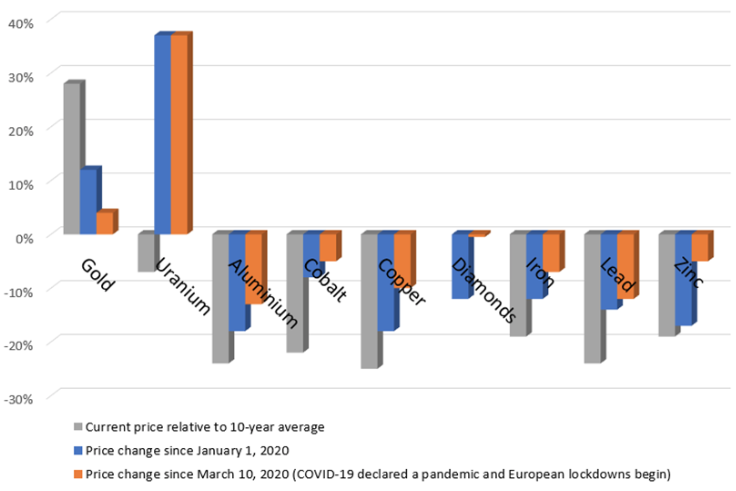 Sources: London Metals Exchange; Ziminsky Global Rough Diamond Price Index; Trading Economics
Mine shutdowns are, in some cases, doing worse damage to public finances than low prices. Production is being cut as mines suspend operations or reduce output to prevent spread of the virus, even where prices are high enough keep a mine profitable. For instance, Peru’s enormous Antamina copper and zinc mine is being suspended to contain the outbreak. Mexico has suspended production at all mines. Malaysia and Mozambique suspended their bauxite mines. South Africa has reduced mining production by 50 percent following a full shutdown. Further disruptions, whether to prevent the spread of the virus or in response to infections at mine sites, are likely, despite some governments’ efforts to keep production going by declaring mining an essential service.
Shutdowns and weak prices are hitting certain countries harder than others. In 2016, 27 percent of Guinea’s fiscal revenues, 26 percent of Zambia’s and 24 percent of the Democratic Republic of the Congo’s (DRC) were paid by mining companies. Even these high numbers underestimate the governments’ dependence on the mining sector, as they do not include income taxes from mine workers and taxes from mine suppliers. The longer the containment measures persist, pushing down demand and increasing stockpiles, the greater the pain for mineral producers will be.
Still, the main worry for many mineral-dependent countries is not just the decline in fiscal revenues. Rather, it is that many will face balance-of-payments crises, meaning they will not have enough foreign currency to pay for imports or service external debts. Mineral exports are the primary source of foreign currency for more than 20 countries, including Eritrea, Mongolia and Tajikistan.
In a handful of countries with small foreign reserve buffers and limited access to foreign capital, sovereign debt crises may coincide with balance-of-payments crises. As the export dependence, foreign reserve and credit default swap (CDS) spread (an indicator default probability) figures in the table below indicate, several African countries, including DRC, Guinea, Mauritania, Sierra Leone and Zambia, are at high risk of these dual crises.
Mineral-dependent countries’ risk of sovereign debt and balance-of-payments crises
| Country | Main mineral exports | Mineral exports as a percentage of total exports (2017 or most recent) | Risk of debt distress (based on CDS spreads, IMF DSAs and govt reports) | CDS spread on sovereign debt (as of April 1, 2020) | Reserves by months of imports (2018 or most recent) |
|---|---|---|---|---|---|
| Australia | Iron, coal, gold | 62% | Low | 0.0% | 2 |
| Bolivia | Zinc, gold, lead | 49% | Low | 6.7% | 8 |
| Botswana | Diamonds | 91% | Low | 1.3% | 9 |
| Chile | Copper | 56% | Low | 1.0% | 4 |
| Namibia | Diamonds, copper | 61% | Low | 4.5% | 4 |
| Peru | Copper, gold, zinc | 63% | Low | 1.8% | 11 |
| South Africa | Gold, diamonds, platinum, iron | 60% | Low | 3.7% | 5 |
| Tanzania | Gold | 43% | Low | 6.7% | 6 |
| Burkina Faso | Gold | 85% | Moderate | 8.2% | - |
| Ghana | Gold | 53% | Moderate | 9.6% | 3 |
| Guyana | Gold, aluminum | 51% | Moderate | 9.7% | 2 |
| Kyrgyzstan | Gold | 57% | Moderate | 8.2% | 4 |
| Mali | Gold | 63% | Moderate | 9.7% | - |
| Mongolia | Copper, coal | 91% | Moderate | 9.7% | 4 |
| Niger | Uranium | 60% | Moderate | 9.7% | - |
| Papua New Guinea | Gold, copper | 45% | Moderate | 8.2% | 4 |
| Suriname | Gold | 80% | Moderate | 8.2% | 3 |
| Tajikistan | Aluminum, gold, zinc, lead | 78% | Moderate | 9.7% | 4 |
| Congo, DR of | Cobalt, copper | 90% | High | 11.1% | 0 |
| Eritrea | Zinc, copper | 97% | High | n/a | 1 |
| Guinea | Aluminum, gold | 81% | High | 14.8% | 3 |
| Mauritania | Iron, gold, copper | 53% | High | n/a | 3 |
| Mozambique | Coal, aluminum | 69% | High | 13.4% | 4 |
| Nauru | Phosphates | 74% | High | n/a | 4 |
| Sierra Leone | Iron, titanium, diamonds | 67% | High | 14.8% | 3 |
| Zambia | Copper | 84% | High | 15.00% | 2 |
What can officials do, bearing in mind that each country faces its own challenges and no single policy would be applicable in every context?
1. Support mine workers and foreign exchange generation rather than shareholders
The mining sector produces fewer jobs per dollar of revenue generated and has smaller economic spillovers than almost any sector. But mining is a major employer in some countries and localities. In many countries, it is also an important generator of much-needed foreign currency.
Authorities should design financial relief measures for mines to meet specific policy goals, and only apply them to mining projects that are suffering from historically low commodity prices. If the goal is to keep workers employed, it is better for governments to pay a portion of workers’ salaries as long as they are kept on the payroll or defer payroll taxes, rather than bail out companies and their shareholders. If the goal is to maintain operations, governments can provide logistical support to mines, for instance through virus testing and keeping key trade routes open.
2. Resist impulsive tax relief and subsidy measures
Mineral prices are likely to trend toward their medium-term averages, though it is difficult to know when, given global uncertainty around demand and coronavirus containment. In the meantime, mining companies, employees and business associations are pressuring officials for tax relief and subsidies as compensation for shutdowns, sometimes successfully.
There are serious risks associated with renegotiating mining contracts or changing tax regimes in a manner that fails to capture future profit increases. Past experience shows that governments often fail to cancel tax relief after prices have risen again. Further, asset owners are in weak negotiating positions when prices are low.
Introducing sliding royalties might be one approach to providing temporary relief while automatically responding to a price rise. Sliding royalty rates automatically fall when prices fall, providing some relief in the current context, and rise when prices recover.
3. Distinguish between public sector liquidity and solvency crises
In some mineral-dependent countries, the drop in fiscal revenues will generate significant burdens on public finances. Many governments will need to further indebt themselves to overcome a temporary shock to fiscal revenues. However, in a handful of countries, the twin shocks are likely to push them over the edge into insolvency.
Countries in liquidity crises must find sources of financing to withstand the next couple of years. While the G20 have offered support, more will be needed. Temporary debt relief is part of the solution. Additional borrowing from institutional investors and the central bank may also be necessary. Debt monetization is an option worth considering during a contractionary spiral, especially in countries with shallow financial sectors and limited access to international capital, but with adequate foreign reserves to prevent a major depreciation. Where governments are insolvent, debts must be restructured immediately to create the fiscal space to respond to the coronavirus crisis and set themselves up for growth once the crisis is over.
Notes
-
1
Government of Ghana and Barari DV Ghana Ltd, Mining Lease Agreement (2023), www.mincom.gov.gh/wp-content/uploads/2023/11/BDL_ML-AGREEMENT_102023_31.pdf
-
2
See e.g. Kizito Cudjoe, “IEA flags ‘historical mistakes’ in lithium agreement,” B&FT Online, 30 November 2023, thebftonline.com/2023/11/30/iea-flags-historical-mistakes-in-lithium-agreement; Bright Simons, “Ghana’s lithium deal: Separating fact from fiction,” The Africa Report, 22 December 2023, www.theafricareport.com/331005/ghanas-lithium-deal-separating-fact-from-fiction; Kofi Ansah and Fui Tsikata, “Why Ghana’s lithium agreement is good,” Graphic Online, 11 December 2023, www.graphic.com.gh/features/opinion/why-ghanas-lithium-agreement-is-good-kofi-ansah-fui-tsikata-shares-opinion.html.
-
3
This requirement is set out in provision 1.b. of the second schedule: Government of Ghana and Barari DV Ghana Ltd, Mining Lease Agreement.
-
4
Government of Ghana and Barari DV Ghana Ltd, Mining Lease Agreement.
-
5
As indicated in the agreement, provisions in laws such as the Minerals and Mining Act 2006 as amended, Income Tax Act 2015 as amended and Value Added Tax Act 2013 as amended also apply to the Ewoyaa mine.
-
6
The strict definition of “free carried interest” involves the government paying for its share from the future dividends or profits that would otherwise have been distributed to it—as is the case with carried interest—but with no interest accruing on the amount payable by the government. However, in many countries it is interpreted as free equity, for which the government does not incur any cost either at the time of acquiring it or in the future. We understand that the government is currently interpreting the Ghanaian provision in this way.
-
7
Depending on the multinational structure of a company, double taxation treaties between Ghana and other jurisdictions may significantly reduce the effective rates of withholding taxes. Government officials have indicated that existing treaties do not currently impact the applicability of the fiscal regime for producing mines. It remains to be seen whether they will impact the Ewoyaa mine. For a summary of withholding tax limits in existing treaties, see PWC, “Worldwide Tax Summaries—Ghana,” accessed 12 June 2024, taxsummaries.pwc.com/ghana/corporate/withholding-taxes.
-
8
Lithium is currently produced from two main sources: hard rock and brine. The known lithium deposits in Africa, including Ghana, are hard rock. The “Lithium Triangle” in Latin America of Argentina, Bolivia and Chile has brine deposits. Extraction of lithium from hard rock uses conventional mining techniques, while extraction from brine involves pumping the brine to the surface before concentrating it through evaporation. The economics of brine operations are different to those of hard rock operations. We therefore do not include the fiscal regimes of countries with brine operations as comparators.
-
9
The Fraser Institute survey of mining companies estimates that, unless there are extremely harmful policies, around 60 percent of an investment decision tends to be based on a country’s geology. The other 40 percent comprises several other factors, including political stability and policy predictability (given they affect the risk that investors will not be able to secure future returns generated by their investments), a conducive business environment and the tax level. See Julio Mejia and Elmira Aliakbari, Fraser Institute Annual Survey of Mining Companies 2023 (Fraser Institute, 2024), https://www.fraserinstitute.org/studies/annual-survey-of-mining-companies-2023.
-
10
Information gaps make it difficult for taxes to be designed to capture all excess profit. See Jean-Franҫois Wen, Progressive Taxation of Extractive Resources as Second-Best Optimal Policy (International Monetary Fund, 2018), www.imf.org/en/Publications/WP/Issues/2018/06/13/Progressive-Taxation-of-Extractive-Resources-as-Second-Best-Optimal-Policy-45923.
-
11
Atlantic Lithium, Ewoyaa Definitive Feasibility Study (2023), static1.squarespace.com/static/61711d27ed0db12cacbcfb5a/t/649d3f851c02121fcf7bffcd/1688027016483/2023.06.29+-+Project+Update+-+Ewoyaa+Definitive+Feasibility+Study+%28ASX%29.pdf.
-
12
Spodumene concentrate pricing tends to be based on 6 percent lithium oxide content. Atlantic Lithium has priced its SC5.5 production using the formula (5.5/6)*SC6 Price*0.95.
-
13
Wood Mackenzie found in 2017 that four out of five mining projects are over budget by an average of 43 percent; an EY study of large mining projects in 2021 found an average cost overrun of 39 percent: Mark Kuvshinikov, Piotr Pikul and Robert Samek, “Getting big mining projects right: Lessons from (and for) the industry,” Wood Mackenzie, 8 February 2017, www.mckinsey.com/industries/metals-and-mining/our-insights/getting-big-mining-projects-right-lessons-from-and-for-the-industry; EY, How rethinking project management can boost mining’s capital productivity (2021), assets.ey.com/content/dam/ey-sites/ey-com/en_gl/topics/mining-metals/ey-how-better-project-management-can-boost-minings-capital-productivity-final.pdf?download.
-
14
James Mickleboro, “Here’s the lithium price forecast through to 2027,” The Motley Fool, 23 January 2024, www.fool.com.au/2024/01/23/heres-the-lithium-price-forecast-through-to-2027.
-
15
Kabah Atawoge, “We’ve not given Barari DV 10-year tax holiday—Minerals Commission CEO,” Citi Newsroom, 16 December 2023, citinewsroom.com/2023/12/weve-not-given-barari-dv-10-year-tax-holiday-minerals-commission-ceo.
-
16
Atlantic Lithium, “Project development update,” 22 November 2023, www.investegate.co.uk/announcement/rns/atlantic-lithium-limited-npv-di---all/project-development-update/7895763. Energy costs tend to account for around 15 percent of the operating expenditure of hard rock lithium mines (according to S&P Global data). With a simplifying assumption that all this energy is provided as electricity, an electricity subsidy of 50 percent would result in a 7.5 percent reduction in operating expenditure. On this basis, we estimate that the government could lose around $100 million in electricity revenues but, with effective tax administration, gain around $50 million from higher profit taxes and state dividends: a net loss of around $50 million.
-
17
On a 100 percent equity basis, i.e. before accounting for any debt financing: Atlantic Lithium Limited, “Mining Lease Granted for Ewoyaa Lithium Project,” London Stock Exchange, 20 October 2023, www.londonstockexchange.com/news-article/ALL/mining-lease-granted-for-ewoyaa-lithium-project/16174954. Our reliance on publicly available information means that our model suggests a slightly different post-tax IRR of 90 percent on a 100 percent equity basis.
-
18
The AETR measures only the proportionate split of mine profits between the government and investor, not the magnitude of profits. A high AETR may therefore still provide the investor with a large profit in absolute terms. If so, and particularly if the investor makes only a modest initial investment, a high AETR will not necessarily prevent a high post-tax IRR.
-
19
This operating cost is net of secondary product credits: Atlantic Lithium, “Charging the Change,” February 2024, www.rns-pdf.londonstockexchange.com/rns/6891B_1-2024-2-1.pdf.
-
20
Sabrina Jardim, “Atlantic achieves positive drilling results at Ewoyaa target,” Mining Weekly, 7 May 2024, www.miningweekly.com/article/atlantic-achieves-positive-drilling-results-at-ewoyaa-target-2024-05-07.
-
21
For example, only 11 percent of survey respondents said that current implementation of the legal system would be a strong deterrent to investment in Ghana, compared to 67 percent of respondents in relation to DRC; 5 percent of respondents said that regulatory uncertainty would be a strong deterrent to investment in Ghana, compared to 52 percent of respondents in relation to Zimbabwe: Mejia and Aliakbari, Fraser Institute Annual Survey of Mining Companies 2023.
-
22
Alexandra Readhead, Preventing Base Erosion: South Africa’s Interest Limitation Rules (NRGI, 2017), resourcegovernance.org/sites/default/files/documents/preventing-base-erosion-south-africa-limitation-rule.pdf.
-
23
The specific limit needs to balance the objective of protecting the tax base and ensuring companies can deduct legitimate financing costs. Consultations, including with companies, will be required to ensure an appropriate limit is set. For further discussion of this approach, see Dan Devlin, Limiting the Impact of Excessive Interest Deductions on Mining Revenue (Intergovernmental Forum on Mining, Minerals, Metals and Sustainable Development and Organisation for Economic Co-operation and Development, 2018), www.igfmining.org/resource/limiting-the-impact-of-excessive-interest-deductions-on-mining-revenue. Another approach, taken by Senegal, is to limit the interest rate on loans between related parties; however, this relies on effective identification of related parties: PWC, “Senegal—Corporate deductions,” accessed 12 July 2024, www.taxsummaries.pwc.com/senegal/corporate/deductions.
-
24
Alexander Malden and Edna Osei, Ghana’s Gold Mining Revenues: An Analysis of Company Disclosures (NRGI, 2018), www.resourcegovernance.org/analysis-tools/publications/ghanas-gold-mining-revenues-analysis-company-disclosures.
-
25
The Income Tax Act has a thin capitalization limit that prevents interest payments for any debt above 75 percent of the project capital to be deducted from the corporate income tax base. However, it will not protect state dividends. A company can pay back any loan and interest payments before the government receives any dividends. Debt financing from related companies could therefore be used to reduce dividend payments to the government.
-
26
For example, the government has responded to the challenge of limited dividends by requiring advanced payments in some of the renegotiated development agreements. In years when the government does not receive any dividends from a mine, a higher rate of royalty or corporate income tax is levied (though the terminology in the agreements is slightly different).
-
27
EITI requirement 2.4, which requires contract disclosure, defines a contract as “any contract, concession, production-sharing agreement or other agreement granted by, or entered into by, the government which provides the terms attached to the exploitation of oil, gas and mineral resources”: EITI, “EITI Requirements,” 12 June 2023, eiti.org/eiti-requirements.
-
28
See e.g. Erdenes MGL LLC, Ivanhoe Oyu Tolgoi (BVI) Ltd, Oyu Tolgoi Netherlands BV and Oyu Tolgoi LLC, Amended and Restated Shareholders’ Agreement (2011), www.resourcecontracts.org/contract/ocds-591adf-4472360738/view#/pdf.
-
29
Our modeling suggests that if, in addition to these lower prices and higher development costs, operating costs are more than 15 percent higher than Atlantic Lithium assumes, the post-tax IRR is still sufficient to secure investment in Ewoyaa; but the mine could reach its economic limit, and therefore Barari could stop producing, before the reserves are exhausted.
-
30
The Minerals Development Fund Act 2016 (Act 912) provides for 20 percent of royalty revenue to be deposited in the Minerals Development Fund; 50 percent of this amount is to be allocated to the Office of the Administrator of Stool Lands (OASL, which retains 10 percent of this) and 20 percent to the Mining Community Development Scheme. The remainder is to be distributed to various central government entities.
-
31
These agreements contain a royalty rate schedule that ranges from 3 percent to 5 percent depending on the price. Civil society has proposed a schedule for Ewoyaa that has 10 percent as the lowest rate.
-
32
Anna Fleming, David Manley and Thomas Lassourd, Variable Royalties: An answer to volatile mineral prices (African Tax Administration Forum and Intergovernmental Forum on Mining, Minerals, Metals and Sustainable Development, 2022), www.igfmining.org/wp-content/uploads/2022/11/variable-royalties-an-answer-to-volatile-mineral-prices.pdf.
-
33
A template of the FARI model and a paper that explains the concepts and workings of the model are available at IMF, “Fiscal Analysis of Resource Industries,” https://www.imf.org/external/np/fad/fari
-
34
Aswath Damodaran, “Damodaran Online,” accessed 19 June 2024, pages.stern.nyu.edu/~adamodar/.
Six Reasons Why Sovereign Wealth Funds Should Not Invest or Spend at Home

Developing, capital-scarce countries need domestic investment. Governments in countries such as Angola, Mongolia, and Timor-Leste must invest in education, health and infrastructure like roads, ports, electricity, water and sanitation systems if they hope to achieve middle- or high-income status in a sustainable and balanced way. What’s more, oil-, gas- and mineral-rich countries have access to large (yet finite) sources of income that can be used to boost domestic investment and help overcome the poverty trap. On this nearly everyone can agree.
In response to this need for domestic investment, some commentators have recently suggested that there might be opportunities for these countries’ sovereign wealth funds (SWFs) to directly invest at home. Nearly every country with significant oil, gas or mineral exports operates a SWF. Already, governments in Angola, Azerbaijan, Iran, Nigeria and Russia, for example, use their SWFs to channel money to special domestic projects.
A SWF is a type of extra-budgetary fund that operates outside the annual government budget process. SWFs have traditionally been created to achieve a macroeconomic goal (e.g., fiscal stability; save for future generations; help mitigate the Dutch disease). All invest at least partly in foreign assets. (This definition draws on a number of sources, namely the International Forum of Sovereign Wealth Funds, Truman (2010) and Castelli and Scacciavillani (2012)).
While the idea of using a SWF to invest domestically may resonate with government officials and politicians in low-income, resource-rich countries—particularly at this time of low commodity prices and surging fiscal deficits among oil and mineral exporters—there are strong arguments against using SWFs for this purpose. A fund with multiple objectives—say promoting domestic economic development and generating financial returns on savings for the benefit of future generations—can undermine public financial management systems, and lead to poor investment decisions, patronage and even corruption.
Governments can establish safeguards to limit SWF mismanagement and corruption, namely conflict-of-interest standards combined with legislative approval and strong fund transparency and oversight. However the challenges associated with creating a parallel budget or multiple mandates may not be so easy to overcome. A single SWF may not be well-placed to be a checking account, a savings account, an education or health financing vehicle, and a development bank all at once.
In countries where funds have helped to improve macroeconomic management, fiscal rules have determined how much resource revenue is saved and spent. All spending is then channeled through national or subnational budget processes, or through state-owned entities like development banks that act at arms’ length from the government. In most of these successful cases, savings are placed in a SWF and invested abroad with purely financial returns in mind.
I am not suggesting that natural resource revenues shouldn’t be used for domestic spending. Just the opposite; there are no better reasons for extracting resources from the ground. But SWFs, as savings mechanisms for macroeconomic management, should not be the vehicles of such direct spending. If there is under-investment in the domestic economy, a far better way to remedy the situation is to enact fiscal rules that allocate resource revenues more appropriately between the budget and a SWF.
Here are six reasons why it is generally inadvisable to use a SWF for domestic spending or investment:
-
Home spending or investment through SWFs can undermine macroeconomic objectives. The very reason governments usually create these funds is to address the macroeconomic challenges associated with natural resource revenue inflows. In Norway and Timor-Leste, for example, funds work in tandem with fiscal rules that require governments to save a portion of their resource revenues to help mitigate Dutch disease. If governments transfer money to a fund, then transfer money back into the economy through domestic spending, the fund’s macroeconomic objective of sterilizing capital inflows could be undermined.
-
Home spending or investment through SWFs can undermine public financial management systems. In many countries the budget process—including project appraisal, public procurement, and project monitoring—does not adequately deliver needed social programs and physical infrastructure. Governments sometimes respond by creating new institutions to bypass budget systems that do not work, such as a SWF that invests at home as well as abroad. This can lead to the establishment of uncoordinated parallel budgets—each with its own appraisal, procurement and monitoring system. While budget processes may well be flawed in many countries, the best approach is usually not to create new institutions with unintended consequences, but rather to repair what is broken.
-
Home spending or investment through SWFs can undermine public accountability. Bypassing normal budgetary systems can also undermine legislative oversight and democracy. Budget allocations are usually examined and approved by legislatures. This is rarely the case for specific SWF investments. In Azerbaijan and Iran, for instance, governments have used SWFs to finance politically motivated projects without submission to parliamentary scrutiny. Given the private interests that politicians and SWF investment managers often have in their own countries, lack of accountability can lead to politically motivated investments or investments for personal gain. The risk is even higher in countries where most SWF activities are not publicly disclosed, which is the case is more than 50 percent of the funds NRGI has examined in recent research.
-
Financial and development mandates require different expertise. Financial managers specializing in maximizing financial returns are usually not trained in identifying or managing infrastructure projects. A single institution may not be well placed to achieve both financial returns and domestic development, unless there are strict firewalls between the two portfolios.
-
Multiple mandates can lead to inconsistent and confused decision-making. A fund with multiple objectives—say promoting domestic economic development and generating returns on savings for the benefit of future generations—can become difficult for officials to manage, and can lead to poor investment decisions. What percentage of the fund should be allocated to what objective? Can the ratio change, and if so, with whose approval? If one portfolio grows faster than another, is there a need for rebalancing? Is fund liquidity or investing in local businesses for the long-term more important? In theory, strict guidelines can help address these challenges, but in practice, where funds are allowed to make home investments, such guidelines are rarely drafted or enforced, allowing fund managers excessive discretion to make politically- or privately-motivated investments.
-
There is no opportunity cost to banning home spending or investment through SWFs in most developing countries. If we construe SWFs as government savings mechanisms (rather than extra-budgetary spending funds), they should be managed in much the same way a family or institutional trust fund is managed—meaning maximizing returns for future use given a particular risk appetite. SWF managers generally set an investment target (e.g., 4-6 percent annually), which is an implicit declaration of risk appetite. In order to achieve this objective, fund managers will choose financial instruments that are likely to generate the target financial return while minimizing the risk of loss. In most developing countries, the chance is quite low that any single domestic asset can satisfy the fund managers’ criteria for maximizing return and minimizing risk (this would not necessarily be the case in China, Europe or the United States, for instance, due to the size of their economies or the sophistication of their financial markets). Therefore, in developing countries, the opportunity cost of prohibiting domestic investment in order to maximize financial returns is near zero.
Evidence on SWF home spending and investments highlights risks
Evidence on SWF treatment of home spending and investment already exists. Countries and subnational jurisdictions whose funds cannot invest domestically include Abu Dhabi (ADIA), Botswana, Chile, Ghana, Kazakhstan, Norway and Timor-Leste. While each may be faced with its own challenges, these funds generally achieve their objectives.
On the other hand there are countries where funds can invest or spend at home: Angola, Azerbaijan, Equatorial Guinea, Iran, Kuwait, Libya, Nigeria and Russia. Many of these funds have become conduits for corruption, patronage and financial mismanagement. The Libya Investment Authority invested with close personal friends of fund managers. Russia’s National Welfare Fund, an oil-financed pension fund, has been depleted to the tune of $20 billion since 2011. These stories illustrate the dangers of establishing an unaccountable extra-budgetary fund. The Natural Resource Governance Institute (NRGI) and the Columbia Center on Sustainable Investment’s (CCSI) recent research on SWFs in resource-rich regions found that half of these funds were too opaque to study. Of those that we were able to examine, we found that very few achieved their stated objectives.
Recommendations for governments of natural resource-rich countries
When a country discovers oil, gas or minerals, government officials should consider three separate questions:
-
How much resource revenue should we spend and how much should we save?
-
Where should we invest our savings to maximize financial returns given our risk appetite?
-
What mechanisms should we use to spend our resource revenues most efficiently?
With regard to the first question, the literature on the “savings vs. spending” question is extensive. While different theories propose a range of solutions, the Natural Resource Governance Institute’s (NRGI) approach, codified in the Natural Resource Charter, has generally been to encourage governments to use natural resource wealth to invest in education, health and infrastructure. That said, NRGI also encourages governments to enact fiscal rules that help them to manage volatile revenues and—if the oil, gas or mineral windfall revenues are large enough to be destabilizing—to “park” a portion of these revenues until they can be used more efficiently.
“Parking” can mean paying down public debt, or saving revenues in a SWF. Chile, Norway, Saudi Arabia and the American states of North Dakota and Wyoming have all effectively used SWFs to help stabilize their budgets, overcome Dutch disease by sterilizing capital inflows, and/or create an endowment for future generations. In most of these cases, funds have been financed by a budget surplus generated by a fiscal rule.
With regard to the second question, a SWF’s investment strategy must match its objectives. For instance, a fund that is designed to stabilize the budget by providing financing in case of a drop in oil prices (as is the case in Chile, Ghana, and Trinidad & Tobago today) would need to invest in more liquid assets than a long-term savings fund. A government’s risk appetite is equally important in deciding on an investment strategy. NRGI and CCSI have developed a set guidelines on investment rules for policymakers.
With regard to the third question on spending mechanisms, in certain circumstances, officials may wish to create special budgetary units to ensure that chronically underfunded expenditure items are fully financed. Some examples are the US state of Alabama’s Forever Wild Land Trust Fund, which earmarks resource revenues for roads and environmental protection; Liberia’s aid-funded Health Sector Pooled Fund; and Timor-Leste’s multi-year Infrastructure and Human Capacity Development Fund. These are all essentially accounts, rather than institutions with their own organizational structures, staff, and buildings. They should not be confused with SWFs. What is important for good governance in these cases is that all spending be approved by the legislature and be subject to the same or stronger project appraisal, procurement and monitoring systems as other government spending. In the case of Ghana, for example, 70 percent of resource revenues spent out of its SWF is earmarked for domestic investment. However the government channels this money back through the budget rather than spending or investing it outside the budget process.
Governments may also wish to establish development banks or state-owned holding companies to invest in commercially viable domestic investments that have trouble attracting capital. Examples include Brazil’s BNDES, the Qatar Development Bank, France’s Agence des Participations de l'État (APE), and Kazakhstan’s Samruk Kazyna (which is a holding company despite calling itself a SWF). As with any state-owned company, investment decisions ought to be free from political interference, be it through independent boards or other oversight mechanisms, and have clear administrative or developmental mandates.
In short, different vehicles may be required to achieve domestic investment goals and manage the macroeconomic challenges associated with large and volatile fiscal revenue inflows. One tool cannot fix every problem.
Andrew Bauer is a senior economic analyst at the Natural Resource Governance Institute (NRGI).
Notes
-
1
Government of Ghana and Barari DV Ghana Ltd, Mining Lease Agreement (2023), www.mincom.gov.gh/wp-content/uploads/2023/11/BDL_ML-AGREEMENT_102023_31.pdf
-
2
See e.g. Kizito Cudjoe, “IEA flags ‘historical mistakes’ in lithium agreement,” B&FT Online, 30 November 2023, thebftonline.com/2023/11/30/iea-flags-historical-mistakes-in-lithium-agreement; Bright Simons, “Ghana’s lithium deal: Separating fact from fiction,” The Africa Report, 22 December 2023, www.theafricareport.com/331005/ghanas-lithium-deal-separating-fact-from-fiction; Kofi Ansah and Fui Tsikata, “Why Ghana’s lithium agreement is good,” Graphic Online, 11 December 2023, www.graphic.com.gh/features/opinion/why-ghanas-lithium-agreement-is-good-kofi-ansah-fui-tsikata-shares-opinion.html.
-
3
This requirement is set out in provision 1.b. of the second schedule: Government of Ghana and Barari DV Ghana Ltd, Mining Lease Agreement.
-
4
Government of Ghana and Barari DV Ghana Ltd, Mining Lease Agreement.
-
5
As indicated in the agreement, provisions in laws such as the Minerals and Mining Act 2006 as amended, Income Tax Act 2015 as amended and Value Added Tax Act 2013 as amended also apply to the Ewoyaa mine.
-
6
The strict definition of “free carried interest” involves the government paying for its share from the future dividends or profits that would otherwise have been distributed to it—as is the case with carried interest—but with no interest accruing on the amount payable by the government. However, in many countries it is interpreted as free equity, for which the government does not incur any cost either at the time of acquiring it or in the future. We understand that the government is currently interpreting the Ghanaian provision in this way.
-
7
Depending on the multinational structure of a company, double taxation treaties between Ghana and other jurisdictions may significantly reduce the effective rates of withholding taxes. Government officials have indicated that existing treaties do not currently impact the applicability of the fiscal regime for producing mines. It remains to be seen whether they will impact the Ewoyaa mine. For a summary of withholding tax limits in existing treaties, see PWC, “Worldwide Tax Summaries—Ghana,” accessed 12 June 2024, taxsummaries.pwc.com/ghana/corporate/withholding-taxes.
-
8
Lithium is currently produced from two main sources: hard rock and brine. The known lithium deposits in Africa, including Ghana, are hard rock. The “Lithium Triangle” in Latin America of Argentina, Bolivia and Chile has brine deposits. Extraction of lithium from hard rock uses conventional mining techniques, while extraction from brine involves pumping the brine to the surface before concentrating it through evaporation. The economics of brine operations are different to those of hard rock operations. We therefore do not include the fiscal regimes of countries with brine operations as comparators.
-
9
The Fraser Institute survey of mining companies estimates that, unless there are extremely harmful policies, around 60 percent of an investment decision tends to be based on a country’s geology. The other 40 percent comprises several other factors, including political stability and policy predictability (given they affect the risk that investors will not be able to secure future returns generated by their investments), a conducive business environment and the tax level. See Julio Mejia and Elmira Aliakbari, Fraser Institute Annual Survey of Mining Companies 2023 (Fraser Institute, 2024), https://www.fraserinstitute.org/studies/annual-survey-of-mining-companies-2023.
-
10
Information gaps make it difficult for taxes to be designed to capture all excess profit. See Jean-Franҫois Wen, Progressive Taxation of Extractive Resources as Second-Best Optimal Policy (International Monetary Fund, 2018), www.imf.org/en/Publications/WP/Issues/2018/06/13/Progressive-Taxation-of-Extractive-Resources-as-Second-Best-Optimal-Policy-45923.
-
11
Atlantic Lithium, Ewoyaa Definitive Feasibility Study (2023), static1.squarespace.com/static/61711d27ed0db12cacbcfb5a/t/649d3f851c02121fcf7bffcd/1688027016483/2023.06.29+-+Project+Update+-+Ewoyaa+Definitive+Feasibility+Study+%28ASX%29.pdf.
-
12
Spodumene concentrate pricing tends to be based on 6 percent lithium oxide content. Atlantic Lithium has priced its SC5.5 production using the formula (5.5/6)*SC6 Price*0.95.
-
13
Wood Mackenzie found in 2017 that four out of five mining projects are over budget by an average of 43 percent; an EY study of large mining projects in 2021 found an average cost overrun of 39 percent: Mark Kuvshinikov, Piotr Pikul and Robert Samek, “Getting big mining projects right: Lessons from (and for) the industry,” Wood Mackenzie, 8 February 2017, www.mckinsey.com/industries/metals-and-mining/our-insights/getting-big-mining-projects-right-lessons-from-and-for-the-industry; EY, How rethinking project management can boost mining’s capital productivity (2021), assets.ey.com/content/dam/ey-sites/ey-com/en_gl/topics/mining-metals/ey-how-better-project-management-can-boost-minings-capital-productivity-final.pdf?download.
-
14
James Mickleboro, “Here’s the lithium price forecast through to 2027,” The Motley Fool, 23 January 2024, www.fool.com.au/2024/01/23/heres-the-lithium-price-forecast-through-to-2027.
-
15
Kabah Atawoge, “We’ve not given Barari DV 10-year tax holiday—Minerals Commission CEO,” Citi Newsroom, 16 December 2023, citinewsroom.com/2023/12/weve-not-given-barari-dv-10-year-tax-holiday-minerals-commission-ceo.
-
16
Atlantic Lithium, “Project development update,” 22 November 2023, www.investegate.co.uk/announcement/rns/atlantic-lithium-limited-npv-di---all/project-development-update/7895763. Energy costs tend to account for around 15 percent of the operating expenditure of hard rock lithium mines (according to S&P Global data). With a simplifying assumption that all this energy is provided as electricity, an electricity subsidy of 50 percent would result in a 7.5 percent reduction in operating expenditure. On this basis, we estimate that the government could lose around $100 million in electricity revenues but, with effective tax administration, gain around $50 million from higher profit taxes and state dividends: a net loss of around $50 million.
-
17
On a 100 percent equity basis, i.e. before accounting for any debt financing: Atlantic Lithium Limited, “Mining Lease Granted for Ewoyaa Lithium Project,” London Stock Exchange, 20 October 2023, www.londonstockexchange.com/news-article/ALL/mining-lease-granted-for-ewoyaa-lithium-project/16174954. Our reliance on publicly available information means that our model suggests a slightly different post-tax IRR of 90 percent on a 100 percent equity basis.
-
18
The AETR measures only the proportionate split of mine profits between the government and investor, not the magnitude of profits. A high AETR may therefore still provide the investor with a large profit in absolute terms. If so, and particularly if the investor makes only a modest initial investment, a high AETR will not necessarily prevent a high post-tax IRR.
-
19
This operating cost is net of secondary product credits: Atlantic Lithium, “Charging the Change,” February 2024, www.rns-pdf.londonstockexchange.com/rns/6891B_1-2024-2-1.pdf.
-
20
Sabrina Jardim, “Atlantic achieves positive drilling results at Ewoyaa target,” Mining Weekly, 7 May 2024, www.miningweekly.com/article/atlantic-achieves-positive-drilling-results-at-ewoyaa-target-2024-05-07.
-
21
For example, only 11 percent of survey respondents said that current implementation of the legal system would be a strong deterrent to investment in Ghana, compared to 67 percent of respondents in relation to DRC; 5 percent of respondents said that regulatory uncertainty would be a strong deterrent to investment in Ghana, compared to 52 percent of respondents in relation to Zimbabwe: Mejia and Aliakbari, Fraser Institute Annual Survey of Mining Companies 2023.
-
22
Alexandra Readhead, Preventing Base Erosion: South Africa’s Interest Limitation Rules (NRGI, 2017), resourcegovernance.org/sites/default/files/documents/preventing-base-erosion-south-africa-limitation-rule.pdf.
-
23
The specific limit needs to balance the objective of protecting the tax base and ensuring companies can deduct legitimate financing costs. Consultations, including with companies, will be required to ensure an appropriate limit is set. For further discussion of this approach, see Dan Devlin, Limiting the Impact of Excessive Interest Deductions on Mining Revenue (Intergovernmental Forum on Mining, Minerals, Metals and Sustainable Development and Organisation for Economic Co-operation and Development, 2018), www.igfmining.org/resource/limiting-the-impact-of-excessive-interest-deductions-on-mining-revenue. Another approach, taken by Senegal, is to limit the interest rate on loans between related parties; however, this relies on effective identification of related parties: PWC, “Senegal—Corporate deductions,” accessed 12 July 2024, www.taxsummaries.pwc.com/senegal/corporate/deductions.
-
24
Alexander Malden and Edna Osei, Ghana’s Gold Mining Revenues: An Analysis of Company Disclosures (NRGI, 2018), www.resourcegovernance.org/analysis-tools/publications/ghanas-gold-mining-revenues-analysis-company-disclosures.
-
25
The Income Tax Act has a thin capitalization limit that prevents interest payments for any debt above 75 percent of the project capital to be deducted from the corporate income tax base. However, it will not protect state dividends. A company can pay back any loan and interest payments before the government receives any dividends. Debt financing from related companies could therefore be used to reduce dividend payments to the government.
-
26
For example, the government has responded to the challenge of limited dividends by requiring advanced payments in some of the renegotiated development agreements. In years when the government does not receive any dividends from a mine, a higher rate of royalty or corporate income tax is levied (though the terminology in the agreements is slightly different).
-
27
EITI requirement 2.4, which requires contract disclosure, defines a contract as “any contract, concession, production-sharing agreement or other agreement granted by, or entered into by, the government which provides the terms attached to the exploitation of oil, gas and mineral resources”: EITI, “EITI Requirements,” 12 June 2023, eiti.org/eiti-requirements.
-
28
See e.g. Erdenes MGL LLC, Ivanhoe Oyu Tolgoi (BVI) Ltd, Oyu Tolgoi Netherlands BV and Oyu Tolgoi LLC, Amended and Restated Shareholders’ Agreement (2011), www.resourcecontracts.org/contract/ocds-591adf-4472360738/view#/pdf.
-
29
Our modeling suggests that if, in addition to these lower prices and higher development costs, operating costs are more than 15 percent higher than Atlantic Lithium assumes, the post-tax IRR is still sufficient to secure investment in Ewoyaa; but the mine could reach its economic limit, and therefore Barari could stop producing, before the reserves are exhausted.
-
30
The Minerals Development Fund Act 2016 (Act 912) provides for 20 percent of royalty revenue to be deposited in the Minerals Development Fund; 50 percent of this amount is to be allocated to the Office of the Administrator of Stool Lands (OASL, which retains 10 percent of this) and 20 percent to the Mining Community Development Scheme. The remainder is to be distributed to various central government entities.
-
31
These agreements contain a royalty rate schedule that ranges from 3 percent to 5 percent depending on the price. Civil society has proposed a schedule for Ewoyaa that has 10 percent as the lowest rate.
-
32
Anna Fleming, David Manley and Thomas Lassourd, Variable Royalties: An answer to volatile mineral prices (African Tax Administration Forum and Intergovernmental Forum on Mining, Minerals, Metals and Sustainable Development, 2022), www.igfmining.org/wp-content/uploads/2022/11/variable-royalties-an-answer-to-volatile-mineral-prices.pdf.
-
33
A template of the FARI model and a paper that explains the concepts and workings of the model are available at IMF, “Fiscal Analysis of Resource Industries,” https://www.imf.org/external/np/fad/fari
-
34
Aswath Damodaran, “Damodaran Online,” accessed 19 June 2024, pages.stern.nyu.edu/~adamodar/.