
Breaking Ground: Critical minerals, critical opportunities for women’s participation
GA Building CR-12, New York

The side event of the 69th Commission on the Status of Women (CSW69) allowed the discussion on women’s roles and opportunities related to the extraction, production, and beneficiation of critical minerals for the energy transition and related sectors, including strategies to ensure their equal participation at every step—from artisanal and small-scale mining to higher-value-added processes.
The event organised by the Intergovernmental Forum on Mining, Minerals, Metals and Sustainable Development (IGF) and the United Nations Conference on Trade and Development (UNCTAD), featured industry experts such as Fernanda Ballesteros, NRGI's Country Manager for Mexico.
This event was designed to foster dialogue on strategies needed to ensure that women can benefit from the trade and employment opportunities in the expanding mineral sector, showcase policies to facilitate women’s equitable participation in the low-carbon energy transition, and discuss public and private policies to enhance finance, technology, and markets for women in the mineral value chain.

Fernanda Ballesteros
Mexico Country Manager
Guinean Communities Benefit from Mining Revenues and Civil Society Capacity Building

The Challenge
Like many resource-rich low-income countries, Guinea faces challenges in leveraging its natural resource wealth for sustainable development. Despite being the world’s second largest bauxite producer and rich in iron ore, gold and diamonds, Guinea has so far delivered only limited benefits from mining to its citizens, more than half of whom live in poverty.
Guinea introduced sector-wide reforms following democratization in 2010 and is successfully implementing the Extractive Industries Transparency Initiative (EITI). However, social unrest, political instability, and the impacts of the Ebola crisis and coronavirus pandemic have slowed the country’s progress toward ensuring that mining income helps improve citizens’ quality of life.
NRGI's role
As part of its support to Guinean civil society and its provision of technical advice to Guinea’s Ministry of Mines, NRGI has advocated the adoption of new subnational mining revenue-sharing mechanisms. The aim is to enable Guinea’s low-income communities in mining-affected and other areas of the country to sustainably share in the proceeds from mining.
Following elements of NRGI’s recommendations, the Guinean government committed from 2019 to fully implement its previously established contribution to local development (CDL) mechanism to finance the new Local Economic Development Fund (FODEL).
A 2019 NRGI report recommended ways to improve the implementation of these financial mechanisms for community development and local economic diversification. NRGI advised the government to avoid over-dependence on the mining sector and instead support family farming, local manufacturing and other forms of local entrepreneurship to promote self-employment and long-term food security.
At the same time, NRGI provided training, advice and selected grant funding to Guinean civil society organizations (CSOs), journalists and parliamentarians to strengthen public oversight of the country’s mining revenue flows. A key focus has been to enhance CSO monitoring of mining companies’ legal and contractual obligations and subnational mining-related payments and transfers, including through the use of smartphones in data collection and the production of a guide and videos on citizen monitoring. NRGI has trained more than 200 members of five mining communities to monitor state and company legal and contractual obligations.
Impact
With NRGI’s help, under the subnational finance provisions of Guinea’s reformed mining code and via the two local development funds, the country’s 342 municipalities have received mining-related payments totaling USD 42 million since 2019. Mining companies have paid $20 million directly to municipalities where they operate, while the government has disbursed a further $22 million around the country.
Action Mines, an NRGI civil society partner in Guinea, undertook a participatory evaluation of the first financial year of the Local Economic Development Fund (FODEL). FODEL comprises companies’ payments of a set percentage of their turnover (0.5 percent of sales for bauxite and iron and 1 percent for other mining substances) to subnational authorities in areas where their activities have direct impacts on communities.
Action Mines found that Guinea’s rural and urban prefectures and communes have invested receipts from the fund in a broad spectrum of infrastructure, public services, job creation and income generation projects.
Investments include improved water and sanitation provision; electrification for underserved communities and households; the building, enlargement and improvement of roads, bridges, schools, health centers, youth centers, markets, shops, kiosks and warehouses; purchase of municipal vehicles; new business enterprises such as market gardening and community agriculture; and tree nurseries for local reforestation. Municipalities reserve a fixed proportion of funds for women- and youth-led projects.
Guinean CSOs’ and local communities’ capacity in revenue and expenditure monitoring has developed significantly. Local citizen monitoring committees are now equipped to engage effectively with municipal authorities, and they have started to address shortcomings in the allocation of mining revenues.
NRGI's work impacts stakeholders in many different places and at many levels, ranging from communities to international institutions.
Laying Foundations for Civic Engagement and Government Accountability in Guinea (2011-2020)

The challenge
When President Alpha Condé took office after Guinea’s first democratic election in 2010, he promised to reform the country’s mining sector. Following decades of sector mismanagement and corruption, Guinea introduced a new mining code in 2011 (later amended in 2013) and, in 2012, the government committed to implementing the Extractive Industries Transparency Initiative (EITI) Standard and reviewed 19 mining contracts signed by previous administrations. This reform effort precipitated a significant expansion of the industry: investments picked up and bauxite exports rose, and mining revenues grew.
Despite progress, and because of the speed of mining expansion, communities in mining areas experienced increasingly negative impacts from the industry. Their interests went unaddressed; the government had been slow to implement key regulations aimed at protecting them. As a result, 2016 saw uprisings in key bauxite-producing areas. In addition, civil society engagement on extractive issues was weak and fragmented; citizens, activists and journalists lacked crucial information and were ill-equipped to engage on key governance issues.
Furthermore, significant gaps in environmental laws remained and the mining code’s provision for environmental rehabilitation during operations and after mining site closures had gone unimplemented. Additionally, the government negotiated a massive but opaque deal with China in 2017, equivalent to around 20 percent of the country’s GDP; involving the provision of loans for multi-sector infrastructure development to be paid for by bauxite mining revenues.
NRGI’s response
In its early years working in Guinea, NRGI focused on strengthening the role of civil society organizations (CSOs) and journalists, and on building a collaborative approach with the government. In 2011, NRGI provided technical expertise to the government for the redrafting of the mining code and supported the transparent and consultative review of mining contracts. In parallel, NRGI partnerships with CSOs, journalists and parliamentarians led to advances in transparency, reform efforts and government accountability, as well as increased visibility of mining-affected communities.
NRGI then focused on deepening the technical skills of CSOs and analyzing key extractives data, particularly with revisions of the EITI Standard in 2016 and 2019, and Resource Governance Index assessments in 2017, 2019 and 2021. The government also approved and implemented regulations related to the establishment of two mining funds, integrating some of NRGI’s key recommendations.
NRGI continued to support the government’s reform efforts, advising on the development of a mining strategy, and undertaking valuations of mining projects and drafting key regulations. When the minister of Mines and Geology upgraded Guinea’s existing contracts website in 2017, NRGI created the Guinea Resource Contracts platform and trained mining ministry administrators on making contracts more accessible.
NRGI further provided grant support, training and technical guidance to CSOs. Campaigners were able to track subnational payments to a host of bauxite- and gold-rich prefectures to assess the adequacy and use of transferred funds involving local communities.
Impact
Since 2011, CSOs in Guinea have contributed to unprecedented levels of transparency in the mining sector, held authorities accountable and successfully pushed for the issuance of key mining regulations. Mining governance has improved from “poor” in 2017 to “satisfactory” in 2021 and CSOs have grown in size and diversity. These include Action Mines, founded by a group of Guinean journalists who had attended NRGI training courses, and the Publish What You Pay Guinea coalition. Other key achievements in Guinea include:
- CSOs secured a seat in key reform processes and played its role actively.
- Important revenue and contract information were disclosed publicly for the first time in 2013, with the government publishing all mining contracts signed between 1958 and 2013. The available data informed civil society’s advocacy and monitoring efforts.
- In 2020, through the local development funds, companies paid GNF 199 billion (USD 20 million) to mining municipalities and the government transferred GNF 225 billion (USD 22 million) to all municipalities.
- State-owned mining enterprise SOGUIPAMI has started disclosing its annual reports since 2014, with increasingly detailed data on government investments and returns in the sector.
- In response to advocacy from CSOs, the government began disclosing details of its deal with China.
- Five mining communities have improved their capacities in monitoring state and company legal and contractual obligations after NRGI provided training on advocacy and understanding their rights.
Looking ahead
Over the last decade, CSOs in Guinea have become more effective. As the quality of reports and evidence has improved, the next steps involve ensuring that these tools are more rigorous and accessible, and that CSOs regularly engage with mining communities to amplify their voice in national debates. To build on progress made in its first decade working in Guinea, NRGI is supporting CSOs to set a coordinated agenda of governance reforms.
Mining Revenues Flow to Provinces and Communities in the DRC
In 2002, the Democratic Republic of Congo (DRC) adopted a mining code offering generous terms to investors to attract them to the country’s post-conflict environment. Investment indeed soared, but government revenues and local benefits did not—there was an urgent need to reform the code to decrease this disparity.
In 2011, NRGI provided a grant to the civil society organization POM to reform the code. POM then led advocacy to add a mechanism mandating that a fixed percentage of mining companies’ revenues go directly to subnational governments and local communities. POM also successfully pushed for a community development fund.
Parliament passed revisions in March 2018. The regulation was published in June 2019, and companies have begun payments to communities. The provincial governments of Haut-Katanga and Lualaba are projected to receive between USD 75 million and 225 million in annual revenue, while local communities will receive between 45 million and 157 million. Every province has received some money already. The sector head in Luilu said “With the first collections of our part of the mining royalty, we have already built some community facilities: a pediatric and a maternity ward at the Luilu Health Center, but also a well-equipped mortuary.”
Many communities still lack capacity to receive transfers, while others don’t have the infrastructure to ensure the money benefits citizens. NRGI is measuring the impact of transfers on communities and facilitating a manual to help communities budget, develop capacity and develop revenue management standards.
DRC Communities Engage with Multinational Mining Companies

The Challenge
As the Democratic Republic of Congo mining sector liberalized over the past decade, private capital flooded in.
L’Action pour la Défense des Droits Humains (ADDH), or Action for the Defense of Human Rights, was part of a local response to the foreign investment in influx. Kolwezi, ADDH’s home in Lualaba Province, is a mining town. Nearly 30 companies operate there, extracting copper and cobalt.
Understanding the complex sector and the roles diverse stakeholders would play in it became a pressing need for members of civil society. As they began to explore the economically, legally and technologically complicated extractives sector, ADDH and Kolwezi’s citizens faced a significant knowledge gap: there are no academic or school programs on mineral resources governance in the DRC.
For ADDH to become an effective actor of meaningful change, expert training was urgently needed.
NRGI's role
In 2015, ADDH coordinator Daudet Kitwa Kalume took part in NRGI’s Francophone Africa training course in Yaoundé, Cameroon, where he learned about investment analysis, the political economy of extractive industries and the extractive industries value chain. During the training, Kalume focused on the legal and contractual obligations of companies and their often intense interactions with communities affected by their activities.
NRGI financially and technically supported ADDH efforts to monitor the corporate social responsibility obligations of majority foreign-owned Kamoto Copper Company (KCC) and Sino Congolaise des Mines (Sicomines), both of which operate in Kolwezi. The companies had a history of focusing more on international non-governmental organizations and largely ignoring inputs from activists and advocates in affected communities.
ADDH told NRGI it was difficult to conduct a study focused on the impacts of mining and community consultation and compensation robust enough to draw the attention of certain stakeholders, particularly mining companies. Local civil society was essentially unable to make their concerns known to companies operating in their own back yard.
Impact
With NRGI help, Kalume and his colleagues released a report evaluating the extractives-related benefits the community saw.
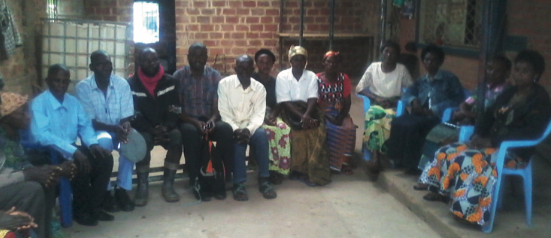 A focus meeting with members of communities surrounding the Sicomines project and impacted by it.
KCC’s board chairman, legal advisor and community development department manager welcomed ADDH to discuss the report. This was significant: the company had previously brushed off meetings with the civil society organization.
KCC and Sicomines directors sent ADDH responses to the report’s recommendations, surprising the group’s members. For the first time, ADDH was seen as a peer group worth hearing out—a legitimate interlocutor for the community impacted by mining.
Two days after ADDH visited KCC, a Luilu community delegation impacted by KCC’s project visited the miner’s offices. During that meeting, in an abrupt shift from previous experience, KCC expressed interest in the needs of the communities impacted by its project. The move was apparently prompted by the earlier KCC and ADDH meeting.
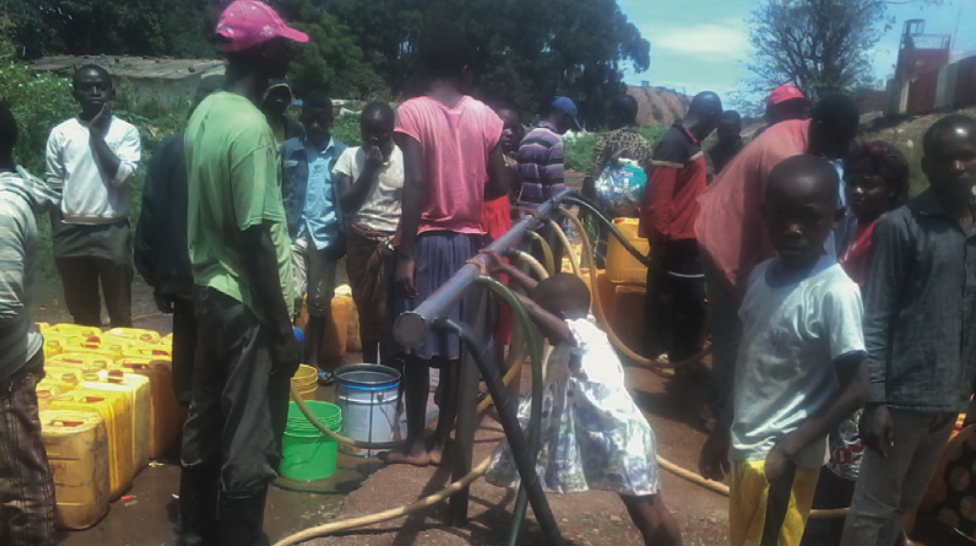 This well supplies the communities surrounding the Sicomines project.
A community consultation also resulted in KCC promising to finalize an uncompleted well project supporting the Luilu and Tshamundenda communities, with populations of 24,300 and 16,700, respectively. Lobbying also resulted in Sicomines building a multi-purpose road in a community impacted by its project.
Sicomines and KCC now have a different perception of local NGOs’ competencies. ADDH presented its report to key decision-makers in Kinshasa and presented report recommendations to national authorities, advocating for better monitoring of companies’ local commitments. The organization passed along what it learned in a data validation workshop with local authorities, NGOs, community leaders and journalists.
NRGI is helping the citizens most impacted by mining make their voices heard to elected representatives and companies operating with their consent. And through its training and outreach, NRGI is promoting the important work of organizations like ADDH.
Extractive Industries Revenues Distribution at the Subnational Level
A new study, Extractive Industries Revenues Distribution at the Sub-National Level, presents a comparative analysis of international legislation regulating distribution of revenues from extractive industries across all levels of government. Prepared by development economics consultant Matteo Morgandi at the request of a working group of the Peruvian National Congress, it encompasses legislative practices in Bolivia, Brazil, Ghana, Indonesia, Mexico, Nigeria and Papua New Guinea.
The assessment stresses the potential and specific challenges associated with the transfer of revenues to lower levels of government through fiscal decentralization. Among these challenges are 'Dutch Disease'—the deindustrialization of an economy due to increased natural resource revenues and a resulting decline in the manufacturing sector; revenue volatility; constraints on local planning and expenditure capacity; the lack of local functional responsibilities proportional to new revenues received; the absence of external controls; and institutional deterioration. Although compensation of resource producing regions with a share of the total revenues is legitimate, empirical evidence from the selected countries shows that the mere transfer of revenue wealth to local governments is not a sufficient remedy to the negative effects of extractive activities on local communities. An explicit strategy to spur economic development and safeguard both institutions and the environment is critical to escaping the resource curse.
|
Download:
|
 Extractive Industries Revenues Distribution at the Subnational Level
The research also finds that countries with high level of resource dependency (e.g., Nigeria, Bolivia, Indonesia and Mexico) are more likely to redistribute extractive revenues to all regions rather than to producers only. Developing a revenue sharing formula that encompasses demographic and economic development parameters is necessary to mitigate inequalities between producing and non-producing regions.
Other mechanisms in the fiscal architecture can also enhance the equity and efficiency of revenue distribution. For instance, the General Grant (DAU) formula in Indonesia automatically allocates more funds to non-producing regions from the general pool of collected taxes.
Nevertheless, even where means of redistribution are in place, the country studies show limited effectiveness in redistributing resources to the poorest regions (such as in Indonesia, Bolivia, and Nigeria), due in some cases to an inadequate formula and in others to the limited amount of funds redistributed. Transparency and consensus building between producers and non-producers are crucial to establishing the legitimacy of any revenue distribution arrangement.
This study was prepared at the request of a congressional working group in Peru in order to review and integrate into a single proposal the numerous partial modifications of the Canon Law presented over the last few years. The Canon Law regulates the way income tax from companies in the extractive sectors (including mining, gas, oil, fisheries, forestry and hydroenergy) is distributed between the central government and the sub-national governments in regions where extractive activity takes place.
The study was presented to both the advisors of the working group and the congressional representatives, as well as to several independent experts.
The working group incorporated the study into its own report to the Congress, along with 12 general recommendations. The report was then approved by Congress, opening the way for debate on concrete proposals for modifying the existing regulations.
READ MORE
The Political Economy of Black Panther: Who Benefits from Wakanda’s Mineral Resources?

This post is the first of two relating to the film Black Panther; the second is here. The post contains spoilers about the film.
The remarkable success of Black Panther and its resonant storyline has already attracted wide commentary.
Writers in the Guardian and many other media outlets have praised the beautiful picture it paints of a vanguard, economically successful African country spared the horrors of colonization and the injustices of the post-colonial world order (although for some Ghanaian moviegoers, the African accents were not quite realistic). And the policy community has embraced it too: researchers from the Brookings Institution wrote about the film’s lessons for good resource management and increased trade openness in Africa.
But there is also a more uncomfortable quality to Black Panther. Russell Rickford, in the blog Africa is a Country, calls out the film’s political conservatism, the isolationism of the Wakandan elite living comfortably in their resource-rich bubble and the triumph of monarchy over revolution. In Wakanda, after all, political power belongs to the king, T’Challa, appointed for life based on a royal lineage and his fighting skills, with the support of a small oligarchy.
The country’s precious natural resources—the metal vibranium as well as a heart-shaped herb that gives the king supernatural powers—are managed by the royal family, the army and a small clergy. The rest of Wakanda’s population seems to live off the redistribution of the country’s resources.
The institutions and political regime of Wakanda may actually be the result of the domination by vibranium of the country’s economy, and reflect another aspect of the resource curse. One political scientist has analyzed the political economy of Wakanda in that light in a research paper.
In the real world, countries dependent on oil and gas tend to have more authoritarian regimes and fewer civil liberties. On the African continent, elites in Algeria, Angola and Nigeria have organized their countries’ institutions in order to capture the rents from hydrocarbon resources and selectively redistribute the proceeds to maintain power and privileges.
From this perspective, it is easier to understand how some Wakandans so readily accept a complete reversal of their country’s foreign policy by Erik Killmonger, T’Challa’s cousin, when he suddenly comes to power from his exile as a child in Oakland, California. The lack of citizen participation in Wakanda politics explains the weakness of its institutions and the very few obstacles faced by Killmonger when he decides to start a global war.
The work of Paul Collier in particular suggests that resource-dependent countries can be prone to violent conflicts, in part because there is fiercer competition for access to the resources, controlled narrowly by whoever sits on top of the pyramid. In this context, it is unsurprising Killmonger seeks to overthrow a ruling king.
Michael B. Jordan’s subtle rendition of Killmonger makes him more complex than your typical Marvel villain. He has strong political arguments in his favor: he disputes how Wakanda has defined the ownership of its vibranium resources.
While we aren’t privy to the Wakandan constitution (if there is one), the movie leads us to believe that vibranium is controlled by T’Challa on behalf of the Wakandan population, a typical system adopted by resource-rich nations around the world. Killmonger argues that vibranium belongs to all people of African descent, and should therefore be used to fight oppression faced by black people everywhere. This perspective is emphasized in Black Panther’s soundtrack, when Kendrick Lamar denounces “Mass destruction and mass corruption/The souls of sufferin’ men.”
Disputes over resource ownership are indeed a recurring theme in civil wars, such as the Biafra war in Nigeria, and fuel militias and separatist movements from Myanmar and Iraq to the Democratic Republic of Congo. Many resource-rich countries have defined revenue-sharing schemes for their natural resources in order to ensure a sense of fairness among the population and avoid conflicts.
The movie ends without a proper redefinition of vibranium ownership. It is still very much under the control of T’Challa, but with emerging programs of “outreach” to share the benefits of vibranium beyond Wakanda. Will T’Challa’s outreach be limited to a token educational program in Killmonger’s hometown and resemble the Heydar Aliyev Foundation in Azerbaijan, run by the country’s first lady, serving to polish the image of the ruling family while it appropriates the country’s oil resources and jails its political opponents? Or will Wakanda find a way to genuinely challenge power imbalances that continue to disadvantage black communities and black nations in today’s global system?
If Wakanda’s royal family truly wants to make the world a better place, and take after the relative successes of Norway and Chile in transforming their abundant oil and copper resources into increased welfare and citizen participation, I would recommend the latter approach. Kendrick Lamar does too, when he challenges T’Challa in the soundtrack: “What do you stand for? Are you a activist? What are your city plans for? / Are you a king or you jokin’? Are you a king or you posin’?”