
Africa’s Natural Resources for Africans?
As Mexico Votes, State Oil Company Pemex Needs a New Direction

In less than two weeks Mexicans will vote for their next president. The outgoing leader, Andrés Manuel López Obrador, has made energy sovereignty and self-sufficiency one of the sustained themes of his presidency. AMLO, as he is universally known, has focused his energy aspirations on Pemex, the world’s most indebted national oil company. What Mexico’s next president does with Pemex will determine the country’s energy and fiscal future amid a rapidly changing outlook for fossil fuels.
Pemex faces unprecedented risk brought about by the quickening global energy transition away from hydrocarbons. At NRGI, we have described that risk in a new Spanish-language report, and summarize it below. We also offer some recommendations for the victor in June’s elections and the Pemex executives, including its director, whom the new president will appoint.
A risky business
National oil companies (NOCs) account for 55 percent of the world's oil production and yet they are moving more slowly than their private sector counterparts in terms of decarbonization planning.
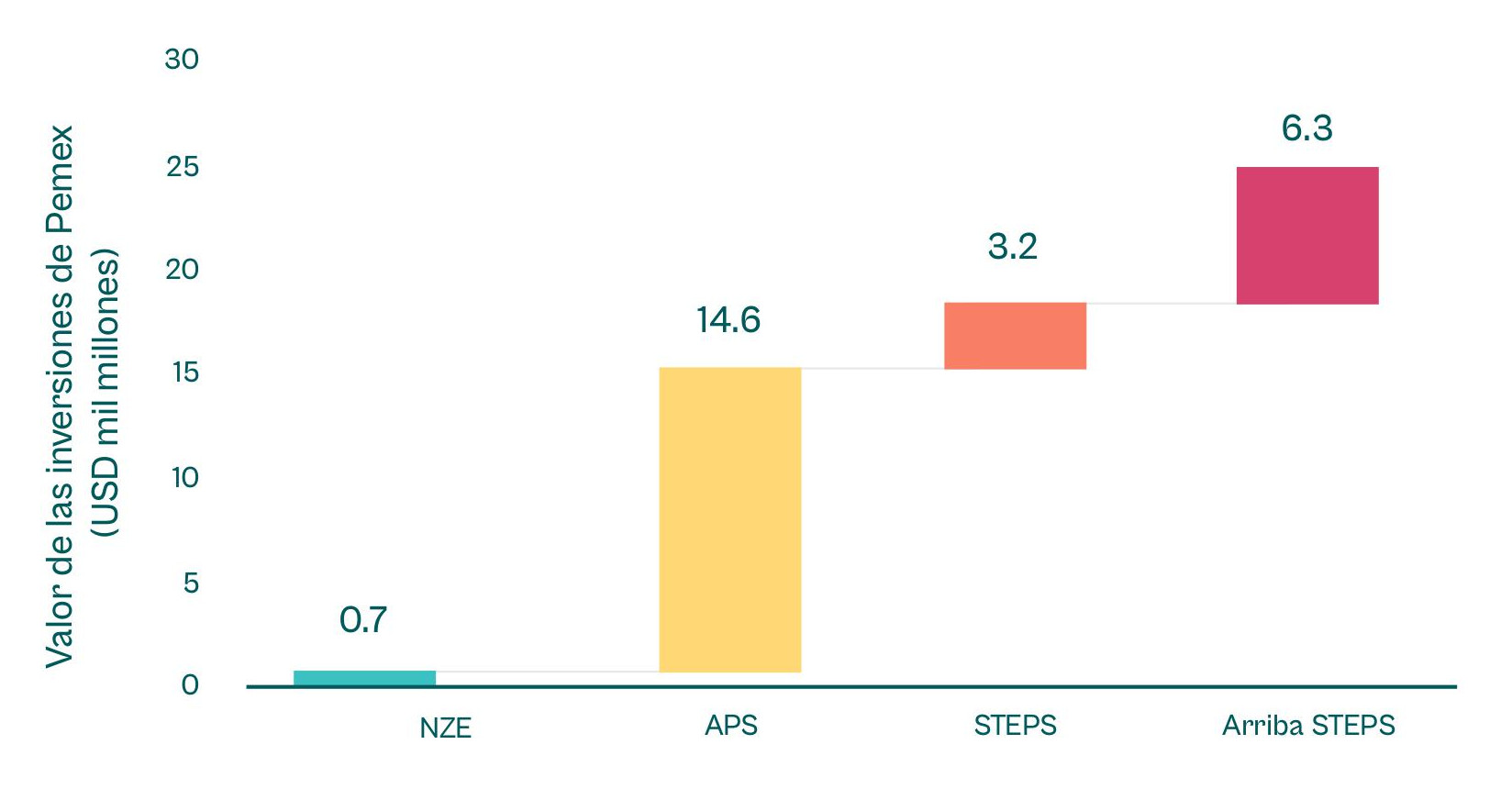
Among the 58 NOCs we studied last year, Pemex ranked 11th in terms of its exposure to transition risk. The biggest of these risks is the changing economics of the oil sector, with demand likely to markedly diminish in coming decades as countries seek to meet their emissions reduction goals. Mexico’s remaining oil reserves will be increasingly costly to extract, meaning that as global oil prices fall, Pemex may be caught out, its assets “stranded.” We found that approximately $10 billion in Pemex's expected investment over the coming decade would not break even under the International Energy Agency’s Announced Pledges Scenario for future oil demand. Given Pemex’s already problematic debt obligations, this presents the government with the specter of more bailouts to alleviate the company’s financial situation, generating an even deeper crisis.
Value of Pemex's upstream oil and gas investments breaking even in each of the IEA's scenarios.
In late 2022, Pemex presented a new business plan which, for the first time, explicitly referenced the energy transition. The plan recognized as risks the international hydrocarbon market contraction due to the increase in electric vehicles, and the downward trend in the demand for oil-derived plastics. While this recognition was an important first step, we still know little about what government officials and Pemex executives plan to do with respect to the transition.
In March 2024 Pemex released a sustainability plan that included more detail on some aspects of its intentions to reduce production emissions. But the plan did not address the transition risk in terms of falling global demand and prices.
Early dissemination of our findings in a workshop with climate and energy experts in Mexico yielded more insight:
- Pemex’s diversification plans remain somewhat vague, and their technical feasibility is uncertain.
- Pemex must be more transparent and accountable about its financial situation.
- Many sector insiders believe that the transition will be slow, and that Pemex will remain competitive.
We are confident that experts from Mexico’s oil and gas sector and its climate community can work with Pemex to improve understanding and communication of its plans.
How to improve Pemex’s future
Our research and consultations have led us to propose three categories of recommendation:
1. Pemex should further recognize and analyze transition risks.
This means more thorough scenario planning around market conditions, shared publicly. And Pemex officials should include more acknowledgement of transition risk in their financial reporting—not just in planning.
2. Pemex should adopt and adapt transition risk mitigation approaches from other oil companies.
Executives should look very carefully at large fields with high production costs. Factoring in lead times (7.5 years on average) and changing market conditions, these may not represent the bonanza that some imagine. One such find is the Kante field in Tabasco state; our analysis suggests that increased investment could be a financial misstep. Ambitions around producing more “no matter what” should give way to innovative thinking about Pemex’s potential role in a domestic energy transition.
Regarding diversification and downstream activities, executives have several opportunities. First, Pemex should better coordinate with CFE, Mexico’s state-owned electricity company. Both can play a fundamental role in advancing the energy transition. Leadership should build a coordinated and integrated vision and action plan that defines the role of each company.
Decision-makers must also carefully consider the viability of diversification options. For example, the two leading presidential candidates have been enthusiastic about expansion in petrochemical production. But petrochemicals only account for 12 percent of current oil demand and the global market may soon be oversupplied as many oil companies seek to expand. This presents a risk of overinvestment and therefore warrants caution.
3. Mexico’s next president should oversee key changes in the government’s approach to the oil and energy sectors.
Mexico’s energy ministry (SENER) should assume a transition planning role in which officials consider the transition risk and build synergies among the country’s state-owned energy companies.
Meanwhile, the finance ministry (SHCP) should review the conditions for financial support to Pemex in the interest of fiscal responsibility and transparency in the management of public resources.
Moreover, the state, as Pemex’s owner, has a crucial role in holding the company accountable. SENER, SHCP, the Congress of the Union and the Federal Superior Audit Office determine and supervise the company's ownership policy. These actors should therefore play a role in improving transition-related decision making within Pemex.
Whoever triumphs on 2 June must stop Pemex from making risky bets and have a clear vision for the company—and Mexico—in a world in transition.
Mexico’s risky bets
Learn more about the transition risks Pemex faces with new NRGI research.
Growing resource-backed loans seen threatening oil economy
Transición energética puede agravar crisis de Pemex y generar una en México: NRGI
AfDB president urges end to loans tied to natural resources
Avoiding $1.6 Billion in Debt and Making Fossil Fuel Transitions in Ghana

- In July 2021, the Ghana National Petroleum Corporation stated its intention to spend USD 1.65 billion of public money to purchase a share of undeveloped offshore oil projects held by Aker Energy, a Norwegian company.
- NRGI provided technical analysis to an alliance of civil society actors interrogating GNPC’s request, and raised questions around the value of the asset, GNPC’s capacity to jointly operate the field, and the riskiness of the investment, building on prior NRGI research including Risky Bet. This underpinned advocacy by the alliance calling for investigation and greater transparency around the transaction.
- Following persistent advocacy, the Ghanaian government reduced the value of assets in the Aker-GNPC transaction from $1.65 billion to $1.1 billion and committed to further evaluating the deal. Media investigations revealed that Bank of America had appraised the oil field’s value at $300 million.
- In May 2023, Aker returned ownership of the two offshore blocks to the Ghanaian government for a sale price of $1.
Building partnerships for united advocacy and reform
The extractive sector contributes significantly to Ghana‘s economy. Gold mining has been important for the country for over a century, and Ghanaians have more recently hoped that the country’s oil and gas assets will contribute to public revenues.

Following Aker Energy’s 2017 acquisitions in Ghana of the South Deep Water Tano (SDWT) block and a 50 percent stake in the Deep Water Tano / Cape Three Point (DWT/CTP) block, the Norwegian company dominated the policy environment. It successfully lobbied the government of Ghana to amend the governance architecture of the upstream sector. But more recently, Aker had been seeking private buyers for its stake in these offshore blocks, with no success.
NRGI and many others considered a public investment in the declining oil industry to be a risky bet
In July 2021 Ghana’s national oil company, the Ghana National Petroleum Corporation (GNPC), stated its intention to purchase a share of Aker Energy’s offshore oil projects, after Aker had failed to find any takers. The Minister of Energy submitted a memo to parliament requesting $1.65 billion for the government to finalize negotiations and acquire a 37 percent stake in DWT/CTP and a 70 percent stake in SDWT. NRGI and many others considered a public investment in the declining oil industry to be a risky bet—an accelerated energy transition would reduce the financial returns on this investment and purchasing the assets would divert funds away from programs that were potentially more socially beneficial.
NRGI’s research and technical expertise on national oil companies enabled us to support the Alliance of Civil Society Organizations (CSOs) Working on Extractives, Anti-corruption and Good Governance. We analyzed public data related to the GNPC-Aker transaction, GNPC’s past transactions, its strategic position, and emerging implications of energy transition on Ghana’s oil sector, revenue flows and economy. Concerns arose about the asset’s value, the capacity of GNPC to take on production, and the investment risk amid the transition.
NRGI provided vetted data and technical support to the allied CSOs who were then able to professionally and meaningfully engage on the issues with different stakeholders including the Ministry of Energy, parliament, GNPC, the International Monetary Fund, the World Bank, the Norwegian embassy, the media and the Ghanaian public.
Through an extensive advocacy campaign the alliance called for a halt in the transaction and for the development of a national policy on energy transition. Specifically the alliance (including NRGI) requested that the parliament fully investigate the transaction to verify the actual cost incurred by Aker to date on the blocks, clarify inconsistencies in the presentations by GNPC to Ghana’s cabinet, and allow for open consultation to provide opportunities for independent expert opinions. Alliance members engaged with the media locally and internationally, authored articles, participated in public forums, and called for government transparency regarding the deal. NRGI provided technical support for the development of communication materials and clear infographics for engaging the public. Two press statements were released in 2021 by the CSO alliance—in August and September. These were widely featured in the media in Ghana and abroad.
After 18 months of persistent campaigning, Aker Energy wrote to relinquish its interest in the SWDT block to Ghana for free. This reinforced the CSOs’ position on the risks of investment. In May, 2023 Aker Energy sold the other field to Africa Finance Corporation Equity and Investment for a token price of $1 after the former defaulted on repayment of a loan of $200 million from the latter.
Driving the energy transition agenda in Ghana
In response to the CSO advocacy demands and emerging issues, the Ghanaian government constituted the National Energy Transition Committee (NETC), hosted at the Ministry of Energy. The committee is tasked with developing an energy transition plan to inform a policy for the country and mandated to conduct a nationwide consultation with various stakeholders including CSOs and youth. GNPC and the Ghanaian government officials credited the work of NRGI and the alliance of CSOs as significant influences on the evolution of their approach and requested NRGI’s technical assistance in the development of an energy transition plan.
NRGI continues to advise GNPC and has met with company officials to provide technical support on their plans for developing a comprehensive strategy for diversification in response to the energy transition. Discussions have also addressed the importance of reviewing the law establishing GNPC to understand the governance challenges, the role of government and hindrances to a smooth transition.
In November 2023, NRGI published two reports that reference Ghana and GNPC’s exposure to transition risk—Riskier Bets, Smaller Pockets and Facing the Future—leveraging data in its National Oil Company Database.
Debt Policy of State-Owned Mining Enterprises in Mongolia

-
Mongolia relies heavily on state-owned enterprises (SOEs) to manage several key mining assets. Baganuur, Shivee Ovoo, Erdenet, Mongolrostsvetmet and Erdenes Tavan Tolgoi are the most important majority state-owned companies operating large-scale mines.
-
From 2019 to 2021, debt held by mining SOEs increased 4.3 times. The total liabilities of these companies reached USD 2.3 billion, representing 15 percent of GDP. The new debt was largely issued to cover social spending and an economically questionable railway project. It is unclear how the government intends to service this debt, particularly since profitability at most mining SOEs has been weak and most face liquidity challenges.
-
Mining SOEs’ poor financial health is due to the combination of quasi-fiscal activity financing, poor project selection and management, and inadequate legislation and control mechanisms for new debt issuance.
-
Legal reforms to new debt issuance and stronger Ministry of Finance oversight of SOEs are needed, in addition to stricter implementation of existing legal requirements such as collecting and disclosing complete data on SOE debt. Mongolia’s government should also review mining SOE quasi-fiscal expenditures, such as price controls on coal, and other reasons for low profitability of mines.
Mongolia’s 10 most important upstream mining state-owned enterprises (SOEs) reported total liabilities of 6.45 trillion Mongolian tugrug (MNT) (around USD 2.3 billion) at the end of 2021, of which 26 percent could be classified as “debt.” The liabilities of these 10 companies alone represented 15 percent of GDP, while liabilities officially declared as “debt” represented four percent of GDP. In comparison, around the world, SOE debt from all sectors is equivalent to roughly seven percent of GDP on average. While SOE debt can be a useful source of financing for economic development projects, Mongolia’s mining SOE debt issuances represent a significant risk to economic stability and fiscal sustainability.
Mining SOE debt is 4.3 times larger than in 2019, while liabilities are 4.8 times greater. The biggest increases came from bond issuances from Erdenes Tavan Tolgoi to pay for the Gashuun Sukhait railway project, and Erdenes Mongol to pay for the government’s policy to cover pension-backed loans and other subsidies to the elderly. In other words, the government has collateralized future revenues of mining SOEs to pay for projects that may not actually contribute to SOEs’ improved performance.
In addition, mining SOE profitability is well below international standards and is highly dependent on volatile coal and copper prices. Three out of Mongolia’s five state-owned operating mines make little or no profit. Borrowing to finance long-term state-owned projects of unclear feasibility risks throwing good money after bad.Given these high costs and the global energy transition, it is unclear whether mining SOEs will be able to pay back their debt. More likely, the government will need to cover mining SOEs’ losses in the future using taxpayers’ money, shifting state resources away from programs that would benefit the majority, such as investments in education, healthcare and modernizing infrastructure.
Resource-Backed Loans in Ghana: Risks, Opportunities and Lessons

Developing countries have trouble financing development mainly due to limited access to capital markets, high cost of borrowing, slow growth, or a mix of these. Countries with natural resource endowments have attempted in the last few decades to leverage these endowments to surmount those challenges. Many of their development efforts focus on closing huge infrastructure gaps.
Ghana is a producer of cocoa, minerals, oil and gas—assets that have increasingly featured in the government’s infrastructure financing plans. Ghana’s infrastructure financing totaled USD 23 billion between 2007 and 2020, and annual infrastructure investment will need to reach $9.3 billion by 2030 (13.9 percent of 2019 GDP). Official development funding and private sector financing have been inadequate to meet these infrastructure needs. As a result, the Ghana Infrastructure Plan identifies Chinese infrastructural funding as a source to fill the gap.
Ghana’s infrastructure financing has in part relied on leveraging its natural resources. Through resource-backed loans (RBLs), governments (directly or through state-owned companies) borrow funds and repay the loans in physical natural resources or with money from resource-related future income streams. Ghana has entered into three such RBL deals, totaling more than $5 billion, in the last two decades; all three involve Chinese state-owned enterprises as lenders.
Given the country’s narrowing fiscal space and debt levels, Ghanaian officials may be tempted to explore additional innovative financing arrangements including pursuing additional resource-backed loans (RBLs).
The government continues to pursue “creative” financing approaches involving Ghana’s resources, such as the controversial proposed Agyapa deal whereby the government would leverage mineral royalties for development financing by listing of 49 percent of Ghana’s gold royalties through a special purpose vehicle. While Agyapa is not a resource-backed loan per se, Ghana’s experience with RBLs should inform such plans as there are shared characteristics and risks with resource valuation and collateralization, project financing, lack of transparency and citizen consultation.
Key messages:
- Ghana’s government continues to pursue “creative” financing approaches involving the country’s resources. Lessons from Ghana’s past experiences with resource-backed loans (RBLs) should inform such plans as there are shared characteristics and risks.
- RBL arrangements have helped to address critical infrastructure gaps in key sectors such as power, gas and road infrastructure but are characterized by ineffective oversight, project financing challenges, hidden debt and negative economic impacts. Officials ought to address such risks in the conception of any unconventional financing arrangements in the future.
- RBLs in Ghana, as elsewhere in sub-Saharan Africa, have been largely characterized by unrealistic projections of loan amounts and potential projects; this has resulted in disbursement challenges and project funding bottlenecks. More modestly sized loans and rigorous valuation of earmarked projects could address these and minimize costs charged as a percentage of the initial loan amount.
- Given the trajectory of Ghana’s debt and questions around the use of borrowed funds, it has become imperative for the government to publish all project-related loan contracts, including RBLs, with foreign creditors of all types. Officials can draw lessons from the experiences of nearby countries including Cameroon.
- Collateralized resources are collectively owned by citizens; officials and policymakers must therefore solicit and hear their concerns. The government must factor citizens’ concerns about collateralizing mineral royalties into the structure of any deal. It is not sufficient for sponsors to rush such deals through parliament with the justification that “the representatives of the people will provide oversight.”
Resource-backed loans: pitfalls and potential
The G7 Missed a Crucial Ingredient for a Green and Equitable Future. Here’s a Way Forward.

Last weekend leaders of the G7 group of wealthy countries recommitted to the value of democratic, open societies and declared lofty ambitions around the pandemic response, economic recovery, climate change and global infrastructure. But they left out a crucial element. Improved governance in resource-rich countries is essential for the billion people who live in poverty in countries abundant in oil, gas and minerals. Without it, they will be excluded from the “clean, green growth” needed for an effective global energy transition. Fortunately the major gatherings in the months ahead—notably the G7 interior ministers meeting in September and the COP26 climate summit in November—offer an opportunity for G7 governments to address the gap in their plans.
Here are five ways they can correct their course:
Wind down fossil fuel production and support low-income producer countries on governance fundamentals needed for the transition to clean energy
The G7 “advanced economies” have yet to fulfil their pledge to mobilize $100 billion in public or private funding to support energy transition in developing countries. Low-income resource-rich countries need support to transition to a future in which fossil fuel extraction delivers dramatically less income. At the same time, enabling them to decarbonize and diversify into renewables will require a major shift in incentives. G7 governments should:
- Promote a core set of government and company disclosure requirements on fossil fuel projects in all countries; this will enable the public to assess every project’s viability under different climate scenarios.
- Support accountability and economic planning capacity in low-income countries, to help align political incentives and capabilities around a sustainable path forward. G7 countries must fund the identification of options for lower-income countries that are more attractive than fossil fuel extraction.
- Lead by example and take more decisive action to wind down their own countries’ production of oil, gas and coal. It is unrealistic, and unfair, for wealthy countries to expect low-income countries to abandon the sector when G7 countries continue to license new petroleum fields.
Enact and support global standards on critical minerals governance
The G7 meeting and communiqué rightly touched upon the importance of resilience in the global supply chain of critical minerals from the perspective of economic recovery and jobs in their own countries, and called for sharing of best practice to address threats to supply. However, addressing governance and corruption risks in producing countries were missing from the G7 conclusions. Failing to address these risks will impact reliability of supplies and thereby threaten the clean energy transition which relies on increased use of minerals such as cobalt and lithium; it will also diminish the potential for citizens of producer countries to benefit from the extraction of these minerals. G7 governments should:
- Promote robust governance standards in mineral supply chain initiatives.
- Prioritize transparency, accountability, anticorruption and support to civil society in their assistance to low-income critical mineral producer countries.
Deploy the new infrastructure initiative with an emphasis on financial support, accountability and debt transparency
Last weekend the G7 announced a new approach to financing the significant infrastructure needs of low- and middle-income countries. The aim is to enable these countries to build back better post-pandemic, with a focus on quality infrastructure supporting “clean and green growth” based on the principles of transparency, sustainability and collaboration. (In recent decades, many resource-rich countries have financed infrastructure upgrades with opaque resource-backed loans, often from China.)
The initiative has been cast in the media, and will likely be viewed from low-income countries, as an attempt to compete with China, given the important role that the country has played in financing infrastructure in much of the world. Developing countries will likely view this increased interest and competition around infrastructure as positive. However, no announcements of specific financial support accompanied the G7’s plan.
In order for their new infrastructure initiative to succeed, the G7 governments should:
- Raise the bar on sovereign debt transparency, so that citizens can assess the impact of different financing options, including on resource-backed loans. Publication of key loan terms and loan agreements is essential. Greater transparency in direct G7 country lending will be important, as will a broader G7 push for transparency from private creditors. (In resource-producing countries, loans from commodity trading firms are often even more opaque than those from Chinese lenders and have destabilized whole economies.)
- Support borrower countries in adopting transparent debt approval and management processes.
- Follow through on the commitment to consult openly and collaborate with developing country governments, including as part of the new proposal development taskforce.
- Commit significant funding in the near term to get the initiative off the ground.
Include the concerns of resource-rich developing countries in global tax reforms
Tax avoidance and evasion are longstanding challenges for resource-producing countries. The G7 acknowledged the need to end the “40-year race to the bottom” on international tax—a welcome step. However, the G7 commitment doesn’t serve resource-rich developing countries. The proposed global minimum corporate tax rate of 15 percent is likely too low to prevent profit shifting in the extractive sector as producer country tax rates for the sector are often significantly higher. Developing countries are also unlikely to acquire much additional revenue from applying the 15 percent rate to profits booked in low-tax jurisdictions as the G7 is silent on who collects those, suggesting that most will go to multinational companies’ headquarters jurisdictions, as per an OECD proposal. The emphasis on allocating taxation rights to “market countries” (i.e., where goods or services are consumed) rather than producer countries also means that resource-rich countries may even end up with less revenue than they collect now unless the sector is exempted (as was previously agreed in the OECD context).
G7 governments should integrate the concerns of resource-rich developing countries into the OECD/G20 Inclusive Framework when these tax reforms are refined later this year.
Tackle fossil fuel sector corruption, state capture and kleptocracy—with a climate lens
Corruption is an overlooked threat to a successful energy transition. In fossil fuel-producing countries, corruption and narrow political agendas can mean that leaders invest more in oil, gas and coal projects; lavish these industries with subsidies; and block progress on greener energy—even when doing so runs counter to climate goals and citizens’ economic and environmental interests. Elites behind fossil fuel company lobbying and campaign donations can (often legally) influence or even direct energy and climate policy.
Half of the world’s oil is produced by 13 authoritarian countries, including several run by kleptocratic regimes with few incentives to move away from fossil fuel production. Meanwhile, as we have discussed above, the boom in demand for minerals required for clean energy could also trigger surges in corruption like those associated with past oil booms. G7 governments, including the G7 interior ministers meeting in September with their focus on strengthening international action against corruption and kleptocracies, should:
- Explicitly acknowledge the extractive sector as high-risk and recognize that strong action on anticorruption in fossil fuels and critical minerals is also good climate policy.
- Build on the commitment to greater beneficial ownership disclosure by requiring greater transparency in areas where the fossil fuel industry and governments interact, such as lobbying and government contracting, commodity trading, subsidy payments and national oil company finance.
- Seek fresh responses and modes of cooperation, including punishment for Western enablers who help kleptocrats to profit and thrive.
Leaders of G7 countries must turn their rhetoric into reality in the months ahead; they can do so by urgently prioritizing the governance of fossil fuels and critical minerals in producer countries, and making concrete commitments as described here. The “green revolution” cannot otherwise succeed.
This post was written by a group of NRGI experts.
Disclosures Pave the Way for Transparency in Resource-Backed Loans

During the commodity boom of the last two decades, many governments and state-owned enterprises in developing countries signed significant “resource-backed loans” (RBLs). These loans provide governments access to finance in exchange for, or collateralized by, future streams of income from natural resource wealth, such as oil and minerals; Chinese entities are the dominant lenders in this space. In NRGI’s 2020 study on RBLs, which explored the experience of RBL borrowers in sub-Saharan Africa and Latin America between 2004 and 2018, we found that Chinese entities account for $152 billion (more than 90 percent) of the total amount lent through identified RBLs.
NRGI and others have frequently criticized RBL deals for their opacity. Information about agreed terms and conditions is scant. At the time of our study, we lacked basic information, such as the interest rate, for 33 out of the 52 cases surveyed, and just one loan document was publicly accessible: the Sicomines loan that the Democratic Republic of the Congo (DRC) signed in 2011. But since the publication of our report a year ago, the transparency landscape has already showed signs of change.
Last week, AidData released a trove of loan agreements between Chinese entities and sovereign borrowers in developing countries. The researchers scoured debt information management systems, official registers and gazettes, and parliamentary websites to find 100 publicly available Chinese loan agreements in 24 countries. Their database, and accompanying “How China Lends” report comparing terms with other loan agreements from a benchmark sample, both confirms and expands our understanding of sovereign debt agreements involving Chinese state lenders.
One key finding of the report is the widespread use of far-reaching confidentiality clauses in the Chinese loan agreements meant to restrict borrowers from disclosing loan information. This confirms worries about opacity and the need to rein in confidentiality provisions in sovereign debt agreements, as previously highlighted. However, the fact that a significant number of Chinese loan agreements were publicly accessible despite these confidentiality provisions may point to a pathway to greater transparency: leveraging and building on borrower country laws and procedures requiring parliamentary ratification and/or disclosure of sovereign debt agreements. Carve-outs from confidentiality, where applicable law requires disclosure, are relatively common and is likely how many of the Chinese loan agreements ended up publicly disclosed and in the database notwithstanding the confidentiality clauses.
In addition to the Sicomines loan, the AidData database includes contracts for five more RBLs: three with the government of Ecuador, one with the government of Ghana and one with Venezuela’s state-owned enterprises (SOEs) PDVSA and BANDES. We featured these deals in the 2020 NRGI report, and the key terms we had reported in relation to loan amounts, interest and maturities were the same or very similar to those included in the contracts. (We plan to update our report’s dataset with insights from the AidData work, adding new details such as missing grace period information).
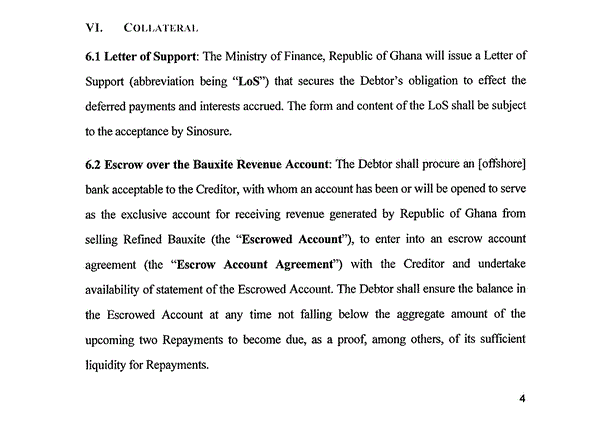
Access to the contracts allows us to better understand certain critical details about these loans. For example, while we and others have reported Ghana’s 2018 loan from Sinohydro, a Chinese SOE, as a $2 billion loan, the published agreement clarifies that the Chinese lenders offered $1.7 billion and that the Ghanaian government sought an additional $300 million elsewhere. The contracts also shed light on how the government has used Ghana’s bauxite revenues as collateral and how this approach fits within broader patterns of collateralization in Chinese lending described in the AidData report, namely the requirement to maintain a funded bank account with the lender that could be seized in case of non-payment. In Ghana’s case, the agreement specifies that bauxite proceeds be kept in an offshore escrow account and that the government entered into an escrow agreement with creditor Sinohydro.
Disclosed loan agreements can also be useful for countries, like Guinea, with similar Chinese loans that are not yet disclosed. In 2017 the Guinean government signed an agreement with China for a $20 billion credit line, from which loans backed by bauxite receipts would be drawn with a group of Chinese state-owned companies and lenders. Information on the credit line and loans signed in 2018 was limited, but we now have the headline parameters through Guinea’s latest Extractive Industries Transparency Initiative (EITI) report (broadly aligned with EITI’s recent guidance on barter deals). Guinean civil society organizations and EITI Guinea have been instrumental in making this disclosure happen. The remaining challenge is access to the actual loan and infrastructure contracts that would unveil the overall commitments between the government and its Chinese partners. This would enable oversight actors to undertake a comprehensive risk assessment, both of the government’s ability to repay existing loans and whether it is advisable for the government to draw down further loans on the existing line of credit given the uncertain future economic context.
The need for transparency around loans and financing arrangements involving natural resources is not limited to those involving Chinese lenders. RBLs from commodity trading firms are often even more opaque than those from Chinese lenders and have destabilized economies in borrower countries. Transparency is also essential as governments use increasingly creative ways to raise finances leveraging their natural resources, as recent developments in the DRC and Ghana illustrate. The DRC’s commitment to disclose mining contracts, and civil society monitoring of the commitment, resulted in the recent publication of one such contract. In 2017, the country’s giant state-owned mineral company Gécamines sold its future mining royalty revenues from the Metalkol cobalt and copper project to Multree Limited, a company associated with Dan Gertler, who has faced U.S. sanctions on the basis of alleged corruption. While certain details of the deal remain unclear, it appears that Gécamines exchanged future royalties for an upfront payment of $55 million and Multree’s assumption of a $28 million debt owed by Gécamines to Metalkol. In Ghana, the government recently confirmed that it will resume its own controversial plan to sell an interest in future gold royalties to private investors through a stock exchange listing.
As many developing countries struggle with debt, increased transparency around Chinese lending and resource-based financing is critically important. Access to information about past deals will enable borrower countries seeking fresh financing or contemplating debt renegotiation to better structure and negotiate. And other lenders can use the information to lead by example in providing finance on more sustainable terms. Perhaps most importantly, sovereign debt transparency is also critical for civil society organizations and other oversight actors. According to the authors of the “How China Lends” report:
Disclosing all debt contracts, however difficult politically, should become the norm rather than the exception. This would give citizens the ability to hold their governments accountable for the debt contracts signed in their name. Public debt should be public.
Disclosure of sovereign loan agreements is a natural progression from the publication of oil, gas and mining contracts, which has improved markedly in recent years. In 2009, governments and companies expressed skepticism around the publication of these documents, but just over 10 years later at least 49 countries have officially disclosed contracts and over 20 companies publicly support the practice. Extractive sector contract transparency is now an established global norm endorsed by the IMF and required by EITI.
Given the similar public interest questions surrounding the management of public debt and the governance of natural resource wealth, those working for greater transparency of sovereign debt should build on these gains. RBLs are of particular importance—they are the intersection of extractives transparency and debt transparency. Momentum around greater sovereign debt transparency is building and this can only benefit the governance of natural resources.