
Getting the Most Out of the EITI's New Provision on Greenhouse Gas Data

When the 2023 EITI Standard introduced Requirement 3.4 on greenhouse gas emissions in response to civil society demands, it marked the first time the global extractive industries transparency standard addressed this important climate data. But the provision is only "encouraged," at the lowest tier of the EITI's hierarchy of obligations—with no consequences for non-compliance.
Yet the response has been strong. As of June 2026, 25 implementing countries are already reporting on GHG emissions, and civil society in at least five more is actively pushing for disclosure. That is more than half of all implementing countries engaging with a provision they have no obligation to follow.
EITI implementing countries doing some form of GHG emissions reporting | EITI countries that are not reporting on GHG emissions but where civil society is working to advance emissions disclosures |
25 Angola, Argentina, Burkina Faso, Cameroon, Central African Republic, Chad, Côte d'Ivoire, Democratic Republic of the Congo, Ecuador, Ghana, Guyana, Kazakhstan, Mauritania, Madagascar, Mongolia, Nigeria, Norway, Peru, Republic of Congo, Senegal, Timor-Leste, Trinidad and Tobago, Uganda, Ukraine and United Kingdom | 5 Colombia, Guinea, Indonesia, Philippines, and Zambia |
Source: NRGI review of latest EITI reports, June 2026
The question now is not whether countries will engage with the provision, but whether they will use it to get the data they actually need to inform public debate about emissions from their extractive industries.
The data producing countries actually need
Requirement 3.4 has two parts. The first encourages companies to disclose GHG emissions in alignment with leading disclosure standards—something many large extractive companies already do, to varying degrees, through the CDP, corporate sustainability reports, or upcoming mandatory frameworks like the EU's Corporate Sustainability Reporting Directive and the ISSB's IFRS S2.
The second part encourages multi-stakeholder groups (MSGs) to request disaggregated disclosures. This is where the real opportunity lies—not because the EITI is going beyond what other frameworks require, but because it gives producing countries access to emissions data at a level of detail that actually serves their needs.
Most existing emissions disclosures are aggregated at the company level—global totals that may help investors compare companies' overall climate footprints and assess portfolio risk. But a company-wide emissions figure tells a government official in Senegal or a community leader in Mozambique nothing about the emissions profile of the company’s specific operations in their country. It tells them nothing about which projects are the highest emitters and therefore most exposed to carbon pricing, import restrictions like the EU's Methane Regulation and Carbon Border Adjustment Mechanism (CBAM), or shifting investor expectations. For workers, suppliers and communities whose livelihoods depend on these projects, this matters: high-emitting projects carry greater climate-related financial risk and are linked to greater environmental impacts. The people who depend on them deserve to understand that risk. Aggregated data hides it.
Even national-level data fall short for stakeholders in producing countries. What they need is project-level data. Only this level of detail lets them understand the emissions footprint of individual operations, assess economic risks, hold companies to account for reduction commitments, and inform national climate plans.
Project-level disclosure is already becoming the norm
Asking for project-level emissions data is not a radical proposition. In mining, the Global Reporting Initiative's GRI 14 Mining Sector Standard already recommends it. The most recent drafts of the revised Initiative for Responsible Mining Assurance (IRMA) standard and the Consolidated Mining Standard Initiative both require site-level disclosure. South32, Anglo American, BHP and Newmont disclose project-level emissions data through their sustainability reporting, and they are far from alone. Project-level disclosure is becoming standard practice across the mining sector.
Oil and gas has historically been more resistant to granular disclosure, but that is changing. The widely used Oil and Gas Methane Partnership 2.0 (OGMP 2.0) framework requires companies to produce site-level data to achieve its top-level reporting tier, and over 65 companies have now met that standard, including majors like Eni, Equinor, Repsol, Shell, and TotalEnergies. Given that these companies are already producing site-level, measurement-based emissions data, sharing it through the EITI MSG should be straightforward.
What countries and civil society are doing
Ambition varies across EITI implementing countries. In Côte d'Ivoire, Burkina Faso and Ghana, at least some mining companies are already providing project-level emissions data through EITI reporting. Norway publishes project-level oil and gas emissions data on the Norwegian Petroleum website, run by the Ministry of Energy and the Norwegian Offshore Directorate.
Much of this progress is being driven by civil society. In Nigeria, NRGI worked with the Nigeria EITI (NEITI) to develop a standardized GHG reporting template that is now integrated into the national EITI audit process, bringing company emissions data into a consolidated public dataset for the first time. NRGI has supported the development of tools to make this data more accessible and used it to help journalists, civil society organizations, and parliamentarians scrutinize corporate emissions performance. In Senegal—a new hydrocarbon producer—NRGI also produced some of the first independent estimates of methane emissions from the country’s oil and gas operations and is now working with EITI and government stakeholders to build a methane emissions governance framework, including a dedicated monitoring, reporting, and verification system for the sector.
Elsewhere, with support from the World Bank's Extractives Global Programmatic Support (EGPS) trust fund, Transparency International and NRGI ran a program supporting local civil society groups to use the 2023 EITI Standard to strengthen accountability. Two of the ten projects selected focused specifically on Requirement 3.4. In Indonesia, Publish What You Pay Indonesia produced a scoping study on GHG reporting gaps in the coal sector that led the Ministry of Energy to commit to using the findings for policy development. In Kazakhstan, Public Association Echo developed a standardized GHG reporting form and policy brief that resulted in the Terms of Reference for the National EITI Report being expanded to include disclosure of GHG reduction measures and emission quotas. Both projects independently identified project-level disaggregation as the critical missing piece for meaningful local oversight.
Why EITI? Turning data into dialogue
Data published through EITI is truly public. Many existing disclosure platforms for GHG emissions, including the CDP, the OGMP and UNEP’s Methane Alert and Response System (MARS), are oriented more toward investors, governments or company decision-makers than to the general public. Some put data behind paywalls. By contrast, data published through EITI is open to everyone.
But the distinctive value of bringing emissions data into EITI processes is not just the data itself—it is the multi-stakeholder structure that surrounds it. Emissions data disclosed through EITI enters a process where representatives of government, industry, and civil society are already convened to discuss extractive sector governance. Environmental groups can scrutinize methane emissions. Workers and suppliers can ask whether governments and companies are doing enough to ensure that projects they depend on remain competitive in light of international GHG regulations. Citizens can ask whether state-owned companies—which a recent IEA-led assessment found tend to fall short on reporting against their emissions pledges—are putting public finances at risk. Governments can assess whether extractive sector oversight aligns with national climate commitments. This process—different stakeholders examining the same data from different angles—is what turns transparency into accountability and supports more informed decision-making.
What MSGs should do now
The EITI International Secretariat published a guidance note on Requirement 3.4 in October 2025, setting out a six-step process for implementation. It is a practical resource. Importantly, the guidance shows why project-level data is important, and why MSGs should request it. This data serves citizens and governments. Many companies already report it. The momentum behind Requirement 3.4 shows that EITI stakeholders understand the value of emissions transparency. The task now is to ensure that the data countries collect is detailed enough to make a difference.
From Marginalization to Inclusive Empowerment: Women Shaping the Energy Transition

In the global pursuit of a sustainable energy future, the voices and experiences of women and marginalized groups often remain unheard and overlooked. Despite playing pivotal roles in driving the energy transition, women face barriers that hinder their inclusion and full participation in decision-making processes.
Yet, there is a growing urgency to amplify these voices, signaling the need for a more inclusive approach. Here, in observance of this year’s International Women’s Day theme of inclusion, we explore the key challenges and opportunities faced by different stakeholders in advancing gender equality within the extractives sector.
In 2023, NRGI engaged with diverse partners and stakeholders on gender-focused projects. Discussions from these events underscore three key factors in advancing gender equality in the energy transition.
Enhancing gender-inclusive decision-making processes
Across NRGI’s different engagements, including a workshop on gender and the energy transition with participants from the executive course on "Oil, Gas, and Mining Governance" in Oxford, United Kingdom, a clear consensus emerged: achieving a gender-equitable energy transition requires the inclusion of gender considerations in every stage of policymaking. This begins with ensuring women's active participation in decision-making processes, as emphasized by Georgette Barnes, an alumna of NRGI's executive course and president of Women in Mining, Ghana, and Winnie Mirembe, an alumna of NRGI's advanced course and executive director of Global Rights Alert, Uganda, during a recent just transition workshop hosted by NRGI in Accra, Ghana.
In Nigeria, NRGI conducted a series of just energy transition workshops in collaboration with the BudgIt Foundation to address the positive and negative impacts of the transition away from fossil fuels in the Niger Delta region, calling on government actors to include women at every step of decision-making processes. This involves engaging them in discussions around energy policies and around energy transition at government, subregional government, or at community levels.
Given the direct impact of energy transition plans on women's livelihoods and environments in resource-rich countries, government officials and civil society organization (CSO) staff should prioritize inclusive decision-making processes that involve communities, extractive companies and public bodies. They should also effectively communicate these plans at local levels to foster responsive and varied actions toward gender-just transition processes.
"A just energy transition should include all vulnerable groups in all aspects of the decision-making process, including women, and in a way that addresses women’s needs and tools that can favour their fair representation. Women should actively contribute to change, not just receive its benefits." Georgette Barnes during a workshop on a just transition hosted by NRGI in Accra, Ghana.
Unlocking the power of gender-disaggregated data
Unlocking the power of gender-relevant and gender-disaggregated data is vital for advancing gender equity and women's rights within the extractive industries. By directly collecting critical data from women, CSOs, governments and extractive companies can assess and map socio-economic circumstances and potential impacts before extractive projects begin.
During an NRGI’s workshop around gender-just natural resources governance in Oxford, participants emphasized the challenge of data accessibility, addressing the lack of gender-disaggregated data and its inadequate use.
Efforts by grassroots actors to collect and share gender-disaggregated data are essential. They help local governments and extractive companies to better understand the true impact of their actions on women and communities. In addition, they enable communities, CSOs, public authorities and private companies to more accurately assess the progress of women-centered policies.
However, decision-makers at governmental or corporate level often exclude women from discussions around extractives; when women do participate, their role is often informal and undervalued. NRGI research in Uganda, which involved consultation with 70 community stakeholders, underscored this disparity, highlighting the need for early assessment of communities' socioeconomic circumstances by local authorities and extractive companies.
Investing in gender-disaggregated data is crucial, as it exposes inequalities, informs women and communities about social and economic opportunities, and can help communities and local CSOs hold elected representatives accountable. CSOs and governments can advocate for extractive companies and investors to create effective funds that target gender-transformative action plans. Extractive companies’ social and environmental funds can include allocations for community consultations and gender-disaggregated data collection. This helps create sustainable and context-specific gender action plans for just transitions.
"Numerous countries across the African region have established systems and engaged stakeholders conducting valuable research on gender-sensitive and gender-disaggregated data, encompassing aspects such as local content contracts, training opportunities and employment figures," Mukupa Nsenduluka (Tax Justice Network Africa, Zambia, and NRGI's Executive Course alumna), who participated in a recent gender workshop organized by NRGI in Oxford, England.
Ensuring meaningful community consultations
Governments, companies and CSOs conducting consultations within extraction-impacted communities must ensure the meaningful participation of women, particularly indigenous women.
Empowering women through safe and inclusive consultation enables them to identify opportunities and advocate for transparency in negotiation around energy policies and extractive investment plans. However, despite the importance of community consultations play in every phase of extractive industry operations—from initial exploration to compensation —women often face exclusion from these discussions. Various factors contribute to this exclusion, including cultural norms, constraints imposed by formal community leaders, lack of formal land tenure, economic disparities, language barriers, and limited access to information about the consultation process.
Additionally, many women may not realize that they are directly being disadvantaged by external decisions, further hindering their active engagement in consultations that influence significant community-level decisions. We have also observed this through an ongoing NRGI analysis of a Colombian coal-producing region undergoing production phaseout. The analysis revealed challenges in assessing the different dynamics and gendered impacts on men and women in the region.
But change can happen. NRGI initiatives, such as establishing an experts committee and local civil society actors in Tunisia, resulted in improved decision-making at community level, as well as at government and corporate level, leading to increased phosphate production. This was achieved through constructive dialogue and openness between communities and local authorities. Similarly, collaborations in Colombia provided valuable insights into civil society participants’ views on energy transition plans. Replicating these collaborations to amplify women’s voices through community consultations can help civil society actors to influence decision-making processes in the energy transition.
As challenges and opportunities faced by women vary depending on their country’s natural resource and energy context, CSOs, governments and extractive companies should engage in participatory community consultations. They should also ensure that women have adequate spaces for obtaining information about and express concerns around transition processes that directly impact them.
MINDEX: A Deeper Look at the Extractive Wealth of Nations

Sigmund Freud wrote that “it is impossible to escape the impression that people commonly use false standards of measurement.” The case of natural resource wealth measurements is no exception, as these estimations have been plagued by biases, statistical misconceptions and a misleading tendency to lump very different countries together as “resource-rich.”
Improving how we conceptualize, and measure, resource wealth and dependence is central to helping countries decide what role resources should play in their development. Better measurements will also help countries to navigate the global transition toward cleaner energy, which poses threats to some resource producers and creates opportunities for others.
This need led to the recent creation of the Multidimensional Indicator of Extractives-based Development (MINDEX), which provides a new and improved approach to measuring resource wealth and dependence. The MINDEX:
- Distinguishes between resource dependence (i.e., what proportion of key economic indicators comes from the resource sector) and resource (i.e., how rich a country is in natural resources per capita).
- Provides a framework for analyzing six different variables of resource wealth and dependence together, leading to a number of “case scenarios” that describe the role of resources in a country’s economy and the challenges that it may be facing to make the most of them.
- Differentiates between extractive resources, which allows us to see how policy challenges can vary from one extractive commodity to another.
In this post, we draw key lessons from a recent collaboration through which we’ve applied the MINDEX methodology to build profiles for six pilot countries (Algeria, Chile, Colombia, Democratic Republic of the Congo, Mongolia and Nigeria) that shed light on the varying dynamics and challenges countries face in managing their natural resources. (Access the profiles here.)
Challenges of acute mono-resource dependence: Nigeria
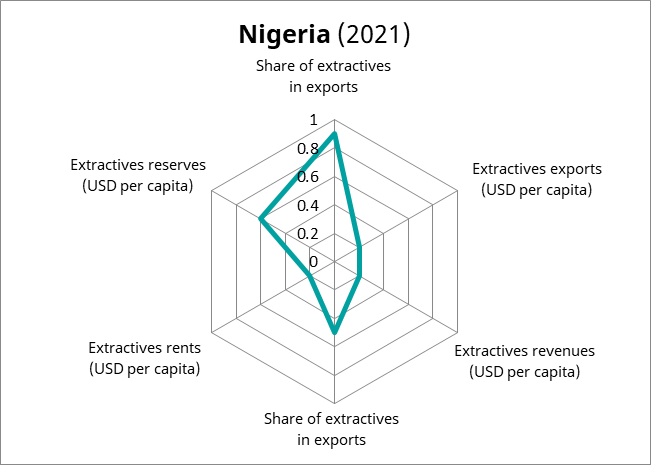
Nigeria ranks as the world’s 12th largest producer of oil and holds the largest natural gas reserves in Africa. Though the country also holds reserves of a variety of minerals (especially iron ore), the mining sector remains nascent, with insignificant contributions to the country’s export basket and fiscal revenues. As of 2021, Nigeria displayed a heavy dependence on oil and gas, but with relatively modest resource production per person, given the country’s large population. As can be seen in the figure below, in per capita terms, Nigeria has low extractive resource production (as approximated by rents), exports, revenues and reserves, but nevertheless a high share of extractives in total exports. Nigeria therefore should shift its focus from simply diversifying within the oil and gas sector to broadening its overall economic landscape. With a large and rapidly increasing population, relying solely on linkage development around oil and gas on e.g., processing oil and gas in-country may not meet diversification needs.
Unlike countries that are dependent on a variety of extractive resources, Nigeria’s over-reliance on oil and gas also exposes the country to severe risks related to the energy transition. Nigeria ranks 3rd globally for the highest carbon intensity in gas production and 22nd for oil. As carbon taxes rise, and consuming firms and investors increasingly prefer oil and gas that was produced with fewer emissions, Nigeria’s dependence on its relatively dirty oil and gas sector puts it in a challenging spot, underscoring the urgency with which government officials and other stakeholders should rethink its resource strategy.
Lessons multi-resource abundance: Colombia and Mongolia
The challenges of resource-based development can be very different across extractive sectors even within the same country. It can therefore be helpful to look at how a country’s resource wealth is divided between different extractive commodities. The cases of Colombia and Mongolia are informative in this regard.
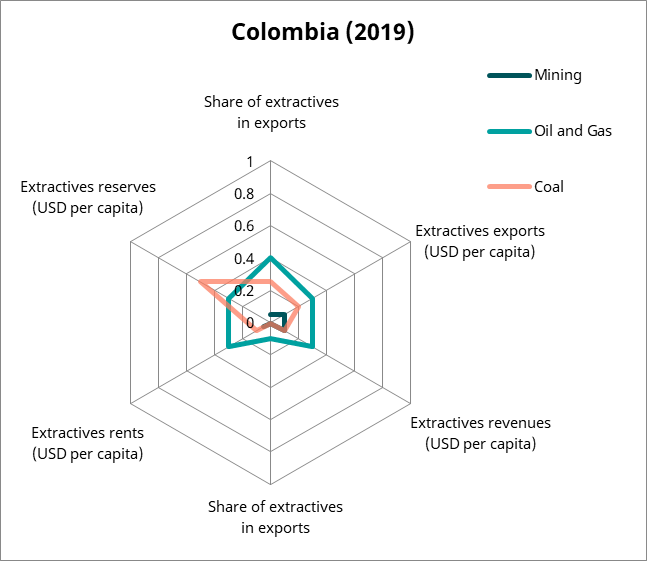
Though Colombia holds and extracts minerals (such as ferronickel and gold), fossil fuels make up the bulk of the country’s extractive resource wealth, with coal reserves estimated to be more valuable (at current prices) than its oil and gas reserves (though coal currently provides a much lower contribution to fiscal revenues and the export basket). Coal is most at risk of becoming a “stranded asset” (i.e., it is no longer commercially viable to produce it), followed by oil. So even though Colombia’s extractive resources are diversified between oil, gas and mining, most of its resource wealth will be threatened by the energy transition to green technologies. This is all the more important because some regions of Colombia depend heavily on coal.
Mongolia is endowed with a variety of extractive reserves, particularly gold, copper, coal and iron ore. Among these, coal is most at risk of becoming a stranded asset due to the energy transition.
Although the graphic below shows that Mongolia’s fossil fuel exports were slightly higher than mining exports (in 2018), the country’s MINDEX scores reveal that the broader economic weight and potential of the non-coal mining sector exceeds that of the country’s fossil fuel industry. Furthermore, Mongolia’s mineral reserves (not including coal) are considerably more valuable than the country’s fossil fuel reserves. In the future, the non-coal mining sector to will likely overtake fossil fuels as a main source of exports, especially as demand for coal declines with the energy transition.
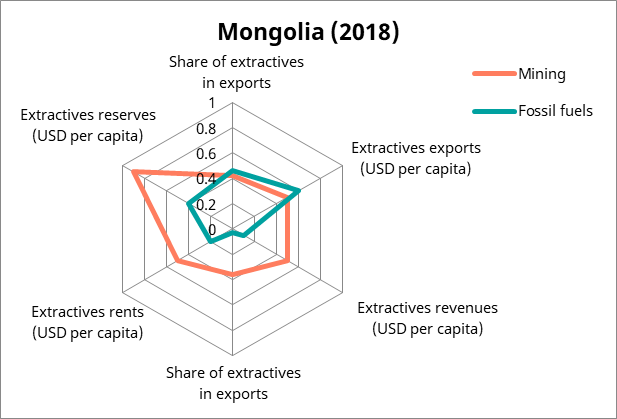
NB: in this figure, coal is classified as a fossil fuel rather than part of the mining sector.
Assessing policy changes amid evolving resource dynamics: Democratic Republic of the Congo
The DRC’s economy is highly dependent on the extractive sector. Extractives account for as much as 99 percent of the country’s exports in some years. Time analysis of the DRC’s MINDEX scores suggest that more resource revenues accrued to the government of DRC in 2014 than in 2010. This could be explained by the efforts from government to encourage more investment in mining, notably through a mining code revision process that began in 2012. However, resource production remains extremely low in comparison to the value of extractive reserves and the level of export dependency on extractives, suggesting that extraction capacity may be limited, or that there could be smuggling of extracted commodities.
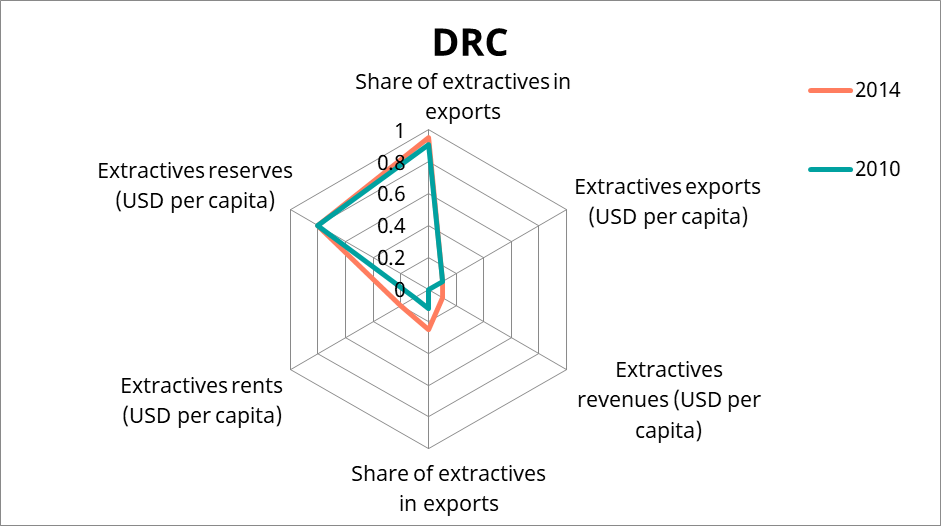
In conclusion, examining the different dimensions of extractives dependency can help us to understand the challenges facing resource-producing countries, and how to address them. The country profiles mentioned above present these kinds of insights, as well as a template for analyzing a country’s resource dependence.
For further information about the MINDEX, consult this published study.
Introducing NRGI's Fresh Look and New Website
Notice something different? Today we at NRGI are thrilled to share a crisp new visual brand.
In light of dramatic global developments, from the pandemic to the intensifying climate crisis, we have steadily transformed our strategy, approaches and partnerships. We are harnessing our longstanding strengths—collaboration and evidence-driven rigor—in pursuit of a world where natural resources enable fair, prosperous and sustainable societies, instead of undermining them.
Our fresh look reflects an evolved NRGI, at the leading edge of resource governance for a new era.
Today we also unveil a bold and dynamic new website. Those seeking analytical insights into the critical issues affecting resource-rich countries will find them in a variety of languages and media. Learn more about us, explore NRGI’s impacts, browse a trove of our analysis and data tools, find new learning opportunities, and read or listen to commentary from experts and changemakers.
Humanity needs critical advances in democratic accountability, sustainable development and climate action. Resource governance expertise is a crucial input to that progress. Our new online home will help us reach and partner with those whose decisions or advocacy determine whether people in resource-rich countries suffer or thrive.
We are enthusiastic about investing in people, shifting power and shaping policy. We look forward to your partnership as we continue to support informed, inclusive decision-making about natural resources and the energy transition.
2021 Resource Governance Index: Common Questions & Answers

Thousands tuned in to our only country-specific launch events. The 2021 RGI prompted commentary pieces and received print, online and TV coverage in dozens of outlets. Civil society organizations (CSOs), government officials and industry experts have shown widespread interest in how countries govern their extractive sectors.
Since the publication of the first 2021 RGI country assessment, we have received numerous comments and questions about various aspects of the index. We publish the RGI because transparency and accountability in the extractive sector are key to ensuring people receive lasting benefits and experience reduced harms from their country’s extractive sector. NRGI is committed to ensuring that the RGI is fully transparent, by publishing the methods we use and the underlying data and supporting documentation for each assessment. Many interesting questions have come up, so here we answer some of the most common.
Use the links below to navigate to the answers.
- How were the researchers selected?
- How were the assessed countries and sectors selected?
- What was the time period under assessment?
- Were governments involved in the research process?
- What does the RGI measure?
- Is the RGI technical or perception-based?
- Why are some parts of the RGI not applicable in certain contexts?
- How is the “enabling environment” component calculated?
- Does the RGI assess any new topics? Are there any areas that are not covered?
- How can the RGI be used by civil society and accountability actors pushing for change?
- Does the NRGI follow up with governments to ensure that the RGI’s recommendations are implemented?
Research process
How were the researchers selected?
In mid-2020 we began the recruitment process for researchers and peer reviewers, including in most countries an open call for consultants in each RGI country assessed. We interviewed and selected researchers who best met the following three standards:
- A citizen or person with good working knowledge of the country they were to assess.
- Excellent knowledge of resource governance issues.
- Independence from the government or extractive companies.
The names of the researchers and peer reviewers are published on the RGI website (we have withheld the names of those who requested anonymity). Researchers then answered the RGI questionnaire, which through almost 200 questions assesses the state of resource governance in the country and sector (either oil and gas, or mining). Upon the completion of the research phase, NRGI’s country and subject matter experts and the RGI project team thoroughly validated the findings of the researchers and peer reviewers.
How were the assessed countries and sectors selected?
Several factors played a role in selecting the countries for the 2021 RGI.
- Is the country one where NRGI operates?
- Does the country have an extractive sector that either already plays a significant role in the economy, or is expected to do so in the coming years?
- in the case of the mining sector, is there a particular mineral that plays a special role in the country’s economy, strategic considerations, or future potential?
As a result, we chose to focus on 18 countries, assessing half on both their mining and oil and gas sectors. The 2021 RGI includes assessment of 28 oil, gas and mining sectors in total. A map of country coverage in the 2021 RGI can be viewed here.
What was the time period under assessment?
Research on the 2021 RGI took place between the end of 2020 and2021 Q1. In order to ensure consistency across all the countries assessed, researchers and peer reviewers only noted developments in resource governance until 31 December 2020. The 2021 RGI does not therefore capture any policy changes or disclosures that took place after this date.
Were governments involved in the research process?
Governments were not involved in the primary data collection process and had no say in determining the final answers and scores. In some cases, where NRGI country experts were able to do so, we provided preliminary answers to governments, civil society organizations and/or international organizations. If they provided feedback and presented new information on specific answers, we independently reviewed and verified their accuracy and adjusted the validated scores where relevant. As with the answers to every question in the RGI questionnaire, we also required and verified the supporting documentation, ensuring its public availability.
Methodology and calculation
What does the RGI measure? What does it not measure?
The RGI defines resource governance as the rules, disclosures, practices and oversight procedures and enabling environment governing countries’ extractive sectors. The RGI focuses on transparency and accountability. Therefore, all information the answers are based on must be publicly available. The RGI is the most comprehensive data-driven tool assessing extractive sector governance, but it is important to point out what the index does and does not measure:
| What the RGI measures | What the RGI does not measure |
|---|---|
| Rules, laws, regulations or policies relevant to countries’ extractive sectors |
Appropriateness of a particular country’s policies. For example, we evaluate the processes and practices that are undertaken to ensure a state-owned enterprise (SOE) is well-governed. However, we do not assess whether it is appropriate for the country to have an SOE in the first place. Areas that cannot be standardized or where approaches to research are lacking, e.g., international tax treaties. |
| Disclosures of data, transparency of processes and availability of documents related to the extractive sectors | |
| Oversight, including processes such as audits and appointments of independent bodies | |
| Wider governance metrics that enable or hamper the effectiveness of resource-specific sectors | External factors such as commodity prices and access to international markets. |
Is the RGI technical or perception-based?
The first two components of the index, which are derived from the RGI questionnaire, are technical assessments of resource governance. The third component, Enabling Environment, includes some perceptions data on the broader governance framework.
As mentioned in the question immediately above, the RGI focuses on the rules and laws in place, as well as the corresponding disclosures of information in practice. The first two components of the RGI, value realization and revenue management, focus solely on publicly available, measurable, technical aspects of countries’ resource governance. The third component, the enabling environment is calculated using data from the Worldwide Governance Indicators, which focuses on countries’ general governance in key areas, and from the Open Data Inventory, which assesses the coverage and openness of governments’ data portals.
Why are some parts of the RGI not applicable in specific contexts?
The RGI questionnaire is designed so that the questions posed apply to both the mining and oil and gas sectors in all countries. Nevertheless, not every country manages its extractive sector in the same way, and in some countries, certain institutions might not (or not yet) exist. This applies mostly to state-owned enterprises, subnational resource revenue sharing mechanisms and sovereign wealth funds. In countries where extractive sectors are in the pre-production phase, certain questions related to production or exports may not be relevant. In cases where institutions do not exist or local conditions are different, we mark these questions as not applicable, which means that the sections do not receive a numerical score. The question/section is then excluded from the calculation of the average score to ensure that the country’s overall score is not affected by the absence of these institutions.
How is the “enabling environment” component calculated?
We take the raw data for the enabling environment from the Worldwide Governance Indicators (WGI) and Open Data Inventory (ODIN). We then convert it to the rest of the RGI structure, using a data processing method called “percentile rank normalization.” Below we show what this means in practice, using Senegal’s “control of corruption” subcomponent of the WGI data as an example:
| Step: | Senegal - Control of Corruption | Comments on data processing |
|---|---|---|
| 1. Raw value | 0.0484844 | We take the “estimate” data point from the WGI database, which is 0.0484844. WGI “estimate” data is on a scale of -2.5 to 2.5. Given that the rest of the RGI is on a scale of 0-100, we need to convert this number. |
| 2.Ranking | Position 71 / 84 | We take the above number and rank it within the sample of 84 countries that appeared in the 2017 and 2021 editions of the RGI. Where 1st is the worst and 84th is the best, Senegal’s control of corruption places as the 71st out of the 84 countries surveyed. We retained 84 countries to maintain comparability with the 2017 RGI data for this component. |
| 3. Percentile rank normalization | 84.52 | We then convert this position to a percentile rank, calculated as 84.52. This is the percentile rank of Senegal’s control of corruption out of the RGI sample of countries. |
| 4. Rounding to obtain final score | 85 | We round this number to the nearest whole number to obtain the final score of 85 that Senegal receives for this subcomponent. |
Data and the entire calculation process for each country’s enabling environment can be found on the RGI website.
Does the RGI assess any new topics? Are there any areas that are not covered?
During data collection for the 2021 RGI, NRGI also collected answers to pilot questions related to the energy transition, economic linkages and local content. While the answers to these questions did not count toward countries’ overall scores in this year’s version of the index, the results provided important findings on how countries are preparing for the energy transition, the extent to which governments and SOEs are disclosing extractive sector climate-related information, and what policies govern their thinking on economic linkages such as local content or domestic processing and use of minerals, oil or gas. We have previously tested questions about some aspects of the gender dimension in the extractive industries, and as an organization, we have done research on gender inequality and published several pieces of research on the topic. However, we are still exploring how best to incorporate gender issues into the RGI.
The local economic impact of natural resource extraction is another area we have received questions about, however, to date we have not identified a relevant governance measurement to include in the index. While the RGI is the most comprehensive measure of resource governance available, some areas have insufficient elements of governance that are measurable or require research not feasible within the current context and timeframe.
Impact
How can the RGI be used by civil society and accountability actors pushing for change?
We produce the RGI primarily as a country- and sector-level diagnostic tool, and roadmap for policy and practice reforms. Through in-depth research and analysis, the RGI identifies and highlights some of the most pressing issues in resource governance. We frequently collaborate with civil society organizations in our countries of operation, so they can use the RGI as a robust evidence base to advocate for change.
CSOs can use the RGI to bolster existing advocacy for governance improvements in a specific topic. In Guinea, for example, the 2019 RGI interim assessment highlighted the implementation gap in subnational transfers of mining revenues to municipalities. Civil society organizations were able to strengthen their advocacy efforts, which helped to ensure that the government implemented these provisions from December 2019 onwards.
CSOs have also utilized the RGI as a monitoring tool for specific public bodies. For example, although the RGI covers one SOE per assessment, advocates can use the RGI questionnaire themselves to assess multiple SOEs. In 2018, a group of CSOs in Mexico combined information from the 2017 RGI and NRGI’s SOE Disclosure Guide to develop a methodology for monitoring energy SOEs in the country. in the country.
The RGI provides CSOs with a starting point for discussions and evidence of the need for working groups or committees, either with the government or as a group of CSOs. We have seen in several countries that the RGI can be utilized as a collective focal point for the state of resource governance in a country to help kick-start successful collaborations.
Does the NRGI follow up with governments to ensure that the RGI’s recommendations are implemented?
While the RGI provides a data-driven, robust view of resource governance in the countries assessed, we see this as only the first step in the process. We are using NRGI’s networks and convening capacity to ensure broad stakeholder involvement in implementing the RGI recommendations. We tailor methods for government involvement and follow-up that are specific to each country. Many RGI launch events included the participation of government representatives as participants and keynote speakers. Bilateral engagements with government departments will be ongoing as NRGI’s country experts continue to use the RGI to advance programming and support our mission. Change and impact take time to materialize. The 2017 index has led to many concrete and tangible impacts on improving resource governance worldwide. While it is still early to assess the impact of the 2021 RGI, the analysis has already led to information disclosure in several countries and has featured in calls by policymakers to reform various aspects of their resource governance.
Of course, the above might not answer all the questions you might have about the 2021 Resource Governance Index. If you have any questions which we have not addressed, please reach out to us at index@resourcegovernance.org.
The RGI is a free data tool that helps key stakeholders to better understand the state of resource governance in countries around the world.
Reforming National Oil Companies: Nine Recommendations
Some national oil companies (NOCs) have contributed heavily to successful efforts to harness benefits from the oil sector and drive broader national development. In other cases, however, NOCs have become inefficient managers of national resources, obstacles to private investment, drains on public coffers, or sources of patronage and corruption. As such, NOC reform—incremental in some cases, fundamental in others—lies at or near the top of the policy agendas of many oil-rich countries.
Building on existing literature, we surveyed 12 NOCs from diverse geographical and operational contexts to distill practical steps that policy-makers can take to make their countries' NOCs more effective and more accountable—to governments and to citizens. Our recommendations can be seen in both the executive summary and the full report.
The report's recommendations are based on the experiences of the following national oil companies:
- GNPC (Ghana)
- KMG (Kazakhstan)
- Petronas (Malaysia)
- Petrobras (Brazil)
- Saudi Aramco (Saudi Arabia)
- Sonangol (Angola)
- NIOC (Iran)
- NNPC (Nigeria)
- Pemex (Mexico)
- Statoil (Norway)
- PetroVietnam (Vietnam)
- SNH (Cameroon)
The nine recommendations for companies and the authorities who oversee them— described in detail in the report—are:
| Recommendation | Core features | |
| Defining and financing a commercial mandate |
1. Carefully define commercial and non-commercial roles. Limit non-commercial activities where sophisticated or expensive commercial activities heighten the risk and cost of conflicts of interest. |
|
|
2. Develop a workable revenue retention model. |
|
|
|
3. Procure external financing by listing some NOC shares on public stock exchanges or issuing external debt where appropriate. |
|
|
| Limiting political interference in technical decisions |
4. Define clear structures and roles for state shareholders. |
|
|
5. Empower professional, independent boards. |
|
|
|
6. Invest in NOC staff integrity and capacity. |
|
|
| Ensuring transparency and oversight |
7. Maximize public reporting of key data. |
|
|
8. Secure independent financial audits, and publish them. |
|
|
|
9. Choose an effective level of legislative oversight. |
|
|
The Resource Governance Index Drives Reform in Uganda

In 2021, NRGI published RGI assessment results for 18 countries including Uganda, where it assessed both the mining and oil and gas sectors.
The challenge
The RGI assessment revealed two significant challenges in Uganda’s extractive sector.
First was the absence of fiscal rules governing revenue withdrawals from the Petroleum Fund. Once Uganda begins oil production, the resulting revenues will be deposited into the Petroleum Fund, held at the Bank of Uganda. Withdrawals from the Petroleum Fund will flow to the Consolidated Fund (to finance infrastructure and development). The remaining balance will be transferred to the Petroleum Revenue Investment Reserve (a sovereign wealth fund) to be invested outside the country. Fiscal rules would set guidelines on how much can be transferred to the Consolidated Fund for budgetary spending and how much should be transferred to the sovereign wealth fund. Resource-rich countries without relevant fiscal rules risk that political pressure results in pro-cyclical budgetary spending, which increases or decreases with volatile oil prices. This in turn risks a scenario in which the government fails to save any revenues in the sovereign wealth fund.
Second, NRGI’s assessment highlighted the absence of laws requiring the disclosure of the identities of beneficial owners of extractive companies. Such laws enhance transparency and accountability and mitigate corruption. Without them, Ugandans cannot know who ultimately owns the companies that benefit from extraction, and some extractives companies may evade taxes payments or hide improper relationships with powerful decisionmakers.
With low scores of 55 and 49 (out of 100) in the mining and oil and gas sectors respectively, the RGI results highlighted the pressing need for reforms in Uganda’s extractive sector and the need for greater transparency and accountability to ensure that resource revenues benefit Ugandans.
NRGI’s role
In response to its findings, NRGI recommended several key reforms to the Ugandan government. Among them, NRGI suggested making the identity of beneficial owners of companies engaging in extractive projects publicly available and implementing robust numerical rules governing deposits to and withdrawals from the Petroleum Fund, as well as firm rules governing the investment of oil revenues.
By providing technical assistance and financial support, NRGI played a critical role in driving engagement for these reforms. Between February and June 2022, NRGI prioritized engagement with the Ugandan government to push for the implementation of these recommendations. NRGI staff also met with key stakeholders, including the Ministry of Finance, civil society organizations and media partners such as CSCO, ACME and CSBAG, to develop capacity on transparency and accountability, petroleum revenue management, beneficial ownership disclosure and fiscal rules.
Impact
NRGI’s engagement with the government of Uganda resulted in significant legal and institutional policy reforms. Following a series of strategic meetings between NRGI and the Ministry of Finance, Planning and Economic Development, and in collaboration with the International Monetary Fund, the government of Uganda adopted fiscal rules for petroleum revenue management. The rule adopted by parliament provided that: “A maximum of oil revenue worth 0.8% of the preceding year’s estimated non-oil GDP outturn shall be transferred to the Consolidated Fund for budget operations. The balance shall be transferred to the Petroleum Revenue Investment Reserve (PRIR) for investment in accordance with the Public Finance Management Act (2015) as amended.” (Objective 3 of the CFR 2021-2025).
NRGI’s engagement with the government of Uganda resulted in significant legal and institutional policy reforms.
In addition, following NRGI’s engagement with the Ministry of Energy and Mineral Development and the Uganda National Oil Company, the parliament amended Uganda’s Companies Act to include a requirement for companies, including those in the extractives sector, to disclose their beneficial owners. The successful implementation of these amendments could serve as a catalyst for addressing potential corruption and elite capture of Uganda’s extractive sector.
These reforms are timely, given that Uganda is undergoing a major extractive sector transition, with the government keen to unlock the sector’s potential while avoiding the “resource curse.” NRGI’s analysis provided policymakers and citizens with a measurable lens through which to understand trends in performance and gaps, enhancing transparency and accountability in the extractives sector.
NRGI will continue to engage civil society organizations and other stakeholders to enhance their understanding of the rationale and importance of fiscal rules to better hold the government to account and ensure that the government adheres to the beneficial ownership provisions in the Companies Act.
ResourceData.org
2021 Resource Governance Index
The Natural Resource Governance Institute (NRGI) is committed to increasing transparency and accountability in the extractive sector. One of NRGI's flagship contributions in pursuit of this mission is the Resource Governance Index (RGI), a free data tool that helps key stakeholders—government officials, staff at civil society organizations, oversight actors and private sector executives—to better understand the state of resource governance in countries around the world. But understanding resource governance is only the first step. NRGI produces the RGI as a global benchmark, country and sector diagnostic tool, and a roadmap for policy and practice reforms at the global, regional and country levels.

NRGI last released the index in 2017, empowering and enabling public officials, communities and organizations to push for greater transparency, accountability, and reform within the oil, gas and mining sectors. This year NRGI took a new approach, with the staggered release of country assessments over several months, and the publication of analysis of the assessments as a group in December 2021.
Country assessments
Measuring Extractives Dependency: Why it Matters and New Approaches

These include:
- The volatility of natural resource commodity prices, which can cause shocks that are difficult for the country to manage
- The exhaustibility of natural resources and the challenges of replacing them as a source of income when they run out
- The political economy of governments relying on natural resources, which seems to make governments less effective (e.g., if they rely on resource wealth to fund themselves rather than developing other sectors of the economy)
To address resource dependency, we need to be able to measure it. With this in mind, NRGI has produced a new dataset that builds on existing literature to provide a broad range of indicators of dependency on the extractive industries. This dataset is primarily for internal use by NRGI colleagues, but is also freely available to interested researchers.
The aim of this dataset is to support a more multidimensional approach to understanding resource dependency, its causes and consequences. The related briefing explains the rationale behind the dataset and its various indicators, and some includes some initial insights based on analysis of the data.