
Corruption in Mineral Value Addition: Why It Matters

Many mineral-producing countries are pursuing value addition to capture more economic benefits from mining and strengthen their position in global supply chains. This briefing examines how corruption can undermine those ambitions—making value-addition efforts less fair, less reliable and more costly—and outlines practical steps to manage the risks.
Key messages
Value addition can make mineral supply chains fairer and more reliable—if decisions are made with integrity.
Corruption in mineral value addition is occurring across a wide range of countries, minerals and technologies, yet anticorruption is missing from many current initiatives. In some contexts, it is being actively weakened.
Politicians and companies in many countries are promoting value-addition projects that are unlikely to happen or to be economically viable. These claims deserve scrutiny.
Corruption in value addition undermines fairness by funneling wealth and opportunities to a privileged few, while harming vulnerable communities.
Corruption can also make mineral supply chains less reliable, delaying projects, discouraging investment and cutting output.
Governments, companies, investors and international initiatives can take concrete steps to mitigate corruption risks in mineral value addition.
This briefing explores how corruption can undermine efforts to promote mineral value addition, a growing priority for mineral-producing countries amid the energy transition and shifting geopolitical dynamics. Using real-world examples across regions, minerals and processing stages, it examines how corruption distorts policy choices, project selection and implementation, with consequences for fairness, public revenues, investment and supply-chain reliability. The briefing concludes with practical recommendations for governments, companies, investors and multilateral organizations.
Stopping a False Start: Identifying Corruption Risks in Ghana’s Nascent Lithium Sector

Key messages
- As lithium demand grows to meet global electrification ambitions, new producers like Ghana are entering the market. Yet insufficient attention to the corruption risks in the sector—particularly in licensing and revenue collection decisions—could undermine these efforts.
- Corruption cases from other lithium producers, both new and old, have shown many familiar risks, such as licensing irregularities and opaque pricing structures.
- There are also pertinent lessons from elsewhere in Ghana’s mining sector, where cases involving bribery, favoritism, politically exposed persons and failures to follow award processes have caused harm.
- By acting now to strengthen transparency, ensure fair processes and bolster enforcement, Ghana can ensure that its lithium sector avoids previous pitfalls experienced elsewhere in the country’s mining sector and by other lithium producers.
Introduction
Ghana’s mining sector is expanding from gold to green. The country is ramping up production of key minerals needed for the energy transition, with lithium at the center of this plan. Since the first deal was proposed in 2024, Ghana has debated how to learn from past mistakes and ensure that the lithium deal best serves the country. Yet one element that could undermine this ambition has received insufficient attention: the risk of corruption.
We know that corruption is a high risk across transition minerals. NRGI’s research has identified over 50 cases of corruption risk in the licensing and contracting stage alone, and similar problems in the midstream part of the value chain.
In other lithium producers, both new and old, we have seen how corruption has meant that citizens have received fewer benefits from mining, while communities and nature have suffered. Common corruption risks have appeared across countries, such as licensing irregularities, opaque pricing structures, and the involvement of people or companies with a worrying track record.
Drawing on evidence from elsewhere in Ghana’s mining sector, and the experience of other lithium producers, we outline key corruption risks below, the risk factors that make them more likely to occur, and initial ideas for how to tackle them.
Preventing Corruption in Africa’s Transition Mineral Supply Chains

Key Messages:
- The current increasing attention to Africa’s mineral resources could attract much needed investment to the continent or power broader development goals, but many citizens view the prospect of a new mining boom with suspicion. The sector has become synonymous with harmful and costly corruption, often perpetrated by wealthy elites and foreign companies who are able to avoid its worst impacts.
- At the same time, anticorruption actors should be alert to new or shifting dynamics, such as the greater emphasis on value addition, or challenges around access to financing. They should also devote more attention to issues that have long been overlooked, such as the intersection between corruption and other types of harm in the mining sector.
- Failure to properly address corruption and its causes and consequences will only lead to more harm and instability, both for African countries and across the mineral supply chains needed to power the green transition.
- Tackling these issues effectively requires a deep understanding of the specific nature of corruption in each country, yet the drivers of corruption often have global roots. Long-lasting solutions to corruption must therefore be a shared responsibility between African leaders, decision-makers in major market jurisdictions, multilateral actors such as the African Union and the African Development Bank, companies across the supply chain, investors and the donor community.
- Addressing this corruption is therefore crucial, to avoid the injustices of the past. Many of the risks are well known, surrounding political access and civic space, licensing and contracting processes for mining projects, the role of state-owned enterprises (SOEs), and processes for collecting revenues from the sector. This means that there are important lessons to learn from the efforts of reformers across the continent and beyond to tackle these harms.
The global energy transition is driving unprecedented demand for Africa’s vast mineral wealth. From cobalt and manganese to lithium and copper, the continent holds some of the world’s most critical reserves needed to power clean energy technologies. Yet Africa’s mining history tells a troubling story: while its resources have fueled development elsewhere, too often African countries and communities have been left with little more than environmental damage, economic inequality, and social unrest.
As competition for Africa’s minerals intensifies, there is a serious risk that corruption will once again take root, deepening injustice and undermining the promise of a just transition. Past booms have shown how fast-paced dealmaking and weak oversight can open the door to graft, while local populations face forced relocations, land loss, health crises, and worsening environmental degradation. Without stronger governance, today’s green energy revolution could create a new form of green colonialism, where Africa’s resources are exported to decarbonize wealthier economies, but the benefits never reach those who need them most.
This briefing draws on NRGI’s experience across resource-rich African countries to examine the key corruption challenges in the mining sector - from licensing and contracting to state-owned enterprises and revenue collection. It highlights urgent risks and opportunities for reform, offering practical steps for governments, civil society, and international partners to ensure that Africa’s minerals power not only the world’s energy transition, but also a fairer, more sustainable future for the continent itself.
Corruption and Mining: Hidden Harms to People and Planet

As demand for transition minerals grows, the hidden costs of corruption are mounting. Decisions about mining — whether it should happen, where and how — are too often distorted by vested interests, undermining safeguards for communities, Indigenous Peoples and the environment.
This video highlights the findings of our joint briefing, Digging Into the Problem, which explores how corruption fuels socioenvironmental and human rights harms in mining, and what must change to build responsible and secure supply chains.
Digging Into the Problem
How corruption facilitates socioenvironmental, human rights, and Indigenous Peoples’ rights harms in the mining sector

Key messages
- As more mining takes place across the globe, the social, human rights and environmental harms associated with the sector are also growing. Corruption plays an essential, but often overlooked, role in facilitating, obscuring, and preventing accountability for these harms, particularly in mining for in-demand transition minerals and gold.
- This corruption can manifest in different ways depending on the form of mining and stage of the process. It may impact the political economy of mining countries or regions, undermining the legal frameworks that regulate the sector and leading to shrinking civic space. Decisions about whether mining should go ahead may be stacked in the favour of vested interests, while corruption in the operations of mines can lead to significant harm to workers, communities, and nature. Harm may also continue after the mining process, with corruption redirecting essential revenues and leading to poor mine closure practices.
- Ambiguous legal frameworks, weak governance, political transition or instability, geopolitical competition, and high demand and commodity prices all drive this corruption, often leading decision-makers to prioritize economic and supply security concerns over the needs of communities and nature.
- Although the harm of this corruption is often experienced primarily at the community level, it often has global roots. Addressing this problem therefore requires greater action from actors with leverage over mineral supply chains. Governments in major market jurisdictions should strengthen the enforcement of anticorruption legislation, pass corporate mandatory due diligence legislation that addresses corruption risks in the whole supply chain, and implement policies to reduce the overall demand for minerals. Downstream companies should do more to hold actors in their supply chain to account for corruption allegations, and international and multilateral bodies should better connect their agendas on fighting corruption, tackling climate change and biodiversity loss, and upholding human rights and Indigenous Peoples’ rights.
- To combat corruption effectively, it is essential to recognize that environmental justice and Indigenous Peoples’ rights are inherently linked. Equitable resource governance that respects Free Prior and Informed Consent (FPIC), ensures land tenure security, and integrates Indigenous stewardship not only reduces corruption risks but also protects biodiversity and supports sustainable practices.
Mining in its myriad forms is experiencing tremendous growth, against a backdrop of growing global inequality, transnational crime and geopolitical tension over future energy security. Yet this growth has also brought challenges, as corruption flourishes and enables a host of socioenvironmental and human rights harms.
Within this context, two areas emerge where the intersection between corruption and broader harms is particularly clear: transition minerals and gold mining. While many of the forms of corruption outlined in this briefing could apply across the mining sector, we highlight cases linked to these commodities because of the acute nature of demand for these products, the vulnerability of their mining processes to corruption and crime, their links to informal mining (often involving marginalized groups) and, crucially, the harms they pose to people and to nature.
Minerals with key applications in the renewable technologies and electrification of transport needed to deliver the energy transition (“transition minerals”) are receiving significant attention from policy-makers worldwide, who are concerned for future energy security. The International Energy Agency estimates that to meet the goals of the Paris Agreement, the next two decades will need to see an increase of 40 percent in rare earth elements, 60-70 percent in nickel and cobalt, and around 90 percent in lithium. However, it is important to note that these predictions are not a foregone conclusion. Shifting towards a circular economy—emphasizing mineral recycling, reuse, and efficiency improvements—can help reduce the reliance on new mining. With heightened pressure to meet growing demand, there is a real risk that corruption will increase commensurate to growth in these supply chains. The push for more mining can lead to corruption at the extraction stage, such as bribery or the manipulation of licenses, which can have far-reaching consequences in downstream industries, such as electronics, electric vehicle manufacture and other renewable energy industries.
At the same time, extremely high prices have also driven an explosive increase in gold mining. Gold bullion’s price gained 40 percent in the last year alone, reaching record highs in October 2024. The increase in gold mining has been particularly clear in the informal sector, where there are often fewer protections for workers, local communities and nature. In many cases, gold has provided an easily-laundered alternative to illicit commodities for organized crime groups or militias, with widespread consequences for the rule of law and the likelihood of conflict, violence and human rights violations.
As mining expands to meet demand, many actors have described the real consequences of its scale. In September 2024, Global Witness identified mining as the sector most associated with the killing of environmental and land defenders. Similarly, the Business and Human Rights Resource Centre (BHRRC) has consistently found mining to be the most dangerous sector for human rights defenders, documenting 630 allegations of human rights abuses over a 13-year period associated with transition minerals alone. These harms extend to nature—WWF has shown that current mining impacts up to one third of global forest ecosystems.
A key enabler of the profound harm mining does to people and nature is corruption—too often seen as a victimless crime or even as the inevitable ‘cost’ of doing business. Corruption diverts resources from service provision, undermines oversight institutions, the rule of law, and the state’s ability to uphold human rights, while being flagged as key to environmental crime. Such corruption also can undermine political stability, and it may even become profitable for some to retain levels of instability. The Natural Resource Governance Institute (NRGI) has identified over fifty cases of corruption in licensing and contracting of transition minerals projects.
These harms disproportionately impact Indigenous Peoples and local land-connected communities and lead to acute effects for women, children, and other vulnerable groups. Researchers from the University of Queensland have identified that 54 percent of energy transition minerals projects are found on or near Indigenous Peoples’ lands. Environmental justice and Indigenous Peoples’ rights are inseparable, as both are rooted in the equitable governance of natural resources. Indigenous Peoples are not only rights-holders but also stewards of nature, with their territories holding a majority of the world’s biodiversity. Upholding Indigenous Peoples’ rights is essential to addressing the harmful socioenvironmental impacts of mining.
Appreciating the risks associated with the growth in mining, in September 2024, the U.N. Secretary General launched principles to promote justice and equity in energy transition mineral supply chains, focusing on human rights, Indigenous Peoples’ rights, environmental protection, biodiversity and anticorruption measures. At the biodiversity COP16, the Colombian government launched an initiative to push for a new binding global treaty on traceability in mineral supply chains.
While such global policy developments help draw attention to these issues, their impact will depend on how effectively their recommendations are implemented at local, national and regional levels, and within company policies. A further key element of their success will be the extent to which reforms address the interconnected nature of these issues.
Policy-makers must pay greater attention to the often-overlooked role of corruption in enabling human rights abuses, violations of Indigenous Peoples’ rights, and social and environmental harm, and take action to combat it. This briefing seeks to support this work, breaking down silos between communities of expertise in the mining sector. It highlights the many forms of harm that corruption causes across the mining process, whether large-scale or artisanal and small-scale, formal or informal, and offers recommendations for addressing these challenges. To truly tackle the harms caused by mining to people, planet and our ability to exist within planetary boundaries, policy-makers must also be bolder in questioning how much mining is necessary, balanced against the imperative to deliver an energy transition across the globe that is truly just.
Featured people

Susannah Fitzgerald
Critical Minerals Governance Senior Officer

Matthieu Salomon
Lead, Anticorruption
Red Flags, Green Future: Tackling Corruption in Mining Licensing

Conflicts over access to the minerals needed for the energy transition are sparking all over the globe, from geopolitical disputes to grassroots protests. Just last month, Global Witness reported more than 100 instances of mining-related protests and violence annually in the top ten producers of copper, cobalt, lithium and nickel alone. Much of this unrest centers on at least one of two critical questions: who has the rights to extract these minerals, and how are they treating nearby communities and ecosystems?
In most countries with transition minerals, mining cannot legally proceed without a license. For mining firms, securing a license can be a time-consuming and costly burden—one that can sometimes lead to corrupt practices. “Fast-tracking” licensing and permitting processes has become go-to of the mining lobby—and many companies have had success. In recent years, jurisdictions including the European Union, Norway and Brazil have announced new strategies or developed rules to deliver on this demand, with politicians in many more countries pushing for similar changes.
Yet, the steps in licensing processes that are the most time-consuming are often those that provide the best safeguards against the harms of mining for communities and nature. These include securing free, prior and informed consent (FPIC), carrying out meaningful community consultation, and conducting environmental and social impact assessments. Achieving efficiencies and better decision-making around licensing is possible—but it requires scaling up resources, facilitating better training, and ensuring knowledge transfer for ministries and officials, rather than cutting corners on these essential steps.
Red flags for corruption risk in licensing
At NRGI, our experience examining corruption in the high-risk licensing and contracting stages of the decision chain for extractives projects means that we watch these developments with interest—and no small amount of alarm. In part, this concern inspired our new research, launched today, on corruption risks in the licensing and contracting of transition mineral projects.
Our report, Ten Red Flags, draws on the methodology of our 2017 report Twelve Red Flags, which examined corruption risks in licensing and contracting across the extractives sector. Looking at 10 different transition minerals since 2010, we reviewed over 100 cases of alleged corruption, identifying 53 that met our evidence threshold across 30 countries. These cases occurred in high-, middle-, and low-income countries across five continents, and involved a diverse range of minerals. Alarmingly, we found that most countries with the largest transition mineral reserves have experienced cases of corruption. Nearly two-thirds of all reserves are in countries where corruption has been documented, and eight out of the 10 countries with the highest reserves had reported cases.
The risk of corruption in licensing and contracting is a global problem. The following countries appeared multiple times in our database as the home jurisdictions of companies involved in corruption cases: Australia, Canada, China, Russia, Switzerland, the U.K. and the U.S. There is an unfortunate tendency among higher-income countries like these, many of which depend on minerals sourced elsewhere to power their energy transitions, to see corruption as a problem of lower- and middle-income countries. Our findings firmly refute this narrative and reaffirm the shared responsibility of all countries to investigate and prosecute corruption, including foreign bribery.
Map: Corruption as a global problem
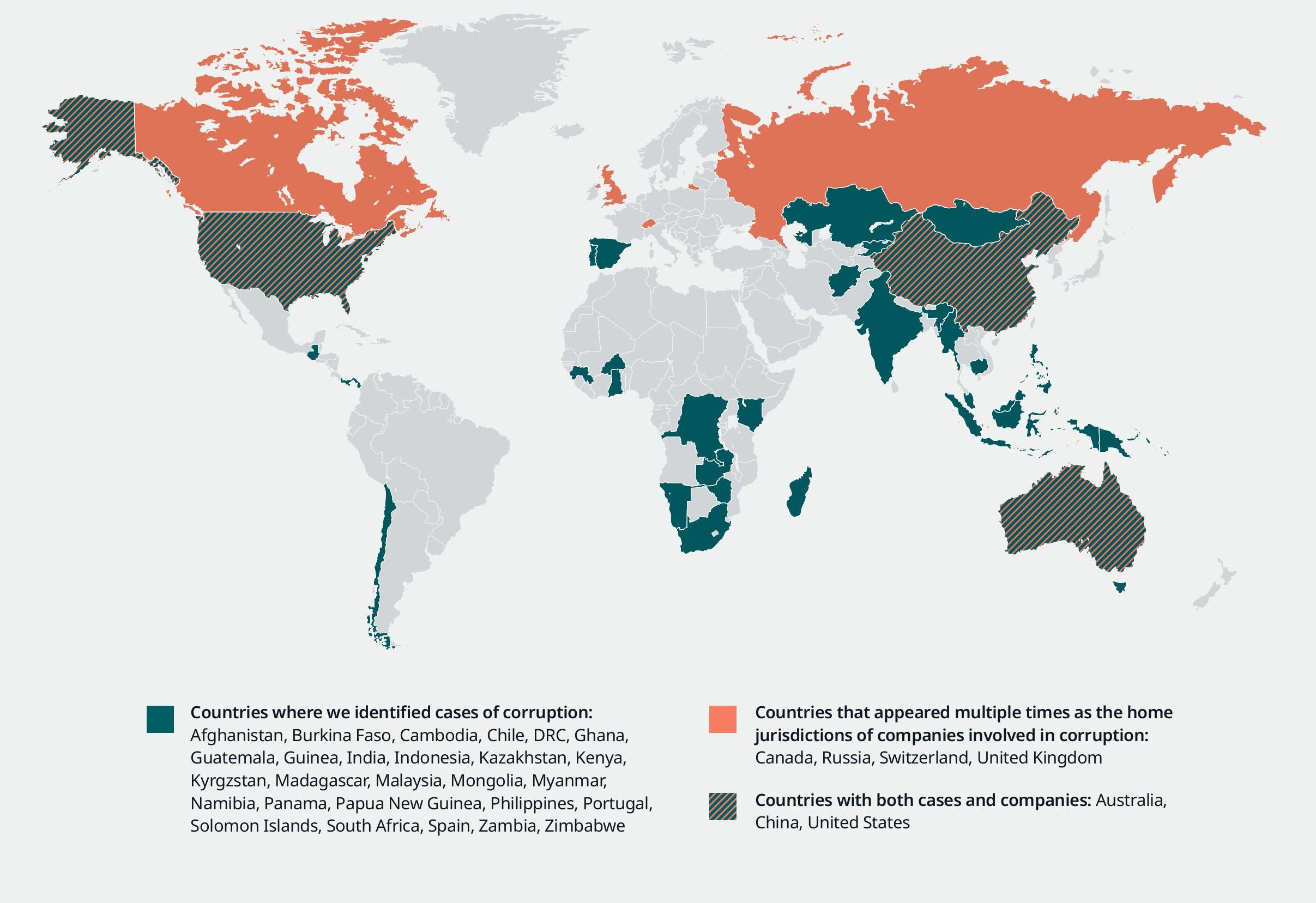
For each of these cases, we identified red flags that indicate corruption risk. These cover the types of companies granted licenses or contracts, the ways companies unduly influence decisions and decision-makers—often with implications for democratic processes—and how officials circumvent proper processes. While many of these corruption risks will be familiar to those working in the extractives sector, this report highlights emerging concerns, including the longer-term time scales of some corruption schemes, how corruption can flare up around elections, and its connection to social and environmental harms.
The consequences of corruption in licensing and contracting
The impacts of corruption are stark. Some government officials and mining company executives are already exploiting corruption around licenses and contracts to deny citizens and communities of their fair share of the benefits of mining transition minerals. With corruption starting in the licensing and contracting phase, companies are able to neglect and harm vulnerable populations and ecosystems with impunity. Corruption also delays mineral production, sometimes for years. In this way corruption in the licensing and contracting of transition minerals projects is actively undermining a just energy transition.
A swift transition away from polluting fossil fuels is essential to fight climate change, but this shift must also be just to ensure long-term sustainability and avoid breaching planetary boundaries. Decisions by authorities in producing countries about licensing and contracting process for new transition mineral extraction are integral to this effort. Authorities must take these decisions carefully to prevent mining communities, particularly in lower- and middle-income countries, from becoming sacrifice zones.
By providing officials, companies, regulators and enforcement agencies, civil society and journalists with the “clues” to identify corruption risks, we aim to contribute to the safeguarding of a just and equitable energy transition.
Corruption risks in transition minerals threaten a just energy transition
Learn about the ten red flags and how to address them.
Ten Red Flags for Corruption Risk in Transition Minerals Licensing and Contracting

Key messages
- Corruption in the licensing and contracting of transition minerals projects is undermining a just energy transition.
- Some government officials and mining company executives are already using corruption around licenses and contracts to deny citizens and communities a fair share of the benefits of mining transition minerals. Through corruption that starts in the licensing and contracting phase, companies are neglecting and harming vulnerable populations and ecosystems with impunity. And corruption is delaying mineral production, sometimes for years.
- Corruption in transition mineral supply chains is a global problem, with our study identifying 53 cases of corruption in 30 countries across five continents, involving a diverse range of minerals. Corruption cases have been documented in 8 out of the 10 countries with the highest levels of transition mineral reserves. The companies involved in these cases are often based in the world’s wealthiest or most powerful countries, including Australia, Canada, China, Russia, Switzerland, the U.K. and the U.S.
- Most of the corruption cases identified followed a familiar pattern, with red flags surrounding the types of company granted licenses or contracts, the ways in which companies have sought to unduly influence decisions and decision-makers—often with implications for democratic processes, and how officials have circumvented proper processes.
- Efforts to skip or shorten essential safeguards around licensing and contracting processes can lead to greater problems in the future, as production is slowed or stopped entirely by legal proceedings, shutdowns, protests and strikes.
As the world moves away from fossil fuels, there is a growing demand for renewable energy technologies—and the minerals and metals needed to build them. To reach net zero globally by 2050, the International Energy Agency estimates that the world will require six times more mineral inputs in 2040 than in 2021. For some minerals, the demand could even reach 30 times current levels. Demand remained strong in 2023, despite more volatility in prices. While the development of new technologies or policies to reduce consumption and increase circularity could have a crucial mitigating impact on this demand, the coming decades will no doubt see many new mines come online.
As demand for these essential materials booms, there is risk of a corresponding increase in corruption, with harmful impacts on communities and nature, the state budgets of mining countries, and humanity’s collective ability to realise a just energy transition. In past commodity booms, fast-paced dealmaking and the promise of windfall profits encouraged graft and self-dealing. At the same time, the scale and pace of activity hampered the ability of oversight actors to keep pace with developments in the sector, making it harder to spot corrupt behavior. These problems could easily repeat themselves in transition mineral projects, not least given the added pressure of tackling the climate crisis.
Other characteristics of the current mineral boom could further increase corruption risks. First, NRGI’s research finds that many players in today’s transition mineral supply chains are assuming new roles in different stages of the supply chain and negotiating unprecedented deals, such as in cobalt supply chains.
As offtakers and consumer product companies manage unfamiliar risks and dominate multiple stages of the supply chain, their anticorruption processes may be poorly equipped, perhaps even intentionally, to address the challenges posed in the extraction and processing of transition minerals.
Second, reserves of key transition minerals are concentrated in countries that have struggled to control corruption. Transparency International Australia identified that as much as 94 percent of rare earth reserves and 70 percent of cobalt reserves are found in countries that score poorly on Transparency International’s Corruption Perceptions Index. Some minerals, such as rare earth elements, are found in countries with contested governments or ongoing violent conflict.
Corruption in mineral supply chains threatens a just energy transition both by increasing the risk of harms associated with mining, and delaying and disrupting the supply of minerals needed to deliver the necessary scale-up in renewable technologies required to fight climate change. Taking steps now to identify, prevent and redress corruption can help avoid the mistakes and harmful outcomes of the past, as well as new harms, lost opportunities and the reproduction of inequities.
Lost Wealth in Senegal's Mining Sector

NRGI senior economic analyst William Davis appeared on West Africa Democracy Radio (WADR) to discuss and explore key findings from the NRGI report Tax Avoidance, Tax Evasion and Trade Misinvoicing: Risks to Senegal’s Mining Sector. Among his remarks, he said:
Tax avoidance is legal strategies that companies use to reduce their tax bill. Tax evasion is when taxpayers hide incomes from tax authorities or lie about their taxable income, which is illegal. Trade misinvoicing can be a type of tax avoidance or tax evasion or motivated by other illicit motives such as money laundering or hiding illicit wealth overseas. Trade misinvoicing is distorting what is declared to customs about the value of goods or services that are being traded internationally.
Published under USAID/TRACES program, this report highlights critical risks in Senegal’s extractive sector, emphasizing the need for transparency and accountability to safeguard national revenues. Tune in to learn more about the report’s impact and recommendations for Senegal’s economic resilience.
Tune in
Listen to the full interview at the West Africa Democracy Radio (WADR) and explore how stronger fiscal oversight could ensure that Senegal’s natural resources contribute meaningfully to national development.
We Can’t Protect Nature Without Fighting Mining-Sector Corruption

This week, leaders from across the world have converged in Cali, Colombia, for the 16th Meeting of the Conference of the Parties to the Convention on Biological Diversity (COP16). Their mission is to set bold targets to halt and reverse the dangerous loss of biodiversity. Colombian authorities, as the hosts, are spotlighting a critical issue: the impacts of mining on nature. They are calling for an international agreement on traceability in in supply chains for high-risk commodities.
Growing demand for raw materials is driving harm to people and planet
Just a few hundred kilometers south of Cali, the urgent consequences of unchecked mining are evident. The Amazon is being ravaged by a surge in informal, often illegal, mining, particularly in the gold sector, much of it linked to organized crime. This mining activity has led to extensive deforestation, bringing the Amazon dangerously close to an ecological collapse. Toxic mercury from these mines has polluted essential water sources, endangering local communities, wildlife, and the miners themselves. Global Witness has identified that Colombia remains the most dangerous country in the world to be a human rights, environment, and land defender, by a significant margin. Where an industry could be linked to the killing of a defender, mining was the most common sector, reflecting global trends.
As is often the case, corruption has played a crucial role in enabling these harms. Across the Amazon, corruption has led to collusion between political elites and illegal miners, induced oversight actors to turn a blind eye, and facilitated huge illicit financial flows. For example, researchers from Global Financial Integrity have outlined how trade misinvoicing has likely led to a value gap of more than USD 5.6 billion in Colombian gold exports to imports by international trading partners between 2010 and 2018, with the U.S. and Switzerland the biggest importers by weight. Foreign companies have often enabled such harm, such as a Miami based refinery that continued to source gold from an export company even after it was sanctioned by Colombian authorities.
Despite overwhelming evidence of corruption’s role in driving environmental destruction, human rights abuses, and socio-economic harms in the mining sector, it remains a major blind-spot for decisionmakers. The EU is one example: its landmark Corporate Sustainability Due Diligence Directive is a major step forward in corporate accountability yet despite calls by anticorruption experts the CSDDD fails to address governance impacts such as corruption. The bloc’s Battery Regulation, which requires companies selling EV and industrial batteries in the EU to conduct supply chain due diligence, also fails to address corruption in its risk categories.
This is why NRGI and our partners are calling for greater recognition among decision-makers, in government and in business, of the often-overlooked impacts of corruption on the environment and society. At COP16 and beyond, we are advocating for a deeper understanding of how corruption undermines efforts to protect nature, human rights and Indigenous Peoples’ rights. Corruption fuels harm in multiple ways: undue influence on policymaking processes; bribery to secure mining licenses; payoffs to conceal social and environmental damage; extortion of workers and communities; and the avoidance of responsibility for mine-site rehabilitation, to name but a few.
These forms of corruption create incentives for environmental destruction. This includes direct impacts like deforestation or the release of toxins in water systems, as well as indirect ones such as financing for militia or organized crime groups that perpetuate environmental crimes. Corruption also harms people, leading to the exploitation of workers and local communities. This harm may be felt particularly strongly by marginalized groups, such as women, who are exposed to sextortion by corrupt actors, or Indigenous Peoples and other rightsholders, whose lands and resources are disproportionately targeted for extraction, and who often bear the environmental and rights-based brunt of these impacts.
This corruption is driven and enabled by several factors, including weak governance, powerful vested interests (sometimes linked to criminal organizations), constrained civic space, and geopolitical competition. Underpinning all of this is the increasing global demand for resources, largely propelled by rising prices and the consumption levels of wealthier nations.
This is particularly visible in sectors like gold mining, where informal and illegal mining operations are often linked to organized crime, bribery, and smuggling. Gold is a high-value and easily traded commodity, making it especially prone to corruption. There are examples of this across Latin America, such as the dramatic expansion of illegal gold mining in the Peruvian and Bolivian Amazon. In some of the alluvial gold producing areas in Madre de Dios and Loreto, authorities admit they cannot access certain areas controlled by illegal miners. Journalists and NGOs have also documented the roles of “gold mafias”, smugglers, and armed groups in East, Central, and Southern Africa, with Dubai playing a crucial role in laundering this illegally mined or conflict gold.
In addition to gold, other critical metals and minerals essential for renewable energy technologies, such as lithium, cobalt, and rare earths, are also vulnerable to corrupt practices due to immense demand and weak governance in mining regions. With demand continuing to rise, communities are raising the alarm over the potential for an explosion of socio-environmental harm, including intensified corruption. Policymakers must be bolder in addressing this demand if they are serious about reducing harm and tackling the overconsumption that has driven both the biodiversity and climate crises.
Bridging the gap on efforts to tackle corruption, climate change and biodiversity loss
Yet there is reason for cautious optimism. Major recent initiatives, such as the UN Secretary-General’s “Resourcing the Energy Transition” principles, have brought much-needed attention to the human rights, environmental, social, and governance challenges in the mining sector. The call for a “new paradigm rooted in equity and justice” is an essential step toward addressing these issues, even if there is still too much emphasis placed on industry-driven solutions over the needs of rights holders.
At COP16, leaders have the opportunity to build on this momentum. Looking ahead to next year’s climate COP30 in Brazil, the stage is set for Latin America to lead in better integrating the needs of communities and nature into climate solutions. Doing so requires also addressing the elephant in the room: corruption.
In this spirit, we call on policy-makers to:
- Recognize the fundamental role that corruption, and the crimes it enables, has in hampering the achievement of Global Biodiversity Framework targets, and the imperative to reduce incentives for corruption to delivering on this framework whilst achieving a just transition, particularly in the mining sector where acute demand poses growing risks to biodiversity.
- Reinforce the importance of due diligence in mineral supply chains and support efforts to pass and enforce comprehensive legislation mandating corporate human rights, Indigenous Peoples’ rights and environmental due diligence, including extra territorial obligations, inclusive of corruption risks and biodiversity harms, based on inclusive consultation and shared benefit with rightsholders, such as Indigenous Peoples and workers.
- Ensure greater coordination between UNODC, UNEP, and OHCHR on the intersection of corruption, climate, biodiversity, and human rights, including in key processes such as the UN Convention on Biological Diversity, UN Framework Convention on Climate Change, UN Convention Against Corruption, and the UN Convention against Transnational Organized Crime.
The author wishes to thank NRGI partners the Business and Human Rights Resource Centre, SIRGE Coalition, and WWF for their valuable input to this blog.
Tax Avoidance, Tax Evasion and Trade Misinvoicing: Risks to Senegal’s Mining Sector

Key messages
- Tax evasion, trade misinvoicing and multinational companies’ efforts to avoid tax are important risks in the extractive sector, especially in developing countries, including Senegal.
- Senegal’s extractive governance arrangements are strong in many areas, including in preventing multinational tax avoidance.
- However, there is cause for concern in two areas: misinvoicing of international trade (imports and exports), and cost inflation by subcontractors in the extractive industries. Quantitative estimates of trade misinvoicing suggest the former is a significant problem for Senegal (including for its mining sector), which could lead to the loss of 1–3 percent of the country’s tax revenues.
- Authorities in Senegal should address such risks, especially before the country begins large-scale oil and gas production. Unless they do so, revenues from the country’s hydrocarbon resources will be at risk.
- Measures that Senegal can take include strengthening the tax authorities—especially customs and auditing accounts of extractive industry suppliers.
Senegal’s extractive industries could provide 8–9 percent of state revenues until 2030. But efforts by companies or individuals to dodge their tax responsibilities could reduce the contribution the sector makes. Evidence suggests, for example, that multinational corporations shift around 35 percent of their profits to tax havens. This problem affects the extractive industries and is particularly acute in developing countries such as Senegal.
Flows of funds linked to corruption, illegal mining, money laundering and avoiding regulations can also undermine resource-rich countries’ ability to benefit from their extractive industries. Senegal appears to be significantly affected by these problems. Various estimates have suggested that the country could be losing 1-12 percent of its tax revenues each year, due to various types of the illicit financial flows mentioned above, with a significant share linked to the mining sector. The wide range of estimates underscores the need for better data.
This report includes estimates of Senegal’s tax revenue losses due to trade misinvoicing (false customs declarations): losses of USD57 million to $153 million (1–3 percent of tax revenues) depending on the method used, with a substantial share linked to the mining sector. If reclaimed, these amounts could be large enough to double the size of Senegal’s cash transfer support program for households.
How do such losses occur? Though Senegal’s tax system is strong in many ways and officials have high capacity for overseeing the taxes of mining companies, there are still weaknesses. For instance, Senegal could strengthen coordination and information sharing between the tax department and the Ministry of Mines. The country may also need to acquire more capacity to audit oil and gas companies for tax purposes, including through hiring geologists. In addition, Senegal may be losing tax revenues due to trade misinvoicing.
Gold exports to the United Arab Emirates appear to be particularly affected, although by themselves they would account for a minority of the tax revenue losses that Senegal experiences. According to the country’s national statistical agency, another major source of tax losses in the extractive industries is the under-declaration of the value of minerals, where these are processed in Senegal by the mining company (or a part of the same group). A further potential area of vulnerability is subcontractors in the extractive industries. When subcontractors based abroad supply extractive companies in Senegal from the same multinational group, the subcontractors can be used to inflate costs. Such subcontractors capture a substantial share of gross revenues from the extractive sector and can benefit from tax treaties that allow them to avoid taxes.
The Senegalese authorities should also remain vigilant to the risks of tax treaty abuse, given that several multinational companies operating in the extractive industries benefit from tax treaties that Senegal has signed with other countries (either directly, or indirectly via bilateral investment treaties). This report identifies a number of policies to address these problems. For example, it recommends that Senegal’s government and parliamentarians strengthen the country’s tax authority (Direction Générale des Impôts et des Domaines) with more personnel, and remain vigilant to the risks posed by tax treaties and bilateral investment treaties. To the Direction Générale des Impôts et des Domaines, the report recommends that officials improve co-ordination between the tax authority and the Ministry of Mines, and information sharing with customs authorities of Senegal’s trading partners, to help prevent trade misinvoicing.